




Abstract
Social work is a global force as seen in international/regional organisations such as the International Federation of Social Work, the International Association of Schools of Social Work and the European Social Work Research Association. In this brief note, it is shown that though several papers have analysed the development of social work in different countries, there does not seem to be a tool that facilitates a cross-analysis of the social work situation around the globe. The author addresses this gap and suggests an International Social Work Observatory that collects and analyses data worldwide and publishes a social work index. The author also presents a questionnaire that this observatory could use to produce a world map of social work periodically.
Keywords
Social work as a global force
As a profession, social work has a global reach (O’Leary and Tsui, 2020). This globality is evident in the International Social Work (ISW) itself and the numerous supranational social work organisations, such as the International Federation of Social Workers (IFSW), the International Association of Schools of Social Work (IASSW) and the European Social Work Research Association (ESWRA).
ISW is a platform for the global social work community where social work researchers, practitioners and users promote the global dimension of social work while researching and reflecting on its local realities (O’Leary and Tsui, 2020).
IFSW comprises 147 national social work organisations worldwide and promotes social justice, human rights, and sustainable social development. It achieves this by advocating best practices in social work and fostering international cooperation (IFSW, 2023).
The IASSW is a global organisation connecting social work schools, tertiary-level educational programmes and educators. The IASSW (2024) aims to advance social work education worldwide, establish standards to improve the quality of social work education, foster international collaboration, facilitate the sharing of social work research and scholarship, and advocate for human rights and social development through policy activities.
The ESWRA was established in 2014 as a central hub for developing, collaborating and exchanging social work research throughout Europe. Stemming from the high level of participation in the European Social Work Research Conference, the Association currently has over 600 members from over 33 countries (www.eswra.org). There is also the Social Work Workforce Research Special Interest Group (WRSIG) within ESWRA (2024), where members across the globe gather data on how to improve social workers’ well-being and retention.
The above initiatives by IFSW and WRSIG within ESWRA show a solid willingness to focus on social work development worldwide, particularly on social workers’ work conditions. IFSW, IASSW, and ESWRA are significant reminders of social work’s global nature. These institutions’ passion and dedication to international collaboration inspire the advancement of the social work profession.
The literature
On 9 December 2021, IFSW launched the first international survey to study the working conditions of social workers. The pilot study conducted in 2019–2020 received 3451 responses. IFSW has launched a global study entitled ‘Improving the Poor Working Conditions of Social Workers’. According to the IFSW (2022) news web page, the survey closed on 19 April 2022; no published results were available when writing this brief note.
Several authors have shown their preoccupation with how the social work profession is being transformed and challenged.
Studies about social work in specific countries.
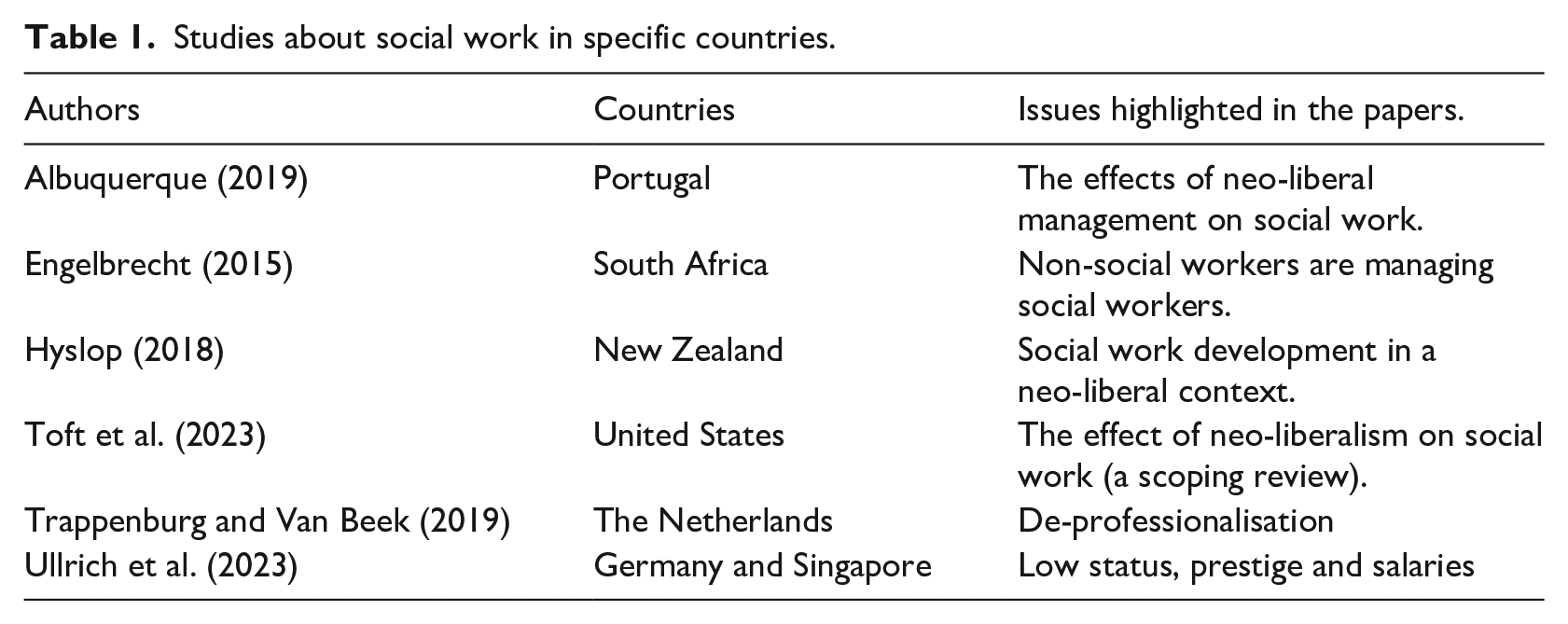
Despite numerous studies about the development of social work, there does not seem to be a common framework that allows comparable analysis of the social work profession worldwide. The author searched for ‘world social work map’ and ‘social work index’ and could not find anything close to what the author suggests in this brief note. Ornellas et al. (2019) compared social work development across ten countries. They adopted a qualitative cross-national comparative analysis; however, they did not seem to adopt a particular data collection tool.
What is an international observatory?
Several examples of international observatories exist, and this brief note presents three of them: the International Observatory on Participatory Democracy (IOPD), the Global Observatory (GO) and the European Observatory on Femicide (EOF).
IOPD is an international network incorporating cities, organisations and research centres interested in learning about, exchanging and applying participatory democracy experience. It was founded in 2001 within the European Commission’s URB-AL programme for decentralised cooperation (International Observatory on Participatory Democracy, 2024).
The GO analyses issues and trends in international affairs. It seeks to present an innovative analysis of the global problems and challenges related to, among others, multilateralism, peacekeeping operations, building and maintaining peace, mediation, security, and climate change (The Global Observatory, 2024).
The EOF was established in January 2018 at the University of Malta within the Department of Gender Studies at the Faculty of Social Wellbeing. The EOF (2024) is the first European observatory focusing on collecting and analysing data on femicide. The observatory emphasises the need for separate research to inform strategies to safeguard women’s lives.
International, global or regional observatories gather and analyse data from across the globe or specific regions and recommend innovative and doable action plans to policymakers and authorities. Their role is to provide technical assistance to authorities to improve in that field.
Why is an International Social Work Observatory required?
An International Social Work Observatory (ISWO) would compile information from countries worldwide, construct a world social work map and keep updating it. This method should also encourage policymakers and authorities concerned to improve the conditions of the social work profession in that country.
An excellent example of a workable index/map is that adopted by ILGA-Europe. ILGA is the International Lesbian, Gay, Bisexual, Trans, and Intersex Association that promotes LGBTQ+ rights (https://ilga.org/). ILGA-Europe adopts the Rainbow Map and Index, an annual benchmarking tool that ranks 49 European countries based on their LGBTI equality laws and policies (International Lesbian, Gay, Bisexual, Trans, and Intersex Association, 2024). The author suggests a similar index that ranks the positioning of social work worldwide.
The author could think of at least five concerns or challenges that such an endeavour could raise:
Naming the entity as the ISWO may not be liked; it may sound exaggerated and inflated.
Emphasising the professionalisation of the social work profession may deflect the profession from its true mission.
Naming and shaming: low-ranked countries may feel ashamed and blamed.
Finding a measurement tool that applies to all situations of all social workers worldwide could be challenging.
Having inaccurate or inflating self-rating exercises to boost one’s own country’s ranking.
The author suggests ‘International Social Work Observatory’ (ISWO); however, other names could be explored.
Some may argue that emphasising the professionalisation of social work may be too self-focused, sidelining its true mission. The author disagrees with this line of thought and considers it a typical zero-sum bias - the reasoning that win–win situations are impossible, and that one idea necessarily works at the expense of another (Pilditch et al., 2019). Social workers can focus on their true mission and improve their conditions simultaneously.
The ‘naming and shaming’ element should target the policymakers and authorities of that country, not the social workers. Low ranking should serve as leverage to improve the status/conditions of the social work profession. Naming-and-shaming should work in favour of the social workers and their profession.
No tool is perfect; however, one of the ISWO’s first tasks would be to pilot and improve the suggested measurement tool. The tool could be piloted on a small scale to evaluate and improve it before its first global launch, after which it may still be improved.
Two independent respondents per country could submit the questionnaire. The Observatory would evaluate the discrepancy in the submissions and perform desk audits to ensure the accuracy of the submitted data. Biennial rather than annual ranking might be more feasible for the initial stages of this exercise.
How would this ISWO work?
ISWO could be either an autonomous body or an affiliated organ within an existing international organisation. The author thinks IFSW is the most suitable organisation for hosting the ISWO. IASSW, ESWRA, ISW and other interested universities could be associate members. Universities or research institutes from small and developing countries should be highly considered.
What tool could this ISWO use?
The author suggests a tool with 46 statements (Supplementary Table S1). It is based on six criteria: recognition, education, employment, practice, research and image. ISWO’s first task would be to revise and improve this tool to better represent worldwide social work scenarios.
Conclusion
This brief note proposes an ISWO to gather and analyse data about social work development worldwide. This note also presents a draft tool to assess each country’s social work situation. The author hopes that organisations such as IFSW, IASSW, ESWRA and some universities will join forces to consider and implement the ISWO idea.
Supplemental Material
sj-pdf-1-isw-10.1177_00208728241305447 – Supplemental material for Creating a world social work map: The need for an International Social Work Observatory (ISWO)
Supplemental material, sj-pdf-1-isw-10.1177_00208728241305447 for Creating a world social work map: The need for an International Social Work Observatory (ISWO) by Holger Suarez in International Social Work
Footnotes
Declaration of conflicting interests
The author(s) declared no potential conflicts of interest with respect to the research, authorship and/or publication of this article.
Funding
The author(s) received no financial support for the research, authorship and/or publication of this article.

Supplemental material
Supplemental material for this article is available online.
Author biography
References
Supplementary Material
Please find the following supplemental material available below.
For Open Access articles published under a Creative Commons License, all supplemental material carries the same license as the article it is associated with.
For non-Open Access articles published, all supplemental material carries a non-exclusive license, and permission requests for re-use of supplemental material or any part of supplemental material shall be sent directly to the copyright owner as specified in the copyright notice associated with the article.
