




Abstract
In Norway, legislation requires consideration of a child’s culture in all phases of child welfare work. Through a quantitative content analysis of 285 child welfare expert assessment reports, we explored experts’ utilisation of a cultural perspective, comparing reports concerning immigrant and non-immigrant background children. We found that experts were rarely instructed to employ a cultural perspective but do so more frequently in reports concerning immigrant than non-immigrant background children. We found little evidence of critical reflection and interpreters were used rarely. The article discusses the possible explanations for and implications of a limited cultural perspective in child welfare expert assessments.
Introduction
People with an immigrant background make up approximately 20 percent of the population in Norway, comprising individuals from 223 countries (Statistics Norway, 2023). Although there is variation according to national background, as a group, children with an immigrant background are overrepresented in Norwegian child welfare services (CWS) (Statistics Norway, 2024). Both children who have themselves migrated to Norway and those born to immigrant parents are subject to higher numbers of referrals than children without an immigrant background (64 per 1000 and 52 per 1000 compared to 33 per 1000) and in 2022, 29 percent of children receiving CWS interventions had an immigrant background (Statistics Norway, 2024). While there is evidence that these discrepancies narrow when the socio-economic conditions are controlled for (Kojan et al., 2021), they persist. Disproportionate representation of minority children in CWS is not unique to Norway. Similar ‘child welfare inequality’ (Bywaters, 2015) is found in the United States (Maguire-Jack et al., 2020) and in the United Kingdom (Bywaters et al., 2017). Understanding how CWS responds to cultural diversity can provide a valuable addition to socio-economic understandings of these differences (Bywaters et al., 2017; Sawrikar and Katz, 2014).
In Norway, legislation allows CWS to commission independent child welfare experts (hereafter ‘experts’) to conduct additional assessments of children and families to inform decision making (Child Welfare Act, 2021: para. 2–2). Experts, usually psychologists (Bufdir, 2021), tend to be commissioned in particularly complex cases or where an application for a care order is considered (Greve et al., 2023). Experts are issued with a mandate from the commissioning body which details the issues their assessment should consider. Particular requests can also be made about how the work should be conducted, e.g. that the assessment should include an observation of contact (Melinder et al., 2021). Expert assessment reports are reviewed by the Commission for Child Welfare Experts before they are employed in child welfare decisions. The Commission does not approve reports but instead assigns them a category (no significant remarks, remarks or serious deficiencies) which decision makers can use to inform the way in which they use the report. In 2023, 61.5 percent of all reviewed reports received no significant remarks (Civil Law Administration, 2024). Note that experts themselves express concerns about the Commission as a quality assurance body (Nordanger et al., 2024). In practice, expert reports are highly influential in child welfare decisions (Agenda Kaupang, 2015; Augusti et al., 2017; Greve et al., 2023). Considering their influence, this article considers the extent to which experts consider culture in their assessments.
In the Norwegian child welfare field, the term ‘cultural perspective’ is commonly used to describe approaches that acknowledge and respond to cultural diversity (Norwegian Board of Health Supervision, 2019). A cultural perspective is relevant in assessments of children and their families because parenting norms vary between cultures (Harkness and Super, 2020; Lansford, 2022; Lin et al., 2023; Mesman et al., 2015, 2016; Ren et al., 2023). Studies have shown how failure to consider families’ cultural context can compromise the quality of assessments. Keipert and Bastian (2024) have highlighted how caregiver engagement can be hindered, and others have warned that key information can be overlooked or misinterpreted (Aarset and Bredal, 2018; Laird and Tedham, 2019; Van der Weele and Fiecko, 2020a). Thus, assessment which does not address culture may be incomplete or incorrect and provide an unsound foundation for subsequent decisions about how to support children and families. The Child Welfare Act (2021), with which experts must comply, requires that consideration is given to a child’s ethnic, cultural, language and religious identity in all phases of child welfare work. This reflects the UNCRC specification that a child’s identity is a critical factor in respect of Article 3, which concerns child’s best interests decisions (UN Committee on the Rights of the Child, 2013). Experts are also subject to specific guidelines (Bufdir, 2022) which require that they explore families’ culture as part of their assessments. However, neither the legislation nor guidelines offer direction regarding what might constitute a consideration of culture or how such a consideration should be documented.
What employing a cultural perspective entails, in practice, is much discussed (see Danso, 2018; Dean, 2001; Rugkåsa and Ylvisaker, 2021). However, for Norwegian practitioners, some direction is offered by leading authors in the field who contend that a cultural perspective requires additional time and demands high levels of critical self-reflection. Families may have a different first language and/or communication style than the expert assessing them (Aarset and Bredal, 2018; Berg et al., 2017; Fylkesnes et al., 2018). Families from some cultural backgrounds also describe mistrust of CWS (Fylkesnes et al., 2015). Accordingly, additional time for rapport building, use of qualified interpreters and additional observation may be necessary to respond to these challenges. A cultural perspective in child welfare assessment also requires critical self-reflection regarding how one’s own culture, norms and values and theoretical/disciplinary positioning can shape assessment. Such reflections can help to ensure that areas of uncertainty, incomplete knowledge and alternative explanations for observed child or parent behaviour are addressed (Aarset and Bredal, 2018; Van der Weele and Karlsen, 2021).
Research indicates that such a cultural perspective is limited in child welfare assessment and decision-making in Norway. In a review of care proceedings cases concerning ethnic minority children, Aarset and Bredal (2018) concluded that there was a striking absence of reference to culture and a lack of cultural sensitivity. This is in accord with a later review of CWS cases which concluded that it was common that culture was not an important theme in the cases (Norwegian Board of Health Supervision, 2019). A 2019 study of CWS assessments of immigrant and non-immigrant children revealed that while according to some measures (number of meetings with fathers) more time was afforded to assessments of immigrant children, according to other measures (number of observations and number of conversations with children) assessments did not differ (Christiansen et al., 2019). The same study found that interpreters were used in 31.9 percent of assessments of children with an African/Asian background but only in 13.8 percent of assessments of children with a European background (Christiansen et al., 2019). A 2008 survey of CWS employees revealed an underuse of interpreters with 16 percent of municipal CWS staff reporting not using interpreters when needed and 48 percent of CWS institution staff reporting the same (IMDI, 2008). One Norwegian study explored the consideration of culture in child welfare tribunal decisions identifying such a consideration in 29 percent of all decisions and 57 percent of decisions concerning children with an immigrant background (Løvlie and Skivenes, 2021). In respect of expert work particularly, research has shown that the mandates that commissioners issue to experts rarely require them to consider culture in their assessments (Melinder et al., 2021). Insufficient consideration of a family’s culture has been highlighted by the European Court of Human Rights in judgements against Norway regarding violations of Article 8 (right to respect for family life) in child welfare cases (Jansen v. Norway 2018, 2822/16; Abdi Ibrahaim v. Norway 2021, 15379/16). Norwegian child welfare practice, including expert assessment practice, has also attracted criticism regarding its handling of culture and cultural diversity in professional debate (Van der Weele and Fiecko, 2020a, 2020b) and in national and international media (for example Ali, 2019; Whewell, 2016). An account of a cultural perspective in Norwegian child welfare work is incomplete without reference to culturalisation. Culturalisation describes the tendency to understand minority children and families’ situations and challenges only in terms of culture and cultural difference, to the neglect of individual, structural and institutional factors, which has been identified (Križ and Skivenes, 2010) and criticised (Rugkåsa and Ylvisaker, 2021) in research.
The current study is a part of the ‘Expert Reports’ research project (www.hvl.no/expert) which has been granted access to the Commission for Child Welfare Experts archive. Data from the project provide quantitative information about the assessment approaches of experts. While quantitative measures cannot capture the complex entirety of what employment of a cultural perspective in child welfare contexts may entail, certain key elements lend themselves to such analysis and can provide valuable knowledge to the field. Drawing on guidance for experts about assessment work in a cultural perspective (Bufdir, 2022; Van der Weele and Fiecko, 2020a) we explore the time afforded to assessments, the frequency with which experts explicitly describe consideration of culture, demonstrate critical self-reflection and doubt, and consider alternative hypotheses and the frequency of the use of interpreters as measures of utilisation of a cultural perspective, comparing reports concerning children with immigrant and non-immigrant backgrounds.
Method
Sample
The sample comprised 300 expert report files from the Commission for Child Welfare Experts archive, selected by an administrative consultant employed there. The stratified sample included equal numbers of report files concerning children with an immigrant (n = 150) and a non-immigrant background (n = 150) and of older (2010–2015, n = 150) and newer (2016–2022, n = 150) report files. The latter stratification was to support the overarching project’s research questions. From within these stratification criteria, files were randomly selected and uploaded to the Western Norway University of Applied Sciences secure research server where they were accessed digitally.
Measures
The reports were coded according to a quantitative codebook, developed for the Expert reports research project. The codebook comprises 125 variables, under five information domains: demographic details; content of report mandate; methods of assessment; foci of assessment; and recommendations/conclusion. Inter-rater reliability (IRR) across all variables was 83 percent. IRR was also calculated at the variable level. For a detailed account of the process of codebook development and IRR testing procedures see McGinn et al. (in press). Expert reports can include assessments of more than one child. In these cases, coding followed the assessment of a single child. Children in the report were assigned a number according to their order of appearance and one of these numbers was selected at random, by digital dice toss. All reports were coded by the first author with every 10th report double coded by one of the other authors to protect against coder drift, and secure reliability. The final sample size for coding was 285 expert reports. Two of the files sent from the Commission for Child Welfare Experts included no content. A further 14 files were excluded from the dataset because the reports they held fell outside the study focus. Reasons for exclusion were as follows: report concerned a child over 18 (n = 1); report regarded an assessment other than a child welfare expert assessment (n = 2); report was not completed by an expert (n = 1); report addressed a legal question regarding which paragraph the child should be placed under (n = 4); report concerned the question of frequency of contact (n = 6). One file contained two expert reports both of which were included for analysis, giving a final sample of N = 285.
We identified and analysed codebook variables that responded particularly to the aims of this study. From the demographic details domain, we included ‘child’s immigrant background’ and ‘use of interpreter’. From the content of the report mandate domain we included ‘assessment of the child’s care situation in a cultural perspective’. From the methods of assessment domain, we included ‘consideration of cultural or religious context’ and variables that provided a measure of the time allocated to the assessment: ‘number of conversations with the child’, ‘number of conversations with the caregiver(s)’ and ‘number of observations’. We also included variables from the recommendations/conclusion domain: ‘expression of doubt, reservation or uncertainty’, ‘presentation of alternative hypotheses’ and ‘consideration of how the expert themself may have influenced the assessment’. All included variables had a level of IRR of between 74 and 100 percent.
Children were coded as having an immigrant background if they or one of their parents were not Norwegian born, which mirrors Bufdir’s (n.d.) definition. Use of interpreter was coded as ‘not required/required but not used/required and used/use unclear’ where these were mutually exclusive. Coding of the report mandate variable ‘assess the care situation in a cultural perspective’ was binary ‘yes/no’ and coding ‘yes’ reflected its inclusion in the mandate issued to the expert. The ‘number of conversations with the child’ was coded as the total number of reported conversations between the expert and the assessed child including telephone and face to face conversations. ‘Number of conversations with the caregiver(s)’ encompassed six variables which each captured the number of reported conversations, telephone and face to face, between the expert and six caregiver constellations: mother and father together; mother alone; mother with partner (not father); father alone; father with partner (not mother); and any other daily caregiver, respectively. These six variables were added to give a sum score for the total number of conversations between expert and caregiver(s). Similarly, ‘number of observations’ encompasses three variables which capture the number of observations of child and caregiver(s): at home, in another home-setting and out of the home. These three variables were added to give a sum score for the total number of observations of child and caregiver(s). Where the number of conversations or observations conducted was unclear in the report this was coded as such. These data were excluded from statistical analyses. ‘Consideration of cultural or religious context’ was a binary ‘yes/no’ reverse coded variable, i.e. coders coded ‘yes’ if cultural or religious context were ‘Not referred to beyond case details about the family’s ethnicity, culture or religion’. The included Recommendations/Conclusion variables were also binary ‘yes/no’ and coding reflected whether these themes could be identified in the report’s conclusion.
Statistics
Data were exported to and analysed with IBM SPSS Statistics for Windows (version 28.0). Descriptive statistics were calculated for all variables for the whole sample and immigrant and non-immigrant background subsamples. Chi-square tests were conducted to compare the frequency with which a request to employ a cultural perspective was included in the experts’ mandate, the use of interpreters and the frequency with which culture and religious context, doubt, alternative hypotheses, and expert influence were considered between immigrant and non-immigrant background samples. For binary variables, we adjusted the chi-square test statistic according to Yates’ continuity correction. Independent t-tests were conducted to compare mean numbers of conversations with children, mean numbers of conversations with caregiver(s) and mean numbers of observations, between immigrant and non-immigrant background samples.
Ethics and data security
Expert reports contain sensitive information about the children and families they concern and other contributors. Approval for access to the report archive without children’s or parents’ consent was granted by Norwegian Council for Confidentiality and Research, and Bufdir. A Data Protection Impact Assessment (DPIA) was approved by the privacy ombudsman of Western Norway University of Applied Sciences in March 2021. The Norwegian Centre for Research Data (SIKT) has been notified of the project (project number 228593).
Results
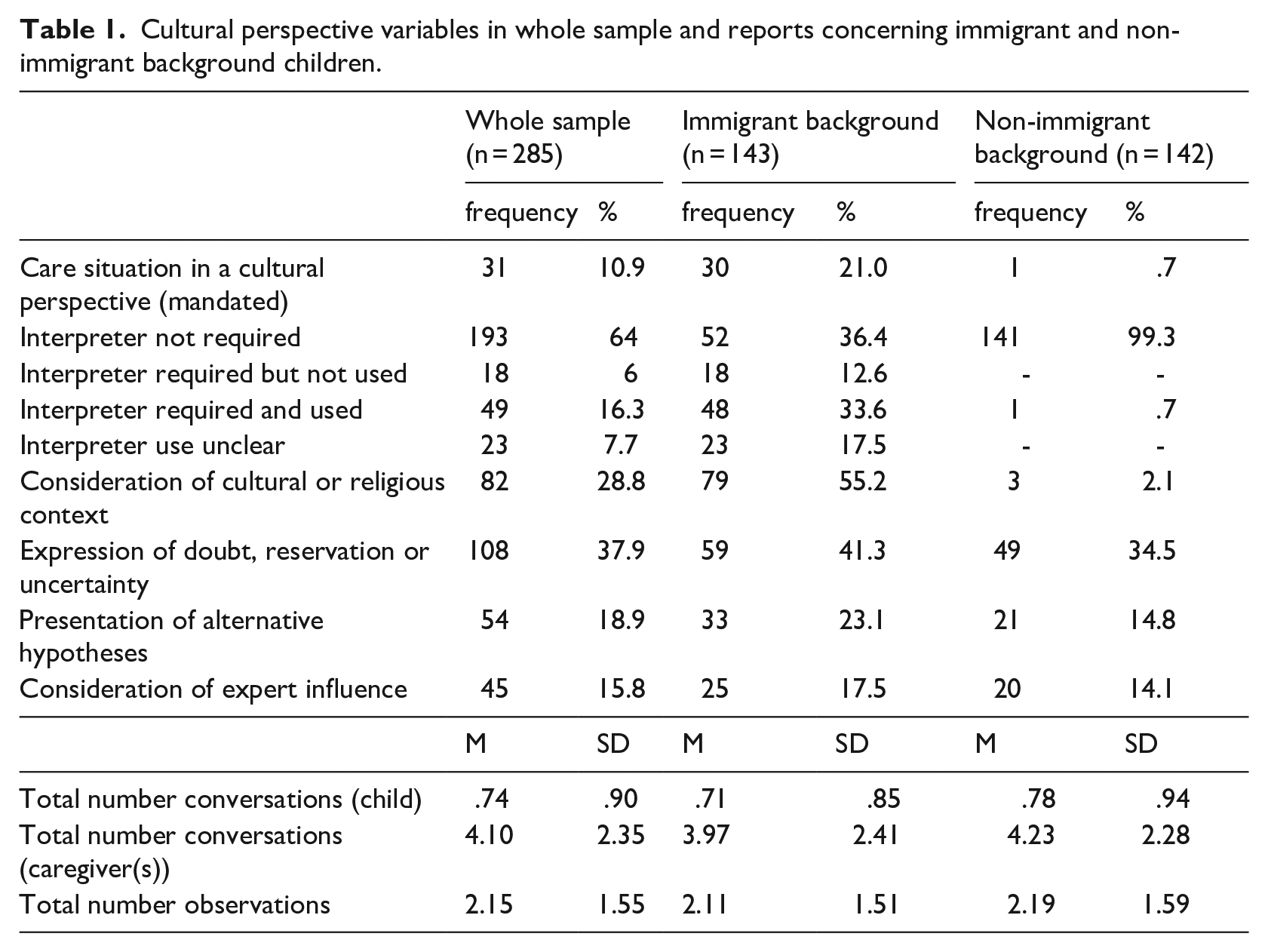
Table 1 offers an overview of the descriptive statistics of all cultural perspective variables in the entire sample and in reports concerning immigrant and non-immigrant background children. Chi-square tests showed that a request to employ a cultural perspective in the assessment was found significantly more frequently in mandates of reports concerning children with an immigrant background than reports concerning children with a non-immigrant background (χ2 (1, N = 285) = 28.18 (with Yates’ continuity correction), p < .001). We also found use of interpreters to be significantly more frequent in reports concerning children with an immigrant background (χ2 (3, N = 285) = 129.12, p < .001). Finally, we found that experts considered cultural or religious context significantly more frequently in reports concerning children with an immigrant background (χ2 (1, N = 285) = 95.57 (with Yates’ continuity correction), p < .001). There were no significant differences in the prevalence of expression of doubt, reservation or uncertainty; presentation of alternative hypotheses or consideration of how the expert themself may have influenced the assessment between reports concerning children with immigrant and non-immigrant backgrounds. A series of independent t-tests showed no significant differences in the mean number of conversations with children, mean number of conversations with caregiver(s) or the mean number of observations between reports concerning children with immigrant and non-immigrant backgrounds.
Cultural perspective variables in whole sample and reports concerning immigrant and non-immigrant background children.
Discussion
The objective of this study was to explore the extent to which a cultural perspective is employed in expert assessment in Norway. We analysed the prevalence of key features of a cultural perspective, comparing reports concerning children with an immigrant background and children with a non-immigrant background. Our results showed that experts’ mandates rarely included a request to employ a cultural perspective, though this was more common in reports concerning immigrant background children than non-immigrant background children. In our sample interpreters were used in about a third of reports concerning immigrant background children and on just one occasion in reports concerning non-immigrant background children. Overall, experts considered families’ cultural or religious context in about one-third of assessments. Comparing subsamples showed that experts considered culture in about half of reports concerning immigrant background children and in just three reports concerning non-immigrant background children. Considering experts critical self-reflection, we found that experts identified doubts and areas of uncertainty in under 40 percent of all reports. More rarely did they present alternative hypotheses or reflect upon their own influence on the assessment. When we compared reports concerning immigrant and non-immigrant background children we found similar patterns in expression of self-reflection. We also found that experts conducted similar numbers of observations and conversations with children and caregivers.
We found that, overall, in just 10 percent of reports was a request to employ a cultural perspective included in the expert’s mandate. This is a far greater proportion than the 1.5 percent reported by Melinder et al. (2021) in their study of expert assessment mandates. However, considering our finding of significant differences between the prevalence of this mandate request in reports concerning immigrant background children (21%) and non-immigrant background children (7%) the discrepancy is likely attributable to the stratified nature of our sample. The rarity with which commissioners request that experts employ a cultural perspective may in part be explained by a general lack of understanding regarding cultural differences in caregiving, and the challenges these might pose for some families, as Melinder et al. (2021) conclude. An alternative explanation may lie in misplaced confidence among commissioners that given the legal requirements to consider a child’s culture (Bufdir, 2022; Child Welfare Act, 2021; UN General Assembly, 1989) it is unnecessary to specify this in the mandates they issue to experts. It is noteworthy that a UK study found that child welfare social workers highly value tools that prompt them to explore families’ heritage and background (Laird and Williams, 2023).
We found interpreters were used in 34 percent of reports concerning children with an immigrant background. This is in accordance with the rates of interpreter use that Christiansen et al. (2019) found in assessments of children with an African/Asian background but much higher than the rates of interpreter use they found among assessments of children with a European background (Christiansen et al., 2019). It may be that our aggregation of children of all immigrant backgrounds conceals differences in the use of interpreters according to families’ region/country of origin in expert assessment.
In our study, in 12.6 percent of reports concerning immigrant background children, experts described needing interpreters but not using them. Our results support the findings of the survey by IMDI (2008) which also identified reasons for the underuse of interpreters: overestimation of families’ Norwegian proficiency, families’ own preference to not use interpreters and difficulties with securing interpretation services. Van der Weele and Karlsen (2021) warn particularly about the risk of overestimating people’s language proficiency, particularly children, whose understanding may be less than their expressed language might suggest. Ethnic minority parents describe high-quality interpretation as decisive to good communication with CWS practitioners and communication without interpreters as pointless (Stang et al., 2023). Failure to use interpreters where required can mean that people are excluded from meaningfully participating in decisions, which can lead to feelings of discrimination (Buzungu, 2021; Stang et al., 2023). It can make it difficult to establish working relationships and compromise information exchange, threatening the quality of assessment (Bernard and Harris, 2019; Buzungu and Rugkåsa, 2023; Van der Weele and Karlsen, 2021). The law is clear and states that interpreters must be used in communication with all individuals with whom communication may be compromised without the use of interpreters (Interpreter Act, 2022). Interpreters were rarely used with non-immigrant background families. Interpreters also have a role to support communication between CWS and national minorities in Norway who do not speak Norwegian as a first language, as well as members of the Deaf community (Stang et al., 2023). The rights of non-immigrant children and families are also threatened if interpreters are not used when required.
We found consideration of a family’s cultural or religious context in 29 percent of all reports and 55 percent of reports concerning children with an immigrant background. Our findings align with those of Løvlie and Skivenes (2021), suggesting that experts demonstrate a similar level of consideration of culture or religion to other practitioners in the child welfare field. That said, a consideration of culture or religion in just over half of reports concerning immigrant children is surprising considering the legislative and practice requirements for experts in this matter (Bufdir, 2022; Child Welfare Act, 2021). From an ecological understanding of child development (see Bronfenbrenner and Evans, 2000), which is central to Norwegian CWS work (Halvorsen and Halvorsen, 2023), this finding raises concerns. Research is clear that parenting norms, both in terms of child rearing goals and practices, vary between cultures (Harkness and Super, 2020; Lansford, 2022; Lin et al., 2023; Mesman et al., 2015, 2016; Ren et al., 2023). Failure to consider the cultural context of a child’s development, behaviour, or relationship with their caregiver can result in gaps and misunderstandings in assessment of a family’s functioning, which in turn may threaten the legitimacy of any subsequent child welfare decisions. The level of influence of expert assessment reports is highly relevant here.
Practitioners’ failure to consider culture has been attributed to a lack of experience working with cultural diversity (Laird and Tedham, 2019; Sawrikar and Katz, 2014). This may be particularly pertinent in the Norwegian context given the small number of immigrants in the Norwegian population until recently (Statistics Norway, 2023). Others contend that failure to consider culture arises from a discourse of colour-blind universalism which disregards culture completely, and instead stresses neutrality, fairness, and equality (Eliassi, 2015; Sawrikar and Katz, 2014). It may also be that the dominance afforded to individual developmental psychology in Norwegian child welfare work, including expert work (Aarset and Bredal, 2018; Lorentzen, 2018), serves to eclipse considerations of culture and religion.
The three critical reflection variables varied in prevalence. Experts expressed doubt and uncertainty in 37.9 percent of reports while alternative hypotheses were expressed in 18.9 percent of reports. Experts considered their own influence on the assessment in 15.8 percent of reports. There was no significant difference in the prevalence of these variables between reports concerning immigrant background and non-immigrant background children. Taken together these findings can be understood to indicate low levels of critical reflection among experts, the implications of which are relevant for both immigrant and non-immigrant children. Critical (self) reflection is a cornerstone of good assessment practice as it provides some protection against the raft of biases which shape human decision making and threaten assessment quality (Backe-Hansen et al., 2023; Van der Weele and Karlsen, 2021). Where evidence is incomplete or complex, judgement is particularly vulnerable to such biases, especially those anchored in cultural norms (Munro, 2019). In light of this knowledge, one might anticipate elevated levels of critical reflection in expert work, and particularly that concerning immigrant background children. A recent government review of the expert role noted it to be a lonely one, with experts commonly self-employed, working independently and without ready access to a network of professional colleagues (Bufdir, 2021). In the absence of peer discussion and supervision experts may lack opportunities to engage in critical reflection.
Our results showed no significant difference in the amount of time experts afford to assessments of immigrant and non-immigrant background children. This is discordant with practice guidance that extra time should be afforded to the assessment of immigrant background children and families (Bufdir, 2022; Van der Weele and Fiecko, 2020a). The rationale for this is multifaceted. Experts and assessed families may not share a first language and/or communication style (Aarset and Bredal, 2018; Berg et al., 2017; Fylkesnes et al., 2018). Families may also lack trust in children’s services (Fylkesnes et al., 2015; Tembo, 2022). Accordingly time may be required for the use of interpreters, information sharing and rapport building. Limited use of interpreters in our study may provide some explanation for our findings here. Christiansen et al. (2019), who found a mixed picture when they compared different measures of time spent on CWS assessments of immigrant and non-immigrant children, noted that underlying differences between the two groups, beyond their immigration background, may be relevant for the way in which assessments are conducted. This is a valid observation where both the nature of the concern regarding the child and family composition may shape decisions about assessment approaches and should be considered in any interpretation of our findings. Furthermore, experts may afford additional time to their preparation for assessment of immigrant families which goes unrecorded in their reports.
Understood in their entirety, our findings can be understood as evidence for a limited cultural perspective in expert assessment, which is significant for both immigrant and non-immigrant children. Without a cultural perspective, intervention decisions, including care order decisions, are grounded in assessment conclusions reached on the basis of incomplete information and potentially invalid understandings of children’s needs (Aarset and Bredal, 2018; Brophy et al., 2003; Laird and Williams, 2023; Van der Weele and Fiecko, 2020a, 2020b). This can be understood as child welfare inequality, the consequences of which can be fatal (Bernard and Harris, 2019). These risks apply equally to non-immigrant families. The rarity with which experts in our sample considered culture or religion in their assessments of non-immigrant children indicates an invisibility of Norwegian culture in expert assessment. The diverse cultural belongings of non-immigrant children, which include class, religion, and indigenous heritage, also influence parenting practice and children’s development (Fævelen et al., 2023; Fauske et al., 2018; Nergård, 2011) and lack of attention to culture can result in the incomplete or invalid assessment of these children too. The limited extent of a cultural perspective in our sample would suggest that culturalisation is not widespread in expert assessment practice.
Strengths and limitations
To our knowledge, this is the first empirical study to explore a cultural perspective in Norwegian expert assessment. Given the influence of experts in child welfare decision-making, knowledge about how experts consider children’s culture is crucial to understanding how child welfare services meet their legal obligations to children in this respect. Although the experiences of immigrant and non-immigrant background children are compared, the inclusion of children of all backgrounds in this study ensures the cultural belongings of all children are included in professional discussion.
Another strength is our quantitative approach. From our knowledge of the field much of the existing research that considers culture in Norwegian child welfare work is qualitative. Drawing on actual case data, our study provides a valuable adjunct. Our quantification of key elements of assessment practice from a cultural perspective offers a baseline against which future research can evaluate any developments and changes in expert assessment according to these measures over time and supports replication studies in other areas of child welfare work.
However, a limitation of the study is the loss of context that results from quantifying elements of a complex concept such as cultural perspective. The measures included can in no way be understood to capture the entirety of what it is to employ a cultural perspective. The binary coding of variables means that reports that include lengthy discussions about the relevance of a family’s cultural heritage are treated equally to those that include a brief paragraph on the topic. Similarly, a dichotomous division of families into immigrant and non-immigrant background does not allow for more nuanced understandings of differences in consideration of culture according to country of origin. Other limitations follow from the study’s reliance on expert assessment reports to measure the extent to which they consider culture. These reports are written in response to a mandate that rarely requests that the expert employ a cultural perspective. Consequently, experts’ consideration of culture may go undocumented. Moreover, experts’ accounts of their work are subjective and might not reflect the experience of the children and families.
Conclusion
Expert assessments hold significant power in child welfare decision-making in Norway. How experts respond to legal requirements to consider children’s culture in their assessments is critical to securing the rights of children and caregivers and ensuring appropriate interventions. This is essential for all children but is particularly relevant for those belonging to minority cultures, including children from immigrant backgrounds. Such knowledge can inform responses to the criticism lobbied at the way Norwegian child welfare responds to minority families.
We find limited evidence of a cultural perspective in expert assessments, both in terms of assessment approaches and conclusions, and this is almost absent in assessments of non-immigrant children. This study contributes to the knowledge base regarding the role of culture in child welfare decision-making and can serve as a starting point for discussions on how experts can be supported to improve this aspect of their practice. Teamwork and regular supervision to support critical reflection and a coherent procedure for the use of interpreters, as stipulated by the recent Interpreter Act, represent key areas for further development. Consideration might be given to a role for the Commission for Child Welfare Experts to monitor experts’ compliance with their legal requirement to consider children’s culture.
Footnotes
Funding
The author(s) disclosed receipt of the following financial support for the research, authorship and/or publication of this article: This work has been supported by grants from the Research Council of Norway (Grant 300827).
Ethical considerations
Norwegian Council for Confidentiality and Research, in conjunction with the Norwegian Directorate for Children, Youth and Family Affairs approved access to the Commission for Child Welfare Experts report archive for the analysis and publication of the retrospectively obtained and anonymised data for this non-interventional study. A Data Protection Impact Assessment (DPIA) was conducted in collaboration with, and the project was approved by, the Privacy Ombudsman of the Western Norway University of Applied Sciences. The Norwegian Centre for Research Data (SIKT) has been notified of the project.
Consent to participate
The Norwegian Council for Confidentiality and Research, and Bufdir waived consent for the analysis and publication of the retrospectively obtained and anonymised data for this non-interventional study.

Data availability
Due to the nature of the research and the sensitive data in the project, supporting data are not available.