




Abstract
Decolonisation is redressing colonial legacies and reaffirming self-determination. Understandings of decolonisation in social work field education literature were examined using a social justice lens. This scoping review combined systematic database searching with decolonising methods including relational searches. Data synthesis included thematic and deductive analysis to critical frameworks. The 43 studies included were primarily English-speaking and post-2010. Themes emphasised integrating Indigenous knowledge, challenging White dominance, reconstructing spaces, promoting critical reflection, and understanding socio-political contexts. Analysis highlighted the need for ameliorative and transformative change. Cultural and epistemic injustices embedded in social work field education marginalise non-White social work students. If unaddressed, harmful practices will be perpetuated.
Introduction
The impact of colonisation runs deep within and across contemporary systems, services and policies. Its legacy has shaped and disrupted entire cultures, ideologies and traditional structures. Through elimination and minimisation colonisation creates alien interpretations of complex worldviews and lifeways, negating diversity in its many forms, and erasing Indigenous cultural history and organic processes of social change. These epistemological patterns are embedded within modern professions and education systems, playing out through varied power imbalances, and result in the reinforcement of White dominance and its assumptions. The social work profession has been ‘part and parcel’ of colonial processes (Ioakimidis and Wyllie, 2023). The profession has a history of implementing and enacting policies on ‘others’ that have resulted in exploitation, violence, trauma and genocide (Bennett, 2019).
Internationally within social work, there has been a call for decolonisation within practice, education and research. Decolonisation is a process and an act of ‘glocal’ (global and local) determination involving resistance or reversal of impacts of colonisation (Gray et al., 2013). Importantly, decolonisation is an action, a verb or a noun, not simply an aspirational metaphor for greater social inclusion (Tuck and Yang, 2012). Andreotti et al. (2015) defined decolonisation along a continuum of change or action, as soft reform, radical reform and beyond reform.
The International Federation of Social Work (IFSW) provides a global definition of social work, emphasising social work is to be informed by practice environments, Western theories and Indigenous knowledge (IFSW, 2023). The approach recognises and values local Indigenous ways of knowing, doing and being, representing the local, and aligns with calls to decolonise social work education by including other epistemologies in essentially Western dominant curricula.
Social work educators are now grappling with decolonising pedagogies and curriculums to remove assumptions and cultural dominance of Western knowledge and epistemologies, to reduce epistemic violence. This action occurs, however, within an institutional, epistemological and ontological context of schools of social work. Universities have both critiqued and engaged in ‘modernity’s violences’, primarily through ‘negation and suppression of other ways of knowing and being and producing scholarship legitimizing and capacitating racial, colonial and other forms of subjugation’ (Andreotti et al., 2015: 33). This raises the question of whether higher education can undertake a decolonial project. These violences are one space where students, academics and supervisors may experience injustices related to field education. This review is innovative in its focus on the injustices of colonial practices in social work field education, which encompass interpersonal conflict between students, academics and supervisors, structural disadvantages to minority and non-White students, other local experiences of epistemic violence, war and conflict across our globe including contemporary wars, and the climate catastrophe. Although there exists extensive discourse on the broader subject of decolonising social work education, very little attention has been given to decolonising social work practice field education, known as ‘placements’ in some jurisdictions.
This research seeks to ‘turn the gaze’ (Green and Bennett, 2018: 263) upon existing decolonising social work literature and address the gap with a focus on injustices. Field education in social work is seen as a key pedagogy (Egan et al., 2018) and a central component of social work education and thereby warrants deeper analysis. The research aim was to seek an understanding of what is known about decolonisation and social work field education, guided by the research questions: ‘What does decolonising mean for social work field education? Using a justice lens, how can social work field education adapt to ensure decolonising pedagogies are possible?’ This scoping review examines international practices towards this action.
Applied within a higher education context, Adam (2020) merged decolonial and social justice discourses in the development of the Dimensions of Injustice Framework. This framework highlights three dimensions of decolonial injustice: (1) material, (2) cultural/epistemic and (3) political/geopolitical, connecting them with ameliorative or transformative responses (Hodgkinson-Williams and Trotter, 2018). This framework was used to examine how social work educators tackle decolonial injustices faced by First Nations, and Black, Asian and Minority Ethnic (BAME) students on their field education experiences. The application of Adam’s (2020) framework acknowledges the injustices experienced by First Nations and BAME social work students and offers an opportunity to map the field education actions or strategies used in response to the injustices these groups face in the course of their field education.
Method
A scoping review was selected to examine the extent, range and nature of the existing research and evidence base on a broad topic (Arksey and O’Malley, 2005). Māori researcher and methodologist Smith (1999) argues imperialism and colonialism are regulated and maintained through research. Scholarly disciplines and scientific paradigms within the academy reinforce them and Indigenous peoples positioned as the ‘Other’ within the research (Smith, 1999). Selected methodologies and methods serve to reinforce the dominance of Western research paradigms. In alignment with Tuck and Yang (2012), who argued decolonisation is not just a metaphor, it was attempted to decolonise the scoping review method to conduct the review enacting decolonisation in and of itself. The process of decolonisation and alternative ways of doing, being and knowing, are accepting of, and embrace, a diversity of knowledge. We recognise that intellectual engagement is reliant on the relational and contextual experience (e.g. within conflict or warzone) of the phenomena being studied and constructed and the positioning of the researcher/s.
Combined with collaborative team reflexivity (Rankl et al., 2021), a decolonising approach to the systematic search and scoping review of the literature was attempted (Chambers et al., 2018; Tynan and Bishop, 2023). Collaborative team reflexivity involved formal and informal group discussions constructing a shared understanding of team practices and the quality of the research output (Rankl et al., 2021). While often multidisciplinary, the team of international academics were primarily social workers or social scientists who collaborated on the design, data collection and analysis of the scoping review. Meeting online monthly over a 2-year period, authors were in a constant state of active reflection and reflexivity on both the research processes and methods employed, arguably lending to greater rigour (Rankl et al., 2021). Our shared struggle to achieve decolonising methodologies highlights the paradigm conflicts between ‘traditional’ and ‘post-colonial/non-Western’. Reflexivity resulted in the ontological frameworks of the authors being challenged and having to work with uncertainties among academics’ epistemological and axiological positionings. We were confronted with ethical dilemmas (Chambers et al., 2018), the tyranny of distance, COVID, cultural and/or language misunderstandings which risked fragmenting the decolonisation processes, and re-colonising Indigenous knowledges. Adopting a reflective stance in our monthly meetings enabled authors to talk through these challenges.
Search strategy
Problematising and decolonising the literature review process, Australian (ab)Original authors Tynan and Bishop (2023) offer a relational approach, relying on accepting authors’ ontological position, relationships and operating in each of our relational realities. In line with a relational approach, the team began the search by establishing individuals’ relationships with people, places and knowledge within the research group. All members of the research team were asked to share personal and regional literature that either they had published or was by authors known to them. In total, with duplicates removed, 88 articles were added, and the second number reported was the total included in the final review sample (Authors 1, 7 & 10 [n = 10/4], Author 2 [n = 11/2], Authors 3 & 4 [n = 14/3], Author 5 [n = 10/2], Author 8 [n = 34/0], Author 11 [n = 9/2]). This included research published in full or the partial use of languages reflective of the research or researchers’ linguistic backgrounds (Hebrew n = 8). As the only shared language by all researchers was English, the title and abstracts of the articles ‘in language’ 1 were translated into English using Google Translate. If the article was in the final sample, funds were allocated for the formal translation of the full article. The abstract Google translations were uploaded into COVIDENCE for review. In addition to the relational search, the research team co-developed a PICo search and Western search string (Table 1), which was reviewed by the University research librarian (primarily for syntax support). In regard to the glocal context of the researchers, consideration was given to including conflict within the search terms. The authors decided not to use ‘conflict’ as a specific search term, due to variance between understandings and experiences of the concept. The articles were read for interpretations and conceptualisations of injustices, conflict and conflict zones within.
Search terms based on PICo.
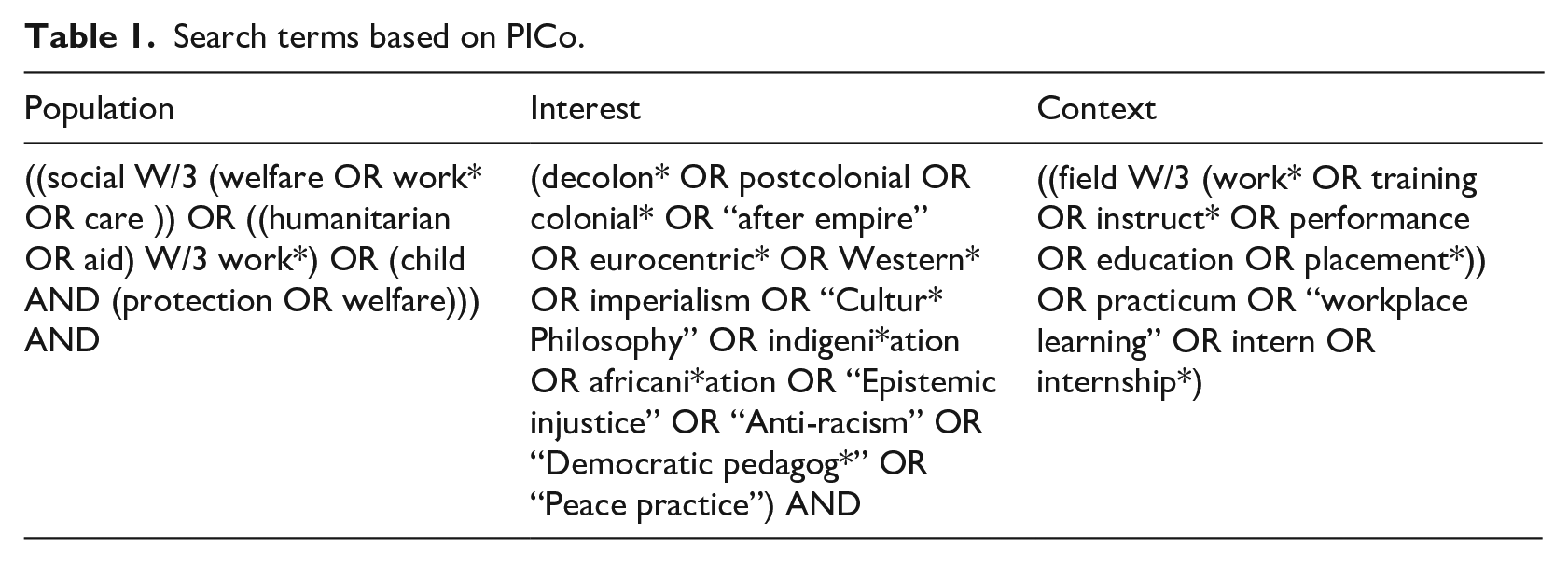
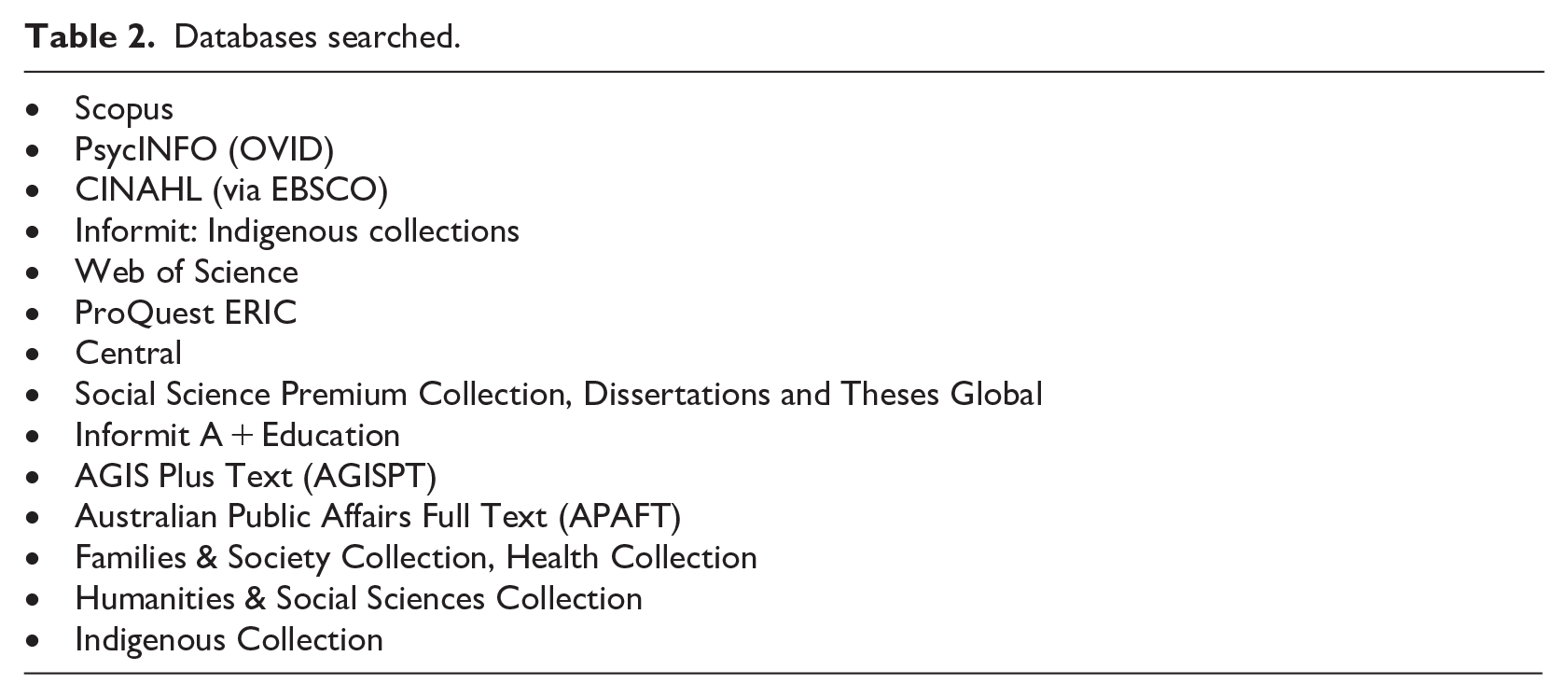
The Westernised English search string (including inter-database variations) was used to search the databases on 30 November 2022 (Table 2). The databases were selected based on a combination of evidence (Bramer et al., 2017) and research librarian advice regarding local Australian collections. These databases were selected the search was conducted from an Australian university.
Databases searched.
Screening
Library searches were downloaded into Endnote software, and ‘local relational’ articles were hand-entered into Endnote software by the project lead. The Endnote files were uploaded into COVIDENCE online software, where auto-generated duplicates were removed (Figure 1). There were two stages of screening: title and abstract screening, and then full-text screening. Title and abstract screening were undertaken by Authors 1, 2 and 6, and then title and abstract conflicts were resolved by Authors 1, 2, 6 and 7. Authors 1–8 and 10–11 were involved in the full-text screening followed by conflict resolution. The use of COVIDENCE ensured that two independent reviewers screened and that conflicts were resolved by a third independent reviewer.
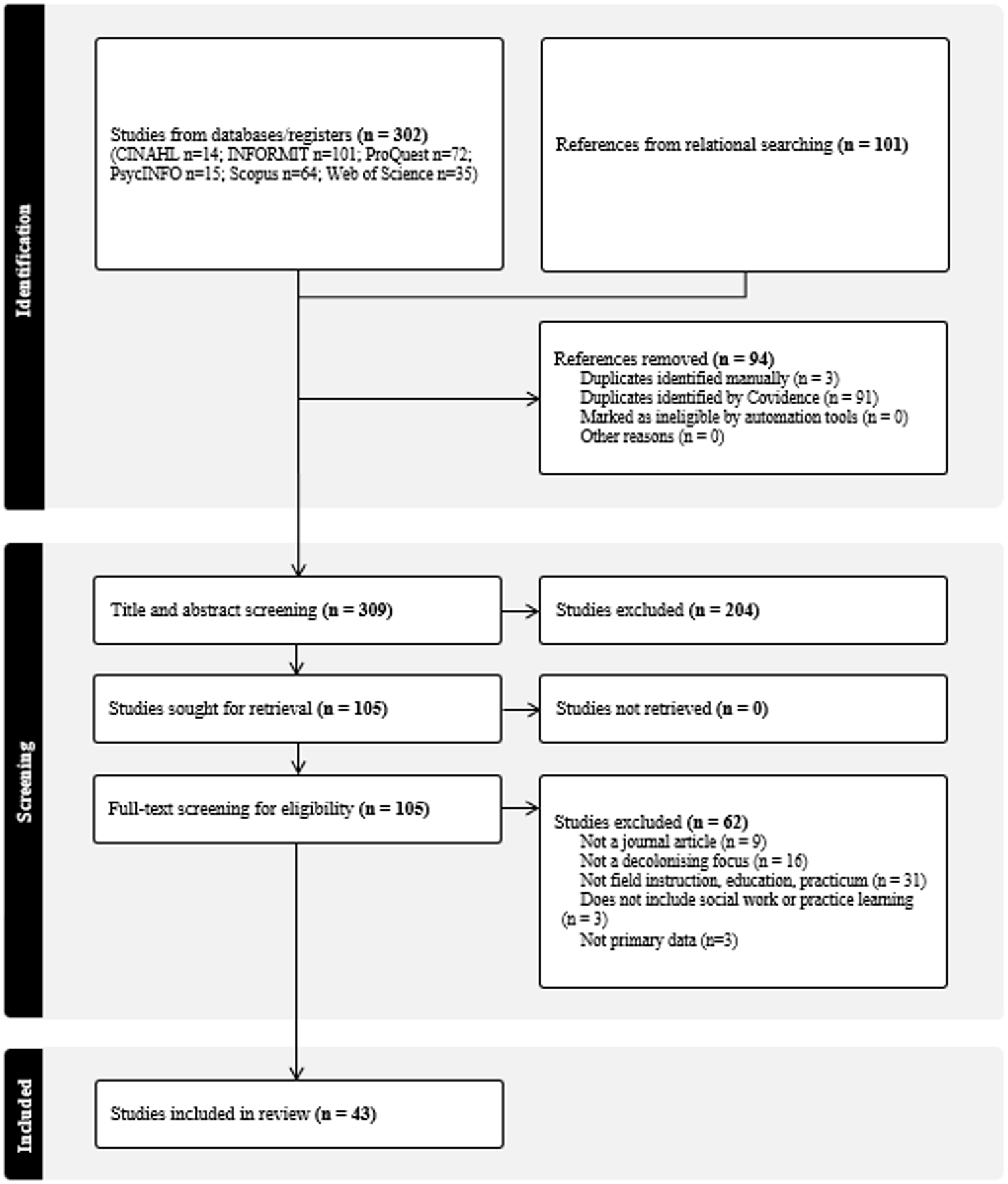
PRISMA (Preferred Reporting Items for Systematic Reviews and Meta-Analyses).
Eligibility criteria
To be screened into the review, papers needed to include both social work and concepts of decolonising. Not all papers included made specific reference to field education nor specifically used the term decolonisation.
Quality appraisal, data extraction and analysis
It is noted scoping reviews do not routinely include quality appraisals (Arksey and O’Malley, 2005). Following team reflection, quality appraisals were deemed to privilege certain knowledge (for e.g. scientific paradigms) and consequently were not undertaken. Authors (1–2 and 4–11) were randomly allocated 4–5 articles for reading, re-reading and data extraction into two evidence mapping tables on a Google Share drive. The first table included extracted data for the sample characteristics table; Authors 1 and 9 reviewed for accuracy.
Data for Table 2 were extracted into the upper-level themes: ‘understandings of decolonisation’, ‘injustice/s’ and the ‘learnings for social work field education’. Initial coding was undertaken whereby a process of qualitative content analysis techniques (Hsieh and Shannon, 2005) and thematic synthesis methods (Thomas and Harden, 2008) were utilised, alongside Braun and Clarke’s (2006, 2021) approach to thematic analysis. This was primarily conducted by Authors 1, 2 and 11 and checked by smaller groups of all authors for recurring salient themes. The upper-level themes of ‘learnings for social work field education’ and ‘injustices’ were deductively analysed by Authors 1 and 2 according to Adam’s Dimensions of Injustice Framework (Adam, 2020) and Fricker’s (2007) concept of epistemic injustice where sub-themes were identified.
Collaborative team reflection and reflexivity in our monthly meetings enabled further analysis of the themes and focused more broadly on issues relating commonalities, differences and practice implications. Coding remained open and organic throughout the approach, as the final themes were continuously developed as a team while maintaining consensus through a focus on our research aims (Braun and Clarke, 2021). Below we present a description of the sample, followed by sharing the themes derived from the analysis.
Author positionality
We are aware of the potential for bias resulting from our positionalities and so the data extraction was shared between the authors and analysis was discussed at our monthly meetings. As a diverse authorship team, including First Nations, BAME, and White social work or social science academics, practitioners, and students, we discussed the inclusion of author positionality statements. These were discussed in relation to our religio-cultural, educational, geographical and temporal positionalities. Drawing on the work of Gani and Khan (2024) the team decided against reporting these as they can be interpreted as hegemonic confessionals revealing privilege and power dynamics in knowledge production. We have, however, as required by the journal, provided author biographies.
Results
Study characteristics
Sample
A final sample of 43 studies included 13 sourced through relational searches. Despite efforts, the majority originated from English-speaking nations (n = 27), highlighting potential language biases and inequalities in research source distribution. This was particularly evidenced in the high number of articles from Israel (n = 8), the United Kingdom (n = 8), Australia (n = 7), the United States (n = 4), Canada (n = 4) and Africa (n = 2) (see Table 3 Study Characteristics – supplementary materials). No articles ‘in language’ (see Note 1) met the selection criteria. The predominant research methods were qualitative (n = 25), 15 studies used self-reflection or reflexive analysis and four used mixed methods. The primary population samples within the studies were social work students, field educators, social work practitioners and social work academics.
Provenance and decolonial praxis
Given our commitment to decolonising praxis, the team was conscious of the power dynamics involved in reporting the provenance of studies. Informed by Tuck and Yang’s (2012) critique of settler colonialism, it is the ‘settler’ making the land their own, disrupting the Indigenous relationship with the land and represents ‘profound epistemic, ontological, cosmological violence’ (Tuck and Yang, 2012: 5). The team questioned reporting Israel as the country of origin for Palestinian social work academics and reporting the country ‘now known as Australia’ for Aboriginal and Torres Strait Islander authors. As a result, it was decided to base the origin of each article on the identified location of the study rather than the authors’ nationalities. For example, a study authored by American-based academics was located in Palestine (Sousa et al., 2019). In addition, the sample included studies from Aotearoa New Zealand, Sweden/Norway, India (Prasad et al., 2021), Hong Kong (Lee et al., 2022), China (Lei et al., 2021), the Pacific Region (Ravulo, 2019) and Mexico (Walsh et al., 2021). There were challenges in delineating study sample populations into rigid categories. The collaborative paradigm adopted by numerous research studies aimed at decolonisation necessitates the active engagement of diverse individuals and communities. This approach facilitates the collective construction of knowledge and the incorporation of varied perspectives, thereby fostering an inclusive and comprehensive understanding of decolonising social work field education.
Linguistic diversity and representation
Despite the dominance of English within our sample, several studies demonstrated a commitment to linguistic diversity and decolonising research by integrating Indigenous languages relevant to the authors or participants (e.g. Chilvers, 2022). These languages were used to express specific cultural practices, knowledge systems and geographical references. For example, Chilvers (2022) employed the Māori term ‘mātauranga’ (knowledge originating from Māori ancestors). Other languages represented in our sample included Fijian, Tongan, Samoan, Igbo, Sanskrit, Yiddish, Arabic, Secwepemc, various First Nations languages within Australia, Spanish, Filipino and Ghanaian.
Fourteen authors identified as Indigenous or BAME. The authors’ identities were not declared or identified in 29 articles. This may have resulted from fears of racism and highlights a need for safety such that greater transparency and representation within the publication processes and social work research can be achieved.
Importantly, the analysis reveals a substantial increase in publications on decolonising social work field education from 2020 onwards (Figure 2). Notably, the term ‘decolonising’ was not present in articles published before Clark et al.’s (2010) seminal work.
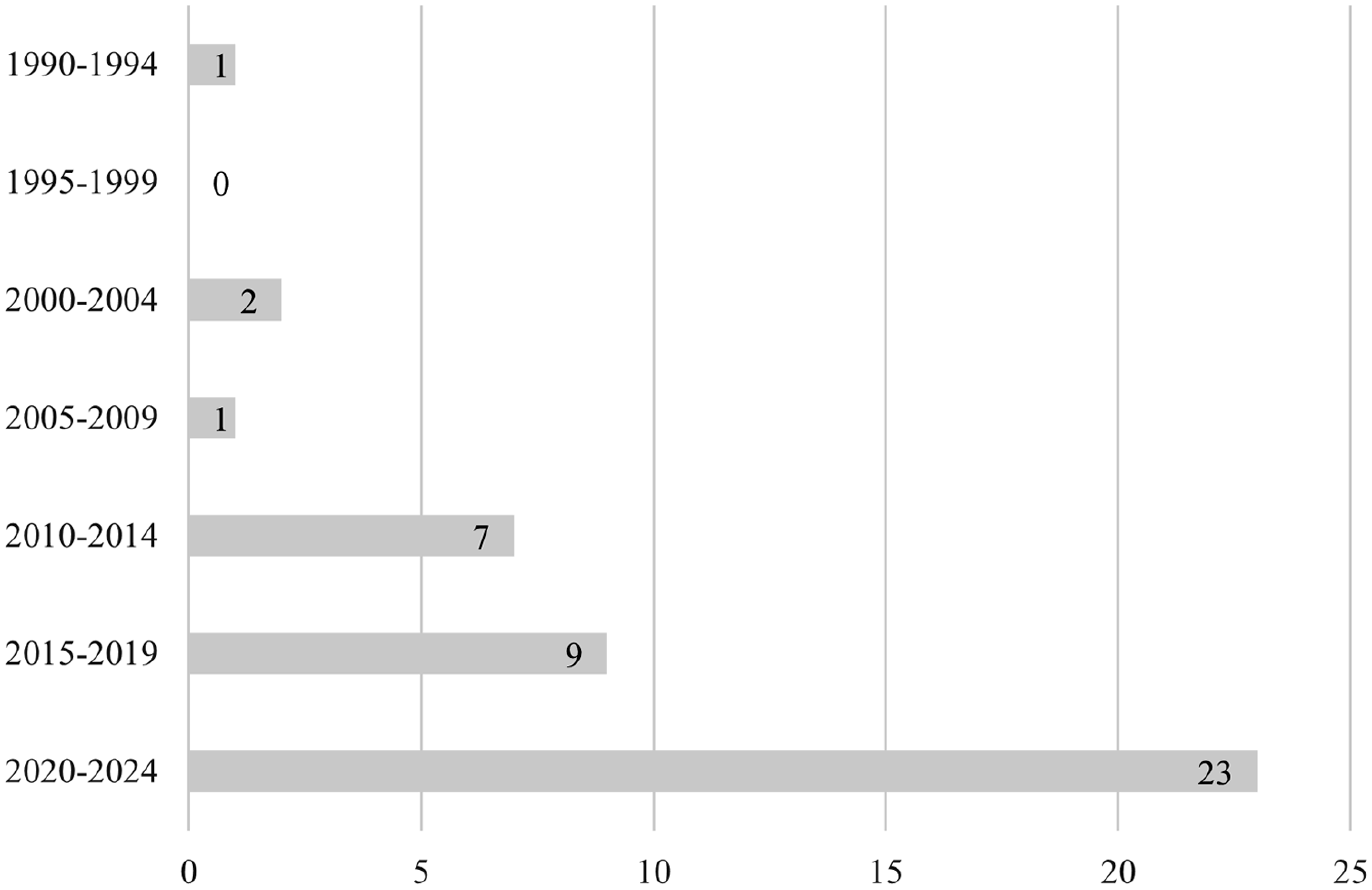
Frequency of articles by year published.
Themes
There were two upper-level themes identified within the articles. The first theme ‘understandings of decolonisation in social work FE’ included five sub-themes: recognition and incorporation of Indigenous knowledges; challenging white dominance and racism; reconstruction of spaces and curriculum; critical reflection and unlearning colonial ideologies and resistance and socio-political context. The second upper-level theme ‘understandings of justice’ incorporated understandings of conflict and was deductively coded to the following three sub-themes based on Adam’s (2020) Dimensions of Injustice Framework: cultural and epistemic injustices, political and geopolitical injustices and material injustices. This is followed by a reflection on the nature of change, whether it is ameliorative or transformative, using Adam’s (2020) Dimensions of Injustice and Fricker’s (2007) concept of epistemic injustice social work.
Understandings of decolonisation in social work field education
Decolonisation has garnered significant attention within social work, with scholars offering diverse perspectives. We share the themes identified (Figure 3).
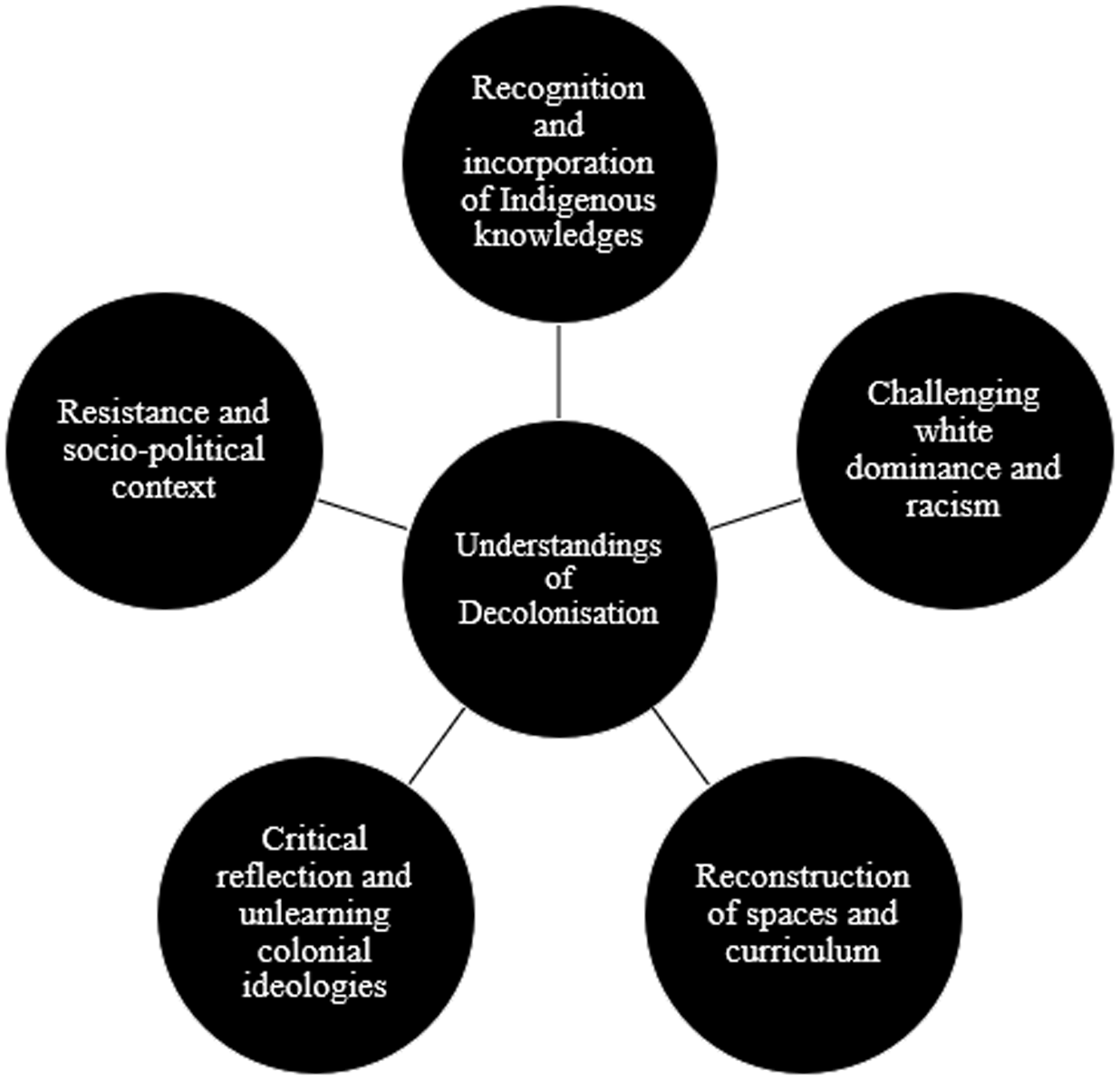
Understandings of decolonisation themes.
Recognition and incorporation of Indigenous knowledges
Decolonisation necessitates acknowledging and integrating Indigenous knowledges and epistemologies into social work education and practice. Alhuzail (2021), whose study was based in Israel, and Prasad et al., (2021) study in India advocate incorporating Indigenous ways of knowing (traditions, cultural practices, histories and philosophies, spirituality and voice) to challenge Western-centric paradigms. Similarly, Jönsson and Flem (2022) from Sweden/Norway underscore the importance of postcolonial engagement consisting of using critical and globally informed social work education to foster ethical awareness among social work students regarding global inequalities. In centring Indigenous voices, their knowledge systems and reproduction of inequalities, social work can adopt a more inclusive and culturally responsive approach.
Challenging White dominance and racism
Decolonisation serves as a means of challenging White dominance and addressing racism within social work. Afrouz’s (2022) study from Australia and Chukwu et al.’s (2022) study from Africa advocate for decolonisation to combat systemic racism within the profession. Similarly, Ravulo’s (2019) study from the Pacific Region discusses Indigenisation by advocating the inclusion of traditional practice, wisdom of Elders, sense of place, kinship and servant leadership values in the professional social work model which they argued would inherently challenge colonial power structures. By confronting racism and advocating for equity, social work can actively work towards decolonising its practices and promoting inclusivity.
Reconstruction of spaces and curriculum
Decolonisation requires reconstructing institutional spaces and curricula to centre marginalised voices and experiences. Authors Bennett and Gates’ (2021) study from Australia advocates for re-Indigenisation achieved through the inclusion of First Nations theories, practice methods, cultural traditions, intersectional diversities and the impact of racism in social work education to enable those training to work with diverse communities. This idea is supported by Mahajne et al.’s (2021) study from Israel, who highlight the need for inclusive curriculum development. In addition, Lei et al.’s (2021) study from China emphasise the importance of cultural competence training to strengthen service provision to diverse groups. By reconstructing spaces and curriculum, social work can foster an environment that values diversity and promotes social justice.
Critical reflection and unlearning colonial ideologies
Decolonisation involves engaging in critical reflection and unlearning colonial ideologies embedded within social work education and practice. Caron’s (2020) from Canada advocates challenging Western frameworks and promoting intersectional feminist perspectives through the co-creation of knowledge, meaning and dialogue and understanding of the impact of colonisation, imperialism and anti-racism. Similarly, Jönsson and Flem’s (2018) study from Sweden/Norway underscores the importance of promoting ethical alertness to counteract paternalism. Ford et al. (2022) from the United States discuss the impact of Whitewashing academia on Indigenous experiences, highlighting the importance of decolonising educational spaces. By critically examining and challenging colonial ideologies, social work can promote active and transformative change.
Resistance and sociopolitical context
Decolonisation is situated within broader sociopolitical contexts of resistance and liberation. Shaw’s (2023) study focused on Singapore emphasises the importance of historical consciousness in decolonisation efforts. Segev and Nadan (2016) from Israel/Gaza reference decolonisation within socio-cultural-political contexts, highlighting the interconnectedness of colonialism and power dynamics. In addition, Lee et al.’s (2022) study in Hong Kong describes international collaborations promoting critical awareness of global inequalities. By acknowledging the sociopolitical dimensions of decolonisation, social work can work towards dismantling oppressive structures and promoting justice for marginalised communities.
Understandings of justice
Using Adam’s (2020) Dimensions of Injustice Framework the different understandings of conflict resulting in injustices for First Nations and BAME students were categorised. The understandings of spaces of injustice identified across the articles include a spectrum from war zones to organisational and individual level or interpersonal conflicts.
Cultural and epistemic injustices
Cultural and epistemic injustices refer to knowledge conflicts, questioning what is considered as knowledge and whose knowledge counts (Adam, 2020; Fricker, 2007). The primary type of conflict identified within the articles was epistemic conflict, either the dominance of Western knowledges was experienced as oppressive and violent or Western and Indigenous knowledges were in tension (Ayim et al., 2023; Chukwu et al., 2022; Clark et al., 2010; Khan and Absolon, 2021; Maglalang and Rao, 2021; Nuttman-Shwartz and Ranz, 2014; Prasad et al., 2021; Ravulo, 2019; Razack, 2002; Shaw, 2023). These epistemic conflicts created injustices for First Nations and BAME social work students.
Ontological (Band-Winterstein and Freund, 2015; Bennett et al., 2018; Ganz, 2020; Khan and Absolon, 2021) and ethical (Blackdeer and Ocampo, 2022; Jönsson and Flem, 2022) conflicts were identified where professional and cultural/religious values were in conflict. For example, the field educator’s emotional conflict when failing students on social work placement (Afrouz, 2022; Bartoli et al., 2008; Finch and Poletti, 2014) or interpersonal conflicts between the student and their supervisor or student and teacher and/or service user (Bartoli et al., 2008; Caron, 2020; Fairtlough et al., 2014). Conflicts extended to organisational ethical conflicts between students and field educators with professional/ regulatory bodies and university procedures (Finch and Poletti, 2014; Lei et al., 2021; Tedam, 2014).
Racism was a conflict, written about between Black and White or Indigenous and non-Indigenous students (Ford et al., 2022; Gair et al., 2015; Khan and Absolon, 2021) and at the organisational or institutional level as systemic racism (Alhuzail, 2021; Bartoli et al., 2008; Cane and Tedam, 2022). Secular and religious conflicts were identified within several articles (Band-Winterstein and Freund, 2015; Ganz, 2020; Mahajne et al., 2021; Segev and Nadan, 2016). Gender conflicts were also identified at the intersection of religio-cultural injustices (Ayim et al., 2023; Bartoli et al., 2008; Chukwu et al., 2022; Maglalang and Rao, 2021).
Political and geopolitical injustices
Political and geopolitical injustices recognised the systematic imbalances in power relations and resulting conflicts from regional to international (Adam, 2020). Several of the studies were set within violent sociopolitical conflicts impacting the delivery of social work field education and the ability to prepare students fully for field education (Alhuzail, 2021; Campbell et al., 2013; Lee et al., 2022; Loewenberg, 1992; Segev and Nadan, 2016; Sousa et al., 2019). These violent socio-political conflicts included geographical territory disputes such as Palestine/Israel, Hong Kong/China and Northern Ireland. In the context of Israel and Palestine, Alhuzail (2021) spoke to the personal/professional conflicts when preparing students for social work field education within the context of the Palestine/Israel war zone. Alhuzail (2021) argued for the need for Arab and Jewish social work academics and students to adopt a social justice stance and the use of personal and traditional knowledges in teaching social work. Some articles recognised global inequities as conflicts (Bennett and Gates, 2021; Jönsson and Flem, 2018). For example, in Sweden/Norway, Jönsson and Flem (2018) articulate the impacts of the globalisation of neoliberalism on social work field education and the need for critical and global-oriented social work education to support social work students on international field education.
Material injustices
Material injustices address the conflicts resulting from injustices in the distribution of or hierarchies within resources, such as infrastructural, geographical and socio-economic (Adam, 2020; Fricker, 2007). Access to social work education for First Nations students was raised as a concern in the Pacific Region by Ravulo (2019) and the ability for First Nations and BAME mothers to undertake field education was also raised in relation to access to childcare and commitments to paid work (Bartoli et al., 2008).
Transformative or ameliorative?
Ameliorative responses were intended to make the colonial practices more bearable or more satisfactory. These changes included actions that redistributed resources; provided recognition of First Nations and BAME values; or increased representation (Adam, 2020; Hodgkinson-Williams and Trotter, 2018). To redistribute resources in the United Kingdom, Bartoli et al. (2008) proposed supporting Black African female social work students to help balance their caring and student role.
Ameliorative responses in this study included the recognition and inclusion of Indigenous knowledge in social work field education curricula and delivery. Many articles across many nations argued for epistemic justice in the inclusion and recognition of Indigenous or Black, Asian and Minority Ethnic (BAME) knowledges within social work field education (Afrouz, 2022; Alhuzail, 2021; Ayim et al., 2023; Bennett and Gates, 2021; Caron, 2020; Chukwu et al., 2022; Ford et al., 2022; Khan and Absolon, 2021; Maglalang and Rao, 2021; Mahajne et al., 2021; Nuttman-Shwartz and Ranz, 2014; Ravulo, 2019; Razack, 2002; Shaw, 2023; Sousa et al., 2019). Recognition of cultural differences through inclusive practices was recommended in another UK study. Cane and Tedam (2022) urged social work educators to offer more training on race and anti-racism to organisations supporting newly qualified social workers. These strategies require resources and support to apply cultural safety and intersectionality frameworks in recognition of the diversity and complexity of student identity (Clark et al., 2010). Strategies to improve Indigenous and BAME social work students’ field education experiences were raised and ranged from calls for reflection on beliefs, cultural competence and creative training (Chilvers, 2022; Tedam, 2014), to the use of cultural mentors (Bartoli et al., 2008; Gair et al., 2015), and reflexivity (Jönsson and Flem, 2018, 2022). This extended to the adoption of critical approaches and shifting the dominance of Western social work practice theories. In addition, field education learning materials were redesigned (e.g. fieldwork workbooks) to recognise Indigenous and BAME knowledges (Clark et al., 2010; Ford et al., 2022; Lei et al., 2021; Nuttman-Shwartz and Ranz, 2014; Prasad et al., 2021). In Australia, Bennett and Gates (2021) argued for the need for representation and ‘other’ voices including First Nations students to be heard at all levels of the education system.
Transformative responses work to address the root causes of inequality or injustice through for example restructuring; re-acculturation by including a plurality of perspectives and reframing towards the parity of rights through practices such as co-design (Adam, 2020; Hodgkinson-Williams and Trotter, 2018). In Canada, Khan and Absolon (2021) suggest the sharing of vulnerability as a means of decolonising social work field education. Recommendations were made to restructure field education matching processes (Fairtlough et al., 2014) as well as embedding critical and equity mindedness in schools of social work (Bennett and Gates, 2021).There were re-acculturation approaches in support of either the decolonisation of Western social work pedagogy in Israel by Segev and Nadan (2016) or combining Western and Indigenous social work practice approaches in countries such as Canada, UK, Africa, US, Israel, Sweden/Norway (Bennett and Gates, 2021; Blackdeer and Ocampo, 2022; Campbell et al., 2013; Cane and Tedam, 2022; Chukwu et al., 2022; Jönsson and Flem, 2018; Maglalang and Rao, 2021; Segev and Nadan, 2016). Importantly, to disrupt the dominance of Western epistemology and pedagogy, Maglalang and Rao (2021) suggest the use of alternative social work theories that resonate with Black Indigenous, People of Colour (BIPOC) communities – examples included Compa Love, Racial Triangulation theory, Breath of Life, Kapwa, and Cultural wealth. It was acknowledged that the use of alternative social work theories works to re-acculturate provided a plurality of perspectives. An Australian social work curriculum was co-constructed with Aboriginal and Torres Strait Islander peoples (Bennett et al., 2018). While in Northern Ireland, Campbell et al. (2013) co-designed and involved the victims/survivors of the political conflict to work alongside social work academics in preparing social work students to practise learning. This ensured the development of the knowledge and skills needed to work with victims/survivors of political conflict (Campbell et al., 2013). The delivery of co-designed curriculum with a trauma lens was used to upskill social workers, educators and students to deliver appropriate services, enabling the reframing of the curriculum and arguably the pedagogy.
Discussion
The scoping review yielded rich insights into the multifaceted nature of decolonising social work field education. A central theme emerged – the urgent need to dismantle the dominance of Western epistemologies within the social work curriculum. This aligns with calls for recognising and incorporating Indigenous knowledges, challenging White dominance, and reconstructing educational spaces to centre the experiences of First Nations and Black, Asian, and Minority Ethnic (BAME) students. The emphasis on critical self-reflection and decolonising colonial mindsets underscored the importance of ongoing transformation within the field. An innovative contribution of this review was comparing and contrasting understandings of injustices and conflict within social work field education. We conceptualised conflict through Adam’s (2020) framework of material, epistemic and geo-political injustice. Epistemic injustice is concerned with forms of injustice arising from: the silencing of certain epistemic agents (a knower), through unfair and harmful discrimination perpetuated against the knower due to prejudice and the psychological harm caused by silencing (Fricker, 2007). Fricker’s (2007) concept of epistemic injustice and Hookway’s (2010) notion of participatory prejudice provided valuable theoretical lenses for understanding these epistemic injustices.
While most strategies within the academy were ameliorative, focusing on incremental change, we identified promising transformative approaches. These included incorporating diverse knowledge systems such as Compa Love (Maglalang and Rao, 2021), co-design of curricula (Bennett et al., 2018; Campbell et al., 2013), and reframing understandings of social problems (Ayim et al., 2023; Chukwu et al., 2022). However, the risk of co-opting these knowledges within the existing Western social work paradigms remains a concern.
A critical gap was identified in addressing the material injustices experienced by First Nations/BAME social work students. Adam’s (2020) Dimensions of Injustice Framework highlighted the needs to dismantle systemic barriers disadvantaging these students in accessing and succeeding within social work education. These barriers often stem from financial constraints associated with lengthy field placements and limited access to education in the first place (Bartoli et al., 2008).
Implications for social work field education
Our review highlights critical implementation for social work educators, regulatory bodies, Higher Education Institutions, and their field education partners. This is a global review with glocal implications and relevance for schools of social work globally. Foremost, it underscores the urgent need to ensure justice for First Nations and BAME students within social work field education. We identified a multitude of strategies and approaches aimed at decolonising this crucial area.
To address cultural-epistemic injustices or conflicts, we advocate Adam’s (2020) three-tiered approach to decolonised curriculum development:
Justice-as-content: Decolonise learning and assessment materials and formats by eliminating deficit narratives and correcting under-representation or misrepresentation.
Justice-as-process: Focuses on decolonising education processes. This includes matching placements equitably (Fairtlough et al., 2014), embedding critical perspectives (Bennett and Gates, 2021), incorporating diverse thought paradigms, and encouraging co-creation of decolonised learning materials.
Justice-as-pedagogy: Promote critical engagement, reflection, and challenge existing assumptions. Design assessments that explicitly address socio-cultural justice, decolonisation, and cultural competence, scaffolding critical thinking skills. The goal is to equip students with the ability to decolonise.
While there was ample evidence of ameliorative action, transformative action is crucial to fully dismantle the dominance of Western knowledge paradigms. First Nations social work academics are spearheading these efforts in countries such as New Zealand, Canada, and Australia. Social work academics working in conflict zones deserve recognition for their transformative contributions. They bravely challenge colonial structures within their institutions despite facing considerable risks (Alhuzail, 2021). Their efforts to decolonise from within these challenging environments are truly commendable.
Strengths and limitations
The breadth of included studies, while offering valuable insights, naturally limits the potential for in-depth analysis within the scoping review format. Articles included in the sample met the inclusion criteria which relied upon the application of decolonising approaches within social work field education, reducing outliers. A variety of perspectives on understandings of decolonisation, injustices (or conflicts) and learnings for social work field education were embraced, rather than seen as deviant or outlying. While attempts were made to decolonise the methods used within the scoping review this was tempered by our need to maintain rigour and get published within the academy. We struggled in our ability to strike this balance and found at times we were automatically swayed towards Western epistemologies. Given the nature of academic publications, it could be argued that even though we have attempted to re-acculturate by sharing Indigenous knowledges, this itself may be questioned. Is it Indigenous knowledge as it has been reported by Indigenous scholars or students? Or what has happened to the knowledge for it to appear within an academic journal, has the publication process itself colonised the knowledges? While our process of inclusion may carry some transformative effect, extensive collaboration with First Nations and BAME colleagues throughout the review process helped to mitigate potential misrepresentation. The predominance of English-language sources highlights the need for a wider publishing landscape that incorporates diverse perspectives. Understanding the chosen methodology’s constraints (preclusion of systematic data synthesis or quality appraisal), the review team prioritised inclusivity.
A particular strength of this work lies in its diverse sample, reflecting critical input from First Nations and BAME social work students, field educators, and supervisors. This provides a strong foundation for mapping the experiences of these groups within social work education. The review advocates further research on decolonising social work practice (field) education, emphasising the creation of truly transformative practices that prioritise the empowerment of First Nations and BAME students.
Conclusion
Our research highlights the cultural and epistemic injustices perpetuating marginalisation and oppression within social work field education. The findings underscore the dominance of Western epistemologies and the urgent need for schools of social work to address these injustices. Recommendations include integrating Indigenous knowledges, dismantling White dominance, reconstructing curricula, fostering critical reflection, and understanding socio-political contexts. Changes in response to recommendations may be monitored through replication of this review and/or the evaluation of decolonial practices within field education curriculums by schools of social work or universities. Decolonisation demands transformative action that dismantles systemic barriers, centres diverse knowledge and fosters inclusivity. We argue schools of social work have a moral imperative to lead this change, ensuring social justice and participatory parity within the field.
Supplemental Material
sj-docx-1-isw-10.1177_00208728241303596 – Supplemental material for Decolonising social work practice field education: A scoping review
Supplemental material, sj-docx-1-isw-10.1177_00208728241303596 for Decolonising social work practice field education: A scoping review by Michelle Jones, Ann Anka, Einav Segev, Nuzha Allassad Alhuzail, Omar Mohamed, Michael Wallengren-Lynch, Luke Cantley, Nishi Mitra vom Berg, Samantha Laver, Libby Hammond and Henglien Lisa Chen in International Social Work
Footnotes
Acknowledgements
Our collaboration originated within the cross-national research group initiated by Dr Henglien Lisa Chen in 2021, focusing on decolonising social work education and practice. We are actively expanding the group to include diverse voices from social work students, service users, practice educators, and other stakeholders. This expansion reflects our commitment to diverse perspectives in the decolonisation of social work on an international level. In addition, the authors extend thanks to an anonymous colleague for providing valuable feedback on an early draft of this manuscript. This review was conducted on the land of multiple First Nations Peoples during a time of substantial increase in global socio-political unrest and instability. The rise in violent conflicts has impacted the lives of millions of people and their communities. We acknowledge the trauma and direct impacts for members of the authorship team, and the community of practice, in navigating turbulent times.
Funding
The author(s) disclosed receipt of the following financial support for the research, authorship, and/or publication of this article: This project was funded by the International Association of Schools of Social Work (IASSW), supplemented by a small internal grant from the Justice and Society, University of South Australia.
ORCID iDs

Supplemental material
Supplemental material for this article is available online.
Notes
Author biographies
References
Supplementary Material
Please find the following supplemental material available below.
For Open Access articles published under a Creative Commons License, all supplemental material carries the same license as the article it is associated with.
For non-Open Access articles published, all supplemental material carries a non-exclusive license, and permission requests for re-use of supplemental material or any part of supplemental material shall be sent directly to the copyright owner as specified in the copyright notice associated with the article.
