




Abstract
An increase in exposure to successive disaster events is causing widespread adverse impacts on social workers worldwide, resulting in escalated levels of stress and exhaustion. This article examines the concept of disaster fatigue and its impact on social workers engaging in disaster practice. A SAFE framework for addressing disaster fatigue is outlined involving: (S) sustaining self-care; (A) adopting a trauma-informed approach; (F) fostering professional capability; and (E) enhancing disaster preparedness. Implications for social work involve the need to move beyond individualised notions of burnout, compassion fatigue and secondary traumatic stress towards a collective and multidimensional approach to enhancing disaster resilience.
Introduction
An increase in exposure to complex and successive disaster events is causing widespread adverse impacts on social workers, resulting in escalated levels of stress, fatigue and exhaustion (First and Houston, 2022; Ratzon et al., 2022). Induced by climate change, an increase in average global temperature trends is contributing to an increase in the frequency, intensity and proximity of disaster events (United Nations Office for Disaster Risk Reduction [UNDRR], 2015). According to the World Meteorological Organisation (WMO) (2021), disasters caused by extreme weather and climate events increased by a factor of five over the period 1970–2019. Recent statistics reveal there were 399 natural disasters in 2023 causing 86,473 fatalities, which exceeds the 20-year average of 64,148 and the median value of 19,290 for a number of deaths (Centre for Research on the Epidemiology of Disasters [CRED], 2024). The commencement of the COVID-19 pandemic in late 2019 added further strain and exacerbated an already complex and multilayered disaster context (Dominelli, 2021), resulting in over seven million deaths worldwide between 2019 and 2023 (World Health Organisation [WHO], 2024). With such widespread impacts, social work practitioners engaging in disaster practice are grappling with extremely difficult personal and professional consequences. Disaster practice in social work refers to interventions that build disaster resilience and ameliorate the impacts of disasters on people, communities and ecosystems (Rusconi and Boetto, 2024). This article explores the impacts of disaster fatigue on social work practitioners engaging in disaster practice and presents a SAFE framework for building disaster resilience, consisting of four components: (S) sustaining self-care; (A) adopting a trauma-informed approach; (F) fostering professional capability; and (E) enhancing disaster preparedness. The author contends social work needs to move beyond individualised notions of burnout, compassion fatigue and secondary traumatic stress towards a collective and relational approach to addressing disaster fatigue within the profession.
Increase in successive disasters
Disasters are defined as hazardous events that cause serious disruption to the functioning of a community or society (UNDRR, 2015). Given the rise in number of disaster events, there has been an increasing focus on understanding the complexities associated with successive or consecutive disaster events (Leppold et al., 2022). While a complex disaster is typically defined as a single event causing multiple compounding issues (e.g. drought causing famine, displacement and conflict), successive disasters refer to two or more discrete consecutive events that overlap in the recovery phase (e.g. fire followed by a flood) (de Ruiter et al., 2020). Although these terms have been established within emergency and disaster disciplines for some time, Cutter (2018) recently introduced the term ‘social cascading’ disasters to acknowledge the combined impacts of both complex and successive disaster events. Social cascading disasters refer to the interconnecting social, cultural, economic and political effects of successive disaster events that occur in close spatial and temporal proximity (Cutter, 2018). Due to the amalgam of complex historical and social aspects of human systems, a multiplier effect causes cumulative impacts, which inhibit short-term and long-term community recovery processes (Cutter, 2018). This situation results in reduced community capacity to participate in recovery processes and implies a threshold to community disaster resilience.
Not surprisingly, the experience of successive disaster events causes an increase in cumulative impacts on people, communities and ecosystems (Leppold et al., 2022). According to Lowe et al. (2019), exposure to successive disasters in the United States involving Hurricane Katrina and the Deepwater Horizon oil spill caused higher levels of physical and emotional health conditions compared with those exposed to one of these disaster events. Similarly, research in the United States exploring the successive disaster impacts of a tornado and the COVID-19 pandemic on community members in 2021 revealed that higher levels of exposure were associated with higher levels of depression and post-traumatic stress symptoms (First and Houston, 2022). These cumulative impacts also cause damage to ecosystems, as identified by researchers in China who examined the impacts of the Wenchuan earthquake and subsequent cascading disasters in the form of landslides (Duan et al., 2021). Given social work’s core commitment to equity and justice, these findings highlight the need for the profession to understand and respond to the impacts of successive disasters on people, communities and ecosystems.
What is disaster fatigue?
While the feeling of fatigue following a disaster event is a relatively common experience, ‘disaster fatigue’ is a novel term to describe a form of cumulative emotional exhaustion relating to persistent adverse impacts of successive disaster events. This experience of exhaustion leads to a decline in capacity to undertake proactive behaviours in response to the persistent impacts of disasters. The English language term has occurred in the United States in various online media, including news articles (e.g. Aridi, 2020) and blogs (e.g. Caldwell, 2020), as well as professional websites relating to business (Duffy, 2021) and psychology (Beresin, 2020). In Europe, the WHO (2020) introduced the term ‘pandemic fatigue’ in response to the COVID-19 pandemic, which is defined as the ‘demotivation to follow recommended protective behaviours, emerging gradually over time and affected by a number of emotions, experiences and perceptions’ (p. 4). In Australia, disaster fatigue has also featured in news media (e.g. Randall, 2022) and climate-related organisational websites (e.g. Climate Central, 2020). These references to disaster fatigue draw attention to the lived experience of complex and successive disaster events, suggesting that disaster fatigue can be manifested as tangible emotional and behavioural issues for affected individuals.
Although sparse, research has begun to explore the concept of ‘disaster fatigue’ in a community context. According to Ingham et al. (2022), community disaster fatigue relates to how a community ‘perceives, reacts and adapts’ in the aftermath of successive disaster events (p. 12). As a form of collective emotional exhaustion, community disaster fatigue materialises as a lack of cooperative capacity to mobilise and prepare for subsequent or future disaster events (Ingham et al., 2022, 2023). Based on outcomes from research with community leaders following a series of disasters in Australia, three components of community disaster fatigue were identified: defeatism and lack of planning; weakening of health and wellbeing and corrosion of economic entrepreneurialism and decline in social capital (Ingham et al., 2022, 2023). Defeatism and lack of planning refer to overwhelming feelings of fatigue and exhaustion and the subsequent declining capacity to participate in community-based initiatives and planning (Ingham et al., 2022, 2023). Diminishing health and wellbeing refers to collective experiences of trauma and feelings of helplessness, and withdrawal from participation in organised activities, which place an extra burden on local social and community support services (Ingham et al., 2022, 2023). Finally, corrosion of economic entrepreneurialism and decline in social capital refer to a decline in local business production and reduced community networks and social support (Ingham et al., 2022, 2023). These components suggest that community disaster fatigue leads to a breakdown or disruption in community disaster resilience.
Disaster fatigue in social work
While disaster fatigue has been applied to individuals and communities located in common geographical locations, it is also applicable to professional communities. A professional community refers to a group of professionals in similar fields that aim to learn from one another about how to improve their work practices (Miretti, 2022; Waters, 2021). Closely related to this term is ‘communities of practice’, where groups of people who share a common concern come together to develop new knowledge and best practice approaches (Mercieca, 2017). The five elements of communities outlined by Ife (2016) aptly characterise social work’s professional community, including human scale, involving the opportunity for interaction between people; identity and belonging, involving a sense of attachment and connection, of being accepted and valued within the group; obligations, which requires all members to carry both rights and responsibilities; gemeinschaft, involving interaction with one another in a diverse range of roles; and culture, involving unique characteristics associated with the community. Professional communities of social workers may operate across various modes, including face-to-face and online platforms, and may vary in size from a small group of three to thousands of people. Social work, a profession increasingly engaging in disaster practice as part of daily activity, is vulnerable to the effects of community disaster fatigue.
Indicators of disaster fatigue in social work
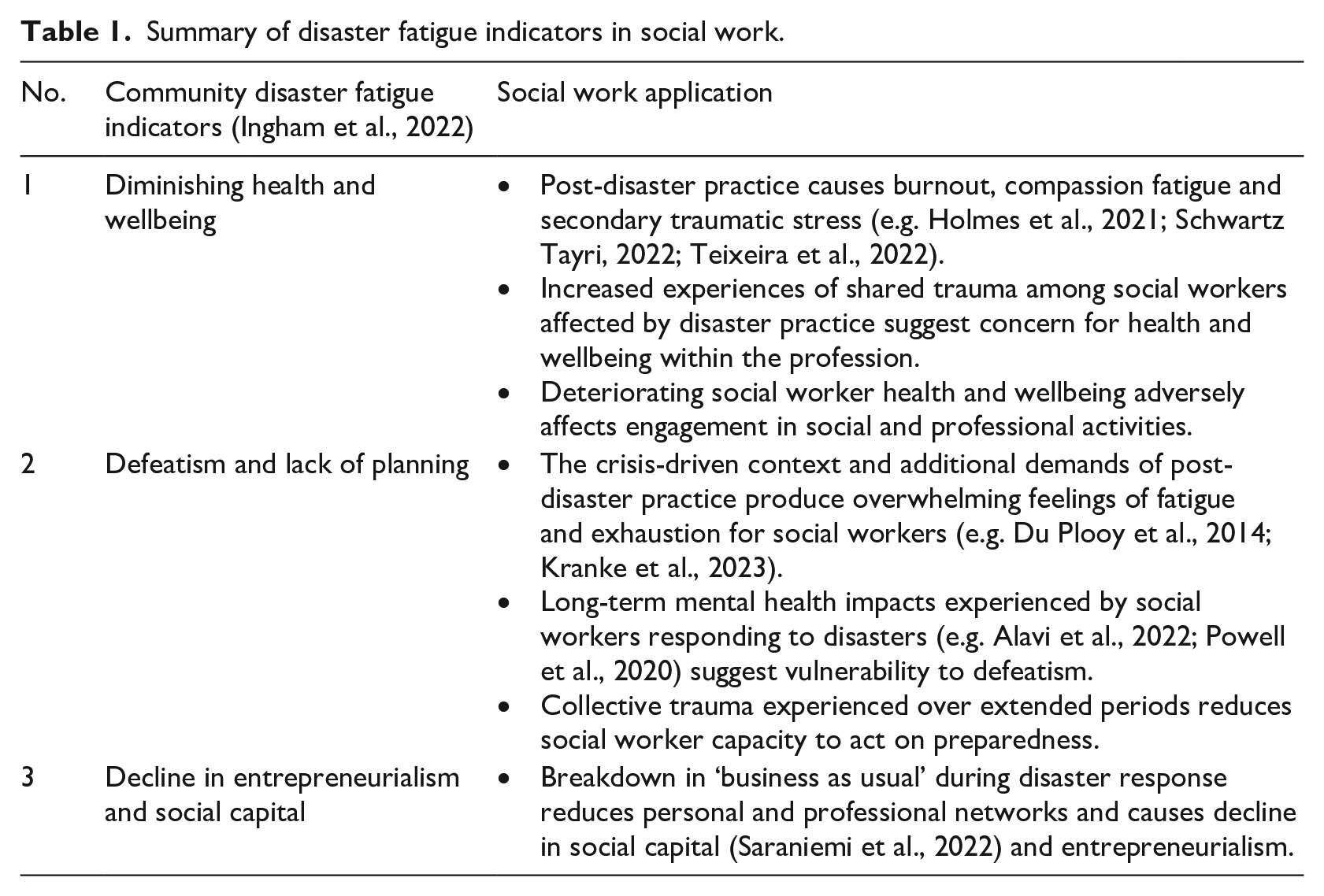
Drawing from the concept of community disaster fatigue as defined by Ingham et al. (2022, 2023), indicators within social work are explored below across three dimensions, including: diminishing health and wellbeing; defeatism and lack of planning; and decline in entrepreneurialism and social capital (Table 1).
Summary of disaster fatigue indicators in social work.
Diminishing health and wellbeing
Diminishing health and wellbeing refers to collective experiences of trauma and feelings of helplessness, as well as withdrawal from participation in organised activities (Ingham et al., 2022, 2023). Within social work, many practitioners on the front line of disaster response experience substantial adverse impacts on their health and wellbeing, including an increase in burnout, compassion fatigue and secondary traumatic stress (Holmes et al., 2021; Powell et al., 2020). Burnout is typically caused by prolonged stress in the workplace resulting in symptoms of emotional exhaustion, reduced sense of accomplishment and developing cynicism, which has not been addressed by management (Ratzon et al., 2022). Compassion fatigue occurs when the demand for compassionate feelings is overloaded, causing a depletion in the capacity to provide an empathetic response (Adams et al., 2008). Vicarious trauma and secondary traumatic stress are often used interchangeably to refer to a shift in attitude caused by exposure to indirect disturbing stories and images; secondary traumatic stress is usually associated with sudden occurrences, for example after being exposed to one incident, while vicarious trauma is usually considered to occur over an extended period, for example after prolonged exposure to service users’ traumatic experiences (Holmes et al., 2021).
Another concept relevant to social worker health and wellbeing in post-disaster practice is collective trauma. Collective trauma refers to a shared catastrophic experience that adversely impacts the whole community (Macias et al., 2021). Collective trauma recognises that social workers are intrinsically embedded in the communities where they live and work and are therefore impacted by disasters as both survivors and professionals (Lavi et al., 2017). As a global phenomenon, the COVID-19 pandemic provides an apt opportunity for understanding collective trauma experienced by social workers. A study by Holmes et al. (2021) interviewing 181 social workers in the United States following the first wave of the COVID-19 pandemic revealed more than a quarter of social workers met the diagnostic criteria for post-traumatic stress disorder, over 60 per cent experienced burnout, and almost 50 per cent experienced secondary traumatic stress. Similarly, in Israel, a study by Schwartz Tayri (2022) found that the impacts of the COVID-19 pandemic on 2542 Israeli social workers caused at least 1 work-related health problem for over 70 per cent, including nervousness, fatigue, neck and back pain, stomach and digestive problems, high blood pressure and others. These shared responses reflect the challenging situations facing social workers in the context of disasters and highlight the need for proactive responses for ensuring the wellbeing of practitioners.
According to Ingham et al. (2022, 2023) withdrawal from participation in organised activities is related to a decline in health and wellbeing. While articles in social work literature do not specifically explore behaviours of social workers’ participation in organised activities, it stands to reason that a decline in health and wellbeing may inhibit engagement in professional and personal activities. Interestingly, a study exploring the self-care practices of social workers responding to the COVID-19 pandemic in the United States revealed a decrease in multiple dimensions of self-care, including those that occur in the personal sphere (e.g. life balance and support) and the professional sphere (e.g. professional development and support) (Miller and Reddin Cassar, 2021). These behaviours could suggest a decline in motivation and capacity to participate in personal and professional initiatives due to ongoing adverse impacts of disasters on health and wellbeing. According to Drolet and Fulton (2018), a relational understanding of wellbeing and self-care involves a positive concept of self, as well as healthy relationships with other people. Social worker withdrawal from socialising with other people, whether in the workplace or community, therefore, suggests the need for further research regarding the impacts of declining health and wellbeing in relation to disaster fatigue indicators.
Defeatism and lack of planning
Defeatism refers to overwhelming feelings of fatigue and exhaustion and the subsequent declining ability to participate in planning for future disasters (Ingham et al., 2022, 2023). The crisis-driven context of post-disaster practice exposes social workers to traumatic and distressful situations, which cause vulnerability to experiencing primary negative emotions. Activities associated with post-disaster practice are substantially different from the usual day-to-day responsibilities involving more diversified and additional demands within an often-chaotic context (Du Plooy et al., 2014; Kranke et al., 2023). A study by Hickson and Lehmann (2014) during the Australian Black Saturday fires in 2009 revealed social workers were overwhelmed by the sheer magnitude of the disaster while simultaneously trying to demonstrate empathy and provide practical support to affected community members. Another study exploring social worker experiences in a hospital setting responding to the same fire found that professional boundaries were continually challenged by management expectations to increase workloads and prioritise patient needs over their own needs (Du Plooy et al., 2014). Similarly, during the COVID-19 pandemic, social workers in the United States reported intensified periods of distress when expected to work outside their usual scope of practice and when their skills were overlooked (Teixeira et al., 2022). Given these increasing demands and expectations, vulnerability to feelings of defeatism may be caused by these extraordinary workplace conditions.
In addition, evidence indicates that the long-term mental health impacts experienced by social workers responding to disasters are significant. A study by Alavi et al. (2022) exploring the wellbeing of healthcare practitioners following a fatal debris flow in the United States identified both short-term and long-term complex mental health issues. In this study, healthcare workers experienced complex mental health issues for up to 12 months following the disaster, even for those who had never experienced previous mental health issues before (Alavi et al., 2022). Another study by Powell et al. (2020) exploring the impacts of separate hurricanes on healthcare workers, including social workers, in Texas and Puerto Rico in the United States found that increases in emotional distress remained high for approximately 1 year following these disasters. Interestingly, distress levels were significantly higher for healthcare workers in Puerto Rico where the devastation of disasters was considered longer and more sustained, compared with healthcare workers in Texas (Powell et al., 2020). The results of these studies cause concern for social worker wellbeing and highlight the need for further research to explore complex longer-term issues impacting practitioners.
According to Ingham et al. (2022, 2023), a lack of planning involving the reduced capacity to mobilise and prepare for subsequent or future disaster events is related to defeatism. While articles in social work literature do not specifically explore the relationship between defeatism and lack of planning for future disasters, a study by Kranke et al. (2023) highlighted the need for social workers to prepare emotionally, and physically for future disasters. In this study, the need to increase social worker ‘emotional preparedness’ was distinguished from other forms of preparedness to assist with understanding the emotional challenges relating to disasters that may assist with reducing burnout, compassion fatigue and secondary traumatic stress (Kranke et al., 2023). Furthermore, Alavi et al. (2022) found a lack of readiness as a factor that perpetuated stress and anxiety among healthcare workers responding to a disaster, including a sense of incompetence regardless of their years of experience. More generally, Boetto et al. (2021) argue that the invisibility of disaster preparedness in social work requires a conscious effort within the profession to conceptualise disaster preparedness as a fundamental part of disaster practice. This literature suggests that neglecting disaster preparedness exposes social workers to heightened levels of distress, causing vulnerability to feelings of defeatism and lack of capacity for future planning.
Decline in entrepreneurialism and social capital
According to Ingham et al. (2022, 2023), a decline in entrepreneurialism and social capital represents the third component of community disaster fatigue. The economic impacts of disasters usually result in reduced economic activity and the temporary or permanent closure of local businesses, including self-employed social workers involved in private practice. Although social work literature has not specifically explored the decline in entrepreneurialism following disasters, research on self-employed female psychologists in the United Kingdom found that the COVID-19 pandemic had detrimental impacts on their family relationships, mental health and wellbeing (Miller and Essex, 2023). While further research specific to social work is needed, it could be inferred that self-employed social workers could be at collective risk of experiencing economic hardship and associated health and wellbeing issues.
A decline in social capital refers to a breakdown in social networks that enable a community to function effectively following disasters. Conversely, high levels of social capital consist of strong social relationships, interaction, cohesion and solidarity, which promote an effective community response to disasters (Mathbor, 2007). Romakkaniemi et al. (2021) explore a related term called ‘professional capital’, which refers to collective resources within social work for mobilising social networks considered crucial for responding to disasters. These authors argue that professional capital consists of two key characteristics, including the mobilisation of social worker competencies and skills, and the ability to organise community resources associated with external relationships within the community. As a collective resource among social workers, a decline in social capital impacts effective functioning within the profession, causing vulnerability to disaster fatigue.
Social capital among social workers has garnered attention from researchers in Finland. Saraniemi et al. (2022) examined changes to social capital in the workplace during the first wave of the COVID-19 pandemic and revealed that changes to the structure of workplaces caused a breakdown in professional relationships between social workers. Various issues relating to remote working arrangements, lack of technological resources and conflicting views about the pandemic resulted in reduced emotional support and lack of trust between colleagues (Saraniemi et al., 2022). Furthermore, a study by Rapeli (2018) explored social capital, including bonding, bridging and linking forms of social capital, in Finnish social worker disaster preparedness plans. While bonding was considered to involve existing relationships among social workers, bridging and linking forms of social capital were considered to involve external relationships with community organisations and resources, as well as governments and leaders in emergency services. Outcomes of the study revealed that a lack of these latter two forms of social capital involving external collaborations with community organisations, government and emergency services reduced social worker capacity for effective disaster practice. These studies identify a gap in professional social capital and suggest the need for collective strategies to enhance social capital in workplaces and the profession.
A collective response to disaster fatigue: The SAFE framework
The concept of disaster fatigue provides insight for social work to move beyond individualised notions of burnout, compassion fatigue and secondary traumatic stress towards a collective and relational understanding. As social workers increasingly experience shared personal and professional responses to the impacts of disasters, a collective response is required to build disaster resilience. The SAFE framework for promoting disaster resilience consists of four components: (S) sustaining self-care; (A) adopting a trauma-informed approach; (F) fostering professional capability; and (E) enhancing disaster preparedness (Figure 1). These components are not mutually exclusive but rather overlap to form a holistic and relational approach for supporting social workers in disaster practice. The components of the SAFE framework are outlined below.
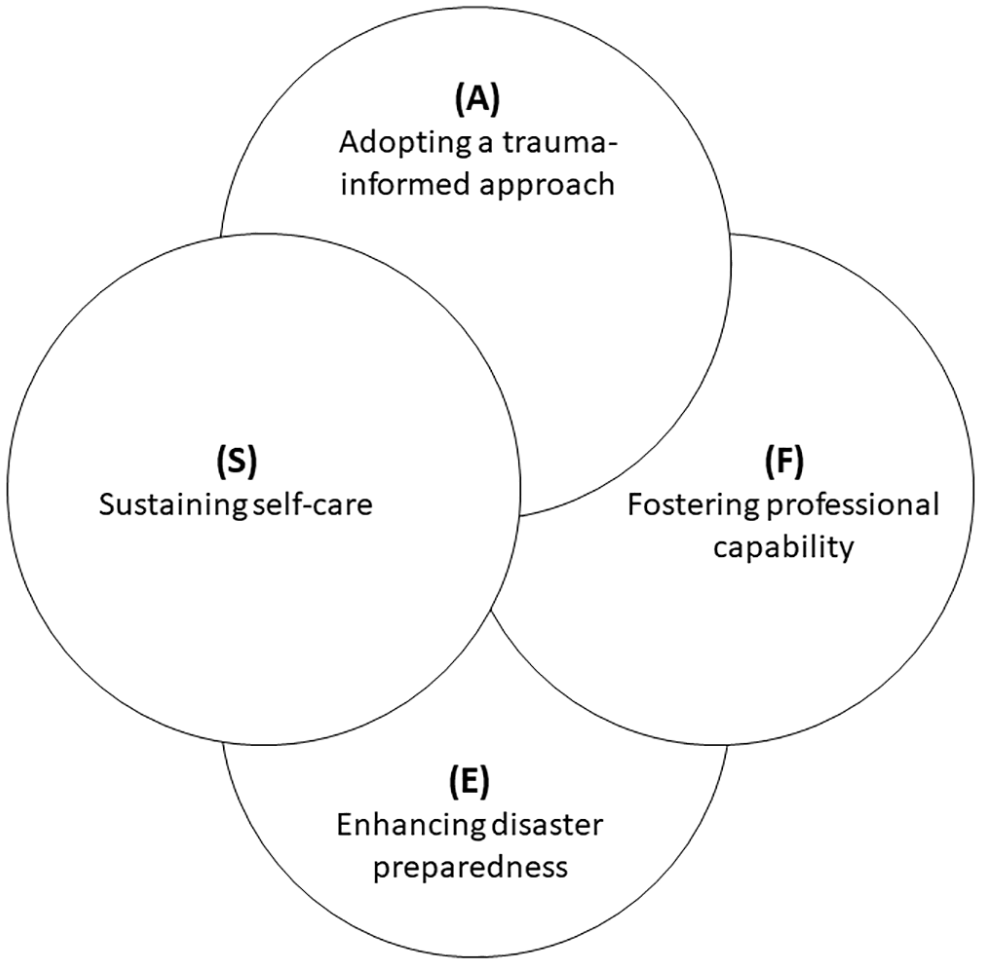
The SAFE framework for enhancing disaster resilience in social work.
Sustaining self-care
A comprehensive response to addressing disaster fatigue in the profession involves the implementation of interventions to promote self-care at multiple levels of practice. Dombo and Gray (2013) identify self-care strategies at multidimensional levels, including the micro level, involving efforts made by individual practitioners to enhance their wellbeing; the meso level, involving efforts by teams and colleagues; and the macro level, involving organisational governance and policy. Ideally, this multidimensional approach needs to be embedded within the organisational domain to ensure the onus of self-care is not solely the responsibility of individual practitioners, but rather a collective approach involving colleagues, organisational management and leadership.
Individual practitioners can initiate self-care strategies by accessing educational resources, attending workshops and undertaking professional development relating to disaster practice (Alston et al., 2019). Other self-care approaches include the development of household disaster preparedness plans, ensuring vaccinations are updated and farewelling family members if being deployed to another location (Alston et al., 2019). Despite the personal desire to address the scale of need during disasters, understanding the importance of taking regular breaks, maintaining contact with family and talking with a trusted mentor about experiences can assist with sustaining individual self-care.
Self-care strategies at the meso level of practice involve efforts by teams and colleagues to develop relationships that promote collaborative wellbeing. Building networks and ‘communities of practice’ where practitioners come together to share experiences, support one another in their actions and learn from each other is integral to sustaining self-care (Mercieca, 2017). For example, maintaining communication with colleagues in the field, as well as colleagues located in the office assists with the identification of unusual behaviours that indicate the need for a break. Likewise, developing positive relationships with partner organisations and multidisciplinary teams within the disaster context provides opportunities for additional support when in the field.
Embedding self-care practices into organisational governance and policy promotes a sustainable culture of self-care at the macro level of practice, including the implementation of reasonable workloads, provision of adequate resources and supervision. Strategies associated with workload involve the maintenance of adequate staffing, roster rotation, provision of flexible work arrangements and ensuring staff can attend to personal and family needs. The provision of adequate resources promotes safety and security and thereby reduces distress, including updated and regular information (e.g. ongoing details about the unfolding disaster), physical assets (e.g. vehicles, accommodation) and technological resources (e.g. portable equipment, communication devices). Finally, professional supervision for staff across the disaster cycle, including preparedness, response and recovery phases, provides a longitudinal and proactive approach to sustaining self-care (Adamson, 2018).
Adopting a trauma-informed approach
An ethical response to addressing disaster fatigue in the profession involves implementing a trauma-informed approach to support social workers engaging in disaster practice. A trauma-informed approach is ‘grounded in an understanding of and responsiveness to the impact of trauma that emphasises physical, psychological, and emotional safety for both providers and survivors’ (Hopper et al., 2010: 82). Research indicates that adopting a trauma-informed approach within organisations improves staff wellbeing, including increased levels of job satisfaction and decreased levels of burnout and secondary traumatic stress (Keesler, 2020). A trauma-informed approach in organisations acknowledges the shared experiences of trauma, which in a disaster context often involves interactions with large-scale human suffering and fatalities.
Commonplace in organisations is an individualised approach to supporting staff who experience distress and trauma, which places the onus on staff to self-assess their own needs and then to further request support from management on a needs basis (Teixeira et al., 2022). Underpinned by neoliberal principles of individual choice and efficiency (Teixeira et al., 2022), this approach shifts responsibility from organisations to individual practitioners and serves to reinforce an already under-resourced human services sector. Rather, trauma-informed leadership in organisations creates and sustains an organisational culture where staff feel safe and supported; and which benefits service users who receive quality services by staff who are well-cared for. Esaki (2020) identifies five key elements for building trauma-responsive organisations, including observable stable behaviours of management and leaders, a sense of trust between staff and management, fair and just treatment of staff, management knowledge about trauma and equity and staff confidence in judgements and decisions made by management and leaders.
Strategies for embedding a trauma-informed approach in organisations involve the implementation of policies that normalise secondary traumatic stress and vicarious trauma as an accepted part of working within a disaster context (Keesler, 2020). Prioritising collective approaches of peer-support and debriefing as part of daily and weekly routines ensures social workers and other staff have opportunities to acknowledge trauma impacts and maintain a sense of control. The provision of adequate work conditions, staff development relating to trauma-informed practice and clinical supervision is integral to adopting a trauma-informed organisational approach (Hickle, 2020). A trauma-responsive organisation has the capacity to create structural change to practice methods, policies and procedures and the physical environments which their staff and service users occupy.
Notwithstanding the adverse impacts of trauma on social workers, some positive responses and outcomes from trauma have been documented. For example, shared trauma experiences within a disaster context where social workers live and work in the same community can be used as a creative tool to support one another and promote therapeutic interventions (Tan, 2022). Shared experiences of trauma and subsequent secondary traumatic stress, compassion fatigue and burnout may also be accompanied by increases in connectivity with colleagues who are experiencing similar reactions and provide opportunities for peer-support and mentoring. This strengths-based approach accepts trauma as a part of practice and embraces an assets-based approach, rather than a deficit approach to supporting social workers in disaster practice.
Fostering professional capability
An effective approach to addressing disaster fatigue in social work requires the advancement of professional capability in disaster practice. Professional capability encapsulates the relevant knowledge, skills and resources needed for effectively undertaking disaster practice. Although social workers are increasingly engaging with disasters, they face numerous challenges, including the need for further role definition (Cleary and Dominelli, 2020) and a lack of visibility within social work and the broader disaster management context (Boetto et al., 2021). Disaster practice is also considered an auxiliary service in many organisational contexts due to the prevailing demands of day-to-day practice (Boetto and Bell, 2022) and remains peripheral in social work education. To improve professional capability in disaster practice, a multilayered approach across organisational and educational domains is needed to enhance social worker competence in disaster practice.
Organisations are a key enabler to promoting social worker competence through professional development specific to disaster practice, including knowledge about local community emergency plans, and grief, loss and trauma (Drolet et al., 2021). The coordination of pre-disaster planning, provision of peer-support and resources and post-disaster debriefing at the organisational level are integral to increasing social worker capability (Alavi et al., 2022). In addition, organised regular clinical supervision, including the provision of a confidential environment for social worker skill development and reflection, resilience building and plans for continuing supervision arrangements during disaster response, enhances social worker capability (Adamson, 2018). An embedded policy approach within organisations facilitates a sustained approach for enhancing the continuous development of social worker capability in disaster practice.
Enhancing social worker capability in disaster practice also requires leadership from professional governing bodies to guide and empower social workers in the context of disasters. For example, the International Federation of Social Workers (IFSW) (2022) has recently prioritised an ecosocial approach in practice through its policy position supporting the profession’s role in co-building a new ecosocial world. However, further development in each IFSW member country is needed to build social worker capability in disaster practice at the local level by implementing disaster-related professional practice standards for accredited university social work programmes. In addition, the provision of professional development opportunities for graduated practitioners to enhance disaster practice skills is also integral for upskilling the professional workforce, for example by offering accredited Continued Professional Development (CPD) opportunities.
Enhancing disaster preparedness
Addressing disaster fatigue in the profession requires a proactive approach towards developing social worker disaster preparedness. Given that a community’s level of disaster preparedness is intrinsically linked to their recovery experience (UNDRR, 2015), it stands to reason that the profession’s collective level of disaster preparedness is also linked to post-disaster experiences. Generally, the more prepared an individual or community, the more resilient they are to disaster impacts and associated recovery processes. Disaster preparedness refers to interventions that effectively prepare or make ready for a disaster event, including the capacity to manage risks and respond to threats (Alston et al., 2019; Boetto et al., 2021). Developing social worker disaster preparedness assists with mitigating the impacts of disasters on practitioners, which promotes positive health and wellbeing, thereby increasing work performance and the quality of services provided to affected communities.
As part of a collective effort, developing social worker disaster preparedness requires a multidimensional approach at the micro, meso and macro levels of practice (Alston et al., 2019). Interventions at the micro level of practice involve efforts made by individual practitioners to enhance their personal disaster preparedness. For example, creating household preparedness plans helps keep social workers and their families safe and facilitates their capacity to return to work as soon as possible. In addition, increasing social workers’ level of ‘emotional preparedness’, for example by increasing self-efficacy and the ability to focus on professional tasks when dealing with dual personal impacts, also reduces practitioner stress and anxiety during the response and recovery phases (Kranke et al., 2023). These factors may be enhanced by setting reasonable personal goals and expectations, participating in professional development and recruiting a mentor on an informal and continuous basis.
At the meso level of practice, social worker disaster preparedness is located within an organisational context and requires an integrated approach to strengthen partnerships with all sectors of the community, including emergency services, governments and the private sector, to increase knowledge, skills and resources (Alston et al., 2019). This integrated and collaborative approach is supported by research; for example Rapeli (2018) describes the importance of building cross-sectorial relationships via ‘bridging’ and ‘linking’ forms of social capital to improve disaster preparedness within organisations. Other strategies involve understanding the significant role organisations play in building community resilience, assessing organisational vulnerabilities and assets, ensuring staff and volunteers are prepared, implementing policies and procedures and enhancing service user preparedness (Boetto and Bell, 2022).
Finally, the macro level of disaster preparedness involves governance and policy, including the development of organisational procedures for alternative accommodation, risk registers and preparedness kits (Boetto et al., 2021). Social workers have identified the need for employing organisations to have disaster plans to assist with response and recovery processes (Drolet et al., 2021). Preparing social workers for post-disaster practice, such as rapid deployment processes, critical incident management and knowledge about local community disaster plans, provides a solid foundation for post-disaster practice (Harms et al., 2022). Likewise, locating disaster preparedness more explicitly within professional social work policy documents, such as course accreditation requirements and practice standards, is critical for a holistic approach to enhancing disaster preparedness.
Conclusion
While individual practitioners often experience fatigue following involvement in disaster practice, disaster fatigue within a professional community transcends individual experiences to conceptualise a collective understanding of professional functioning and resilience. Within a context of increasing exposure to complex and successive disaster events, social work practitioners worldwide are grappling with extremely difficult personal and professional consequences. Drawing on disaster fatigue research, collective indicators are explored within social work across three dimensions, including diminishing health and wellbeing; defeatism and lack of planning; and declining entrepreneurialism and social capital (Ingham et al., 2022, 2023). Application of these indicators highlights common experiences among social work practitioners of increased stress, fatigue and exhaustion, which suggest vulnerability to disaster fatigue within social work. To address disaster fatigue in social work, a SAFE framework for building disaster resilience is presented, consisting of four components: (S) sustaining self-care; (A) adopting a trauma-informed approach; (F) fostering professional capability; and (E) enhancing disaster preparedness. The need for a collective and multidimensional approach to addressing disaster fatigue is critical for supporting practitioners’ wellbeing and capacity to thrive in a growing disaster context.
Footnotes
Acknowledgements
I would like to acknowledge social worker Courtney Bryant for the research assistance provided.
Declaration of conflicting interests
The author declared no potential conflicts of interest with respect to the research, authorship and/or publication of this article.
Funding
The author received no financial support for the research, authorship and/or publication of this article.
