




Abstract
The present article presents empirical evidence regarding factors that explain the involvement of social workers from minority groups in policy practice based on data from an extensive survey of social workers from the Arab minority group in Israel (n = 218). The findings revealed that the sociopolitical context of an ethnic minority significantly affects their involvement in policy practice. In order to increase the involvement of minority social workers in policy arenas in multicultural societies, professional bodies and social work training frameworks should provide social workers with knowledge resources and professional skills, including tailored organizational support.
Introduction
The involvement of social workers in policy design processes (‘policy practice’ [PP]) is seen as a central component of social work. Social work discourse (Gal and Weiss-Gal, 2022; Jansson, 2014; Kaufman, 2018) and its professional codes of ethics (Australian Association of Social Workers [AASW], 2020; British Association of Social Workers [BASW], 2021; Israel Association of Social Workers [ISASW], 2018) emphasize the obligation of social workers to analyze, challenge, and influence the promotion of social policy in order to advance social justice. In the past two decades, fruitful research has been conducted on PP that provides insight into the strategies and ways in which social workers can impact policy (e.g. Klammer et al., 2020; Mendes et al., 2012; Weiss-Gal, 2017), as well as the factors that motivate social workers to engage in PP (Gal and Weiss-Gal, 2022; Hoefer, 2016; Nouman et al., 2020; Ritter, 2008).
Despite the increased research efforts in this arena, few studies have examined it in the context of ethnic minority groups (Kwok, 2022). In multicultural societies, social workers from diverse groups, including ethnic minority groups, may be engaged in PP (e.g. Bent-Goodley et al., 2017; Darawshy et al., 2022; Mendes, 2015). Their involvement is emphasized as important and essential to reducing gaps between the majority and the minority. The comprehensive knowledge of minority group social workers regarding the needs of minority group citizens and residents, as well as their ability to identify policy gaps and offer practical ways to challenge policymakers’ decisions, may contribute greatly to promoting equality and ensuring that the voices of disadvantaged minority groups are heard (Nouman, 2020). However, recent studies conducted among ethnic minorities in the social work literature revealed that they face political, cultural, and personality challenges that inhibit and hinder their political involvement (Kwok, 2022; Nouman and Azaiza, 2021). This article expands the existing knowledge about PP in multicultural societies. It presents an extensive survey that examined the motivational and facilitating factors that explain the involvement of social workers from minority groups (SWM) in Israel in PP.
Theoretical background: Policy practice of minority social workers
The conceptual framework of Minority Policy Practice (MPP; Nouman and Azaiza, 2022) applied in this article is based on a body of knowledge concerning the political involvement of ethnic minorities in multicultural societies (e.g. Cinalli and Giugni, 2011; Miller et al., 1981) and of PP (policy practice engagement [PPE]; Gal and Weiss-Gal, 2015). This framework presents three categories of factors in the social and political context of the majority and minority in society that may influence the involvement of SWM in policy arenas: motivation, facilitation, and opportunity.
Motivation refers to individual-level factors that may influence the involvement of minority social workers in PP, and comprises civic attitudes, professional status, professional resources, group identification, as well as belonging to an ethnic recruitment network. Civic stances include a perception of political interest and political efficacy that refers to the perceived influence of nongovernmental actors on the policy process (Verba et al., 1995). The literature shows that higher levels of political interest and political efficacy among social workers are linked to involvement in PP (Gewirtz-Meydan et al., 2016). Another factor that explains involvement in PP is the professional status of social workers, including their managerial role and seniority in the profession (Weiss-Gal and Gal, 2020). Professional resources include PP skills as well as actual training in PP (Jansson, 2014). These aspects are acquired in the professional socialization process through exposure to learning PP in academic or professional frameworks (Gal and Weiss-Gal, 2015). When it comes to minorities, unique knowledge and insights are required, such as identifying and analyzing social problems from a local and global perspective for change in the community (Nouman, 2020). Previous studies conducted among minorities have found that professional skills in a sociopolitical context increase political involvement (De Rooij, 2012; Leal, 2002).
The literature dealing with political involvement of ethnic minorities emphasizes the conditions necessary for this involvement – identification with the minority group and a perception that the group’s social status is deprived and discriminated against by the majority group in the country (Miller et al., 1981; Simon and Klandermans, 2001). The more individuals identify with their community and the more they feel dissatisfied with its relative status and assign guilt to the political system, the greater their political involvement (Miller et al., 1981). In the context of social work, evidence suggests that an inequitable policy perception and a sense of discrimination experienced by social workers in minority communities may provoke a reactive focus on attempts to change reality through political involvement (Barrow, 2007; Bent-Goodley et al., 2017). Furthermore, belonging to ethnic recruitment networks, which include associations or organizations of people from a common ethnic origin, is also an influential motivational factor that affects the level and forms of PP (Nouman and Azaiza, 2022).
Facilitation refers to factors related to the workplace of minority group social workers, which enable, promote, or inhibit PP. These factors include the organization’s goals, funding sources, and scope, as well as organizational heritage and guidelines (Gal and Weiss-Gal, 2015; Mosley, 2010). Social services that encourage social workers to engage in PP have created an organizational culture, which includes forms of behavior and the organization’s assumptions that foster and enable policy involvement (Jansson et al., 2016). A notable finding is that an organizational culture that supports PP correlates with greater involvement of social workers in PP (Gewirtz-Meydan et al., 2016; Jansson et al., 2016). Managers’ expectations for the involvement of social workers in PP also encourage them to integrate this involvement in their professional activities, even if they did not previously perceive it as a part of their job (Nouman, 2020).
Opportunity refers to the political institutions in which the policy formulation process takes place and the nature of opportunities for involvement in policy design processes that are accessible to minority group social workers. The most appropriate way to examine opportunity factors is through studies conducted at the institutional level that can identify the type and levels of opportunities for political participation of minorities in diverse policy arenas. As such, these opportunities are not incorporated into the current study.
The Israeli context
The Palestinian Arab minority in Israel constitutes approximately 21 percent of the total population (Statistical Abstract of Israel, 2022). This group tends to live separately in communities with an independent culture, religion, language, and education system. Israeli Palestinians are Israeli citizens and, formally, enjoy the same rights as the Israeli Jewish majority. However, in practice, they suffer from inequality and exclusion in all spheres of life (Arar and Haj-Yehia, 2016), and 45 percent of them live in poverty compared with 13 percent of Jewish citizens (Endeweld et al., 2019).
Social work in Israel’s indigenous Arab society developed under an establishment that perceived its members in the Jewish state as citizens with inferior rights in light of the continuing Israeli–Arab conflict. It was therefore allocated fewer resources than its Jewish counterpart, and Arabs were excluded from social work-related decision making. Notwithstanding, over the past two decades, social work in Israel’s Arab society has seen positive developments. These include a consistent increase in academically trained personnel, the gradual adoption of generic methods that favored Arab society’s family orientation, and formal training for specialized roles (Mahajne et al., 2020).
Every year, dozens of social workers from the Arab minority group graduate from higher education institutions in Israel. Social work education in Israel, which is based on Western culture, places great emphasis on engaging in PP (Schwartz-Tayri, 2021). Most of the certified Arab social workers in Israel are employed by the public welfare agencies of the local government in Arab communities, and they share a common identity, language, and culture with their minority group clients (Mahajne and Bar-On, 2023).
The current study sought to expand knowledge about factors that explain the involvement of SWM in PP, based on data from a survey of social workers from the Arab minority group in Israel employed by the local government in Arab communities. Specifically, motivational and facilitating factors were examined based on the MPP framework (Nouman and Azaiza, 2022). These include (1) individual-based motivational factors: personal resources – seniority and managerial position; civil attitudes – political interest and political efficacy; professional resources – professional skills and training for PP; (2) group-based motivational factors – group identification and belonging to ethnic recruitment networks; and (3) facilitating factors – organizational support. Figure 1 shows the research model.
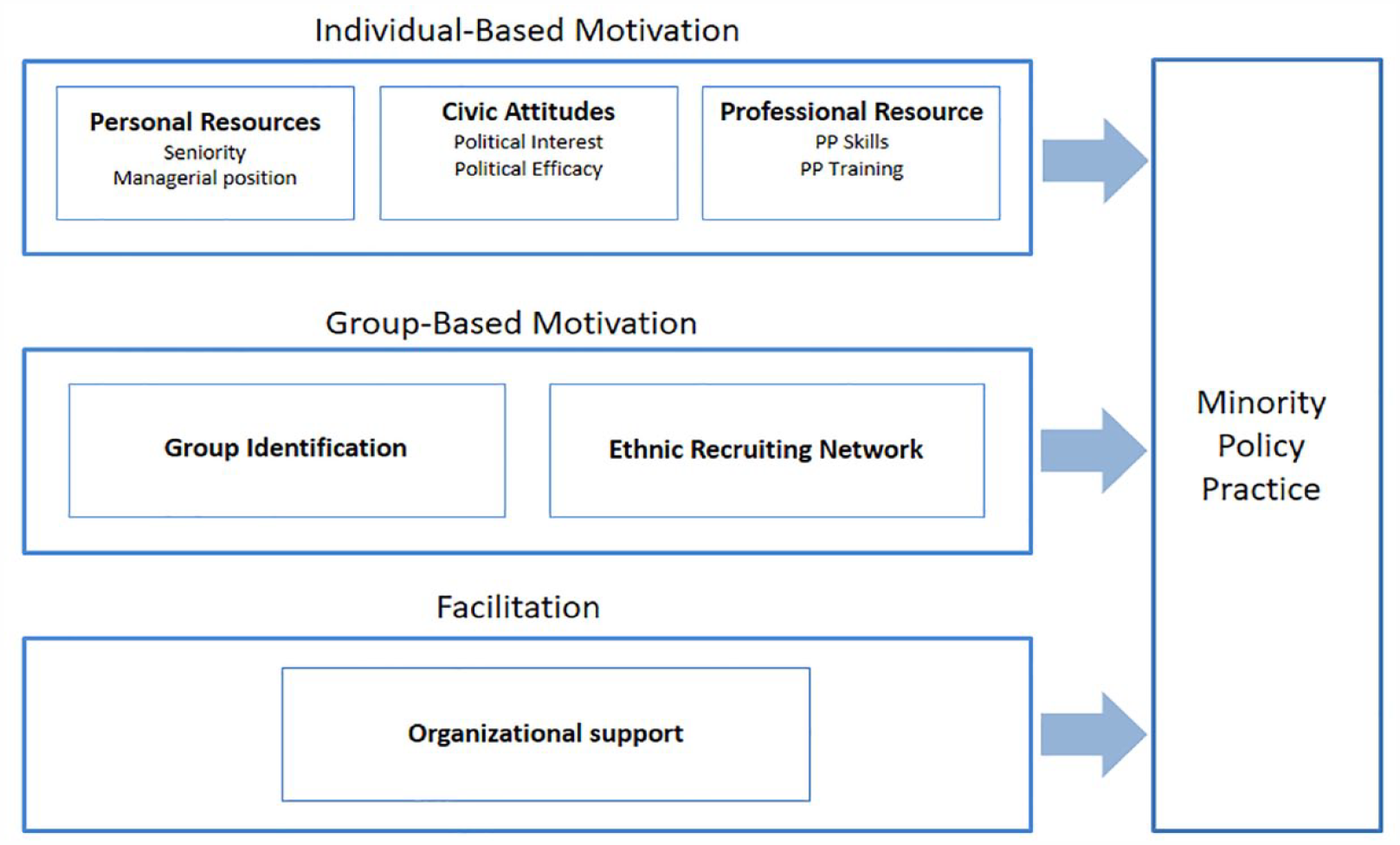
The involvement of social workers from minority groups in policy practice; the research model. 218 Arab workers self-reported between 2019 and 2021.
The study examined six hypotheses:
The higher the professional status (seniority and managerial position) of SWM, the greater their involvement in PP.
The greater the civic stance (political interest and political efficacy) of SWM, the greater their involvement in PP.
The greater the professional resources (PP skills and PP training) of SWM to engage in PP, the greater their involvement in PP.
The stronger the group identification of SWM, the greater their involvement in PP.
The higher the level of SWM activity in ethnic recruitment networks, the greater their PP.
The greater the perceived organizational support for PP, the greater the commitment of SWM to engage in PP.
Method
Sample and sampling procedures
A purposive convenience sample was used (Patton, 2011) to recruit respondents. The sample was recruited from Arab social workers employed in 25 social services departments in Arab settlements that were randomly sampled (simple random sampling) from a list of all 84 departments of social services in the Arab sector in Israel. All 25 managers of these departments consented to participate in the study. Research assistants visited each of these agencies and sampled all social workers present at their agencies on the days of data collection.
Overall, 300 social workers were approached, of whom 218 responded (81% response rate). Of these, most were female (82%), with an average age of 35 (SD = 10.15) and average professional experience of 10.29 years (SD = 7.34). Most of the participants enjoyed tenure (77%) and 43 percent held some sort of managerial position. All participants were certified social workers, graduates from academic institutions in Israel who attained a bachelor’s or master’s degree in social work.
Research tools
The data were collected by self-report questionnaires developed and validated in previous studies on social workers (e.g. Gewirtz-Meydan et al., 2016; Tayri-Schwartz, 2015; Teush, 2012; Weiss-Gal et al., 2020). Questionnaires pertaining to political efficacy and political interest were based on the tools developed by Verba et al. (1995). Two questionnaires pertaining to group identification and activity in ethnic recruiting networks were developed specifically for this study. The questionnaires for SWM were adapted linguistically and culturally by seven senior Arab social workers, and changes to their wording were made based on their comments.
Level of involvement in PP was measured by a 29-item scale (see Tayri-Schwartz, 2015; Weiss-Gal et al., 2020). Each item depicted one of a range of activities that constitute PP in social work (Figueira-McDonough, 1993; Jansson, 2014). The respondents were asked to indicate ‘yes’ or ‘no’, about whether they undertook the activity as a part of their professional practice during their career as social workers. These included, for example, contacting policymakers or being a member of a committee or professional team dealing with policy problems. Scores were calculated as the percentages of items answered as ‘yes’ from all items, and then recalculated on a continuum ranging between 0 and 1. A higher score reflected a greater degree of PP. Cronbach’s alpha values were .93.
Political interest was measured by a four-item scale – two questions each relating separately to local and national levels: ‘How often do you discuss politics and current affairs with friends, neighbors or relatives?’ and ‘How interested are you in politics and current affairs?’ (see Verba et al., 1995). Answers were on a 5-point Likert-type scale ranging from 1 (not at all) to 5 (to a large extent). An average of all the items on the scale was calculated to create the respondent’s score. Cronbach’s alpha values were .95.
Political efficacy was measured by two questions, each asked twice, about local and national politics (see Verba et al., 1995). The questions were: ‘How much attention do you think a member of the government (minister, member of parliament, senior official) would pay to a complaint regarding a government activity or policy you raised with him or her?’ and ‘How much influence do you think someone like you can have on government decisions?’ A 5-point Likert-type scale ranging from 1 (not at all) to 5 (to a large extent) was employed. Here again, the score was based on a calculation of the average of all the items, with a higher score reflecting a greater sense of political efficacy. Cronbach’s alpha values were .88.
Level of perceived PP skills was measured by a 27-item scale (see Teush, 2012; Weiss-Gal et al., 2020) that examined the extent to which respondents believed they had the necessary skills to engage in PP (Jansson, 2014), including the capacity to analyze social policy, to draw the attention of policymakers to a policy issue, or to draft a position paper with policy ideas. Answers were on a 5-point Likert-type scale ranging from 1 (not at all) to 5 (to a large extent). To determine whether the skills could be divided into subgroups, an exploratory principal component factor analysis with varimax rotation was undertaken, which yielded five factors with eigenvalues greater than 1. These factors jointly explained 66.3 percent of the variance. The first component had an eigenvalue of 16.1 and explained 50.3 percent of the items’ variance. The next components had eigenvalues of 1.01–1.82 and explained 3.2 percent to 5.7 percent of the variance. All items were highly loaded on at least one component, with loadings ranging from 0.43 to 0.78. In light of this pattern of results and the scree test, it was decided to regard this scale as one component. The Cronbach’s alpha for the entire scale was high (α = .96), similar to the internal consistencies in previous studies (Gewirtz-Meydan et al., 2016; Tayri-Schwartz, 2015). The respondent’s score was the average of all the items. The higher the score, the greater the perceived PP skills. Cronbach’s alpha values were .90.
Level of exposure to PP education was measured by a five-item scale to assess the extent of exposure to classes or field training on influencing policy (see Tayri-Schwartz, 2015; Teush, 2012). For example, ‘During your undergraduate/graduate studies, how much did you learn about ways to influence policies?’, or ‘How much did you learn about motivating and employing the community as a tool to influence policies?’ An average of the five responses created the score, with a higher score reflecting greater exposure to PP training. Cronbach’s alpha values were .92.
Level of group identification was measured by a 10-item scale, which was developed for the present study. The scale measured the degree of identification of social workers with their minority group and the degree of satisfaction with their relative status in Israeli society. The questions were, for example, ‘I don’t get the same rights as other citizens in the country’, ‘As an Arab, I am afraid that I will encounter prejudiced behavior’, ‘The democratic regime in the State of Israel does not enable me to feel identification with the country’. A 5-point Likert-type scale ranging from 1 (not at all) to 5 (to a large extent) was employed. The score was based on a calculation of the average of all the items, with a higher score reflecting a greater sense of group identification. Cronbach’s alpha values were .87.
The level of activity in ethnic recruitment networks focused on the extent to which respondents were active in ethnic networks. The participants were asked to indicate three ethnic networks in which they were involved and the degree of activity in each recruitment network on a scale ranging from 1 (not active at all) to 3 (highly active). A higher score (which was calculated as the average of the three answers) indicated a greater level of activity in ethnic recruitment networks. Cronbach’s alpha values were .77.
Organizational support of PP was measured by an eight-item scale that assessed the perceived tangible signs of support for PP from a respondent’s organization (see Tayri-Schwartz, 2015; Teush, 2012). Among the items were, ‘In my agency, social workers’ involvement in PP contributes to their professional advancement’, or ‘In my agency, policy issues are discussed during staff meetings’. A scale ranging from 1 (totally disagree) to 7 (very much agree) was employed. The score was the average of all the items. The higher the score, the greater the organizational support for PP as perceived by the social worker. Cronbach’s alpha values were .92.
Professional status was queried by two items. Seniority was based on a response regarding the number of years of service as a social worker. Managerial position (responsibility for other workers, training workers, team leader, department head, branch head) was queried by one question, to which the answer was ‘yes/no’.
Procedure
The data were collected between October 2019 and November 2021 due to the need to reach out directly to minority social workers in a wide range of settings and to achieve a satisfactory number of respondents. The study was approved by the Institutional Review Board at the authors’ university. Meticulous adherence to ethical obligations was maintained throughout all stages of the research. In an attached letter received by the participants, it was explained that participation was voluntary and that there would be no sanctions for nonparticipation. The respondents were asked to confirm that they agreed to participate in the research, and they were guaranteed anonymity.
Findings
Table 1 presents the respondents’ descriptive statistics (i.e. means and standard deviations) and correlations with PP involvement.
The involvement of social workers from minority groups in policy practice (PP), descriptive statistics (N = 218 Arab social workers in Israel).
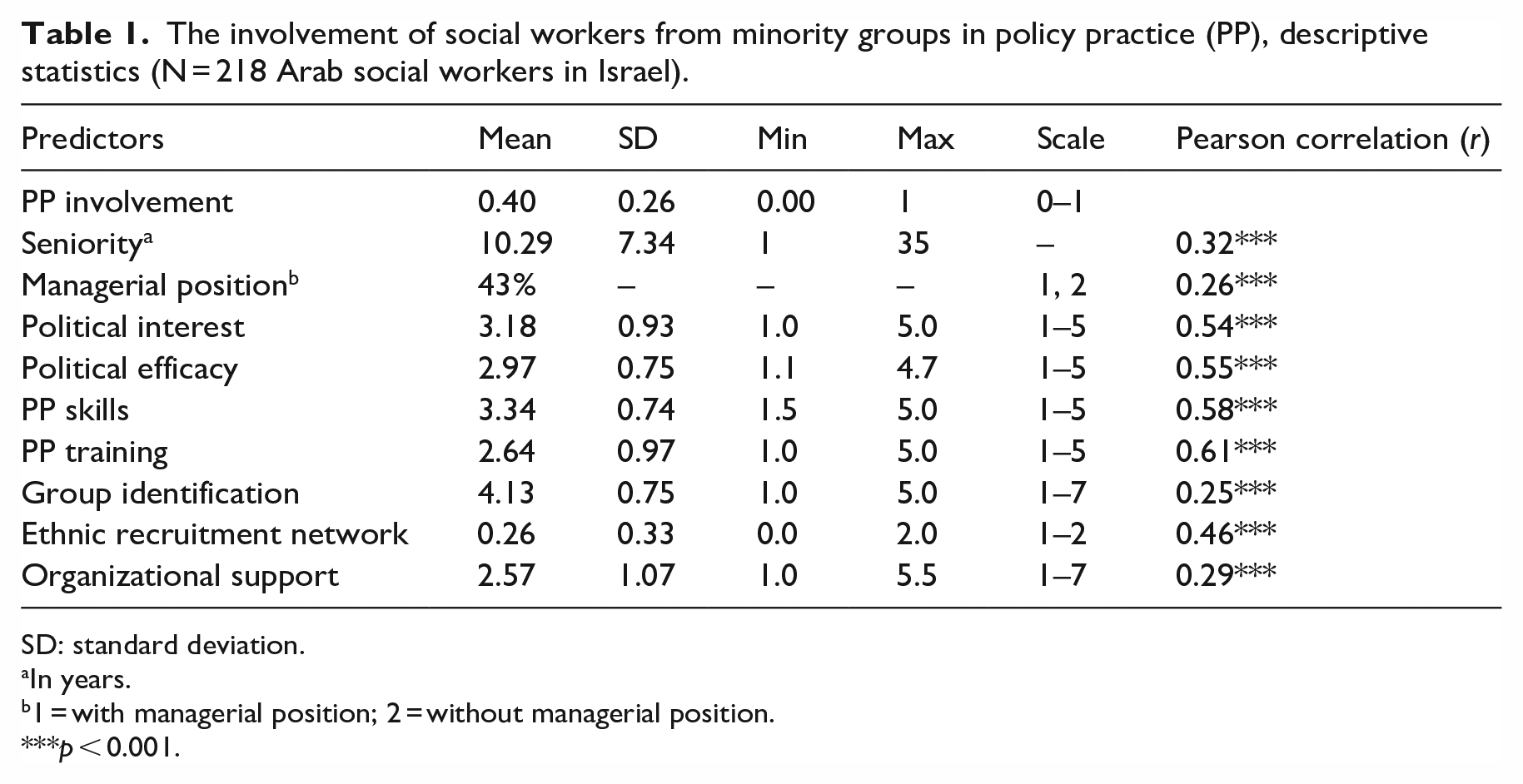
SD: standard deviation.
In years.
1 = with managerial position; 2 = without managerial position.
***p < 0.001.
As can be seen in Table 1, statistically significant correlations were found between all the predictors. To examine the total and unique contribution of the predictor variables to variance in PP involvement, a five-step hierarchical regression analysis was undertaken. All the motivational variables were entered in the first four steps and, in the final step, a single facilitation variable was added. In the first step, the personal resources variables (seniority and managerial position) were entered. In the second step, two civic attitudes variables that significantly correlated with PP involvement (political interest and political efficacy) were added. In the third step, the two professional resource variables (PP skills and PP training) were added. In the fourth step, the two variables depicting group-based motivation (group identification and ethnic recruitment network) were entered. Finally, in the last step, the facilitating variable, organizational support for PP, was entered (Table 2).
Variables explaining variances in PP (N = 218 Arab social workers in Israel).
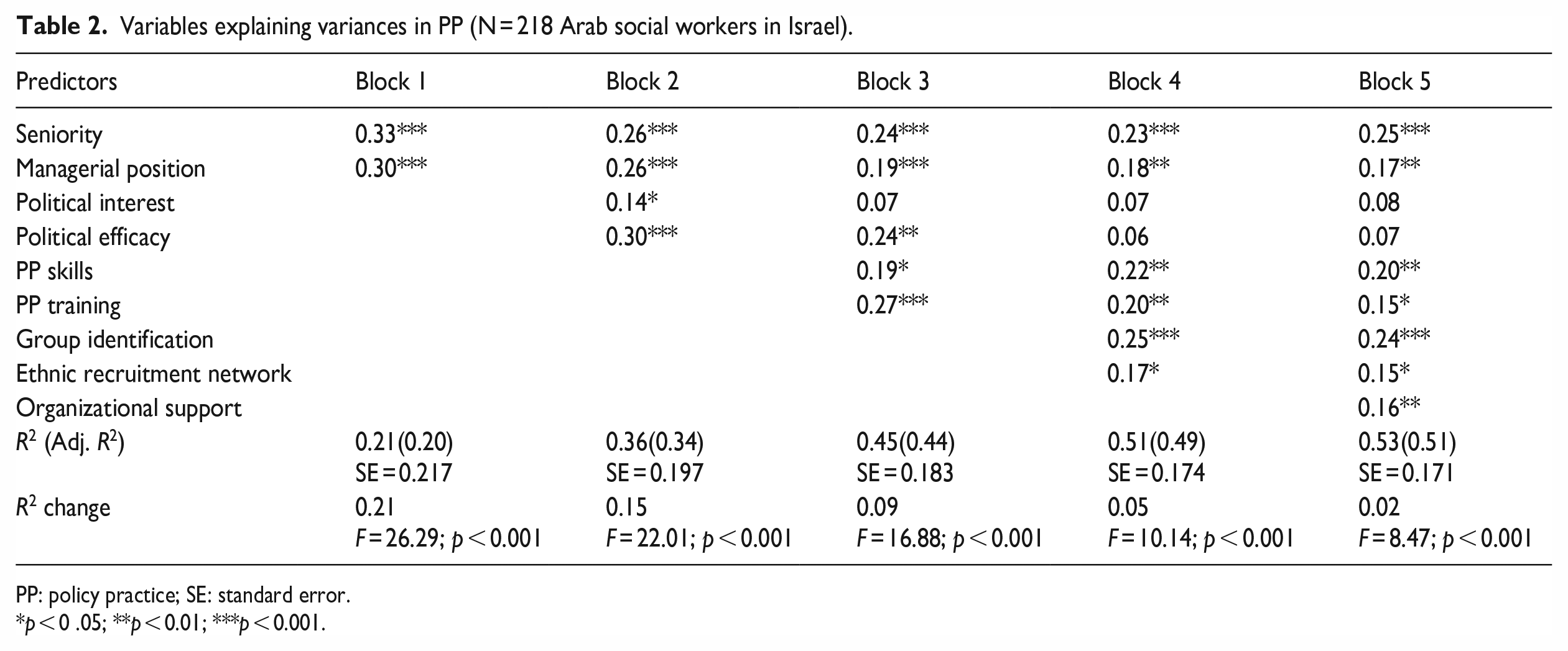
PP: policy practice; SE: standard error.
p < 0 .05; **p < 0.01; ***p < 0.001.
Table 2 shows that the variables explained a total of 53 percent of the variance in PP involvement. In the first step, two measures of personal resources – seniority and managerial position – explained 21 percent of the variance, suggesting that the higher the professional status, the greater the involvement in PP. In the second step, two civic attitudes variables – political interest and political efficacy – contributed another 15 percent to the explained variance, though the contribution of political efficacy was more significant. In the third step, two measures of professional resource variables – skills and training – contributed another 9 percent to the explained variance. The greater the social worker’s skills and training, the greater the PP involvement. In the fourth step, two measures – group identification and activity in ethnic recruitment networks – added an additional 6 percent to the explained variance, so the stronger the group identification and the level of SWM activity in ethnic recruitment networks, the greater the PP involvement. Finally, organizational support contributed another 2 percent to the explained variance and was statistically significant, hence suggesting that the greater the organizational support for PP, the greater the involvement in PP.
Discussion
This article presents empirical evidence regarding factors that explain the involvement of SWM in PP, based on data from a survey of local government social workers from the Arab minority group in Israel. The study revealed that the sociopolitical context of an ethnic minority is significant to these social workers’ involvement in PP. Social workers from a minority group are more likely to engage in policy when they have a political predisposition and a concept of political efficacy, identify with their minority group, and are involved in ethnic recruitment networks. Higher professional status, professional resources, and greater organizational support also predict minority group involvement in PP.
These explanatory factors, which correspond to the research hypotheses, have been partially addressed in the social work literature. Previous studies have pointed to personal factors such as managerial status, political efficacy, skills and training for PP, and organizational support as factors that contribute to social workers’ involvement in policy arenas (e.g. Gal and Weiss-Gal, 2022; Gillingham, 2007; Hoefer, 2016). The present study is novel in that it points to these factors in a minority context. SWM are not only required to have skills and a professional status that may give them confidence to act in policy arenas, they are also required to have a perception of political ability to act in policy arenas shaped by the majority in society and for the organizational support to do so.
The literature dealing with the involvement of ethnic minorities in policy arenas emphasizes that high levels of political interest and perceived political efficacy by minorities can influence the process of policy design by increasing political participation (Verba et al., 1995). These findings have been documented in previous studies (Kwok, 2022), but have rarely been examined in the context of SWM. The research findings clarify that actual involvement in policy requires political efficacy that may be achieved by belonging to ethnic recruitment networks. The involvement of SWM in ethnic recruitment networks may provide support to social workers and help them accumulate more knowledge resources and skills relevant to PP.
Minority groups in multicultural societies often face alienation and exclusion. Social workers’ identification with the disadvantaged minority group may, as the findings of the present study show, stimulate a reactive focus in an attempt to change reality. The previous literature emphasizes that involvement in ethnic groups may lead to empowerment by facilitating the expression of shared identities. Intercultural dialogue that takes place in ethnic minority groups contributes to learning and recognizing intra- and inter-group differences, promotes critical awareness, fosters empowerment by processing shared experiences, and helps in taking joint steps in fighting oppression (Mullaly, 2002; Schoem, 2003).
Organizational support is another important factor for the involvement of SWM in policy arenas. This finding confirms the claims in the literature that organizations employing social workers can influence levels of involvement in policy-related activities (Gewirtz-Meydan et al., 2016; Nouman, 2020; Schneider and Lester, 2001). Social workers are not only individual professionals who seek to promote policy goals, as is expected of them according to their professional code of ethics. They are also representatives of agencies that determine in different ways the contours of their employees’ policy-related activities. Organizational system support provides legitimacy for SWM to act in policy arenas.
The present study has three main limitations. First, it is based on self-report. Although self-report is the most commonly used tool in professional practice studies, it relies solely on SWM’s own responses and can be subject to social desirability. Second, its cross-sectional structure does not enable us to make claims for causality but only to identify associations between the motivational and facilitating factors and involvement in PP. Finally, the study focused on Arab social workers, who are a native minority in Israel employed in Arab local government. We recommend that future studies examine this issue among various minority groups employed in diverse welfare services.
Implications for social work
In order to increase the involvement of SWM in policy arenas in multicultural societies, professional bodies and educational frameworks for social work should provide social workers with knowledge resources and professional skills in the field, including tailored organizational support that legitimizes minorities to operate in policy arenas. These frameworks should also encourage belonging to ethnic recruitment networks in order to promote perceptions of identification and a sense of minorities belonging to their community and taking joint steps to promote beneficial policies.
The commitment of social work to the promotion of social justice can be manifested by integrating these subjects into the curricula of schools of social work by expanding the discourse on PP in sociopolitical contexts. Such curricula should develop a critical awareness of the oppression of policy and power relations in society, while increasing political interest and the perception of political efficacy to promote social justice and equality in multicultural societies.
Footnotes
Declaration of conflicting interests
The authors declared no potential conflicts of interest with respect to the research, authorship, and/or publication of this article.
Funding
The author disclosed receipt of the following financial support for the research, authorship, and/or publication of this article: This work was supported by Israel Science Foundation [Grant Number 51/3651].
