



Abstract
The review explored how serious games are utilized for preventing adolescents’ social exclusion. Four original articles were retrieved using six databases. The use of serious games to prevent adolescents’ social exclusion was rare, but there are potential areas where serious games could be utilized. Serious games may be a promising new intervention to use in adolescents’ social rehabilitation and social work, preventing social exclusion, reducing the risk of unemployment, lack of education and training. These early findings suggest using serious games as a part of adolescents’ social work and social rehabilitation to prevent social exclusion among adolescents, along with other methods.
Introduction
The COVID-19 pandemic has challenged health care systems and global working markets and disrupted people’s education, family and social lives. In addition, lockdowns, quarantines and closed borders have impacted in many ways children’s well-being, mental health and development globally. Because of lockdowns, children and young people were placed out of sight, which makes protection of them more difficult (O’Leary and Tsui, 2022). Moreover, due to the pandemic, many families have lost their source of livelihood, great drops in income causing poverty (O’Leary and Tsui, 2022). Now, when the COVID-19 pandemic is easing, social work is facing new challenges, such as international geo-political conflicts in terms of military tensions, climate change, inequality and violence (O’Leary and Tsui, 2023). Geo-political confrontations may cause fear and insecurity in youths’ lives. The effects of armed conflicts on children and youths’ physical, mental and behavioral health are direct and indirect (Shenoda, 2018). Therefore, the most vulnerable groups, including youth, are now at even higher risk of social exclusion (Unt et al., 2021). Social work has a critical role to support and empower these groups, who must manage their lives with limited resources and resilience after the pandemic and other globally arising challenges (O’Leary and Tsui, 2022, 2023). Hence, one key thing is to prevent social exclusion among adolescents. The pandemic has also challenged established client work practices in social work. Information and communication technology-mediated digital social work has become more common and advanced due to social distancing (Harrikari et al., 2021; O’Leary and Tsui, 2023; Pink et al., 2021). The European Commission’s scientific and policy report addressed the potential of digital games to support social inclusion and empowerment goals. Moreover, the development of digital games may promote the effectiveness of public services and interventions, reducing social exclusion (Steward et al., 2013). Gaming is a popular activity among young people, so that it is justified to add some game-based methods to the social work tool kit. In addition, game-based approaches have the potential to reach out to adolescents at risk of exclusion (Steward et al., 2013).
The definition of adolescence by the World Health Organization covers the age group 10–19 years, which means life between childhood and adulthood. Young people are defined as those between the ages 10 and 24, and youth are defined as the age range 15–24 years (WHO, 2021). The COVID-19 pandemic has also affected children’s well-being in the European Union. Social inequality has increased in many countries; more and more families are living at risk of poverty. Anxiety, mental health problems and domestic violence have increased, and school closures have had negative impacts on children’s social lives and learning outcomes (Eurochild Report, 2020). Children and adolescents are experiencing symptoms such as difficulties in concentrating, boredom, irritability, restlessness, nervousness, feelings of loneliness and being uneasy and worried (Orgilés et al., 2020). Many of the impacts of the COVID-19 pandemic and other arising global crises are likely to increase the risk of social exclusion among young people.
Social exclusion can be seen as a dynamic process, and also as an identity or a condition, and it has economic, sociological, interactional, cultural and political dimensions (Silver, 1994). Social exclusion can be described as ‘a state in which individuals are unable to participate fully in economic, social, political and cultural life, as well as the process leading to and sustaining such a state’ (United Nations, 2016). It is experienced especially by certain groups of people, for example, indigenous peoples, the poor, the homeless, the mentally ill and people with disabilities (Popay, 2010). People may be excluded from financial aspects of living, such as making a livelihood, earnings, minimal or prevailing consumption levels, property, credit or land, and also from things like secure and permanent employment, housing, education, skills and cultural capital. Excluded people may also suffer from lack of the benefits provided by the welfare state, citizenship and legal equality before the law, democratic participation, public goods, the nation or the dominant race, family and sociability, humanity, respect, fulfillment and understanding (Silver, 1994). A relational approach focuses especially on exclusionary processes and the unequal economic, political, social and cultural power relationships that are related to them (Popay, 2010).
Silver (1994) introduces three paradigms of social exclusion based on different notions of social integration. In the solidarity-paradigm, exclusion is seen to happen when the bond between the individual and society (social solidarity) falls apart. The specialization-paradigm defines exclusion resulting from specialization (social differentiation, economic division of labor and separation of spheres). The exclusion does not necessarily occur in every social sphere. The third, monopoly-paradigm, describes exclusion as a result of the formation of a group monopoly, when the institutions and cultural distinctions create boundaries to keep others out and sustain inequality.
Global youth unemployment is a growing problem (Mawn, 2017) and it has been increasing due the pandemic (Barford et al., 2021). Young adults who are outside of the labor market or educational system, the so called ‘Not in Education, Employment, or Training’ (NEET), are at a higher risk of social exclusion (OECD, 2021). Studies show that they are likely to have more problems with mental health as they have often had poor school experiences, such as learning difficulties and bullying (Gutiérrez-García et al., 2018). These adolescents often come from low socio-economic backgrounds and are lacking the skills to improve their economic situation (OECD, 2021). The preventive aspect of tackling unemployment among adolescents now plays an even more crucial role in social work practice and in social rehabilitation.
As mentioned previously, social exclusion especially concerns marginalized groups of people. Marginalized adolescents may suffer from difficult relationships, lack of social and political participation, poor physical and mental health, drug abuse and criminality (Bynner and Parsons, 2002). Moreover, the societal costs of adolescents’ unemployment are massive (Mawn, 2017). Therefore, reducing adolescents’ unemployment has been a priority in high-income countries worldwide. Earlier research has found that the characteristics are often associated with a low educational level or early school-leaving (Furlong, 2007). Moreover, unemployed persons are more likely to be at risk of psychiatric disorders, substance use and suicidal behavior (Benjet et al., 2012). In addition, poor social skills, inactivity and problems in managing daily life are typical with these adolescents (Kiss et al., 2022). Previous studies have found that this group of adolescents has major motivation challenges and disengagement, which block them from moving toward employment or education (Katznelson, 2017). Social work practice and social rehabilitation has an important mission to help adolescents facing these kinds of life challenges (IASSW, 2022).
Social rehabilitation is a multidimensional concept and does not have an unambiguous definition. Furthermore, it is not widely used internationally. According to Kataja et al. (2022), the concept of social rehabilitation refers to the services that concentrate specifically on the social aspect of the rehabilitation process. The aim of social rehabilitation is to increase human well-being by strengthening opportunities and facilitating the interaction between individuals and their environment (Kataja et al., 2022). Moreover, social rehabilitation often involves corrective work, but it also seeks to prevent social exclusion. The aim of the support offered by social rehabilitation is to strengthen the client’s social capacity, to combat social exclusion, and promote social inclusion by individual support and group activities (Ministry of Social Affairs and Health, 2023). Social work professionals deliver services to excluded individuals and groups in society and empower service users by acting as progressive agents of change (Cunningham and Cunningham, 2014). Social rehabilitation may take place through services and activities, such as social assessment, therapy, counseling and coaching, educative groups, vocational training, job hunting, solving relationships or communication problems and recreational activities and outings. Two distinct client groups of social rehabilitation are patients with a clear medical diagnosis or an impairment, which affects their social life, and people with various psycho-social problems that may stem from a difficult background or socially unconventional behavior (Kataja et al., 2022). A bio-psycho-social approach with interprofessional collaboration may play an important role in social rehabilitation services (Saia et al., 2020).
An integrative review of studies on social work practices with adolescents and young adults with complex needs shows three empirically generated themes: collaboration-, relationship- and empowerment-oriented practices. In collaboration-oriented practices, collaboration is seen as a tool to avoid fragmentation in the human service delivery system. Relationship-oriented practices emphasize the quality of the relationship between the professional and the young person; and empowerment-oriented practice addresses the young person’s involvement in decision-making and services. The concept of ‘complex needs’ may include a large variation of different kinds of problems and needs that the person may have, for example mental illness, difficulties in completing education, unemployment, out-of-home care, substance abuse and juvenile delinquency (Almqvist and Lassinantti, 2017).
Previously it has been noted that serious games might be one solution for different problems that adolescents at high risk of social exclusion may suffer. A serious game is a game designed for other primary purposes than solely entertainment (Bonnechère, 2018) and these include the following elements: intrinsic motivation, learning through enjoyment and ‘fun’, authenticity, self-reliance and autonomy and experiential learning (Perrotta et al., 2013). Serious games facilitate learning and participation in several ways (Steward et al., 2013). Furthermore, serious games are usually created to achieve different goals (e.g. learning, health, recovery) (Dörner et al., 2016). The advantage of serious games is that they promote players’ motivation and positive feelings (Bakkali Yedri et al., 2018). Serious games are highly motivating and engaging, because of the feedback mechanisms and interactivity, which can promote the self-efficacy of the player (Anastasiadis et al., 2018). Serious games contextualize the player’s experience in challenging, realistic environments, supporting situated cognition (De Gloria et al., 2014). Further potential benefits of serious games include problem-solving and increased social skills, such as collaboration, negotiation and shared decision-making (Susi et al., 2007), not to mention, developing online collaboration and creative thinking (Steward et al., 2013). Furthermore, 3D games allow players to experience realistically simulated situations, which might be difficult to experience in the real world (Susi et al., 2007). Former studies have noted that adolescents at risk of social exclusion might benefit from the opportunities offered by engaging in ‘non-traditional’ learning and opportunities for fun and enjoyment (Barnes and Morris, 2008), which can be achieved by playing serious games. According to Steward et al. (2013), serious games can have the potential to support disengaged and disadvantaged learners, enhance employability and integration into society, promote health and well-being and foster civic participation and community-building.
According to Fleming et al. (2017), serious games provide potential benefits for psychological and behavioral changes. Serious games have been utilized for years in the context of medical rehabilitation (Nap and Diaz-Orueta, 2014; Sánchez-Herrera-Baeza et al., 2020) and, to some extent, also in education and training (e.g. De Gloria et al., 2014), vocational rehabilitation of individuals with physical disabilities (e.g. Bozgeyikli et al., 2018) and cognitive rehabilitation (Korhonen and Halonen, 2017). In addition, serious games have been used for treatment or prevention of depression (Fleming et al., 2014). The most common demographic groups using serious games are children, the elderly and patients with certain diseases (Korhonen and Halonen, 2017). When developing a serious game in social and health care it requires a deep understanding of the subject area. This also requires that the supporting specialists in this area are included in the process. Compared to entertainment games, serious games are developed with a limited budget. This is one reason why it is challenging to fulfill youth needs especially (Korhonen et al., 2019).
As stated before, the social work profession is trying to tackle social exclusion by promoting change (Cunningham and Cunningham, 2014). Serious games may play an important role in communication campaigns for social change, and they could also facilitate social change on an individual level. Compared to learning and developing, social change is a broader, multicomponent phenomenon that is closely connected to the people’s everyday lives, often in their communities and with their families. The notion of social change should be examined at the societal, meso- and individual levels. At the individual level, social change appears in the individual’s cognition and behavior. Properties of contemporary digital games, for example, stunning graphics and sound, rich narratives, discovery experiences and social interaction between players, could be successfully utilized in serious games for social change (Klimmt, 2009). However, previously, it has been noted that serious games targeting, for example, life management skills are still very rare (Korhonen et al., 2019).
According to Klimmt (2009), playing serious games could be useful in facilitating social change because of the mechanisms of playing that may affect the player’s motivation to elaborate the content of desired social change, as well as knowledge acquisition/comprehension and attitude change/persuasion. Within an educational context, serious games have been utilized to promote social change in some areas that are closely related to social work and social rehabilitation. For example, in a child sexual abuse prevention project in Australia, an online child protection resource game, Orbit (2013), was developed and piloted to reduce the incidence of child sexual abuse. The purpose of the computer game was to increase 8- to 10-year-old children’s awareness of potentially risky situations and empower them to act, and also to increase community knowledge about child sexual abuse prevention (Scholes et al., 2014). The study was able to show that there were some statistically significant increases in knowledge of sexual abuse prevention only in the intervention groups and only if the students completed the game (Jones et al., 2020).
Serious games have also been used to support the mental health of young people. An online gaming program Reach Out Central was designed to support mental health of people aged 16–25. The real-life scenarios and use of role-play encourage the player to think about solutions to common problems, consolidate learned skills and apply them in the real world. The results indicate a reduction in the use of maladaptive coping behaviors (e.g. alcohol use and avoidance) while strengthening resilience and facilitating healthier coping behaviors (e.g. problem-solving) (Shandley et al., 2010). Systematic review of 19 studies that have examined children and young people’s experiences of and the effectiveness of using applied games or virtual reality (VR) games for mental health problems reveals that children and young people find applied games helpful, enjoyable and engage with them, but they may not necessarily consider them relevant in addressing their mental health problems. Applied games have some potential in treatment of depression, but the evidence is still at a very early stage (Halldorsson et al., 2021).
In the field of social work and in social rehabilitation the use of serious games as a method of client work is still quite infrequent, even though it could be well suited for example in relationship-oriented practices. Moreover, these fields would benefit from new methods which utilize technology to prevent the problems coming from rapidly changing contexts as well as to defeat the social and psychological long-term consequences among adolescents of the COVID-19 pandemic (O’Leary and Tsui, 2021, 2023). To increase adolescent social inclusion, it is important to determine how serious games are utilized to prevent social exclusion. Therefore, this scoping review aimed to explore the literature on how serious games are utilized to prevent social exclusion of adolescents.
Methods
This study was performed using a scoping review to provide an overview of the discussed topic. The study has been prepared in accordance with the PRISMA (Preferred Reporting Items for Systematic Reviews and Meta-Analyses) Extension for Scoping Reviews (PRISMA-ScR) (Tricco et al., 2018). A scoping review is suitable for this study because knowledge about the research area is relatively scarce (Peters et al., 2015). The methodological framework by Arksey and O’Malley (2005) for scoping reviews was followed to describe how serious games are utilized for the social rehabilitation of adolescents. The framework includes five stages: (1) identifying the research question, (2) identifying relevant studies, (3) study selection, (4) charting the data and (5) collating, summarizing and reporting the results.
Identifying the research question
The authors created the research questions before beginning the actual database search for the scoping review. The following research questions were identified:
RQ1. What kinds of serious games have been used to prevent adolescents’ social exclusion?
RQ2. What kinds of outcomes have been achieved with serious games to prevent adolescents’ social exclusion?
RQ3. What kinds of experiences do adolescents have of serious games?
Identifying relevant studies
The literature search was conducted in June 2021 and updated in June 2022 in six international electronic databases, including SocIndex, the Sociology Database, the Social Science Database, the Web of Science, IEEE and ACM. First, specific keywords were identified, which after a comprehensive search strategy was developed with the help of an information specialist for each database. The search strategy included a range of relevant combinations of the keywords: ‘gamification’, ‘serious game’, ‘virtual simulation’, ‘game-based learning’, ‘computer-based simulation’, ‘adolescent’, ‘NEET’, ‘marginalization’, ‘rehabilitation’ and ‘return to work’. The search did not include any limitations, to ensure the most inclusive literature search. Zotero was used to record and manage the sources.
Study selection
The inclusion and exclusion criteria were defined to identify the most relevant studies. The inclusion criteria were as follows: (1) the included studies needed to be original empirical studies, including qualitative or quantitative data; (2) they had to be published in an international peer-reviewed journal; (3) the study population had to be adolescents, aged 13–29; (4) the included studies had to be studies which described the use of serious games in the context of social work, education or social rehabilitation; (5) the study outcomes had to deal with topics with the purpose to prevent social exclusion or to improve potential adolescent employment, education, and training; and (6) the studies had to be in English and/or Finnish. The exclusion criteria included those articles (1) which were not scientific articles, (2) in which the population were young children (aged 0–12), adults (aged over 29) or elderly, (3) which described medical rehabilitation or (4) which had used some other interventions than serious games.
The database search yielded 4062 articles in total. All duplicate records were deleted, after which 3948 articles remained. The first author screened the titles and abstracts of the retrieved studies comparing them to the inclusion and exclusion criteria. In total, 37 articles were found to be potentially relevant for a full-text review by two authors independently. Finally, four (n = 4) articles met all the predefined inclusion criteria and were included for the analysis. Reference lists of these articles were explored, but no more relevant articles were found for the review. A PRISMA flow diagram (Moher et al., 2009) was used to present the whole process of search strategy in detail (Figure 1).
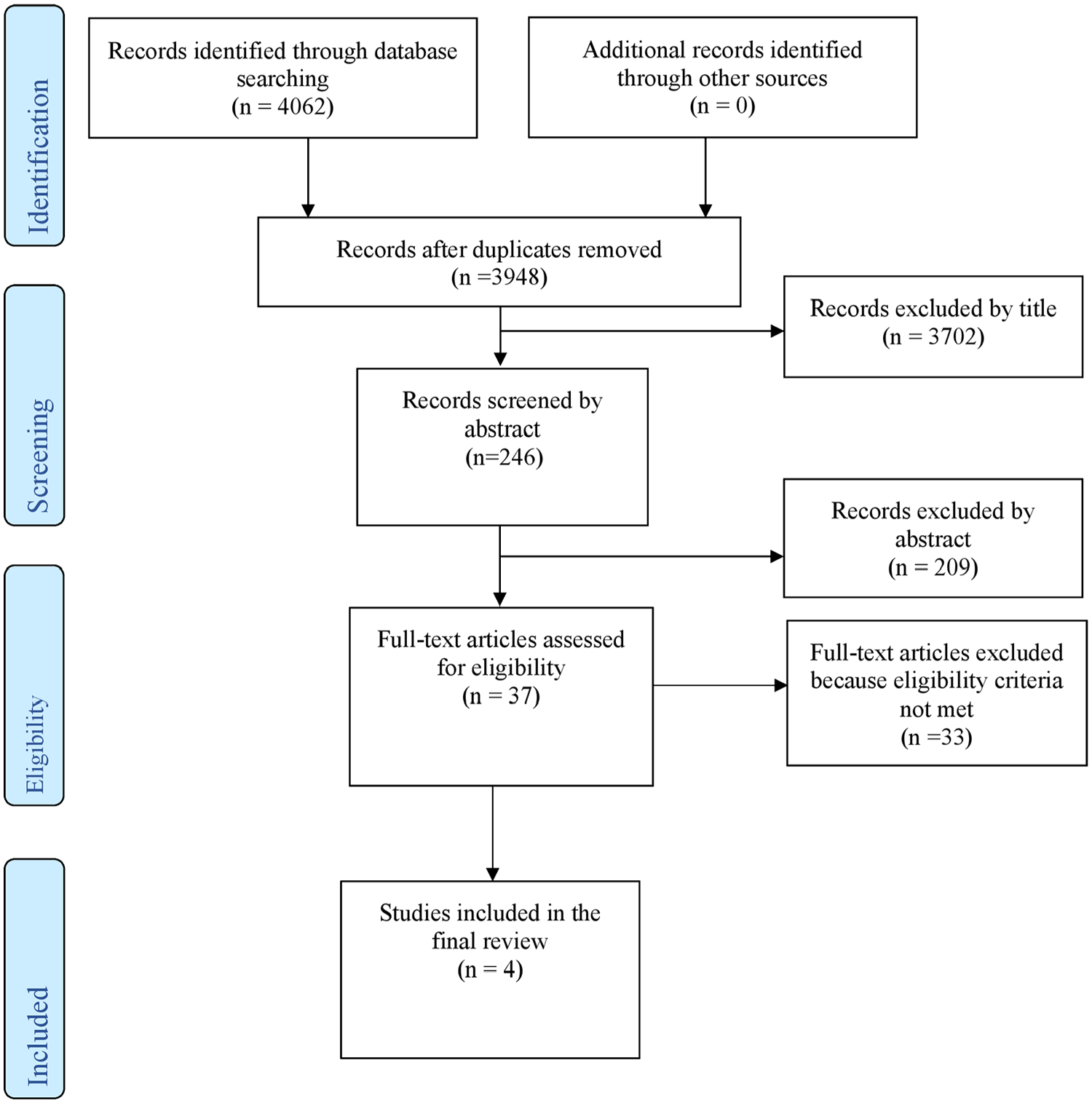
PRISMA flow diagram of the literature search of study screening and inclusion process.
Charting the data
Charting the data includes charting and sorting the key items obtained from the reviewed original articles (Arksey and O’Malley, 2005). The first author charted the data of the four articles, and the following information was sorted and collected: authors, publication year, country, aims, sample, methods, intervention and the key findings. The results were collated, summarized and reported including the data from the retrieved studies describing the articles in detail according to the research questions previously defined (Table 1).
Summary of the articles included in the scoping review.
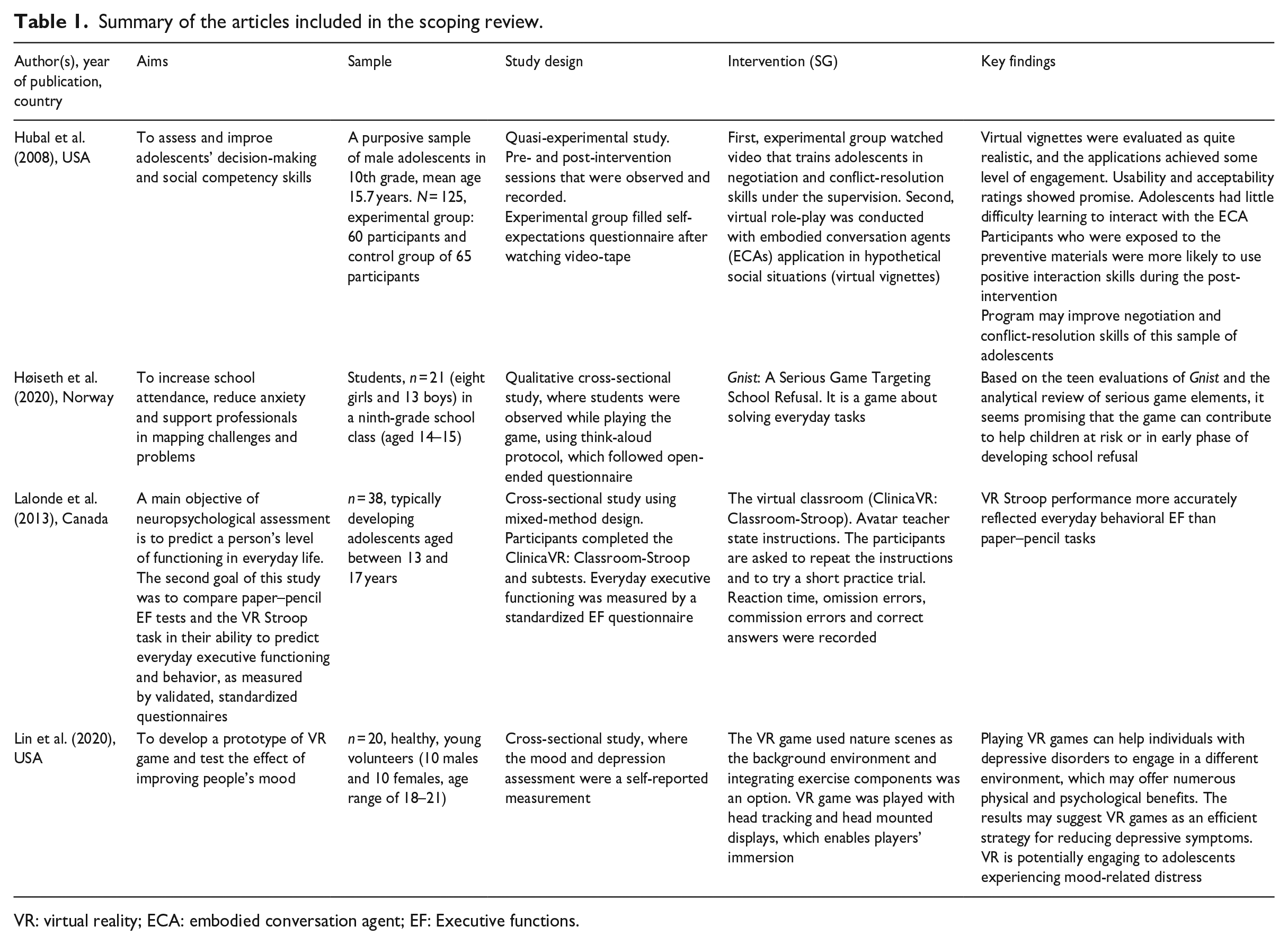
VR: virtual reality; ECA: embodied conversation agent; EF: Executive functions.
Results
Study characteristics
All the included studies were published between 2008 and 2020. The studies were conducted in Norway (n = 1), Canada (n = 1) and the United States (n = 2). The participants in the studies included adolescents aged 13–21 years. The sample sizes varied from 20 to 125. The studies consisted of quantitative (Lin et al., 2020) and mixed-method (Høiseth et al., 2020; Hubal et al., 2008; Lalonde et al., 2013) designs. Most of the included articles were cross-sectional empirical studies (Høiseth et al., 2020; Lalonde et al., 2013; Lin et al., 2020). In addition, a quasi-experimental study design was used in one study (Hubal et al., 2008). The mixed-method studies used hidden observation, recording, scales, open questions (Hubal et al., 2008), observations, think-aloud protocols allowed by open-ended questions (Høiseth et al., 2020), different questionnaires, scales and recorded tasks (Lalonde et al., 2013) for data collection. In the study by Lin et al. (2020), data collection was conducted with a questionnaire (n = 1) and a self-report rating scale.
Description of the serious games used to prevent adolescents’ social exclusion
Among the included studies, we identified four different serious games used to prevent social exclusion among adolescents. Two games were played with immersive VR gear, such as a head mounted display and microphones (Lin et al., 2020) or using a visor with a visual screen which reflected a 3D virtual classroom (Lalonde et al., 2013). The visor allowed a complete 360-degree view of the virtual environment, and a tracking device transferred the players’ location information to a computer. One game was played with a computer (Hubal et al., 2008), and one with a mobile phone (Høiseth et al., 2020). Most of the games were single player games (Høiseth et al., 2020; Hubal et al., 2008; Lalonde et al., 2013), but a VR game developed by Lin et al. (2020) was a multiplayer game enabling playing at the same time by one or more players in the same environment with different levels of difficulty. In addition, it enabled interaction and social communication between the players, such as competition, partnerships, or rivalry. In addition, there were computer-generated non-player characters on some levels, if the player decided not to play with other human players (Lin et al., 2020). The Gnist game developed by Høiseth et al. (2020) also included interaction, such as the ability to send messages to friends or caregivers.
The storylines of the games were quite different. In the study by Høiseth et al. (2020), the purpose of the game was to increase school attendance, reduce anxiety and support professionals in mapping challenges and problems. In the game, the players solved daily tasks in a motivating and fun way. The story included four phases: before school, going to school, at school and going home. In the game, a friendly monster is with the player for the entire day and the player can have small conversations with the monster. The player rates the perceived difficulty of daily activities, and this is gamified by collecting berries and feeding the monster, keeping it healthy and happy. The daily activities included things, such as ‘brushing your teeth’, ‘getting dressed’, ‘learning math’, ‘talking to the teacher’ and ‘drawing the school route on a map’. With earned points, players could buy the monster accessories from the in-game store (Høiseth et al., 2020). In the game created by Lin et al. (2020), the purpose was to develop a prototype of a VR game to improve people’s moods. Players could create their own avatars in a virtual environment that used nature and seasonal scenes and themes as backgrounds, such as mountains and islands. Exercise components, such as bicycling, or skiing were integrated into the VR game. The theme of the game is a magical world where residents are getting ill and being attacked by enemies. The player needs to find a magical healing potion and battle with enemies to save the residents. Players can choose different exercises (biking, walking, canoeing, etc.) during the game if they want.
In the study by Lalonde et al. (2013), the purpose of the game was to predict a person’s level of functioning in everyday life. A virtual classroom game called ClinicaVR, an adaptation of the traditional Stroop (1992) tasks into the VR classroom, was used to assess executive functions. The storyline in the game was that first, a teacher avatar gives instructions in front of a virtual class, and second, the player repeats the instructions and tries a short practice trial. An example task consisted of the following. Three boxes with different colors are shown on the virtual chalkboard. The teacher states the name of the color as each stimulus appears. Next, the player needs to click mouse if the color on the chalkboard is the same as that stated by the teacher. The game recorded the players’ reaction time, errors and correct answers (Lalonde et al., 2013).
In the study by Hubal et al. (2008), the purpose of the game was to assess and improve adolescents’ decision-making and social competency skills. Three scenarios including embodied conversational agents (ECAs) were developed. These were virtual characters rendered on a computer screen to simulate verbal interactions in hypothetical social situations with the player. The created ECA was made to represent the same gender and ethnicity as the study participants, and the purpose was to simulate provocative social situations in a school setting. The scenarios were designed to engage players in risky decision-making and exhibit impulsive behavior and insensitivity to penalties. For example, in one scenario the ECA invited the player to join in a known prohibited activity. The participants received instructions to answer the ECA as they would do in real life. In addition, the participants were instructed to respond to the ECA in their own voice (Hubal et al., 2008).
Achieved outcomes by playing
In the study by Høiseth et al. (2020), the teens reported that the gaming approach which separated daily activities, involved interaction with an interesting character, included collecting points, receiving messages and getting a visual overview, might help them going to school, being able to get things done, and sharing thoughts and reflections about the day with their friends and caregivers. Based on the teens’ evaluation and analysis of the serious game elements, the Gnist game has the potential to help children at risk or in the early phase of developing school refusal (Høiseth et al., 2020).
The VR game developed by Lin et al. (2020) has a positive effect and improved the mood for all participants. It seems that the longer the players played the game, the more effective it was at changing the players’ mood. All the players’ subjective reports showed that the game helped to improve their mood after playing the game. Study results indicated that VR games can help to both increase physical activity and reduce symptoms of anxiety and depression. Playing VR games can help individuals with depressive disorders to engage in a different environment, which may offer numerous physical and psychological benefits. The results suggest VR games are an efficient strategy for reducing depressive symptoms. Playing VR games can positively affect the mood of people with depressive and anxiety disorders (Lin et al., 2020).
The ECA technology and simulations of social situations aimed to develop a decision-making and social competency skills assessment and training tool for high-risk adolescents. The study results by Hubal et al. (2008) concluded that the used intervention with an ECA focused on the social competencies of interest and the scenarios evoked social responses. The findings indicated that the negotiation and conflict-resolution skills of adolescents could be improved with this kind of interactive virtual role-play.
In the ClinicaVR: Classroom-Stroop VR game, the participants’ performance reflected better everyday behavioral executive functioning than normal paper–pencil tests. The study found that VR could be a useful technique in assessing high-order cognitive abilities, because of the users’ feeling of presence and the games’ ability to reflect real-life functioning and behavior. In addition, study results indicate that VR has the potential to predict cognitive difficulties reflecting on daily situations (Lalonde et al., 2013).
Players’ experiences of serious games
Overall, the players’ impression of the serious games used in the included studies was very positive. The teens generally gave positive feedback on their first impression of the Gnist game. The flow of the game was considered and rated as good. They generally understood what to do and pointed out that the game seemed orderly. The game characters’ different personalities were considered easy to like and described as cool, funny, weird and cute. Humor was considered important for gaining players’ confidence. The teens liked that the game provided an overview of routines and that gaming their way through them released points (Høiseth et al., 2020). In the study by Hubal et al. (2008), most of the participants thought that the scenarios were fun, relevant, realistic and interesting. About 45% of participants claimed the scenarios were silly or stupid (Hubal et al., 2008). The other two studies (Lalonde et al., 2013; Lin et al., 2020) did not report the players’ experiences of the serious games included in the studies.
Discussion
This scoping review examined how serious games are utilized to prevent social exclusion of adolescents. The first question in this study sought to determine what kinds of serious games have been used. The present scoping review found that research focusing on gamification to prevent social exclusion of adolescents is relatively rare. The review found only four studies exploring the topic. Most of the studies were using SGs in the context of education purposes.
The studies were quite heterogeneous considering the used games and study objectives. However, all the included studies handled things that may potentially prevent adolescents’ social exclusion, such as reducing school dropouts, improving daily skills management, promoting mental health and well-being, training social skills and communication skills. The one reason that this area is so unexamined may be that applicable serious games have not been developed yet. Another reason might be that the benefits of serious games have not been recognized. In addition, more evidence is needed about the advantages of using serious games in this specific area. Moreover, the implementation of serious games in the social work practice and social rehabilitation of adolescents might be challenging because of lack of resources (e.g. knowledge of the employees, financial resources, attitudes). However, a promising aspect about serious games is that they can supply the possibility of reaching an unlimited audience (Steward et al., 2013). In addition, rapid development of technology ensures better quality of serious games, which makes playing more compelling. Kataja et al. (2022) described that social rehabilitation aims to facilitate interaction between individuals and their environment, and this is where serious games could be utilized. Even though the use of serious games in preventing social exclusion is very limited, there can be found potential areas where serious games could be utilized, such as in social assessment, job hunting, solving relationships or communication problems and recreational activities and outings (Kataja et. al., 2022), as well as migrant integration and tackling school and training dropouts (Steward et al., 2013).
The second question in this research concerned the outcomes achieved with serious games to prevent adolescents’ social exclusion. The current study found that all the included study outcomes varied. However, all the included studies handled things that may potentially prevent adolescents’ social exclusion, such as reducing early phase school refusal, reducing symptoms of anxiety and depression, developing decision-making and social competency skills and adolescents’ ability to reflect on their real-life functioning and behavior. This finding is associated with Katznelson’s (2017) study, which indicated that marginalized adolescents suffer from major motivation challenges and disengagement, which may negatively affect this group of adolescents to obtain employment or education. For example, the game called The Gnist used in the study by Høiseth et al. (2020) might help children going to school, be able to get things done and share thoughts and reflections about the day with friends and caregivers. They suggested that The Gnist has great potential to help children at risk or in the early phase of developing school refusal.
Previous research has found that marginalized adolescents frequently suffer from mental health problems (Benjet et al., 2012; Bynner and Parsons, 2002). Moreover, the present consequences of pandemic and other world crises might negatively affect the mental health of adolescents (O’Leary and Tsui, 2021, 2023). One included study result showed that players’ moods improved after playing (Lin et al., 2020). It could thus be suggested that serious games might be a potential option for use with adolescents who have problems with their mental health. Moreover, adolescents in the risk of social exclusion often suffer from poor social skills, inactivity and problems managing daily life (Batini et al., 2016; Kiss et al., 2022). Another included study noticed that VR games were able to predict cognitive difficulties with daily situations (Lalonde et al., 2013). It is also crucial that games exist that can measure everyday behavioral executive functioning. Serious games used in social work or social rehabilitation can facilitate interaction between the players and the environment (Kataja et al., 2022), which may promote managing daily life, social interaction and overall activity, including job- or training-seeking.
The last research question asked what kinds of experiences adolescents have of serious games. Only two of the included studies reported the players’ experiences of the played games, and all the experiences were positive overall. The users’ positive experiences may have possible effects on motivation and outcomes in which the games target. Serious games have been proven to be fun, engaging, motivating and realistic (e.g. Iten and Petko, 2016). Therefore, the use of serious games to prevent adolescents’ social exclusion could be promising. Using serious games for tackling unemployment might be an innovative way to motivate young people to seek jobs or training and education options. Motivating adolescents by playing serious games might be easy, because usually this generation is competent using games and technology. Nevertheless, more study of adolescents’ attitudes and experiences concerning serious games used in this context is essential.
According to Klimmt (2009), serious games may play an important role in the social change of individuals, and the change appears in the players’ cognition and behavior. Interaction is one element that may enhance social change. This review revealed that almost all the included studies used some kind of interaction in the games. The game used in the study by Lin et al. (2020) allowed social interaction between players or virtual characters. In addition, in the study by Hubal et al. (2008), adolescents’ decision-making and social competency skills (such as negotiation and conflict-resolution skills) were improved with verbal interactions in hypothetical social situations with the player. The Gnist game allowed communication with other players or caregivers (Høiseth et al., 2020). These kinds of games may promote social change in adolescents and help prevent social exclusion, through interaction.
This scoping review was conducted systematically, following a high degree of scientific integrity. However, the results of this review should be interpreted cautiously because of some limitations. The first limitation relates to the selected search terms. The search terms were comprehensive and yielded lots of studies, nevertheless some relevant studies might remain missing. The second limitation relates to the risk of bias in including and excluding articles, even though predefined criteria were specified. The third limitation pertains to the risk that only one reviewer conducted the first two parts of the review. However, two authors independently accomplished a full-text review and the final study selection. In addition, there are some limitations relating to the included articles. First, the number of included articles in this review was relatively small. The review resulted in only four studies. However, studies were carefully chosen compared to the predefined criteria.
Further research and implications for practitioners
Based on reported results, the use of serious games to prevent adolescents’ social exclusion seems to be initially promising, even though the results are preliminary. Social work and social rehabilitation practices might benefit from these kinds of tools to empower and help adolescents at risk of social exclusion. Serious games might be useful to develop young people’s life management and job, training or education seeking skills, as well as studying and working skills. Playing is fun and motivating, which positively affects adolescents’ mood and mental health, which may lead to better capacity of life management skills. The results suggest implementing and using serious games among this specific group to obtain more data on the potential benefits. The need for accurate content targeting to prevent adolescents’ social exclusion is crucial. Further research should be undertaken to investigate the use of serious games in social work practices, social rehabilitation, and in general among adolescents. It would be important to clarify which goals, what kinds of situations and which group serious games would be suitable for. Moreover, additional studies will be needed to determine the experiences of adolescents and professionals with serious games in this specific context. More evidence about the usefulness of serious games is needed. Finally, an important issue for future research is to develop more applications which reflect the needs of adolescents.
Furthermore, these study results offer different implications for practitioners. The study results encourage social work practitioners to use serious games to prevent social exclusion among adolescents and in the social work and social rehabilitation of adolescents without preconceptions. These results suggest social work practitioners should adopt serious games as a new alternative rehabilitation tool to use with adolescents, for example, in school social work, child welfare and after-care. Applicable serious games could not only be usable in casework with individuals but also as a working tool with different kinds of groups, for example, in schools, community centres and child welfare institutions. Serious games could be utilized to promote social change and participation on the individual level and to support communality with different client groups on the communal level. In addition, serious games might be a solution to use with adolescents who have already grown up along with the technology revolution and have experienced the breakthrough in entertainment games. Using serious games along with other methods in social work practices and social rehabilitation might help the practitioners to construct dialogical interaction with the adolescents and increase adolescents’ motivation and engagement, ultimately promoting social change. Nevertheless, it is crucial to develop more serious games and appropriate content for this specific context of social rehabilitation, after which these games can be implemented in practice.
Conclusion
The findings of this review highlighted that research using serious games to prevent social exclusion of adolescents continues to be extremely limited. Serious games were used preventively in the early phase of developing school refusal, to improve adolescents’ moods, predicting adolescents’ everyday life functioning and adolescents’ decision-making and social competency skills. These preliminary findings cautiously suggest that serious games can be used with adolescents experiencing social exclusion to motivate and engage them to social inclusion. Serious games may be a promising new intervention to use in the social work and social rehabilitation of adolescents, reducing the risk of unemployment, and lack of education and training. Increasing motivation and engagement may positively affect adolescents’ behavior and may lead to social change. These early findings suggest that using serious games to prevent adolescents’ social exclusion in social work and social rehabilitation practices, along with other methods, such as social assessment, counseling, coaching and vocational training has potential. These different methods together could create the most comprehensive way to help adolescents concerning the studied phenomena. Nevertheless, the need for more adequately conducted studies to test serious games in the social work practices and social rehabilitation of adolescents is highlighted before drawing clear conclusions.
Footnotes
Declaration of conflicting interests
The authors declared no potential conflicts of interest with respect to the research, authorship, and/or publication of this article.
Funding
This study was funded by Kela, the Social Insurance Institution of Finland.
