




Abstract
A plethora of discussion informs decolonising social work. However, how social work can be decolonised from women’s perspective is still unexplored. Using the context of Nepal as a case study, this article theoretically explores ‘the what’, ‘the why’ and ‘the how’ of decolonising social work from women’s standpoint. It is hoped this analysis will initiate and contribute to the critical debate on women, social work and decolonisation in Nepal and elsewhere.
Keywords
Introduction
The social work profession is an imported, borrowed discipline and practice in Nepal. While the decolonising debate has already been set forth in Nepal, the question of decolonising social work from Nepali women’s perspective has yet to be addressed. This article thus explores ‘the what’, ‘the why’ and ‘the how’ of decolonising social work from Nepali women’s positionality and perspective.
This article begins with a brief account of the (de)colonising of social work in Nepal. This section also briefly outlines the colonial linkage of Nepali social work and the way it continues to be sustained in Nepal. Then, drawing mainly on the idea of androcentrism, the next section of this article discusses how Nepali society centres around Nepali men and their perspectives, priorities and principles to push Nepali women to the periphery. This section also highlights poor development indicators relating to women in Nepal. For instance, the Gender Development Index, Gender Inequality Index and Human Development Index (female) are 0.933, 0.452 and 0.581, respectively, in Nepal (see Table 1). Thereafter, it briefly examines social work’s ideology, pedagogy and technology, and, thus, poses a question: Can social work really emancipate Nepali women? Finally, this article discusses the need and prospect of decolonising social work with Nepali women.
Development indicators of Nepali women.
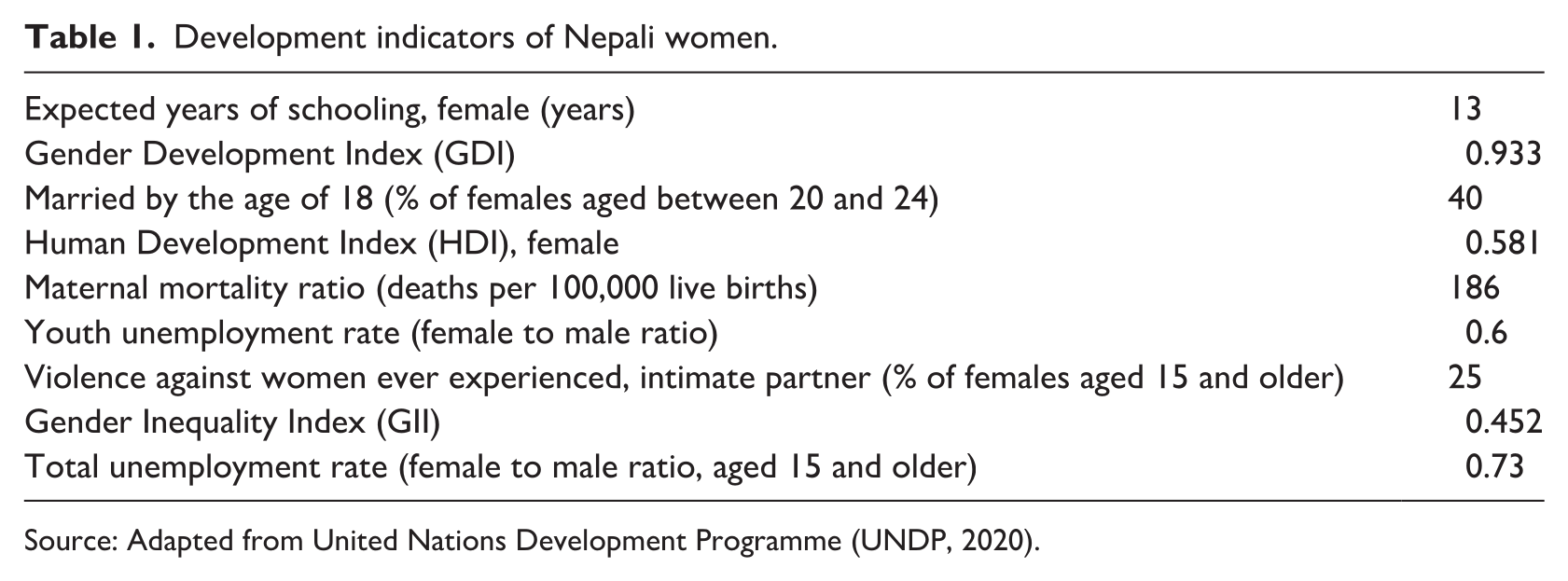
Source: Adapted from United Nations Development Programme (UNDP, 2020).
Important to note from the outset, this article not only rejects the universalism notion and approach of mainstream social work but it also defies the homogeneous advocacy for the promotion and privilege of culture that has been so central to decolonising debate. It critically delineates how an androcentric space is the product of Nepali culture that (re)produces victimisation of Nepali women. Thus, an alternative conception of decolonising social work will equip Nepali social workers with an alternative paradigm within the decolonising debate to utilise social work to both question their lives critically and emancipate themselves.
Social work in Nepal: A brief account of (de)colonising discourse
Jesuit missionaries introduced social work training in Nepal in 1987. Nonetheless, the onset of social work as an academic discipline began when St. Xavier’s College then led by American Jesuit missionaries initiated a Bachelor of Social Work programme affiliated to the Kathmandu University in 1996 (Yadav, 2019). In their endeavours to initiate social work in Nepal, they amalgamated the American model of social work with their understanding and analysis of Indian societies, and decided on a notion of social work that would thus best fit Nepali society to address its various social problems. Hence, a colonial social work was established in Nepal. Elsewhere, this beginning of Nepali social work, or colonial Nepali social work in other words, has been termed as ‘western cuisine with Indian flavour’ (Yadav, 2019 for further details).
Worth noting here, social work was introduced in the decade when the country was struggling to sustain its new multiparty democracy system, and meantime, it was dealing with the Maoist insurgency. Nepali people then faced various structural social-economic-cultural-political issues. Contrary to what was expected in social work’s responses to the structural Nepali issues, the colonial-led social work promoted clinical and psychological interventions designed to deal with individual dysfunctions (Nikku, 2012; Yadav & Yadav, 2020). As Yadav (2019) argued, such colonial-led social work has ‘failed . . . overall to encourage a critical engagement with Nepal’s multilinguistic, multicultural, and multiethnic populations’ and address their social issues which are structural in nature. As discussed below, this colonial-led social work is some distance away from thinking about Nepali women and their issues, and thus, liberating them from the cultural oppression and suppression that victimise them in several ways.
Since its inception in 1996, social work institutes have rapidly increased in Nepal. There are four universities and over 50 private colleges affiliated with these universities that offer social work education at the bachelor, master and doctoral levels in Nepal. These institutes continue to draw on Western worldviews, equipping social work graduates with knowledge and skills of social casework, interventions based on the psychodynamic approach and counselling, and Western ways of doing research (Tribhuvan University, 2021a, 2021b; Yadav, 2019). The psychodynamic approach, in particular, focuses on identifying individual deficiencies as the root cause of problems. It furthermore neglects structural issues that may cause women to have inferior statuses in Nepali society. Given this background, Yadav (2019) argued that the very notion of ‘social’ in ‘social work’ was missing in Nepal; hence, it must be revisited and simultaneously radically reformed to fit it into Nepali society. Thus, there is a need to decolonise Nepali social work.
However, the notion of decolonisation, when it concerns women, should not take a similar route as the decolonial social work scholars have argued for in Nepal and elsewhere. There is a need to think alternatively and especially from the Nepali women’s standpoint since their unique historical-social-cultural-political positionality has not been captured by the decolonial scholars. Moreover, Nepali women’s current issues and needs, as discussed below, can be neither determined nor a suitable approach to engage with them be developed unless the existing colonial model of social work education and practice is re-examined, re-visited and re-defined.
Positioning Nepali women
Understanding of position(ality) is important while seeking to decolonise social work with Nepali women. As Andreotti (2016) and Moghli and Kadiwal (2021) argued elsewhere, exploration of position(ality) from a decolonial perspective is critical not only to understand how the intersectionality of the sociocultural and political dehumanises women in Nepal, but that it also challenges the paternalistic worldview of those in the Global North or the West. Above all, practising such positionality has positive implications for Nepali women since it makes them feel included, heard and healed (Moghli and Kadiwal, 2021).
Much has already been discussed about Nepali women (see, for example, Banskota, 2012; Bhattarai, 2014; Fujikura, 2001; Leve, 2014; Lotter, 2017; Luitel, 2001; Tamang, 2009). However, missing in such discussions is a critical understanding of how the intersectionality of social, cultural, religious, economic and political practices creates an androcentric space that not only dehumanises Nepali women but also hinders their overall empowerment and emancipation. As shown in Figure 1, and discussed below in detail, such androcentric space not only undermines Nepali women’s identities such that they are considered less rational, less educated and not ‘men’ (Acharya, 2017: 198), but it also limits their daily identities to daughters, wives or mothers (Acharya, 2020b; Morgan and Niraula, 1995; Shrestha and Gartoulla, 2015; Subedi, 2010). Despite this, as Bourdieu’s (1977: 169) ‘doxa’ suggests, the discriminated and oppressed positionality of Nepali women is ‘undiscussed, unnamed, [and] admitted without argument or scrutiny’.
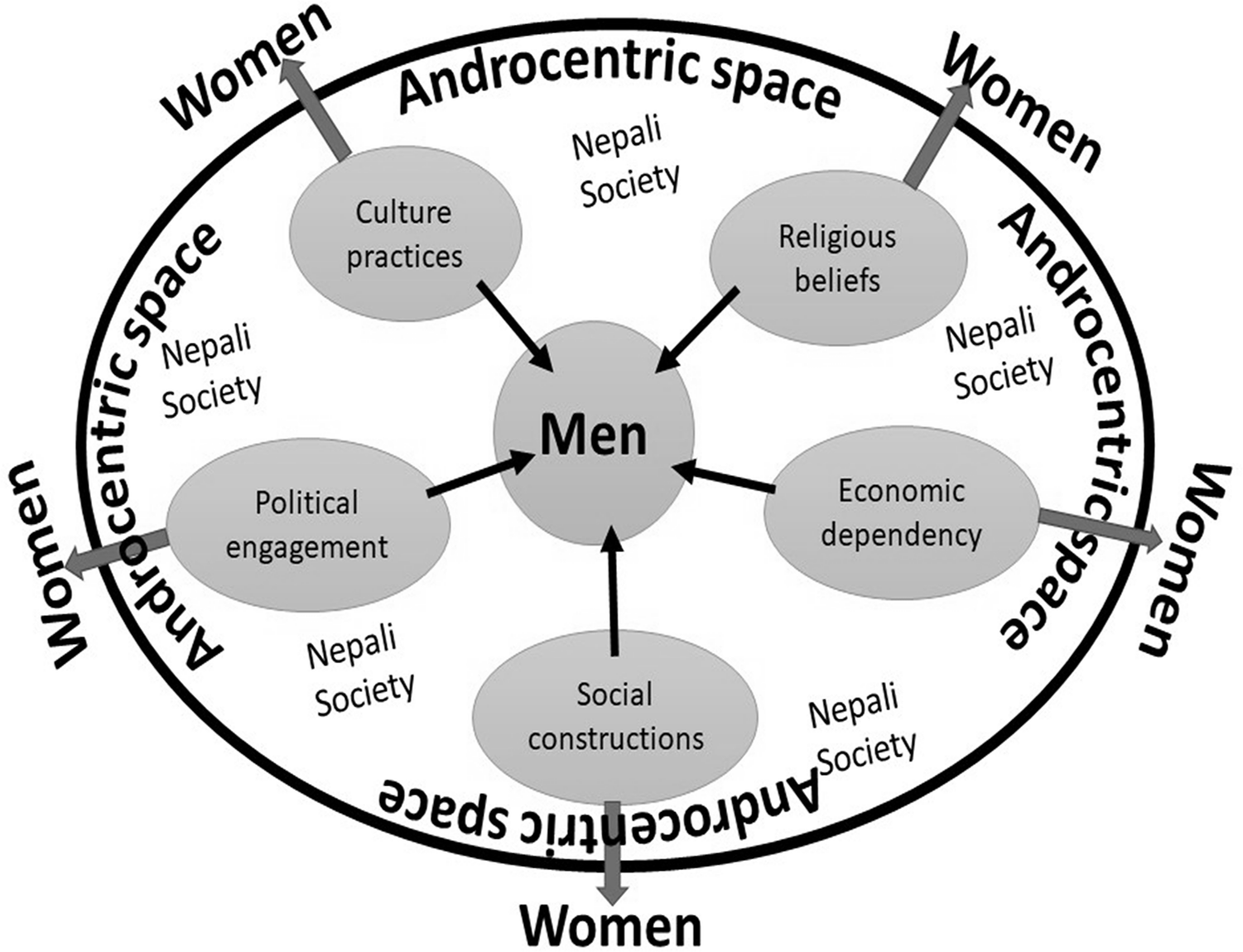
Androcentric space in Nepali society.
Several social-cultural-political practices make women vulnerable in Nepal. For example, not only are women assigned particular household chores to perform, but in general they are expected to care for the entire family (Mishra, 2018). Moreover, traditional sociocultural practices such as dowry and chhaupadi (a shed designated for a woman during her menstruation), albeit outlawed, continue in one or another form in Nepal (Adhikari, 2020; Amatya et al., 2018; Onta, 2020). These practices have worsened women’s daily experiences and, on several occasions, have even led women to lose their lives (Adhikari, 2020; Amatya et al., 2018; Sharma, 2019; Shrestha, 2019).
Although their overall status has improved in more recent years, Nepali women still face myriad discrimination across their lifespan. First, preference for a male child is still a common practice among many Nepali communities, with the birth of a girl child viewed unfavourably and considered a financial burden for the family. To this, Bista (2004: 7) argued that ‘the birth of a girl child is considered pricey, as well as they are considered as someone else’s property, Such belief is still prevalent in rural parts of Nepal’. (Gupta, 2019).
Later, a female child has to identify herself not according to her unique individuality but in relation to male members, argued Acharya (2006). It is common that most women, especially in the rural areas of Nepal, introduce themselves as someone’s daughters, sisters, wives or mothers instead of by their own names (Acharya, 2020a; Pathak, 2019; Shrestha, 2017). Later, despite their maturity and ability to decide on their marriage, it is the family, in fact, the male members of the family, who approve their choice of a partner in one or another way (Ahearn, 2004). Once married, it is general practice that a woman should compromise with her last name and change it according to her partner’s last name. Moreover, she must listen to and obey her partner, and at times should also consult her in-laws to make decisions in her life (Acharya, 2020b).
Furthermore, there are stigmas and taboos that worsen Nepali women’s situation. For example, a widow, as it has been commonly believed in Nepali society, should refrain not only from re-marrying but also from dressing herself colourfully. Moreover, their social and public participation in traditional and cultural activities is restricted since they are considered impure and their presence in these activities is believed to be a bad omen (Galvin, 2005; Yadav, 2016).
Worth noting in this regard, Hinduism mainly dominates Nepali societies and several practices within it contribute to the inferior statuses of Nepali women. For instance, chhora paye swarga jane – that is, the birth of a son opens heaven’s door for parents – is a widespread belief among Nepali Hindus (Malla, 2001). Also, it is believed that one’s heredity can be only sustained through a son and the funeral rites should only be performed by the male children. Such religious practices compel women to give birth to many children until they deliver a son, and parenting remains gendered as the birth of every child forces women into domestic slavery (Manchanda, 2004). Women are blamed for not giving birth to a son, and quite often, they are humiliated, abused and rejected by their family members for the same reason. In the past, as Clark et al. (2018), Subedi (2011) and Oomman and Ganatra (2002) noted, many women were forced to have abortions, and in the worst-case scenarios, either they faced polygamy or got divorced when they gave birth to female children. Needless to say, this has an insidious effect on women’s health and well-being.
The sociocultural and religious barriers explained above also contribute to women’s limited involvement in the economic sector. According to the World Bank (WB, 2020), women’s involvement in the industry and service sectors is significantly lower than men’s involvement. Only 6.71 and 13.48 percent of women are employed in the industry and service sectors, respectively, which are 20.08 and 20.92 percent for men. Women are generally forced to adopt the role of housewives rather than economic producers (Rajkarnikar, 2019). However, when they get an opportunity to work, they are mainly employed in the so-called ‘women’s job sectors’ that consist of agriculture, sewing and knitting and the carpet industry where pay is minimal. R.C. Acharya (2020a) further explains that women’s involvement in managing daily household work as well as their roles in caring for the family members and raising their children is far from being recognised as an economic contribution, which is significantly higher compared to their male counterparts. In addition, women relocate and/or even quit their education and jobs after marriage, which curtails their freedom to choose careers and prospective opportunities (Devkota and Bagale, 2015; Sekine and Hodgkin, 2017).
Nor is woman’s political status different in Nepal. The Constitution of Nepal 2015 states that there must be a mandatory 33 percent of women’s representation in the parliament. Women were able to occupy 41.8 percent of the political positions across the country in the 2017–2018 provincial and local elections (Upreti et al., 2020). Nevertheless, critics note the rampant gendered politics in Nepal. They are concerned that women’s representation in politics is merely tokenistic since their political decisions are controlled by the men – either their kin or their parties’ male leaders (see, for example, Acharya, 2017; Jamil and Dangal, 2009; Khadka et al., 2014; Momen, 2013). Not only are their capacity and competency consistently questioned in the Nepali political space but also women are far from taking leadership roles in any of the political parties (Upreti et al., 2020).
Thus, as shown in Table 1, Nepali women’s subordinated and inferior positionalities have impacted their overall development and progress. The UNDP (2020) reported that 40 percent of females aged between 20 and 24 got married by the age of 18. This limits the time they spend in education to 13 years, negatively impacting their involvement in economic activities. With a score of 0.933, Nepal has been listed in group 3 for the Gender Development Index. This means that Nepal is a country with medium equality in the Human Development Index achievements between women and men, which indicates a high prevalence of gender gaps. Similarly, the Gender Inequality Index score for Nepal in 2020 was 0.452 indicating Nepal’s poor performance in achieving equality between women and men in the areas of reproductive health, empowerment and labour market. Women’s labour force accounts for only 26.3 percent as compared to men at 53.8 percent (UNDP, 2020). Despite actively seeking employment, females aged 15 and older are neither in paid employment nor self-employed and are poorly reflected in the unemployment ratio of females to males which accounts for 0.73 (UNDP, 2020).
Also, the health status of Nepali women is not promising as Nepal grapples to meet the Sustainable Development Goals. The average fertility rate of Nepali women in 2020 was 3.1, indicating that a woman gives birth to more than three children during her lifetime (UNDP, 2020). Similarly, it was found that 186 women lost their lives due to pregnancy-related complications, which are furthermore compounded by geographical difficulties, inaccessibility to hospitals and superstition and traditional beliefs (UNDP, 2020). In addition, the extent of domestic violence is equally severe, with 25 percent of females aged 15 and over having experienced physical and sexual violence to some extent from their partners in either public or private space (UNDP, 2020).
The abovementioned development indicators suggest that the issues of women in Nepal must be taken seriously, and the focus should be on their liberation and empowerment so that they can identify their issues by themselves and address them accordingly. Social work, as defined by the International Association of Schools of Social Work and International Federation of Social Workers (2014), is primarily a profession of liberation and empowerment. Therefore, Nepali social work should engage with Nepali women. Nonetheless, as indicated above and discussed in the following section, Nepali social work is governed by colonial tradition and mentality, which fails to encompass and conceptualise the issues of Nepali women in its pedagogy and praxis.
Social work with Nepali women: Liberation or glamorisation?
Social work, in general, commits to the liberation of people. Furthermore, its developmental aspect, as well as an emerging area of social work relating to women, emphasises that social workers should seek to liberate women, and in doing so, should link them with their development aspirations and goals. However, Nepali social work proves to be otherwise. As explained above and the authors’ engagements in this area confirm, it is problematic from a point of view of Nepali women’s struggles mainly for three reasons: (1) ideology, (2) pedagogy and (3) technology.
Ideologically, colonialism and imperialism inform the development of social work in Nepal, and its White Euro-American-centric foundation drives Nepali social work (Dittfeld, 2020; Gray and Hetherington, 2013; Yadav, 2019). Historically, social work is a young, developing profession in Nepal. Social work training was introduced in Nepal in the late 1980s by the Jesuit missionaries, who mainly drew knowledge from the psychodynamic approach (Yadav, 2019; Yadav and Yadav, 2020). Later, in 1996, social work was offered as an academic discipline at St. Xavier’s College in Kathmandu. However, the majority of its academics had earned their social work degrees from India. Worthy of note, the Indian social work profession itself is the result of colonialism and imperialism (Rao, 2016). Yadav (2019) critiqued that social work education, its philosophy and approaches, is purely colonial and its introduction to Nepal occurred via Indian imperialism. Dominated by colonial and imperial sentiments, social work has failed to consider the abovementioned positionality, struggles and issues of Nepali women.
Pedagogically, the continued development of Nepali social work draws on imported ways of thinking and perspective. Since its advent, social work students and researchers are mainly equipped with Western knowledge. Unfortunately, missing in this social work pedagogy is knowledge and integration of the issues and struggles of Nepali women. Uncritical adoption of Western pedagogy does not prepare Nepali social work graduates to work effectively with Nepali women, and simultaneously, does not contribute to women’s emancipation and struggles.
Generally, most social work graduates seek to work in non-government development agencies. Many of these agencies work in the sector of women’s development and empowerment (Social Welfare Council, 2022a, 2022b). Alongside social work, these non-government development agencies, too, are Western in nature and are influenced by colonial development discourse (Hertzog, 2011; Shrestha, 1995, 1997). Thus, social work graduates’ engagements in these organisations contribute to a double colonisation process (Deepak, 2012; Mikkonen, 2020; Yadav, 2019). Such a double colonisation process, in other words, neither synergises nor complements the long-standing struggles of Nepali women and their development issues that are embedded in Nepali historical-social-cultural-political practice (Mahat, 2003).
Thus, the abovementioned ideological, pedagogical and technological discussion shows that Nepali social work has little to contribute to the issues of women in Nepal. Doubtlessly, it is more a case of glamourisation than actually contributing to the liberation of Nepali women. Hence, what is required is that Nepali social work takes a decolonising perspective when it engages with women of Nepal.
Decolonising social work with Nepali women: Need and prospect
Elsewhere, discussions on social work with women continue to emerge (see, for example, Alston, 2018; Hicks, 2015; Hosken et al., 2021). Mainly influenced by critical theory (Fook and Pease, 2016; Pease et al., 2020), anti-oppressive and anti-discriminatory theories (Cocker and Hafford-Letchfield, 2014; Dominelli and Campling, 2002; Graham and Schiele, 2010; Hölscher and Chiumbu, 2020; Thompson, 2016; Wilson and Beresford, 2000), gender-sensitive social work practice (Alston, 2018; Figueira-MacDonough, 2018; Messing, 2020) and feminist social work perspectives (Butler-Mokoro and Grant, 2017; Dominelli, 2002; Sands, 1996), the idea of social work with women in these discussions has been constructed within and from modernistic, Western, privileged and a so-called developed nation point of view, where women are in a position to identify and recognise inequalities against them in the society and at work and other places. As Brown (1992: 300) rightly summarised, the Western discussions about women ‘reinforce the notion that the experiences of white middle-class women are the norm; all others become deviant – different from’. Also missing in these discussions, as Hussein and Hussain (2019: 262) argued, are both epistemological and ontological positions of ‘Other’ women that can ‘destabilise narratives that (re)produce dominant ideas about “gender” [or women] outside the western world’. The problem of social work with women, as this has been conceived in the mainstream social work, is that it universalises the experiences and struggles of women globally. It has not acknowledged that ‘the difference is not just between the West and non-West but within these geographies and temporalities and any universalism is discursive violence that writes out histories and mutes voices [of the “Other”]’ (Parashar, 2016: 371).
And, therefore, not the universalism but the inward Nepali women perspective must prevail while conceptualising decolonised social work with Nepali women. Such conceptualisation should be done by engaging in a paradigm shift that divorces social work from the colonial, imported and Western-centric notions of social work (Mabvurira et al., 2021; Nhapi, 2021) as well as from the homogeneous interpretation of decolonising social work. And, in doing so, it should consider the daily realities of diverse Nepali women. It should do so because the danger of essentialising mainstream social work with women in Nepal is that it does not address the complex androcentric Nepali space. Neither does the mainstream social work have the ability to address the struggles and oppressions of Nepali women nor the vision to emancipate them.
Hence, what is required is that Nepali social workers look inward and reflect on how social-cultural-economic-political dimensions undermine the statuses of Nepali women, and considering these they should then devise the notion of social work with women from the groundup in Nepal. In this process, Nepali social workers should be consulted, especially female social workers who are working in the sector of women and development. This way not only can Nepali social work illuminate interconnections and interrelations among these social workers but can also build foundations for women’s solidarity and emancipation in Nepal (Cornwall and Anyidoho, 2010; Hanmer and Statham, 1999; Mohanty, 1988).
Importantly, conceptualising decolonising social work with Nepali women must go beyond the way decolonisation of social work has been fashionably conceived in social work in more recent years. Most decolonising debates and discourses promote and privilege the notion of culture. From Nepali women’s perspective, such uncritical centrality of culture in decolonising discourse itself is problematic since it endorses the androcentric space that not only justifies women’s subordinated positionality but also rejects their individualities and intellectual capabilities (Collins, 2009; Harding, 1998; Sprague, 2016).
As Mignolo (2011: 275) argued, social workers in Nepal should focus on ‘changing the terms of conversation [about social work with Nepali women] by acknowledging and validating [Nepali women’s] social worldviews and knowledge of their own space, lived experiences, and [this] requires reformation and transformation of [their] consciousness’. They should attempt to shift the unequal power balance between men and women, and this is possible by better recognising Nepali women’s distinct struggles (Cornwall, 2016; Hartley and Whittle, 2003) as well as imagining their equal status in Nepali society not just as someone’s daughter, wife or mother. Furthermore, Nepali social workers should not only be in solidarity with these women but also join with them in macro actions to help them to achieve equal status in decision-making in families and in social, economic, political and policy sectors. Moreover, social workers concerned with women’s issues in Nepal should not limit themselves to non-government organisations. Rather they should aim to strengthen community-based, grassroots organisation and support them to make women’s issues central at the national level so that relevant policies and practices can be introduced.
Conclusion
Decolonising social work with Nepali women is urgent. However, as argued in this article, the notion of decolonisation of social work with Nepali women cannot embrace the similar debates and discourses as has been the case elsewhere. While decolonising social work with Nepali women, the need is to critically examine the intersectionality of Nepali androcentric space and victimisation of Nepali women. A careful examination of this alongside emphasising the centrality of Nepali women‘s voices will eventually lead towards a truely decolonised social work with Nepali women in Nepal in the future. And hence, Nepali social work stakeholders must engage in thinking about decolonising social work considering Nepali women’s positionality and perspective.
To sum up, Nepali social workers should advocate for alternative, more contextual and practical and inward-bent social work with Nepali women that attempts to bring the knowledge and voices of marginalised Nepali women to the centre. Social workers in Nepal need to defy and redress the dominant knowledge of social work and move beyond the Western assumption of women’s liberation and they must consider the daily realities of Nepali women. Doing so will highlight Nepali women’s lived experiences, and simultaneously will equip them with self-determination and self-worth eventually leading them to their own empowerment and emancipation. Also, the need will be to utilise an interdisciplinary macro approach and partner with likeminded political, legal, policy and development actors that can contribute to political and social power restructuring, and thus, support the overall movement of women’s liberation in Nepal.
Finally, there is a need to emphasise that potential research about Nepali social work should start from Nepali women’s positionality, and thus, redesign the social work pedagogy and praxis that genuinely represent Nepali women. This will allow social work profession to organically develop social work practice from ground reality that will be effective for addressing Nepali women’s issues and concerns. Others who have similar experiences like Nepal can learn and adopt ideas discussed here to decolonise social work while working with women.
Footnotes
Declaration of conflicting interests
The authors declared no potential conflicts of interest with respect to the research, authorship and/or publication of this article.
Funding
The authors received no financial support for the research, authorship and/or publication of this article.
