




Abstract
This article explores the extent to which approaches to supervision developed outside of China fit with Chinese cultural approaches to learning and teaching. Qualitative data were collected from students and supervisors from three different regions in China. The findings suggest that a student-focused, egalitarian approach is fundamental to promote students’ learning at the current developmental stage of the social work profession in China. This approach is in conflict to some degree with the deeply rooted traditional teacher-centred, authoritative teaching and learning style. This study illustrates how a student-focused, equalitarian approach could be applied to alleviate such a tension.
Keywords
Background
Since 2000, the rapid expansion of social work education has driven the development of social work in China. In 1999, there were 28 undergraduate social work programmes; the number has increased from 269 in 2011 to 328 in 2022, with a more rapid increase in postgraduate programmes from 58 in 2011 to 183 in 2022 (China Society News, 2022). The underlying reason for this rapid development has been the Chinese Government’s perception that social work provides one of several mechanisms both to restore social harmony and stability and to safeguard social fairness and justice (Yuen-Tsang and Wang, 2008). Hence, the Chinese Government has committed to develop social work as a profession and planned to train 1.45 million professional social workers by 2020 (Wang et al., 2019). The path to achieving such a target of practising and qualified social workers has not been straightforward for several reasons. First, poor recognition of social work as a profession and limited career prospects have discouraged young people in China from entering this emerging profession (Wu et al., 2016). Second, a significant proportion of students who study social work (about 70% according to Liu, 2013) do so to obtain a university degree and have no intention, at the point of admission to university, of becoming social workers (Gallagher et al., 2019). Third is a lack of educational and professional infrastructure, for example, an inadequate supply of social work educators with social work practice experience to supervise and teach professional practice (Li et al., 2012) and insufficient quality placements in social work agencies (Wang et al., 2019; Wu et al., 2016), required to develop their skills and knowledge for social work practice (Cai et al., 2018). Lack of training for supervisors to support students in field practice presents another challenge.
Field education forms an essential part in social work training to prepare students for future practice. The role of supervisor is a complex one involving educational, supportive, organisational and assessment functions. In this article, we use the term ‘supervisor(s)’ to refer to the agency-based supervisors who work in agencies delivering social work services and support students while they are on placement. In China, during field practice students have access to support from university academic supervisors and agency supervisors, who are not required to undertake any training prior to field supervision, and some may not have social work qualifications (Liu et al., 2013; Mo et al., 2019). Our overall aim in this article was to explore how supervision was experienced by students and supervisors as a component of field education.
Literature review
A literature review was conducted using a systematic approach to identify empirical studies relevant to field education/social work supervision in China, which incorporated the PRISMA (Preferred Reporting Items for Systematic Review and Meta-Analyses) checklist (Page et al., 2021). The following databases were searched: EBSCO, Google Scholar, ProQuest, Scopus, Social Work Online. Keywords used in the search were ‘social work’, ‘field education’ and ‘China’. The search was extended to include reference lists of identified relevant articles. The inclusion criteria were (a) publication date between 2000 and 2021, (b) articles written in English or Chinese and (c) empirical study related to field education in social work conducted in China. Articles not based on empirical study or where no full text was available were excluded. Using the SPIDER (Sample, Phenomenon of Interest, Design, Evaluation and Research type) approach (Cooke et al., 2012), a total of nine articles were identified for the review. The review process is illustrated in Figure 1.
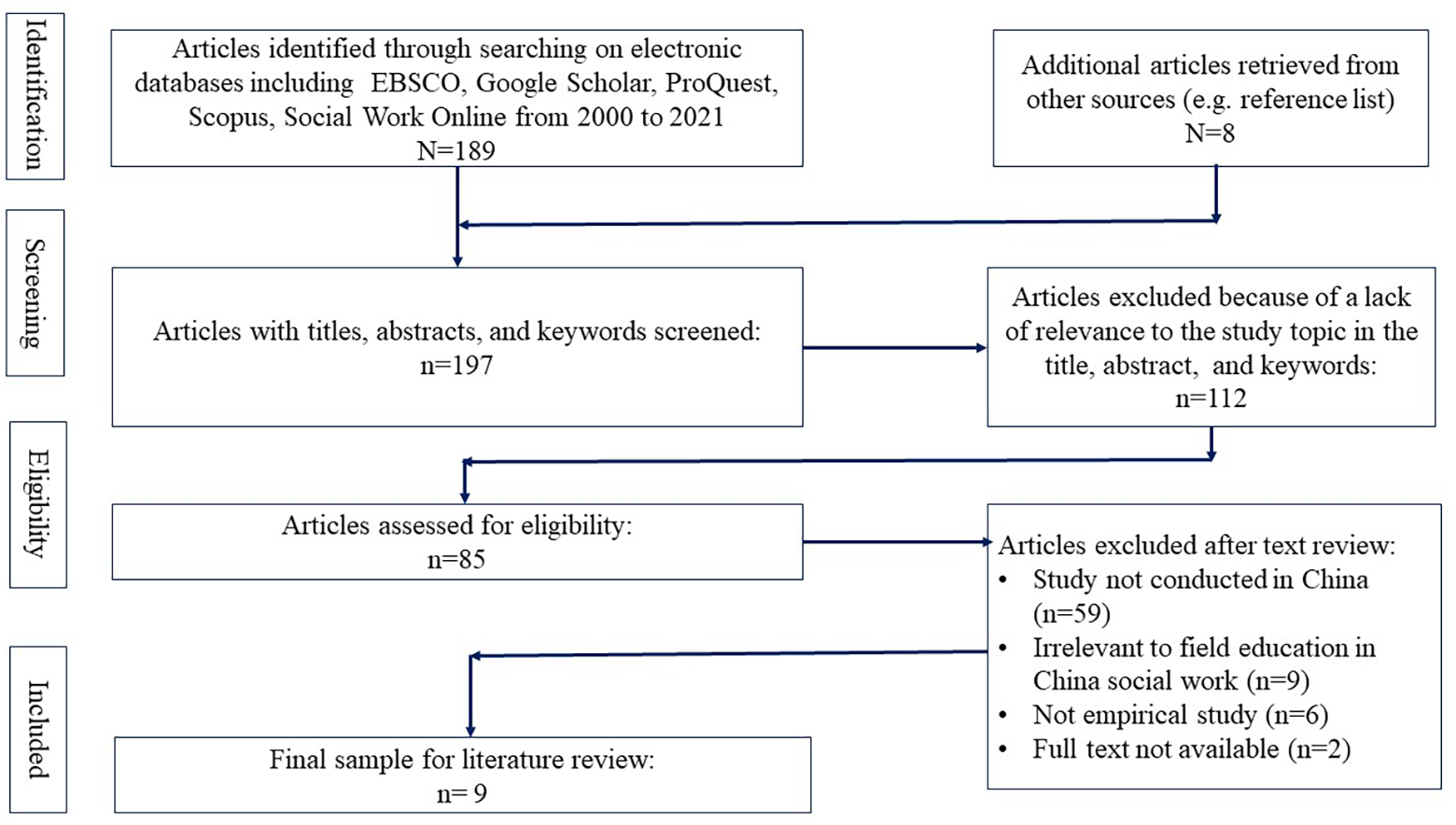
Process of systematic review: identification of nine research articles relevant to field supervision in social work in China.
We used the JBI Critical Appraisal Checklist (Joanna Briggs Institute, 2017) to evaluate the introduction, methods, results, discussion and conclusion of articles identified in the search. This led to the conclusion that a high level of quality data supported by evidence was presented in these selected empirical studies. After the extraction of key findings was completed, the subjective process of narrative synthesis was conducted, integrating and interpreting results from these nine articles. The focus of this synthesis was to gain new insights and a better understanding of our research topic. Four themes that help to enhance students’ experience in field education emerged from the selected literature. These were: supervisory culture and supervision relationship; importance of structured supervision; guidance for critical reflective thinking; and attention to different functions of supervision. Most identified studies mainly reported students’ perspectives. Only one study examined agency supervisors’ experiences (An et al., 2017). Other studies reported perspectives of external supervisors from Hong Kong who provided supervisory support for qualified social workers (Hung et al., 2010; Mo, 2016; Mo and O’Donoghue, 2019).
Supervisory culture and supervision relationship
In the majority of the materials, the supervisor in China was described as ‘senior’ (Tsui, 2008) and an authority figure resonating with traditional Chinese culture and values, which have emphasised the importance of authority (quan wei 權威) and face (mian zi 面子) (An et al., 2017). In Chinese societies, student–teacher relationships have been shaped by Confucianism. Within this moral framework, teachers tend to adopt authoritative, teacher-centred approaches. Teachers are expected to have good subject knowledge and provide students with moral guidance beyond the realm of the classroom. Conversely, students are expected to respect their teachers both on account of their mastery of subject knowledge and because they are perceived as authority figures (Mo, 2016). Students thought that they had to ‘obey’ the orders and undertake the tasks assigned to them without question (An et al., 2017; Cai et al., 2018). In An et al.’s (2017) study, although students desired a collaborative and supportive relationship with their supervisors, supervisors appeared to be either unable or unwilling to adopt a collaborative approach. Students were reported as using various descriptors for their relationship with their supervisor: these included teacher, life coach, mentor, counsellor, supporter, mediator and friend (Mo, 2016; Mo and O’Donoghue, 2019).
Importance of structured supervision
Social work students desired structured, planned and regular supervision with their supervisors (Chen et al., 2018). They wanted a clear supervision agreement that specified the supervisor and supervisee roles and responsibilities to maximise learning opportunities (Chen et al., 2018; Tsui, 2008). Students wanted more guidance from supervisors about their professional development (Cai et al., 2018), in particular, to help integrate social work theories into practice; this is consistent with the notion of the teacher as an expert. They preferred their supervisors to be qualified social workers who were responsive to their developmental needs (Liu et al., 2013). The qualification also validated the supervisor’s expert status. However, supervisors reported that they struggled to provide regular and timely support for students because of organisational constraints and workload demands (An et al., 2017).
Guidance for critical reflective thinking
Supervision was valued by students for the opportunity to develop their critical thinking, to consider how to work effectively with service users using various theoretical lenses and ethical frameworks. There was support for the idea that supervisors should encourage students to write reflective diaries about their practice (Hung et al., 2010; Mo and O’Donoghue, 2019) to facilitate critical examination of personal beliefs, social work values and application of skills. Students appreciated more guidance from supervisors to help them develop critical reflective thinking for further professional development (An et al., 2017), which in turn facilitates defensible decision-making about the work they undertake with service users.
Attention to different functions of supervision
An et al.’s (2017) study indicated that both students and supervisors perceived that the latter tended to focus too much on organisational policies and procedures, and on negotiating resources to support students’ learning, a finding that echoes supervisor practice in many countries. Such a focus may lead students to become demotivated about the value of direct practice, which may be perceived by students as less relevant to professional development due to an emphasis on administration (Wang et al., 2019). There was evidence that some supervisors wanted to shift to a balanced approach which encompassed both educational and supportive functions of supervision (Tsui, 2008). However, they may not have had sufficient knowledge and skills relevant to social work practice to deliver the educational aspect of supervision effectively (Hung et al., 2010; Liu et al., 2013). Students found it difficult to apply theories and knowledge learnt in the classroom due to the current state of indigenisation of field education in China (Chen et al., 2018; Wang et al., 2019); again there is a similarity with other countries’ experience, with students often reporting difficulty in translating theory into practice. In addition, students needed emotional support, understanding and encouragement from supervisors to be able to manage stress, tackle environmental constraints in service delivery and provide quality service output (Chen et al., 2018; Hung et al., 2010; Mo and O’Donoghue, 2019; Tsui, 2008). However, supervisors were not equipped with the skills and knowledge to develop an effective working relationship with the students.
The current study gathered qualitative data from supervisors who had attended supervision training and from students who were supervised by these supervisors. The aim of this article is to explore the extent to which approaches to supervision developed outside of China and introduced to the supervisors during training fit with Chinese cultural approaches to learning and teaching.
Study design
The study reported here was part of a 3-year (2017–2021) Erasmus+ Programme part-funded by the European Union, entitled ‘Building Bridges between Europe and China to Strengthen the Social Work Profession (hereafter the BUIBRI project)’; it was extended to 4 years due to the Covid-19 pandemic. Details of contextual information about the BUIBRI project and the training programme for supervisors delivered within the project can be found in Lei et al.’s (2021) article. We present here the findings from focus groups with supervisors from three regions (A, B and C) in China who had participated in the supervision training programmes provided through the BUIBRI project and focus groups with students who were supervised by the supervisors involved in the training.
Data collection
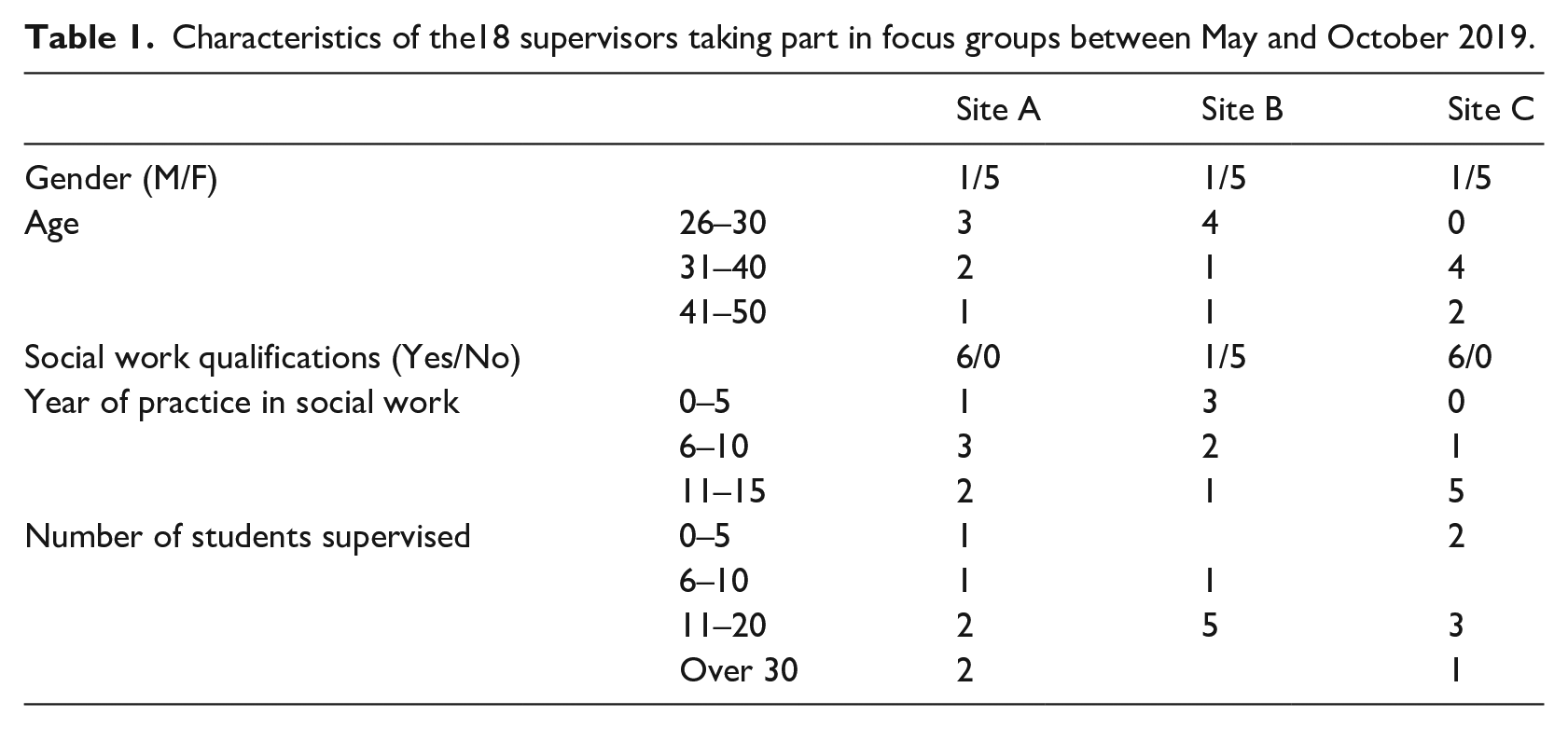
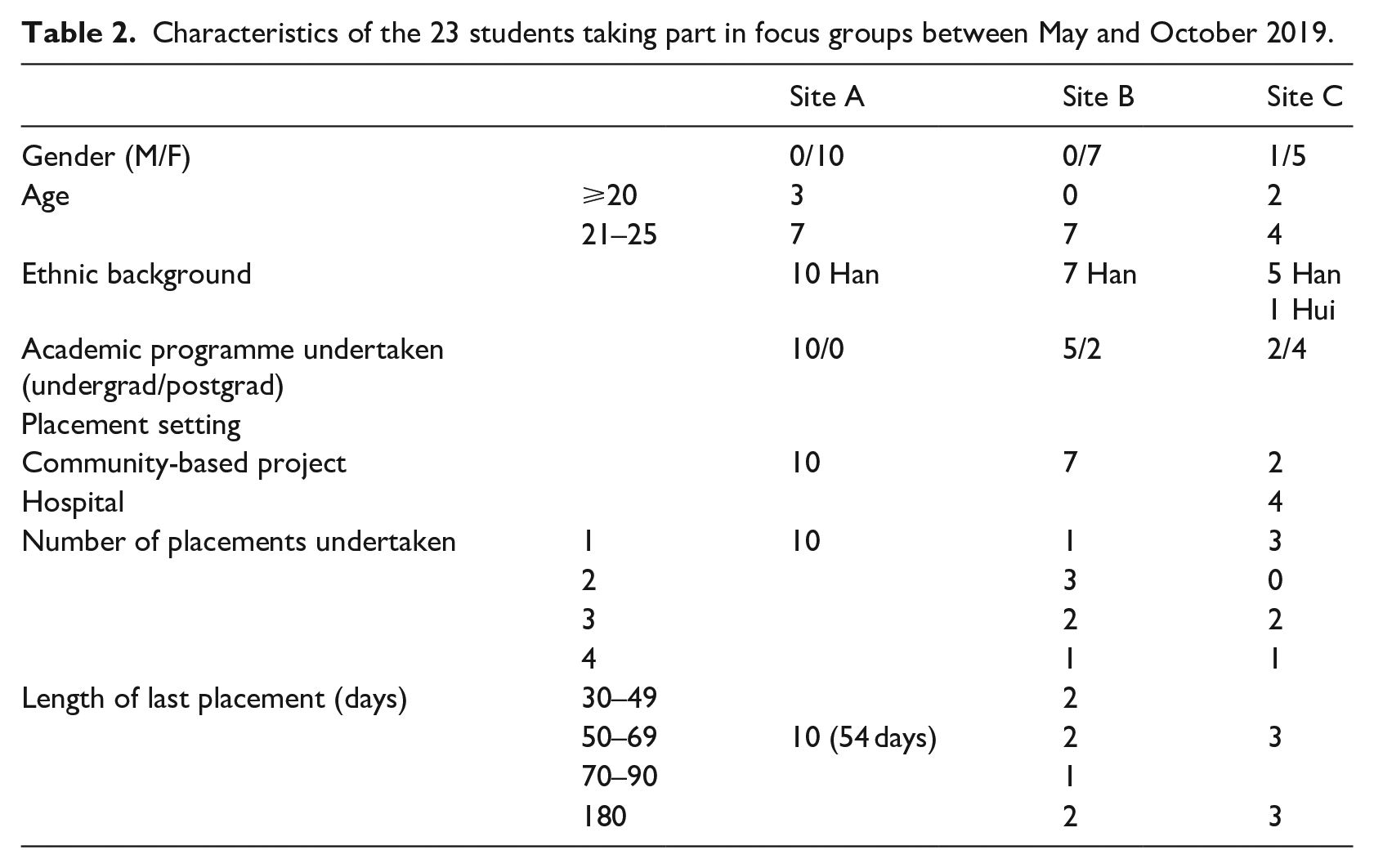
Each Chinese partner university from the three regions emailed all supervisors who attended the training and invited them to participate in the focus groups. Eighteen supervisors, six from each region, took part in the study (Table 1). Students who were supervised by those supervisors who attended the training were invited; 23 students agreed to take part in the focus groups (Table 2). The study obtained ethical approval from the research ethics committee at the University of Hertfordshire. Informed consent was obtained before data collection commenced.
Characteristics of the18 supervisors taking part in focus groups between May and October 2019.
Characteristics of the 23 students taking part in focus groups between May and October 2019.
Focus groups were used in this study to allow deeper exploration of the respective supervision experience of supervisors and students (Denscombe, 2014). Six focus groups (three with supervisors and three with students) were formed in autumn 2019. The focus groups were conducted in Mandarin, lasted between 60 and 90 minutes and were audio-recorded. A research student from each Chinese partner university facilitated the focus group in each region; the research students were briefed by the project team before focus groups commenced. Questions used to guide discussion focused on participants’ perception of supervisors’ role. We began the focus groups by asking students and supervisors (in brackets) broad questions to allow participants to express freely their experience of supervision. For example,
What was discussed during supervision?
What did your supervisor (you) do to support you (your students) in field practice?
We also asked focused questions to examine how the structure and content of supervision supported students’ learning:
How often did you meet your supervisor (student) and how long did each supervision session last?
How did your supervisor (you) guide you (your student) to critically reflect upon your practice?
Data analysis
All focus groups were fully transcribed and analysed in the language of the meeting to ensure the original meanings were kept (Al-Amer et al., 2015). NVivo version 12 was used to facilitate storage and retrieval of data. A framework analysis approach was used to guide the process of data analysis (Smith and Firth, 2011). The lead author undertook initial coding and then developed a coding framework for analysis. The second and third author cross-checked the transcripts independently and reviewed the coding framework. All authors discussed the overarching themes and the analysis framework until a consensus was reached.
Kadushin and Harkness’s (2014) supervision framework was introduced to supervisors in the training programme within the BUIBRI project. The framework is also used here as an underpinning theoretical lens for our analysis. Kadushin and Harkness proposed three main functions of social work supervision, which support the professional development of social work practitioners and students; these are administrative, educational and supportive functions:
The administrative function focuses on the promotion and maintenance of work standards and compliance with organisation policy and procedure. Hence, in field practice, the role of supervisor is to ensure that students follow procedures required by the organisation and the university; identify and allocate a suitable workload; monitor students’ progress; and ensure their performance is of acceptable standard.
The educational function concerns the development of knowledge, skills and attitudes required for the performance of a social worker role within the context of a particular organisation. Here, the role of supervisor is to encourage reflection and exploration by students of their practice and promote development of new insights and strategies that enable the transference of skills to a variety of practice scenarios.
The supportive function emphasises the importance of addressing those emotive responses engendered by practice which may undermine safe practice and to ensure students’ wellbeing. Therefore, supervisors are expected to develop supportive relationships and environments that facilitate students’ professional development.
Findings
We present our findings through the lens of the administrative, educational and supportive function of Kadushin and Harkness’s work as a framework, to explore the fit of supervisory practices to the Chinese approaches to learning and teaching.
Administrative function
Supervisors from all sites acknowledged that regular and structured supervision should be part of their practice with students. A key reason given was that planned supervision prompted supervisors and students to prepare for each meeting, which facilitated meaningful conversations that aided students’ professional development. In addition, they indicated planned supervision provided a platform for students to both voice concerns and monitor students’ progress. Supervisors recognised the importance of making time for supervision and to be accessible so that students felt supported and able to approach their supervisor directly for advice; one supervisor commented, I have a daily ‘five-minute’ check-in and check-out exercise with my student . . . I am really pleased that my student is devoted to her professional development and is proactive in her learning. (Site/B/1)
All focus groups voiced a strong resonant message that supervisors should place students at the centre of plans for their learning journey. To achieve this aim, supervisors recognised the need, after participating in the training, to get to know the students as individuals and to find out their backgrounds, interests and learning needs. Supervisors commented that the training both helped them appreciate the importance of establishing a relationship with students and provided a framework for collaborative work, which is fundamental to relationship building. One supervisor commented, Using a collaborative approach in learning . . . my student is like my friend. I share my work experiences; she listens attentively and shares her views. We are like learning together and there is a kind of mutual support, I am like her teacher and friend. (Site/B/4)
Prior to training, there was a general assumption among supervisors that students should be treated as a social worker in the team. Subsequent to training, supervisors recognised that supervision of social workers has a different emphasis to supervision of students. For example, a supervisor (Site/A/5) commented that ‘students have many questions about professional identity, it is a different level of learning’. Providing suitable work to meet such learning needs could be problematic, which may be overcome by involving others. For example, a supervisor (Site/B/3) with experience of case work and group work but not community work asked other colleagues to provide opportunities through a community project to enrich the students’ learning experience.
Students valued highly regular, structured supervision. They wanted supervisors to be available, to be heard and to have their individual learning needs addressed. A structured approach to supervision made the students feel supported, which helped to develop trusting relationships. A student commented, I had many supervisions, we had very thorough discussions, nearly every time she gave me some feedback and suggestions for improvement. (Site/A/4)
Nonetheless, students appreciated that supervisors were busy with other work commitments, which made regular supervision difficult. A few students stated that their supervisors cancelled supervision meetings frequently, while some students did not receive any supervision, which made them feel undervalued and that their learning was unimportant. As an example, one student stated that ‘she was forgotten completely’ when her supervisor could not remember her placement end-date.
Students wanted a wide range of learning opportunities relevant for professional development, but these aspirations were not always met. Most students from Site C undertook their first placement during the summer, usually in community projects. Frequently, these students were given simple administrative tasks unrelated to their professional development with limited opportunities to undertake individual casework, which they perceived to be professional social work.
Apart from opportunities to undertake casework, students discussed benefits from externally delivered specialist training. Students stated that they wanted opportunities to observe the practice of their supervisors, frontline workers and other professionals in multi-disciplinary settings. Most students were keen to seek advice and support from other team members to enrich their learning: I could seek advice from the team leader immediately. She was very helpful. She was a frontline worker and had ample knowledge about drug service. This gave me a deeper understanding of drug issues. (Site/C/3)
Educational function
Supervisors recognised the importance of key elements of their role to enable students to reflect on practice; assess students’ performance; and provide timely, constructive and critical feedback via structured supervision. As one supervisor commented, After each activity, I spend 15 minutes with the student, so that she can ask questions, whether they are related to professional development or personal issues. This will help the student reflect on her role in the organisation, develop a sense of belonging and professional identity. (Site/B/3)
Gibbs’s (1988) six-stage reflective model, which was introduced during the supervision training programme, was frequently mentioned by supervisors from all sites. Gibbs’s model provides a structure to learn from experience, allowing students and practitioners to reflect, learn and plan from their actual experiences that either went well or did not go well. Supervisors found the model helpful as it could be used to encourage students’ learning and develop critical thinking; assess student performance; and identify students’ strengths and areas for further development. According to one supervisor, Students are encouraged to challenge and question practice. When students observe poor practice, . . . how social workers communicate with service users with physical disabilities, students should question that . . . this is very important for their professional development. (Site/B/5)
One supervisor commented that the reflective model helped him not only guide students to reflect on their practice but also examine critically his role as a supervisor and social work practitioner.
Students valued timely and critical feedback about their practice and reflective diaries. Although some did not receive regular supervision, many students discussed the significant benefits of immediate feedback from supervisors particularly after directly observed practice; one student stated, Our supervisor demonstrated how to communicate with the patients, then gave us opportunities to practise. I think this is good learning. She would then observe our practice and advise us how to improve our communications skills, questioning technique. (Site/A/2)
Students appreciated when supervisors encouraged critical and reflective thinking. The value of Gibbs’s six-stage reflective cycle was also mentioned by students; some supervisors had developed group exercises that applied the model to reflections about practice. Students welcomed an egalitarian approach, when adopted by supervisors, which promoted collaborative learning and critical and independent thinking: There is weekly staff sharing. I learn a lot more that is not available from reading. My supervisor would listen to me and exchange views . . . We were allowed to comment on the performance of project managers. This is an egalitarian approach. We can share our opinions, how to improve and develop independent thinking. (Site/B/4)
Supportive function
Supervisors viewed supervision as a venue for students to air anxieties and seek emotional support, guidance and advice about their professional identity and development. Supervisors discussed feelings of helplessness when working with students who were indecisive about their future career. Uncertainty about career paths caused emotional distress for students, as one supervisor commented: My student said she was standing at the junction of the crossroad; she didn’t know which direction to take . . . she was at a loss. I think during the placement, they need to develop a sense of professional identity. I had two students. They both decided not to choose social work as their career. In the BUIBRI training, it didn’t cover how to help students work through this struggle, what we could do to help students develop their professional identity. (Site/C/2)
A supervisor (Site/A/4) remarked that her agency encouraged students to undertake informal interviews with social workers, to explore their reasons for entering the social work profession, which helped students gain a deeper understanding of the profession. If students had opportunities to learn from experienced social workers about their motivation to become social workers, they were more likely to develop a positive professional identity and choose social work as their future career.
One supervisor (Site/A/2) exemplified the challenges of supporting underachieving students. Previously, she would have adopted a pessimistic approach and given up readily on students who struggled. Through discussion at training sessions, she recognised the importance of adopting a student-focused approach that engaged students in the learning journey and took full account of the students’ perspective and reasons for underperformance.
Students were clear that field practice played a vital role in the development of their professional identity. It is a matter of concern that placement experiences resulted in some students becoming more confused and indecisive about their professional development; one student commented, My expectation of the placement is to help me find out if I want to choose social work. I want more guidance from her [supervisor] for professional development but now, I am more confused, I am really at a loss. (Site/C/10)
Students working in multi-disciplinary settings (e.g. hospitals) often experienced a lack of understanding from different professionals about the role and responsibilities of social workers. Some professionals thought social workers were expected to resolve relational conflicts among different service user groups, while others saw no difference between social work and voluntary work. This lack of clarity about social work caused confusion and undermined the profession. One student remarked that discussion with her supervisor restored her belief in the profession: It takes time for other profession[s] to understand what [the] social work profession entails, through collaborative and interprofessional working, we can introduce the concept of social work to other professions, so that they can accept and understand the role of social work. (Site/A/4)
Other students affirmed the important role supervisors played by providing guidance and support about professional development and the knowledge and values that underpinned the profession, for example: I found the community projects to have no relevance to social work. My supervisor asked us to explore the social work value [that] underpinned community activities; we needed to look at it from different perspective. It helped me understand the value of community work. (Site/C/6)
Students remarked that because some supervisors did not have social work qualifications, they were unable to provide guidance about professional development. However, these supervisors were keen to find out more from the students about the profession; moreover, such dialogues helped students consolidate their knowledge and understanding of their profession. Students found that an egalitarian relationship and collaborative approach facilitated independent and critical thinking, which enhanced their approach to social work: I learnt more from my supervisor about practical tasks, but very limited guidance for professional development. Sometimes she asked me questions about professional practice, I would collect the information and share with her, this actually helped me understand my profession. This is like a mutual learning process. (Site/B/7)
Discussion
Unlike findings from previous studies about practice education in China, supervisors in our study embraced the importance of the three supervisory functions to support students in field practice. The key question is to what extent it was possible to implement these supervisory functions within a Chinese cultural context of learning and teaching. The framework advocated by Kadushin and Harkness is to some degree in conflict with the traditional authoritative, teacher-centred approach to learning and teaching in China. It advocates a non-hierarchical student–teacher relationship to facilitate learning. Having attended the training, supervisors expressed the view that it was not only desirable but also necessary to adopt a student-focused egalitarian approach to support students’ learning – an approach many supervisors espoused in practice as reflected from both supervisors and students’ experience in our study. This study illustrates how the student-focused and equalitarian approach could be applied to alleviate such a tension.
Student-focused approach
Previous studies have illustrated the limited expectations that supervisors in China will provide regular structured supervision (Chen et al., 2018). Before attending the BUIBRI training, most supervisors were of the opinion that supervision served mainly organisational and administrative functions, that is, to ensure student organisational policy compliance (Kadushin and Harkness, 2014). The training helped supervisors understand the importance of the educational and supportive function of supervision and placing students at the centre of their learning journey. They were not only aware of the need but were also willing to make time for students, provide regular supervision, provide timely and constructive feedback, and monitor their progress. Students in this study clearly expressed their desire for regular structured supervision, to enable planning and preparation. Some students complained that they were ‘forgotten’ when supervisors were not able to provide regular supervision and timely feedback. Students and supervisors in this study shared the view that a lack of clearly structured and regular supervision not only hampered students’ learning but also harmed the student–supervisor relationship.
Consistent with findings of previous studies in China, students were not satisfied to be treated in placement organisations either as employees (Cai et al., 2018) or as volunteers (Liu et al., 2013). Students commented that supervisors tended to prioritise organisational goals over their individual learning needs (An et al., 2017). After training, supervisors were more aware of the differences between employed workers and students: for example, that they should get to know students as individuals and engage students in the formulation of their learning plan.
Similar to Chen and Fortune’s (2017) findings about field practice experience in China, students in our study generally favoured casework over other social work approaches as they perceived casework to be ‘professional social work’. However, there were divergent views among students in our study about the tasks they were assigned. Some students viewed the administrative or laborious tasks they undertook in community projects of limited relevance to social work practice. Wang et al. (2019) asserted that when students were given limited opportunities to perform ‘real’ social work tasks, they were less likely to develop professional commitment and choose social work as their future career. However, students in our study found it extremely helpful when supervisors encouraged exploration of values that underpinned community work, which aided their professional development. This illustrates the value added to students’ field practice experience when supervisors were willing to invest time to help them develop a critical approach to their learning.
Students wanted to receive timely, quality and critical feedback to help consolidate learning and improve their practice, which was seen as the essence of the supervisory role to lead as a teacher – an idea consistent with Confucian thinking. In this and other studies (Wang et al., 2019; Yeung et al., 2021), students have welcomed critical and constructive feedback to maximise their learning opportunities. Students in this study appreciated the time given by supervisors to prepare and undertake group reflective exercises. They wanted more learning activities to enable them to apply theories to practice in the learning and to develop their critical and reflective thinking. However, they remarked that they were individuals with different learning needs, and the importance of one-to-one supervision should not be overlooked. There was evidence in our study which suggested that the supervisors changed their approach to field supervision and shifted from traditional approaches towards a more student-centred style of learning and teaching after attending training, which was welcome by the students.
In China, many students have not intended to become social workers at enrolment on a social work programme (Wang et al., 2019; Wu et al., 2016). Some choose to major in social work to secure a place at a prestigious university, which may be more important for future career prospects than the subject studied. This is a feature of the Gao Kao (高考), the Chinese national entrance examination for university admission. Research evidence suggests that students who are dissatisfied with their subject choice are more likely to experience mental distress (Li et al., 2008). In our study, supervisors found it challenging and felt helpless when working with students who were uncertain about their career path. Similarly, some students felt more confused and were at a loss when they did not receive adequate guidance about professional development. This difficulty, viewed from both student and supervisor perspectives, may be a distinctive feature of social work education in China, where a significant number of students on a social work programme may initially have little commitment to a career in social work (Gallagher et al., 2019). The need to provide both emotional support and practical advice to aid students’ professional development has been voiced in previous studies by both supervisors (Mo and O’Donoghue, 2019) and students (Chen et al., 2018). A commitment to a social work career may develop through exposure to social work practice during the BUIBRI training programme, a model shared by supervisors during their training, which they found helpful. This lack of commitment among some students makes the role of the supervisor extremely challenging, perhaps even more so than in many other countries with a well-developed social work profession. This complexity around career choice is confounded by the way in which teachers are perceived in China through a Confucian lens.
Some purchase on this issue can be obtained through consideration of how supervisors in this study adopted the role of ‘life coach’ to guide students about career choice. This resonates with a Chinese proverb which says, ‘a day as a teacher, a lifetime as a father’ (一日為師終身為父). Supervisors recognised that it was important to spend time talking with students about their anxieties and uncertainties about entering the profession. There is evidence that reflective discussion promotes a sense of membership to a professional community (Bruno and Dell’Aversana, 2018). However, as indicated in our study, most supervisors considered that they were not fully equipped with the skills to perform the ‘life coach’ role to help students develop professional identity within the complex context we describe here. More training for supervisors in this area requires urgent attention.
Equalitarian approach
Educators are expected to bring a wealth of experience and knowledge to their teaching, and this is especially pertinent in the Chinese cultural context. However, some supervisors in this study did not have social work qualifications and acknowledged that they did not have the sufficiently broad knowledge and experience to support their students’ learning. Some students in this study were also aware that their supervisors did not have the qualifications to impart a body of knowledge and practice wisdom that would be expected. This is perhaps even more problematic for both teacher and student in a legacy Confucian context than it would be in other jurisdictions. The mitigation of this potential difficulty partly explains the reason for the adoption of a collaborative approach in field supervision in our study. As proposed in An and Szto’s (2019: 194) study, supervisors should encourage students as ‘carriers of textbook knowledge’ and supervisors as ‘practical knowledge user’ to bring their respective knowledge to supervision. However, there is a challenge to overcome because of the hierarchical student–teacher relationship based on Confucian thought. Supervisors in our study encouraged students to challenge poor practice, which is somewhat counter to traditional Chinese notions of learner–teacher relationships. They described their relationship with students to be ‘like teachers like friends’ (亦師亦友); it is a reciprocal and non-hierarchical relationship. Supervisors acknowledged that they should seek feedback from their ‘little friends’ and reflect on their approach to field supervision. Both students and supervisors in this study shared the view that an honest and egalitarian approach which allowed an open dialogue and promoted mutual learning that students valued was fundamental to a trusting relationship that facilitated students’ learning. This approach, based on a collaborative and non-hierarchical relationship, while beneficial to all, was particularly helpful to those field supervisors without social work qualifications.
Limitations
This article reports the views of supervisors who attended the BUIBRI training programme, which could differ from those who have not attended any supervision training. The sites selected in the study may be to a degree atypical as there is considerable regional disparity in the development of social work education in China. Relative to other regions in China, there is a more rapid economic growth in the three study sites, and hence their local governments are more inclined to invest in social care services and support development of the social work profession. Similarly, the sample size is modest, and as with all qualitative studies and on account of the distinctive features of the sites and training, the ability to generalise to other regions in China is limited.
Conclusion
The study findings are consistent with students’ experiences and expectations in previous studies. However, this study enriches our understanding of agency supervisors’ perspective as it is an underresearched area. For example, previous studies suggested that supervisors tend to prioritise organisational goals and are not able or willing to provide educational and emotional support for students. This study indicates that supervisors are committed and ready to shift this perspective, but they require training and resources to enable them to bring rich knowledge and skills to supervision.
Our finding indicates that different functions of supervision are not separate entities; they overlap and are mutually interdependent. Nevertheless, it demonstrates that Kadushin and Harkness’s approach to supervision, an approach developed outside of China, offers a structural framework for supervisors to support students’ learning. There is a need to review the teaching and learning approach used to fully utilise the benefits that such a framework might bring to the development of the social work profession in China. A different style to teaching, which places emphasis on a student-focused, interactive and collaborative approach, was highly valued by students in this study. Conversely, supervisors in this study came to recognise the benefits and need for a student-focused egalitarian approach, which challenges the deeply rooted Confucian model of hierarchical student–teacher relationships. This study does show strong evidence that supervisors are willing and committed to change their formerly held views. However, supervisors need to be mindful of the potential issues of crossing professional boundaries. We recommend using a friendly and supportive approach that promotes mutual and collaborative learning in the context of field practice.
In addition, supervisors should make use of the resources available within their organisation and draw upon external expertise to provide a good range of learning opportunities for students. This is especially important for those supervisors who do not have social work qualifications.
Further research is required to explore and develop different ways to cultivate and manage a harmonious learning environment for students and supervisors to better meet the needs of the social work profession in China. This study illustrates that training for supervisors such as the one delivered by BUIBRI project is urgently needed so that they are enabled to help individual students develop a commitment to the profession. More efforts from social work educators, social care organisations and a firm commitment from the Chinese government are needed to ensure more qualified social workers with supervision training will take up the supervisory role to support students’ learning.
Supplemental Material
sj-pdf-1-isw-10.1177_00208728221136974 – Supplemental material for Supervision of Chinese social work students during field practice: Harmonising a student-focused, egalitarian approach with traditional teaching and learning
Supplemental material, sj-pdf-1-isw-10.1177_00208728221136974 for Supervision of Chinese social work students during field practice: Harmonising a student-focused, egalitarian approach with traditional teaching and learning by Echo Yuet Wah Yeung, Zhuang Jie, Ben Chi Pun Liu and Steven M Shardlow in International Social Work
Footnotes
Acknowledgements
The authors would like to thank the students and supervisors for taking part in the focus group discussions. We also want to extend our thanks to the research students who facilitated the focus groups; they are Shu Zhang from Fudan University; Yu Xue Tang from Nanjing Normal University; and Lu Wang from the Wenxin Social Services Centre. We are also grateful for the contribution of other project members who were involved in the BUIBRI project; they are Prof. Sibin Wang and Porf. Fengzhi Ma from Peking University; Prof. Juha Hämäläinen, Prof. Timo Toikko, Ms Agnieszka Repo and Ms. Minchun Ryhänen from the University of Eastern Finland; Prof. Brian Littlechild and Dr. Julia Warrener from the University of Hertfordshire; Professor Staffan Hojer and Dr. Jörgen Lundälv from the University of Gothenburg; Prof. Fang Zhao and Prof. Honglin Chen from Fudan University; Dr. Jingzhen Du and Dr. Xiaoshan Huang from Nanjing Normal University; Dr Jie Lei from Sun Yet Sun University and Dr Wei Lu from Xiamen University.
Funding
The BUIBRI project [585758-EPP-1-2017-l-FI-EPPKA2-CBHE-JP] as described in this study was funded by the Erasmus+ Programme, European Commission.

Supplemental material
Supplemental material for this article is available online.
Author biographies
References
Supplementary Material
Please find the following supplemental material available below.
For Open Access articles published under a Creative Commons License, all supplemental material carries the same license as the article it is associated with.
For non-Open Access articles published, all supplemental material carries a non-exclusive license, and permission requests for re-use of supplemental material or any part of supplemental material shall be sent directly to the copyright owner as specified in the copyright notice associated with the article.
