




Abstract
Based on observational data, individual interviews (N = 22) and focus groups (N = 8) with practitioners in Italy, Norway and Slovenia, this study applies a grounded theory approach in exploring frontline practitioners’ experiences of supporting families involved with child welfare services. It was anticipated that there would be significant differences between the countries regarding practitioners’ understandings of families’ needs and problems, and approaches to help. However, the analysis showed considerable transnational similarities. This study, therefore, offers a new perspective to the welfare regime literature in suggesting that there are important similarities to be recognised across child welfare typologies.
Keywords
Introduction
This article sheds light on practitioners’ experiences of working with children and families in three different child welfare systems located in Italy, Norway and Slovenia. Following numerous previous studies of welfare regimes and child protection typologies, the original purpose was to compare the differences between the countries. Although recognising that there are differences between child welfare systems, we draw attention to several similarities across the countries that emerged from our data. With this, the article contributes to the growing body of research comparing different child welfare and protection systems by giving greater space to explore similar features. The following research question was explored: How do practitioners in Italy, Norway and Slovenia experience working with children and families involved with child welfare services?
Literature on welfare regimes and typologies of child protection are used as a theoretical backdrop to discuss the similarities identified between the three countries in this study. Since Esping-Andersen’s (1990) pioneering publication of The Three Worlds of Welfare Capitalism, researchers from many fields have addressed typologies of welfare systems (Aspalter, 2019; Greve, 2020). Welfare states are not constructed overnight, but rather through slow social, economic and political processes, and therefore, changes often go under the radar. Furthermore, welfare regimes can be understood as clusters of welfare systems that share all or some of the same characteristics in the way they are organised and operated.
More recently, several studies have aimed to compare different child welfare and protection systems and identify differences between them, and to see whether alternative and emerging typologies or orientations could be identified from this (Parton, 2017). One influential study was coordinated by Gilbert et al. (2011), following up Gilbert’s (1997) earlier work, who compared 10 countries. From this, they identified three different orientations of the state’s role concerning child welfare and protection: child focus, family service and child protection. This work has been further developed by Connolly and Katz (2019) to better understand how different countries create systems to protect the interests of vulnerable children and respond to families in need of support. The typologies focus on a set of values and beliefs that underpin and drive child welfare systems, not only structural differences. Connolly and Katz’s typologies are based on two dimensions: whether the systems are oriented towards an individual or community focus, and whether the systems are more or less regulated.
The frameworks developed by Gilbert et al. (2011) and Connolly and Katz (2019) have been drawn on by several researchers to explore differences in the ways countries have shaped their systems and respond to social problems, like much of the welfare regime literature available (Berrick et al., 2017; Helland, 2019; Samsonsen and Willumsen, 2014; Skivenes and Sørsdal, 2018).
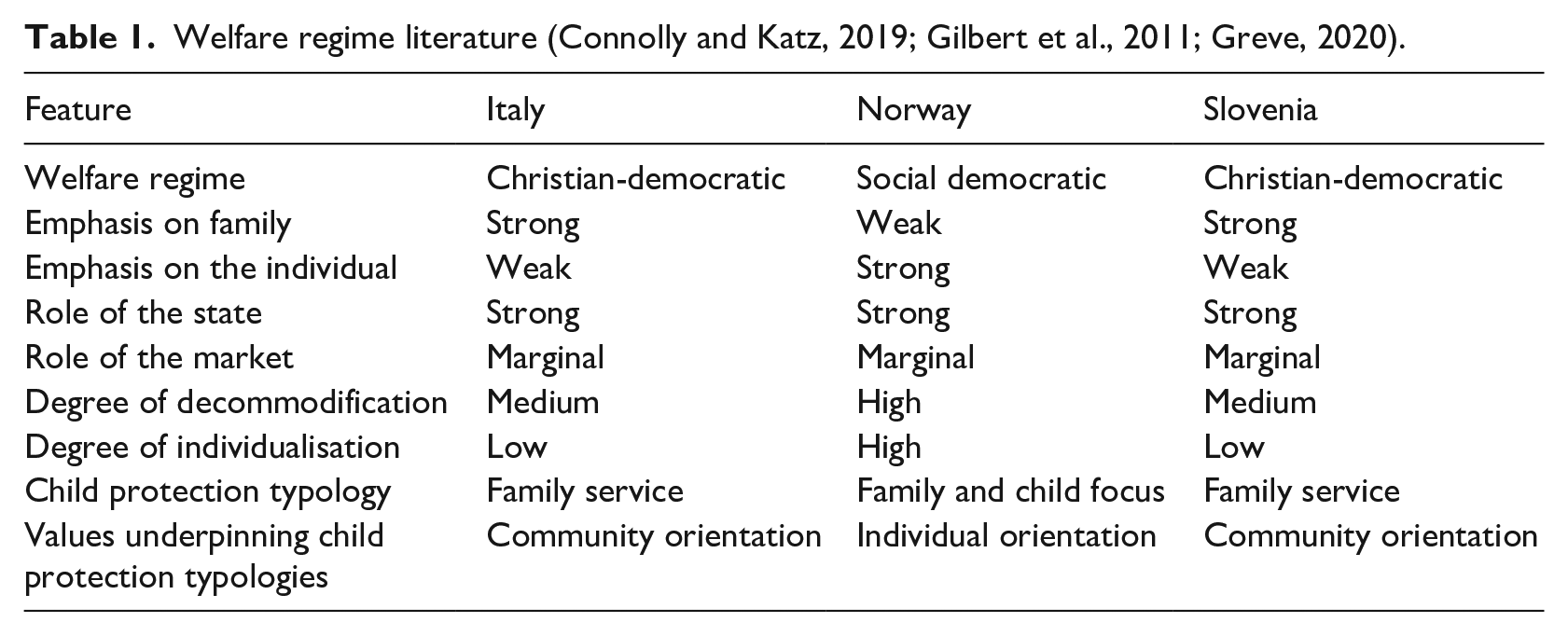
Table 1 presents an overview of how Italy, Norway and Slovenia have been characterised within previous literature (Connolly and Katz, 2019; Gilbert et al., 2011; Greve, 2020). As shown, the systems in Italy, Norway and Slovenia differ regarding their orientation towards the child or the family (Gilbert et al., 2011; Greve, 2020) and whether the focus is on the individual or the community (Connolly and Katz, 2019). Regime memberships do change over time, and usually rather slowly, as Aspalter (2019) points out. Later, we will return to the extent to which such categorisations are suitable to illuminate the complex nature of child welfare.
Welfare regime literature (Connolly and Katz, 2019; Gilbert et al., 2011; Greve, 2020).
Sample and methodology
Table 2 shows the methodological components of the study, a mixed-methods design (Creswell and Clark, 2017), consisting of individual interviews (N = 22) and focus groups (N = 8) with practitioners from Italy, Norway and Slovenia, as well as observational data from practitioners’ workplaces, and transnational and national meetings and workshops arranged by an international research project, LIFE. 1 All data collection was approved by the Norwegian Centre for Research Data (NSD) and conducted by one of the authors, who had a direct link with LIFE.
Overview of sample and methodological components.
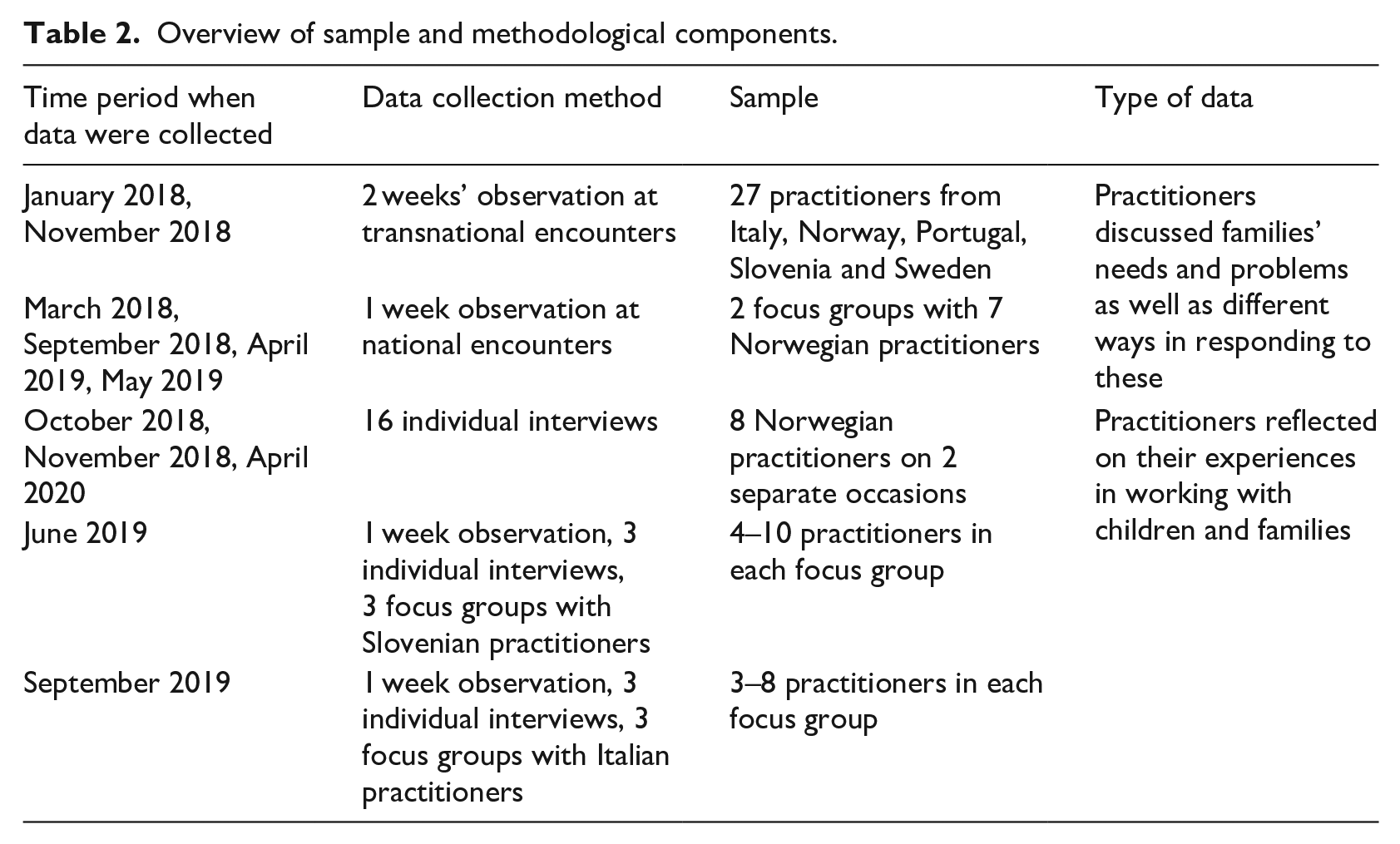
The Italian practitioners worked in social services in two municipalities in the region Emilia Romagna, the Norwegian practitioners worked in child welfare services in two municipalities and the Slovenian practitioners worked in centres for social work in two municipalities. Participants were consecutively recruited through LIFE. Although the practitioners had various backgrounds such as family therapist, child welfare worker, social worker, social educator and psychologist, all worked with children and families struggling with diverse and complex problems in a child welfare context.
Observations
The observational study component included visits by the researcher to the practitioners’ workplaces in all countries for different time periods. Observational visits included possibilities to ask questions along the way, which has similarities with go-along interviews (Burns et al., 2020). Observations were mainly used as contextual data to better understand results from individual interviews and focus groups, and to get an insight into child and family social work in the respective countries from the practitioners’ perspectives. Furthermore, the visits provided a unique access to the fields of practice. This served as a valuable resource in the preparation and conduct of individual interviews and focus groups. It was an important element in order to clarify and understand concepts, as well as getting a hold on the comparative component of the study.
The second part of the observational data involved the researcher attending discussions among practitioners on transnational and national encounters in LIFE, observing and taking notes along the way and during breaks. During these observations, the author reached out to the practitioners and invited them to participate in individual interviews.
Individual interviews
The individual interviews were semi-structured and mainly conducted at the practitioners’ workplaces, while a few took place at collaborating universities and other public places of their choosing. The researcher asked the practitioners questions about their experiences of working with children and families within their organisational framework, for example, ‘how would you describe your work with children and families?’ and ‘what do you consider as opportunities in your work with children and families?’ In the interview settings, the researcher was considered an ‘outsider’, which according to Berger (2015) can serve as a strength because the participants do not take for granted that the researcher ‘already knows’.
Focus groups
Participants recruited for individual interviews through LIFE served as contact persons for further recruitment to focus groups in the respective countries. The snowball method was used by the practitioners to recruit colleagues at their workplaces. The focus groups were mainly conducted at the practitioners’ workplaces, some in meeting rooms and others in their offices. The locations were familiar to the participants, which gave access to in-group conversations, although this setting could not fully correspond with the daily reflective dialogues among practitioners (Heggdalsvik et al., 2018). The focus groups were conducted as roundtable discussions on specific topics, taking a relatively unstructured format (Marvasti, 2020). In some cases, the researcher participated as facilitator, while in others it was more like a ‘fly on the wall’. Often the practitioners followed up questions asked by the researcher and reflected further together.
The participants reflected on the families’ situation and various issues together, contributing to a sense of security and a culture of sharing. Such a process can also bring more reflections than any of the individuals would have thought of by themselves. Focus groups can, therefore, provide rich data on group opinions associated with a given issue (Halkier, 2010). Some participants, nevertheless, expressed different understandings of families’ situation.
Triangulating data
We consider the combination of the methodological components a strength for several reasons: one of which concerns capturing nuances of the practitioners’ reflections. By triangulating data, practitioners’ experiences of working with children and families could be explored in different ways. Crucially, a third major strength of triangulating data was that it helped to demonstrate the experience of saturation whereby the same topics, perceived opportunities and challenges emerged across the data.
Grounded theory approach
An inductive approach to analysing the data was adopted, starting with transcribing the recorded interviews and looking through field notes from observations. The data were then assigned empirical codes, which related to how practitioners experienced working with children and families, and how they responded to their needs and problems within their respective systems. The next step involved grouping empirical codes into three main categories: individualising social problems, navigating fragmented systems and increasing bureaucracy. This way, the empirically driven analysis can be considered a grounded theory approach (Glaser and Strauss, 1967). The coding was conducted by two coders and laid the foundation for developing the research question. During this development, welfare regime literature and typologies of child protection were selected as an appropriate theoretical framework for making sense of the data.
Limitations of the study
The results reported in this study should be considered in the light of some limitations. First, there are potential limitations regarding the comparative nature of the study. Trying to determine what ‘child protection’ or ‘child welfare’ means in comparative research may present challenges. Basic words and concepts can have different meanings, statistics may differ and refer to different things, and there might be differences in the division of tasks and responsibilities in different organisations.
Second, the fact that the researcher in this study was considered an ‘outsider’ could potentially contribute to challenges related to understanding the jargon and experiences of the practitioners. In order to avoid misunderstandings and misinterpretations, it was therefore important for the researcher to be specific, ask clarifying questions and repeat interpretations of the practitioners’ experiences.
This brings us to a third limitation, which concerns the use of English language in collecting the data. Although the English language is often easily accessible in the field of child welfare and is adopted by many countries, the practitioners also had their own way of thinking and expressing their experiences using specific terms and metaphors, for example ‘firefighting’, which needed elaboration not to be misinterpreted. Throughout the data collection, the practitioners expressed that they were comfortable with sharing their experiences in English. An interpreter was, therefore, not used. In the focus groups, discussions arose among the participants in both English and their original language. This situation led to some participants spontaneously taking on the role of interpreter during the interviews, interpreting questions and answers, unfamiliar terms and cultural references (Fujii, 2018). This made it easier for the researcher to identify themes across the countries and minimise language errors and deficiencies. However, this can also present challenges, as some perspectives can emerge more than others, as these answers may potentially lack nuance and appear somewhat simplified.
Results
Individualising social problems
A balancing act emerged related to which approaches the practitioners adopted in understanding and responding to the social problems of families. When social problems of families were discussed, the practitioners problematised what, and who, was in the spotlight. According to the Italian practitioners, ‘the social worker sees the parents, and not always the children’ and that within their system there are [. . .] different specialised services, one for mental health problems and one for substance abuse, within which the social worker collaborates with the doctor, the nurse, the educator, and so on. From the outside, it might seem that there is a network of actors working together to help and support the family, but each service thinks only of ‘the person’, not that this person lives in a family.
Although several measures were aimed at children and parents separately, the practitioners from all countries ideally wanted to work closely with the family as one unit. Practitioners from Slovenia identified a need to ‘think about the whole family, but in the practice, it is not like that. It’s difficult, but we try our best’, as did the Italian practitioners. Furthermore, the situation of the Slovenian practitioners stood out due to lack of resources for home visits, and they experienced lacking the opportunity to talk with family members before intervening. They saw the need to justify intervention and removal of the child from the family by referring to ‘the best interests of the child’. Although the Norwegian practitioners shared the ideal of working with the family as a unit, in practice, they were more concerned with ‘the child in relation to its surroundings’, including the family environment.
Although a holistic focus was perceived as an ideal when working with children and their families, the practitioners struggled to implement this in practice because the system facilitated other ways of working with families. According to the practitioners, the holistic ideal proved to be challenging for various reasons in their respective countries. The Italian practitioners were concerned with seeing ‘the whole family’ but pointed out a gap between their understandings and desires to work closely with families and formal constraints within the organisational structure. Practitioners from Slovenia identified the prioritisation and allocation of state resources as imminent limitations. They felt compelled to adopt a protective focus as they saw no other choice with the resources they had at their disposal.
The Norwegian practitioners were more oriented towards the child and thus had a higher degree of individualisation. In this sense, the results indicate that the Norwegian practitioners were more consciously child-focused in their approaches and working methods compared to the other two countries. One of the Norwegian practitioners stated the following: [. . .] and in each child welfare case, we conduct conversations with parents and children, but seldom together. We must talk to the child at all stages of a child welfare case. When we receive a report of concern, we often talk to the child before we talk to the parents.
This understanding of children underlies Norwegian child welfare practices, where children are placed at the centre of the work (Melinder et al., 2021). This was further reflected in how the practitioners talked about (the inclusion of) children and their rights to participate.
Overall, our analysis of practitioners’ ‘problem framing’ in all three countries revealed that the family perspective is given little emphasis in practice, although Italy and Slovenia are typically characterised in the welfare regime literature as family service orientations (Table 1). The practitioners defined problems in an individualised manner, as they distinguished between problems associated with parents and others that were attributed to the child. The responses followed the same pattern, as the services available within the systems were individually oriented towards the respective family members. This shows the impact of individualisation on practice, a result that emerged across all welfare contexts.
Navigating fragmented systems
The individualising manner of understanding and approaching families’ social problems was closely related to the practitioners’ experiences of fragmented systems. The Norwegian and Italian practitioners expressed concerns regarding the fragmentation of the child welfare systems, which made it more difficult for both them and the families to navigate between public actors that play a central role in the everyday life of children and parents, such as kindergarten, school and, for some families, other welfare and health services. This problem was perceived as a significant challenge because the families were often in contact with many public actors at the same time. One of the Italian practitioners said, The needs of the individual are [constructed as] the needs of the whole family. So, if the mother has mental health issues, often in this kind of situation, the part of the system that deals with this type of problem, doesn’t consider this a problem for the child. It’s a schizophrenic system. It’s too fragmented. So, it’s like the psychologists look at the family in one way, and other services look at the family another way, and there is no communication whatsoever.
Similarly, the Norwegian practitioners problematised the lack of simultaneous and coordinated services, emphasising the importance of good collaboration structures. A Norwegian practitioner expressed this concern as follows: We have a very fragmented system, because some deal with housing problems, some with financial problems, some with mental health issues, some work with children, others with adults. The point is, that there are many problems originating in different areas, and there are responses from different parts of the system, but these parts don’t work together.
The system in Slovenia was also perceived as fragmented by the practitioners, particularly related to lack of communication between government bodies and local organisations, and different strategies for responding to problems. One of the Slovenian practitioners was concerned about superficial assessments and responses from key parts of the system: [. . .] they don’t care that we need to meet the families, that we need time, that we need to talk about their problems, and so on. They just count the people that need money, they are not interested in the problems that the families experience. They don’t investigate the causes for the problems, for example poverty. They are not considering the causes, which are important to talk about, not just curing the problems.
Moreover, this illustrates how the Slovenian practitioners experienced how the system limited their scope of action for responding to families’ problems because the government bodies were only concerned with allocating resources to identify symptoms and solving problems, not exploring the reasons why they occurred.
Increasing bureaucracy
The role of the state in Italy, Norway and Slovenia is considered strong, as illustrated in the welfare regime literature (Table 1). The development of increasing bureaucracy can be understood as a state response to the severe criticism against Western child protection services failing to identify ‘dangerous parents’ (Howe, 1992: 500). A central component in the bureaucratisation of child welfare involves an increase in documentation and the surveillance of parents and ‘children at risk’, usually by the growth of information technology systems.
Although the practitioners in this study recognised the importance of describing and documenting decisions, all were critical of the increase in bureaucratic procedures. They described being dragged in a direction in which they did not agree. They wanted to work closely with the families, to gain a better insight into their situations to better understand the problems with which they were struggling. The Italian practitioners had the opportunity to do home visits but felt that there was not enough time due to other bureaucratic duties. The Norwegian practitioners expressed a similar concern: We, who are actually working within the system, need flexibility related to how time should be spent. We feel that we don’t have time, or that the system requires us to spend our time on certain things with which we do not agree.
Moreover, practitioners from all countries had experienced several organisational reorganisation processes in recent years, which greatly influenced their work. According to the Slovenian practitioners, the roles and responsibilities of the social worker have changed due to both the economic situation in the country and reorganisation processes. The Slovenian practitioners expressed a particular concern about how the economic situation in the country has influenced the resource allocation for social work with children and families. In comparing previous and current practices, one of the Slovenian practitioners stated that [. . .] the problem is that we used to have people who worked in the family to sort out the situation, and to calm things down. Now, there is nobody there, and we don’t know what is going on, so when something happens, we must do what we can to protect the child, based on the information we have.
Furthermore, recent reorganisation processes have had a major influence on the understanding of child and family social work in Slovenia. In October 2018, the number of social work centres in Slovenia was reduced from 64 to 16, which had adverse consequences for practice. One of the Slovenian practitioners stated that she felt ‘like a bureaucrat, not like a social worker, not like a real social worker’. Similarly, a Norwegian practitioner said that At times I see myself as a journalist, rather than a family therapist. In this case, journalism is about trying to catch up on and document the latest that has happened of quite dramatic events within the family.
For the practitioners, there was dissonance between the ‘ideal social worker’ and formal demands and expectations in the way the system defined the role. They found themselves stuck between the system and their own values and attitudes as professionals.
In Slovenia, the responsibilities for child welfare had recently been transferred to the courts to a greater degree, and according to the practitioners, the government ‘doesn’t understand the point of helping these families. There is no money for preventive measures, just for following up the law and for the court procedures. We are like assistants for the court’, as one of them put it. Another Slovenian practitioner said, We are not heard. We have sent a lot of complaints last year, but we don’t hear anything back, and we don’t see any change. [. . .] The amount of work keeps piling up, and the new law gives us new tasks. Earlier, when there was an incident, we had a week to report it to the court, now we have 48 hours, maybe less. We must choose what is most on ‘fire’. In addition to this, there are more computer programs. Now, I have one case, two programs and two screens, and no time for families.
The Slovenian practitioners felt that they did not have time to work with their families other than on paper. They were left with a feeling of fumbling in the dark, with little opportunity to get to know the families. They had to prioritise the most urgent problems and leave the others. Suddenly a ‘fire’ emerged here and another one there, and they had to run from fire to fire trying to put them all out.
Although the firefighting metaphor was used by the Slovenian practitioners, similar situations were described by both the Italian and the Norwegian practitioners. One of the Norwegian practitioners reflected on how new problems seemed to pop up after she had put in place measures to solve other ones: When problems increase, what should we do? If we address one problem, another one pops up elsewhere. Where should we start, and what about the families? What do they themselves think is most urgent?
Practitioners problematised who had the power to define the issues, and they reflected on the extent to which the families participated (or not) in this process.
Discussion
In the discussion, we draw upon the welfare regime literature (Table 1) to discuss the results and address the extent to which such categorisations are suitable to illuminate the complex nature of child welfare. Furthermore, we look at important societal trends that may contribute to understanding the similar experiences of the practitioners.
This study identified a gap between how practitioners wanted to work with children and their families, and the extent to which they felt they were able to realise these ideals in practice. Typologies for comparing child welfare systems can be useful in outlining both differences and similarities between welfare contexts. Our data suggest that the practices in the respective countries seem to be more similar than theorised within established typologies (Connolly and Katz, 2019; Gilbert et al., 2011; Greve, 2020). Frontline practitioners in Italy, Norway and Slovenia experienced many common challenges across the systems, for example, related to emphasis on the family or the individual, the degree of individualisation and changing organisational demands.
Regarding the role of the family in welfare policy and practice, previous literature has put a strong focus on family in the Italian and Slovenian welfare systems, and a less significant focus in the Norwegian welfare system. However, from the practitioners’ point of view, we found that all perceived working holistically with the family as the ideal way of working. In this way, all practitioners expressed a family service orientation in their work, despite the measures being aimed at children and parents separately in practice. Moreover, the Norwegian practitioners also had an increased orientation towards the child, and the Slovenian practitioners can be said to have affiliation to all three types of child protection typologies, as they felt compelled to adopt a more acute child protection focus.
Existing welfare regime literature considers the emphasis on the individual to be less significant in Italy and Slovenia, which does not match our results. Practitioners from all countries seemed to work in a highly individualised matter, in terms of both defining social problems of families and responding to them with available measures within their respective systems. The same trend goes for the degree of individualisation, which has been stated as less significant in both Italy and Slovenia. As such, results from this study may indicate that the three countries are being influenced by the similar trends.
In terms of values underpinning the child welfare systems, practitioners’ experiences cannot be categorised as oriented towards either the community or the individual. For the most part, it seems that the Italian practitioners were oriented towards the community in their ideals and way of thinking, but they conducted an individualising practice governed by their organisational environment. The same tendencies could be interpreted from the experiences of the Slovenian practitioners. The experiences of the Norwegian practitioners were highly characterised by an individual orientation both ideally and in practice; however, they also had an increasing holistic focus on the community.
Individualising social problems in the age of neoliberalism
Our results demonstrate that the practitioners reported similar experiences, which brings important nuances to the existing welfare regime literature. Furthermore, it can be questioned whether current child protection typologies capture the complex nature of child welfare practices and how global societal changes may affect frontline practitioners’ mindsets and approaches across various welfare regimes. While Gilbert et al. (2011) have proved influential in identifying three different child protection orientations, they also identified several important common themes and similarities in the way child welfare and protection systems had developed over the previous 15 years. However, these similarities have received much less attention in subsequent research and writing.
Perhaps most significantly, they identified important changes in the social, political and economic contexts during the period. While these did not affect all countries equally, they had clearly impacted each countries’ policies and practices. The growing significance of neoliberal ideas, the influence of globalisation and the increased awareness of uncertainty and insecurity were all significant. Recent years had seen an intensification of global competition, wide-ranging mobility of capital and labour, the speeding up of economic and communication processes, and the increasing interdependence of national economies which had contributed to the erosion of individual nation states’ abilities to control their economies. The massive global economic downturn following the ‘credit crunch’ of 2007/2008 and the crisis in the global banking and financial sectors demonstrated this very starkly.
The individualisation of social problems, increasing bureaucracy and the experience of fragmented systems are all associated with neoliberal policies and reforms (Garrett, 2019; Kamali and Jönsson, 2018). The influence of such policies and reforms has been reinforced by the fact that the practitioners themselves used neoliberal ways of thinking in explaining their understanding of social problems and the approaches adopted in practice. In addition, their language was marked by neoliberal jargon. What does the influence of neoliberalism mean in the context of child welfare?
Since the 1980s, processes of neoliberalism have continued to impact, and to remake, all areas of life (Dardot and Laval, 2017; Garrett, 2014). Williams (2011: 73) states, ‘social workers are on the frontline of the neoliberal deception both by being acted on by the neoliberal modernizing project but also as agents of it. The professional agenda has been ideologically controlled and its critique muted’. Countries worldwide have followed in an increasingly neoliberal direction, where the collective has given way to the individualistic, and it is therefore not surprising that this has influenced professional thinking and developments within child welfare (Hyslop, 2018; Rogowski, 2012).
Increasing neoliberal influence affects how social problems are defined. Individualisation, both of the labour market and of the family, is a characteristic feature of neoliberalism, which has penetrated social life and poses a challenge for welfare states across the globe, as life choices and solutions to problems are left more and more to the individual (Beck and Beck-Gernsheim, 2002). The result means seeking individual solutions to problems created by unequal structures in society. Furthermore, the individualisation of the family implies that the family unit has been split, and consequently, the individual family members have established a direct relationship with the state and the market (Johner and Durst, 2017; Wyness, 2014). As shown in the results, this individualisation trend was reflected in the way practitioners constructed social problems and the measures to tackle them. According to the practitioners, their organisational environments enforced this construction process by offering individualised measures incompatible with their preferred way of working.
Increasing child-centrism
Another aspect of the individualisation of the family concerns increasing child-centrism, especially in the Western world (Barnes, 2018). There is a strong interest in children as independent social actors, as they are more involved in the processes and decisions that concern them, and they are increasingly perceived as responsible for the choices they make (Kjørholt, 2010). Furthermore, the individualisation of the family has meant that both the child and the parents are regarded as independent social actors with their own rights in line with an understanding of the child as ‘human being’ rather than ‘human becoming’.
According to the practitioners, the Norwegian child welfare system appears more oriented towards the individual child than the other two countries, which emphasised the importance of seeing the whole family. Hennum (2015) characterises the Norwegian society as child-centred, where children have individual rights, and adults recognise them as individuals with specific interests and needs, and they are perceived as independent social actors. The Norwegian child welfare system can, thus, be associated with a high value on the individual dimension outlined by Connolly and Katz (2019). Pösö et al. (2014) recognise that many of the principles of present Nordic child welfare systems are, and will remain, challenged by a child-centric orientation.
This can be further linked to the orientations presented by Gilbert et al. (2011), where the Norwegian system is largely child-focused. Within this orientation, children’s rights trump parents’ rights, and emphasis is laid on parental obligation and responsibilities as caregivers (Parton, 2017). This situation presents a paradox. Child welfare systems provide services to promote children’s needs and wellbeing, and the responses are often directed towards parents and their (lack of) competence, but in return, change in the child is demanded. According to Barnes (2018), keeping a focus on children can be difficult when other adult professionals, caregivers and managers have strong and more influential voices than the children themselves. The politics of child protection are fundamentally set around ideals about the family and parenting norms (Shirani et al., 2012). Therefore, marginalised parents tend to be seen as responsible both for the occurrence of social problems and for solving them (Kojan and Clifford, 2018).
On the contrary, the child welfare systems in Italy and Slovenia theoretically have a family orientation. The Italian practitioners ideally wanted more focus on the whole family, in line with what is traditionally associated with the Italian cultural value base. The Italian welfare system has been defined as ‘familialist’ (Hantrais, 2004). Familialism is at the core of Italian welfare provision and is embedded in the assumption that kinship networks, mainly through the involvement of women, are available to support, and substitute for, public care (Garrett and Bertotti, 2017). According to the Italian practitioners, this is more complicated in practice. This way of thinking and practice could be true for children and their families outside the system, but for the ones within the system, there were large variations.
Although the Slovenian practitioners shared the ideal of working closely with the whole family, they did not have the opportunity to get to know the families and felt they had to intervene without sufficient information. As noted earlier, child welfare systems can contain elements from several typologies (Aspalter, 2019). Such was the case with the Slovenian child welfare system, where the practitioners idealised the whole family, but perceived being forced to implement a strong focus on child protection.
The missing social in bureaucratic child welfare
Another common feature among the practitioners was that their workplaces had undergone several reorganisations, and they were constantly assigned new roles and responsibilities. The reorganisation processes had led to undesirable changes with neoliberal characteristics, such as a higher demand for efficiency, increased obligation to document, scarce resources, little time for direct work with families and an increase in bureaucratic procedures. This, in turn, left the practitioners feeling helpless and uncertain, and limited their opportunities to respond. Banks (2020) points out that social work is increasingly characterised by bureaucracy, which challenges the social work knowledge base and values. There is a concern that the social aspect of child welfare work will be lost in the bureaucratic structure, which can lead to a practice that has less to do with helping children and more to do with meeting the needs of the state (Jordan and Drakeford, 2012).
As shown in the results, the practitioners experienced the child welfare systems as fragmented. Services were specialised, children were categorised, and child and family social work was measured in order to be priced and controlled. For the practitioners, this fragmentation reinforced the individualisation of social problems, and consequently, the responses were also marked by separation of one from the other. With increasingly specialised services, people who need help risk falling between the categories or not fitting into any of them, and quarrels about who owns the problems might occur.
Kennedy (2020) argues that high caseloads, organisational restructuring, staffing and time constraints, limited budgets and performance targets have contributed to child welfare becoming ‘child blind’. Such a neoliberal framework pushes ‘the best interest of the child’ into the background. Although children’s best interests are emphasised as the guiding principle in both research and practice, our results indicate that children and families must compete for attention within a system that is managed, organised and financed in ways that undermine the significance of being where the families are.
Conclusion
In conclusion, there are some differences in the way child welfare and protection systems operate and are experienced by the practitioners in Italy, Norway and Slovenia, as existing literature suggests. However, what struck us from the data analysis was how similar the experiences of the practitioners were, with common traits in what they identified as main challenges and frustrations. It is the practitioners themselves who link their experiences of helping children and families to the same type of societal trends across the child welfare systems. Furthermore, it seems clear to us that the individualisation trend in particular is related to the influence of neoliberal policies, which has become increasingly pervasive in all three countries.
Footnotes
Declaration of conflicting interests
The authors declared no potential conflicts of interest with respect to the research, authorship and/or publication of this article.
Funding
This work was supported by the European Commission’s Erasmus+ Programme.
