




Abstract
Critical consciousness, as a core competence of western social workers and a type of personal resource, has been diminished in China. This study examined whether critical consciousness buffered the effect of role stress on burnout with a nationally representative sample. Results showed that critical consciousness prevented emotional exhaustion and depersonalization in social workers suffering from role stress while it did not enable them to perceive personal accomplishment. The results carry implications for maintaining social workers’ workplace well-being and professional pursuits by incorporating critical consciousness into their professional competence and personal resources.
Introduction
Burnout has been investigated in a variety of service occupations and settings. It is a work-related syndrome and conceptualized as emotional exhaustion, depersonalization, and reduced personal accomplishment (Maslach and Jackson, 1986; Maslach et al., 1996). Research has demonstrated that burnout can result in health problems and organizational issues such as anxiety, depression, decreased job performance, and turnover intentions (Maslach et al., 2001).
As human service professionals working with people most in need, social worker burnout is a serious problem (Kim et al., 2011). As a consequence of burnout, social workers may lose work interest, develop negative attitudes toward clients, feel helpless, experience deterioration in physical health, and have turnover intentions (Kim et al., 2011; Li et al., 2022).
Conservation of resources (COR) theory has been widely accepted to explain burnout, stating that burnout is a stress reaction caused by resource loss (Hobfoll, 1989). Role stress is a major form of occupational stress (House and Rizzo, 1972). Most studies, irrespective of setting, occupation, or country, have found a positive relationship of role stress with burnout (Garrosa et al., 2011). In accordance with COR theory, job resources (e.g. social support and promotion) have been substantially observed to help social workers resolve role stress and burnout (Font, 2012; Tang and Li, 2021). By contrast, personal resources have received limited attention with only a few recent studies noting that these psychosocial resources protect social workers from stress and burnout (Garrosa et al., 2011; Stanley et al., 2021).
This research aims to examine the role of personal resources in between role stress and burnout of Chinese social workers with a focus on such a psychosocial resource: critical consciousness. Critical consciousness was defined by Paulo Freire (2005) as an approach to empowering people to recognize their situation as dehumanizing social conditions. It is now widely recognized as a core capacity for understanding and overcoming sociopolitical barriers (Diemer et al., 2015; Watts et al., 2011). Contemporary formulations of critical consciousness were related to career development (Murray and Milner, 2015). It enabled people to be aware of their career aspirations and commit to their professional pursuits (Diemer and Blustein, 2006).
Critical consciousness has been acknowledged as one core professional competence of social workers (Taiwo, 2022). The International Association of Schools of Social Work (IASSW) and the International Federation of Social Workers (IFSW) have put emphasis on fostering practitioners with the ability of critical self-reflexivity irrespective of contexts (Sewpaul and Jones, 2004). Critical consciousness is included throughout the social work competence framework in the United Kingdom and the United States (Colby, 2009; O’Hagan, 2007). By making people feel attached to and capable of their work, critical consciousness was found to help prevent or ameliorate burnout (Diemer et al., 2015). Unfortunately, few studies look at the effect of critical consciousness on social workers’ burnout.
In authoritarian countries like China, underdeveloped critical consciousness and its impact on social workers and the profession merit further research. Chinese social work is still in the preliminary stages of professionalization. Empirical research mirrored the submission of critical consciousness of social workers to administrativization, managerialism, and institutionalization in the authoritarian context (Zhu and Chen, 2013). The core values of critical consciousness such as human rights, social justice, and social change were not addressed by social workers in their practice (Lei and Huang, 2018). However, Lu and Chen’s (2022) study demonstrated that social workers were aware of being critically reflective, although their reflections did not extend to future critical action. Therefore, an improved understanding of whether critical consciousness plays a role in the relationship between role stress and burnout among Chinese social workers is of importance for future intervention aiming at improving their workplace well-being as well as professional development, especially for developing countries and authoritarian states.
Conceptual model and hypotheses
The conceptual model is informed by the framework of COR theory (Hobfoll, 1989). COR theory holds that people seek to preserve resources that they cherish and that stress occurs when these resources are threatened (Hobfoll, 1989, 2002). Personal resources (e.g. self-efficacy) are among these cherished resources (Hobfoll, 2011).
COR theory provided an integrative foundation for and robust theoretical view of burnout perceptions as well as its causes and consequences (Shirom, 2003: 245–264; Westman et al., 2004: 167–220). According to COR theory, burnout can result from work stress as a job demand exceeding resources or even depleting them. A particular work stress in the literature is role stress, which consists of role conflict and role ambiguity (Ackfeldt and Malhotra, 2013). Role ambiguity occurs when information regarding job responsibilities is unclear, whereas role conflict arises when conflicting demands are made at work (Fried et al., 2008). Role stress was corroborated to be positively associated with burnout for employees in a variety of workplace contexts of different occupations and countries (Garrosa et al., 2011). Based on the literature, the first hypothesis is posited as follows:
H1. Role stress is positively related to burnout.
Critical reflection and critical action are generally considered essential components of critical consciousness (Christens et al., 2016). Critical reflection refers to identifying and questioning social arrangements that govern people’s actions, as well as developing alternative ways to act (Cranton, 1996). Critical action refers to people taking actions individually or collectively for social change (Watts et al., 2011). In this connection, critical consciousness enables individuals to develop a critical analysis of the demanding work environment that causes them stress, and take action against it. Accordingly, social workers with higher critical reflection or critical action can better understand the causes of burnout and have the ability to develop strategies to address them. On the basis of these considerations, the following hypothesis is proposed:
H2. Critical consciousness (critical reflection and critical action) is negatively related to burnout.
Critical consciousness is recognized as a core capacity to recognize and overcome the sociopolitical causes of stress, to which people are more capable of proactively making a response rather than being passively threatened by adverse conditions (Watts and Flanagan, 2007). For social workers, their primary professional value is related to advocacy for social justice. However, this professional role is not readily put into practice in the Chinese context where there may be different or even conflicting values between social workers with theoretical knowledge largely drawn from western models and other stakeholders of local political dynamics (Niu and Haugen, 2019). Thus, critical consciousness may contribute to helping social workers adhere more consistently to their professional values.
More specifically, Watts et al. (2011) noted that a person with critical consciousness will seek to enhance his or her awareness and skills that can assist in effectively combatting social injustice. Critical consciousness is a moderator in the relationship between external constraints and career competences and appraisal (Autin et al., 2021). Gutierrez (1990) found that this psychosocial resource yields a career calling, encouraging social workers to find the strength to sustain themselves in their work and avoid dwelling on negative psychology through an understanding of sociopolitical factors that influence their work environment. However, the absence of practical approaches to critical consciousness may result in unrealistic promotion of social change (Barak, 2016), which in turn exacerbates burnout for social workers (Christens et al., 2013).
Accordingly, while social workers encounter role stress and the subsequent burnout in relation to their professional performance in China, critical consciousness may allow social workers to realize where the causes lie and find room for resilience in maintaining their professional roles by strengthening their career calling and work volition, thus avoiding being battered by burnout issues all at once. Therefore, the following hypothesis is posited:
H3. Critical consciousness (critical reflection and critical action) moderates the effects of role stress on burnout.
Method
Participants and procedures
The data were obtained from the dataset of the China Social Work Longitudinal Study (CSWLS) in 2019, the first national survey aiming to monitor social work development in China. The study gained approval from the Institutional Review Board of the East China University of Science and Technology with the participants’ written consent. CSWLS is a longitudinal study planned to collect data from the same cases including social workers and social work organizations once every 3 years since 2019. At the first round of data collection, CSWLS provided a nationally representative sample for researchers by collecting the data from 979 agency questionnaires and 5965 social worker questionnaires in 56 cities using a stratified random sampling method (for more details, see Yuan et al., 2021). Nineteen variables extracted from the social worker questionnaires were used for this study (N = 5341).
The descriptive characteristics of the participants and for the control variables are shown in Table 1. In total, 4222 (79.05%) were females and 1119 (20.95%) were males. The mean age was 30.35 years (SD = 7.95). In total, 59.81% had urban household registration. About half (46.85%) were married. In total, 63.07% had a bachelor’s or higher degree. A total of 36.66% had social work educational backgrounds and 48.72% had social work professional qualifications. Most participants (86.45%) engaged in frontline work. In total, 62.07% were dissatisfied with their salary. Their average length of work experience in social work (SD = 3.36) and the current organization (SD = 2.72) is 3.32 years and 2.29 years, respectively. The weekly working hours were 39.68 (SD = 8.50). The mean score of organizational support was 98.35 (SD = 18.08).
Description of the sample from the China Social Work Longitudinal Study in 2019.
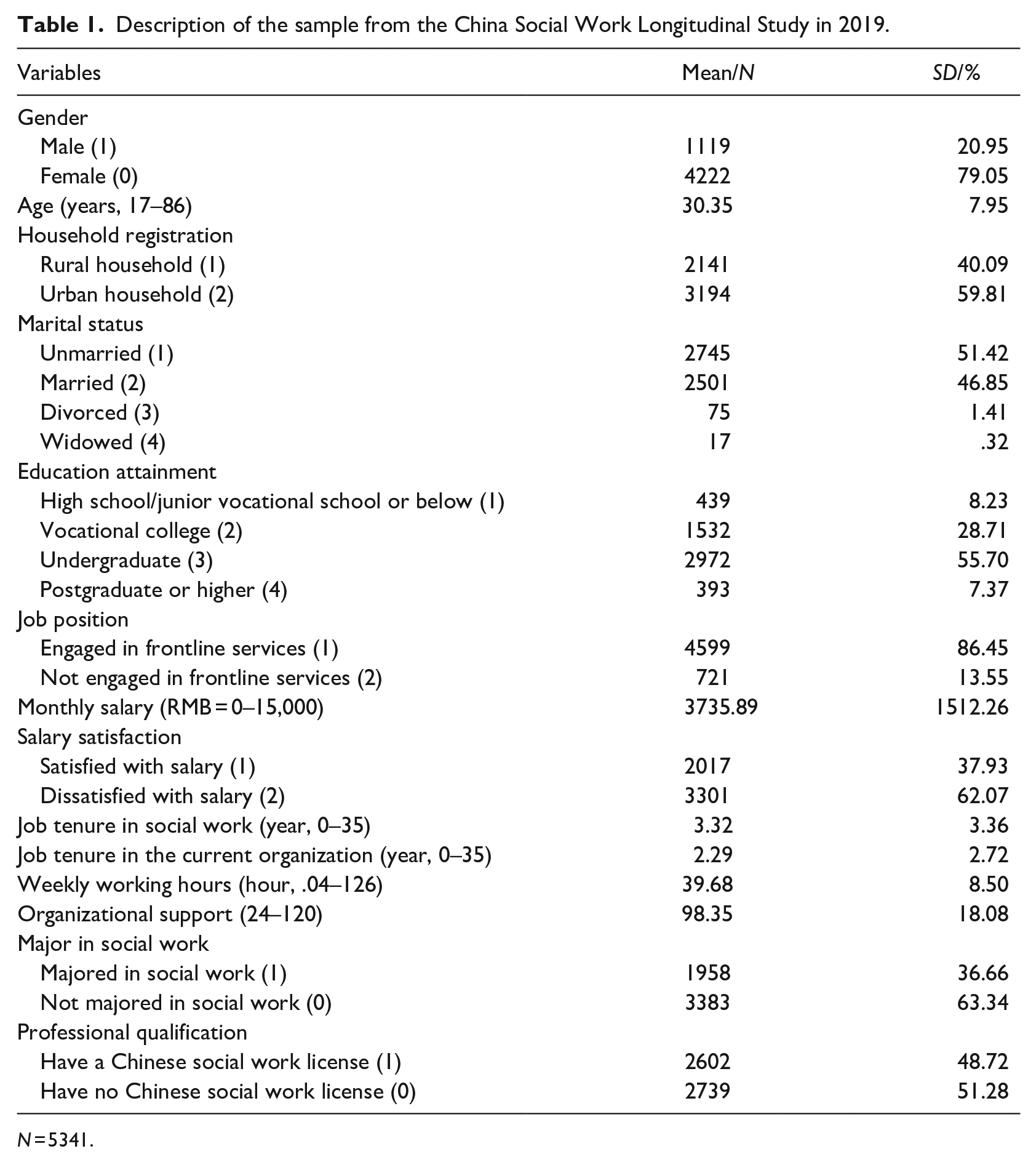
N = 5341.
Measures
Dependent variable: Burnout
Burnout was measured by MBI-HSS (Maslach and Jackson, 1986), including emotional exhaustion (nine items), depersonalization (five items), and reduced personal accomplishment (eight items). We deployed this measurement because various studies have suggested that it can be widely employed in countries with different contexts including China (Schaufeli and Taris, 2005; Wang et al., 2019). The response to each item was measured on a seven-point Likert-type scale, reporting how often participants felt burnout at work. A higher score on the scale for each component of burnout represented a higher level of emotional exhaustion, depersonalization, and reduced personal accomplishment, respectively. The Cronbach’s alphas for emotional exhaustion, depersonalization, and reduced personal accomplishment were .91, .84, and .93, respectively.
Independent variable: Role stress
Role stress was examined by its two major components, namely, role conflict and role ambiguity (Deckard and Present, 1989). Role conflict and role ambiguity were measured using 9-item and 5-item scales of a five-point Likert type, respectively, which were developed by Rizzo, House, and Lirtzman in the English version (Rizzo et al., 1970) and translated into Chinese by the researchers in charge of CSWLS. The scores of these two scales were combined to yield the score of role stress. A higher score represented a higher level of role stress. The Cronbach’s alpha was .82 for role conflict and .81 for role ambiguity.
Moderator: Critical consciousness
Critical consciousness, unpacked into critical reflection and critical action, was examined by eight items of a five-point Likert-type scale in the questionnaire of CSWLS. The items measuring critical reflection are such as ‘The role of social work is to promote social justice’, ‘The role of social work is to advocate social change’, and ‘Social workers should use their professional knowledge to actively engage in policy advocacy’. The items measuring critical action are such as ‘I help service users change their situations and improve their quality of life’ and ‘I help service users solve some problems at personal, family and social levels’. The sum of the scores for the critical reflection items and critical action items was calculated, with a higher score representing a higher level of critical reflection or critical action, respectively. The Cronbach’s alpha was .75 for critical reflection and .84 for critical action.
Control variables
Some demographic, job-related, and profession-related variables that could significantly influence burnout were included. In terms of demographic variables, gender, age, and educational attainment were significantly associated with social workers’ burnout (Su et al., 2020). Social workers’ workplace well-being differed according to different household registration and marital status in the Chinese context (Li et al., 2022). Thus, gender, age, education attainment, household registration, and marital status were controlled.
For job-related characteristics, the commonly studied significant predictors of burnout or workplace well-being were controlled, including job position, monthly salary, salary satisfaction, job tenure in social work, job tenure at the current organization, weekly working hours, and organizational support (Fukui et al., 2019; Su et al., 2020).
Data analysis
Descriptive statistics, bivariate correlation, and moderated multiple regression analysis were performed using Stata 15.0. First, descriptive statistics and bivariate correlation were conducted on the main variables (i.e. independent, dependent, and moderator variables). Then, moderated multiple regression analysis was conducted to estimate whether critical consciousness enhanced, buffered, or reversed the effects of role stress on burnout. Finally, following moderated multiple regression analysis for each component of burnout, a post hoc probing was plotted to illustrate how the strength or direction of the relationship between role stress and the concerned component of burnout was affected by critical consciousness.
Results
Descriptive statistics and correlation analysis
Table 2 displays the means, standard deviations, and correlations of role stress, critical reflection, critical action, emotional exhaustion, depersonalization, and reduced personal accomplishment.
Descriptive statistics and correlation coefficients of emotional exhaustion, depersonalization, reduced personal accomplishment, role stress, critical reflection, and critical action.
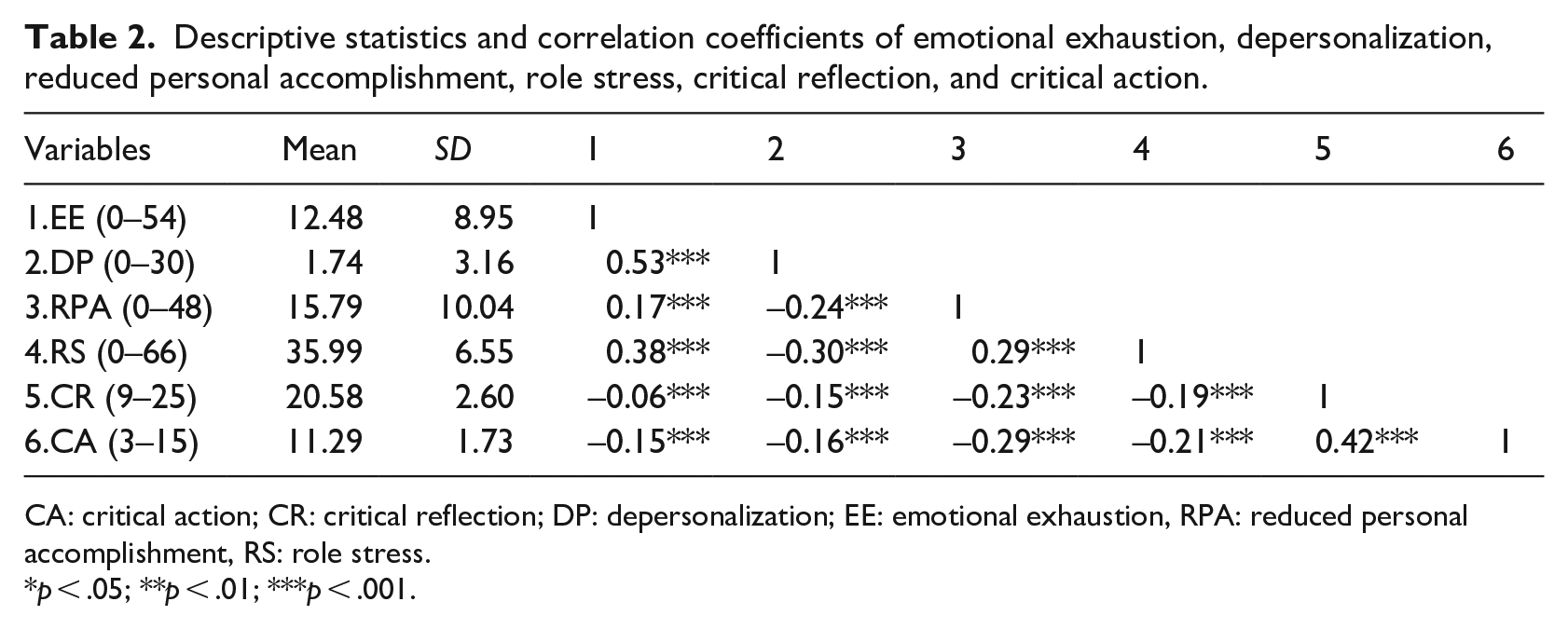
CA: critical action; CR: critical reflection; DP: depersonalization; EE: emotional exhaustion, RPA: reduced personal accomplishment, RS: role stress.
p < .05; **p < .01; ***p < .001.
The average scores of emotional exhaustion, depersonalization, and reduced personal accomplishment among social workers were 12.48, 1.74, and 15.79, respectively. Role stress was positively associated with emotional exhaustion (r = .38, p < .001), depersonalization (r = .30, p < .001), and reduced personal accomplishment (r = .29, p < .001). Critical reflection was negatively associated with emotional exhaustion (r = –.06, p < .001), depersonalization (r = –.15, p < .001), and reduced personal accomplishment (r = –.23, p < .001). Critical action was negatively associated with emotional exhaustion (r = –.15, p < .001), depersonalization (r = –.16, p < .001), and reduced personal accomplishment (r = –.29, p < .001).
Moderated multiple regression analysis
Main effects
Table 3 shows the results of the summary of moderated multiple regression analysis that predicted burnout by role stress, critical consciousness, the interaction term (i.e. role stress × critical consciousness), and the control variables including demographic characteristics (i.e. gender, age, household registration, marital status, and educational level), job-related characteristics (i.e. job position, monthly salary, salary satisfaction, tenure in social work, tenure in the organization, weekly working hours, and organizational support), and professional backgrounds (i.e. major in social work and professional qualifications). After the control variables entered the models, it was found that role stress was a significant positive predictor of emotional exhaustion (β = .40, p < .001), depersonalization (β = .11, p < .001), and reduced personal accomplishment (β = .28, p < .001). Therefore, H1 was supported. Critical reflection was a significant negative predictor of depersonalization (β = –.08, p < .001) and reduced personal accomplishment (β = –.37, p < .001), while it was a significant positive predictor of emotional exhaustion (β = .13, p < .01). Critical action was a significant negative predictor of emotional exhaustion (β = –.38, p < .001), depersonalization (β = –.13, p < .001), and reduced personal accomplishment (β = –1.14, p < .001). As such, H2 was partially supported with an unexpected positive effect of critical reflection on emotional exhaustion.
Results of the moderated multiple regression analysis on how each dimension of critical consciousness moderates the effect of role stress on each component of burnout.
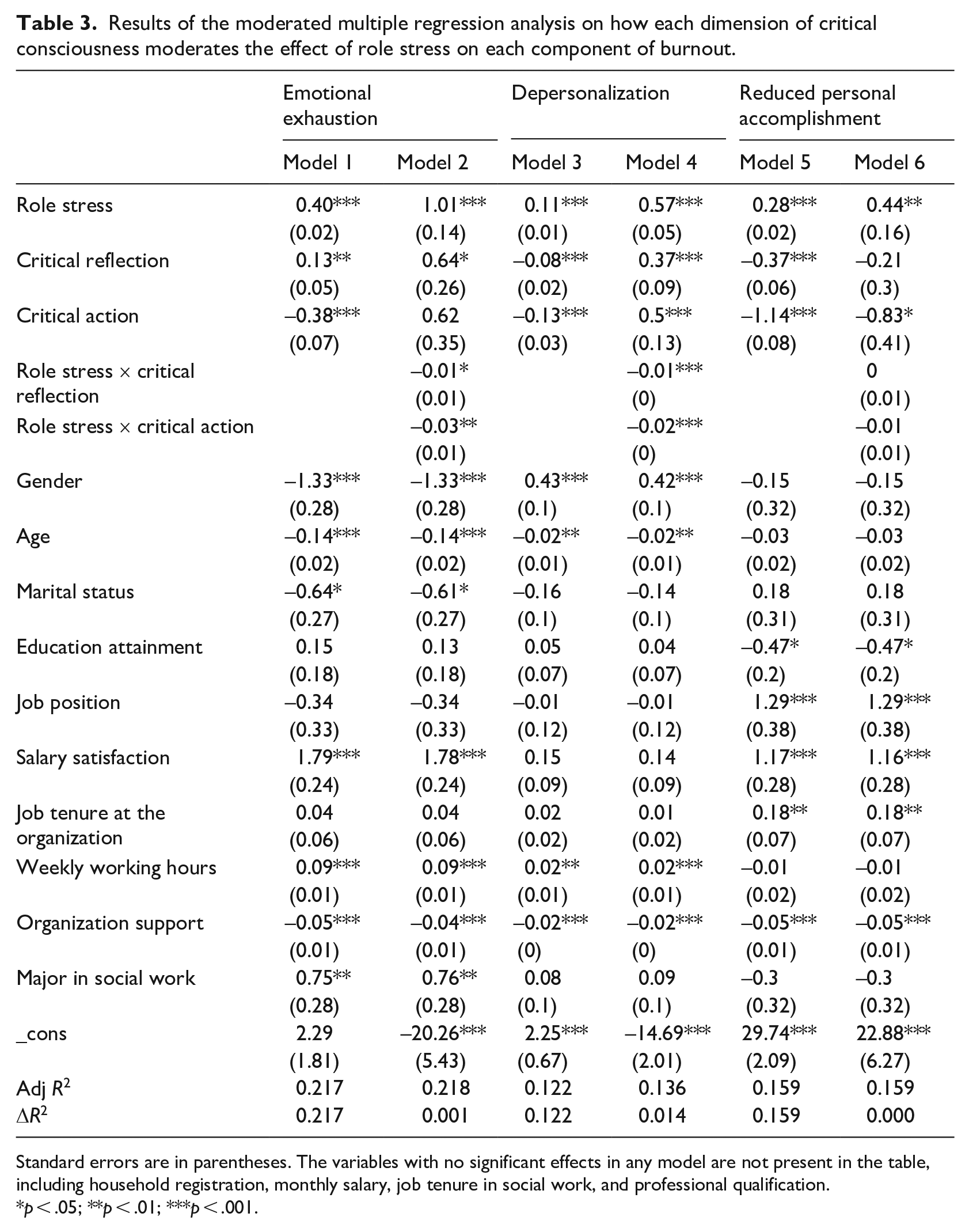
Standard errors are in parentheses. The variables with no significant effects in any model are not present in the table, including household registration, monthly salary, job tenure in social work, and professional qualification.
p < .05; **p < .01; ***p < .001.
Moderation effects
Both critical reflection and critical action moderated the relationship between role stress and emotional exhaustion (β = –.01, p < .05; β = –.03, p < .01). The moderation model explained 21.8% of the total variance of emotional exhaustion, and the interaction terms (role stress × critical reflection and role stress × critical action) explained an additional 0.1% of the variance of emotional exhaustion. To facilitate the interpretation of the two-way interaction effect, a post hoc probing (Aiken and West, 1991) was plotted with values one standard deviation above and below the mean and mean indicating high, low, and medium levels of critical reflection and critical action. As illustrated in Figure 1, the simple slope analysis showed that role stress was significantly positively associated with emotional exhaustion among social workers with different levels of critical reflection and critical action. It also showed that the higher levels of critical reflection and critical action, the weaker positive relationship between role stress and emotional exhaustion, indicating that both critical reflection and critical action buffered the effects of role stress on emotional exhaustion.
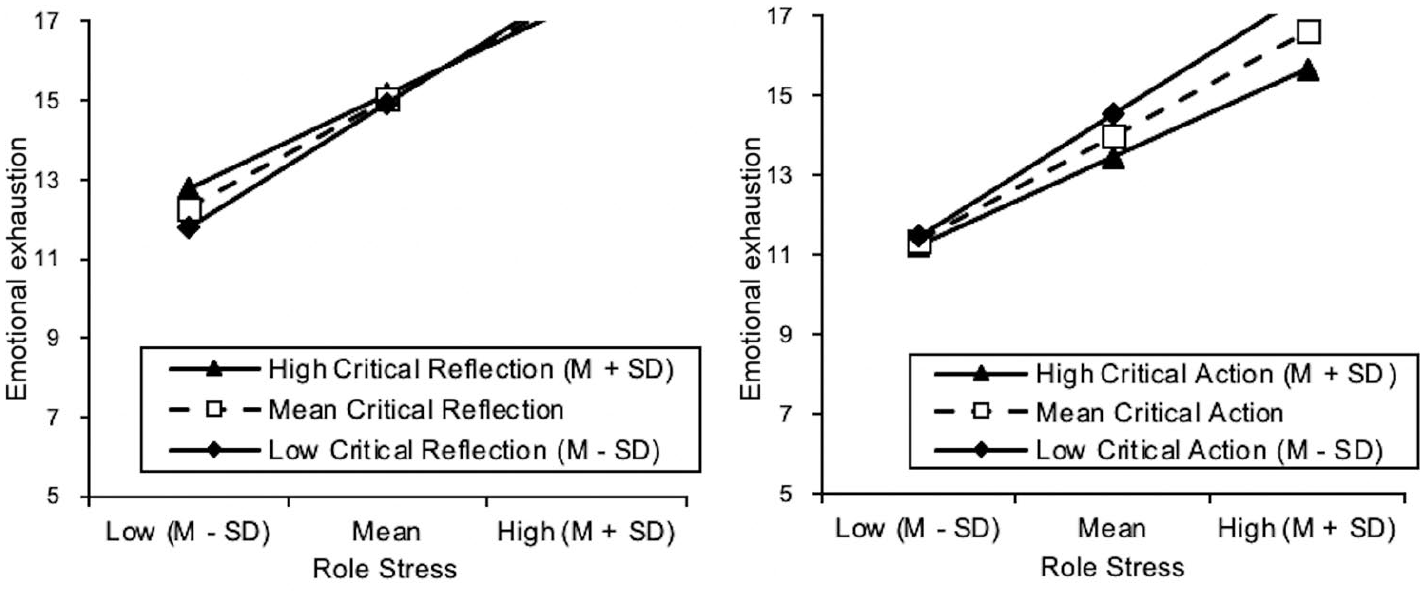
The moderation of each dimension of critical consciousness (i.e. critical reflection and critical action) on emotional exhaustion by role stress.
Similarly, there were significant interaction terms between role stress and critical reflection, and between role stress and critical action in predicting depersonalization (β = –.01, p < .001; β = –.02, p < .001) that accounted for a significant additional variance for depersonalization (ΔR2 = 1.4%, p < .001), with 13.6% of the total variance of depersonalization being explained by the full moderation model. As illustrated in Figure 2, there was a significant positive relationship between role stress and depersonalization among social workers with all levels of critical reflection or critical action. Figure 2 also shows that social workers with a higher level of critical reflection or critical action reported a much lower level of depersonalization, indicating that social workers with a higher level of critical reflection or critical action are less likely to be depersonalized by role stress.
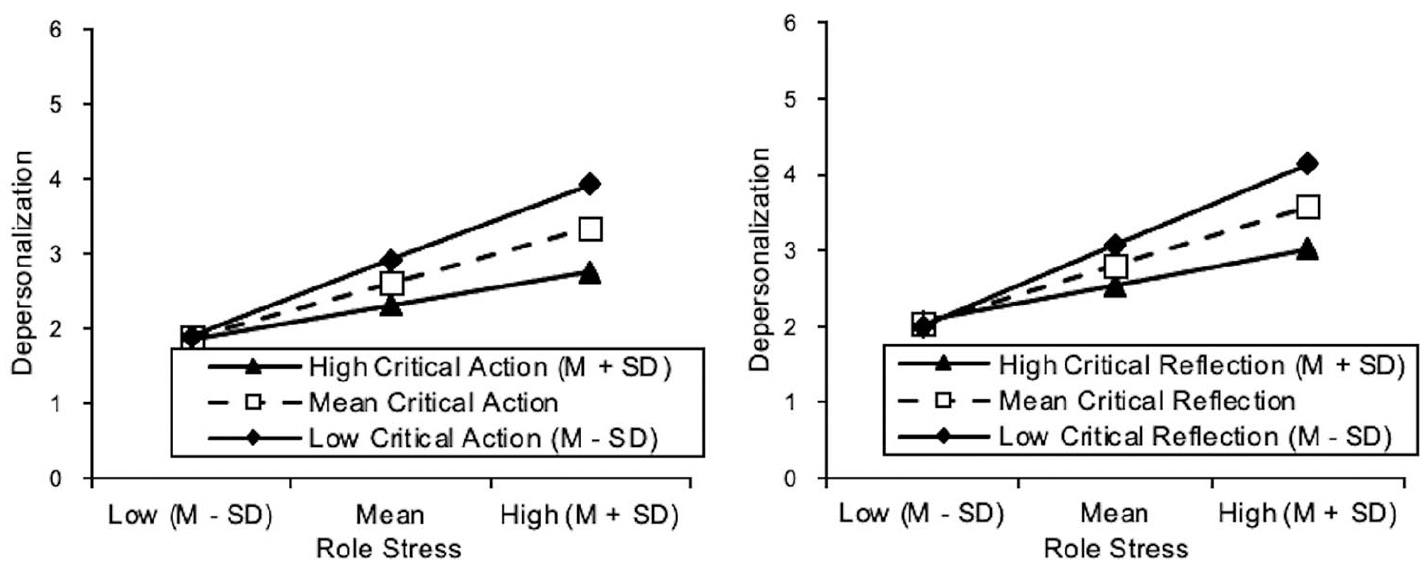
The moderation of each dimension of critical consciousness (i.e. critical reflection and critical action) on depersonalization by role stress.
As illustrated in Figure 3, there was a significant positive relationship between role stress and reduced personal accomplishment among social workers with all levels of critical reflection or critical action. However, according to Table 3 and the simple slope analysis in Figure 3, the interaction term of role stress and critical reflection or critical action did not significantly predict reduced personal accomplishment (β = 0, p > .05; β = –.01, p > .05). According to the above moderation analysis, H3 was partially supported in that critical consciousness (critical reflection and critical action) significantly buffered the effects of role stress on emotional exhaustion and depersonalization but not reduced personal accomplishment.
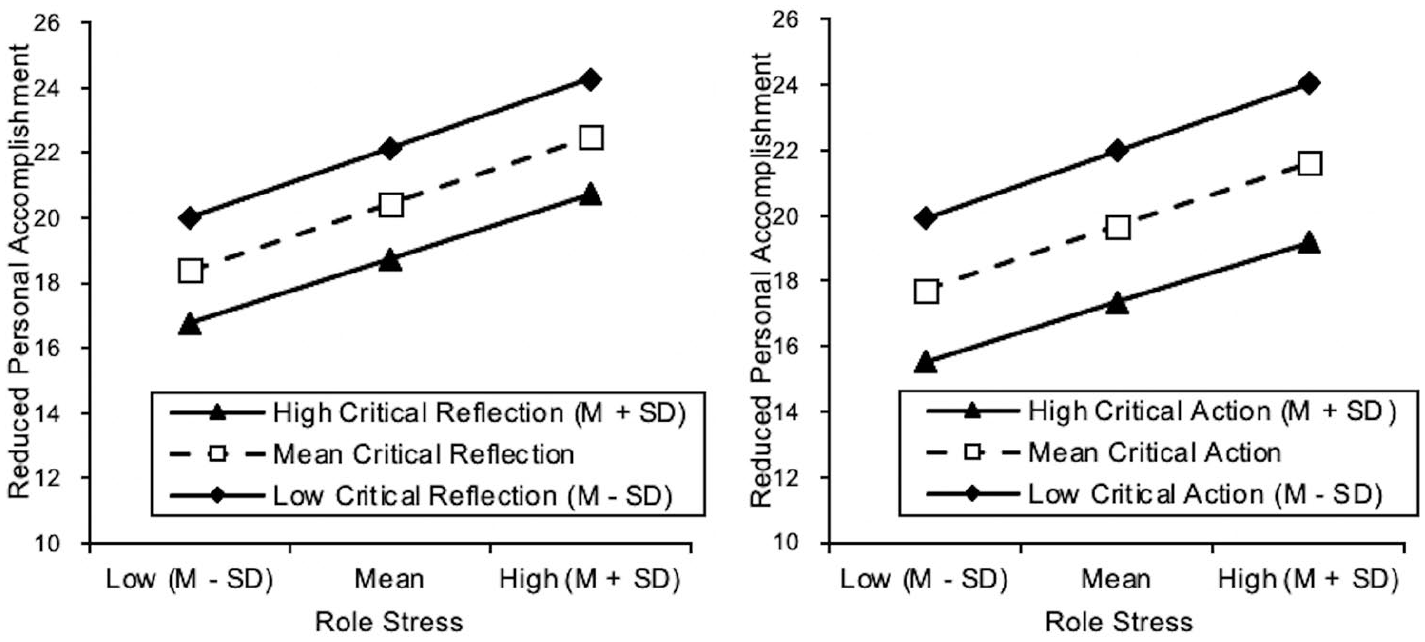
The moderation of each dimension of critical consciousness (i.e. critical reflection and critical action) on reduced personal accomplishment by role stress.
Discussion
This study investigates the main and interaction effects of critical consciousness on role stress and burnout using COR theory and a nationwide survey of Chinese social workers. The results show that role stress is positively associated with all three components of burnout, supporting Hypothesis 1. Particularly, role stress has the strongest relation with emotional exhaustion. Our findings of the effects of role stress on burnout lend support to the argument of COR theory (Hobfoll, 1989) that emotional exhaustion occurs prior to depersonalization and reduced personal accomplishment and thus role stress may be more strongly associated with emotional exhaustion than with depersonalization or reduced personal accomplishment.
The results partially support Hypothesis 2 that critical consciousness negatively relates with all three components of burnout. Critical consciousness is negatively associated with depersonalization and reduced personal accomplishment. It is consistent with COR theory in that resources are closely associated with depersonalization and reduced personal accomplishment while demands are closely related to emotional exhaustion (Leiter, 1993: 237–250). However, critical reflection is positively associated with emotional exhaustion, but critical action is negatively associated. This finding supports Christens et al.’s (2013) claim that social workers are likely to encounter emotional burnout if they fail to put critical thinking into action. In this regard, critical action may be a more effective resource than critical reflection for reducing burnout.
The results partially support Hypothesis 3 that critical consciousness acts as a moderator between role stress and burnout. The results demonstrate that critical consciousness buffers role stress’s effects on emotional exhaustion and depersonalization but not on reduced personal accomplishment. This finding is consistent with previous research suggesting that critical consciousness helps social workers manage conflicting environments by developing a more responsible position in the face of stress and conflict (Fook, 2002). Possible explanations as to why critical consciousness cannot be a clearer moderator against role stress on reduced personal accomplishment are as follows.
First, according to COR theory, a sense of accomplishment and depersonalization are often formed in social contexts, such as during interactions with others and resource arrangements, as opposed to emotional exhaustion, which can occur internally (Leiter, 1993: 237–250). This may explain why role stress on reduced personal accomplishment cannot be buffered by critical consciousness, whose effect is probably limited by the external environment. Despite the preliminary professionalization of social work in China, it is required that social workers be qualified to help service users in solving social problems in an era of drastic economic and social transformation. Due to this demanding work condition, inexperienced social workers and even social workers with higher critical consciousness may feel helpless and bear a weaker sense of accomplishment in China.
Second, reduced personal accomplishment, may either precede or result from emotional exhaustion and depersonalization (Schaufeli and Taris, 2005). Even if it is a part of the burnout construct, reduced personal accomplishment at work was not necessarily valued like other aspects such as energy at work (Alarcon, 2011). Compared to normative populations, social workers experienced higher levels of burnout with reduced personal accomplishment as a particular concern, which may be attributable to the very core of social work philosophy and values that guide the provision of services in a relationship-based practice rather than due to strict efficiency concerns (Lloyd et al., 2002). In COR terms, social workers with higher critical consciousness may value their relationship with clients rather than personal accomplishment as a kind of resource.
Informed by the earlier discussion, ‘Let not the world change us’ seems to epitomize social workers who possess critical consciousness. These social workers may be dedicated to the profession with passion and resilience in facing unfavorable work conditions leading to role stress and burnout. Despite that critical consciousness cannot buffer role stress on reduced personal accomplishment, this resource can successfully buffer role stress on emotional exhaustion and depersonalization for social workers in China. Previous studies show that different from social workers in Western countries with emotional exhaustion as a key component of burnout (Kim and Ji, 2009), Chinese social workers’ key component of burnout is depersonalization (Wang et al., 2019). According to COR theory, depersonalization is inherent to social contexts, this kind of burnout is more likely to be ameliorated by critical consciousness, which is a core capacity to recognize and overcome sociopolitical barriers. Social workers with higher critical consciousness may question work environment rather than doubt the value of their work or become cynical.
This work thus contributes to the research into personal resources for addressing burnout. Previous studies have identified that self-esteem and mastery are relevant to the development of burnout (Janssen et al., 1999; Shirom, 1989: 25–48). This study extends these discussions and informs this stream of research that critical consciousness is important for preventing or ameliorating burnout.
This work also contributes to research on whether critical consciousness plays a role in the impact of role stress on burnout among social workers in developing countries and authoritarian states. Drawing from many studies (e.g. Watts et al., 2011), the study provides one way of operationalizing critical consciousness into the following two structural dimensions: critical reflection and critical action. Previous studies have found that critical consciousness or critical thinking was eliminated by Chinese social workers in their practice (Lei and Huang, 2018). In contrast, this study suggests that critical consciousness can be a central predictor of success under the competence framework as identified by Colby (2009).
Implications
Our results have important practical implications. First, role stress appears to play a greater role in emotional exhaustion than in depersonalization and reduced personal accomplishment. Social work is a profession characterized as emotional labor in both positive and negative ways (Moesby-Jensen and Nielsen, 2015). Managers may need to optimize the responsibilities of social workers at work to mitigate their burnout experiences, especially emotionally.
Second, social workers with critical reflection and little experience of critical action are likely to be frustrated with their jobs. Poletta (2002) suggested that actions taken by a group of people rather than individuals are more likely to lead to a change of circumstances. As the importance of critical action has been found, it is worth exploring community organizing among social workers and providing concrete guidelines that link the generated critical reflection to potential critical action among social workers in a collective approach. This would allow them to develop a large array of techniques that could be used with different clients toward social justice.
Third, critical consciousness is a key resource of resistance and a core professional competence to lessen the effect of role stress on work-related burnout among social workers. Therefore, social work managers, supervisors, and educators should recognize critical consciousness as an important psychosocial resource at both an individual and professional level that enables social workers to work in the challenging and stressful jobs within the emerging and unstable social work industry in China. Thus, both organizational and educational practices should be considered jointly to promote critical consciousness among social workers, thereby protecting them from burnout as well as engaging them in materializing professional roles.
Limitations
There are certain limitations to be acknowledged. First, as a cross-sectional design, this study cannot guarantee a causal sequence in which role stress influences burnout and this influence is altered by critical consciousness. The causal effect may be reversed. For example, existing burnout syndromes and lack of resources may trigger stressful events. Thus, longitudinal data are required for future research in this field.
Second, the measurement of critical consciousness should be improved in future studies. Due to the limited CSWLS dataset, which was not intended to examine critical consciousness, we constructed critical consciousness by incorporating relevant measurements into the questionnaire. Future research may need to develop measurements of critical consciousness based on this work of critical consciousness. Many measures have been developed to assess critical consciousness (Baker and Brookins, 2014; Diemer et al., 2017; McWhirter and McWhirter, 2016; Thomas et al., 2014). Hence, it is worth developing a standardized and culture-based scale of critical consciousness with social workers as the target population.
Third, the generation of personal resources entails the interaction between individuals and environment. How is individual critical consciousness influenced by social resources, thus affecting the relationship between critical reflection and critical action, and what is its relationship with different parts of burnout? This also deserves further inquiry.
Conclusion
Our overall findings generally support COR theory. Demands (role stress) correlate strongest with emotional exhaustion, and then with depersonalization and reduced personal accomplishment. Resources (critical consciousness) have the opposite correlations with depersonalization and reduced personal accomplishment while critical reflection rather than critical action is positively associated with emotional exhaustion, indicating that critical action can better protect social workers in emotion-related burnout. Critical consciousness does not buffer the effects of role stress on reduced personal accomplishment, however, by buffering the effect of role stress on the key components of emotional exhaustion and depersonalization, it leads to resource gain and resistance to occupational fatigue.
Footnotes
Declaration of conflicting interests
The authors declared no potential conflicts of interest with respect to the research, authorship, and/or publication of this article.
Funding
The authors disclosed receipt of the following financial support for the research, authorship, and/or publication of this article: This research is supported by the Teaching Research Projects of Central China Normal University in 2022 and this project’s title is The Study of Service Learning Teaching Model of Social Work Courses.
