




Abstract
Corresponding to the growth of the immigrant population in the late-20th and early-21st centuries, immigrants’ difficulties have been intensified and diversified in the United States. Drawing on the lens of social exclusion, this study aims to synthesize recent qualitative studies on immigrants’ challenges in the United States. This study conducted a systematic review with 22 studies on immigrants’ exclusion experiences. Results from this study indicate several types of immigrants’ social exclusion and barriers to their inclusion. The findings of this study fortify our understanding of the social exclusion dynamics among immigrants and provide meaningful implications for their social inclusion.
Keywords
Introduction
Social exclusion is generally defined as the process in which individuals are blocked from economic resources, social services, or political opportunities (Jordan, 1996; Taket et al., 2009). Room (1999) also explained that social exclusion is the condition of relationship breakdown between an individual and society. Scholars have characterized that social exclusion rests on a multi-dimensional notion of participation in society, involving a combination of physical, material, relational, and societal needs (Barnes, 2005; Berghman, 1995; Room, 1999). Sen (2000) and Silver (2006) argued that the social exclusion perspective has the advantage of explaining the effects of public policies on social solidarity and assisting in developing policies to achieve social cohesion.
Since Parker (1928) associated social exclusion with immigrants, the social exclusion framework has been used to explain how immigrants experience segregation along with multi-dimensional aspects of social life. Particularly in Europe, many studies have pointed out the tenuous political status of immigrants (Morales, 2016) and the extremely unequal distribution of resources across ethnic groups within countries (Esses et al., 1998; Gradstein and Schiff, 2006). In addition, the social exclusion framework has been utilized to address immigrants’ various difficulties, such as lack of social services for immigrants (Negi et al., 2013; Prislin et al., 1998; Shah et al., 2006), their isolation (Liu et al., 2012; Ryan et al., 2008), and their reduced opportunities in the labor market (Arbaci and Malheiros, 2010; McLaren, 2003; Rydgren, 2004). However, in the United States, social exclusion research has been scant while many studies on immigrants’ social exclusion have been conducted globally (Moffatt and Glasgow, 2009; Rawal, 2008; Sen, 2000). Silver and Miller (2003) pointed out that the United States still addresses poverty as a narrow construct, strictly as ‘a deficiency of income for basic necessities’ (p. 1). Moffatt and Glasgow (2009) also argued that the focus on a unidimensional income-based measure of poverty, which comprises the US approach to measuring poverty rates, explains why social exclusion discourse has not been heavily discussed in the United States.
US immigrant populations from Latin America and Asia have been growing rapidly since the late 1990s (Batalova et al., 2020). Many scholars have examined the various challenges faced by US immigrants including economic difficulties, limited social networks, and discrimination experiences (Ayón, 2016; Chung, 2011; Ellis et al., 2010; Held et al., 2018; Kwong and Mak, 2009). However, under the traditional measure of poverty, US immigrants’ multi-dimensional difficulties cannot be fully addressed. Using the social exclusion framework, this study synthesizes evidence from previous studies to fortify our understanding of the social exclusion dynamics among US immigrants. Consequently, this study aims to provide meaningful implications for immigrants’ inclusion and contribute to guiding social workers to develop services for immigrants from the social inclusion perspective.
Background
One year after the Civil Rights Act passed, the Immigration Act of 1965 abolished the discriminatory quotas based on race or national origin for denying immigration to the United States. Since that point, immigration in the United States has undergone dramatic changes in volume and origins. Immigrants from Latin American and Asian nations moved to the United States in large numbers since the late-20th century, which stands in contrast to immigration trends in the mid-19th century, when most immigrants were from European countries (Budiman, 2020). Migration Policy Institute (2019) data show that 43.9 million immigrants lived in the United States in 2017, accounting for 13.7 percent of the nation’s population. The immigrant population from Latin America and Asia was estimated to account for 83.3 percent of total immigrants in 2017 (Batalova et al., 2020).
Corresponding to the growth of the immigrant population from Latin America and Asia in the late-20th and early-21st centuries, anti-immigrant sentiments have been growing in the United States (Flores, 2018). There have existed several national crises and threats, such as the terrorist attacks of 9/11, the Iraq War, and the global economic recession, which aroused anti-immigrant attitudes and support for more restrictive immigration policies (Esses et al., 2002; Golash-Boza, 2015; Hines, 2006; LeBrón et al., 2018). According to Goo (2015), 41 percent of native-born Americans reported harboring negative attitudes toward immigrants, describing them as a ‘burden on the country’. Ayón (2016) pointed out the increased anti-immigrant sentiments nationwide and the recent passage of anti-immigrant legislation, such as the Arizona Senate Bill 1070. Quesada et al. (2011) pointed out Latino migrant laborers’ structural vulnerability in the United States. They defined structural vulnerability as ‘a product of class-based economic exploitation and cultural, gender/sexual, and racialized discrimination’ and argued immigrants’ economically and culturally depreciated status in the United States is aggravated by ‘legal persecution’ (Quesada et al., 2011: 339–340). Particularly, since 2016, several exclusive proposals or implementation of policies including building a wall on the border with Mexico, ceasing legal immigration, and conducting nationwide mass raids have been proposed and enacted (Pierce et al., 2018; Pierce and Selee, 2017). To be specific, US immigrants are now at an unprecedented risk of social exclusion, which covers economic, political, social, and cultural marginalization.
Methods
To strengthen our understanding of the dynamics of social exclusion among US immigrants, this study synthesized recent qualitative studies on immigrants’ social exclusion and their findings conducting a systematic review.
The Preferred Reporting Items for Systematic reviews and Meta-Analyses (PRISMA) method was utilized to determine the articles that would be included in the final review (see Figure 1). Not to superficially investigate immigrants’ social exclusion but to identify and to empathize with the problem from their perspective, this study limited the data to the qualitative studies published in social work journals. To consolidate the list of social work journals, the Social Science Citation Index (SSCI) database was used, which is managed by the Journal Citation Reports. A total of 24 journals were categorized as social work journals by the SSCI. Using the SSIC database, the following search terms were used to select final articles: immigrant, social exclusion, isolation, alienation, discrimination, qualitative research, and qualitative study. Also, the inclusion criteria for this meta-analysis included: (1) a qualitative design, (2) published articles between 2000 and 2019, (3) published articles in social work journals as categorized by the SSCI, (4) investigation of immigrants’ exclusion experiences in the United States, (5) presence of verbal interaction between the researcher and the participant, and (6) English-language articles. The application of these criteria yielded 22 articles for analysis.
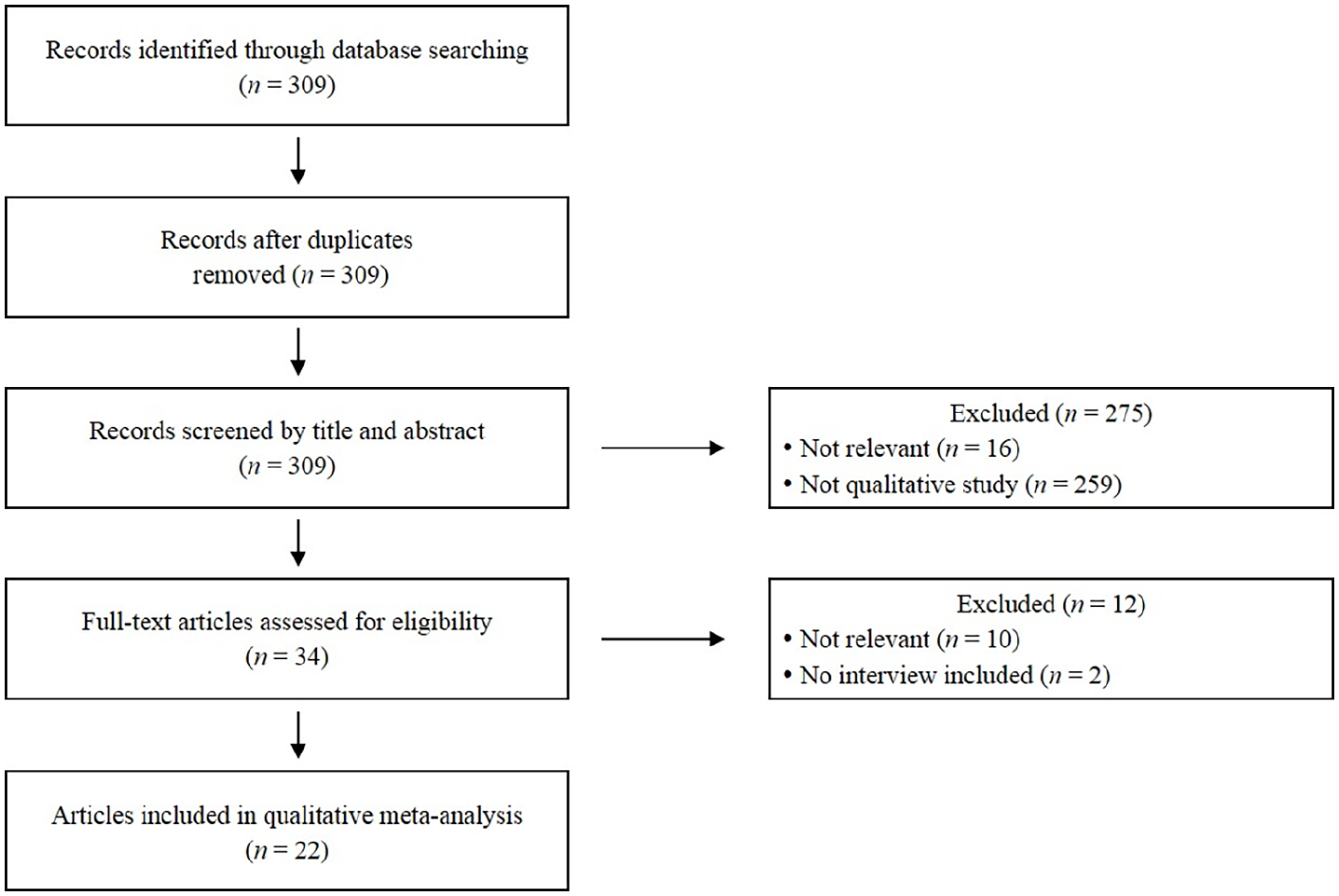
Article inclusion process using the PRISMA flow chart.
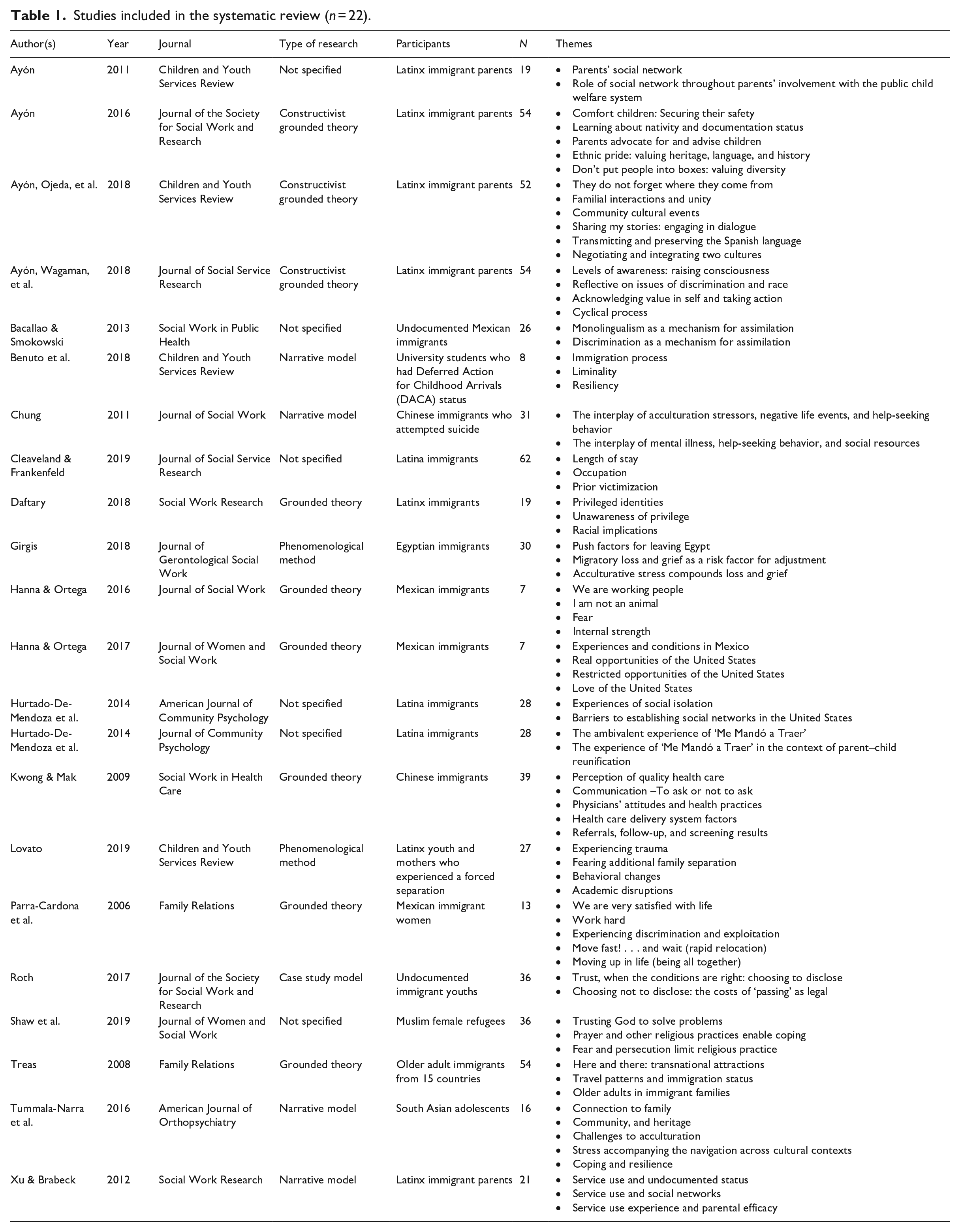
A total of 22 studies, which focused on immigrants’ exclusion experiences and conducted in-person interviews, were published in 14 social work journals between 2006 and 2019. Of note, no research that involved in-person interviews on immigrants’ social exclusion was published in social work journals before 2006. Almost 60 percent of the studies (n = 13, 59.1%) were published since 2016. Table 1 is a summary of the characteristics of the studies included in this systematic review. More than half of the studies interviewed immigrants who were of Mexican-origin or from Latin American countries (n = 13, 59.1%). The sample sizes of the studies ranged from 7 to 62 (µ = 30.32, SD = 16.577).
Studies included in the systematic review (n = 22).
Findings
Studies in the dataset interviewed US immigrants and detailed their various experiences of social exclusion. An analysis of the studies shows barriers regarding immigrants’ social inclusion as well as how the studies’ results fall into four distinct but overlapping types of immigrants’ social exclusion, including economic, political, relational, and cultural exclusion.
Barriers against immigrants’ social inclusion
Several studies in the dataset captured and focused on the barriers to immigrants’ social inclusion. Ayón et al. (2018b) explained that limited English proficiency, documentation status, and lack of awareness of US service systems all served as hindrances to social inclusion. In the 22 selected studies, the most mentioned obstacle was the language barrier (Ayón et al., 2018b; Bacallao and Smokowski, 2013; Chung, 2011; Daftary, 2018; Girgis, 2018; Hanna and Ortega, 2016, 2017; Kwong and Mak, 2009; Treas, 2008; Tummala-Narra et al., 2016). Chung (2011) pointed out that the language barrier was an underlying factor that influenced participants’ social isolation and poor living conditions. For example, a participant in Girgis’s (2018) research, a 72-year-old former accountant from Egypt, reported his frustrations about how the language barrier negatively affected him: I did not have the language [proficiency] to resume practicing my profession here. I did not understand people. I did not understand the American accent, slangs, or expressions, especially when people spoke quickly. (p. 363)
Another barrier that was revealed in previous studies was cultural in nature (Bacallao and Smokowski, 2013; Benuto et al., 2018; Parra-Cardona et al., 2006; Shaw et al., 2019). In the study by Benuto et al. (2018), immigrants faced certain liminality, not feeling accepted by the culture of their home country, while simultaneously feeling rejected by the culture that they immigrated to and now lived within.
Finally, studies in the dataset revealed that policy negatively affected immigrants’ social inclusion in the United States (Ayón, 2011; Ayón et al., 2018a, 2018b; Bacallao and Smokowski, 2013; Cleaveland and Frankenfeld, 2019; Hanna and Ortega, 2016, 2017; Kwong and Mak, 2009; Lovato, 2019; Parra-Cardona et al., 2006; Tummala-Narra et al., 2016). Particularly with unauthorized immigrants, the policy barrier was strongly interconnected with their economic exclusion in the American labor market (Ayón, 2016; Chung, 2011; Hanna and Ortega, 2016). In addition, many participants reported oppressive policies that severely lowered the probability of attending universities (Bacallao and Smokowski, 2013). For example, state policies often charge unauthorized immigrants out-of-state tuition and deny financial aid options, even when youths have spent the majority of their lives in that state. Furthermore, participants discussed a deep fear of the police, of being deported, and of being separated from their families (Hanna and Ortega, 2016, 2017; Lovato, 2019). Such barriers, which were intertwined and interconnected with each other, hindered immigrants’ successful acculturation and contributed to their various exclusion experiences.
Economic exclusion
Although the most common reason for immigration is to escape poverty and to seek better economic opportunities, many participants in the selected studies reported economic difficulties and employment difficulties (Ayón, 2016; Chung, 2011; Girgis, 2018; Hanna and Ortega, 2016; Hurtado-De-Mendoza et al., 2014a, 2014b; Parra-Cardona et al., 2006). For example, one Chinese immigrant participant in Chung’s (2011) study said, I only earned $700–$800 a month – very low wages, given that I worked 13 to 14 hours a day . . . When I went out, I wanted to buy things but wouldn’t dare spend any money . . . Sometimes we had to eat crackers for dinner because we couldn’t afford rice. (p. 619)
Unfair wages and discrimination in the labor market, particularly for those who were unauthorized to work in the United States, were mentioned as discriminatory acts encountered by respondents, ‘They pay less because I didn’t have my papers’ (Hanna and Ortega, 2016: 55), ‘Even if they are good people and want to give you a job, they can’t. The police will give them a fine because they are not supposed to give us jobs’ (Ayón, 2016: 459). In addition, many participants in Hurtado-De-Mendoza et al. (2014a), and Parra-Cardona et al. (2006) reported that they felt pressure to cover their expenses in the United States and to send money to their relatives in their home countries. With this double burden, even if immigrants worked hard every day, all their life, they hardly escaped poverty.
Political exclusion
Immigrants’ political exclusion was not highlighted in the selected studies as much as other types of exclusion; however, it is clear from this analysis that it existed. Although the rights to vote and stand for elections are the most common and typical rights to political participation, for immigrants, those rights are precisely impeded by the lack of citizenship (Pilati, 2021). In the selected studies, immigrants’ political exclusion in the United States has been discussed in the broad sense of political rights including political engagement through protests, demonstrations, and movements. Ayón et al. (2018b) pointed out that US immigrants may not be able to advocate for themselves and improve their oppressed status within the existing socio-political context. It was demonstrated that multiple barriers to immigrants, such as racial discrimination, limited English proficiency, and lack of political information, disempowered and alienated them from political processes and participation (Hanna and Ortega, 2017). Particularly, some participants in Hanna and Ortega’s (2017) study said that ‘the knowledge that unauthorized immigrants are often not granted a pathway toward citizenship despite the contributions they make to the U.S.’ (p. 368) made them disheartened. Moreover, half of the selected studies identified unauthorized immigrants’ fear of possible family separation and deportation, and the fear refrained them from seeking services, building social networks, and participating in political activities (Ayón, 2016; Ayón et al., 2018a; Benuto et al., 2018; Cleaveland and Frankenfeld, 2019; Daftary, 2018; Hanna and Ortega, 2016; Lovato, 2019; Roth, 2017; Treas, 2008; Xu and Brabeck, 2012).
Relational exclusion
This subsection addresses how immigrants in the studies experienced relational exclusion, which is defined as an inability to take part in valued activities and limited social relationships (Ocean, 2005; Reid, 2004; Sen, 2000; Stewart et al., 2009). In several studies, participants emphasized the importance of family as a key source of support (Ayón, 2011, 2016; Tummala-Narra et al., 2016). However, some immigrants reported stressors related to changes in family structure and roles post immigration (Ayón et al., 2018b; Tummala-Narra et al., 2016). Some participants, who had left family members in their home country, reported feelings of loneliness and isolation (Chung, 2011; Hurtado-De-Mendoza et al., 2014a, 2014b). For example, one participant in Chung’s (2011) research said, ‘There was no one who could help me in America. I had to rely on myself for everything’ (p. 623).
In addition, most immigrants reported difficulties in making social relations outside of the family as well. One participant in research by Hurtado-De-Mendoza et al. (2014a) stated, ‘I want to advance, be able to study, to work, but I don’t have anyone. I don’t have acquaintances.’ Similar to other types of exclusion, immigrants’ unstable status, limited English proficiency, and various policy and cultural barriers exacerbated their social isolation. A Latina immigrant described, ‘In my country, I had a lot of friends. They used to tell me their problems and we joked together. Here I go from home to work and from work back home, and on my day off I sleep’ (Hurtado-De-Mendoza et al., 2014b: 77).
Cultural exclusion
Finally, it was found that immigrants were forced to abandon their culture, including language, religion, and dress culture (Ayón et al., 2018a; Bacallao and Smokowski, 2013; Benuto et al., 2018; Shaw et al., 2019; Tummala-Narra et al., 2016). Some Latinx parents reported that maintaining the Spanish language was difficult, and their children felt ashamed to speak Spanish in the classroom since the state’s restrictive immigration political context and schools implement English-only policies (Ayón et al., 2018a). One child in Bacallao and Smokowski’s (2013) study shared his experience: I went to school the next day after I got to the U.S. looking like a cowboy from Mexico. Aaahh. I went through that day and I wouldn’t even take off my sombrero. Everybody was laughing at me. Then I started wearing shorts and running shoes to school. (p. 6)
Shaw et al. (2019) interviewed Muslim female refugees on the difficulties of living with fear and persecution due to religious identity in the United States. Because of fear, participants reported being unable to openly practice their religion through prayer, mosque attendance, and participation in religious events (Shaw et al., 2019). Tummala-Narra et al. (2016) also identified South Asian participants’ experiences of being bullied and marginalized concerning South Asian food, language, and religion.
Social exclusion dynamics among US immigrants
Synthesizing previous findings, this study identified how the barriers to immigrants’ social inclusion functioned and interrelated with the four types of social exclusion (see Figure 2). Much of immigrants’ economic exclusion was reported as discrimination in the labor market, such as verbal abuse, excessive work, and prohibition of speaking Spanish (Chung, 2011; Girgis, 2018; Hanna and Ortega, 2016; Parra-Cardona et al., 2006). Many immigrant workers reported receiving low wages and working in very poor conditions (Chung, 2011; Hanna and Ortega, 2016; Parra-Cardona et al., 2006). Particularly, immigrants who had limited English proficiency and unauthorized immigrants were likely to be exposed to economic exclusion. Because of the language barrier, some immigrants could not get job information or communicate with other workers well (Cleaveland and Frankenfeld, 2019; Hanna and Ortega, 2017; Parra-Cardona et al., 2006). Also, unauthorized immigrants feared possible family separation and deportation and had trouble in seeking work (Ayón, 2011; Hanna and Ortega, 2016).
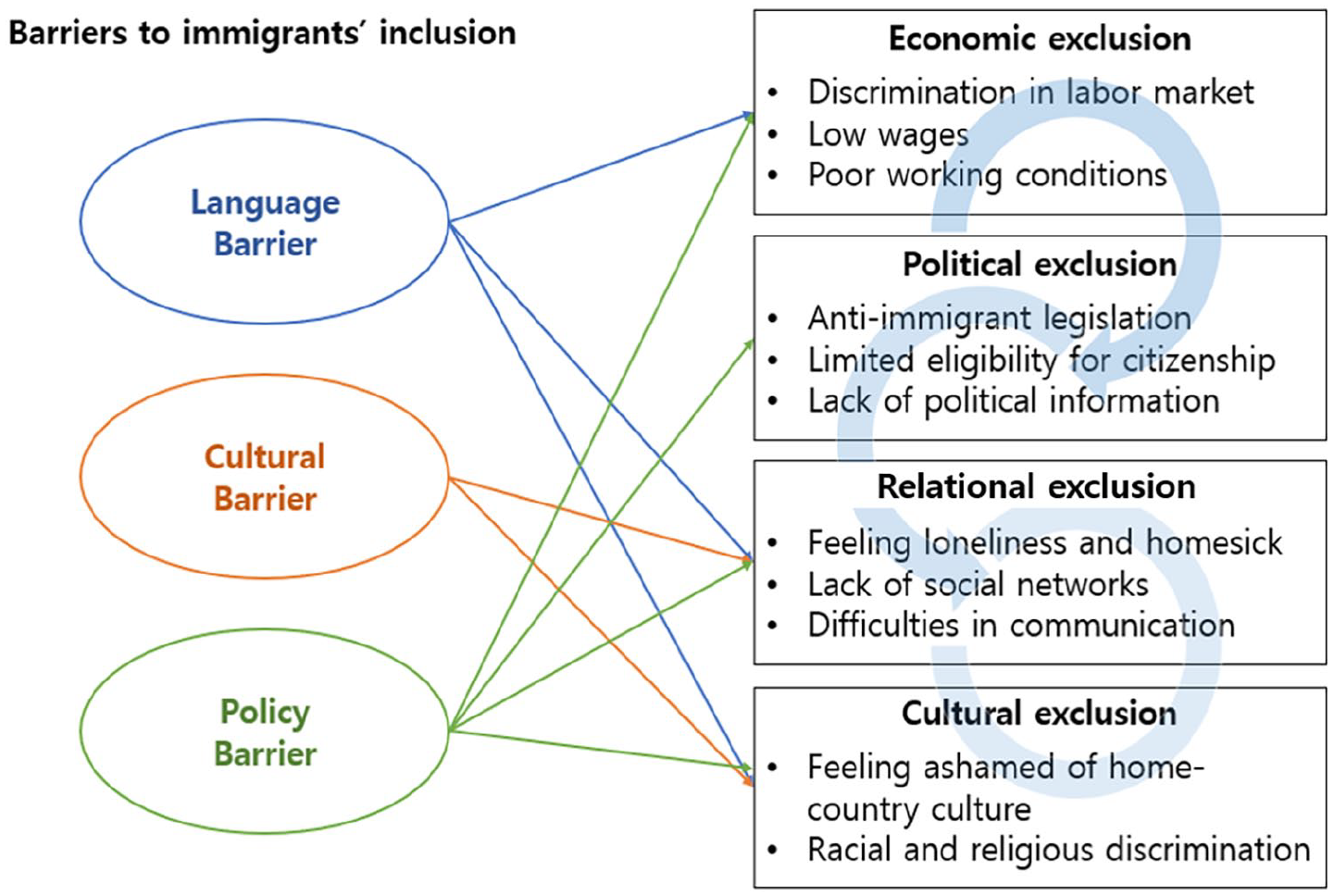
Barriers and social exclusion of US immigrants.
Immigrants’ political exclusion, such as disempowerment, lack of political rights, and alienation from political processes, was implied in many of the selected studies (Ayón et al., 2018a, 2018b; Benuto et al., 2018; Cleaveland and Frankenfeld, 2019; Daftary, 2018; Lovato, 2019; Roth, 2017; Treas, 2006; Xu and Brabeck, 2012). The passage of anti-immigrant legislation and increased anti-immigrant sentiment also have limited immigrants’ political and civic participation (Ayón, 2016). Particularly, unauthorized immigrants reported feeling despair in the knowledge that they are often not granted a pathway toward citizenship regardless of their contributions to the United States (Hanna and Ortega, 2017).
Relational exclusion was prominently reported by immigrants who had left family members in their home country (Chung, 2011; Hurtado-De-Mendoza et al., 2014a, 2014b). All three barriers, language barrier, cultural barrier, and policy barrier, underlie and deteriorate immigrants’ relational exclusion. Immigrants reported feeling it difficult to establish and develop social relations in the United States because of their limited English proficiency (Hurtado-De-Mendoza et al., 2014a, 2014b; Treas, 2008; Tummala-Narra et al., 2016) and culture differences (Bacallao and Smokowski, 2013; Hurtado-De-Mendoza et al., 2014b; Shaw et al., 2019). Particularly, because of the fear of forced deportation, immigrants were even scared to go out in the street and were socially isolated (Hanna and Ortega, 2016).
Finally, similarly to relational exclusion, participants’ cultural exclusion was strongly linked with all three barriers. In several studies, immigrants were forced to abandon their culture, including language, religion, and dress culture (Ayón et al., 2018a; Bacallao and Smokowski, 2013; Benuto et al., 2018; Shaw et al., 2019; Tummala-Narra et al., 2016). The barriers limited opportunities for immigrants to understand and learn the new culture of their new homeland. Lack of communication and racial discrimination prevented immigrants from being culturally included and participating in community events. In particular, students faced bullying and felt that this experience interfered with school (Ayón, 2016; Ayón et al., 2018a, 2018b; Bacallao and Smokowski, 2013). Furthermore, because of some federal, state, and institutional policies that restricted financial aid to undocumented students, they essentially had no opportunity to get higher education (Benuto et al., 2018; Hanna and Ortega, 2017).
Discussion
In contrast to immigration trends in the 19th and early-20th centuries when most immigrants were from European countries, immigrants from other American and Asian nations began to immigrate to the United States in large numbers in the late-20th and early-21st centuries (Budiman, 2020). Since anti-immigrant sentiments in the 19th and early-20th centuries resulted in frequent discrimination, prejudice, and even physical violence toward European immigrants (Healey, 2003; Jaret, 1999; Michalikova, 2017), many studies have pointed out US immigrants’ various challenges and difficulties (Ayón, 2016; Chung, 2011; Ellis et al., 2010; Esses et al., 2002; Held et al., 2018; Kwong and Mak, 2009). In this context, this study conducted a systematic review of recent qualitative studies on immigrants’ multi-dimensional challenges based on the social exclusion perspective.
The findings of this study indicate that language and cultural barriers underlie immigrants’ social exclusion and negatively influence immigrants’ social relations and participation in civic and social activities in the United States. Language and cultural differences were reported to disrupt immigrants’ acculturation and result in their social isolation in previous research that interviewed service providers supporting immigrants in the United States (Held et al., 2018; Roschelle et al., 2018). Also, many scholars pointed out that language and culture are significant factors that determine access to social resources within an immigrant community (Esses et al., 1998; Gradstein and Schiff, 2006; Held et al., 2018; Neto, 2002). Namely, service agencies supporting immigrants can alleviate the barriers by providing social programs, such as English tutoring, cultural education, and translating and interpreting services.
The findings of this study also suggest that the policy barriers have a wide range of influences on immigrants’ multi-dimensional exclusion. With the shift from Aid to Families with Dependent Children (AFDC) to Temporary Assistance for Needy Families (TANF) and the Illegal Immigration Reform and Immigrant Responsibility Act (IIRIRA) legislation in 1996, immigrant eligibility criteria for social benefits has been narrowed (Hagan et al., 2011). In addition, since the terrorist attacks of 9/11, there has been more support for restrictive immigration policies based on anti-immigrant sentiments (Ayón, 2016; Flores, 2018; Golash-Boza, 2015; Hines, 2006; LeBrón et al., 2018). Moreover, policy barriers militate against immigrants’ opportunities for higher education and quality employment (Boyas et al., 2009). However, US immigrants may be reticent to lead social change efforts and overcome their multifaceted problems because of their tenuous political status (Morales, 2016). Particularly, in recent studies, undocumented immigrants reported their fear of forced deportation and family separation coincided with the rescission of Deferred Action for Childhood Arrivals (DACA), a temporary program providing relief from deportation and work authorization for immigrant youth (Bacallao and Smokowski, 2013; Lee, 2022; Roth, 2017; Xu and Brabeck, 2012). Because of such fear, undocumented immigrants, who are not legally allowed to work and excluded from almost all social programs in the United States, could find it harder to freely express themselves and therefore participate in social, economic, civil, and political events (Daftary, 2018; Held et al., 2018; Roschelle et al., 2018). Thus, social activists and civic groups are required to provide legal aid for immigrants against anti-immigrant legislation and policies that threaten their rights.
In summary, the findings of this study reveal that several barriers mutually influence and are interconnected with immigrants’ social, economic, cultural, and political exclusion. Immigrants’ fundamental human rights and even their families and lives in the United States are threatened. As noted, social exclusion research in the United States has been scant (Moffatt and Glasgow, 2009; Sen, 2000), but the multifaceted social problems and barriers which US immigrants have been facing cannot be fully covered under the traditional concept of poverty. Nevertheless, many service agencies supporting immigrants in the United States do not care much about their empowerment and inclusion but focus on their economic difficulties and provide temporary aid. In order to address immigrants’ multi-dimensional challenges, it is required to develop a unique American social exclusion discourse. The findings of this study can be also helpful not only to American social workers but also to social workers in other countries in understanding their immigrants’ social exclusion and barriers to inclusion.
Limitations
The study has a few limitations that should be discussed. First, the data of this study were limited to the information from the 22 selected studies. This study searched social work journals to draw practical and policy implications for immigrants to the United States. Nevertheless, there could be some omitted studies that provided meaningful findings. For instance, because this study did not add ‘social inclusion’ as a search term, some studies focusing on immigrants’ inclusion based on an inclusion perspective might not be covered in this systematic review. Also, half of the included studies only interviewed Latinx participants. Thus, this study could not fully reveal and examine the social exclusion of non-Latinx immigrants. This means that follow-up studies that focus on non-Latinx immigrants and their social exclusion or that conduct comparative research between Latinx and non-Latinx immigrants are necessary. Finally, this study only examined qualitative studies. Examining quantitative studies and providing statistical evidence would be another way to build knowledge regarding immigrants’ social exclusion. Future studies can carry out a systematic review or meta-analysis with large samples, examine the social exclusion of non-Latinx immigrants, or provide quantitative proofs and statistical findings to discuss US immigrants’ social exclusion. Ultimately, it is hoped that this study brings more attention to the social exclusion discourse in the United States and can contribute to immigrants’ social inclusion.
Footnotes
Funding
The author received no financial support for the research, authorship, and/or publication of this article.
