




Abstract
Resilience is a very significant issue in the context of social work practice and therefore receives a great deal of research interest. However, certain factors and combinations of factors that could explain the variability in resilience among social workers have not yet received proper research attention. Therefore, this study aimed to investigate the contribution of several personal factors (gender and length of work experience) and environmental factors (subjection to client violence, social support, and social and economic exchange in the employee–organization relationship) to self-reported resilience among social workers in Israel. Structured questionnaires were administered to 346 social workers. The findings suggest that previous subjection to violence by clients was associated with lower levels of self-reported resilience. Perceived social support and social exchange were positively associated with self-reported resilience. However, gender, length of professional experience, and economic exchange were not significantly associated with self-reported resilience among social workers.
Keywords
Introduction
Resilience is a multifaceted phenomenon (Stewart, 2017), referred to in some studies as a constructive personality trait that embodies such personal qualities as hardiness, sense of control, and emotional intelligence, and that enhances individual adaptation and ability to cope with stressful life events (Bonanno, 2004; Lev et al., 2020). Other studies suggest that resilience is a process and an adaptive state in the face of stress or trauma (Luthar et al., 2000) rather than a personal attribute (Waller, 2010). The Social Ecology of Resilience Theory (Ungar, 2011) emphasizes that resilience is an ever-changing and dynamic product of interacting forces (individual, social, and organizational) within a given eco-systemic context (Garrett, 2016; Collins, 2017).
Despite the conceptual differences, most of the studies agree that resilience has many benefits for employees and organizations in general, and for social workers in particular (Fisk and Dionisi, 2010; Stanley et al., 2021). It helps them handle and adapt positively to the complexities and challenges of their constantly changing work environment, and boosts their professional growth (Collins, 2008), decision-making capacities, and job satisfaction (Youssef and Luthans, 2007) as well as enhances their health and wellbeing (Grant and Kinman, 2014). In addition, social workers who perceive their resilience as high are more capable of reflecting on their practice, examining their own experiences of the work – including its emotional meanings and relationships – and identifying supervision and support needs with regard to supervisors, managers, and peers (Ferguson, 2011); they also experience less secondary traumatization, which is typical of the social work profession (Lev et al., 2020). Notwithstanding, some studies indicate an opposite direction, such that employee resilience might serve as outcome of some of the previously mentioned factors such as supervision (Beddoe et al., 2014; Webb et al., 2016).
Previous studies (Bobek, 2002; Gu and Day, 2007) argued that these enhanced capabilities associated with resilience are likely to benefit service delivery quality and to elicit good outcomes for service users, and they identified both personal and environmental factors as potential contributors to resilience among social workers. Personal factors refer to demographics such as age, gender, ethnicity, and socioeconomic status (Barbé et al., 2021; Lightfoot et al., 2020; Robelski et al., 2020), and individual characteristics. Individual characteristics include elements such as personality traits (De las Olas Palma-García and Hombrados-Mendieta, 2017), attachment style (Rasmussen et al., 2019), emotional intelligence (Kinman and Grant, 2011), the ability to be reflective and demonstrate hope and empathy (Koenig and Spano, 2007), and high-level social skills (Wilks, 2008). Moreover, sense of meaning and reward, sense of coherence, self-efficacy (Fisk and Dionisi, 2010), self-confidence, self-care (Collins, 2007), compassion, sense of mastery, and sense of relatedness (Kinman and Grant, 2011) were also found to be associated with resilience among social workers.
Environmental factors refer to all social and organizational aspects, forces, and contexts in which social actors operate. A work environment that helps create and maintain collegial relationships with coworkers and supervisors, and a workplace climate that reduces stressors, such as personal work-related violence and workload (Grant and Kinman, 2013), were found to be associated with higher levels of resilience among social workers. In addition, social support, working with clients in adverse situations, and promoting growth in clients (Stevanovic and Rupert, 2004), as well as positive role models and clarity in one’s job (Beddoe et al., 2014), were also found to be associated with high levels of resilience among social workers.
Based on the ecological understanding that resilience is influenced by various individual and environmental factors (McFadden et al., 2019), the aim of the current study was to examine variables that had not yet been sufficiently examined in other studies in order to expand the understanding of these factors and combination of factors to self-rated resilience among social workers in Israel. With regard to personal factors, the current study focused on the gender and length of work experience. With regard to environmental factors, the study examined subjection to client violence, social support, and social and economic exchange in the employee–organization relationship.
Literature review
Personal factors associated with self-rated resilience among social workers
Gender
Studies on the possible association between gender and resilience in social work present ambivalent findings. Some studies found a significant association between gender and resilience, as females scored higher on resilience than males, such as in a sample of 845 healthcare employees in the United Kingdom that included social workers (Sull et al., 2015) and in a sample of 3342 professionals and students of different professions in Spain during the initial period of COVID-19 (Barbé et al., 2021). This might be explained by women’s more effective use of emotional intelligence skills acquired through gender socialization (Barbé et al., 2021). However, another study in a sample of 253 social workers in Germany noted the opposite, suggesting that men tend to perceive lower job stress than women, resulting in higher levels of resilience (Robelski et al., 2020). Compared with these studies, McFadden et al. (2019) found no association between gender and resilience in their research in Northern Ireland among 162 child protection social workers. Thus, it is still unclear whether there is an association between gender and resilience among social workers.
Length of work experience
Most studies in the literature have shown a positive association between years of experience and resilience among social workers. Grant and Kinman (2013), for example, found that more experienced social workers in England (N = 300) reported higher resilience than less experienced staff. The authors explain that experienced social workers tend to refer to resilience as a form of ‘psychological capital’, which is manifested in a positive attitude encompassing reactive and proactive coping skills combined with their higher ability to utilize them effectively. Experienced social workers better understand the effectiveness of a combination of intrinsic (e.g. self-knowledge, reflection) and extrinsic (e.g. supervision) personal strategies for developing and enhancing resilience compared with those less experienced. De las Olas Palma-García and Hombrados-Mendieta (2014) also found a positive association between these variables in a sample of 613 social workers from Malaga (Spain), especially in acceptance of self and life and in the ability to cope with adversity and problems at work. Stanley et al. (2021), in a sample of 120 female social workers in India, and McFadden et al. (2019), in their research in Northern Ireland among 162 child protection social workers, also indicated that length of experience was positively associated with resilience.
Environment-related factors associated with self-rated resilience among social workers
Subjection to client violence
Social workers have a high risk of being subjected to some form of violence or threats during their daily work (Kagan, 2021). Robelski et al. (2020), for example, found that physical aggression by clients within the past year had been reported by 30 percent of social workers in Germany, while 75 percent of them were able to recall incidents of verbal aggression during the same period (N = 253). In Israel, 83.2 percent of social workers (N = 501) reported that they had been subjected to at least one type of violence by their clients or by help-seekers, 50.7 percent had been threatened with a lawsuit, 44.7 percent had been threatened with physical violence, 23.2 percent had been subjected to physical violence, 77.8 percent had been subjected to verbal violence, and 20.4 percent had been subjected to damage of property (Itzick et al., 2018). Another study conducted among 573 female social workers in Israel found that 69.5 percent had been subjected to client violence, of which 95 percent reported having been subjected to verbal violence and 36.1 percent to physical violence (Kagan, 2021).
Workplace violence has a negative effect on the individual’s professional performance, safety, and health, as well as physical and psychological wellbeing (Di Martino, 2003). Subjection to client violence was found to be associated with high levels of psychological distress in a sample of 494 social workers in Israel (Kagan and Itzick, 2019), and also with low levels of self-reported resilience in a sample of 253 social workers in Germany (Robelski et al., 2020).
Perceived social support
Social support is a multidimensional structure that relates to tangible resources provided by others (i.e. family, friends, and significant others), which can be considered as one of the major external factors that help reduce stress (Lev et al., 2020). Perception of the availability of a social network in times of need (Russ et al., 2020) has an important impact on mental health (Zhang et al., 2018). Perceived social support can provide workers with psychological relief by helping them handle stressful experiences and regulating emotions associated with them (Lepore et al., 2000), and thus may increase resilience.
Studies confirmed that, generally, social support enhances resilience in face of various difficulties (Yildirim and Belen, 2019), as well as helping individuals protect their mental health against trauma-related psychopathology (Henry et al., 2019). Social support was found to be positively associated with resilience among a sample of 314 social work students (BSW = 144; MSW = 170) from three accredited schools/programs in the southern United States (Wilks, 2008). Moreover, Wilks (2008) also found that peer support serves as a means of promoting student resilience as a resource for effective stress management, since they internalize the support of peers on their way to developing an independent and autonomous identity (an indication of resilience).
Social and economic exchange in the employee–organization relationship
Employees engage in economic exchange and social exchange with their employers (Shore et al., 2006). These two kinds of exchange differ in four dimensions: investment and obligation level, degree of trust, immediacy of the exchange, and financial versus socioemotional content (Andersen et al., 2020). Higher economic exchange implies a more clear-cut financially motivated relationship, whereas higher social exchange implies an emotionally invested interpersonal relationship.
In economic exchange, the employee perceives their relationship with the employer as a contract consisting of a clear financial arrangement in exchange for fulfillment of specified work duties. This type of exchange requires less interpersonal investment as there is no employee expectation of a non-economic reward; therefore, the level of employee trust in the employer is less strongly linked to the relationship itself (Andersen et al., 2020) than to the financial contract. As such, the contract provides for tangible resources (e.g. pay and benefits) over a specified period of time and the relationships are based on discrete quid pro quo transactions and motivated by immediate self-interest (Kuvaas and Buch, 2018). In contrast, social exchange involves a more invested interpersonal relationship developed through reciprocal behaviors and resources (e.g. support, quality, commitment, care, trust, and fulfillment) by exchange partners over a long period of time, and through an ongoing employment relationship (Cropanzano and Mitchell, 2005) based on feelings of diffuse obligation (Andersen et al., 2020). Diffuse obligation refers to a sense of being ‘taken care of’ by the other, and an anticipated mutuality in exchanges (Andersen et al., 2020). Social exchange relationships are characterized by a type of temporary asymmetry between the investment and the reward because each party can prioritize the interests of the other over its own interests (Andersen et al., 2020).
These two types of exchange, which take place simultaneously, can lead to different outcomes (Kuvaas et al., 2012). Economic exchange perceptions were found to be associated with low willingness to contribute beyond in-role performance requirements (Redmond, 2013), lower job satisfaction (Kuvaas and Buch, 2018), and higher levels of turnover intention (O’Donnell and Jayawardana, 2012). Zychlinski et al. (2020) examined the mediating role of social and economic exchange in the association between psychological distress and the intention to leave the profession among social workers. They found that higher levels of psychological distress were associated with higher levels of economic exchange and with lower levels of social exchange, both of which, in turn, were associated with increased intention to leave. In contrast, social exchange was found to be associated with higher levels of employee commitment and to a display of positive work-related attitudes and behavior (such as OCB: organizational citizenship behavior) that benefit the employees as well as their organization (Andersen et al., 2020). Liu et al. (2020) found a positive association among social workers between social exchange and a normative commitment, and that a normative commitment mediates the negative association between social exchange and the intention to leave the workplace. Higher social exchange might boost further reciprocal behaviors (such as social interactions in the workplace), which should generate more social and emotional resources (such as resilience) and, in turn, increase organizational commitment and buffer job burnout (Cropanzano and Byrne, 2000). To the best of our knowledge, despite the important role of social and economic exchange for understanding various issues related to work, the association between social and economic exchange and resilience in general, and among social workers in particular, has not been explored.
Research hypotheses
H1(1) Gender – female social workers will report lower levels of resilience than male social workers.
H1(2) Length of work experience – more experienced social workers will report higher levels of resilience than less experienced social workers.
H1(3) Subjection to client verbal violence – social workers who have been subjected to verbal violence by clients will report lower levels of resilience than social workers who have not been subjected to verbal violence by clients.
H1(4) Subjection to client physical violence – social workers who have been subjected to physical violence by clients will report lower levels of resilience than social workers who have not been subjected to physical violence by clients.
H1(5) Social support – social workers with higher levels of perceived social support will report higher levels of resilience than social workers with lower levels of perceived social support.
H1(6) Social exchange – social workers with higher levels of perceived social exchange will report higher levels of resilience than social workers with lower levels of perceived social exchange.
H1(7) Economic exchange – social workers with higher levels of perceived economic exchange will report lower levels of resilience than social workers with lower levels of economic exchange.
Research population and sample
The population of the current study comprised social workers in Israel. The sample included 346 social workers, of whom 38.7 percent were men and 61.3 percent were women. The mean age of the social workers in the sample was 37.83 years (SD = 10.58) and the mean length of professional experience in the field of social work was 10.78 years (SD = 9.47). All respondents had academic degrees in social work, with 45.7 percent having a Bachelor’s degree, 52.3 percent a Master’s degree, and 2 percent a Doctoral degree.
Procedure
The present study was conducted after receiving the approval of the ethics committee for non-clinical studies in humans on behalf of the university with which the researchers are affiliated. Although all social workers in Israel are registered in the social workers’ register of the Ministry of Labor, Welfare, and Social Services, their contact details are confidential and not accessible to the general public and therefore a random sample was not possible. Consequently, research assistants, third-year social work students, distributed structured questionnaires among social workers using a convenience sample. Some of the questionnaires were distributed to social workers at their practical training sites. Research assistants also recruited social workers to take part in the study at other places where they are located (such as social services departments, hospitals, and associations). In addition, the questionnaires were distributed online using Google Forms (survey software) on social workers’ social networks.
Throughout the research process, the respondents’ anonymity was maintained, as the questionnaires included no identifying details about those who had completed them. All questionnaires were accompanied by an informed consent form as well as an explanation of the study, instructions for completing the questionnaires, and contact details of the principal researchers in case any questions or comments about the study arose among the participants.
Measurements
Independent variables
Subjection to client violence
Respondents were presented with two questions: ‘Have you ever been exposed personally to physical violence by your clients or the clients’ relatives?’ and ‘Have you ever been exposed personally to verbal violence by your clients or the clients’ relatives?’ The response options were ‘0 − have been exposed’, or ‘1 − have never been exposed’ (Itzick et al., 2018).
Perceived social support
The Multidimensional Scale of Perceived Social Support (MSPSS) (Zimet et al., 1988) was used to assess perceived social support. This instrument consists of 12 items and examines one’s subjective perception of the social support at one’s disposal from three sources: family (items 3,4,8,11), friends (items 6,7,9,12), and significant others (items 1,2,5,10). Responses were given on a Likert-type scale from 1 (very strongly disagree) to 7 (very strongly agree). A mean score was calculated for all questions in the MSPSS, with a higher score indicating higher perceived support. Cronbach’s alpha for this scale in the current study was .962.
Social and economic exchange in the employee–organization relationship
A 16-item scale designed by Shore et al. (2006) measured these constructs, with eight items measuring economic exchange and eight measuring social exchange. The responses were given on a Likert-type scale ranging from 1 (strongly disagree) to 5 (strongly agree). For each type of exchange (economic and social separately), a mean score was calculated, with the minimum score (1) indicating the lowest exchange rate and (5) indicating the highest exchange rate. Cronbach’s alpha for economic exchange in the current study was .736 and for social exchange was .762.
In addition, the respondents were asked to indicate their gender and length of work experience, which was measured by years of employment in the role of social worker.
Dependent variable
Self-reported resilience was assessed by the Connor–Davidson Resilience Scale-10 (CD-RISC-10) developed by Campbell-Sills and Stein (2007). This scale comprised 10 of the original 25 items from the CD-RISC scale (Connor and Davidson, 2003). Campbell-Sills and Stein (2007) asserted that the CD-RISC-10 is a short, efficient measurement of resilience that displays excellent psychometric properties and highly correlates with the original instrument’s scores (r = .92); this assertion was supported by subsequent studies (e.g. Aloba et al., 2016; Notario-Pacheco et al., 2014). The CD-RISC-10 includes items such as ‘able to adapt to change’, ‘can achieve goals despite obstacles’, ‘can stay focused under pressure’, ‘not easily discouraged by failure’, and ‘thinks of self as strong person’. Respondents were asked to rate on a 5-point Likert-type scale to what degree the statements were true for them after having undergone a difficult experience. The response options ranged from 0 (not true) to 4 (true nearly all of the time). The final score for assessing resilience was calculated as the sum of respondents’ answers to all 10 questions. Cronbach’s alpha for this scale in the current study was .895.
Beyond the research variables, other variables were examined to describe the characteristics of the sample: the respondents’ age and their highest academic degree in social work (Bachelor’s, Master’s, or PhD). However, the age of the respondents was not included in the regression model in the present study due to too high correlation with length of work experience which produces the collinearity problem (r = .849, p < .001).
Results
Statistical analyses were conducted using SPSS software, version 25.0 (SPSS Inc., Chicago, IL). A four-step hierarchical multiple regression was conducted, with self-reported resilience as the dependent variable. Prior to conducting a hierarchical multiple regression, the relevant assumptions of this statistical analysis were tested. First, a sample size of 346 was deemed adequate given the number of independent variables to be included in the analysis (Tabachnick and Fidell, 2001). An examination of correlations between the independent variables (gender, length of professional experience, subjection to verbal and to physical violence, social support, and economic and social exchange) revealed that they were not highly correlated, with the maximal VIF measure of predictors being 1.106, indicating an absence of the multicollinearity problem.
Gender and length of professional experience were entered in the first step of the regression to control for demographic variables. Subjection to verbal and to physical violence were entered in the second step, social support was entered in the third step, and social and economic exchange in the employee–organization relationship were entered in the fourth step. The descriptive statistics of the research variables are reported in Table 1 and the hierarchical regression analysis for variables predicting self-reported resilience among social workers is reported in Table 2.
Descriptive statistics derived from structured questionnaire data collected between November 2019 and March 2020 among social worker cohort (N = 346).
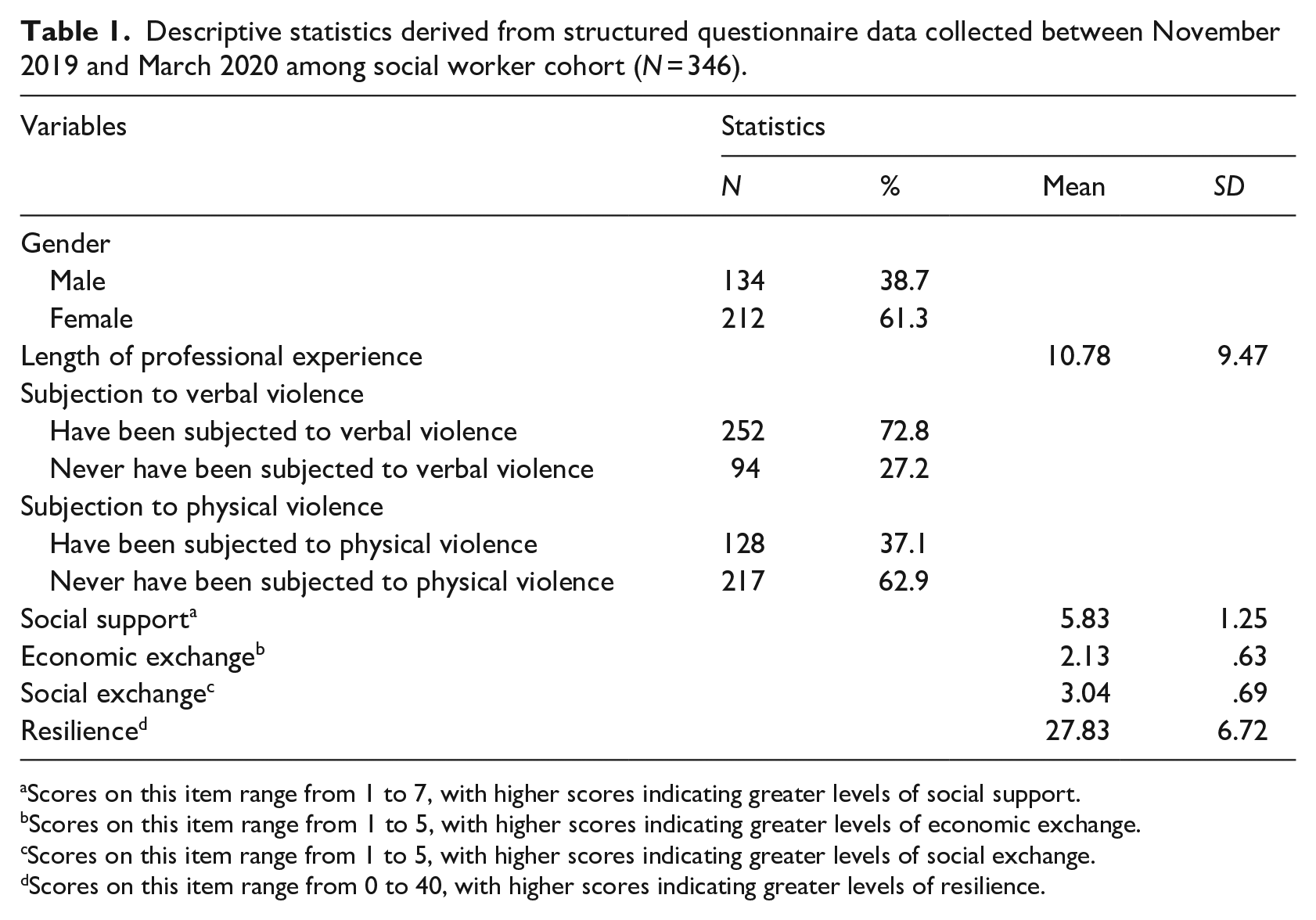
Scores on this item range from 1 to 7, with higher scores indicating greater levels of social support.
Scores on this item range from 1 to 5, with higher scores indicating greater levels of economic exchange.
Scores on this item range from 1 to 5, with higher scores indicating greater levels of social exchange.
Scores on this item range from 0 to 40, with higher scores indicating greater levels of resilience.
Summary of hierarchical regression analysis of variables contributing to resilience among social workers (N = 346). Data collected from structured questionnaires between November 2019 and March 2020.
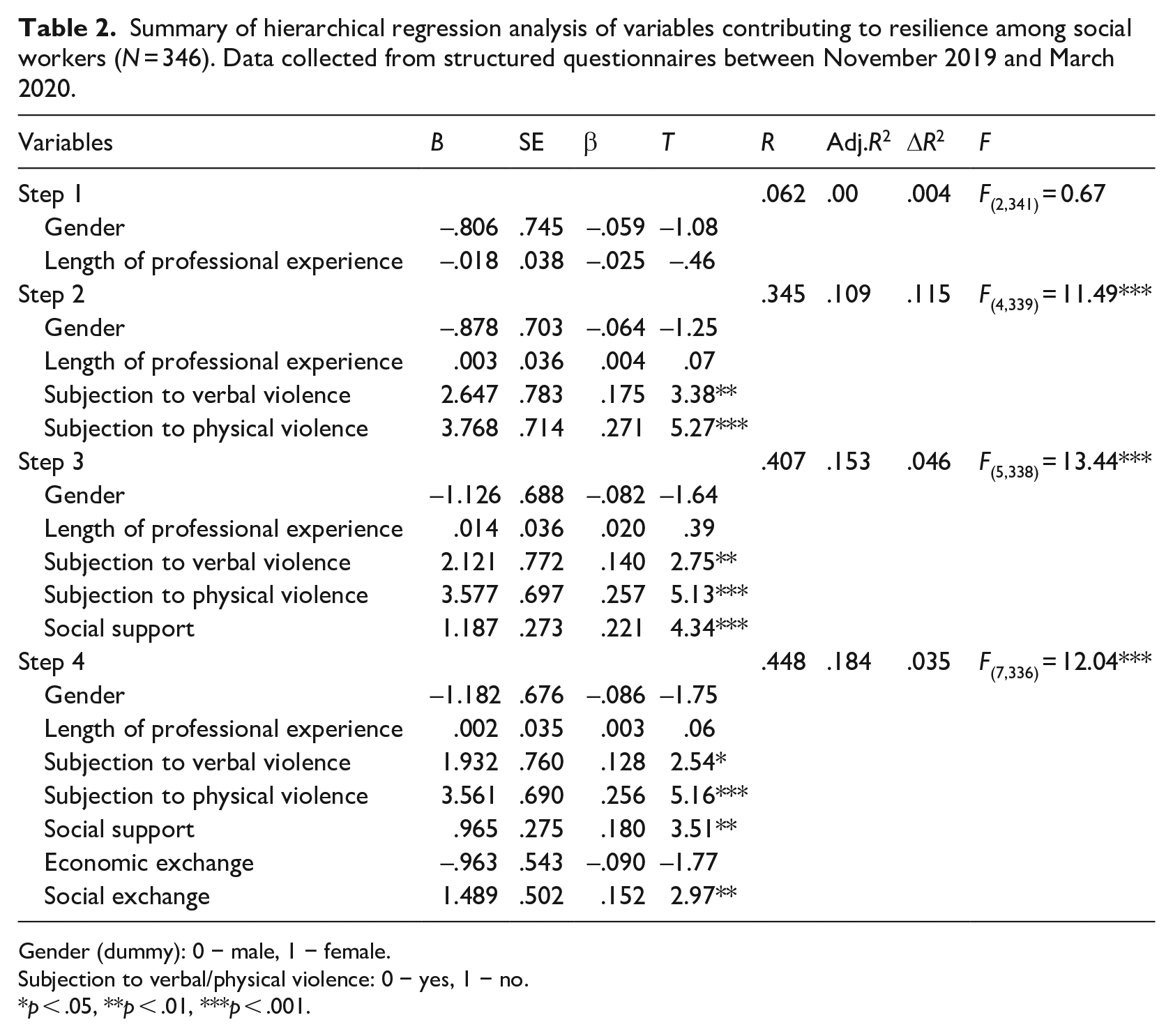
Gender (dummy): 0 − male, 1 − female.
Subjection to verbal/physical violence: 0 − yes, 1 − no.
p < .05, **p < .01, ***p < .001.
The hierarchical multiple regression revealed that at Step 1, gender and length of professional experience did not have a significant contribution to the regression model (p > .05). Social worker subjection to verbal and physical violence explained 11.5 percent of the variance in their self-reported resilience (F(4,339) = 11.49, p < .001). Self-assessed social support explained an additional 4.6 percent of the variance in self-reported resilience (F(5,338) = 13.44, p < .001). Adding social workers’ evaluation of their social and economic exchange in the employee–organization relationship in the fourth step of the regression model explained an additional 3.5 percent of their self-reported resilience (F(7,336) = 12.04, p < .001).
When all independent variables were included in the last (fourth) step of the regression model, some hypotheses were found to be confirmed. Thus, social workers previously subjected to verbal (β = .128, p < .05) or physical violence (β = .256, p < .001) by their clients or client’s relatives reported lower levels of resilience than social workers not previously subjected to this type of violence. Higher levels of perceived social support (β = .180, p < .01) and of social exchange (β = .152, p < .01) were associated with higher levels of self-reported resilience among social workers. In contrast, gender, length of professional experience, and economic exchange were not significantly associated with self-reported resilience (p > .05). Taken together, the independent variables accounted for 18.4 percent of the variance in the dependent variable.
Discussion
The aim of the current study was to assess the contribution of select personal factors (gender and length of work experience) and work environment-related factors (subjection to client violence, perceived social support, and social and economic exchange in the employee–organization relationship) to explaining self-reported resilience among social workers in Israel.
Contrary to expectations in the present study, no association was found between the personal factors and the social workers’ self-reported resilience. Regarding gender, the lack of association may be explained by the fact that, in social work, as a help-providing profession, awareness of emotions is an inherent part of socialization to the profession and is also accompanied by ongoing supervision in the field, so men and women have the same professional skills that contribute to resilience. Considering that research on the relationship between gender and resilience in social work is scant and the findings are inconsistent, further research is needed to examine this issue. With regard to length of experience, the lack of association between this variable and resilience is not consistent with previous studies in the field of social work but is consistent with findings from the field of nursing such as a study of 321 critical care nurses in Saudi Arabia (Alharbi et al., 2019). The authors argue that their choice of a nursing career points to altruistic attitudes that protect nurses over the years when encountering difficulties. Further research is needed to examine this issue as well.
The current study highlights the importance of work environment-related factors to the social workers’ perception of their resilience. According to the findings, social workers’ subjection to physical and verbal client violence had the largest effect of all variables in explaining the level of their resilience. This is compatible with studies conducted by Zimmerman (2013) and Robelski et al. (2020), which found that subjection to client violence is considered a contextual risk factor that results in low levels of self-reported resilience. This finding implies that this contextual factor has precedence over personal and other environmental factors in explaining social workers’ self-reported resilience. Therefore, it is the role of social organizations and workplaces to enhance the social worker’s resilience, in order to mitigate the negative effects of work stressors (e.g. being subjected to client violence), to increase their wellbeing and work satisfaction, and ultimately to enhance their quality-of-service delivery and outcomes (Masson, 2019; Truter et al., 2016). It is important for workplaces to allow social workers to speak openly about their experiences and feelings regarding being subjected to client violence, in a safe environment. Indeed, Knight (2019) suggests managers adopt trauma-informed supervision, especially in cases of workers’ exposure to violence in the workplace, as this type of supervision was found to enhance resilience among helping professionals. Trauma-informed supervision integrates such components as: safety (i.e. supervisees are helped to feel accepted and understood, are supported in establishing clear boundaries and expectations, and are encouraged to take an active role in their learning and practice); trust (i.e. supervisors are viewed as knowledgeable about trauma and its impact); and choice collaboration and empowerment (i.e. supervisors balance their teaching role with their role to foster supervisee autonomy, independence, and empowerment).
Along with such proactive support, workplaces should also take measures to reduce the physical and emotional risks of exposure to violence. Given the fact that subjection to client violence is one of the key factors associated with social worker resilience, it is important that research identify what factors more significantly protect and strengthen social worker resilience, so that more effective prevention and intervention can be developed.
The current study has identified two factors that might be considered facilitators or resources that provide workers with contextual attributes necessary for developing and strengthening resilience (Zimmerman, 2013): perception of social support and social exchange between the employee and the employer. Regarding the perception of social support, higher levels of perceived social support were found to be associated with higher levels of self-reported resilience among social workers. This is compatible with other studies that explored social support (by family, friends, colleagues) as a significant resource for dealing with mental distress (Henry et al., 2019) and with secondary traumatization (Lev et al., 2020) among social workers, finding it to be associated with higher resilience (Wilks, 2008). In light of this, it is important to be aware of the importance of developing and maintaining social support in the workplace. Social support can be enhanced through providing manager support, promoting a supportive organizational climate, strengthening teamwork as a key work tool, and providing ongoing supervision and training. Indeed, the social support offered by high-quality supervision is associated with greater job satisfaction (particularly when it is offered regularly, includes task-oriented advice, and supports workers’ access to resources for clients), with higher organizational commitment, and with better overall social and emotional wellbeing. Such supervisory support is also associated with greater professional retention, an additional outcome associated with professional resilience (More Barak, 2009; Webb et al., 2016). Finally, the significance of social support should also be emphasized among social workers themselves in order to increase their awareness of the critical benefits of receiving support from family, friends, colleagues, and supervisors, and of the need to invest in and strengthen these relationships.
Regarding the perception of social and economic exchange by the employee, the current study found that economic exchange was not associated with social workers’ resilience, while social exchange contributed to strengthening their resilience. Social exchange refers to the emotional aspects of an employer–employee relationship, such as trust, support, prosocial behavior, sense of belonging, and commitment (Andersen et al., 2020; Liu et al., 2020; Meyer and Parfyonova, 2010), which can promote their mental wellbeing in the workplace. These feelings also seem to reinforce employees’ own perceptions of their mental resilience.
In contrast, economic exchange, which is based on less personal relationships and more quid pro quo considerations, does not provide employees with a sense of mental wellbeing, and does not promote perceived resilience among social workers. Therefore, it seems worthwhile for organizations to invest in developing and augmenting social exchange in the workplace and to earmark budgets to enable development of resilience through enhancing supervision, strengthening teamwork, promoting transparency, and encouraging partnership between workers and employers (Zychlinski et al., 2020). Given the importance of social exchange, managers and supervisors should be encouraged not only to provide direct support to employees, but also to facilitate mutually supportive peer relationships between team members.
The present study has certain limitations. Although the sample is relatively wide it is not possible to assess its degree of representativeness due to the convenience sample. An additional limitation is the study’s cross-sectional design, which is based on data collected at a specific point in time and thus cannot be used to analyze the research variables over a period of time, and which also does not provide the option of determining cause and effect. It is suggested that future research include other personal factors, such as socioeconomic status, marital status, race/ethnicity, and parental status, as well as other environmental factors, such as occupational commitment, other types of violence in the workplace (such as electronic media violence using text messages and emails), indirect exposure to violence (by being a witness or by being exposed to details concerning violence), and violence by colleagues and managers. In addition, other factors, such as social workers’ fields of expertise and practice types, types and sizes of organizational affiliations, caseloads, resource levels, salary levels, and types of client populations, should also be examined, since they may affect the degree of exposure to violence as well as the social and economic exchange relationship between employee and employer, which may be associated with their resilience. Future research would also benefit from examining whether social workers are receiving supervision and, if so, collecting information about the quality and nature of the supervision, such as whether supervisors also serve in the role of team manager. It is also worth researching whether social workers’ social exchange level may be an indicator of the quality of supervision. Moreover, it is suggested that longitudinal studies on resilience be conducted, initiating data collection at the beginning of social workers’ careers, with additional measurements taken during subsequent years of practice in the social work field.
The current research findings can be used by policymakers and managers of welfare organizations intending to strengthen the resilience of social workers. Promoting resilience should consist of both measures to protect the physical safety of social workers in the work environment, and mechanisms to strengthen their emotional coping. Physical safety measures can include adjustment of rooms to allow double exits, distress buttons, a security guard, a comfortable and inviting workplace, a clear administrative policy of what should be done in the event of violent incidents, and encouragement to report these incidents (Macdonald and Sirotich, 2005). Policymakers and managers of welfare organizations should also promote emotional support in order for social workers to gain a renewed sense of confidence, self-efficacy, and resilience in stressful situations (Barbé et al., 2021) such as exposure to violence. Moreover, studies show that supervision and workplace resilience-building programs aiming to provide workers with resources and skills to prevent the potentially negative effects of future exposure to stressors (Karoly, 2010) have a significant positive effect on workers’ mental health and performance, and on prevention of absenteeism (Mor Barak, 2009). Thus, enhancing the resilience experienced by social workers will benefit not only their own quality of life, but also their families’, colleagues’, and clients’. Furthermore, resilience should be promoted among every social worker at every stage of their social work career, as gender and seniority were not found to be related to resilience in the current study’s findings.
Policymakers and managers should encourage, and budget for, organizational activities to promote teamwork development workshops and social activities for team building. Emphasis on legitimization and support of social workers’ practices, while simultaneously providing supervision in accordance with their professional needs, may strengthen the sense of social exchange with their employers as well as their resilience. Moreover, policymakers should explore the broadening of anti-violence legislation to prohibit undesirable behaviors against social workers. This should be society’s goal, since violence at work is often a reflection of violence in many areas of social life, which should be dealt with on the policy level (Phillips, 2007). Indeed, clear unambiguous policies supporting social worker safety in general, and in the workplace specifically, will likely augment social worker resilience and its downstream benefits.
Footnotes
Declaration of conflicting interests
The authors declared no potential conflicts of interest with respect to the research, authorship, and/or publication of this article.
Funding
The authors received no financial support for the research, authorship, and/or publication of this article.
