



Abstract
Little is known about how social work supervisors can be equipped and supported. A qualitative evaluation of a supervision of supervisory practice (SOSp) training programme with nine supervisors with 2 years of experience was done. Benefits for the supervisors were the application of knowledge and skills that improved the supervisory practice, and the opportunity to receive feedback. However, lack of time was a major obstacle for quality supervision. Supervisees reported experiencing a more collaborative supervision and an increase in confidence and perception of competence in case management. This exploratory study highlights the importance of developing competencies in the education and support functions of supervision.
Introduction
Social work supervision has evolved tremendously since its inception as primarily an organizational and administrative function. With the expansion of the social work profession, with social workers employed in various fields ranging from medical, community-based to government organizations, the need for supervision has ballooned. Supervision now provides social workers with the needed emotional support, development of clinical competency as well as administrative functions (Bruce and Austin, 2001; Hair, 2012). Yet, research in this area is not abreast with the developments. The core issue is the lack of an empirical base for social work supervision of professional staff (Bogo and McKnight, 2006; Sewell, 2018).
Specifically, there is a gap in both the research and practice concerning the supervision of supervisors supporting social workers in the field. This essential practice for the development of supervision was only mentioned in Singapore in a recent international overview of social work supervision (O’Donoghue and Engelbrecht, 2021).
This article contributes to social work supervision knowledge with the presentation of a supervision of supervisory practice (SOSp) programme for practising supervisors, and the evaluation of its impact on supervisors and supervisees.
State of social work supervision
It is concerning how supervision has transformed to take on a surveillance role due to organizational demands (Beddoe, 2010; Wilkins et al., 2017). There appears to be an overemphasis on the administrative/accountability function of supervision, at the expense of the other education and support functions. Such a skewed emphasis can culminate in a lack of trust for supervisors and impede growth of the practitioners (Egan et al., 2017). For supervisors, this culture increases stress and tension as they are caught between higher management and the needs of supervisees in their dual roles as both line manager and clinical supervisor (Egan et al., 2017; Wong and Lee, 2015).
To exacerbate these challenges, supervisor development remains an underdeveloped practice. There is limited literature on how best to support supervisors in practice contexts, although nascent research indicates that supervisors require a similar structure, reflective space and positive containment of their emotions in ways similar to what they provide for their supervisees (Patterson, 2017, 2019).
Various models and approaches to supervision exist to guide supervisors. These include Kadushin’s (1976) delineation of the three functions in social work supervision (educative, supportive and managerial), models that illustrate the process of a supervision session (see Hawkins and Smith, 2006; Page and Wosket, 2001) and developmental models for assessing developmental stages to scaffold appropriately at each stage (Stoltenberg and Delworth, 1987). The irony is that the literature on supervision in the other helping professions found a common lack in the elucidation of pedagogical approaches for supervisors to develop their supervisory competencies (Bernard and Luke, 2015; Tangen et al., 2019). A recent article by Tangen et al. (2019) outlined an interdisciplinary supervision guide for novice supervisors, with each stage of the supervision process based on learning theories. Focused on the pedagogical explanation of the supervision process that was found lacking, this guide complements existing supervision models to guide supervisors in facilitating learning. This suggests a need for supervisors to not just have supervision models as guides, but also tools to help them apply these models appropriately based on their supervisees’ needs.
SOSp
Elsewhere in the literature, the equipping of supervisors with knowledge and skills has been described as ‘competency training’ (Tebes et al., 2011), or ‘supervisor training’ (Sundin et al., 2008), but these fail to adequately capture the whole range of support needed by supervisors. Stoltenberg and Delworth (1987) proposed that supervisors themselves go through a parallel process of developmental stages as their supervisees (pp. 152–167). This implies that supervision on their practice is essential to support their development. Beyond the educative focus that ‘training’ connotes, supervisors require emotional support and a reflective space to review their supervisory practice. Supervision is a dynamic and relational activity that has a qualitative richness which goes beyond the clinical competence of the supervisor as a social worker or technical knowledge and skills for supervision. The term SOSp (Wong, 2021b) encompasses the qualitative aspects of supervisory practice in supporting and educating supervisees in their work with clients within the organizational context, and not just the ‘person’ of the supervisors.
Cousins (2010) has drawn attention to the critical need for supervisors themselves to be supervised because of their susceptibility to supervisory games which can then have an adverse impact for vulnerable clients due to poor staff performance. Furthermore, supervisors evaluate the clinical competencies of their supervisees which are factored into their work appraisals. This can cause tensions in the supervisory relationship and social workers may also choose not to disclose certain issues with their clients if they believe that it would translate to a negative evaluation by their supervisors. This skewed emphasis on one function of supervision (administration/accountability) is a major challenge that social work supervisors face (Noble and Irwin, 2009). Redressing this problem calls for supervisors to be supported and for them to be able to examine and reflect on their supervisory practice.
However, with the exception of the evaluations on supervisor training by Landsman (2007) and Tebes et al. (2011), the other sparse literature gives conceptual descriptions of the training for supervisors (Nye, 2012; Patterson, 2017; Rosenfield, 2012). Training in both Landsman (2007) and Tebes et al. (2011) employed a combination of formats, including instructional teaching, case discussions and workshops. Both studies used supervisor self-reports in the impact evaluation, which compared supervisory competencies before and after the training. From the training in interactional supervision for 81 supervisors conducted by Tebes et al. (2011), the largest gains in self-reported supervisory competencies were found 7 months subsequent from the programme initiation, with moderate to large effect sizes found for the three supervisory competencies under study. In addition, the study found that reported increase in the competency of ‘managing supervisory relationships’, which involves contracting and structuring each session, was related to improvement in supervisor’s satisfaction with their supervision and coping with stress. The evaluation in Landsman (2007) was part of a longer project and focused on recruiting and retaining social workers in the public child welfare agencies. A unique feature was the collaborative approach used in designing the training curriculum, which was based on focus group discussions (FGDs) with supervisors on their training needs. Short-term results reported were an almost perfect attendance rate, satisfaction with the training content and delivery, increased knowledge in developmental stages of supervisees and corresponding role as supervisors, and increased knowledge of training content.
In Singapore, where this study was conducted, the origins of SOSp can be found in the Counselling and Care Centre, a non-governmental organization that provides training and consultations to social service practitioners on top of counselling. The trainings provided in clinical and casework supervision incorporate live supervision of the supervisors in-training where course trainers will observe a supervision session to discuss and provide feedback on. Live supervision is a useful approach in providing collaborative supervision that is helpful for supervisees in managing their clients during the session itself (Champe and Kleist, 2003). While valuable, these courses are inadequate in meeting the developmental needs of the social work supervisor. Generalist social work necessitates practice knowledge in a broad range of approaches beyond casework, such as community work and group work. An SOSp programme tailored for social work supervisors is needed to equip them for supervision of these practice approaches and also the administrative tasks involved in the work.
Within the social service sector, there are varying levels of training for supervisors, depending on an organization’s policies. Some supervisors are given the role based on their observed proficiency in clinical skills without formal training in supervision, while some are de facto supervisors because of their managerial positions. While training for new supervisors in recent years has become more common in the sector, good social work practitioners with greater seniority appear to be promoted to supervisors. Good direct practice did not entail adequate supervision competency since supervision demands different sets of knowledge and skills (Wong, 2014). Moreover, since supervisors tend to have dual roles as clinical and administrative supervisors, it seems that they do not feel well-equipped for the transition from being good practitioners to that of dual-role supervisors (Wong and Lee, 2015). There is still some way to go before SOSp is established in the social service sector with enough resources and expertise to develop supervisors.
To meet this lacuna, the Singapore Association of Social Workers (SASW) invited three experts to look at the development of SOSp (Wong, 2021b). It sought to develop an SOSp curriculum to tailor to the range of roles that supervisors perform across the different practice contexts of social work in Singapore (SASW, 2020). It goes beyond clinical supervision to encompass the education and management tasks (Long, 2020). Complementing this is the Social Work Supervision Guidelines 2021 that include the supervisory knowledge and skills needed at each supervisory level, with the competencies of the expert-level mirroring the knowledge and skill sets of supervisors who supervise younger supervisors (Social Work Accreditation and Advisory Board [SWAAB], 2021). These guidelines provide social service organizations with a framework on supervision practice, and the organization and development of supervision.
In the development of SOSp, it is hoped that supervisors could develop competencies for more effective supervision of their supervisees (who are supervisors). Besides the requisite technical knowledge and skills of the practice, these competencies invariably also involve the supervisor’s professional use of self. The supervisory alliance and reflective practice of the supervisor are examples of the domains under which supervisory competencies are grouped (Falender et al., 2014; Jamshidi et al., 2018; Olds and Hawkins, 2014). Beyond knowledge or skills equipping, the development of these supervisory competencies requires supervision support to provide the reflective space and needed feedback. The SOSp programme to be described in the following section integrates the best practices in the literature with the contextual nuances of social work practice in Singapore to create a curriculum that fits the needs of the supervisors.
Method
This study evaluates a SOSp training programme for a largely homogeneous group of supervisors. This was conducted in January–August 2016 by the first author together with an experienced trainer who was involved in supervision training. The programme focused on training the supervisors to develop reflective practice in their supervisees and employed process models of supervision to structure the content. It was part of a commissioned study by the Ministry of Social and Family Development (MSF) for the Family Service Centres (FSCs) in Singapore to ascertain the impact of supervision training, alongside ascertaining the effectiveness of the Code of Social Work Practice (CSWP). In essence, CSWP was used to standardize the professional practice in the FSCs and this was implemented by MSF in late 2014. With CSWP, this meant additional administrative processes and training for social workers, on top of the need for FSCs to streamline internal work processes in response to this policy implementation. This development in FSCs was used as an apt example by the trainers during SOSp to provide perspective on balancing the administrative demands with the other functions of supervision.
SOSp programme
The programme structure is presented in Table 1.
Outline of the SOSp programme conducted in January–August 2016 (N = 12 supervisors).
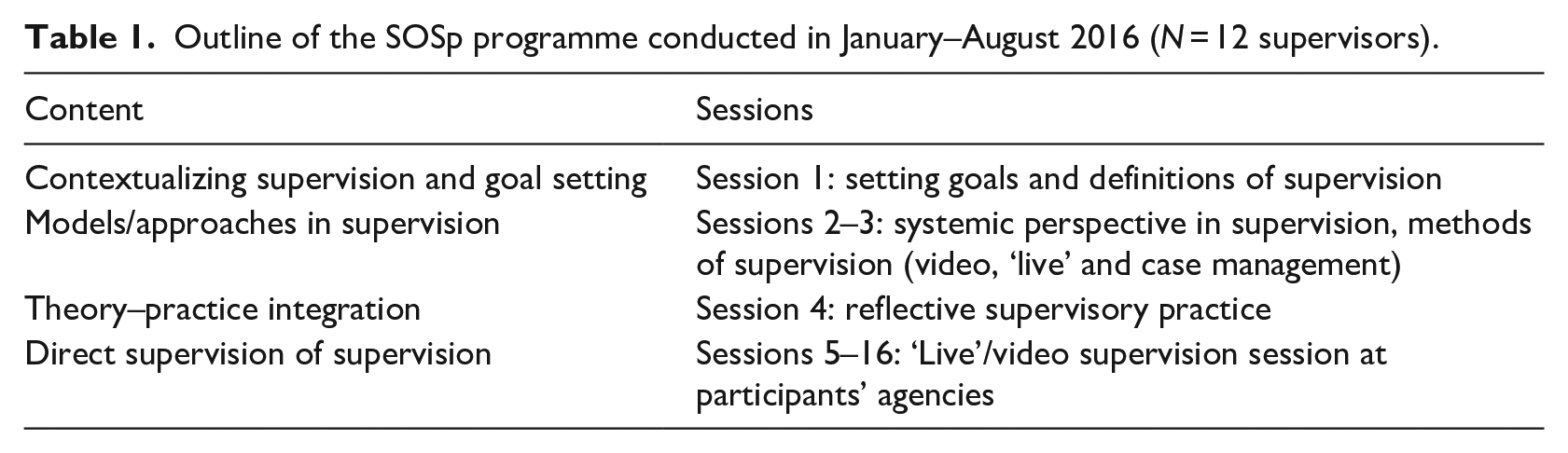
The first part of the programme focused on the theoretical knowledge and skills of supervision using an interactive process, where trainees are engaged to contextualize their learning to their practice settings. The second part then used applied learning for trainees to integrate their learning with their supervisory practice using a ‘live’ session or video-taped supervision session. The ‘live’ session consisted of a pre-session, in-session and post-session. During the pre-session, the presenting supervisor would share about the nature of supervision, profile of supervisee and areas in which the supervisor would like to seek support from the training group. During the in-session, the supervision would proceed normally. A reflecting team comprising the trainer(s) and a group of 4–5 trainees would then be invited to the same room where the supervision took place to have a respectful conversation about what they noticed of the session. The use of a reflecting team encourages the search for a multitude of ideas rather than for the ‘right’ solution for the case (Reichelt and Skjerve, 2013).
During the post-session, the trainers will do a reflection with the trainees to look at the extent to which the supervisor was able to integrate supervisory knowledge/skills during that supervision session. A similar process was used for the video-taped session, except that the presenting supervisor/trainees would be guided to look at tape to consider different ways to enhance the supervisory session.
The theories and models used in the SOSp programme are described next. While the developmental model of supervision is also commonly used, process models are employed in this context to provide a concrete structure to discuss the ideal stages of a supervision session. Furthermore, as supervisors come from varying levels of training and years of experience in supervision, the developmental model which charts the supervisor’s development in stages is less helpful in building common ground within the training group.
CLEAR model
The CLEAR supervision model shows the typical stages that a supervision session progresses through, and is thus a process model of supervision. The five stages involved are Contracting, Listening, Exploring, Action and Review (Hawkins and Shohet, 2006). This model is used to conduct supervision based on the supervisee’s desired goals in a relational manner. The supervisor tunes in to the supervisee’s feelings and perceptions, before facilitating reflection and insight on the situation. Supervision in the final two stages then focuses on implementing solutions.
PEACE process-in-context supervisory model
The PEACE process-in-context supervision model is both a process and contextual model. It conceptualizes the process of a supervision session as having five stages: Place & priority, Event recounting, Appreciative analysis, Collaborative planning, and Experimentation & evaluation (Wong, 2014). The process of supervision begins with a suitable physical location and identifying goals for the session (place & priority). The following stages integrate the experiential learning cycle (Kolb, 1984) and the Integration of Theory and Practice loop (Bogo and Vayda, 1987) to theorize how learning occurs during supervision.
The contextual aspect of the model builds on the seven-eyed process model of supervision (Hawkins and Shohet, 2006). It expands on the contexts implicated in supervision as identified by Hawkins and Shohet (2006). Supervision is situated within the client–supervisee–supervisor context in an organization, which is influenced by the culture, professional values and ethics, spirituality and socio-economic realities. It thus guides supervisors in balancing their administrative, educational and supportive roles (Wong, 2021a).
Participants
Ethical approval was obtained from the Institutional Review Board at the National University of Singapore before the research commenced. Written consent was obtained from all the research participants, with the assurance that participation was on a voluntary basis and that all identifying information would be kept confidential. Ethical challenges that can arise from the group supervision process in SOSp were minimized through the programme design. The trainers were external supervisors and thus did not affect the appraisals of the supervisor trainees, allowing them to discuss mistakes and challenges without worrying about potential implications. Potential group process issues such as power play (Ellis and Douce, 1994) were also mitigated through having only one supervisor per FSC participating in the SOSp. This maximized the diversity of the group and promoted optimal learning in the group as participants could learn from the different experiences and practice orientations of each person.
Supervisors were first recruited through a mass invitation email sent to all the Executive Directors of the FSCs. The criteria for nomination to this study were 5 years of work experience in the FSC sector and 2 years of supervision experience. Each FSC was allowed to nominate only one supervisor.
A cap of 12 supervisors was determined as the best trainer to supervisor ratio. With 15 supervisors being nominated and 3 agencies nominating 2 supervisors instead of 1 supervisor, a careful selection of 3 out of these 6 nominated supervisors from the 3 agencies was done to form the training group. The selection considered motivations for attending the training and having participants with a range of supervisory experience. As three supervisors left their organizations during the study period, participation in this research study was also withdrawn, leaving nine supervisors in the study.
Following this, supervisees were recruited for the research by a convenience sample formed from the supervisees of the remaining nine FSC supervisors.
Procedures
Different sources of qualitative data were collected to triangulate findings. This will assess the credibility of the results through determining the extent of convergence of the data from the different sources (Merriam, 2009). A greater emphasis was placed on understanding the impact of SOSp to the supervisees of the participating supervisors as this would provide a better assessment of the programme’s benefits.
Qualitative feedback was gathered from the supervisors through an FGD and a post-training feedback form. In the FGD, the supervisors were mainly asked about their challenges in providing clinical supervision and if they had any thoughts about the support that may be necessary for supervisors. The feedback form asked questions about the applicability of the knowledge and skills learnt, the supervision challenges faced and how they have managed them, and additional support that may be helpful to them as supervisors.
Supervisees were invited to participate in an FGD following programme completion, and those who were available and willing to participate attended the session. There were seven supervisees who agreed to participate in the FGD. The FGD centred on understanding their experience of clinical supervision, particularly whether they had experienced any change in the supervision received following SOSp. The group was also asked whether there was any change in their relationship with the supervisor. Furthermore, supervisees who had done 2–6 months of casework with their clients while being supervised by the SOSp supervisors were invited for an in-depth interview to understand the impact of the supervisory process on their casework. Three social work supervisees met the selection criteria and were willing to participate.
The data collected from the above FGDs and in-depth interviews were transcribed and thematic analysis used to code themes from the data. To familiarize with the data, the transcribed data were read and reread several times. During the process of ‘repeated reading’ (Braun and Clarke, 2006) initial thoughts and ideas were noted down. These thoughts and ideas from the data were subsequently coded into the emerging themes.
Results
Supervisors
The benefits of the SOSp programme as perceived by the supervisors were in three main areas: acquiring new knowledge and skills, helpfulness of the reflecting team in expanding perspectives and the opportunity to receive feedback. Supervisors also reported improvements in different aspects of the supervisory process as they applied what was learnt from the programme. However, another key theme was difficulty in practising the ideal supervision as taught.
Perceived benefits of SOSp
A dominant theme was acquiring new knowledge and skills in supervisory practice. Positive shifts were reported in their supervisory practice as a whole, including paying more attention to the supervision process and better understanding of the supervisory relationship. Supervisors also expressed that they had applied the new skills picked up during the supervision session itself. Some of the reported skills were a greater ability to pace the supervision session, the use of reflective questions to guide the supervisees and rephrasing feedback in a gentle manner.
Furthermore, there was overwhelming consensus that the reflecting team technique employed in the ‘live’ supervision sessions was useful in improving their supervision practice. While supervisors found it stressful to be observed by a team of people, they opined that the feedback given on their supervision by other trainees helped them to refine their practice and expand their perspectives. Linked to this is the importance supervisors placed on receiving feedback on their supervisory practice, both to affirm what they were doing well and to point out areas for improvement. Some of the consolidated learning points reported from these supervision sessions were contracting a supervision goal with the supervisee, the importance of the supervisor–supervisee relationship in the supervisory work, and processing with the supervisee on various delicate situations like saying ‘No’ to a client or termination of therapeutic relationship with a client.
Practical challenges
At the same time, the managerial–administrative role demanded of supervisors also presented challenges to fully applying what was taught. The demands of the CSWP framework were especially salient. The following quote illustrates the tensions felt: The learnings can definitely be applied in the supervision within the CSWP framework in processing with my supervisees on their assessment and support [the supervisees] in integrating the various perspective[s] of the cases through our discussion. However, I am also thinking about the practicability of it. While it will be good to have it, can both my supervisee and me ‘afford’ the luxury of time to process. There will bound to be some aspects which will be a touch and go or more directive from the supervisor.
Supervisors also brought up mixed feelings about the applicability of the reflecting team in their own FSCs for future supervision sessions, even as they concurred on its usefulness. The main challenge brought up was the lack of time amid the high caseloads and administrative demands in the FSC work, both for the supervisors and the supervisees. As one supervisor expressed: I think it is difficult to go through the use of reflecting team with supervisees as the CSWP framework takes up a considerable amount of workload and time of each supervisee.
As such, supervisors felt that having SOSp that is focused on the CSWP framework would be of better support to them, and in turn their supervisees whom they had to guide through the different assessment tools as required in FSC case management under CSWP. This included specific areas like teaching information gathering skills so that the supervisee can collect accurate information for a holistic assessment.
Supervisees
The main themes from the FGD and in-depth interviews were experiencing a more collaborative supervision with their supervisors, and reaping the benefits of having a reflective space in supervision during casework.
More collaborative supervision
Almost all the supervisees reported that their supervisor had shifted to be more collaborative during supervision after the training. A significant change observed by most of the supervisees was how the supervisor made greater use of the technique of reflexive questions that were taught as opposed to top-down approaches. Describing how the supervision process had changed, one FGD participant shared that it had become a more consultative . . . more reflective sort of supervision, whereby I am able to, to actually think through [the case].
There was a common appreciation for reflective supervision due to its collaborative approach. In reflective supervision, the supervisor aims to provide an empathetic, non-judgmental space for the supervisee to work through issues experienced in their work with clients. The significance of such a collaborative approach was that supervisees felt that their viewpoints were considered seriously, even if it differed from their supervisors. The supervisees expressed appreciation that they were given ‘room to explain’ when supervisors asked reflective questions to clarify the thought process, thus increasing the collaborative decision making with regard to the case being discussed.
This supervision approach also increased the supportive role of the supervisor. A sense of bonding and camaraderie with the supervisees was reported. It seemed that with the supervisors applying what was learnt, their supportive role was enhanced. Amid the increased workload due to the additional administrative processes with the implementation of the CSWP framework, the notion of ‘We’re in this together’ reverberated throughout the discussion. This is reflected in this representative quote regarding the supervisory relationship: Our relationship [got] closer . . . we really support each other, [provide] moral and emotional support.
The idea of the supervisor being a guide and source of support resonated throughout the FGD discussion. For one of the participants, this marked a change in the supervision process. He found that the support he received after SOSp was richer. The support he received included helping him ‘navigat[e] around some difficult issues’, such as how to respond to professionals from other agencies during a case conference, and supporting him in reflecting on his casework planning and actions through the use of reflexive questions in the supervision. Supervisors were described to have tried to pace with them, give them ‘positive strokes’ or affirmation, ‘motivate’ them and ‘respect(ed) individual differences’. A recurring theme from both sources of data was an increased feeling of confidence and competence when they were supportively guided to make their own assessments and decisions for the case. This was perceived to have positive influence on their case management.
Benefits of a reflective space on case management
The shift towards a more collaborative approach facilitated the supervisees to feel more empowered and reduced their anxiety when working on their cases. All felt that the openness experienced in the supervision process accounted for an increase in their ability to work through the uncertainties that weighed on them in case management. This idea is encapsulated in the following quote: [I]n times of frustration, you know, especially during crisis cases, we just react . . . but I think through that, he [the supervisor] also sat me down and he said, should we go through our Case Management Plan again. [He asked], are we doing according to what we are supposed to plan on, or have we forgotten to plan? So when we draft everything out and [I] see [that] actually I’ve jumped the gun, that’s why everything is stuck. So with our supervisor during supervision, I think that is when things start to move . . . at the client’s pace as well as our pace. [It is] then we can attain the outcome.
Sharing from the supervisees suggests that this increased self-efficacy in case management may be because reflective supervision had helped in conceptualization of the case and case management plan. For example, the FGD participants highlighted that they were guided through questions posed by the supervisors that helped to clarify their thoughts on the case. This can include self-reflexive thinking in how the personal self has affected the way a case is approached as a social worker. A quote from the in-depth interview illustrates the professional growth felt by supervisees: I think you find your own understanding, how you see a case yourself . . . because along the way, after you become more experienced and supervision hours get lesser and you move towards being more independent. So, you have to learn those skills, [like] how are you going to see your cases and manage the case . . . you reflect on how you do the case, why you do things this way and you find answers for yourself . . . you learn how to seek answers yourself.
The parallel process of supervision to the casework with the client was extensively discussed in the FGD. Parallel process refers to the unconscious replication of the therapeutic relationship between the social worker and the client in the supervision session (Morrissey and Tribe, 2001). The therapeutic difficulties in the supervision session could be an unconscious re-enactment of the issues which the social worker had with a client. The supervisor may then respond by inadvertently modelling behaviour that is taken up by the supervisee in the therapeutic relationship (Williams, 1997). Supervisees felt that the supervisor’s attention to the self of the social worker was of paramount importance in the supervision process as it will be translated in their work with clients. For one of the FGD participants, the positive containment of his anxiety during supervision translated to a similar calmness that reassured the client: I am less anxious with my client after I have gone through supervision for particular issues or particular clients, especially when it is crisis issues. I think being able to be calm and contained whatever is happening it gives the client some sense of okay, all is not lost, it is not the end of the world. So I think that’s where I can see that [supervision impacts] the client.
Discussion
Research implications
The study has contributed to evidence that social work SOSp serves an important function for supervisors, and consequently has positive effects on their supervisees and their casework. Future research on SOSp should include client outcomes in the evaluations given that the raison d’etre of SOSp is increasing benefits for the clients whom social workers serve.
The supervisors’ experience was that the training equipped them with skills and knowledge of not just how to better conduct a supervision session, but to view the supervisory process in its different contexts. Undergoing training with other supervisors from different organizations likely encouraged the supervisors to be more forthcoming in sharing their supervision experiences and the exchange of feedback, as there was little fear of appraisal. A synthesis of the literature on training for health and human services supervisors found that having dedicated time for learning, active and/or experiential learning to complement didactic approaches, and positive relationships during supervisor trainings contribute to different positive supervisor outcomes (Rees et al., 2020). We propose that SOSp programmes should be designed with a conscious effort to minimize the surveillance function that is present in social work supervision, and focus on the education and support functions instead. This may involve external supervisors for the supervisors where possible, as was presented in this article.
With respect to the supervisees, given the strong focus on professionalism in the social work sector in Singapore, social workers are trained to comply with professional guidelines for practice like the FSC-CSWP framework. They are also appraised by their supervisors based on these guidelines, which may contribute to reticence in sharing their struggles with clients to their supervisors. The SOSp training helped supervisors to adopt a more nurturing approach, which contributed to supervisees perceiving that the supervision was fruitful. While such reflective supervision could be beneficial for helping supervisees to meet the professional standards, both supervisors and supervisees struggle to find time for this amid administrative and practice demands. The SOSp programme can be tailored to better equip supervisors to guide supervisees in applying the CSWP framework in their casework, but adequate time is still needed for quality supervision. This tension may point to the need to review how CSWP is implemented in the social service system so that reflective supervision can be encouraged in the FSCs, as both CSWP and supervision share the same goal of improving professional practice.
Practice implication
While indispensable to the development of social workers and hence the profession as a whole, social work supervision is an organizational function, in that the boundaries and tasks of what is termed ‘supervision’ is tied intimately to the organization’s directive (Bogo and McKnight, 2006). There is a danger for supervision to veer towards managerial functions given the increased need for professional accountability and oversight in the modern service delivery context, which diminishes effective supervision (Beddoe, 2010). There is thus an imperative to engage and dialogue with the leadership in social service organizations to develop a greater consensus on what supervision entails, and how supervisors should be supported to grow their supervisees into more competent social workers who can serve their clients better.
Social work should pay attention to the benefits of implementing SOSp in practice to provide support to supervisors. In particular, supervisors who are new to supervision or in high-stress practice settings like family violence and child protection would benefit from gearing up to support and empower their supervisees. With the trend of high turnover due to burn-out, supervision can serve as a crucial link not just to support, but to retain social workers in the field (Chiller and Crisp, 2012). Ground experience also shows that supervisors themselves can be overwhelmed with work demands even to the point of burn-out. It is thus hoped that SOSp will boost supervision competencies, and contribute to job satisfaction and retention of both supervisors and social workers.
Furthermore, there should be consideration to articulate the supervisory competencies for both supervisors, as well as their supervisees. This will aid the further development of social work supervision guidelines formulated by the professional associations internationally. The Social Work Supervision Guidelines (SWAAB, 2021) developed for the Singapore context might provide a good starting point for this essential task. In addition, the career pathway for supervisors could be considered alongside the developmental trajectories of supervisors, which could encourage professional development in the social service sector (O’Donoghue, 2011). This can come alongside as parallel or part of existing competency frameworks for professional manpower, like the National Social Work Competency Framework (Ministry of Health, Ministry of Social and Family Development and National Council of Social Service, 2015) in Singapore.
Limitations
Given the exploratory nature of the study, a major limitation was the representativeness of the findings to the whole social work field in Singapore. Out of a total of 48 FSCs, 9 were represented in this study. While FSCs employ a significant number of generalist social workers in Singapore, social workers in other organizations that may be in more specialized fields like youth work account for the other significant proportion (Ministry of Social and Family Development, 2020, 2021). Although the theories and models for social work supervision can be applied across all areas of social work practice, there may be some contextual differences in what supervisors from a different area would find helpful. For instance, supervision of programmes may be a higher priority for some supervisors, and they may thus find the reflecting team technique less applicable.
Furthermore, any reported impact on casework could not be attributed solely to the improvement in supervision due to SOSp, as some of the supervisees may receive other sources of supervision. The small non-randomized sample sizes also did not allow for other factors that may affect the experience of SOSp or supervisees’ experience of supervision to be ruled out. Factors like caseloads of both supervisor and supervisee, and the supervision structure of an organization should be considered for future research.
Finally, the original research design had intended to assess the indirect effect of supervision on client outcomes, through a quasi-experimental design. This is because the goal of supervision is to improve practice for better client outcomes, and thus clients form a key data source to assess supervision. Furthermore, there is a lack of supervision research that included clients as research participants (O’Donoghue and Tsui, 2015). However, there were challenges in meeting the target sample size. The challenges included difficulties in enlisting client participation, dropouts from the study when supervisors or supervisees leave the organization, and a smaller than expected pool of new cases from which to recruit client participants. Future research designs can consider enlisting a larger pool of supervisors for the SOSp programme to account for attrition.
Conclusion
This exploratory study indicated the importance of SOSp for both supervisors and supervisees. Supervisors indicated that they had gained new knowledge and skills, and also benefitted from the feedback given by other supervisors through the reflecting team approach. Through the training, they became aware of how their supervision styles were helpful to their supervisees or not. The benefits of SOSp experienced by supervisees were in terms of facilitating their professional growth because of the collaborative and reflective approach taken on by their supervisors following the programme. This contributed to their increased sense of professional competence in serving their clients. Therefore, the development of SOSp is essential for the social work profession to continue with its mission to enhance human well-being. Training for supervisors, along with development or refinement of social work supervision guidelines, should thus be a priority for professional associations and organizations that employ social workers.
Footnotes
Author Note
Marcus Yu Lung Chiu is now affiliated to Visiting Professor, School of Health and Society, University of Bolton, UK.
Declaration of conflicting interests
The authors declared the following potential conflicts of interest with respect to the research, authorship and/or publication of this article: The SOSp programme evaluated was part of a consultancy project undertaken for the Ministry of Social and Family Development, Singapore, by Dr Peace Wong.
Funding
The authors received no financial support for the research, authorship and/or publication of this article.
