



Abstract
During the last few years, there has been a growing concern for environmental justice within international social work. This article connects to such concerns and aims to present and discuss environmental injustices faced by local communities in Mauritius, Peru and Sweden. Primary data were collected through face-to-face semi-structured interviews with a total of 25 key representatives of local communities in the three countries. Secondary materials were combined with the primary data in ATLAS-ti v.8.3 for a deductive critical discourse analysis. The findings describe the substantive, distributive and procedural environmental injustices faced by local communities in the three case studies. The article then considers the implications of the findings for international social work interventions in promoting environmental justice. The article concludes on the need for international social workers to continue their efforts and practices towards achieving environmental justice for all, in promoting global sustainable development.
Keywords
Introduction
A decent biophysical environment is crucial for the well-being of all. Over the past few years, various forms of environmental injustices occurring almost all around the world have compelled social workers to reconsider their obligations and responsibilities towards biophysical environmental issues in promoting social justice (Dominelli, 2012). Consequently, there has been a growing environmental justice (EJ) movement within social work in various parts of the world and also at the global level. EJ requires the engagement and commitment of social workers towards achieving fairness and meaningfulness in people’s interactions with their environment.
The Global Agenda for Social Work and Social Development (hereinafter referred to as the Global Agenda) (International Association of Schools of Social Work [IASSW], International Council on Social Welfare [ICSW] and International Federation of Social Workers [IFSW], 2012), which is in line with United Nations’ 2030 Agenda for Sustainable Development (hereinafter referred to as the 2030 Agenda), places particular emphasis on social work implications, commitments and interventions for EJ (Lombard, 2015). The commitment to promote the 2030 Agenda, through the Global Agenda, was taken in response to the profoundly unjust, unfair and above all unsustainable social, economic and political systems of the contemporary world that are posing a threat to the people and the planet (Truell, 2017). However, the SDG Index and Dashboards 2018 reports that ‘no country is on track to achieve all the goals by 2030’ (Sachs et al., 2018: viii). In pursuing the global responsibilities towards the 2030 Agenda, much more therefore remains to be done by international social workers.
Healy (2008) defines international social work (ISW) as international professional social work practice and the capacity for international action by social workers. In particular, ISW promotes global and transnational knowledge, studies and experiences to foster social justice all around the world (Mohan, 2008). In this sense, international social workers act as citizens of the world in shaping an effective global practical response to global issues, such as EJ (Dominelli, 2011; Hawkins, 2010). As Erickson (2018) puts it, ‘Social work believes in global equality, that is, in the right of all people of the world to share equally in Earth’s bounty’ (p. 15).
Environmental injustices are linked to structural inequalities, marginalities and vulnerabilities of poor and disenfranchised communities. In fact, environmental injustices exacerbate the vulnerable position of these communities, thereby reducing their capacity to mitigate and deter any risk arising from internal or external stressors (Kubanza and Simatele, 2016). Under such circumstances, international social workers are duty-bound by their ethical obligations to act on such global injustices (IASSW, ICSW, IFSW, 2018). According to Dominelli (2012), EJ compels social workers to tackle structural and individual forms of oppression that impact upon people and destroy the environment in the process of creating a privileged life for a few elites.
This article presents three case studies on environmental injustices from three countries: Mauritius, Peru and Sweden. These three countries are worlds apart geographically, economically and culturally; however, they share a common challenge in terms of EJ. Neo-liberal economic models are exerting pressures on local communities in these countries. Through these conveniently selected case studies from Mauritius, Peru and Sweden, this article therefore considers the implications for ISW in promoting EJ in various parts of the world. Before presenting the findings and the discussion, the conceptual and theoretical framework is outlined, and the methodology used in gathering and analysing the data is explained.
Conceptual and theoretical framework
In this article, Bell’s (2014) conceptual framework on EJ for cross-national analysis is used to structure and analyse the gathered data. Thereafter, Dominelli’s (2012) green social work (GSW) theoretical perspective is applied in considering the implications of the findings for ISW interventions in promoting EJ.
Bell (2014: 17–22) conceptualises EJ as having three overlapping dimensions: substantive EJ – the overall quality of the environment; distributive EJ – the extent of environmental equalities; and procedural EJ – the fairness and inclusiveness of environmental decision-making. Substantive EJ is based on our fundamental functional right to enjoy a state of the environment that is pleasant and not harmful to the well-being of either humans or non-humans (Ako, 2013; Rambaree, 2017). Distributive EJ refers to the issue of equity, mostly in terms of the distribution of environmental burden, risks and benefits among different sections of the population. Finally, procedural EJ focuses on fairness, transparency and democratic participation in the process of decision-making related to the environment.
Schlosberg (2013) opines that the conceptualisation of EJ has moved from being simply a general reflection of social injustice, to being a statement about the crucial nature of the relationship between the environment and the provision of justice itself. He therefore argues that EJ’s theorisation is nowadays more focused on the material relationships between human disadvantage and vulnerability, and the condition of the environment and natural world in which that experience is immersed (Schlosberg, 2013). In this sense, contemporary discourses on EJ include arguments and issues related to the current unsustainable models of development, the unequal power dynamics within and across communities and states, as well as the unequal distribution of resources, which are central to the current global socio-economic systems of neo-liberalism (Dominelli, 2013; Kubanza and Simatele, 2016). Thus, the needs and rights of the poor, marginalised, disenfranchised and vulnerable communities are to be given due consideration by putting individuals and groups from such particular backgrounds at the centre in studying EJ.
Within this context, Dominelli (2012) proposes GSW as an essential theoretical perspective and approach in social work. GSW obliges social workers to intervene for the cause of justice within its transformative politics and practice (Dominelli, 2012; Rambaree and Rock, 2018). In essence, GSW aims to protect the environment and enhance the well-being of individuals, groups and communities by analysing and addressing prevailing oppressions, structural inequalities and the unequal distribution of power and resources. In this way, by standing up for EJ, GSW further promotes the central identity of social work as a liberating and emancipatory profession (Rambaree and Rock, 2018).
Methodology
This study is based on primary data that were collected through face-to-face semi-structured interviews from Mauritius, Peru and Sweden. Secondary materials such as videographic and photographic evidence, as well as reports and documents related to the cases of injustices faced by the studied communities, were also gathered from the respective countries. The countries were chosen based on the researchers’ convenience in having access to respondents for data collection. The cases were purposively chosen based on EJ issues and concerns that are frequently being raised in local media and EJ discourses in each of the selected countries. Data for Mauritius were collected from December 2017 to February 2018 through six interviews, each of about 45 minutes, in the Mauritian Creole language with representatives of community leaders from a local community. The interviewees were five men and a woman who had been representing community-based organisations and movements on behalf of the local residents. For the case in Sweden, three representatives – one woman and two men – from a Sámi reindeer herding community in the northern part of Sweden were interviewed. The interviewees had been active in organising protests against environmental injustices in the region. They were interviewed in the Swedish language. The interviews lasted on average 30 minutes each and were conducted during the month of December 2017. Data for Peru were collected through 16 interviews, each lasting for an average of 45 minutes. The interviews were conducted in the Spanish language with local community inhabitants in vulnerable areas of Lima during the period February to March 2017. The interviewees were 14 men and 2 women. They were purposively chosen from among those who had been raising their voices, through local organisations and media, on behalf of the local inhabitants, against environmental injustices in their locality.
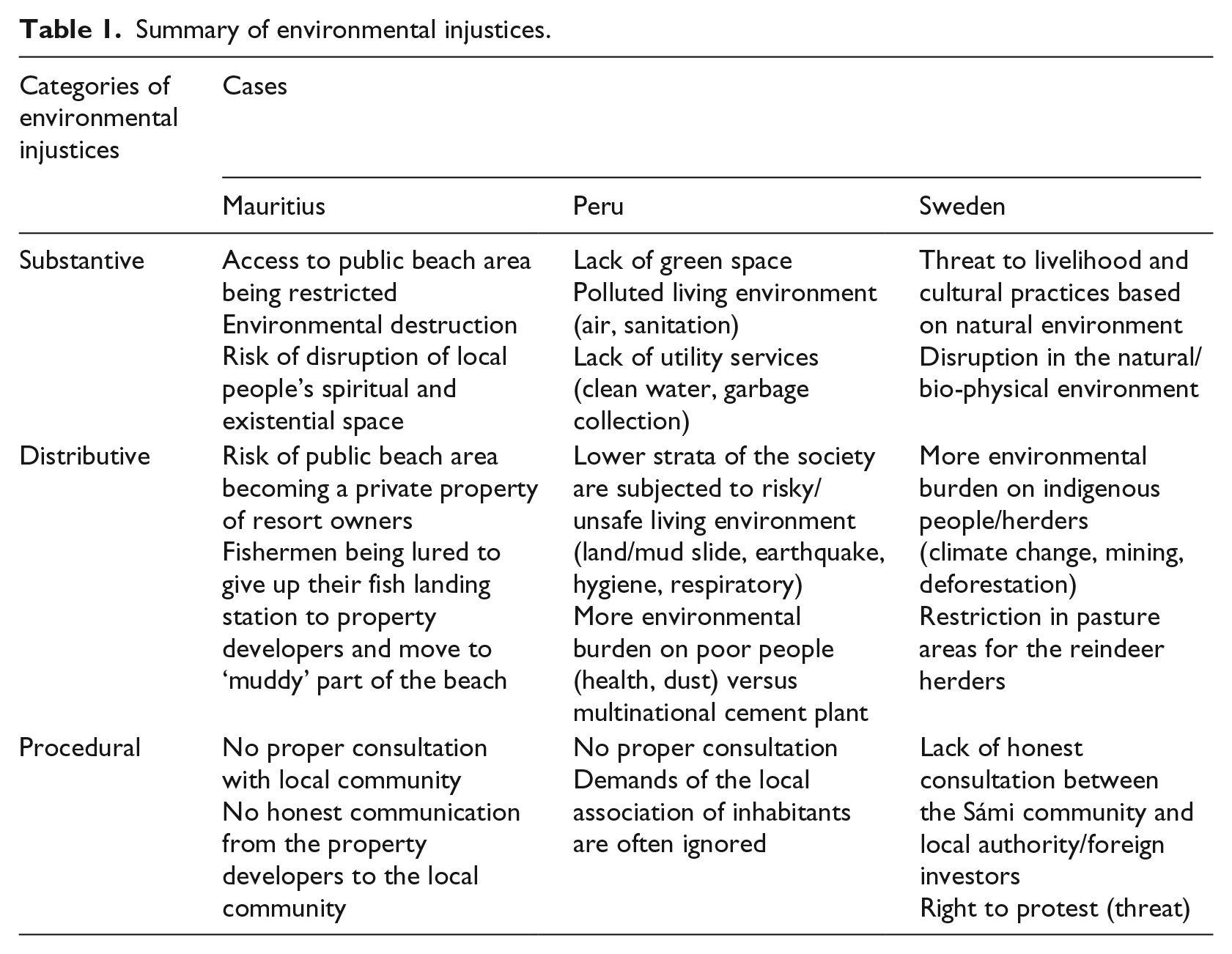
The gathered data were analysed with the help of ATLAS-ti v.8.3 to identify and select quotations related to environmental injustices. The selected quotations were coded into categories using Bell’s (2014) Environmental Justice Indicator Framework (p. 31), with components such as substantive, distributive and procedural EJ. This framework was used for identifying and discussing environmental injustices in each of the cases (refer to Table 1). For each category that was created, a deductive critical discourse analysis was carried out with the help of ATLAS-ti (Rambaree, 2014). In particular, the analysis focused on coding and memoing meanings, motivations, ideologies and power related to the theorisation of environmental injustices. Some selected quotations from the gathered data are presented in the following section as support to the discussion. Thereafter, the analysis also drew on Dominelli’s (2012) conceptualisation of GSW interventions and practices to consider the implications for ISW in promoting global EJ.
Summary of environmental injustices.
In accordance with the Swedish law on ethics approval of research (SFS 2003:460, 2003), this study did not require ethics approval, since it did not involve any records of names or other details of interviewees persons, or any details that could connect a specific person to a crime or illegal activity. General social research ethical guidelines as outlined by Hardwick and Worsley (2011) were carefully followed in the research process. The participants were informed about the purpose of the research, and only volunteers were recruited as respondents. Steps were also taken to ensure anonymity in reporting the findings from the case studies. The researchers also sought permission for using the secondary data, such as images, videos and unpublished documents and reports, from the respective ‘owners’ of the materials. Some of the secondary materials were provided to the researchers by the research participants.
Findings: Environmental injustices
Mauritius: A coastal community from locality ‘X’
Mauritius is a Small Island Developing State (SID) located in the southern part of the Indian Ocean off the east coast of Madagascar. It has a land surface area of about 2040 km2 and a coastline of about 177 km. There is a growing concern in Mauritius regarding the negative impacts of climate change on coastal areas and communities (Ramessur, 2013). Mauritius does not have an indigenous population, in the traditional sense. Several waves of colonisation – Dutch, French and British – led Mauritius to become a multi-ethnic country. The Mauritian population consists of descendants of French settlers, African slaves, Indian indentured labourers and immigrant traders from China. Currently, the island has about 1.3 million inhabitants, and it has been having an average annual economic growth of about 4 percent over the past few decades. The island receives about 1.2 million tourists per year. Tourism together with the finance, service and textile sectors are important pillars of the Mauritian economy, while sugar production – the traditional pillar of the island’s economy – is declining in relative importance (Svirydzenka and Petri, 2017).
In order to deal with the decline in the sugar sector, in the year 2002, the then Government of Mauritius introduced the Integrated Resort Scheme (IRS), which was later somewhat modified and renamed as the Property Development Scheme (PDS) by the current government. The aim of these schemes has been to boost foreign direct investment in the tourism sector by allowing particularly the sugar estate owners to convert acres of agricultural land, mostly in coastal areas, into luxurious villas. Such resorts are being sold to foreign buyers through international estate agents and international property promoters for a minimum price of about US$500,000.
In this article, a case of a PDS being planned in locality ‘X’ is presented and discussed. Locality ‘X’ is situated in a scenic location with clear turquoise sea. Locality ‘X’ is among few beach areas in Mauritius where people can still find mangroves, and where no major concrete construction currently exists. People from the neighbourhood describe the place as a heavenly space with tranquillity and calmness. Local people have been using the beach area for Sunday picnics with their extended families, which is a very common cultural practice in Mauritius. Moreover, key representatives from the local community report that some people use the place for spiritual prayers. One can find Christian and Hindu praying corners within the beach area. Locality ‘X’ therefore represents an existential and spiritual space for the local communities.
Locality ‘X’ has always been accessible to the public, despite being surrounded by a private sugar estate. The private sugar estate acquired the land during colonial time for sugar cane/agricultural purposes. According to legislation referred as the ‘Pas Géométriques Act of 1895’, local inhabitants have been guaranteed public right to access the beach – at least 80 m counted from the high water mark (shoreline). The legislation stipulates that [t]he reserved lands along the sea coast commonly called the ‘Pas Géométriques’ and referred to in the Arrêté of Général Decaen of 5 May 1807, shall form part of the ‘domaine public’ and be inalienable and imprescriptible. (Ministry of Housing and Lands – Mauritius, n.d.: 1)
Within this context, all the respondents state that the beach is a heritage that needs to be shared with all people in the community and should not become a property of a privileged elite. In a similar manner, some of the respondents have the following arguements: We come here to relax and have a good time with our families. Sitting by the beach under the trees, we forget about our stressful life . . . The way the promoters are doing, it will create massive inequality, frustrations, and injustices in our society. (Respondent X-5) This is a capitalist move, which will destroy our nature for creating their own wealth . . . they are stealing our beach from us . . . this (frustration) will lead to social problems such as thefts and drug dealings in this area . . . (Respondent X-1)
The PDS project plan is to construct about 100 private luxury residential units in a land surface area of about 70,000 m2 to be sold largely to foreign buyers. According to the interviewees, people from the neighbourhood are feeling threatened by the PDS project being planned in their locality. Over the past few years, all around Mauritius there has been growing public discontent regarding such types of property development programmes (Ramtohul, 2016). For instance, some sections of the Mauritian population are becoming increasingly worried about ‘Mauritius being sold to foreigners’, and representatives from coastal communities are anxious about the increasing number of privately owned gated communities that are blocking access to the beach for local people (Rambaree and Rock, 2018).
Some respondents from the local community perceive that the promoters covertly started planning for the PDS project in locality X as early as a decade ago. They had observed several public rights of way being gradually blocked by huge rocks placed on the access road to locality ‘X’. Respondents from the community make the following observations: . . . it is really sad what is happening here. Almost every Sunday, I bring my children to the beach here. I have been coming here for more than 45 years . . . I am very against such an approach . . . soon I will have to ask my children to swim in bath-tubs as there will be no beach left for us. (Respondent X-5) . . . in the future our children will not have access to the beach . . . our heritage will become a property for the children of the ultra-rich . . . we are being pushed from our own local territories. (Respondent X-2)
One of the interviewees from the region pointed out that the small-scale traditional fishermen and the small-scale recreational boat owners are being compelled to relocate towards a muddy coastal part of the locality X. Fishermen from the neighbouring areas have been using locality ‘X’ as an embarkation station for several decades. According to government records, there are about 20 registered small-scale traditional fishermen who are officially based at locality X. In addition, there are about four persons from the neighbouring areas who have tourist recreational boating licences from the government to operate at locality ‘X’. According to the respondents, the promoters will put their own high-speed boats in the area, which will affect the ability of local people to continue using the space for earning a livelihood.
Respondents from the community also feel that the promise of employment for the people in the resorts will be another form of oppression. They opine that people will not be directly employed by the resorts, as most of the jobs will be contracted out to agencies that may exploit people as cheap labour and have recourse to foreign workers from other countries such as Bangladesh and Madagascar. In this sense, they fear that the promoters of the PDS will obtain almost complete control of the ecosystem resources in locality ‘X’. Two of the respondents argue as follows: They [the promoters] will take control of our livelihoods and exploit us. (Respondent X-4) Me, my father, my grandfather, we all have been fishermen based in this area . . . with this project we will not have access to the beach . . . this is our heritage . . . this project is a threat to our livelihoods . . . (Respondent X-6)
Another respondent states that . . . the promoters are luring the fishermen communities with a peanut sum as a compensation for giving away their fish landing station . . . many fishermen, who often have low level of education, will be tempted by the sum . . . the sum is nothing if you reckon in long term . . . In the long run, our marine ecosystem will be destroyed . . . (Respondent X-5)
The interviewees from the community unanimously voiced that the promoters have failed to have any consultation with the local people. The vast majority of the respondents from the local community state that they are not against ‘economic and infrastructural development’, but that they cannot accept injustices to people from the local communities within the process of such development. According to them, it was only in 2016 that some key representatives from the neighbouring communities were called to a presentation of the project as information sharing. The interviewees felt that the investors have avoided discussion related to many key issues, such as access to the ‘Pas Geometric’ and the negative impacts of such a project on the environment and the local communities. Consequently, some people from the local community have joined a national movement against beach grabbing in Mauritius. They are networking with several other national organisations to raise consciousness and advocate for sustainable development with respect for the ecosystem and the rights of local people. Locality ‘X’ is not an isolated case of environmental injustices in Mauritius. Currently, there are more than six cases of ‘beach grabbing’ in the country where local communities are trying to save their beaches from being taken by multinational companies for exploitation of ecosystem resources (see http://www.aknl.net/).
Peru: The desert community from locality ‘Y’
Peru is located in South America and has a population of around 30 million. The country has previously been one of the poorest in Latin America, but through a recent economic boom, the national poverty rate has decreased from 50 percent in 2004 to around 24 percent in 2015 (Oxfam, 2015). Peru is one of the most biodiverse countries in the world (World Wildlife Fund [WWF], 2015). More than 65 percent of the country is covered by the Amazon rainforest, and the Andes mountainous region is home to more than 70 percent of the world’s tropical glaciers (Takahashi and Martínez, 2017). The country also has a large area of coastal desert. Its capital – Lima – is one of the few megacities in the world that is located in a desert area. Lima’s population has been growing from 600,000 inhabitants to 10 million inhabitants in the past few decades (García et al., 2014; Miyashiro, 2016). During the internal armed conflict period – from 1980 to 2000 – many people fled to Lima in order to escape from the violence and poverty that mostly affected people living in the countryside (García et al., 2015). Currently, almost one-third of the Peruvian population lives in Lima. In this article, a case study of a desert community from locality ‘Y’ in Lima is presented and discussed.
During wintertime in Lima, the air is filled with fog, drizzling rain and humidity, and the sandy coastal hills are temporarily covered with native fauna (García et al., 2014). However, climate change is affecting Lima’s ecosystems. Some research participants report that they can feel the effect of climate change in their locality. As respondent Y-8 puts it, ‘during the summertime the heat is getting very strong and in the wintertime, the cold is getting too harsh’. Another major environmental problem faced by the local community is the lack of green spaces and trees. Consequently, many respondents mention that the area has severe dust and sand problems. According to a recent study by the World Health Organization, Lima has the worst air pollution of all Latin American cities (Peruvian Times, 2014). Thousands of people are dying because of the pollution level and lack of green spaces in Lima (Jolly, 2015). A vast majority of the respondents from locality ‘Y’ blame the nearby cement factory for aggravating the dust and causing respiratory problems. For instance, one of the respondents opines, It is a cement company that pollutes the environment with dust and powder of cement. All of our cloths are covered with that dust, gets dirty. People here are getting skin and allergy problems. (Respondent Y-10)
Locality ‘Y’ is not adequately planned for either human settlement or urban growth. The uncontrolled urbanisation in this particular desert region of Lima has further contributed to pollution and loss of biodiversity in the area. Such conditions have also significantly increased challenges for the population to adapt to the effects of climate change, such as increased flooding, landslides, lack of water, and heat waves. In addition, the local inhabitants are also vulnerable to earthquakes.
The housing areas in the coastal desert of Lima are most often divided into groupings of 30–40 families that are brought together into an ‘asentamiento humano’ (human settlement) (García et al., 2015). Such forms of human settlements on the fragile ecosystems in the coastal hills contribute to problems in the natural equilibrium. It increases human-induced pressures and decreases the vegetation that is needed to stabilise the soil for preventing landslides and mudslides. One respondent voiced his concerns: I am worried because, at this place here, we don’t have trees . . . we breathe a lot of powder from the sand and the industry. In the winter time this place turns into mud and sludge. This place can bring infections. It is also an area of high risk in terms of earthquakes and landslides. (Respondent Y-16)
The coastal desert communities are disproportionately exposed to higher levels of environmental risks compared to the wealthier areas of Lima (García et al., 2014). They are overcrowded and difficult to access and often they lack accessibility to water, drain/sewage systems and electricity. It is estimated that almost a million residents in Lima live without access to running water (Ioris, 2016), and most of them are from the coastal desert areas. The lack of adequate basic utility services – waste collection and disposal, and in some cases even accessibility to and from alleys – further problematise the situation for the inhabitants in locality ‘Y’. Access to water is a major cost and challenge for many. As one respondent reports, [w]e get water from a water company, before we had it in tanks and then we paid much more, because every bucket costed 5 soles (about 1.5 USD) for 2–3 days. But now, when we have water we are trying to decrease our use, to use it as little as we can . . . because of the problems of the landslides and flooding we have to pay much more for the water but this month we have used much less. (Respondent Y-9)
Over the years, the local inhabitants in locality ‘Y’ have adapted to the areas by developing solidarity and obtaining support from various governmental and non-governmental organisations. Although there are some representations of the people in various different voluntary organisations, the demands of local inhabitants are often ignored by authorities and powerful industries like the nearby cement plant. As some of the respondents point out, . . . of course the situation here is not good. We have planted some trees but not all of them survived. There are only few left. We asked the municipality to plant trees, but there is still no response from them. (Respondent Y-16) When I was leader of the community, we sent a lot of proposals to the municipality for green areas, also a programme to have roads and footpaths, but we did not get, they ignored it . . . the garbage truck doesn’t pass . . . (Respondent Y-10)
As Dominelli (2012) puts it, ‘industrial pollution and environmental degradation will be detrimental to the development of any community’ (p. 82). Sustainable community development requires urban/spatial planning with consideration of the needs of all members of the community, and special consideration for those who are poor, marginalised and vulnerable. Local authorities need to take the politics of obligations within the frame of environment ethics and citizenship seriously (MacGregor, 2011). In this case study, the local inhabitants are clearly living in a hazardous environment. They are exposed to unequal risks and benefits in their local environmental area, and they feel powerless and voiceless vis-a-vis the authorities that are supposed to care and protect them. In this endeavour, social workers can play a vital role in assisting, lobbying and advocating for those disenfranchised within the process of ‘development’.
Sweden: Sámi indigenous community from locality ‘Z’
In Northern Scandinavia, some communities of Sámi people live in close connection with the nature – within a mesh of complex socioecological systems, linking humans, nature and animals (Sametinget, 2016). The Sámi population in Sweden is about 20,000 in number. They gained recognition as indigenous people in Sweden in the year 1977. The Sámi communities, as indigenous people, have long been struggling for their land, self-determination and traditional and cultural rights (Dominelli, 2012; Persson et al., 2017). For instance, the International Labour Organisation (ILO) convention number 169 that protect the rights of the indigenous people has still not been ratified by Sweden (Bell, 2014). As an indigenous group, Sámi communities have the right to preserve and develop – among others – their language, reindeer husbandry, traditions and identity. The Sámi Parliament reports that some laws in Sweden, such as the Mineral Act (1991: 45), actually protect the rights of the mining companies to exploit land more than they protect the Sámi lifestyle and culture (Sametinget, 2014). There is a common belief among the interviewees that the right to decide about land use historically falls on the Sámi people, and the right to affect land use, which is decided by the central government in Sweden, is in some cases detrimental to the survival of the Sámi culture and brings more vulnerabilities to their living and working conditions (Persson et al., 2017). This study considers EJ in the case of the Sámi community in locality ‘Z’, which is located in the northern part of Sweden.
Reindeer as an animal and reindeer husbandry as an enterprise represent icons of Sámi culture and identity (Silvén, 2014). The reindeer herders from the Sámi communities have been using large land areas in the Northern part of Sweden, Finland, Norway and Russia for their livelihoods for over thousands of years. Various forms of oppression and injustices faced by the Sámi communities, such as their forced assimilation into the mainstream culture and threat to their traditional livelihoods, have been identified as an indigenous social work issue (Laitinen and Väyrynen, 2016).
Currently, Sámi communities in locality ‘Z’ (like in other parts of the North) are facing vulnerabilities with the effect of climate change. The respondents report that they are regularly experiencing unpredictable changes in the climate. The winter is getting unusually warm or it is snowing more than it usually does. The effects of climate change are making reindeer herding difficult and stressful. The annual success of the livelihood of the reindeer is to a large extent dependent on the amount and quality of snow during winter (Turunen et al., 2016).
Reindeer typically feed by digging into the snow and grazing on lichen during the wintertime. Climate change is creating a crust of hard snow, which makes the reindeer unable to reach the lichen they eat during wintertime. Lichen not only provides a good source of nutrition to the reindeer during the winter, but it also plays a beneficial role in the digestive system of these animals (Storeheier et al., 2002). Within this context, one of the respondents explained the following: I lost almost half of my reindeers. They starved to death. It was snowing unusually much, and we were in an area that did not have much lichen on the trees. (Respondent Z-25)
One of the participants (Respondent Z-23) explained that they could see on the reindeer in the autumn if it has been a very hot summer. During a hot summer, the reindeer do not get enough to eat in order to create the necessary fat that is needed for facing the cold wintertime. This makes the animals less likely to survive during harsh winters. It is not only the warmer winters that are affecting the reindeer but also restricted access to pasture areas. During hot summers, reindeer are herded towards pasture areas located at higher altitudes. Land usage by others (non-Sámi) in Sápmi (the traditional Sámi land) for other purposes, such as mining and forestry, is causing a gradual decline in and access to pasture areas and food sources for the reindeer. The participants are worried and anxious about the impact of the mining being planned in the region on their livelihood and lifestyle. As one of the respondents states, [a]ll the transport vehicles for the mining industries will have to go through our Sámi community. This will affect us a lot . . . the reindeer herders have been in this area for more than thousands of years. Suddenly, other industries come and take over this place, and displace the Sámi people. (Respondent Z-24)
The municipality in the region wants to have mining activities in the area because they believe it will generate work opportunities. Similar to corporations, local municipalities often carry forward the business discourses driven by a profit-focused worldview (Persson et al., 2017). However, the Sámi communities are arguing that they need support for their traditional livelihood and occupation, and not employment in multinational companies that are going to exploit them and most likely damage the ecosystem resources of the region. One of the participants talked about the protest against the mining being planned in the area: I have been fighting against it . . . I have been sitting on the road and demonstrated. The police had to carry me away from the place . . . If they open the mine, it will probably be the end of reindeer herding in this area. (Respondent Z-24)
In particular, the respondents demand that both the forestry and mining industries must have consultation with the Sámi communities before any environmental action in their areas. However, they feel that their wishes (or rather their needs) are not taken into consideration in the decision-making processes concerning their working and living environments. Most of the time, the Sámi communities are just being informed. In this connection, respondents report the following: It feels like there is someone above my head who decides about my life. (Respondent Z-24) It feels like I get run over, no one listens to us. They pretend to listen, but they do as they want anyway. (Respondent Z-23)
An increasingly warm climate and changing landscapes due to mining can damage the cultural heritage of indigenous people (Weaver, 2014). Non-indigenous people might not be affected by human intrusions to the same extent as Sámi people who are dependent on their land, and the distribution of access to safe working and living conditions is unequal compared to other groups in the society. Persson et al. (2017) opine that the perceived environmental conflict can be viewed as part of a larger struggle over social status and recognition of a minority indigenous group. ‘For many years indigenous peoples, their needs, rights, culture and identity have either been neglected or eliminated altogether’ (Szpak, 2017). Persson et al. (2017) therefore argue that the promotion of the mining business by state actors is yet another way of marginalising Sámi people, as it serves to introduce competing land uses at an increasingly rapid pace in the era of neo-liberalism.
Discussion
In all three cases – Mauritius, Peru and Sweden – there are indications of environmental injustices against local/indigenous communities. In Mauritius and Peru, some social workers are directly involved with local community movements fighting against environmental injustices. However, in Sweden, social workers play almost no active role in supporting EJ for the Sámi community. The role of structural social work (including community-based social work) has been marginalised and neglected in Sweden since the end of the 1980s (Sjöberg and Turunen, 2018). From the analysis of the gathered data, it could be said that all the three countries could benefit from ISW intervention and support. Before embarking on the implications of the findings for ISW, we presented a summary of the environmental injustices identification/discussion in Table 1.
The case studies highlight that the ecosystem resources and services are gradually being centralised in the hands of powerful industries. As a result, there are growing concerns and emerging conflicts between local communities and industrial groups – such as the resorts industry in Mauritius, the cement industry in Peru and the mining and forestry industries in Sweden. Industrial expansion is commonly seen as a necessity for job creation and economic growth; however, it appears to contribute to environmental injustices often driven by the requirements of maximisation of profits (Bell, 2014). In a similar manner, authors from different parts of the world, such as Shajahan and Sharma (2018), Philip and Reisch (2015), Dominelli and Ku (2017) and Coates and Gray (2012), have all argued that the roots of environmental injustices in various parts of the world can often be traced to global economic systems.
Moreover, the burden of environmental risks and degradations are being gradually shifted on, or are already borne by common local people/communities whose livelihoods are already being threatened by the effects of climate change (such as fishermen in Mauritius, micro-scale business owners in Peru and reindeer herders in Sweden). In this sense, ISW needs GSW strategies on community mobilisation for demanding distributive EJ from government authorities and corporate bodies (as outlined by Dominelli, 2012). Among others, there is an urgent need for GSW interventions in the case from Lima in order to establish/improve access to basic facilities such as water and sanitary services, for the preservation of the natural flora and fauna and the creation of more green spaces, and for reversing the migration of the people towards the rural parts by improving rural living conditions. GSW interventions can be used to focus on people’s substantive environmental rights, such as freedom from environmental degradation that is threatening livelihoods and well-being. Resource mobilisation and advocacy strategies are also essential in such tasks.
The voices of the local communities are often ignored or marginalised. Within the decision-making process, the say of the more powerful corporate actors and public authorities dominates. Vulnerable communities seldom have a say in how development initiatives are executed, even though they bear the consequences of environmental impact on their immediate working and living environment (Dominelli, 2013). The authorities, who are supposed to look at the interest of all, are often guided by the hope and promise of economic growth and employment. In all three case studies, interviewees agree on the need for economic investment, but they all demand a fair and a just form of industrialisation.
Often, local communities have to protest against unfairness and their exclusion from environmental decision-making processes. In this sense, there should be respect for procedural EJ. Addressing environmental injustices also requires ISW to engage with multinational corporations and bring the voices of the vulnerable, marginalised and disenfranchised communities to them. In particular, sustainability and corporate social responsibility hold a prominent place within the agenda of most multinational corporations. At the global level, the United Nations’ Global Compact, the ISO 26000 and the Global Reporting Initiative are some of the frameworks that can be used by international social workers to check the reliability and validity in monitoring, and reporting fair, ethical, honest and transparent approaches in doing sustainable business. International social workers need to become acquainted with such frameworks in their advocacy work for sustainable development. For instance, with reference to the global sustainability reporting frameworks, international social workers can highlight the lack of accountability/misreporting among multinational corporations in national and international fora (Dominelli, 2012, 2013).
In this endeavour, international social workers can liaise with global social work and social development organisations – such as the International Federation of Social Workers, the International Association of Schools of Social Work and the International Council of Social Welfare – to create pressure on multinational corporations to respect and work towards sustainable global business practices. However, it is to be noted that often global pressure increases only ceremonial commitment from companies, suggesting a pattern of organised hypocrisy, whereby discursive commitments are not followed by subsequent actions (Lim and Tsutsui, 2012). ISW, as a practice-based profession, can therefore make valuable contributions in partnership with multinational corporations and local communities through genuine, honest and concrete actions for sustainable development around the world. As Ross (2013) puts it, EJ cannot be achieved without open dialogue between the ‘oppressed’ and ‘the oppressors’ (p. 201). Similarly, Dominelli (2011) suggests that social workers need to establish dialogue with policy makers and use the media to change unsustainable policies at local, national and international levels. In this sense, international social workers can make valuable contributions by bringing their skills and competencies as mediators/negotiators into practice for achieving global sustainable development.
Before moving to the conclusion, it is important to consider and discuss certain limitations of this study. In terms of methodology, the study is confined only to certain particular target groups from the purposively chosen communities. For instance, the community in Mauritius also includes members who, for various reasons, are supporting the PDS. The findings and discussion therefore need to be generalised with a certain degree of caution. In addition, GSW can be one of the suitable frameworks for ISW intervention; however, the possibilities for local social workers to get involved in GSW differ to a large extent. For instance, in Sweden, the state’s support regarding community work within public bodies has been reduced, and private market-based mechanisms are arranged to deal with the needs and well-being of local communities (Sjöberg and Turunen, 2018).
Conclusion
This study highlights how poor, disenfranchised and marginalised communities are being pushed towards more environmental vulnerabilities, risks and disasters. Their basic rights to have a say in the process of national and local levels of decision-making are being ignored or marginalised. Throughout the world, the dominant global model of economic development based on neoliberal capitalism that prioritises profit-making for a few over the fulfilment of the basic needs and rights of the many is being questioned (Dominelli, 2013). In this sense, GSW provides a suitable framework for ISW interventions such as through advocacy, lobbying, pressure groups, resource mobilisation, building community resilience and collective empowerment. International social workers through GSW interventions need to act as guardians of people, the planet and prosperity as part of their overall ‘responsibilities’ towards global sustainable development.
All over the world there are cases where the fundamental rights of local communities to enjoy a healthy environment are being violated (Bell, 2014). Meeting the goals of the 2030 Agenda therefore requires transformative societal changes where the input of international social workers is necessary. Through the Global Agenda, the global communities of social workers, as well as social work educators and researchers, have therefore rightly committed themselves to support, influence and promote global initiatives aimed at achieving environmental justice and sustainable societies (IASSW, ICSW and IFSW, 2012).
Footnotes
Acknowledgements
We would like to acknowledge the contribution of all the respondents from Mauritius, Peru and Sweden in providing the data for this study.
Declaration of conflicting interests
The author(s) declared no potential conflicts of interest with respect to the research, authorship and/or publication of this article.
Funding
The author(s) received no financial support for the research, authorship and/or publication of this article.
