




Abstract
Social work in East Africa is confronted with myriad social and structural problems. The heritage of imported theories and concepts from the West is still affecting education and practice. The profession lacks resources and has only limited influence on social policies. Since 2010, a multi-phase, research-focused project called PROSOWO has been running in order to bring the professionalization of social work on the agenda. In this article, empirical data are discussed with regard to developmental and indigenized social work in these countries. The discussion reflects on social work in East Africa from a cross-cultural perspective.
Introduction
The focus of this article is on challenges and developments of social work in countries of the East African Community (EAC). The EAC is located in the African Great Lakes region and has six partner states: Burundi, Kenya, Rwanda, Tanzania, Uganda, and South Sudan which became the latest member in 2016. 1 On the one hand, an analysis of social work in these contexts must take into account current structural processes of modernization, globalization and social change, as well as social problems such as widespread poverty, social exclusion, poor governance and scenarios of ethnic and political violence. On the other hand, social work in these societies must be analysed against the historical background of what Midgley (1981) called ‘professional imperialism’, that is, the uncritical imposition of Western theories, concepts and methods on countries of the Global South which still has serious implications for contemporary social work education and practice.
This article starts with an explication of the mzungu perspective, which refers to a cross-cultural and self-reflective outsider’s view. Thereafter, some existing political and social challenges in East Africa are outlined, followed by a discussion of social work education and practice in these countries. As a next step, the key components, the conceptual framework and the methodology of a project on the promotion of professional social work in East Africa (PROSOWO) are presented. At the core of this project lay a comprehensive research on social work in Kenya, Rwanda, Tanzania, and Uganda. The focus of the discussion of empirical data in this article is on the extent of developmental and culture-specific social work in these countries. Finally, I provide some examples of social action as a means of social work’s policy advocacy.
The mzungu perspective
The perspective in this article refers to someone who has been working in various East African contexts for a period of 20 years, the experience being a mixture of long-term research and about 30 short-term visits in the course of international partnership programmes. I call this perspective a mzungu perspective, thus referring to a popular Swahili term for ‘White people’ or Europeans. The term has manifold historical and linguistic connotations; it derives from the Swahili verb kuzungua which means ‘to go around’, thus ironically denoting the high level of mobility associated with light-skinned foreigners. It is not a racist term but it indicates distinctiveness on grounds of skin colour and cultural background. It is almost impossible for a ‘White’ person to avoid this attribution; wherever you go, children will most probably start calling ‘Mzungu, how are you?’ It became a term that I learned to live and identify with.
Recent debates on genuine profiles of social work in African contexts still caution against inherent attitudes of hegemony and paternalism on the side of Western or so-called donor partners who might view their collaboration with African counterparts as one-way traffic (e.g. Mwansa, 2012; Rankopo and Osei-Hwedie, 2011). By contrast, the mzungu perspective is deeply inspired by the endeavour to critically reflect on one’s own Eurocentric bias and to avoid the pitfalls of professional imperialism which are too often ignored in transnational cooperation. What became paramount to me as a researcher and coordinator of Africa-related projects is the struggle for principles in cooperation based on Freire’s (1996: 72) ideas of dialogue. In Freire’s sense, dialogue is a ‘horizontal relationship’ of which mutual trust is a logical condition. Such a relationship implies reciprocal respect and equal participation in project planning, implementation and decision-making. These principles are echoed in the African philosophy of ubuntu, a concept denoting humanity and the interconnectedness of human beings. Key characteristics of ubuntu are human dignity, solidarity, respect for diversity, care for others, generosity and reconciliation. Such ethics are very relevant for international projects. They can be linked to Ferguson’s (2005) deliberations on the roles of partners in international social work programmes as ‘co-participants’, meaning that both sides are creators and recipients of knowledge and practices (p. 534). The mzungu perspective in this article is a self-reflective one; it critically reflects upon social work realities in East Africa against one’s own cultural background. Its underlying philosophy is that such inherent reflection should be a standard in international cooperation and research.
Contemporary challenges in East Africa
Political violence and its implications
The region experienced a number of armed conflicts and political turmoil in past decades. In Rwanda, the genocide in 1994 caused close to 1 million deaths and left a whole nation traumatized. Burundi underwent repeated periods of ethnic violence and mass murder. Kenya experienced ethnic clashes in the course of post-election episodes. Uganda suffered from a long-lasting civil war in its Northern region where tens of thousands of children and youth were forcefully recruited into a rebel group. While Burundi (which experienced a new dawn of political violence in 2015) and Northern Uganda can be described as ‘post-conflict’ situations, Rwanda faced the challenges of a ‘post-genocide’ society; each context requires individual responses in terms of reconstruction and development efforts, peace-building and reconciliation, psychosocial work and trauma healing, and social work interventions (Spitzer and Twikirize, 2014c). A major challenge in the region is the situation of refugees and internally displaced people. If one includes the conflict-ridden situation of the Democratic Republic of the Congo and South Sudan into the analysis, the conclusion is that the African Great Lakes region has to deal with millions of people who are on the move due to the consequences of politically and economically induced violence and warfare.
Poverty and lack of basic services
Another prevalent problem in the EAC is poverty in all its multidimensional manifestations. Figures provided by the African Development Bank (2014) are appalling: 81.3 percent of the Burundian population lived on less than US$1.25 a day between 2009 and 2011; in Kenya, it was 43.4 % in Rwanda, 63.2 % in Tanzania, 67.9 % and in Uganda, 38 percent. In our study on the role of social work in poverty reduction, 80 percent of social work practitioners indicated that the primary concern of their clients is poverty (Twikirize et al., 2014).
There is a fundamental lack of social protection in virtually all countries of the EAC. Due to the fact that the majority of the people work in the informal sector or make a living from subsistence farming, they are not covered by formal social protection schemes but rather depend on informal support mechanisms provided by their families and communities (Spitzer and Mabeyo, 2011). Moreover, unemployment rates are extremely high, particularly among the younger population. Despite an average economic growth rate of 6 percent in the region, the number of jobs created has not been in line with this boom (Society for International Development [SID], 2016).
The livelihoods of people dwelling in rural areas are particularly precarious. A lack of policy interventions in the agricultural sector contributes to one of the major challenges to the longer-term stability of the region, namely food insecurity (SID, 2016). Rural residents also suffer most from poor quality educational and healthcare services, despite some progress made in the course of the Millennium Development Goals (MDGs) (United Nations Economic Commission for Africa et al., 2015). Lack of access to safe drinking water and poor sanitary conditions affect the quality of life of both rural dwellers and people living in slum areas.
The impact of HIV/AIDS
The spread of HIV/AIDS affects the reproductive generation in these countries not only in terms of health risks, but also with regard to the disruption of economic productivity. Families are confronted with high numbers of deaths due to the epidemic, and a growing number of older people have to take over the role of guardians for their orphaned grandchildren (Spitzer and Mabeyo, 2011).
Human rights violations, discrimination and social exclusion
There are also particular population groups who face the danger of being discriminated against, socially excluded, mistreated, persecuted, and even killed. Human rights violations pertain to homosexual people, people with albinism, the handicapped, street children, ethnic minorities, girls in the form of female genital mutilation (FGM), and women in terms of widespread gender-based violence, to name just a few (Spitzer and Twikirize, 2014a).
Environmental risks
A sometimes underestimated jeopardy for the living conditions in both rural and urban areas must be seen in environmental degradation and other ecological miseries. A growing number of people suffer from the effects of environmental pollution, deforestation, desertification, soil erosion, unreliable rainfalls, drought and flooding. According to Maathai (2009), climate change is bringing massive ecological and economic challenges to African societies which are not addressed at all.
Modernization, social change and the role of civil society
Processes of modernization and urbanization and the spread of new technologies such as mobile phones, the Internet and digital money transfer systems have contributed to a fundamental cultural change that affects people’s communication patterns, lifestyles, identities, as well as family, gender and intergenerational relationships.
Civil society is also changing, albeit slowly. Despite the dominance of economic and political elites, and political instability and even oppression in some East African countries, there seems to be a trend towards a more plural order, with an independent civil society playing a more influential role. The late Kenyan Nobel Peace Prize Laureate Wangari Maathai (2009) was optimistic that African civil society – non-governmental organizations (NGOs), trade unions, civic associations, community-based groups and ordinary citizens – has become bolder in speaking out in support of human rights and good governance. Social work can take a lead in this process. The profession is challenged to critically analyse structural problems in society and to search for meaningful concepts to address them. Seen from the mzungu perspective, the profession is confronted with myriad challenges and has to take care that it is not overwhelmed with tasks that it is not properly prepared for.
Social work in the EAC
History of social work development
As in other parts of Africa, the emergence of social work in the East African region can be traced in two historical stages. First, rudimentary social welfare services were established during the colonial era as part of the colonial administrative systems and missionary work. Second, the spread of modern training institutions for social work personnel began after the period of independence in the early 1960s. In Tanzania, social work is sometimes referred to as an ‘adopted child’ (Mabeyo, 2014: 127), thus indicating the foreign character of the profession’s origin.
In Uganda, social work training began with the establishment of the Nsamizi Training Institute for Social Development in 1952 whose mandate was to prepare clerical officers in the social sector of the colonial government. In 1963, training in social welfare, community development and social administration commenced at Makerere University. The first degree programme was started in 1969 (Twikirize, 2014b). In Kenya, formal social work education was introduced in 1962 at diploma level at the Kenya-Israel School of Social Work, and training at degree level was started in 1976 at the University of Nairobi (Wairire, 2014). In Tanzania, social work education began in 1973 at the Institute of Social Work which served as the sole provider of social work training in the country until 2000 (Mabeyo, 2014). In Rwanda, it was as late as 1998 when the National University of Rwanda initiated a Bachelor programme in social work in the context of dealing with the complex problems fuelled by the effects of the genocide (Kalinganire and Rutikanga, 2014). Neighbouring Burundi was the last country in the EAC to establish social work training; it was in 2004 when Hope Africa University instituted the first Bachelor programme (Spitzer et al., 2014b).
Contemporary social work education
As of 2017, a total of 44 Bachelor and only seven Master programmes in social work were registered in the entire EAC region; no single university offers a PhD in social work (see Table 1).
Training programmes, national associations and legal regulation of social work in EAC countries.
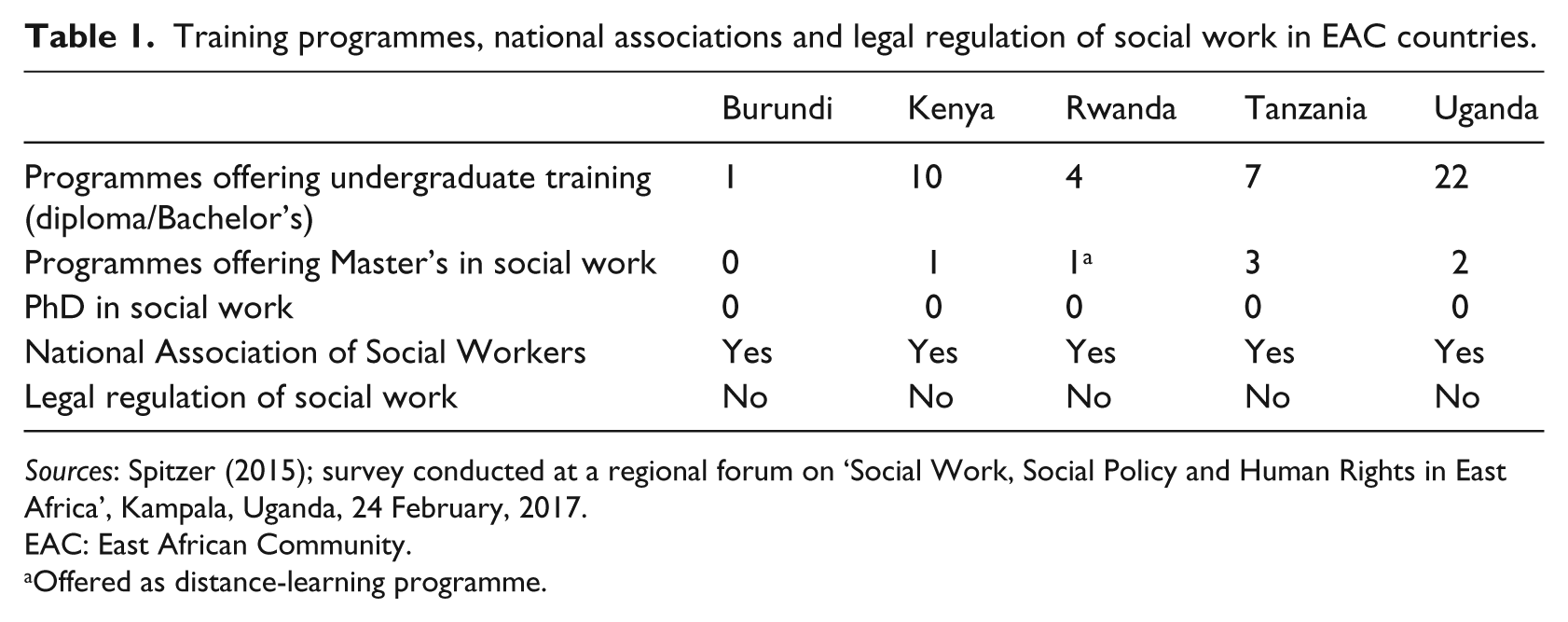
Sources: Spitzer (2015); survey conducted at a regional forum on ‘Social Work, Social Policy and Human Rights in East Africa’, Kampala, Uganda, 24 February, 2017.
EAC: East African Community.
Offered as distance-learning programme.
What I have observed in my mzungu years in East Africa is that most schools of social work in the region share similar constraints such as lack of qualified staff, insufficient resources and inadequate infrastructure, lack of appropriate teaching material and literature, and limited capacities for lecturers to conduct research and engage in academic activities. When visiting a library in any of the East African universities, one hardly comes across social work reference books that were written and published in-country. Teaching is still heavily based on theories, concepts and methods deriving from non-African contexts.
The heritage of imported theories and concepts from the West is still heavily affecting social work education and practice in the 21st century; these imported models neither provide sufficient responses to contemporary challenges in society nor do they effectively meet the sociocultural realities in these contexts. Hence, the core of the struggle for indigenization of social work in African contexts lies in the search for culturally relevant education and practice (Rankopo and Osei-Hwedie, 2011).
Social work practice, legal gaps and professional associations
In the East African practice domains, there is a lack of qualified social workers. 2 In many cases, social workers face heavy workloads under unconducive working conditions; jobs are mostly underpaid, and sometimes payment is not forthcoming at all due to suspended funding. From a mzungu perspective, it is astonishing and admirable to see social workers’ high levels of commitment and unabated passion despite working conditions that are inconceivable in most Western contexts.
Social workers are exposed to highly competitive fields where other professions occupy jobs that were designed as social work in the first place. Additionally, the term ‘social worker’ is not protected so even lay persons can call themselves social workers. To date, none of the EAC countries has a legitimized statutory body to regulate social work (Twikirize et al., 2014), nor is there a system of licensure in place.
With regard to professional associations, it can be said that in all EAC countries (with the exception of South Sudan) such associations do exist, yet their degree of organization and level of activities vary from country to country. Apart from Burundi, all national associations are members of the International Federation of Social Workers (IFSW (2017)).
As a next step, I shall now refer to a project that was initiated in order to respond to some of the challenges as outlined above.
PROSOWO: Promotion of professional social work in East Africa
In 2010, a group of social work educators from Austria, Kenya, Rwanda, South Africa, Tanzania and Uganda met in Nairobi in order to brainstorm on a joint project which should be powerful enough to uplift the social work profession in East African countries. 3 The outcome of the workshop was a concept for the ‘Promotion of Professional Social Work in East Africa’ under the acronym PROSOWO. The project design was based on a participatory, demand-driven approach, in line with the views and needs expressed by the East African colleagues. The implementation of the project started in 2011 and activities ran up to 2014. In 2016, a follow-up project called PROSOWO II started for another 3 years. 4 My own role in both phases was and continues to be the overall coordination of project activities.
A multidimensional project
Key components in the first phase were as follows:
basic research on the role of social work in poverty reduction and the achievement of the MDGs;
revision of existing curricula based on the research findings and development of new curricula at Master’s level;
development of sustainable academic partnerships and networks in social work training and research in Africa and internationally;
capacity building of schools of social work through increased research and publications;
policy advocacy by means of drafting discussion papers on the regulation of social work for negotiations with relevant government authorities;
dissemination of project outcomes through a series of publications, symposia, workshops, and conferences (Spitzer and Twikirize, 2014d).
The manifold project activities were interlinked in order to serve the overall objective of the project, namely, to promote professional social work education and practice to more effectively contribute to social development and poverty reduction in East Africa. The following sections of this article concentrate on PROSOWO’s research component and also highlight some project-related events which proved to have a significant impact on social work policy in the EAC.
Conceptual framework and methodology
The PROSOWO research was conducted in 2011 and had a broad geographical coverage in both rural and urban areas in the countries of Kenya, Rwanda, Tanzania and Uganda. In total, 2000 respondents were involved in the study (see Table 2). It was the most comprehensive research on social work in the East African region (for Kenya, see Wairire et al., 2014; for Rwanda, see Kalinganire and Rutikanga, 2015; for Tanzania, see Mabeyo et al., 2014; for Uganda, see Twikirize et al., 2013; for regional perspectives, see Spitzer et al., 2014a).
Country-specific respondents and research methods.
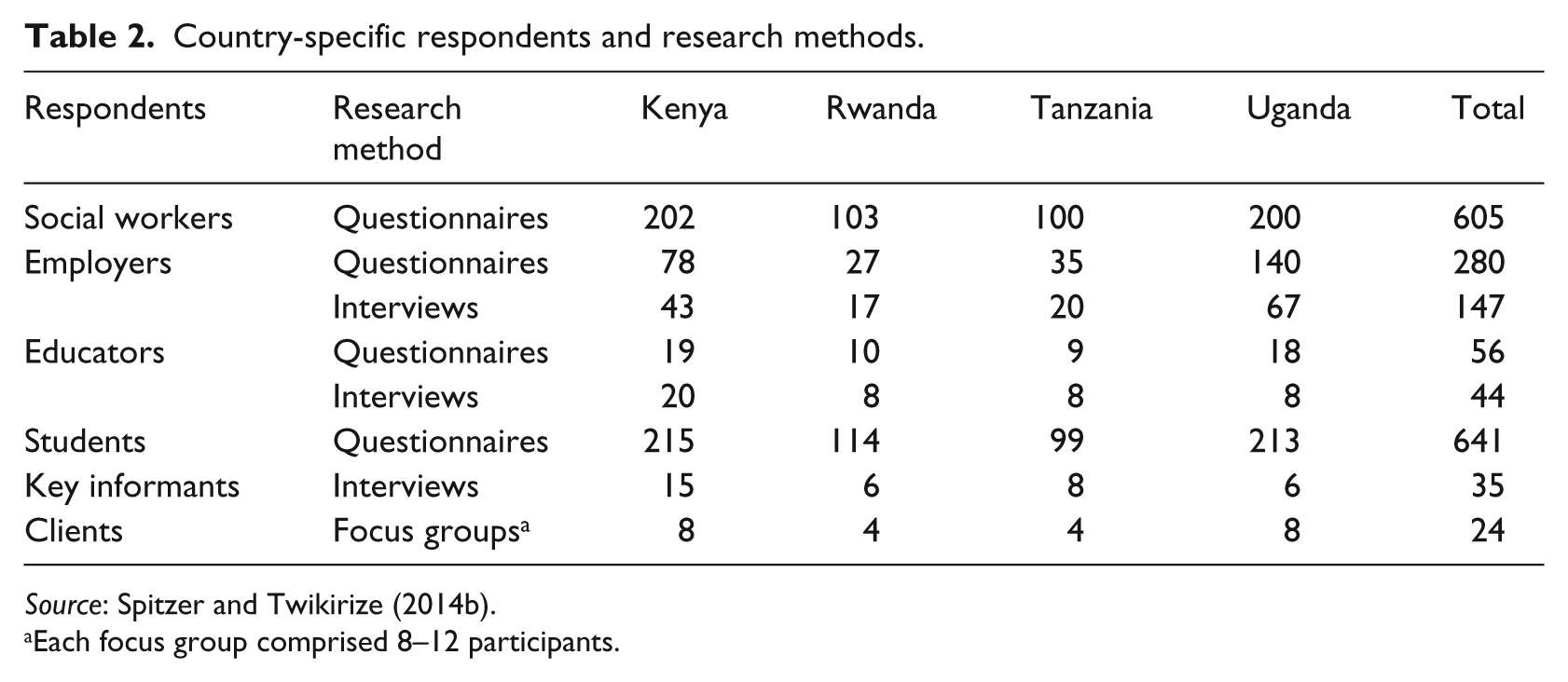
Source: Spitzer and Twikirize (2014b).
Each focus group comprised 8–12 participants.
The research was based on six conceptual pillars which determined the research questions and the research design: poverty reduction, MDGs, social development, gender equality, cultural relevance and professional social work (for a detailed discussion, see Spitzer and Twikirize, 2014b). For the purpose of this article, two aspects are highlighted here:
Social development. A social development approach in social work (also referred to as ‘developmental social work’) has turned out to be the most influential concept in social work theory and practice in African contexts (Chitereka, 2009). In this model, social work is positioned as a key social policy agent with strong social change and transformative functions. Developmental social work implicates both a macro-perspective (e.g. in terms of policy interventions) and meso- and micro-level interventions (Hugman, 2016; Lombard, 2014; Midgley, 2010). Mupedziswa (2001) proposed a conceptual model of developmental social work education and practice as opposed to remedial-oriented concepts, which he regarded to be more effective in African contexts. Some of his considerations inspired the PROSOWO research where the knowledge and level of application of this approach in Kenya, Rwanda, Tanzania and Uganda were explored.
Cultural relevance. Based on the notion that social work concepts and methods should be related to the respective social, cultural, economic and environmental contexts within which the profession operates, the following areas were explored: relevance of local knowledge systems and coping mechanisms for social work practice and education; the extent to which social work training prepares for culturally relevant practice; and the compatibility of social work interventions with cultural values and traditions.
The study combined quantitative and qualitative research methods with a set of four structured questionnaires (for social work practitioners, educators, students and employers), semi-structured interviews (for educators, employers and key informants) and focus group discussions with social work clients in order to give voice to those who are supposed to eventually benefit from improved social services (see Table 2).
In this article, I focus on two empirical outcomes of the quantitative data: first, the extent to which a social developmental perspective is applied in social work education and practice in these countries, and second, the aspect of context-specific, indigenized social work.
Discussion: Developmental and culture-specific social work in East Africa
Developmental social work
Empirical findings of our study reveal that the social developmental approach in social work has become quite influential in countries of the EAC, albeit with some country-specific differences and limitations (see Table 3). While more than half of social workers in Kenya (52%) and Uganda (56%) located their practice within a developmental framework, in Rwanda it was 29 percent and in Tanzania only 18 percent (all figures in this section are based on Twikirize et al., 2014). In Tanzania, the predominant level of intervention was at the individual/family level (38%), followed by the community level (33%); correspondingly, a significant percentage of practitioners (56%) described their practice as remedial, with individual casework stated as the main type in terms of applied social work method (68%). Conversely, in Uganda, Kenya and Rwanda practitioners indicated that their interventions are mainly based at community level (66%, 57% and 48%, respectively). This is strong empirical proof that the community is at the centre of social work practice in these contexts. But the data must be analysed with some caution. It seems that there exists some kind of conceptual overlap in the mindset of social workers with regard to social development and community development. Social development interventions do not stop at the community level. Hugman (2016) argues for a careful distinction between the two concepts as complementary but separate approaches to social work practice, social development being the overarching framework that brings together a range of practices, including community development and other methods which are sometimes subsumed under a ‘generalist’ social work perspective.
Some indicators on developmental social work in EAC countries (in %).
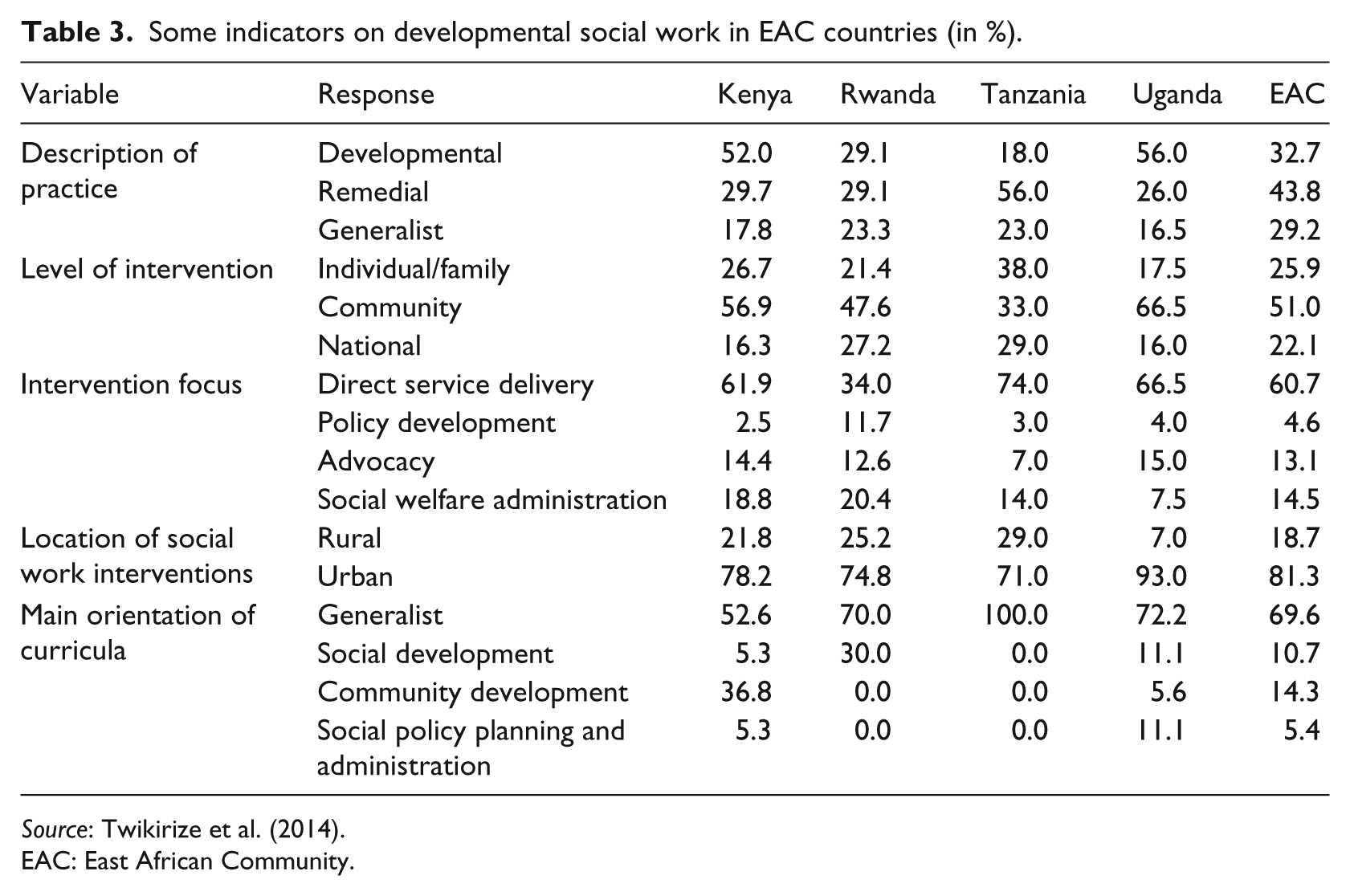
Source: Twikirize et al. (2014).
EAC: East African Community.
On average, most social work interventions in the EAC were located at micro (support of individuals and families) and meso (support of communities) levels (26% and 51%, respectively). Although 22 percent of study respondents indicated that they intervene at a national level, this figure could not be proved by qualitative findings. Rather, the term national might have been used for geographical coverage (e.g. when an NGO operates in different regions of a country) and not so much in terms of macro practice. In general, macro-level interventions were much underrepresented, with less than 5 percent of social work agencies being involved in some kind of policy development and 13 percent in advocacy practice. Social workers hardly reach up to a level where they can influence policies. In other words, most social work interventions in the EAC are dealing with the symptoms of poverty, social exclusion and inequality, rather than addressing the root causes of social problems.
Not surprisingly, this situation in social work practice corresponds with the empirical picture at training level: slightly more than 10 percent of social work educators described their social work curriculum as social development-oriented, again with some variations across the four EAC countries. While 30 percent of respondents in Rwanda described the main orientation of their curriculum as social development, in Tanzania the curriculum was described as 100 percent generalist. In Rwanda, 70 percent of respondents termed their curriculum as generalist, in Uganda it was 72 percent, and in Kenya 53 percent, with another 37 percent who referred to their curriculum as being mainly based on community development. The overall picture suggests that social work education in the countries of the EAC is mainly conceptualized as generalist, with a tendency of including elements of community development and only limited knowledge transfer in social development issues. Still, there is need for more in-depth country-specific analysis. For example, Wairire et al. (2014: 77) state for the situation in Kenya that despite a strong focus on a generalist approach and community development, social work education still features social development as cross-cutting issues throughout the curriculum or in the form of separate modules.
A last comment refers to the location where social work interventions can be found. In our study, it turned out that 81 percent of organizations employing social workers were based in an urban or peri-urban area, with Tanzania having the highest ratio (29%) of agencies located in rural areas and Uganda the lowest (7%). These figures contradict the fact that the majority of East Africans reside in rural areas where they are severely affected by poverty and lack of basic services. Consequently, social work service delivery is least available where the need for social development interventions is most evidently high. The profession must shed its urban bias and play its role in the remote African areas where limited infrastructure prevails and people are exposed to living conditions on the brink of survival.
Seen from the mzungu perspective, a social development approach in social work seems to be an adequate response to the contemporary challenges in East African societies. Its focus on community and macro-level interventions proved to be successful in many practice fields across Africa (see Butterfield and Abye, 2013; Gray, 2017). However, empirical evidence suggests that its conceptual and practical potential for social work education and practice has so far not been fully utilized – or even realized – in the countries of the EAC. What is needed is intensified research on its effectiveness, coupled with theory construction that aligns social development with cultural concepts and epistemologies in order to identify innovative approaches that work in a given context. The respective findings must consequently be transferred into revised social work curricula and made available for future generations of social workers. These coupled efforts would be a powerful means to shed Western concepts that turned out to be inappropriate, thus contributing to the decolonization of social work and building a self-confident identity of the profession.
Indigenization of social work in East Africa
With regard to the cultural relevance of social work practice methods, our study provided a rather differentiated picture (see Table 4). Close to half of the practitioners (48%) indicated that their social work training had sufficiently prepared them to work in diverse cultural settings, while almost a quarter (24%) admitted that this had been the case to a great extent. Kenya had the highest scores with regard to culturally relevant training (80%), while Rwanda, Tanzania and Uganda showed similar figures (between 66% and 70%). Yet, 28 percent of social workers in the EAC regarded their training as inadequate in terms of cultural relevance; hence, there is still a need for incorporating African knowledge systems and cultural concepts into the curriculum in order to adequately prepare students for the environments of their future practice. Alarmingly, 86 percent of social work students said the literature they get to know in their studies exclusively derives from outside their own contexts. The question remains how indigenous concepts can be passed on to students who are hungry for such knowledge when essential reading is missing.
Some indicators on culture-specific social work in EAC countries (in %).
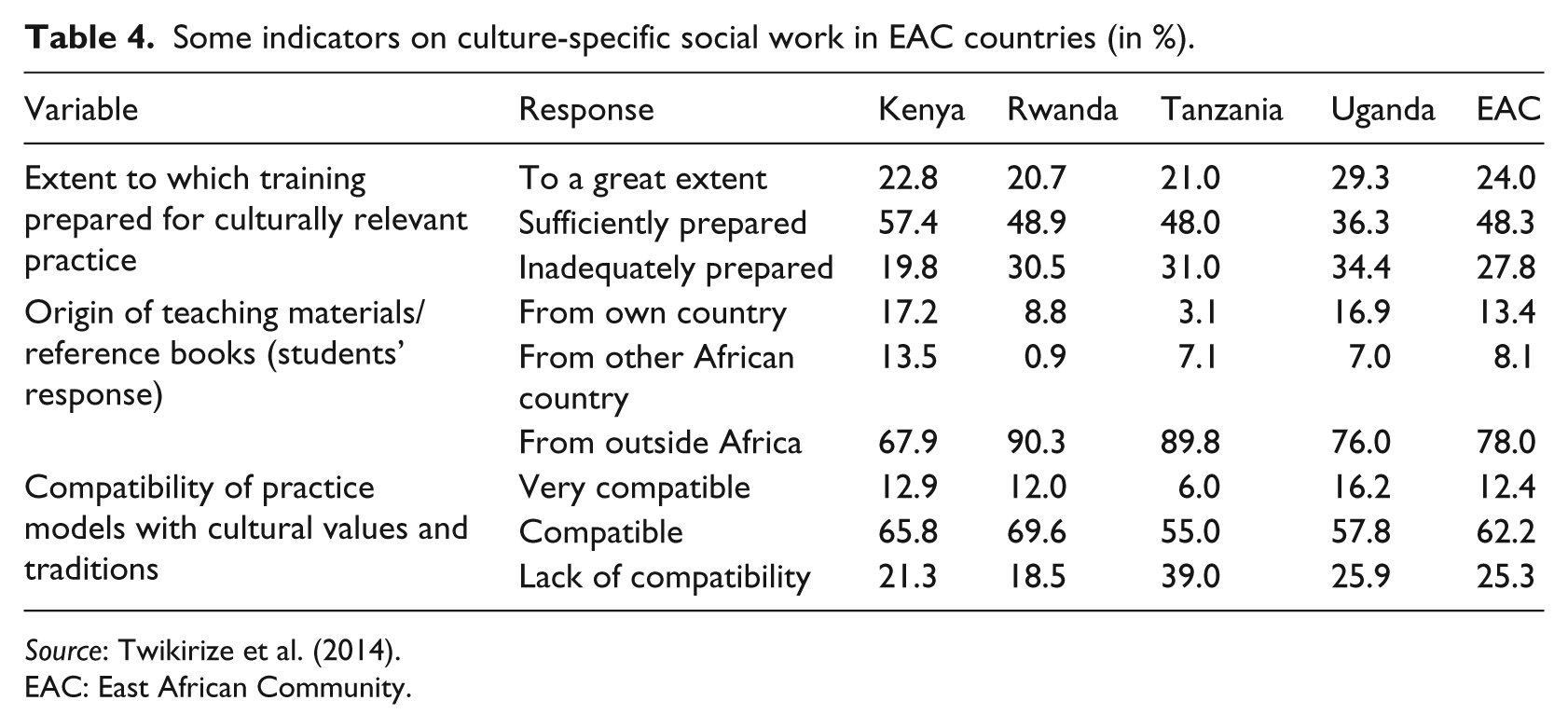
Source: Twikirize et al. (2014).
EAC: East African Community.
In line with the largely positive picture of curricula which prepare their students for culturally relevant practice, social work practitioners gave high scores to the compatibility of their practice models with cultural norms and traditions (close to 75%). Rwanda featured the highest number of social workers (82%) who stated so. This tendency can be linked to the country’s particular circumstances where efforts had been made to incorporate traditional ways of conflict resolution (such as gacaca as a means of informal jurisdiction at grassroots level) and collective work (such as ubudehe as a form of community-based action to combat poverty) in order to cope with a situation of total economic destruction and social disorder in the aftermath of the genocide (Kalinganire and Rutikanga, 2014). Despite some criticism of these policies as being part of an authoritarian political system where such concepts are imposed on the people on the ground (Straus and Waldorf, 2011), social workers seem to play a crucial role in their implementation.
The situation in Rwanda can be regarded as exemplary for the ambiguous roles of social work: On the one hand, the profession has to strive for a delicate balance between the empowerment of its clients and its normative function sanctioned by state control. On the other hand, social workers have to critically reflect on their ethical and professional standards and how they match with cultural norms and practices which might reinforce existing power hierarchies and oppressive structures in society and even violate human rights. To give an example, FGM, which is common in some East African regions, is often justified on the grounds of tradition and culture, yet the practice fundamentally violates girls’ physical intimacy and human integrity. When intervening in communities where FGM is prevalent, social workers have to face a challenging tension between human rights and culture. As much as culture plays a central role in the process of indigenizing social work in African contexts, this claim has its limitation where culture is in contrast with human dignity and contradicts basic social work ethics. In such cases, a rights-based approach and the promotion of gender equality should be considered as more viable for social work practice than an uncritical acceptance of indigenous practices which perpetuate inequality, maintain women and girls in a subordinate position and expose them to violence and vulnerability (Twikirize, 2014a).
The empirical picture shows that cultural relevance seems to play a significant role in social work education and practice in EAC countries. The qualitative findings of our research revealed that social workers have to deal with cultural issues on a day-to-day base, for example in terms of gender aspects, child care practices (such as adoption and foster care), marriage issues (such as polygamy vis-a-vis household poverty), taboos about sexual and reproductive health, and the often contradicting forms of traditional, religious and modern ways of healing and helping (Twikirize et al., 2014). What is essentially missing in this regard is in-depth research on these topics. Accordingly, the search for both indigenous and innovative models of social work practice is a major component in PROSOWO II.
Social action as a means of policy advocacy
Apart from research, another aspect of the PROSOWO project is the relevance of social work events. In the course of the project, a good number of workshops, symposia and conferences were launched in order to bring various stakeholders on board and to sensitize policy makers on the role of social work in social development and poverty reduction. A major milestone was an international conference in Uganda in March 2014, which brought together more than 400 social work practitioners, educators and students from Africa and other parts of the world in order to share experiences and knowledge and celebrate World Social Work Day. 5 This date was deliberately chosen to emphasize the significance of social work for shaping societies, to attract media and to gain attention from representatives of relevant government authorities. A highlight of this conference was a march on the streets of the capital city Kampala where participants advocated social justice and human rights and raised public awareness for the social work profession.
The philosophy of marching on the streets as a means of social action was further cultivated in other social work events in the region. On World Social Work Day 2015, another conference was launched in Burundi where participants marched on the streets of Bujumbura under tight political circumstances in view of the upcoming presidential elections. One year later, World Social Work Day was celebrated in Tanzania during a conference which also culminated in a march in the Northern town of Arusha, the host of the EAC’s headquarters. On this occasion, a Minister of the EAC attended the conference and received the Arusha Call for Action, a position paper which, among other things, calls for a permanent voice of social workers in the administrative structures of the EAC. 6
Coming from Austria where social work does not have a strong political voice, the mzungu was impressed by the way social workers in East Africa expose themselves in public and manage to liaise with political decision makers. But I am fully aware of the fact that social work in these countries is faced by oppressive political structures that tend to ignore critical comments – or punish those who express them. Political action can be both risky and rewarding. This was the case when social workers openly criticized Uganda’s Anti-Homosexuality Act during the 2014 conference in Kampala. The law allowed for life imprisonment of homosexual people. While some organizations (such as the social workers’ association) were confronted with financial cuts in the aftermath of the event, I later learned that the advocacy role some courageous social workers had played for the rights of sexual minorities eventually contributed to the process of overturning the controversial law.
Concluding remarks
This article features some developments of social work in the countries of the EAC. In these contexts, the profession has to operate under difficult circumstances. In recent years, some positive trends with regard to research, professional standards, context-specific publications, policy advocacy and practice domains in line with a social development approach and culture-specific elements of social work could be observed.
The PROSOWO project, in its current phase, continues with a maintained spirit to foster social work in East Africa. Empirical research on indigenous and innovative social work practice, increased efforts towards the legislation of the profession, as well as accelerated engagement of social workers in social policy and human rights advocacy are on the agenda of PROSOWO II. In early 2017, a new Centre for Research and Innovation in Social Work was established at Makerere University, Uganda. This Centre will serve as a regional hub for applied research, innovative practice and knowledge production in the EAC.
Just like the mzungu in this article, members of the international social work community can seek for tangible ways to collaborate with colleagues in Africa, to learn from them, to support their efforts towards strengthening social work and to stand by them in their demanding fight for social justice and human rights. Such support should not come across as a disguised form of professional imperialism or imposed aid, but as partnership and dialogue on equal terms.
Professional social work in East Africa has still got a long way to go, but indeed, it is well on the way.
Footnotes
Funding
The research and publication of this article was funded by APPEAR (Austrian Partnership Programme in Higher Education and Research for Development), a programme of the Austrian Development Cooperation.