



Abstract
Governments around the world are increasingly searching for ways to develop robust emergency management structures that support customized, bricolaged and scaled responses to turbulent problems. In this article, we examine how collaborative platforms can facilitate the execution, adaptation and efficiency of emergency management operations. Based on a qualitative study of six Local Rescue Coordination Centres aiming to facilitate collaboration between authorities and voluntary organizations in search and rescue operations in Norway, we find that the functioning of the platforms depends on feedback mechanisms between their peacetime and operational modes of action. Our findings suggest that collaborative platforms serve as a stable institutional framework for swift, flexible and efficient emergency management collaboration when their design fosters productive interaction between these two modes of action.
Points for practitioners
Effective emergency management platforms must be deliberately designed to shift between peacetime collaboration and operational command. Between incidents, public authorities should invest in ‘platform care’ by building trust and reciprocity and recognizing the needs and expertise of voluntary actors, as these conditions underpin their willingness to align with public leadership and accept hierarchical coordination during emergencies. Systematic feedback from operations into training, rules and routines is essential to sustain motivation, clarify authority shifts and strengthen long-term platform robustness.
Keywords
Introduction
Across the globe, governments and public institutions are intensifying their search for robust governance responses to complex and turbulent problems (Ansell et al., 2023; Scognamiglio et al. 2023). Reflecting this need, a growing body of emergency management research underscores the importance of understanding how interorganizational networks form and perform (Hu et al., 2022), how effective communication and coordination across level and sectors can be achieved (Kapucu and Hu, 2016) and how flexible yet reliable institutional arrangements can be organized for large-scale disaster response (Boin and ‘t Hart, 2010; Krogh and Lo, 2025). Building on the emerging public governance scholarship on collaborative platforms (Ansell and Miura, 2020; Bell and Scott, 2020; Haveri and Anttiroiko, 2023; Lee, 2023; Sahamies et al., 2022), we aim to demonstrate how such arrangements offer a promising avenue for advancing emergency management in theory and practice. A collaborative platform is a structured framework for cross-sector cooperation, defined as ‘an organization or program with dedicated competences, institutions and resources for facilitating the creation, adaptation, and success of multiple or ongoing collaborative projects or networks’ (Ansell and Gash, 2018: 20). These platforms excel in mobilizing stakeholders, building local partnerships and fostering cross-sectoral learning (Ansell and Gash, 2018), suggesting they can be ideal instruments for institutionalized partnerships in emergency management, where these qualities are particularly salient (Kapucu, 2006).
Existing research has demonstrated that collaborative platforms can serve as critical infrastructure for generative governance, enabling public and non-profit actors to combine their strengths in cross-sector problem-solving (Ansell and Miura, 2020: 262). With their ability for rapid and effective scaling of collaborative problem-solving (Ansell and Miura, 2020; Bell and Scott, 2020; Sørensen and Torfing, 2019), collaborative platforms appear apt for emergency management. However, empirical research on the use of collaborative platforms in emergency management has been scarce. Although some generic features of collaborative platforms may support robust emergency management, the volatile, high-pressure operating environment demands closer scrutiny. To better understand how collaborative platforms facilitate cross-sector collaboration in emergency management operations, this article addresses the following research question: How can collaborative platforms facilitate the execution, adaptation and effectiveness of emergency management operations?
We answer this research question by examining Local Rescue Coordination Centres (LRCCs) in Norway. The LRCCs are an illustrative and well-developed case of collaborative emergency management platforms, as they aim to structure and facilitate collaboration between public authorities and voluntary organizations before, during and after search and rescue (SAR) operations. These centres facilitate cross-sector collaboration in nearly all land-based SAR operations, providing a relatively stable institutional framework for integrating the collective efforts of the police, other local emergency departments and voluntary organizations. In 2021, the LRCCs were activated approximately 5000 times (Hovedredningssentralen, 2022), testifying to their pivotal role in facilitating the execution, adaptation and success of Norwegian SAR operations.
We organize the remainder of this article as follows. First, we examine the search for constructive patterns of interaction within the emergency management literature. Building on this discussion, we draw on collaborative platform scholarship and broader collaborative governance theory to develop an analytical framework for studying how LRCCs function in Norwegian SAR operations. Second, we provide contextual background information on the Norwegian emergency management system and the socio-political conditions that characterize this study's context. Third, we present and discuss our methodological approach to case selection, as well as our data collection and analysis methods. Fourth, we present the study findings. Fifth, we discuss our main findings, summarize the new insights and suggest some avenues for future research.
Emergency management and collaborative platforms
Over the past four decades, emergency management scholarship has examined a wide range of approaches to cross-sector collaboration and inter-agency coordination (Oh and Lee, 2020). In that vein, recent research has focused on collaborative governance models that support agile and adaptive responses to emerging, disruptive and dynamic problems (Mizrahi et al., 2022). This work highlights the potential of purpose-built, ad hoc organizational structures to institutionalize constructive interaction patterns across different phases of crises and emergencies (Antonsen et al., 2023). Although parts of this literature have developed largely independently of the wider collaborative governance literature, some scholars have identified areas of promising cross-fertilization (Nohrstedt et al., 2018).
In recent collaborative governance theory and research, the notion of collaborative platforms has gained traction as a way of conceptualizing collaborative governance as a generic policy instrument (Ansell and Gash, 2018). Extending this concept to the field of emergency management marks a new step in applying broader public management approaches to collaboration, both to advance understanding of effective emergency response and to generate insights with relevance beyond the emergency management domain.
The core function of collaborative platforms is ‘to facilitate the interaction of different skills, resources, knowledge or needs’ (Ansell and Gash, 2018: 19). They constitute an institutional framework that mediates between stakeholders, enables adaptable and sustainable collaboration, and facilitates the (co-)creation of multiple projects with a customized resource bricolage (Ansell and Gash, 2018: 21–22). Collaborative platforms represent a significant shift from the engineering and digital origins of the platform concept (Sahamies, 2025). As the platform approach has spread and evolved, various related conceptualizations have emerged, such as governance platforms (Sahamies et al., 2022), public sector platforms (Linåker and Runeson, 2020) and urban platforms (Haveri and Anttiroiko, 2023).
Collaborative platforms can be distinguished from both other platform conceptualizations and governance models. Three core aspects differentiate collaborative platforms from other types of platforms. First, we do not treat digital technologies as a constitutive feature of the platform; rather, we conceive of the platform as a form of collaborative organization. Second, although public sector actors often play a vital role, we do not regard the platform as an extension of the public sector but as an institutionalized arrangement that brings together operationally autonomous actors from different sectors of society. Third, we do not conceive of the platform as a market-oriented arena for matching consumers and providers but as an arena for addressing shared problems and co-creating public value outcomes.
In this article, we conceptualize collaborative platform as an organizational model in public governance (Ansell and Gash, 2018). To delimit this model from broader notions of networks and from command structures in emergency response, we treat an arrangement as a collaborative platform when: (a) it comprises an institutionalized hub with dedicated coordinating capacity to convene and structure collaboration across organizational boundaries; (b) it involves recurrent cross-sector participation, such that collaboration is repeated over time rather than limited to a single incident; (c) it relies on a relatively stable yet adaptable ruleset (e.g. entry, interaction and decision-making rules) that structures collaboration; and (d) it orchestrates multiple collaborative ‘instances’ (in our context, repeated SAR operations and associated training, planning and evaluation activities) through which participants can be recombined and scaled as needs change.
By contrast, we do not label as collaborative platforms: (a) loosely coupled interorganizational networks without a coordinating hub and designed rules; (b) ad hoc incident command groups that exist only during an operation and lack peacetime institutionalization and learning feedback; or (c) single organizations coordinating their internal activities.
The notion of ‘institutional design’ captures the set of norms, values, rules and procedures embedded in collaborative platforms (Bell and Scott, 2020; Fossheim and Andersen, 2022; Hysing, 2022; Sørensen and Torfing, 2019). This includes both formal and informal rules that regulate platform participation, processes and relationships, such as written, spoken and unspoken codes of conduct. The network governance literature has identified three important types of rules affecting the interaction in networked arrangements (Klijn and Koppenjan, 2006): (a) entry rules that regulate access through both formal membership requirements and informal norms about who is needed, trustworthy or desirable as a participant; (b) interaction rules that define both the formally acceptable and informally expected ways of behaving and relating to other actors; and (c) decision-making rules that stipulate formal decision-making procedures as well as appropriate and legitimate ways of arriving at decisions that affect the joint problem-solving activities. We expect such rules to shape the relationship between platform participants and the platform's overall problem-solving capacity. Given the mix of formal and informal elements, the institutional design of a collaborative platform is likely to be relatively stable but not fixed, enabling flexible adaptation to changing circumstances (Ansell and Miura, 2020). Such adaptability is especially vital in emergency management, where events are often difficult to predict, resource needs vary across incidents and response demands fluctuate as situations evolve (Boin and ‘t Hart, 2010).
In emergency management, the entry requirements, forms of interaction and modes of decision-making often shift significantly before, during and after an emergency operation (Boin and McConnell, 2007; Krogh and Lo, 2025; McGuire et al., 2010). To grasp how collaborative platforms function in an emergency it is therefore essential to distinguish between peacetime mode and operational modes and to examine how power dynamics shape rule formation and manifest in interaction patterns within each mode. Ansell and Gash (2018: 23) suggest that how power relationships shape the platform control hinges on the ‘design rules’; however, research on the processes and mechanisms shaping the transition between these modes remains limited, leaving this aspect under-theorized and under-explored. Drawing on insights from the emergency management literature, we can generate preliminary expectations about how rules of entry, interaction and decision-making operate across the two modes. These expectations will guide our empirical investigation.
Entry rules regulate who participates in the platform. In peacetime, we expect formal documents and institutionalized perceptions among core members to define who belongs to the platform, determining who is invited to meetings, training exercises and other peacetime activities. During operations, however, a more situational and solution-oriented mindset is likely to determine the appropriate actors (Kapucu and Garayev, 2011, 2016). A specific operation may include all or only some of the stable members of the platform, and it may also include actors who are not part of the platform in peacetime.
Interaction rules frame the collaboration and coordination between platform members while providing a common framework of norms, values and interaction procedures (Thornton et al., 2012). In peacetime, actors allow more time for conflict resolution and negotiation, whereas during operations the need for speed and friction reduction often precludes it (Krogh and Lo, 2025). This dynamic may result in the need to address conflicts arising during operations when transitioning back to the peacetime mode of the platform.
Decision-making rules affect the capacity of the platform participants to make decisions and facilitate collaborative decision-making in an effective and efficient manner. In general, participation in collaborative platforms is voluntary, whereby hierarchies are typically not a defining feature of platforms (Ansell and Gash, 2018). Due to the need for swift decision-making in high-pressure situations, however, hierarchies and more traditional forms of command-and-control are almost unavoidable features of emergency management operations (Drews and Fiedrich, 2024). We can therefore expect a shift in decision-making rules when transitioning from the peacetime mode to the operational mode of the platform. Yet the two modes may affect each other in intricate ways. For instance, more horizontal forms of deliberation during peacetime may facilitate acceptance of hierarchical decision-making during operations.
SAR and emergency management in Norway
Norway has a long tradition of making voluntary contributions to emergency management. Public–non-profit emergency management collaboration has been formalized as official Norwegian policy since the 1960s (Aasland and Braut, 2018). According to a government white paper, the entire system relies on cross-sectoral exchange of resources with voluntary organizations as ‘the very backbone’ of the Norwegian Rescue Service (Meld. St 5, 2020–2021: 121 our translation). The most prevalent type of land-based emergency efforts is (SAR) operations in which a limited number of people are missing or in danger (Hansen and Winsvold, 2021).
The LRCCs serve as a set of local collaborative platforms that aim to structure and facilitate collaboration between public authorities and voluntary organizations around the initiation, management and execution of (SAR) operations. The regional police department chairs the LRCC and conducts most SAR operations together with the voluntary organizations. The voluntary organizations include the Red Cross, Norwegian People's Aid, Norwegian Rescue Dogs, alpine rescue groups and the scouts’ emergency groups. Most of the relevant voluntary organizations involved in emergency management have collaboratively formed the Voluntary Professional Rescue Organizations’ Forum (FORF) – an umbrella organization that coordinates their activities and interactions with the public sector at the local and national levels.
When a person goes missing and an SAR operation is initiated, the police alert the relevant authorities and organizations. Leaders from the respective organizations then join the responsible police officer at the headquarters for the operation (i.e. the command centre). Each leader is an expert on the specific capabilities they bring into the operation, and they direct and command their own members in close coordination with the other leaders. Beyond rescue operations, platform participants spend time planning, training and evaluating operations with other participants.
Case selection and methods
Our empirical research design is a qualitative case study of six Norwegian LRCCs, situated in three different police districts. We analyse the governance of the LRCCs as platforms because they comprise an institutionalized coordinating hub, involve recurring cross-sector collaboration in both peacetime and operational settings, operate through shared and adaptable rules for participation and coordination, and repeatedly organize distinct SAR operations and related activities rather than one-off incidents.
Furthermore, the generic institutional design of LRCCs in Norway aligns nicely with our operationalization of collaborative platforms. First, the platforms have a deliberately designed structure: the police and a consistent set of voluntary organizations operate under national regulations that define formal roles and responsibilities. Second, coordination is supported by shared procedures, most notably the national SAR handbook, which structures collaboration across actors while allowing for local adaptation in how collaboration is practised. Third, the arrangement enables repeated scaling and recombination of resources across incidents, as the LRCC convenes relevant actors for each operation and connects operational experiences to peacetime activities.
The LRCCs were strategically selected to capture variation across geographical, demographical and contextual factors. To ensure both urban–rural diversity and a sufficient number of SAR operations, we chose one urban area and one rural area with frequent search activity in each of the police districts. This approach resulted in two cases per district, totalling six. Although some voluntary organizations participated in operations in urban and rural settings within the same districts, others were involved only in the urban or rural tourist setting. The cases allow us to examine platforms with the same basic institutional design function in different settings, demonstrating that consistent findings extend beyond individual local contexts (Ragin, 2004).
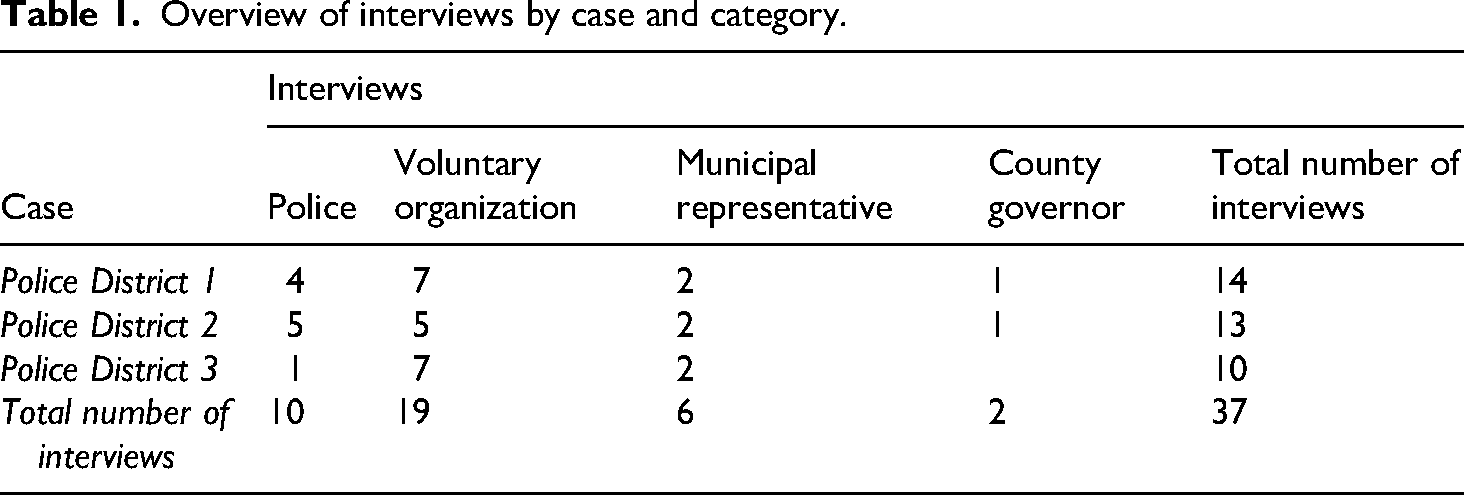
Within each district, we interviewed police officers and leaders from the voluntary organizations. For context, we also interviewed representatives from the municipalities and the county governor, as they routinely engage with or observe the platforms. Table 1 sums up the number of interviews per role and platform.
Overview of interviews by case and category.
Using a shared interview guide, four researchers conducted the interviews. The interview guide included questions on platform participants, the relationship between the different actors, and the collaborative drivers and barriers. The interviewees were further asked to describe successful and failed operations (see Appendix in Supplemental material for complete guide). All interviews were recorded, transcribed and thematically coded. The coding took place in an iterative fashion. Our initial coding was fundamentally inductive although the reading of the above-cited literature on collaborative platforms and on emergency management informed our identification of relevant codes for our research puzzle (Braun and Clarke, 2021: 331–332). Subsequently, this primarily data-driven approach to code development was supplemented by codes we identified in the literature that were absent from the more inductively based initial coding (Locke et al., 2022). The coding was performed manually by two of the authors. We did not develop a measure for intercoding reliability but convened in workshops to discuss any coding discrepancies. After a new round of coding, we had our complete set of codes and engaged in the development of constructs by scrutinizing codes, their relationships and how they inform and are informed by theory. In this process we sought to benefit from both the within-case understanding of processes and mechanisms and the comparative case logic which helps assess the frame conditions for our inferences (Ragin, 2004). In practical terms, this means that we conducted analysis within each of the six cases, but also comparative analysis across the cases and across groups of informants across cases (identifying consistency and variation from police officers and voluntary sector personnel across cases). In all of these analyses we engaged with the themes to enable inferences about which aspects of the collaborative platforms were related to their ability to facilitate the execution, adaptation and effectiveness of emergency management operations. We report the findings emphasizing the role of the three institutional design dimensions and the shifts between the peacetime and operational modes.
Findings
The case study revealed consistent patterns across platform contexts, suggesting they stem from institutional features rather than from actor-specific or environmental variations. In the following section, we discuss these patterns per the three institutional design dimensions promulgated in the analytical framework of the study: entry, interaction and decision-making rules. When discussing each dimension, we pay particular attention to the variation between peacetime and operational modes, thus examining the dynamics of the platform as it shifts from one mode to the other.
Entry into the local emergency platforms
There are two types of entry rules: one for accessing the platform in peacetime mode and another for participating in operations in operational mode. Both sets of rules are based on the overarching premise that the platform should be able to mobilize sufficient and appropriate human resources for operations.
For voluntary organizations to enter the platform in peacetime, they must have routines for recruiting, training and approving members to ensure that they are sufficiently vetted and fit for the task. An underlying premise that was omnipresent in interviews with both the police and voluntary organizations was that organizations are expected to continuously recruit new members to maintain the platform's ability to mobilize resources. Once an organization is part of the platform, it is expected to act as a gatekeeper for people who want to get involved. From this we infer that organizations – and therefore their members – meeting these requirements are considered trustworthy. Membership in a voluntary organization relieves the police of the task of assessing whether a person is sufficiently qualified and trustworthy and promotes trust between the voluntary organizations whose members must have confidence in their peers during rescue operations.
When changing to operational mode, it is the police's task to determine the required number and specialization of volunteers. The entry rules at the operational mode are guided by a shared principle that the interviewees unanimously subscribed to: ‘the situation is the master’. This implied that the characteristics of the operation should determine the kind of resources needed and, thus, which actors should get involved.
Representatives from all police districts and many of the interviewees from the voluntary sector emphasized the ability to scale efforts and create a bricolage of different capabilities as one of the greatest advantages of the collaborative emergency platform. Different incidents require different expertise and varying levels of effort. When an incident demands resources beyond those available to the police, the police adjust the configuration of the LRCC platform accordingly. However, due to peacetime access requirements, voluntary organizations often play a central role in determining which individual volunteers can be deployed during a scaled-up operation. As one representative from a voluntary organization explained: The police do not contact volunteers directly but contact the on-duty officer at the voluntary organization, who, in turn, contacts the volunteers. In the southern district of the country, FORF (the volunteers’ umbrella organization) is responsible for the call, so then the police contacts FORF, which then establishes the team. (Interviewee 31)
Although all interviewees – from both the police and the voluntary sector – agreed that ‘the situation is the master’ is the primary principle in scaling operations, many also discussed an alternative consideration that we label ‘platform care’. The idea of platform care emphasizes that volunteers need to be engaged in emergency work with sufficient regularity to develop collaborative skills and maintain motivation. For this reason, the volunteers wish to be deployed more frequently than the police deem necessary. A representative from a local volunteer organization expressed a widespread concern: We are all equally important, aren’t we? If the Norwegian rescue service is to continue to consist of volunteers, the police must increase their use of local resources. That applies to the whole country. There are certainly some local teams around that feel ignored when operations have taken place in their vicinity. We have experienced that here too, that we are the last to be notified. (Interviewee 9)
Importantly, the entry rules are a major point of discussion between the police and the voluntary organizations in all platforms. When necessary, organizations voice their dissatisfaction with the police's decisions on who they call out, and, in all districts, there are numerous examples of the police changing their practices based on platform discussions. This demonstrates how entry rules are constantly negotiated among platform participants. It also shows how the needs of organizations in peacetime prompt voluntary organizations to challenge police practices in operational mode. Although efficiency is the guiding principle in operational contexts, in peacetime these priorities are complemented by broader considerations of volunteer needs. In this way, platform care and long-term sustainability of the platform become legitimate concerns even when making priorities at the sharp end of emergency management operations. However, a prerequisite for this legitimacy is that negotiations on scaling take place in peacetime, not during operations.
The police's acceptance of the need for platform care helps to ensure that organizations recruit sufficient eligible resources. By delegating responsibility for recruitment to the voluntary organizations, the police can mobilize through established command channels by leaders familiar with their crews, making mobilization efficient, flexible and effective. Importantly, the delegation of responsibility requires police confidence in the organization's recruitment and selection processes. This basic trust is established through peacetime discussions. Hence, the interrelated entry rules in the two modes ensure that sufficient suitable resources are available and can be mobilized in a fast and flexible manner.
Interaction among platform actors
At the surface, the police and voluntary organizations operate according to fundamentally different logics. Authorized to use force in their mandate to secure law and order, the police follow a logic of command and control. By contrast, representing the interests of civil society, voluntary organizations adhere to a logic of horizontal and voluntary coordination. To ensure both predictability and speed during operations, these opposing logics must be carefully managed.
When operations begin and platforms shift from peacetime to operational mode, the police formally assume the lead role. This transition sometimes creates tension, as volunteers move from an equal to a subordinate position. However, once an operation is launched, the ordinary modes and norms of each organization are partially suspended and replaced by a shared institutional logic, helping to reduce such tension. When a police station alerts the national Joint Rescue Coordination Centres (JRCCs) of an operation, the police station becomes the Local Rescue Coordination Centre (LRCC), thereby activating the collaborative platform. This renaming – from ‘police station’ to ‘LRCC’ – is more than symbolic; it signals that a different set of rules applies than in a normal situation, thereby activating the principle of ‘working together’. Enshrined in Norwegian law since 2015, under the term samvirke, this principle obliges all participants to contribute their available resources to collaborative rescue efforts aimed at saving lives. This principle is frequently invoked, both directly and indirectly, through recurring phrases among police and volunteers alike, such as ‘no one can run their own show’, ‘we work as a team’ and ‘we are in this together’.
Although the formal and legislated principle of ‘working together’ is most visible in the operational mode of the platform, we identify an equally important counterpart in peacetime. During operations, it requires volunteers to respect the hierarchical command of the police. When the platform is in peacetime mode, it encourages the police to engage in horizontal collaboration with volunteers. In this way, ‘working together’ functions as a mutual contract: the volunteers accept a subordinate role during operations in exchange for an equal relationship in peacetime. These shared rules of action, spanning both peacetime and operational modes, help bridge different institutional logics and enable effective collaboration.
The formal status of the collaborative platforms, together with the shared belief in samvirke, heightens awareness among all parties that they are in this together and that common rules are essential. Predictability – knowing what to expect from platform partners – is particularly critical in the heat of operations. This recognition has already led to the development of a shared manual for (SAR) operations, used by both the police and voluntary organizations across all districts. The manual serves not only to establish and sustain shared norms and rules of action but also to structure and coordinate interaction during operations, fostering a sense of belonging to a common organization. By following the same principles in training as well as in actual SAR operations, the actors ensure consistency and cohesion across the platform.
Decision-making between the hierarchy and the network
Whereas participation in collaborative platforms is voluntary and rests on networked interdependence and mutual consent, emergency management also requires a certain degree of command and control to ensure swift action. This tension makes the fluctuation between hierarchical and network-based decision-making a defining feature of emergency management platforms.
In our cases, decision-making in the platform's peacetime mode largely follows a horizontal pattern, reflecting the interdependent relationships among participants. As the formal managers of the platform, the police are involved in most decisions, yet they cannot easily impose their views.
In the operational setting, the platform's decision-making structure shifts from being mainly horizontal to mainly vertical to ensure efficiency. The clearest expression of hierarchy in the collaborative emergency platforms is the police's legal authority to command all citizens, including the voluntary organizations, when lives are at stake. Although this authority is mostly dormant and rarely invoked, it is recognized by both the police and the voluntary organizations. All parties understand that, in cases of disagreement, the police can activate their formal right to overrule volunteers, which structures interaction and reinforces discipline. In all six cases, there are examples of episodes where the police override the volunteers’ assessments. As one police officer explained: ‘We can expel a volunteer from the operation if the person is difficult to interact with or does not follow guidelines’ (Interview 6).
Nonetheless, according to both police and volunteer interviewees such episodes are rare and typically arise when volunteers propose actions that the police deem excessively risky. In the interviews, the police themselves express unease about these situations, as exercising formal authority is seen as a breach of the norms of horizontal collaboration. Across all six platforms, the police emphasize that they are cautious not to command volunteers against their will out of concern for preserving the collaborative relationship over the long term.
However, the interviews from both the police and voluntary sector underline how the views of those with the highest expertise and most relevant experience often carry the greatest weight, even if they come from voluntary groups. The police openly acknowledge that volunteers are frequently the true specialists in SAR operations, possessing more experience, broader knowledge and more specialized skills. Authority in operations is therefore tied not only to formal position but also – often more strongly – to competence. The police informants describe a hierarchy of expertise linked to specific skills: for example, the Alpine Rescue Group has the final say in alpine rescues, the Red Cross River Divers in river searches, and so on. The more specialized the groups, the less the police treat them as subordinates. From the interviews with the voluntary organizations we even have examples showing that the most specialized groups do not seek police approval for their chosen course of action but simply inform them.
To understand how the formal leadership responsibility the police hold during operations is supplemented with informal hierarchies that also shape decision-making in the platform's operational mode, we need to consider how the police and the voluntary organizations see themselves as emergency actors committed to the principle of samvirke. This entails placing the success of the operation above strict adherence to formal hierarchy. Guided by the norm that the situation – rather than formal structures – should dictate collaborative action, the police depart, to a certain extent, from the conventional institutional logic of public organizations.
The importance of expertise is embedded in the platform's decision-making structure. One experienced volunteer recalled being called to an SAR operation in a neighbouring police district where he was unknown to the police and was initially assigned routine tasks that did not require his specialized skills: Then I said to the operational leader of the police: ‘Screw you, I haven’t driven for three hours to look at a crew list. Forget it.’ Then I told him about my background and expertise, and I ended up getting proper decision-making tasks like drawing up search areas. The police must have learned from the experience because the next day, they requested someone [from the voluntary organization] with the same type of background and expertise. (Interviewee 16)
Discussion and conclusion
In our analysis of the LRCCs, we set out to examine how collaborative platforms can facilitate the execution, adaptation and effectiveness of emergency management operations. As outlined in our theoretical framework, prior research highlights the potential of collaborative platforms as an innovative form of governance connecting public institutions with civil society and market actors (Haveri and Anttiroiko, 2023; Sahamies et al., 2022). Our findings confirm this connective function but also reveal an inherent tension between partners oriented towards a civil society logic and those adhering to a public sector one. Whereas the police embody a hierarchical logic with formal powers resting with the state authorities, civil society representatives also adhere to other sources of authority, challenging the prerogative of the police. At the same time, we see how shifting dynamics between the peacetime and operational modes of the platform help manage and resolve these tensions. Different formal and informal rules for engagement in the two modes create a structure that both exploits the diverse strengths of participating actors during operations and sustains their long-term commitment to the platform. Entry, interaction and decision-making follow different institutional logics in peacetime and operational modes, making the platforms well suited to the swift, flexible and scalable responses demanded by emergency management.
Crucially, participants have internalized and institutionalized a shared acceptance of rule-shifting when moving between modes. Most importantly, the shared and intertwined principles of ‘working together’, ‘the situation is the master’ and ‘authority follows competence’ underpin this flexibility. Together, these three action logics enable the actor to transition seamlessly between institutional rules as situations evolve, thereby ensuring smooth, quickly scalable collaboration across sectors in multi-actor rescue operations.
Our study thus informs a pressing issue in emergency management literature, which is to identify structures that, in normal times, function in a fashion that facilitates agile adaptation to handle a crisis (Antonsen et al., 2023). Concordantly, Hu et al. (2022: 291) suggest that future research should ‘define and contextualize ties among organizations in different phases of emergency management’. Our study demonstrates how platforms can serve as vehicles for swift adaptations between phases. A policy lesson from the study is that such platforms require participant awareness and a long-term perspective, with this awereness manifesting in both the peacetime and the operational mode of the platform. Systematic feedback from the operational mode to inform adjustments in the peacetime mode becomes a central mechanism for the gradual institutional evolution of the platform.
Several contextual and design-related conditions shape whether collaborative platforms can effectively enable multi-actor crisis management. First, strongly institutionalized expectations and shared norms of actions in the policy field of emergency management encourage civil society actors to comply with professional norms during operations. Second, interaction rules in the peacetime mode are infused with a civil society logic, which fosters a sense of autonomy among civil society actors, even as more professionalized rules of interaction govern behaviour in the operational mode. This dynamic points to an important lesson: the continuous cultivation and negotiation of design rules across the two modes of the platform are essential to sustaining collaboration. Finally, the broader socio-political context frames the modes of interaction. National legislation underpins the role of the police, while the national civil society regime helps define the position of the voluntary organizations. Such contextual influences are likely to be present in most collaborative platforms, but their precise effects will vary across settings.
An important policy lesson concerns the platform's capacity for scaling. The institutional design of the LRCCs enables scaling, but limits its scope. As locally embedded platforms, the LRCCs are comprised of local actors who benefit from strong local anchoring through knowledge of both their own community and the personal relationships that connect community members (Ansell and Gash, 2018; Lee, 2023: 819). Yet this local grounding also constrains scaling, compared with platforms that operate with leaner entry rules or a global reach in terms of value creation (Ansell and Torfing, 2015). Reliance on trained personnel enhances service quality but simultaneously limits the potential for resource mobilization. In large-scale crises that require more personnel than the platform can provide, these strict entry rules risk becoming an impediment.
The findings of our study contribute to a better understanding of how collaborative platforms support robust emergency management in practice while also offering valuable insights into their role in enabling robust governance, relevant beyond the field of emergency management. The lessons are particularly relevant for other settings that alternate between extreme conditions for collaborative action and phases characterized by more routine interaction – for example, health services, security or child protection. Future studies could further explore the conditions for designing effective collaborative platforms in other domains.
At the same time, the study's limitations must be acknowledged. Since our study is based on a qualitative design with a limited number of cases, our findings cannot be generalized statistically. More studies are required to examine the scope of our findings. Moreover, the platforms we examined are situated in a specific socio-political context. Although mobilizing civil society resources and facilitating cross-sector collaboration in emergency management is a challenge across many settings, the relationship between the institutional design of collaborative platforms and the execution, adaptation and success of emergency management operations warrants investigation in other contexts.
Supplemental Material
sj-docx-1-ras-10.1177_00208523261419012 - Supplemental material for Designing collaborative platforms for robust emergency management: The case of the Local Rescue Coordination Centres in Norway
Supplemental material, sj-docx-1-ras-10.1177_00208523261419012 for Designing collaborative platforms for robust emergency management: The case of the Local Rescue Coordination Centres in Norway by Håkon Solbu Trætteberg, Andreas Hagedorn Krogh and Marte Winsvold in International Review of Administrative Sciences
Footnotes

Funding
The authors disclosed receipt of the following financial support for the research, authorship and/or publication of this article: Funding was provided by the Research Council of Norway (grant number 296064).
Declaration of conflicting interests
The authors declared no potential conflicts of interest with respect to the research, authorship and/or publication of this article.
Supplemental material
Supplemental material for this article is available online.
Author biographies
References
Supplementary Material
Please find the following supplemental material available below.
For Open Access articles published under a Creative Commons License, all supplemental material carries the same license as the article it is associated with.
For non-Open Access articles published, all supplemental material carries a non-exclusive license, and permission requests for re-use of supplemental material or any part of supplemental material shall be sent directly to the copyright owner as specified in the copyright notice associated with the article.
