




Abstract
The increasing use of municipally owned corporations (MOCs) to provide vital public services has drawn attention to the representation of women on MOC boards of directors. Resource dependency theory suggests that board composition is likely to be shaped by linkages to critical resources within an organization's environment. This paper presents an analysis of the organizational determinants of board gender diversity in 802 MOCs in England and Wales for the period 2009–2019. The findings suggest that public ownership, nonprofit legal form, board size and a human services focus are positively related to board gender diversity, but that inter-municipal ownership and a technical services focus are all negatively related to such diversity. The findings highlight the impact that organizational characteristics associated with critical resource dependencies can have on gender equality (GE) in corporatized public services.
Points for practitioners
Evidence on the determinants of gender board diversity in MOCs can help policy-makers to understand the role that organizational characteristics play in shaping GE within corporatized public services. This paper highlights that the ownership structure, board size and legal form of MOCs all affect the prevalence of women directors on MOC boards. It is also important to recognize how service area can influence GE on MOC boards.
Introduction
Resource dependency theory (RDT) suggests that organizations continually seek to minimize the impact of their dependence on actors and organizations who control resources within their environment (Pfeffer and Salancik, 1978). To manage resource dependencies as effectively as possible, the directors of corporate boards are expected to develop linkages with key stakeholders within an organization's environment (Boyd, 1990). Such linkages can be crafted more successfully when the types of directors on boards are matched to the types of resource dependencies that need to be managed (Pfeffer, 1972). One area in which efforts to match board composition to critical resource dependencies have become particularly important is gender equality (GE) (Hillman et al., 2007). As pressures to address women's economic and political demands have grown (United Nations Women, 2022), so too have calls for organizations to increase female representation on corporate boards (Denis, 2022). However, despite extensive empirical research on the factors influencing board gender diversity in private sector companies (Kirsch, 2018; Terjesen et al., 2009), few studies systematically investigate women's representation on the boards of corporatized public service organizations (van Genugten et al., 2023). This paper analyses the organizational characteristics associated with the presence of women in the boardrooms of 802 municipally owned corporations (MOCs) in England and Wales.
MOCs are legally-separate, majority-owned, Type 3 arms-length bodies – ‘private law-based organizations established by or on behalf of local government(s)’ (van Genugten et al., 2020: p. 6), typically governed by boards of directors. Because MOCs operate under private company law, they are not subject to the same regulatory constraints as the public bodies to whom they are accountable (van Genugten et al., 2023). As a result, questions have been raised about the commitment to equality and diversity within MOCs (Papenfuß et al., 2018). Descriptive evidence on the representation of women on MOC boards is now emerging (see van Genugten et al., 2023), but researchers have yet to investigate the resource dependencies likely to influence MOC board gender diversity. Drawing on RDT, the main contribution of this paper is to utilize panel regression techniques to identify the organizational characteristics that determine the representation of women on MOC boards.
RDT suggests that board linkages reduce resource dependencies by generating improved advice and counsel, stronger legitimacy and channels for communication and preferential access to commitments or support (Pfeffer and Salancik, 1978). Aside from the human and relational capital that individual directors possess, there are several organizational characteristics that may influence how MOCs seek to reduce dependencies through the appointment of more female directors. Firstly, the ownership structure of MOCs is likely to matter. Due to governments’ efforts to be regarded as model employers (Parken and Ashworth, 2019), MOCs with a higher degree of public ownership can gain stronger legitimacy from high board gender diversity and thereby strengthen their access to corporate parents. By contrast, MOCs with several municipal parents could find it more difficult to sustain effective channels of communication and support when there are multiple owners (Voorn et al., 2019) and thereby feel less pressure to encourage diversity. Secondly, board size may influence gender board representation, with larger boards having better linkages with diverse external stakeholder groups, and therefore benefiting more from the advice, legitimacy and contacts that female directors can bring (Mateos de Cabo et al., 2012). Finally, the level of female employment associated with MOCs could play a role (Hillman et al., 2007). Given the preponderance of women among their workforce, MOCs providing human services or taking a nonprofit form may appoint more female directors to gain richer insights into GE issues and to legitimize GE policies.
Do organizational characteristics influence female representation on MOC boards of directors? In this paper, theory and evidence on representation of women on the boards of private companies are used to develop arguments relating to gender board diversity in MOCs. Those arguments are tested through statistical analysis of female representation and gender board diversity on the boards of 802 MOCs in England and Wales for the period 2009–2019. These MOCs provide many different local public services, and are subject to the public sector equality duty requiring them to ensure that ‘policies and services are appropriate and accessible to all’ (Government Equalities Office, 2011). As such, they represent an especially interesting case for exploring board gender diversity.
In the next part of the paper, hypotheses pertaining to gender board diversity in MOCs are developed by drawing on RDT. Thereafter, the data and methods employed in the study are explained, before the statistical results are described and interpreted. The paper concludes by discussing theoretical and practical implications of the findings.
Theory and hypotheses
Governments across the world are increasingly concerned about organizational-level practices that can improve GE, particularly on boards of directors (Denis, 2022; Organisation for Economic Co-operation and Development, 2016). However, to date, little systematic research addresses board gender diversity in corporatized public service organizations, especially the MOCs that are increasingly responsible for a large proportion of the public sector expenditure at the local level (van Genugten et al., 2023). This is surprising, and concerning, because GE is one of the seventeen United Nations Sustainable Development Goals (Bisogno et al., Forthcoming), and MOCs are regarded as important vehicles for the achievement of those goals (Ahrend, 2023).
There is growing recognition that the independent corporate status of MOCs gives rise to unique management and governance challenges (Papenfuß and Schmidt, 2022). At the same time, there is increasing awareness that networking with stakeholders to manage interdependencies is a vital task for public service leaders (Andrews and Beynon, 2017). Evidence on the organizational determinants of the representation of women in the boardroom of MOCs can therefore tell us much about the resource dependencies and linkages that influence the achievement of GE goals within MOCs and can inform wider debates about the significance of publicness for corporate governance outcomes (see Mensi-Klarbach et al., 2021).
While MOCs may have to heed statutory guidance relating to the provision of certain public services, they typically retain considerable autonomy over human resources, finance and operational matters (Krause and van Thiel, 2019). The directors who sit on MOC boards can play a vital role in ensuring that organizational interdependencies are managed effectively (Krause et al., forthcoming). Indeed, as Pfeffer highlights ‘board size and composition are not random or independent factors, but are, rather, rational organization responses to the conditions of the external environment’ (Pfeffer, 1972: 226). As a result, the presence of women on their boards of directors is likely to be an important indicator of the extent to which MOCs can realize the benefits of advice, legitimacy and support achievable through gender-based stakeholder linkages (Hillman et al., 2007). Those linkages seem most likely to be a product of MOC ownership structure, board size and female employment.
Ownership structure
The owners of an organization retain ultimate control over its management and thus represent a critical resource dependency to be handled carefully by company directors (Luoma and Goodstein, 1999). Effective management of dependencies implies the appointment of directors with the human and social capital necessary to build productive linkages with key stakeholders (Pfeffer and Salancik, 1978). Where corporate ownership is more concentrated fewer such linkages may be required, rendering it more straightforward for organizations to make board appointments that reduce the challenges of interdependency. For MOCs, two indicators of ownership concentration capture resource dependencies likely to influence the appointment of female directors: (i) the degree of public ownership; and (ii) multiple municipal owners.
Publicly-owned organizations operate in an environment that foregrounds accountability to societal concerns and renders legitimacy dependent on their relationships with the public and with government (Pfeffer and Salancik, 1978). One important way that publicly-owned corporations seek to enhance their wider legitimacy is by increasing the representation of key stakeholder groups among their boards of directors (Luoma and Goodstein, 1999). Such an approach is consistent with the efforts of the public sector to be seen as a model employer promoting greater equity within the workplace (Parken and Ashworth, 2019). Indeed, policy-makers internationally urge the public sector to increase the number of women in leadership roles to ensure that GE issues receive the attention that they deserve (Organisation for Economic Co-operation and Development, 2016). Although MOCs may not be directly subject to the same level of scrutiny as their parent organizations, legitimacy-orientated pressures are likely to be stronger for those that have a higher degree of public ownership due to their greater dependence on their public parents for advice, support and legitimation. Such pressure may be especially acute in the United Kingdom because the public sector equality duty requires that public ‘policies and services are appropriate and accessible to all’ (Government Equalities Office, 2011). Given the salience of the institutional pressures surrounding public service organizations in general and, specifically, in the case of GE, the following is proposed:
In addition to the degree of public ownership, the number of public owners may influence the representation of women on MOC boards. The concentration of organizational ownership within fewer hands reduces the number of potentially critical resource dependencies with which a board of directors must contend (Pfeffer and Salancik, 1978) and can be an effective way to address equality-based concerns (Holderness, 2017). Even if the multiple owners of a MOC are all local governments, the ownership stake and voting rights, along with the monitoring roles and responsibilities of each of those owners may vary considerably (Voorn et al., 2019). In such circumstances, the goals and motivations of organizational owners are likely to diverge, potentially including their commitment to GE (Johnston, 2017), making it more difficult for MOCs to determine the optimal board appointment strategy. Furthermore, even if each of a group of municipal owners of a MOC favours GE, they may also have other priorities, such as financial performance or environmental sustainability, that give rise to resource dependencies that may supersede a more general need for additional women directors. As a result:
Board size
Involvement of a wider range of directors in the strategic direction of MOCs can enable the organization to maintain its legitimacy by building linkages with more stakeholder groups, which, in turn, may spur a drive to improve board gender diversity (Lückerath-Rovers, 2009). Linkages to more relevant stakeholders in the organizational environment increase the pressure to ensure that the composition of boards is in accordance with social expectations regarding GE (Hillman et al., 2007). For example, private sector studies have observed a positive connection between board size and the proportion of female directors in several settings, such as publicly-listed companies in the United Kingdom (Brammer et al., 2007) and France (Nekhili and Gatfaoui, 2013). A positive relationship between board size and gender board diversity seems particularly likely to apply to MOCs, since they must address the interests of multiple stakeholders (Daiser and Wirtz, 2021) and women represent one of the most important social groups who rely upon local public services (Hastings et al., 2023). In addition, one of the most effective strategies for complying with equality and diversity directives and for achieving greater legitimacy with the public and with government may be to simply add further female directors to the board (Powell, 1999). For all the above reasons:
Female employment
As employees, women represent an especially important stakeholder group with whom corporate boards seek to build connections to bolster organizational legitimacy. Nevertheless, the degree of dependence on female employment among organizations varies considerably across different industries and sectors, with pressures to increase female representation on corporate boards correspondingly greater in those areas of activity that are more dependent on female employees (Hillman et al., 2007). MOCs responsible for human services, such as education and social care, tend to employ more women, whereas those responsible for technical services, such as highways maintenance and waste management, tend to employ more men. These gender differences in employment patterns seem likely to be reflected in the gender diversity of MOC boards. Hence:
In addition to the gendered nature of employment across the different types of services provided by MOCs, it is possible that the legal form of MOCs makes a difference to female representation in the boardroom. In particular, non-profit MOCs may be more likely to employ women, in part because they frequently provide human services, but also because the nonprofit sector is seen by women as offering attractive employment conditions, such as flexible-working and family-friendly policies (Parry et al., 2005) and because nonprofits are often required by law to have a public benefit mission (Halliday and Harding, 2022). Indeed, according to the National Council for Voluntary Organisations (2022), women make up around two-thirds (67%) of the workforce of nonprofit organizations in the United Kingdom. By contrast, profit-making MOCs are more likely to provide technical services, such as economic development and transportation, which employ more men, and are not legally required to provide a public benefit. Thus:
Data and measures
The units of analysis for this study are 802 MOCs in England and Wales operated by local governments during the study period, 2009–2019. At that time in England, there were 123 single-tier local governments within mostly urban areas: 32 London boroughs; 36 metropolitan boroughs; and 55 unitary authorities. In rural England, there were 27 county councils in the upper and 201 district councils in the lower parts of a two-tier system. In Wales, 22 single-tier unitary authorities cover urban and rural areas. These are all elected governments, with a Westminster-style cabinet system of political management.
Single tier governments provide primary and secondary schooling, social care, environmental services, highways, economic development, social housing, public health and leisure and culture services. In rural England, county councils provide most of the above services, with district councils being responsible for waste collection, social housing, public health and leisure services. Total annual expenditure on these services in England and Wales amounts to around £110–130bn, representing about a quarter of United Kingdom public sector expenditure on services (circa £430–530bn) (Her Majesty’s Treasury, 2020). This expenditure is largely financed by grants and transfer payments from central government.
The MOCs were identified via the annual statements of account for the local governments in each country. More than 1200 separate corporations were found, of which 945 were majority-owned by local governments, meeting the definition of municipal ownership proposed in the corporatization literature (van Genugten et al., 2023). The boards of directors for English and Welsh MOCs are one-tier boards, upon which politicians and senior local government managers may sit, subject to the principles of board independence laid down in the United Kingdom corporate governance code. MOC directors are initially appointed by a committee of local politicians and public managers based on their skills, expertise and networks. Thereafter, executive director appointments are managed by the board, apart from those politicians and public managers who serve on some boards as representatives of the municipal owners. MOC boards in England and Wales typically comprise around six or seven executive directors, and often include one local politician and one local government manager representing the corporate parent, and, occasionally, independent non-executive directors. All MOC directors are subject to United Kingdom company law, which enjoins a statutory duty to make decisions in the organization's best interests. For that reason, politically-appointed directors (and non-executive directors) are, in effect, co-opted into representing the interests of MOCs to external stakeholders (Malatesta and Smith, 2014).
To construct a MOC-level dataset, the registered company number for each of the identified MOCs was searched using the United Kingdom Companies House database, before being imported into the FAME database from Bureau Van Dijk to extract the independent and control variables. Some small charitable MOCs lacked separate legal status, and the financial and board composition data were missing for some of the other MOCs, so the final sample is 802 MOCs. Little's test revealed that the missing data are not completely at random, and that this was associated with missingness in the board composition and assets variables. t-Tests between missing and non-missing cases revealed that MOCs excluded from the analysis were: (i) small charitable incorporated organizations (34%) or Limited Liability Partnerships (28%) that did not have boards of directors; (ii) joint ventures that did not hold assets in common (2%); or (iii) dormant companies (37%) that held no assets during the study period. Since these MOCs either have no directors or hold no assets, their exclusion from the analysis seems unlikely to have influenced the results.
Dependent variables
The statistical analysis focuses on two measures of gender board diversity. Firstly, the percentage of female directors on each MOC board is used to gauge higher levels of board gender representation per se, since women are under-represented on the vast majority of MOC boards (van Genugten et al., 2023). Second, a measure capturing the gender representativeness of MOC boards when compared with the population is constructed by calculating the distance between the percentage of female directors and the percentage figure for female representation in the population (i.e., 50%). This score was then subtracted from 50 to ensure that a high score indicated a higher level of diversity, with the maximum possible score being 50 (i.e., 50% female, 50% male).
To identify the gender of MOC directors, self-reported information in the FAME database was checked against gender-specific names (e.g., Michael = male; Charlotte = female). For directors with missing gender information or gender-ambiguous names, an Internet-based search of MOC, local government and media reports was employed to identify relevant pronouns used in association with those directors. Similar results to those presented were observed when analysing only the percentage of female executive directors on MOC boards (see Supplemental material).
Independent variables
Public ownership is measured by calculating the percentage of the shares local governments held in each MOC. While all the sample of MOCs are majority-owned by one or more municipalities, some are minority-owned by private companies and non-profit organizations. Inter-municipal ownership is measured using a dichotomous variable coded one if a MOC has more than one local government parent and zero if it has only one parent. Similar results to those presented below were observed when substituting measures of the number of local government parents (logged) and a Herfindahl index of ownership fragmentation for the dichotomous variable (available on request), but the latter is preferred due to the non-normal distribution of the alternative indicators.
Board size is measured as the number of directors on each MOC board per annum. Dichotomous variables coded for public service type provided by each MOC are added to the models: administrative support; cultural services; economic development; educational support; environmental services; leisure services; social care; social housing; and transportation. Administrative support services are the reference category. Culture, education, leisure, social care and housing are regarded as human services, with economic development, environment and transportation treated as technical services. The legal form of each MOC was captured using a dichotomous variable coded 1 if the legal form of the MOC did not permit the distribution of share equity and 0 if it did.
Control variables
To control for other potential dependencies that might influence gender board diversity, several additional variables are used. The first is organizational size measured as the log of the assets held by each MOC. Large organizations tend to experience pressure from a wider variety of external stakeholders to demonstrate their legitimacy, and so have more incentive to address gender inequalities than smaller ones (Hillman et al., 2007). Second, organizational age is measured as the number of years since the year in which the MOC was set up. More mature organizations may resist change, leading them to appoint fewer women to their boards (Skaggs et al., 2012). Finally, a dichotomous variable coded one if a MOC operated in Wales and zero if it was operated in England was included in the model to capture differences between the economic, social and political environments in the two countries (Parken and Ashworth, 2019).
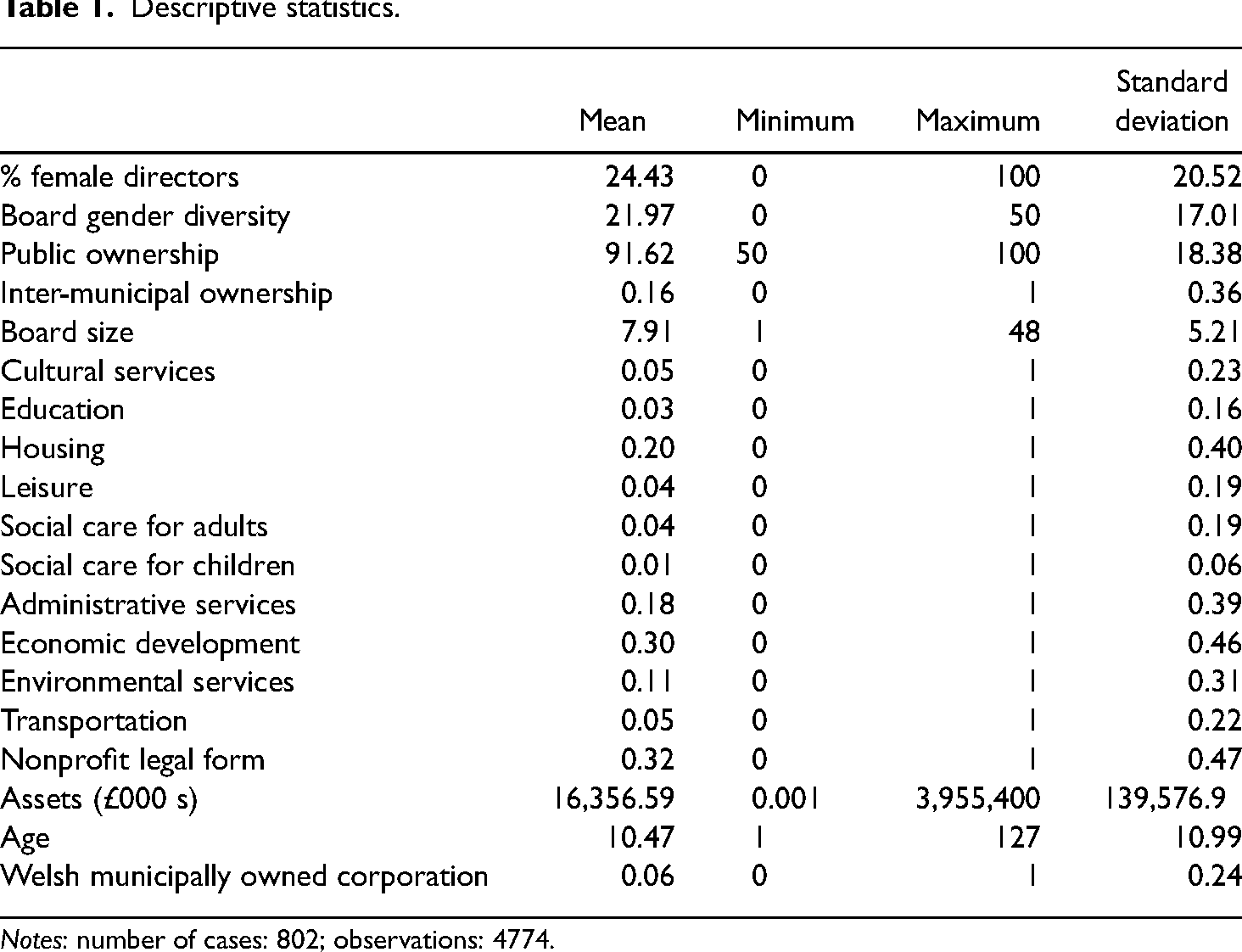
Descriptive statistics for the dependent and independent variables are shown in Table 1. During the study period the mean level of female representation on MOC boards of directors was 24.43%, with the mean board gender diversity being 21.97. Gender representation on English and Welsh MOC boards is therefore lower than that for the boards of large publicly-listed Financial Times Stock Exchange companies operating in the United Kingdom private sector (Financial Times Stock Exchange Women Leaders, 2023). The large standard deviations for these indicators highlight that they vary considerably across MOCs. Indeed, in many cases women were entirely absent from boards of directors, while in a small number of cases they made up the whole board.
Descriptive statistics.
Notes: number of cases: 802; observations: 4774.
The MOCs in the sample are medium-sized organizations holding around £16 million of assets and are, on average, about ten years old. Levels of public ownership are very high, averaging almost 92%, with most MOCs being owned by a single local government (84%). The mean number of directors on MOC boards is nearly eight. A sizeable minority of MOCs (32%) are nonprofit-making with few being Welsh (6%). Most of the MOCs in the sample provide technical services, especially economic development (30%) or administrative services (e.g., information technology, human resource management, legal) (18%), though many provide social housing services (20%).
Correlations
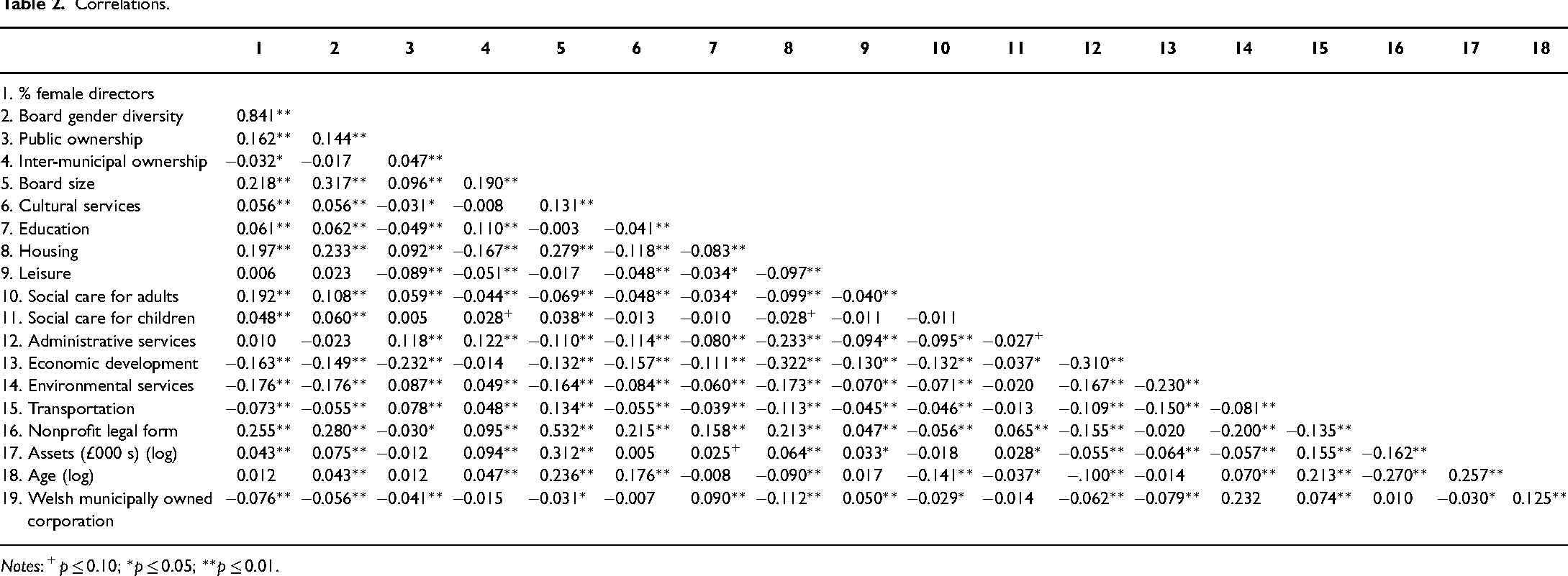
Correlations between the variables included in the statistical modelling are displayed in Table 2. The organizational size and age variables are logged prior to being included in the correlational and regression analysis to normalize their distribution. The table highlights a very high positive correlation between the two measures of board gender diversity, indicating that low female representation is responsible for relatively low levels of diversity on MOC boards. The many statistically significant correlations between the two diversity measures and the other variables are nearly all identical. Of particular interest are the large positive correlations between board size and nonprofit legal form and the board gender diversity measures.
Correlations.
Notes: + p ≤ 0.10; *p ≤ 0.05; **p ≤ 0.01.
Statistical results
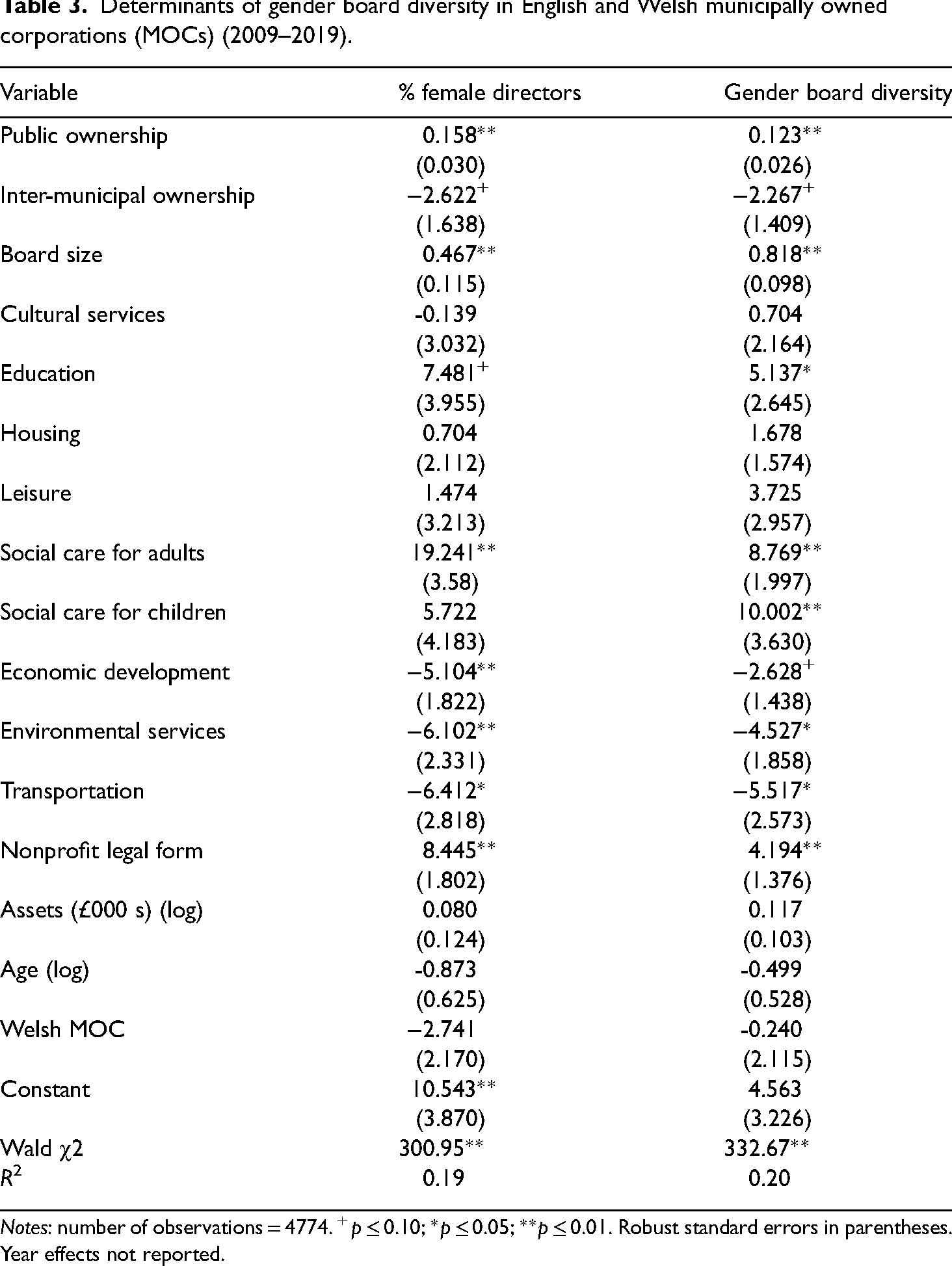
Table 3 presents random effects estimates for the regression models. The random effects estimator can accommodate theoretically important time-invariant independent variables (e.g., type of service provided). Hausman tests do not reject the null hypothesis of no misspecification when comparing random effects estimations with fixed effects estimates and Hausman–Taylor estimates of the statistical model, confirming their robustness. The second column of Table 3 shows the results when regressing the independent and control variables on to the percentage of female directors on MOC boards, with the third column showing the results when regressing the same variables on to the gender board diversity measure. The average variance inflation factor score is 1.81, so multicollinearity is unlikely to be a problem. Dummy variables for each year of the analysis minus one control for the possible effects of idiosyncratic events within individual years.
Determinants of gender board diversity in English and Welsh municipally owned corporations (MOCs) (2009–2019).
Notes: number of observations = 4774. + p ≤ 0.10; *p ≤ 0.05; **p ≤ 0.01. Robust standard errors in parentheses. Year effects not reported.
Beginning with the control variables, the results reported in Table 3 suggest that larger, older and Welsh MOCs are no more or less likely to have gender diverse boards than smaller, younger and English MOCs. Although these results suggest that some key organizational characteristics make little difference to MOC board gender diversity, the results for the hypothesis testing suggest that other organizational determinants really do matter.
The results shown in Table 3 provide strong support for the arguments about the connection between public ownership and the presence of women on MOC boards. The coefficient for public ownership is positive and statistically significant in both regression models. Substantive interpretation of that coefficient suggests that for a 10% increase in public ownership there would be a corresponding 1.58% increase in the percentage of female MOC directors. However, there is more modest support for the second hypothesis regarding the relationship between inter-municipal ownership and board gender diversity. The coefficient for inter-municipal ownership is negative, as expected, but it is only weakly significant. So, although substantively speaking during the study period inter-municipal corporations had on average 2.6% fewer female directors than single owner MOCs, this finding should be interpreted with some caution. Substitution of the measures capturing the number of municipal owners per MOC (logged) and ownership fragmentation revealed broadly similar findings (see Supplemental material).
The results suggest that the third hypothesis receives strong support. The coefficient for board size is positive and statistically significant. However, substantive interpretation of this coefficient suggests that for a one standard deviation increase in board size (i.e., about 5 directors) it is likely that there would be only a 2% increase in the percentage of women directors, pointing towards the slow rate at which female directors were added to MOC boards during the study period.
In terms of Hypothesis 4a, there is mixed support for the proposition that MOCs providing human services have more female directors, since only MOCs providing education or, especially, adult social care services appear to have higher board gender diversity. The coefficient for the latter type of service suggests that there are almost 20% more women directors on the boards of MOCs providing adult social care than the average board. That said, the estimates for the board diversity measure suggest that this effect may be a product of more women than men being on the board of adult social care MOCs, as the coefficient is half of the size in the second model than in the first. There is stronger support for Hypothesis 4b regarding technical services and an absence of female directors. The coefficients for economic development, environmental and transportation services all negative and statistically significant. In each case, substantive interpretation indicates that English and Welsh MOCs providing technical services had around 5% fewer women directors.
As well as confirming the salience of technical services for board gender diversity, the statistical results underline that nonprofit MOCs are likely to have more female directors, as posited in Hypothesis 5. The coefficient for nonprofit legal form is positive and statistically significant, with its size implying that there were around 8% more women directors on the boards of nonprofit than profit-making MOCs (approximately one more female director), though again the estimates for the board gender diversity model indicate that this may be partly explained by the presence of more women than men on such boards.
Discussion
Gender equality in the boardroom is one of the biggest societal challenges confronting governments across the globe (United Nations Women, 2022). Despite the ongoing corporatization of public services, analysis of gender diversity on the boards of the MOCs is only slowly emerging. The present research corroborates evidence from Germany that MOCs providing human services have more women directors (Papenfuß, 2023), though there is a more mixed picture of service-based variations in the Netherlands, where female MOC directors are fewer in number than Germany (and the United Kingdom) (Papenfuß et al., 2018). Drawing on ideas from RDT, the study also finds that board gender diversity is greater in MOCs with a higher level of public ownership, a larger number of directors and a nonprofit legal form. By contrast, board diversity is lower in MOCs that are owned by multiple local governments and have a profit-making form. These findings have important theoretical and practical implications.
The results confirm resource dependence arguments about the impact that linkages to key stakeholders associated with ownership structure, board size and female employment can have on female representation on corporate boards. The analysis underscores the important role that public ownership can play in requiring that organizations demonstrate their legitimacy to society and responsiveness to equality and diversity legislation by increasing female representation on their boards of directors (Mensi-Klarbach et al., 2021; Terjesen et al., 2009). At the same time, the negative relationship between board gender diversity and inter-municipal ownership underlines the challenges associated with partial absorption of the multiplexity of interdependency through inter-organizational collaboration (Hillman et al., 2009). The finding that larger boards have higher gender diversity mirrors resource dependency-based research from the private sector (Mateos de Cabo et al., 2012), while the observed variations between service type confirm the insights of Hillman et al. (2007) regarding organizational recognition of dependence on female employees. Likewise, the higher rate of female representation on nonprofit MOC boards affirms prior research identifying more women in the boardroom of nonprofit organizations than private firms (Claus et al., 2013). Survey-based research and detailed case studies would prove invaluable in revealing precisely how the dynamics of the interdependencies between MOC boards, their corporate parents, and key external and internal stakeholders influence the appointment of female directors.
The results of the study have important implications for policy-makers responsible for the corporatization of local public services. The public ownership finding highlights that closer control of MOCs may be necessary to meet GE aspirations. Aside from retaining a larger share of the ownership of MOCs, this could be achieved by adopting a nonprofit legal form when establishing a MOC. This, in turn, could encourage both a more feminist approach to management due to the larger share of female employment in nonprofit MOCs and capitalize on the distinctive public benefit orientation associated with nonprofit organizations. In addition, local policy-makers could stipulate that MOC boards are large enough to represent all relevant stakeholder groups, especially those with connections to gender-based issues. Finally, policies to increase the representation of women in the boardrooms (and front-line) of MOCs providing technical services may help to improve GE in the corporatized local state. Gender quotas, corporate governance codes and ‘comply or explain’ provisions could potentially help to attain these ends (Papenfuß et al., 2018).
The study offers useful insights into the organizational determinants of board gender diversity in MOCs, but has several limitations that subsequent studies could address. First, it would be invaluable to know more about whether the appointment of female directors is an effective strategy for reducing the impact of dependencies on GE outcomes more widely. Are decisions relating to GE issues within MOCs better-informed, perceived to be more legitimate and given greater support by internal and external stakeholders when there are more female directors on the board? Quantitative and qualitative research investigating the strategies that female MOC directors (and managers) utilize to actively represent women's interests when interacting with key stakeholders could illuminate how interdependence can potentially be leveraged to advance GE.
Second, in addition to understanding more about the board strategies adopted by female MOC directors, studies should investigate the extent to which female political and managerial leaders in the municipal parents of MOCs influence MOC board gender diversity. Likewise, research on the impact of alternative approaches to the governance of MOCs taken by local governments could help to pinpoint practices likely to improve GE in the boardroom of MOCs, and perhaps in private corporations as well. For example, although MOCs in England and Wales are not subject to gender board quotas, many MOCs in other countries, such as the Netherlands and Germany, have adopted mandatory quotas (Papenfuß et al. 2018), and other countries, such as Austria, voluntary gender board quotas have been adopted (Mensi-Klarbach et al., 2021) Comparative analysis of the determinants of the representation of women in the boardroom of MOCs across several countries with varying approaches to the management and governance of MOCs would therefore provide vital knowledge about GE in the evolving corporatized state.
Finally, future research should examine the determinants of diversity in relation to the presence of other historically under-represented groups in MOC boardrooms, such as ethnic minorities, people identifying as lesbian, gay, bisexual, transgender, intersex, queer/questioning asexual and many other terms (such as non-binary and pansexual) and people with registered disabilities.
Supplemental Material
sj-docx-1-ras-10.1177_00208523241264549 - Supplemental material for Board gender diversity in municipally owned corporations: A resource dependence perspective
Supplemental material, sj-docx-1-ras-10.1177_00208523241264549 for Board gender diversity in municipally owned corporations: A resource dependence perspective by Rhys Andrews in International Review of Administrative Sciences
Footnotes
Acknowledgement
The author acknowledges the helpful comments and suggestions from the reviewers of this article.
Declaration of conflicting interests
The author declared no potential conflicts of interest with respect to the research, authorship, and/or publication of this article.
Funding
The author received no financial support for the research, authorship, and/or publication of this article.

Supplemental material
Supplemental material for this article is available online.
References
Supplementary Material
Please find the following supplemental material available below.
For Open Access articles published under a Creative Commons License, all supplemental material carries the same license as the article it is associated with.
For non-Open Access articles published, all supplemental material carries a non-exclusive license, and permission requests for re-use of supplemental material or any part of supplemental material shall be sent directly to the copyright owner as specified in the copyright notice associated with the article.
