




Abstract
Two thematic areas have grown in significance in the contemporary scientific literature of public governance, public administration and public management over the past 20 to 30 years: the theory and practice of public value, and theorisation of the neo-Weberian state (NWS). In this paper, we argue that, while these two important thematic areas have so far developed in a mostly unconnected way from each other, they both might benefit from integrating each other's perspective into their theoretical frame, and we outline the contours of such a framework. We argue that the NWS and public value might theoretically be combined in three forms of integration of the respective perspectives: the integration of the NWS conceived of as model with an approach to public value conceived of as an addition of value through the actions by public managers; the NWS as an ideal type with public value conceived of as an addition of value through the actions by public managers; and the NWS as an ideal type with public value conceived of as a contribution to the public sphere. The NWS may benefit from integrating the public value perspective in order to develop some of its core components: how it compounds input legitimacy with output legitimacy, and how it integrates the managerial components into a narrative of managerial action for the public purpose. The perspective of public value may benefit from engaging into a dialogue with NWS, if it aspires to be a truly global paradigm for managing public services.
Points for practitioners
Public managers could and should pursue courses of action aimed at creating public value within the frame of NWS institutions and processes. The adoption of a public value perspective is compatible with an NWS framework and mutually beneficial. The development of the NWS in jurisdictions across the world is strengthened by the integration of the public value perspective, which can lead to matching output legitimacy and input legitimacy.
Introduction
Two thematic areas have grown in significance in the contemporary scientific literature of public governance, public administration and public management over the past 20 to 30 years: the theory and practice of public value (PV), also referred to as public value governance and management (Benington, 2011, 2015; Bryson et al., 2014; Hartley et al., 2017, 2019; Meynhardt, 2009, 2022; Moore, 1995, 2013; Torfing et al., 2020), and the theorisation of the neo-Weberian state (NWS) to analyse the reform of public management (Bouckaert, 2023; Pollitt and Bouckaert, 2004/2017). In this paper, we argue that, while these two important thematic areas have so far developed in mostly unconnected ways from each other, they both might benefit from integrating each other's perspective into their theoretical frame. Outlining a framework to integrate these two perspectives is the main goal of this paper.
Our starting point is as follows.
NWS and PV have been pitched at different conceptual levels: in fact, the NWS was initially conceptualised by the very authors who coined the term as a (descriptive) model; it was later argued that the NWS can also be seen as an ideal type (Bouckaert, 2023), while PV as a theory and a practice has been qualified as a (quasi-)paradigm in public management (Torfing et al., 2020). (We elaborate on the notions of ‘model’, ‘ideal type’ and ‘quasi-paradigm’ – which has also been applied to the NWS – later in this paper.) NWS and PV have been initially ‘discovered’ and wrought out in different jurisdictions, meaning both the jurisdiction of initial empirical detection (i.e. the empirics to which such frameworks have been applied to ‘make sense’ of the transformations occurring in such jurisdictions) and in terms of the academic context within which they came to be theorised: Mark Moore theorised PV by looking at mostly Anglo-Saxon, specifically American, public services settings, most famously the hypothetical case of the town librarian outlined in chapter 1 of Moore's book (Moore, 1995: pp13ff), inspired by a discussion had by the author in Belmont, MA, USA. Both earlier and more recent stock-taking exercises on PV have looked mostly at Anglo-Saxon jurisdictions (Alford and O’Flynn, 2009; O’Flynn, 2021), while Pollitt and Bouckaert ‘detected’ a pattern of reforms and wrought out the outline of the NWS to characterise the trajectory of public management reforms in primarily continental European states. In short, the NWS (model and then ideal type) originated in continental Europe, whereas the PV ‘paradigm’ was conceived and elaborated in primarily an Anglo-Saxon and Anglo-phone world. NWS and PV have been predicated on a different underlying legitimacy criterion: input legitimacy (that is, legitimacy based on due process) is the basic rationale for the NWS, whereas output legitimacy (that is, legitimacy based on results and outcomes) is the basic rationale for PV.
These two important thematic areas would benefit from integrating each other's perspective into their theoretical frame. The NWS might benefit from integrating the PV perspective in order to develop some of its core components, that is, how it compounds input legitimacy with output legitimacy, and how it integrates the managerial components into a narrative of managerial action for the public purpose. The PV perspective would benefit from engaging in a dialogue with the NWS, if it aspires to be a truly global paradigm for managing public services and for managing in the public service, in order to further work out its ‘scope of applicability’ in non-Anglo-Saxon, and notably in continental European, jurisdictions.
More specifically, we argue that NWS and PV might theoretically be combined in four ways, of which three forms of integration of the respective perspectives are meaningful. This paper explores these integrative paths. We elaborate on how to integrate the NWS, both conceived of as a model and as an ideal type, with an approach to PV conceived of as an addition of value through actions by public managers; and on how to integrate the NWS as an ideal type with PV conceived of as a contribution to the public sphere.
The remainder of this paper is structured as follows: first, the notions of model,’(quasi-)paradigm’ and ‘ideal type’ as used in this paper are introduced. The NWS and PV are then presented and discussed, paving the way for working out and discussing the proposed integrative framework in the two subsequent and final sections of the work.
Definitions: model, (quasi-)paradigm, ideal type
There are almost countless, and amply debated, definitions of the notions of model, ‘paradigm’ and ‘ideal type’. For the purposes of this paper, we adopt the following. First, a model can be defined as a selective reduction of reality in order to highlight key relations and connections for the purposes of understanding and highlighting key causal relations as well as for guiding action (Ongaro, 2020: 249; Raadschelders, 2020: 61). Models are ubiquitous in the study of public administration and are used to provide descriptions, explanations and interpretations of a variety of administrative phenomena.
As to the notion of paradigm, this is usually pitched at a higher level than a model: in the well-known definition introduced by Kuhn (1962), a scientific paradigm can be defined as a coherent pattern of core ideas and premises (assumptions or hypotheses) that informs a programme of scientific inquiry; paradigms may be in competition, and it may happen that one paradigm becomes dominant in a discipline at a given time, to then be displaced and replaced by one or more alternative paradigms at a later time. In a slightly different interpretation and usage of the term, more common in the field of public administration (for a review of the term with specific reference to the field of public administration, see Riccucci, 2010), the notion of paradigm may also take a normative and prescriptive thrust, with a paradigm being defined as a set of core tenets about how to organise the public sector. Authors like Jacob Torfing and colleagues use the notion of paradigm to work out what they refer to as the contemporary ‘public governance paradigms’, in their review encompassing both PV management and the NWS, alongside other approaches including the New Public Management, the New Public Governance, and Digital Era Governance (Torfing et al., 2020; see also O’Flynn, 2007, who initially introduced the notion of PV as a ‘paradigm’ in the public management debate). In a more specific and nuanced way, Torfing and colleagues refer to public governance paradigms as ‘quasi-paradigms’: like paradigms à la Kuhn, they retain the property of having a core of propositions, and then a set of declensions of these core propositions can be made to flesh out the implications drawn from the core tenets; in contrast to the Kuhnian interpretation of paradigms, they have a rather normative and prescriptive thrust: they are geared to tackling extant and pressing public affairs problems. Specifically, they are defined as ‘relatively coherent and comprehensive norms and ideas about how to govern, organize and lead the public administration [which] may be formed through an eclectic combination of ideas from different intellectual strands, but these ideas are re-articulated and integrated within a relatively coherent storyline that typically provides a diagnosis of current problems and challenges and a strategy for solving them’ (Torfing et al., 2020: 2). According to the authors, these quasi-paradigms: [are not] paradigms in the Kuhnian sense of the term. However, we agree with Dunleavy and Margetts (2013) that public governance paradigms behave like ordinary paradigms in two important respects. First, they tend to have two levels, with an overall macro-level theory based on a few propositions that pull together and give direction to a wider range of supplementary concepts, detailed recommendations and preferred methods. Second, they develop in response to the problems of their predecessor, enter a period of relatively successful ‘normal governance’ and are problematized by the accumulation of problems to which they cannot provide an appropriate response. These resemblances to Kuhnian-type scientific paradigms serve to justify the notion of public governance paradigms (Torfing et al., 2020: 10).
Finally, the notion of ‘ideal type’ (also famously associated with the work of Max Weber), like the notion of ‘Weberian state’, can be delineated as follows: It [the ideal type] is not a description of reality but it aims to give unambiguous means of expression to such a description … An ideal-type is formed by the one-sided accentuation of one or more points of view and by the synthesis of a great many diffuse, discrete, more or less present and occasionally absent concrete individual phenomena, which are arranged according to those one-sidedly emphasized viewpoints into a unified analytical construct (Gedankenbild). In its conceptual purity, this mental construct (Gedankenbild) cannot be found empirically anywhere in reality (Weber, 1949: 90).
We now explore their applicability for the purpose of integrating the theoretical perspective of the NWS (defined as both a model and an ideal type by the authors who devised the notion) and the theory of PV: variously defined as a theory, a practice, and – especially relevant for the purposes of this paper – a (quasi-) paradigm (Torfing et al., 2020).
In the treatment of the NWS developed in this paper for the purposes of integrating the NWS with PV, we align with the authors who coined the notion of NWS (Christopher Pollitt and Geert Bouckaert) and consequently treat the NWS as a model and as an ideal type, while recognising the NWS can also be seen as a quasi-paradigm as per the definition outlined by Torfing and colleagues. The way in which we have proceeded in integrating these two perspectives is by inserting (‘grafting’) the PV perspective into the NWS. The rationale for proceeding this way lies in the consideration that the NWS is a ‘conception of the state’, pitched at the macro-level of the configuration of the public sector, while PV is focused more on the micro-level of the agential action undertaken within public service settings by public managers. These perspectives are described in the next two sections.
The neo-Weberian state
While the term itself has a longer history (Lynn, 2008), the notion of the NWS as widely debated in contemporary public administration discourse was introduced by Christopher Pollitt and Geert Bouckaert of their highly cited book Public Management Reform: A Comparative Analysis (Pollitt and Bouckaert, 2004/2017). The term has since been widely picked up in debates on the trajectories of reform of public management in a range of countries, especially continental European (see the special issue in the NISPAcee journal ‘A Distinctive European Model: The Neo-Weberian State’, reviewing the extent of applicability of the notion in central eastern European jurisdictions; Ongaro (2009: chapter 7), which discusses the extent to which the trajectories of reform of public management in France, Greece, Italy, Portugal and Spain can be read through the lens of the NWS; on the development of the NWS in Italy, see also Ongaro et al. (2016); and for consideration of the extent to which the very administration of the European Commission can be characterised as being neo-Weberian, see Ongaro, 2015; also Drechsler, 2009). More of recent, attempts at characterising trajectories of reform in jurisdictions beyond Europe according to the NWS have also been developed (see Ramos and Milanesi, 2020, on the Uruguayan administration; Shimada, 2023, on the Japanese civil service; and Tahib, 2023, on the Malaysian administrative system).
The debate has also shifted theoretically. Initially, the NWS has been characterised – most notably by the very scholars who coined the term for the contemporary PA debate – as a model suitable for describing trajectories of reform of public management in a range of jurisdictions. Later, Bouckaert has characterised the NWS as – also –an ideal type, referring explicitly to Weber's conceptualisation of the notion (Bouckaert, 2023; Drechsler, 2023). In this shift, the NWS has also taken a more prescriptive stance, becoming one of the normative reform models extant in public administration and management, whose substantive strength lies, according to Bouckaert (2023), in its capacity to ensure the three core functions of a ‘whole of government’ strategy within a ‘whole of society’ context: inclusive and equitable service delivery, crises-resilient governance, and effective innovation for government and society. In this shift, the NWS has also taken on a stronger emphasis on forms of output legitimacy, that is, based on ‘outcomes and results’, while the initial characterisation emphasised input legitimacy via a reaffirmation of the Weberian elements of a bureaucracy (Du Gay, 2000, and subsequent works), a key feature of the characterisation of the NWS.
As to the substantive contents of the NWS, Pollitt and Bouckaert (2017: 121–124) argue that the NWS is characterised by a combination of ‘Weberian’ elements and ‘neo’ elements that are more managerial in nature. The Weberian elements include a reaffirmation of a) the role of the state as the main facilitator of solutions to the new problems posed by globalisation, demographic trends, environmental threat, and technological change; b) the role of representative democracy (central, regional and local) as the legitimating element within the state apparatus; c) the role of administrative law, suitably modernised, in preserving principles pertaining to the state–citizen relationship (including equality before the law, legal security and the availability of specialised legal scrutiny of state actions); as well as d) the idea of a distinctive status, culture and (to some extent) terms and conditions of the public service. The neo elements include a) the shift from an internal orientation towards bureaucratic rules to an external orientation towards meeting citizens’ needs (on this point the authors further argue that the primary route to achieving this is not the employment of market mechanisms, but the creation of a professional culture of quality and service); b) the supplementation (not replacement) of the role of representative democracy by a range of devices for consultation with the direct representation of citizens’ views; c) a modernisation of the relevant laws, in the management of resources within government, to encourage a greater orientation toward the achievement of results rather than merely the following of correct procedures – this being expressed partly at least in a shift in the balance from ex ante to ex post controls, but without a complete abandonment of the former; such a shift may also take the form of a degree of performance management; and d) a professionalisation of the civil service, so that ‘bureaucrats’ become not simply experts in the law relevant to their sphere of activity, but also get closer to professional managers, oriented toward meeting the needs of their users – knowledge of the law in the relevant area is only one of a broader range of skills required of a public official.
As a model, the NWS can be interpreted as a territorially specific form of governance representing a political response to global pressures, the main goal of which is preserving the European social model (a response addressed to citizens that has higher expectations than in the past with regard to the quality of public services as well as the amount they are prepared to pay for financing those services, while they want to preserve the kind of social insurances that exist in continental ‘big government’ European countries). As an ideal type it may become a yardstick against which to gauge an actual administrative system, possibly also with the impetus of introducing change into the extant administrative system by using the NWS in a normative, prescriptive way, and in this sense serving the function of an end point, or – in the terminology of Pollitt and Bouckaert (2017) – as an omega of the trajectory of public management reform of a given jurisdiction.
Public value
Considered an emergent paradigm of public governance (Torfing et al., 2020: 105), PV has become a topic of intense debate and the PV literature nowadays interconnects with various streams of thinking, from transparency and accountability to collaborative governance and co-production, from co-creation to public innovation and innovation for public purpose (e.g. Bryson et al., 2014; Hartley et al., 2017; Kattel et al., 2022; Mazzucato, 2013; O’Flynn, 2021; Rønning et al., 2022; Torfing et al., 2021), and important developments include ongoing projects that connect PV (and the NWS) with under-researched areas in public administration like the influence of religious institutions (see the Templeton Foundation-funded project ‘Islamic PV’ based at the UCL Institute for Innovation and Public Purpose, spanning 2022–2025, which investigates indigenous institutions still operating across the Islamic world and their role in creating PV; see also Ongaro and Tantardini, 2023). Bryson et al. (2014), Hartley et al. (2017) and O’Flynn (2021) have provided summative assessments of the ongoing debates in PV research and practice, while Meynhardt (2009) has proposed a psychological needs-based elaboration of the notion of PV. Mark Moore introduced the notion: in his seminal work, he lays out a structure of practical reasoning to guide public managers (Moore, 1995: p1ff). PV from this perspective is seen as processes of value addition through actions undertaken in organisations or partnerships. The heuristic framework of the strategic triangle originally introduced by Moore (1995) aims to provide practical guidance to orient public managers in their courses of action.
In a later work, Moore proposed a range of ways to measure the creation of PV, notably via a ‘PV scorecard’ approach (Moore, 2013). From a different perspective but with complementary effects (in our view), Barry Bozeman has undertaken a very important endeavour to address the interconnected questions of measuring, or at least detecting and gauging, what the public is and what it wants or deems to be good for itself (Bozeman, 2007, 2019), by combining a variety of reproducible sources of evidence as a way of measuring this: sources including public policy goal and priorities declarations; legislation, rules and regulations; and opinion polls. The work by Bozeman (2007, 2019), in our interpretation, aims to integrate systems of public values (‘values’ in the plural) shaped by notions of common interest and common good and based in the constitution or human rights, into the definition and detection of measures of PV. Detecting public opinions – empirically derived citizens’ PVs – in an objective way is part and parcel of the thrust of this approach, as outlined by Bozeman (2019), whose stated objectives include (1) to provide and analyse empirical data on citizens’ specific views about what does and does not constitute a PV, (2) to distinguish between ‘contested’ and ‘consensus’ PVs; (3) to suggest some implications of citizens’ PV assessment in terms of their theoretical meaning; and (4) to compare expressed versus enacted PVs (Bozeman, 2019).
In sum, a major stream of research and inquiry seems to configure and substantiate the first approach to qualifying the theory and practice of PV, one that is centred around laying out a structure of practical reasoning to guide public managers in engaging in processes of PV addition through their agential action undertaken within public service settings, broadly intended (as we argue later in this paper, one such setting into which public managers engage in courses of action finalised to the creation of PV is the NWS), and supported by a range of tools and heuristics to detect PVs in a political community and gauge and measure the creation of PV. Authors like Torfing et al. (2020) seem to refer especially to this understanding of PV when they qualify ‘PV management’ as a quasi-paradigm (Torfing et al., 2020: 105–124).
Scholars like John Benington have provided another approach to PV, one that is inspired by the thoughts of the contemporary German philosopher Habermas, notably his writings on democracy and the public sphere (Habermas, 2006). According to this conception, answering the crucial question of ‘what is public value?’ is the outcome of a process of deliberation, by which ‘what constitutes value is established dialectically [thereby allowing] for contest, and for diversities of values and identities, within a negotiated understanding of what it means to be part of the wider “public” sphere, at that time and place’ (Benington, 2011: 43). Deliberation is premised on a democratic process, one in which contestation is not only allowed but of the essence, hence an understanding of PV as contested democratic practice (Benington, 2015).
A key notion in this line of argumentation is that of the public sphere. As applied to the development of the theory and practice of PV, the notion of public sphere may be understood as revolving around addressing the questions of ‘what does the public most value in this particular context?’ alongside the question of ‘what adds (the most) value to the public sphere?’. In order to define PV according to this perspective, Benington (2011: 43–45) addresses the three questions of (i) what is the public sphere? (ii) what is the public? and (iii) what is value? As to the first question, Benington adopts a notion of public sphere as the web of values, places, organizations, rules, knowledge and other cultural resources held in common by people through their everyday commitments and behaviors, and held in trust by government and public institutions. It is what provides society with some sense of belonging, meaning, purpose and continuity, and which enable people to thrive and strive amid uncertainty.
As to the notion of the ‘public’, it is seen as continuously created and constructed (we note that, in a similar line of argumentation, Hartley et al., 2019, deem it pivotal to refer to a plurality of publics and their interactions, and to the function that a public service and its leadership may perform in convening those publics and getting them to engage with each other, in order to understand what the public is in the theory and practice of PV). Finally, as regards the notion of value, Benington links PV chiefly to the notion of ‘use value’ (as distinguished from the other notions worked out the by economic theory of ‘exchange value’ and ‘labour value’). Use value is understood multi-dimensionally by articulating it in its economic value (adding value to the public realm through the generation of economic activity, enterprise and employment), social and cultural value (adding value to the public realm by contributing to social capital, social cohesion, social relationship, social meaning and cultural identity, individual and community wellbeing), political value (adding value to the public realm by stimulating and supporting democratic dialogue and active public participation and citizen engagement), and ecological value (adding value to the public realm by actively promoting sustainable development).
Taking stock so far, there seem therefore to be at least two main conceptions of PV, as Hartley and colleagues have summed up: one is the notion of PV as the addition of value through actions by public managers (broadly defined) in an organisational or partnership setting; the other is the notion of PV as contribution to the public sphere (see also Hartley et al., 2017: 671).
Can either or both approaches to PV be applied in an integrative way to the NWS? And if so, how might each of the two conceptions of PV delineated here be applied to the NWS? And what is the ‘added value’ (if the reader will pardon the pun) of integrating the perspective of PV with the NWS framework (and vice versa)? It is to these questions we now turn.
Integrating the perspectives
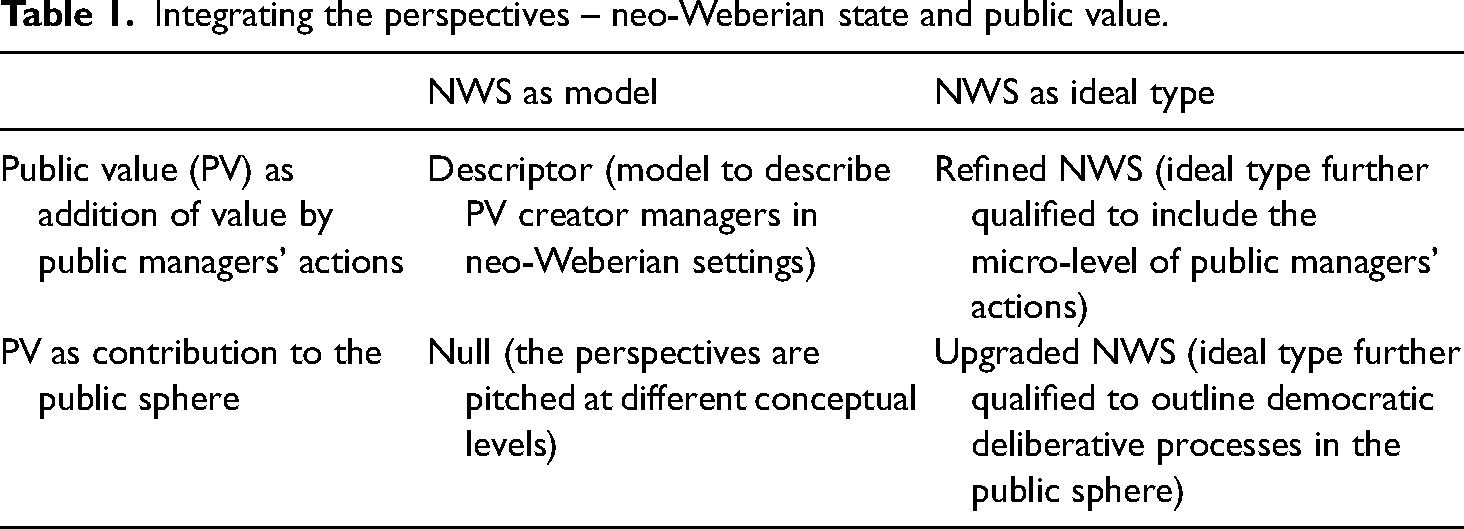
In revisiting and critically reviewing the notions of the NWS and of PV, we have identified two ways of conceptualising and understanding the NWS, one as a model, the other one as an ideal type, and two ways of conceiving of PV as a quasi-paradigm, one that sees PV as the addition of value through the actions by public managers in an organisational or partnership setting, the other that sees the notion of PV as contribution to the public sphere. We can therefore develop our analysis about whether and how the perspectives of the NWS and of PV might be integrated by articulating our analysis through a two-by-two conceptual matrix (illustrated in Table 1), which highlights four possible combinations as follows: (1) integrating the NWS as a model with PV conceived of as an addition of value through actions by public managers; (2) integrating the NWS as model with PV conceived of as contribution to the public sphere; (3) integrating the NWS as an ideal type with PV conceived of as an addition of value through actions by public managers; and (4) integrating the NWS as an ideal type with PV conceived of as a contribution to the public sphere. We now analyse these four conceptually possible combinations in turn.
Integrating the perspectives – neo-Weberian state and public value.
Integrating the NWS as model with public value conceived of as addition of value through actions by public managers (1)
The integration of these perspectives provides a sort of compound model: onto the framework of the NWS, the PV theory can be ‘grafted’ and the resulting composite model can represent a useful descriptor: a descriptive model apt to interpreting cases or other forms of evidence of instances in which ‘entrepreneurial public managers’ oriented to creating PV operate in ‘Weberian and managerialised’ administrative systems. This model seems to be suited to describing and possibly also explicating a number of ‘cases’ being studied and reported in the literature that illustrate the activity of public managers acting as creators of PV and operating in NWS environments: the many ‘public managers à la Moore’ that can be detected outside of Anglo-Saxon jurisdictions, who are enabled by the neo elements of the NWS to act as creators of PV, while also informing their agential action to – ‘complying with’ – the requirements of the fundamentally Weberian administration in which they operate (see Mejier and Boon, 2021; van Gestel and Grotenbreg, 2021).
Integrating the NWS as a model with public value conceived of as a contribution to the public sphere (2)
In our view, these two perspectives are, basically, not possible to integrate, because ultimately the two frameworks are pitched at different conceptual levels. The intersection of the two sets is null, it is an empty sub-set, if we may borrow the expression from mathematical terminology. In fact, the NWS as a model is a conceptual tool with a classificatory purpose, whose usefulness lies in providing an instrument to describe a range of administrative phenomena, notably the trajectories of reform of public management in a number of jurisdictions and the resulting configuration of these administrative systems. On the other hand, an understanding of PV as the outcome of a process of deliberation, by which what constitutes value is established dialectically (Benington, 2011: 43), pertains to another level, that of political communication in the broadest sense (Habermas, 2006), that is, the way in which the public discourse in a political community unfolds and constitutes the context into which agreements, or disagreements, come into being and enable processes of (democratic) deliberation to occur. Ultimately, the two notions evoked here are located at different conceptual levels and pertain to different objects, and for this reason they cannot be integrated (nor does it make particular sense to try to integrate them).
Integrating the NWS as an ideal type with public value conceived of as addition of value through actions by public managers (3)
The integration of these two perspectives provides a way to connect conceptually two notions that are located at, respectively, the macro-level (NWS) and the micro-level (PV). Integration of the perspectives delineated here produces, in a sense, the grafting of the micro-level framework of PV as a structure of practical reasoning to guide individual public managers in engaging in processes of PV addition through their agential action undertaken within public service settings, into the macro-level ideal-type of the NWS, which outlines an (ideal typical) configuration of an administrative system (the NWS is a mental construct that is located at the level of an administrative system as a whole, and in this sense it is a macro-level concept). Integrating the two perspectives entails amending the NWS ideal type by adding traits to the configuration, whereby the neo elements of the NWS come to be qualified as follows (the traits that are added to the initial definition of the NWS, provided by Pollitt and Bouckaert (2004, 2017) are highlighted in italics – the other elements of the NWS, not explicitly reported here, remain unaltered): a) the shift from an internal orientation towards bureaucratic rules to an external orientation towards meeting citizens’ needs actively pursued by entrepreneurial public managers oriented to the creation of public value; b) the supplementation (not replacement) of the role of representative democracy by a range of devices for consultation with the direct representation of citizens’ views, thereby including a range of tools and heuristics to detect the public values in the political community and gauge and measure the creation of public value; c) a modernisation of the relevant laws, in the management of resources within government, to encourage a greater orientation on the achievement of results rather than merely the following of correct procedure, thereby enabling or at least facilitating public managers’ value-creating entrepreneurship; d) a professionalisation of the civil service, so that bureaucrats become not simply experts in the law relevant to their sphere of activity, but also get closer to professional managers, oriented to meeting the needs of their users, where knowledge of the law in the relevant area is only one of a broader range of skills required of a public official, an integral part of which lies in laying out a structure of practical reasoning to enable and guide public managers to the creation of public value. In the integration of the NWS as an ideal type with PV conceived of as an addition of value through actions by public managers, the resultant is a further qualified NWS ideal type, in which PV as a (quasi-)paradigm ‘infuses’ the NWS and provides additions to it that ultimately produce a more nuanced and articulate ideal type of NWS.
Integrating the NWS as an ideal type with public value conceived of as a contribution to the public sphere (4)
The integration of these two perspectives provides – as in (3) – a refined elaboration of the NWS ideal type, the overall thrust of which is to compound an input kind of legitimacy of the administrative system with output legitimacy. This entails amending the NWS ideal type by adding the traits already delineated in (3). In addition to that, we further argue that Benington's take on PV provides an encompassing framework for understanding PV. Benington (2015) defines PV as a dialogical process, embedded in Habermas's vision of the public sphere in which competing interests are debated: here, PV, not a settled matter, is about creating ‘what the public values’ and ‘what enhances the public sphere’ (Benington, 2011: 31). In a way, Benington's insights on PV enable a performative understanding of values and valuing, shedding light on the dynamic processes within which PVs emerge and then consolidate in individual practices and collective performances in the public sphere. In this way, PV as a paradigm encompasses and provides the venue for the dynamic processes of the continual redefinition of PV – ‘what the public values’ and ‘what enhances the public sphere’ – that is, it provides the ideational narrative horizon within which the entrepreneurial action of public managers – as delineated in the integrated NWS ideal type – takes place. This integrative NWS ideal type is one in which the legitimacy that derives from the law (the core Weberian element) is compounded and further reinforced by the legitimacy that derives from the dynamics of the processes of continual redefinition of PV – of ‘what the public values’ and ‘what enhances the public sphere’. A form of input legitimacy (the one that derives from the law) and a form of output legitimacy (the one that derives from the deliberative process to attain a shared understanding of PV – albeit one that is always in flux and under redefinition via the same democratic deliberative process) get combined and mutually reinforced in this ‘upgraded’ version of ‘NWS plus PV paradigm’.
We summarise some of the findings of our speculative journey aimed at exploring how the theoretical perspectives of the NWS and PV can be integrated in Table 1.
Discussion and conclusion
This paper argues for integrating the perspectives of NWS and PV and outlines a framework for accomplishing such an integrative effort. The framework we propose enables the delineation of three approaches, each of which may facilitate further refinement with regard to how we analyse relevant administrative phenomena and processes. The first approach, ‘descriptor’, is a model for describing how public managers act in creating PV in neo-Weberian settings; this model enables expansion of the remit of PV as a quasi-paradigm to a range of jurisdictions where it was not initially theorised, detected or applied, thereby complementing existing major approaches to PV as a (quasi-)paradigm. The framework by Torfing et al. (2020) provides a schema for empirical analyses – notably by delineating the emphasis that PV management gives to societal involvement and to the explicit use of value articulation by public managers. However, it does not (at least directly) engage with the issue of how public managers’ agential action emphasising societal involvement and explicit articulation of PV ‘fits into’ the requirements of the Weberian administration, that is, where PV is applied in contexts outside Anglo-American ones, where such an approach has so far, for the most part, been both empirically detected and theorised. The proposed descriptor approach may support studying agential action in neo-Weberian contexts (see, for example, the case of mayors interacting with citizens and local administrators for co-creating PV in a neo-Weberian context like Italy, reported in Sancino et al., 2023).
The second approach, ‘refined NWS’, provides an ideal type, which is further qualified to include the micro-level of public managers’ actions. It can therefore complement existing studies by enabling the application of the NWS as a yardstick against which to gauge empirical phenomena (for example, the extent to which the trajectory of public management reform of a given jurisdiction can be patterned as being neo-Weberian) by also encompassing the more micro-level aspect of managerial agency, alongside the macro-level of the reconfiguration of the public sector as a whole, thereby complementing mainstream research on the NWS with this specific focus (Drechsler and Kattel, 2008; Pollitt and Bouckaert, 2017).
The third approach – ‘upgraded NWS’ – furnishes a qualified version of the NWS ideal type, which may enable the bridging of this ideal type with ongoing debates about (deliberative) democracy and the public sphere, thereby contributing to bridging the NWS and the PV debates with major intellectual debates about the conceptualisation of the public sphere.
The integrative perspective proposed in this article may expand the repertoire of conceptual tools through which it may be possible to analyse government and public administration conceived of as at the service of society – a democratic government and administration in (and for) society (not above society, as has been the case for most of the history of humankind, as aptly noted by Raadschelders, 2020). The refined and finessed model and ideal type of the NWS integrated with the perspective of PV may provide adequate lenses for the interpretation of transformative change in government and public administration from a democratic standpoint.
Footnotes
Declaration of conflicting interests
The author declared no potential conflicts of interest with respect to the research, authorship, and/or publication of this article.
Funding
The author received no financial support for the research, authorship, and/or publication of this article.
