



Abstract
Employee performance has been a critical theme which has received global attention in the mainstream literature of public sector governance. In developing countries, the need for employee performance is backed up by public dismay on declining public sector performance. Some of the causes attributed to low performance are the meagre resources allocated to the public sector and the existing formal rules and regulations which mould the behaviour of employees. So far, the existing informal social rules which also regulate the behaviour of employees have received little attention. This article is therefore set to explore the relationship between the formal institutional framework, the informal social rules and the availability of resources on one hand, and employee performance within Tanzania's maritime sector on the other. Accordingly, the study adopted a mixed approach with a case study of the Tanzania Port Authority in Dar es Salaam. To this end, a stratified simple random sampling technique was used to get a sample of 318 respondents for a questionnaire and a purposeful sampling technique was used to get a sample of 30 respondents for in-depth interviews. Quantitative data were analysed through descriptive statistics of employee performance variables and interviews were analysed through a thematic approach to get in-depth information concerning the influence of formal and informal institutions and resources on employee performance. The study found that employees’ performance behaviour at Dar es Salaam port authority is regulated by formal system such as the Open Performance Review and Appraisal System and informal channels of communication. The formal rules define the targets to be reached by each employee but the informal social rules and the resources provide the conditions to achieve the predetermined target.
Points for practitioners
Public managers should be aware that employee performance in the public sector is a function not only of formal rules and regulations in place but also of the availability of resources and the informal social rules which set the conditions and influence the way public officials perform their daily duties and responsibilities in the public office.
Introduction
Most organizations across the globe have recognized the importance of employee performance and the role that it plays in organizational productivity. This is because employee performance places more emphasis on employees to fulfil their required duties towards the realization of organizational goals. Despite this recognition, in recent years many countries have experienced a decline in employee performance which has raised a global concern for organizational productivity (Sarangi and Shah, 2015; Tchapchet et al., 2014). This concern has drawn the attention of many researchers in different parts of the world with a varying degree and causes. In Asian countries, for example, there is a growing drastic decline in employee performance in the public sector associated with poor governance conditions which bear on disincentives for employee performance (Sarangi and Shah, 2015). The situation is even worse in Africa, where the declining employee performance is attributed to the existing corruption associated with a lack of transparency, accountability and the unlimited powers of government officials (Arinanye, 2015; Bana, 2009). Another factor attributed to declining employee performance in Africa is the limited budget allocated to public sector agencies. As a result, the limited budget constrains employee promotions, and payments of incentives and bonuses, which consequently bears on their de-motivations and poor performance (Arinanye, 2015). Apart from that, in some African countries, poor employee performance is attributed to employee job dissatisfaction which results in frequent riots and strikes over poor working conditions and remunerations (Arinanye, 2015; Tchapchet et al., 2014). The Tanzania experience concerning employee performance is more or less similar to that of other countries across the globe. For example, the Tanzanian government adopted public sector reforms with performance management as the core component of the reform. The reforms aimed at improving employees’ performance through increased efficiency and effectiveness in public service delivery (Lufunyo, 2013). Following that, the reforms were implemented across all government ministries and agencies (Bana, 2009; Homayounizadpanah and Baqerrkord, 2012). Accordingly, performance management systems were developed and designed to implement, evaluate and report on employee performance. In addition, several processes, tools and mechanisms were introduced to facilitate the institutionalization process of performance management systems and improve the performance of public servants (Bana, 2009; Lufunyo, 2013). Despite these efforts, the performance of the public sector and civil servants is still low. Some of the indicators for low performance are poor working morale among employees, absenteeism, job dissatisfaction among workers and a lack of motivation among public servants (Kandula, 2006). In addition, unfair evaluation and feedback for the employees through the Open Performance Review and Appraisal System (OPRAS) have been discouraging to employees, making them feel insecure about their jobs and hence lowering their performance (Gupta and Upadhyay, 2012; Mone, 2010). Like other public institutions, the TPA in Dar es Salaam was established in 2004 to develop, manage, operate and promote the port sector in Tanzania. It also operates as a system of ports serving the Tanzania hinterland and landlocked countries of Malawi, Zambia and the Democratic Republic of the Congo, Burundi, Rwanda and Uganda. In recent years, the port authority has been accused of poor performance by its employees. For example, in 2015 the president dissolved the board of the TPA and sacked the permanent secretary of the transport ministry due to the poor performance of employees (Mfuko, 2015; Xinhua, 2021). This raises a question worth investigation: what is the state of employee performance at the TPA and how do formal rules and informal social rules together with resources influence that performance?
Theoretical premise
The theoretical promise of this article is based on goal-setting theory for employee performance. The goal-setting theory is based on the assumption that the prior determination of goals serves as performance stimuli for employees in an organization. Therefore, the absence of a prior determination of goals creates ambiguous and challenging goals for both employees and the organization (Latham and Locke, 2006). Furthermore, the goal setting normally forecasts the preconditions for goal attainment and stimulates an employee's job performance (Yortkoru, 2017). Therefore, the theory provides four conditions for employees' performance: firstly, goals draw and direct attention to priorities; in this case, when specific goals are set out by the organization to the workers, they normally draw their attention to priorities of achieving the goals. Secondly, goals stimulate efforts; the organization usually sets out goals and attaches them to a specific rewarding system that stimulates employees’ working morale so that they work better and effectively. Thirdly, goals challenge people to utilize their skills and knowledge to the maximum and increase their chances of success. Fourthly, the more challenging the goal, the more people will draw on and utilize their full range of knowledge and skills (Jung, 2011; Latham and Locke, 2006). Nevertheless, for employees to achieve their goals they must have a good working environment, and the rules governing the implementation of the goals set must be well enforced and adequate resources must be available. For example, the organization must provide rules and guidelines for performance evaluation and the provision of performance feedback to employees for future performance improvement. The assumption here is that if institutions guide employees to receive feedback frequently, they become more aware of the difference between their actual performance and the expected performance and hence are helped to improve their performance (Arinanye, 2015). This can be through taking corrective measures to increase their performance to achieve the level of performance that is needed by their organization (Ikemefuna, 2012).
Therefore, for employees to achieve their goals, there must be clear formal rules and regulations together with social norms and values which define the constraints and opportunities for employees to realize their goals. To be more precise, formal institutions set rules, policies and laws to which actors have to conform, whereas informal institutions provide social rules and norms which govern the behaviour of the employees in the organizations (Greve and Argote, 2015; Scott, 1987). In addition, the institutions set boundaries for the behaviour of employees. They define what is allowed or not allowed to be done in a particular context of the organization (Meyer and Rowan, 1977; Powell and DiMaggio, 1991). Therefore, the institutional theory emphasizes rules and norms which shape the behaviour of the employees in an organization. The underlying assumption is that complying with organizational rules, regulations, beliefs and norms decreases uncertainty and increases the intelligibility of the organization's actions and activities (Scott, 1987). These prepositions have been confirmed by empirical literature which shows that informal channels of communication, especially gossip chains and cluster chains, influence the performance of employees (Mushumbusi, 2020), but other studies have also confirmed that social networks and managerial interpersonal skills have a great influence on employee performance (Thao and Hwang, 2018).
Methodology
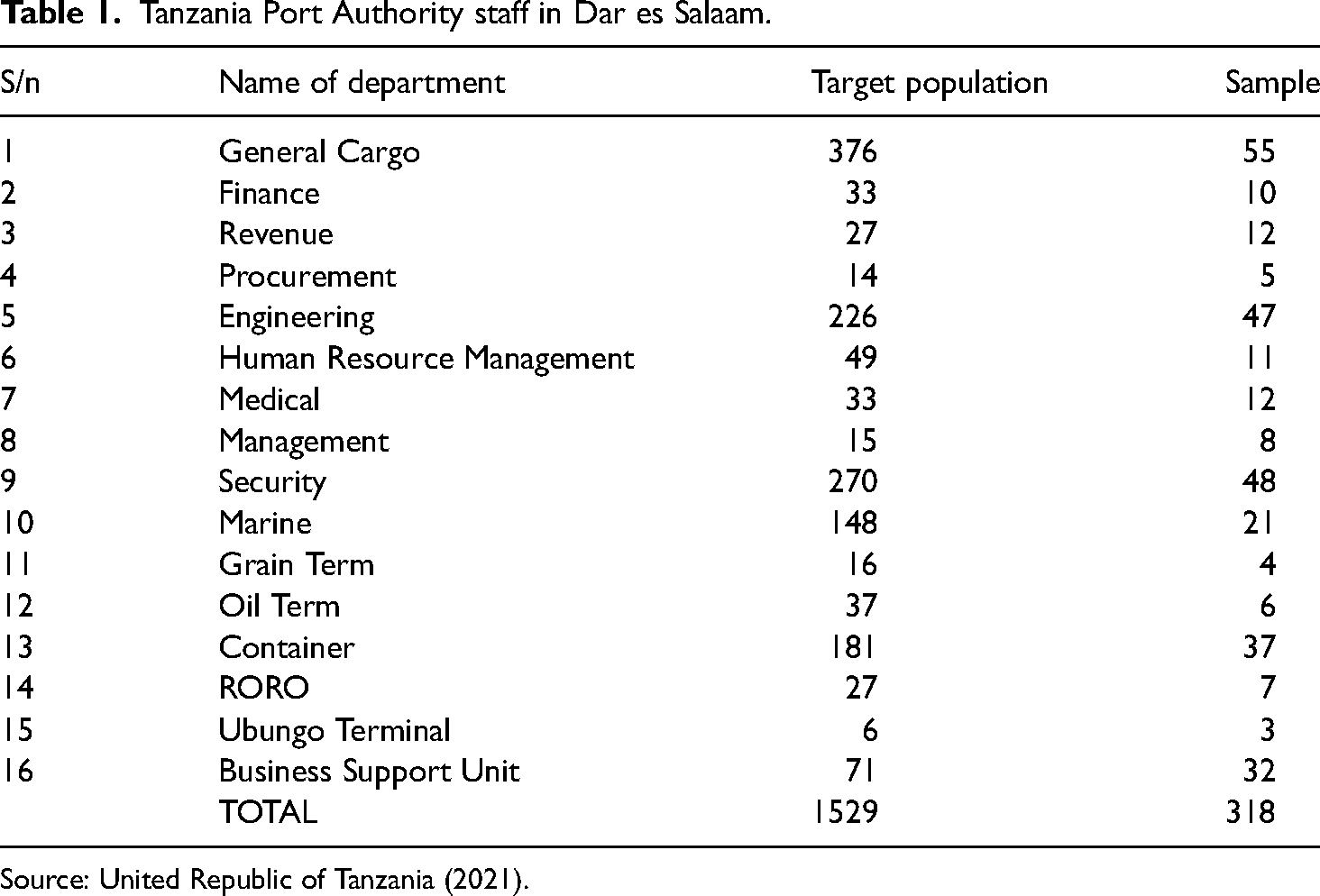
The methodology of this study was guided by the main research question which asks: what is the state of employee performance at the TPA and how do formal rules and informal social rules together with resources influence their performance? To answer this question, the mixed research methods approach with a case study design was adopted. The adoption of mixed methods was a result of the nature of the research question under investigation, of which the quantitative approach was used to generate descriptive statistics with regard to the state of employee performance at the TPA and the qualitative approach was adopted to generate in-depth data on the existing institutional framework at the port authority and its influence on employee performance. To this end, the research began with a quantitative part to generate descriptive statistics on the state of employee performance at Dar es Salaam port authority. This was followed by a qualitative approach to generate in-depth data on the process and the institutional context which have lead to the existing state of employee performance. On the other hand, the TPA in Dar es Salaam was selected as the case study based on the fact that the TPA was a public service institution which was subjected to reforms in the past 20 years, and to which new performance improvement measures were introduced. Despite all these efforts, the performance of employees is still low. Therefore, the study targeted the population of staff at the TPA in Dar es Salaam, which numbers 1529. These employees constitute 16 departments of the authority as indicated in Table 1.
Tanzania Port Authority staff in Dar es Salaam.
Source: United Republic of Tanzania (2021).
To select the respondents for questionnaires, the study employed a stratified non-proportionate sampling technique in which all the employees of the port authority were divided in their stratum and the sample was picked randomly from each stratum to ensure each stratum is represented in the sample. To this end, a sample of 318 which is equal to 21% of the population was drawn from all departments as shown in Table 1.
Furthermore, the study applied purposive sampling techniques to get the key informants for the interviews. To this end, all the heads of departments and units and their assistants at the TPA in Dar es Salaam formed the purposeful sample of the study which was 30 employees. These employees were selected because of their position in the authority and the fact that they are the key informants who could provide information about the different types of rules, regulations and guidelines and the resources which are disposed of and the way they influence employee performance at Dare es Salaam port authority.
Data collection methods
The actual data collection began with the review of important documents such as the corporate strategic plan, employees’ performance reports, the summary of quarterly and annual performance reviews, employees’ performance records and the mid-year and annual performance reviews. The completion of the documentary review was followed by a Likert-scale questionnaire. The questionnaire restricts the respondents to providing specific categories of answers in line with their attitudes towards their performance. The variables and indicators in the questionnaire focused on the academic qualifications and working experience of the employees, the extent to which TPA employees fulfil the required duties in relation to corporate strategic plan, the goal of the OPRAS, their involvement in the development of performance standards and the way they implement the OPRAS. A 5-point Likert scale was used and structured questions were ranked indicating the degree of employee performance. The completion of the questionnaire was followed by an in-depth interview with key informants to get their views and opinions concerning employee performance and the extent to which the guidelines, rules and regulations together with the availability of resources and the informal social rules and norms at the TPA in Dar es Salaam influence employees’ performance.
Data analysis
The data from the documentary review was analysed through step-by-step content analysis and the key themes were extracted from the objective of the study. On the other hand, quantitative data were analysed through descriptive statistical analysis and presented by graphs and percentages. With respect to interviews, a thematic approach was used to analyse the interview transcripts but also to distil the raw data from audio recordings and handwritten notes into easily understandable themes and sub-themes that match with research questions.
Study findings
Academic qualification of respondents
In order to get information about academic qualifications, the respondents were asked to indicate their educational background. The survey findings as indicated in Figure 1 show that 64.21% of the respondents had a degree, followed by 25.26% with a diploma, 7.89% with a certificate and 2.6% with a master’s degree. Generally, the findings indicate that most of the respondents (64.21%) had a degree followed by those with a diploma (25.26%) and certificates
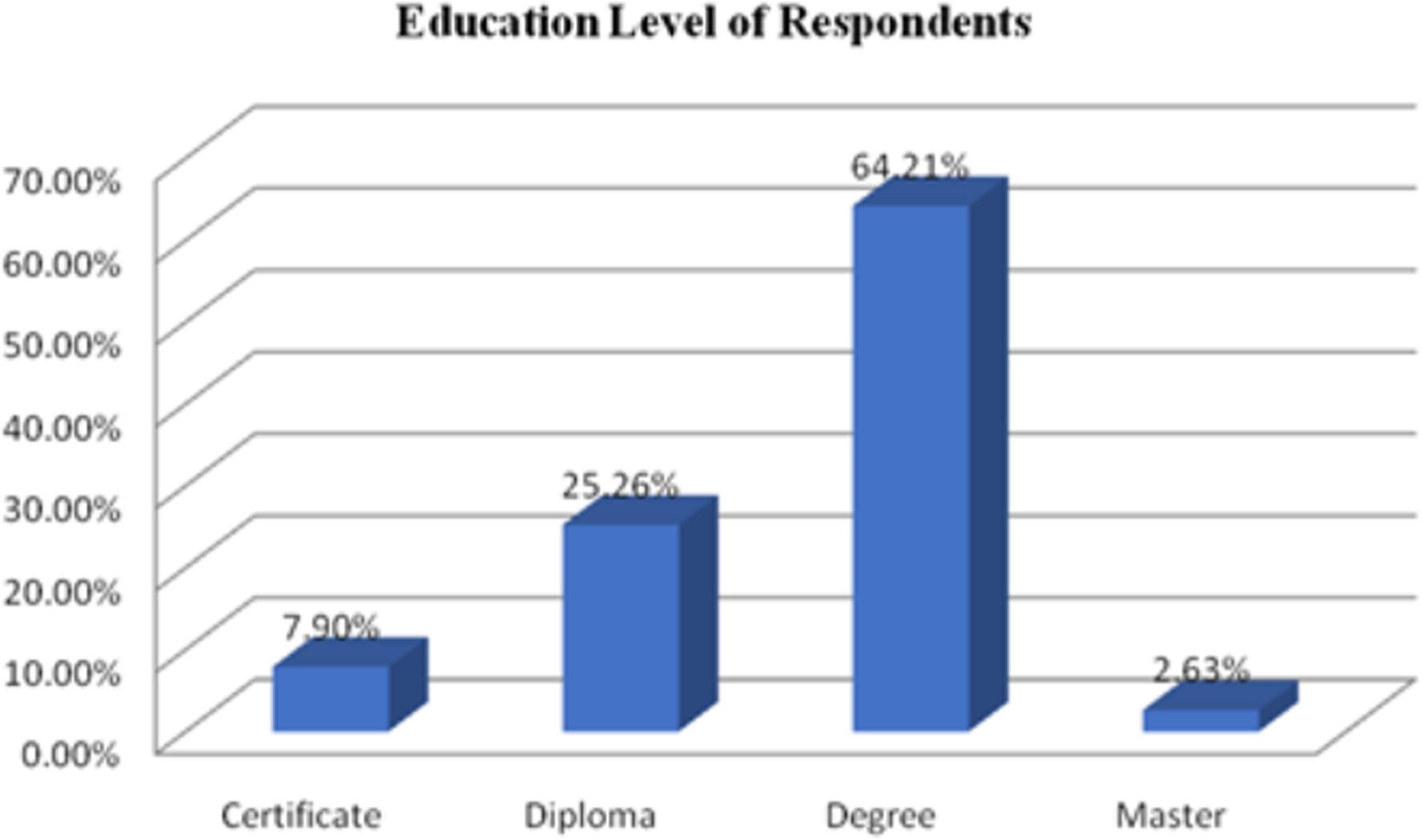
Education level of respondents.
Working experience of respondents
As for the working experience of respondents, the findings as indicated in Figure 2 show that most of the respondents (64.74%) had a working experience of 6–10 years, followed by those with 1–5 years (30.53%), 11–15 years (3.7%); finally, those below 1 year and 16–20 years in each group were represented by 0.526% of the respondents. It was noted from Figure 2 that most of the respondents had experience of more than six years, implying that most of the workers at the TPA had enough experience and hence they are expected to have a good performance level as they are familiar with their job.
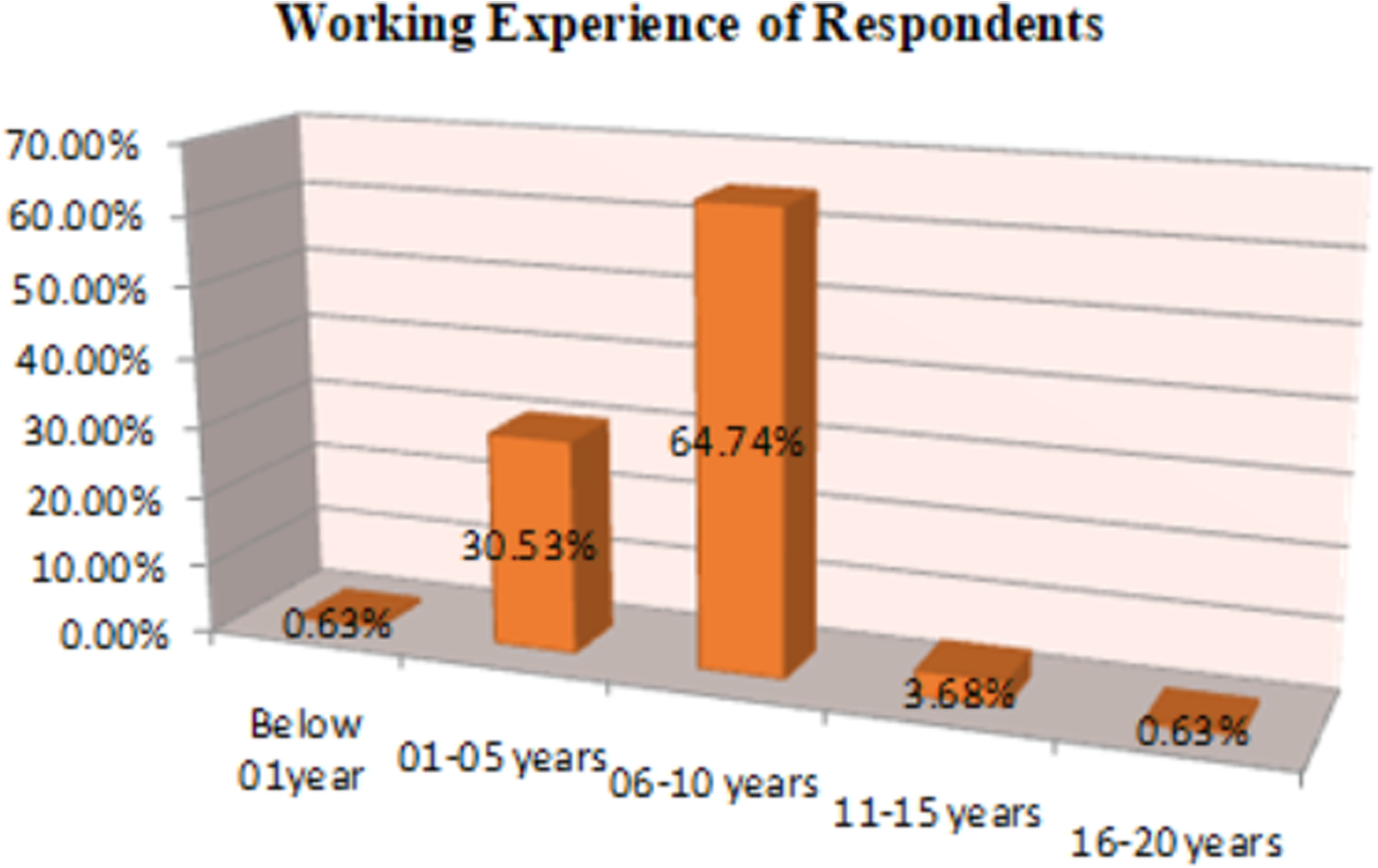
Working experience of respondents.
Corporate strategic plan and employee performance at Dar es Salaam port authority
As part of the TPA, Dar es Salaam port authority follows a five-year corporate strategic plan as a means of enhancing result-based management and efficiency in resource utilization. The plan charts the broad direction of the port authority and describes its vision, mission and core values. The vision of the current corporate strategic plan is to lead regional maritime trade and logistic services to excellence and its mission is to develop and manage ports that provide world-class maritime services and promote excelling total logistics services in Eastern, Central and Southern Africa, while the core values of the authority are to promote integrity, professionalism, teamwork, stakeholders focus, accountability and transparency.
One of the goals of the current corporate strategic plan of the TPA is to improve port infrastructure and services. The second goal is to enhance human and financial resources sustainability. The third goal is to increase traffic volume and transit cargo in ports. The fourth goal is to improve security, safety and environmental protections achievements and the final goal is to enhance and sustain effective implementation of national and anti-corruption strategy and to reduce HIV/AIDS infection among the employees.
The goals presented above are set for five years and a review of their implementation is done every five years. The goals are then cascaded to the director general and then down to the directors of departments and finally to managers, who cascade them to employees in their departments through the OPRAS. Therefore, the port authority’s five-year strategic plan goals are set for five years and the directors, with the support of their heads of department, cascade them to form an annual plan which is evaluated through quarterly reviews, mid-year reviews and annual reviews (United Republic of Tanzania (URT), 2021).
Like other public institutions in Tanzania, the TPA uses the OPRAS as a tool to assess the performance of its employees. As in other public institutions, the implementation of an open performance and review system at the port authority follows a series of interlinked processes that have roots in the annual planning process and end with feedback on the annual overall performance. Therefore, the port authority signs performance agreements with its employees every year which follow various steps: the first is the setting of individual annual performance targets; the second is that individual employees agree on the implementation of the agreed performance targets; the third is a mid-year review; finally, there is an annual performance review based on the agreed targets. Therefore, every year, these agreements are measured in three quarters; that is, after every three months (quarterly, mid-year review and annual review) within a year (URT, 2021).
The goal of performance appraisal at the TPA
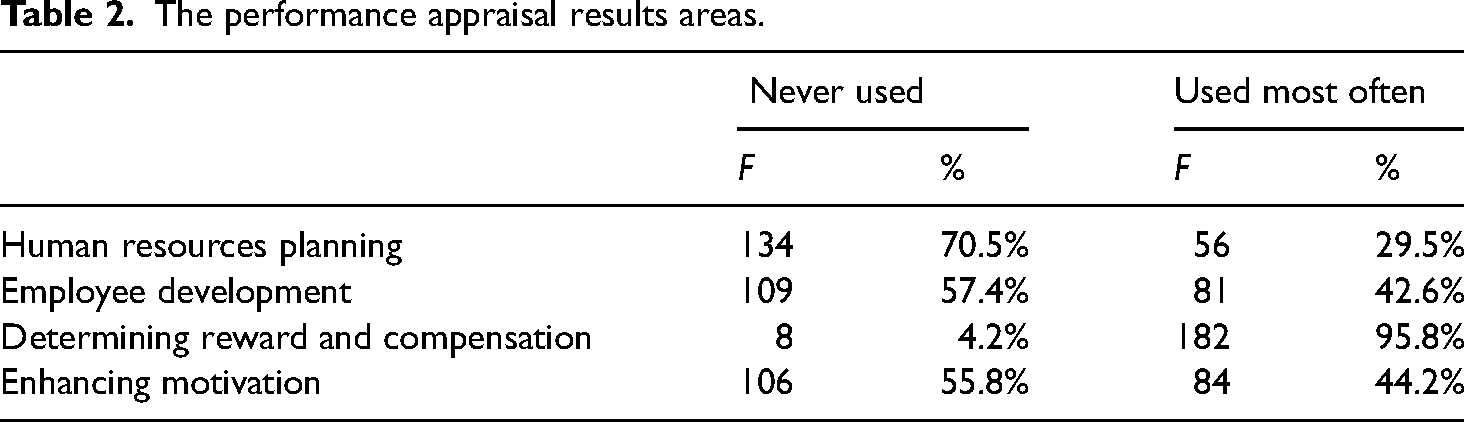
To understand the goal of performance appraisal at the TPA, the respondents were asked to identify the areas where the results of performance appraisal system are primarily used. To this end, the results indicate that the areas in which the results of performance appraisal system are primarily used at Dar Es Salaam port authority are the determination of rewards and compensation, as identified by the majority of respondent (95.8%). On the other hand, human resources planning is not an area where the results of performance appraisal are primarily used, as argued by a majority of respondents (70.5%); also, employee development is not an area where the results of performance appraisal are primarily used, as argued by a majority of respondents (57.4%), as listed in Table 2. Finally, enhancing motivation is not an area in which the performance appraisal results are primarily used, as argued by a majority of respondents (55.8%).
The performance appraisal results areas.
Employee involvement in the development of performance standards
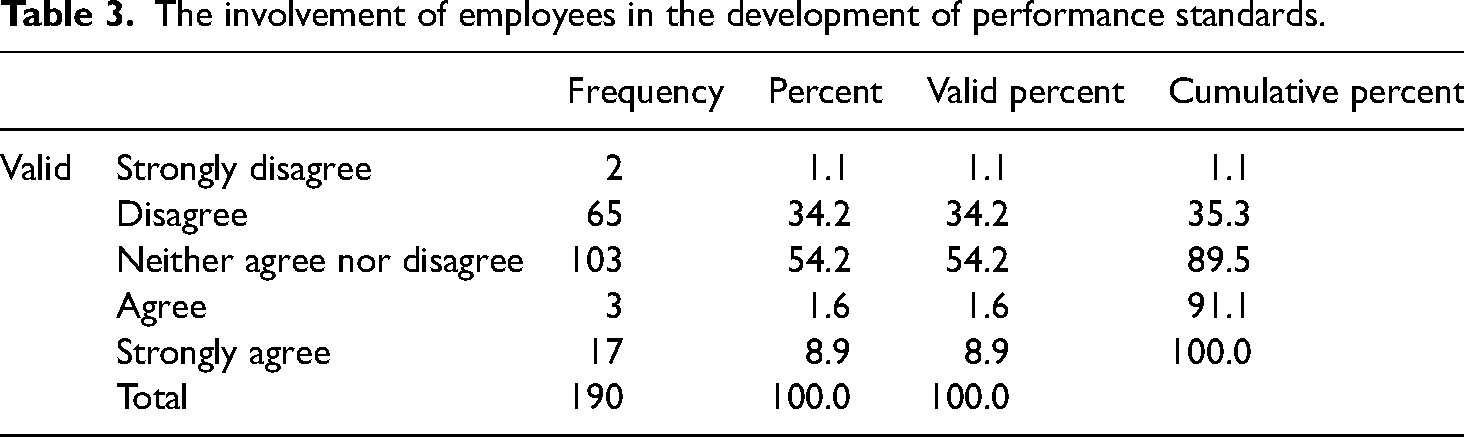
In order to gain more insights into the criteria used to gauge employee performance, the respondents were asked if the performance standards are carefully developed and if the respondents are involved in the development of the standards. The findings listed in Table 2 revealed that a majority of respondents, about 103 (54.2%), neither agreed nor disagreed, whereas 65 (34.2%) of respondents disagreed and 2 (1.1%) of respondents strongly disagreed. On the other hand, 3 (1.6%) and 17 (8.9%) of respondents agreed and strongly agreed correspondingly. This implies that the majority of respondents were unfamiliar with the performance standards at Dar Es Salaam port authority; however, 34.2% of respondents disagreed that performance standards are developed on the basis of employees’ performance. This indicates that most performance standards are not developed on the basis of employees’ opinions. That is why most of the employees at the port authority do not adhere to the performance standards
Discussion of the OPRAS
To get more insight into the implementation of the open performance review system, the respondents were asked whether they discuss the performance agreement with their supervisors before signing. The findings listed in Table 3 reveal that the majority of respondents, about 163 (85.8%), disagreed and 25 (13.2%) strongly disagreed, whereas only 2 (1.1%) agreed. This implies that TPA employees do not discuss the performance agreement with their supervisors, as one of the respondents reported: ‘The performance appraisal system at our department is not effective because there are a lot of weaknesses during the appraising time, for example workers are given assessment forms to fill themselves without their supervisors’ (interview with one respondent from the container department at Dar Es Salaam port authority, 21 June 2022).
The involvement of employees in the development of performance standards.
Also, the employees are not given feedback on their performance. The feedback is delayed and sometimes they do not receive feedback at all, as seen in this quotation from an interview with the head of the cargo department: ‘In most cases we are not given feedback, therefore for me the performance appraisal system is not [a] better system for measuring performance.’
Rules and regulations governing employee performance at the TPA
At the TPA, rules and regulations that govern employee performance are the Public Service Standing Orders of 2009, the Public Service Act of 2008, the Public Service Regulation of 2003, the TPA Staff Regulations of 2017 and the TPA Scheme of Services of 2020. These rules and regulations are normally used interchangeably at the TPA. All these guidelines are helpful for the performance of employees; for instance, the government issued a directive requiring all employers to use OPRAS as a performance appraisal system for its employees if they intend to measure the result of the employees as stipulated in public service regulation section 298 of (6)1(a), rule 22 (1) of 2003 and section D.62 of Public Service Standing Order of 2009.
As a general rule, the information obtained from the appraisal is supposed to be used for promotion, rewards or punishment and to prepare an organizational training plan. Also, the organizational scheme of service has defined the needs of employees to work at a higher level of efficiency, competence and integrity in the implementation of their duties. It has also been explained that performance information should be prepared regularly for all employees in accordance with the organization's guidelines and performance appraisal system. Furthermore, the TPA organization structure shows the duties and responsibilities of all employees. This fosters employee performance because it reminds an employee to perform according to the demands or requirements of the assigned tasks.
Existing norms and values for the performance of employees at the TPA
The findings shows that the evaluation process creates anxiety for the appraised employee. This may take the form of discontent, apathy and turnover. In a worst-case scenario, a lawsuit is filed based on real or perceived unfairness. Opportunities for promotion, better work assignments and increased compensation may hinge on the results. One opinion is that if you surveyed typical employees, they would tell you that performance appraisal is management's way of highlighting all the bad things they do all year.
The findings indicate that the TPA used the performance management review conducted with its employees to select the best workers from the department as well as at organizational levels. In terms of influencing performance among employees, those selected as the best workers are normally given rewards in terms of money and certificates of the best performance, and are granted visits to the internal national parks and game reserves or recreational centres as bonuses to motivate them. The situation makes employees refresh through tour visits in the national parks and recreational centers. In turn, the refreshment they obtained through visiting tourist attractions induce them to work hard and hence improving their performance. Therefore, organizations use this as a performance inducer for their employees because after enough time of resting they go back to their working place with the new rigour.
One of the respondents explained that favouritism and corruption are to a great extent omnipresent at the TPA during OPRAS, promotion and even on training programmes: The distribution of marks in OPRAS favours some people, and this also shows in the way of promoting employees, if you do not know the candidate you will spin until you stop or complain, but others just get promoted and this contributes a lot to employees not working with effort and knowledge in our organization.
Another social value and norm seen at the TPA involves supervisor negligence concerning OPRAS, as one senior security officer from the security department explained: Sometimes OPRAS becomes a problem for the employee and management due to the supervisor's negligence and carelessness in using OPRAS, as they say, Government spend a lot of money dealing with such poor thing like OPRAS, OPRAS encourages employees not to work hard.
Then, the supervisor's slackness on this tool of monitoring and measuring performance pertains to their failure to learn how to use it and become productive for the organization’s betterment.
Organizational resources and employee performance
The findings shows that the performance of employees at Dar es Salaam port authority depends on the presence of enough funds or budget, a compatible communication system (information resources) and enough material resources such as equipment or facilities. With regard to this, the TPA in Dar es Salaam is well resourced and its resources capacity facilitates the payment of salaries on time, the procurement of equipment, machine spare parts and maintenance, as stated in this quotation: ‘Our organization has the stable financial capability to pay salaries to our employees on time, buy new equipment and spare parts for machines maintenance and pay for other projects’ (interview with the director of the TPA).
The quotation from the director of finance and accounts at the TPA indicates that in terms of financial matters, the TPA has invested a lot to provide the necessary resources required for the performance of its staff. Therefore, the performance of workers is better at the TPA because the employees are paid their salaries on time, working equipment is bought and spare parts for repairing machines and other tools which are in good order are used to facilitates employees’ performance, as an information and communications technology (ICT) manager said: ‘[The] TPA uses information resources especially in carrying out its duties effectively, these systems are Enterprises Resources Planning System (ERP), Bills Systems, Cargo System, and Harbour View System and Port Operations Application System (POAS).’
The extract above indicates that the provision of salaries, equipments and the effective use of information improves employee performance. This implies that taking breakfast and lunch at the workplace serves time for work as it makes employees punctual to their work. Before the introduction of the meal programme at the TPA, most workers were spending hours taking breakfast and lunch from outside the workplace and as a result many jobs were not accomplished on time. Thus, after recognizing this, the organization decided to introduce a meal programme to its employees, which has produced a positive outcome on employee performance.
Another question was the extent to which a house rent given annually to an employee out of their salary has improved the performance of employees in the TPA. Provision of housing allowance to employees function as an incentive which induce employees to attend to work early and with required vigor and hence uplifting their performance to the required standards: Exactly house allowance has a great contribution to the performance of employee since it has reduced living expenses. The salary does not cover everything; therefore house allowance reduces a great burden for an employee on living expenses and motivate[s] them to work hard and improve their performance.
Also, one respondent from the operational department (senior operations officer) commented: Good and smooth operational infrastructure in TPA has increased the performance of employees, issues such as good roads within the port area, deep berths for mooring ships, attractive and full furnished offices, hospital for those who are sick/get the sick and more further presence of college called ‘Bandari college’ for skills and knowledge updating to employees.
Discussion of the findings
The research shows that a performance standard is one of the important tools for improving employee performance. Good work assessment of employees in their workplaces helps to improve their work performance and helps the organization to meet the organization's expectations. The TPA has various formal rules and regulations which govern the behaviour and conduct of employees, such as performance appraisal, promotion, rewards or training. This includes the scheme of service which defines the promotion ladder and the performance requirements. Apart from that, the TPA has performance management guidelines which regulate the performance appraisal of employees. To a larger extent, the formal rules including the guidelines for performance management are undermined by the existing informal rules. For example, the research shows that the existing institutions facilitate the allocation of financial resources for motivating employees to demonstrate good performance, but they also guide employee behaviour as they define what is allowed or not allowed at the TPA.
On the other hand, there are social norms and values which to a larger extent undermine the formal rules and regulations. This is proved by the research which shows that employees at the TPA have negative opinions concerning performance evaluation and that they consider the evaluation as the management's way of highlighting all the bad things they do. Although the TPA selects the best workers and rewards them with money or certificates of recognition, the employees consider the whole process to be engulfed by negative social rules such as favouritism and corruption through which some employees are favoured more than others, hence demoralizing them so that they perform less effectively. The social rule of favouritism is extended to the evaluation of employees through OPRAS. Because of this, some employees are evaluated negatively and are denied opportunities for training and promotion. Finally, it is the existing informal channels of communication, especially gossip chains and cluster chains, which influence employee performance. These findings are consistent with Armstrong (2015) who argued that the appraisal systems in many organizations are introduced to manage employee performance through directing and supporting workers to work effectively and efficiently with regard to organizational demands. But also, the performance appraisal on human resources planning as well as employee development has been the main source for improving the work performance of individuals and the team work within an organization. Nevertheless, the absence of clear standards to gauge employees’ performance and the existence of negative social rules such as corruption and favouritism can result in ambiguous measurement criteria which bear on subjectivity in the assessment of employee performance and hence affect the performance of employees. But there is also research by Magupa (2017), who argued that if an organization does not have well-set performance standards, this can provide a loophole for corruption and hence seriously constrain employee performance within the organization.
Another factor which is of no less importance is the availability of resources which comprise financial and human resources and information and material resources as well as managerial capabilities. The research shows that the TPA in Dar es Salaam has both tangible resources such as financial and human resources and intangible resources such as information resources which function as a base for employee performance at the TPA. These resources function as vital elements for employee performance at the TPA as they are used to induce employees to fulfil their responsibilities smoothly. This suggests that the performance of employees depends on the presence of both financial and material resources which are necessary for employee performance. The introduction of a meal programme, for example, facilitated the serving of breakfast and lunch to employees. Before the introduction of this programme at the TPA, most workers were spending few hours to work and could not accomplish their task on time and to the required standards. The introduction of the meal programmes to employees, especially the provision of breakfast and lunch, motivated employees to accomplish their work on time, hence improving their performance. Another resource factor was the provision of a housing allowance to employees which reduces their living expenses and motivates them to work hard and produce the standard work. These findings are consistent with the literature by Porter (1985), Barney (1991) and Shillinig (2018), which shows that organizational resources are the base of the organization's power and survival and that their effective use can improve employee performance; and also with the research by Latham and Locke (2008) which shows that pay and incentives in many organizations can be used as performance inducers.
Conclusion
The overall conclusion is that employee performance at the TPA in Dar es Salaam is moderate. The authority has developed a clear system of managing employee performance, which is the OPRAS. The goals of the appraisal system are cascaded from the five-year corporate strategic plan. Therefore, the OPRAS brainstorms the goals of the corporate strategic plan into specific departmental goals and functions from which the individual employees from different departments draw their performance targets. The implementation of OPRAS at the TPA follows different rules and guidelines, including human resources policy and performance management guidelines. Nevertheless, the strategic goals are not clear regarding the performance standards. Although there are guidelines and rules for performance evaluations and performance discussions, the actual performance review does not comply with the guidelines and standards. The managers and supervisors bend rules in the process of appraising performance and the provision of feedback to employees. The informal social rules and norms such as favourites guide the whole process of evaluations and hence constrain effective performance and provision of feedback to employees. Therefore, unfair evaluations discouraged some employees from working hard and made them feel insecure and oppressed, which leads to the low performance of those employees. The overall conclusion is that the existing institutional frameworks for employee performance at the TPA in Dar es Salaam provide a clear guide for performance management, but the existing negative social rules undermine the formal rules and also misdirect the allocation of organizational resources, which in the end constrains employee performance.
Recommendations
First of all, the government should the revisit the rules and guidelines for employee performance in the public service to ensure that the guidelines clearly define the performance target and standards for effective compliance. Second, the government should create effective reporting and control systems to make sure that supervisors and employees conduct the performance discussion before approving their OPRAS forms, particularly at the TPA. The culture of giving employees OPRAS forms to fill out themselves and return them to supervisors without discussion should be stopped because most of them over-grade themselves and their grades do not reflect the reality of their performance.
Third, the government should create a more transparent system and peer review of the allocation of public resources for performance improvement. This will facilitate an allocation of resources which is geared towards performance improvement.
Fourth, the government should introduce an ethics training programme in the public service to make sure that both supervisors and subordinates are aware of the required ethical conduct in the public service, especially with respect to performance standards and evaluation. This will help the government to reduce the existing unfair evaluations of some employees, and favouritism.
Finally, policymakers in the government should provide follow-up to evaluate how the OPRAS is carried out in the entire public service and revisit the existing weaknesses to address the problems of unfair evaluations, feedback system and the allocation of organizational resources to employees.
Areas for further research
More research in the same areas can be carried out in other public service institutions in Tanzania to establish how the combination of certain factors – formal rules, social rules and resources – facilitates or hinders employee performance in the public service, and their relative importance.
Footnotes
Declaration of conflicting interests
The author(s) declared no potential conflicts of interest with respect to the research, authorship and/or publication of this article.
Funding
The author(s) received no financial support for the research, authorship and/or publication of this article.

CORRECTION (August 2023):
There were some typos in the caption of Figure 1. Those typos have been corrected in the article.