




Abstract
The paper explores how members of parliament (MPs) address gender-related aspects in the budgeting process at the central level in Germany, a country that pursues gender equality as a global objective but has not implemented gender budgeting (GB) (yet). Nevertheless, from a budgeting perspective the German context is interesting, as parliament has unrestricted powers to amend the budget draft. The study follows approaches in performance management literature streams that have explored different types of performance information use. Building on a qualitative analysis of parliamentary budget debates, our results show that gender-related aspects matter in budgeting even when GB is not implemented. However, resources are less often referenced than programmes and policies in the budget debates. We find that MPs address gender-related aspects in a differentiated way (reflected in four types of performance information use), and that this is affected by user characteristics: the MPs’ gender, their party affiliation, committee membership and in some aspects, their age. While it may not come as a surprise that female MPs act as advocates for gender-related aspects, it is interesting that female MPs are more likely to reference resources when addressing gender-related aspects than male MPs. Further, our analysis of types of performance information use shows that a party's position as either a part of a governing coalition or opposition, as well as party lines across the opposition, affect the way in which gender-related aspects are addressed: exerting supportive use types (i.e., legitimizing, highlighting) and rather challenging use types (i.e., de-legitimizing, deflecting).
Even in a context where gender budgeting is not implemented, members of parliament (MPs) reference gender equality in budget debates.
The frequency and the way in which gender-related aspects are referenced mirrors MPs’ stance towards gender equality (rather supportive/rather challenging).
Female MPs are more likely than male MPs to draw attention to the allocation of resources for gender-related issues.
More female MPs in parliament may strengthen advocacy for gender-related aspects, particularly if budget documents do not contain gender-related performance goals.
Introduction
Since the early 2000s, multi-faceted approaches of performance budgeting have been adopted by governments worldwide and have therefore also played a major role in research on budgeting and accounting (Moynihan and Beazley, 2016). More broadly, performance budgeting refers to “the systematic use of performance information to inform budget decisions” (OECD, 2019a). As such, it changes the logic and internal processes in budgeting, building on wider performance-measurement systems that entail non-financial goals and indicators. To the public, these performance-related aspects mainly become visible in publicly available budget documents or in budget debates that address policy-related goals and objectives or provide a platform for discussions about the latter. This is particularly observable in countries with an outcome-oriented approach to policy-making and budgeting (Downes et al., 2018; Saliterer et al., 2019).
A similar logic applies to gender budgeting (GB), an outcome-oriented concept for implementing measures towards gender equality (see Downes and Nicol, 2019) that introduces gender-related perspectives into the budgetary process (Budlender et al., 2002; Klatzer et al., 2018) to achieve gender equality. GB scholars argue that the allocation of resources, and therefore the budget, has different impacts on women and men. Thus, despite the budget being usually described as “gender-neutral”, it should rather be described as “gender-blind” (Budlender and Hewitt, 2003; Elson, 2002).
In this vein, more recent studies suggest that the introduction of GB has enhanced the political debate around gender-related aspects in parliament (Korac et al., 2019; Polzer and Seiwald, 2021). However, there is little knowledge on how gender-related aspects are considered in resource allocation in countries that pursue gender equality as a global objective but have not implemented GB (yet). Germany is an example of these countries, as it actively pursues the United Nations (UN) Sustainable Development Goals, of which gender equality is an explicit goal (SDG5), and also adopted a comprehensive national gender equality strategy in 2020 (Ahrens et al. 2022), but has actively decided against implementing GB in the past (Bundesregierung, 2020; Färber, 2018). Information on the progress towards gender equality therefore remains de-coupled from the information provided in budget documents at the central level. As a consequence, gender equality and gender-related (performance) goals find their way into the budgeting process through the political debate in parliament, that is, parliamentary budget debates.
Although the active pursuit of Sustainable Development Goals (and therefore SDG5, gender equality) may translate into a rather supportive introduction of gender-related aspects in budget debates, prior studies in the field of performance information use (PIU) have revealed different types of performance goals and associated PIU (Giacomini et al., 2016; Saliterer et al., 2019).
Furthermore, empirical studies have repeatedly shown that the way in which performance information is used is influenced by characteristics of the user (e.g., party affiliation, governing/opposition status; see Moynihan, 2006; Saliterer et al., 2019). However, little is known about how political decision-makers’ socio-demographic characteristics may affect whether and how certain performance information is used in budgeting (for an exception, see Faber and Budding, 2022).
Building on a content analysis of parliamentary budget debates for the budget years 2016−2021, this paper therefore seeks to answer the following research questions: (RQ1) Which types of PIU are reflected in parliamentary budget debates when speakers address gender-related aspects? (RQ2) Which subjects are referenced when speakers refer to gender-related aspects in parliamentary budget debates? (RQ3) Do specific user characteristics (i.e., gender, age, party affiliation) affect the way in which gender-related aspects are referred to in parliamentary budget debates (i.e., extent and type of PIU)?
The paper is structured as follows. The next section provides a review of the key literature investigating performance budgeting and PIU by politicians, followed by a short overview of the literature on GB. The third and fourth sections describe the study context, data and methods. The fifth section provides the results, followed by their discussion in the sixth section. Concluding remarks are provided in the last section.
Literature review and propositions
Different literature streams, most importantly studies on performance budgeting and GB, have addressed the question of how objectives are introduced into the budgetary process. Here, many contributions in the GB literature remain conceptual and prescriptive, focusing on describing the concept and offering tools for implementation (Budlender and Hewitt, 2003; Elson, 2002). GB has, however, mainly remained a topic of interest to feminist scholars across the social science disciplines (e.g., political science, economics) (Khalifa and Scarparo, 2021) and entered the public sector accounting literature only recently (Galizzi et al., 2021; Polzer et al., 2021). Several scholars in this field have recently investigated GB approaches in a budgeting context at the central level (e.g., Elomäki and Ylöstalo, 2021; Sushant and Laha, 2021) or different government levels (see Gunluk-Senesen, 2021).
The mentioned studies have looked at enacted budgets to reveal the role of gender-related aspects in the allocated resources and therefore the outcome of different implemented GB approaches. To the best of the authors’ knowledge, only two contributions in the GB literature illustrate how gender-related aspects find entrance into the budget preparation phase (Moser and Korac, 2021; Polzer and Seiwald, 2021). Polzer and Seiwald (2021) provide a thorough investigation of the adoption process of GB in Austria, focusing on gender impact assessments and gender aspects in audits. The authors also include an analysis of the relative importance of GB and gender mainstreaming in parliamentary debates. The article, however, does not look at the ways in which gender-related aspects are addressed in budget debates. In a study conducted in the same country context, Moser and Korac (2021) shed light on this matter. The authors analyse parliamentary budget debates to assess (a) the frequency in which GB or gender aspects and gender equality targets are mentioned, (b) the referenced subjects (GB, performance information yielded from the GB system) and (c) the speakers’ overall attitude towards GB (positive, negative). A more differentiated view on how gender-related aspects are introduced into the budget preparation phase is, however, missing.
Here, a particular stream of public performance management may offer valuable insights that assist in addressing this issue. Several scholars have explored how politicians use performance goals and other performance information in a budgetary context (e.g., Giacomini et al., 2016; Grossi et al., 2016; Raudla, 2012; Saliterer et al., 2019), and some have specifically looked at gender-related performance goals while explicitly referring to frameworks that have been developed in the public performance management literature (e.g., Moser and Korac 2021).
This literature has largely put performance information (PI; i.e., goals, targets, indicators) at the centre of scholarly interest (see Moynihan and Pandey, 2010; Van Dooren and van de Walle, 2016). There exists much evidence about how performance information is used by politicians (e.g., Ho, 2006; Liguori et al., 2012; Sterck, 2007) and factors that enhance or inhibit the latter, but also different types of use (e.g., Grossi et al., 2016; Van Dooren et al., 2015). While the mentioned studies have been conducted across different contexts, already early work on performance budgeting has argued that PIU may assist legislators in allocating funds, and thereby rationalize budgetary processes (Joyce, 1993; Moynihan, 2006). This “rational” or “purposeful” view (Joyce and Sieg, 2000), has later been nuanced by studies pointing to other types and purposes of PIU (e.g., ammunition, legitimizing; e.g., Giacomini et al., 2016). Based on an iterative blending of types of PIU discussed in prior literature with data from budgetary debates, Saliterer et al. (2019) identified four different types of how members of parliament (MPs) used performance information in the budgeting process at the central level: legitimizing, de-legitimizing, improving and understanding, and deflecting. While a legitimizing use reflects support for achieved results and actions (to be) taken, a de-legitimizing use indicates the opposite, that is, criticizing and questioning results and actions (to be) taken. An improving and understanding oriented use aims at highlighting the need for more attention, effort or improvements of results and actions to be taken. Finally, a deflecting use of performance information is oriented towards diverting attention to new (only loosely related or unrelated) topics to promote specific party positions (p. 836, Appendix).
In addressing RQ1, Which types of PIU are reflected in parliamentary budget debates when speakers address gender-related aspects?, we follow this nuanced understanding of PIU and suggest the following.
Proposition 1: MPs will address gender-related aspects in parliamentary budget debates in a differentiated way, which will be reflected in different types of PIU.
Further, in addressing RQ2, Which subjects are referenced when speakers refer to gender-related aspects in parliamentary budget debates?, we distinguish between different subjects that are referenced when politicians mention gender-related aspects in parliamentary budget debates. The scarce results in previous studies paint an inconclusive picture. As Raudla (2012) showed that MPs did not use performance information, given that their power to make substantial changes to the budget is limited, we may expect that gender-related aspects are rarely addressed in connection to resources. However, Saliterer et al. (2019) showed that MPs mentioned performance goals more often in combination with resources than with policies and programmes, for instance. Given the – theoretically – unlimited power of the German parliament to amend the budget (OECD, 2019b) we propose the following.
Proposition 2: MPs will address gender-related aspects in parliamentary budget debates in connection to resources more often than in connection to other subjects.
With regards to RQ3, Do specific user characteristics (i.e., gender, age, party affiliation) affect the way in which gender-related aspects are addressed in parliamentary budget debates (i.e., extent and type of PIU)?, we look at different characteristics of users (i.e., MPs) that have been discussed as drivers of the extent (or level) of PIU. Here, scholars have looked at expertise (in financial or accounting themes; see Askim, 2007; van Helden, 2016), their position as front- or backbenchers (see Askim, 2007; Raudla, 2012; Saliterer et al., 2019) or the users’ party affiliation (see Askim, 2009; Nielsen and Moynihan, 2017). However, socio-demographic factors (e.g., gender, age) of political decision-makers have seldom been addressed in the budgetary context (see Saliterer et al., 2019; for exceptions see Faber and Budding, 2022; Moser and Korac, 2021).
Female MPs have been described as strong advocates for GB (Quinn, 2017), and following Weiss’ thesis (1983), are also likely to have higher interest in considering gender-related aspects in their policy-making. Further, a recent study showed that female MPs mention gender-related performance goals more often than male MPs (Moser and Korac, 2021). We therefore suggest the following.
Proposition 3: Female MPs will address gender-related aspects more often than (3a) and differently from (3b) male MPs.
Prior findings suggest that younger generations tend to put higher emphasis on gender equality than older ones (Boone, 2016). This higher emphasis is likely to be mirrored in a more frequent, as well as in a different, way in which gender-related aspects are addressed. Consequently we suggest the following.
Proposition 4: Younger MPs will address gender-related aspects more often than (4a) and differently from (4b) older MPs.
Mixed results have been found when it comes to a politician's affiliation with a governing versus an opposition party. While Askim (2009) found no effect of the latter on the extent of PIU at the local level, studies at the central level found clear differences between MPs affiliated with governing and opposition parties on the extent and type of PIU (Moser and Korac, 2021; Raudla 2012; Saliterer et al., 2019). We therefore propose the following.
Proposition 5: MPs affiliated with a governing party will address gender-related aspects more often than (5a) and differently from (5b) MPs affiliated with the opposition.
Nielsen and Moynihan (2017) showed that a politician's affiliation to a particular political party affected their PIU. This finding is in line with Weiss’ (1983) argument that ideology (encompassing “principles, values, political orientation”, p. 224) affects how policy positions are made. The topic of gender equality is a highly politicized one, and the politics literature has repeatedly pointed at differences in the stance towards gender equality across party lines, particularly visible between green/left and conservative/right (Kantola and Augstín, 2016: 643; see Ahrens et al., 2022). We therefore suggest the following.
Proposition 6: Gender-related aspects will be addressed differently depending on MPs’ party affiliation.
Context
This paper explores how parliament introduces gender perspectives in the budgeting process at the central level in Germany. As such, the study is conducted in a context characterized by a lack of performance budgeting (see OECD, 2019a) as well as GB (see Alonso-Albarran et al., 2021). Even though the budget contains a “results-oriented component in text form” (Reichard and Küchler-Stahn, 2019: 103), these remarks are kept very short. They therefore cannot be considered as sufficient information as required in a performance budgeting system (Reichard and Küchler-Stahn, 2019). In addition, even though the German constitution and the procedural rules of the ministries embed the “principle of gender equality”, there is no explicit provision to do so in the budget, and Germany has actively decided against implementing GB in the past (Bundesregierung, 2020; Färber, 2018).
As a result, budget documents do not contain explicit performance targets or gender-related objectives. However, policy objectives are mirrored in the resource allocation itself and, therefore, the budget. Parliamentary budget debates, where resource allocation according to the budget draft is debated, are therefore used as the data source for exploring how parliament introduces gender perspectives in the budgeting process. In the budgetary process, the German parliament is assigned a key role, given its duty to enact the budget and its unrestricted powers to amend the budget (OECD, 2019b).
The focus of this paper is the phase of budget preparation and approval (phase 2 of the budgetary process; Lee et al., 2020), where the budget draft is presented to the parliament by the Minister of Finance. From there, the legislative process schedules three readings. The annual debates start at the beginning of September (first reading) and close in November (second and third readings, resolution). Readings regularly extend over four days, with a total average duration of around 60 h.
The period of analysis (2016−2021) is set in two different legislative terms: debates on two budget years refer to legislative term A (2013−2017), and the others to legislative term B (2017−2021). Due to the electoral mechanisms, the number of MPs increased from 630 (women: 234, men: 396) during term A to 709 (women: 223, men: 486) during term B. The share of female representatives hence declined in absolute and relative terms during legislative term B. While the coalition parties remained the same (CDU/CSU 1 , SPD) they lost seats in absolute and relative terms. The opposition parties B90/Gruene 2 and Die Linke show a slight increase in seats in absolute terms, but due to the larger size of the parliament in legislative term B a decrease in relative terms. The liberal FDP has re-entered the parliament in 2017, while the right-wing oriented Alternative fuer Deutschland (AfD) entered the parliament for the first time. There is only a marginal increase in non-attached parliament members.
Data and methods
The study builds on a qualitative document analysis of transcripts of all readings during the budget consultation phase, covering the debates for the budget years 2016−2021. The data were obtained using the website of the German parliament, which provides transcripts of every parliamentary meeting. The documents were edited manually to delete components that were not part of the speeches but rather verbal interjections by MPs who, at that time, were not granted speaking time. This editing process followed a structured manual.
Data were analysed using MaxQDA. In the first step, seven keywords (derived from the operationalization of the UN SDG5 – “Gender Equality”) were used to highlight relevant text segments: women, gender equality/gender equity, promotion of women, violence against women, pay gap, women in leadership positions and women's quota. The qualitative analysis covered the transcripts of debates for budgets of six consecutive years (2016−2021) that fall into two legislative terms (i.e., term A and term B). The total number of analysed pages amounts to 4581.The qualitative document analysis then used a coding system with three main categories and subcategories as follows.
The first main category, type of PIU, covers legitimizing, highlighting, de-legitimizing and deflecting as subcategories, derived from the above-mentioned study by Saliterer et al. (2019) (see Appendix A) and their extensive literature review on use types.
The second main category, referenced subjects, mirrors what MPs reference when using keywords: (i) general, in which MPs referenced gender equality in general or non-discerned, general, activities of the government regarding gender equality; (ii) resources, in which MPs referenced resource allocation/budget claims with explicit or individually perceived connection to gender equality; (iii) programmes/policies, in which MPs referenced policies or programmes with explicit or individually perceived connection to gender equality. The third main category, user characteristics, includes gender, age and party affiliation. Every segment could be coded with one subcategory per main category only. For an impression of the coding system, see Appendix A, which presents exemplary quotes.
Results
This section presents the results, which are structured according to the three research questions and the propositions guiding the analysis.
Use types (RQ1)
Following RQ1, we distinguish between different types of PIU (use types) when gender-related aspects are addressed in budget debates. Here, the coding process showed that each of the 513 text segments where gender-related aspects had been addressed corresponds to one of the four use types mentioned above. Moreover, the analysis revealed that MPs addressed gender-related aspects in a differentiated way, as all four use types could be identified within the data.
In this regard, the analysis revealed legitimizing in 278 (54%) of the segments. In our study context, this use type is particularly related to (retrospectively) advocating for efforts made towards gender equality in general, justifying or backing specific budget claims, advocating for gender-related policies or complimenting certain policy achievements. While legitimizing was by far the most frequent use type, the other three use types occurred with similar frequency. The use type of highlighting was present in 83 segments (16%), and comprises (prospectively) calling for more effort towards gender equality in general, suggesting improvements to specific budget claims or drawing attention towards the gender relevance of a certain programme/policy or calling for more effort in pursuit of gender-related policies. When addressing gender-related aspects, MPs, however, also showed the use type of de-legitimizing, which was characterized by refuting or opposing specific budget claims or pointing at misallocations, or criticizing gender-related policies or belittling certain policy achievements. In sum, 75 segments (∼15%) were counted in this subcategory. The last use type, deflecting, was identified in 77 segments (15%). Here, MPs were questioning (efforts towards) gender equality in general, pointing at specific budget claims to divert attention or introducing new topics of debate, denouncing gender-related policies or referencing specific programmes to introduce new unrelated topics of debate (see Appendix A for exemplary quotes).
Referenced subjects (RQ2)
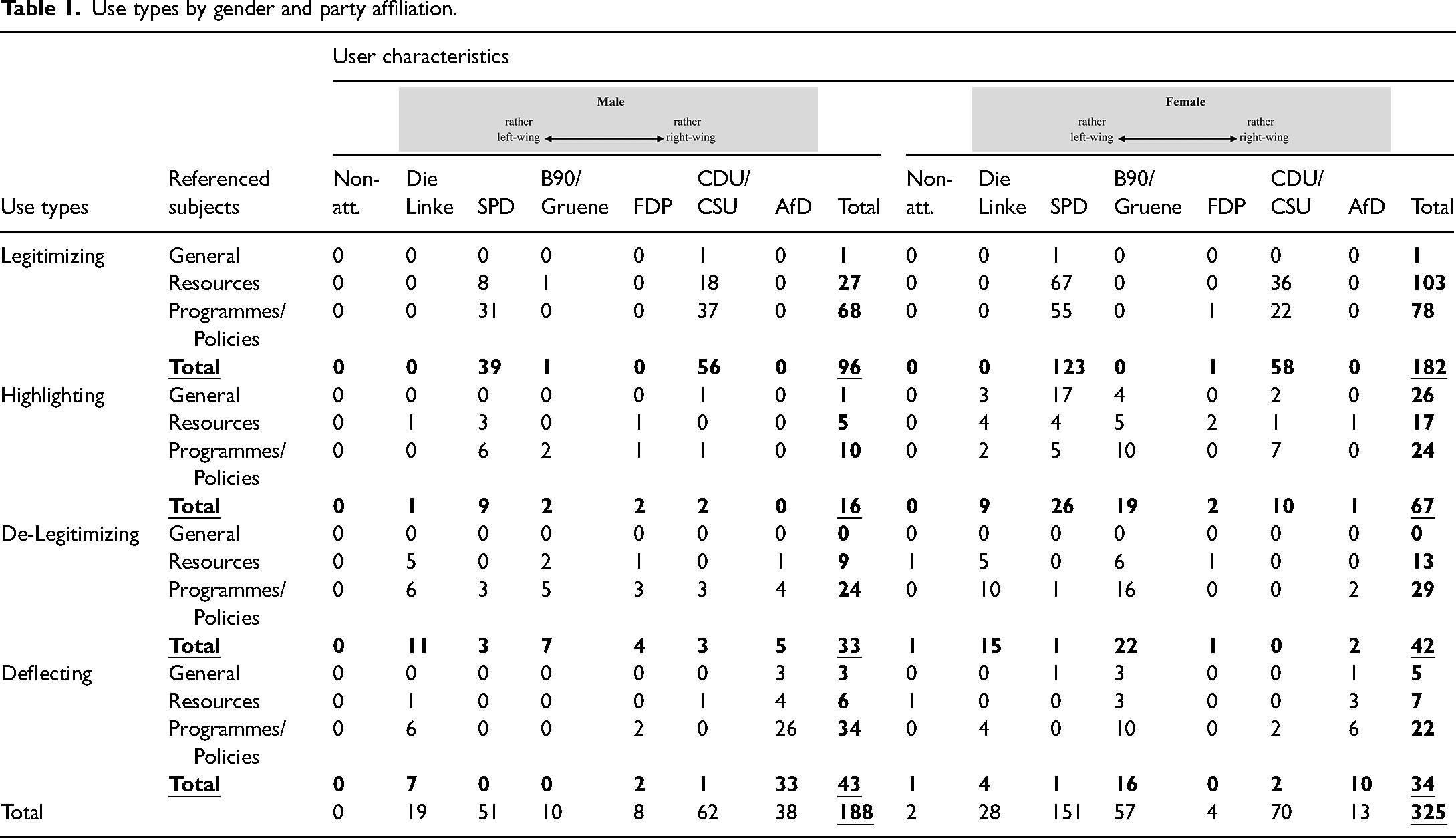
The text segments were also analysed with regard to referenced subjects (see also Appendix A). In contrast to our expectations, MPs addressed gender-related aspects most often in connection to (iii) programmes/policies (n = 291, 57%), followed by (ii) resources (n = 185, 36%). Gender equality in general or non-discerned, general, activities of the government regarding gender equality were the least referenced (n = 37, 7%) (see Table 1 for absolute numbers). In summary, the results do not support our Proposition 2, as resources were not the most frequently referenced subject.
Use types by gender and party affiliation.
User characteristics (RQ3)
The analysis revealed that female MPs addressed gender-related aspects more often than male MPs (female: 325, male: 188; see Table 1), thus corroborating Proposition 3a. Note that the share of women in parliament decreased over legislative terms A and B.
Gender-related differences were also found in use types and referenced subjects. While there are some similarities across both genders, with legitimizing being the dominating use type with both female (56%) and male (51%) MPs, and de-legitimizing (female: 13%, male: 18%) ranking third, there are clear differences with regard to the remaining use types. In terms of mentions, highlighting ranked second with female, but fourth with male MPs (female: 21%, male: 9%). The opposite picture is shown for deflecting, ranking fourth with female and second with male MPs (female: 10%, male 23%). With regard to the referenced subjects, the number of mentions follows the same order for both genders, with programmes being the most frequently referenced (female: 47%, male: 72%), resources being the second (female: 43%, male: 25%) and general (female: 10%, male: 3%) being the least referenced subject in both gender groups (see Table 1 for absolute numbers). These results corroborate Proposition 3b.
Younger MPs address gender-related aspects more often (see Figure 1). Although the two middle-aged groups dominate the frequency in which gender-related aspects are addressed, the results allow the corroboration of Proposition 4a. Regarding use types and referenced subjects by age group, it becomes apparent that legitimizing dominates across all age groups. While some differences are shown with regards to the other use types, that is, each age group shows a different composition of the second, third and least frequently identified use type, the differences are only nuanced (see Figure 1). Programmes/policies are the most frequently referenced subject, followed by resources, across all age groups. Similarly, younger as well as older MPs reference the general subject the least. Therefore, our results provide only insufficient evidence for corroborating Proposition 4b.
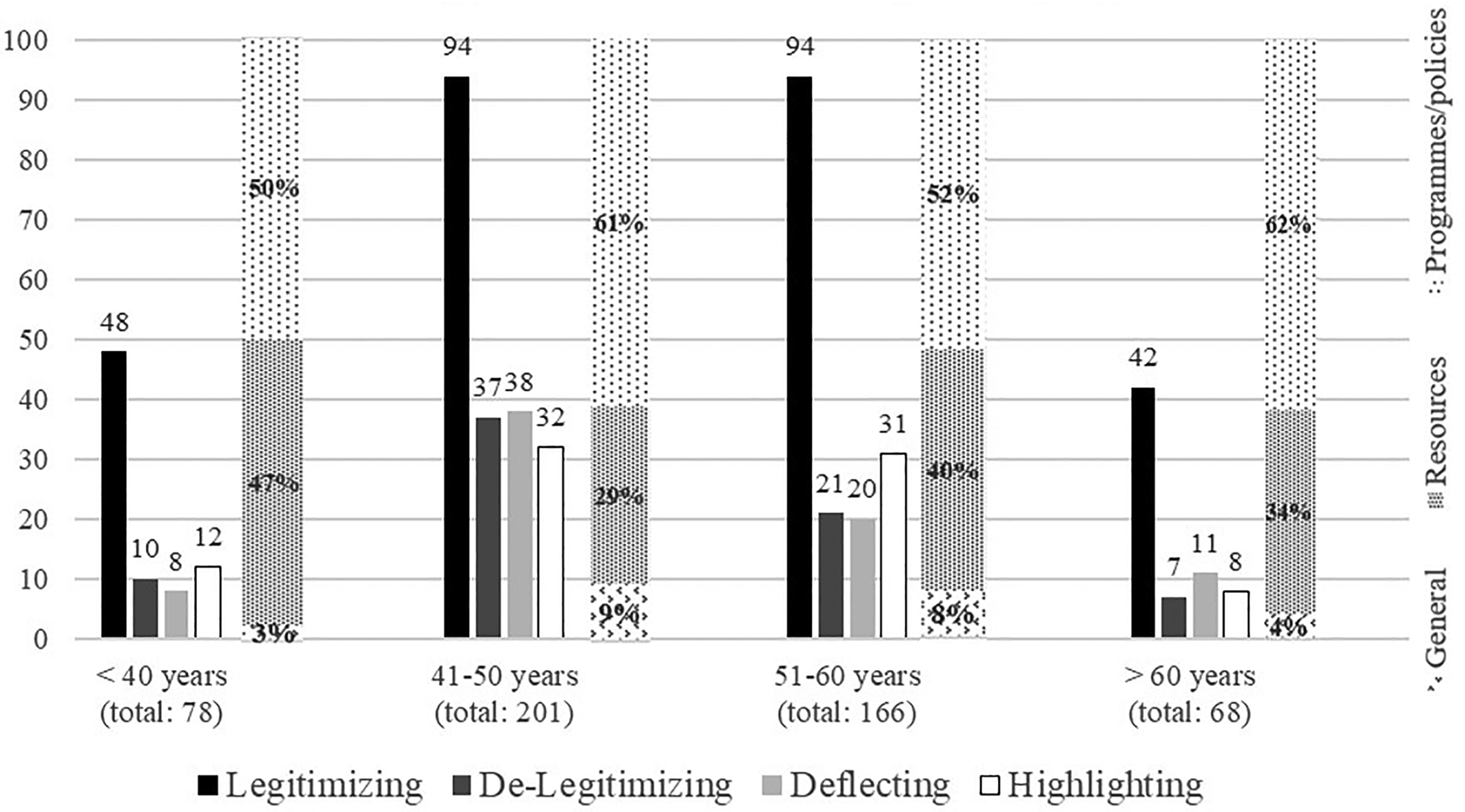
Use types and referenced subjects by age.
Considering MPs’ party affiliation, it became clear that the governing parties (CDU/CSU, SPD) used keywords more often (governing parties: 334, opposition parties: 179). Legitimizing dominated with governing parties (CDU/CSU n = 114; SPD n = 162), whereas the opposition parties used keywords mostly as de-legitimizing (B90/Gruene n = 29; FDP n = 5; Die Linke n = 26) and deflecting (AfD n = 43) (see Table 1). These results corroborate Propositions 5a and b.
A closer look at possible differences regarding MPs’ party affiliation revealed that legitimizing dominated with MPs from SPD (162 out of 202 total) and CDU/CSU (114 out of 132 total) (see also Proposition 5b), followed by highlighting, with a substantial difference (SPD: 35, CDU/CSU: 12). De-legitimizing dominated with Die Linke (26 out of 47), B90/Gruene (29 out of 67) and FDP (5 out of 12). However, the second most frequently identified use type with the latter two parties was highlighting (B90/Gruene: 21, FDP: 4), while MPs from Die Linke showed the use types of highlighting (10) and deflecting (11) in a relatively balanced manner. The most frequent use type with AfD was deflecting (43 out of 51) followed by de-legitimizing, again with a substantial difference (7). References to programmes/policies dominated among MPs from all parties. However, while in four parties (CDU/CSU, SPD, FDP, Die Linke) resources also played a relatively large role, B90/Gruene and AfD referenced programmes/policies notably more often than resources (see Table 1 and Appendix B). This corroborates our Proposition 6.
Additional analysis: Developments over legislative terms A and B
As mentioned above, our data covers budget debates that fall into two different legislative terms, which, among others, has also led to a different structure of political parties represented in parliament. Consequently, we performed an additional analysis to check whether the results regarding Proposition 6 may be due to this changed structure. The most important differences in use types across parties between legislative terms A and B are as follows: SPD in legitimizing (53 to 109) and highlighting (0 to 35); CDU/CSU in highlighting (3 to 9); B90/Gruene (0 to 20) and Die Linke in highlighting (0 to 10). The newly entering AfD seems to account for an increase in deflecting in legislative term B (43 out of 62). The overall increase in addressing gender-related aspects cannot be explained by more extensive data for 2018−2021 alone. Even a more than double increase in the volume of documents (3078 pages [B], 1503 pages [A]) appears insufficient for explaining the partly substantial differences.
Discussion
Building on frameworks put forward in the context of performance budgeting that allow an analysis of how performance goals and related information are used, the results show that gender-related aspects are addressed in a differentiated way in budget debates. This is reflected in the four use types (types of PIU) identified in the data.
Considering the three different subjects referenced when addressing gender-related aspects, it turned out that resources have been referenced similarly frequently as programmes/policies. This is unsurprising given that, firstly, budget debates are about allocating resources. Secondly, it may be expected that MPs would reference programmes/policies in the budget debate, not least given the general understanding of the budget as “policy in numbers”.
In contrast, gender-related aspects in general play a minor role. This is in line with the nature of budget debates, which focus on resource allocation for certain programmes and policies, rather than covering fundamental strategies. Further, MPs seem to have a tendency to address issues reflected in the provided budget documents. As the latter neither contain performance goals nor gender-related objectives in Germany, gender-related aspects as a general subject play only a minor role in budget debates. Despite this – relatively – minor role, the interesting finding here is that MPs do use the budget debate to refer to gender equality in general, even when they discuss neither resources nor particular programmes/policies. This suggests that MPs utilize the importance and attention devoted to budget debates to express their stance (i.e., rather supportive or rather challenging) towards gender equality in general. The latter is reflected in the results on the frequency with which the general subject of gender equality is referenced, and in what way (use type). A closer look reveals that this subject in general is not de-legitimized and only seldom legitimized (1 out of 37), but that MPs refer to it relatively often with highlighting (27 out of 37; in particular female MPs affiliated with SPD – 17 out of 37) or deflecting (8 out of 37; in particular male MPs affiliated with AfD – 3 out of 37 – and female MPs affiliated with B90/Gruene – 3 out of 37) (see Table 1). In doing so, willingly or unwillingly, MPs also acknowledge the link between budgeting and the overall goal of gender equality.
The analysis of use types and referenced subjects provides insights into which types of PIU (RQ1) and which subjects (RQ2) are reflected in parliamentary budget debates when speakers refer to gender-related aspects. Our study, however, also looks at whether specific users’ characteristics (i.e., gender, age, party affiliation) affect the way in which gender-related aspects are addressed in parliamentary budget debates (i.e., extent and type of PIU) (RQ3). It thereby confirms prior findings regarding the effect of party affiliation on PIU (Nielsen and Moynihan, 2017; Raudla, 2012; Saliterer et al., 2019) also for the specific case in which such information is gender-related. Moreover, it also adds to the body of knowledge by looking at the effects of socio-demographic characteristics (i.e., gender, age), which have only seldom been investigated so far (Faber and Budding, 2022; Moser and Korac, 2021).
The study shows that, unsurprisingly, female MPs mention keywords more often than male MPs (see Quinn, 2017). The role of female MPs for gender-related aspects becomes even more evident when considering use types: with legitimizing and highlighting dominating with female MPs, they seem to act as advocates for gender-related aspects. Taking further into account the finding that female MPs were more likely to reference resources when addressing gender-related aspects in the debate, we suspect that a higher number of female MPs may strengthen advocacy for gender-related aspects in parliament.
Looking at the effect of age, the results provide some evidence that gender-related aspects are addressed more often by younger MPs, but not necessarily in a different way. While there are some nuances in use types across the age groups, the dominating use type overall was legitimizing. In addition, no differences in the referenced subjects could be found between younger and older MPs.
However, an interesting picture emerges considering the MPs’ party affiliation. The findings that members of governing parties use keywords almost solely in a legitimizing way and members of opposition parties in a de-legitimizing or deflecting way are in line with earlier findings (Askim, 2009; Raudla, 2012; Saliterer et al., 2019). The effect of party affiliation becomes even clearer within opposition parties: while three out of four (B90/Gruene, FDP, Die Linke) focus on de-legitimizing (in line with their assumed parliamentary role), the AfD most frequently shows the use type of deflecting. This may be due to the party's traditional family image and clearly delineated gender roles. This finding suggests that party ideology plays an important role when it comes to how gender perspectives are introduced into the budgeting process, and thereby also provides further support for arguments in earlier contributions on party politics and gender equality (see Ahrens et al. 2022; Kantola and Agustín, 2016).
In summary, the results corroborate four of our six propositions (see Appendix C), which confirm and contrast prior results but also add new findings on the effect of (socio-demographic) user characteristics and their impact on PIU. As the study was conducted in a country that pursues gender equality as a global objective but has not implemented GB or performance budgeting (yet), it adds to the knowledge that has so far come mainly from studies in the field of performance budgeting or PIU in the budgeting context.
Conclusion
This paper explored how parliament introduces gender perspectives in the budgeting process at the central level in Germany, where neither performance budgeting nor GB are implemented. From a budgeting perspective, the German context is interesting, as parliament has unrestricted powers to amend the budget draft. Prior contributions have highlighted parliament's central role in calling for GB (Alonso-Albarran et al., 2021; Galizzi et al., 2021). Exploring how parliament introduces gender perspectives in budget debates in a context where GB is absent therefore may uncover whether gender-related aspects matter in a key policy-making arena even when GB is not implemented.
Our results suggest that indeed they do. Against the background of RQ1 and RQ2, which types of PIU are reflected and which subjects are referenced when speakers address gender-related aspects in parliamentary budget debates, we found that MPs were mainly supportive, showing the use types of legitimizing and highlighting. Surprisingly, given the research context of budget debates, gender-related aspects were mostly addressed in connection to programmes/policies and not resources (see Table 1).
In addressing RQ3, asking whether user characteristics (i.e., gender, age, party affiliation) affect the way in which gender-related aspects are referred to in budget debates (i.e., extent and type of PIU), our study shows that gender matters probably even more than age for introducing gender-related aspects in budgeting, and for doing so in a supportive way.
While it may not be surprising that female MPs act as advocates, it is interesting that they are more likely to reference resources when addressing gender-related aspects than male MPs. In a context where GB and gender-related performance goals are missing, and MPs therefore cannot refer to budget documents on this, our findings suggest that increasing the share of female MPs may lead to gender-related aspects playing a heightened role in budget debates. In addition, our analysis of use types shows that a party's position as either a part of a governing coalition or opposition, as well as party lines across the opposition, affect the way in which gender-related aspects are addressed: exerting supportive use types (i.e., legitimizing, highlighting) and rather challenging use types (i.e., de-legitimizing, deflecting).
Limitations and further research
This study builds on a qualitative document analysis of transcripts of parliamentary budget debates. The method allows a comprehensive view of statements by all MPs. The analysis of budget transcripts also tends to be more objective than interviews, which could possibly display socially accepted behaviour. Transcripts were edited manually to delete verbal interjections by MPs who at that time were not granted speaking time. While a structured manual was followed to avoid inconsistencies, it bears the potential for omitting comments that may have been picked up by MPs, and of skewing findings on the effects of party affiliation. The research period covered one legislative term in full (B), and half of another (A). While some findings cannot be explained by the higher volume in the data analysed, this disproportion may contribute to skewed results.
Another limitation arises from the study context. While the central budget may serve as a “role model”, it provides only a narrow platform for exploring how gender-related aspects are addressed in budgeting. Key public policies (e.g., education, public healthcare, childcare) remain the responsibility of the states as well as the local level. Further research could therefore analyse state budgets (Laender) to provide a more comprehensive view. Future studies may also focus on comparative research with a country that has already implemented GB at the central level, investigating whether the presented findings on use types and the effect of user characteristics can be confirmed across contexts. Lastly, while our findings suggest that gender matters for addressing gender-related aspects in budgeting, the question of whether it is the MPs’ perceived belonging to a certain group, their (informal) role in their respective party or their individual interest that comes into play, remains open.
Supplemental Material
sj-docx-1-ras-10.1177_00208523231156538 - Supplemental material for Assessing the role of gender-related aspects in public budgeting debates: A view of the central level in Germany
Supplemental material, sj-docx-1-ras-10.1177_00208523231156538 for Assessing the role of gender-related aspects in public budgeting debates: A view of the central level in Germany by Sarah Mueller, Iris Saliterer and Sanja Korac in International Review of Administrative Sciences
Footnotes
Declaration of conflicting interests
The author(s) have no conflicts of interest to declare.
Funding
The author(s) received no financial support for the research, authorship and/or publication of this article

Supplemental Material
Supplemental material for this article is available online.
Notes
References
Supplementary Material
Please find the following supplemental material available below.
For Open Access articles published under a Creative Commons License, all supplemental material carries the same license as the article it is associated with.
For non-Open Access articles published, all supplemental material carries a non-exclusive license, and permission requests for re-use of supplemental material or any part of supplemental material shall be sent directly to the copyright owner as specified in the copyright notice associated with the article.
