



Abstract
It is well known that the meanings of public values can vary significantly across different settings, given their abstract nature. Despite this knowledge, however, the public values literature has not significantly examined the official meanings of public values in their local setting. Against this backdrop, on the basis of a translation perspective we examine the context-specific meanings of 219 public values as defined by the core values statements of 61 Nordic central government agencies. We show variation and patterns in the meanings, emphasizing how the meanings vary depending on whether the values are translated into (1) a work and service delivery theme, (2) an internal relations theme and (3) an external relations theme. Through these findings, the study highlights the importance of taking into consideration the official meanings of agency core values for understanding the relationship between public values and administrative behaviour.
Points for practitioners
The findings from this study inform public managers and administrators of the possible variation in the official meanings that could be attributed to core values. They suggest that public managers should carefully consider how they want their agency's core values to be understood by the employees. Specifically, when translating core values, public managers are advised to assess whether the signifiers they use to translate the values should guide work and service delivery, internal relations or external relations, respectively, or a combination. By drawing attention to the intended meanings of core values, the findings create increased awareness of how different translations of core values implicate different administrative behaviours.
Keywords
Public values are ‘the ideals, articulated as principles, to be followed when producing a public service or regulating citizens’ behavior, thereby providing direction to the behavior of public servants’ (Beck Jørgensen & Sørensen, 2013, p. 72). The problem is, however, that values are not good guidelines for action in themselves. Values generally express ‘conceptions of the desirable’ (Schwartz, 1999, p. 24), but their abstract and ambiguous nature enables different, unstable interpretations of what is desirable and ultimately different behaviours and practices.
To provide more clarity for civil servants, many public agencies develop formal statements in which they translate each of their core values into more specific guidelines for administrative behaviour (Nyström Höög & Björkvall, 2018). To translate, in this sense, is to move a construct from the abstract to the context-specific (Czarniawska & Sevón, 1996). Values statements that display such translations can be found in strategic plans, handbooks, annual reports and agency websites. Despite their visibility, however, little is known about them. We therefore ask: what are official agency core values intended to mean?
Our research question is motivated by calls for more research into the meanings of public values (Martinsen & Beck Jørgensen, 2010; Veeneman, Dicke, & De Bruijne, 2009). These calls are warranted for several reasons. First, whereas multiple studies of codes of conduct in public organisations (Grundstein-Amado, 2001; Svensson & Wood, 2004; Thaler & Helmig, 2016) and national administrative codes of ethics (Christensen & Lægreid, 2011; De Graaf & Van der Wal, 2008; Kernaghan, 2000, 2003) have been conducted, the literature on agency-specific core values statements constitutes a very limited part of the public values literature. This is surprising given that core values are meant to guide what civil servants should do in certain situations and how they should do it (Nyström Höög & Björkvall, 2018). Thus, empirical data on how agencies translate their core values into specific guidelines could enable us to better understand, explain and predict administrative behaviour and decisions (Veeneman et al., 2009).
Second, a challenge to progress in the research on public sector values is that values tend to be aggregated in large N studies and examined out of their empirical context, thereby ‘robbing them of specific meaning’ (Beck Jørgensen & Bozeman, 2007, p. 358). If the specific meaning of values is unknown, researchers are forced to rely on labels and the general meanings of the values rather than their local meanings, and on the frequency of these labels as indicators for their importance. From this line of reasoning, core values are those values that are the most frequently mentioned (cf. Rutgers, 2008). However, not knowing the local meaning of values makes it difficult for researchers to reach conclusions about the specific significance of a value, let alone how it actually is intended to guide administrative behaviour.
This paper examines the local translations of agency core values through which the agencies themselves explicate how their official values should be interpreted within their local context. It does so not only to offer context-specific insights into the variation in the local meanings of public values, but also to obtain an understanding of the kind of administrative behaviour that is expected of civil servants on the basis of their agencies’ core values. We rely on a translation perspective (Czarniawska & Sevón, 1996, 2005; Wedlin & Sahlin, 2017) to do so. Rooted in an inductive, interpretive and social constructivist epistemology, this perspective treats local translations of any social construct as a contextualisation within the local setting.
On the basis of data from 61 Nordic public agencies, the contribution we make to public values research is to show variation in the intended meanings of official public values but also shared patterns across three themes of translations: (1) service delivery and work; (2) the relationship between employees; and (3) the relationship between the agency and its external environments. We discuss the implications of our findings for public values research and suggest some directions for future research.
Theoretical considerations
Public values and core values statements
Public values are often equated with classic values such as the public interest, loyalty, accountability, legality, honesty, integrity and robustness. These values are accepted as good principles for public governance by international organisations such the United Nations, the European Council and the Organisation for Economic Cooperation and Development (Beck Jørgensen & Sørensen, 2013). However, they are not necessarily included in official core value statements (Wæraas, 2014). Even if they were, the problem of knowing what the values mean or should mean for administrative behaviour in a local organisational setting still remains.
Some researchers seek to reduce this problem by conducting qualitative interviews with public servants about the meanings of public values in general (De Graaf, Huberts, & Smulders, 2016; De Graaf & Paanakker, 2015; Paarlberg & Perry, 2007). Although this approach allows for informant-centric views to be captured, studies that do so are few and have not examined core values statements. Another approach with a similar limitation is to examine public values as they are expressed in performance indicators (Colon & Guérin-Schneider, 2015) or contracts (Reynaers, 2022). Yet another approach is to give respondents a list of values with corresponding definitions and then ask the respondents to rate the importance of these values on the basis of those definitions (Molina, 2015; Molina & McKeown, 2012; Van der Wal & Huberts, 2008). Whereas this approach offers a standardised basis for differentiating between values, its deductive and researcher-centric grounding limits the discovery of locally embedded values definitions.
As a supplement to these studies, our study focuses on the official meanings of public values according to public agencies themselves. Such agency-specific values statements are in addition to, and can be different from, professional codes of conduct and national codes of ethics that have been determined by superordinate administrative bodies (Beck Jørgensen & Sørensen, 2013; Christensen & Lægreid, 2011; Kernaghan, 2003; McCandless & Ronquillo, 2020). The fact that they are official means that they have been purposely selected and formally approved by upper management as principles and ideals for administrative behaviour (Wæraas, 2010, 2018). Values statements guide decision-making, actions, goal fulfilment, internal discussions on ethics and forms of collaboration (Nyström Höög & Björkvall, 2018). They can also be used to resolve ethical dilemmas, elevate the moral profile of employees and educate the public about the agency's mission (Grundstein-Amado, 2001).
At the same time, values statements can have a strong symbolic dimension in the sense that they express organisational identity (Aust, 2004; Wæraas, 2010). Whether this identity is a ‘true’ representation is a point of contention, echoing a debate concerning organisational hypocrisy (Brunsson, 1989) and decoupling (Meyer & Rowan, 1977). From this perspective, core values are like many mission statements, often ‘lofty’ and ‘disconnected from the true capabilities of the organization’ (Goldsmith, 1997, p. 35). Given the growing tendencies of branding and reputation management in public organisations (Bustos, 2021; Leijerholt, Biedenbach, & Hultén, 2019), the argument that core values statements could be insincere is understandable.
However, the argument is less convincing when officially stated core values are accompanied by a description of their meanings. It would be rather unnecessary for an agency to explain what the values should mean in the local setting if these values are mainly image-enhancing symbols. As noted by Scott (1998, p. 211), who spoke of institutional elements in general, in this case it would be more important to ‘ensure their visibility to outsiders, and it is essential that their distinctive features remain intact’. It follows that detailed meanings attributed to official core values make the statements more institution-specific and unique, not generic and universal. It is this translation of values from the generic and universal to the specific and unique that is of interest here.
The translation of core values
Translation theory concerns itself with the change that occurs in social constructs as they move from one setting to another. To translate something is to ‘construct it anew’ (Czarniawska & Sevón, 2005, p. 8) by attributing new meaning to it and re-embedding it in a new context. Translators do so in light of prevailing context-specific needs so that the construct becomes less generic and universal and more unique and context-specific – and therefore more meaningful. This process can have strong sensegiving aspects (Gioia & Chittipeddi, 1991) in the sense that actors, typically managers, impose a definition of the social construct on others (Bergström & Diedrich, 2011; Bruce & Nyland, 2011). The more abstract and generic a construct is, the more likely it is to be translated in its new context.
Similar to goal ambiguity research, which has shown that official goals are often translated into context-specific operative goals in order to provide meaningful guidelines for action (Jung, 2014; Perrow, 1961), a large number of studies have highlighted public values’ sensitivity to structural, cultural, political and technological contexts (Beck Jørgensen, 2006; De Graaf et al., 2016; De Graaf & Paanakker, 2022; Fukumoto & Bozeman, 2019; Huijbregts, George, & Bekkers, 2022; Paanakker & Reynaers, 2020; Rutgers, 2008; Rutgers & Van Der Meer, 2010). For example, Martinsen and Beck Jørgensen (2010) point out that accountability is an ‘open’ value because it can take on many different local meanings. In a study of decision-making processes, Veeneman et al. (2009) found that public values are formulated in generic ways in the beginning of the process but gradually take on more tangible and context-specific meanings.
A common theme in all these studies is value relativism, meaning that values find their specific meaning in specific contexts (Paanakker & Reynaers, 2020). Some scholars question the notion of universal meanings of values, as ‘values are essentially contested concepts: The proper use of these concepts and concrete values (such as honesty) is never agreed upon’ (De Graaf & Van der Wal, 2008, pp. 83–84). Thus, even if public values were characterised by value universalism, these meanings are unlikely to be sufficiently precise as guidelines for administrative behaviour in context-specific situations. To the extent that public agencies have core values statements, the ambiguous, contested and elusive nature of values makes it all the more important for public agencies to specify their intended meaning. If we want to better understand the relationship between public values and administrative behaviour, then we should learn more about the formalisation of values and their official meanings in local settings. In other words, we should aim to understand how they are translated from generic, ambiguous forms into more locally meaningful guidelines, not only because abstract public values tend to require a local sensegiving effort, but also because administrative behaviour tends to follow formal structures (Egeberg, 1994). Officially translated public values reduce ambiguity by making it easier for civil servants to understand how the values apply to them. The more locally translated the values are, the more embedded and context-specific they become, and the more relevant they are likely to be for civil servants’ activities and work.
On the basis of translation theory, we can expect the agencies to assign different official meanings to the same value. This is not a controversial assumption, as previous studies give little reason to expect the official meanings of a value to be exactly the same across different institutional contexts (Beck Jørgensen, 2006; De Graaf et al., 2016; Huijbregts et al., 2022; Rutgers, 2008), and translation theory stipulates an ever-growing variation in spreading constructs that produces heterogeneity in organisational fields (Czarniawska & Joerges, 1996). A more interesting question is what the core values are intended to mean. For example, transparency could mean one thing in one agency and something else in another, but what? What do agencies mean when they say they stand for integrity, accountability, trustworthiness and professionalism? To date, public administration scholarship has said little about such questions, despite their relevance for understanding values-related administrative behaviour.
Methods
Selection of agencies
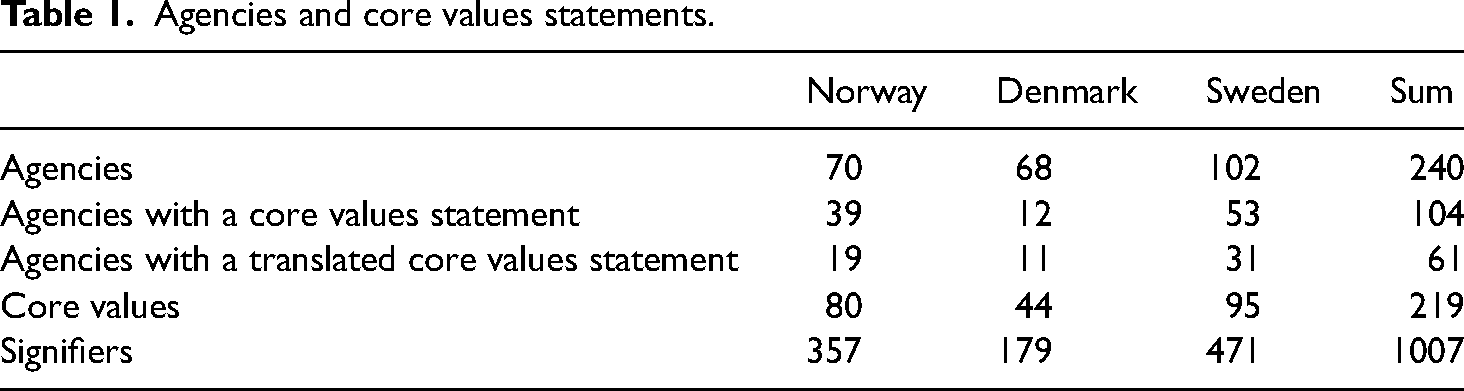
The Nordic countries can be divided into a West and an East Nordic administrative model (Hansen, Lægreid, Pierre, & Salminen, 2012). Whereas Norway and Denmark belong to the Western model whereby government agencies are subordinate to a ministry and not legally independent entities, Sweden belongs to the Eastern model where government agencies are legally independent and structurally separate from ministries (Hansen et al., 2012). To delimit a sample of agencies that are as similar as possible with respect to function and jurisdiction, we started out with the Danish and Norwegian agencies defined as state agencies (i.e. ‘direktorater’, ‘tilsyn’, or ‘styrelser’, or similar). 1 We then added to our sample any Swedish agency that is regulatory or a state ‘directorate’ with national jurisdiction, while omitting universities, colleges, regional authorities, councils, committees, secretariats, delegations and institutes. Agencies that specialise in analysis and intelligence in specific sectors (e.g. the Swedish Agency for Growth Policy Analysis, The Swedish Agency for Health and Care Services Analysis and Transport Analysis) were included because they have national jurisdiction. The result of these procedures was a sampling frame of 240 agencies from the Nordic area (Table 1).
Agencies and core values statements.
Selection of core values statements
We visited the web pages of all 240 agencies and looked in their ‘about us’ or ‘work for us’ (or similar) sections, annual reports and strategy documents. 2 The core values statements we retrieved were in some cases referred to as ‘principles’ or ‘brand platform’ (e.g. ‘varumerkeplattform’ and ‘vägledande principer’ in Swedish) rather than values. After including such statements if they had the same structure as ‘core values’ statements, that is, they expressed a set of principled guidelines for administrative behaviour, and excluding statements that were not unique to the agency (e.g. they were the values or ethical guidelines of a parent ministry), we ended up with 104 core values statements of which 61 were accompanied by a description of their context-specific meaning. These 61 statements contained almost 250 core values. After merging synonyms, we ended up with a total of 219 core values.
Data analysis
In the first step of the analysis, we read through the entire dataset while making note of possible patterns. We quickly observed the tendency for the agencies to use a number of different signifiers when translating the same value. These signifiers could be other values (e.g. openness was in some cases translated into clarity and transparency) and adjectives (e.g. openness was also, in some cases, translated into caring and respectful).
In the second step of the analysis, we concentrated more intently on these signifiers by coding them. We based our approach on the notion that the researcher is the research instrument (Pezalla, Pettigrew, & Miller-Day, 2012), consistent with the interpretive, inductive and constructivist traditions on which qualitative research in general and translation research in particular are built. We used in vivo codes in combination with descriptive codes (Saldaña, 2015). In vivo codes were used when a core value was translated into explicit signifiers such as other values or adjectives. An example of in vivo coding is the following translation of quality made by the Danish Competition and Consumer Agency: ‘[Quality means that] We have high professionalism’. In this case, professionalism is a direct translation of quality and thus we used it as a signifier for quality. For statements where the core values were translated without reference to relevant values or adjectives, we generated descriptive codes. An example is the translation of competence by the Norwegian Accreditation Agency; ‘Being competent means for us to be good at what we do’, which we coded as quality. In total we generated 1007 signifiers from the values (Table 1).
The second step of the analysis offered important information about the signifiers of each value and an indication of the translated first-order meanings of the values (cf. Van Maanen, 1979). However, in accordance with a translation perspective, it is important to acknowledge that the meaning of values cannot be fully captured simply by distilling single-word signifiers from the data. To better appreciate the meanings, it is necessary to consider how the signifiers infuse meanings into the core values through their contextual embedding. In a third step of analysis, therefore, we developed overarching second-order meanings at the sentence or paragraph level (cf. Van Maanen, 1979) on the basis of this embedding, relying on thematic analysis. This is not only a method for generating patterns of meanings from qualitative data (Braun & Clarke, 2006) but also for analysing values in textual data (Wæraas, 2022).
Through our thematic analysis we were able to develop three overarching second-order meanings. Specifically, some translations infused meaning into a value by connecting it with work, tasks, services, task solving and deliverables. We named this theme work and service delivery. In other statements, the translations embedded a value in employee voice, work climate, work environment, sharing and collaboration. We named this theme internal relations. Finally, in cases where the agencies’ use of the signifiers connected the meaning of a value with the outside world, the market, partners, political relations and image, we named this theme external relations. Figure 1 illustrates the data structure generated from this analysis. The majority of the signifiers, 62% (n = 624), pertained to work and service delivery, while external and internal relations represented 25% (n = 252) and 13% (n = 131) of the data, respectively.
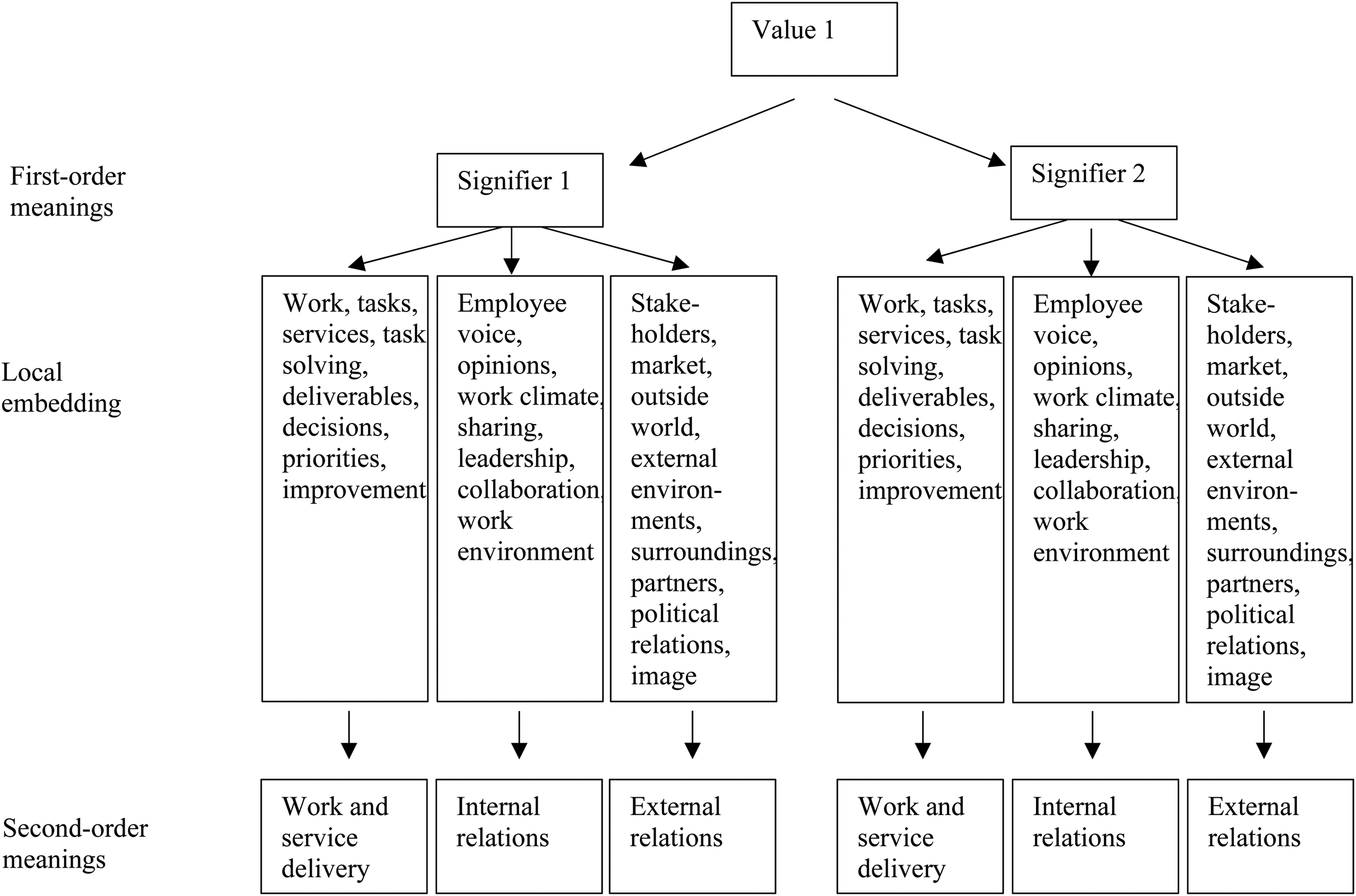
Data structure.
Some limitations of our study should be considered. First, we do not examine actual administrative behaviour or public servants’ sensemaking of their agencies’ values, as this is beyond the scope of the study and would require a different research method. Second, we do not study translations in single agency contexts. We look instead for differences and shared patterns in the local embedding of values that can be observed across the entire sample of agencies. This also means that the data do not allow us to address the reasons why a particular agency translates a value the way it does. Finally, the validity and generalisability of our study are, strictly speaking, limited to the Nordic area, although we assume that our findings could be relevant for other contexts as well.
Findings
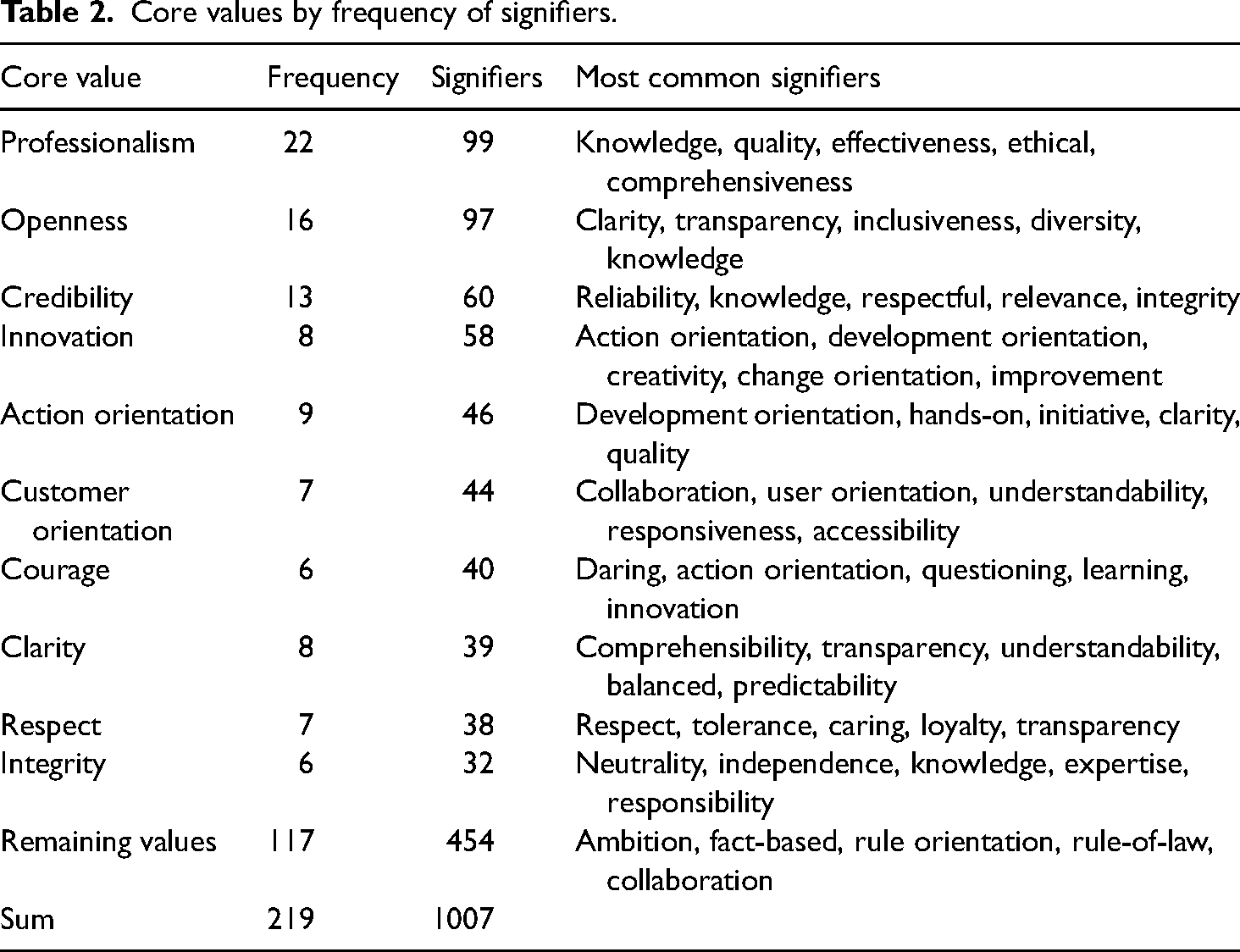
Table 2 gives an overview of the 10 most frequently occurring core values and the five most common first-order meanings, or signifiers, of each value. It shows that each core value has low frequencies but many signifiers, indicating that the agencies fill their values statements with a large variety of values and translate them in very different, almost unlimited ways. For example, although the most frequently occurring signifiers of professionalism are knowledge, quality, effectiveness, ethical and comprehensiveness, most of the signifiers occur only once or twice. In fact, despite being mentioned in only 22 values statements, professionalism is translated into a total of 99 signifiers.
Core values by frequency of signifiers.
Two examples below illustrate the variety of signifiers used by the agencies to translate professionalism (italics added):
The foundation of our values is professionalism. The values stand for desired behaviours in our everyday work. Professionalism means that we have competence and knowledge for our tasks and that we always deliver with quality. (Swedish Intellectual Property Office) [Professionalism means that] We work professionally, effectively, and purposefully. We solve our tasks at a high competence level. We continually develop our knowledge and competence. We achieve respect and credibility through our professionalism and engagement. (Danish Veterinary and Food Administration)
Thus, professionalism can be intended to mean competence and knowledge, but also quality, effective, purposeful and respect. This variety of meanings is evident for other values as well. Openness involves an even larger range of signifiers than professionalism because it only appears 16 times in the 61 core values statements, yet it is translated into 97 signifiers. Openness can be intended to mean clarity and transparency, but it can also mean being generous (Norwegian Agency for International Cooperation and Quality Enhancement in Higher Education), loyal (Danish Veterinary and Food Administration) and showing respect (Swedish Mapping, Cadastral, and Land Registration Authority). Thus, the same value can have many meanings, but different values can also have similar meanings. For example, Table 2 (see also Appendix 1) shows that knowledge is a signifier for values such as professionalism, openness, credibility and integrity. Transparency is a signifier for openness and clarity, and development orientation is a signifier for both innovation and action orientation.
At first glance this large interpretive range of core values seems to suggest that the translations are more or less random and unpredictable. This would be as expected from a translation perspective (Czarniawska & Joerges, 1996). However, the picture is more nuanced as the translations can be distinguished on the basis of three themes across which the official meanings of values differ significantly. These themes serve to organise the data by pointing to overarching patterns in the translations. Together they highlight the systematic variation in the translation of public values and not only show how the same value can come to have different intended meanings but also how values have shared meanings. In the case of openness, some of the translated meanings are the following:
[Openness means that] The work of the Health Directorate is characterised by clarity, transparency, open processes, and good communication. (Norwegian Health Directorate) [Openness means that] Our decisions are clear, unequivocal, and justified (Danish Veterinary and Food Administration) [Openness means that] We are clear and transparent about what we do and why. (Swedish Energy Markets Inspectorate)
In these examples, the agencies translate openness into meanings that are not unique to the work and service delivery theme. Clarity and transparency, for example, are signifiers that occur under the internal and external relations themes as well (Appendix 1). However, the statements embed these signifiers of openness within a context emphasising work, decisions and tasks. This is a distinct way of translating through which openness takes on special meanings: it means to foster administrative behaviour that is open about work, processes, decisions, priorities and tasks.
In contrast, when openness is meant to shape behaviour related to the relationship between employees, its meaning changes significantly:
[Openness means that] We welcome diversity, respect the opinions of others, different experiences and knowledge. We have good leadership and employees who, in collaboration and dialogue, contribute to a good work environment and a secure supply of skills. (Swedish Geological Survey) [Openness means] To be open for others’ viewpoints and expertise, and to share knowledge and competence. (Competence Norway) [Openness means that] We are open to others’ viewpoints, and we communicate on an equal basis with mutual respect. (Danish Veterinary and Food Administration)
No explicit references to work, tasks, decisions, deliverables or priorities are made in these translations of openness. Instead, they emphasise employee voice, leadership, work environment, collaboration and sharing. Although the translated value (openness) is the same as in the examples concerning the work and service delivery theme, and some of the signifiers used to translate the meaning of openness are the same (e.g. transparency), the local embedding of openness is not. In these translations, openness is about the relationship between agency members; how they should build a positive work environment by respecting each other and stimulating a diversity of opinions.
Finally, when openness is meant to guide behaviour vis-à-vis the external environments, its intended meanings change yet again:
[Openness means that] We actively include our collaboration partners. We listen and reflect, and we share our knowledge with others and communicate clearly. (Danish Patient Safety Authority) [Openness means that] We shall be open towards the external environments … Our communication shall be clear, and we shall be easily accessible. We shall safeguard equal treatment and transparency and we shall be particularly open and including towards individuals and groups that do not have a clear position or strong public voice. (Culture Council Norway) [Openness means that] We have a dialogue with external stakeholders where we listen and read about special or new circumstances in the market. (Swedish Energy Markets Inspectorate)
Again, the value is the same as before (openness) and some of the signifiers are the same as in the other two themes (knowledge, transparency) (Appendix 1). However, the behaviour with which the translated intended meaning of openness is connected is different. In this theme, openness is connected to behaviour that relates to stakeholders, the outside world, the market, the external environments, and so on, not to work and service delivery or to internal relations. Specifically, openness means to share information and be open to impressions, feedback, and input from actors and circumstances outside of the agency.
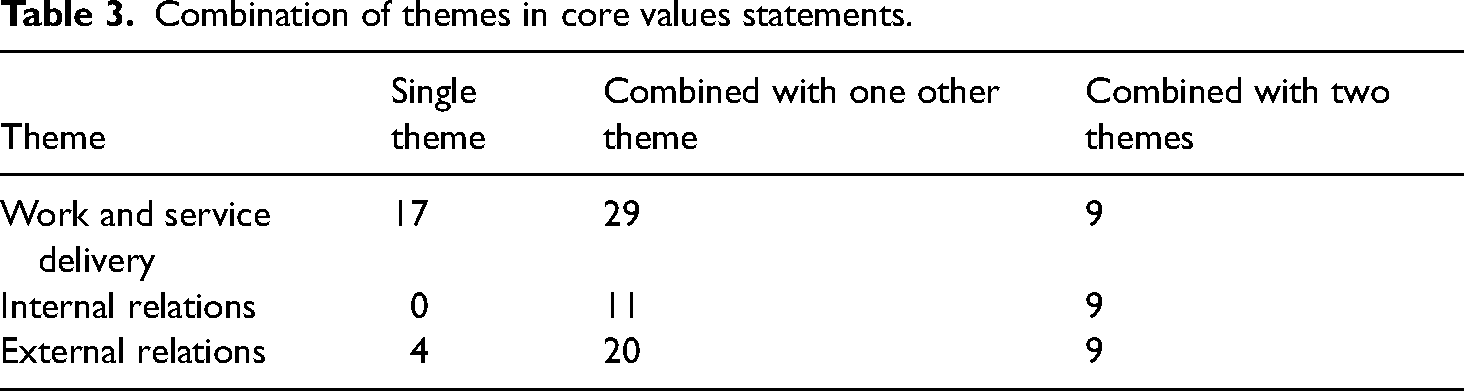
The three different ways of translating openness provide an illustration of the potential range in the intended meanings of any public value. The range is potential because the three themes are not equally likely to be invoked in the translations. Only three values (openness, customer orientation, clarity) are translated in all three ways (Appendix 1). Moreover, no single agency translates the same value into all three themes. The agencies seem to have one preferred theme for every value, although they may translate different values in the same core values statement into different themes. Thus, whereas each value is likely to be translated into one theme, each core values statement is likely to be translated into several themes. For example, the possibility that a value is translated into the work and service delivery theme does not prevent another value in the same statement from being translated into the internal relations theme (Table 3). The most common combination of themes in a core values statement is the work and service delivery theme and the external relations theme, occurring 28 times.
Combination of themes in core values statements.
Discussion and conclusion
Our study began with the question: what are official agency values intended to mean? We asked this question because even though the large body of literature on public values research has produced significant insights on the meanings of public values in different contexts (De Graaf et al., 2016; De Graaf & Paanakker, 2015; Molina, 2015; Molina & McKeown, 2012; Paarlberg & Perry, 2007; Van der Wal & Huberts, 2008), we know little about core values statements and even less about the official meanings of the values contained in these statements. Agency-specific translations of such statements are important because they specify in a formal way how civil servants should behave at work on the basis of the agencies’ official values.
Against this backdrop, a main finding from our research is the three overarching meanings of the core values. Even if each value could potentially be associated with a very large and seemingly unpredictable number of signifiers, our findings show that the translations are not random. The intended meaning of a value is formed within the boundaries of either a work and service delivery setting, an internal relations setting or an external relations setting. With a sample of agencies from different policy fields and country contexts, the findings arguably point to general ‘rules’ for translating a value. This is in contrast to the theoretical starting point for translation theory, which typically emphasises unpredictable translations and the lack of shared patterns (Czarniawska & Joerges, 1996).
The most striking finding, however, is the large variation in the meanings across the three themes. These differences are not trivial. Two agencies that express the same value in their official core values statement may not have the same behaviours in mind when translating the values into local guidelines. For example, openness translated into work and service implies being open about work, decisions and priorities. Openness translated into external relations involves behaviour that is open to impulses from the external environment. In the first case, administrators make information flow from the agency to the external environment; in the second they make it flow from the external environment to the agency. The value is the same, but the intended meaning and implicated administrative behaviour are not.
Thus, although it is helpful to know that a value such as openness is central in public administration, it is even more helpful to know the signifiers and themes into which this value is translated. Only then can we better assess the behavioural implications of the value for public servants. Without examining these behaviour-governing signifiers and themes, it may be a mistake for public values research to conclude that two agencies that display the same value in a core values statement (or claim to represent a certain value through other means) actually pursue the same values-related behaviour in practice. The study thus confirms previous arguments concerning the embeddedness of public values (De Graaf et al., 2016; Fukumoto & Bozeman, 2019; Huijbregts et al., 2022; Rutgers, 2008; Rutgers & Van Der Meer, 2010) but extends them by showing the importance of understanding the translated intended meanings of the values.
A translation perspective on public values offers the benefits of increased sensitivity to such meanings. The point is nicely captured by anthropologist George Marcus, who said ‘everything is everywhere, yet everywhere different’ (1992, p. 313). Without taking this variation seriously, it is difficult for public administration research to assess the significance of a certain official value – or any value – or predict the kind of behaviour in which official core values are likely to result. How researchers rank, understand and classify public values, especially on the basis of large N studies, is not necessarily consistent with the official core values of the public agencies they are studying, nor with how agencies understand and translate their own core values into behaviour-relevant guidelines.
An obvious next step for future research is to examine how public servants translate the core values statements. Official core values may provide a normative orientation as cognitive templates, but not necessarily sufficient direction for action (Sirris, 2020). This is particularly the case when core values are not accompanied by a local translation, which in the Nordic countries is the case in about 41% of the core values statements (cf. Table 1). A translation perspective can help disclose the meanings that public servants assign to the official values regardless of the intended meanings. And, to better understand the relationship between values and behaviour, a translation perspective could also help examine the values that are invoked by the administrative behaviour of public servants, especially behaviour that relates to work and service delivery, internal relations and external relations. Observations could begin with the actual behaviour of public servants rather than official values (Gehman, Treviño, & Garud, 2013), and subsequently analyse the correspondence between official values and administrative behaviour. Such a study could pursue a combined focus on the translation of behaviour into values and the translation of values into behaviour. By doing so, sensemaking as well as sensegiving aspects of public values would be foregrounded, thereby contributing much needed insights into the linkages between public values and administrative behaviour.
Footnotes
Acknowledgements
An early version of this paper was presented at the 2020 annual NEON conference, hosted by Oslo Metropolitan University, and the LIVAP research seminar at VID Specialized University. We thank the participants for their comments. We also thank the IRAS reviewers for their constructive advice.
Declaration of conflicting interests
The author(s) declared no potential conflicts of interest with respect to the research, authorship, and/or publication of this article.
Funding
The author(s) received no financial support for the research, authorship, and/or publication of this article.
