




Abstract
In the literature on relational governance, it is often assumed that relational governance emerges primarily after formal contracting and acts as a functional supplement to a formal contract. In this article, we show that especially facing deep uncertainties, relational governance can emerge before the start of formal partnerships, in the form of trust-building, exchanging resources, and fostering flexibility. Based on a case study of a smart city outsourcing project, this article introduces a forward-extended framework of relational governance that captures the pre-contractual dimensions of relationship cultivation and their role in facilitating formal contracting. The study finds that pre-contractual relational governance facilitates formal contracting by reducing substantive, evaluative, technological, and procedural uncertainties in the project and helps the partners to design an elaborative contract, undergo an easy negotiation, adopt short-term contracts, and use simple monitoring and evaluation methods. The article thus argues that only understanding post-contractual relational governance is insufficient for exploring the relation between formal contracting and relational governance; facing deep uncertainties, it is necessary to understand how public and private parties develop their pre-contractual relationship and reduce the uncertainties before a formal contract can be signed.
Practitioners should realize that there is much room for relational governance in the pre-contractual phase of PPP projects when the projects are rife with various uncertainties. Public and private parties can take measures to build trust, foster flexibility, and create interdependence before a formal contract is signed. These ex-ante relational governance measures can facilitate formal contracting by reducing the various uncertainties, making a formal contract designable, making negotiation smooth and easy, and reducing the need for contract supervision.
Introduction
In public–private partnerships (PPPs), because of information asymmetry, opportunism, and distrust, keeping partners’ long-term and high-level commitment is challenging (Chuang et al., 2020; Mu et al., 2010). Confronting this challenge, researchers and practitioners have devoted much attention to designing appropriate governance mechanisms that can facilitate economic exchanges and avoid transaction hazards between public and private organizations in the provision of public services or assets (Maurya and Srivastava, 2019; Xiong et al., 2019). Currently, there are at least two governance mechanisms in the literature, contractual governance and relational governance, with the former using rules, performance indicators, sanctions, and risk allocation to govern exchanges, and the latter emphasizing the role of trust, flexibility, and interdependence in ensuring partners’ commitment and performance (Benítez-Ávila et al., 2018; Poppo and Zenger, 2002; Warsen et al., 2019).
Prior literature analyzed the functional complementarity between contractual and relational governance. For instance, Benítez-Ávila et al. (2018) find that relational governance, including elements of norm and trust, functions as a positive mediator between contractual elements and partners’ contributions to the project. Warsen et al. (2019) suggest that successful PPPs are ascribed to a mix and match of contractual and relational conditions; that is, formal rules and relationship management in terms of trust-building and conflict resolution jointly shape the performance of PPPs. Young et al. (2021) investigate the dynamic interplay between contractual and relational governance along the whole project lifecycle and identify the interactions between contractual and relational elements over time. These studies typically assume that relational governance comes about after contracts are made and that relational governance plays as a post-contractual complementary strategy. There is little to no attention to the development of relational governance before establishing formal contracts.
In this article, we explore the possibility that some dimensions of relational governance develop prior to formal contracting. Rather than merely being a complementary tool for post-contractual governance, we argue that relational governance is a prerequisite for formal contracting. Actually, pre-contractual relational governance is crucial. In many circumstances where the outsourcing projects are full of technical and managerial uncertainties, formal contracting without ex-ante relation development between public and private partners is extremely challenging or even impossible (Nooteboom et al., 1997; Zaheer and Venkatraman, 1995). We use the case of smart city outsourcing to explore how relational governance develops before a contract is made, and how the relational governance in the pre-contractual phase of PPP is helpful for formal contracting. Our central research questions are as follows:
What are the measures for pre-contractual relational governance in smart city outsourcing? How does the pre-contractual relational governance contribute to the establishment of a formal contract?
In the next section, we introduce the background of smart city outsourcing and contracting uncertainties. Then we develop the conceptual basis for our investigation. After presenting our case of smart city outsourcing in Xiaoshan district, Hangzhou, and the interviews, we report our findings on specific measures for pre-contractual relational governance and their influence on formal contracting. Finally, we conclude our research, point out research limitations, and propose a future research agenda. The study has both theoretical and practical significance. Theoretically, we aim to contribute with a forward-extended framework on relational and contractual governance that will allow future empirical analysis. Practically, the measures of pre-contractual relational governance may be useful for government bodies and private entities to reduce contracting uncertainties and formulate and operate a contract.
Smart city outsourcing and contracting uncertainties
A smart city can be defined as an urban locality that employs digital data and technologies to stimulate innovations and create efficiencies for enhancing the quality of life, boosting economic development, and improving environmental sustainability (Ingwersen and Serrano-Lopez, 2018; Mu and Wang, 2020; Yigitcanlar et al., 2020). Smart city outsourcing refers to local governments buying in technical services associated with smart city construction and operation (including data collection, data analytics, algorithm design, digital product development and marketing, and system maintenance) from private companies based on a long-term contract (Viitanen and Kingston, 2014). Many scholars have recognized that unlike normal infrastructures (e.g. a road or a public building) whose outsourcing regulations and procedures are fully fledged, smart city outsourcing is still an immature field, owing to governments’ insufficient experience with it, inadequate technical knowledge, and the absence of legislative rules related to the application of digital technologies (Galdon-Clavell, 2013).
In such circumstances, formal contracting between governments and private companies will be subject to many uncertainties. First, substantive uncertainties may exist because both public and private parties are ambiguous about the problem situation. Both parties may lack information on specific urban problems, and they are unclear about the available courses of action and their potential effects (Carson et al., 2006; Zaheer and Venkatraman, 1995). Thus, it is likely that both partners are unclear about the exact workload of constructing and operating a smart city and they do not know how much a smart city project will cost. Second, the substantive uncertainties trigger evaluative uncertainties. Because of the ambiguity about the project goals and costs, both parties are unsure about how to measure contract performance accordingly. Third, technological uncertainties can be induced by the unpredictability of technological change in an environment over time. In smart city outsourcing, this is particularly true because it depends on rapidly changing digital technologies and algorithm substitution (Allam and Dhunny, 2019; Mu et al., 2022). Fourth, legislative or procedural uncertainties may exist. Smart city construction requires collaboration between different public agencies. However, if relevant position rules and collaborative working procedures are absent, then previous long-term administrative fragmentation may lead to difficulties concerning interagency information sharing and resource exchange (Meijer et al., 2016).
The existence of these uncertainties makes formal contracting very hard or even impossible (Carson et al., 2006). For instance, ambiguity about the problem situation makes it hard for the partners to establish an explicit common mission for the contract. Difficulty in measuring the contract performance also generates exchange hazards. Contracts could be established only when they can effectively link rewards to productivity, that is, they can measure productivity and pay for it accordingly. When performance is difficult to measure, or when the partners do not know the project workload and costs at all, contracts cannot be made because there will be no rules that can regulate the behavior of contractors, and consequently the private companies will have incentives to limit their efforts toward fulfilling the project mission. The rapidly changing technologies make performance measurement even harder because technical advancement might change the performance level that private companies could actually achieve. Moreover, when private companies need to coordinate with multiple silo bureaucracies for data accessibility, they will face enormous risks if the bureaucracies are uncooperative or show low incentives to participate. If such risks cannot be managed efficiently beforehand, the prospects for formal contracting are bleaker.
A literature review of relational governance
Although there is a lack of an explicit definition of relational governance, a common view is that relational governance consists of the efforts of public and private organizations to engage in “facilitating behaviors” to foster the development of mutually beneficial relationships (Chuang et al., 2020).
Relational governance is initially proposed based on a sociological perspective (Macneil, 1980). The work of sociologists, such as Granovetter (1985), has argued for recognizing the role played by socially embedded relationships in economic exchange. Economic exchange relations thus depart from purely economic motives and become overlaid with social content.
Scholars present “relationality” in the concept of relational governance as a composite term comprising several social norms. First, trust is the most frequently discussed relational element (Nooteboom et al., 1997; Warsen et al., 2019). Trust refers to the confidence in the partner's integrity, credibility, and benevolence in an exchange (Mayer et al., 1995). When a high level of mutual trust exists, both parties share the confidence that the other party will not exploit any adverse situation, and they are more likely to consider their partner's interests rather than just their own (Cao and Lumineau, 2015). Thus, trust reduces the unpredictability and ambiguity of exchange because one can anticipate the behavior of his or her partner (Ran and Qi 2018).
In addition, interdependence or resource exchange is considered an essential relational component (Chuang et al., 2020). Interdependence reflects the extent to which organizations are dependent on each other's resources. In theory, three types of interdependence are possible between the parties involved in an exchange: (1) contractor more dependent on contracted agency; (2) contracted agency more dependent on contractor; and (3) equal dependence (Kumar et al., 1995). Research suggests that only equal dependence has been proven to enhance inter-organizational cooperation; instead, asymmetric dependence can harm cooperation because trust can be challenging to cultivate in relationships with unbalanced resources or power (Mu et al., 2019).
Additionally, flexibility is of critical importance in relation development. Flexibility refers to an organization's openness to different ways of organizing and accomplishing their work as well as their ability to adapt to changing conditions (Poppo and Zenger, 2002). When mutual flexibility is high in exchange, the partners can consistently adapt to contingencies and adjust their strategies in response to those of their partners in a timely manner.
Apart from the sociological perspective, scholars also try to explain the effectiveness of relational governance from an economic perspective. The economic school emphasizes relational governance's rational, calculative origins and points out that continuity becomes the cornerstone of relational governance (Uzzi, 1997). This means that the “shadow of the future” looms large and sanctions in the form of the loss of future business are the key to removing incentives for opportunistic behavior in the present. With expectations of continuity, partners will have strong incentives to invest in the project. Moreover, expectations for longevity minimize the need for precise performance measurement in the short run; partners expect that short-term inequalities will be corrected in the long term (Bertelli and Smith, 2010; Poppo and Zenger, 2002).
Despite the differences, the economic and sociological views on relational governance are interrelated: trust, interdependence, and flexibility support stable positive expectations on future interactions and continuity of cooperation. The expectations on continuity, in turn, can further strengthen the trustworthy status of exchange partners, promote more intense resource sharing, and foster a flexible and open-minded attitude.
Therefore, drawing on the above understanding of relational governance, in this article, we define relational governance as an informal coordinative mechanism, in which the public and private partners carry expectations of continuous cooperation and take facilitating actions to develop a trustworthy, interdependent, and flexible relationship.
Current empirical studies on relational governance focus on post-contractual relationship development to respond to the need for contract adaptation (Warsen et al., 2019; Young et al., 2021). In other words, the view that the formal contract comes first and then relational governance comes afterwards is compelling because scholars generally observe that the presence of clearly articulated contractual terms, remedies, and processes of dispute resolution is the precondition for some shared social norms to develop (Cao and Lumineau, 2015; Poppo and Zenger, 2002). As the economic model on relational governance highlights, the expected pay-offs from future exchange deter the pursuit of short-run gains that undermine the relationship's longevity. Contracts just have this source of advantage because they formally specify a long-term commitment to exchange, and thus, partners are confident about the longevity of the relationship. In addition, contracts clearly specify the clauses about responsibilities and punishments, which further facilitates relationship development because safeguards are in place to constrain opportunistic behavior. Moreover, contracts are not only explicitly drafted with provisions that have legal significance but also designed with frameworks for bilateral adjustments in response to unexpected disturbances. The discussions and negotiations about such frameworks in the contracting process may themselves promote relational governance because partners will be honest about their concerns and mutually determine the strategies for dealing with unexpected changes (Poppo and Zenger, 2002). Therefore, the development of complex contracts in response to uncertainties will positively affect the social relations between the partners.
In contrast, some scholars argue that the prior existence of formal contracts has a pernicious effect on relationship development. As Ghoshal and Moran (1996: 24) argue: “the use of rational control signals that they are neither trusted nor trustworthy to behave appropriately without such controls … For the controller, negative feelings arise from ‘the dilemma of supervisor’, i.e., the situation when the use of surveillance, monitoring, and authority leads to management's distrust of employees and perceptions of an increased need for more surveillance and control.” Similarly, in economic exchanges, scholars argue that formal contracts may actually undermine the formation of good relationships. For instance, Macaulay (1963) points out that detailed contracts can get in the way of creating good exchange relationships between partners.
Therefore, it is apparent that current academic discussions on relational governance center around the post-contractual relationship development between the partners. Attention is absent regarding how pre-contractual relations can be developed and how such pre-contractual relations affect the establishment and management of a formal contract. In the following section, we use the case of smart city outsourcing to fill this gap. The investigation on pre-contractual relational governance is significant because in situations of deep uncertainties, a formal contract cannot even be designed without any ex-ante relationship cultivation (Nooteboom et al., 1997; Zaheer and Venkatraman, 1995).
Case and data collection
The case in this article is Xiaoshan's smart city outsourcing project in Hangzhou, China. This case can be regarded as a PPP project because, according to the definition of PPP (cf. Wang et al., 2018): (1) it is a cooperation between a public party (the Data Bureau of Xiaoshan District Government) and a private party (the local IT company CityCloud); (2) in the cooperation, the CityCloud contributes technical expertise in project design, building, operation, and maintenance, and the Data Bureau contributes financial resources; thus both parties sharing resources and risks; and (3) both parties share the common goal of making Xiaoshan a smart city so that the CityCloud makes profits from providing technical services for the government and the Xiaoshan District Government generates public values with more efficient and convenient urban services.
We choose this case for the following reason. Smart cities are an emerging field that has adopted PPP for delivery. Thus, unlike the fields with fully fledged PPP regulations, technical standards, and contracting procedures, smart city projects are flooded with various managerial and technical uncertainties. Therefore, smart city projects are highly representative of the situation where formal contracts are difficult to design and manage. Consequently, they provide suitable testbeds for exploring the relation between relational governance and contractual governance.
The context of this case is the Xiaoshan district in Hangzhou, China. Hangzhou is the capital of Zhejiang province in eastern China. It is located 180 km southeast of Shanghai in the Yangtze River Delta. To distinguish itself from other large cities in the Yangtze River Delta, especially Shanghai, Hangzhou has promoted itself as a city with a high quality of life through various efforts related to digital urban transformation. In Hangzhou, Xiaoshan is appointed as the demonstration area to carry out the smart city projects. This is because Xiaoshan's comprehensive strength ranks first in Hangzhou. It has been selected as one of “China's top 10 strongest districts”, and is reputed to be “China's best investment place” at the district level.
Our empirical evidence comes from two major sources. One is our direct observation of the interactions between the Data Bureau and CityCloud. We visited Xiaoshan in July 2020. During this period, we attended meetings between the Data Bureau and CityCloud about twice a day to observe their interactions and understand the specific events of their relationship development. In addition, during the visit, we were allowed by the district chief to conduct interviews. We asked our respondents the question: “what actions did you take before the contract to develop the relationship with your partner?” Moreover, during the revision process of this article (June and July 2021), we conducted a second round of interviews to collect information on the role of ex-ante relationship cultivation in facilitating formal contracting. We asked objective questions about the contract's design terms and management and evaluation methods; we also asked subjective questions about how the relationship cultivation before the contract helped establish the formal contract. In total, we performed 18 interviews, of which 11 were from the government side and seven were from private companies. The interviews lasted between 60 and 120 min. A list of the interviewees is shown in the Appendix of this article (see online).
Measures of relational governance in the pre-contractual phase
In this section, we report our findings on the measures that the public and private parties adopted to foster a relationship before signing the contract for Xiaoshan's smart city project.
Measures of building mutual trust
On the public side, the Xiaoshan District Government (XDG) earned CityCloud's trust by establishing a Leader Group for Smart City Construction. Initially, CityCloud held a distrustful attitude toward the XDG because it was unsure if the district leaders would show a strong commitment to the project in the long run. As noted by the vice general manager of CityCloud (no. 12): “There were many cases before … something happened, like the change of leaders, and then all of the sudden the government didn't want the project. How long will the government hold on to things, how to clean up the mess after the government withdraw, I don't know … We attempt to be trustworthy as long as we have adequate assurances of project continuity on an institutional level.” However, the foundation of the leader group cleaned up CityCloud's doubt. The leader group is made up of the district chief and the various department heads. If one department head or the district chief is transferred to another post, the new successor will automatically be involved in the leader group to ensure stable political support (no. 2). The major mission of the leader group is to promote a more frequent and systematic engagement of politicians, keep the politicians informed and involved, and thus help the politicians understand more about the project and know where the leadership actions are most helpful to achieve project outcomes (nos 5 and 6). The vice general manager of CityCloud revealed (no. 12): “Thanks to the leaders’ facilitation and coordination, the section clerks in different government departments are willing to cooperate with us in terms of sharing information and adjusting working procedures … The government's institutional responsibility is now making a good faith effort to put in place the best security possible. We are confident about the project's smooth implementation.”
As the XDG is trustworthy and the project continuity is ensured, CityCloud has shown its trustworthy status through working before payment. Owing to the lack of past experience with smart city projects, both public and private parties are uncertain about the workload of the outsourced project, both about the specific jobs and how much the project will cost. Facing such uncertainties, CityCloud decided to first start some preliminary work without signing a formal contract or charging any fees. According to the vice general manager of the CityCloud (no. 12): “We planned to take one year to know clearly what the aim of the smart city project is, what the scope is, what we need to do, including what to change within the public sector, to achieve that aim”, “through sufficient preliminary investigation, we want to gain trust from the government that our final declaration on the project workload and cost is rational and reliable”, and “we want to show our sincerity of participating into the project by bearing initial expenses on our own.”
Measures of fostering mutual flexibility
On the public side, to prevent future contingencies on capital chain rupture, the XDG designed flexible funding mechanisms to ensure project vitality. First, the XDG determined to set a fixed government budget every year for smart city construction. Second, the XDG bought insurance for the smart city project. If the capital chain was broken, the insurance company would take over to ensure its continuity. Third, the XDG has made an alliance with five large state-owned banks in Xiaoshan, in order to facilitate the private parties to make loans from banks. In the eyes of the private companies, the XDG renders a high level of flexibility because it holds an open attitude toward different ways of financing and its ability to adapt to changing financial conditions is high (according to interviews with nos 13–17). These measures in response to financial contingencies sweep away the worries of the private party about “working-without-payment.” According to the data engineer from the CityCloud (no. 13), “The government's flexible funding mechanisms give us a reassurance, which enables us to start data processing and analysis work with confidence”, and according to the data engineer from Unicom (no. 15), “After knowing the government's efforts in building up the multiple financing sources, we are more willing to start data processing work ahead of payment.”
On the private side, CityCloud showed its flexibility by acting as a first aider. During the project implementation process, there were contingencies where some subcontractors withdrew halfway owing to technical difficulties. Confronting these emergencies, CityCloud flexibly adjusted its working plan and proactively took over the first-aid work. For example, in the “anti-corruption platform” project that aims to solve official shirking through citizen reporting, the original IT company, Hangzhou Juchuang Network Technology Co. Ltd, could not provide a satisfactory product for the government owing to technical difficulties. To ensure that this digital service could be put online as promised to citizens, CityCloud determined to take it over and assigned appropriate technical personnel to tackle the problems (according to interviews with nos 1 and 3). The vice general manager of the CityCloud revealed (no. 12) that “at the beginning, we recommend this company to the government to do this project, now the project meet difficulties, it is our responsibility to rescue and make sure it can be delivered on time and under quality requirements … We couldn't waste the government's trust in us.” The data engineer of the CityCloud told us (no. 13) that “This is not our first time to aid other technology companies. We also help the Hangzhou Huawang Information Technology Co., Ltd solve technical difficulties with the typhoon warning information project … We actively respond to emergencies to make the government more reassured.”
Measures of realizing interdependence
On the public side, the XDG shared its power with CityCloud by letting CityCloud select the subcontractors. Owing to the large scale of the project, the Data Bureau agreed with CityCloud to subcontract the missions to other private IT companies. Because the government lacks technical expertise, the Data Bureau granted CityCloud the ability to evaluate potential subcontractors’ technological qualifications and make the decisions on who can be involved and how. This power sharing is believed to be an effective promoter for the partners’ perceived interdependence. On the public side, as revealed by several section chiefs of the Data Bureau, “to grant CityCloud the power to evaluate and select subcontractors would be an effective measure to show our dependence on them” (no. 1), “by sharing some power with our private partner, we, performing as a public authority, can reduce some power asymmetry with our private partner” (no. 3), and “our private partner will gain some degrees of resource control and discursive legitimacy, thus will have a sense of ownership of the project” (no. 4). On the private side, the vice general manager of CityCloud (no. 12) revealed that “Our power to select subcontractors provides us with a unique condition to expand our company's technical network, as well as the social network.” The data engineer of the CityCloud (no. 13) said that “The government not only trusts us on our capacity to evaluate the qualifications of potential subcontractors, but also believes that we are honest in the relationship with the subcontractors … The government treats us not merely as a technical consultant, but also an important bridge linking the government with many technology companies.”
On the private side, CityCloud shared human resources with the Data Bureau to do the bureau's administrative and routine jobs. The Data Bureau is a newly built government organization that is seriously short-staffed. After initial interaction with the Data Bureau, CityCloud recognized this fact and initiated the proposal of sending its staff to the Data Bureau as secondment personnel. According to our interview with the bureau's section clerks (nos 7 and 8), there are 19 secondment personnel, including one project manager, one chief data engineer, three data analysts and 14 administrative staff. The vice general manager from CityCloud (no. 12) revealed to us that “While we work in the Data Bureau, we not only do managerial and technical job but also administrative affairs … For instance, when there is a meeting between the Data Bureau and other bureaus in the district, it is our staff that help organize the meeting, including front desk sign-in, setting table, doing conference records, etc.” In addition, he revealed that “We will accompany the Data Bureau when the XDG asks the bureau to attend conference … At the conference, it is also our staff who do reports to the leader of the district regarding the progress of digitalization projects in smart city construction.” In addition, the data engineer (no. 13) told us that “Our job sometimes goes beyond the smart city construction itself … For example, when other cities visit the Data Bureau for experience exchange on smart city construction, it is our managers and engineers who receive visitors and share our experience.”
The role of ex-ante relational governance in facilitating formal contracting
In our case, the Data Bureau and CityCloud signed the formal contract in July 2020, which means that the public and private parties spent more than one year cultivating the relationship before formal contracting. In this section, we report our findings on the role of pre-contractual relationship cultivation in helping formulate and manage a formal contract.
Designing elaborative contract
The close contact between the public and private parties in the pre-contractual phase enabled a better understanding of each other and the essence of the project. It further allowed elaboration of the contract. According to the general manager of CityCloud (no.18): “At the beginning, we didn't know what services we could offer the government or what the government needs. Now, we know the project like the palms of our own hands. This enables us to design a detailed contract with 7 service modules: project approval, technology provision, technology maintenance, data management and consultation, brand promotion, product operation, and product research and innovation. In each module, we formulated a list of specific tasks and defined KPI for each task. In this way, we obtained a very detailed and measurable contract.”
Achieving agreement on contract terms in an easy negotiation
The perceived interdependence and trust cultivated in the pre-contractual phase facilitated the two parties undergoing a smooth and easy negotiation on the detailed contract terms. The general manager of CityCloud (no. 18) revealed that “The draft contract consists of 7 service modules and hundreds of tasks and measurement criteria. Despite this, when we presented the draft contract to the government in our formal negotiation meeting, the government didn't challenge the contract and we signed the contract soon, without any hesitation or debate.” Also, the bureau head revealed (no. 11) that “We signed the contract fast because we fully trust our partner; actually we are already familiar with the plan CityCloud attempts to carry out; in fact, some of the defined tasks are already in the process of implementation with perfect performance.”
Replacing long-term contracts with short-term contracts
Normally, PPP contracts are long-term ones, ranging from 15 to 20 years. However, in our case, the public and private parties’ good relationship drove them to give up the long-term contract and turn to the more flexible short-term contract. The bureau head (no. 11) revealed that “we need to review and update the smart city projects on a yearly basis; thus, we have to sign a new contract once a year. Thanks to our partners’ understanding and cooperation; otherwise, we couldn't incorporate new smart projects or cancel less prosperous ones.” The general manager (no. 18) told us that “We agreed to sign this one-year contract because we trust the government not to stop collaboration with us; we know the government becomes increasingly dependent on us in technical terms. We need to be flexible enough and hold an open-minded attitude.”
Skipping process monitoring
Finally, the good relation governance in the pre-contractual phase lets the government skip the monitoring process and save significant supervision costs. The general manager of CityCloud (no. 18) revealed that “There's no supervision during contract implementation. We supervised ourselves. The final performance evaluation is done by submitting a review report on the extent to which we completed our tasks. That means we set performance benchmarks and evaluate our performance all by ourselves.” The bureau head (no. 11) told us sincerely that “There's no need to monitor because, on the one hand, we trust our partner, and on the other hand, frankly speaking, we possess little knowledge about intelligent technologies.”
A forward-extended framework of relational governance
As the literature review of relational governance shows, the existing studies focus on post-contractual relational governance and the role of formal contracts in fostering relational governance in partnerships. However, little attention has been put on pre-contractual relational governance and how it can facilitate formal contracting. In this section, based on our empirical evidence, we propose a forward-extended framework of relational governance, hopefully adding new knowledge to the theory of relational governance and the relationship between relational governance and contractual governance (Figure 1).
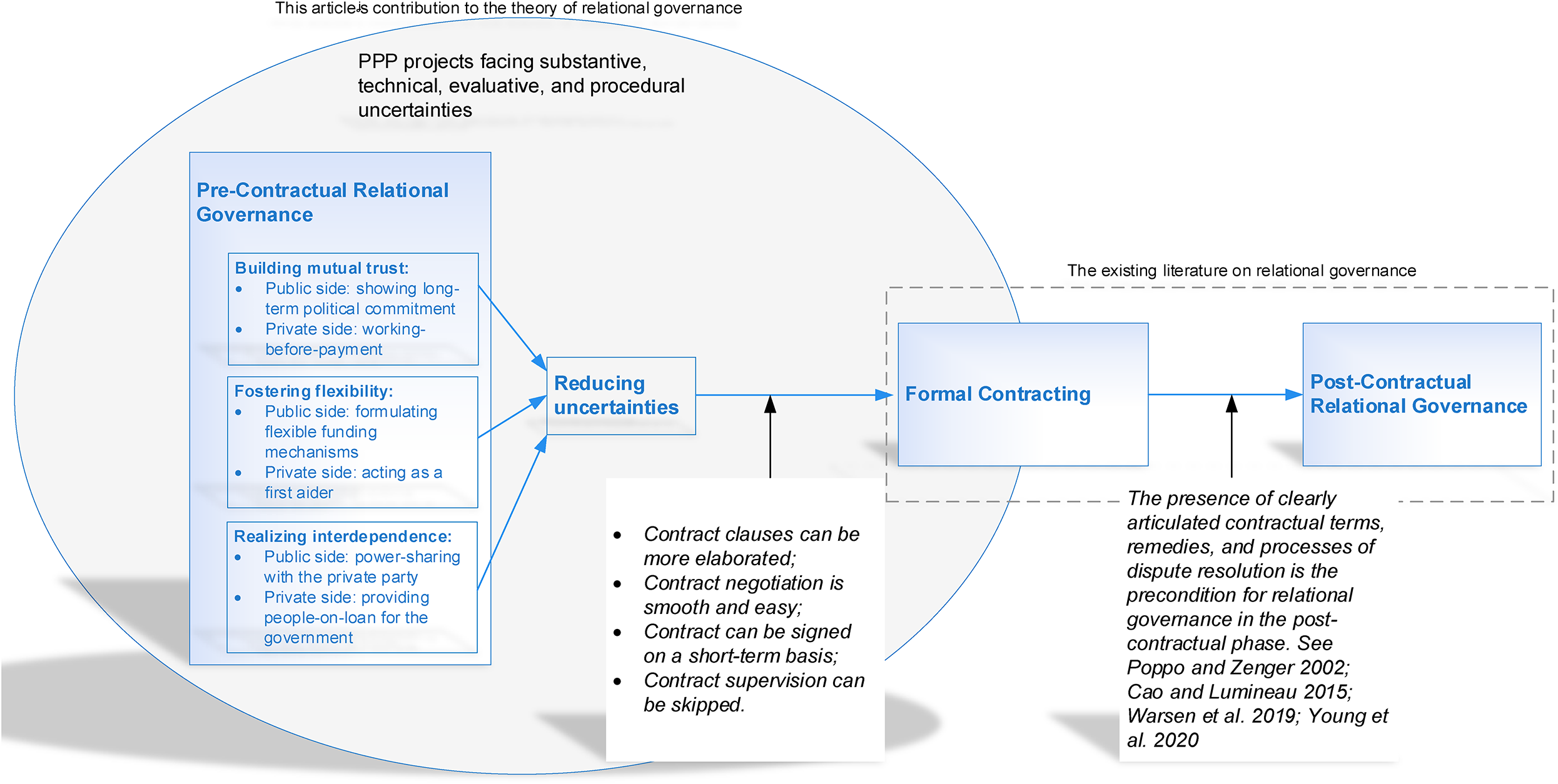
A forward-extended framework of relational governance.
The central idea of this forward-extended framework is that when PPP is applied to an emerging and immature field that is full of substantive (e.g. ambiguity about the project goal and workload), legislative (e.g. the absence of regulations and procedures), technological (e.g. the fast iteration of technologies and algorithm), and evaluative (e.g. the difficulty of performance measurement) uncertainties and thus a contract cannot be designed at the beginning, it is important for the partners to first concentrate on initial relationship cultivation without any discussions on contractual clauses. Therefore, in contrast to the projects with standardized contracts and strict procurement regulations, there is much room for pre-contractual relation governance for projects with various managerial and technical uncertainties.
The specific public and private measures for relational governance should echo each other to build mutual trust, foster flexibility, and realize interdependence. In our case, the institutional safeguards on the public side and the decision of working-before-payment on the private side built up mutual trust between the XDG and CityCloud; the government's open-ended funding mechanisms and the private company's acting as a first aider to the failed projects helped both parties to foster mutually flexible attitudes; and the government's power-sharing and the private company's sharing of human resources enhanced both parties’ mutual interdependence. These measures from our case study can be regarded as suggested actions that any PPP could undertake to cultivate a pre-contractual relationship; on the other hand, our framework is open and can be built with more measures from future case studies.
Additionally, this framework proposes that pre-contractual relational governance is beneficial for formal contracting by reducing the various uncertainties and making a formal contract designable and manageable. First, the close contact before formal contracting helps both parties to understand the project better and removes substantive uncertainties and evaluative uncertainties, making the contract detailed and measurable. Second, mutual trust and interdependence make the negotiation on the complex clauses very smooth and easy. Third, mutual flexibility and trust make the long-term contract unnecessary and drive both parties to correct the contract according to the actual needs. Fourth, mutual trust helps simplify contract monitoring and evaluation, which could save transaction costs.
This framework is consistent with some earlier viewpoints on organizational science and collaboration. As Adler (2001) indicates, exchange partners may replace detailed negotiated contracts with handshakes, talks, and exchange of views. Repeated contacts and honest communications make it clear how the partners view the problem at hand, what they pursue in collaboration, and what resources they can contribute to the partnership. These communications may foster trust between the partners as familiarity through ongoing interactions will grow into anticipation of mutual faithfulness and predictability. The communications are thus beneficial for removing ambiguities, improving mutual understanding, and most importantly, increasing perceived mutual interdependence. With a high level of perceived mutual interdependence, the partners may not easily walk away from the partnership and are more willing to take an open-minded gesture, adjust plans flexibly, and become more committed to the project.
Conclusions
This article aims to explore the measures of relational governance before a contract is made and how such ex-ante relational governance may contribute to formal contracting. Based on the case of the smart city outsourcing project in Xiaoshan, Hangzhou, we conclude that exchange partners’ good relations can be developed prior to a formal contract by fostering mutual trust, flexibility, and interdependence; this mutuality then facilitates the partners designing and managing a contract by removing various uncertainties. This article thus proposes a forward-extended framework of relational governance, arguing that only understanding post-contractual relational governance is insufficient for exploring the relation between formal contracting and relational governance; facing deep uncertainties, it is necessary to understand how public and private parties develop pre-contractual relations and reduce the uncertainties before a formal contract can be signed. This also indicates that there is much room for relational governance in the pre-contractual phase of PPP projects when the projects are rife with different uncertainties. For regular PPP projects that are well-defined by regulations, procuring procedures, technical standards, risk allocation principals, and sanction methods, the room or the necessity for ex-ante relational governance is limited.
This article is subject to a few limitations and future research to eliminate the limitations is encouraged. First, our research is based on a single case study in a Chinese city of economic prosperity. Whether pre-contractual measures for relationship cultivation can be taken in other places with different contexts is not certain. For instance, it has not been determined if “working before payment” or “providing secondment personnel” would happen when the private party lacks the resources. It is also not known whether the public party is willing to provide the institutional safeguards and the flexible funding mechanisms in an underdeveloped city. Therefore, future multiple case studies are encouraged to examine the applicability of the forward-extended framework. Second, our research focuses on the partners’ relation governance in the pre-contractual phase of a PPP project, but how this pre-contractual relation will change after formal contracting has not been studied. Therefore, a dynamic view on the partners’ relation is encouraged to investigate how the pre-contractual relation will change after the contract is signed.
Footnotes
Acknowledgements
We would like to thank the anonymous reviewers for their valuable and constructive comments. We would also like to express our appreciation to the officials of the Data Bureau and the experts of CityCloud who hosted us for interviews and gave us insightful views and valuable information.
Declaration of conflicting interests
The authors declared no potential conflicts of interest with respect to the research, authorship, and/or publication of this article.
Funding
The authors disclosed receipt of the following financial support for the research, authorship, and/or publication of this article: this work was supported by the National Natural Science Foundation of China (grant numbers 72174036, 71774022).
