



Abstract
This qualitative study provides empirical knowledge and develops theory about the role of strategic management in Malaysian local government. As the country addresses the grand challenge of economic growth amid enduring national aspirations of moving from developing to fully developed status, the analysis identifies six approaches to strategic management across nine Malaysian local authorities. Rather than presenting a linear story of progression, the six models of strategizing in Malaysia illuminate the governance traditions that co-exist in this setting. The study examines the assumptions about public management that underpin the different approaches and relates these to the country's inheritance of classical public administration and centralized government, the introduction of New Public Management, and the subsequent emergence of features of New Public Governance. It contributes to theory by providing an analysis of the role of strategy in each of the three governance traditions and connects debates about local governance with scholarship on strategic management. It also contributes to the emerging literature on strategizing for grand challenges and the limited repository of such studies located in a public sector context. The article ends by identifying the implications for policy and practice and suggesting areas for further research.
This study highlights the need for collaboration to address strategic meta problems, manage economic pressures and deliver public services. The six approaches to strategy development presented provide a set of models and frames through which practitioners may assess their local environment. Our typology offers a basis for cross-sectoral learning and reflection, including ways of diagnosing contextual variables and developing strategic knowledge. The Malaysian case shows how the context of strategy formation has been affected by the shift from local government to governance, as well as by interacting colonial legacies.
Keywords
Introduction
In this article we provide empirical knowledge about public management in Malaysia and use that to develop theory about of the role of strategic management in local governance. We contribute to the field's interest in research which can be a basis for comparative knowledge (Bromfield and McConnell, 2021; Kuhlmann et al., 2021) and to its interest in studies of the Asian region in general and Malaysia in particular (Christensen and Fan, 2018; Kim and Han, 2015; Yusoff, 2005). The study takes place in the context of an economic grand challenge (George et al., 2016; Jarzabkowski et al., 2019) as the country attempts to transition from developing to fully developed status (The World Bank, 2020). In Malaysia, the stakes are high in relation to the economy, health and ethnic inequalities, and so considering the role of local strategizing is a worthwhile task. Building on the work of scholars who have been translating ideas about strategic management to public sector contexts (Favoreu et al., 2016; Johnsen, 2021), we provide an account of six approaches to strategic management in local government. In each case we identify the assumptions about public management that underpin each of these practices and relate them to Malaysia's history of centralization, the introduction of New Public Management (NPM) (Bellé and Ongaro, 2014; Manning, 2001; Reiter and Klenk, 2019) and the evolution of features of New Public Governance (NPG) (Casady et al., 2020). We conclude that the six strategic management models we see in Malaysia show how particular governance traditions co-exist in this setting. We contribute to theory by providing an analysis of the role of strategy in each of the three public management traditions against the backdrop of an enduring grand challenge. In an era where such “strategic meta problems” (Seidl and Werle, 2018) are becoming increasingly commonplace and ever grander in scope, we contend that research of this nature is of interest to both academic and practitioner communities.
Our overarching goal is to explain and contextualize the different approaches to strategic management in Malaysian local government and to use these explanations to build administrative theory. We examine how a “modernising” technique such as strategic management is accommodated within longer-standing assumptions about public administration. The related aims of this paper therefore are to identify different and often overlapping approaches to strategizing in Malaysian local government, explain the influence of different governance traditions on practices and to generate theoretical insights into strategic management in the public sector. We organize our inquiry around three research questions: (1) how does the pursuit of successive governance reforms in Malaysia influence public management in local councils; (2) how do these interacting traditions shape local managers’ approaches to strategizing; and (3) what does the case of Malaysian local government tell us more widely about public management and strategy? The paper concludes by identifying the implications for policy and practice and suggesting areas for further research.
Strategic management, public management, and grand challenges
We begin by defining strategic management and delineating established approaches to strategy development, before introducing the concept of grand challenges. The relevance of strategic management to contemporary local governance and public management is then discussed. We review the literature and identify the ways in which strategic management principles have found application in public organizations.
Strategic management and approaches to strategy development
Derived from the military perspective, the term “strategy” in the business world refers to a set of measures designed and carried out by top management to achieve the goals of the organization (Johnson and Scholes, 2001). Fundamental aspects include establishing the organization's long-term direction, setting goals and determining the course of action toward achieving these aims (Coutler, 2002). Strategic management is viewed as a continuous process involving three main elements, namely, understanding the organization's current context, identifying and developing strategic options and the development of a strategic plan, and turning the chosen strategy into practical actions (Johnson et al., 2005).
Numerous classifications for understanding strategic management have been proposed (Wolf and Floyd, 2017). Approaches can be differentiated according to their premises and assumptions about the nature of the strategy process. At one end of the spectrum are mechanistic or classical approaches to strategy work, involving specific requirements and procedures about what to do and how to do it, and which are reliant upon objective analyses of relevant data to reach predefined objectives (Favoreu et al., 2016). At the opposite end are approaches that emphasize elements of personal intuition, judgment, and relationality and emphasize that politics and interests mediate strategic management processes (Dobusch et al., 2019). Our study develops a classification built upon six approaches to strategy development: rational and analytical, centralized and top-down, collective and bottom-up, political and power-bargaining, stakeholder, and adaptive and learning.
Strategizing for grand challenges
Scholarly interest in grand challenges has gained momentum in recent years across the wider strategic management and organization studies disciplines (Jarzabkowski and Bednarek, 2018). Also referred to as “strategic meta problems” (Seidl and Werle, 2018) or “wicked problems” (Reinecke and Ansari, 2016), grand challenges tend to be “large-scale, complex, enduring problems that affect large populations, have a strong social component and appear intractable” (Jarzabkowski et al., 2019: 120). Research into grand challenges has relevance for practice and policy. Studies have explored issues such as strategic collaborations in the context of water provision (Seidl and Werle, 2018), how organizations have navigated the impact of the COVID-19 pandemic (Ketchen and Craighead, 2020), and responses to climate change (Wright and Nyberg, 2017).
The United Nations’ Sustainable Development Goals are the most widely accepted taxonomy of grand challenges. In this context, our study was undertaken against the backdrop of Malaysia's ambitions to transition from the status of a developing to a fully developed country. This challenge includes reducing high income inequality, raising productivity, and tackling structural constraints (The World Bank, 2020). Our analysis of Malaysia is closely aligned to the United Nations’ Sustainable Development Goal 8 “Decent work and economic growth”, taking a more granular view of strategy work in Local Authorities (LAs), that is, beneath Federal and State Government.
Strategic management: from NPM to NPG
The interest in strategic management gained momentum in the public sector from the rise of NPM. NPM describes a set of inter-related principles and practices aiming to make public organizations operate more like their private sector counterparts (Lapuente and Van de Walle, 2020). A review of the public management literature suggests considerable support for the idea that, as in the case of private firms, strategic management appears to offer a number of advantages to public sector organizations (Bovaird, 2003). Embracing strategic thinking, acting and learning in an organization can enhance organizational performance and effectiveness (O’Regan and Ghobadian, 2005). Strategies in public sector organizations can be understood as a pattern of purposes, policies and programmes, actions and decisions (including resource allocation) that are formulated to create the maximum public value in accordance with their specific mandates and objectives (Ferlie, 2002).
However, NPG (Casady et al., 2020) stemmed from a critique of the dysfunctions of NPM. In governance theory, networks represent a shift from command and control and centralized policy-making processes (Bouckaert, 2017; Kickert, 1997) towards an appreciation of interdependency and interactions between network members. Influence and voice are distributed among a broader set of participants and policy processes feature greater involvement of actors and stakeholders (Malbon et al., 2019). The shift from government to governance has been seen in theories of urban governance where “changes in practice … emerged as a strategy to harness resources from all corners of the territory as the challenges facing cities and regions often exceed the capabilities which these institutions harbor” (Pierre, 2016: 477). Globalization and austerity act to encourage participants in networks of local governance to acknowledge interdependencies and build closer coalitions.
Both NPM and NPG share a sense of the importance of strategic management. NPM emphasizes strategic management as part of sound management practices, informed by the assumption that public organizations should operate like well-run private firms. It is an approach to strategic management which cleaves to the power of rational analysis and systematic planning. NPG implies a loosening of bureaucratic or professional control in order to develop generative relationships with a mix of partners and stakeholders. Recognising the significance of complexity and the importance of networks, it suggests a role for strategic management which is more open to collaboration and plurality of voice. Strategy processes should be co-created with a range of people—who had previously been passive subjects and recipients of decisions—playing a more active and influential role. NPG therefore enshrines ideas of the value of pluralism and the decentring of power.
Context: Malaysian local government
Malaysia has a federal system of government comprising three units of government: Federal, State and Local. Local Government falls under the jurisdiction of the State Government. Constitutionally central government retains a role in overseeing uniformity in programmes and policies, as well as in modernizing the administration of local government. The Local Government system in Malaysia is in part a British colonial legacy (Beaglehole, 1976), but has experienced incremental reform since the country gained independence in 1957. City councils govern large urban centers, often state administrative centers. Municipal Councils have sizeable populations, whilst District Councils are in more rural areas with populations which are smaller and of lower density.
In 1991, the Malaysian Government announced Vision 2020 as a long-term plan to achieve the status of a fully developed nation by the year 2020. The country has also formulated 12 successive Malaysia Plans running through to 2025. The National Urbanization Plan and the National Physical Plan were introduced to integrate local, state and national planning with particular regard to the pressures of urbanization. Singaravelloo (2013) has suggested that elements of these reforms can be seen as centralization, particularly when set beside relatively high dependencies on central government for fiscal revenue. Malaysia subsequently committed to the 2030 Agenda on Sustainability, at the same time as managing demographic change and the pressures of urbanization. As a continuation of Vision 2020, the Shared Prosperity Vision 2030 (SPV 2030) aims to provide a decent standard of living to all Malaysians by 2030 (Ministry of Economic Affairs Malaysia, 2019). SPV 2030 is rooted in three objectives—Development for All, Addressing Wealth and Income Disparities, and United, Prosperous and Dignified Nation.
Over time Malaysia's developing civil society has enabled a more participatory system of governance, displacing what was historically a somewhat feudal model of politics and challenging ethnic hierarchies. Inequality between ethnic groups remains a salient issue, despite the wider uplift in the economic context in the past 30 years (OECD, 2019; Welsh, 2020). Harding (2015: 153) positions Malaysia in the context of a progression “from the shadow of an old state”, perhaps reluctant to let go of some of its centralizing practices. He suggests that Local Government acts as something of a pressure valve to “help lower the tension of contestation over big prizes at the national level” (Harding, 2015: 152). Malaysia's “consociational” contract between the country's main ethnic groups (Malay, Indian, and Chinese) also mediates the work of government organizations. In Local Government, some administrative and financial matters are constrained by the role of state authorities. For example, the chief executives of LAs (i.e. the Mayor for City Councils or President for Municipal or District Councils) and Councillors are state rather than elected appointments, the latter tending to be grass-roots politicians from the ruling party.
Examples of the influence of such NPM reforms and principles in the Malaysian public sector have been provided by a number of writers (for example, Ferry et al., 2017; Karim, 2003; McCourt and Foon, 2007; Barizah and Ismail, 2011; Osman et al., 2014; Painter, 2004; Singaravelloo, 2013; Xavier, 2013). Our focus on strategic management offers an opportunity to look at the setting in relation to the idea that NPM can be understood as a transitory stage in the journey from statist public administration to NPG, and from developing to developed nation. We argue, however, that centralist traditions continue to mediate the local implementation of NPM and constrain the developments of NPG.
Methodology
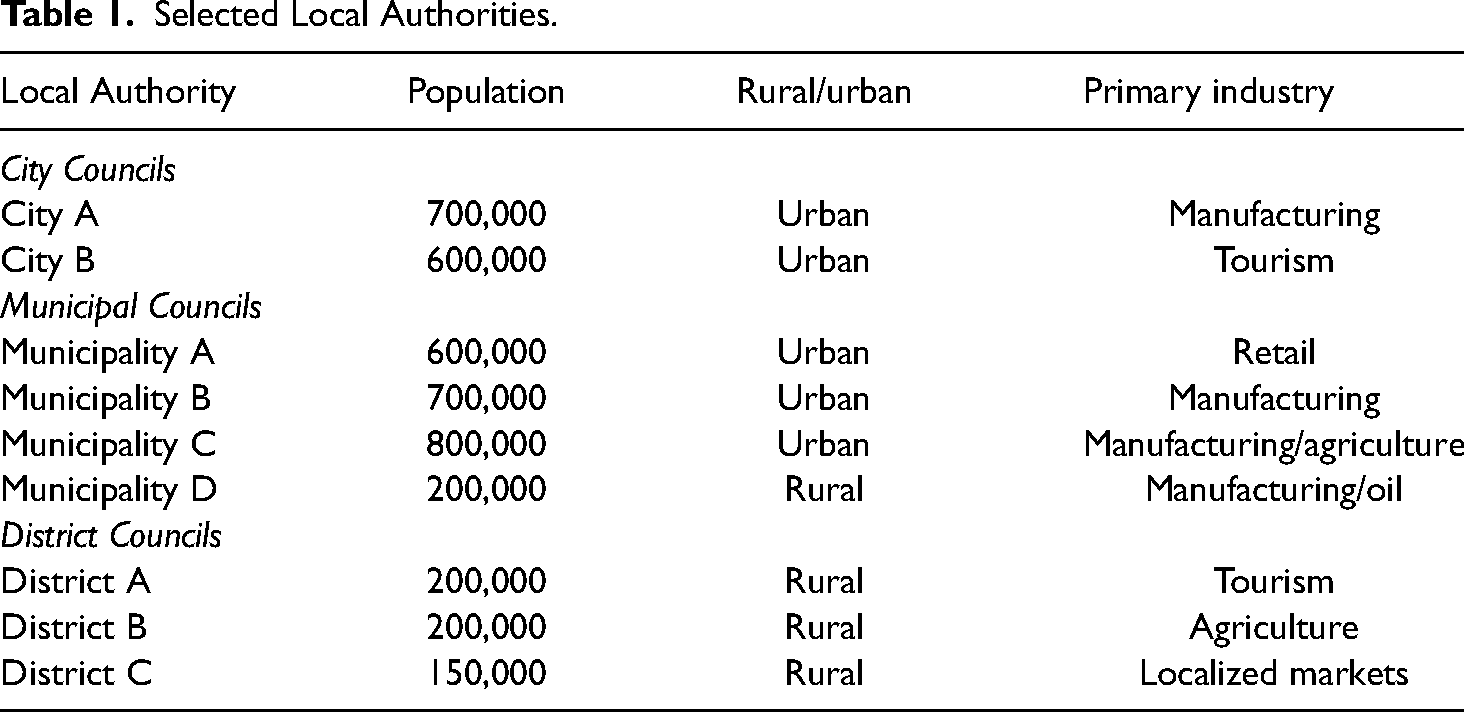
This study adopts a multiple case study method. A purposive and theoretical sampling technique was used in identifying multiple cases for this research. Reflecting the norms of this mode of research (Yin, 2017), nine LAs were selected as the sample. A documentary survey was undertaken to ascertain the local policy contexts and strategic emphases. We examined official documents such as reports on Strategic Planning Workshops, Department Reports, and Annual Reports of LAs. The exercise was used to get “first cut” information on factors motivating the work of the LAs, including indications of external stakeholders viewed as important by the LAs. Our findings focus on the interview data, but our process was underpinned by this prior phase of work. Although this study adopted a purposive and theoretical sampling strategy, it employed a mixture of homogeneous and heterogeneous samples (Patton, 2002), covering all three categories of LAs, and a mix of regions, sizes, complexity and environments, to ensure reasonable representativeness. For ethical reasons we have anonymized the organizations but offer a brief thumbnail profile of each in Table 1 to provide context.
Selected Local Authorities.
The study employed semi-structured interviews. Forty-seven interviews were undertaken in the nine LAs. Participants included the Mayors or Presidents (who also act as CEO); Secretaries (chief administrators); Corporate Planners; and Directors (middle management). Interviews typically lasted for one hour. Coding of the transcripts was undertaken to identify first-order codes and second-order themes in line with the norms of qualitative research (Bell et al., 2019), and we put these in dialogue with our literature review to build our theoretical framework. We now turn to the findings of this process.
Findings: examining six approaches to strategy development in LAs
Our findings identify six strategic management variants. We analyze these in relation to principles of classical public administration (CPA), NPM and NPG. At the Local Government level, strategizing for the prevailing economic grand challenge is somewhat “downstream” from centralized governmental polices and plans and thus possibly less conspicuous than its manifestations in either Federal or State Government strategic activity. Yet these expressions of strategy development are evident, even if more abstract in their contributions to overcoming the wider meta problem. The six approaches adopted by the LAs add to the existing literature on strategic management in public organizations by revealing the characteristics of strategy making that takes place in different contexts. Table 2 sets out each of these in turn, using illustrative quotations from our interviewees, and identifying the key assumptions in each approach to strategy development.
Strategy development in Malaysian local government: approaches and assumptions.
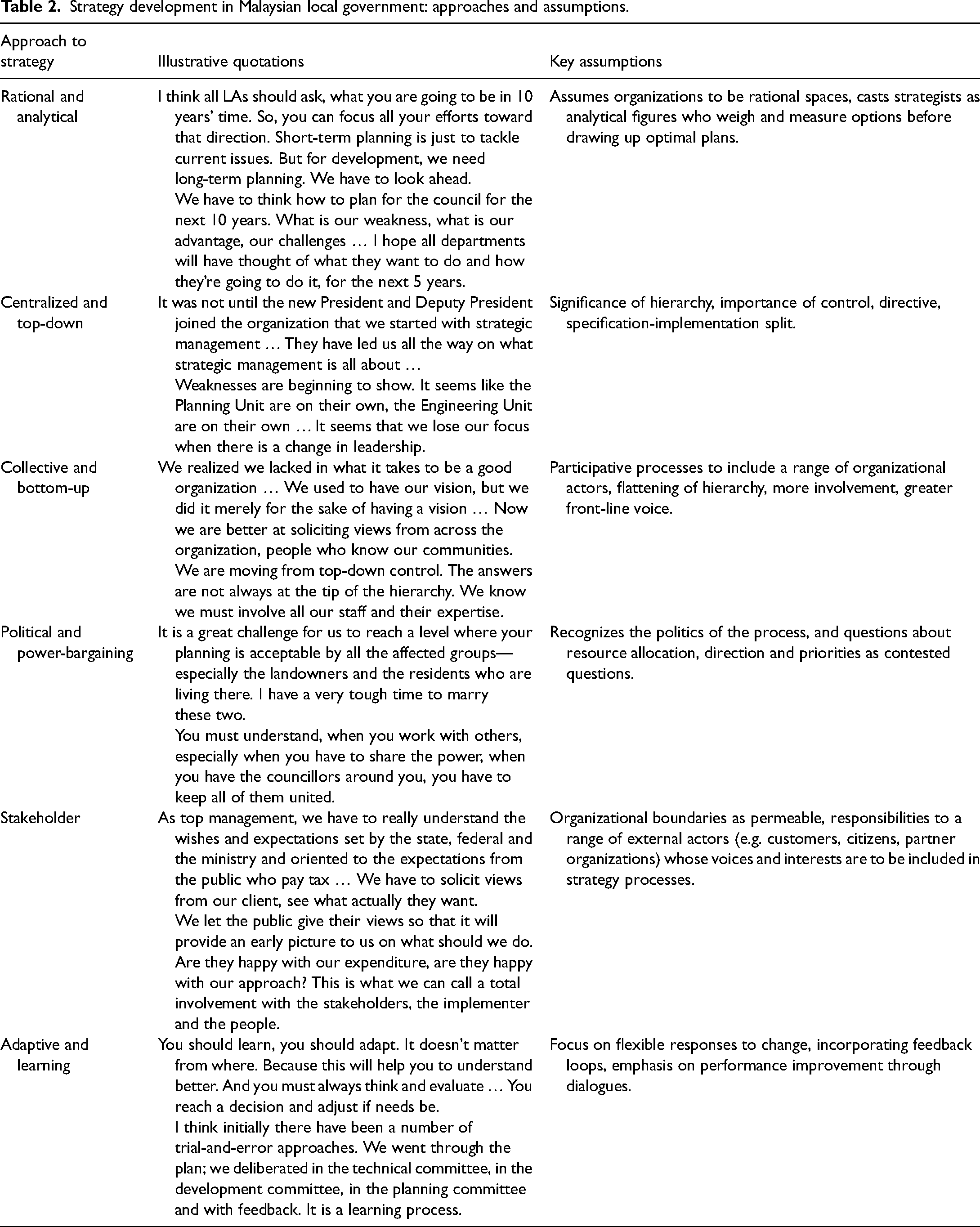
The findings from interviews and documentary review reveal that a number of LAs employed some form of “rational and analytical” approach in formulating their strategies. This involved fact gathering and analysis of the current and future situation before a particular strategy was formulated. It enshrines the importance of linking strategic management to other organizational components. The assumption is that the budgetary process, and the allocation of resources, can become a planned and rational process.
Such views align with the literature that the rational and design approach gives the organization a sense of direction and purpose, preventing it from drifting, tackling merely current issues and concentrating on mundane activities (Favoreu et al., 2016). It emphasizes the possibility of forecasting and planning and of taking an orderly and managed approach to the setting of policy and direction. In these ways it has strong elements of the CPA model but overlaid with NPM ideas about strategy and of the role of managers.
The second dimension relates to who is involved in strategy making and the extent to which this is a centralized or hierarchical process (Porter, 2008). Discussions with various managers suggest that strategies in their organizations took place through a centralized and top-down process. We found considerable data density for this expression of strategy, with examples across all LA types. Our research participants were not uncritical of their experiences of top-down and centralized approaches. They often identified weaknesses. For example, when everything is “dictated and handheld” by the CEO, it creates an element of over-dependency. Thus, when the CEO leaves the organization, people can feel adrift or directionless.
The third finding relates to processes which are driven in more inclusive ways in the organizations—approaches to strategy which are more “collective” or “bottom-up” (Dobusch et al., 2019). Such accounts suggest that strategies in these organizations were shaped by a process of debate and exchange of views among managers. There was less evidence of this among the smaller Districts and Municipalities committed to incremental changes. The reflections depict that different organizational members were allowed to voice and discuss their views with all relevant facts and figures, while at the same time being open to others’ views. They feature the idea of collective discussion and the involvement of different professionals with a range of perspectives.
The fourth dimension of our findings examines the politics and power relations involved in strategy development. In contexts where a public consensus is difficult to reach (Bovaird and Löffler, 2002), political negotiation and power-bargaining approaches to strategy formation emerge. A political and power-bargaining approach to strategy development forms one cornerstone to strategizing in many of the LAs. A number of important strategies in these organizations seemed to have taken shape from a process of negotiation, bargaining for power and compromise among multiple layers and multiple groups.
The stakeholder approach to strategy formation (Freeman, 2010) resembles some elements of the political approach. The basic premise of the stakeholder approach is that the strategies should reflect the demands and needs of various stakeholders within the environment. It contains elements of NPM inasmuch as it focuses on ideas of service users as customers, from whom eliciting feedback is important. Under NPG it takes on an added emphasis and moves closer to ideas of coproducing services and of local voices being on a more even footing with those of professionals. Our data was less dense in this respect. We saw more examples of NPM-type engagement. However, more developed expressions of the principles of NPG were not entirely absent, especially among larger LAs which have more capacity to undertake programmatic consultations, but less so among Districts cleaving to bureaucratic traditions. At minimum, reflections from many respondents suggest a broad acceptance across the majority of our sample authorities that stakeholders’ involvement has helped ensure that their strategies are better aligned to stakeholders’ concerns. The fundamental influence of State and Federal Government casts a shadow over the mapping of more local stakeholder interests.
The final approach that we identify in our data is evidence of an adaptive and learning approach to strategic development, aligning with prior work exploring the advances made by the Malaysian public service as a learning organization (Yusoff, 2005). As the literature suggests, this approach is based on the importance of learning from previous experience, sometimes in ways that carry echoes of the rational and analytical approach. This approach proposes that organizational strategy should be kept broadly formative and subject to review. The practitioners’ discourse involves challenging the status quo and stresses the importance of public managers asking if conventional methods are still practicable, or if newer methods can give better results. It has resonances of the language of NPM, which places emphasis on the performance of public organizations.
Table 3 develops theory in this area by analyzing the approaches to strategy in each of the three governance traditions: CPA, NPM, and NPG.
Comparison of approaches to strategy development.
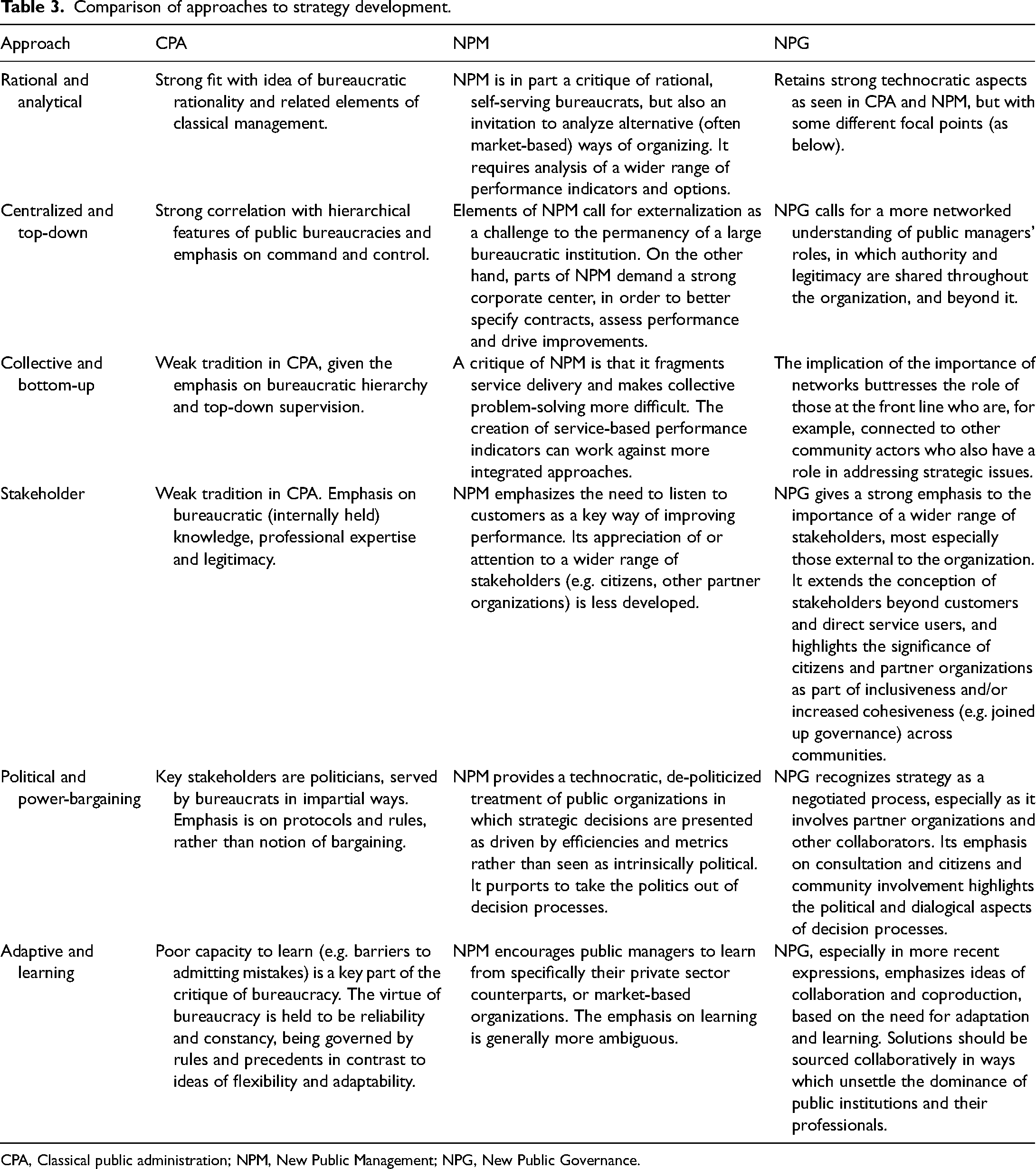
CPA, Classical public administration; NPM, New Public Management; NPG, New Public Governance.
Discussion and conclusion
This article has explored strategic management in local government in Malaysia as the country struggles with transitioning from developing to fully developed nation status. This undertaking is an important one for scholars who wish to understand and appreciate the range of practices in this relatively under-researched context and how strategy is employed as a mechanism to overcome an enduring grand challenge beneath the national level. It also contributes to Roberts’ (2017: 538) call for an increase in “the flow of research from major countries that are inadequately represented in leading journals” and Bice and Sullivan’s (2014) invitation to develop work which helps engage with the “Asian century”. It builds knowledge about the local expressions of wider influences such as NPM and NPG, within a setting which abounds with centralizing legacies.
Returning therefore to the first two of our research questions—“How does the pursuit of successive governance reforms in Malaysia influence public management in local councils?” and “How do these interacting traditions shape local managers’ approaches to strategizing?”—Table 3 shows the dimensions of influence of successive governance reforms in Malaysia on public management, and on strategizing, in local councils. We identify how facets of CPA have been challenged by new practices in ways which recast the roles of bureaucrats (NPM) and widens the networks of actors involved in strategy processes (NPG). Our six strategy schools provide a framework for understanding the relative commitments of CPA, NPM and NPG to concepts such as stakeholders, bureaucracy, markets, legitimacy, participation, collaboration, and organizational learning.
Looking closely at the different approaches to strategic management provides lenses through which underlying assumptions about the role and context of public managers can be viewed. Our study shows an array of different front-line practices in local government organizations. Malaysia presents an interesting illustration of the extent to which different national and local traditions inform management practices and processes. The embrace of “adaptive and learning”, “collective and bottom up”, and “stakeholder” approaches, analyzed in Table 3, is qualified by longstanding centralizing currents. Our evidence supports the idea of the “hybridization” (Bromfield and McConnell, 2021; Dickinson, 2016) of governance practices. In an interpretive reading, it also resonates with the idea of Local Government as a mixture of competing assumptions about how to organize action (Orr and Vince, 2009).
Governance has become a lens through which practitioners are encouraged to understand the context of strategy formation. It highlights the need for collaboration to address wicked or strategic meta problems, manage economic pressures and deliver public services. Resource exchange and the pooling of skills and resources, joining up government and the integration of networks, and building bridges across bureaucratic silos are key features of the NPG narrative. Our study finds considerable evidence of a turn to governance. Nonetheless, the picture is a complex one and practices which enshrine stakeholders, collaboration, and pluralism co-exist with other processes that are more indicative of NPM assumptions, insofar as they rely more on formal authority and less on the resources and interests of different groups beyond the public agencies themselves (Gash, 2016) or social exchanges and mutual interests (Keast, 2016). Moreover, the legacy of strong central and state government and traditions of bureaucratic power also endures in ways which point to significant elements of CPA and colonial legacies. NPG carries the presumption of direct elections, and despite the anticipation of such reform, this remains a glaring absence.
The approaches to strategy development provide a set of models and frames through which local practitioners have come to assess their environment. We have presented the range in six categories. In doing so we do not mean to imply a hard and fast separation, but rather to highlight both the diversity and overlap between the different methods. For scholars interested in assessing the impacts of NPM or the influence of NPG, we see expressions of both. These sit alongside recognizable aspects of strong central control across the Malaysian public sector. In particular those elements of the strategy process which bring to the fore ideas of stakeholders, a plurality of voices and politically nuanced readings of the local environment suggest the emergence of elements of a shift to governance through networks of public and private institutions and actors.
Looking at strategic management processes enables us to discern local politics and practices, and explore the ways in which actors engage with their mission and context, and how they deal with different influences on the management of change. Each of the approaches to strategy development suggests a different local sense of the models, governance processes and role boundaries that may be preferred in particular organizations. We saw in each case examples of NPM philosophies being established and modified by local and national specificities. Here we note that the closed system approach to recruitment may be a barrier to the cross-fertilization of ideas as well as to homogeneity. With the nascent turn to NPG, the significance of state in making key appointments may also influence local actors’ readings of which stakeholders count most.
Finally, regarding our third research question, “What does the case of Malaysian local government tell us more widely about public management and strategy?”, our typology can be used in a broad range of national and local settings to understand the implications that different traditions of public management carry for approaches to strategy formation. It can engage practitioners and policymakers with the potential to adjust practices, and offer a basis for cross-sectoral learning and reflection, including ways of diagnosing contextual variables and developing strategic knowledge about change. Our article contributes to ongoing scholarship which connects strategic management research to public management debates. This study provides a rich picture of local government organizations and a basis for thinking about the interplay of strategic processes and organizational change, including for some practitioners, unlocking new ways of thinking and acting. Contextualized to a nation tackling an economic grand challenge, this study provides value by adding to the limited stock of such knowledge. The findings hold the potential to navigate to disparate settings where public organizations are responding to grand challenges. At this more granular level of analysis, we are able to view how centralized strategic goals are manifest in more localized strategic activity.
Reform patterns in Malaysia have been somewhat incremental and inconsistent. Despite the rise of NPM practices in Malaysia, a Weberian emphasis on bureaucratic career progression, supported by investments in professional training and development, has been maintained. Equally, public employment levels have remained buoyant as part of the consociational approach, perhaps undercutting some tenets of NPM's drive for “efficiencies”. Within this context, however, our research maps the emergent and co-existing reform and management discourses used by public managers as part of the everyday work of strategy formation and implementation. The study shows familiar aspects of NPM and NPG reforms alongside continuing attachments to centralization, elements of protectionism and the distinctive policies stemming from the consociational settlement. Malaysian Local Government provides stories of journeys of change and also significant threads of continuity.
Looking ahead, our study focusses on a limited set of cases from one level of government in a single country. Further research can continue to map the development of governance reform in Malaysia at different levels of government and enhance the basis for building comparative knowledge. Examining other countries which are working through post-colonial legacies seems an especially timely undertaking for public management scholars.
Footnotes
Declaration of conflicting interests
The authors declared no potential conflicts of interest with respect to the research, authorship, and/or publication of this article.
Funding
The authors received no financial support for the research, authorship and/or publication of this article.
