



Abstract
What explains geographical representation in the professional staff of intergovernmental organizations (IOs)? We address this question from an organizational perspective by considering IO recruitment processes. In the United Nations (UN) system, recruitment processes are designed to ensure bureaucratic merit, with experience and education being the relevant merit criteria. We develop and test a supply-side theory, postulating that differences in countries’ supply of well-educated and highly experienced candidates can explain geographical representation. Drawing on staff data from 34 IOs and supply data from 174 member states, and controlling for endogeneity and alternative explanations, we find no such relationship for education. However, countries with a high supply of candidates with relevant working and regional experiences have significantly higher representation values. These findings offer a complementary narrative as to why some countries are more strongly represented in the international professional staff than others. Findings also unveil the nature of bureaucratic merit in the UN, which seems to emphasize local knowledge and working experience over formal (Western) education.
Points for practitioners
What explains member states’ representation in the staff bodies of organizations in the UN system? Previous work has shown that member state power is a good predictor. But what about bureaucratic merit? The paper demonstrates that representation patterns can also be explained when measuring states’ supply of candidates with relevant working and regional experience. Supply of educated candidates plays no significant role. Bureaucratic merit in the UN seems to emphasize local knowledge and working experience over formal (Western) education.
Keywords
Introduction
This paper addresses the geographical representation of United Nations (UN) member states in the staff bodies of 34 intergovernmental organizations (IOs) of the UN system. More precisely, we ask about the factors that explain the distribution of all 31,611 positions in the international professional staff (IPS) of these IOs among their member states. Officials in the IPS are those who usually make a lifelong career in the UN system outside their home country, often by serving in different IOs or at least at different duty stations within one IO. A brief glance at the data reveals that among the 193 member states of the UN, 184 are represented in the IPS. At the same time, many nationalities are only represented by few individuals whereas the nationality of the USA, France and the UK appears most frequently. China and Russia, in contrast, two other powerful permanent members of the UN Security Council, do not even make it into the top 10 list of nationalities. The question therefore is: what determines how many professional IO staff positions a country holds?
Previous studies have found that a range of macro forces explain geographical representation of IPS positions, in particular member state power politics as well as IOs’ concern for legitimacy and functionality (Badache, 2020; Christensen et al., 2017; Dijkstra, 2016; Novosad and Werker, 2019; Oksamytna et al., 2021; Parizek, 2017). However, the literature pays little attention to the administrative procedures conditioning representation patterns, in particular the recruitment processes of IOs. This is mainly due to the lack of data restrictions on individual recruitment decisions (but see Christensen et al., 2017 on the European Union).
Our aim is to address the puzzle of geographical representation from an organizational lens. Such an organizational perspective considers the internal administrative processes conditioning aggregated representation patterns. In particular, our focus is on the recruitment process of IOs. Our analysis reveals that these processes are designed to ensure bureaucratic merit, including a series of competitive applicant examinations and interviews as well as the involvement of multiperson committees in candidate screening and selection. The relevant merit criteria emphasized by the UN are experience and education. Our aim is therefore to develop a complementary explanation of geographical representation by deriving hypotheses postulating that differences in countries’ supply of well-educated and highly experienced candidates can also serve as a standalone empirical explanation of geographical representation.
Similar to previous studies, we execute a statistical analysis of representation patterns at the level of member states. However, we add novel data to test our theory. We find that variables measuring countries’ supply of educated candidates have no particular impact. Yet countries which possess a higher supply of candidates with crucial experience within or around the UN system are more highly represented in the IPS, everything else being equal. Experience refers (1) to previous working experience in the UN system in one of the subordinate staff groups of the UN, the General Service or the National Professional Officers. Moreover, (2) experience can also be of more substantive nature if applicants possess regional experience such as local knowledge about the social, cultural and linguistic context of the regions in which the UN operates. Controlling for endogeneity and a range of alternative explanations, we find that countries with candidates possessing working and regional experience have significantly higher representation values in the IPS.
Our findings are consistent with a functional perspective on representation patterns, but do not necessarily contradict arguments about power or legitimacy. In this way, they do not directly oppose existing explanations but provide a complementary narrative about why some countries are more strongly represented in the IPS than others.
After reviewing the existing literature, this paper proceeds by providing a qualitative comparison of recruitment systems in UN system IOs. We then derive three hypotheses that sustain a merit-based explanation of geographical representation and introduce our dataset and variables. After presenting the analysis and robustness checks, we discuss the findings and provide a brief conclusion of theoretical implications and the academic contribution.
Explaining geographical representation in IOs
There is a growing number of macro-level studies that assess the staffing of IOs, including the geographical representation of member states in IO staff bodies (Badache, 2020; Christensen et al., 2017; Novosad and Werker, 2019; Oksamytna et al., 2021; Parizek, 2017) as well as how IO bureaucrats represent the general populous in terms of their role perceptions and policy preferences (Murdoch et al., 2017). Reviewing the literature, we identify three theoretical arguments about the forces affecting the number of staff positions held by each member state.
First, drawing on a broad body of thought emphasizing member states’ power politics, one expectation is that powerful states seek to have their own citizens working in the IO staff body. Indeed, placing their ‘own’ staff in an IO secretariat is a relatively inexpensive alternative way for states to control the administration and its actions (Stone, 2011). Studies indeed found that powerful states hold a large share of all IPS positions in UN system IOs (Parizek, 2017) and that they maintain ‘national fiefdoms’ (Kleine, 2013) and so-called ‘shadow bureaucracies’ (Dijkstra, 2016) within IOs.
A second explanation links to IO legitimacy concerns. As for any political institution, IOs care about whether they are perceived as legitimate by their constituents, such as member states and their populations. However, owing to IO decision rules, majority constellations and unequal political resources among member states, there has been widespread criticism that IOs are undemocratic and lack legitimacy (Held and Koenig-Archibugi, 2005). It is possible, therefore, that equal geographical representation could ‘operate as a legitimacy enhancer’ (Gravier, 2013: 833). Indeed, many IOs have policies that ascribe to each member state a certain share of Secretariat staff positions (McNulty and Brewster, 2017).
The last dynamic mentioned in the literature is functional pressure. Intergovernmental organizations are bureaucracies and as such should subscribe to established ideals of bureaucratic organizations, including the principle of merit in staff recruitment (e.g. Weber, 1922). In the UN system, the merit principle is even codified in the UN Charter which holds that ‘paramount consideration in the employment of the staff … shall be the necessity of securing the highest standards of efficiency, competence, and integrity’ (Art. 101 UN Charter). Here, scholarly contributions highlight that substantive knowledge about the policy tasks carried out by IOs is considered relevant in IO staff policies. This also includes knowledge about member states, such as their domestic politics (Gravier, 2013). Implementing country operations in particular recruit large numbers of national staff (residents from host countries) who provide crucial local knowledge or soft information to bridge the gap between international policy and the national context (Eckhard, 2020; Eckhard and Parizek, 2020).
Empirical studies vetting these macro dynamics for the UN system are inconclusive. Parizek’s (2017) multivariate analysis of geographical representation among all professional UN staff finds support for all three hypotheses: powerful high-income states are overrepresented, but so are low-income states. This could be explained through both functional pressure and legitimacy. Similarly, Badache (2020) adds to these insights that the adequate representation of countries in the UN Secretariat is crucially determined by countries’ political representation in the IO's key decision-making body as well as by the available local labour pool. Novosad and Werker (2019), who study the geographical distribution of senior leadership positions in the UN system, find support for the power explanation (using indicators similar to Parizek), but not for bureaucratic merit. Oksamytna et al. (2021: 16), however, study 200 leadership appointments in UN peacekeeping and find that, in addition to power-related factors, what ‘the Secretariat considers is leaders’ linguistic and cultural skills’. Finally, drawing on data from the European Commission, Christensen et al. (2017) find that concerns for representation topped concerns for specialist expertise during the EU's enlargement period.
A key concern with the literature is the lack of clarity about the mechanisms sustaining each theory. Working with staff statistics and country-level macro data, few of these studies offer insights into the actual organizational dynamics, such as the recruitment process, or individual level antecedents (but see the above studies on the EU and UN peacekeeping). For the UN system, this means that we do not know whether decisions that build an aggregate pattern of geographical representation are based on concerns about merit, legitimacy or ‘unofficial jockeying’, as Novosad and Werker (2019: 6) suggest. While we cannot offer such individual level data either, we suggest that a macro theory of geographical representation must take into consideration organizational dynamics sustaining the aggregate geographic representation pattern, in particular the characteristics of staff recruitment processes.
An organizational perspective on staff recruitment in the UN system
To complement existing explanations on geographic representation, we offer an organizational perspective that begins by considering the nature of the recruitment processes in UN system organizations. Findings from this organizational analysis enable us to subsequently formulate a ‘supply-side’ theory of geographical representation.
In 2013, the UN system comprised 31,611 staff in the IPS (Appendix 1). For each of these positions, there is usually no lack of supply of candidates. On the one hand, the UN offers an attractive working environment with interesting and politically challenging tasks. On the other hand, positions in the international professional staff are also financially rewarding. In the UN, staff remuneration is based on the Noblemaire principle of 1921, which states that financial compensation of international bureaucrats should be at a competitive level compared with the world's best paid domestic civil service (Ogwezzy, 2016). Working in hazardous countries entitles international bureaucrats to receive additional benefits and allowances. There is hence a high competition about single professional posts in the UN system. According to the UN human resource department, standard entry-level political officer positions regularly receive around 700 applications from all over the world from which the secretariat can select the best candidates. 1
A first important conditioning factor for recruitment processes is whether the staff decision is taken by a central human resource office, which enables more political control, or decentralized, that is, managed by the hiring office or department. We find that recruitment processes in the UN system are highly decentralized. This decentralization can be compared on the basis of three single decisions taken upon individual applications: (a) the shortlisting of candidates for interviews; (b) the recommendation of a group of final candidates; and (c) the final decision on one candidate. A review on this matter by the UN's Joint Inspection Unit found that ‘the responsibility for the recruitment process and selection decisions has been increasingly delegated to the managers concerned, with less direct involvement of human resources management (HRM) officers’ (JIU/NOTE/2012/1, 2012: 3; see also Appendix 2).
The second conditioning factor is about the formalization of the selection process and who gets to decide. In each UN agency, applicants for entry-level positions are vetted through a series of competitive tests (UN Careers, 2015). 2 In addition to the scrutiny of application material, eligible candidates first undergo a written assessment exercise. Short-listed candidates are then invited for one or more competency-based interviews per person or telephone. An interview panel consisting of human resource and/or hiring department officials decides who to recommend for a position. There is usually more than one recommended candidate. The final staff decision is then made by the head of the human resource department or the head of the hiring departments. All candidates who have been recommended are placed on a roster for similar functions. They can be selected for an upcoming job opening without having to undergo the entire application process again. Whoever ends up on such a staff roster thus has succeeded in competitive examinations and interviews by multiperson committees, which reduces the possibilities for systematic outside political influence.
Overall, these insights suggest that the characteristics of the UN recruitment process – high numbers of applicants, decentralized decisions and formalized candidate vetting – value the principles of bureaucratic merit. This does not mean that power politics and legitimacy concerns cannot prevail in single recruitment decisions, but it also seems that those who end up on a staff roster are usually those who came out on top of a large candidate pool through a highly competitive assessment procedure.
Furthermore, according to the UN human resource department, there are three broad merit-based criteria that guide these selection processes. These are ‘experience, education and skills’. 3 These criteria inform the vetting and selection of candidates in each of the three formal steps of the recruitment process. The question thus arises whether we can also explain country-level staff representation patterns based on a theory that assumes these merit-based criteria to be the main drivers for recruitment processes.
A ‘supply-side’ explanation of geographical representation in IOs
In this section we develop a ‘supply-side’ explanation of geographical representation in the international professional staff of UN system IOs. Taking such a supply-side perspective, the question is whether some countries are more likely to have candidates with qualifications in the light of the UN's main selection criteria – experience, education and skills – than others. We next define the three criteria based on insights from expert interviews and discuss whether and how they can be measured in the sense of their ‘supply’ at the country level.
First, experience is understood as the functional demand of a position, such as expertise on performing a certain task. Yet experts highlight that experience mainly refers to whether candidates have previous working experience within the UN system. 4 It is plausible to expect that some countries possess generally more ‘experienced’ candidates than others, for instance, if they host major UN duty stations with many employees.
Second, given major global differences in education standards, it is also plausible to expect that countries differ in the extent to which they possess large numbers of highly qualified and competitive candidates.
Finally, the skillset is also mentioned. Skillset means that two candidates with similar education and experience might be differently capable of completing comparable tasks. Given that we cannot (ex-ante) expect that there are systematic differences in the skillset of people from different national backgrounds that cannot be explained by a country's educational system, we deem the factor ‘skill’ to be more or less equally distributed among all applicants and thus exclude it from the analysis. Otherwise, we must assume that – all things equal – a person from, for instance, the USA might be generally better in performing a given task than a person from France, or vice versa. Remarkably, all available cross-country datasets on people's skills and abilities mainly refer to education-related aspects such as literacy or numeracy (e.g. OECD, 2018).
We next discuss why some countries can be expected to have a higher supply of candidates with education and experience than other countries. We assume that candidates from high-supply countries are likely to complete steps one and two of the selection process more frequently than candidates from low-supply countries, implying that they end up in the pool of candidates on the roster from which final staff decisions are ultimately made. We formulate three hypotheses: H1 refers to education; H2 and H3 cover different facets of experience.
Education levels are generally higher for richer countries of the global north (UN Development Reports, 2016). To qualify for an IPS position, applicants must have a university degree and speak multiple UN languages. Previous research has already shown that education spending positively affects academic achievements (e.g. Greenwald et al., 1996), which is why applicants from richer countries usually exhibit higher educational levels both in terms of the languages they speak and in terms of their chances of achieving a university degree. High education levels should thus lead to higher representation values in IOs’ professional staff bodies. The hypothesis to be tested thus reads as follows:
H1: The higher the education level of country X, the higher the representation of that country X is in the IPS.
We next consider the supply of candidates with major experience. There are two ways in which countries can vary with respect to the availability of candidates with relevant experience. These are regional (H2) and working experience (H3). Regional experience refers to the local knowledge or soft information that IO country operations require to successfully execute their mandate in the environment of a host state (Eckhard, 2020; Parizek, 2017). Applicants from such host countries should have a clear advantage because of their advanced social, cultural and linguistic experience. At the same time, however, UN system IOs are quite concerned about the impartiality of their operations. According to the UN human resource office, individuals in the IPS staff category therefore hardly ever work in their country of origin.
5
In order to still gain local social, cultural and linguistic knowledge, IOs often recruit their staff from those countries in the geographical proximity of a duty station. Candidates from countries surrounding a state which hosts a major UN operation are therefore more likely to be hired on the grounds of their regional expertise. The following hypothesis captures this relationship:
H2: The more IPS staff work in the geographic proximity of country X, the higher the representation of that country X is in the IPS.
The other way in which individuals can gain relevant experience is by accomplishing previous postings in the UN system (working experience). Individuals mainly gain prior work experience in the UN system by serving in one of the two other staff categories of the UN system, the National Professional Officers (NPOs) or General Service (GS). In the 1960s, the UN invented NPOs as a new staff category that only exists at non-headquarters duty stations. Incumbents are per definition nationals of their home country, and their functions must have a national context (ST/SGB/2014/1, 2014, Staff Rule 4.4 (b)). This staff category has been designed to fulfill the demand for local expertise in operational offices (see H2) while still ensuring that leadership positions within IO offices are occupied by IPS who, as expatriates, face a lower risk of being entangled in a local conflict of interests (Eckhard and Parizek, 2020). NPOs make up around 10% of the overall staff in the UN system. The work contracts of NPOs are bound to their duty station; an international career is in fact not foreseen. Another difference is that, on top of their basic salary, international staff receive additional financial benefits and allowances that NPOs are excluded from. NPOs thus have a number of reasons why they should get an IPS position outside their current duty station.
The GS is the other locally recruited staff group. GS staff based at field-level duty stations are predominantly nationals of the host state. 6 GS staff usually perform support functions such as administrative, secretarial and clerical tasks. However, specifically in conflict and in low-income countries, there are few well-paid job opportunities even for individuals who received a first-grade education. This is why highly qualified individuals often end up as interpreters or drivers in an IO office, rather than taking a financially less attractive position in the local economy. Individuals in the GS staff therefore also have good reasons to seek employment in the UN's international staff and the UN system encourages such applications by organizing a central GS/NPO selection exam each year.
Staff in the GS and NPO categories have incentives to apply for IPS positions and their prior experience serves as a competitive advantage in the recruitment process. There are also opportunities to enter the IPS directly through the GS/NPO selection exam. Accordingly, we expect that the number of UN staff in the categories NPO and GS per country directly links to the over- and underrepresentation of member states. The respective hypothesis reads as follows:
H3: The more staff a country X contributes to the GS and NPO staff categories, the higher the representation of country X is in the IPS.
Research design and empirical analysis
In this section, we test whether the identified ‘supply-side’ factors can serve as valid explanations for the representation of countries in the IPS. Here, we apply standard regression techniques. Our dependent variable is the total number of individuals from each member state working in the IPS of 34 UN organizations (for a list of organizations under scrutiny see Appendix 3). The IPS consists of professionals at different career levels (P1–P5) as well as directors (D1–D2), assistant secretary-generals and the secretary general (ST/SGB/2014/1, 2014). IPS officials serve at international duty stations and usually not in their home country.
Our core independent variables are (a) a country's educational level, (b) the number of UN staff in a country's geographic proximity and (c) a country's contribution to the GS and NPO staff categories. The information about both the IPS as well as the NPO and GS staff was collected manually, drawing on the personnel statistics provided by the UN System Chief Executive Board for Coordination (CEB/2014/HLCM/HR/21, 2014; CEB/2014/HLCM/HR/22, 2014). The data is cross-sectional, referring to the year 2013.
To account for the number of UN staff in a country's geographic proximity, we assigned each country to one of the 21 world regions suggested by the UN geoscheme. The countries from Melanesia, Polynesia and Micronesia were grouped together. In a second step, we summed up the entirety of IPS stationed in a particular region. Thereafter, we calculated an individual value for each country by subtracting the number of IPS located in a given country from those stationed in the region. This step is necessary as people in the IPS typically do not work in the country they are recruited from. 7 Because the variable captures social, cultural and linguistic experience in an implementation context, IPS working in headquarters were not included in this calculation.
To assess a country's educational level, we rely on the educational index as provided by the UN Development Programme. This index is calculated by combining the ‘expected years of schooling’ and the ‘mean years of schooling’ for each country (see also our report on alternative education measures in Appendix 5).
There are a number of additional factors that might affect the geographical representation of member states in the IPS, including the target representation formula defined by the UN (see Parizek, 2017). The main components of this formula are (1) the share of financial contributions to the UN System (UN Secretariat, 2017) and (2) the population size (World Bank, 2017a). As specified in a number of resolutions by the UN General Assembly, the share of member states’ budget contributions and their total population size (in thousands) should be the main criteria to determine (and thus explain) a country's level of representation. Also, we control for the overall state investment into international affairs. To assess this aspect, we refer to countries’ total number of diplomatic missions worldwide (Rhamey et al., 2013) and their contributions to UN peacekeeping missions, drawing on the average troop contribution in the 2003 to 2013 period (UN Peacekeeping, 2017). Likewise, it might be the case that some countries are overrepresented in the IPS not owing to their own power and influence but because of the close ties they hold with powerful member states such as the United States or the two former colonial powers Great Britain and France. We use the vote agreement with the United States in the United Nations General Assembly as a proxy for these privileged relationships (Voeten et al., 2009). The British or French colonial heritage is captured by two simple dummy variables. Also, the chance of getting a job in the UN system might be determined not only by an applicant's educational level and regional and working experience but also by the question of whether or not he or she is considered a reliable and trustworthy future employee (Novosad and Werker, 2019). An appropriate country-level variable that might represent such considerations is the Control of Corruption measure of the Worldwide Governance Indicators (World Bank, 2017b). Moreover, the length of a country's membership in an IO might affect its relative representation in IPS. From the perspective of an applicant, it might make a difference whether he or she can use well-established professional networks of national colleagues within the respective IO promoting the application or not. To take this into account, we calculated a country's average membership across all IOs in our dataset. Appendix 4 presents a quantitative summary of our dataset. Lastly, we control whether hosting a UN headquarters affects a country's representation in the IPS. Where possible and meaningful, we tried to combine information from different data sources to reduce the number of missing observations.
Our dependent variable, that is, the total number of IPS by nationality, takes the form of count data, that is, non-negative integer values (y = 0, 1, 2, 3, …). Most appropriately, count data can be approximated by either a Poisson or a negative binomial distribution depending on the degree of statistical dispersion and the question of whether the variability in a dataset fits that expected by a given statistical model. As shown in Appendix 5, the negative binomial model has a better fit and is therefore the more favourable model. The usual problem of zero inflation when dealing with count data, that is, an excessive number of zeros, is not given in the context of our analysis as there are only nine countries – mostly small island states – that have no nationals employed in the IPS category. We hence perform our final analysis by fitting ordinary negative binomial models (Long and Freese, 2001).
The model output of binomial models is the difference between the logs of expected counts. As these are usually difficult to interpret, we recalculated our model output by exponentiating the regression coefficients (the standard errors are reported unchanged). This gives us the so-called incidence risk ratio. The incidence risk ratio indicates whether the chance of choosing one outcome category over a fixed reference group increases or decreases in the case of a unit change in the independent variable. If this value is larger than one, the likelihood increases; if the value is smaller than one, the opposite is true (Hilbe, 2014).
All results of the statistical analysis are displayed in Table 1. Overall, we report five models. Models I–III test for each hypothesis individually. Model IV is our full model and comprises all key independent variables simultaneously. In Model V, we not only include a country's budget contribution and the population size as control variables but explicitly refer to the desirable level of representation for each member state as specified by the rules of the UN Secretariat (e.g. A/RES/65/247, 2011). 8
Determinants of geographical representation in the international professional staff.
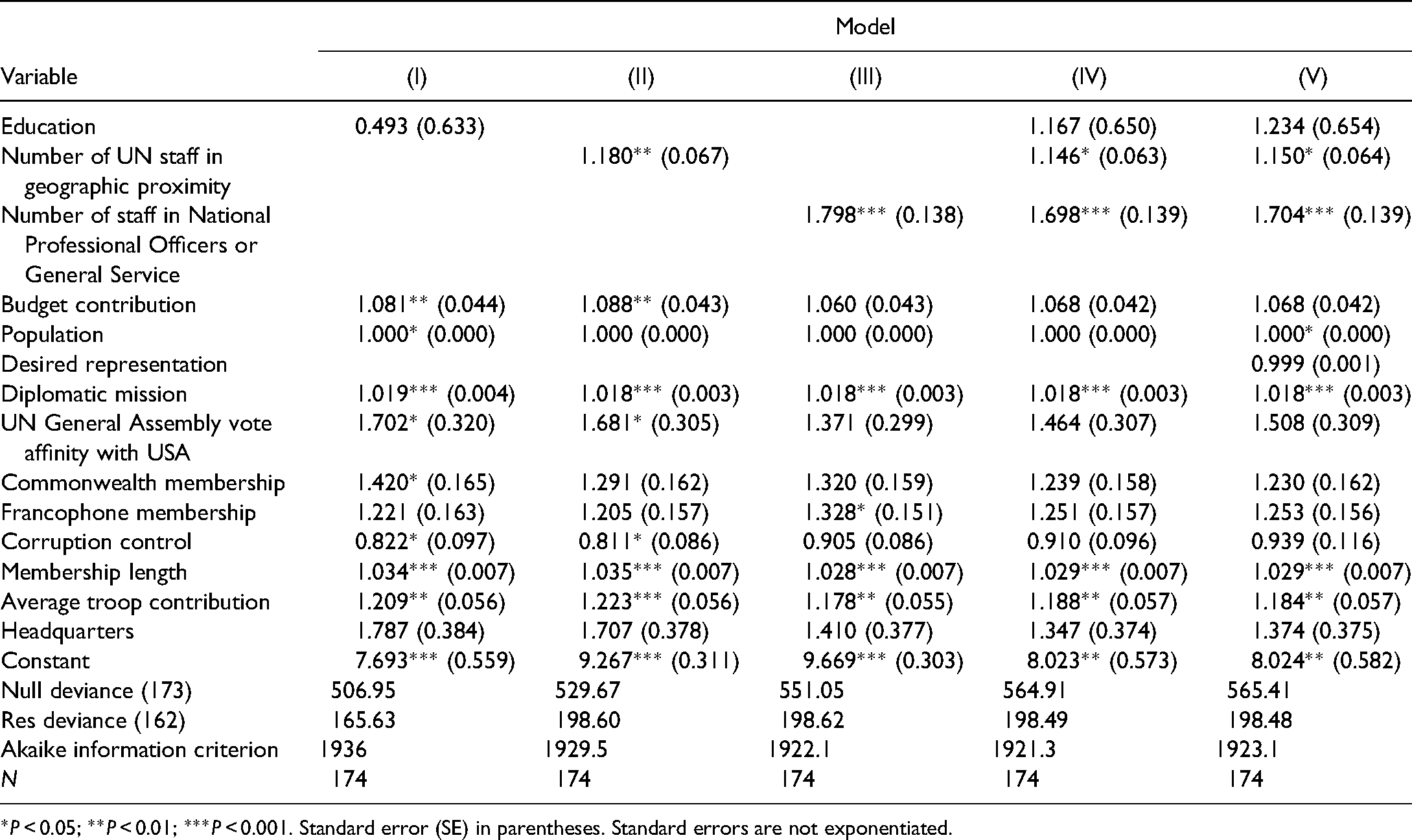
*P < 0.05; **P < 0.01; ***P < 0.001. Standard error (SE) in parentheses. Standard errors are not exponentiated.
The results of Model I suggest that the education variable does not reach levels of statistical significance and nor does the value of the coefficient point in the expected direction. To recap, a value smaller than one indicates a decreasing likelihood that a higher educational level coincides with a stronger representation in the IPS. We thus cannot confirm our first hypothesis (H1). Appendix 7 discusses this finding in more detail and offers an alternative measurement for education that, however, does not lead to a different result.
When turning to our second set of hypotheses capturing the influence of experience, in contrast, we find strong support for our theoretical expectations. More precisely, Model II shows that there is a highly statistically significant association between the number of UN staff in a country's region and its geographical representation in the IPS. As expected, a strong UN presence in a country's region increases the likelihood that a country is strongly represented in the IPS. We can, therefore, confirm the second hypothesis (H2). Likewise, Model III indicates that a country's contribution to the NPO and GS staff categories is positively correlated with the representation in the IPS figures. This provides strong support for the third hypothesis (H3). All of our main results do remain robust if all key independent variables are simultaneously included in the model equation (Model IV). Likewise, it does not affect our key results when the desired level of representation enters the model equation as a distinct variable.
The control variables that show a consistent effect across all models are a country's investment into international affairs, the length of IO membership and the contributions to UN peacekeeping missions. In line with theoretical considerations made above, all of these factors increase the likelihood that countries are stronger represented in the IPS. In addition, Models I, II, IV and V reveal that, in line with the UN's own resolutions, countries’ budget contributions are directly reflected in the IPS figures. The Akaike information criterion indicates that the relative amount of information lost by a given model is smallest in the case of Model IV, implying that the inclusion of our central variables (with the exception of the education variable) indeed improves our understanding of the IPS representation patterns. In Appendix 6, we contrast our models with a limited model that only contains the control variables. Again, the full model provides the best relative fit.
Discussion
Similar to previous studies, we are offering an explanation of geographical representation that rests on country-level macro data. Such analyses typically run the risk of systematic biases, such as endogeneity problems. This is especially the case as we do not work with time-series data and hence cannot ensure that changes in the GS and NPO staff category do antecede changes in the IPS. In consequence, it might be the case that there are some omitted variables that make countries generally more (or less) ‘into’ international matters and thus affect their representation in both the IPS and the GS and NPO staff category simultaneously. To handle this issue, we apply an instrumental variable analysis (discussed and reported in Appendix 9) and control whether the results are driven by distinct organizations (reported and discussed in Appendix 10). Our findings remain robust throughout these additional checks.
We therefore find that the indicators related to regional experience and working experience are positively associated with the geographical distribution of IPS positions in 34 UN system IOs. This indicates that countries with a larger supply of candidates with relevant regional and working experience indeed achieve higher representation values, all other factors being equal. In particular, the variable capturing countries’ supply of candidates with relevant working experience in subordinate staff groups provides the most conclusive evidence. The finding therefore is that a supply-side explanation based on the assumption of bureaucratic merit in the recruitment processes provides conclusive results and a standalone explanation for geographical representation in the IPS.
There are obviously limitations to our study, the most noticeable of which is the need for micro level data to substantiate our reasoning. Moreover, we must admit that we have ultimately been able to perform our analysis on the representation pattern based on 174 out of the 193 UN member states (90%) owing to a lack of data on some of the variables tested. Here, we deliberately opted for the conservative approach of ‘listwise deletion’ given the well-known challenges of alternative approaches such as imputation techniques (Lall, 2017). In addition, we must also note that our analysis does not capture other forms of expertise such as vocational training and related skillsets or other prominent ways to get experience in the UN system, such as internships or the Junior Professional Officer programmes.
Conclusion
In this paper, we offer an organizational explanation of geographic representation that considers the recruitment process of UN system IOs. These processes are designed to ensure bureaucratic merit, in particular to recruit well-educated and highly experienced candidates. Our analysis rejects the education explanation. The main empirical finding is therefore that countries’ supply of candidates with relevant working experience and regional experience serves as a standalone explanation for geographical representation patterns. Bureaucratic merit thus seems to matter in UN system recruitment, in particular for the bulk of regular staff positions at the P-level below senior management. Other factors such as power-related variables, however, matter as well. It is important to note that our findings report macro-level patterns. Such data does not entitle conclusions on individual behaviour and actual recruitment dynamics. It must therefore suffice to state that none of our findings contradict the (unobservable) micro level dynamics that sustain our hypotheses and are supported by the qualitative review of recruitment processes and some anecdotal evidence.
These findings indicate that we must revise our understanding of bureaucratic merit in the UN system. Other than expected, the data do not support a notion of bureaucratic merit that equally emphasizes high levels of education and experience. Instead, our analysis points to experience as the main merit-based criterion of recruitment decisions. Such experience comprises both regional expertise (local knowledge) needed in UN country operations where the bulk of UN personnel work and previous working experience. It is possible that typical (Western) education systems do not deliver this kind of knowledge, which may be the reason why we observe such a pronounced importance of regional and work experience in the UN.
More precisely, because UN country operations seem to be worried about the impartiality of their staff but still need employees who possess local cultural knowledge, candidates from proximate countries in the region appear to have higher chances of making it into the IPS. Furthermore, while there is a lot of competition for individual IPS positions, having prior experience in NPO or GS staff positions seems to constitute a viable career path option. Our findings on the relationship between regional experience and working experience imply that the chances of getting an international staff position are highest when an individual works as national staffer in a region where the UN has a significant regional presence. In such cases, working experience seems to add to the possession of regional experience.
Our findings and interpretation speak to previous studies that emphasize power, legitimacy and functional demand as drivers of representation (Badache, 2020; Dijkstra, 2016; Novosad and Werker, 2019; Oksamytna et al., 2021; Parizek, 2017). Our findings on staff mobility and regional experience are generally in line with the functional perspective: being from a country or region where the UN has operational presences and having worked in one of the subordinate staff groups seem to increase the chances of getting a permanent position in the IPS. Findings are also in line with the legitimacy perspective, because the IO leadership can partially influence mobility between staff groups by regulating which nationalities are accepted for the annual central selection exam for GS and NPO. The statistical analysis also finds that some of the power variables predict representation values. Yet the question for future research will be whether power plays out in the form of lobbying and unofficial jockeying, or within the framework of prevailing merit rules. For example, the UN's Junior Professional Officer programme enables candidates from richer (and more powerful) member states who can afford to finance such positions to gather working experience in the UN. Note that no statistical data on such positions exist, which is why they are not in our analysis. Novel empirical research strategies such as temporal analysis (for instance recently Parizek and Stephen, 2021) and data are required in order to judge the actual causal mechanisms at the level of individual recruitment processes more comprehensively.
Supplemental Material
sj-docx-1-ras-10.1177_00208523211031379 - Supplemental material for Staff recruitment and geographical representation in international organizations
Supplemental material, sj-docx-1-ras-10.1177_00208523211031379 for Staff recruitment and geographical representation in international organizations by Steffen Eckhard and Yves Steinebach in International Review of Administrative Sciences
Footnotes
Acknowledgements
For research assistance and feedback on earlier versions of this paper, the authors would like to express their gratitude to Jens Mattmüller, Alexa Lenz, participants of the ECPR general conference section on international organizations, members of the DFG research unit ‘International Public Administration’, and three anonymous reviewers.
Declaration of conflicting interests
The author(s) declared no potential conflicts of interest with respect to the research, authorship, and/or publication of this article.
Funding
The authors received no financial support for the research, authorship and/or publication of this article.

Notes
References
Supplementary Material
Please find the following supplemental material available below.
For Open Access articles published under a Creative Commons License, all supplemental material carries the same license as the article it is associated with.
For non-Open Access articles published, all supplemental material carries a non-exclusive license, and permission requests for re-use of supplemental material or any part of supplemental material shall be sent directly to the copyright owner as specified in the copyright notice associated with the article.
