



Abstract
Integrative strategic management for urban regeneration involves reconciling conflicting demands and translating abstract concepts into concrete actions. This article examines how public-sector strategists address these dilemmas by developing a dynamic perspective that helps in understanding how they ‘strategize’. This perspective was applied to two urban regeneration projects in Gothenburg (Sweden) and Antwerp (Belgium). Our findings illustrate how actors strategize at different locations and times, putting middle-management strategists, in particular, on the horns of a dilemma. Acting quickly through establishing experimentation spaces could result in innovative outcomes, but politicians and local residents may feel bypassed; however, waiting until strategic visions are translated into detailed actions may eventually result in no action at all. This article helps us understand the disconnect between planning, implementation and performance in strategic management.
Points for practitioners
Public-sector strategists have to overcome conflicting demands in urban regeneration projects and translate ambitious visions into actions. As strategists' actions can drift from the original goals, they have to regularly reflect on the contribution of actions to the vision. Middle managers, in particular, have to be careful: their leeway can lead to innovative actions but can also clash with initial goals. Finally, living labs – used to implement the strategy at a small scale – should not become detached from the broader urban regeneration project.
Introduction
Public organizations, such as local governments, increasingly draft visions and strategies for their future (Ferlie and Ongaro, 2015; Rosenberg Hansen and Ferlie, 2014), a development prompted by new public management (NPM) reforms (George et al., 2019; Johnsen, 2021). These vision and strategy documents, often approved across organizational boundaries in response to ‘wicked problems’ such as sustainability (Head and Alford, 2015), tend to be abstract and encompass conflicting demands (Brorström, 2020). This trend has also been acknowledged by post-NPM movements, such as new public governance (Osborne, 2010), which emphasize cooperation, collaboration and community engagement by increasing interaction between sectors (Torfing and Triantafillou, 2013). Klijn and Koppenjan (2020) recently argued that this has entailed an increased complexity for public organizations that requires new forms of leadership and strategizing.
In this article, which considers how public-sector strategists at the middle-management level respond in practice to conflicting demands, we investigate how two local governments moved from strategic intentions to action in two urban regeneration projects. Urban regeneration projects typically encompass conflicting demands related to social, economic and environmental goals, such as improving residents' quality of life, promoting sustainability and increasing housing prices (Albrechts, 2006; Frantzeskaki et al., 2014). Urban regeneration projects thus encompass various policy domains, such as housing, transportation, social welfare and urban drainage. Research has so far focused on identifying institutional and organizational barriers to integrative strategic management. To illustrate, Mawson and Hall (2000) noted that departmental ‘silos’ give rise to institutional fragmentation, in which each policy domain defines its own ambitions and approaches. However, integration between these domains is considered necessary (Frantzeskaki et al., 2014) because it can contribute to synergetic effects (Rode, 2019). The task of strategists in public organizations becomes one of facilitating integration between departmental silos and policy domains.
To focus on the practice of integrative strategic management, we adopt a dynamic perspective that considers strategic management as an ongoing activity undertaken by actors who may have different motivations (Candel and Biesbroek, 2016; Rouleau, 2005). Strategic work is not something that necessarily leads to integrative urban regeneration, but rather a continuous and contested practice, in which actors at all levels of an organization are integrating (or disintegrating) strategic agendas (Carter et al., 2010). We adopt this perspective on strategic management because it has rarely been operationalized until now. To illustrate, Bryson et al. (2010) advocated studies of how pluralistic and ambiguous ambitions are addressed within strategic management in the public sector. Likewise, George (2017) argued that to understand public-sector strategic management, we must understand the people ‘doing’ the strategic work. In this article, we advance this discussion by examining strategists who experience conflicting demands regarding strategic management on a daily basis in their work, essentially considering how these individuals are ‘strategizing’.
Consequently, this article strives to understand how strategists integrate or disintegrate policy domains in order to realize integrative urban regeneration projects. Our research question is: how do public-sector strategists integrate policy domains in urban regeneration projects and what are the outcomes of doing so? We will address this question through a comparative case study of two regeneration projects in Gothenburg (Sweden) and Antwerp (Belgium). The reason for focusing on these two cities is that in both cities, local governments articulated ambitious aims, for example, regarding social sustainability, climate adaptation, mobility and renewable energy. The two cities are regarded as international front-runners in urban regeneration, as seen, for example, in the several awards that the local city planning offices have won, from which other cities can learn. As we were able to follow both projects for a longer period of time, these cases allowed us to explore in depth how key actors attempt to connect and manage ideas and interests in order to change institutions and develop strategies for advancing their projects. We thus contribute to the literature on strategic management and public administration by showing how public officials are ‘strategizing’ in a context of conflicting demands. Following Bryson et al. (2010, 2018), this demonstrates the (dis)integration between strategic planning and implementation, and hence will lead to an improved understanding of the performance of strategic management. These insights enrich the practice of urban regeneration, as they demonstrate the agency of individuals to overcome institutional and organizational barriers in integrative strategic management.
The article is structured as follows. The second section presents the theoretical framework and operationalizes our practice-centred perspective on strategic management for urban regeneration. The third section introduces the case studies and discusses the data collection and analysis. The fourth section presents and compares the case-study results. The fifth section discusses the results, relating them back to theory. The sixth and final section presents the conclusions, limitations and avenues for future research.
Theoretical framework
Strategic management as activity: doing strategy
Strategic management encompasses both the formulation and implementation of strategic planning (Bryson and George, 2020). Ferlie and Ongaro (2015) claimed that when adopting a strategy, different parts of an organization adopt it differently, and actions based on the strategy will thus vary. However, little empirical research has examined in detail how public-sector strategic planning is connected to implementation and performance (Bryson et al., 2018), making it important to understand how individuals experience integrative strategic management. This generates discussion of the role and impact of strategic planning in the public sector. So far, most studies of strategic management have applied a static conception, assessing whether or not integration has been achieved (Candel and Biesbroek, 2016; Tosun and Lang, 2017). Conceiving of strategic management in terms of the verb ‘strategizing’ instead emphasizes the everyday activities of actors. The insights gained from this approach could improve strategic planning processes, which would be expected to improve public-sector performance (Lee et al., 2018).
Recent advances in strategic management offer several clues to operationalizing a dynamic perspective, notably, the strategy-as-practice (SaP) perspective. This viewpoint considers strategy as something an organization does and not something that an organization possesses (Whittington, 1996). Golsorkhi et al. (2010: 1) argued that the SaP perspective can be seen as an alternative to ‘mainstream strategy research’, emphasizing the effects of strategies on performance and standing for a ‘more comprehensive, in-depth analysis of what actually takes place in strategic planning’. From this perspective, strategy involves: ‘practitioners (people who do the work of strategy); practices (the social, symbolic and material tools through which strategy work is done); and praxis (the flow of activity in which strategy is accomplished)’ (Spee and Jarzabkowski, 2009: 2). From this starting point, Jarzabkowski et al. (2007: 7–8) defined strategy as: ‘a situated, socially accomplished activity, while strategizing comprises those actions, interactions and negotiations of multiple actors and the situated practices that they draw upon in accomplishing that activity’.
Operationalizing a practice-driven take on strategic management
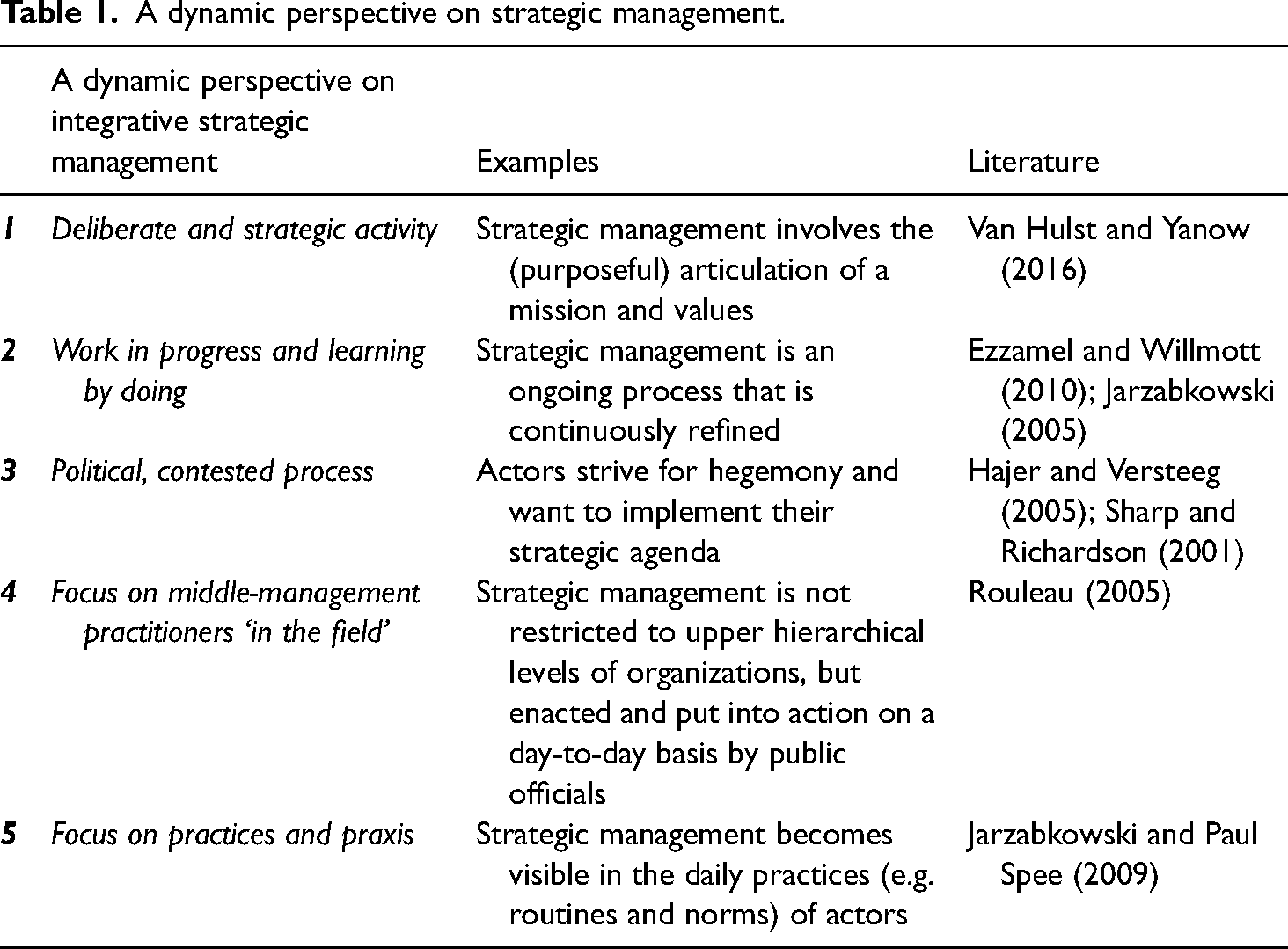
Based on insights from SaP, we operationalize integrative strategic management for urban regeneration as comprising five elements. First, the integration of policy domains for urban regeneration is considered a strategic activity in which actors deliberately decide to choose policy integration through creating new structures or through continuing or disrupting established structures (Lawrence and Suddaby, 2006).
Second, strategic management is a ‘work in progress’ (Ezzamel and Willmott, 2010), since there is uncertainty about where it will end up (Begkos et al., 2019). For example, activities intended to have strategic outcomes might not be strategic, and vice versa (Jarzabkowski, 2005). Similarly, Johnsen (2018) claimed that ‘strategic knowing’ does not always translate into ‘strategic doing’, and George and Desmidt (2014) argued that it is important to understand the strategy-formulation process in order to understand the outcomes of strategy. Therefore, strategizing has been seen as ‘wayfinding’ (Hutchins, 1995) in order to construct new pathways to elude socially situated problems (Chia and MacKay, 2007). This also means that organizations become successful not necessarily because they have predefined strategies, but because strategic actions emerge (Chia, 2013).
Third, and building on the previous point, SaP research acknowledges concern for the embedded nature of human agency within strategy work (Vaara and Whittington, 2012). This means that the actors (i.e. the strategy practitioners) involved in strategy work have other interests than simply fulfilling the aims of the strategy, and that the process of strategy formulation can be an arena for power struggles and negotiations between different interests (Brorström, 2020). As a result, integrative strategic management becomes a political, contested process in which different actors may strive for hegemony (Sharp and Richardson, 2001).
Fourth, SaP is predominantly concerned with practitioners in the field. While classic strategy research has assumed that top managers are the most important actors when it comes to formulating and realizing strategy (e.g. Finkelstein et al., 1996), more recent accounts of SaP have acknowledged that, for example, middle managers are equally important in both formulating and realizing strategy (Elliott et al., 2020; Mantere, 2008).
The fifth and final element of practice-driven research concerns its focus on practices and praxis, that is, how practices are embedded in wider institutions (Jarzabkowski and Paul Spee, 2009). Practices can become visible in tangible artefacts, such as shared accounting devices (Denis et al., 2006).
Table 1 offers a theoretical lens for looking at strategizing in the interest of urban regeneration. The five elements – such as strategic activity (Albrechts, 2006), learning by doing (Frantzeskaki et al., 2014) and the political dimension of strategizing in the context of urban regeneration (Rode, 2019) – have often been discussed individually. In this article, we approach the five elements together and comprehensively. These five elements together create an analytical framework that is used as a guide to assess the two case studies of urban regeneration in Antwerp and Gothenburg.
A dynamic perspective on strategic management.
Methodology
The analytical framework presented in Table 1 has been translated into an interpretive research strategy in which we compare two cases of urban regeneration. Case-study research offers an opportunity to acquire in-depth knowledge (Vaara and Whittington, 2012) due to its sensitivity to differences between contexts. This allows us to gain a deep understanding of how, why and with what outcome public-sector strategists at the middle-management level address conflicting demands in strategic work.
Case-study comparison of Gothenburg and Antwerp
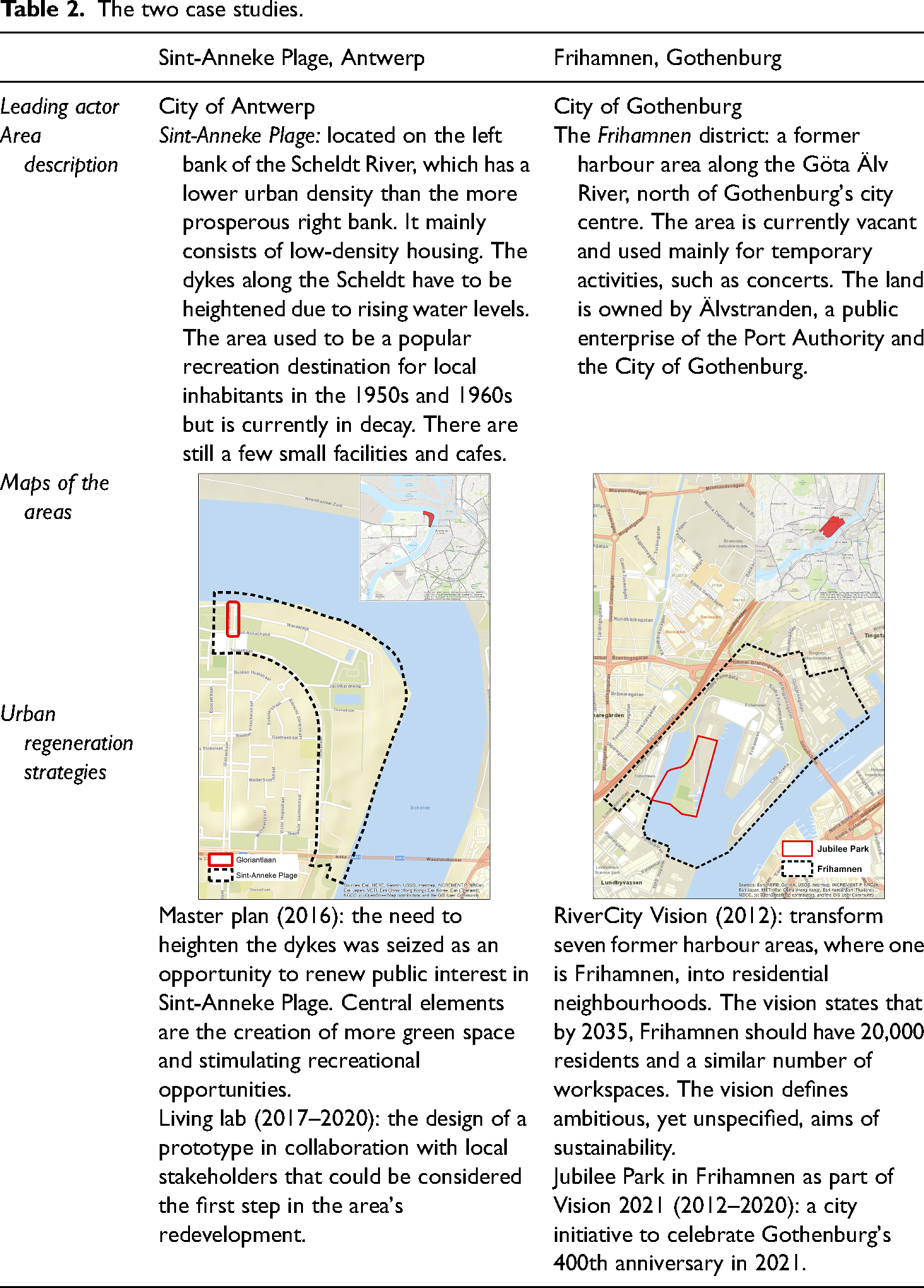
Our case selection of two urban regeneration projects in Gothenburg and Antwerp is an informed one (Flyvbjerg, 2006). The two cases can be considered international front-runners, with ambitious aims regarding housing, climate adaptation and social cohesion. For example, the project in Gothenburg won two international prizes and one Swedish prize for its innovative and inclusive planning model. Antwerp is internationally known for its innovative water and urban planning (e.g. City of Antwerp, 2010). Consequently, in both cases, we would expect to see integrative strategizing activities involving various municipal domains and stakeholders. Table 2 introduces the two studied cases.
The two case studies.
Data collection and analysis
Insights into how the studied public-sector strategists put strategic objectives into action and managed conflicting demands have been acquired through three steps of data collection. First, in-depth interviews were held with key individuals involved in the projects. These individuals, operating at the middle-management level, were identified through exploratory talks with the project leaders in both cities and through snowball sampling. In Gothenburg, a collaborative organization, containing involved municipal departments and corporations, was created after the adoption of the RiverCity Vision in 2012. This ‘RiverCity Organization’ consists of a steering committee, a project management group (recently replaced with a portfolio office) and seven city development projects, of which Frihamnen is one. Interviews were conducted with key individuals at these levels, as well as with project leaders and team members. Between 2018 and 2020, 22 interviews were conducted, in which Frihamnen was a specific topic of inquiry. In Antwerp, six interviews were conducted with the Sint-Anneke Plage team and with managers of the involved departments. Accordingly, we have accounted for different levels within the government (e.g. management, middle management and advisors) and for different municipal departments involved in the two urban regeneration projects. Second, participatory observations were conducted during meetings and events. In Gothenburg, the steering committee meetings, project management group meetings and, more recently, portfolio office meetings in which Frihamnen was discussed were observed between 2018 and 2020, for a total of about 130 hours of observations. These observations were intended to verify the interview findings. In Antwerp, we attended meetings of the project team (2018–2020) and events with external stakeholders, such as the ‘Design Sprint’. Third, the interview and observation findings were triangulated through an analysis of internal documents (e.g. plans, evaluations, roadmaps and progress reports) in both cities and of short questionnaires administered to stakeholders concerning key events in Antwerp.
The interviews served as the primary data source and have been central to our analysis. For each case, interview transcripts were coded to identify the strategic activities that stake-holders have undertaken, using the five elements (see Table 1) as family codes. The analysis was first executed per city to develop an understanding of the strategic activities, and then the two cities were compared. The five elements (see Table 1) helped us understand the difficulties experienced by the interviewees in moving from objectives to action and allowed for systematic comparison of the two cities. The insights gained were verified in light of the fieldwork notes on the observations.
Results
In both cases, strategic activities preceded the urban regeneration projects. In the RiverCity Vision (City of Gothenburg, 2012), Frihamnen is mentioned as especially important for the future due to its location in the city centre and its three piers in the Göta Älv River. Frihamnen had previously been part of Gothenburg’s shipyard and the port of entry for the import of, for example, bananas to Sweden. For some time, however, the area has been empty, used only for temporary activities, such as go-kart racing and concerts. The RiverCity Vision stated that the area should be ‘inclusive’, and social sustainability was highlighted as the most important strategic objective of the Frihamnen project, though this remained unspecified in concrete terms.
In Antwerp, the City Council has been drafting strategic plans for the left bank of the Scheldt River since the 1970s, for example, the Sigma plan covered flood protection, nature development and urban regeneration. As an important part of the left bank, the Sint-Anneke Plage area has its own master plan (City of Antwerp, 2016). This strategic plan emphasizes, on the one hand, improving flood resilience and, on the other, improving local socio-economic conditions. Civil servants framed the area as a somewhat neglected neighbourhood that used to be a popular destination for recreation. The left bank consists of low-density housing, with a high proportion of green space. Along the Scheldt, there are several recreational facilities, such as a small marina, a beach and a swimming pool, as well as a few cafes and restaurants. According to interviewees, these facilities are slightly dated and require refurbishment. The strategic activities undertaken for Frihamnen and Sint-Anneke Plage will be analysed in terms of the five elements outlined in Table 1.
Deliberate and strategic activity
At an early phase in Frihamnen, interviewees described the project as a ‘flagship’ that would set the standard for future neighbourhoods in terms of, for example, housing, renewable energy, new mobility patterns and climate adaptation. Furthermore, it was proposed that the area could be used while the future residential area was being planned. This idea was arguably based on the idea of social sustainability, that is, involving people in all phases of planning, but also responded to the idea of being a ‘test bed’, which was interpreted in Gothenburg as trying out innovative ideas. One of the two Frihamnen project leaders said: ‘It [i.e. Frihamnen] is a test bed – if we are going here [i.e. realizing the vision], then we need to experiment. If it does not work, then we will have to find other ways.’ This led to the start of planning the Jubilee Park in the heart of Frihamnen, which would become a large park marking the city's 400th anniversary. In the development of the park, place-building activities were organized to involve residents as much as possible in jointly ‘building’ the place.
In Antwerp, the activity started in the Sint-Anneke Plage area was inspired by the objectives of flood protection, socio-economic development and citizen engagement. Interviewees described the aim as regaining the area's attractiveness, making it once again an area appealing to citizens. The master plan envisioned an open and continuous park consisting of a river dune landscape around the existing facilities, making them more appealing and improving local economic activity. The park would also become more multifunctional, being used for water storage and related climate adaptation measures. The plan finally reconsidered existing transportation arrangements, recommending the removal of several car parks and the closure of roads. The interviewees argued that the strategy built on existing values for the area, while simultaneously incorporating new ones to make the area more sustainable. Some interviewees leaned towards creating a new area (i.e. a new landscape with more green elements), while others emphasized the need to protect and sustain existing facilities and local businesses. As realizing the plan could take some time, the municipality established an urban living lab in which part of the plan could be tested and validated with high levels of stakeholder engagement in a short time.
Work in progress and learning by doing
As indicated earlier, strategic work in the two cities included testing different ideas under the labels ‘test bed’ and ‘living lab’. In Frihamnen, this resulted in a sub-project with two leaders whose task was to manage place-building activities in the planned Jubilee Park. The project team experimented by creating different prototypes to determine what would and would not work. By framing the project as ‘Jubilee Park 0.5’, its temporary character was emphasized. After citywide consultations, the project team defined five themes for which prototypes would be developed. Open calls were made, inviting architects and artists to develop proposals for prototypes for specific themes through participatory art-making. For example, local residents wanted a swimming pool in the city, which the project team defined as the ‘bathing culture’ theme. Through an open call, a small Spanish architecture firm developed a sauna in Frihamnen, the construction of which consisted of activities in which local residents could participate. Accordingly, the prototype creation helped introduce the area to residents and, as the project team put it, ‘activate the place’. The idea was that all citizens of Gothenburg would be able to visit the future park, sauna and pool.
In Antwerp, the master plan was developed by the Urban Development Department of Antwerp City Council. The department then started a living lab in 2018 to work towards achieving tangible results. By positioning the plan in a living lab, the project team deliberately targeted more ‘out-of-the-box’ thinking. The living lab was presented as an experiment to show residents, businesses and councillors what the neighbourhood might look like when more natural aspects were incorporated and how the neighbourhood would attract more visitors again. As such, the lab was an ‘appetizer’ for the larger master plan, demonstrating in the short term the potential of the area. The Urban Development Department team used the living lab as a strategic element to convince local stakeholders.
Political, contested process
While the projects were being managed locally by the project teams in the two cities, they were also being discussed at the managerial level. In Gothenburg, the steering committee of the RiverCity Organization repeatedly discussed Frihamnen when the project started to face financial problems. In late 2017, these financial troubles caused the steering committee to cease all planning activities. The financial situation was said to have arisen because the soil was more contaminated than expected, making it much more expensive to develop housing than initially anticipated. This was discussed at the political level: the politicians required answers as to why the project had been stopped and why the contamination had not previously been discovered. Interviewees blamed the collaborative model of urban planning, and one city manager said: ‘The planning department has too much power without being responsible for budgeting costs for preparing land for housing. That was what happened in Frihamnen: during the implementation of the plan, we realized we couldn’t afford it.’
In Antwerp, Sint-Anneke Plage was also on the agenda of the managers and politicians. By including novel elements, the master plan team deliberately sought to put the future of Sint-Anneke Plage on the agenda. The strategic plan for the area immediately triggered discussion and was met with opposition from local businesses and politicians. Although the plan had been developed in response to complaints from local businesses, these businesses were afraid that removing roads and car parks from the river dune landscape would make the area less accessible and, hence, less attractive. This fear was also voiced by local politicians. As one civil servant explained, politicians were torn between two considerations:
On one hand, local politicians are putting their money on the liveable city – a city has to be green, liveable, with good air quality and cycling opportunities. On the other hand, politicians are afraid that this will scare citizens, so a lot of attention continues to be paid to car mobility and car parking.
This process was further complicated by the test-bed function. To facilitate the living lab, the Urban Development Department invited the participation of the municipal CityLab2050. This unit had previously successfully run similar projects in other parts of Antwerp. CityLab2050 used its social network to bring together an enthusiastic group of people representing design agencies, consultancies and non-governmental organizations, who would develop creative ideas for redeveloping Sint-Anneke Plage. During a participation week in late 2018 (called the ‘Design Sprint’), the team worked from ideation to prototype development. Local stakeholders were largely excluded from this process because they had been allowed to voice their opinions during previous consultation rounds. Local stakeholders were instead asked to provide their views on the prototypes developed by the living lab participants. Consequently, the broader master plan remained somewhat disconnected from the specific Sint-Anneke Plage living lab. In particular, according to interviewees, the external experts displayed limited affinity with existing values in the area. Some interviewees described the living lab as not doing justice to local voices, highlighting that its participants were less connected to the area. Meanwhile, the project team behind the living lab emphasized innovation and creativity, spurred by these same participants.
Focus on middle-management practitioners ‘in the field’
Over time, conflicting demands as to what to include in planning Frihamnen, as well as financial constraints, made the strategists' role unclear, as one thing was happening at the managerial level and quite another at the project level. For the project leaders, these different demands made their task difficult, and they described in interviews how they needed the managers to set priorities. However, decision-making in the steering committee was slow and based on the idea of consensus, which was difficult to attain in practice. In interviews, project leaders described how the steering committee made them responsible for resolving issues for which they lacked the decision-making mandate, as the response of the managers on the steering committee was often ‘you solve it – you know best’. The upside was that the place-building team responsible for ‘Jubilee Park 0.5’ had freedom to develop their innovative ideas, and the project was generally seen as a success because the sauna and swimming pool were well used and fully booked. The downside was that the strategists felt uncertain about their role, while, at the same time, feeling pressure to make things happen.
In Antwerp, after approval of the master plan in 2016, the Urban Development Department team started to formulate a new land-use plan for the area. Extensive participation rounds with local businesses were organized in order to incorporate their concerns, and the land-use plan was presented in 2019. The team had difficulty securing funds for plan realization because of political opposition. The cumbersome process had given rise to scepticism on the part of local stakeholders, who wanted to see a more moderate, realistic plan that would secure their business interests. Civil servants leading the project at the middle-management level were also not satisfied with the progress. The project team tried to incorporate citywide ambitions regarding green elements into their project, but their ideas were met with opposition. For example, local businesses feared that transforming a car park into a park would lead to fewer visitors. Also, local politicians complained when a video posted on a local Facebook page by the project team overemphasized, in their opinion, the green elements. Instead, they wanted to highlight how the interventions would bring socio-economic development to the area. As a result, middle management felt torn between the two sides. They had to bring together conflicting values – that is, development versus conservation, and long-term versus short-term interests – about which they received contradictory signs from politicians and upper levels of government. The middle managers struggled to bring together these different values.
Focus on practices and praxis
The political interest in the projects meant that it became important to demonstrate progress. At Frihamnen, there seemed to be two parallel stories of the development: the first, a story of financial problems and delays at the managerial level; and the second, a success story of citizens who could now go swimming in the city centre at the ‘action level’. These two levels seemed decoupled from each other, though they overlapped at some points. The upside of this decoupling was freedom for the project leaders, and when they found their own funding and forged their collaboration, they could create their own action space. Now, with Gothenburg celebrating its 400th anniversary, only the Jubilee Park prototypes have been realized. These prototypes are only temporary and are to be incorporated into the final Jubilee Park. Since the project has been delayed, this is unlikely to happen as scheduled. The initial place-building process will eventually stop but may continue as long there is no real estate development.
The learning-by-doing approach adopted by Antwerp City Council, through initiating a living lab, has paradoxically led to divergence in practices. External experts were hired to develop new plans for the area within the living lab context, and this group of stakeholders adopted their own practices, as seen in new participation techniques (e.g. the ‘Design Sprint’) and a progressive discourse. Meanwhile, regular practices such as the ongoing consultation process continued, giving voice to different groups of stakeholders (e.g. local businesses and residents), who were generally more conservative in outlook. Consequently, the project team had difficulty linking the living lab with the ongoing participation process, as the two groups of stakeholders had developed limited shared practices. Although different strategies (e.g. a master plan and a living lab) were developed for comprehensive urban regeneration, the actual practices were less integrative and followed two somewhat disconnected tracks.
Comparison
In both cities, similar strategic objectives were based on the ideas of sustainability and creating new solutions through innovation. It is obvious that the strategic intentions formulated in the RiverCity Vision and in the Sint-Anneke Plage master plan incorporated conflicting elements to be addressed by managers at lower levels. Yet, it is also apparent that abstractly formulated intentions require sufficient space for action. That action quickly occurred was partly a result of the pressure to act felt by the strategists, even without managerial-level support as to what action to take. The strategists found that they were responsible for acting, even though they did not have the mandate or budget to do so. The risk here, as in Frihamnen, was the later discovery of no financial resources for the planned action. This duality signals a ‘catch-22’ in acting strategically: acting fast might get some results, but at a later stage, these might create problems and political disturbance; yet, waiting for more detailed decisions from managers might result in no action for a long time, or perhaps ever. In both cases, the strategists chose to act, doing so by the translation of strategic objectives through concepts such as the living lab and test bed, concepts emphasizing the need to be innovative to succeed in realizing ambitious goals. These concepts also signalled a trial-and-error approach, and interviewees stated that they would try something out, learn from the experience and then repeat the attempt. Discussions at the managerial and political levels did not, however, seem to embrace this approach. One example illustrating this duality is that of the car park in Antwerp that was to be transformed into a park; this proposal caused a stir among local politicians even though they were the ones who had set the goal of reducing car traffic in the area. The trade-offs made during the strategy-making stage could be questioned by civil servants, politicians, citizens or all of them.
Conclusion and discussion
In this article, we developed a dynamic perspective of five elements that helped us understand how key actors ‘strategize’ in urban regeneration projects. While existing research often defines organizational or institutional barriers to integrative strategic management, our perspective highlights how strategists navigate their way around barriers and conflicting demands predefined by ambitious strategy documents (Brorström, 2020; Head and Alford, 2015). Our findings contribute in three ways to the literature on strategic management in the public sector by showing the (dis)integration between planning, implementation and performance (Bryson et al., 2018), and, more generally, to an understanding of the impact of public-sector strategy (Johnsen, 2018), illustrating how it leads to action disconnected from the overall strategy.
First, our case studies showed that when different teams were ‘strategizing’ at different locations, they did not feel ownership of the full strategizing process. Since the integration of policy domains entailed challenges, both our cases embraced an experimental approach by setting up a test bed or a living lab. However, as the test-bed and living-lab teams were occupied with delivering experiments and prototypes, their contributions to the larger visions faded into the background, and it is uncertain where the results will end up (Begkos et al., 2019; Jarzabkowski, 2005). Also evident in both cases was that the middle-management strategists involved in the strategic vision making considered the test bed and living lab, and their role in them, solely as small-scale experiments that would only marginally contribute to the larger vision. Strategizing at the two locations was, therefore, conditioned by different circumstances, of which not all actors were aware. Interestingly, the prototypes worked well, as they were prototypes, not final products. In Frihamnen, this was obvious because there seemed to be parallel stories, with the prototypes succeeding, while the ‘regular’ planning faced troubles. At some point, however, these stories need to be integrated, and then the project risks facing larger problems. This also means that while the strategists saw themselves as smaller pieces of larger puzzles, their actions were judged based on how well they responded to the greater ambition of the visions, showing a not-always-equitable outcome for their work (George and Desmidt, 2014). A suggestion to manage this dilemma would be to secure the position of the prototypes in the broader urban regeneration project, for example, by ensuring that the project teams of both locations partially overlap.
Second, our case studies demonstrated the temporality of strategizing, compounding the complexity for public-sector strategists (Klijn and Koppenjan, 2020): integration at one time might lead to disintegration later on. This calls for attention to the implementation of larger ambitions, not only in space, but also in time. A concrete suggestion to deal with this dilemma would be for local governments, when presenting ‘grand visions’ with ambitious but undefined goals from which bottom-up projects could emerge, to also regularly reflect on whether the projects contribute to the wider goals.
Third and finally, our study illustrates how dealing with conflicting demands and attempting to integrate different domains became something of a ‘catch-22’ for middle-management strategists. Middle managers were, in practice, trying to adhere to the abstraction of the integrative strategic documents, while also being expected to deliver concrete actions. Over time, this balancing act became increasingly difficult. As there are seldom any detailed instructions in these documents, all actions risk being criticized by either politicians or local stakeholders. Taking no action, however, makes the strategic document mere ‘hollow phrases’. This insight into the middle-management dilemma contributes to the literature on public-sector strategic management by illustrating what public-sector strategists ‘do’ (George, 2017) and why. This also empirically illustrates how the middle-management level is of great importance to achieving positive outcomes but is in an exposed position (Elliott et al., 2020; Mantere, 2008). There are both advantages and disadvantages of the space given to middle managers, as our findings have shown: while it might be a source for innovation, it might also create gaps between organizational levels. A suggestion to handle this dilemma could be the creation of a scenario document by middle management that shows different courses of action that politicians and local stakeholders could value.
Our dynamic perspective contributes to an understanding of the day-to-day activities of strategic work, yet the data on which this article is based are limited to two European cities. The insights from these cases could, therefore, be verified in cases of other social domains and geographical settings. Our micro-level perspective highlights the agency of individuals in advancing strategy, which could be advanced by more critical, power-sensitive theories derived from, for example, discourse analysis and political ecology. Accordingly, the power struggles between individuals become the unit of analysis. In addition, future research could assess how to combine more experimental, learning-based approaches to strategizing (through using pilot projects or living labs) with more regular forms of strategy making.
Footnotes
Acknowledgements
The authors would like to thank the two anonymous reviewers for their helpful comments. We would also like to thank Bert George for comments on a previous draft of this article and Marcel Heemskerk for creating the maps. Finally, we are thankful to Lien Engels and Malin Finlöf for assisting in setting up the interviews.
Declaration of conflicting interests
The authors declared no potential conflicts of interest with respect to the research, authorship and/or publication of this article.
Funding
The authors disclosed receipt of the following financial support for the research, authorship and/or publication of this article: This work was supported by Mistra urban futures. BEGIN project – Interreg VB North Sea Region Programme and The city of Gothenburg as financial support.
