




Abstract
The article investigates how international public administrations, as corporate actors, influence policymaking within international organizations. Starting from a conception of international organizations as political-administrative systems, we theorize the strategies international bureaucrats may use to affect international organizations’ policies and the conditions under which these strategies vary. Building on a most-likely case design, we use process tracing to study two cases of bureaucratic influence: the influence of the secretariat of the World Health Organization on the “Global action plan for the prevention and control of noncommunicable diseases”; and the influence of the International Labour Office on the “Resolution concerning decent work in global supply chains”. We use interview material gathered from international public administration staff and stakeholders to illustrate varying influence strategies and the conditions under which these strategies are used. The study shows how and when international public administrations exert policy influence, and offers new opportunities to extend the generalizability of public administration theories.
Points for practitioners
International bureaucrats influence the outcomes of multilateral negotiations by means of their technical expertise and strategic involvement in the decision-making process. Their influence is primarily geared toward achieving organizational goals. However, the perception of too much influence can threaten the implementation of a decision. Political leadership needs to find the right balance between encouraging entrepreneurial behavior and providing sufficient political steering. Civil servants themselves need a well-functioning political radar to sense how far they can push with their ambitions.
Keywords
Introduction 1
Despite recent backlashes against multilateralism (Weiss, 2019), interest in the secretariats of international organizations (IOs) or international public administrations (IPAs) remains high—not least because of their unique role in fostering collective policy action in fighting global pandemics or regulating international trade (Stone and Moloney, 2019). The effectiveness of collective action depends on IPAs’ autonomous capacities (Barnett and Finnemore, 2004; Beigbeder, 1997; see also Thorvaldsdottir et al., this issue). At the same time, the rise of unelected civil servants raises questions of democratic control and the legitimacy of global governance (Vibert, 2007: 144–164). Between these poles, IPA influence has become the crucial variable to explain the problem-solving capacities (Hickmann et al., 2021), as well as pathologies, of international bureaucracies (Barnett and Finnemore, 2004).
We conceive of IPAs as corporate actors made up of individual bureaucrats who are jointly able to engage in strategic behavior. We aim to identify the strategies that these actors use in the complex streams of policymaking. While strategies are primarily actions of individuals, we start from the assumption that aggregated individual behavior can lead to strategic collective action, which allows the administration to influence public policy (Mayntz, 1986). Thus, this article contributes to the debate about when and how IPAs can exert influence within IOs. Considering the long tradition in public administration of studying bureaucracy and its influence (Weber, 1922; Wilson, 1941), this article aims to make classical views on bureaucracy applicable (and adjusted where necessary) to IPAs.
Our focus lies on a specific but highly important form of bureaucratic influence: influence on the content of political decisions. Like other types of influence (e.g. on intra-organizational resource distribution or policy implementation), its precise definition rests on the counterfactual reasoning that if the administration had not been involved (or had not acted the way it did), the result would have been different (see Goritz et al., this issue). In contrast to other definitions, however, we deliberately limit our perspective to the sum of observable effects related to policy content—effectively excluding the role of a neutral broker from our definition of influence.
In the next section, we theorize both conditions and strategies of influence to delimit our perspective for empirical investigation. The third section outlines our case selection. The fourth section discusses the empirical insights. Finally, our conclusions highlight that IPAs successfully employ expertise-based and procedure-based influence strategies. The main claim is that the relevance of process-related IPA influence strategies has so far remained underestimated, and that future research on IPA influence is well advised to engage more systematically in what we conceive as the procedural influence of IPAs.
Theorizing influence: conditions and strategies
Influence is an elusive concept. With a view to systematic analysis, it is therefore crucial to specify actor preferences regarding the desired (negotiation) outcomes, strategies applied to achieve these outcomes, and precise objects of influence. Key to the following analysis is the restriction of the influence concept to policy influence, which highlights different degrees of administrative goal attainment in the final decision (Ege et al., 2020). We acknowledge that bureaucratic preferences, behavior, and influence can be generally related to “working, shirking, and sabotage” (Brehm and Gates, 1997). In this article, however, we focus on a “working” presumption—referring to bureaucrats’ efforts toward accomplishing policy (Brehm and Gates, 1997: 21). This focus is supported by research on both domestic and international administration, which finds that bureaucrats “prefer work and serving the public,” while shirking and sabotage happen only at the margins (Brehm and Gates, 1997: 196; see also Ege, 2020).
In order to identify the contribution of different actors to a particular decision, a focus on an individual IO as political system seems useful (see Cox and Jacobson, 1973). In order to convert information and demands into decisional outputs, most IOs consist of a legislative assembly, an executive board, and the IPA, with the executive head (director-general (DG)) on top (Rittberger et al., 2019). Table A1 in the supplementary online annex (available at: https://journals.sagepub.com/home/ras) illustrates the institutional structures of the International Labour Organization (ILO) and the World Health Organization (WHO) in more detail.
We understand bureaucratic influence as that particular aspect of an IO decision that can be attributed to the presence and specific behavior of the IPA. We start from the assumption that successful influence requires the existence of explicit administrative preferences in favor of a particular policy option and efforts toward achieving this option. Moreover, there needs to be a congruence between these IPA preferences and the final policy output that can be traced back to the specific influence strategies applied (Ege et al., 2020: 13).
Conditions
The literature identified a variety of conditions under which IPAs are influential. 2 In this article, we focus on two factors that we argue to be particularly important conditions to enable IPAs to successfully engage in influence strategies: complex policy problems and political contestation.
Regarding (programmatic) complexity, policy problems vary with regard to the capacities that are required to address them (Thomann et al., 2019). Even though IO decision-makers receive policy-related support from their constituents, this expertise is not always sufficient to adequately address the problem at hand—especially if it is programmatically complex (Peters, 2005). Programmatic complexity denotes the degree to which a policy is difficult to address because of its underlying requirements for context-specific knowledge or technical expertise. Under such circumstances, decision-makers rely on the IPA for policy solutions and expertise (Busch and Liese, 2017; Johnson and Urpelainen, 2014). Examples of programmatically complex problems are those that require comparative knowledge of individual country contexts or effective solutions that work across contexts. The need for this knowledge, which results from such a programmatically complex policy problem, creates opportunities that the IPA may use to eventually influence the underlying decision.
Regarding contestation, a certain degree of (post-delegation) contestation can be considered a necessary condition for IPA influence because it creates opportunities for collaboration with like-minded stakeholders (Dijkstra, 2017). Contestation is usually related to the solution of a problem but can sometimes even concern the definition of the problem itself. It is this contestation of an issue that creates room to maneuver for the IPA. If, by contrast, all relevant stakeholders are united and had already agreed on a particular solution, the IPA would be unable to influence the output. Classically, this condition has been highlighted for decisions based on majority rule (Lyne et al., 2006: 45). Yet, even under the consensus requirements often present in United Nations (UN) negotiations, the IPA can use divergent preferences of members to specify the (often diffuse) interest and offer its own solution to the problem at hand.
If a policy problem is programmatically complex and politically contested, bureaucratic influence becomes more likely. However, what are the strategies that are available to IPAs to achieve an observable effect on the political content of a decision?
Based on the Weberian distinction between technical expertise (Fachwissen) and process-related knowledge (Dienstwissen), we distinguish between expertise-related and procedural influence strategies. If an administration possesses neither expertise-related nor procedural knowledge, bureaucratic influence will become impossible. However, this is an unlikely situation because the Weberian features of bureaucracy, such as meritocratic recruitment or the intricate involvement of bureaucrats in decision-making processes, almost always allow for the development of process knowledge and policy expertise. In other words, the question is less about the availability of bureaucratic knowledge than about whether it can be applied strategically. The strategies also correspond to a prominent distinction in between an IPA’s role as a knowledge hub—gathering, synthesizing, processing, and disseminating information—and a negotiation facilitator—creating, supporting, and shaping norm-building processes for issue-specific international negotiations (Biermann and Siebenhüner, 2009). The distinction is a conceptual one. In practice, both strategies might be empirically intertwined.
Strategies related to expertise and framing
One of the IPA’s main tasks is to provide evidence-based information for IO stakeholders. This may include collecting data from countries and summarizing research or a description of lessons learned in a certain sector. While fulfilling these tasks cannot be considered as strategic behavior in itself, it creates opportunities for entrepreneurial strategies: the IPA may actively frame information or the broader discourse and selectively present problems/or their solutions, or it may link different topics in a strategic way (Dijkstra, 2017: 605). The IPA may also use evidence to offer concrete recommendations for policy solutions and action proposals (Littoz-Monnet, 2017). At the same time, the IPA needs to avoid the impression that it favors one stakeholder over another; it must balance its policy ambitions, on the one hand, and political impartiality and interest of all stakeholders, on the other. Expertise-related strategies can be expected to be particularly relevant if the problem at hand is programmatically complex, as the need for a particular kind of policy knowledge can be used by the IPA to exert influence by framing the discourse and proposing solutions.
Strategies related to procedural knowledge and policy involvement
Since IPAs have no formal vote in IO policymaking, their most important procedural strategies for exerting policy influence is through IO stakeholders. IPAs might collaborate with like-minded stakeholders in three ways. First, during agenda setting, the IPA cooperates with one or more stakeholders to make sure a certain agenda item is discussed in the legislative or executive body. This is usually the case if formal agenda setting is a prerogative of stakeholders and thus the IPA needs to act informally to make sure a proposal is put on the agenda. Second, during negotiations, the IPA collaborates with like-minded stakeholders to help them chair negotiations or become a member in a committee. This is done informally because the final selection is usually based on political agreement. The IPA may also prepare the chairperson for the negotiation by providing them with strategic expertise beyond the usual procedural support. Third, another strategy available during a negotiation is the strategic preparation of policy drafts. The IPA may draft a negotiation text in a way that goes beyond a simple summary of the stakeholder discussion. As preparing draft proposals or conclusions is often the explicit task of the IPA, evidence should be found that the IPA shapes the draft policies’ content strategically to steer the outcome of the negotiations in a particular direction. Procedural strategies are most relevant in situations where contestation is high and, consequently, the collective principal breaks up into multiple principals (Dijkstra, 2017).
Case selection
With the WHO and ILO, we selected two Geneva-based organizations that are active in the field of social regulation (broadly understood). At the same time, the two organizations have a different membership structure. While governments are the central players in the WHO, ILO tripartism not only gives representatives of workers and employers a formal voice in ILO decision-making, but also institutionalizes their interests within the International Labour Office (hereafter, the Office) (via the Bureaus for Workers’ and Employers’ Activities).
To select policy cases, we conducted an online survey among IPA staff members and stakeholders, where we asked the participants about what they consider the most important decisions of “their” IO over the last 10 years. We selected two decisions that are characterized by high degrees of programmatic complexity and political contestation. Thus, the two policies constitute most-likely cases because they have a relatively high probability of confirming the proposition under scrutiny—in our case, the occurrence of bureaucratic influence strategies (Rohlfing, 2012: 84). This is because we expect that high complexity and high contestation create opportunity structures that the IPA may exploit to exert both expertise-based and procedural strategies. Selecting most-likely cases is an adequate sampling strategy to support our arguments because it helps to observe and juxtapose the different influence strategies, which would have been less likely to be observed otherwise. This also implies that under other configurations of complexity and contestation, one would expect different strategies and different degrees of IPA influence. We theorize these possible scenarios when we discuss the comparative insights of the two case studies (see below).
In order to study the way bureaucratic strategies are linked to (counterfactual) changes in the content of the two policies under these (non-variant) conditions, we rely on process tracing “to identify the intervening causal process—the causal chain and causal mechanism—between an independent variable (or variables) and the outcome of the dependent variable” (George and Bennett, 2005: 206). Doing so allows us to link strategic IPA behavior to policy influence.
IPA influence strategies in action
We now sketch out the background that led to the adoption of the two decisions and then focus on the strategies observed.
WHO “Global action plan for the prevention and control of noncommunicable diseases”
Noncommunicable diseases (NCDs) have been on the WHO agenda since the 1980s (for a full exposition, see Heller et al., 2019). Despite having become one of the major causes for morbidity and mortality, NCDs have not received adequate political attention on the global level and were not included in the Millennium Development Goals. On the initiative of several WHO member states under the leadership of Russia, the topic was brought on the agenda of the UN General Assembly in 2010, which decided to convene a UN High-level Meeting (UNHLM). The concluding political declaration acknowledged NCDs as one of the major challenges for global development. Next, the WHO Executive Board requested the Director-General to develop a global action plan (GAP) for the period 2013–2020. The GAP was developed over four rounds of informal consultations with member states, UN organizations, relevant non-governmental organizations (NGOs), and selected private actors. It provided a road map and various policy options for member states and other stakeholders to attain nine voluntary global targets related to NCDs. The GAP was adopted at the 66th World Health Assembly (WHA) in 2013.
ILO “Resolution concerning decent work in global supply chains”
The collapse of the Rana Plaza factories in Bangladesh in 2013 resulted in the deaths of 1000 workers. As a direct consequence, the Governing Body (GB) of the ILO decided to place the issue of decent work in global supply chains (GSC) on the agenda of the 105th session of the International Labour Conference (ILC) for general discussion. Furthermore, the GB requested the Office to form an inter-departmental taskforce to conduct background research on GSC. In consultation with workers’, employers’, and member states’ representatives, the Office produced a document titled “Report IV: Decent work in global supply chains.” (International Labour Office, 2016) The following discussion in the ILC was characterized by highly diverging interests, especially between the Workers’ and Employers’ Groups: The workers’ representatives wanted a convention or recommendation to regulate the world of work in GSC and to close existing governance gaps; the employers’ representatives argued that new regulation was not needed, instead favoring more corporate social responsibility on a voluntary basis. After general discussions, the ILC decided to prepare a resolution to address governance gaps in GSC. Therefore, workers’, employers’, and governments’ representatives were selected to form a “working party on conclusions,” which was provided with a draft by the Office. After three days of extensive discussion in the group, and two days of further consultations with the constituents, the resolution was adopted.
IPA influence in the WHO case
The WHO secretariat made extensive use of its expertise in NCDs. We found evidence for expertise-based influence strategies across the entire process—from raising awareness of the problem to the implementation of the GAP in individual countries. When providing its expertise, the secretariat has been more than a neutral supplier of evidence. It has created, bundled, and interpreted scientific findings about the scope of NCD-related deaths and the potential effect of national legislation. Using its knowledge about the situation in member states the secretariat was able to “put a business case together” (WHO_IPA1) and frame the problem and its solutions. One important framing strategy was to link the four major NCDs (cancer, diabetes, lung disease, and heart disease) with the four main risk factors (unhealthy diets, alcohol, physical inactivity, and tobacco). By creating these synergies (called “4 by 4”) and offering a list of 88 interventions (including 16 cost-effective “best buys”), the secretariat created a vision that had a substantial impact on the content of the GAP: So, that vision did not exist in any country really, I think. I’m trying to think there were countries that had a little bit of that. Those countries are the Scandinavian ones … But even they did not have the complete agenda and all the cross-references. [Other UN agencies, such as the United Nations Development Programme or the Joint United Nations Programme on HIV/AIDS] could not come up with a comprehensive approach. They could not bundle all the evidence. They could not look at the 4 by 4 … Their governing bodies would not have paid attention to this issue. (WHO_IPA1)
Even though the expertise of the secretariat put it into a unique position within the international health community, using evidence and recommendations to frame the NCD discourse was insufficient to bring stakeholders together and act collectively. Our interviews show that the secretariat also applied several procedural strategies. The most important one was to collaborate with like-minded governments. Even one of our more reserved interview partners acknowledged that WHO staff “sometimes engage with the states which are balanced, who can understand this, or a member state open to other member states is also sometimes a way of getting things sorted out” (WHO_IPA2). Member state collaboration was mentioned as a central strategy during the early stages, when the secretariat wanted to gather support for the NCD agenda (especially against fears of certain governments over trade disputes and industry interference). One of our interviewees, who was responsible for the NCD agenda within the secretariat, explained: “So, what we did inside WHO is we formulated this agenda and, through lobbying, we convinced a couple of countries to take this forward” (WHO_IPA1). Here, the collaboration with the Russian government was crucial because it created an entry point to the group of developing countries within the G77, which helped making NCDs an international issue. The leadership of the Russian government was also crucial for forwarding the issue to the UNHLM on NCDs in 2012 (see WHO_MS1).
The political commitment gained from heads of state and government at the UNHLM was important for the WHO secretariat to move forward with the NCD agenda (Heller et al., 2019: 379). Two interviewees (one from within the secretariat and a government official present at the UNHLM) agued independently that the idea to move the issue to the UN General Assembly was an intentional strategy coming from within the secretariat. We found several indications that before and during the negotiations in the WHA, the secretariat was very actively involved behind the scenes, and employed a number of process-related strategies, such as agenda setting with the help of like-minded states and the preparation of policy drafts. We heard a particularly telling example of how the secretariat worked with member states in the run-up to the UN General Assembly session. It was in the context of a three-day negotiation meeting that took place in Geneva in November 2012 where the secretariat worked closely with the chair of the negotiations. This meeting was a crucial event because member states reached consensus on the NCD targets and indicators, which paved the way for the WHA session in May 2013: So, what we did was we went to Norway and we asked Bjørn-Inge Larsen, who was the highest-level civil servant in the Ministry of Health, to come to Geneva and chair this negotiation. So, we worked with him for maybe a week to prepare him well. And then, we had a list of 20 targets, and we had different scenarios of how we would negotiate target by target and not start negotiating the next target until one target was accepted … So, in the end, I think after two days, we still had two or three targets. And we had agreed with him that we wanted at least half [of the proposed 20 targets]. So, then he suspended the meeting, and we had a little brainstorming of what to do. And then, we came up with a couple of tactics, and after the meeting continued, we finished at 9 or 10 o’clock at night and we had these nine. So, the last seven were negotiated in maybe one or two hours. But it was only because of him. So, if we, WHO, had not picked him and had not worked with him and prepared him and so forth, this would have never happened … Of course, we cannot say that publicly, we always have to say that this is driven by member states. But, of course, it doesn’t work like that in this case. In HIV/AIDS, it would have worked like that. In NCDs, because of the commercial and trade interests, it doesn’t work like that. (WHO_IPA1) [m]ost of the resolutions we get come from the secretariat. And … then we need to think: is this from the secretariat or does it come from the proposing country? … And we have to understand the text in the light that [sic] what is the interest of the program within the secretariat to make that kind of proposal. (WHO_MS2) And in 2013, at the World Health Assembly, we formulated these targets. And we wanted to do this because we wanted to make sure that in the negotiations on the 2030 Agenda, the SDGs [Sustainable Development Goals], that there would be a target included on NCDs. So, that’s why we did these nine targets, hoping that this one would make it into the SDGs, which it did because … the 25% reduction by 2025 is a one-third reduction by 2030. So, this has become SDG target [3.4] we worked for. Now, if I say “we,” then who is “we”? Because this is, of course, the secret. Is it member states-led/driven? So, are member states asking this or are we the invisible hand pushing from behind, and in the end, it’s that! So, if it is not for us secretly pushing, this would not have happened. (WHO_IPA1)
IPA influence in the ILO case
Just like the WHO secretariat, the Office used knowledge-based influence strategies in the case of GSC. However, owing to the political delicacy of the issue and the deep cleavages between the Workers’ and Employers’ Groups, it was aware that in order to make its expertise count, it had to be perceived as impartial by all parties involved. The relevance of the Office’s impartiality as a potential constraint on its influence became particularly important when it prepared Report IV as a basis for discussion in the ILC. This report was based on extensive research (including surveys, reports, and data from member states). Owing to the workers’ and employers’ opposing views on the current situation, however, the Office could not simply present the results of its research, but needed to make sure to include concerns from all parties involved.
Nevertheless, our interviewees confirmed that the Office had its own view on the issue and considered governance gaps the biggest problem in GSC (a view that was supported by the workers, but initially opposed by the employers). Therefore, the Office faced a tradeoff when drafting the report between being as balanced as possible and not compromising its own (expertise-based) arguments: We are trying to make the case because the ILO, the Office, is firmly convinced that the big problem in global supply chains is governance gaps. Not the global supply chains themselves. They are not a problem. [It is] the governance gaps. So, we try to get that message through. But then of course, in a balanced perspective, as [much as] possible. (ILO_IPA3)
The framing of the discourse was also crucial for putting decent work in GSC on the agenda in the first place. DG Guy Ryder was actively promoting it as a topic under the ILO mandate. At the ILC in 2013, shortly after the Rana Plaza accident, he reframed the GSC discourse as a case of abuse of workers’ rights, acknowledging the need for vertical cross-border regulation (Thomas and Turnbull, 2018: 547).
The Office also made use of process-related strategies. It used its central position during the agenda-setting stage of the ILC in 2016 and the subsequent preparation of the resolution to exert influence. Cooperation with the Workers’ Group in the run-up to the ILC was one of the main procedural strategies the Office used to put the issue on the ILC agenda and, at the same time, maintain its impartial position: The Office was able to orchestrate the Workers’ Group in alliance with a sufficient number of government representatives from developed countries, Brazil and the Africa Group, to insert into the agreed Conclusions of the ILC in 2013 a request for the Governing Body to consider supply chains as an agenda item for the ILC no later than 2016. (Thomas and Turnbull, 2018: 548–549)
Besides the Office’s successful efforts at framing the broader discourse, ILO staff stressed in our interviews that during the negotiations at the ILC, the Office becomes more passive in general (ILO_IPA1). This was also the case during the GSC negotiations: [W]e [the Office] have our own mandate to also do research and promote policy coherence but also promote certain policies. But our role changes when we set foot in the Palais des Nations [where the ILC takes place] once a year. Then, we become the secretariat. We are the secretariat of the committees … So, at that stage, the only thing we do, and I swear this is really carried through very carefully, is we note down what’s being said in the room and we reflect it carefully in the context of the report and other matters. And we produce draft conclusions, which we then discuss in a working group on conclusions. And I’m describing this process very elaborately and carefully because this is what we do. We don’t have our own interpretations. We don’t think: “Oh, well, she said this, but she actually meant this.” We don’t do that. We just reflect what we hear. But, of course, no one believes us. They think that we draft up these conclusions or pre-draft them and put them on the table as we go. Well, that’s not the case. (ILO_IPA3) But because what has happened during the discussion, we saw completely blurred roles and responsibilities and we decided it’s important to just mention that it is the state that has the duty to adopt, implement, and enforce national laws and regulations. And then, the next sentence “Governments, business and social partners have complementary but different responsibilities in promoting decent work in global supply chains … ” I mean simple division of roles and responsibilities. But it was so important. And so, when we put this in, it was reassuring for many groups. (ILO_IPA3) That is to be read in the final conclusions, which were, to be honest, quite a miracle that we got there because it was two weeks of major, major fights, discussions, opposition, etc. We also got there, to be honest, because on the Employer side, there were at least a few, including the spokesperson on the Employer side, that wanted to get to positive results. They didn’t want this debate to fail. So, that was, for instance, the Employer spokesperson … who I think did quite a lot to get his Employer’s Group to agree to something. (ILO_SP1)
Comparative insights
In both cases, the secretariats used a combination of expertise-based and process-based strategies. Both IPAs used the expertise-related strategy of framing to raise awareness, overcome opposition, and make recommendations. Furthermore, they were both actively involved in putting the topic on the IOs’ agendas. Due to its tripartite structure and the general constellation of interest, however, the ILO secretariat was much more cautious in pushing for its preferred policy output, especially during the negotiation process. In contrast to the WHO secretariat, which employed several process-related strategies in close cooperation with like-minded states and the chair, the Office was eager to appear impartial. However, it could make strategic use of its room for maneuver in the preparation of the draft resolution, which was eventually accepted by the Employers’ Group.
The two cases of influence studied here are characterized by particular constellations of stakeholder interest and policy-related requirements. In both cases, the levels of political contestation and programmatic complexity were high. In order to help future research about making sense of which types and degrees of influence to expect and to put the current results into perspective, Table 1 summarizes our expectations with regard to other constellations not studied here.
Expected influence and strategies under different constellations.
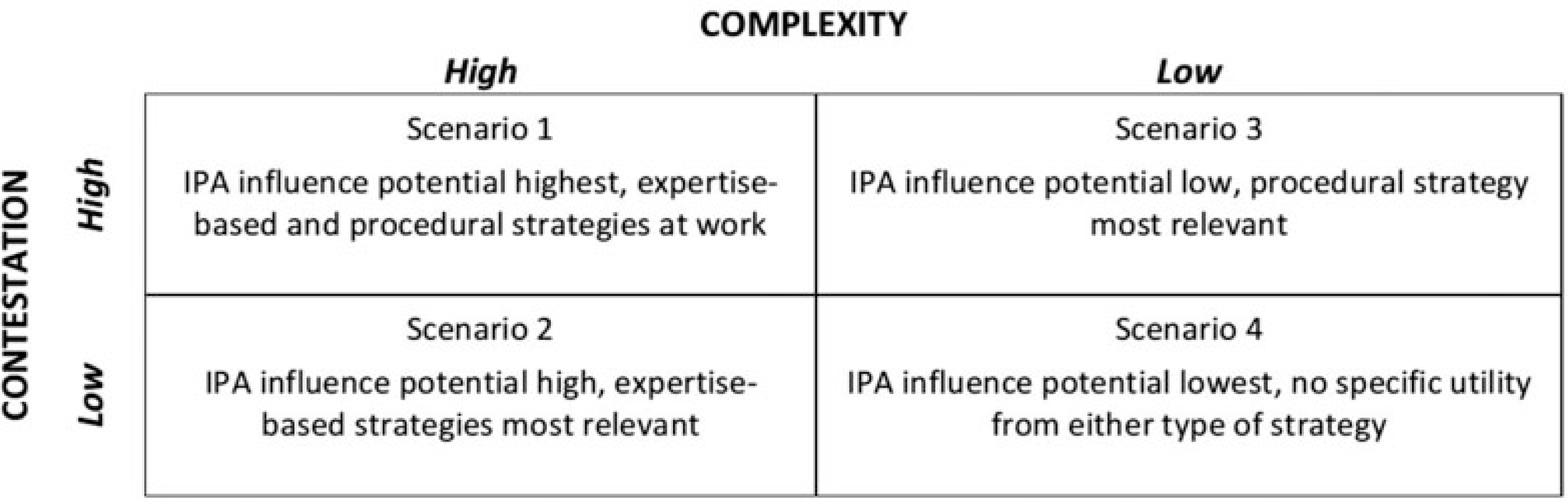
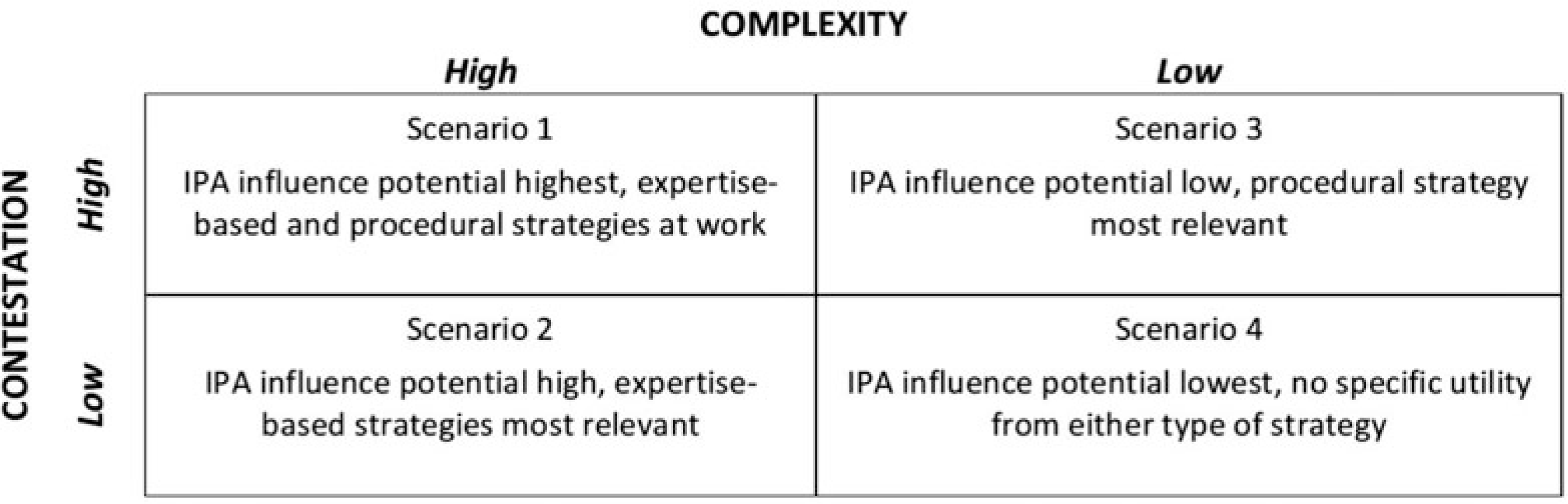
Under the constellation studied here (scenario 1), we expect a high degree of influence that is achieved by means of both expertise-based and procedural strategies. This is what we found in our analysis. However, the ILO case reminds us that organizational specificities matter as well. The process leading to the GAP illustrates that the ILO’s unique tripartite structure makes it generally more difficult for the Office to behave entrepreneurially. Under the condition of low contestation (scenario 2), an IPA’s potential influence remains high but we expect that expertise-related strategies become more important. As one interviewee suggested earlier, the WHO’s response to HIV/AIDS could have been such a case. Here, the secretariat had to engage much less in process-related strategies and work less with like-minded states because there was a broad consensus about the threat of HIV/AIDS. In scenario 3, where a policy is characterized by low programmatic complexity but is highly contested, stakeholders are less dependent on IPA expertise. We expect this to reduce the overall influence of the administration. Yet, the IPA may still use procedural strategies to cooperate with like-minded decision-makers and draft proposals strategically. Bureaucratic influence becomes most unlikely if, as in scenario 4, all stakeholders agree on the appropriate solution to a programmatically uncomplex policy problem. In this scenario, the service the IPA provides is mostly limited to conference support.
Conclusion
Our understanding of what constitutes IPA influence, how to conceive it analytically, and how to study it systematically is still ill defined. The results of our study offer some insights. First, it confirmed that international bureaucrats do have policy preferences and work strategically to achieving them. This finding can be contrasted to the argument that in national contexts, bureaucrats rarely have distinct policy preferences (Egeberg, 1995). Second, our analysis adds evidence to the view that the role of IPAs goes beyond that of a neutral facilitator of stakeholder negotiations, to that of an influential actor in its own right. Third, despite the fact that the furthering of individual ambition is regularly considered the most important driver of bureaucratic behavior, we find that the behavior of IPA staff is often about achieving ambitious agreements that effectively address global problems (see also Ege, 2020). Fourth, our findings reiterate the common observation that diplomatic skills, inclusiveness, and the appearance of impartiality are key.
A crucial challenge in our efforts to determine IPA influence remains related to the fact that most substantial theories about bureaucratic influence have been developed for nation states’ political systems. Thus, it is necessary to reflect upon the different systemic environments that international, as compared to national, bureaucracies operate in. Combining the variant conditions of complexity with contestation not only helps to formulate expectations in which certain types of IPA influence strategies are more likely to arise than in others. It also backs the proposition that IPAs may have an advantage over national bureaucracies, which (in similar constellations) are unlikely to be able to rely on procedural strategies to the extent that IPAs can. In other words, the fluidity and relative openness of the policymaking process in the international sphere might allow IPAs to engage in procedural influence strategies to a great(er) extent than national bureaucracies (Bauer et al., 2017: 191), and this proposition should be made a matter of systematic investigation. At any rate, the insights of our study constitute a promising focus for future empirical and theoretical influence research on international bureaucracies.
Supplemental Material
sj-pdf-1-ras-10.1177_00208523211000109 - Supplemental material for How do international bureaucrats affect policy outputs? Studying administrative influence strategies in international organizations
Supplemental material, sj-pdf-1-ras-10.1177_00208523211000109 for How do international bureaucrats affect policy outputs? Studying administrative influence strategies in international organizations by Jörn Ege Michael W. Bauer Nora Wagner in International Review of Administrative Sciences
Footnotes
Declaration of conflicting interests
The authors declared no potential conflicts of interest with respect to the research, authorship and/or publication of this article.
Funding
This research is financed by the German Research Foundation under grant FOR # 1745 TP 02 EG 395/1-2 and FOR # 1745 TP 02 BA 3658/5-2.

Notes
References
Supplementary Material
Please find the following supplemental material available below.
For Open Access articles published under a Creative Commons License, all supplemental material carries the same license as the article it is associated with.
For non-Open Access articles published, all supplemental material carries a non-exclusive license, and permission requests for re-use of supplemental material or any part of supplemental material shall be sent directly to the copyright owner as specified in the copyright notice associated with the article.
