




Abstract
New post-bureaucratic organizational forms, such as projects, are increasingly used in policy implementation. Their assumed benefits in decreasing bureaucracy and increasing flexibility have, however, been questioned. It has been argued that public projects increase red tape (or bureaucracy perceived as a nuisance) because of the formal rules associated with them. Despite the topicality of the subject, we do not know how public project bureaucracy is perceived by the actors involved. This article explores the bureaucracy of public projects by analysing project managers’ perceptions of them with data from European Union Cohesion policy projects in Finland. The data consist of project register data and a survey to project managers (N = 728). The study finds that when talking of the perception of bureaucracy, it is relevant to distinguish between a general attitude towards bureaucracy and a specific perception of the task at hand. The general attitude seems more negative than the specific perception of bureaucracy. We also show that project managers’ experience, institutional background and share of administrative tasks in the project condition the extent to which bureaucracy is perceived as red tape. To conclude, the findings are discussed in relation to previous research on red tape in public administration.
Points for practitioners
Project organization connotes flexibility and innovation but involves also bureaucracy, which can be received as red tape, especially for inexperienced managers. In general, managers consider project bureaucracy as red tape, while in their own projects, bureaucracy is seen as less burdensome. Public managers have an advantage over managers from non-public organizations by perceiving public project bureaucracy as less burdensome.
Introduction
Since the 1980s, the public sector in Western welfare states has been reformed to become less bureaucratic and more reflexive and effective (e.g. Christensen and Laegreid, 2011; Lynn, 2006). Driven partly by the prevailing New Public Management (NPM) doctrine and partly by economic constraints (Osborne and Gaebler, 1992), hierarchical public administration has been dismantled and complemented with new organizational forms, such as networks and projects. The new organizations are assumed to be flexible and inclusive, and, consequently, effective tools for public service delivery and policy implementation (du Gay, 2000; Lynn, 2011). However, public managers, who encounter these organizations in their daily work, have questioned the de-bureaucratization measures as counterproductive and raised concerns that the new processes in the old structures increase rather than decrease bureaucracy (Moynihan, 2008). The shift is depicted by public administration research as transformation in the form rather than degree of bureaucracy (Hall, 2012; Hibou, 2015).
The discrepancy between optimistic post-bureaucratic assumptions regarding flexibility and efficiency in public governance, and the bureaucratic reality of contemporary public managers, is perhaps embodied most strikingly in project-based policy implementation (Sjöblom et al., 2013). The project, which connotes experimentation and innovation in the military and technology fields, is in widespread use in both the internal development of public administration and public policy implementation at the local level (Grabher, 2004; Jacobsson et al., 2015). Projects are the default organization for implementing the European Union’s (EU’s) Cohesion policy (Bache, 2010), as well as other policies and programmes outside Europe (Munck af Rosenschöld and Wolf, 2017). However, public sector projects operate in administrative structures that demand certain formality, such as funding applications, regular finance and operative reporting, and project management practices (Lynn, 2006; Sjöblom et al., 2013). Consequently, public projects have been criticized for failing to deliver on the promise of flexibility and increasing time-consuming administrative routines (Fred, 2018; Hodgson, 2004).
Given that agents in public governance permanently operate with new policy tools, it is crucial to know how they relate to the potential bureaucracy of these organizations and what explains their perception. Project-based policy implementation offers an excellent point of departure for scrutinizing the forms and perceptions of bureaucracy related to new organizational forms as policy tools in public governance. The research question can be formulated as: how is bureaucracy perceived by project managers in project-based policy implementation?
Theoretical framework
Bureaucracy and post-bureaucracy in policy implementation
Bureaucracy, in both the traditional public administration and the modern public governance contexts, can be understood from two perspectives (du Gay, 2000). The Weberian standpoint on bureaucracy as an organizational ideal type supposes it to be the ultimate rational organization, providing efficiency and legitimacy in modern society (Lundquist, 1991; Lynn, 2011; Peters, 2010). A more popular sentiment for bureaucracy, however, generally refers to red tape, defined as ‘rules, regulations, and procedures that remain in force and entail a compliance burden, but do not advance the legitimate purposes the rules were intended to serve’ (Bozeman, 2000: 12). This turns bureaucracy into the antithesis of the rational organization, clumsily restricting action instead of rendering it possible (du Gay, 2000). In public discussion, the critique of bureaucracy has overshadowed the largely academic position on the benefits of bureaucracy (du Gay, 2000). However, Kaufman (1977: 1) never separated the positive effects of regulation and administration from red tape; as he put it, ‘[o]ne person’s red tape may be another’s treasured safeguard’. Here, perceptions of what red tape, or administrative burden, is play a significant role and depend on the actors and the context (Burden et al., 2012; DeHart-Davis and Pandey, 2005; Feeney and Bozeman, 2009; Peck et al., 2012).
Public sector reforms have aimed at increasing the efficiency of public governance by introducing new, nimble organizations as policy tools (see, e.g., Christensen and Laegreid, 2011; Lynn, 2006). This development is often labelled as a shift to ‘post-bureaucracy’ (e.g. Heckscher and Donnellon, 1994; Iedema, 2003). In earlier studies on the topic, Alvesson and Thompson (2005: 487) stated that ‘the decentralised, loosely coupled, flexible, non-hierarchical, and fluid organization is or will become dominant’. Several researchers have nevertheless pointed out that this development seems paradoxically to have increased bureaucracy rather than dismantle it (Hall, 2012; Hibou, 2015; Farrell and Morris, 2003; Lynn, 2011). Recent scholarship has sometimes referred to ‘neo-bureaucracy’ instead of ‘post-bureaucracy’ to highlight the fact that traditional bureaucracy has not disappeared (Clegg, 2012; Farrell and Morris, 2003; Lopdrup-Hjorth and Roelsgaard Obling, 2019). Nevertheless, this article draws on the literature on post-bureaucracy because, as we see it, the use of the ‘post-’ prefix does not, in fact, entail the erasure of bureaucracy, but rather the transformation of its meaning (cf. Bolin and Härenstam, 2008).
The development towards post-bureaucratic organizations is strongly visible in the proliferation of projects in the public sector (Jensen, 2012; Munck af Rosenschöld and Wolf, 2017; Sjöblom et al., 2013). Public projects often connote grand construction endeavours or policy projects aiming at renewing welfare service models (Donahue and Zeckhauser, 2011). However, in the shadow of such unique endeavours, projects are also deployed systematically as tools for policy implementation at the local level by international organizations for development aid, supra-state organizations and national governments (Brulin and Svensson, 2012). The latter development is often referred to as ‘projectification’, which points to the implications of project organization for public administration processes (Hodgson et al., 2019). Research has shown that projects in private companies are a highly bureaucratic organization form, which can increase the share of administrative tasks because of the formal procedures, reporting and monitoring related to them (Hodgson, 2004). The same seems to apply to public projects, mostly because of the administrative burden related to, for example, funding applications and reporting (Fred, 2018), but also due to the networked character of projects spreading the bureaucratic project logic to actors outside public administration (Hall, 2012).
Although research has emphasized the red tape perspective of project bureaucracy (Fred, 2018; Hall, 2012), some attention has been given to the benefit of a supportive administration to projects (Godenhjelm et al., 2019; Kuokkanen and Vihinen, 2009). It remains an empirical question whether the bureaucracy of public projects is supportive of, or a hindrance to, public policy implementation. In this article, the focus on the actualization and perception of bureaucracy is on the micro-level of public projects as we concentrate on the perceptions of project managers in EU Cohesion policy projects.
Drivers and perceptions of bureaucracy in public projects
Bureaucracy and red tape have been extensively studied in public governance but, so far, the project as an organizational form has not been considered in this research. We argue that established knowledge on bureaucracy perception is insufficient when not considering the new flexible organizations in the public sector, such as projects, where the premise of a post-bureaucracy reality is perhaps most tangible.
Empirical research has shown that perceived and observed red tape are two separate things (Bozeman and Crow, 1991). Public managers’ perception of red tape varies according to their organizational position, work attitude or public service motivation, and an estimate of outcome benefit (Brewer and Walker, 2010; Kaufmann and Feeney, 2013; Scott and Pandey, 2005). While the research primarily concerns public managers, perceptions of red tape have also been shown to exist in private firms and non-governmental organizations (NGOs) (Peck et al., 2012; Wiley and Berry, 2018). Studies have shown that public managers perceive red tape to a higher degree than non-state agents working as private contractors as a result of greater bureaucracy and lower work satisfaction in the public sector (Feeney and Bozeman, 2009). Earlier research has also found that customers’ perception of red tape in public services varies depending on the outcome of the process for personal benefit, as well as its societal impact more generally (see, e.g., Heinrich, 2016).
So far, research has largely approached red tape attitudes from the individual’s perception with regard to the processes they encounter (Burden et al., 2012; DeHart-Davis and Pandey, 2005; Heinrich, 2016; Peck et al., 2012). However, some have hinted at red tape also being a more general attitude, with a relation with political ideology, implying a pathological nature of red tape attitudes (Kaufmann and Tummers, 2017). In this article, we seek to explore the two-dimensionality of red tape perception using a common distinction in opinion research between attitude, which is a more or less general opinion about a phenomenon, and perception, which consists of a more evaluative opinion on a subject. Attitudes have been theorized to stem from values, which are the most fundamental layer of a person’s beliefs, with a moral dimension of right and wrong (Rokeach, 1968); however, they are also connected to personal experience about the phenomenon in question, though to a lesser degree (Norris and Inglehart, 2019; Svallfors, 2012). It is possible to simultaneously hold negative sentiment towards a general phenomenon while having a positive perception of its practical form (Blomberg and Kroll, 2002). Similarly, public managers are known to act upon different spheres of ethics, such as work, organization and personal ethics (see, e.g., Lundquist, 1991; Pollitt, 2003), which means that public managers are conscious moral agents and not immoral cogs in the bureaucratic machinery. Translating the duality of attitude and perception to project implementation, with project managers as the agents of interest, we argue that their opinion on bureaucracy can be distinguished as a general sentiment of red tape, affected by the public discourse about red tape, and subjective perception on bureaucracy in a specific task or activity, which is an evaluation of the case at hand, as against the anticipation.
The agent’s perception is also known to be conditioned by experience, age, gender and so on. Management theory offers most weight to acquirable agency characteristics, such as knowledge, leadership and substantial skills, which are attained by experience (Clegg et al., 2011). The agent’s experience has been considered particularly important in short-term activities, such as projects, due to the limited time to socialize into the new environment, tasks and partners or stakeholders (Meyerson et al., 1996). The actual bureaucracy can also affect the perception of bureaucracy as either red tape or as an organizational resource. Bureaucratic and routine tasks, especially as a high share of the manager’s tasks, have been found to increase the perception of bureaucracy as red tape (Brewer and Walker, 2010). On the other hand, a well-functioning administration should support the management of an organization (Lynn, 2011), which can be assumed to generate a positive perception of the bureaucracy.
As mentioned earlier, research has found red tape to be more prevalent in the processes of public administration compared to the processes of private business in related endeavours. However, we do not sufficiently know how agents from different sectors perceive public project bureaucracy. Public projects are characteristically hybrid organizations, where funding, ownership and management are detached from each other and possibly held by different organizations (Johanson and Vakkuri, 2017). Consequently, this can lead to a conflict about norms, cultures and logics, as well as to a feeling of unnecessary bureaucracy for actors not representing the public sector because of their different rationale (Fred, 2018; Jensen et al., 2007; Sahlin-Andersson and Söderholm, 2002; Thornton et al., 2012). Operating within the same public governance structure, we hypothesize that public agents perceive red tape to a lesser degree than non-state agents due to knowledge of the ‘game’.
The evolving post-bureaucracy in policy implementation and the knowledge that the perception of bureaucracy matters for individual behaviour require considering the perception as a multidimensional phenomenon. For this, we expect: H1: There is a difference between attitudes in general and specific perceptions of bureaucracy. H2: Professional experience decreases managers’ perception of bureaucracy as red tape. H3: A higher share of administrative tasks increases managers’ perception of bureaucracy as red tape. H4: The existence of a separate project administration decreases managers’ perception of bureaucracy as red tape. H5: Public sector agents perceive public bureaucracy as red tape to a lesser extent than agents from other sectors.
Data, methodology and operationalization
We employ cross-sectional register and survey data to analyse project bureaucracy in a highly projectified policy field, namely, the Cohesion policy of the EU and its implementation in Finland. The background of Cohesion policy is in redistributive regional policies inside the EU (Munzi, 1965), which has been governed by the Director General for Regional Policy (DG) since the 1960s (Brunazzo, 2016). Starting in the 1980s, the policy has been organized as structural funds covering a certain broad policy area and, in practice, is realized by means of local-level projects, making it one of the most extensive project-based policies (Büttner, 2019). It encompassed a total of €347 billion in the programme period 2007–2013, and €336 billion in 2014–2020. The uniform policy structure makes the Cohesion policy exemplary for quantitatively studying the effect of project organization on public management. Studies have also underlined the administrative burden of the policy and its negative effects, both in central and more peripheral EU countries, partly because of its excessively formalistic forms of compliance (e.g. Balsiger, 2016; Fazekas and King, 2019).
This study focuses on the EU’s European Regional Development Fund (ERDF) programme in Finland during 2007–2013. During this period, approximately 18,000 EU projects were implemented in Finland. However, most projects concerned financial support to companies. Some 2200 projects were development or innovation projects, in the sense of having a project organization with a manager and a goal of creating or developing something (Godenhjelm and Johanson, 2018). Approximately half of these projects were ERDF projects and the rest were projects from other EU funds. Of the ERDF development projects in Finland, 728 had ended by 2012. The project managers of these projects were surveyed in 2013 (response rate = 49%). As a unitary Nordic welfare state with a strong central administration (Sjöblom, 2011), Finland offers a case for studying how the project processes within a well-governed public administration generate red tape.
The relations between individual, organizational and contextual factors, as well as the project managers’ red tape perception, are studied with ordinary least squares (OLS) regression analysis. In case our hypotheses are not given support by the data, we also analyse the interaction of explanatory variables.
The dependent variable
The dependent variable consists of the project managers’ perception of bureaucracy in their own projects as restricting the project activity (project manager red tape perception). In the survey, we applied Bozeman’s (2000) and Brewer and Walker’s (2010) example by defining the statements regarding red tape in the context of project bureaucracy as ‘burdensome rules and procedures that negatively affect performance’. Project manager red tape perception is an index variable constructed by adding the values of survey questions regarding the project managers’ perception of bureaucracy restricting the activity of the project (for descriptive statistics, see the Appendix). A high score on the index equals a perception of bureaucracy as red tape in their own projects and a low score indicates that bureaucracy is not perceived as red tape in their own projects.
The general attitude towards bureaucracy is operationalized with survey respondents’ response to the claim that ‘The project bureaucracy in general is too time-consuming’, measured as a Likert-scale (1–5) item. The general attitude towards bureaucracy is analysed only in relation to the specific perception of bureaucracy as we aim to determine the feasibility of the distinction. No further analysis of factors explaining its variation is pursued in this study due to the limits set for reliability by a single-item dependent variable.
The independent variables and covariates
The independent variables consist of organizational factors of the projects, project manager characteristics, project owner agency type and different dimensions of project bureaucracy obtained from the Ministry of Employment and Economy’s register on the ERDF projects, as well as from the survey of the project managers. The descriptive statistics of the variables are presented in the Appendix. Project budget and project manager gender are added as covariates to control for the size of the project and gender roles affecting the project managers’ perception of bureaucracy.
Empirical analysis: bureaucracy and red tape in public projects
The purpose of the following descriptives on public project bureaucracy is to depict the extent of bureaucracy in public projects (see Tables 1–3). 1 As shown in Table 1, project managers consider that a substantial part of project activity consists of administrative tasks. Approximately two-fifths of them (40.7%) saw that administrative tasks constituted 6–20% of the project activity. One quarter of them (25.3%) considered administrative tasks to be around 21–35%, slightly over a tenth (11.5%) saw the degree as large as 36–50% and 8.7% of them saw that administrative tasks constituted over 50% of the project activity. Only 13.8% of the project managers considered the degree of administrative tasks to be less than 5% of the project’s activity.
Share of administrative tasks of the project activity in total.

Personnel designated to administration.

Arguments regarding red tape in general and in their own projects.
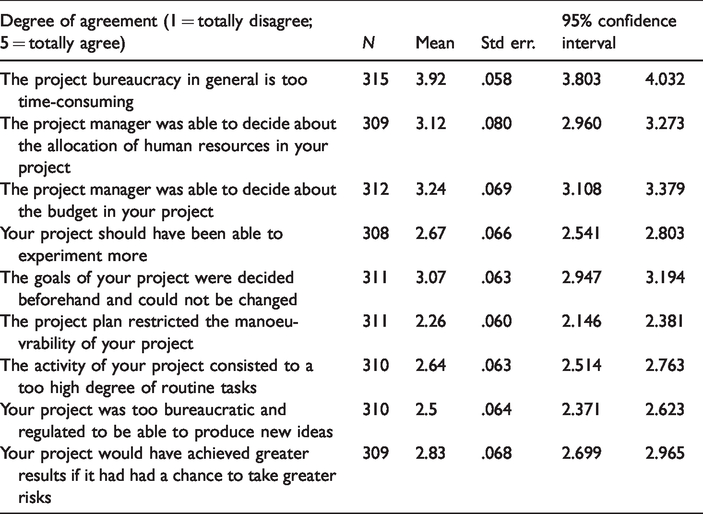
The majority of the projects (64.3%) had part-time personnel designated to project administration (see Table 2). In approximately one-fifth of them (19.7%), there was no specific personnel designated to it, while 15.9% of them had full-time personnel. For the OLS regression, the administrative personnel were converted into a dichotomous dummy variable of part-time and full-time administrative personnel or no administrative personnel.
OLS regression of project managers’ red tape perception on project organizational factors, project manager characteristics and type of agency.
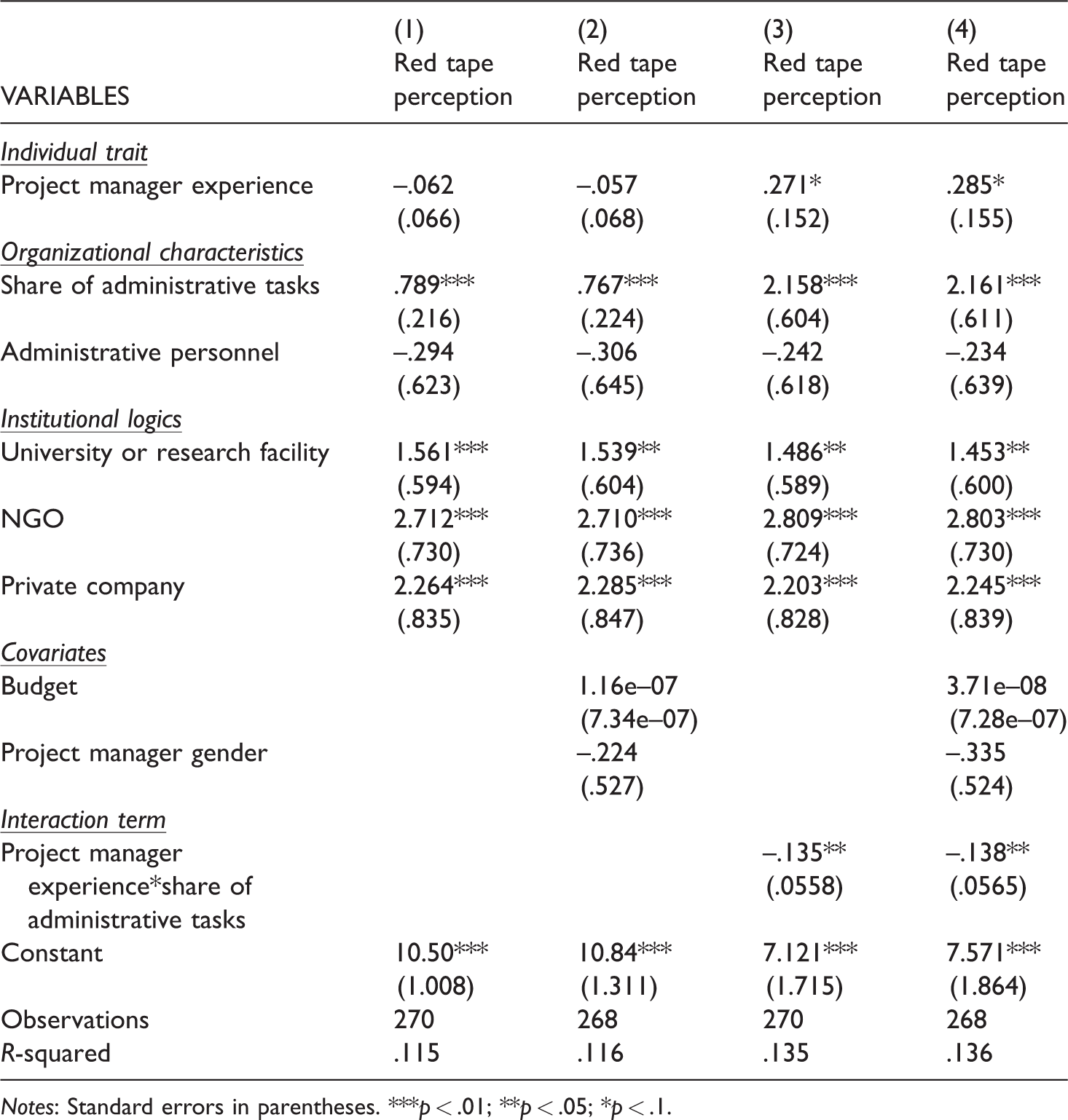
Notes: Standard errors in parentheses. ***p < .01; **p < .05; *p < .1.
Table 3 shows the positions of the project managers in relation to arguments regarding project bureaucracy. Notably, the project managers’ sentiment regarding project bureaucracy in general being too time-consuming is rather high (mean of 3.92 of a max of 5) compared to the perceptions regarding their own projects in hand (the other eight statements), though there is some variation in the latter category. The differences between bureaucracy in general and the more specific perceptions of bureaucracy are statistically significant on a 95% confidence interval. Further, one sample t-tests validate that the observed means for most arguments are different from the midpoint (3) of the scale (see the Appendix). There seems indeed to be a general negative sentiment regarding bureaucracy. Conversely, the perceptions of specific bureaucracy are clearly more neutral, lending support to the distinction of bureaucracy as a diffuse opinion and a specific perception.
What explains the perception of bureaucracy?
The relation between different factors and project managers’ perception of bureaucracy is analysed with four OLS hierarchical regression models (see Table 4). Surprisingly, from column 1 we can tell that the experience of the project manager and administrative personnel is statistically unrelated to the perception of bureaucracy. The share of administrative tasks in project activity is as expected adding to the perception of bureaucracy as red tape (B = .789, p < .01). The agency types also correlate with red tape perception, as project managers from universities or research facilities, NGOs, and private companies perceive project bureaucracy to a greater extent as red tape compared to public sector agents, where NGO representatives demonstrate the most pronounced perceptions. Column 2 shows the model where we control for the project’s budget and the project manager’s gender, which both are statistically non-associated with the perception of red tape. The effects of the covariates in model 1 are not namely altered by controlling for budget and gender.
Due to the surprising lack of effect of professional experience on red tape perception, we further analyse the relation between professional experience and red tape perception with an interaction analysis, where we study if experience might indirectly affect red tape perception by conditioning the effect of administrative tasks. Column 3 shows the effect of a model including the interaction term between the project managers’ experience and the share of administrative tasks. Interestingly, the interaction term has a negative effect on red tape perception (B = –.135, p < .05). The effect remains more or less the same when controlling for budget and gender in model 4 (column 4).
The effect of the interaction term is further analysed by post-estimating predictive margins at low and high levels of the project managers’ experience, including covariates as controls (see Figure 1). Surprisingly, more experienced project managers perceive red tape to a higher degree on low levels of routine administrative tasks as a share of their work than the less experienced project managers. At a share of 6–20% of administrative tasks, less and more experienced project managers have the same sentiment regarding red tape, and at a share of 21–35%, the less experienced project managers have a stronger red tape perception than more experienced ones. However, administrative tasks as a share of work at 36–50% are perceived significantly more as red tape by inexperienced project managers than by more experienced ones. The effect is further increased at the highest share of administrative tasks.
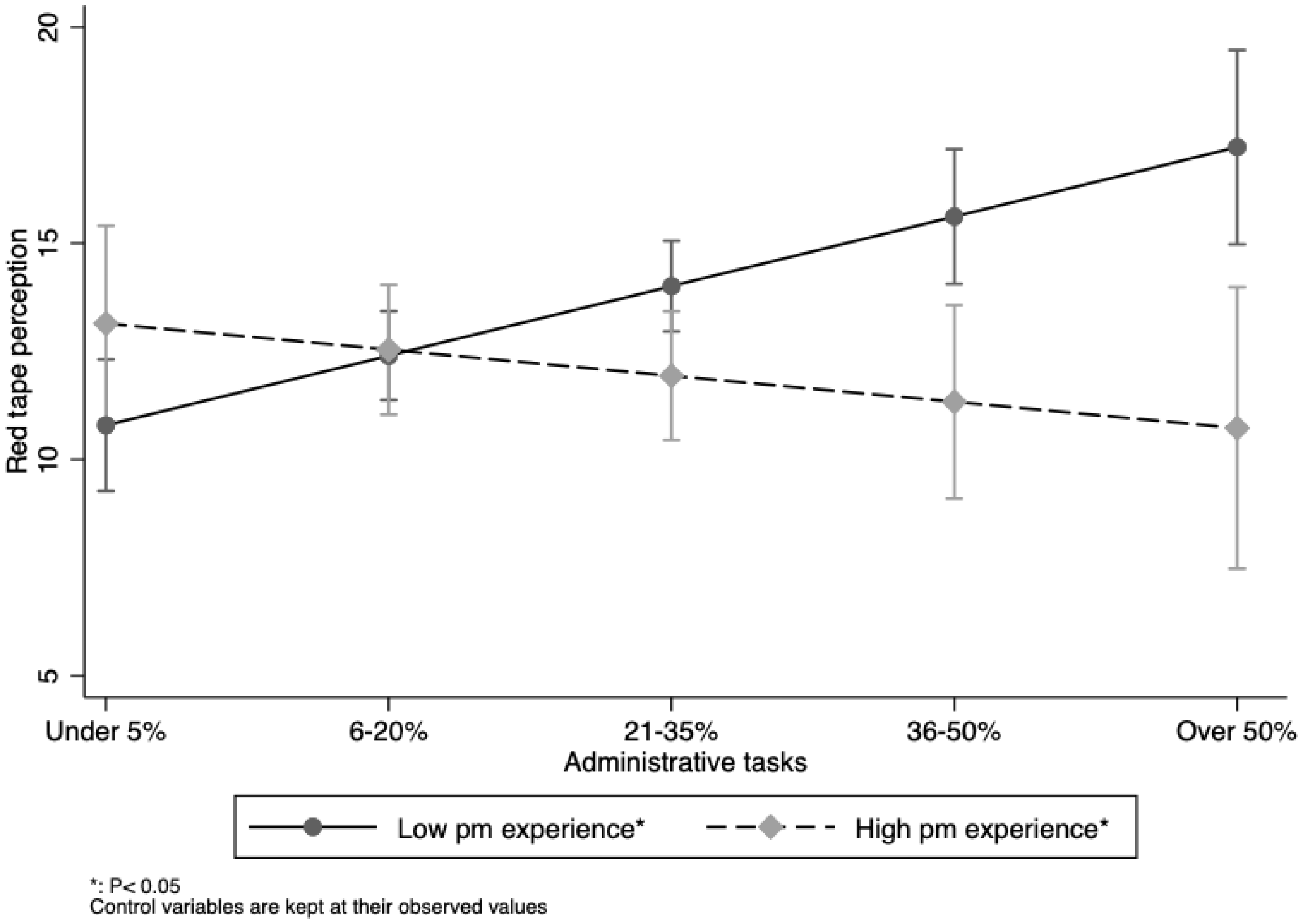
OLS predictive margins of project manager red tape perception at low and high values of professional experience.
In sum, interaction analysis shows that less experienced project managers feel more burdened by bureaucracy when the share of administrative tasks is high in their work, compared to more experienced ones. The perception of administrative tasks as red tape among inexperienced project managers increases significantly from the lowest share to the highest share of work as administrative tasks. Conversely, the most experienced project managers are not only immune to feeling burdened by bureaucracy at high shares of administrative tasks, but feel somewhat less burdened than at a low share of administrative tasks.
Discussion and conclusions
The aim of this article was to explore the perception of red tape related to post-bureaucracy in modern public governance, as exemplified by project-based policy implementation. Public projects, which have proliferated to the point of whole policy sectors being deemed projectified (Hodgson et al., 2019), were argued to be an optimal case for studying the bureaucracy involved in new types of organizational forms connoting flexibility in public governance. As an early adapter of project implementation, the Cohesion policy is an exemplary case for studying post-bureaucracy, while as a well-governed state with a strong central administration, Finland is an optimal case for studying how project processes in well-functioning hierarchical structures produce red tape. The daily encounters of agents in contemporary public governance with new policy tools in old administrative structures augment the significance of understanding how bureaucracy is perceived and what affects its perception. By focusing on project managers, this study has provided new information about the professional perception of project bureaucracy and the factors that explain it.
The descriptive analysis shows that most project managers designate at most a fifth of their work time to administration. However, almost half also spend more than a fifth and up to over half of their time on administration, which can be considered a high degree in relation to the flexibility promise of project organization. Most projects also employ specific administrative staff, though only on part-time.
We distinguished theoretically between a red tape attitude towards bureaucracy in general and a perception of specific tasks as being red tape. The general sentiment about project bureaucracy among project managers is that it is restrictive for management; however, the perception of bureaucracy regarding the project managers’ own projects is more ambiguous, which confirms our first hypothesis. Our second hypothesis, based on management theory assuming relative benefits of a posteriori knowledge (Clegg et al., 2011), was not given immediate support by the OLS analysis, which found no direct relation between experience and red tape perception. This was surprising given that professional experience has been assumed to be of special importance in a time-limited project (Meyerson et al., 1996). The share of administrative tasks was also found to increase the perception of bureaucracy as red tape, similar to findings from previous research in public governance, which supports our third hypothesis. A separate project administration did not, however, affect red tape perception as our fourth hypothesis assumed. We can conclude that red tape perception in public project organization seems to react similarly to administrative burden as in other branches of public administration.
The fifth hypothesis, which assumed that the institutional background affecting the perception of bureaucracy as red tape, so that project managers from the public sector perceive bureaucracy less as red tape than their peers from other sectors, was supported by the data. Project managers representing public sector organizations perceived project bureaucracy as least burdensome, while third sector actors experienced the most burden, potentially because of their organizational culture based on voluntarism and, often, an idealistic mission (Kuokkanen and Vihinen, 2009). The result complements previous research findings that public managers perceive more red tape than private peers in their respective processes (Feeney and Bozeman, 2009) by showing that in the same public project process, the public manager has the upper hand compared to non-state agents.
The interaction analysis showed how less experienced project managers feel more burdened by bureaucracy when the share of administrative tasks in their work is high, while the most experienced project managers are not only immune to feeling burdened by bureaucracy at high shares of administrative tasks, but actually feel less burdened than at low shares of administrative tasks. This finding of a bureaucracy-enthusiastic manager can intriguingly be assumed to show several things, among them the relative benefit that an experienced project manager perceives themselves having from know-how in comparison to less experienced peers in the bureaucratic game of public project management. In this study, we have concentrated on red tape perceptions; however, the experience of project managers can also naturally affect other aspects in projects, such as knowledge about the contents of a project and the creation of stakeholder networks.
In conclusion, when talking about bureaucratic sentiment in public governance with new policy tools, we ought to specify whether we are referring to a general attitude or a perception of a specific task. The general attitude leans to a diffuse distaste of bureaucracy as red tape, while the specific perception is more neutral. Moreover, the managers’ specific perception is dependent on the agency’s institutional background, as well as on professional experience, which lowers or amplifies the feeling of bureaucracy as restrictive for management.
Future studies should pursue the latent attitude towards bureaucracy in more detail by tracing the explanations distinct to it and analysing its relation to the specific perception of bureaucracy. Most importantly, the results indicate that the literature on post-bureaucracy in project organization needs to recognize that the bureaucracy that is red tape for one manager, can be a beneficial process for another. This study has also covered the actual forms of project bureaucracy – for example, project applications, reporting and timetables caused by programming periods – to only a limited extent. The same applies to the role of administrating authorities in steering and advising project managers and thus either augmenting or diminishing their perception of red tape. Qualitative case studies are also needed to explore the explanations of the causal mechanisms put forth here in more detail. Finally, more research is needed about the effects of project bureaucracy on policy outcomes, which is especially salient in the case of Cohesion policy.
Footnotes
Declaration of conflicting interests
The author(s) declared no potential conflicts of interest with respect to the research, authorship, and/or publication of this article.
Funding
The author(s) disclosed receipt of the following financial support for the research, authorship and/or publication of this article: Funding was provided by the Strategic Research Council at the Academy of Finland (312710). The data for the study was collected in the Academy of Finland project (251978) “The democratic impact of administrative reforms – Temporary governance instruments in regional development”.
