




Abstract
Studies into decision-making suggest the existence of a tension between transparent and efficient decision-making. It is assumed that an increase in transparency leads to a decline in the efficiency of decision-making processes; however, this assumption has not been tested empirically. This study provides a starting point for investigating the complex relationship between transparency and efficiency on a set of 244 European Union legislative processes between 2014 and 2019. It finds that transparency neither speeds up nor slows down decision-making processes, and that the efficiency of the lawmaking process depends on political complexity. Our results call for further systematic research into the causes and consequences of decision-making transparency.
Points for practitioners
In decision-making processes, transparency is widely seen as both a blessing and a curse. On the one hand, it is seen as a virtue that fosters legitimacy and participation; on the other hand, it is said to reduce decisional efficiency. However, our study of 244 European Union legislative processes shows that transparency has no effect on their duration. This calls for a re-appreciation of the effects of transparency in decision-making processes.
Introduction
Scholars and decision-makers alike regularly identify a curious trade-off between efficient and transparent decision-making. Transparency during decision-making processes is widely regarded as a means to inform citizens and stakeholders, enabling them to voice their concerns to decision-makers, which opens up opportunities for actors to slow down or even stall decision-making processes (Hillebrandt and Novák, 2016; Novák, 2011). Especially in the situation of multi-actor decision-making with complex negotiations, these external influences complicate the process and therefore negatively affect its efficiency in the sense of slowing it down. Decision-making processes in closed groups is regarded as easier and ‘outsiders’ may complicate this process (Leino, 2017; Stasavage, 2004). In other words, transparency is believed to increase input legitimacy at the expense of efficiency and other forms of output legitimacy (e.g. Greenwood, 2007; Häge and Kaeding, 2007).
Even though they attribute different values to it and do not always mention the efficiency of decision-making processes explicitly, there seems to be a surprisingly shared conviction between the opponents and proponents of transparency regarding the negative effect of transparency on the efficiency of (multi-actor) decision-making processes (for overviews, see Cucciniello et al., 2017; Hood and Heald, 2006). For opponents of transparency, this is an argument to resist it, but even proponents assume that decision-making is slowed down by transparency. They highlight that transparency creates more opportunities for public debate about issues, which they see as desirable from a democratic perspective but that, by default, slows down the process of decision-making by opening it up to outsiders. In their view, increased deliberation leads to a higher quality of decision-making, which makes aspects of input and output legitimacy mutually reinforcing (cf. Lindgren and Persson, 2010), and the decrease in the efficiency of the decision-making process is seen as a small price for these substantial gains.
However, these arguments about the relation between transparency and the efficiency of multi-actor decision-making processes are mostly based on theoretical reasoning and not on empirical research. Empirical transparency research has focused on the relations between transparency and trust (Grimmelikhuijsen et al., 2013), transparency and corruption (Lindstedt and Naurin, 2010), and transparency and effectiveness (Cucciniello et al., 2017) but, as far as we know, not the relation between transparency and the efficiency of decision-making processes. At the same time, existing studies of the efficiency of decision-making highlight aspects such as the number of veto players, preference distributions and the complexity of files under negotiation (e.g. Brandsma, 2015; Drüner et al., 2018; Rasmussen and Toshkov, 2013) but not transparency. To contribute both to the literature on transparency and to the literature on (multi-actor) decision-making, this article sets out to test the relation between transparency and the efficiency of decision-making processes empirically.
This study has selected multi-actor decision-making in the European Union (EU) as a case in point to investigate the relation between transparency and the efficiency of multi-actor decision-making processes. Decision-making in the EU is a key example of complex negotiations between a variety of actors (e.g. Farrell and Héritier, 2004). The EU has a tradition of secluded decision-making, which has enabled the various institutions to realize compromises (Leino, 2017). At the same time, the call for transparency has been transforming these processes and now stipulates that decision-making should be more transparent (Curtin and Meijer, 2006; Hillebrandt et al., 2014). This means that the relation between transparency and efficiency can readily be studied for the EU since the EU systematically publishes information on the lifeline of its legislative proposals, and because it features varying degrees of transparency of decision-making processes.
This article is structured as follows. After conceptualizing transparency and outlining the theoretical expectations that guide our research in more detail, we proceed by investigating our hypothesis for EU legislative processes. We present the strategy for our data collection and systematic analysis of 244 decision-making processes. The data are used to test the hypothesis and enhance our understanding of the relation between transparency and the efficiency of decision-making processes. The article ends with reflections on the implications of our findings for theories about transparency and decision-making in the EU and the public sector in general.
Transparency and efficiency
Definitions
Although all definitions of transparency have in common that they refer to the availability of information, there is a surprisingly large variety of conceptualizations that focus on different aspects thereof, particularly with a view to the addressees of information, as well as to the object on which transparency is rendered. Some authors specifically focus on the exchange of information between subordinates and superiors, or between organizations and outside actors (e.g. Heald, 2006). In a large systematic literature review, Cucciniello et al. (2017) concluded that most research on transparency centres on the availability of information to external stakeholders – outsiders – to enable them to scrutinize the actions of public sector actors.
In line with this, we define transparency as the availability of information about an actor that allows other actors to monitor the workings or performance of the first actor (Grimmelikhuijsen and Meijer, 2012; Meijer et al., 2018). In this study, we exclusively focus on the availability of information on the decision-making process in terms of issues, participants, opinions, criteria and so on as the object of transparency and not on other objects such as the outputs or the outcomes of policies.
The second concept in our study – the efficiency of multi-actor decision-making – has been discussed even more in the literature (Klijn and Koppenjan, 2015; Klijn and Teisman, 1991). A thorough overview is provided by Teisman (2000), who highlights that it can be understood from three different perspectives, that is, as phases, streams or rounds. The phase model highlights the ordered nature of these processes and the sequential, formal, steps in a decision-making process. The streams and rounds models highlight the broad range of interactions around these formal steps and emphasize that decision-making processes are not as linear and rational as the phase model suggests. Nevertheless, in this study, we will use the phase model as a basis since we focus on the formal steps of EU decision-making processes. In the analysis of this process, we focus on its efficiency, which we define as the time it takes to take these steps. Commonly, the literature on decisional efficiency defines it as synonymous with duration (e.g. Drüner et al., 2018; Golub, 2007).
Effects of transparency
Research into government transparency has typically studied both the determinants of transparency and the effects of transparency. For this article, the research into the effects of transparency is relevant and the literature review by Cucciniello et al. (2017) provides a strong overview of this expanding body of literature. Cucciniello et al. (2017) identify a variety of goals of transparency on the side of citizens – legitimacy, citizen participation, trust in government and satisfaction – and also on the side of government – accountability, less corruption, quality of decision-making processes and financial management. They highlight that the evidence for the contribution of transparency to these goals was mixed.
The literature review by Cucciniello et al. (2017) does not identify the efficiency of decision-making processes as one of the effects of transparency. At the same time, both opponents and proponents of transparency indicate that it may have an impact on this efficiency since transparency would help actors obtain information that they might use to influence the decision-making process (Leino, 2017: 6). For multi-actor decision-making processes, this is specifically relevant since external actors may try to influence the positions of multiple decision-makers. These efforts are often mentioned as one of the reasons why multi-actor decision-making processes are notoriously slow (Teisman, 2000).
This overview indicates that the body of literature on transparency in the public sector has studied various effects but largely ignored the relation between transparency and the efficiency of decision-making processes. We will now turn to the literature on decision-making processes to check whether this relation has been studied in that body of literature. In line with our empirical focus, we focus specifically on decision-making in the EU.
Determinants of decision-making efficiency
Studies related to decision-making in the EU point to preference distributions and voting rules as important determinants of the duration of decision-making processes. Typically, these studies find that majority voting leads to faster decision-making than unanimity rules do (Golub, 2007; Schulz and König, 2000). Also, given that the EU has grown over time to include 27 member states and that legislative decision-making has become increasingly bicameral (from the Council of Ministers only to co-decision between the Council of Ministers and European Parliament (EP)), the effects of these two developments have been extensively researched. Studies have found that the involvement of the EP slows down decision-making, even in those cases where the EP does not enjoy more than an advisory role (Golub, 2007; Schulz and König, 2000). The evidence related to the number of member states represented in the Council of Ministers is rather mixed. Golub (2007) finds that EU enlargement speeds up decision-making, while Hertz and Leuffen (2011) find that it slows it down and Toshkov (2017) finds no effect at all.
Other studies have focused on various manifestations of political complexity that do not relate to the number of member states in the Council of Ministers or the institutional role of the EP. Drüner et al. (2018) have shown that longer bargaining processes have less to do with choosing one out of several available options than with finding a solution to begin with. Brandsma (2015) shows that various forms of political contestation have a strong effect on the duration of negotiations. Finally, Rasmussen and Toshkov (2013) show that stakeholder involvement in the drafting phase of legislation prolongs decision-making processes; they argue that stakeholder consultations increase the transaction cost of subsequent bargaining, which affects the duration of legislative processes.
In this literature too, transparency has never featured as a determinant of decision-making expedience. Stasavage (2004) warns that decision-making processes risk taking longer when decision-makers know that they are being watched, and sociological accounts of decision-making inside the Council of Ministers also suggest that its ‘club-like’ atmosphere facilitates finding agreements (Lewis, 2005). Yet, they do not provide an empirical test of this argument. Hagemann and Franchino (2016) did carry out an empirical plausibility probe of their argument that the publication of votes and legislative records does not slow down decision-making, but any such documents are usually only made available when the decision-making process has already been completed (cf. Curtin and Leino, 2017; Novák and Hillebrandt, 2020).
For their part, decision-makers seem to strongly believe that transparency hampers decision-making efficiency (Novák, 2011). For that reason, they resist external pressure for more transparency, arguing that institutions need a ‘space to think’ (Hillebrandt and Novák, 2016). However, it again needs to be stressed that this causal link between transparency and reduced efficiency is only assumed by decision-makers; empirical evidence on the actual effect is lacking, and sometimes they also strategically use more transparency to ‘lock in’ negotiations and hence speed them up (Novák and Hillebrandt, 2020). Thus, claims that the public provision of information while negotiations are still ongoing would slow down decision-making have, to our knowledge, never been put to the test.
Hypothesis
Thus, the literature has not yet systematically investigated the relation, but presents one prevailing theoretical argument: transparency is generally expected to slow down the decision-making process. This argument underlies the hypothesis that we investigate in this article.
The argument can be understood on the basis of rational choice institutionalist literature, which highlights that transparency reduces the control over information flows that are crucial for complex negotiations. Given that the negotiators of a legislative file represent their respective legislative institutions, they need to command a majority in each of these for any compromise that they agree between them. In such a two-level game situation (cf. Putnam, 1988), negotiators benefit from controlling the flow of information: more transparency might increase public pressure on the course of the negotiations and thus alter the win set (for similar arguments, see also Farrell and Héritier, 2004; Stasavage, 2004). The complexity of the two-level game situation increases considerably when the nexus between the levels is opened up, and the increased complexity that results from this transparency can be expected to slow down the decision-making process. We therefore hypothesize: H1: More transparency during the early phase of a decision-making process will result in a longer decision-making process.
Transparency of legislative decision-making in the EU
Our empirical test of the hypothesis regarding the relation between transparency and decision-making efficiency takes place in the context of EU legislative decision-making. These legislative processes result in regulations, directives and decisions, and involve three key actors: The European Commission exclusively prepares and formally presents legislative proposals, after which the EP and the Council of Ministers (representing the member states’ governments) each debate and amend these, and adopt new legislation together.
Like any political system that is based on legislative deliberation in multiple chambers or multiple institutions, the preferences of the aforementioned three institutional actors need to be aligned. In the EU’s political processes, such alignment is generally sought via so-called ‘informal trilogues’ (cf. Häge and Kaeding, 2007). Such trilogues bring together the chief negotiators of the three institutions, supplemented by support staff, in order to find a compromise agreement – and they are not public (Roederer-Rynning and Greenwood, 2015). After having found such an agreement, this compromise is tabled for formal approval in, first, the EP and finally the Council of Ministers. Some files require only few or even no trilogues at all for finding agreement, while for other files, up to 10 or even 50 such informal meetings are necessary (Brandsma, 2015). In the absence of any publicly accessible negotiation space, the first trilogue for a legislative file thus marks the start of the negotiation process. It is here that the institutions’ points of view confront each other for the first time.
The EU’s institutions have hitherto upheld a policy of not releasing documents pertaining to the content of trilogue meetings before legislation has been finally adopted (Curtin and Leino, 2017). However, the EP formally requires its chief negotiator in trilogue meetings to report back to the responsible EP committee after each and every trilogue, and these committees do meet in public (European Parliament, 2017: rule 69f). This means that some transparency is created about the decision-making process, though, in practice, the availability and quality of such feedback reports vary greatly, from total absence, to considerable and to extensive information provision (Brandsma, 2019). The degree of transparency that is provided is thus actor-dependent. Still, it is the only institutionalized and proactive form of transparency that exists about trilogue proceedings while the decision-making process is still ongoing.
This practice therefore opens up an opportunity for studying the relation between transparency and the efficiency of the decision-making process. In our empirical research, we investigate the relation between the degree of transparency about the discussion in the first trilogue on a legislative proposal, and the actual time between the reporting in the EP and the formal approval of the eventual legislation by the two co-legislators (a process that ends in the Council of Ministers). Figure 1 shows this timeline. The number of days between T3 and T2 is our efficiency measurement – the dependent variable in our research. It is during this period that representatives of the EP and the Council of Ministers negotiate an inter-institutional compromise. It is characterized by further trilogue meetings, informal talks, extensive lobbying, exploring compromises and building support for emerging compromises in each respective institution (Roederer-Rynning and Greenwood, 2015). Knowing the conflict lines within and between institutions is essential for lobbyists to successfully influence the ongoing negotiations, and the report on the first trilogue at T2 (of the trilogue at T1) is the first public expression of these conflict lines as the Council of Ministers, in particular, does not publish documents pertaining to the legislative process while files are still ongoing (Hillebrandt and Novák, 2016). Our main independent variable is the degree of transparency provided at T2. The control variable that captures political complexity is based on the number of days between T0 and T1, during which the EP and the Council of Ministers each internally coordinate their respective positions and negotiation mandates.
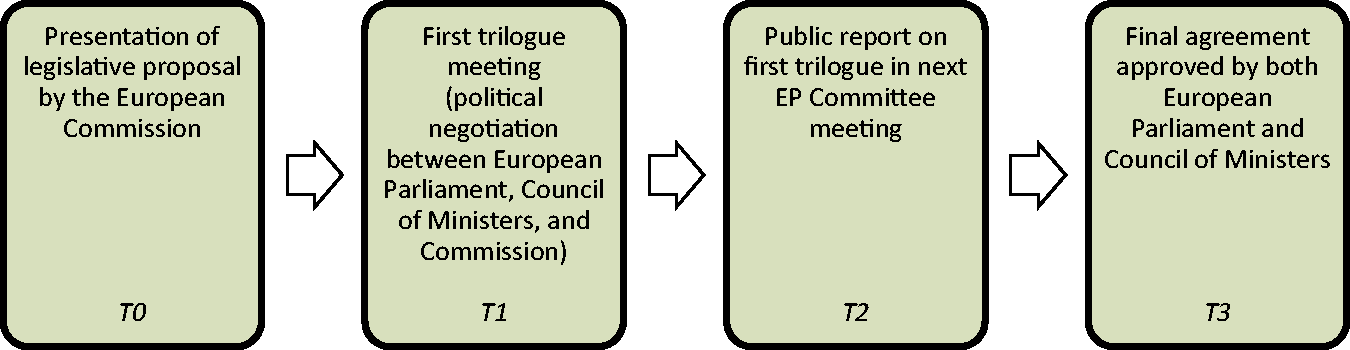
Timeline of decision-making speed.
The hypothesis will be tested through empirical research into legislative decision-making processes in the EU. In doing so, we control for a number of variables that are well known from the existing literature on decision-making expedience, capturing their cognitive complexity, their innovativeness and their political complexity.
Regarding cognitive complexity, the idea is simply that longer legislative files contain more substance and hence take more time to be agreed upon. This perhaps trivial independent variable, measured by the number of articles contained in a legislative proposal (Brandsma, 2015), has been found to be a strong predictor. Having said this, we are aware that the EU sometimes adopts Acts that amend existing legislation, in which numerous and often all amendments are collapsed into very few articles, or just one. For that reason, we also included an alternative measurement of this variable – we counted the number of words contained in the articles – a point to which we return in the empirical analysis.
This brings us to the innovativeness of a legislative Act. Previous research has found that Acts that merely amend existing legislation are agreed upon more easily compared to laws that regulate something new (Rasmussen, 2011); by definition, Acts that regulate entirely new aspects are more controversial than Acts that merely change existing policy provisions. We therefore take note of whether a legislative Act solely amends existing legislation or not.
The final control variable is political complexity. Our research design necessitates measurements of political complexity before the actual negotiations start; otherwise, its measurement would overlap with our dependent variable. We have used four different indicators. First, we counted the number of recitals in a legislative proposal as this is indicative of both the scope of a legislative Act and the number of salient issues regulated therein (Rasmussen and Toshkov, 2011). Second, we capture political complexity in each of the EU’s legislative institutions. For the EP, we measured the number of amendments tabled in committee against the rapporteur’s draft report. This variable is indicative of intra-institutional contestation (Brandsma, 2015). For the Council of Ministers, we measured whether or not the mandate for inter-institutional negotiations was cleared at the minister rather than ambassador level, in the form of a ‘general approach’ (Greenwood and Roederer-Rynning, 2019a). Finally, we use the number of days between the launch of a legislative proposal and the beginning of actual negotiations as a proxy for other manifestations of political complexity that are time-dependent.
Data and methods
Operationalizing transparency
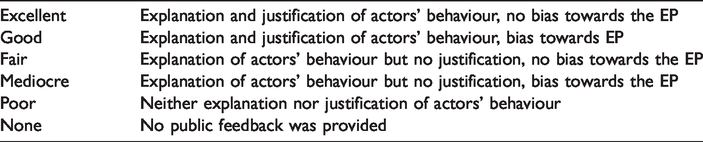
An instrument was developed to measure the transparency of the decision-making process through reporting in the EP (Brandsma, 2019). We created a scale that includes the constitutive elements of decision-making transparency: explanation of actors’ behaviour during trilogues; justification thereof; and (lack of) bias or framing. In view of the specific context of this study, we operationalized these three elements as follows. First, explanation of actors’ behaviour refers to specific points that the institutions want to achieve, or meanwhile have achieved. More general descriptions, such as ‘working towards more sustainability’, do not therefore qualify as explanations of actors’ behaviour as these do not specify what exactly has been under discussion. Second, justification refers to arguments as to why a certain position is taken or a certain compromise has been made. Finally, bias has been gauged by observing to what degree feedback emphasizes the EP negotiators’ own behaviour or whether it rather takes into account the other institutions’ behaviour during trilogues as well.
Given that justification can only occur in the presence of explanation, and that the absence of bias is valued higher than its presence, this leads to the following scale for assessing the quality of transparency provided via EP committee meetings (see Table 1).
Scale for assessing the quality of transparency provided via EP committee meetings.
It is important to note here that legislative proposals vary tremendously in scope and size, which affects the potential extent to which explanation and justification can be given. Hence, we have coded whether any explanation or justification was given, regardless of the extent thereof.
Our data
Out of the universe of all EU legislative processes, we selected our cases according to two selection criteria. First, since changes in the composition of parliaments as well as election recesses significantly affect the duration of legislative processes when these start before elections and end afterwards, we limited our analysis to those pieces of legislation that were formally proposed within a single legislative term. Hence, we listed all legislative files in the EU’s legislative repository (EUR-LEX) that were formally tabled by the European Commission during the 2014–2019 EU legislative term.
Second, we limited our sample to those files for which at least one informal trilogue took place, for it is the transparency provided about the points discussed in trilogues that is our main independent variable. A list of informal trilogues is not publicly available, but the EP’s secretariat does prepare monthly overviews of when informal trilogues took place for each file under negotiation (Brandsma, 2015, 2019). These overviews were requested for the entire legislative term and used to select those files for which at least one informal trilogue took place.
In total, we identified 249 files that met all selection criteria. Information on the dates of proposal and adoption of a legislative file were taken from EUR-LEX, while the date of the first trilogue was taken from the aforementioned parliamentary documents. Then, on the basis of the EP’s website, we identified when its according committees met following the first trilogue. For the according committee meetings, the date was noted and the archived webcast of the respective committee meeting was checked to see if the first trilogue was reported back on at all, and what the quality of transparency was, using the scoring instrument described earlier. Scores range from 0 (no transparency) to 5 (excellent transparency). Where EP committee meetings spanned multiple days, we noted the first day. Also, in five cases, multiple EP committees were assigned to the same file. Since we could not determine in which meetings discussions on these files took place, we omitted those cases from our analysis. This brings our total sample to 244.
For our measurement of decision-making duration, we only looked at the first reading of the EU’s ordinary legislative procedure as it is the only reading in which legislative files can be adopted in the absence of any time limits – which is necessary for our analysis. It is very rare for files to move to a second reading (European Parliament, 2017), and in our data set, this only applies to two cases. Also, for 44 cases, the first reading had not been completed by the day of the 2019 election. These cases and the two cases that moved to a second reading offer incomplete measurements of decision-making duration. We therefore apply a Cox proportional hazards model, which is specifically designed for time-to-event data, and is capable of handling right-censored observations. We coded agreement at first reading as the event of interest, and measured the number of days until the Council of Ministers adopted its first-reading position. We truncated our duration measurement to the day of the election, and coded all cases without a first-reading agreement before the 2019 EP elections as right-censored cases.
For our control variables, we added information on the length and scope of the legislative proposals from the proposals themselves, as published in EUR-LEX. Whether a legislative Act only amends existing legislation or not was coded directly from the title of the legislative proposal, while the number of articles and words contained therein was simply counted. The number of amendments to the rapporteur’s draft report was taken from the EP’s legislative observatory, while the Council of Ministers’ general approaches were retrieved from its document register.
Findings
Before homing in on the causal relationships between our variables of interest, we first explain in a bit more detail how our information of interest features in the EP committee meeting webcasts, that is, what transparency looks like. The rule to provide feedback on ongoing trilogues in the first committee meeting following the trilogue (European Parliament, 2017: rule 69f) is not always respected. One committee, for instance, turns off the camera when trilogues are discussed, 1 while another only once provided feedback on trilogues in committee. 2 In other committees where feedback is provided more frequently, the way in which it is provided varies. In some committees, the chair provides a brief update, 3 while in other committees, the rapporteur does so, 4 sometimes with opportunities for fellow Members of Parliament to ask questions or engage in a debate. 5
Nonetheless, the degree to which feedback on the first trilogue was actually provided, as well as the quality thereof, is quite variable. Therefore, not only does our transparency measurement range from ‘none’ to ‘excellent’ in theory, but the two end points of our scale also manifest themselves in practice. Table 2 provides descriptive statistics for our variables, and it hints at sobering expectations with respect to transparency. Although scores range all the way from no to excellent transparency and variance is quite high, there is a clear bias towards low scores on this variable. While 5 cases received the highest transparency score and another 15 the second highest, in 136 cases, no transparency was provided on the proceedings of inter-institutional negotiations at all. A further 60 cases were scored ‘poor’, another 20 ‘mediocre’ and a final 7 ‘fair’. This distribution of scores is in line with a previous study of a smaller sample of the same resource (Brandsma, 2019).
Descriptive statistics.
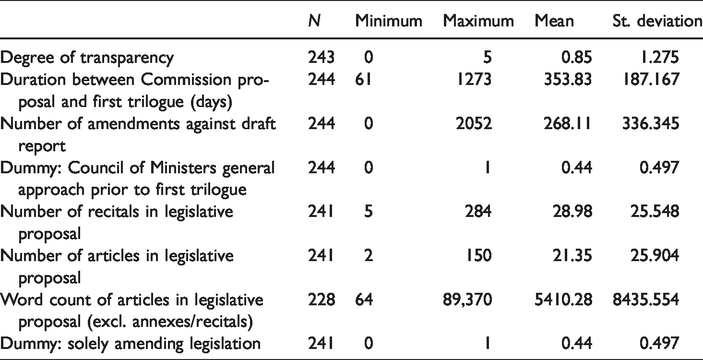
With respect to the duration of the various stages of the decision-making process, the results are more variable. After the provision (or non-provision) of public feedback on the first trilogue in a parliamentary committee, it takes roughly half a year before the decision-making process is completed – for those cases where agreement was found at first reading and before the 2019 elections. However, the actual duration ranges from a mere 14 days to well over a year. This stands in stark contrast to the time taken by the legislative institutions before they start negotiations on a legislative proposal, which is one of our political complexity indicators. On average, this takes twice as long: 354 days. However, in an extreme case, this took over three years, with two months as a minimum.
Our other complexity indicators also display high variances. Together, these descriptive results confirm that our cases constitute an appropriate testing ground for empirically testing the relationship between transparency, complexity and the duration of a legislative process; given the range of values on each of our variables and the degree of variance in them, we should be able to trace effects between our variables of interest.
Explanatory analysis
Table 3 reports the results of our Cox proportional hazards model. In total, we present three models to present a more detailed account of the contribution of individual variables to our overall model. In model 1, we only include our transparency measurement as an independent variable to demonstrate the effect of this variable in the absence of any other variables. This variable by itself does not produce a significant effect.
Determinants of decision-making efficiency: Cox proportional hazards models.
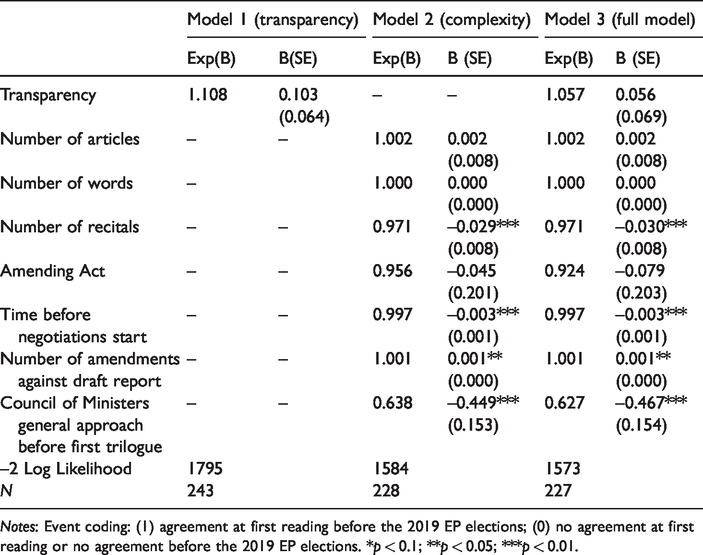
Notes: Event coding: (1) agreement at first reading before the 2019 EP elections; (0) no agreement at first reading or no agreement before the 2019 EP elections. *p < 0.1; **p < 0.05; ***p < 0.01.
In model 2, we exclusively include our complexity measurements as independent variables. This model displays strong results. Four variables significantly affect our dependent variable, being all our political complexity indicators. A higher number of recitals, a Council of Ministers general approach prior to trilogues and the time taken before the first trilogue all decrease the odds of finding agreement over time: 2.9% for every recital, and 36.2% for a Council of Ministers general approach. Unexpectedly, the number of amendments to the rapporteur’s draft report increases the odds of finding agreement but the effect is very small: 0.1% per amendment. Our dummy variable that picks up innovativeness does not yield significant results, and neither does the length of the legislative proposal. Although we assumed that amending Acts would contain less salient content than Acts that regulate new terrain, this effect did not surface in our analysis. The number of articles and words do not yield effects either. The lower N in this model is the result of recast legislation dropping out as it is not possible to unambiguously count the number of words, as well as proposed changes to the statutes of the European Central Bank and the Court of Justice, which do not come with a recital/article-based legislative proposal from the European Commission.
In our full model 3, we directly confront our transparency and complexity indicators. Our transparency indicator still produces no effect, neither increasing nor decreasing decision-making efficiency. This non-result tells us that transparency does not affect the duration of legislative processes when we control for the complexity of a file. This means that neither proponents nor opponents of transparency are right: transparency does not speed up or slow down decision-making. The effects of the complexity indicators remain the same compared to model 2.
Our results show that the duration of a legislative process only depends on the political complexity of a file. Transparency has no independent effect on the efficiency of decision-making.
Since only few cases in our data set obtained the highest transparency score, we carried out a further check to see if these cases are distinctive from the rest of our sample in terms of our complexity indicators. We found that there is no significant correlation between our transparency indicator and any of our cognitive complexity, innovativeness or political complexity indicators. This tells us that transparency, or the lack thereof, is not a product of complexity itself.
Conclusions
Decision-makers and scholars identify a trade-off between transparency and efficiency: you can be either transparent or efficient, but not both (cf. Greenwood, 2007; Hillebrandt and Novák, 2016; Stasavage, 2004). As much as this relationship has been discussed and problematized in the literature, it has been little investigated empirically. This study provides an important first step to empirically understanding the relationship between these two desiderata.
For the case of EU lawmaking, we did not find evidence of a correlation between transparency and decision-making efficiency. We therefore reject our hypothesis: transparency neither speeds up nor slows down decision-making. Since we have found no evidence of an effect of transparency on the duration of decision-making processes, even though such effects follow directly from the theories that we applied, we are left with a puzzle regarding the theoretical implications of our findings. We hypothesized that transparency would have an effect on the efficiency of decision-making because we expected the public provision of information to mobilize groups that would, in turn, attempt to influence decision-makers, which would result in a slower decision-making process. The fact that representatives and civil society organizations do try to influence decision-makers has been confirmed many times in the literature (e.g. Beyers, 2004; Greenwood and Roederer-Rynning, 2019b). Why is it, then, that we found no effects for transparency on legislative efficiency? We propose that our non-finding can be explained in two ways.
A first explanation might be that other factors are so much more important that any small effects of transparency cannot be detected. Our analysis bears important lessons for researchers of the effects of transparency and, in the slipstream of this, the legitimacy of democratic government. The complexity of a legislative file matters a great deal more than transparency does. This finding implies that for future research into the effects of transparency, as well as in other contexts than that of the EU and in small-N case studies, it is important to take the complexity of files into account. The study is a reality check in the sense that it highlights that transparency does not matter as much as transparency scholars sometimes assume.
A second possible explanation is that non-public forms of information sharing are more important. Public transparency can make a difference if it creates transparency for stakeholders who did not already have access to the information through other means. However, in this case, the standard practice of informal information sharing with insider groups (cf. Greenwood and Roederer-Rynning, 2019b) may explain why public transparency makes no difference in our study. It seems likely that insider groups who attempt to influence EU decision-makers rely on different sources of information than the one analysed in this study because they are part of a policy subsystem and enjoy privileged access to information. The fact remains that for outsider groups, the public reports on trilogues in EP committee meetings are the only institutionalized, systematic source of information on ongoing legislative negotiations that is available; however, these groups may simply not have the power or access to decision-makers to slow down the process. This finding highlights that transparency scholars should be careful not to study public transparency in isolation, but to relate it to other non-public forms of information sharing.
Apart from these substantial insights, the article also results in contributions to the methods for investigating transparency. The research indicates that large-scale analysis of decision-making processes can be done and may help to debunk some insights that are developed on the basis of seemingly logical arguments or single case studies. In addition, we have demonstrated that measuring transparency implies that its contents need to be assessed. Transparency can, in fact, be provided about the content of political decision-making but it is also strategic in nature. The many low transparency scores in our data set reflect the fact that public feedback is often provided in rather vague terms, sometimes just limited to atmosphere descriptions and unspecified accounts of progress that has been made on some issues, giving an illusion of transparency but, in fact, not saying much.
Overall, our findings indicate that increasing the quality and the availability of this information would not affect the efficiency by which decisions are reached. Others have indicated that there are plenty of normative reasons to increase the transparency of decision-making, including in the EU case (e.g. Curtin and Leino, 2017; Hillebrandt and Novák, 2016). This study suggests that the normative argument that transparency is undesirable because it slows down decision-making processes does not have an empirical basis. There are, of course, other arguments for or against transparency but the findings of this study indicate that the relation to decision-making efficiency does not surface in practice. This sobering reality check bears an uneasy message for transparency scholars: for normative reasons, transparency may well be a crucial ingredient for democratic legitimacy but it may be empirically much less relevant than normative reasoning suggests.
Footnotes
Acknowledgements
We wish to thank Niels Kunz and Sjoerd van den Brink for invaluable coding assistance.
Declaration of conflicting interests
The authors declared no potential conflicts of interest with respect to the research, authorship and/or publication of this article.
Funding
This research was funded by the Netherlands Organisation for Scientific Research (NWO) (grant number 464-15-187) as part of the project ‘Democratic legitimacy in the EU: Inside the “black box” of informal trilogues’, which was funded by the Open Research Area for the Social Sciences (ORA).
