



Abstract
Background:
Hikikomori, marked by intense social withdrawal and isolation, was first reported in Japan and has since been identified globally, including in Singapore. While excessive internet use has been proposed as a potential contributing factor, its influence remains contested. Rather, a person’s negative and cynical view of their social environment may better explain the tendency to withdraw which is mediated by internet use.
Aims:
This study investigates social cynicism as a potential antecedent of Hikikomori among Singaporean adults, exploring whether problematic internet use mediates this relationship.
Methods:
The study employed a cross-sectional design with a sample of 229 adults in Singapore, using validated measures to assess levels of social cynicism, problematic internet use, and Hikikomori tendencies. Path analyses were applied to determine both direct and mediated effects.
Results:
Results indicated that social cynicism and problematic internet use significantly predicted Hikikomori tendencies, with social cynicism having a stronger effect. Furthermore, internet use partially mediated the relationship between social cynicism and Hikikomori, suggesting that while internet use contributes, social cynicism exerts a more robust influence on Hikikomori tendencies in Singapore.
Conclusion:
These findings highlight the importance of addressing social cynicism in interventions to mitigate Hikikomori in Singapore. Targeting cynical beliefs about societal environments may enhance social integration and reduce the prevalence of social withdrawal. Future research and interventions should thus prioritize addressing these cynical perspectives to support well-being and reduce Hikikomori in the Singaporean context.
Hikikomori
Hikikomori is characterized by isolation within one’s home or room for a period of at least 6 months, accompanied by significant functional impairment and distress (Kato et al., 2019; 2020). Initially perceived as a culture-specific phenomenon in Japan, research has now identified Hikikomori cases globally (Kato et al., 2012; Nonaka et al., 2022), with reports from Italy (Amendola et al., 2021), France (Chauliac et al., 2017), the United States (Taku et al., 2023), and Nigeria (Bowker et al., 2019). What stands out in Hikikomori research is the lack of agreement on its underlying causes. Though not officially classified as a psychiatric disorder (Nonaka et al., 2022; Tajan, 2015), many studies have proposed psychiatric explanations, citing its comorbidity with major depressive disorder (Teo et al., 2020), anxiety disorders, personality disorders, and suicide risk (Kato et al., 2019; Yong & Nomura, 2019). Kato et al. (2019) proposed a multidimensional model that highlights the salient role of sociocultural factors in the development of Hikikomori. These factors include, but are not limited to, problematic family dynamics, cultural values, childhood trauma (AIS Electronic Library, 2020), bullying, low self-esteem (Husu & Välimäki, 2016), and problematic internet use (Miriam et al., 2024; Tateno et al., 2019). The model also suggests that experiences such as a highly competitive environment, shame, criticism from others, failure, and untrustworthiness may explain the development of Hikikomori worldwide (Kato et al., 2019).
Social Cynicism
Social cynicism refers to a general mistrust and negative perception of people, institutions, and societal structures (Leung et al., 2002). It encompasses beliefs such as the vulnerability of kind-hearted individuals to exploitation or the improbability of achieving positive outcomes in real life. This cynical outlook can foster a pessimistic and sceptical attitude toward one’s societal role and the value of society, potentially heightening the tendency to withdraw from social interactions. As Hikikomori is marked by profound social withdrawal, it is crucial to consider how an individual’s perceptions of their societal role influence these tendencies. A review of the sociocultural drivers of Hikikomori has highlighted its emergence in Japan’s collectivist society during an economic downturn and rising job insecurity, which intensified pessimism among Japanese youth, especially men, who subsequently rejected traditional societal roles and expectations for men to be the primary family breadwinner (Guo, 2022). Similar patterns of rejecting societal expectations have been observed in South Korea. Lee et al. (2022) reported that young adults often resort to self-isolation, driven by negative perceptions of social stability, housing insecurity, limited job opportunities, student debt, and challenges in fulfilling social responsibilities. Likewise, a qualitative analysis of Finnish adults identifying as Hikikomori revealed a perception of their society as highly demanding, unjust, and harsh, leading to feelings of inadequacy and an inability to meet societal expectations (Husu & Välimäki, 2016). It appears that a largely negative, cynical, and pessimistic perception of one’s social role and environment can motivate individuals to be aversive towards any form of social engagement.
Social cynicism may also originate from individual experiences. Those who have faced bullying are prone to adopt a more pessimistic outlook on their future, which may contribute to Hikikomori-like behaviours as a means of escaping adverse social conditions (Frankova, 2019; Kato et al., 2019; Låftman et al., 2018; Park & Yap, 2024). Taku et al. (2023) found a link between Hikikomori symptoms and feelings of perceived burdensomeness and thwarted belongingness among youths in Japan and the USA, suggesting that individuals who view themselves as inadequate or unable to meet societal expectations may prefer to disappear through self-isolation. When viewed through the lens of social cynicism, distrust, pessimism, and scepticism toward societal structures and norms can diminish the motivation to engage with or integrate into society. Moreover, the accessibility and convenience of the Internet can facilitate the shift toward a socially withdrawn lifestyle.
Problematic Internet Use
Problematic Internet Use (PIU) is characterized by an excessive and maladaptive engagement with the Internet, leading to difficulties in self-regulation, emotional distress, and significant impairments in daily life (Spada, 2013). This may include various forms of dysfunctional online behaviour such as online gaming disorder, online gambling disorder, social media addiction, and general internet addiction (Dahl & Bergmark, 2020). Within the literature, PIU has emerged as a common correlate of Hikikomori tendencies (Kato et al., 2020; Miriam et al., 2024; Tateno et al., 2019). Individuals with Hikikomori tendencies tend to engage with the internet at notably higher levels compared to non-Hikikomori (Hamasaki et al., 2020). Nevertheless, the nature of the relationship between PIU and Hikikomori remains contested.
Kato et al. (2020) proposed a bidirectional relationship between PIU and Hikikomori tendencies. They argue that the internet’s inherently solitary nature facilitates the avoidance of social interactions and real-world responsibilities, which contributes to the tendency for physical and social withdrawal. Research from the Yokayoka Hikikomori Support Center in Japan suggests that internet access enables individuals to evade face-to-face interactions and retreat from real-world challenges (AIS Electronic Library, 2020). A study of Japanese college students explored links between smartphone addiction, internet addiction, and the risk of Hikikomori symptoms (Tateno et al., 2019). Results showed a weak association between internet addiction and Hikikomori tendencies, while smartphone addiction appeared unrelated, as it often involves active online social engagement through social media platforms, contrary to the social withdrawal seen in Hikikomori. In contrast, certain internet activities, like browsing or watching videos, are typically solitary and involve little to no interaction with others.
Conversely, a Hikikomori lifestyle may contribute to the development of PIU. Individuals who reject social norms or seek to escape real-world challenges might turn to the internet as a means of coping. In such cases, the internet can become a crutch to fulfil psychological and social needs, leading to a pattern of problematic use. A study among Australian and American youths found that Hikikomori tendencies increased the risk of internet gaming disorder, with this effect being moderated by the time spent gaming (Stavropoulos et al., 2018). Orsolini, Yılmaz-Karaman, et al. (2022) demonstrated that students with PIU displayed higher levels of Hikikomori tendencies than their peers, with Hikikomori traits as a significant predictor of PIU among female students but not male students.
The Present Study
Research on Hikikomori in Singapore remains sparse. Lin et al. (2022) identified a strong connection between Hikikomori and social withdrawal, depression, and anxiety among young adults in Singapore. Another study by Liew et al. (2021) on Hikikomori tendencies and NEET status (Not in Education, Employment, or Training) among university students in Singapore found that a lack of self-competence and low self-esteem were significantly associated with social withdrawal. In a cross-cultural study, Bowker et al. (2019) found that Singaporean students with past Hikikomori experiences reported higher levels of anxiety, depressive symptoms, and loneliness compared to those without such experiences. This suggests that the social and cultural expectations in Singapore might exacerbate feelings of isolation for those struggling with social withdrawal. Bowker’s study also emphasized how the competitive academic environment in Singapore, alongside societal stigma surrounding mental health, might contribute to these elevated levels of distress. Unlike their counterparts in Nigeria and the United States, Singaporean youths experiencing Hikikomori showed a greater tendency to internalize their struggles, often perceiving their withdrawal as a personal failure rather than a response to external pressures. Hikikomori research has gained attention globally, but its cultural nuances and underlying psychological mechanisms remain underexplored in Singapore.
Understanding the epidemiology of Hikikomori is crucial for effective prevention strategies. Hikikomori tends to report more significant interpersonal challenges, engagement in addictive behaviours, and a higher risk of suicide compared to those who do not experience such withdrawal (Yong & Nomura, 2019). They also face a heightened risk of dying alone (Kato et al., 2017). However, research on Hikikomori often overlooks the individual’s belief and perception of their environment, which is arguably at the core of the Hikikomori phenomenon, tracing back to the idea of ‘futoko’ or ‘school refusal’ in the 1970s (Kato et al., 2019). This study explores an alternative argument to the Hikikomori literature by examining the role of social cynicism—a worldview characterized by distrust and scepticism towards the motivations and actions of others, which predicts Hikikomori tendencies. We acknowledge that PIU is a robust modern predictor of Hikikomori tendencies, therefore, we hypothesize that both PIU and social cynicism are predictors of Hikikomori tendencies.
However, we also argue that PIU may also serve as an enabler. When individuals perceive their society as hostile, the internet offers a respite and escape from social scrutiny, pressure, or threats, thus reinforcing withdrawal tendencies. We propose that internet use functions as a means of escape or self-preservation for those who perceive society as overly judgmental or unwelcoming, as opposed to a cause. This perspective shifts the focus to where PIU serves as a bridge between social cynicism and Hikikomori behaviours. In other words, individuals who harbour cynical beliefs may turn to the internet as a means of escaping a pessimistic and cruel world, and over time, contribute to their withdrawal from society. Specifically, we argue that social cynicism predicts Hikikomori tendencies, and this relationship is mediated by PIU. This conceptual framework is depicted in Figure 1.
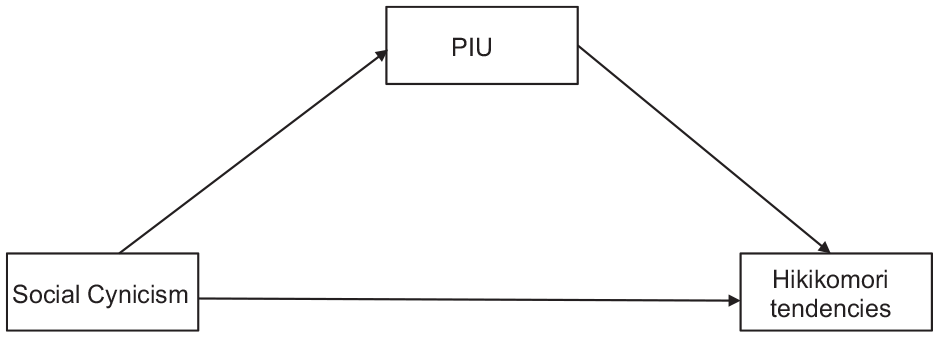
Hypothesized mediation model.
Method
Study Design and Participants
This study employed a cross-sectional design using a self-administered questionnaire on the Gorilla Experiment Builder. Data were analysed using the Statistical Package for Social Sciences (IBM Corp, 2023) with social cynicism as the predictor variable, PIU as the mediating variable, and Hikikomori tendencies as the outcome variable. Ethical approval was obtained from the University of Portsmouth. Participants were recruited through convenience and snowball sampling techniques, leveraging social networking platforms and online forums to reach potential adult respondents (above the age of 18 years) across Singapore.
Measures
Hikikomori Questionnaire (HQ-25)
The Hikikomori Questionnaire (HQ-25) is a 25-item measure assessing social withdrawal over the past 6 months across three dimensions: socialization, isolation, and emotional support. Items are rated on a 5-point Likert scale from 0 (strongly disagree) to 4 (strongly agree), with higher scores indicating greater social withdrawal. The scale demonstrates excellent internal consistency, Cronbach’s α = .96 (Teo et al., 2018).
Social Axioms Scale II (SAS-II)
The Social Axioms Scale II (SAS-II) (Leung et al., 2012) is a 40-item instrument that assesses general beliefs about human behaviour, social institutions, and the physical world, on five key domains: social cynicism, social complexity, reward for application, spirituality, and fate control. Items are scored using a 5-point Likert scale from 1 (strongly disagree) to 5 (strongly agree). In this study, we focus on the eight items from the social cynicism domain. Higher aggregate scores on these items reflect stronger tendencies toward social cynicism. The social cynicism domain has demonstrated acceptable internal consistency, Cronbach’s α = .65 (García-Alonso et al., 2020).
Problematic Internet Use Questionnaire-9 (PIUQ-9)
The Problematic Internet Use Questionnaire-9 (PIUQ-9) is a streamlined adaptation of the original 18-item PIUQ developed by Demetrovics et al. (2008). Comprising 9 items, the PIUQ-9 evaluates problematic internet use across three dimensions: obsession, neglect, and control. Items are scored using a 5-point Likert scale from 1 (never) to 5 (always), with higher total scores reflecting a greater degree of problematic internet use. The PIUQ-9 has demonstrated strong internal consistency among adult populations, Cronbach’s α = .91 (Koronczai et al., 2011).
Procedure
The study was promoted online via platforms (e.g. Reddit, Discord), which included a link to the Gorilla platform. Upon accessing the link, participants were presented with an information sheet that outlined the study’s objectives, procedures, and ethical considerations. Participants were then asked for their informed consent electronically before proceeding. They then completed a demographic questionnaire, the HQ-25, SAS-II, and PIU-9 which was estimated to take about 10 to 15 min to complete Upon completing the survey, participants received a support document containing details of free psychological support services and were invited to participate in a Prize Draw to stand a chance to win 1 out of 10 Amazon Vouchers valued at 10 Singaporean Dollars each.
Results
Preliminary Analyses
A total of 229 responses were collected. The initial analysis using a boxplot identified six outliers. These were excluded from the dataset and subsequent analyses to ensure the robustness of the results, yielding a final sample size of N = 223. with an average age of 29.45 years old (SD = 9.13) (38.6% male, 60.5% female, 0.9% others). Most participants resided with their family/parents (83%), followed by living with a partner (9.9%), alone (4.9%), and with friends/housemates (2.2%). A total of 10.3% indicated a history of psychiatric diagnosis, while 89.7% indicated no psychiatric diagnosis (see Table 1).
Participant characteristics.
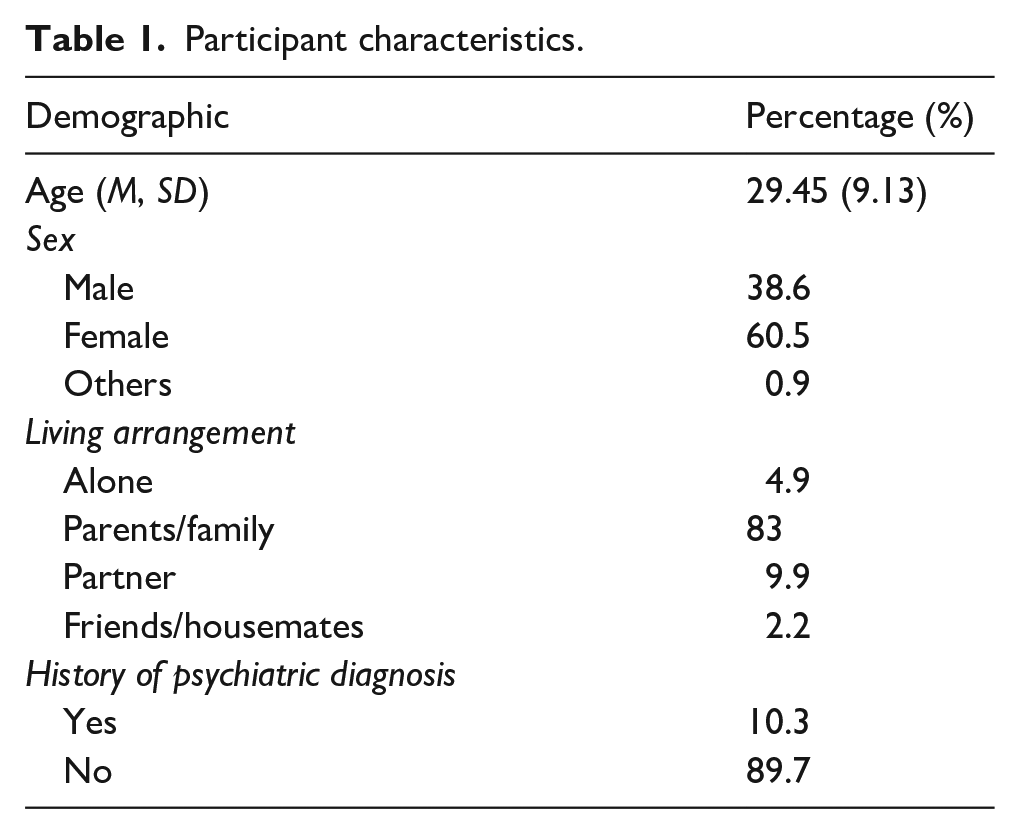
To investigate the influence of demographic factors on social cynicism, problematic internet use (PIU), and Hikikomori symptoms, an Analysis of Variance (ANOVA) was performed. Findings revealed no significant difference in living arrangement on social cynicism, F (3, 219) = 1.844, p = .140, PIU scores, F (3,219) = 0.812, p = .489, and Hikikomori score, F (3,219) = 2.557, p = .056. Similarly, gender did not yield significant differences across the measured variables: social cynicism, F (2, 220) = 2.501, p = .084; PIU scores, F (2,220) = 1.998, p = .138; and Hikikomori score, F (2,220) = .739, p = .479. The reliability of the scales employed in this study was calculated using our data and was robust with Cronbach’s α = .78 for HQ-25, α = .84 for PIUQ-9, and α = .77 for SAS-II.
Regression Analysis
Initial assumption checks indicated no issues with collinearity for social cynicism (tolerance = 0.958, VIF = 1.044) and problematic internet use (PIU) (tolerance = 0.958, VIF = 1.044). The assumption of independent errors was satisfied (Durbin–Watson value = 1.809, p = .148). Multiple linear regression analysis was conducted to determine whether social cynicism and PIU predicted Hikikomori tendencies. Using the enter method, the analysis revealed that PIU and social cynicism explained 13.1% of the variance in Hikikomori tendencies, F (2, 220) = 16.652, p < .001, adjusted R2 = 0.124. Results further demonstrated that social cynicism (β = .272, p < .001, 95% CI [0.475, 1.299]) and PIU (β = .190, p = .003, 95% CI [0.162, 0.803]) significantly predicted Hikikomori tendencies. Findings suggest that social cynicism exerts a more robust predictive effect on Hikikomori tendencies compared to PIU (see Table 2).
Multiple linear regression analysis model predicting Hikikomori tendencies.
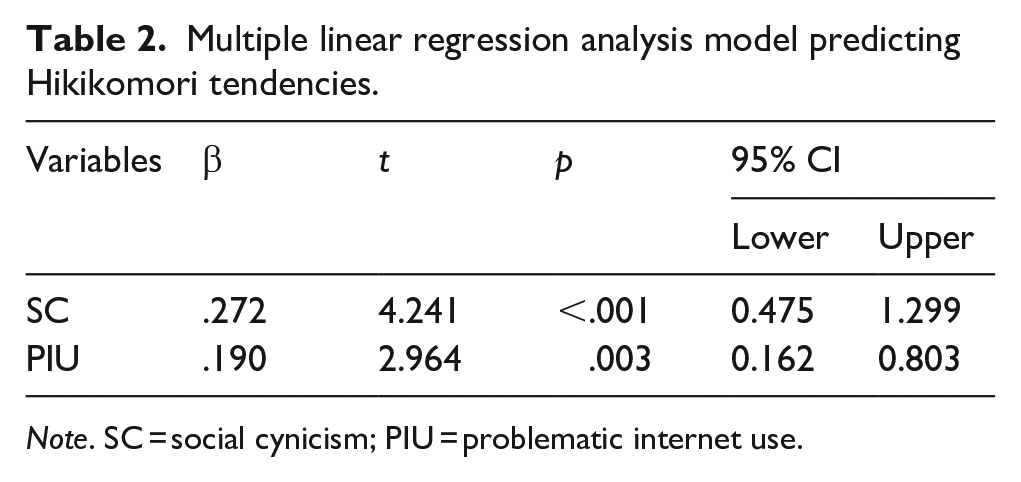
Note. SC = social cynicism; PIU = problematic internet use.
Mediation Analysis
Analysis utilising the PROCESS Macro (Model 4) by Hayes (2017) was conducted to investigate whether PIU mediates the relationship between social cynicism and Hikikomori tendencies (see Figure 2). History of psychiatric diagnosis was added as a covariate. Results indicated a significant indirect effect of PIU, B = .123, p = .035, 95%CI [0.005, 0.298]. Additionally, a significant direct effect of social cynicism on Hikikomori tendencies was observed, B = .871, p < .001, 95% CI [0.461, 1.282]. Findings suggest that PIU serves as a partial mediator in the association between social cynicism and Hikikomori tendencies (see Table 3).
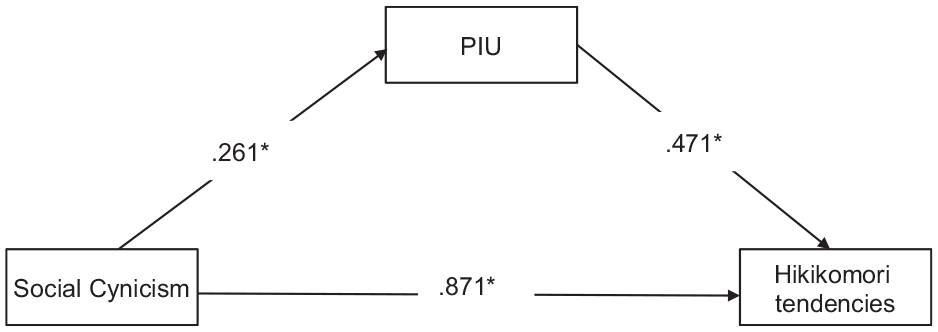
Mediation model.
Mediation effects.
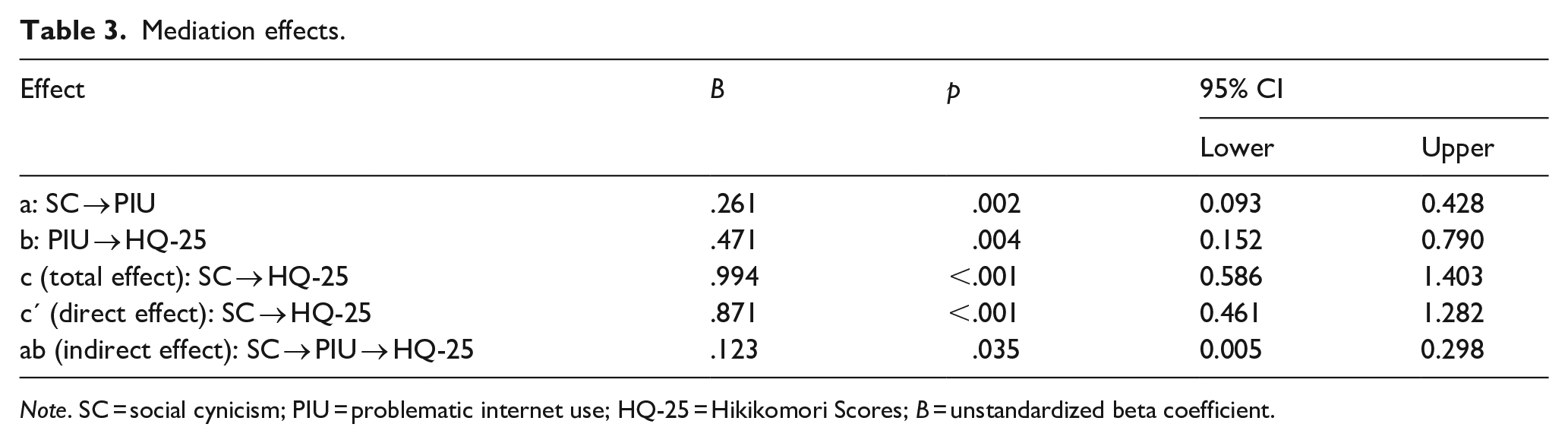
Note. SC = social cynicism; PIU = problematic internet use; HQ-25 = Hikikomori Scores; B = unstandardized beta coefficient.
Discussion
This study explored the link between social cynicism, PIU, and Hikikomori tendencies among Singaporean adults. Our findings demonstrated that both PIU and social cynicism significantly predicted Hikikomori tendencies, supporting our first hypothesis. Our findings also revealed that PIU partially mediated the relationship between social cynicism and Hikikomori tendencies, supporting our second hypothesis. These results present an alternative perspective on the aetiology of Hikikomori that emphasizes societal disengagement.
Social Cynicism as a Key Predictor
The strong predictive effect of social cynicism aligns with theoretical frameworks that suggest Hikikomori tendencies may arise as a coping mechanism for individuals who view societal expectations and systems as oppressive or unjust. Previous research in Japan has similarly identified young men’s rejection of traditional gender roles, such as the expectation to be the family breadwinner, as a factor contributing to social withdrawal (Jee, 2016). In Singapore, where societal pressure for academic and professional success is high, similar patterns may emerge, particularly among individuals who feel they cannot meet these expectations (Dimmock & Tan, 2013). A sense of disillusionment and mistrust toward social structures could lead individuals to withdraw from social life as a means of escaping societal pressures.
This critical interpretation highlights how a negative perception of social structures affects one’s sense of belonging and willingness to engage with society. The findings suggest that in a highly meritocratic society like Singapore, individuals who feel disconnected or alienated may be more likely to develop Hikikomori tendencies. These individuals may perceive society as demanding or unforgiving, leading them to retreat from social interaction as a form of protest or self-preservation. The role of social cynicism in fostering Hikikomori behaviours further supports the view that Hikikomori is not merely a culturally bound phenomenon in Japan, but a socially bound response to modern societal conditions (De Luca, 2016; Furlong, 2008; Martinotti et al., 2020; Orsolini, Bellagamba, et al., 2022; Wong et al., 2019).
The critical question, then, is whether social cynicism in Singapore is a result of systemic social and economic pressures or of disillusionment with societal institutions as a reflection of a broader global trend. While our findings demonstrate the significance of social cynicism, they do not fully address whether these perceptions are context-specific or a more general response to modern societal challenges such as job insecurity, high living costs, or rapidly evolving societal expectations. This ambiguity necessitates further research to determine whether social cynicism in Singapore has unique cultural antecedents or mirrors broader global trends.
The Mediating Role of PIU
PIU emerged as a significant mediator in the relationship between social cynicism and Hikikomori tendencies, though it only partially explained this link. This suggests that while excessive internet use may facilitate or exacerbate social withdrawal, the root cause of Hikikomori behaviours in Singapore is more likely grounded in negative societal perceptions. As previous research has demonstrated, PIU provides an avenue for individuals to escape real-world interactions, allowing them to isolate themselves while still feeling connected to virtual environments (Tateno et al., 2019). However, our findings indicate that PIU, while important, may not be the primary driver of Hikikomori behaviours.
In the context of Singapore, where digital connectivity is high, PIU may serve as both an escape and a reinforcement of social withdrawal tendencies. The partial mediation observed in our study suggests that individuals who hold cynical views of society are more likely to use the internet excessively, but social cynicism itself remains the more robust predictor of withdrawal. This implies that addressing PIU alone in interventions may only target one aspect of the issue, while the deeper, underlying problem of societal mistrust remains unaddressed.
A more critical perspective might argue that PIU could be both a symptom and a consequence of social cynicism. Individuals who distrust societal structures may turn to the internet as a means of bypassing real-world social obligations, reinforcing a cycle of withdrawal. In Singapore, where societal success is highly valorised, the internet may offer a means to disengage while still feeling connected through virtual environments. This partial mediation suggests that efforts to reduce PIU may only address the surface of Hikikomori behaviours’, while deeper issues of societal mistrust and cynicism remain unaddressed.
Cynicism, PIU, and Hikikomori
Critically, the interplay between social cynicism and PIU reflects a broader question of how modernity and digital technology are reshaping the experience of social withdrawal. While PIU may serve as a tangible manifestation of Hikikomori tendencies, our study’s findings emphasize that social cynicism is a more robust predictor. This indicates that negative perceptions of society’s fairness or values may underlie much of the Hikikomori phenomenon, even in highly connected urban environments like Singapore.
Furthermore, the critical link between bullying and social withdrawal has been well-documented, with research showing that individuals who experience peer or parental rejection are more likely to develop Hikikomori tendencies (Amendola & Cerutti, 2024; Krieg & Dickie, 2011; Yong & Kaneko, 2016). In the Singaporean context, where societal expectations are high, failure and rejection may further alienate individuals, exacerbating their social cynicism and driving them to isolate themselves. This narrative supports the argument that Hikikomori is a modern, socially bound phenomenon that transcends cultural boundaries, with social cynicism emerging as a universal factor that predicts withdrawal behaviours (Hayakawa et al., 2018).
This nuanced relationship calls for a more sophisticated approach to understanding the role of technology in social withdrawal. Rather than viewing PIU purely as a driver of isolation, it might be more accurate to consider it a symptom of a deeper, more pervasive societal disengagement fuelled by cynicism. As such, interventions focusing solely on reducing internet use may miss the broader psychological and social contexts that underpin Hikikomori behaviours in Singapore. Addressing the underlying social cynicism, whether through societal reforms, mental health interventions, or educational programs could be more effective in preventing social withdrawal than simply targeting PIU.
Implications for Singaporean Society
The findings have significant implications for addressing Hikikomori tendencies in Singapore, particularly in understanding the broader societal context that may foster social cynicism. Singapore’s focus on meritocracy and success may inadvertently marginalize those who struggle to meet societal expectations, leading them to withdraw, particularly in light of the potential risk for suicide among individuals with Hikikomori tendencies.
In particular, academic stress represents a salient and culturally specific pressure point in Singapore that may contribute to feelings of inadequacy, failure, and eventual social withdrawal. Previous research has highlighted how intense educational competition and performance-driven environments can lead to emotional exhaustion and disengagement (Tosun & Çetin, 2025). Such stressors may act as a proximal factor in the development of both social cynicism and PIU, serving as a gateway to Hikikomori behaviours among younger individuals. Incorporating academic stress into future models could enrich our understanding of how meritocratic pressures uniquely manifest in the Singaporean context and further reinforce the link between societal expectations and withdrawal (Ang & Huan, 2006).
Further, as highlighted by Yong and Nomura (2019), Hikikomori individuals, particularly those with a history of psychiatric conditions, are at a heightened risk for suicidal behaviours. Therefore, interventions aimed at addressing social withdrawal in Singapore should not only focus on individual behaviours but also consider systemic changes that reduce social cynicism, such as creating more inclusive and supportive social environments.
Moreover, mental health practitioners in Singapore may need to adopt a more nuanced approach to treating individuals with Hikikomori tendencies. Rather than solely focusing on internet addiction or depression, interventions should address the underlying mistrust of society and feelings of alienation. Programs designed to build trust in social institutions and foster a sense of belonging could be particularly effective in mitigating the effects of social cynicism and, by extension, reducing Hikikomori behaviours, and associated risks, such as suicide.
Strengths and Limitations
By examining the role of social cynicism in conjunction with PIU, this study offers a novel and holistic understanding of the factors that contribute to Hikikomori tendencies. However, some limitations warrant critical reflection. The cross-sectional nature of the study limits the ability to infer causality between social cynicism, PIU, and Hikikomori tendencies. Longitudinal studies would be necessary to track how these relationships evolve. Additionally, the self-report nature of the questionnaires could introduce bias, as participants may underreport socially undesirable behaviours such as PIU or exaggerated feelings of social withdrawal. Future research should consider more diverse methodologies, including qualitative approaches, to capture a deeper understanding of the lived experiences of individuals with Hikikomori tendencies in Singapore. Additionally, the role of loneliness should also be considered when examining Hikikomori tendencies due to its comorbidity (Wu et al., 2020; Yong, 2024).
Conclusion
In conclusion, this study provides critical insights into the relationships between social cynicism, PIU, and Hikikomori tendencies in Singapore. Our findings suggest that while PIU plays a role in mediating social withdrawal, social cynicism remains the more substantial predictor of Hikikomori tendencies. Addressing this deep-seated mistrust of society is crucial for developing effective interventions to reduce social withdrawal. By tackling the root causes of social cynicism, particularly in Singapore’s highly competitive and meritocratic society, mental health practitioners and policymakers may be able to mitigate the effects of Hikikomori behaviours and associated risks, such as suicide. These findings underscore the need for both individual and societal interventions that go beyond addressing internet use, focusing instead on the broader societal dynamics contributing to social cynicism and disengagement.
Footnotes
Funding
The author(s) disclosed receipt of the following financial support for the research, authorship, and/or publication of this article: Internal departmental funding (Research & Innovation Committee fund, Department of Psychology, University of Portsmouth).
Ethics Considerations
Ethical approval was received from the University of Portsmouth (SHFEC 2023-109).
Consent to Participate
Written consent was sought from participants for this study per the requirements of the ethics approval.
Consent for Publication
Participants have been informed that non-identifying anonymized data will be used for publication and consent has been received.
