




Abstract
Background:
This contribution advances claims about ‘geopsychiatry from below’, attending to how ‘voices’ with lived experience of mental ill-health speak about ‘the geo’ or, more specifically, ‘place and space’.
Aims:
To explore relevant interdisciplinary literature for academic research, scholarship and commentary containing voices of experience speaking about the geo.
Methods:
An ‘indicative’ and ‘facilitative’ review of relevant transdisciplinary literature in arts and humanities and social science, alongside an exploratory workshop where materials are analysed and relationships detected and, provisionally, mapped.
Results:
The literature review discloses no coherent body of studies into the geo from below, but rather a fragmented amalgam of materials—field observations, primary quotes and occasional elaborations—that are rarely the direct focus of inquiry (except in some contributions by academic geographers). Combining the literature review and the workshop analysis, an outline series of prompts are developed for relating ‘Kinds of Places’, their associated ‘Affective Qualities’ and actual spaces and places on the ground.
Conclusions:
This study signals what a geopsychiatry from below might entail, providing important foundations for future transdisciplinary work on ‘the geo’ and mental (ill-)health.
Geopsychiatry from below?
There has recently been a growing interest in what has been called ‘geopsychiatry’ (Alibudbud, 2024a, 2024b; Bhugra & Ventriglio, 2023a, 2023b, 2023c; Castaldelli-Maia & Bhugra, 2022; Koravangattu et al., 2022; Persaud & Bhugra, 2022a, 2022b, 2022c; Persaud et al., 2018; Persaud & Ventriglio, 2023; Smith et al., 2023; Sri et al., 2023; Valsraj et al., 2022), with the field emerging as an insightful point of interconnection between psychiatry, as academic discipline and clinical practice, and geography, as academic discipline and a ‘sensibility’ hinging on acknowledging the importance of ‘space and place’ (and a host of related constructs such as environment, landscape, location and distribution).
To date, inquiries framing themselves as geopsychiatry have addressed the global scale of regional disparities in ‘determinants’ threatening to mental well-being. This focus directs attention to the global theatres of: geopolitical tension, violence against ethnic and other minorities, and the forced migration and struggles of refugees and aslyum-seekers; geoeconomic inequalities between world regions bound up with the uneven workings of capitalism, neo-colonialism and ‘development’; and, to a lesser extent, geocultural dimensions of how powerful societal cohorts discriminate against ‘minority’ groupings on the grounds of race (ethnicity), gender, sexuality and other (innate or attributed) characteristics. Additionally, concern turns to the enormous environmental challenges currently biting for many peoples and places, prompted by climate change, extreme weather events, flooding, desertification, land erosion and more, all impacting the ‘security architecture’ of individuals and communities worldwide. Questions of geographical variability in policy-and-practice responses to situations producing mental ill-health are also woven into these early efforts at founding geopsychiatry.
There is no doubting the value of such inquiries, although we might wish for more credit to be given to existing work in academic geography—our home discipline—that, occasionally explicitly conducted under the umbrella of ‘mental health geography’, tackles these sorts of matters. Such was the message of a piece that we published in this journal—with two other colleagues—on the theme of ‘geopsychiatry and geography’ (Philo et al., 2024). A key feature was to underline that mental health geography has taken seriously critiques of ‘the biomedically-inflected model of illness, pathology and clinical intervention typical of medical geography’ (Philo et al, 2024, p. 82). As such, we have reservations about straightforwardly combining geography with more biomedical versions of psychiatry, but also anticipate that our favoured orientation will dovetail with the ‘social psychiatry’ integral to the ethos of this journal and, moreover, with efforts already made in certain quarters of psychiatry to allow the views of ‘patient’ representatives and advocacy groups to influence both academic research and clinical practice.
In our discussion, moreover, we emphasised how mental health geographers often strive to appreciate ‘the ‘internal’ or ‘agentic’ worlds of people who acquire mental health problems,’ showing ‘commitment . . . to engaging with the lived experience of mental (ill-)health’ (p. 83). Another way of expressing that remark is to claim the value of what here we will term ‘geopsychiatry from below’, 1 centralising voices of experience—emanating from people who live with or are recovering from mental ill-health—and what they may represent, directly or in passing, about their lived experiences of ‘the geo’. We coin the latter term, meanwhile, as a shorthand for ‘space and place’ and related constructs, each of which can be lent precise (if contested) definition by academic geographers but are, unsurprisingly, for the most part used quite imprecisely and interchangeably in everyday life settings.
Centralising voices from below is one way whereby we distance ourselves from a mainstream of psychiatric thought-and-practice that does still tend to regard ‘patient’ views, opinions and experiences as merely expressing—maybe diagnostic of—mental disorder, not necessarily to be engaged for fresh, meaningful insights. 2 In so doing, we work in solidarity with ‘Mad Studies’ that continue to push for a prioritisation of voices from below (Beresford & Russo, 2022, 2023) and we consult the International Mad Studies Journal in what follows. Geopsychiatry, named as such, is nonetheless only a very recent invention, making it premature to conclude that no room can be given such voices here or to suppose that their relative absence as yet necessarily stems from theoretical, methodological or ethical stances already engrained in the field’s ‘DNA’. Indeed, the field is still very much an open book with the potential to be written in many different ways.
The purpose of the present paper is hence to break the ground for an envisaged ‘geopsychiatry from below’, and to do so through the vehicle of a transdisciplinary literature review coupled to a workshopped analysis of materials obtained from that review. This work has been undertaken by the two authors together with a ‘professional storyteller’, Ruth Kirkpatrick, 3 and a ‘lived experience consultant’, Morag Macgilchrist. 4 The combined outcome from the review and the workshops has resulted in what we cast as a preliminary framework—or, more humbly, a series of prompts—for detecting inter-relationships within these materials between voiced ‘affective’ attributes of the geo, on the one hand, and real worldly environments and landscapes, on the other. In what follows, we first clarify the methods that we have used in our inquiry, before exploring our results—reflecting on what the literature review has disclosed—and then recounting what emerged from our workshopped analysis in the form of a framework or prompts. In conclusion, we venture final thoughts about the kind of departure that geopsychiatry, and specifically geopsychiatry from below, entails.
Methods
Search strategy and procedures
Our inquiry pivots around a literature review. Our background in mental health geography means that we are already familiar with writings in the literature of academic geography wherein voicings of the geo from below are prominent (McGeachan & Philo, 2017, 2023), and we have included two widely-read geography journals in our review and analysis. Our prime interest here, however, is excavating a wider transdisciplinary terrain including both traditional disciplines (e.g. anthropology, history) and interdisciplinary fields (e.g. public health, Mad Studies). Given our interest in paying acute attention to the geo from below, we are attuned to ideas about alternative pathways to knowledge and looking in the margins (Burstow et al., 2014). A prior supposition is that materials germane to our inquiry will be found in certain corners of the transdisciplinary terrain, leading us to sample nine academic journals as the basis for our review (see Table 1). We make no great claims about the status, representativeness or comprehensiveness of this selection, except to note that we have prioritised journals leaning away from the natural sciences—the medical sciences included—and instead toward the social sciences and arts and humanities. Such a leaning is consistent with the distance that we hold between our version of geography and a biomedically inclined psychiatry (excepting that elements of the latter feature in one of our selected journals, the International Journal of Social Psychiatry).
Keywords journal search (numerical search conducted 09/08/2024).

Numbers without brackets indicates result from a basic keyword search that finds all papers where the words in the search term (i.e. mental health geography) appear but not necessarily together. Experimenting with Boolean operators does not meaningfully change such results.
Numbers in brackets indicates result from a keyword search with the search term in double quote marks (i.e. “mental health and place”) that only finds papers where the words in the search term appear together.
This journal does not offer a keyword search option. Only two issues have been published to-date.
What we conduct might be termed an ‘unsystematic review’, departing from the recent logic of systematic review and its drive to continually narrow down what is to be read. This ‘unsystematic’ approach connects our attempts to excavate ‘from below’ to wider critiques of systematic review processes in Mad Studies and beyond (Rose, 2021). Systematic review uses the technology of repeated online keyword searches and ‘eligibility’ protocols progressively to whittle away the excessiveness of chosen literature databases in extracting only those published papers dealing exactly with what interests a researcher (e.g. Mengist et al., 2020). Such an approach is unsuitable for us, its reductionism likely stripping out much of relevance for our purposes and militating against what we position, cryptically, as insatiable curiosity about ‘the next paper’ that might be stumbled across in those more unstructured and serendipitous efforts sometimes called ‘narrative review’ (Gregory & Denniss, 2018).
That said, we acknowledge that some basis is needed to guide our inquiry, and so for each selected journal we have commenced with simple compound keyword searches. Discussion with our lived experience consultant on the project conveyed the importance of attending to the simple and clear coordinates of ‘mental health and place’, ‘madness and space’ and ‘mental health geography’ for our search. Often these searches in any one journal return the same papers, but there are intriguing differences, notably in how including ‘madness’ locates papers with a conceptual, qualitative and critical character often missed by the other search terms. It is possible that papers of potential relevance to us remain unidentified by these searches, but our method does not necessitate exhaustivity and instead simply endeavours to be ‘indicative’ of the sorts of materials that might be located and then ‘facilitative’ of our subsequent analysis.
Table 1 shows the numbers of results returned by these searches for each of our selected journals, showing the dramatically different results from both expansive and more restrictive versions of the searches (see notes under table). 5 Such enumerations are actually of little significance for our purposes, since the real work begins when we encounter the located papers by reading their titles, abstracts and, if warranted from title and abstract, their text. The key consideration at this stage is whether a paper contains or draws upon—as a core aspect or just in passing—voices of experience that tell us something about living in, with or through the geo. Accessing such voices requires a move away from ‘inclusion criteria’ and quantification of retained papers, and instead requires investigation into the inner parts (depth) of the works themselves, thereby requiring alternative forms of attention. Additionally, where large numbers of papers have been returned by a journal under a search, we have only read titles, abstracts and text for the first circa 50-70 or so of these papers listed in the search results. Again, such non-systematicity is not a problem for us, since our goals are only to arrive at papers carrying materials that are indicative (of what can be found in the literature) and facilitative (of further work by the authors on the materials located).
Analysis and workshop design
A further methodological step entailed seeking to convert our findings from the literature review into an analytical—although ‘interpretative’ might be a more accurate term—framework within which certain consequential inter-relationships between place and mental (ill-)health can be specified. Through the medium of a workshop—prepared for by both authors and ran by McGeachan with the lived experience consultant and professional storyteller—extracts selected from the literature review, chiefly direct quotations from voices of experience where the geo was obviously foregrounded, 6 were carefully considered for what they potentially disclose about how place and mental (ill-)health play upon one another. Connecting to participatory action research (PAR) methods that valorise giving space and voice to lived experience (Billies et al., 2010; Sexton & Sen, 2018), the workshop treated each extract as a vital fragment of such experience, each being engaged both in its particularity and for what it might suggest with generalisable implications.
There were two dimensions of what followed. First, and most analytically, we arrived at lists of ‘Kinds of Places’ and ‘Affective Qualities’ drawing on the literature extracts—we provide thumbnail definitions of what we mean by these terms in Table 2—and we contemplated throughout the workshop how the former, the ‘Places’, are encountered, sensed, interpreted and responded to through the lenses of the latter, the ‘Qualities’. 7 The second was to ‘map’ the constructs identified under both ‘Kinds of Places’ and ‘Affective Qualities’ in actual spaces (types of location) and concrete places (nameable localities). We used the simple device of a hand-drawn base map which in our workshop identified ‘home’, ‘cultural spaces’ (e.g. art gallery), ‘community centres’, ‘social support (spaces)’, ‘medical spaces’, ‘institutions’ (e.g. hospitals and care homes) and the routes (streets, transport links) between them. 8 In the workshop we experimented with pinning on to the base map some of our review quotes from voices of experience, ones where clearly identifiable and delimited spaces and places were obviously mentioned or insinuated. The two methodological steps explained here were graphically captured in our traditional workshop pinboard (see Figure 1).
Elements in the analysis.

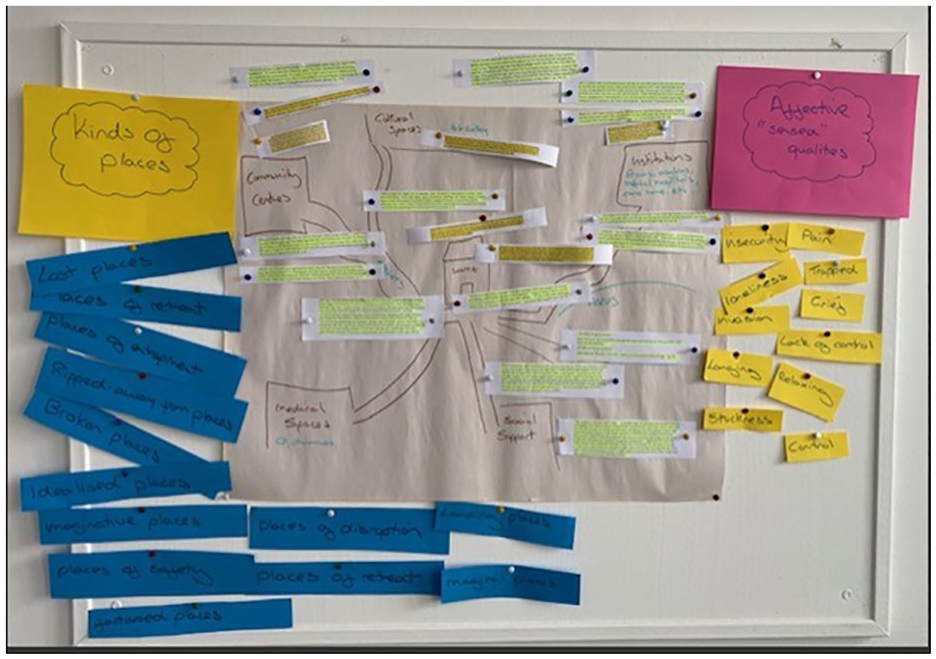
Workshop pinboard (created 28/06/2024).
Results
Exploring the journal papers
The majority of papers returned by our initial searches with some alertness to the geo do not draw upon voices of experience, but rather offer variations on the following: quantitative-statistical analyses of cohort- or population-level mental health data wherein individuals are aggregated into collectives and experiences buried within correlations or purported causal relationships; social and mental health policy analyses majoring on questions about systems, institutions, governance, social change, health outcomes and the like, with only occasional reference to the views of ‘users’; and more abstracted or polemical think-pieces tackling issues in the history or current politics of mental (ill-)health, psychiatry and their contestation, sometimes with the well-being but rarely the actual voices of people with mental health problems at their heart. There is nonetheless a substantial minority of papers—certainly exceeding 100 across our whole sample—where the geo is voiced by people with lived experience, most obviously in direct quotations from these people themselves derived from interviews and focus groups, conducted face-to-face or virtually, or extracted from questionnaires with ‘open questions’ soliciting ‘comments’. In a few cases, notably in observations from ethnographic work, the staple of Medical Anthropology, ‘speech’ from people with lived experience is recounted alongside interpretations of motives, meanings and actions. Crucially, a small number of these papers, particularly but not exclusively in the International Mad Studies Journal, are the writings of ‘experts’ by experience, hence carrying their voices essentially unfiltered. 9
For the most part remarks about the geo in our located papers feature indirectly, fleetingly present within broader reflections on other matters such as experiences of treatment regimes, mental health professionals, welfare systems, housing conditions and more. In a few papers, circa 30, these remarks do get foregrounded, in that the direct focus of attention is how people with mental health problems experience—perceive, conceive and represent—diverse spaces and places central to their biographies and ongoing lives. Unsurprisingly, given the overall raison d’être of Health and Place, it is the journal carrying the richest seam of papers along these lines. While this journal has become a thoroughly interdisciplinary site for a wide-ranging portfolio of public health research, it initially grew from the efforts of academic medical or health geographers (Moon, 1995) and it is the venue in our review where ‘mental health geography’, named as such, appears most frequently.
What is also apparent across our set of located papers is the extent to which voicings of the geo from below—sometimes explicitly citing what is perhaps health geography’s most influential conceptual offering to the transdisciplinary field of ‘social’ health studies, ‘therapeutic landscapes’ (Gesler, 1992, 1993; Kearns & Milligan, 2020)—encompass ‘physical’, ‘social’ and ‘symbolic’ properties of places and spaces. Often overlapping, rarely neatly separated out, voices hence tell of: the physical (scenic, tangible, graspable) aspects of both natural and built environments; the social aspects entailed by human groups, dynamics, relations, inequalities and struggles associated with given locations; and the symbolic, perhaps we might also say cultural, dimensions of what certain spaces and places signify, evoke and impress—what they feel and mean—for the people concerned. Paralleling how the therapeutic landscapes concept has been reworked (e.g. Conradson, 2005), moreover, few if any of our papers imply some innate, fundamental ‘structure’ of space or ‘essence’ of place determining states of mental well- or ill-being. Rather, the finding is of a relational unfolding of how the geo and people mutually co-develop and affect one another. Putting it simply, people are clearly ‘made’ by the geo at the same time that they ‘make’ it in return, in which regard an emphasis on what people do in, with and through spaces—including how they actively ‘place-make’—is definitely part of what our review has disclosed.
In Table 3 we show the ‘Kinds of Places’ identified, providing thumbnail accounts of what each one implies and also specimen quotes from the literature to exemplify something of what is involved in each case. Throughout our tables we retain—where names are given (real or pseudononymised) in the source papers—these named identities of the voices of experience in order to recognise the importance of their agency and personhood. We also retain the original punctuation (or lack of it). In Table 4 we show the ‘Affective Qualities’ identified, providing brief explanations for what each one delimits and, again, some specimen quotes from the literature (some with explicit reference to the geo, some without). Tellingly perhaps, the prevailing ethos of what we listed on both sides of our pinboard was negative, evoking distressed, sometimes deeply ‘dark’, overarching affective states (‘insecurity’, ‘pain’, ‘loneliness’, etc. [cf. ‘relaxing’]) as evidently bound up with places cast in a predominantly negative vocabulary (‘broken’, ‘lost’, ‘disrupted’, etc.). There are potent prompts here to wondering what is at stake in the damaged attributes of places or, better, in how and why places may become perceived as both damaged and damaging to psychological well-being. In the ‘Kind of Places’ column, however, there are also hints about places cast in a more positive vocabulary, with nods to places enabling ‘safety’, retreat’ and ‘launching’, alongside the possibility of places being ‘idealised’—idealising what would be mentally soothing and enriching places – and soaked with ‘imagination’ and ‘fantasy’ (although the latter pair could of course instigate fears and terrors as much as hopes and pleasures). There are further prompts here, therefore, for pondering what might indeed be improved places for well-being pictured by voices of experience, both as found in the wider social world and with respect to quite specific ‘enabling places’ (Duff, 2012)—places of sanctuary, gathering, mutuality, advice, advocacy and more—that might be conceived and even one day realised. There are also intriguing challenges made to usual presumptions about places that are deemed ‘safe’ and how control is enacted in these places, particularly in relation to acts of ‘self-harm’ and suicide, demonstrating the importance of being attentive to the nuances and intricacies of individuals’ relations with place.
‘Kinds of places’ (based on analysis/workshop 28/06/2024).
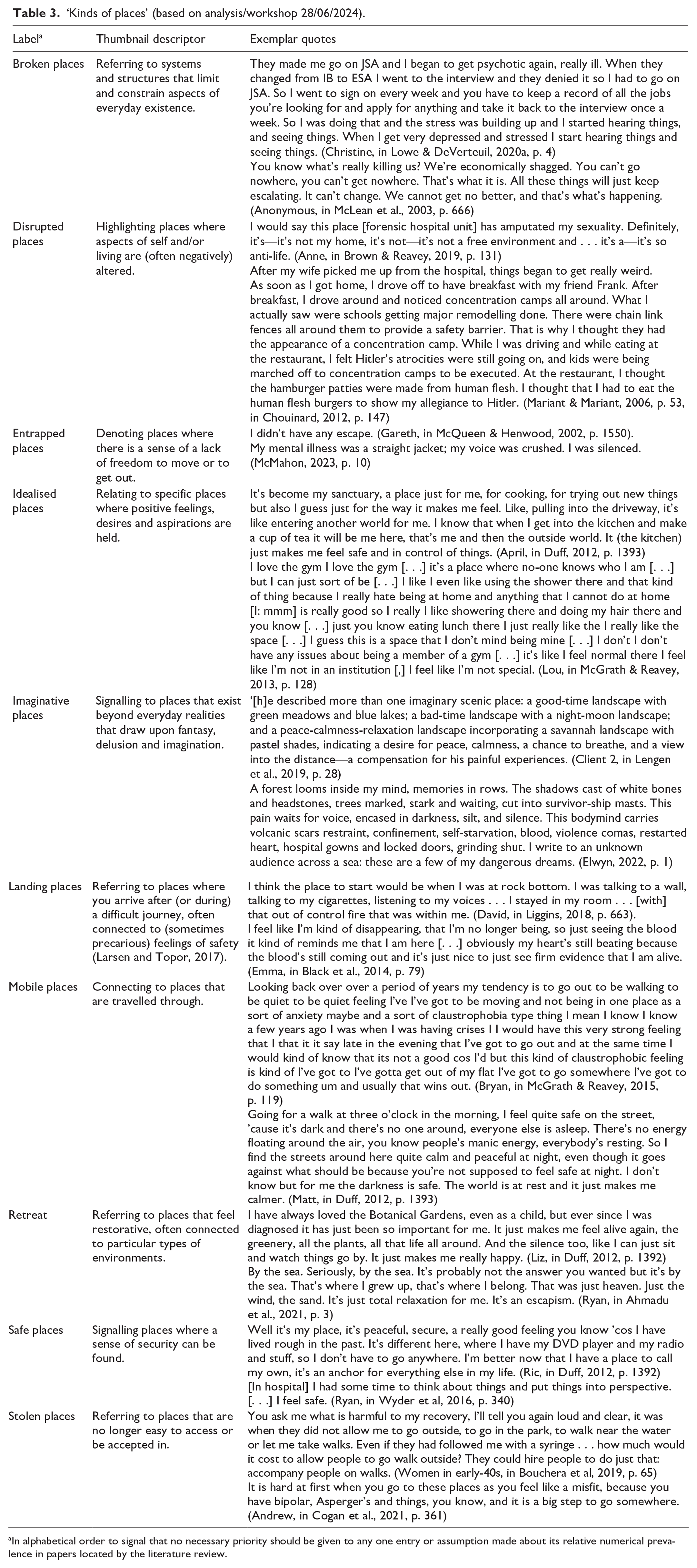
In alphabetical order to signal that no necessary priority should be given to any one entry or assumption made about its relative numerical prevalence in papers located by the literature review.
‘Affective qualities’ (based on analysis/workshop 28/06/2024).
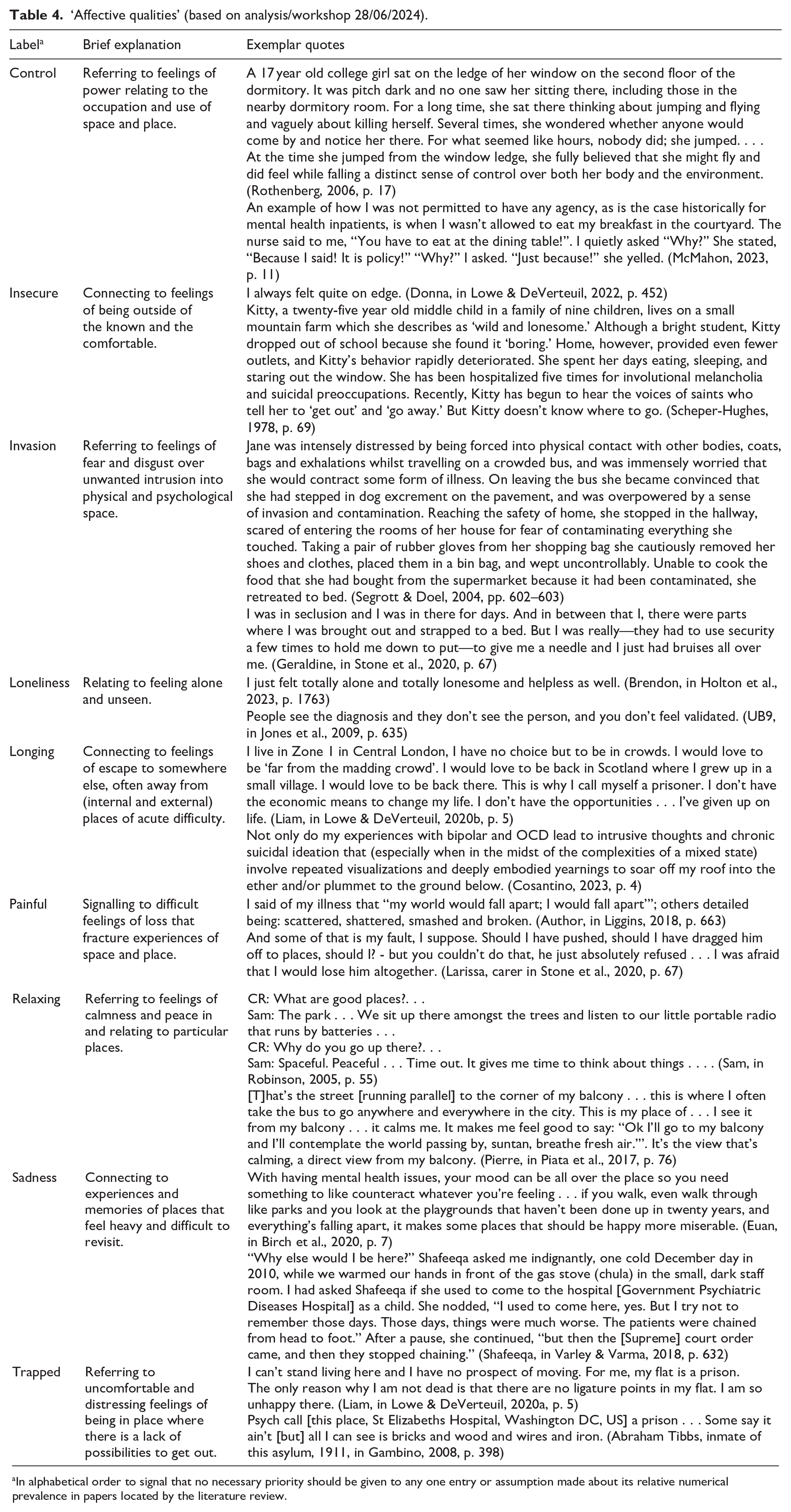
In alphabetical order to signal that no necessary priority should be given to any one entry or assumption made about its relative numerical prevalence in papers located by the literature review.
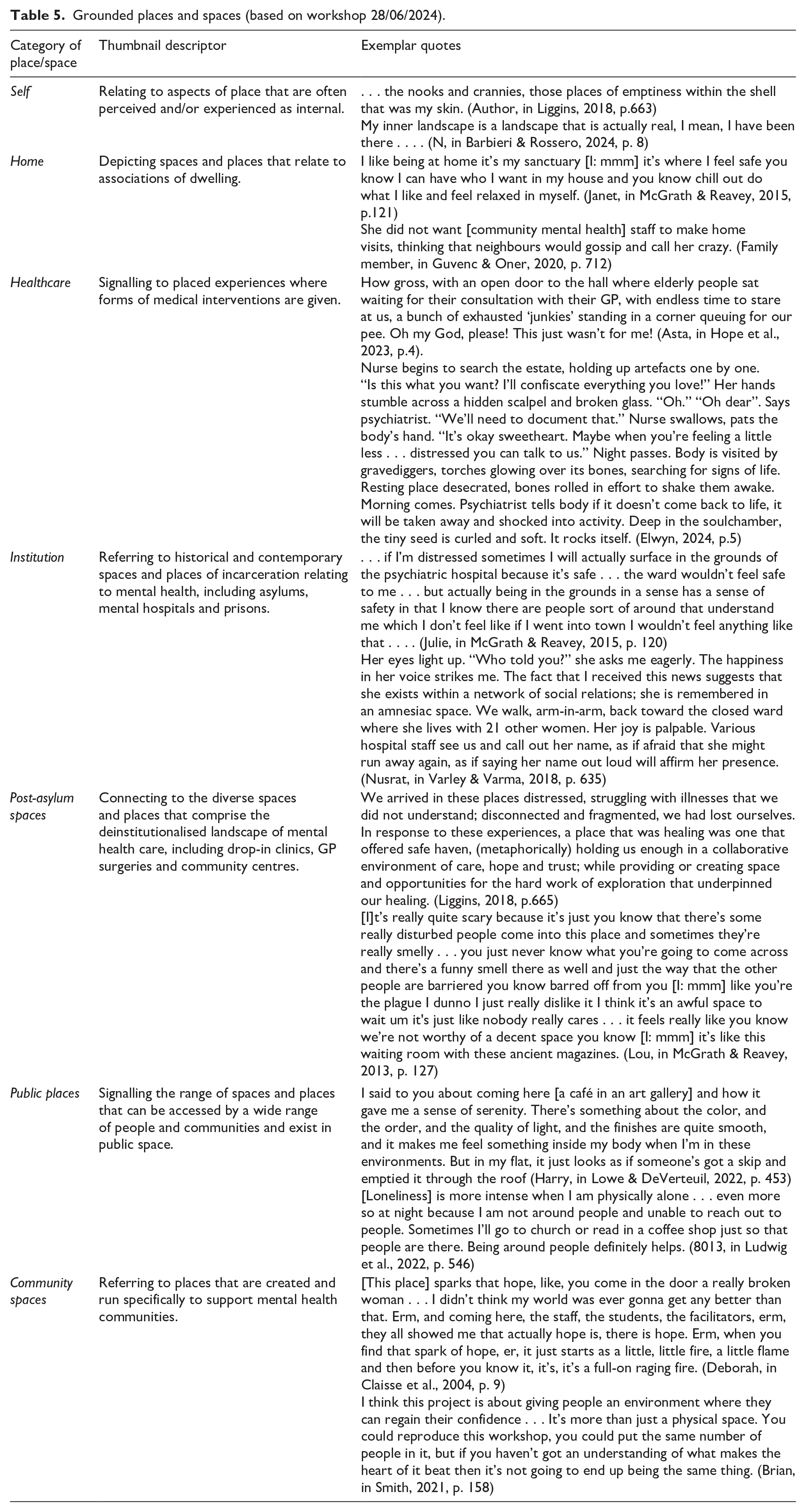
What this exercise instructively demonstrated (see Figure 1) is that there is no straightforward relationship between the grounded spaces on our base map, on the one hand, and particular projections or affectivities listed on the right and left of our pinboard, on the other. To put it another way, just as home or hospital could be the subject of the most intensely negative (dispiriting) or positive (uplifting) of experiential responses, so the same is true of any other space or place that might be recognised and mapped. In Table 5 we categorise a large number of such quotes according to their space or place of reference, including some attributed to nameable settlements or regions and also ones where the referent is arguably more imaginative, metaphorical or delusional (implying a whole other body of questions that might be asked about the voicing of the geo from below).
Grounded places and spaces (based on workshop 28/06/2024).
Discussion
Our objective has been to nuture insight into the possibilities for a geopsychiatry from below, conveying the groundwork required for considering voices of experience in relation to mental ill-health and the geo. This paper hence acts as a starting point for extending geopsychiatry’s remit, spirit and purpose, offering an important window into the lived worlds of mental health, both in terms of the manifold complexities of the world that it illuminates and its countless localised ‘worldings’ across the endlessly diverse spaces and places of the geo. Our inquiry has explored—if in an inevitably preliminary fashion—the complex connectivities between grounded places, how these places are experienced, notably in terms of the emotionally-charged responses and (often vulnerable) affective states of the people concerned, which could be long-turn or episodic. The upshot is what we call a framework, a prompting to take seriously how the elements identified in Table 2 dovetail with one another, which is then amplified by the labels and categories suggested in the left-hand columns of Tables 3 to 5 as well as being fleshed out by the richly textured details of the exemplar quotes given in the right-hand columns of the same tables. We do intend both the former and the latter to be prompts for other researchers’: prompts regarding what generalisations might be advanced about the relations between place and mental (ill-)health, but also prompts about the delicate particularities of the geo—its physical, social, symbolic, imaginative, performative and countless other facets—that, we contend, have such a profound, if rarely foregrounded, impact at the heart of mentally unwell and distressed lives.
We recognise that our claims are a geo-inflected microcosm of much broader, often contentious, debates about the standing of psychiatry as academic discipline and clinical practice. Such debates have been ongoing since a formalised speciality called psychiatry—or ‘alienism’ or ‘mental science’—first clearly took shape during the nineteenth into the early-twentieth centuries. They intensified from the 1960s during struggles around ‘anti-psychiatry’ and then from the 1970s when service user and psychiatric survivor movements began to question the constructs, institutions and practices of biomedically-inclined psychiatry. Marxist, feminist, postcolonial and the decisive Mad Studies challenges have been added into the mix, alongside the call for psychiatry to look beyond the hallways of quantitative (experimental, hypothesis-testing, random-control trials-dominated) scientific inquiry toward forms of qualitative inquiry wherein matters of voice, experience, sensation, feeling, hopes and fears become centralised. Our geopsychiatry from below has moorings in all these critical lines, but we also suppose that there is something encouraging about how a corner of psychiatry—this new geopsychiatry—that is opening psychiatry to the disruptive complexities of place may also act as a gateway for considering the many-sided challenges of people’s lived experience in place.
Conclusion
Paying attention to the fragmented and marginalised voices of experience through our review process highlights the possibilities for new ways of understanding what matters to people and why as they live in and through the worlds of mental (ill-)health, lending crucial insight into where attention may be required to create and sustain more caring and hopeful worlds, not just for those with mental ill-health but arguably for all of ‘us’. Such prompts are ones that we are now taking into a more action-orientated stage of our research, reported in McGeachan et al. (2025), wherein we have undertaken a further workshop—with a mixture of experts by experience and mental healthcare practitioners—to road-test interactive ‘geostory-telling’ and also to furnish materials for what we have now created as a ‘Geo-Story Resource Park’. 10 The hope is that others – maybe researchers but potentially anyone involved in working alongside people with mental health problems—might experiment with running geostory-telling exercises, not necessarily with any definite therapeutic aims in mind but, rather, just as something interesting and stimulating to do (for all concerned). There are hence academic, therapeutic, professional and practical imperatives for why a geopsychiatry from below is needed and why at least some contributions to that project should be attendant to the ‘from belowness’ of the geo as centralised in our contribution.
Footnotes
Acknowledgements
Enormous thanks are due to our two colleagues Morag Macgilchrist and Ruth Kirkpatrick. We gratefully acknowledge MQ Mental Health Grant Reference Number MTGA\17 (MQ: Transforming Mental Health). Acknowledgement is due to two anonymous reviewers for their constructive inputs: we mirror back some of their useful words in this final version of our paper. Furthermore, we wish to thank the authors of all the inspirational papers from which we have learned so much.
Funding
The author(s) disclosed receipt of the following financial support for the research, authorship, and/or publication of this article: The research was funded by MQ Mental Health Grant Reference Number MTGA\17 (MQ: Transforming Mental Health).
Ethical approval statement
Ethical permission for this research was awarded by the College of Science and Engineering Ethics Committee, University of Glasgow (300230228).

Data availability statement
Due to the review nature of this work all data is available to access through the work cited.