




Abstract
Background:
While certain socioeconomic factors have been studied in relation to suicide, housing-price-related indexes have rarely been investigated.
Aims:
This article aims to examine the impact of housing-price-related indexes on suicide rates in the general population of Taiwan, a country with high housing costs and suicide rates.
Methods:
The study utilized three national housing-price-related indexes from 2012 to 2019: (1) housing price index, (2) housing price to income ratio, and (3) housing rental index. Cause of Death Data was employed to calculate suicide rate. A linear regression model with autoregressive errors was used to analyze the association between housing-price-related indexes and suicide rates among different sex and age groups.
Results:
The findings revealed that higher housing rental index values were associated with increased suicide rates in young and middle-aged adults compared to the elderly population, regardless of sex. However, this association was not observed with the other two housing-price-related indexes (i.e. housing price index and housing price to income ratio).
Conclusion:
These results offer valuable insights for policymakers, mental health professionals, and housing advocates to improve housing affordability and reduce the burden of suicide in the general population, particularly among younger generations.
Introduction
Globally, suicide claimed 700,000 lives each year (World Health Organization, 2021). Exploring risk factors of suicide is a policy priority in many countries in the world. Empirical evidence has identified socioeconomic factors, such as income inequality, poverty and economic crisis, to be salient risk factors that contributed to elevated suicide rates (Y. Y. Chen et al., 2010; Qin et al., 2022; Rehkopf & Buka, 2006). However, very few empirical studies have examined the association between housing affordability and suicide. Affordable housing has both social and psychological significance. It serves as a foundational pillar for social cohesion and stability, allowing individuals to participate actively in their communities and fostering a sense of belonging. Over and above providing a basic need for shelter and protection, access to safe and stable housing is essential for an individual’s mental health and well-being (Mueller & Tighe, 2007).
Housing difficulties have been reported as a common phenomenon, and housing affordability can affect individuals’ mental health and susceptibility to suicide. In recent years, the rising cost of housing has made it difficult for many individuals and families to find suitable and affordable accommodation. Housing difficulties has been reported in many countries, such as China (Ren & Hu, 2016), France (Ball, 2009), India (Kim & Yoo, 2021), and South Korea (Kim & Yoo, 2021). Taiwan has also facing the same issue; the current home price to income ratio is 15.79 in Taipei, the capital of Taiwan, ranking it the 17th most expensive city in the world (Numbeo, 2023). Housing difficulties has been proposed to affect individual’s mental health by through social isolation and deprivation (Cao & Hickman, 2018), financial stress (T.-H. Lee et al., 2016), or life constraints (J. H. Lee, 2022). As housing affordability becomes a growing concern with serious implications on individuals’ mental health, it is crucial to delve deeper into the association between housing difficulties and dire outcomes such as suicide, a connection that despite its importance, received little attention in research.
In studying the relationship between housing affordability and suicide, several research gaps persist. Existing literature on the association between housing affordability and suicide primarily revolves around two main aspects. Certain researchers have explored the impact of house loss on suicide rates, particularly in the aftermath of the global subprime mortgage crisis (Fowler et al., 2015; Jones & Pridemore, 2016; Rojas & Stenberg, 2016). Others have focused on the correlation between housing-price-related indices and suicide (Berk et al., 2006; Kang et al., 2021; Park et al., 2023). However, in studies using housing-price-related indices, each employs a unique, singular index, such as the housing price index (Kang et al., 2021), housing loan interest rates (Berk et al., 2006), or the housing cost-to-income ratio (Park et al., 2023). These studies have not clearly delineated the differential impacts of housing-price-related indices on homeowners and tenants. The first two indices, the housing price index and housing loan interest rates, apply specifically to homeowners. The housing cost-to-income ratio can apply to both owners and tenants. Park et al. (2023) used the housing cost-to-income ratio index using actual rentals for house tenants and imputed rentals for owners formulate their housing cost-to-income ratio index. Despite noting a positive correlation between housing cost-to-income ratio and suicide, Park and colleagues did not examine this association in relation to specific homeowner or tenant populations. This oversight may be due to their utilization of country-level panel data from the Organization for Economic Co-operation and Development (OECD). It’s plausible that the impact of housing affordability on suicide rates may vary between owners and tenants due to differences in their respective circumstances. For instance, homeowners has been reported to have greater housing security than tenants (Tran & Dalholm, 2005). Given the high suicide and housing difficulties in Taiwan, it became feasible to examine the impact of housing affordability on suicide in the general population of the country.
This study aimed to address the knowledge gap by investigating the impact of housing affordability on suicide rates, focusing on a population with high housing costs and suicide rates. As financial capability and suicide rates often vary between sex and age groups, the relationship between housing-price-related indices and suicide rates may differ among demographic groups. Specifically, we analyzed the trends in housing-price-related indices and suicide rates, stratified by demographic groups, and assessed whether the association between these indices and suicide rates differs between demographic groups. Through this research, we aimed to provide evidence-based recommendations for policymakers, mental health professionals, and housing advocates to enhance housing affordability and alleviate the burden of suicide in the general population.
Method
Housing-price-related indices
This study used three different housing-price-related indices related from the Department of Land Administration, Ministry of the Interior, Taiwan: (1) housing price index, (2) housing price to income ratio, and (3) housing rental index from 2012 to 2019 (Ministry of the Interior, 2023a). We had seasonal data for housing price index and housing price to income ratio and monthly data for housing rental index. The following were the explanations of each housing-price-related index. For the housing price index, we used the national housing price index, which covered the housing price index throughout all cities of Taiwan, with the reference year of 2015 as 100%. For example, if housing price index in the first season of 2016 is 105%, which means it costs 5% more to purchase the same basket of houses in the first season of 2016 than it did in 2015. In terms of housing price to income ratio, this index was further considered the disposable income, which dividing the median of housing price by the median of household disposable income. If a housing price to income ratio is 16, it indicates that, on average, a person would need 16 years of their annual disposable income to afford a house. A higher value of housing price to income ratio indicates more difficulty to buy a house. Regarding housing rental index, we used the national housing rental index, with the reference time of January 2015 as 100%.
Suicide rate
The daily suicide statistics utilized in this research were gathered from Taiwan’s Office of Statistics of the Ministry of Health and Welfare’s Cause of Death Data. The recorded death record data included age, sex, marital status, place of residence, and cause of death information. The 10th version of the International Classification of Diseases was used to determine the cause of death. (ICD-10). This research includes suicide (X60-X84) and unknown intent (Y10-34) deaths that occurred between January 1, 2012, and December 31, 2019. We calculated the risk of suicide death per 100,000 by dividing the number of suicide death by the generation population, which was obtained from the Ministry of the Interior, Taiwan (Ministry of the Interior, 2023b).
Statistical analysis
SAS 9.4 (SAS Institute Inc., Cary, NC) was used for statistical analyses. Because housing-price-related indices and suicide rate data used in this study were time series data from 2011 to 2019, we used the linear regression model with autoregressive errors to examine the association. We used the PROC AUTOREG and maximum likelihood method. Based on the suggestion of Penfold and Zhang, we used different numbers of lag parameters for seasonal and monthly data (Penfold & Zhang, 2013). For seasonal data (i.e. housing price index and housing price to income ratio), we specified potential four lags (because of four seasons for 1 year), if there was a seasonal trend, the maximum of lag effects is one for each season. To simplify our models, we used backward elimination, in which lags of parameters included in the final model if statistically significant. Similarly, for monthly data (i.e. housing rental index), we specified potential 12 lags of 12 months for a year, with backward elimination. We categorized our participants into three age groups: (1) young-aged adults aged between 18 and 39 years, (2) middle-aged adults aged between 40 and 64 years, and (3) elderly adults aged 65 years or more. To examine whether the associations between housing-price-related indices and suicide rates were different between age groups and sex, we conducted the linear regression model with autoregressive errors between housing-price-related indices and the changes in suicide rates among sex and age groups. For example, if the change of suicide rates with the female as the reference group (i.e. male suicide rate minus female suicide rate), and a statistically positive association was observed with housing-price-related indices, indicating a higher association between housing-price-related indices and suicide rate in male than it was in female. Finally, a sensitivity analysis was conducted to investigate if the inclusion of undetermined death as suicide death affects our findings, we eliminated indeterminate death in our sensitivity analysis.
Results
Figure 1 visualizes the suicide rates and housing-price-related indices across age and sex groups. In terms of suicide rates, older age groups exhibited higher rates, with elderly adults having the highest rate followed by middle-aged and young-aged adults. Additionally, males had higher suicide rates than females. Regarding housing-price-related indices, the housing price index showed a significant increase between 2012 and 2015, after which it remained steady through 2019. The housing price to income ratio exhibited more fluctuation but gradually increased over time. Finally, the housing rental index displayed a stable increase from 2012 to 2019.
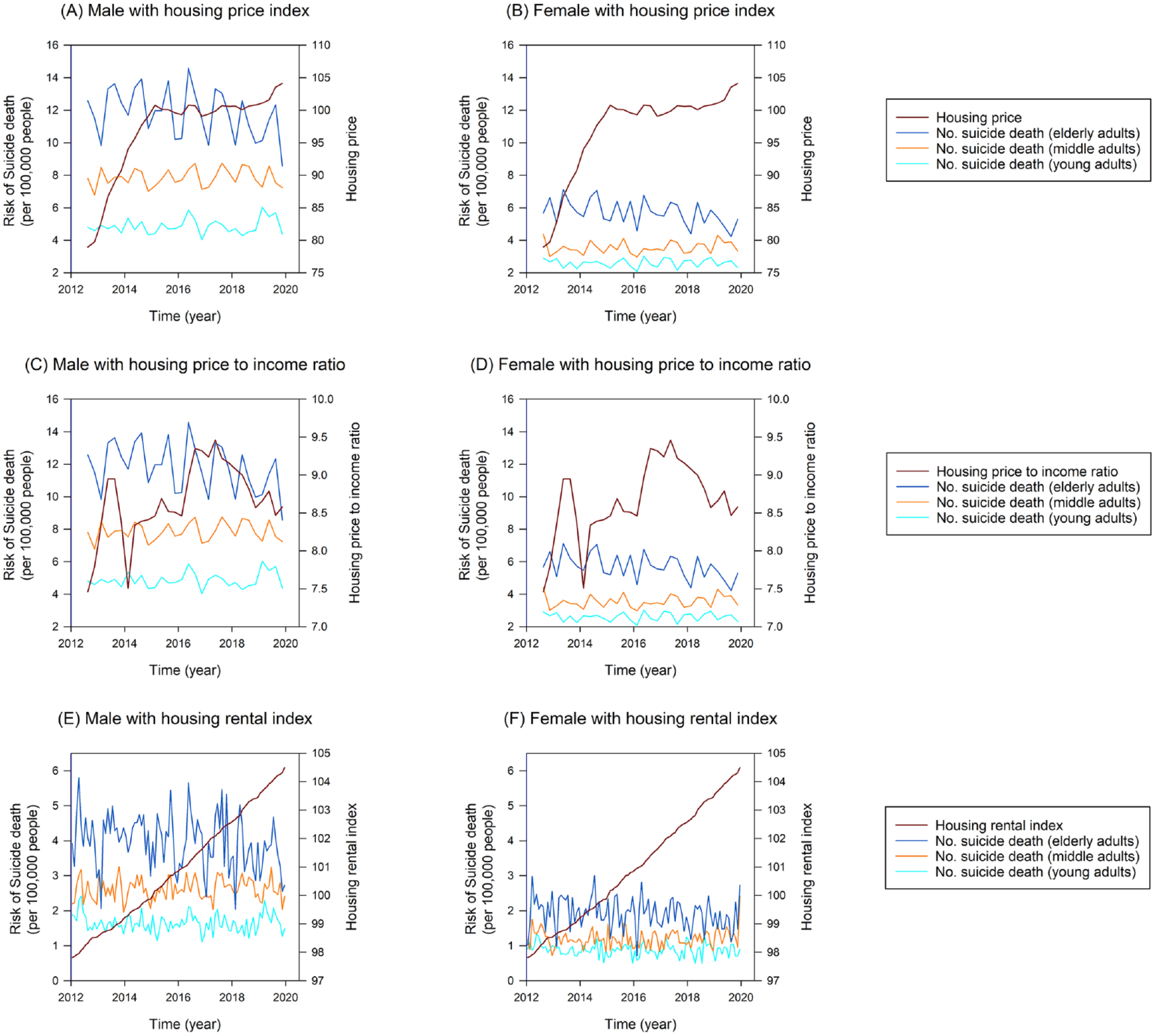
Housing-related indices and suicide rates (per 100,000 people), stratified by sex and age groups.
Table 1 presents the results of the linear regression model with autoregressive errors used to examine the association between suicide rates and housing-price-related indices, stratified by sex and age groups. No association between suicide rates and housing-price-related indices was observed in young-aged and middle-aged adult groups, irrespective of sex. However, inverse associations between suicide rates and the housing rental index were observed in female elderly adult groups.
The association between housing-related indices and suicide rates (per 100,000 people), stratified by sex and age groups.
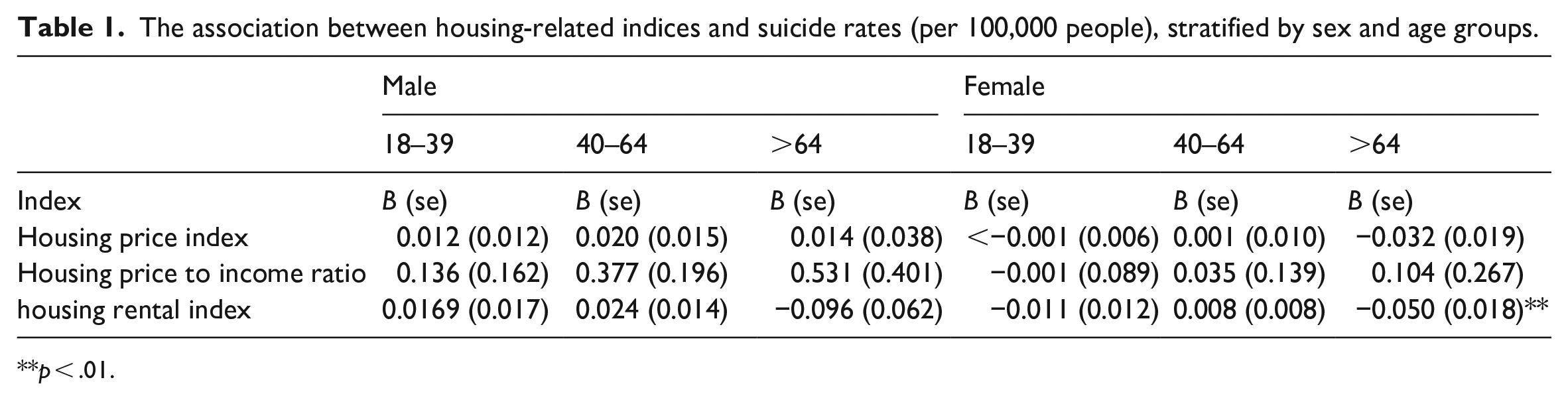
p < .01.
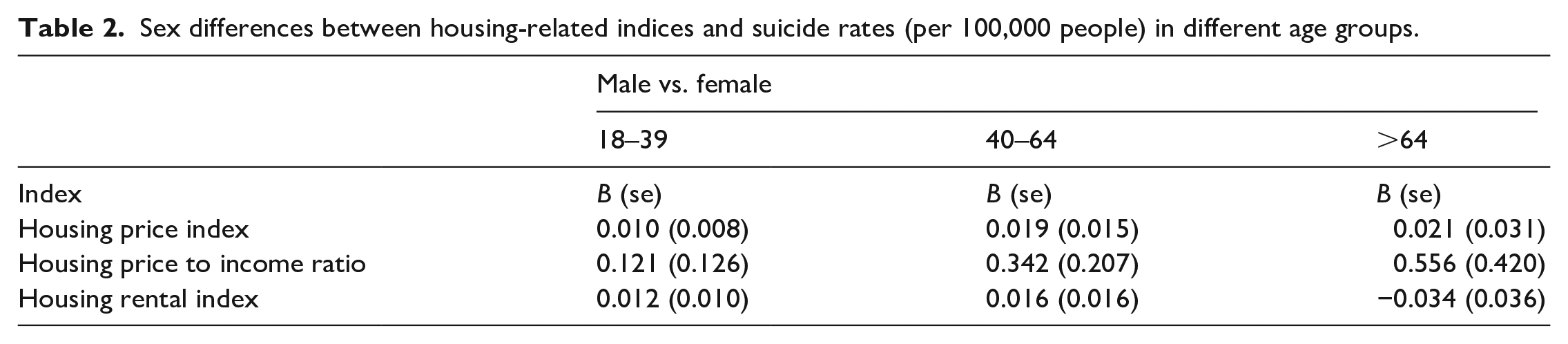
To examine whether the associations between housing-price-related indices and suicide rates differed between sex and age groups, we conducted a linear regression model with autoregressive errors between housing-price-related indices and changes in suicide rates among sex and age groups. The associations between housing-price-related indices and suicide rates were similar between males and females in different age groups (Table 2). In terms of age groups, we observed that higher impacts of the housing rental index were associated with higher suicide rates in young-aged and middle-aged adults, compared with the elderly adult group, and this finding was observed in both males and females (Table 3).
Sex differences between housing-related indices and suicide rates (per 100,000 people) in different age groups.
Age differences between housing-related indices and suicide rates (per 100,000 people), stratified by sex.
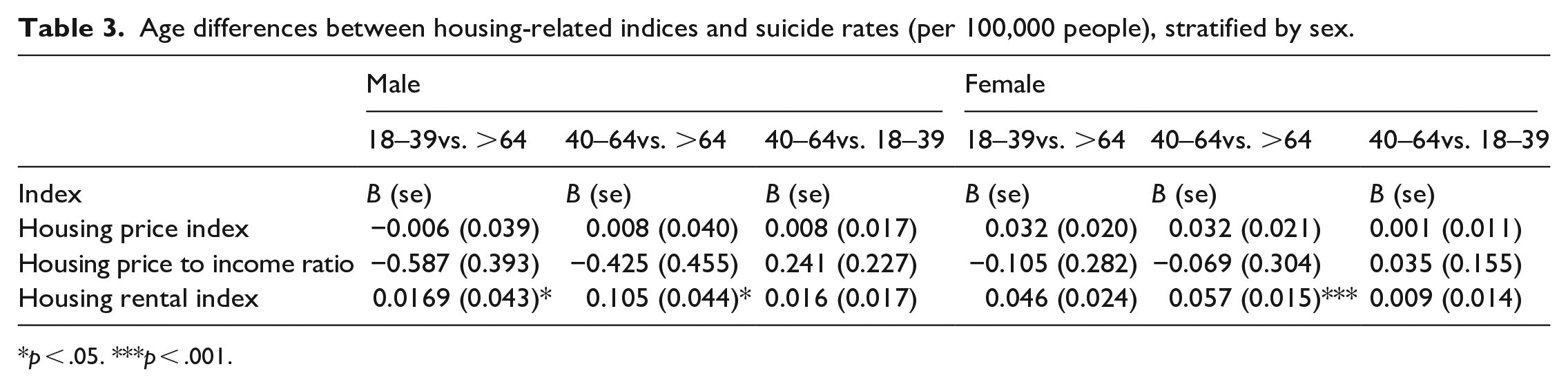
p < .05. ***p < .001.
Discussion
This study explored the impact of housing-price-related indices on suicide death, with a focus on Taiwan where the population with high housing costs and suicide rates. We examined the trend of housing-price-related indices and suicide rates and their associations, stratified by demographic groups. The findings suggest that the housing rental index significantly impacts suicide rates in young-aged and middle-aged adult groups, in contrast to the elderly adult group, irrespective of gender. This study provides evidence-based recommendations for policymakers, mental health professionals, and housing advocates to improve housing affordability and reduce the burden of suicide mortality, particularly among younger generations.
The housing rental index has been found to affect suicide rates in age groups differently. Relatively high impacts of the housing rental index were associated with higher suicide rates in young-aged and middle-aged adults, compared with the elderly adult group, and this finding was observed in both males and females, which was in line with a previous study (Berk et al., 2006). Another study reported a 10-year trend of housing price in Taiwan was positively associated with another trend of antidepressant use (C.-Y. Lee et al., 2021). The researchers posited that depression could be a mediating factor in this relationship. Similarly, depression may also mediate the influence of the housing rental index on suicide rates in our findings. Our findings broaden the existing literature, illustrating that housing affordability may not only influence mental disorders (K. L. Chen et al., 2022; Mason et al., 2013) but also contribute to suicide rates. The effect of the housing rental index on suicide rates can be explained through several mechanisms. For example, high housing rental index may increase renters’ social deprivation (Cao & Hickman, 2018), and it has been reported that social deprivation is associated with suicide (Yeung et al., 2022). Similarly, it has been found that individuals with substantial house-related debt reported higher levels of depression and suicide-related issues, and researchers have postulated that stress may associate with the financial burden of housing costs and be a contributing factor to depression and suicide (T.-H. Lee et al., 2016). Additionally, it has been observed that for individuals living in low-quality housing due to financial constraints, the quality of their housing can also contribute to an increased risk of suicide (J. H. Lee, 2022). In light of these findings, politicians should be aware of the crucial role of housing affordability plays in suicide rate, and initiatives of affordable housing as part of a comprehensive approach to mental health and suicide prevention.
The housing rental index was observed to have a greater impact on suicide rates among young-aged and middle-aged adults compared to elderly adults. This can be attributed to the distinct characteristics and backgrounds of these age groups. Firstly, financial capability has been reported to be positively associated with age, indicating that older individuals are generally wealthier than younger ones (Mokhtar et al., 2020), thus the housing burden may be relatively low in elderly adults than it was in young-aged and middle-aged adults. Additionally, the intention to purchase a house is particularly strong among young and middle-aged adults in Taiwan. This is supported by the fact that young-aged (<40 years old) and middle-aged (between 40 and 64 years old) adults constitute the majority of the housing market (51.0% and 47.5%), according to residential mortgage statistics (Joint Credit Information Center, 2023). As per Taiwanese tradition, buying a house is regarded as both a secure investment and a prerequisite for marriage (Wrenn et al., 2019). This pressure to purchase property can lead to financial stress, resulting in poorer quality of life and mental health (Waldron & Redmond, 2017). Secondly, housing affordability has worsened over time in Taiwan, as evidenced by the increasing housing price-to-income ratio. For instance, the housing price-to-income ratio in Taipei, the capital of Taiwan, was 6.01 in 2002 but rose to 15.91 in 2016 (B.-F. Lee, 2019), signifying heightened housing difficulties in Taiwan. Furthermore, due to the relatively affordable housing price-to-income ratio in earlier periods, many elderly adults in Taiwan may have already paid off their mortgages, resulting in lower housing costs. Consequently, these elderly individuals may be less affected by housing affordability issues than young-aged and middle-aged adults due to higher financial capability or lower housing costs.
Unlike other studies (Kang et al., 2021; Park et al., 2023), our study found no association between suicide and either housing prices or the housing price-to-income ratio. Instead, we found a correlation solely with the housing rental index. Three potential reasons could account for this discrepancy. The first explanation could lie in the differing lifestyle patterns exhibited by homeowners and renters in their respective communities. For instance, homeowners typically demonstrate a more pronounced sense of community, longer residence periods, and increased housing security compared to renters. These factors may each influence mental health to varying degrees. The second potential explanation pertains to the different time frames of the housing-price-related indices used in our study, despite all being released by Taiwan’s Ministry of the Interior. The housing price and housing cost-to-income ratio were presented as seasonal data, while the housing rental index was released as monthly data. Monthly data, due to its higher frequency, can provide a more granular view and detailed information than seasonal data. Lastly, the characteristics of the housing-price-related indices themselves were distinct. As observed in our study, housing prices and their ratio to income were more volatile in Taiwan compared to the housing rental index. However, this trend may not universally apply to other countries. Another consideration is that the housing market is more sensitive to factors such as economic growth, mortgage interest rates, and housing speculation. On the other hand, the rental market tends to be less affected by these elements. These distinctions might account for the inconsistent findings between these housing-price-related indices and suicide rates within our study and when compared to other research.
Study limitations
There are several limitations in this study. Firstly, the suicide death from Cause of Death Data has not been validated although accurate ascertainment of suicide death presents challenges. A previous study reported that the sensitivity of suicide on death certificates ranged between 55% and 99% (O'Carroll, 1989). There is a suggestion that the gold standard for suicide death validation could comprise a combination of interviews with the deceased’s family, coworkers, and friends, forensic autopsies, or reviews by clinical committees using hospital and police records. Further studies are warranted to validate suicide deaths in Taiwan. Secondly, despite obtaining suicide rates across various age and gender groups, we lacked specific information regarding housing-price-related indices for these distinct groups. Housing-price-related indices may vary among different age and sex groups. Furthermore, other factors might influence or mediate the relationship between the housing rental index on suicide, such as the prevalence of mental health diagnoses or employment status. However, we currently face a dearth of individual-level national surveys on housing costs in Taiwan. In response, the Taiwanese government could seek guidance from nations that have conducted such comprehensive surveys, such as the American Housing Survey from the United States or the Annual National Accounts Database on household financial consumption expenditure from the OECD. By acquiring this kind of data and linking it to the Taiwan National Health Insurance Research Database, a more detailed, individual-level analysis could be conducted. Thirdly, this was an observational study, limiting the causal inferences drawn from our results. Some potential socioeconomic factors, such as national growth rate, unemployment rate, and social capital, were not included in this study, which might partially confound our findings. Finally, the generalizability of this study may not extend to countries with low housing costs.
Policy implications
The impact of the housing rental index on suicide, as examined in this study, has some implications for policies concerning housing affordability and suicide prevention in Taiwan. Firstly, although the Taiwanese government has implemented several housing affordability policies, their primary strategies revolve around housing rental and mortgage subsidies. However, these subsidies for housing rentals and mortgages have limited effects on housing affordability. This is because, even though the subsidies are given to renters and homeowners with mortgages, they ultimately benefit construction companies. High subsidies for housing rentals and mortgages may even increase housing prices and the housing rental index, as construction companies attempt to capitalize on the subsidies. Moreover, these subsidies cannot be sustained indefinitely. As a result, temporary subsidies might increase demand for rental and purchased properties, leading to an artificial demand for housing, which can, in turn, result in overbuilding, a mismatch between supply and demand, or housing speculation. This is supported by the high housing vacancy rates, ranging from 13.8% to 26.2% in 2010, in the major cities of Taiwan (Chang & Chen, 2018). A more appropriate strategy would be the implementation of a vacancy tax, which not only increases the housing market supply but also decreases housing prices and the housing rental index. It has been reported that the implementation of a vacancy tax contributed to a 13% decrease in vacancy rates in France (Segú, 2020). Revenue from the vacant house tax can be funneled into suicide prevention, such as public education campaigns or case management.
Secondly, housing rent control has long been overlooked and neglected by the Taiwanese government. It has been speculated that over 90% of renters in Taiwan rent their houses through illicit or clandestine arrangements (Dai et al., 2021), as landlords try to avoid paying taxes on rental income. Discrimination may be more pronounced when housing rent is not adequately regulated. For example, landlords may unfairly reject or raise the rent because of discriminating against tenants suffering from mental disorders, such as depression or schizophrenia, who may have a higher propensity for suicide. The issue of discrimination can be partially addressed by reducing taxes on rental income to encourage landlords to lease their properties to vulnerable people with high suicide tendencies.
Thirdly, the establishment of social housing can help manage housing prices and the housing rental index by increasing supply and implementing rental control. Additionally, since social housing is managed by the government, it can be reserved for people suffering from mental disorders and suicide-related problems. However, the proportion of social housing in Taiwan is extremely low (0.157%) (Y.-L. Chen, 2020), especially when compared to other countries, such as the Netherlands (34%), England (20%), and the U.S. (6.2%) (Chang & Yuan, 2013). Therefore, a significant expansion of social housing is needed in Taiwan.
Conclusion
This study reveals a significant link between housing affordability, particularly the housing rental index, and suicide rates in Taiwan, more prominently within young-aged and middle-aged adults irrespective of gender. Specifically, higher impacts of the housing rental index were associated with increased suicide rates in young-aged and middle-aged adults as compared to the elderly, suggesting that housing affordability issues could exacerbate mental health issues leading to suicide. The findings highlight the need for targeted, multi-dimensional interventions focusing on improved housing affordability as a significant factor in suicide prevention strategies.
Footnotes
Acknowledgements
This study was inspired by the Nest Movement, the Organization of Urban Re-s, and and Tsuei Ma Ma Foundation for housing & community services. We thank them for their long-term efforts on housing affordability in Taiwan.
Funding
The author(s) disclosed receipt of the following financial support for the research, authorship, and/or publication of this article: This study was partially found by Department of Health, Taipei City Government (11201-62-001).
Ethics approval
This study was approved by the Institutional Review Board of Taipei City Hospital Research Ethics Committee (TCHIRB-11012016).
