




Abstract
Abstract
Engineering course is an important branch of university education. With the development of society and the integration of disciplines, some changes have taken place in the connotation of engineering, that is emerging engineering. The educational concept of emerging engineering and the internationally recognized educational certification of Engineering specialty both require higher practical ability. This paper analyses the graduation requirements of engineering education certification. Hierarchical teaching method is put forward and its effect is analyzed. It describes the concrete methods of expanding experiments by using the platform of massive open online courses, and verifies the validity of massive open online courses + simulation. It expounds the extracurricular practice scheme of “Maker Space + Competition” and demonstrates its superiority.
Keywords
Introduction
Engineering course refers to the science of materials science, computers, information, electronics, machinery, electricity, construction, water conservancy, automobiles, instruments and other courses that research application technology. The goal of learning engineering course is to solve problems by applying the principles of science and technology. Therefore, practice teaching plays a very important role in engineering course teaching. Engineering course educators have put forward many practical teaching models and strategies. Especially with the development of communication technology and the popularization of network, there are more and more practical teaching methods. It discussed to use blogs in helping practical teaching of educational technology, and to investigate how to promote students-teacher interaction by using the blog so as to playing the roles of the teacher. The result showed that the use of the blogs was helpful for supporting practical teaching and it was easier for the teacher to track and monitor students' learning processes by using the blogs. 1
With the emergence of some new industries, such as artificial intelligence, intelligent manufacturing, robotics and so on, and engineering course education in university has also appeared some new professions, new standards and new ideas corresponding them. The concept of emerging engineering education came into being and gradually entered people's field of vision. So far, the emerging engineering education does not have a precise definition. There is a generally accepted explanation that it has two meanings: one is “new engineering course”, which is not found in the old disciplines; the other is “new requirements of engineering course”, which means that new ideas, standards and concepts should be permeated into the original engineering. Compared with the old engineering course, the emerging engineering education emphasizes the practicability, crossover and comprehensiveness among subjects, especially the combination of new technology such as information communication, electronic control, software design and traditional industrial.
In fact, the emerging industries and the new economy in the future need high-quality talents with strong practical ability, innovative ability and international competitiveness. They not only have profound academic knowledge in a certain discipline but also have the characteristics of “interdisciplinary integration”. They can not only use their knowledge to solve existing problems but also have the ability to learn new knowledge, new technology to solve future development problems and play a leading role in the future technology and industry. They are not only excellent in technology but also understand the economy, society and management, and have a good humanistic quality. Majors related to emerging engineering education, mainly for emerging industries, with the Internet and industrial intelligence as the core, including large data, cloud computing, artificial intelligence, block chains, virtual reality, intelligent science and technology and other related engineering disciplines.
When discussing the role and construction of emerging engineering education, it summed up five new projects, as shown in Figure 1.
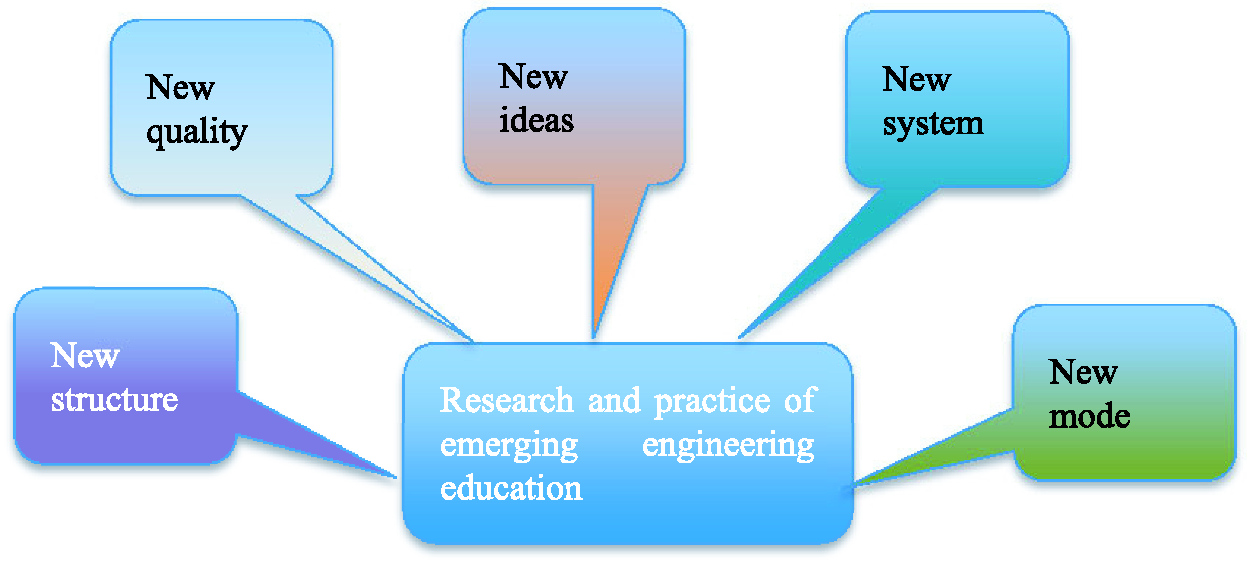
Five new of emerging engineering education.
Practical teaching is an important part of engineering course teaching. For practical teaching mode, there are many research results. Practice is different from theory. Using the proposed practices, students are guided to propose their own hypotheses, collect actual data and make their own inferences, rather than following a predetermined sequence of procedures. 2 The emerging engineering education also calls for the renewal of practical teaching mode, based on the emergence of new industries. A flexible engineering practice teaching mode of “layered teaching + MOOCs + virtual simulation + creator space + competition” suitable for the construction of new engineering education is proposed in this paper. It is applied to majors such as computers, electronic information and Internet of things (IoT).
Whether it is the new subject education mode or the requirement of engineering education certification for graduates' export, engineering students need to have strong practical ability. Under such social background, this paper puts forward several effective teaching methods to cultivate students' practical ability at different levels.
Analysis of graduation requirements
Since China formally joined the Washington Accord in 2016, engineering education professional certification has been in full swing in Colleges and universities. There have been a lot of research on teaching reform aiming at the certification requirements. Literature 3 introduces case teaching in engineering practice teaching. This teaching method is highly participatory and practical, and can effectively cultivate students' ability to solve complex engineering problems. At the same time, it plays a very good role in promoting the realization of the goal of engineering education professional certification. From the perspective of industry, it points out that practical education should be combined with the inherent law of engineering education and the common practice in industry. 4 Taking tailored complex engineering problems as the teaching content, customized integrated product development team as the organizational mode of curriculum implementation, and team-oriented comprehensive perspective assessment method as the evaluation method of practical curriculum. Finally, a practical teaching method is formed which runs through the content-process-evaluation of the whole teaching process.
The core connotation of engineering education certification is to build an Outcome-Based Education (OBE) and Continuous Quality Improvement (CQI). The ultimate goal of OBE is students' ability, which is expressed as “graduation requirements” in the teaching system. CQI will form many closed loops in the teaching process to serve OBE. An important module of OBE is “Graduation Requirements,” which can be measured. Engineering education, especially Emerging Engineering Education, focuses on the cultivation of ability to solve complex engineering problems, and should run through four years. These abilities include “engineering knowledge, analytical thinking, design and development, research and innovation, using tools, engineering literacy, communication and cooperation, lifelong learning”, which can be classified as “technical ability” and “non-technical ability”. The cultivation of technical ability mainly depends on practical teaching.
When implementing the graduation requirements, we usually make an association matrix which includes the graduation requirements and the corresponding curriculum, and explain the logical relationship between the ability and the curriculum. Relevance matrix is designed by East China University of Science and Technology to prove that its professional curriculum system can cover graduation requirements. It can clearly reflect the contribution of professional courses to the indicators of graduation requirements, and it is very valuable. Therefore, in the implementation of professional certification, the correlation matrix of IoT engineering is made, as shown in Table 1.
Relevance matrix between curriculum system and graduation requirements of Internet of Things engineering.
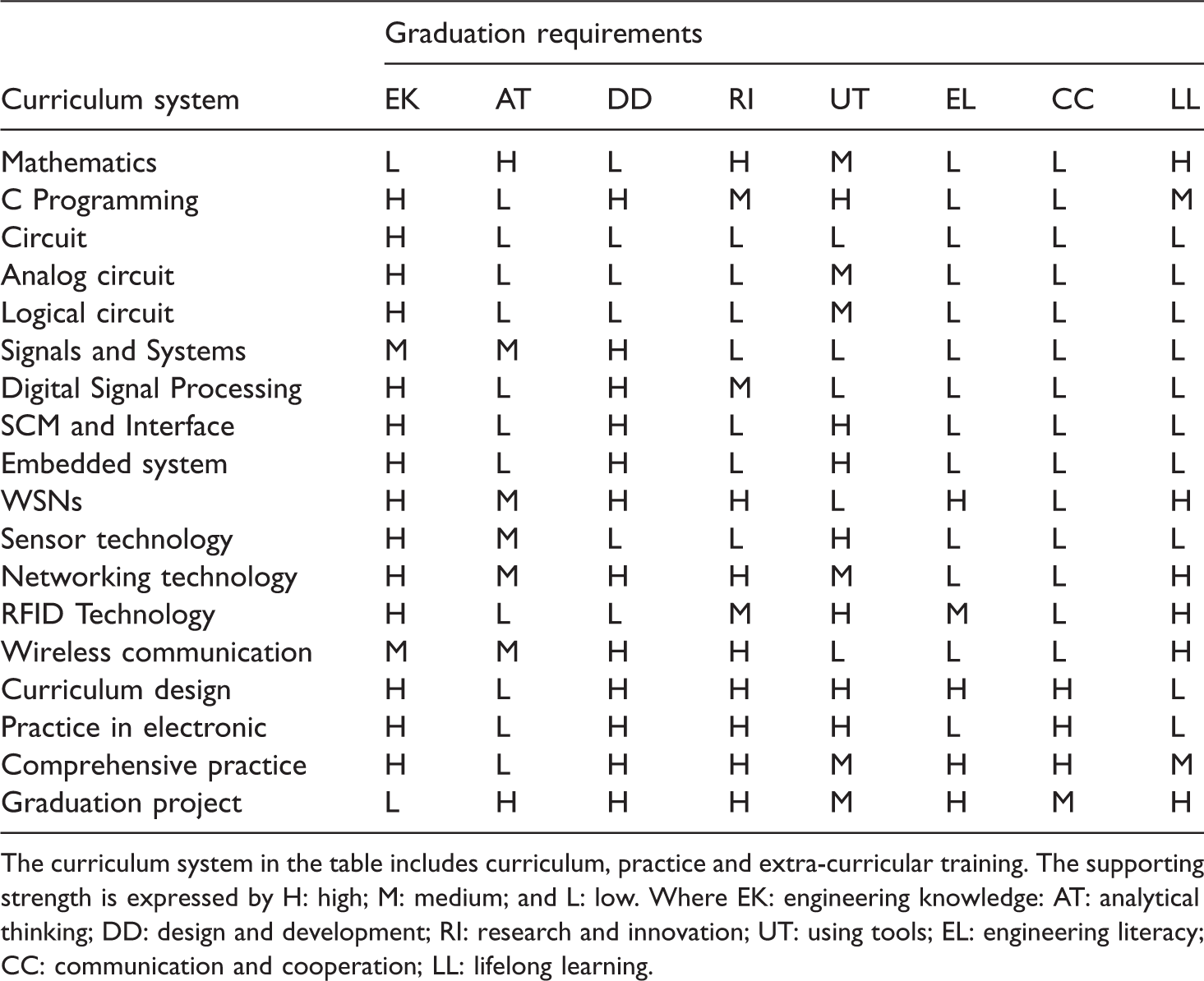
The curriculum system in the table includes curriculum, practice and extra-curricular training. The supporting strength is expressed by H: high; M: medium; and L: low. Where EK: engineering knowledge: AT: analytical thinking; DD: design and development; RI: research and innovation; UT: using tools; EL: engineering literacy; CC: communication and cooperation; LL: lifelong learning.
The relationship between curriculum and graduation requirements is clarified. How can the curriculum achieve graduation requirements? Figure 2 illustrates the relationship between curriculum teaching and graduation requirements OBE-based.
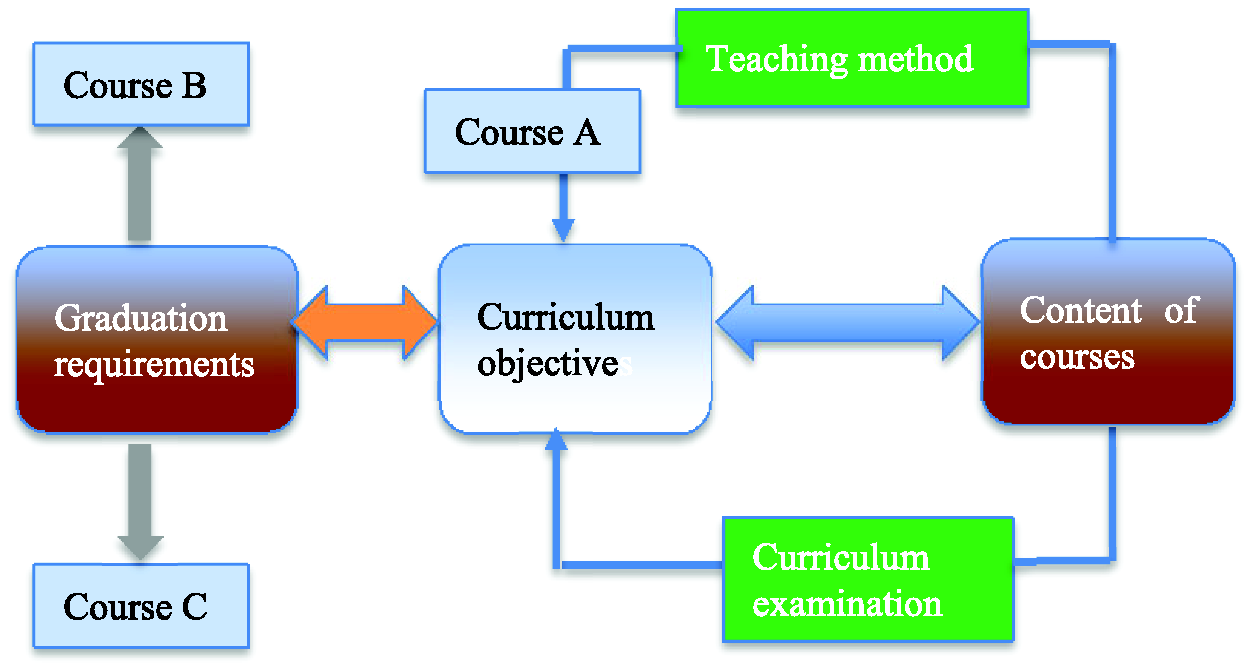
The relationship between curriculum teaching and graduation requirements.
The teaching content serves the curriculum objectives, which reflect the graduation requirements. The teaching method acts on the curriculum, and the curriculum examination points to the curriculum goal. The objective, method and examination method of closed-loop summary are fed back to other courses. Make each link of teaching form a whole, each course is included in the closed-loop system. Practical teaching is an important indicator of graduation requirements and plays an important role in the teaching system. Different from theoretical teaching, special teaching methods need to be explored.
Hierarchical teaching
Although students of the same grade all enter the university with the same score, there are great differences in practical ability. Therefore, at the beginning of practical teaching, it is necessary to divide students and teaching content into different levels to meet the needs of different types of people. Project-driven teaching method and stratified teaching method constructs the supporting system model and divides the process of teaching into basic theory teaching, experimental teaching and practical teaching. The practice proves that this teaching method is available, for it not only improves the teaching effect but also gets the students motivated. 5 According to the principle of teaching students according to their aptitude and layering guidance, the students, teaching content, teaching plan and teaching evaluation should be layered.
Hierarchical model
Hierarchical teaching follows the principle of teaching students according to their aptitude, and layers students, teaching content, teaching plan and teaching evaluation.
First of all, students and teaching content should be stratified and should be one-to-one correspondence. To teach students in accordance with their aptitude, first of all, we need to understand the students' knowledge level and practical ability, and then according to their level and ability to classify the students into different levels, classified guidance. 6 In practice teaching, students should be stratified according to their practical ability. It is necessary to check knowledge and skills before practice teaching. For example, a six-week comprehensive internship for the IoT engineering specialty will be held before the internship. The students will be divided into five levels according to their knowledge and abilities, and the corresponding teaching contents will be worked out. For students with low practical ability, the cycle of understanding circuit and hardware is longer, mainly to understand the practical content and grasp the basic skills; for students with certain practical ability, their own is not satisfied with the basic content, so it is necessary to expand the practical content or improve the technical difficulty to meet the students' desire of knowledge. According to the requirements of practice, the teaching contents are divided into five levels, corresponding to students' stratification. The hierarchical model for students and teaching content is shown in Figure 3.
Practice teaching is different from theory teaching. It has a long cycle and strong continuity. In most cases, it can accomplish the task without taking a few classes. Therefore, its management form and evaluation method are also different from theoretical teaching, not a timetable and a paper can be completed. Figure 4 shows the hierarchical model for management and evaluation.
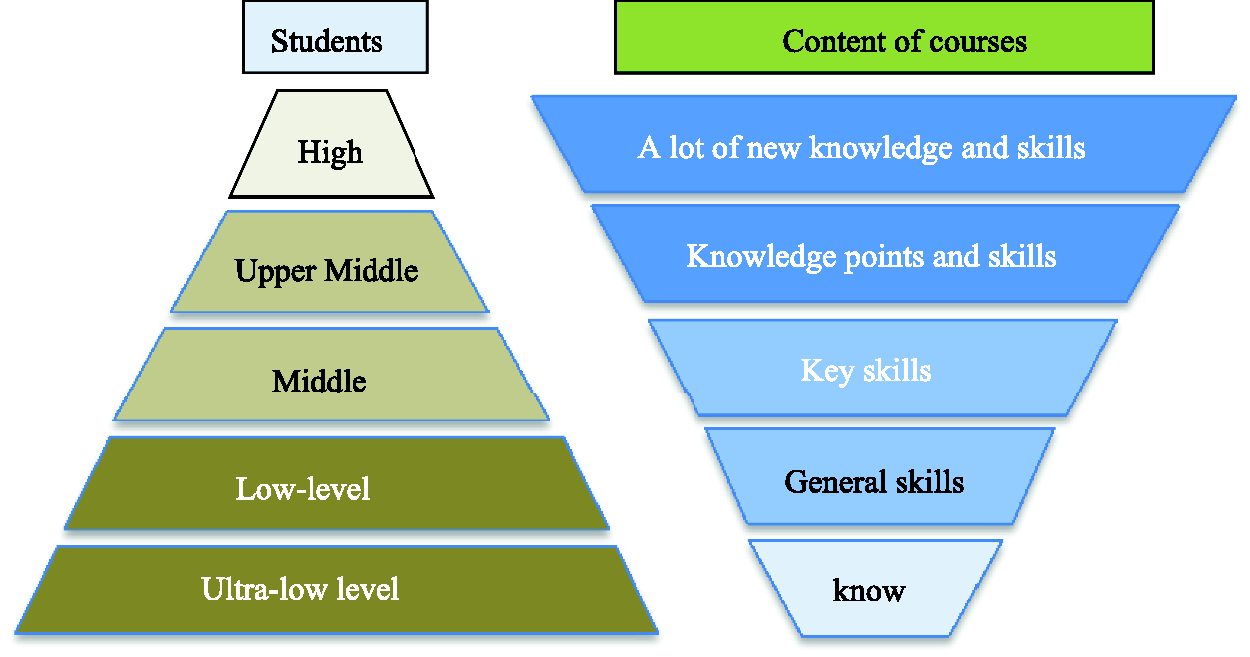
The hierarchical model for students and teaching content.
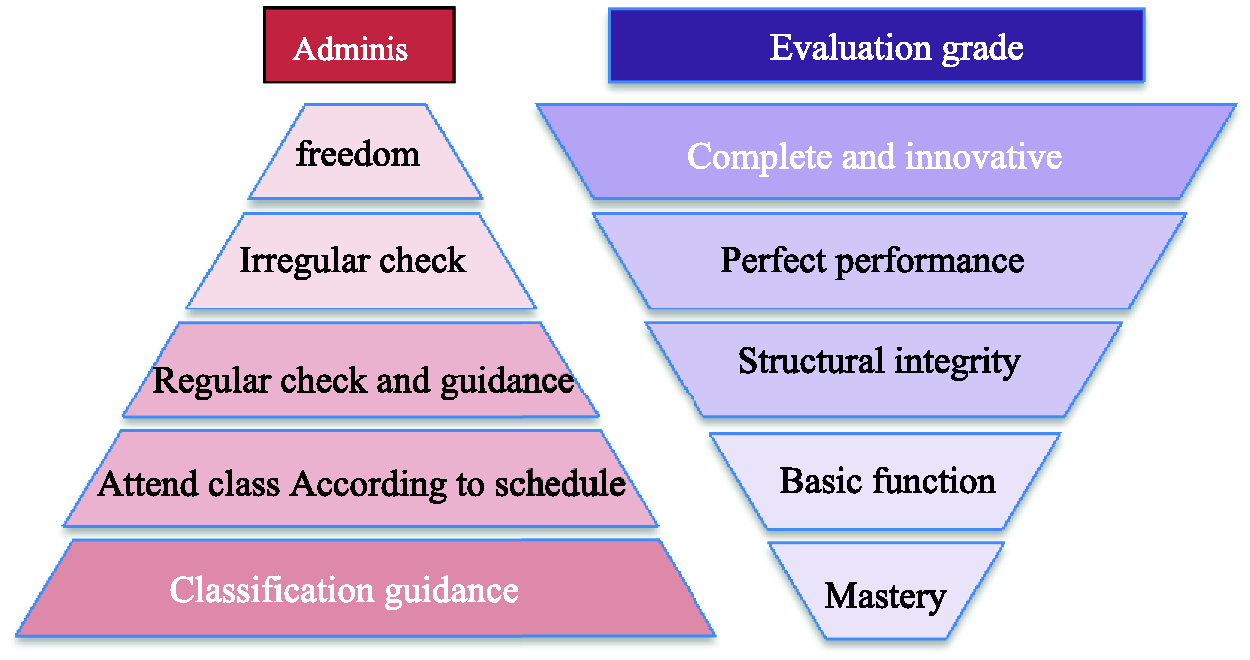
The hierarchical model for management and evaluation.
The idea of hierarchical teaching is “student-centered, result-oriented” teaching method. What we should pay attention to is to fully stimulate students' potential, and students' practical ability is regarded as the teaching achievement.
The effect of hierarchical teaching
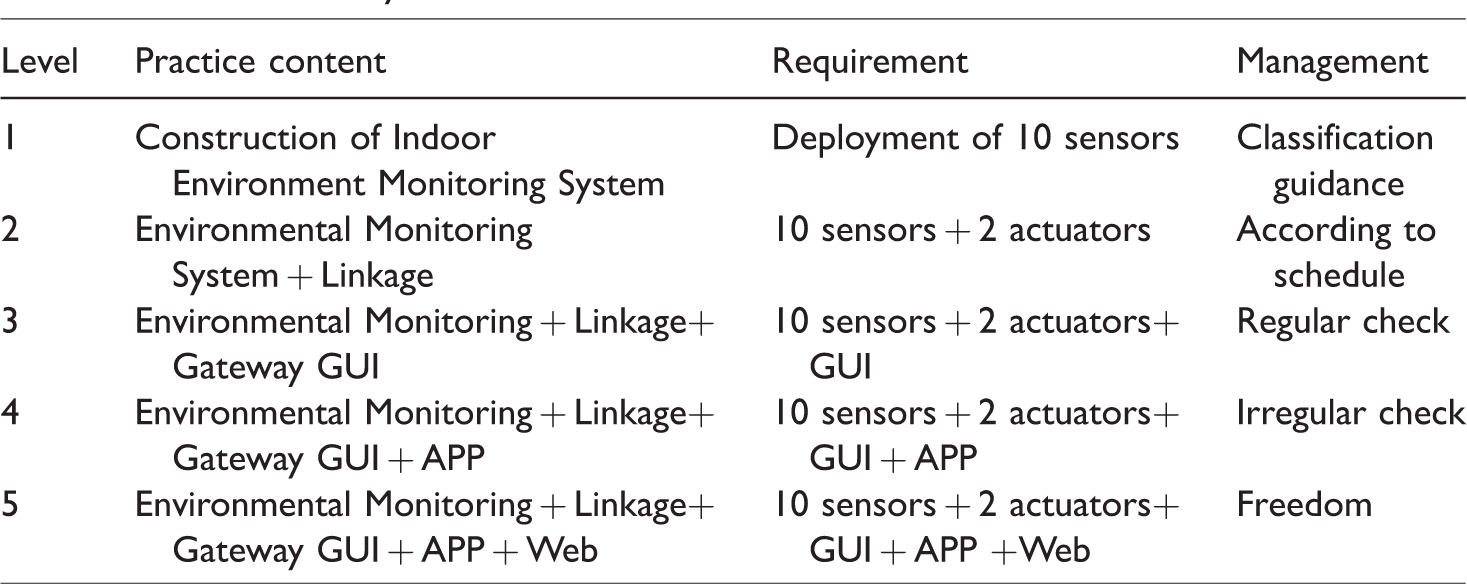
The implementation effect is illustrated by the comprehensive practice of the Internet of Things Engineering Specialty in 2017. The project of comprehensive practice is “Smart Home System Based on ZIGBEE”. The content hierarchy and management hierarchy of the project is shown in Table 2.
Smart Home System Based on ZIGBEE.
A total of 56 students were initially graded according to their Pre-internship test scores and upgraded during the implementation of the project. The promotion of students' works should be rewarded accordingly. The final results and student evaluation are shown in Table 3.
Analysis of implementation effect.
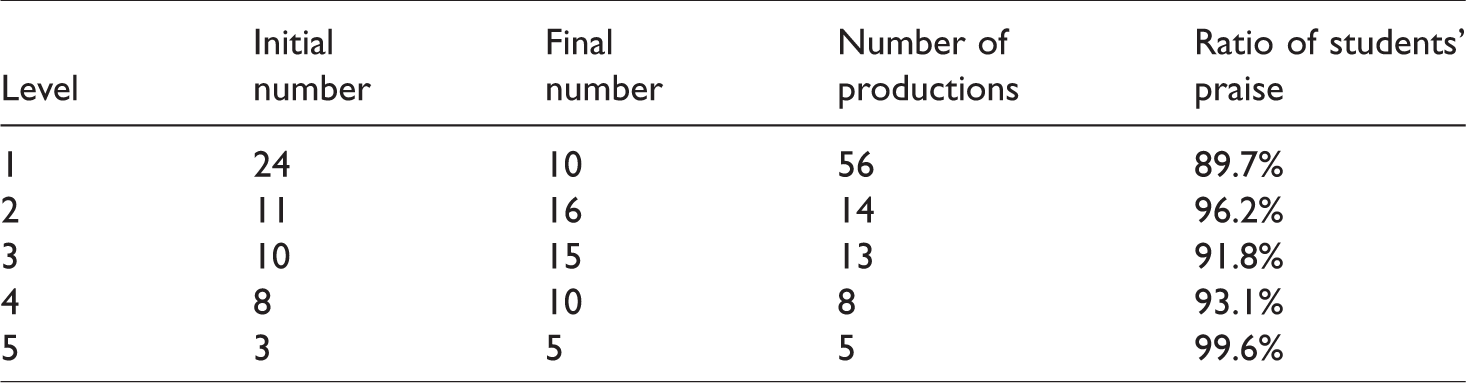
From the data in the Table, it can be seen that the application of hierarchical teaching method in comprehensive practical courses can stimulate students' interest in learning and improve their practical ability. Especially, the application of the upgrade reward mechanism is conducive to tapping the potential of students and improving their comprehensive quality. In 2018, this method was extended to the comprehensive practice of electronic information science and technology specialty with 116 students. With 59 students majoring in IoT, there are 175 students. The conclusion of the test is basically consistent with the data in Table 3.
Because hierarchical teaching embodies “teaching students in accordance with their aptitude”, teachers' teaching and students' learning have autonomy and full freedom. At the same time, it lightens the burden of teachers and students, and improves students' interest in learning. Helping everyone to achieve the same competencies is the ultimate goal of every educator. On the basis of respecting students' differences in understanding and sensitivity to engineering knowledge, grading method is applied to teach students in accordance with their aptitude in order to achieve this goal.
Development and uses of MOOCs
Massive open online courses (MOOCs) is the product of “Internet + education”. It is also a very good choice in practical teaching methods. Especially, with the advent of the information age, new blood has been injected into the construction of MOOCs platform. Studying the operation mode of the platform can clarify the talent training mode and help the talent development. 7 There are many engineering practice courses in engineering, the contents of which are scattered and varied, and the steps are cumbersome. At present, most of the experimental instruments are used for teaching, and students' learning time is limited to class. Software simulation has a long history. The introduction of simulation into teaching is conducive to the extension of practice. There are also many achievements in these aspects. Some studies have integrated OBE education concept into the teaching of mechanical virtual and practical combination. This method uses IRAI software platform to develop training projects, that is, using real PLC and other electrical control components to control the virtual mechanism movement in PC. 8
With the development of mobile communication and network, MOOCs have been paid more and more attention by educational circles. Using the ubiquitous online learning has become a mode of modern learning. However, the application of MOOCs in practical teaching has another problem: it can only be seen, not done, because the experimental equipment is a limited resource. In this context, the use of simulation software is booming again. MOOCs + simulation has become a new mode of practical teaching.
The practice of analog circuit is illustrated as an example. Analog circuit experiments are eight classes and seven experiments. The traditional mode is to build circuits on the experimental box to verify the circuit performance. Most of them are verification experiments, and the flexibility is very poor. The traditional teaching mode is preview + on-site practice + report. The instructors and students are very tired during the whole experimental process. With the use of MOOCs, the experimental mode is changed to simulation + field practice + summary. Multisim simulation-based experimental micro-lessons are put on the MOOCs platform. Students can complete the necessary on-site practice within the prescribed class hours, and then they can do simulation experiments as an additional item of the practical course. Besides being able to do validation experiments, students can give full play to their creativity and design experimental circuits by themselves. Figure 5 shows simulation circuits using Multisim 14.0
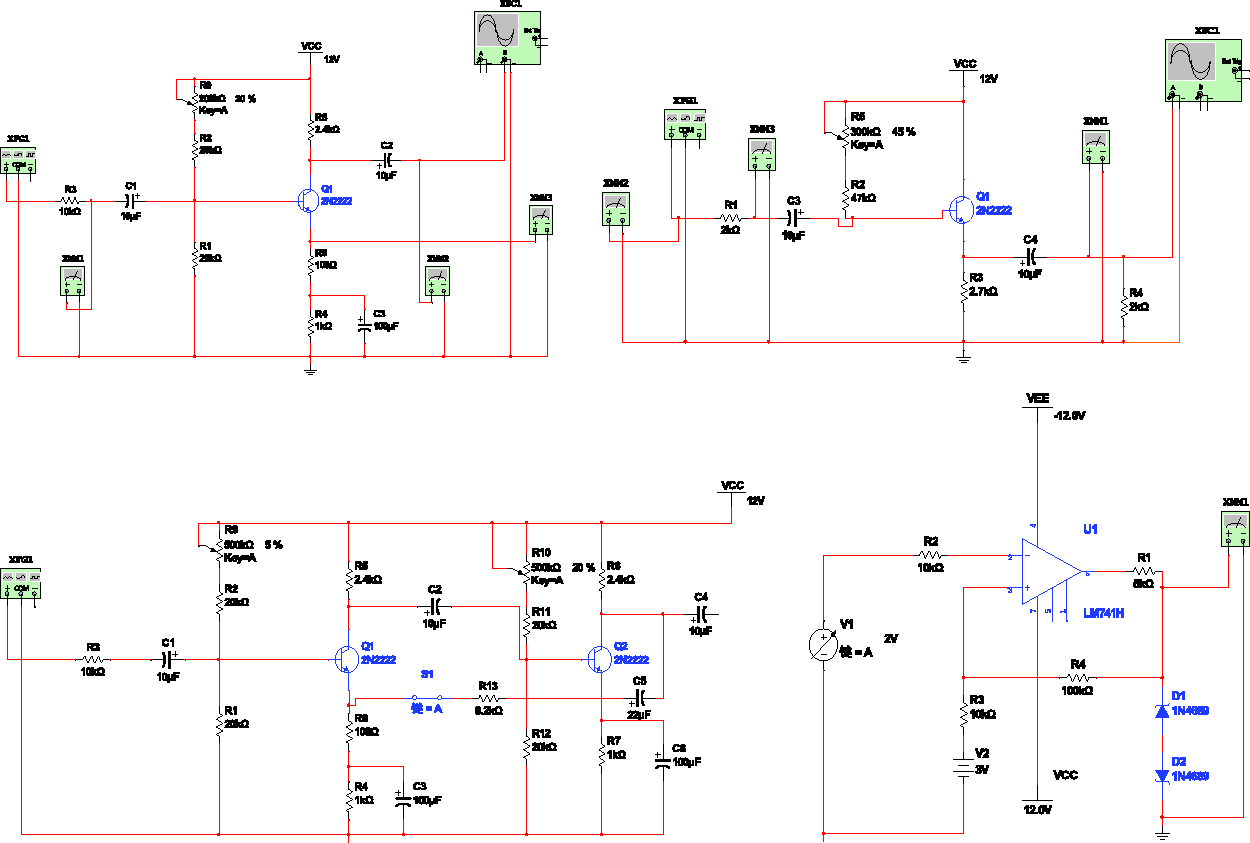
Simulation circuits using Multisim 14.0.
The use of the new experimental teaching mode has fostered students' interest in learning and improved their practical ability. The number and quality of experiments have been improved. The old experimental model is theory preview + experiment class explanation + experiment implementation + experiment report. The old model was used before 2015, simulation began in 2016 and MOOCs was introduced only in 2017. The old model in 2015, simulation addition in 2016, MOOCs addition in 2016, comparison of three sets of data are shown in Table 4. From 2018, we continue to improve the new mode, develop new simulation circuits and increase MOOCs resources.
Comparison of new and old modes in analog circuit experiments.
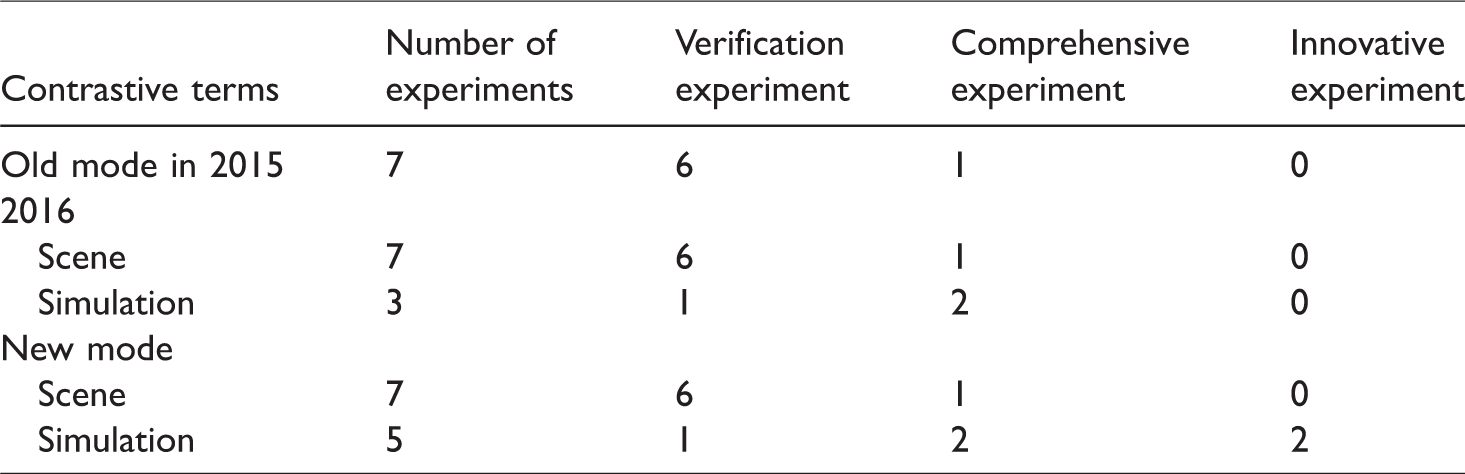
The introduction of simulation not only enlarges MOOCs resources and makes teaching go out of the classroom, but also maximizes students' learning resources so that learning is not limited to the classroom. It is a good way to win-win both teaching and learning.
Discipline competition drives practical teaching project
It has been a long time since competition was used to cultivate interest in learning. There are also many studies in this area. Competitions in various disciplines enrich and improve the content and form of practical teaching, and cultivate the practical and innovative ability of College students. 9 Beihang University improved the previous teaching mode, and formed a competition-based project practice teaching mode. After one year’s exploration and practice, this mode more easily stimulates the enthusiasm and initiative of students, enhances their hands-on ability, innovative thinking and teamwork spirit. The experiment achievements and feedbacks from students prove that this mode largely realized the goal of the course. 10 With the development of society, people's innovative consciousness is getting stronger and stronger. All industries are carrying out innovative entrepreneurship, and there are more competitions than before. It is an effective method to carry out practical teaching by means of competition. Colleges and universities are also aware of this and have introduced various policies to encourage students to participate in competitions. Colleges and universities are also aware of this and have introduced various policies to encourage students to participate in competitions. Under the dual impetus of social demand and incentive policy, students are more and more motivated to participate in competitions. For engineering students, it is undoubtedly an effective way to improve their practical ability, and it is active.
As an educator, how to use this trend and take effective measures to guide students becomes the focus of teaching research. It is an effective way to set up Maker Space. Research shows that students can build knowledge, acquiring knowledge and competencies within Maker Spaces. 11 Students of the same hobby gather spontaneously to study how to develop new technology to participate in the competition, form teams and complement each other's strengths. The construction of Maker Space needs space, equipment, funds and guidance. Universities have unique advantages, such as opening laboratories, experimental equipment, research funds and professional teachers. Therefore, the activities of creating visitors in colleges and universities are developing very quickly and have achieved a lot.
Maker Space extends practical teaching beyond the classroom, which is an effective complement to classroom teaching. Creator can not only improve students' practical ability but also cultivate the spirit of cooperation and broaden their horizons. In establishing Maker Space, it should adhere to the principle of voluntariness and freedom, take part in competitions as method and aim at cultivating ability. The teaching method is based on students' self-study and assisted by teachers' guidance. Formally study and discuss in groups, and divide work freely within groups. Since 2014, more than 200 students have been trained and more than 100 awards have been won in various competitions. Among them, there are 17 national awards and more than 50 provincial awards. There are 36 national and provincial awards in electronic design competition and IoT design competition alone. And the number of students and awards shows an increasing trend year by year. Table 5 shows the number of students and awards from 2013 to 2018.
Statistics of Maker Space.
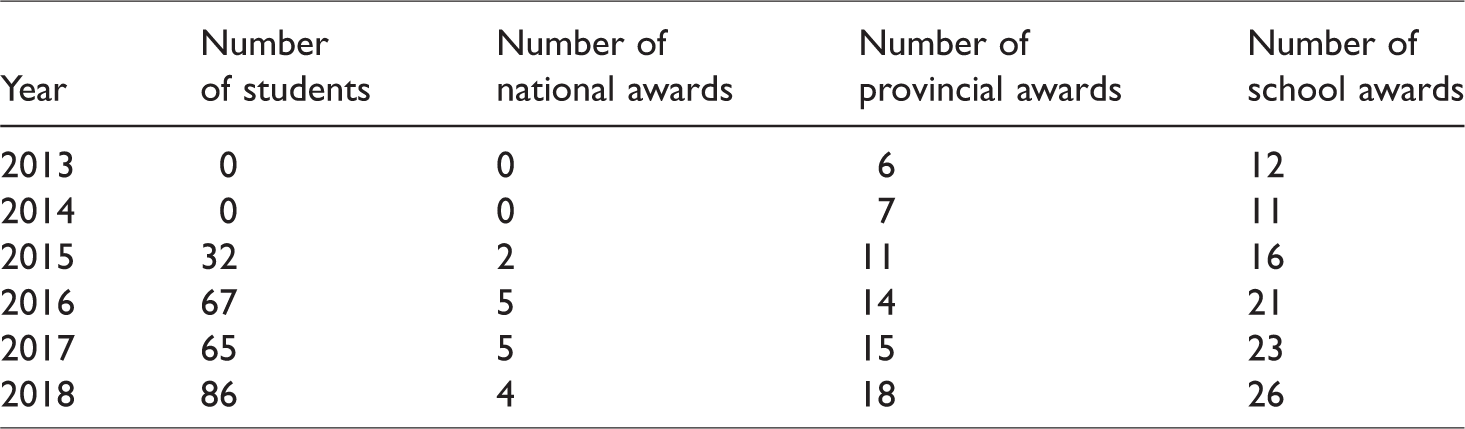
There was no Maker Space before 2014, and the number of awards is significantly less than after 2014. In the spring of 2019, more than 10 freshmen joined the Maker Space to follow the senior students. Maker Space operates in such a way that senior students teach junior students.
Conclusions
Under the background of education certification and emerging engineering, the cultivation of students' practical ability is particularly important. In view of the characteristics of emerging engineering and the graduation requirements of education certification, this paper puts forward several practical teaching methods.
Hierarchical teaching is “student-centered, result-oriented” teaching method. By layering students and practical teaching content, we can teach students in accordance with their aptitude. Content difficulty and students' ability are inversely proportional. The method of “MOOCs + simulation” extends the experimental content. MOOCS platform can extend learning to extracurricular, which previously was limited to the laboratory; simulation can expand the limited experimental content to infinite. The use of both tools is conducive to the expansion of the experiment, both in form and content. Maker Space gives students a space to develop their creativity. Under the attraction of the competition, students enter the Maker Space for extracurricular practice, and expand the limited classroom learning to extracurricular. Under the incentive of competition award, more and more students are entering the Maker Space, realizing the students' self-learning and “helping and leading”.
The comprehensive use of various teaching methods enhances the interest of practical teaching, expands practical teaching from laboratory to any space and time, and improves students' learning efficiency.
Footnotes
Declaration of conflicting interests
The author(s) declared no potential conflicts of interest with respect to the research, authorship, and/or publication of this article.
Funding
The author(s) disclosed receipt of the following financial support for the research, authorship, and/or publication of this article: This work was supported by Hebei Agricultural University Excellent Online Open Course “Analog Circuit”, Hebei Provincial Colleges and Universities Research and Practice Projects on Teaching Reform of Innovation and Entrepreneurship Education (201700086), Hebei Agricultural University Science and Technology Fund (LG201603) and Hebei Graduate Innovation Funding Project (CXZZBS201811).