



Abstract
In early 2024, revelations concerning a meeting of far-right actors to discuss large-scale deportations triggered one of the largest waves of protest in modern German history. What brought people into the streets was not outrage at these plans alone, but also a deeper anxiety about the trajectory of liberal democracy, intensified by the growing strength of the Alternative für Deutschland (AfD). Against this backdrop, the present article draws on theories of grievances, mobilizing structures, political opportunity, and micro-mobilization to examine both the geography of protest and the determinants of participation. Combining protest event data with survey evidence, we suggest that mobilization was shaped less by grievances related to deportation threats than by the organizational strength of, and individual affinities with, parties of the center left. We also identify a curvilinear relationship between the legacy of far-right mobilization and anti-far-right protest: moderate levels of prior far-right activity tend to stimulate anti-far-right protest, while high levels may suppress it—particularly in contexts where mobilizing structures on the center left are weak or absent. In sum, these findings underscore the complexity of mass protest in defense of democracy, pointing to the interplay of various structural, organizational, and individual dynamics.
Introduction
In the first half of 2024, Germany witnessed one of the most extensive waves of protests since 1945 (Rucht, 2024: 17), with millions taking to the streets in opposition to the far right. The crucial spark was a report published on January 10 by the newsroom CORRECTIV (2024), which detailed what soon became known as a “secret meeting” (Geheimtreffen) held the previous year in a villa near Potsdam. According to CORRECTIV, prominent figures of the far right had convened there with members of the far-right Alternative für Deutschland (AfD) 1 to discuss future migration policy—most controversially the concept of “remigration,” which envisions the deportation not only of foreign nationals but also of unwanted Germans of migrant descent. The revelation functioned as a “moral shock” (Jasper, 1997), generating a groundswell of dismay and anger that spread with remarkable speed and, within days, translated into mass protests. From metropoles to small towns, large crowds gathered to denounce the reported plans, transform their shocked indignation into a defense of liberal democracy, and call for the protection of minorities. Particular concern was expressed for those vulnerable to restrictive migration policies: refugees and asylum seekers as well as migrant neighbors, friends, and colleagues. Yet for many protesters, the meeting was more than an isolated scandal. It appeared rather as the latest manifestation of a continuous rightward drift in German politics, a tendency best reflected in the AfD’s rising poll numbers and its increasingly deep societal entrenchment. 2
While the protests unfolded in a distinctly national context, they also resonated with a broader global pattern of mobilizations responding to perceived threats to democracy. In the United States, the first term of Donald Trump triggered large-scale protests and fostered coalition-building at both local and national levels (Meyer and Tarrow, 2018); in Eastern Europe, anxieties over democratic backsliding and state capture likewise provoked reactions from civil society actors (Blackington et al., 2024); in Italy, grassroots mobilization arose in response to the cultural backlash advanced by the Lega (della Porta, 2022); and in Israel, tens of thousands filled the streets to resist a constitutional overhaul they regarded as undermining democratic norms (e.g. Gidron, 2023; Shultziner, 2023). In all these cases, however, protesters mobilized against government actors whom they accused of eroding principles of liberal democracy and violating the spirit of pluralism. Our contribution extends this line of inquiry by investigating a case in which protests emerged despite far-right parties not holding governmental power (Meier et al., 2025). Building on descriptive accounts (Bitschnau and Koos, 2024; Rucht, 2024; Rucht et al., 2024; Wienkoop et al., 2024) and contributing to the debate on how democracies confront challenges from within, we ask how to explain both the local variation in the size and frequency of protests and differences in participation at the individual level.
In our analysis, we build on the grievance approach alongside perspectives on mobilizing structures and political opportunities (e.g. Borbáth and Hutter, 2024; Castelli Gattinara et al., 2021), while also focusing on the role of identity and social networks (van Stekelenburg and Klandermans, 2013). This framework allows us to distinguish between grievances and other mobilizing dynamics at both the micro- and macro-levels. It also enables us to assess whether the protests extended beyond the established base of progressive activism in Germany—left-leaning, educated and mostly urban (e.g. Daphi et al., 2023; Sommer et al., 2021). Our results, in turn, are of relevance for evaluating the broader democratic implications of mobilization under conditions of social and political strain.
Our analysis draws on three complementary data sources: event-level data covering the first protest wave between January and March 2024; individual-level data from a nationally representative survey conducted in March 2024; and on-site survey data collected at two large protest events in mid-2024. Using multivariate regression analysis, we show that the number of protest events tracks prevailing political affinities: mobilization levels are markedly higher in counties with strong vote shares for left-of-center parties (SPD, Bündnis 90/Die Grünen, and Die Linke), and lower in those where support for the AfD is comparatively high. Moreover, the legacy of far-right protests can exert mobilizing, but also demobilizing effects on anti-far-right protests. The local strength of left-of-center parties moderates this relationship, while individual-level party affinity emerges as a helpful predictor of participation. By contrast, we find no evidence that the simple proportion of foreign nationals within a given county (“Landkreise” and “kreisfreie Städte”) plays a crucial role for mobilization. Nor do citizenship status or migration-related diversity in one’s personal network exhibit a significant association with protest participation. Participants appear more motivated, however, when they perceive the “remigration” plans as a direct threat and view the AfD as anti-democratic. These findings shed light on the interplay of grievances, structural factors, and political opportunities in a salient instance of protest, highlighting a complexity that defies all too reductive explanations.
In what follows, we first provide historical context on anti-far-right protests in Germany before outlining our theoretical framework. We then present our empirical results and conclude with a discussion of their implications.
Background: Protesting the German far right
In contrast to most other European countries, far-right parties in Germany long struggled to establish a durable foothold. Only in 2017 did the AfD—initially founded as a Eurosceptic formation—enter the Bundestag as the seventh party in an increasingly heterogeneous political landscape (Weisskircher, 2024). Although far-right attitudes had never fully disappeared, the combination of “Hitler’s shadow” (Minkenberg, 1992: 55), the relative dominance of the Christian Democratic center right, and the fear of social sanctions constrained the far right’s potential largely to local and state politics, where the National Democrats (NPD) and German People’s Union (DVU) served as prominent exponents. 3 Protest against these parties was not primarily waged by their political competitors, which routinely denied them recognition as legitimate challengers, but rather by local antifascist groups (Jones and Schuhmacher, 2024), and it was only the rise in far-right violence after the German reunification in 1990 (Koopmans, 1996) that brought broader awareness of far-right continuities. Soon, thousands gathered across German cities to hold vigils against racist violence (Rucht, 2018) and reaffirm what has been described as an anti-extremist consensus. In the following years, a growing number of civil society organizations emerged to counter the public presence of the far right, for instance during the annual march commemorating the bombing of Dresden. Yet by the early 2000s, their salience had again receded, and when Angela Merkel assumed the chancellorship in 2005, the issue was widely regarded less as a serious political threat than as an educational challenge. The short-sightedness of this judgment became evident in 2011, when it was revealed that the far-right Nationalsozialistischer Untergrund had murdered nine individuals of migrant descent and one police officer over the course of a decade (Schultz, 2023).
A few years later, far-right mobilization assumed a new quality when marches organized by the Patriots against the Islamization of the Occident (PEGIDA) drew large crowds in the Saxon capital of Dresden (Bitschnau et al., 2021; Weisskircher, 2024) and soon spread to other major cities as well (Hellmeier and Vüllers, 2023). Amid the increased politicization of immigration, particularly in the context of the 2015 refugee crisis, this development provided fresh impetus to the AfD, which slowly shifted its focus from Euroscepticism toward an anti-immigration agenda (Weisskircher et al., 2023). By carving out a niche with positions that no other party was willing to claim, its leadership was able to considerably broaden its base of support. It not only absorbed much of the traditional far-right electorate and rallied large numbers of protest voters, but also attracted a sizable share of former center-right and center-left voters: Christian Democrats frustrated by what they perceived as a massive dilution of conservative values during the Merkel years, and Social Democrats alienated from their party and its postmodernist stance (Debus and Traunmüller, 2025). For a while, it appeared that the fallout of the COVID-19 pandemic might curb the AfD’s appeal; yet the party soon regained momentum and by 2023 was again rising in the polls.
This, in turn, led to a surge of progressive mobilizations directed against the far right and those forces on the center right who had spoken out in favor of restrictive migration policies. Rallies attracting tens of thousands convened under the banners of civil society alliances such as Indivisible (Unteilbar) and Stop the Hate (Ausgehetzt), advocating liberal democracy and minority rights (Stjepandić et al., 2023). Their scale signaled that resistance to the far right—and to the perceived mainstreaming of its positions—continued to resonate broadly across the country, 4 and although they themselves proved short-lived, the local networks they mobilized often endured and provided important support for the protest wave that would follow in 2024. That wave, though sparked by the CORRECTIV report, must therefore be understood within a continuous trajectory of anti-far-right activism.
Explaining local and individual patterns of protest
To explain patterns of mobilization in this most recent wave, we adopt a twofold analytical approach that addresses both variation in protest activity and the determinants of individual participation. With respect to the former, we integrate the notion of grievances into the political process model (Borbáth and Hutter, 2024; Castelli Gattinara et al., 2021) in order to identify the principal factors shaping the size and number of protest events (macro-level). With respect to the latter, we draw on insights from the sociological literature on micro-mobilization (Schussman and Soule, 2005; van Stekelenburg and Klandermans, 2013), together with original findings on protest participants (micro-level). We proceed first at the macro and then at the micro-level, attentive to their interdependence and to the partially overlapping mechanisms that link them.
The macro-level dynamics of protest mobilization
Macro-level studies of protest typically seek to explain why demonstrations vary in size and number, and which factors account for this variation. Among the most influential approaches in this regard is the political process model (McAdam, 1982; Tarrow, 1994; Tilly, 1978), which marked a turn from earlier socio-psychological frameworks (Gurr, 1970) that fostered skepticism toward grievances as a crucial driver of mobilization (Oberschall, 1978). Instead of foregrounding subjective discontent, its advocates point to endogenous factors such as resource availability and collective identity alongside exogenous factors related to political context. In recent years, however, scholars have become increasingly receptive to integrating some of its elements with the study of grievances (e.g. Borbáth and Hutter, 2024; Castelli Gattinara et al., 2021; Kriesi et al., 2020). Their expectation here is straightforward: the more intensely grievances are felt, the greater the likelihood and magnitude of protest mobilization.
While grievances may reflect diffuse dissatisfaction with what is perceived as systemic malfunction, they can also assume issue-specific forms. Cultural grievances surrounding migration, for instance, have been identified as a crucial driver of recent far-right mobilization (Castelli Gattinara et al., 2021). Complementing this perspective, the mobilizing structures approach emphasizes the role of political entrepreneurs and resource mobilization, thereby constituting the second pillar of our combined framework (McAdam et al., 1996a; McCarthy and Zald, 1977). Notably, research on environmental protest in Europe lends support to this view: Borbáth and Hutter (2024) demonstrate that variation in protest activity can be attributed to the relative strength of mobilizing structures. Finally, mobilization is also conditioned by opportunities arising from the socio-political context, which can be categorized as either institutional or cultural (Giugni, 2009). The opportunities we focus on in this article are those linked to prior far-right protests. Building on this explanatory triad—grievances, mobilizing structures, and context-based opportunities—we apply our framework to the analysis of cross-local patterns of protest against the far right.
The first potential grievance relates to the threat of “remigration,” whose proponents explicitly aim at migrants and their descendants. Experiencing it can be conceptualized as an expression of collective relative deprivation: a segment of the population is subjected to exclusion vis-à-vis the rest of society (e.g. Kern et al., 2015). From this it follows that counties with larger migrant populations should exhibit both more protest events and higher participation. Not only do more migrants reside there, but so too do more native Germans who know and appreciate them as colleagues and friends. By contrast, in counties with smaller migrant populations, intergroup ties are less common and the perceived threat is more abstract. A second potential grievance relates to the AfD’s electoral strength. Where the party’s vote share is low, one may feel less urgency or doubt the severity of the threat. In far-right strongholds, however, its visibility and the pervasiveness of its discourse may create a different experience, one in which the prospect of the AfD seizing power sets off alarm bells. Still, the simple presence of a party can be considered a grievance only in a qualified sense. It may convey menace, but—unlike in the 1920s and 1930s, when National Socialists and Communists fought each other in the streets—it rarely takes a violent form. These considerations give rise to two hypotheses concerning the effect of grievances on variation in protest:
However, the effect of grievances must be understood in relation to mobilizing structures, the second pillar of our framework. This broad concept encompasses all “collective vehicles, informal as well as formal, through which people mobilize and engage in collective action” (McAdam et al., 1996b: 3). In the context of anti-far-right protests, the strength of civil society organizations and left-of-center parties (Borbáth and Hutter, 2020) is of particular importance: both can initiate protests themselves or sustain them in a variety of ways. They may provide the resources needed to bring people into the streets, facilitate decision-making, or anchor protest in the political sphere. Beyond the protest affinity of left-wing electorates (Borbáth and Hutter, 2020), we assume here that voters of left-of-center parties (SPD, Bündnis 90/Die Grünen, and Die Linke) will be among the vocal supporters and organizers of anti-far-right protests. Counties with high vote shares for these parties should therefore exhibit high levels of protest participation. By contrast, counties in which right-of-center parties (and the AfD) command strong electoral support should be expected to display the exact opposite pattern. 5 Kostelka and Rovny (2019) maintain that protest participation in such contexts depends less on economic left–right positioning than on adherence to the tenets of social liberalism. Fortunately, these dimensions largely overlap in the German context, which motivates the following hypotheses:
As a third factor, alongside grievances and mobilizing structures, opportunities are central to protest mobilization. Since the 1980s, the notion of political opportunity has occupied a pivotal place in the study of collective action (Kitschelt, 1986), and it continues to serve as a powerful explanatory lens. Opportunities embedded in political structures have usually been operationalized through indicators such as the electoral system, the presence of allies in government, or the degree of elite competition, and have proven valuable for explaining cross-national variation (Borbáth and Hutter, 2024; Hutter, 2014; Kriesi et al., 1995). Although the same cannot be said for cross-local comparisons—given the focus of the opportunity approach on national systems and its limited applicability below that level (Garland et al., 2023)—scholars have proposed broadening the framework to encompass economic, cultural, and social dimensions of opportunity (Gamson and Meyer, 1996; Giugni, 2009; Luders, 2006). In this vein, we adopt a comprehensive conception of opportunities by referring to the public visibility and legitimacy of actors, identities, and claims that make mobilization more or less likely (Koopmans and Olzak, 2004). We focus in particular on prior far-right protests, which reflect the local visibility of far-right actors in a twofold sense: first, these actors themselves are immediately visible during such protests; second, their visibility is amplified through diverse forms of media coverage. Together, these two dynamics generate a perceived threat structure and contribute to an atmosphere of dominance that may be experienced as intimidating. Yet, as has been suggested with respect to the openness of political institutions, they may have a curvilinear effect on mobilization (Eisinger, 1973; Tarrow, 1994). This implies the existence of a tipping point beyond which visible far-right protests no longer generate particular urgency for action but instead project legitimacy and inevitability, thereby fostering apathy among critics and opponents. This is all the more the case once such protests appear unstoppable and those who resist risk being ostracized. Consequently, in counties marked either by few prior far-right protests or by a long-standing tradition of them, this legacy aspect may inhibit mobilization: depending on their ideological loyalties, people may feel unconcerned or intimidated. A culture of opposition, by contrast, can be expected to develop mainly in counties with a moderate level of prior far-right protest. For only under such conditions do a sense of urgency and the perceived possibility of averting an overwhelming backlash coincide. To capture this effect of opportunities, we advance two more hypotheses:
Importantly, the factors shaping the number and the size of protests may not be independent of one another. Theorists of opportunity have long emphasized that the success of mobilization efforts often depends on the opportunities available to those undertaking them (Meyer and Minkoff, 2004); where the latter are limited, mobilizing structures become correspondingly more consequential for protest participation. This, in turn, suggests that organizational strength may moderate the effect of existing opportunities (Vráblíková, 2014). In counties with strong left-of-center parties, opportunities linked to prior far-right protests may be less decisive, as there is enough organizational capacity to mobilize regardless. But where they are weak and other mobilizing forces absent, opportunities assume importance, either by stimulating mobilization or (if the threat is viewed as too great) by discouraging it. This brings us to our last macro-level hypothesis:
The micro-level dynamics of protest participation
Turning to individual protest participation, social-psychological approaches identify five key factors, several of which overlap with the determinants discussed (Klandermans, 2004; van Stekelenburg and Klandermans, 2013). Besides grievances, identity, efficacy, emotions, and social embeddedness are widely understood to be central in converting bystanders and passive observers into protest participants. Sociological perspectives point to similar processes but additionally stress biographical availability (such as employment status or care duties) and political engagement (Schussman and Soule, 2005). In our analysis, we focus on three sets of factors that are recognized as pivotal across different disciplinary traditions (e.g. Klandermans et al., 2008; Schussman and Soule, 2005) and appear especially important in the present context: grievances, political identity, and organizational embeddedness.
First, at the individual level, grievances may assume a wide variety of forms. When people perceive that core principles (e.g. of liberal democracy) are being violated, they may experience moral outrage (Jasper, 1997) and come to regard inaction as untenable. Accordingly, those who perceive the AfD—the dominant actor of the German far right—as posing a threat to democratic values should be more likely to participate in protest. In addition, and as noted, migrants, those with close ties to them, and everyone endangered by the idea of “remigration” possess strong incentives to mobilize and should display a heightened propensity to take to the streets, consistent with a logic of deprivation (Kern et al., 2015). Similarly, research on anti-racist protest indicates that mediated experiences of racism as well as emotional attunement may function as catalysts of mobilization (Steinhilper et al., 2025). On this basis, we formulate the following two hypotheses:
Second, political identity provides a crucial channel through which collective wishes are articulated and translated into action. The 2024 protests may be understood as simultaneously sustaining and activating a collective partisan identity defined chiefly in opposition to the far right. In practical terms, supporters and sympathizers of left-of-center parties, who often experience a special responsibility to make their voices heard and perform solidarity with marginalized groups (Stjepandić et al., 2023), should display a greater propensity to participate, while individuals rooted in center-right traditions should be less inclined to do so. This expectation accords with Germany-based research showing that environmental and anti-racist protests alike have been characterized by a left-leaning base (Daphi et al., 2023; Sommer et al., 2021). From this, we derive one further hypothesis:
Finally, social ties and personal embeddedness in associational networks may play an important role for protest participation (van Stekelenburg and Klandermans, 2013). Ties of this kind not only provide practical information about protest events (e.g. time and place), but also generate incentives to join through personal interaction and peer influence. Associational engagement increases the likelihood of receiving an invitation to participate, which, in turn, has been identified as one of the most reliable predictors of protest involvement (Schussman and Soule, 2005). It is therefore reasonable to expect that those actively engaged in voluntary associations—whether sports clubs, cultural organizations, or other civic groups—are more likely to participate. Accordingly, we advance one final hypothesis:
Data and methods
This study draws on three distinct types of data to provide a comprehensive analysis of anti-far-right protest mobilizations. First, we employ event-level data from the initial protest wave between January and March 2024 to examine the structural circumstances shaping patterns of mobilization. Second, we analyze a standardized population survey containing a dedicated module on this protest wave to investigate participation at the individual level. And finally, we complement both these sources with evidence from an on-site protest survey conducted in Hamburg and Dresden.
Protest event data
The event-level data we employ were originally compiled by a team of data journalists for a report on the mobilization dynamics of the protests (Sander and Ansa, 2025). Events were identified through a diverse set of sources, including national and local newspapers, police reports, and public assembly notifications (typically published on municipal websites). The team devoted great effort to detecting these events and verifying both the provenance and the accuracy of the information (personal communication). This multi-source strategy mitigates the bias that may arise when such data are derived solely from national newspaper coverage (Daphi et al., 2025). That said, distortion stemming from uneven media availability cannot be ruled out. To bolster confidence in the dataset, we implemented a two-step validation procedure. First, we cross-checked all sources for a subsample of events. Second, we triangulated the dataset against a database systematized by the grassroots initiative DemokraTEAM (2024). This comparison revealed a high degree of consistency in both the number of events and their size, though our dataset records a slightly higher number of events overall.
To examine local variation, we aggregate the event-level data from the exact protest location (city or town) to Germany’s 400 counties (Landkreise and Kreisfreie Städte), corresponding to the NUTS-3 level of the European Statistical System. This yields a comparable unit of analysis and ensures the availability of additional social and political indicators. Our dependent variables are (a) the number of participants across all protest events per county and (b) the number of protest events per county between January 12 and March 31 (Rucht, 2024). During this interval, an average of 9,900 individuals protested in each county (SD = 26,260), with participation ranging from 50 in Sömmerda to more than 300,000 in Hamburg. The average number of events was 4.5 (SD = 3.8), with a minimum of one in counties like Sigmaringen and a maximum of 31 in Berlin. We combine these measures with indicators capturing grievances, mobilizing structures, opportunities, and contextually relevant socio-economic factors. To operationalize grievances, we use two different indicators. First, the relative proportion of migrants in a county serves as a proxy for the vulnerability of its population to “remigration” plans. And second, the county-level vote share of the AfD functions as a cause-specific grievance indicator. Mobilizing structures are measured through the county-level vote share of the three major left-of-center parties (i.e. SPD, Bündnis 90/Die Grünen, and Die Linke) in the 2021 federal election, based on the second vote or Zweitstimme (StABL, 2024). With respect to the question of opportunities, we use the number of far-right protests per county between 2015 and 2020, drawing on data from past far-right protests (Kanol and Knoesel, 2021). 6 Still, such protests may also signal constricted opportunities, possibly deterring rather than encouraging anti-far-right mobilization.
In addition, we include several control variables that can be expected to shape protest mobilization. These encompass protest potential, measured by a county’s logged population size and population density (in thousands of inhabitants per square kilometer); economic well-being, captured through both log-transformed income level and unemployment rates; and a number of selected demographic and infrastructural characteristics, such as average age and mean distance to public transport (in kilometers), together with controls for the eastern states and Berlin (Hellmeier and Vüllers, 2023). 7 All variables are drawn from the most recent data available for the year before 2024 8 and sourced either from the Federal Institute for Research on Building, Urban Affairs, and Spatial Development (BBSR, 2024) or from the Statistical Offices of the Federation and the Länder (StABL, 2024). Some potentially helpful information, such as party seat shares in district councils (Kreistage and Stadträte) or average education levels, is not available at the county level. To analyze the data, we use negative binomial regression models, which are suited to the distributional properties of count variables. A likelihood ratio test indicates that these models provide a superior fit relative to Poisson specifications, as the data exhibit overdispersion. To address possible heteroscedasticity, we estimate robust standard errors.
General population survey
For our analysis of micro-mobilization, we draw on data from the longitudinal DeZIM.panel (Dollmann et al. 2022). Participants were randomly sampled from registration office data and first contacted by letter in 2021. All subsequent waves have been administered online, with the target population defined as residents of Germany aged 18 to 67. The 11th wave of the panel (N = 1855), fielded in March 2024, included a module focusing on anti–far-right protest (Dollmann et al., 2025). Following a brief introduction describing CORRECTIV’s report on the Geheimtreffen and the reactions it caused, respondents were asked whether they had participated in any of these protests so far (“yes” coded as 1, “no” as 0, and “no answer” treated as missing). 9 With regard to grievances at the individual level, we again proceed from the fact that migrants would be the ones most affected if the “remigration” plans were ever implemented. Accordingly, foreign nationals (citizenship: Yes = 1; No = 0) and individuals whose personal networks 10 include a great share of migrants and people of migrant descent (more than 20%: yes = 1; no = 0) should perceive heightened threat and exhibit a greater propensity to protest against this scenario. Finally, we examine grievances as reflected in attitudes toward the AfD and the notion of “remigration” more broadly. Respondents were asked to indicate their level of agreement with two distinct statements: (1) “The debate on remigration scares me” and (2) “The AfD is anti-democratic.” Both were measured on Likert-type scales ranging from 1 (fully agree) to 5 (fully disagree) and then recoded so that higher values signal stronger grievances.
Political identity is operationalized as proximity (i.e. affinity) to one of the parties represented in the Bundestag, while also distinguishing respondents who report no partisan attachment altogether. We expect individuals who feel close to the main center-left parties (SPD and Bündnis 90/Die Grünen) or to the far left (Die Linke) to be more readily mobilized for anti-far-right protests than those identifying with right-of-center parties. To capture one’s social embeddedness, we rely on the classical indicator of participation in civic associations, including sports and welfare organizations. 11 Individuals who are members in at least one such association are coded as 1, while all others are coded as 0. In addition, we control for standard predictors of protest participation, such as age, education, and gender, and include further controls for unemployment, place of residence (small town, mid-sized town, or city with >100,000 inhabitants), East/West, and institutional trust, here measured as general confidence in the national parliament on a Likert-type scale ranging from 1 (no trust) to 11 (full trust). Owing to sample size constraints and the absence of subnational identifiers, we are unable to account for county-level variation in protest participation beyond the binary East–West divide. To analyze the data, we employ logistic regression models and report results as average marginal effects, that is, the average change in the predicted probability of the dependent variable when the independent variable increases by one unit, holding all other variables constant.
On-site protest survey data
We complement our protest event and population survey data with findings from an original protest survey conducted at the end of the first protest wave in Dresden and Hamburg (N = 534). To minimize selection bias among participants, a systematic sampling procedure was applied in both cities (Wienkoop et al., 2024: 31). Such data offer an important complement to the sources discussed above, as each comes with its own methodological blind spots (Daphi et al., 2023). Protest event analyses yield only little insight into who participates in demonstrations and what motivates them, whereas individual-level population surveys lack contextual information about concrete protest settings. On-site surveys at protest events enable us to directly link individual motivations with the broader protest context in which participants are embedded. This advantage, however, comes at the cost of excluding non-participants and thereby precluding the use of a comparison group. Though protest surveys do not permit rigorous theory testing of participation determinants, they nonetheless offer a valuable window into mobilization dynamics—particularly in light of the sharply contrasting far-right contexts of Dresden and Hamburg.
Because they present quite different political landscapes, these two cities are especially well-suited to comparative analysis. In Dresden, the AfD secured a relatively high vote share of 17.6 percent in the 2021 federal election, and the city has a tradition of far-right protests, with 47 demonstrations reported. At the same time, left-of-center parties still retained significant strength (45.6%). Hamburg, by contrast, displays a markedly different profile: left-of-center parties were particularly strong (61.3%), while the AfD received only 5 percent of the vote. Far-right mobilization was likewise minimal, with just five protests reported. This creates a valuable opportunity to compare protest dynamics across cities that experienced large-scale anti-far-right protests under distinct political conditions—an approximation of a most-different-systems design (Przeworski and Teune, 1970). Comparing such different settings allows us to assess the peculiar role of far-right visibility and the strength of left-of-center mobilizing structures. To operationalize the three dimensions, survey participants were asked how present “far-right actors [were] in [their] place of residence,” whether they themselves “feared becoming a victim of a far-right attack,” and with which party they felt the greatest affinity.
Empirical findings
Protest event analysis: Patterns of local mobilization
Protest participation during the period under study was both extensive and geographically dispersed, encompassing nearly 1800 events and more than 3.9 million individuals (Figure 1a and b). Still, mobilization varied significantly across counties: large protests were concentrated in Berlin, Munich, Cologne, and other major cities, although some rural counties—Steinfurt and Mittelsachsen to name but two—likewise recorded considerable numbers of events and participants. On average, counties in the least densely populated quintile registered 3.6 protest events with roughly 2200 participants, while those in the most urban quintile averaged 4.2 protests with approximately 28,000 participants. These figures confirm that protest activity extended into the most rural regions, albeit with somewhat smaller turnouts. However, the spatial distribution does not mirror the East–West divide documented in AfD electoral results (e.g. Mau, 2024; Weisskircher, 2020). In eastern Germany, protests drew an average of 8700 participants per county across nearly five distinct events (4.8). In western Germany, by contrast, average participation was higher at roughly 10,200, but protest frequency slightly lower at 4.5 events per county. This points to a modest yet noteworthy difference: in the East, protest tends to be dispersed across a larger number of less well-attended events, whereas in the West, it appears concentrated in fewer but larger gatherings.

Number of protest events (a) and protest participants (b) by county.
To further examine the drivers of protest mobilization across counties, we next turn to a multivariate regression analysis. Table 1 presents the results for protest participation, measured in thousands, in its first three columns. Our baseline model (Model 1) indicates that counties with larger populations and higher population density tend to host better attended events, and that a younger population is likewise associated with heightened participation. By contrast, higher unemployment correlates with fewer participants, whereas county-level income shows no statistically significant relationship with the outcome. Counties in eastern Germany (except for Berlin) are positively associated with protest participation once other covariates are controlled for. As for infrastructure, participation is lower in areas where the average distance to public transportation is greater. Contrary to Hypothesis 1a, the proportion of migrants in a county exhibits no statistically significant association with participation levels. The AfD’s vote share is negatively related to the outcome, lending support to the interpretation that it functions as a demobilizing structural factor (Hypothesis 2b) rather than a mobilizing grievance (Hypothesis 1b). Higher vote shares for left-of-center parties are, conversely, positively associated with protest participation, underscoring their role in mobilization and offering support for Hypothesis 2a. Finally, Hypothesis 3a is not borne out by the data: we find no statistically significant relationship between protest activity and opportunities as captured by prior far-right protests.
Regression results (number of protest participants and protest events).

p < 0.05; ** p < 0.01; *** p < 0.001.
In Model 2, we account for the assumed curvilinear effect of these opportunities. 12 The results, shown in Figure 2a, indicate an inverted U-shaped relationship between the legacy of prior far-right protests and the participation in anti-far-right protests in 2024, thereby supporting Hypothesis 3b. In counties with no or only a few instances of prior far-right protests, anti-far-right engagement remains relatively moderate. But as the number of far-right protests increases, so too does anti-far-right mobilization—up to a point. Beyond a threshold of roughly 40 far-right protests, this trend reverses, and the size of anti-far-right protests quickly declines. This may reflect either the perceived legitimacy of the far right in counties where it has long maintained a visible presence or high levels of intimidation arising from it. 13 In our last specification for protest participation, Model 3 introduces an interaction term between prior far-right mobilization and support for left-of-center parties. It reveals a strong conditional effect: the inverted U-shaped relationship persists, but it is limited to counties with low vote shares for these parties. In line with Hypothesis 4, a local history of far-right protest in counties with high left-of-center vote shares exerts little to no influence on anti-far-right protest participation (Figure 3a). 14

Effects of prior far-right protests on protest participation (a) and frequency (b).
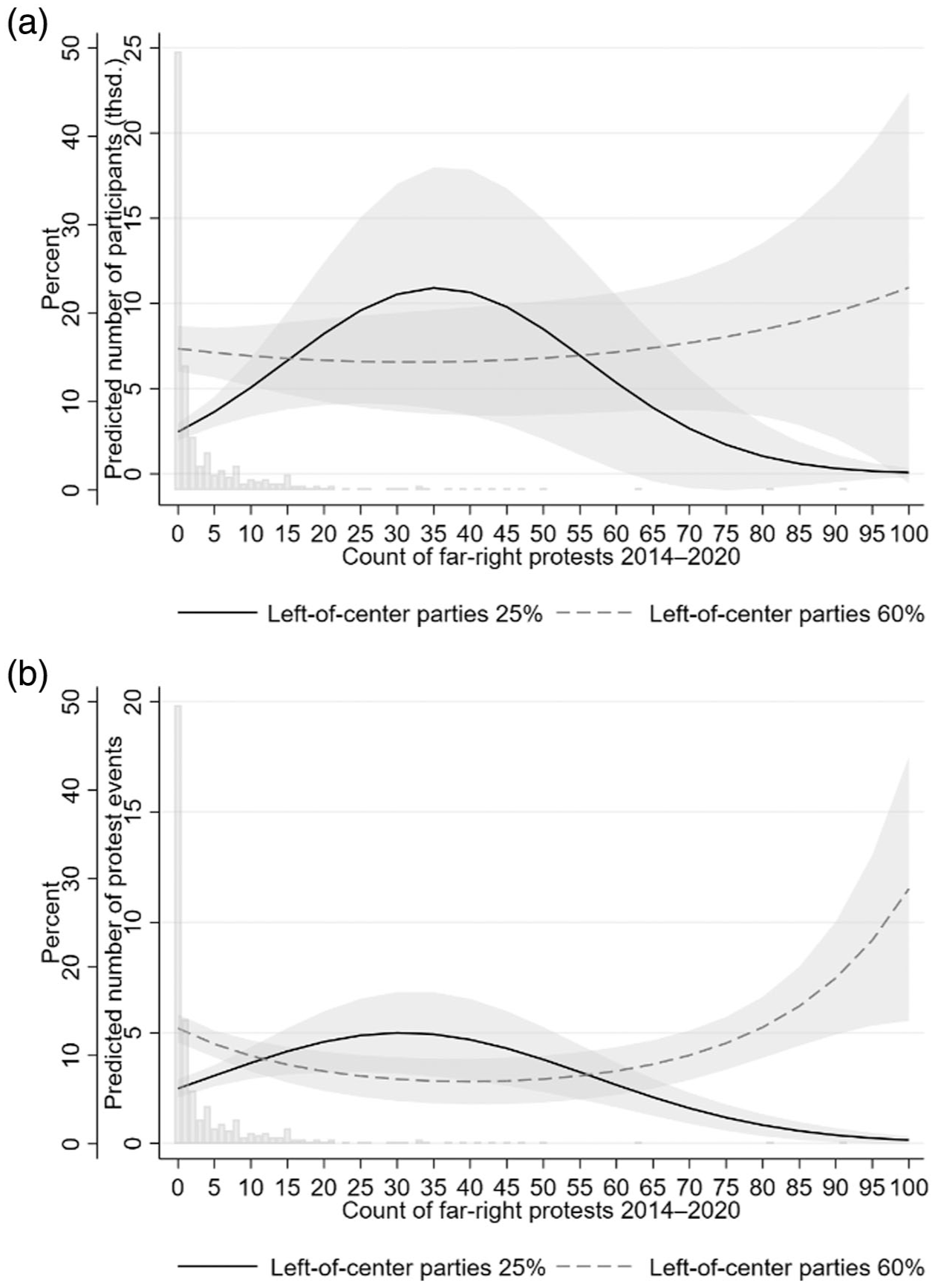
Interaction between both prior far-right protests and left-of-center vote share on protest participation (a) and frequency (b) We evaluate the interaction at 25% and 60%, which approximate the lower and upper bounds of the observed distribution of left-of-center parties while avoiding extreme values
With regard to our second dependent variable, protest frequency, our most important findings mirror the preceding results. We observe no association between the number of events per county and the migrant share, thereby challenging Hypothesis 1a, while again underscoring the relevance of left-of-center mobilizing structures and thus confirming Hypothesis 2a. Several notable differences nevertheless emerge. First, protest events are more numerous in less densely populated rural counties. Second, counties with older populations, as reflected in higher average age, tend to record a greater number of protests as well. Third, the AfD’s vote share exhibits a statistically significant negative association only once the interaction between left-of-center party strength and far-right mobilization is taken into account, partly confirming Hypothesis 2b but contradicting Hypothesis 1b. Hypotheses 3a and 3b receive no empirical support: prior far-right protests show no statistically significant relationship with the number of protest events, whether modeled as a direct effect (Model 4) or as a curvilinear one (Model 5). Yet, as in the analysis of protest size, we again find support for Hypothesis 4—namely, an interaction between the left-of-center vote share and the curvilinear effect of far-right protest legacy on the number of anti-far-right protests in the present (Model 6 and Figure 3b). Long and entrenched histories of far-right protest may thus function in the same way as grievances, but beyond a certain threshold they acquire a rather deterrent association with protest frequency, at least in counties with low electoral support for left-of-center parties. By contrast, in counties where these parties generally command higher vote shares, anti-far-right protest appears largely unaffected by the opportunities induced by prior far-right mobilization.
Population survey analysis: Individual mobilization
A descriptive overview of the population survey data corroborates the absence of a discernible East–West divide. Protest activity was reported by 28 percent of respondents in the eastern states and 27.5 percent in the western states—a difference too slight to sustain the claim of a meaningful regional cleavage. Variation across settlement types was somewhat more pronounced: 32.1 percent of urban residents reported protest attendance, compared with 22.6 percent among those in small towns or rural areas. The strongest contrasts, however, emerge with respect to party affinity. Nearly half of all respondents (46.3%) identified with Bündnis 90/Die Grünen, followed at a distance by the SPD (17.6%), CDU (10.0%), and Die Linke (8.4%). FDP supporters were scarcely represented at all (1.8%), and AfD sympathizers, as expected, entirely absent.
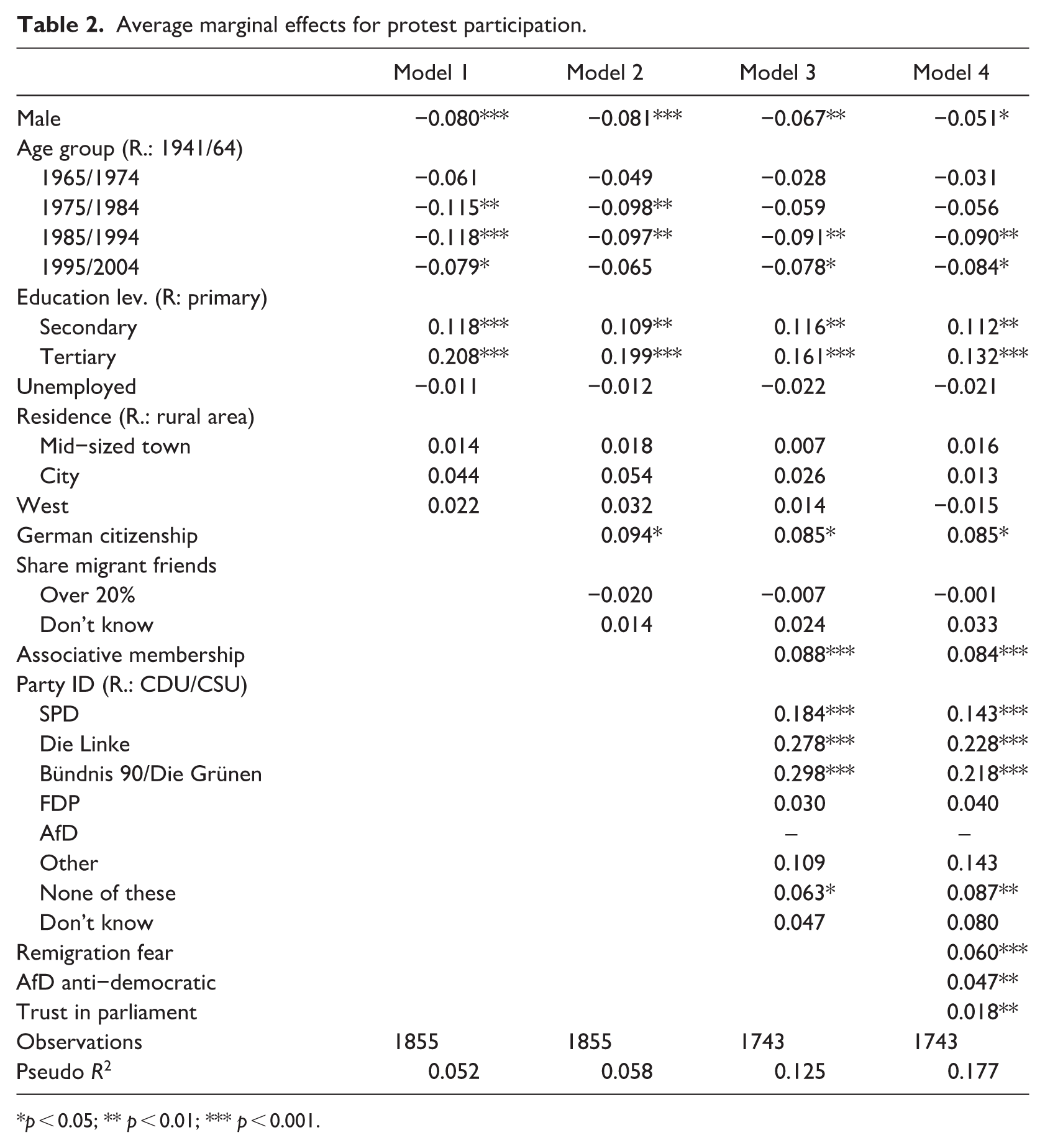
Table 2 complements these descriptive patterns by presenting average marginal effects based on logistic regression models that provide insight into the determinants of participation (see Table A4 in the Appendix for odds-ratios). With regard to standard socio-demographic variables, men and older respondents are less likely to protest than women and younger ones. Consistent with previous research, we also observe a strong positive association with formal education: participation is much higher among those with secondary (11.8%) or tertiary (20.8%) qualifications than among those with only primary schooling (Model 1). No such associations emerge, however, for unemployment, place of residence, or residence in eastern Germany. This last finding, in particular, reinforces the evidence on geographical patterns of protest and calls into question the assumption of a consistent East–West divide in far-right influence and civil society contestation. Turning to issue-specific grievances, German citizens are more likely to participate in protest, yet having a high share of migrants in one’s network proves statistically insignificant (Model 2). Although they would be the ones most directly targeted by a far-right government, foreign nationals (many of them migrants) were less likely to be mobilized. This accords with their lower levels of political participation and stands in clear contradiction to Hypothesis 5b.
Average marginal effects for protest participation.
p < 0.05; ** p < 0.01; *** p < 0.001.
In Model 3, we turn to political affinity and social embeddedness as additional explanatory variables. Association membership increases the likelihood of participation by 9 percent relative to individuals without such ties, thereby confirming Hypothesis 7. In a similar vein, we find support for Hypothesis 6, as affinity with the left-of-center parties is strongly associated with protest engagement compared with identification with the CDU/CSU. By contrast, identification with the AfD perfectly predicts non-participation, necessitating the exclusion of these cases. As far as attitudinal factors are concerned (Model 4), both fear of the “remigration” plans and the perception of the AfD as an anti-democratic party substantially increase the probability of participation and support Hypothesis 5a. A one-unit increase on the five-point scale measuring perceptions of the AfD’s anti-democratic character, for instance, raises the predicted probability of participation by almost 5 percent, controlling for all other covariates. Respondents with higher levels of trust in the Bundestag are also more inclined to protest than skeptics. In sum, these results not only support, but also deepen and extend the insights derived from the analysis of protest events.
On-site protest survey analysis: Mobilization in Dresden and Hamburg
We close with evidence from our protest survey, which highlights the contrasting ways protesters in Dresden and Hamburg perceive the threat of the far right. As discussed, Dresden bears the structural imprint of a relatively strong legacy of far-right mobilization and a high AfD vote share, yet it also hosts a visible left-wing milieu, producing a configuration in which conflict is inscribed into local memory. Hamburg, by contrast, with negligible AfD support, no history of far-right protest, and dominant left-of-center parties, offers a compelling counterpoint. These divergent contexts are vividly reflected in the survey data: in Dresden, 41.5 percent of respondents report far-right actors as quite or very visible in their city, whereas in Hamburg the figure is only 2.2 percent. This pronounced disparity reinforces a central claim of our protest event analysis, namely that the visibility of far-right actors in the present remains tethered to the legacy of past protests.
Moving beyond questions of visibility, we consider whether people feared “becoming a victim of a far-right attack,” a prospect that may dampen popular willingness to mobilize. In Dresden, one in five (20%) expressed such a concern, compared with fewer than one in ten (7.8%) in Hamburg. This extends our protest event analysis by showing that far-right protest legacies may also manifest in fears of violence. Put differently, protesters are unsettled not only by the visibility of far-right actors, but also by the threats they are believed to pose. Even so, strong left-of-center mobilizing structures sustain high levels of protest in both cities, albeit under different conditions. In Dresden, where 84 percent of respondents reported voting for the SPD, Bündnis 90/Die Grünen, or Die Linke in the last election, partisan mobilization appears to draw people into the streets even in the face of perceived threat. Hamburg presents a contrasting picture: far-right actors are often invisible, grievances linked to the AfD’s vote share remain muted, and an overwhelming 94 percent of protesters are firmly in the camp of the left-of-center parties. The survey therefore lends further plausibility to the argument that a history of far-right mobilization can dampen protest potential—unless counterbalanced by robust left-of-center mobilizing structures. At the same time, it confirms that the 2024 protests were carried predominantly by supporters of the broader left rather than by the center (Bitschnau and Koos, 2024).
Discussion
The protest wave investigated in this study displayed remarkable geographical breadth: mobilization occurred across both western and eastern states, in major cities as well as in small towns and rural areas, as citizens voiced concern over what they perceived to be a grave threat to liberal democracy. Yet, as our analysis demonstrates, the intensity of mobilization varied markedly, shaped by dynamics operating at both macro- and micro-levels. Table 3 synthesizes our key findings in relation to the hypotheses formulated in the theory section, offering an overview of the extent to which the empirical evidence supports—or diverges from—our initial expectations.
Overview of hypotheses and results.

The findings regarding grievances diverge in part from our expectations. At the county level, we detect no systematic relationship between protest mobilization and the proportion of migrants, and at the individual level neither citizenship nor social ties exhibit statistically significant effects. However, this absence of association should not be mistaken for an absence of concern. Many protesters report alarm over the discourse on “remigration” and perceive the AfD as anti-democratic, suggesting that issue-related grievances function as drivers of participation even when structural measures fail to register their true salience. This underscores the need to distinguish between objective correlates of mobilization and interpretive frames through which grievances are ultimately translated into protest action (Jasper, 1997; McAdam, 1982). Mobilizing structures, by contrast, prove crucial for explaining relevant patterns of participation. Consistent with findings from other on-site surveys (Bitschnau and Koos, 2024; Rucht et al., 2024), protest willingness was more prevalent among those with political affinities to left-of-center parties. This is mirrored at the macro-level, where high vote shares for these parties, combined with limited support for the AfD, created favorable environments for mobilization. Though our protest event data provide an insufficient proxy for the strength of civil society organizations, survey evidence highlights the importance of embeddedness in civic associations, which appears to have increased individual commitment to take to the streets. Taken together, these findings shed light on the pivotal role of left-of-center parties and civil society networks in mobilizing against the far right (Meier et al., 2025).
Finally, opportunities also affect mobilization, most notably through the local visibility of the far right. Our analysis reveals a curvilinear relationship between past far-right mobilization and the number of protesters in 2024, providing partial support for the classical inverted U-shaped effect of opportunities (Eisinger, 1973). At moderate levels, the far-right legacy galvanizes civic engagement by rendering the threat more salient and heightening the perceived sense of urgency. At low and high levels, however, it suppresses participation—be it by muting this sense or by intensifying fears of backlash and futility. This dynamic is particularly apparent in counties with rather weak left-of-center party support, where partisan infrastructures offer fewer cues and resources. By contrast, in counties where left-of-center parties are strong, the relationship between far-right visibility and protest participation disappears, a pattern corroborated by our data from Hamburg and Dresden. As theories of threat and opportunity suggest, moderate levels of adversarial activity may indeed serve as a spur to action, whereas higher levels exert deterrent effects (Vráblíková, 2014).
Conclusion and outlook
We conclude by reflecting on the significance of the protests within the German political context and in comparison with mobilizations against the far right elsewhere. Despite their unprecedented scale and nationwide reach, our findings show that these mobilizations were carried by progressive social milieus and resonated only weakly with more conservative segments of society. In this respect, they seem to have functioned less as the basis of a cross-ideological alliance than as a reaffirmation of entrenched ideological camps—an effect likewise documented in comparable cases (e.g. Borbáth, 2024; Steinhilper and Hoffmann, 2024). At the same time, there are indications that the protests left a lasting imprint on civil society, not least by forging new networks and fostering a strengthened sense of hope and collective efficacy (Bitschnau and Koos, 2024; Wienkoop et al., 2024). More difficult to assess is whether they exerted any measurable impact on the political landscape, for instance by shifting electoral dynamics to the detriment of the AfD. Evidence of such an effect was found in other countries: protests against the far right in Greece (Ellinas and Lamprianou, 2024) and Italy (Colombo et al., 2024) have been shown to reduce support for radical parties, raising the possibility that a similar dynamic was at work here. Stephan and Schürmann (2025), for instance, conclude that the 2024 protests “reduced the AfD vote share, and to an even greater extent than the mobilization preceding the national election in 2021” (p. 30).
However, any such effect was not reflected in absolute numbers, as the AfD soon recovered from the dip in support it experienced during the protests and went on to record electoral gains. Nowhere was this more evident than in the three 2024 state elections, where it achieved unprecedented results: in Thuringia, it emerged as the strongest party—the first such success for the German far right in postwar history—while in Brandenburg and Saxony it captured approximately 30 percent of the vote. Only a few months later, its advance was further consolidated at the federal level. In the early election of 2025, precipitated by the collapse of Chancellor Olaf Scholz’s traffic-light coalition, the party nearly doubled its national vote share, rising to 20.8 percent. These developments call for a cautious assessment of the electoral significance of mass protest. That said, the AfD’s recent gains cannot be understood in isolation from the turbulent pre-electoral period, marked by several high-profile acts of violence that dominated the public debate on migration. The effects of protest against the far right can therefore only be evaluated within their specific temporal and local context.
This is even more apparent when one considers the broader relationship between far-right electoral advances and patterns of opposition in other countries. France, for example, has witnessed a series of heterogeneous protest movements in recent years—most prominently the Gilets Jaunes (Royall, 2020)—yet far-right breakthroughs, such as Marine Le Pen’s progression to the second round of both the 2017 and 2022 presidential elections, have elicited limited protest activity. One possible explanation lies in the fact that her party, the Rassemblement National, has been firmly entrenched in French politics and, over the past decade, has pursued a strategy of dédiabolisation that positioned it as a more mainstream political force. Yet it may also indicate that, amid widespread dissatisfaction with government policy, popular discontent is more readily channeled into diffuse or issue-specific protest movements than into coordinated counter-mobilization against the far right. By contrast, in several Eastern European countries where far-right parties have already exercised governmental power (such as Hungary and, depending on the definition, Poland 15 ), mass protests have at times occurred (e.g. Karolewski, 2016; Kocyba, 2025; Tyszka, 2024), though with little long-term impact on the balance of power. Here, too, normalization appears to have taken hold. As the shock of far-right actors occupying government has dissipated, it proves more effective to challenge specific policies than to contest a popular governing party as such. The German case, by contrast, diverges from both these constellations. Moral shocks continue to retain their mobilizing power, as evidenced by the outrage provoked by the CORRECTIV report and the societal mobilization it triggered—perhaps not despite, but precisely because the far right is not in power. This points to the importance of political cultures, historical legacies, and the perceived immediacy of threats in shaping responses to the far right, a dynamic that merits closer scrutiny in future research.
Beyond their immediate effects, a promising perspective lies in regarding the protests as catalysts of civil society renewal that can stimulate associational life and generate new connective tissue across political cleavages. They can cultivate networks that endure beyond a single protest cycle, providing resources for future mobilizations and anchoring norms of democratic resilience within local communities. Even where they do not affect vote shares, they may thereby reshape the opportunity structures of contention, altering the structural conditions under which far-right actors operate. The German case offers especially fertile ground for situating these dynamics in a broad analytical framework. While protests against the far right may yield a short-term impact, they do not seem to constitute a mechanism capable of decisively altering its electoral standing. Their longer-term significance may reside in sustaining a counterweight to authoritarian politics, paralleling developments documented in Central and Eastern Europe. At the same time, they may also offer left-of-center parties a valuable opportunity to sharpen their profile—an urgent task in an era in which mainstream left and right parties face mounting pressure and must find their role within rapidly evolving party systems (Abou-Chadi and Krause, 2020). Bringing these observations into dialogue with current debates in sociology could deepen our understanding of mass resistance to democratic backsliding. Rather than focusing narrowly on whether demonstrations yield immediate political effects, future research might instead examine how they cultivate solidarity and trust, re-legitimize democratic institutions, and sustain the cultural and organizational foundations of liberal democracy.
Footnotes
Appendix 1
Acknowledgements
We are deeply grateful to IJCS Editor Phillip Hough and four anonymous reviewers for their thoughtful and constructive feedback, which substantially strengthened this article. We also wish to thank Marie Görner, Adrian Leo, Jonas Stark, Samuel Giovanelli, and Sina Schäfer for outstanding research assistance. We would finally like to extend our sincere gratitude to our colleagues at the Institute for Protest and Social Movement Research (ipb) for generously granting us permission to use the on-site survey data collected during demonstrations in Dresden and Hamburg.

Funding
The authors disclosed receipt of the following financial support for the research, authorship, and/or publication of this article: Sebastian Koos and Marco Bitschnau acknowledge funding from the Cluster of Excellence “The Politics of Inequality,” which is funded by the German Research Foundation (DFG), grant number EXC-2035/1 – 390681379. Elias Steinhilper acknowledges funding by the German Ministry of Education, Family Affairs, Senior Citizens, Women and Youth (BMBFSFJ), grant “DeZIM”.
Declaration of conflicting interests
The authors declared no potential conflicts of interest with respect to the research, authorship, and/or publication of this article.