




Abstract
This phenomenological study explores Turkish musicians’ precarity experiences in Paris and Istanbul. Based on in-depth interviews conducted with 11 professional musicians in each city, it focuses on participants’ lived experiences and interpretations to understand how the precarity varies in these cities with different social policy tools available to musicians. The themes resulting from the data analysis indicate similar challenges in both cities, namely insufficient and low income, employment uncertainty, and informal work relations. Nevertheless, these problems manifest differently in each case. Musicians in Istanbul endure more severe consequences of precarity, lacking fundamental social rights. Hence, the essence of their precarity experience is a sense of invisibility, marginalization, and an unassured future. On the contrary, social policy measures, particularly the “Intermittence du Spectacle” regime tailored for intermittent performance workers in France, provide a significant safety net to mitigate the effects of precarity in the Paris case.
Introduction
In recent years, there has been a notable surge of interest in the working lives of musicians within the fields of employment studies and sociology. In addition to investigations exploring the themes of well-being (Musgrave, 2023; Nørholm Lundin, 2022a, 2022b), creativity (Bilton et al., 2020), and autonomy (Bell, 1994; Calvo and Bejarano, 2020), an increasing body of scholarly research has emerged that highlights the fundamental features of music labor markets. The literature on musical labor comprehensively depicts musicians’ precarious employment conditions due to their atypical work patterns. It shows a broad consensus that musicians face various challenges concerning employment precarity, including job insecurity, unpredictability, low income, and informal work relations (Chafe and Kaida, 2020; Coulson, 2012; Umney and Kretsos, 2014).
However, a limitation of the existing literature is that most research has been conducted in advanced capitalist countries with a relatively extensive scope of social protection systems and institutionalized labor relations. This overlooks the particular circumstances of musicians in countries with limited social protection and less robust labor relations. Investigating the unique employment challenges musicians face in such countries is crucial for offering new sociological insights into the broader consequences of precarity and formulating global policy interventions. Given the worldwide decline in social rights during the globalization era, exploring the dynamic connections between social policy tools, musical production, and broader socio-economic contexts through comparison can provide valuable insights and emphasize the critical role of social policy.
To address this gap, this article focuses on the experience of precarity among Turkish musicians through a comparative case study between Paris and Istanbul. The scope of social protection measures available to musicians in France and Türkiye is profoundly different, which provides an opportunity to explore how the employment conditions of musicians vary in different social policy contexts. By contrasting these experiences and their effects on professional and personal lives, the article aims to underscore the pivotal role of social protection in shaping musicians’ experiences. With this aim, the research question of this article is: What employment challenges do musicians in Paris and Istanbul face, and how do they perceive and experience precarity?
The article proceeds with an overview of the debates surrounding the precarious nature of employment in the music industry. Adopting the notions of “precarity” and “gray zones” as theoretical backgrounds, it considers that musicians have always been positioned at the gray zones of employment relations and hence had a precarious existence by nature. However, it also acknowledges that relative improvements have been achieved in developed welfare states in the historical process of capitalism, even though transformations in the music industry in the last decades have globally exacerbated the situation. The study then examines the social protection measures available to musicians in Türkiye and France before presenting the case studies conducted in Paris and Istanbul.
The article employs a qualitative research design and draws on a dataset from in-depth interviews conducted with 11 professional musicians in each city. It explores the fundamental dynamics of musicians’ working lives and their employment conditions in terms of social rights and the accessibility of social protection measures available to musicians in each context. The research is grounded in a phenomenological approach. As such, it aims to understand and reflect the perspectives of musicians working in these different contexts and to use these insights to answer the research question. By doing so, the study aims to contribute to the literature by developing a more nuanced understanding of the challenges faced by music professionals and offering a comparative perspective to highlight the importance of social protection systems. It is also intended to call attention to identifying policy interventions that could help mitigate the effects of precarity on music professionals.
Background and context
Theoretical framework and previous research
The evolution of musicianship from a craft practiced within patronage to that of an autonomous artist since the rise of modern capitalism has brought a greater emphasis on creativity but has also increased the uncertainty of musicians’ livelihoods (Elias, 1993). As Maturo (2015) claims, although there have been some gains in the employment relations and social rights of musicians due to the transformation of capitalism and social policy, precarious working conditions have remained a constant reality for musicians since pre-capitalist times.
The literature on musical labor highlights several common features of employment conditions that can be analyzed through the theoretical lenses of “precarity” and “gray zone of employment relations.” Precarity is theorized in various ways as a complex, multidimensional, and polysemantic phenomenon. It is conceptualized as a condition of human existence, a descriptor of work situations, a mode of governance within global capitalism, an experiential condition, and a potential basis for new forms of political struggle and solidarity (Armano et al., 2017). However, its primary focus lies in explaining the transformation of employment relations driven by the neoliberal agenda since the 1970s (Mitropoulos, 2005). Standing (2011) defines precarity as the absence of seven social rights associated with industrial citizenship: adequate income-generating prospects in the labor market, regulatory protection on hiring-firing, avenues for career advancement, safeguards against accidents and illness, opportunities for skill development, income security protected by social policy tools, and the ability to have a collective voice.
This article adopts Cingolani’s (2015) definition of precarity, which primarily characterizes it as “discontinuity” as it best captures the nature of the working lives of musicians and other creative laborers. This includes the intermittent nature of employment, income instability, and the absence of associated protections. As a result, precarity represents the absence of an assured future, duration, and stability, embodying notions of uncertainty, transience, and fragility.
The deconstruction of traditional work arrangements, the proliferation of atypical employment patterns, and the erosion of boundaries between the private and professional domains are key factors contributing to precarity. Roux (2022) hence notes that precarity has evolved into a broader notion of a “durable condition of social insecurity” as the intermediate “zones of vulnerability” characterized by alternating periods of employment and unemployment have expanded in recent decades. Since precarity is particularly evident in zones of hybridization, blurring, dissemination, and indecision (Cingolani, 2019), the concept of a “gray zone” is complementary for analysis. Originally derived from the field of geopolitics, “gray zone” refers to the ambiguity and transitivity that exist between the binary categorizations of employment relationships such as self-employed/employee, employment/unemployment, design position/execution position, working time/leisure time, workplace/living place, education/work, and subordinated work/independent work (Bureau et al., 2019a; Corsani, 2020).
These debates primarily revolve around the perspective of the modern capitalist Western world, founded on salaried work and the development of social rights within the context of full-time employment. The discussion has been prompted by the spread of precarious living and working conditions in these countries, affecting even traditionally secure professions. However, it is worth noting that these conditions have long been prevalent in many parts of the world, particularly in certain occupations such as the creative industries.
Creative industries, characterized by a higher prevalence of atypical work arrangements and blurred boundaries, are particularly susceptible to precarity (Cingolani, 2019). Therefore, “the gray zone of employment” and “precarity” concepts shed light on the multifaceted nature of artistic labor and provide a theoretical framework for comprehending the inherent complexities they face in their working lives.
Aligned with this theoretical background, studies on employment trends within the creative industries reveal characteristics of artists’ precarity. These include high levels of unemployment; various forms of underemployment (Menger, 1999); a significant prevalence of self-employment through numerous short-term, project-based contracts that give rise to portfolio careers (Haynes and Marshall, 2018); high levels of multiple job holding across sectors and various occupational roles (Lingo and Tepper, 2013) mostly with occasional, temporary, and irregular working patterns; unpredictable and insufficient income generated through public performances, music sales, mechanical royalties, and commissions (Thomson, 2013); lower wage levels relative to other professionals of a similar age, seniority, and education; and greater income inequality and variability despite their specialized skills (Kretschmer, 2007).
Empirical data shows that artistic labor tends to have higher education levels than the average labor force (Dâmaso, 2021; EuroStat, 2022). However, the creative labor market is intensely competitive and crowded one with limited opportunities (Christopherson, 2008) and hence is characterized by high levels of risk that occur in the forms of employment uncertainty, career uncertainty, and job insecurity (Menger, 1999; Nørholm Lundin, 2022b).
Among the various country studies focusing mainly on musician precarity, Chafe and Kaida’s (2020) research in St. John’s, Canada, reveals that self-employed musicians experience long periods of low pay and employment insecurity. Dobson’s (2010) study highlights the concerns of freelance musicians in London regarding job security and income instability. Balestrino’s (2009) investigation demonstrates that Italian musicians face high levels of undeclared work relations, a significant proportion of irregular work, low career commitment, and insufficient social security coverage, including limited access to unemployment benefits and an unfair pension system. Vaag et al.’s (2014) findings indicate that Norwegian freelance musicians encounter an unpredictable future and substantial external pressures.
Several studies have also shed light on various tensions that agitate precarity within musicians’ professional lives, which align with the notion of a “gray zone.” These tensions encompass the blending of work and non-work time, ambiguous boundaries between work and play, the duality between artistic and economic objectives, and the blurred categorization of music work as art, business, or hobby, and a hybrid combination of bohemianism and entrepreneurship (Everts et al., 2021; Schediwy et al., 2018).
Numerous studies highlight the importance of unionization, organizational frameworks, and solidarity practices as crucial strategies for addressing musicians’ social rights concerns. Nevertheless, individualization, competitiveness, and entrepreneurialism make collective efforts more perplexing (Azzellini et al., 2019; Bain and McLean, 2012; Lizé et al., 2020; Umney and Kretsos, 2014).
Gains in social rights have been undermined globally for workers across various professions due to the impact of the neoliberal agenda on labor markets throughout the digital capitalist era. However, this becomes especially significant for occupations historically in the gray zones of employment relations (Bureau et al., 2019a; Corsani, 2020). Due to the endless and boundaryless flows that characterize music creation and consumption, the dynamics of musicianship are changing dramatically, complicating labor relations, dependencies, and market networks in the music industry. Therefore, regulations concerning social rights are more important than ever.
The risk associated with the precariousness of musicians became particularly evident during the COVID-19 pandemic, marking them as one of the professions most vulnerable to the pandemic’s impacts. By acknowledging precarity as an already existing concern in the industry, research shows that while the pandemic itself was an unprecedented event, its impact on individuals in the music industry stemmed from pre-existing structural challenges (Alfarone and Merlone, 2022; Arditi, 2021; Osborne, 2023; Strong and Cannizzo, 2021).
Context of the cases: musicians in Türkiye and France
An important and relatively unexplored question in the literature pertains to how the experience of precarity varies between countries that lack regulated employment relations within the music industry and those with comparatively extensive social protection measures. Implementing social policy measures for artists has always presented challenges, necessitating tailored arrangements for their support. This topic of consideration has been addressed since UNESCO’s Recommendation on the Status of the Artist in 1980. One notable example of such arrangements is the Intermittent du Spectacle regime (IDS), specific to the French institutional social system. This regime represents a unique employment system that provides unemployment benefits to individuals working intermittently for various employers in the entertainment industry. Given this context, the article proceeds with a summary of the employment relations of musicians in Türkiye and France, focusing on labor law and social assurance. Unionization and solidarity practices, though crucial components of social policy tools, are excluded to maintain the research scope.
Türkiye
With only 592,000 people registered in cultural employment (2.4% of total employment) in 2020, Türkiye has the lowest rates among European Union members and candidate states (EuroStat, 2022; Turkstat, 2022). Although legal frameworks for labor relations, royalties, and social rights exist, including constitutional protections for art and artists, artists’ social protection issues persist due to the dominance of informal work relations. This problem is not unique to musicians; in 2021, 27.8 percent of total workers in Türkiye, over 8 million people, were not covered by social security (Turkstat, 2022). In addition, Türkiye’s labor market faces structural problems such as low wages and high unemployment. However, musicians are particularly affected by the lack of social rights due to the unique nature of their profession.
To gain insight into the situation of musicians in Türkiye regarding social protection, it is helpful to employ the concept of the “gray zone,” as described by Dieuaide and Azais (2020) as “intermediate spheres of regulation.” Illuminating the overlapping nature of employment relations, this encompasses the ineffectiveness of existing institutions and the presence of non-standard regulations implemented by informal actors.
First, the legal employment statuses for musicians under Turkish labor law (civil servants, self-employed, or salaried) are insufficient in effectively addressing their employment issues. Civil servant musicians enjoy the highest job and income security. However, they constitute only a tiny fraction of the music workforce, and their positions are increasingly insecure as temporary contracted personnel replace them. The primary issue lies in the distinction between self-employed and salaried musicians, creating a disadvantageous gray zone since most musicians are classified as self-employed based on subordination criteria (Yıldız Hakkakul, 2016). This complexity in determining subordination leaves musicians vulnerable and unable to benefit from labor law protections, including disputes over labor receivables and essential provisions such as employment security, equal wages, notice, and severance pay (Erol, 2021).
Second, this triple employment status creates a complex structure with varying standards and norms for social assurance. While civil servant artists hold a relatively advantageous position regarding assurance coverage, the other two statuses encounter different disadvantages. Self-employed musicians face challenges in paying their premiums regularly due to their low and irregular income. Besides, the eligibility requirements for insurance benefits are more stringent for self-employed individuals. Salaried musicians, on the contrary, face a critical issue where only performance time is considered as working time. Thus, they struggle to accumulate the necessary days for retirement entitlement, as they often hold part-time or temporary positions (Akpulat, 2016; Caniklioğlu and Özkaraca, 2014; Özel, 2013). In Türkiye, unemployment insurance was established in 1999 with law no 4447, only for salaried employees, excluding civil servants or self-employed individuals. However, to qualify for unemployment benefits, one must have worked continuously for 120 days before contract termination and paid unemployment insurance premiums for at least 600 days within 3 years. Given the nature of their work, these conditions are almost impossible for musicians to fulfill. Consequently, musicians find it challenging to access social protection in practice, typically resulting in undeclared work under informal regulations.
The dominance of informal work relations in the Turkish music industry creates challenges for musicians and contributes to a lack of official statistics, hindering the development of social policy tools. One tragic example highlighting this issue was observed during the pandemic, when Turkish musicians faced sudden unemployment, resulting in over 100 suicides (T24, 16.09.2020). While the Turkish Ministry of Culture and Tourism intervened by offering support packages, the lack of official statistics on musicians in Türkiye posed difficulties in identifying eligible recipients.
Since the pandemic, a few surveys have been conducted to assess the socio-economic situation of Turkish musicians. One study conducted in 2020, with a sample size of 410 musicians, revealed that 67 percent had temporary project-based jobs with daily wages, 32 percent had secondary occupations, and 63 percent were not registered with the social security system. The survey results also indicated a low-income level, with 62 percent of music workers earning less than the minimum wage and a staggering 94 percent falling below the poverty line for a family of four (Dudu et al., 2022). Another survey conducted in 2021 with 5400 participants showed that 70 percent were not registered with the social insurance system (Müzik Platformu, 2021).
Studies that examine the problems encountered by musicians in Türkiye from a theoretical perspective, including social law (Yıldız Hakkakul, 2016), copyright (Kırgız Durukan, 2018; Yıldız, 2014), and gender (Makal, 2020; Ulubasoglu and Levendoğlu, 2020), demonstrate a wide range of discussion topics. A limited number of qualitative studies reveal the risky character of the music industry and exploitative practices resulting from informal work relations (Sezen, 2010). Musicians strive to survive, often juggling multiple roles and taking on secondary jobs while making significant artistic sacrifices (Aydın, 2019). Alongside job insecurity, income instability, wage flexibility, and challenges accessing social assurance (Ertan and Sağer, 2022), concerns regarding the occupational prestige of their job are among the issues faced by musicians in Türkiye (Güven, 2020). Furthermore, musicians express skepticism regarding equal opportunities in the increasingly commercialized, tech-dominated global music industry (Aydın Öztürk, 2020).
In addition, studies in the sociology of music highlight the impact of cultural ideology on the music market. In Türkiye, the institutionalization of music has been based on policies aligned with the state’s secular founding ideology and modernization vision, disseminating Western musical institutions and forms through the education system to create a new national music that blends Western music and traditional Turkish music (Akçay and Solmacı, 2020; Beşevli, 2023). However, these policies have been criticized for failing to encompass the country’s cultural diversity (Ayas, 2019; Erol, 2012; Kutluk, 2019). Over the past 20 years, conservative ideology has shaped current music policies, aiming to create a “national and local culture,” restricting the right to criticize the government, promoting cultural sector privatization in line with neoliberal discourse and deepening the conservative-secularist divide, leading to polarization among musicians (Way, 2018). Despite these changing cultural policies, musicians’ disadvantaged position regarding social rights has remained an ongoing issue.
France
The artistic work and cultural employment sectors in France are constantly expanding, with the number of cultural professionals increasing by 50 percent from 381,000 in 1991 to 573,000 in 2011 (Gouyon and Patureau, 2014). This upward trend continued, with 972,300 employed in 2020 and 1,164,900 in 2022, representing 4 percent of total employment (EuroStat, 2022). As one of the world’s developed economies, France is a significant example of advanced cultural and arts policies. Unlike many countries that delegate arts funding to quasi-autonomous institutions, France actively creates cultural institutions, allocates funding, and supports individual artists (Eling, 1999).
However, working and employment conditions for musicians are deteriorating as the number of workers increases. The average fee per performance is steadily decreasing (Menger, 2005), and musicians experience varying forms of employment relationships (Perrenoud et al., 2022).
Like Türkiye and several other countries, the French legal system recognizes three primary employment statuses: civil servants, self-employed workers, and salaried employees. The legal subordination criteria determine the distinction between the latter two. However, specific arrangements have been developed to presume salaried status for certain occupational activities, and additional regimes have been established to formalize categories within the gray zones of employment relations (Bureau et al., 2019b).
Musicians in France can operate under various social regimes, such as the artist-authors status for creators in diverse artistic fields, including music. Another option is the auto-entrepreneurs (or micro-entrepreneurs), offering simplified tax and social insurance benefits for small-scale, self-employed activities. This is ideal for combining independent artistic work with other employment (Bureau et al., 2019b). For music performances, aside from a small number of permanently employed civil servants and salaried musicians within a few orchestras (Lehmann, 2002), the prevailing employment model in today’s professional music labor market is the IDS regime (Perrenoud et al., 2022).
IDS, tailored explicitly to intermittent workers in the creative industries, was initially established in the 1930s for cinema production workers and later expanded to include musicians in 1969. Its fundamental principle is that any contract between a performing artist and an enterprise in the entertainment sector is treated as an employment contract, regardless of whether the artist’s activities resemble independent work (Bureau and Corsani, 2016) (Article L762-1 of the French Labour Code). The regime grants intermittent performing artists the status and social protection typically associated with standard salaried employment (Coulangeon, 1999).
To qualify for the IDS, workers must accumulate at least 507 work hours, equivalent to approximately 43–48 professional engagements known as “cachets,” within 12 months. A single performance is typically considered 12 hours of work, with the legal minimum “cachet” calculated by multiplying these hours by the SMIC rate (Umney, 2016), set at €9.23 net per hour as of 1 January 2024. Both workers and employers contribute to social security during these engagements, making workers eligible to claim compensation for the next 12 months. The daily compensation amount is indexed to the average salary (“cachets”) over the previous 12 months. If a musician’s earnings fall below their average salary or are nonexistent during the compensation period, they receive compensation for the deficit (Perrenoud et al., 2022). The daily allowance cannot be less than €44 and is capped at 118 percent of the monthly social security ceiling (PMSS), with a ceiling of €4045.04 as of 1 January 2022 (Calas, 2022).
Thus, the IDS functions primarily as an unemployment insurance scheme (Grégoire, 2013) designed to support intermittent workers during periods of work discontinuity. However, most intermittent musicians work every month, accumulating both income and part of their allowance. During a typical year, 95 percent of intermittent beneficiaries combine salaries and compensation, with unemployment benefits representing an average of 42 percent of their total income (salary + compensation) (Unédic, 2022). Typically, days off (including unpaid rehearsal days) outnumber days worked, resulting in total annual unemployment insurance income surpassing earnings from “cachets” (Perrenoud et al., 2022).
The impact of the IDS on precarity and artistic production is a subject of debate. Menger argues that the scheme has led to atypical contracts becoming the majority and permanent in the sector, as intermittent workers strive to maintain this scheme to preserve their status and professional identity. At the same time, employers defend it due to reduced responsibilities. Defining IDS as the cornerstone of the hyperflexible employment system, he claims it promotes flexibility rather than combating it. He also points out the complex criteria for accessing unemployment benefits, which can contribute to a growing structural deficit (Demazière, 2007). According to Menger (2005), the scheme amplifies precarity by perpetuating precariousness in the professional world, deepening inequalities in risk exposure, and potentially subsidizing ongoing underemployment in specific environments.
On the contrary, Grégoire (2013) offers a positive perspective on IDS. In his view, the scheme, as defined in the 1979 agreement and until the 2003 reform, is designed to mitigate precarity by offering protection against job discontinuity. Grégoire argues that this protection empowers intermittent workers to harness their productive capabilities and uphold their autonomy, ultimately improving their socio-economic conditions.
Supporting Grégoire’s thesis, Corsani (2012) argues that IDS offers performing art workers material security amid the uncertainties of the creative industry. Corsani asserts that before the 2003 reform, IDS went beyond its original purpose of providing unemployment compensation by providing a certain level of control over time; it allowed artists to pursue their own artistic projects and regain agency over their work choices. However, the 2003 reform aimed to shift artists toward permanent employment, prioritizing the practical aspects of making a living over artistic creativity.
Umney (2016) highlights the paradoxical impact of IDS on the Paris music industry, noting its positive and negative effects. While it enables specialization in original projects with a basic income, it also creates a divide between musicians in original work and those in function gigs.
Research on musicians in France reveals precarious employment in the music industry, with worsening work conditions and low incomes amid a growing musician population (Menger, 2005) and the prevalence of informal work relationships (Umney, 2016). In this context, the compensation for non-working days through IDS has become crucial rather than supplementary (Langeard, 2013). Sibaud (2013) terms this situation “secure flexi-precariousness,” where income remains unstable but partly secured through the intermittence regime. Perrenoud et al. (2022) claim that the regulations on musical employment in France, mainly through IDS, preserve relative artistic purity and enable engagement in economically less profitable projects aligned with “art for art’s sake.”
Data and methods
The study utilized a phenomenological design to examine precarity from a musician-centered perspective. Phenomenology aims to capture the essence of human experience, emphasizing the participants’ lived experiences and the meanings they attributed to them (Giorgi, 1997; Van Manen, 2016). By adopting a phenomenological approach, the study sought to uncover musicians’ subjective interpretations, definitions, emotions, and sense-making processes regarding precarity (Marshall and Rossman, 2016; Patton, 2015). In addition, the comparative design choice (Gibbs, 2008) intended to highlight similarities and differences in musicians’ experiences across two cases.
A purposeful sampling strategy (Kleiman, 2004) was employed, targeting professional musicians likely to experience precarity. The study adopted a broad definition of “professional” musicians based on UNESCO’s artist classification (UNESCO, 1980). As such, participants included individuals who self-identified as professional musicians with a central focus on music in their lives, and they were expected to be actively engaged in fee-based performances within the music industry, even if they were also involved in non-musical income-generating activities. Musicians holding full-time positions in other occupations or were under contracts in state, municipal, or private choirs were excluded, as they were less likely to experience precarity. Potential participants were contacted through professional organizations of musical labor and musicians’ websites or social media accounts, utilizing snowball sampling (Bernard et al., 2017; Heckathorn and Jeffri, 2001) which facilitates reaching musicians who have experienced the precarity phenomenon (Ramsook, 2018) and maximum variation sampling techniques (Given, 2008) to ensure diverse representation across music genres, activities, education levels, and seniority (see Table 1).
Participant profiles.
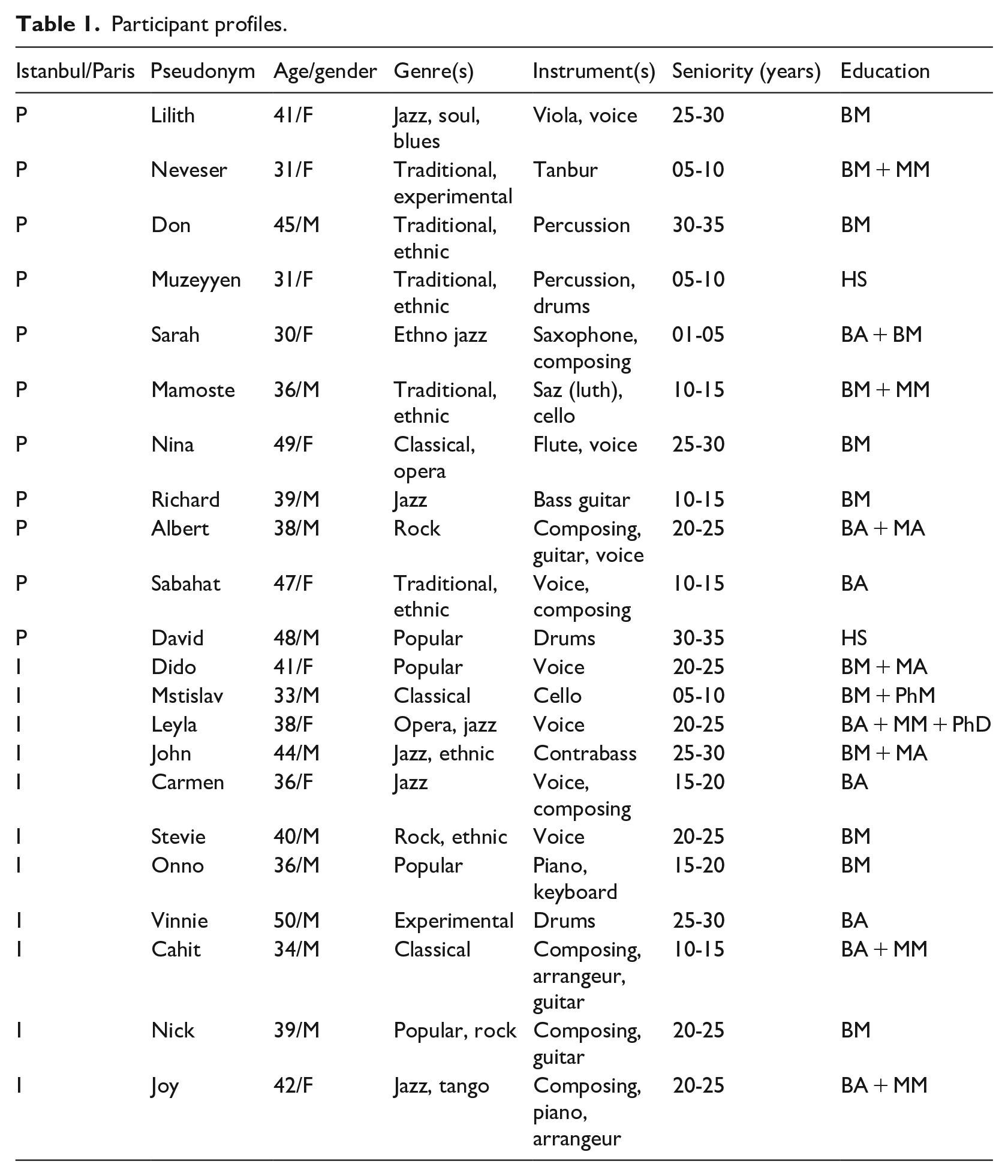
Data were collected through in-depth interviews conducted in Istanbul and Paris, which were chosen as cultural centers of countries with distinct social policy instruments for musicians. To minimize cultural and social background differences between the two cases, musicians of Turkish origin were preferred for the Paris case: three born in France, three residing there for over 20 years, three for 10–20 years, and two for 1–10 years. All Parisian participants had residence and work permits or citizenship rights in France, ensuring equal access to social policy instruments. Nonetheless, only five participants (Neveser, Don, Sarah, Richard, and Sabahat) were covered by IDS, and an additional musician (Muzeyyen) managed to fulfill the stipulated conditions until the follow-up interview.
The number of participants in phenomenological studies can vary (Creswell and Poth, 2018). Therefore, the sample size was not predetermined, but the aim was to achieve data saturation (Sargeant, 2012). Following the pilot interviews with 4 musicians from each city in September–October 2021, interviews with an additional 11 musicians from each city between ages 30 and 50 were carried out between April 2022 and October 2022, which is considered appropriate for phenomenological research (Starks and Brown Trinidad, 2007). Follow-up interviews were held in October 2022 with seven participants.
The study underwent ethical review by the Istanbul University Social and Human Sciences Ethics Committee (02.07.2021, file number 2021/167). The data collection process strictly adhered to ethical guidelines.
The interviews employed a biographic narrative approach (Chamberlayne et al., 2000), allowing participants to articulate their career paths and experiences using their own expressions, preserving spontaneity as suggested for the phenomenology (Jasper, 1994). Probing questions were posed to ensure clarity and encourage participants to delve into specific areas (Starks and Brown Trinidad, 2007), such as details of work relations, experiences, feelings, and available social protection measures. The researcher took reflective notes after each interview to capture initial impressions and insights.
The interviews, lasting 1–2 hours, were conducted in an informal manner, either online or face-to-face, based on the participants’ availability. All interviews were recorded, transcribed verbatim, and anonymized by altering identifiable information. Participants selected pseudonyms representing a musician who had influenced them in addition to the I (Istanbul) P (Paris) codes for their location.
Data analysis followed a multi-step procedure of Moustakas’s (1994) guideline for phenomenological research as epoche, horizontalization, reduction to meaning units, imaginative variation, and development of essence. A descriptive phenomenology (Giorgi and Giorgi, 2003) was employed, and the coding process was conducted using the Maxqda (Kuckartz and Rädiker, 2019). In the initial step, in vivo, structural, and concept coding techniques were utilized, followed by eclectic and pattern coding techniques to identify themes and categories (Saldaña, 2016). The themes within the cases of Istanbul and Paris were described separately, followed by thematic analysis (Creswell and Poth, 2018). The findings were organized into three overarching themes (Wolcott, 2009), incorporating relevant quotes from the participants and comparing the two cases.
As an amateur bass player, the researcher has been surrounded by professional musicians, providing them with a prolonged engagement and observation of the challenges musicians face. Witnessing the struggles of these talented individuals may have led to a bias in favor of advocating for social policy instruments. To enhance the trustworthiness of the study and address potential bias, the researcher implemented validation strategies. These strategies involved an iterative process between the collected data and the insights derived from the inquiry (Patton, 2015), collaborating with participants and seeking their input and feedback to validate the findings (Moustakas, 1994). Furthermore, debriefing sessions on the data and research process were conducted with two external reviewers (Creswell and Poth, 2018). These reviewers, one based in France and the other in Türkiye, were familiar with the research question, ensuring a comprehensive and balanced evaluation of the study’s findings.
Beyond the stage: “An invisible star?”
This section examines the unique challenges and contradictions of the music industry through the perspectives of its participants while avoiding broad generalizations. Both Istanbulite and Parisian musicians describe their career choice as the “only way of life,” driven more by desire than rational decision-making, with only two exceptions influenced by family guidance or financial motivations. The musicians acknowledge that choosing this profession entails sacrifices involving inherent precarity and “risk.” Participant I_Dido remarked, “Embracing uncertainty is at the heart of being a musician. You sign up knowing it’s a rollercoaster ride. If moaning is your thing, maybe this isn’t your stage. Got a better plan? Chase it.” Nevertheless, for most participants, “there is no other way to be able to exist” (P_Lilith).
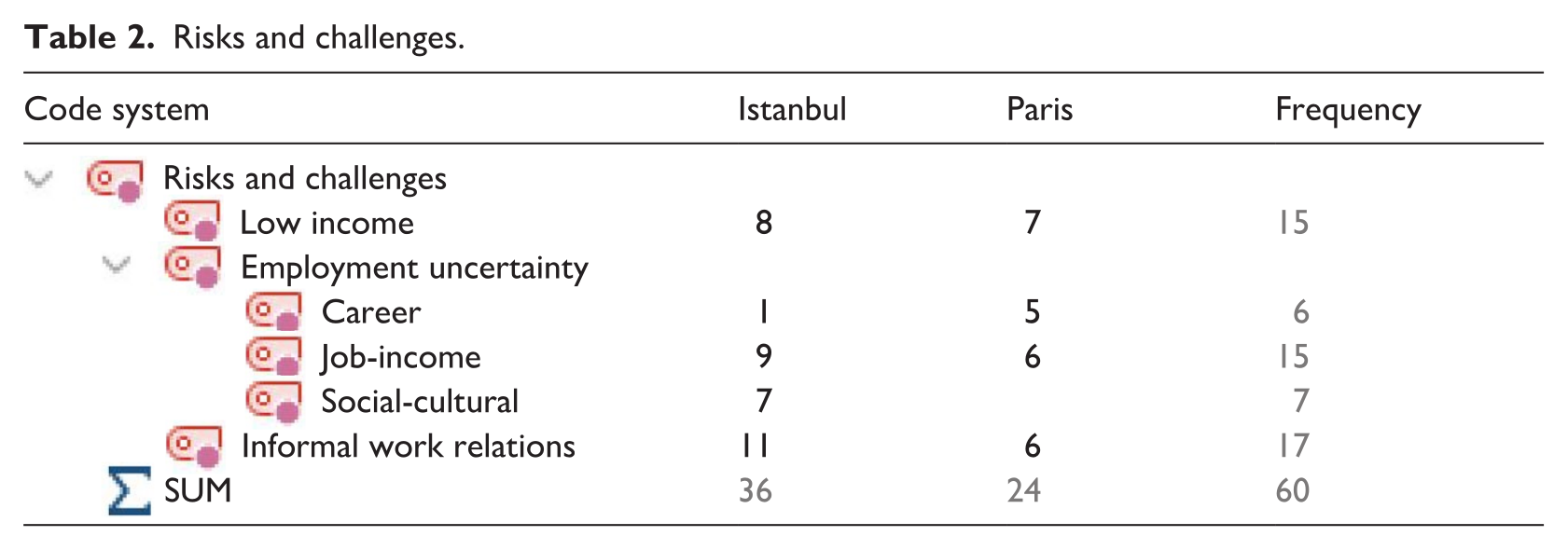
In probing participants’ working life experiences, three core themes for employment challenges emerged: inadequate and unstable income, employment uncertainty, and informal work relationships (Table 2).
Risks and challenges.
Insufficient and unstable income level
Musicians’ incomes stem from live music performances and recorded music. Musicians in both Istanbul and Paris report minimal, often “symbolic,” incomes from royalties and album sales. Live performances, encompassing concerts and gigs, represent their primary income source. In Istanbul, musicians commonly perform in bars and hotels and at special events like weddings and corporate gatherings. Conversely, Parisian musicians play in bars, most likely for promotion and networking purposes, especially at the beginning of their careers, while they obtain their main income from large concert halls and festivals. This also means establishing a high income, secured, and “well” institutionalized work relationships.
Eight Istanbulite and seven Parisian musicians described their earnings from music as insufficient for a sustainable livelihood. I_Carmen shared her frustration: “I’m earning just half of what’s needed. To merely cover my daily expenses, I’d need double to release my album, tenfold.” P_Nina’s experience resonated with this sentiment: “Living off music alone requires notable fame, doing just 3-4 high-paying gigs a month. We perform almost every weekend around Paris, yet it’s not enough.” P_David noted the high cost of living: “With the soaring rents in Paris, without regular performances—thrice weekly, plus a few major concerts or theatrical shows monthly—survival is tough. And that’s not our reality.” The low and irregular income of Istanbul’s participants is starkly evident in their daily struggles, to the point where they must adapt to minimal material conditions. I_Nick described his career trajectory bluntly: “I starved for the first ten years in the music industry. I ate just things like pasta and eggs.” In addition, five participants from Istanbul and two from Paris reported being unable to afford rent, forcing them to continue living with their parents. On a brighter note, those under the IDS seem relatively satisfied with their economic situation; P_Neveser shared, “With IDS coverage for the past two years, I feel quite prosperous.”
The Istanbulite participants pinpoint establishing a family as a critical concern directly linked to their low income. Seven musicians shared concerns about starting a family: I_Leyla expressed, “As a musician, getting married is incredibly challenging.” I_Mstislav added, “Music income might suffice for someone single, but it’s unrealistic when you’re looking to start a family or have children.” These sentiments highlight how a career in music in Istanbul can significantly hinder major life transitions like marriage, homeownership, and parenting, aligning with the findings of Chafe and Kaida’s (2020) study.
In contrast to Istanbul, this issue seems to be largely overcome in France due to robust social protection instruments, especially for those eligible for IDS, like P_Don: “IDS allowed me to establish a decent life—a life with a family and children. Without it, it would have been difficult.”
Even for Parisian musicians outside the IDS system, such as P_Lilith, a single mother of two, state welfare makes a significant difference: “Though my music earnings alone are insufficient, I manage to live with CAF [Family allowance fund] support.”
The findings underscore a shared challenge of low income in both cities. However, its impact on musicians’ lives differs. In Istanbul, low income emerges as a barrier to significant life transitions, while in Paris, social policy instruments, particularly the IDS, mitigate these financial pressures, providing musicians with a stronger safety net for navigating life’s milestones.
Employment uncertainty
The music industry in Türkiye predominantly operates on a daily wage basis, leading to significant income unpredictability for musicians. Istanbul participants frequently cite the absence of “regular and steady income” as a major drawback of their profession. I_Dido pointed out uncertainty, “Earnings vary monthly; nothing is guaranteed.” I_Onno further illustrated this instability, saying,
Some months, like December, are lucrative due to holiday events, but come January or February, the income dries up. We tend to splurge on necessary instruments and gear when times are good—a common pitfall. Budgeting for the slower months is essential because you never know when your income will return.
I_Cahit’s statement, “I can relate to the homeless,” poignantly encapsulates the psychological toll that income instability takes on musicians: “One incorrect turn and I might find myself on the road. I think that edge is just a step away from all of us.”
Musicians deal with a particular combination of employment insecurity and irregular income, which is exacerbated by the music market’s uncertainties. The entertainment industry is the first to feel the effects of recessions, inflation, and downturns. Furthermore, Türkiye has seen increased market instability in the last decade resulting from several factors, including the pandemic, regional conflicts, and political issues. As a result, participants expressed resentment of their disadvantaged position, as I_John explained, “At the slightest hint of negativity in the country, the first thing is cancelling concerts; all other professions continue, but we cease.”
In addition, Way (2018) notes that musicians in Türkiye face a unique social-cultural uncertainty linked to the country’s cultural polarization, which has coincided with the government’s socially and religiously conservative agenda for the previous 20 years. This polarization has also affected musicians; those who disagree with the dominant ideology must deal with obstacles, including concert bans, censorship, and exclusion from popular media. Conversely, those aligned with the existing ideological framework may receive governmental support. These dynamics exacerbate the employment uncertainty for musicians in Türkiye.
Istanbulite musicians additionally face wage stagnation amid rising living costs and inflation. “Our earnings are frozen, yet the living costs surge,” I_Carmen said. Wage inequalities within the music industry, where vocalists usually make more than their instrumentalist peers, complicate matters further.
Parisian musicians face employment uncertainty, too, particularly the six participants who did not qualify for IDS. P_Lilith encapsulated, “The next gig is always a question mark. Predictability in this business is a luxury we don’t have.”
Furthermore, Parisian musicians often identify career uncertainty as a major obstacle to their line of work, exacerbated by fierce competition and hurdles to entry. “Having played music in Istanbul for thirty years, I expected Paris to be easier,” P_David shared his experience, “Yet the competition is fierce, and the scene is saturated with talent.” The music labor market entry barriers appear to be genre-specific; ethnic and traditional musicians face fewer challenges compared to those in Western genres like rock or classical. P_Albert said, “Unless you’re established in Paris’s rock scene, the terms can feel exploitative. Securing a gig can mean queuing outside bars, pleading for a chance to play, sometimes under demanding conditions like drawing a crowd or playing for free.”
Despite these challenges, France offers more opportunities for large-scale events like festivals and tours. The planning for such significant events is often done well in advance—sometimes a year ahead—allowing Parisian musicians involved in these circuits to schedule their commitments far in advance.
In summary, Istanbulite musicians primarily grapple with income uncertainty, whereas Parisians face career uncertainty, navigating a competitive market and the challenges of establishing themselves despite having better planning opportunities for large-scale events.
Informal work relations: “invisible” or “black”
In parallel with the international literature on the working life of musicians, the phenomenon of informal employment denoting individuals lacking adequate coverage under formal legal or practical arrangements (ILO, 2015) emerged as a prevalent problem in this research. This phenomenon manifests in sub-categories for Istanbulite musicians as wholly undeclared (concealing employment status and earnings in cooperation with the employer) or black-market work (concealing earnings with the purchaser for self-employed or employees in a secondary job). For Parisian participants, it predominantly takes the form of under-declared work arrangements (the employment is declared, but a portion of their earnings is hidden), consistent with the OECD’s (2004) categorization.
Nevertheless, it is worth noting that the wording used by Istanbulite participants was “unregistered,” while Parisian participants used the term “black” (in English wording). While both groups refer to their lawful musical performances in venues not declared to the public authorities, by wording, Istanbulite musicians emphasize that they lack formal professional status and related regulatory protection. In contrast, Parisian musicians stress their awareness that this type of work arrangement is illegal.
“Invisibility” in Istanbul
In the Turkish music industry, unregistered employment is almost the norm. Only one participant from Istanbul declared having written employment contracts and social assurance declarations, and this was limited to one or two festival performances organized by institutionalized entities. Apart from this exception, all participants described their live performance arrangements as wholly undeclared or black-market work.
According to the data analysis, informality reflects Istanbulite participants’ lives in four main areas: absence of professional status, lack of regulatory protection, lack of social assurance, and lack of recognition in the social hierarchy.
First, the absence of recognized professional status was identified as one of the most fundamental problems for all Istanbulite participants. I_Cahit succinctly stated, “In Türkiye, musicianship isn’t considered a profession.” This gray zone regarding the professional status of musicians is not unique to Istanbul. As highlighted in existing literature, the definition of a “professional musician” is debatable and varies according to individual experiences and country contexts. For some, professionalism correlates with income generation, while others consider factors like the extent of their musical activities (full-time or part-time) and whether they operate under formal or informal agreements (Chafe and Kaida, 2020).
In Türkiye, the issue is complex and multidimensional, compounded by limited formal music education outside certain genres (Sezen, 2010: 70), unstructured entry and exit processes in the music industry, barriers to joining professional associations, and reliance on verbal agreements for labor relations.
Second, widespread informality means a lack of regulatory protection, which affects internal band dynamics and interactions with venue owners or employers. To illustrate, I_Nick recounted his dismissal after 4 years in a band:
When she [the lead vocal] gained popularity, we began organising massive concerts, drawing audiences of up to one million people. As the scale of our events grew, so did the money she got. When we questioned, “We’ve been working at the same wage for four years; shouldn’t we get a raise?” we were abruptly fired. It was over, just like that.
In addition, the Turkish legal system’s gray zone regarding the classification of self-employed versus salaried musicians creates further obstacles to benefiting from labor law protections. I_Mstislav’s experience demonstrated how this translates into insufficient regulatory protection for musicians:
At times, we didn’t get the agreed-upon fee, leaving us totally reliant on the goodwill of the person who hired us. Without a written agreement, the employer may say, “You weren’t here” or “I didn’t hire you,” leaving us with no room to file a complaint.
It should be noted that according to Turkish labor law, a verbal employment agreement is sufficient to benefit from labor law protection. However, musicians often misinterpret the lack of a written employment contract as an informality and lack of regulatory protections. Therefore, musicians’ insufficient knowledge of their rights and acceptance of conditions specific to the music industry are among the causes of the problem.
Third, another aspect of informal employment is related to access to the right to social assurance. The fact that artists are deprived of social protection branches such as sickness, occupational disease, occupational accidents, and old age pension is one of the problematic areas of the Turkish social security system. The problems that come to the forefront regarding the differentiation of standards and norms between salaried and self-employed artists in the legislation are reinforced by structural issues specific to the music industry in practice. Since unregistered work arrangements are accepted as the norm in the music industry, it is up to the employer’s initiative whether or not to make the registration in the social security institution of salaried musicians. For example, I_Dido said she was never declared to a social security institution even though she performed regularly for 3 years at the same hotel’s weekend events. Another participant, I_Onno, said he feels lucky to have the social security registration. However, in his case, contrary to the legal obligation, it is the musician, not the employer, who pays the premiums:
I worked for a wedding company in 2014. I’m still grateful to them because, thanks to that, my insurance coverage began, and perhaps I’ll have the opportunity to retire. . . . I paid the premiums myself, as typical in our industry.
As the research shows, lack of social assurance is one of the prominent problems of musicians in Türkiye, even in cases where it is clear that musicians will be recognized as salaried for regular periods with the same employer. The situation is even worse for self-employed musicians with intermittent employment relationships with different employers.
As I_Stevie described,
None of the musicians have social assurance. They take money in hand and don’t issue any invoices. Because most of us don’t have enough income to pay the premiums and face a tax burden, that’s why we live daily.
I_Vinnie was the participant who best exemplifies the risk and results of lack of social assurance:
In my seventh year in the music market, I had an accident; the tendons in my finger were severed. The surgery for inserting platinum cost a serious amount of money. Since I had no social assurance, my family covered the costs. [. . .] During my recovery period, the bands I played with started working with others, leaving me jobless for a long time. I lived on family support and depleted my savings. Despite returning to music, the accident hampered my career due to limited finger mobility [. . .] Nevertheless, I consider myself fortunate; if I were a pianist, my life would have been in jeopardy . . .
In addition to legal and economic reasons, cultural reasons such as customary de facto ways of working in the music industry, as well as the lack of awareness and assumptions regarding being a musician, should be counted among the leading causes of informality and lack of social assurance, as I_Vinnie’s quote proved:
I didn’t appreciate the value of social protection until I got injured. Before that, I embraced the musician’s lifestyle as “sex, drugs, and rock‘n’roll” and thought little of it. Only after I was rendered immobile by my disability did I realise the consequences of operating “off the record.”
It is, therefore, doubtful that musicians always demand the right to social security, as Leyla confirmed:
Musicians repeatedly claim we lack legal rights, but this is untrue. The typical scenario is employers suggesting paying a higher wage off the books, bypassing legal obligations. In such cases, many opt for that.
Finally, the lack of labor status recognition by official authorities also reflects in the social reputation of musicianship and the status it signifies in the social hierarchy. The concerns that musicians in Türkiye have about the prestige and respectability of their profession are revealed in a research study (Güven, 2020). Society’s perception of musicians causes musicians to frequently experience a sense of estrangement and otherness from mainstream society. Crockett’s research confirms that because of society’s views on musicians, they may feel their musical identity and experience are not fully understood or appreciated by those outside the musical world, resulting in isolation and disconnection (Crockett, 2015: 171–172).
Similarly, this research revealed that the fact that musicianship is not recognized as a profession creates frustration among Istanbulite musicians. It was stunning to observe that almost the exact wordings from all participants complained about hearing the question “Oh, you are a musician, so what is your real occupation?” from new acquaintances in social life. Although they are accustomed to conducting their profession on the stage under the spotlights, they perceive their formal unrecognition at the level of social law as not existing. This creates a dilemma between two extreme wings of existence. “Here you are on the stage, but you are absent. Do they hear your song or not? You don’t exist in the system in any way, and nobody questions it (I_Nick).” Five Istanbulite participants said they felt invisible once they got off the stage. As I_John sharply expressed,
I worked as a professional musician in Türkiye for 25 years without social assurance. I have no official record anywhere. What does that mean? You’ve never worked, never lived, never existed.
“Black” in Paris
Engaging in “black” work relations is a problem frequently encountered in the Parisian music industry, too. As Umney points out, “black” work further complicates the dynamics of the music labor market and affects musicians’ eligibility for IDS (Umney, 2016). However, our research observed that social protection measures available to musicians provide a minimum standard of social rights and a feeling of security for the future.
At the beginning of the interviews, all Parisian musicians aforesaid that social protection in France is very comprehensive and that all their labor relations are declared. As the probing questions deepened, it became clear that they also experienced “black” work arrangements in different scopes. In contrast to the Istanbulite participants, none of the 11 Parisian musicians are engaged in wholly undeclared activity as they mainly hold declared gigs but have occasional undeclared jobs.
Six participants reported previous experiences, while five indicated their current involvement in “black” music market jobs. It should be noted that despite the participants’ preferred terminology, none of these activities can be considered “black-market work” but “under-declared work,” as any agreement between an enterprise in the entertainment industry and a performing musician is regarded as an employment contract according to the IDS regulation.
Two main reasons exist for the participants’ tendency toward undeclared work arrangements. One reason is if the musicians agree to perform below the official amount of “cachet” per band musician, especially in the early stages of their career when trying to enter the music market and network. This is the case, particularly for yet “no-name” musicians who generally perform in small bars and pubs. “We are not that big yet; you have to be well known to be able to say, ‘This is my price, I won’t come below this price (P_Sarah).’” In this type of work arrangements, “the venue owner makes cachets for some members of the band and pays the fees of the rest under-the-table” (P_Mamoste), “the venue owner does not pay any fee, and the concert entrance fees are shared between the venue owner and the musician at certain rates” (P_Nina), or “in some cases, there is no entrance fee but a ‘chapeau’ is passed among the audience after the performance, and the musicians share the collected amount, solely reliant on the audience’s generosity” (P_Lilith).
The second situation in which an under-declared work relationship is established is related to whether the musician can reach the annual number of “cachets” required for IDS. Umney’s (2016) research indicates that how IDS affects “black” is ambiguous. Supporting his thesis, we found that even though all participants had the desire to access IDS through declared work relations, in cases where the musician considers that they can’t fulfill these conditions, they do not want to pay the tax “in vain” and prefers to receive the fee off-the-book (P_Muzeyyen). In the second case, when they fulfill the 43–48 cachets condition, they do not need to pay any more tax and, therefore, do undeclared performances over the required amount of performances (P_Richard).
Even though Parisian participants also experienced informal labor relations, their meaning and effects on life were less agitated than for the Istanbulite participants.
Perrenoud et al.’s (2022) research emphasizes that IDS is not just a specific unemployment assurance scheme; it serves as a “professional status” by default and hence is expressed as “status” in indigenous terminology. In support of this thesis, participants in this research perceive to be covered by IDS as a “musicianship status.” P_Muzeyyen, for example, stated in the first interview that she felt uncomfortable being called a professional musician and that she felt that she had no right to say that, while at the second interview, 8 months later, she called herself professional now since managed to get “the intermittent status” meanwhile.
Parisian participants, including those not covered by IDS, agreed that social protection instruments provide them significant security in France. Therefore, according to the research findings, it is possible to interpret that although informal labor practices are also encountered in Paris, this is not experienced as remaining outside the social protection system, unlike musicians in Istanbul.
Discussion and conclusion
This article does not claim to make universal statements about all musicians. Instead, as a phenomenological research, it reflects the beliefs and experience from the participant’s viewpoint to access the essence of precarity in the lives of musicians (Jasper, 1994) and provides a comparative analysis of varied realities that Turkish musicians face in Paris and Istanbul. It highlights the parallels and contrasts in the precarity experiences of musicians within these diverse social protection frameworks, particularly focusing on the acute challenges in environments with limited social protection measures available to them, as seen in Istanbul. In doing so, the study argues that discussions of precarity often adopt a Western perspective; in other contexts like Istanbul, precarity is an entrenched reality with effects beyond the professional sphere.
The findings indicate that musicians in both cities face similar challenges, categorized under three themes: unstable and insufficient income, employment uncertainty, and informal work relations, all falling under the broad term of precarity.
However, Istanbulite musicians experience the repercussions of precarity as significantly more severe, manifesting in deprivation of fundamental social rights to the point where, in most cases, it prevents them from starting a family and achieving a sustainable standard of living. Unlike their Parisian counterparts, they find themselves in gray zones regarding employment status, which causes professional and legal recognition issues that leave them without social and regulatory protection. Cultural polarization and the absence of a stable cultural policy further complicate matters, creating division among musicians. However, regulatory problems remain for all Istanbulite musicians, rendering them feel the essence of precarity as though they are “invisible/unheard” in the social and legal sphere, marginalized, and “nonexistent.”
For musicians in Paris, career uncertainty is a predominant issue due to the highly competitive labor market in the music industry. Despite France’s prominent arts policy and state support in cultural life, black market arrangements, intermittent work, and low “cachets” remain key industry features. However, this research shows that social policy measures, particularly IDS, provide significant mitigation against these effects, facilitating major life transitions of musicians, such as marriage and parenting. Contradicting critiques of IDS in some existing literature (Menger, 2005), our findings show that Parisian participants eligible for IDS display greater stability and a tendency toward formal work, and those ineligibles actively strive to fulfill the eligibility criteria.
In conclusion, this study broadly aligns with previous research on musicians’ working lives, yet it contributes further by offering a comparative perspective on how more profound levels of precarity are experienced in contexts with limited social policy tools, as demonstrated in the Istanbul case. It accepts that the concept of precarity, as characterized by “discontinuity” in Cingolani’s definition, applies to both Paris and Istanbul musicians, regardless of the countries’ differing levels of economic development or cultural ideologies. However, the absence of regulatory protection and an assured future is evident among Istanbulite participants, presenting an existential challenge for musicians that undermines their social status not only professionally but also in their roles as citizens, parents, and human beings. Istanbul case provides empirical evidence for the sociological understanding of the lived realities of precarity while highlighting the urgent need for systemic reforms to address musicians’ precarity and vulnerabilities.
Given the widespread informality in Türkiye’s labor market and the underdeveloped state of the music economy, addressing these issues requires a long-term, comprehensive, multi-dimensional approach. As one of the major factors contributing to the sense of precarity as “nonexistence” is the lack of professional recognition, while advocating for broader policy implications, this article suggests that regulations enhancing the professional status of musicians could be a crucial first step toward addressing these challenges.
Conversely, Parisian musicians report more secure lifestyles and a brighter future outlook, attributed to the IDS regime. In addition to ensuring financial stability, IDS plays a crucial, albeit not primarily intended, role as a foundation for professional recognition. Participants noted that this recognition is vital as it affirms social status, personal identity, and self-esteem. This article has contributed to the debate on IDS by highlighting that its role in providing professional recognition is at least as important, if not more so, as its support role in times of discontinuity.
A notable limitation of this article is the Parisian participants’ awareness of Türkiye’s challenging conditions, which may influence their perceptions and lead to positive views on France’s social policy system. As P_Susan noted, “A French-origin musician might have a more critical view of the social policy tools in France.” P_Don echoed, “Here is not a heaven either.” Therefore, future research would benefit from focusing on the shortcomings of social policy instruments in France. This would support and enhance the critical literature on performing artists’ social protection in France (Corsani and Lazzarato, 2008; Sigalo Santos, 2018, 2019), especially considering the reforms since the 2000s that have reduced the social rights of artists.
In addition, the finding that entering the music labor market in Paris is genre-specific might be an interesting topic for future research, particularly regarding whether cultural policies in France lead to discrimination. Participants criticized French cultural policy for maintaining an orientalist perspective by encouraging foreign involvement in traditional/ethnic music genres while seemingly “supporting cultural diversity” yet limiting participation in “high culture” genres. Indeed, while six participants were active in the traditional/ethnic genre, P_Nina, for example, mentioned that despite graduating from French conservatories, she was not accepted even for auditions for state and municipal choirs, attributing this to her ethnic identity.
Finally, another issue beyond this article’s scope is how precarity and coping strategies influence creativity and music production. Considering the digitalization and the recent transformation of the music industry, future studies on this topic would be valuable.
Footnotes
Acknowledgements
This research was conducted as part of post-doctoral work at IDHE.S Paris 1 Panthéon-Sorbonne University, with guidance from Assoc. Prof. Antonella Corsani.
Funding
The author(s) disclosed receipt of the following financial support for the research, authorship, and/or publication of this article: The author received financial support for research from the French Embassy in Turkey’s Young Visiting Researcher Program (2021) and from the Scientific and Technological Research Council of Turkey (TUBİTAK) Postdoctoral Fellowship (2022).
