




Abstract
To what extent do features of education systems in the secondary school influence university graduates being overeducated? Previous research shows that the social origin and the field of study of university graduates are relevant predictors of overeducation. However, the strength of the influence of their social origin varies across fields of study. Having a privileged social origin prevents university graduates from being overeducated in fields of study that are not occupationally focused (e.g. humanities), while it is less relevant in other fields (e.g. engineering). The unevenly distributed effect of social origin in relation to the field of study may also vary across countries, depending on the influence of the secondary education system on social selection. Social origin may provide a filter earlier in vocationally oriented educational systems, whereas in comprehensive systems the social filter occurs at the graduate’s entry into the labor market. This would make university graduates from nonoccupationally focused fields of study and with a disadvantaged social origin more vulnerable to being overeducated in countries with comprehensive secondary school systems, while in vocationally oriented systems social origin may be less influential at that later stage. Using Research into Employment and professional FLEXibility/Higher Education as a Generator of Strategic Competences (REFLEX/HEGESCO) data in combination with macro-level indicators, I assess how secondary education systems mediate the influence of social origin in terms of the university graduate’s risk of overeducation by field of study. When using a subjective measure of overeducation results suggest that social origin is less important in predicting the overeducation of university graduates in countries with greater vocational orientation at the secondary level, while in comprehensive systems social origin regains its influence as a filter when graduates in nonoccupationally oriented fields join the labor market. Yet, results do not hold when using an objective measure of overeducation.
Keywords
Introduction
In the past decades, the expansion of higher education and the demand for skilled labor in European countries have advanced at different paces. This has resulted into a suboptimal match between the high educational credentials that workers are willing to use in the labor market and the requirements of the jobs they are employed in. This mismatch between an individual’s education exceeding the educational requirements of their job is commonly known as “overeducation,” and for a long time, it has concerned both academics and policymakers. Most economists have approached research on overeducation from a human capital perspective, studying the consequences of overeducation in terms of earnings (e.g. Bauer, 2002; Daly et al., 2000; Duncan and Hoffman, 1981; Hartog, 2000; Sloane et al., 1999), job satisfaction, motivation, and productivity (e.g. Allen and Van der Velden, 2011; Fleming and Kler, 2008; Green and Zhu, 2010). More recently, sociologists have engaged in the study of overeducation providing two main contributions. First, by understanding overeducation as a form of social stratification when studying to what extent individuals attaining the same educational level get different labor market outcomes because of the influence of their social origin (Capsada-Munsech, 2017: 2). This is the approach employed in this article. Second, by understanding the role of educational and labor market institutions in cross-national differences in overeducation (e.g. Assirelli, 2015; Barone and Ortiz, 2011; Di Stasio et al., 2015; Levels et al., 2014; Scherer, 2004; Verhaest and Van der Velden, 2013). This comparative approach has been of great value, as previous studies had focused only on the determinants and impacts of overeducation at the national level because the lack of available cross-country data on overeducation challenged comparative research (McGuinness et al., 2018: 995). Once comparative cross-national data became available, remarkable differences came to light. For instance, using the European Union Labour Force Survey (EU-LFS 1991–2012), McGuinness et al. (2018: 1000) show that the overeducation rates for the whole working age population were as low as 8 percent for the Czech and the Slovak Republic and as high as 30 percent in Spain and 31 percent in Cyprus, similar to estimates by Flisi et al. (2014) using the Programme for the International Assessment of Adult Competencies (PIAAC) of the Organisation for Economic Co-operation and Development (OECD) data. These differences are even larger when we turn exclusively to university graduates, which is the target population of this article, for which the average overeducation rate in European countries is around 26 percent, ranging from 14 percent in Portugal to 45 percent in Spain when using REFLEX data (Verhaest and Van der Velden, 2013).
Most comparative studies that examine university graduates’ risk of being overeducated have explored features of the higher education system to explain the differences within and between countries of this phenomenon (e.g. Barone and Ortiz, 2011; Verhaest and Van der Velden, 2013). However, in addition to the features of the higher educational system, we need to study the influence that secondary education systems may have on shaping both the number and socioeconomic composition of graduates. Previous research shows that secondary education systems with a high degree of vocational orientation or early tracking improve individuals’ labor market allocation, but this occurs at the expense of social equality (Bol and Van de Werfhorst, 2013). Students from a disadvantaged social origin tend to be overrepresented in nonacademic tracks that do not usually lead to higher education. More social selectivity at the secondary education level means there is likely to be a smaller number of university entrants and graduates where those from a privileged social background are overrepresented. In comparative terms, less social selection at the secondary education level (i.e. comprehensive education systems) is likely to translate into a more numerous and socially heterogenous pool of individuals at the university level.
Given these differences in the selectivity of education systems at the secondary level and the consequences this has in the composition of university entrants and graduates, it is reasonable to think that the influence of individual characteristics such as social background in predicting the risk that graduates are overeducated might vary across education systems. Previous research shows that university graduates from a relatively disadvantaged social origin are more likely to be overeducated than their peers with more privileged social backgrounds (Capsada-Munsech, 2020; Erdsiek, 2016; Santiago Vela, 2021). Moreover, the relevance of social origin in predicting this risk of overeducation varies across fields of study (Capsada-Munsech, 2015) as it is more relevant for those graduating in fields directing to service-oriented occupations, where soft skills that might be learned in the family (e.g. verbal skills and argumentation) are more appreciated. Thus, if different degrees of vocational orientation or tracking at the secondary school level have implications on the selection of university students and graduates, it is likely that the influence of social origin on university graduates’ risk of overeducation also varies by fields of study and across countries with different secondary education systems.
Based on the above, this article examines whether the influence of social background by field of study in predicting the risk of overeducated university graduates varies across countries with different degrees of vocational orientation or tracking at the secondary education level. For this purpose, I use REFLEX/HEGESCO data combined with macro-level data on secondary education system characteristics to provide empirical evidence for a range of European countries.
Cross-national variation in the overeducation risk of university graduates
An obvious first step to explain both within and between country variations on university graduates’ overeducation risk is focusing on their higher education characteristics. Empirical research has shown that the prestige of the higher education institution is an important factor (McGuinness, 2003; Robst, 1995). Those attending a prestigious university are less likely to experience overeducation, compared to their colleagues from less prestigious universities. Part of the explanation is due to the positive signal that graduating from a comparatively more prestigious university sends to employers, improving the chances of employment in a graduate job. Another part of the explanation refers to a selection effect, as access to comparatively more prestigious universities is partly shaped by individual’s previous educational attainment and achievement but also social background characteristics (Karen, 2002). Yet, the influence of institutional prestige varies across fields of study; the field of study of graduation being a stronger predictor of overeducation than the prestige of the university (McGuinness, 2003: 1943).
Previous research has also paid attention to the signaling power of the type of vertical arrangement in higher education (i.e. Master vs Bachelor; university vs vocational college) to avoid overeducation (Barone and Ortiz, 2011). In countries with sequential systems at the higher education level (i.e. Bachelor vs Master), Master students signal higher skills, motivation, and productivity compared to their Bachelor colleagues, subsequently reducing their overeducation risk. However, this advantage only seems to be relevant in countries where there are a large number of graduates (e.g. the Czech Republic, Norway, Spain). Similarly, in countries with binary systems at the higher education level (i.e. university vs vocational colleges), university graduates are usually more advantaged because they signal higher cognitive and motivation levels (e.g. Austria, Finland, the Netherlands), consequently reducing their overeducation chances. Yet, differences between university and vocational colleges are less pronounced in countries where vocational colleges are fully recognized as higher education, since there is a relatively high degree of selectivity to access them (e.g. Germany, Italy).
Previous studies have also pointed out the quality and orientation of the higher education program (i.e. general vs specific) as possible explanations for cross-national differences in overeducation (Verhaest and Van der Velden, 2013). The quality of the program explains different risks in getting an adequate job match across fields of study within the same country, while the general orientation of the program does explain differences in overeducation risk across countries.
Beyond higher education institutional characteristics, Ortiz and Kucel (2008) find that in Germany fields of study are less important in predicting overeducation than in Spain. Results suggest that in stratified education systems, the field of study is less important as a signaling device in the labor market, compared to comprehensive systems. Nevertheless, no further research has been conducted to assess if cross-national differences on the overeducation risk of university graduates are explained by educational structures prior to entry into university, and how it affects overeducation prevalence by field of study.
Empirical evidence strongly supports field of study as a good predictor of occupational attainment (Goyette and Mullen, 2006; Triventi, 2013) and overeducation (Mavromaras and McGuinness, 2012; Ortiz and Kucel, 2008; Robst, 2007), especially among university graduates (Assirelli, 2015; Ortiz and Kucel, 2008). Graduates from fields of study that do not lead to a specific occupation in the labor market (e.g. humanities, social sciences) are more likely to be overeducated compared to graduates in occupationally focused fields of study (e.g. engineering, medicine). Although cross-national comparisons have similarly reported the influence of fields of study on the overeducation risk of university graduates (Assirelli, 2015; Barone and Ortiz, 2011), differences across fields of study are stronger as they increase the total number of university graduates (Reimer et al., 2008). Countries with a more comprehensive secondary education system have experienced a larger educational expansion at the tertiary level, providing larger numbers of graduates which, in turn, are more likely to experience differences in overeducation risk across fields of study. Therefore, it is likely to think that the influence of fields of study is going to be stronger in countries with a comprehensive system compared to countries with a higher degree of vocational orientation or early tracking.
Secondary education systems and social selection into university
All the research discussed so far focuses on features of the higher education system to explain the overeducation risk among university graduates. Yet, characteristics of previous educational stages may also influence their overeducation risk and the strength of individual factors predicting it across nations. The literature on educational stratification well establishes that cross-national differences in primary and secondary educational stages influence the way students are selected by social background (Bol and Van de Werfhorst, 2013; Brunello and Checci, 2007; Karen, 2002). Education systems with a large proportion of vocationally oriented programs at the secondary education level are associated with a smoother school-to-work transition (Iannelli and Raffe, 2007; Shavit and Müller, 2000), a lower probability of unemployment and a better job match (Shavit and Müller, 1998). Vocational tracks provide ready-to-use skills that students coming from a less-privileged social background—who are usually more risk averse—might see as a safer choice to secure employment rather than enrolling on academic paths providing more general skills (Hillmert and Jacob, 2003; Van de Werfhorst, 2011). Conversely, in comprehensive secondary education systems, the academic track leading to university might be the safest way to a job match or, at the very least, to secure employment.
Similarly to vocational enrollment, the placement of students in different educational tracks also enhances early social selectivity (Bol and Van de Werfhorst, 2013). In Europe, this differentiation is usually based on the orientation of the program (academic vs vocational), with the academic track being considered of a higher status than the vocational one (Allmendinger, 1989). In tracked systems, social origin has a greater influence on academic performance than in non-tracked ones (Brunello and Checci, 2007; Van de Werfhorst and Mijs, 2010). Thus, it is reasonable to think that in tracked systems those accessing and graduating at university are likely to constitute a more socially homogenous group; being those from a more disadvantaged social origin with a minority positively selected by their academic ability (Hillmert and Jacob, 2010; Müller and Gangl, 2003; Scherer et al., 2007).
Therefore, both the degree of vocational orientation and tracking are features of secondary education systems that lead to similar consequences in terms of social selectivity, partly shaping the amount and type of university entrants and graduates entering the labor market. The fact of competing with fewer graduates has already been shown to reduce the risk of overeducation at the first labor market entrance and differences in overeducation probability across fields of study (Reimer et al., 2008). Yet, no attention is paid to the homogeneity of graduates regarding their social origin and its consequences on overeducation. I argue that in vocationally oriented or tracked education, the greater homogeneity with regard to the social origin of university graduates might provide a collective signal to employers, making the individual social background more irrelevant in the hiring and matching process. This collective signal might be more important in some fields of studies than in others. Employers may use graduates’ credentials as a way to certify and signal knowledge and skills of any kind (Jackson et al., 2005), as graduates are a highly selected group of individuals. Even if graduates come from a more disadvantaged social origin, the selection process ensures similar skills levels (including non-cognitive skills) to those of their peers from a more advantageous social origin. Contrary to this, in comprehensive systems social origin might still be a relevant predictor of skills and ability across university graduates from different fields of study, given the larger number of graduates and their heterogeneity in terms of social background.
As stated earlier, previous research shows that the relevance of social background on avoiding overeducation risk varies across fields of study (Capsada-Munsech, 2015). Speaking in public, verbal discussion and argumentation are soft skills that might be learned at school, but they are also very likely to be learned—and/or further improved—in the family environment. These types of skills are more important in service-oriented occupations (Breen and Goldthorpe, 2001) and employers are more likely to reward them by employing individuals in jobs requiring a university degree. Therefore, a more privileged social background may only become an advantage to prevent overeducation among university graduates from fields of study that direct to the service sector occupations, which are generally nonoccupationally focused.
Theoretical framework, research question, and hypotheses
Building on previous research, this article aims to contribute to the academic literature on overeducation by analyzing to what extent the influence of social origin by field of study on the overeducation risk of university graduates varies across countries with different levels of vocational orientation or tracking at the secondary education level. As presented in Figure 1, previous research has shown that (A) those coming from a less privileged social origin are more likely to be overeducated (Capsada-Munsech, 2020; Erdsiek, 2016; Santiago Vela, 2021); (B) the chances to be overeducated vary across fields of study: those who graduated from occupationally focused fields (e.g. engineering, medicine) are less likely to be overeducated compared to those who graduated from a nonoccupationally focused field of study (e.g. humanities, sociology; Assirelli, 2015; Mavromaras and McGuinness, 2012; Ortiz and Kucel, 2008; Robst, 2007); (C) yet, empirical research also points out that the influence of social origin varies depending on the field of study of graduation: social background being more relevant to predict overeducation among university graduates from nonoccupationally focused fields of study (Capsada-Munsech, 2015). The intention of this article is to examine to what extent this mediating effect of social origin through field of study on overeducation varies across European countries depending on their degree of vocational orientation or tracking at the secondary education level (D).
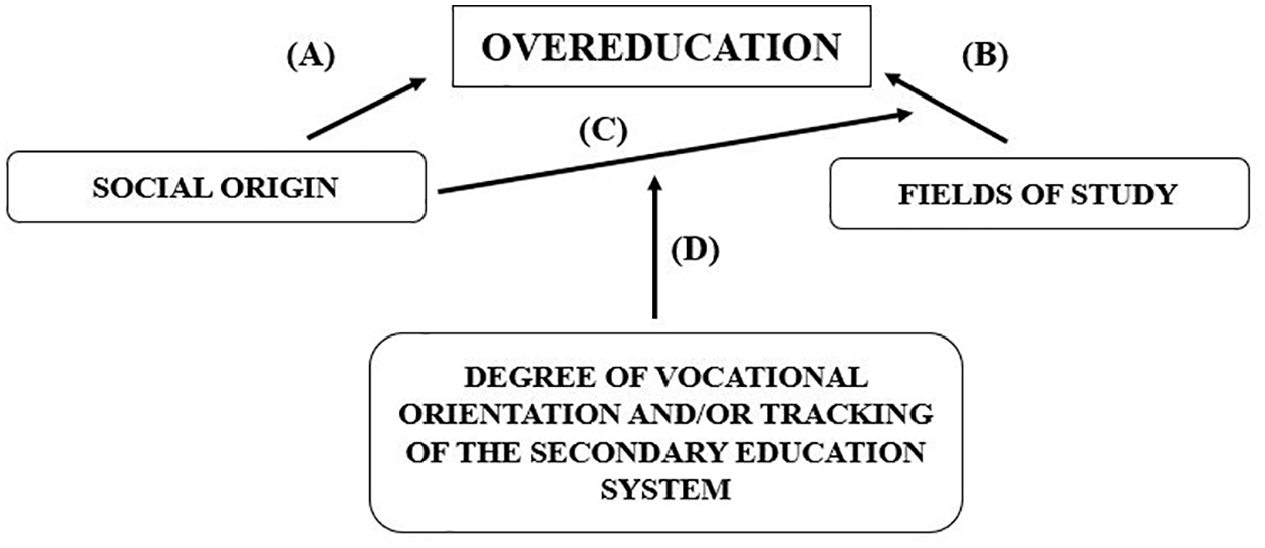
Theoretical framework. Mediating effect of secondary education characteristics on the influence of social origin by field of study on university graduates’ overeducation risk.
Therefore, the research question this article addresses is the following: Does the influence of social background by field of study in predicting the overeducation risk of university graduates vary across countries with different degrees of vocational orientation or tracking at the secondary education level?
The first hypothesis is that individual’s social background is going to be more relevant to predict the overeducation risk in countries with a comprehensive education system at the secondary level, compared to countries with greater vocational orientation or early tracking. While in vocationally oriented or early tracking education systems, social origin works as a filter to sort students into vocational and academic tracks leading to university. In comprehensive education systems, the influence of social origin is less relevant to access university but gains importance as a social filter when transitioning into the labor market. So, it can prevent or enhance overeducation.
The second hypothesis is that university graduates from nonoccupationally focused fields of study (e.g. humanities, sociology) are going to be more at risk of overeducation in comprehensive systems if they come from a more disadvantaged social background, whereas no differences by social background are expected on university graduates’ overeducation risk from nonoccupationally focused fields of study in vocationally oriented or early tracking systems. The main reason for expecting this result is that in comprehensive education systems university graduates are a more heterogenous group of individuals with regard to their social background. Therefore, those from a more advantaged social background might be able to use their (soft) skills to avoid overeducation to a larger extent than those from a less privileged social background. Conversely, in vocationally oriented or early tracking systems university graduates already constitute a more homogenous group with regard to their social background, making it less of an advantage to avoid overeducation. Moreover, those from a less privileged social origin who made it to university and graduated are a very selective group of individuals who are likely to have similar (soft) skills levels as their more socially privileged peers.
Data
Micro-level data
REFLEX and HEGESCO are large-scale European surveys that interview higher educated graduates 5 years after graduation. REFLEX includes country representative samples of higher educated graduates who got their degree in the academic year 1999/2000 in 14 European countries 1 ; HEGESCO data correspond to 2002/2003 graduates interviewed in 2008 2 in five European countries. 3 Four countries, namely Estonia, Japan, Lithuania and Portugal, are not included in the analyses due to a lack of relevant information on the basic variables to perform the analyses, which leaves a total of 15 countries for this study. For the rest of countries, observations with missing values in the dependent variables were dropped.
REFLEX/HEGESCO survey graduates 5 years after graduation and ask them about their labor market situation immediately after graduation and at the moment of the interview. Although in some cases recalling information is likely to be biased or misreported, in this case, it is an advantage that individuals are reporting their job conditions 5 years after graduation. New labor market entrants, and especially university graduates, have rarely been in contact with the labor market and might be overestimating their skills and job opportunities. After 5 years of labor market experience, individuals are likely to have a better perspective of how the labor market works and the nature of the available jobs, making them more competent to objectively assess if they were overeducated (or adequately matched) in their first job after graduation and 5 years later.
The surveys’ focus is on the employment of university graduates and no information on the wider working population is included. Thus, an implicit sample selection is present, and it must be kept in mind that results from the analysis are only inferable to university graduates. Another selection bias may derive from the fact that overeducated university graduates are necessarily employed. Most of the 37,527 university graduates interviewed were in paid employment at some point after graduation (34,927; 93.1%). At the moment of the interview, 32,616 were employed (89.9%), 1659 unemployed (4.6%), and 1999 inactive (5.5%).
Dependent variable: overeducation
Based on the long-standing methodological debate on how to measure overeducation (Clogg and Shockey, 1984; Halaby, 1994; Hartog, 2000; Verhaest and Omey, 2006), the analyses mainly rely on a subjective indicator (i.e. worker’s self-assessment measurements, WA) for several reasons: subjective indicators are the ones reporting the most consistent cross-country estimates and the most up-to-date and flexible source of information with regard to context specificities (Capsada-Munsech, 2019). This is key when conducting cross-country comparisons as objective indicators (e.g. Job Analysis, JA; Realised Matches, RM) require setting a criterion of what is to be considered as a graduate job in each country, making comparisons difficult across countries if the information provided is not very detailed. Subjective indicators are the least biased source of information if the formulated question is straightforward and do not leave room for misinterpretation, such as the one used in this article. Moreover, subjective indicators are the ones presenting the most conservative results in reference to the predictive power of fields of study and father’s education on overeducation (Capsada-Munsech, 2019), the main independent variables employed in this article. Thus, results are likely to be underestimating rather than overestimating the influence that these have on university graduates’ overeducation risk. Yet, whenever possible, “The use of more than one indicator as a robustness check is usually advised, as well as combining objective and subjective indicators to show both employers’ and workers’ points of view” (Capsada-Munsech, 2019: 286). For this reason, the analyses are replicated using an objective JA measurement 4 and the main results are included in Appendix 2 and 3 in the Supplementary File.
Two subjective overeducation variables were constructed: one for the first relevant job 5 after graduation (OAG) and a second for 5 years after graduation (O+5). Both derive from the corresponding question “What type of education do you feel was most appropriate for this work?” with the possible answers being PhD, Other postgraduate qualifications, Master, Bachelor, and Lower than higher education. Corresponding variables comparing individual’s educational level—differentiating between PhD, Master and Bachelor—and the education level deemed appropriate to perform the job tasks are already coded in REFLEX/HEGESCO. There are the following four possible categories: Higher level, Same level, Lower level of tertiary education, and Below tertiary level. I recoded them into binary variables, considering as Overeducated those included in the category Lower tertiary level and Below tertiary level; and as Matched those included in the Same level category. Individuals declaring that their job requires a Higher level are classified as Undereducated and excluded from the analyses 6 because the interest of the research is to compare overeducated graduates with those who are employed in an adequately matched position. Moreover, there are few cases by field of study and country to include them in the analyses. Formally:


Table 1 shows the distribution of the two dependent variables OAG and O+5. The share of overeducated graduates is 29.3 percent in the first relevant job after graduation and it decreases to 18.7 percent 5 years after graduation. Although 16.2 percent of the individuals considered move from an overeducated job to a matched job 5 years after graduation, 13.4 percent of individuals are overeducated in both points in time. The job situation worsens for a minority of individuals, who move from a matched to an overeducated job (5.5%).
Overeducation indicators distribution.
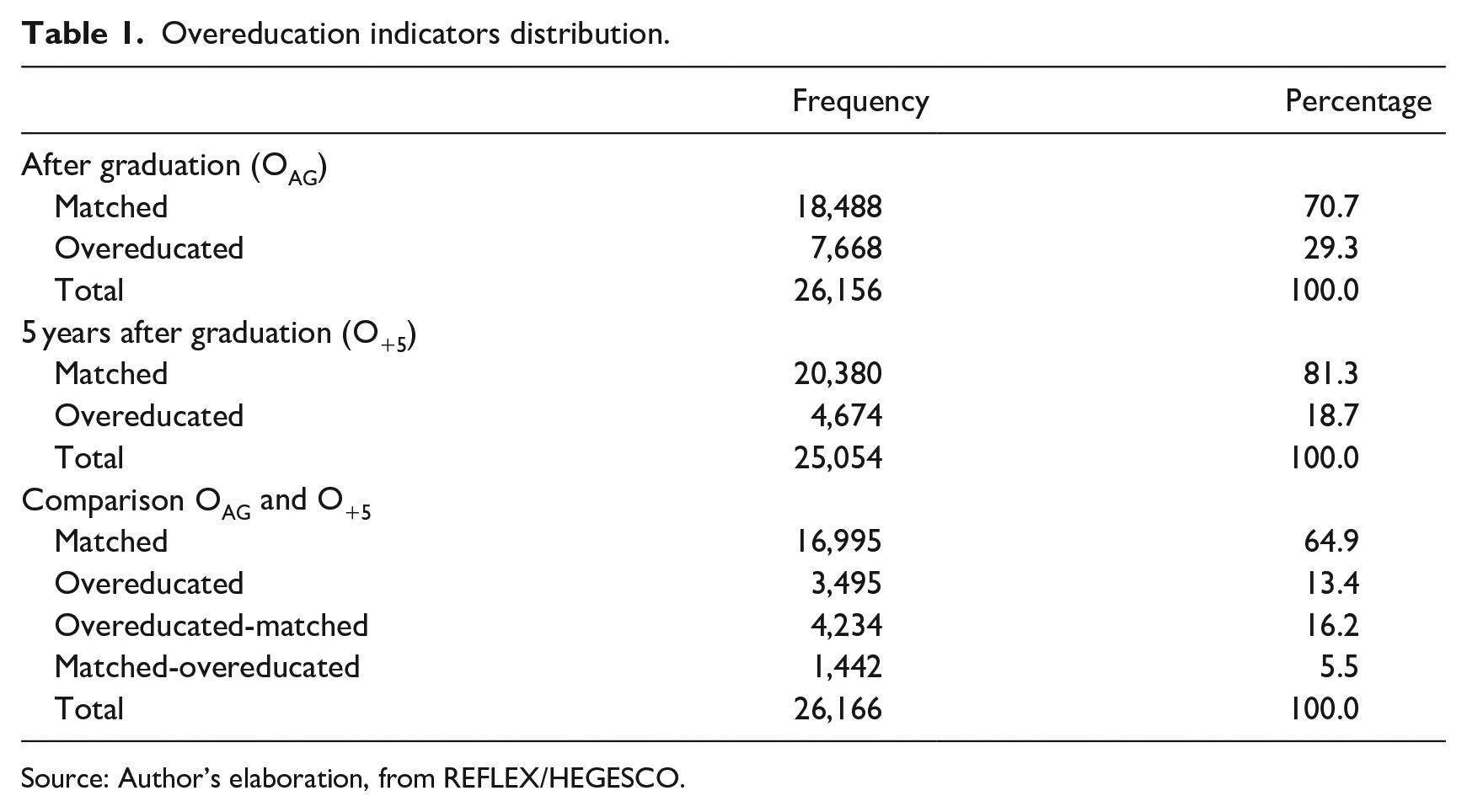
Source: Author’s elaboration, from REFLEX/HEGESCO.
As displayed in Table 2, the overeducation incidence dramatically varies across countries, ranging from 15.8 percent in Germany to 44.8 percent in Spain when considering the first relevant job after graduation (i.e. OAG). The percentage of overeducated graduates is lower 5 years after graduation, with the overall reduction being –10.6 percent. However, this magnitude widely varies across countries. Spain (–21.1%) and Poland (–18.7%) experience substantial decreases in the share of overeducated university graduates, while in Austria (–6.1%), Turkey (–6.5%), and Slovenia (–7.3%) the reduction is less pronounced. Germany is the exception, as overeducation incidence remains stable, showing a small increase.
Overeducation distribution across countries (OAG and O+5).
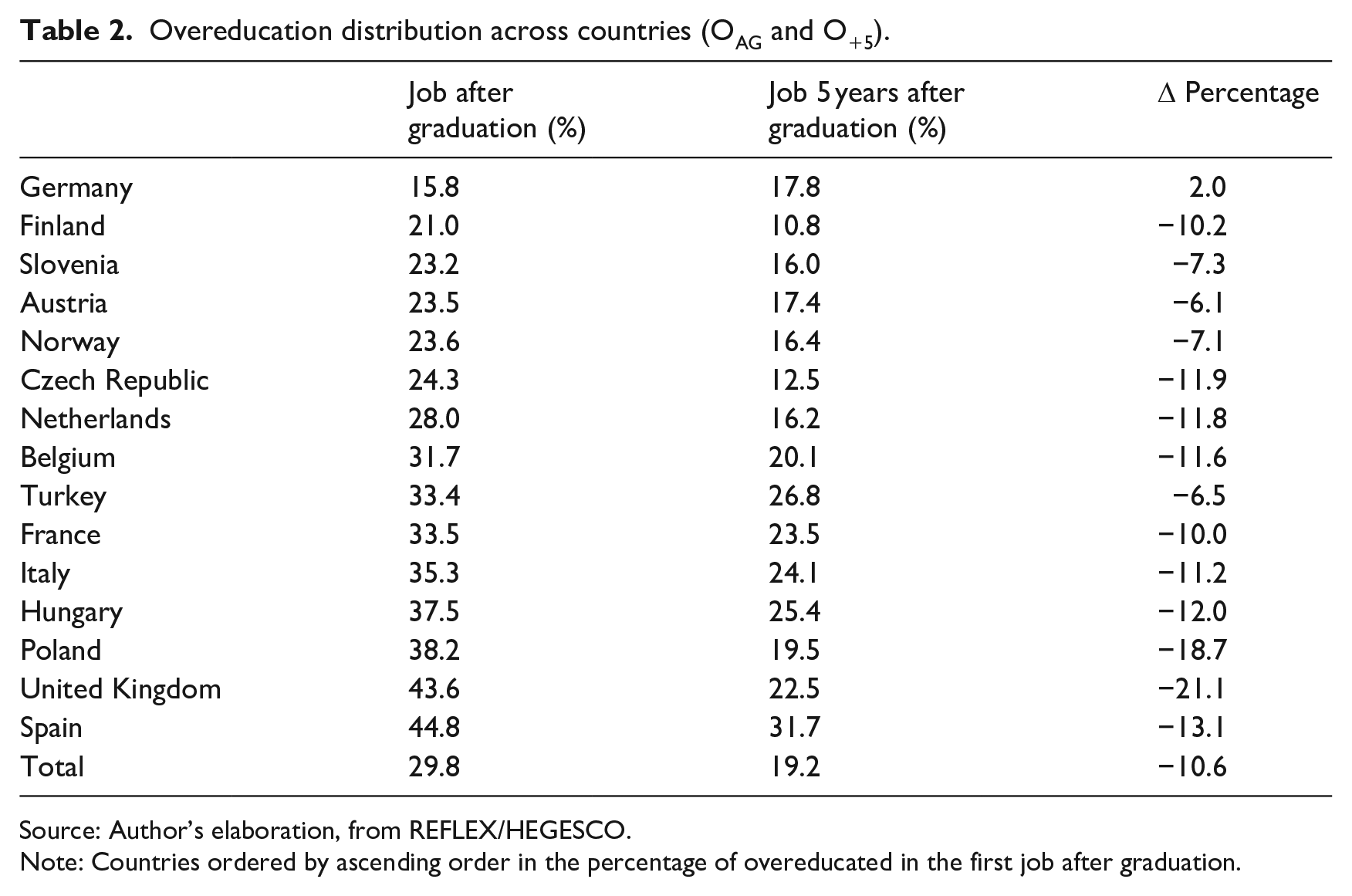
Source: Author’s elaboration, from REFLEX/HEGESCO.
Note: Countries ordered by ascending order in the percentage of overeducated in the first job after graduation.
Independent variables
Field of study and social origin are the two main individual-level predictors included in the analyses. Field of study is introduced through eight dummy variables corresponding to the International Standard Classification of Education—Fields of Study (ISCED-Fields of Study) at one digit, similarly to previous studies assessing the role of field of study on educational and occupational outcomes (Barone and Ortiz, 2011; Goyette and Mullen, 2006; Mavromaras and McGuinness, 2012; Ortiz and Kucel, 2008; Robst, 2007). The eight categories are as follows: (1) Humanities & Arts (Reference Category), (2) Education, (3) Social Sciences & Business & Law, (4) Science & Maths & Computing, (5) Engineering & Manufacturing & Construction, (6) Agriculture & Veterinary, (7) Health & Welfare, and (8) Services.
The concept of social origin is captured through father’s and mother’s educational level. Both are dummy variables differentiating between having a father/mother who attained higher education studies or not, as cultural tastes, behaviors, and preferences are usually transmitted by parents with high-educational attainment (Breen and Goldthorpe, 2001; Hansen, 1996; Torche, 2013). It would be interesting to complement the analysis of social background with information on parental occupational level. Unfortunately, this measure is not available in REFLEX/HEGESCO.
Based on relevant individual-level predictors identified by previous research on university graduates’ overeducation risk (Capsada-Munsech, 2017; Verhaest and Van der Velden, 2013), the following control variables are included in the analyses: sex (Men, Women), country of birth (Home country, Foreign country), student status while at university (Full-time, Part-time); previous participation in work placement or internships (Yes, No), age (continuous variable), average secondary grades and average university grades (standardized by country: µ = 0 and σ = 1). Table 3 presents the distribution of the independent variables. It would also be desirable to control for the prestige of the higher education institution to tackle this complementary form of horizontal differentiation. Yet, REFLEX/HEGESCO does not provide publicly available information on the university attended by university graduates or any other proxy for university prestige.
Independent variables distribution.
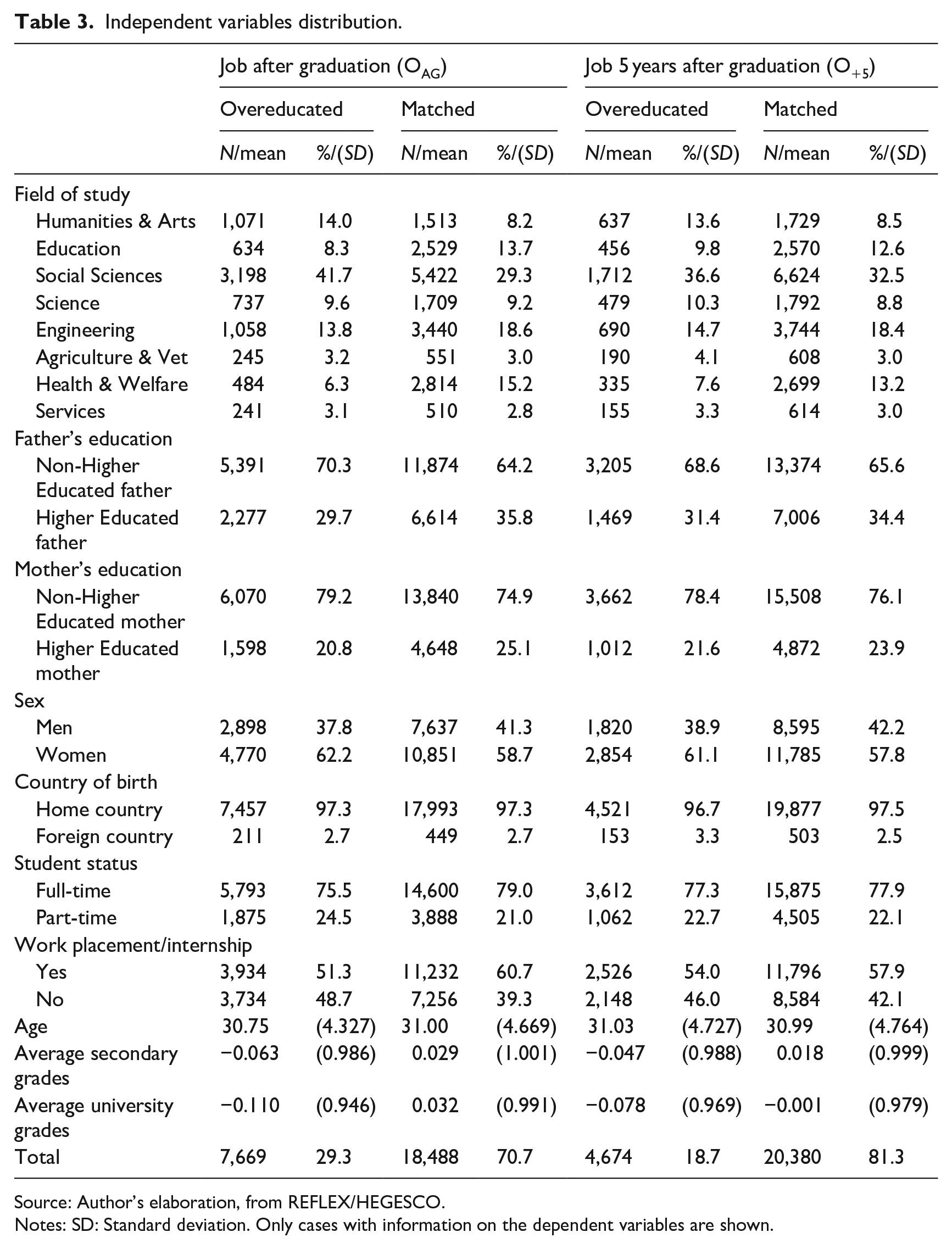
Source: Author’s elaboration, from REFLEX/HEGESCO.
Notes: SD: Standard deviation. Only cases with information on the dependent variables are shown.
Macro-level data
As shown in Table 4, the analyses include two groups of macro-level indicators: (1) education system and (2) labor market indicators. Education system indicators come from Bol and Van de Werfhorst (2013) 7 and are the most complete and up-to-date cross-country comparative indicators 8 regarding the countries, cohorts, and education system features this article focuses on. The main predictor is the degree of vocational enrollment and results are shown for this indicator. The degree of tracking and the existence of dual system are also included in the analyses to control for similar characteristics of the education system that might enhance or lessen the overeducation risk. The definition of the three indicators follows:
Index of vocational enrollment: the percentage of students enrolled in vocational tracks at upper secondary level, combining information from the OECD and the United Nations Educational, Scientific and Cultural Organization (UNESCO). It captures the prevalence of vocational education over academic and general education.
Index of tracking: the allocation of students to different curricula, usually differentiating between academic and vocational streams. The index summarizes information based on a principal-factor analysis of three country-level variables: (1) the age at first selection into different tracks, (2) the percentage of the total curriculum that is tracked in primary and secondary courses, and (3) the number of tracks available for 15-year-olds. Previous research has traditionally used only one of these three indicators as a proxy for tracking, while this index includes them all.
Dual system: gathering the percentage of the upper secondary vocational education that takes place in a dual system format (i.e. combining school and work-based knowledge), allowing to capture the specificity of the vocational system.
Macro-level indicators distribution across countries.
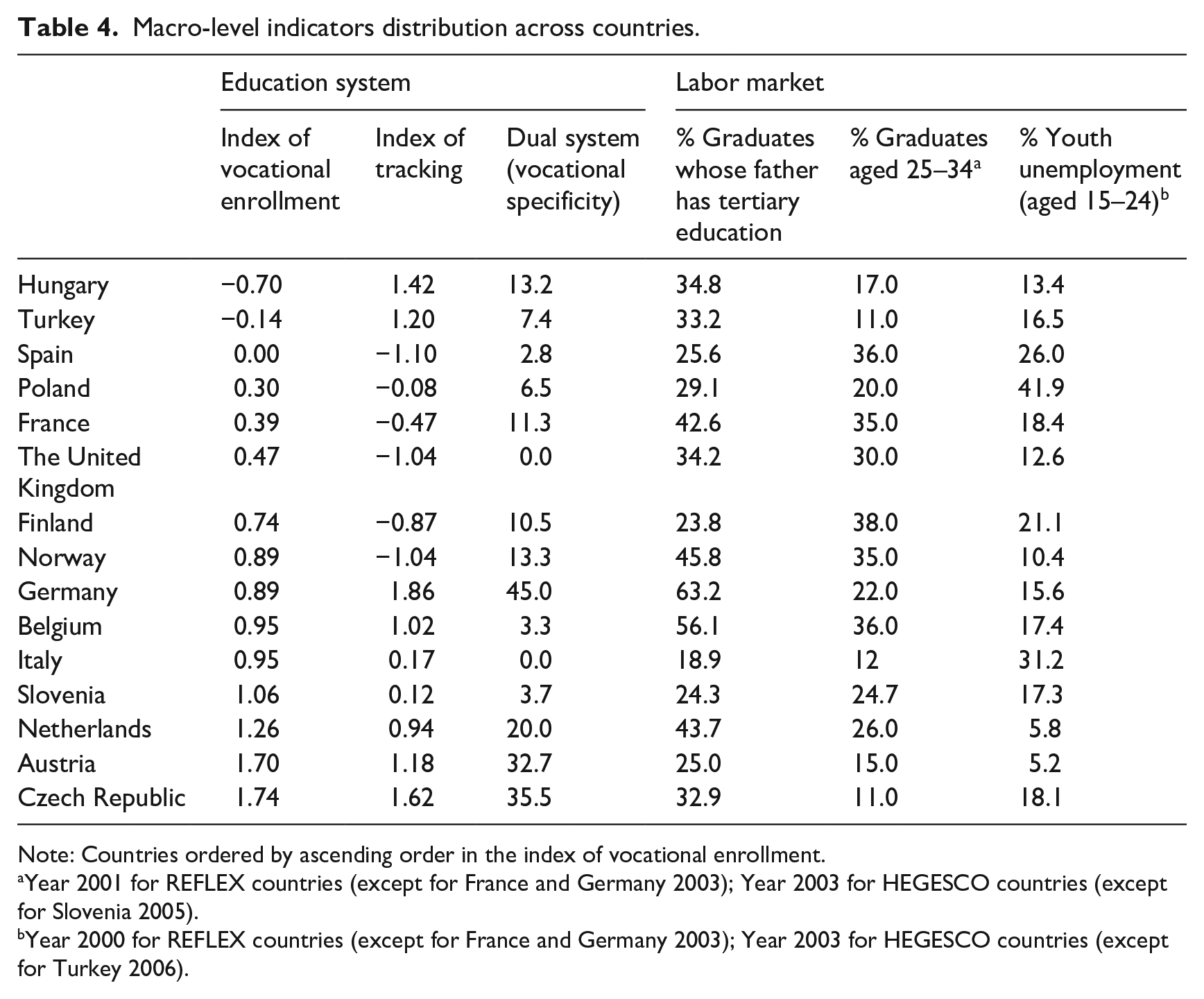
Note: Countries ordered by ascending order in the index of vocational enrollment.
Year 2001 for REFLEX countries (except for France and Germany 2003); Year 2003 for HEGESCO countries (except for Slovenia 2005).
Year 2000 for REFLEX countries (except for France and Germany 2003); Year 2003 for HEGESCO countries (except for Turkey 2006).
Moving into labor market supply- and demand-side factors, previous overeducation studies targeting the whole working population show that the strictness of the employment protection legislation (EPL) and the level of Research and Development (R&D) investments are relevant predictors of cross-national variation (Di Pietro, 2002). Conversely, studies focusing on university graduates have argued that cyclical factors such as the unemployment rate are more relevant for explaining cross-national differences in overeducation (Verhaest and Van der Velden, 2013). Moreover, labor market institutions differently affect the overeducation risk of university graduates by field of study (Assirelli, 2015). Since this research focuses on university graduates, only cyclical labor market factors are considered. The analyses include the following three indicators tackling the degree of competition with other high-skilled new labor market entrants and the labor market opportunities for youth:
Percentage of graduates with higher educated father: aggregated measure derived from REFLEX/HEGESCO showing the proportion of university graduates whose father attained a higher education qualification. Countries with larger percentages present a more homogenous group of selected graduates by social origin. Thus, we would expect social origin to be less influential in predicting overeducation risk in countries that display a high percentage in this indicator. It also implicitly controls for the educational expansion.
Percentage of young university graduates (aged 25–34 years old in the year of graduation, 2000 for REFLEX countries; 2003 for HEGESCO countries): to control for the competition in accessing high-skilled jobs. Countries with a higher percentage of youth graduates are expected to display a higher overeducation likelihood. Information comes from OECD publications (OECD, 2002, 2005).
Youth unemployment rate (aged 15–24 years old in the year of graduation, 2000 for REFLEX countries; 2003 for HEGESCO countries): standard definition. High youth unemployment rates are likely to promote tertiary education enrollment to avoid joblessness. Information comes from OECD statistics (OECD, n.d.).
Analytical strategy
I have conducted multilevel logistic models with random slopes to assess whether the influence of social origin on overeducation varies across fields of study given different degrees of vocational enrollment in the secondary education system, as I departed from the assumption that the scores on the dependent variable for each individual observation vary across countries. The nested structure of the data and the correlation of the error terms within-country justify the use of multilevel analysis. Moreover, the research question inherently calls for a cross-level interaction to differentiate whether individual-level effects (i.e. the influence of social background across fields of study on the overeducation risk of university graduates) vary based on the degree of vocational enrollment of the national education system. The general form of the model is as follows:

where Y is the logit of the probability to be overeducated, β0j is the intercept for each country, X1 is a vector of field of study and X2 of father’s education, both at the individual level (i); Z is a vector of education system characteristics of the country (j), and R and U are random error terms at each level. Intercept and slopes are random, as they vary between and within countries. A total of 10 models have been conducted including individual- and country-level variables following a stepwise strategy and removing variables with high degree of collinearity (e.g. index of vocational enrollment and index of tracking; father’s education and mother’s education). The full model incorporates the main independent variables described in the previous section and the three-way interaction between the relevant macro-level variable (i.e. the degree of vocational enrollment) and individual-level variables (i.e. field of study and father’s education).
Models are replicated using the two dependent variables OAG and O+5. The main results are presented and discussed in the following section in odds ratios and illustrated by figures showing the predicted probabilities of being overeducated by field of study, father’s education, and the index of vocational enrollment. 9 Since only 15 countries are included in the analyses, the results are not robust enough to disentangle the explanatory power of level one (i.e. individual-level) and two variables (i.e. macro-level). Therefore, I interpret the results as cross-national variation, but I do not formulate any explanatory claims (Bryan and Jenkins, 2015). Robustness checks replicating the results are included in the Supplementary File, including different overeducation measurements (i.e. “undereducated” cases jointly with “matched” cases, two JA objective indicators of overeducation, and replication of the results excluding one country at a time).
Results and discussion
This section is divided into three subsections: (1) the association between the overeducation risk of university graduates, field of study, and father’s education (individual-level variables); (2) the interaction between institutional variables, field of study, and father’s education (cross-level two-way interaction); and (3) the interaction between institutional variables and field of study by father’s education (cross-level three-way interaction).
Association between the overeducation risk of university graduates, field of study, and father’s education
Table 5 shows that university graduates from all fields of study are less likely to be overeducated compared to humanities ones. However, the risk to be overeducated clearly varies across fields of study: social science and services graduates present the highest overeducation risk after humanities graduates, while health and engineering graduates present the lowest relative risk. Regarding parental educational background, having a higher educated father and/or mother reduces the overeducation likelihood relative to those that do not have a higher educated father and/or mother. Both fields of study and father’s education remain as relevant predictors when looking at the overeducation risk 6 months after graduation and 5 years later, in line with previous research (Verhaest and Van der Velden, 2013). Results are not statistically significant only for university graduates on agriculture and those with a higher educated mother when looking at the job 5 years after graduation (O+5). Results are consistent even when controlling for secondary school and university grades. Thus, it cannot be claimed that overeducation is explained by lower skills levels among university graduates who are overeducated because we are comparing individuals with similar skills and abilities. The fact of including grades in the analyses also partly controls for primary and secondary effects derived from social origin on academic performance and study choices (Boudon, 1974; Jackson et al., 2007). Thus, in line with previous studies (Assirelli, 2015; Goyette and Mullen, 2006; Mavromaras and McGuinness, 2012; Ortiz and Kucel, 2008; Robst, 2007; Triventi, 2013), we can state that field of study and parental educational background are strong predictors of overeducation among the REFLEX/HEGESCO university graduates.
Odds ratios of being overeducated by field of study and parental educational background.
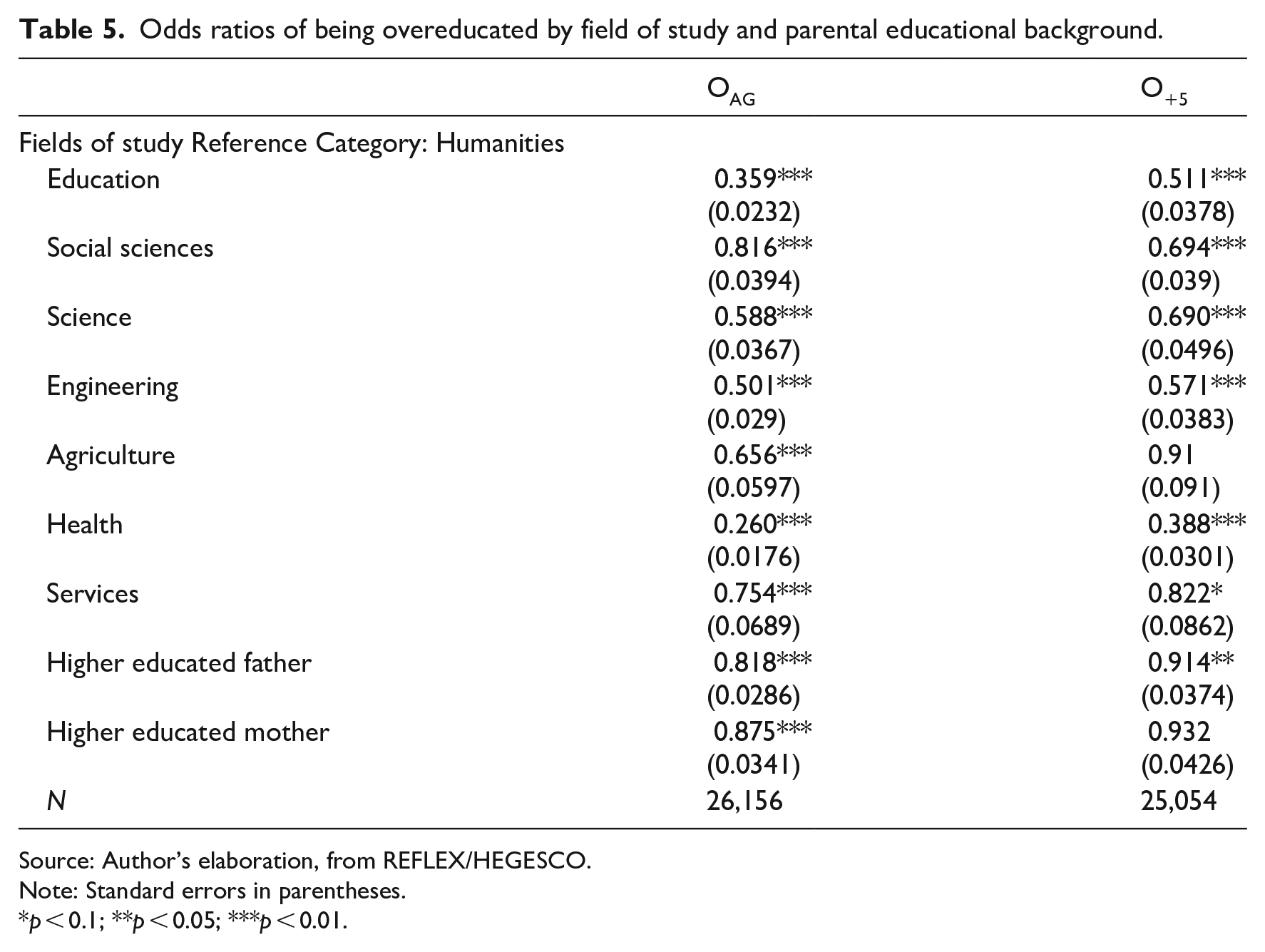
Source: Author’s elaboration, from REFLEX/HEGESCO.
Note: Standard errors in parentheses.
p < 0.1; **p < 0.05; ***p < 0.01.
Institutional variables, field of study, and father’s education (cross-level two-way interaction)
Coming to the role of the institutional variables, Table 6 shows that the education system variables help us understand cross-country variation in overeducation to a larger extent than labor market supply- and demand-side variables. The three educational system variables show statistically significant results when introduced separately, suggesting that higher levels of vocational enrollment, tracking, and dual system decrease overeducation risk. Yet, when introduced jointly, the index of vocational enrollment remains as the most important education system indicator. Neither the percentage of graduates whose father attained higher education, nor the percentage of youth tertiary graduates, nor the youth unemployment rate show statistically significant differences on university graduates’ overeducation risk when included jointly with education system indicators. Thus, the degree of vocational enrollment seems to be picking up on the cross-national variation.
Odds ratio of being overeducated by the macro-level variables.
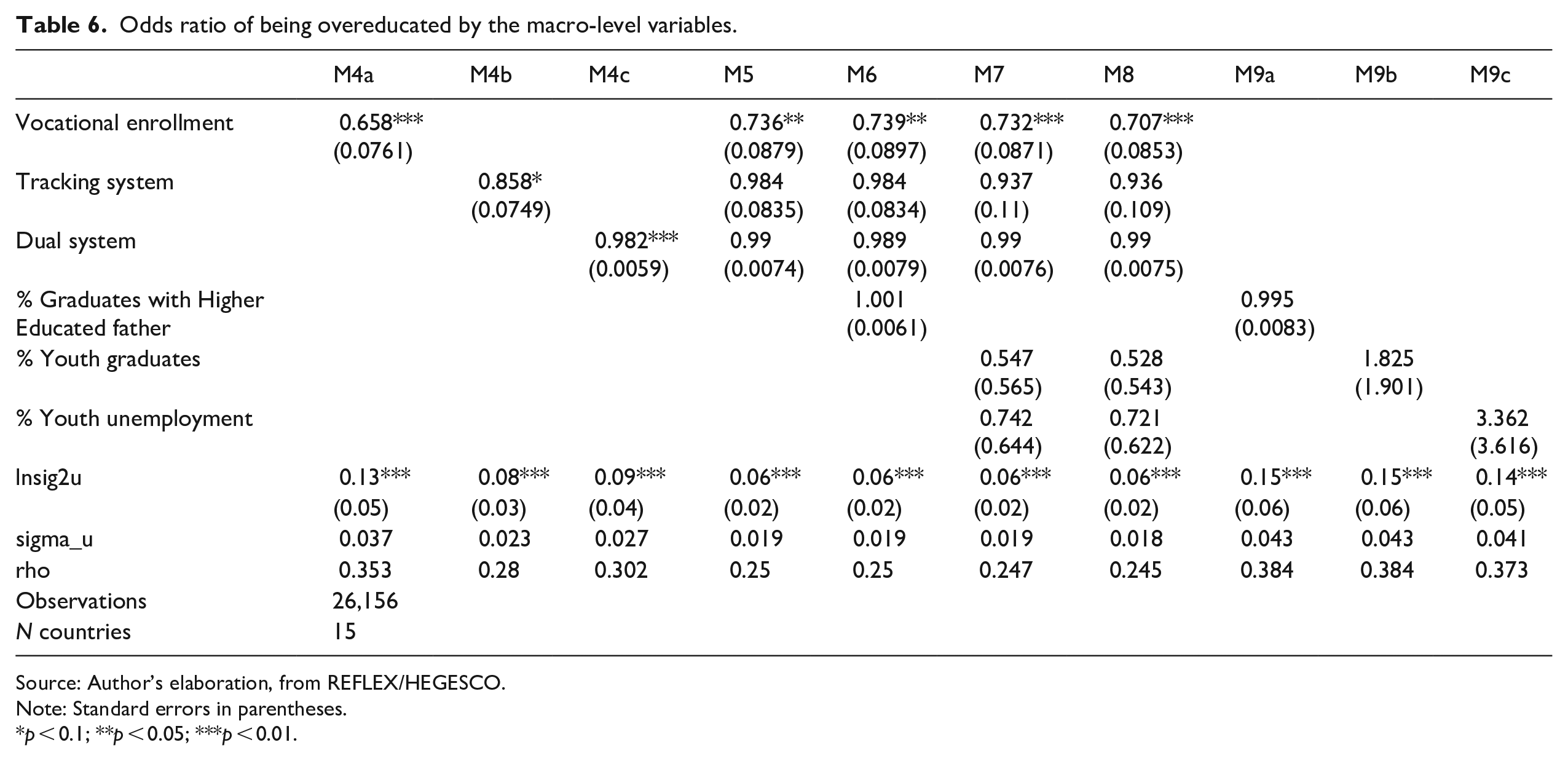
Source: Author’s elaboration, from REFLEX/HEGESCO.
Note: Standard errors in parentheses.
p < 0.1; **p < 0.05; ***p < 0.01.
As expected, there is a negative association between the overeducation risk of university graduates and the degree of vocational enrollment of the education system (see Figure 2): the predicted probability of being overeducated decreases as it increases the index of vocational enrollment. Although the predicated probability is higher when considering the first job after graduation compared to the job 5 years later, the slope is almost identical. Thus, in line with previous research (Bol and Van de Werfhorst, 2013; Di Stasio et al., 2015; Levels et al., 2014), evidence suggests that education systems with a high degree of vocational enrollment at secondary level lessen overeducation risk compared to more comprehensive systems. This article contributes to this literature by providing specific evidence for university graduates and showing that differences persist even 5 years after graduation.
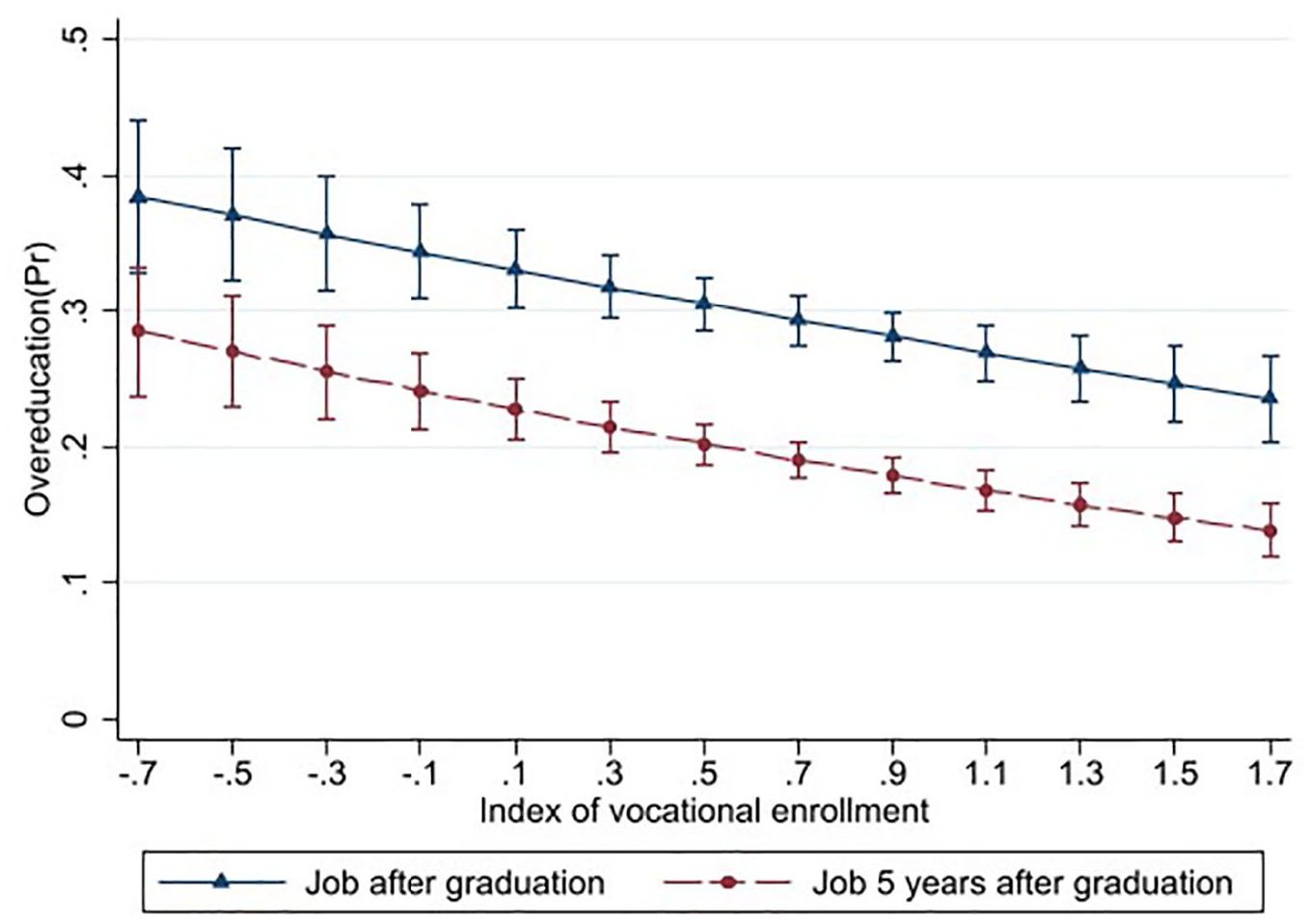
Predicted probabilities of being overeducated by degree of vocational enrollment of the education system (OAG and O+5).
However, results do not present substantive differences between graduates with and without a higher educated father. Figure 3 below shows that the probability of being overeducated is higher for those who do not have a higher educated father in the first job after graduation and 5 years later. Even if not always statistically significant, differences are larger among graduates from education systems with a lower degree of vocational enrollment and almost inexistent in education systems with a higher degree of vocational enrollment. Although in line with my hypothesis, it cannot be claimed that father’s educational level makes a substantive difference in reducing the overeducation risk of university graduates across education systems.
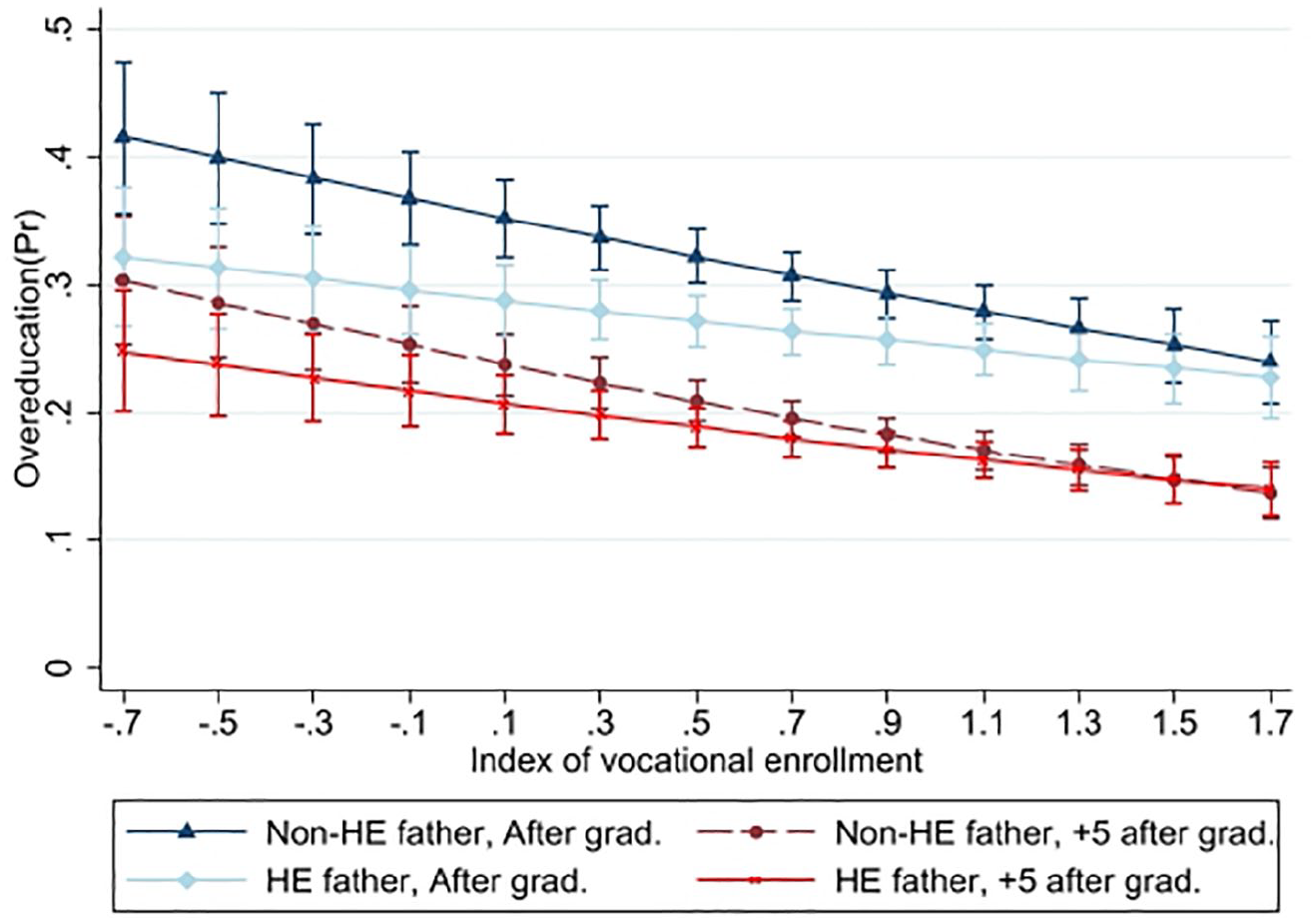
Predicted probabilities of being overeducated by degree of vocational enrollment of the education system and father’s education (OAG and O+5).
Figures 4 and 5 show the predicted probabilities of being overeducated by field of study and the degree of vocational enrollment. All fields of study follow the same pattern: the overeducation risk constantly decreases as it increases the degree of vocational enrollment in the education system. However, the magnitude of the effect varies across fields of study and between the first job after graduation and 5 years later. In the first job after graduation, social sciences and services graduates are the most likely to be overeducated, while 5 years after graduation social sciences graduates reduce their overeducation likelihood in relative and absolute terms. Service graduates reduce their overeducation likelihood in absolute terms, but relative to the rest of the fields, they are still in second position after agriculture university graduates. Health, education, and engineering university graduates are always less prone to fall into overeducation. Even if the effect size differs across education systems, the differences in overeducation likelihood between occupationally focused and nonoccupationally focused fields of study persist, the differences across fields of study being smaller 5 years after graduation.
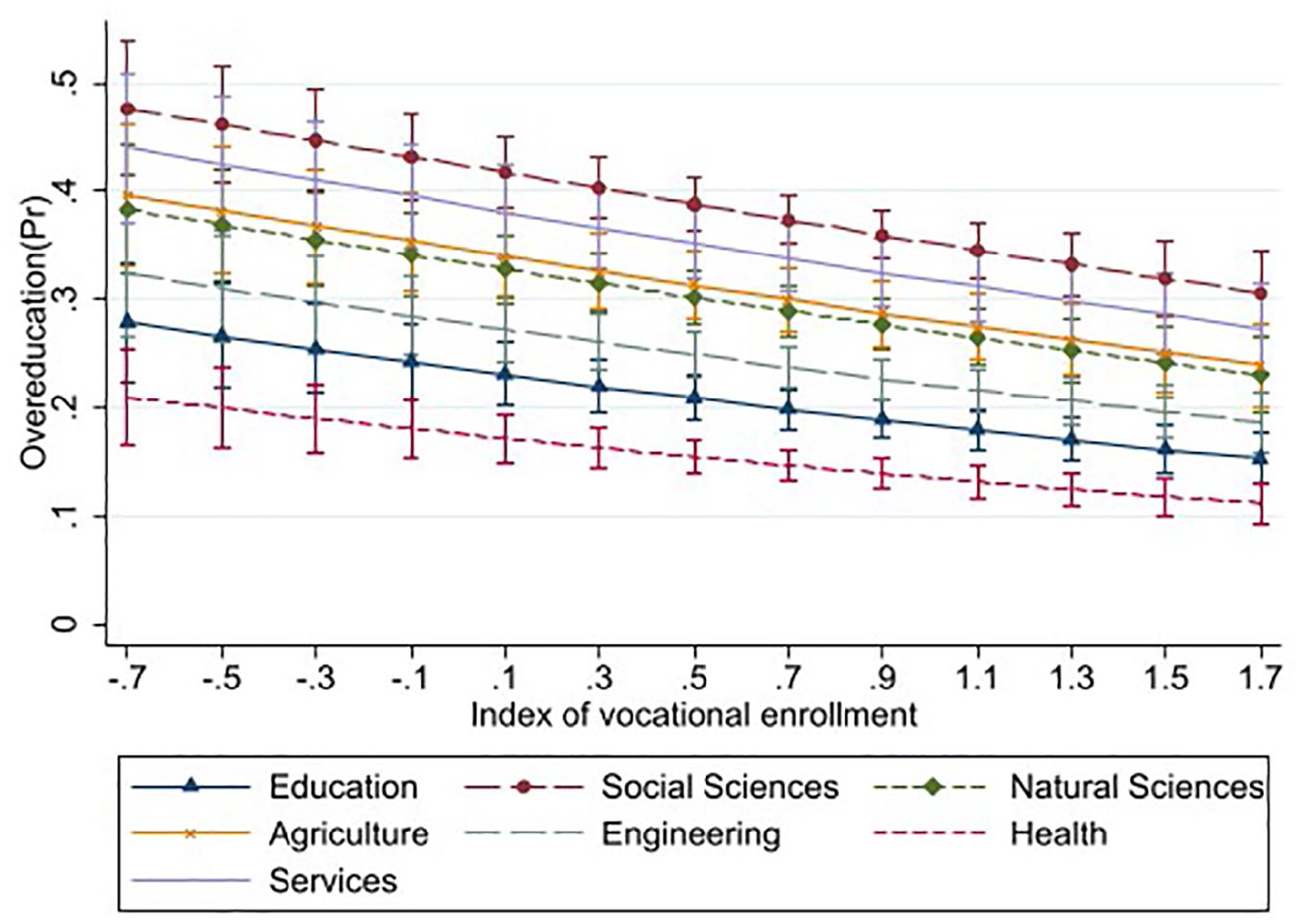
Predicted probabilities of being overeducated by field of study and degree of vocational enrollment of the education system (OAG).
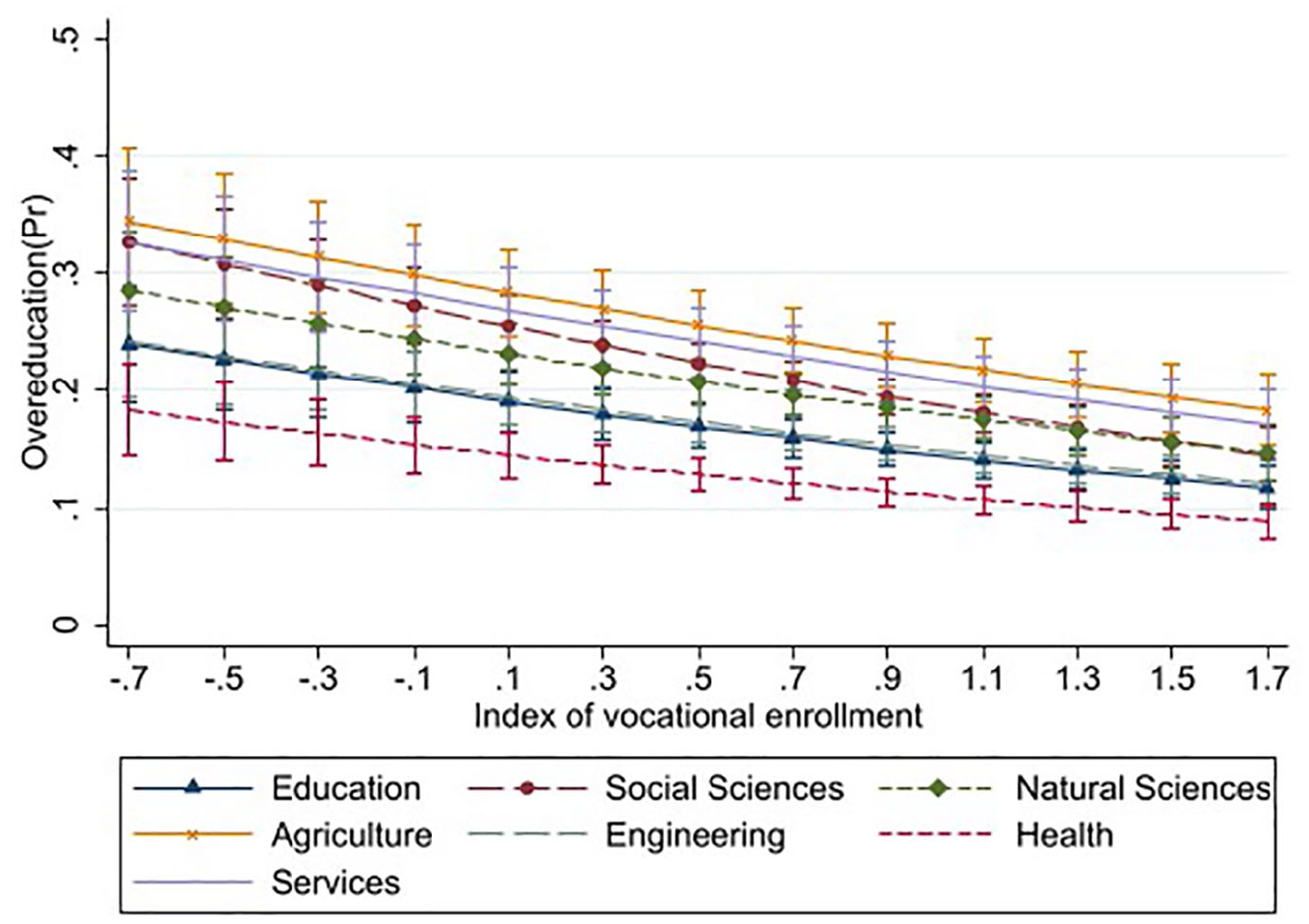
Predicted probabilities of being overeducated by field of study and degree of vocational enrollment of the education system (O+5).
Differences across secondary education systems by field of study and father’s education
Next, I present the main results addressing the research question of this article. To easily interpret and compare the interaction effects between field of study, father’s education, and the degree of vocational enrollment, Figures 6 and 7 show the predicted probabilities of being overeducated by degree of vocational enrollment and father’s education for each field of study of graduation, referring to the first relevant job after graduation (Figure 6(a) to (g)) and 5 years later (Figure 7(a) to 7(g)).
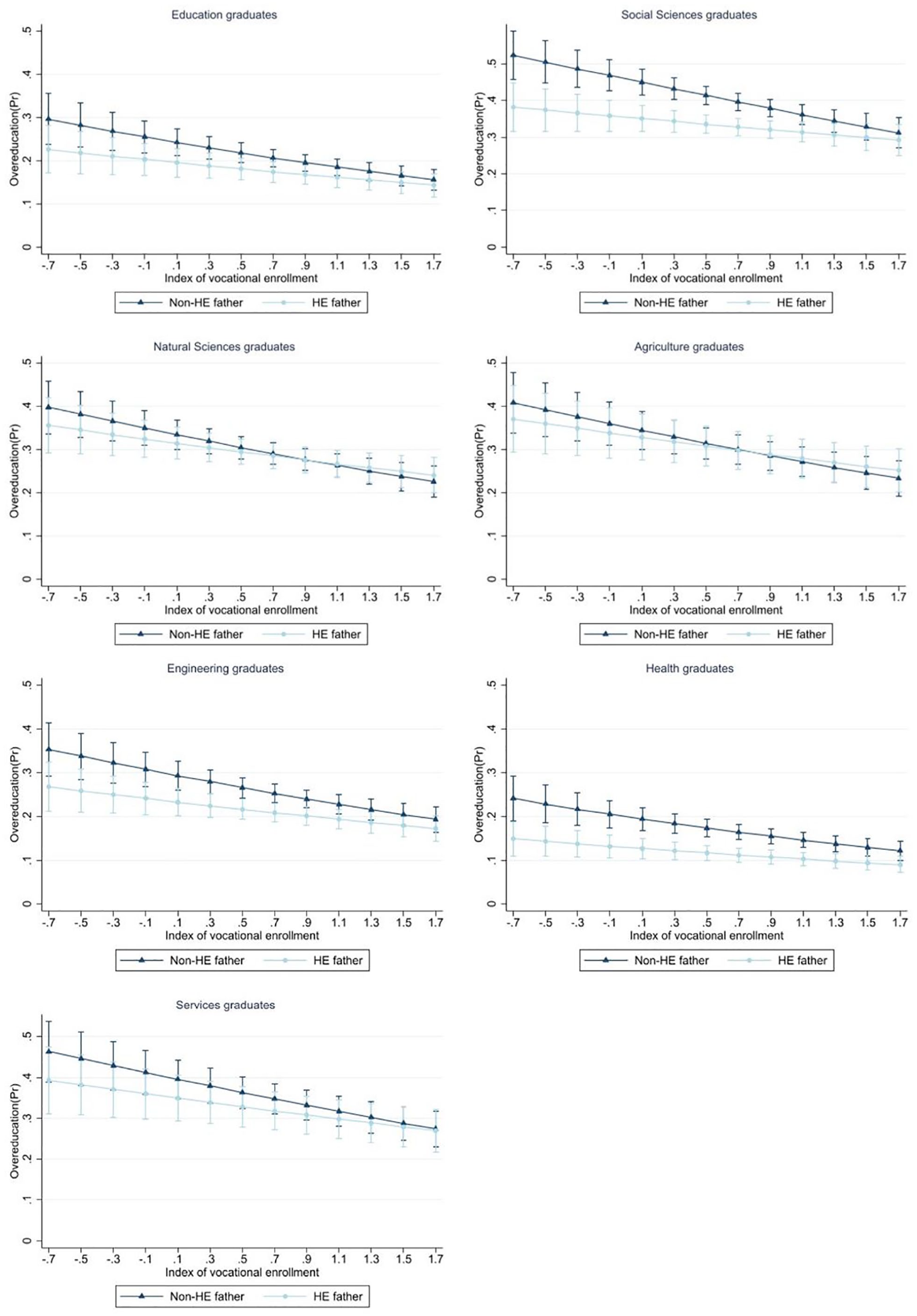
Predicted probabilities of being overeducated by field of study and father’s education by degree of vocational enrollment of the education system (OAG).
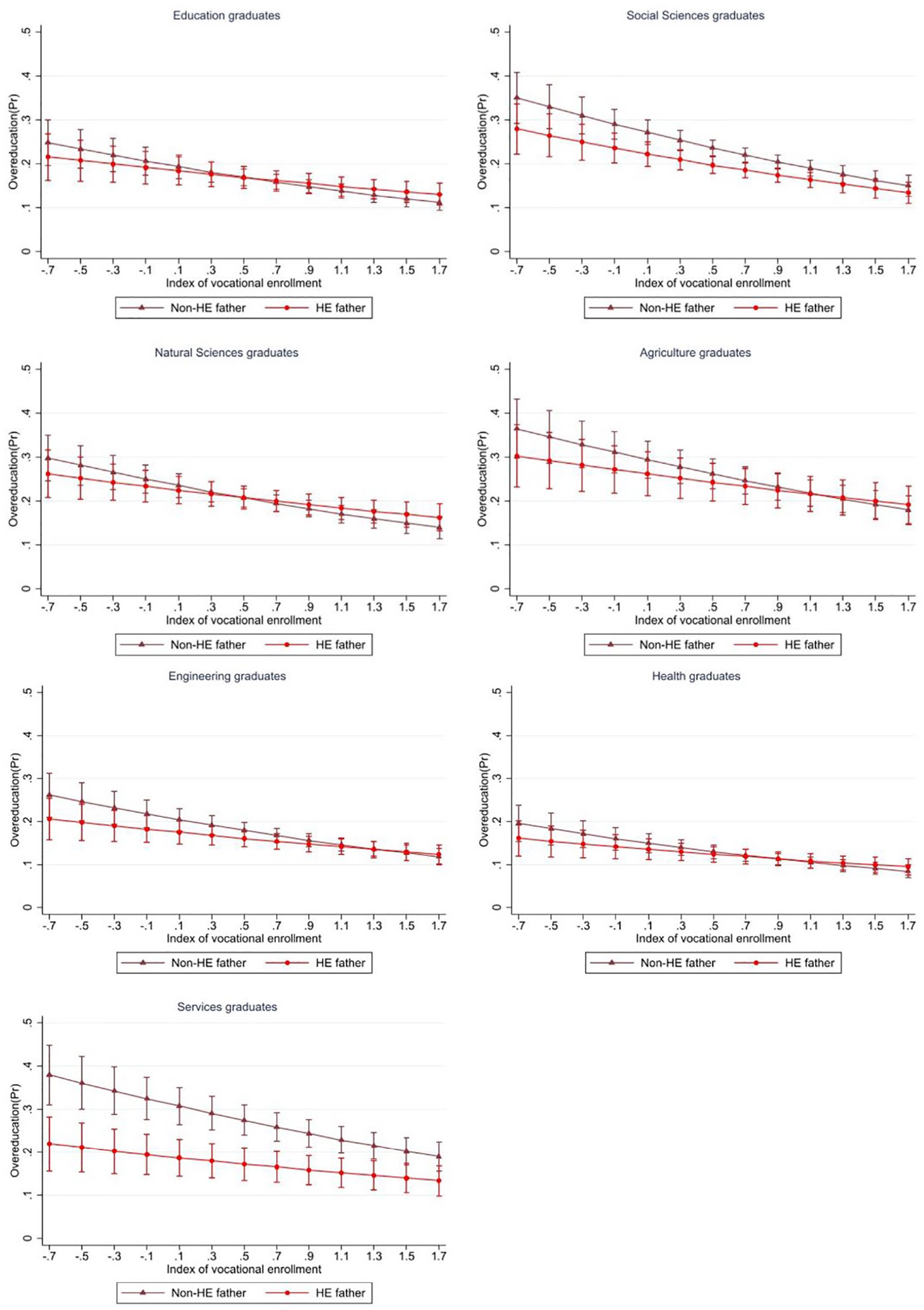
Predicted probabilities of being overeducated by field of study and father’s education by degree of vocational enrollment of the education system (O+5).
When focusing on the first relevant job after graduation, no differences are observed in the likelihood of being overeducated between those who have and do not have a higher educated father, except for social science graduates from education systems with a lower degree of vocational enrollment. Therefore, partly in line with my hypotheses, results suggest that social origin is an advantage in reducing overeducation risk among university graduates from a nonoccupationally focused field of study directing to the service sector (i.e. social sciences) in comprehensive systems but not in education systems with a high degree of vocational enrollment. Yet, these results do not hold when employing an objective indicator of overeducation (see Appendix 2 and 3 in the Supplementary File).
There are also some differences between offspring of higher educated and non-higher educated fathers in the field of health. Thus, even if unexpected, results suggest that father’s education also has an influence on reducing the overeducation risk among health graduates in comprehensive systems. Those with a higher educated father might benefit from better economic stability and knowledge to navigate the system to make sure they end up in a matched job, compared to those that do not have a higher educated father. These results hold even when using an objective measure of overeducation (see Appendix 2 in the Supplementary File).
Differences by social origin among social science graduates 5 years after graduation have vanished regardless of the education system (Figure 7). Nevertheless, differences between offspring of higher educated and non-higher educated have appeared among services graduates. Those that have a higher educated father present a lower probability of being overeducated than their peers without a higher educated father. Differences between these two groups of individuals decrease as it increases the degree of vocational enrollment of the education system. Yet, once again, these results do not hold when employing an objective indicator of overeducation (see Appendix 2 and 3 in the Supplementary File).
Since the analyses are conducted for only 15 countries one could wonder if any of them is driving the results. I conducted robustness checks excluding one country at a time and it is the case that some countries are partially driving the results when employing a subjective indicator of overeducation. For instance, when excluding Spain from the analyses (see Appendix 4 in the Supplementary File), there is no statistically significant difference in the probability to be overeducated between those that have a higher educated father or do not by the degree of vocational enrollment in any field of study, neither Social Sciences. Therefore, empirical evidence is not strong enough to support the fact that the influence of father’s education varies by field of study and by the degree of vocational enrollment of the secondary education system.
Conclusion
A wealth of empirical studies shows that the overeducation risk of university graduates is a non-negligible phenomenon across advanced economies. However, its magnitude varies widely across countries, and little attention has been directed to study this phenomenon from a comparative angle. Building on previous research and aiming to contribute to this comparative approach, this article explores to what extent the influence of field of study and social origin on the overeducation risk of university graduates is meditated by education system characteristics prior to the higher education level.
The main conclusion is that there is not enough empirical evidence to state that the degree of vocational enrollment differently mediates the effect of social origin on the overeducation risk of university graduates by field of study. I hypothesized that the differentiated influence of social origin on the overeducation risk of university graduates would only exist in comprehensive systems and be only relevant to those from nonoccupationally focused fields of study directing to service sector occupations (i.e. social sciences), where soft skills mainly gained through family socialization are considered as having a market value. Yet, this finding is only supported when employing a subjective indicator of overeducation, and results are not robust when excluding some countries from the analyses. Thus, results do not support the main hypothesis of this article.
Although differences are not always statistically significant, another finding of this article is that father’s education is less important in predicting overeducation in highly vocationally oriented systems. I argue that since vocationally oriented systems already implicitly select by social origin at earlier stages of the educational trajectory, the influence of social origin after university graduation is less accentuated. In contrast, comprehensive education systems tend to be less selective in terms of social background at the secondary level and accessing university, but social origin later gains influence as a filter in the transition from higher education to the labor market.
More generally, another relevant finding of this article is the likelihood of university graduates to be overeducated varies across countries based on their degree of vocational enrollment at the secondary education level. University graduates from countries with vocationally oriented education systems are less prone to be overeducated compared to those in comprehensive systems. This result holds for university graduates from all fields of study and is in line with studies targeting the whole working population (Di Stasio et al., 2015).
Moreover, in line with previous studies (Assirelli, 2015; Goyette and Mullen, 2006; Mavromaras and McGuinness, 2012; Ortiz and Kucel, 2008; Robst, 2007), this article confirms that fields of study and parental education are strong predictors of the overeducation risk of university graduates across several European countries both after graduation and at the early career stages (Verhaest and Van der Velden, 2013), even when controlling for ability (i.e. grades). It is worth stressing that results hold even when controlling for country-level differences in the supply of graduates and youth unemployment rate. This suggests that education system characteristics explain to a larger extent the variation in university graduates’ overeducation risk than labor market supply- and demand-side contextual characteristics. This has important policy implications, as features of the education system previous to higher education clearly influence the labor market outcomes of university graduates suggesting that different governmental departments should cooperate and coordinate educational and labor market policies to ensure a smooth transition across educational stages and into the labor market in all countries, yet employing different approaches to tackle their specific challenges.
Supplemental Material
sj-docx-1-cos-10.1177_00207152241228148 – Supplemental material for Do secondary education systems influence the overeducation risk of university graduates? A cross-national analysis by field of study and social background
Supplemental material, sj-docx-1-cos-10.1177_00207152241228148 for Do secondary education systems influence the overeducation risk of university graduates? A cross-national analysis by field of study and social background by Queralt Capsada-Munsech in International Journal of Comparative Sociology
Footnotes

References
Supplementary Material
Please find the following supplemental material available below.
For Open Access articles published under a Creative Commons License, all supplemental material carries the same license as the article it is associated with.
For non-Open Access articles published, all supplemental material carries a non-exclusive license, and permission requests for re-use of supplemental material or any part of supplemental material shall be sent directly to the copyright owner as specified in the copyright notice associated with the article.
