



Abstract
Two competing perspectives have been offered to explain how the Great Recession (GR) impacted citizens’ perspectives on international trade. The citizens-as-workers perspective maintains that anti-trade attitudes increase during economic downturns because higher imports of foreign products pose a severe threat to workers’ job security, whereas the citizens-as-consumers perspective suggests that favorable attitudes toward international trade increase as imports provide better opportunities for cheaper consumer goods. In this article, we examine how the dual identities of citizens—as workers and consumers—play a role in shaping how the GR affects perceived trade threat. Using multilevel ordered logit models, we analyze responses from 19,982 respondents nested within 21 countries in the 2013 International Social Survey Program survey. We find that the GR exacerbated perceived trade threat. We also find that the GR intensified pro-trade attitudes in countries with fast-growing unemployment. The results suggest that anti-trade sentiments of citizens-as-workers were dominant after the GR, but pro-trade sentiments of citizens-as-consumers were also present as a countervailing force against a protectionist backlash.
Introduction
In the aftermath of the Great Recession of 2007–2009, scholars, policymakers, and global activists have expressed heightened concern over the effect of economic globalization on economic well-being and hardship of ordinary citizens (Hirsh, 2016; Norris and Inglehart, 2019). The election of Donald Trump as US president in 2016 ushered in a new era of economic nationalism and populism in which the US withdrew from the Trans-Pacific Partnership, renegotiated the North American Free Trade Agreement, and threatened to impose taxes on US companies that relocated abroad, while instigating trade wars involving tit-for-tat increases in tariffs with several countries (Irwin, 2017). Retaliatory actions by other countries ensued such as China’s diverting its purchase of American pork, airplanes, wheat, and soybeans to producers in other countries. Political convulsions such as Brexit signaled a similar retreat to protectionism in the United Kingdom. Although mainstream economists and political commentators have lauded international trade for improving economic conditions, reducing inequality and poverty, and sustaining global peace (Dollar and Kraay, 2002; Wade, 2004), these events bespeak a deeper anxiety about imports of foreign products on domestic jobs and national security.
The Great Recession (GR) of 2007–2009 was the longest and deepest economic downturn since the Great Depression of the 1930s. In the United States, housing prices plunged and left many homeowners underwater; the financial collapse erased more than half the value of the stock market; gross domestic product (GDP) declined for 18 months, reaching its nadir in the fourth quarter of 2008 with 8.5 percent loss over the previous quarter (Federal Reserve Economic Data, 2021); and the unemployment rate skyrocketed to 10 percent or higher (Redbird and Grusky, 2016). Due to the economic connectedness of the global economy, the economic crisis broadened and deepened as it spread around the world, engulfing every advanced society despite considerable country-to-country variation in length and severity.
Much research has shown that economic crises transform individuals’ beliefs and behaviors (Elder, 1999; Grusky et al., 2011). In the aftermath of the GR, rising populism and right-wing rhetoric promoting protectionism as a path to economic security became pervasive. While researchers have speculated on the connection between the GR and rising anti-trade sentiment (Goldstein and Gulotty, 2019; Irwin, 2016), this topic remains substantially understudied. In this article, we ask how citizens’ perceptions of international trade have been altered by the experience of the GR. We introduce the concept of perceived trade threat (PTT) to capture citizens’ anti-trade attitudes resulting from growing imports of foreign products and how it affects job security and the national economy. 1 And we ask, has the GR heightened PTT? That is, did the GR exacerbate anti-trade sentiment among citizens, or did it supercharge their commitment to international trade as a source of economic revitalization and prosperity?
The impact of the GR on PTT is deeply animated by citizens’ dual identities as workers and consumers. 2 The citizens-as-workers perspective focuses on economic threats to workers resulting from imports of foreign products. Imports increase competition for jobs and wages for workers with low skills and those in import-competing industries by reducing the demand for their labor (Mayda and Rodrik, 2005; Scheve and Slaughter, 2001), and this competition may be intensified during economic downturns (Mansfield et al., 2016). Therefore, this perspective suggests that the GR increases the PTT of citizens-as-workers. In contrast, the citizens-as-consumers perspective emphasizes how consumers gain economic benefits from imports of foreign products (Collins, 2015; Naoi and Kume, 2015). Imports provide consumers with better opportunities for cheaper goods, and the economic benefits may be greater in economic hard times when citizens’ economic security is threatened. This perspective contends that the GR intensifies pro-trade attitudes of citizens-as-consumers.
In this article, we examine how the dual identities of citizens—as workers and consumers—determine how the GR affects PTT. We use a unique international dataset that contains cross-sections in 2003 and 2013 to analyze responses of 19,982 respondents nested within 21 economically advanced countries. This fortuitous design whereby the GR intervenes in time between the two cross-sections uniquely allows us to examine the impact of GR on public attitudes toward imports.
Theoretical background
Four dimensions of the GR
By official accounts, the GR began in the United States in December 2007 and ended in June 2009, but its economic, social, and psychological impact lasted much longer. Since the timing and intensity of the GR varied across countries, our operational definition of the GR spans the years 2007–2010. Our core proposition is that the economic dislocations caused by such a traumatic event are likely to animate citizens’ predispositions about the importance of trade, but how? Is such an event likely to intensify anti-trade attitudes as suggested by the citizens-as-workers perspective or to mollify such attitudes as indicated by the citizens-as-consumers perspective?
Most accounts of the GR suggest that failures in the regulation of US financial markets triggered the Recession (Financial Crisis Inquiry Commission, 2011). Financial institutions were involved in risky investments in toxic assets, and their interlocking relationships created widespread, cascading effects in financial markets that triggered plunging housing prices, economic contraction, a plummeting stock market, and soaring unemployment rates (Redbird and Grusky, 2016). The US economic crisis quickly evolved into a global economic crisis across all the economies in the advanced and developing world (Claessens et al., 2010; Farlow, 2013). In a tightly interconnected global economy, it was inevitable that such an economic disaster would affect the entire world, although its varied intensity led to uneven consequences for national economies (Drezner, 2014; Guillén and Suárez, 2010).
Most countries experienced four distinctive, but interrelated, dimensions of the Recession: the housing crash, the financial crisis, economic decline, and employment loss (Danziger, 2013; Grusky et al., 2011). Using a similar procedure as Wallace et al. (2022), we combined country-level indicators of these four dimensions to create a single Great Recession Index (GRI) to capture national variation in the timing and intensity of the Recession among the 21 nations in our sample.
The first dimension of the GR is the housing crash. In the late 1990s, a US housing bubble began to form due to deregulation of the financial industry and speculative investments in the subprime mortgage market (Levitin and Wachter, 2020). An increase in defaults on subprime mortgages led to faltering housing prices and eventually to the bursting of the housing bubble after 2007 (Fligstein, 2021; Fligstein and Goldstein, 2011). Other countries, particularly the United Kingdom, Spain, Ireland, and several Eastern European countries, experienced a similar housing crash as the United States (Claessens et al., 2010). The boom in housing prices promoted by speculation in the housing market led to a crash that left millions of homeowners shattered (Ivanova, 2011). On average, the 21 countries in the analysis lost 5.5 percent of their average pre-Recession housing value during the GR.
The second dimension of the GR is the financial crisis. US investment banks involved in mortgage-backed securities such as Bear Stearns, Lehman Brothers, and Merrill Lynch went bankrupt in 2007 and 2008 when housing prices declined. This bankruptcy drove further economic decline by evaporating about half of the capital in the US stock market between October 2007 and March 2010 (Fligstein, 2021). It is notable that US financial assets accounted for about 31 percent of global financial assets at the onset of the Recession (Claessens et al., 2010). The interconnection of US financial assets with other countries helped globalize the financial crisis through a global sell-off in financial stocks and the depletion of bank capital. On average, the 19 countries in our sample with retrievable financial data experienced a 6.1 percent decline in value added in the finance and insurance sectors during the GR.
The third dimension of the GR is economic decline. The decline in the production of goods and services in the United States was the deepest and longest since the Great Depression. The Bureau of Economic Analysis recorded that real GDP in the United States decreased 4.2 percent from the fourth quarter of 2007 to the second quarter of 2009, the official duration of the Recession in the United States (Grusky et al., 2011). Personal consumption also declined in the GR even though disposable income remained relatively stable (Petev et al., 2011). On average, the 21 countries in this analysis suffered a 2.4 percent decline in real GDP during the GR.
The final dimension of the GR is employment loss. In the United States, the GR adversely affected the labor market in terms of the depth and duration of employment loss. In the GR, about 8.6 million jobs or 6.3 percent of peak employment were lost, and it took 77 months to recoup these losses (Shambaugh and Strain, 2021). Many lost jobs were never recovered, particularly in well-paying sectors like manufacturing; other jobs came back with diminished wages, benefits, or work conditions. All told, the 21 countries in our sample lost about 2.0 percent of their jobs on average.
PTT in the GR
The citizens-as-workers perspective
The citizens-as-workers perspective on PTT focuses on the way in which imports of foreign products affect economic interests of domestic workers. There are two strands to this perspective. First, existing theories of international trade point to the heterogeneous effects of the import of foreign products on workers according to their skill levels and industries of employment (Mansfield et al., 2016; Mayda and Rodrik, 2005; Scheve and Slaughter, 2001). The Stolper–Samuelson theorem suggests that attitudes toward trade are a function of workers’ skill levels. As advanced economies exercise their comparative advantage by tilting the economy toward high-skilled workers, demand for skilled workers and their wages increase, whereas demand for unskilled workers and their wages decline. This would seem to produce a split between skilled and unskilled workers regarding their levels of PTT. However, the Ricardo-Viner model suggests that PTT is more related to industry of employment. Workers employed in export-dominant industries should look favorably upon trade because it increases demand for their labor and their wages. By contrast, workers employed in import-competing industries are harmed by international trade, so they should have higher levels of PTT. Despite these differences, these two international trade theories are united in suggesting that PTT primarily varies according to the interests of citizens-as-workers.
Another strand of the citizens-as-workers perspective is competitive threat theory that focuses on anxiety of workers fueled by rising competition for scarce resources such as jobs, wages, and welfare benefits. This theory has mainly been used to explain attitudes toward immigrants who compete with native workers (Ceobanu and Escandell, 2010; Kuntz et al., 2017; Kwak and Wallace, 2018; Pichler, 2010), but it can also be applied to attitudes toward trade. International trade extends the pool of available labor from domestic workers to foreign workers who produce products outside the country. Therefore, imports of foreign products increase concerns of citizens-as-workers about rising international competition among workers for jobs and wages.
These two strands of the citizens-as-workers perspective share the expectation that rising competition for resources during economic downturns such as the GR should in the aggregate cause a net increase in negative attitudes toward trade (specifically, imports). Workers with lower skills or those in import-competing industries might have experienced the sharpest decline in the demand for their services during the GR. When individuals perceive their economic situation to be precarious, they fear that they will lose economic status due to competition with foreign products and should therefore have more negative attitudes about trade.
Beyond those workers who are directly affected by trade, other workers employed in occupations and industries tied to those industries such as suppliers of parts, distributors of final products, and service providers might be indirectly affected and therefore might share anti-trade fears and concerns. Also, even workers and ordinary citizens who are not directly or indirectly tied to the affected industries may express concerns about the effects of trade due to their concerns about how it might affect general economic prosperity or social cohesiveness. Therefore, the citizens-as-workers perspective focuses on threats to workers’ economic interests due to the import of foreign products, which leads to the following hypothesis: As citizens prioritize their roles as citizens-as-workers, the severity of the GR will increase the perceived trade threat of citizens.
The citizens-as-consumers perspective
The citizens-as-consumers perspective focuses on citizens’ economic interests as consumers. The concept of consumerism is deeply engrained in Marxist critiques of capitalism. Marx (1990 [1867]) used the term “fetishism of commodities” to describe how the products of workers’ labor come to obscure the social relations of production by which those products are produced. Lukács (1971 [1923]) averred that in capitalism commodification pervades all aspects of human life reducing everything to products that can be bought and sold on a market. Veblen (1994 [1899]) originated the term “conspicuous consumption” to describe how consumption of goods and leisure pursuits is used to signal social status, class position, and wealth. Wright and Rogers (2015: 44) assert that the guiding ideology of the capitalist market is consumer sovereignty, or the idea that the preferences and behaviors of consumers structure the incentive system that coordinate the market, though this principle is more mythic than real.
As workers’ wages stagnated starting in the 1970s, consumerism was sustained by the rise of dual-earner households, the increase in working hours, and the use of credit, as citizens sought to maintain a respectable standard of living (Kornbluth, 2013). The economic crises of the 1970s called into question the Keynesian panacea of government intervention and ushered in a new era of neoliberalism that espoused unfettered free markets, deregulation, free trade, and reduced taxation and government spending (Harvey, 2005). Neoliberalism represented the resurgence of supply-side economics and the rise of consumerism as the engine of economic growth (Wright and Rogers, 2015: 120–141).
Under the aegis of neoliberalism, a revolution in retail sales reshaped the global economy and accelerated the rise of consumerism (Hamilton et al., 2011). This revolution was spurred by two powerful corporate actors, Walmart and Amazon, that transformed the landscape of retail sales. Founded in 1962, Walmart promoted a consumer-centered business model based on “one-stop shopping” and “everyday low prices.” Heavily reliant on imported products from low-wage countries, Walmart devised buyer-driven commodity chains that dictated prices of over 75 million products from over 100,000 global suppliers (Walmart Inc., 2021). Walmart innovated major technological advances in logistics, communications, and inventory control to enhance its global reach over a vast network of suppliers and flip the traditional power relationship between manufacturer and retailer, developing a formidable business model of low-road capitalism (Gereffi and Christian, 2009; Lichtenstein, 2006; Petrovic and Hamilton, 2006). With 10,800 Walmart stores (about 55 percent of them outside the United States), 2.2 million employees, and 275 million weekly customers in 27 countries (Walmart Inc., 2021), Walmart became the pacesetter in global retail and inspired a generation of big box imitators offering general merchandise (Target), groceries (Kroger), home improvement products (Home Depot), electronics (Best Buy), and books (Barnes & Noble).
While the Walmart model advanced the brick-and-mortar retail model as far as it could go, the emergence of Amazon in 1994 ushered in the age of e-commerce that allowed customers to shop from their laptops or smartphones and receive free 2-day shipping to their homes (Alimahomed-Wilson and Reese, 2020). Originally a retailer of books, Amazon quickly moved into other products and services including e-commerce, cloud computing, online advertising, digital streaming, and artificial intelligence, earning it the moniker “The Everything Store” (Kakutani, 2013). Amazon is a diversified conglomerate with over 40 subsidiaries in industries as diverse as pharmaceuticals (Amazon Pharmacy), live streaming of video gaming content (Twitch), e-books (Kindle), products involving spoken audio content on the Internet (Audible), home security (Ring), and groceries (Whole Foods). Amazon’s online platform—featuring not only its own products but also those of individual sellers, small entrepreneurs, and large corporate competitors—has transformed into a global marketplace accessible to consumers with a click of a computer key. With an obsessive focus on the quality of the customer experience, over 1.5 million employees and $469 billion in revenue—second only to Walmart—Amazon has emerged as “one of the most influential economic and cultural forces in the world” (Jacoby, 2020).
In the neoliberal consumerist culture, citizens’ interests as workers to increase wages, benefits, and quality of work are deemed antithetical and secondary to their interests as consumers to purchase products at low prices. Workers’ interests are viewed as parochial and fettering, whereas consumers’ interests are seen as universal and liberating. Under Walmart’s “Save Money, Live Better” slogan, neoliberal consumerist society propagates the idea that efficient market consumption is the path to improving one’s economic standing (Collins, 2015), and citizens’ identities as consumers come to supplant their identities as workers (Carrier, 1997). Consequently, the discourse and business model of Walmart and Amazon encourage citizens to pursue economic improvement not through the collective action of citizens-as-workers but through atomized consumption of low-priced products in the market.
The central role of low-priced, imported products in both business models only consolidates the citizens-as-consumers identity. Whereas the import of foreign products poses an existential threat to workers’ job security, it provides consumers with opportunities for cheaper goods. Citizens who prioritize their role as consumers will be less concerned with the adverse impact that imported goods have on domestic workers’ employment and wages, particularly if their jobs are not directly affected. The benefits of cheaper foreign products might be especially attractive during economic hard times like the GR when their own economic security is threatened. This leads to our second hypothesis: As citizens prioritize their roles as citizens-as-consumers, the severity of the GR will decrease the perceived trade threat of citizens.
The offsetting effect of the GR
These two theoretical perspectives focus on each of the dual identities of citizens—workers versus consumers—that determine levels of PTT in the GR. However, these countervailing forces can possibly offset the impact of the GR and blur public attitudes toward imports. Citizens-as-workers could blame imports, which causes job loss and wage cuts for domestic workers, but citizens-as-consumers could welcome imports because they relieve economic distress by offering cheaper products that reduce the cost of living. As a result, the impact of the GR on PTT might be moderated by citizens’ dual identities as workers and consumers.
Therefore, it is important to explore how the effect of the GR on PTT interacts with other covariates that are associated with each citizen identity. The citizens-as-workers perspective suggests that the positive effect of the GR on PTT will be greater for those who have strong identities as workers in countries with greater competition for jobs and wages. By contrast, the citizens-as-consumers perspective suggests that the negative effect of the GR on PTT would be stronger for those with strong identities as consumers in countries with harsh economic conditions. We thus examine whether the dual identities counteract the impact of the GR on PTT through the analysis of interaction effects between the GR and various individual- and country-level covariates.
Data and methods
Data
In this analysis, we use the 2013 International Social Survey Program (ISSP): National Identity Surveys which consists of nationally representative surveys of citizens in multiple countries and contains their responses to questions on a wide range of social issues. The analysis uses a multilevel design with 19,982 individuals aged 18 years and over nested within 21 countries. The multilevel design is organized such that a battery of Level 1 (or individual-level) variables from the 2013 survey are combined with a series of Level 2 (or country-level) measures taken from public sources. At Level 1, we include responses to a question about attitudes toward imports of foreign products to measure citizens’ levels of PTT in addition to various sociodemographic characteristics. At Level 2, we append geo-coded, country-level measures of the GR and several control variables capturing different dimensions of globalization, labor market conditions, state capacity, political orientation, and economic competition. The analytical focus is whether and how the GR of 2007–2010 impacted citizens’ levels of PTT in 2013, net of the various individual- and country-level controls.
At Level 2, we also use the 2003 ISSP to calculate country-level measures of PTT prior to the GR which we refer to below as the “quasi-lag” of the dependent variable. These 2003 measures provide national baselines for comparison to the individual-level measures of PTT in 2013. Fortuitously, the GR intervenes in time between the two iterations of the ISSP, which allows us to identify possible changes in PTT over the 10-year span. In this way, we can address the additional question of whether changes in PTT from 2003 to 2013 might be due to the impact of the GR in 2007–2010, net of relevant Level 1 and Level 2 control variables.
The 2013 ISSP originally included 33 countries, but we dropped 10 countries from the analysis because the question measuring PTT in the 2003 ISSP was missing. 3 Two additional countries, Israel and the Philippines, were dropped for methodological reasons. 4 As a result, the analysis is restricted to the following 21 high-income countries: Czech Republic, Denmark, Finland, France, Germany, Hungary, Ireland, Japan, Latvia, Norway, Portugal, Russia, Slovakia, Slovenia, South Korea, Spain, Sweden, Switzerland, Taiwan, the United Kingdom, and the United States. This sample includes 11 countries in Western Europe, six in Eastern Europe, three in Asia, and one in North America, and thus displays some degree of global comprehensiveness in understanding the impact of the GR.
Dependent variable
The dependent variable in our analysis is perceived trade threat (PTT), a variable that measures respondents’ protectionist sentiment on international trade. The measure captures public concern about the loss of jobs and the decline in the national economy due to growing competition with foreign products. PTT is derived from asking respondents to what extent they agree or disagree with the following statement: “[COUNTRY] should limit the import of foreign products to protect its national economy: 1 = Agree strongly; 2 = Agree; 3 = Neither agree nor disagree; 4 = Disagree; 5 = Disagree strongly.” We reverse-coded the responses so that higher values indicate higher levels of anti-trade sentiment.
Individual-level control variables
At Level 1 (the individual level), we include several individual-level covariates from the 2013 ISSP dataset. Female indicates the respondent’s gender (1 = female, 0 = male). Age is the respondent’s age. We measure income as country-specific deciles of household income. College graduate measures whether the respondent achieved a bachelor’s degree (1 = college graduates, 0 = non-college graduates). Legal citizen is the respondent’s legal status in the country (1 = legal citizen, 0 = not a legal citizen). Union experience indicates whether the respondent is currently or previously a union member (1 = currently or previously union member, 0 = never). Unemployment measures the respondent’s unemployment status (1 = unemployed, 0 = working full-time or part-time, self-employed, housewife, retired, student, other). Urban indicates whether the respondent lives in an urban or rural setting (1 = urban, 0 = rural). Finally, vote for right-wing party measures whether the respondent voted for a right-wing or conservative party in the last election. We utilize two versions of this measure. The “unmodified version” is coded straightforwardly as 1 = vote for right-wing party, 0 = did not vote for right-wing party, yielding 13,347 cases but leaving 6635 missing cases for respondents who were ineligible to vote, did not vote in the last election, or did not respond to the question about political party affiliation. 5 The “modified version” recodes these missing cases as 0 and yields a larger sample size of 19,982. Our goal is to ascertain if we can use the modified version to retain missing cases for the multilevel analysis.
The quasi-lag of the dependent variable
At Level 2 (the country level), we control for perceived trade threatt-10, which is constructed as the country-level mode for the ordinal measure of PTT derived from the 2003 ISSP. We refer to this as the 10-year quasi-lag of the dependent variable. Unlike a true lag, where the same respondents would answer the same question 10 years apart, the “quasi-lag” represents modal responses from a different sample of respondents for each country 10 years previous to the 2013 ISSP survey. In other words, the quasi-lag effectively controls for national culture and other country-level factors that influenced PTT 10 years earlier. With this control, the dependent variable can be interpreted as how much each respondent’s perception of threat in 2013 deviated from the national norm in 2003. Since the GR intervenes in time between the two ISSP survey years of 2003 and 2013, the quasi-lag provides a means to assess how the GR impacted respondents’ PTT.
Key independent variable
The key independent variable is the Great Recession Index (GRI), which combines four distinct but interrelated dimensions of the economic crisis—the housing crash, the financial crisis, economic decline, and employment loss—as measured for each of the 21 countries (Wallace et al., 2022). All four measures focus on the years of the GR which we define as 2007–2010 and are flexibly defined according to the “peak years” for particular countries. (We use the “peak year” to reference the highest point before the decline caused by the GR.) The housing crash component measures the percent decline in average housing prices in the peak year (either 2007 or 2008) compared with the average during the entire period (2007–2010), as derived from the Housing Price Index. The financial crisis is measured as the percent decline in value added in the finance and insurance sectors in the peak year (either 2007 or 2008) compared with the average during the entire period (2007–2010). Economic decline is the percent decline in real GDP in the peak year (either 2007 or 2008) compared with the average during the entire period (2007–2010). Finally, employment loss is the percent decline in employment in the peak year (either 2007 or 2008) compared with the average during the entire period (2007–2010). Exploratory factor analysis of the four measures yielded a one-factor solution based on Kaiser’s criterion (Eigenvalue > 1) with a Cronbach’s α = .759, suggesting a single underlying dimension. The GRI is created as follows: 6

where GRI is the Great Recession Index, k is one of the four components of the index, zk is z-score of the kth component of the index, pk is the peak value of the kth component in the peak year—either 2007 and 2008, and mk is the average of the kth component during 2007–2010. The GRI captures the uneven intensity of the Recession across the 21 countries in the analysis. Country averages of the z-scores for the GRI and each of its components are provided in Appendix 1.
Country-level control variables
At Level 2, we also included 16 country-level covariates retrieved from various public sources in the models as controls. These variables are used to test the robustness of the GRI’s effects in the models. To save space, we do not explicitly theorize effects for each covariate. Rather, we cast the net broadly to identify a comprehensive array of country-level covariates that most scholars would agree might serve as plausible alternative explanations for respondents’ PTT. All the variables are measured at their 2013 levels.
The first eight measures capture dimensions of globalization. Global capital is an index comprised of the natural logarithm of the sum of four standardized indicators (market value, sales, profits, and assets) for all firms in the Forbes Global 2000 headquartered in a country (Wallace et al., 2011). This measure gauges the presence and influence of large transnational corporations in each country. The next three measures tap foreign direct investment (FDI): outward FDI/GDP is the amount of FDI flowing out of a country divided by GDP; inward FDI/GDP is the amount of FDI flowing into the home country divided by GDP; and FDI balance/GDP is the net amount of FDI (outward minus inward) in a country divided by GDP. We also create three measures of trade: exports/GDP is the amount of exports divided by GDP; imports/GDP is the amount of imports divided by GDP; and trade balance/GDP is the net amount of trade (exports minus imports) divided by GDP. Finally, immigrant stock indicates the percent of the population born in another country.
We incorporate three country-level measures of labor market conditions which might affect PTT (Mansfield et al., 2016; Scheve and Slaughter, 2006). Unemployment is the percentage of the labor force who are unemployed. Union density is the percentage of workers who are union members. Labor productivity indicates the value of GDP divided by total working hours of employed persons. We also include government expenditures/GDP, the value of all government expenditures as a percent of GDP, because attitudes toward international trade can be mediated by state capacity to provide public goods and services (Mayda et al., 2007).
We also control for three measures for economic competition. Income inequality is measured by the Gini index (Solt, 2016). GDP per capita is measured as GDP based on Purchasing Power Parity divided by population (Feenstra et al., 2015). Population (logged) is the natural logarithm of population. Finally, we control the country’s level of support for right-wing populist politics. Right-wing voting rate is the country-level percent of voters who voted for conservative or far-right parties in the last national elections as derived from the 2013 ISSP. Full details of measurement and data sources for all variables are provided in Appendix 2.
Analytical methods
We use multilevel ordered logistic regression models to capture the country-level effect of the GR on the individual-level ordinal response measure of PTT. The multilevel approach provides more precise estimates of country-level parameters and standard errors by treating the country-level variance independently (Snijders and Bosker, 2012). Standard multilevel linear regression is unsuitable for this analysis because the dependent variable PTT is an ordinal outcome in which response categories do not occur at uniform intervals (Long, 1997). We therefore use a variant of multilevel ordered logit known as the multilevel parallel cumulative logit model, which depends on the cumulative probability of outcome categories and imposes the constraint of parallel regressions for every independent variable (Fullerton and Xu, 2016).
The multilevel parallel cumulative logit models in this analysis can be represented by the following equation:

where the left-hand-side component is the link function that transforms the ordinal dependent variables in 2013 for individual i in country j into the logit of the cumulative probability of being above a category m; τ is the cutpoint of each category (m) of the dependent variable;
Because of limited degrees of freedom at Level 2 (N = 21), we follow Brady and Burroway’s (2012) practice of entering no more than three Level 2 covariates in most models—the quasi-lag of PTT, the GRI, and one other country-level covariate at a time. In some analyses, we include a fourth covariate, the interaction term between the GRI and each covariate to assess whether the effect of the GR on PTT is contingent on individual- or country-level attributes. To address the inflation of type 1 errors due to the small Level 2 sample size, we use the adaptive Gauss–Hermite quadrature estimation technique (Austin, 2010), which provides more accurate estimation for multilevel ordered logit models with a small number of clusters (Rabe-Hesketh et al., 2002). Finally, we use generous levels of statistical significance of p < .10 to compensate for the small Level 2 sample size.
In the tables for multilevel ordered logit analyses, we present odds ratios and z-scores for the effects of covariates on the cumulative odds of being above a category in the multilevel ordered logit models. In addition, following Fullerton and Anderson (2013), we present x-standardized odds ratios for the Level 2 continuous covariates because the standard unit of measurement of predictors allows us to compare the effects of the covariates. For Level 1 covariates, we present unstandardized odds ratios.
Analysis
Descriptive statistics
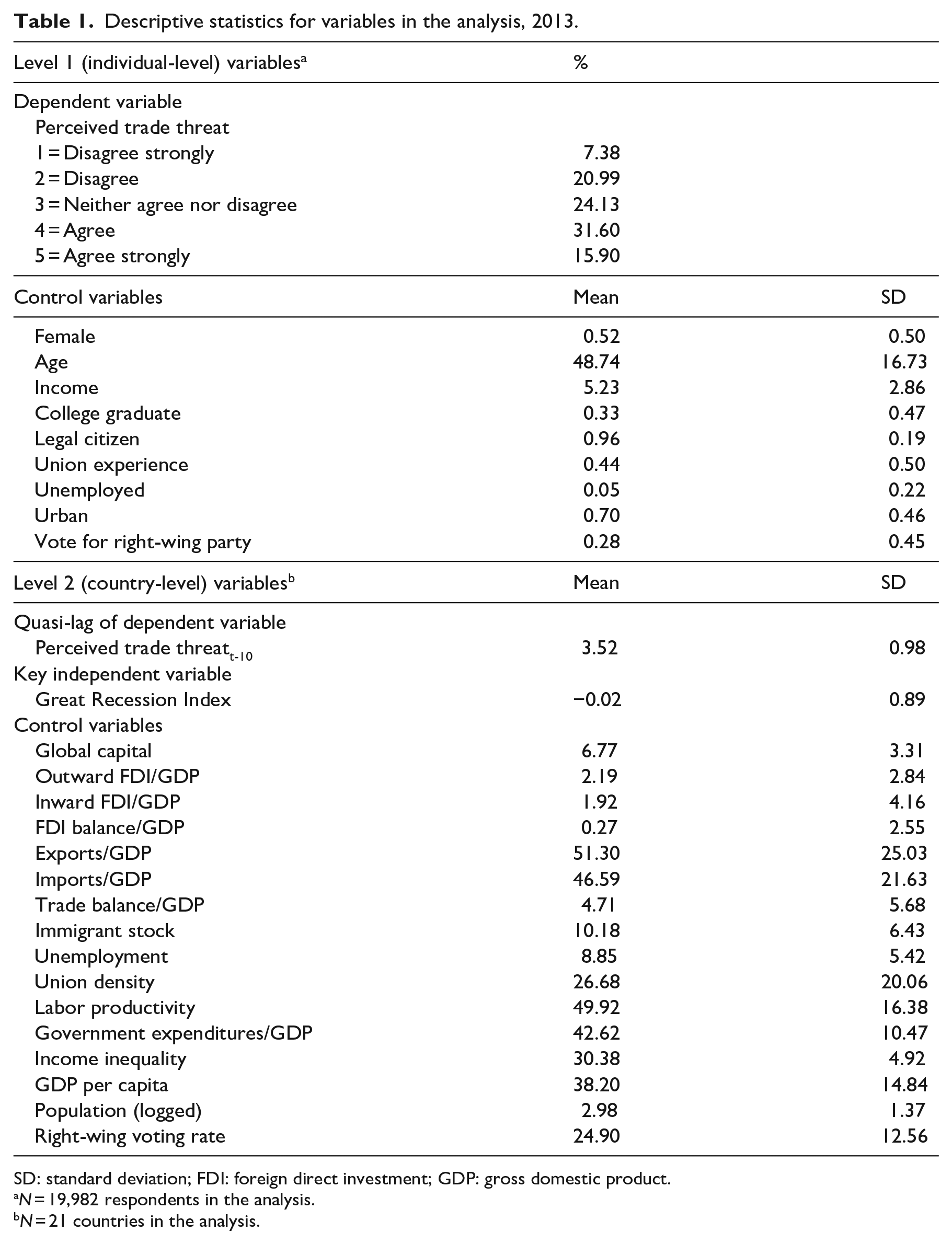
Table 1 displays descriptive statistics for variables in the analysis. In 2013, the proportion of individuals expressing anti-trade sentiment (47.50% = 31.60% + 15.90%) is larger than those who have more favorable attitudes toward imports (28.37% = 7.38% + 20.99%). Among country-level variables, the country mean of the quasi-lag of the dependent variable is 3.52, which shows that the majority of respondents felt threat from imports of foreign products in 2003. This finding suggests that overall public hostility toward international trade was strong even before the GR occurred, supporting the citizens-as-workers perspective.
Descriptive statistics for variables in the analysis, 2013.
SD: standard deviation; FDI: foreign direct investment; GDP: gross domestic product.
N = 19,982 respondents in the analysis.
N = 21 countries in the analysis.
Figure 1 graphically portrays the country-level combined percent of “strongly agree” and “agree” responses for PTT, ranked from highest to lowest in 2013 (the striped bars), alongside the same combination for 2003 (the light bars) and the changes in anti-trade sentiment between 2003 and 2013 (the dark bars). In 2013, Latvia (71.9%) and France (69.1%) expressed the most negative views toward trade, and Japan (28.1%) and Norway (28.2%) had the least. Also, three East Asian countries—Japan, South Korea, and Taiwan—and four Scandinavian countries—Denmark, Finland, Norway, and Sweden—had relatively low anti-trade sentiment in 2013. For 2003, Latvia (66.9%) and Slovakia (65.8%) showed the highest anti-trade sentiment, and Sweden (28.9%) and Finland (34.1%) had the least. Between 2003 and 2013, Ireland (−15.6% points) and South Korea (−13.6% points) experienced the greatest decline in anti-trade sentiments, whereas France (+ 17.4% points) and Switzerland (+ 12.8% points) experienced the greatest increase. In general, public concern about international trade over the 10-year period tended to increase in Western and Eastern European countries but declined in East Asian and Scandinavian countries.
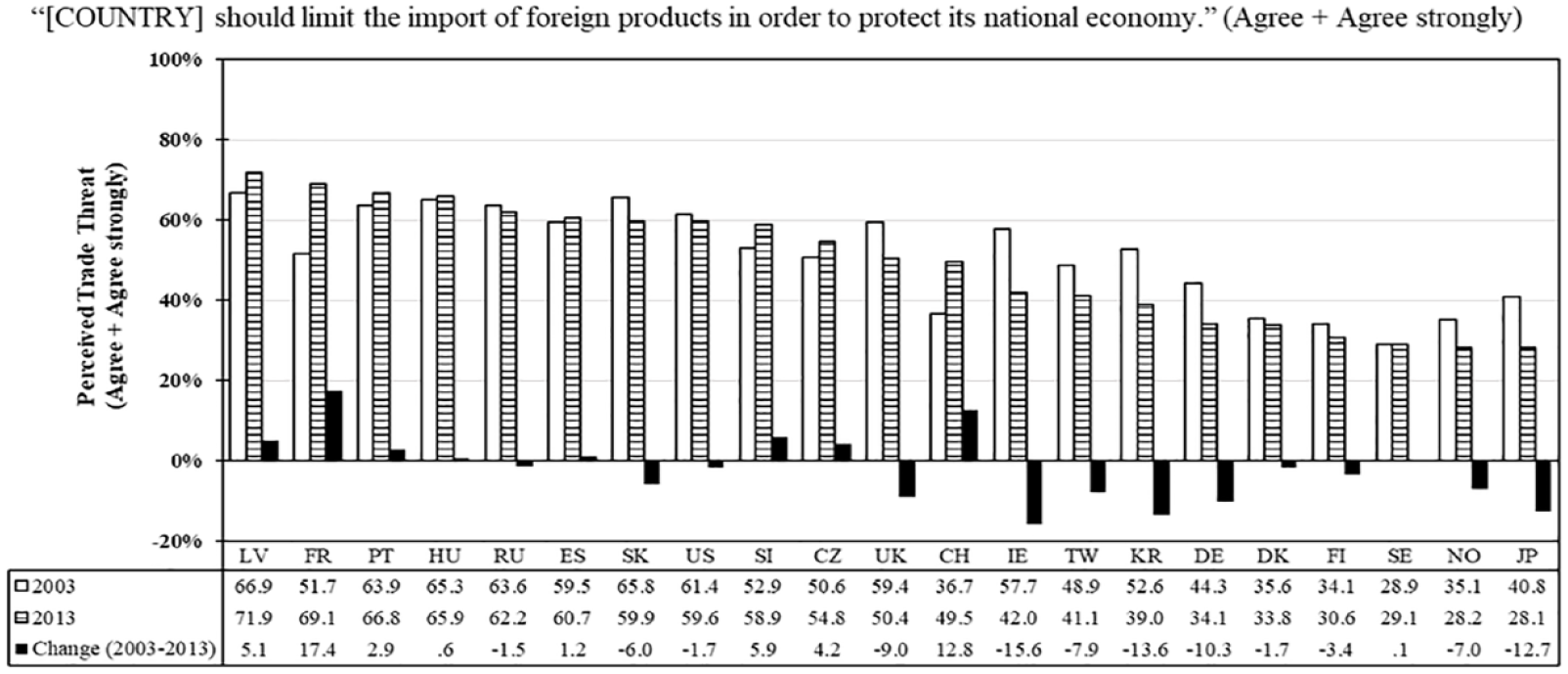
Distribution of perceived trade threat for 21 countries.
Individual-level determinants of PTT
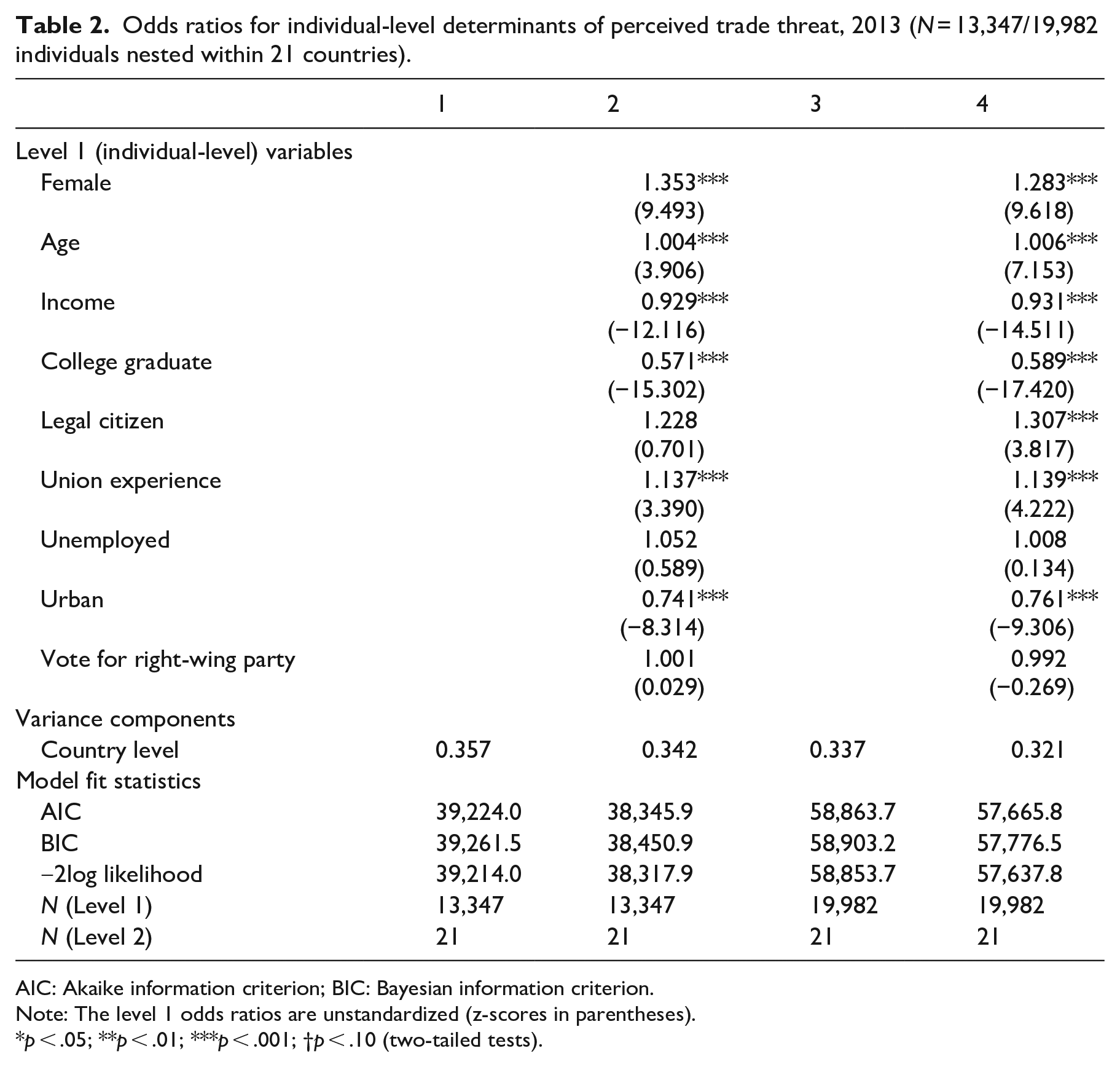
Table 2 presents individual-level determinants of PTT using both the unmodified (N = 13,347) and modified (N = 19,982) versions of vote for right-wing party. Model 1 presents the unconditional model for the smaller sample and shows that the between-country variance is .357. Because the variance of the logistic distribution is π2/3, the intraclass correlation coefficient (ICC) is .098 (= .357/[.357 +π2/3)), meaning that the proportion of variance to be explained by country-level variables is 9.8 percent.
Odds ratios for individual-level determinants of perceived trade threat, 2013 (N = 13,347/19,982 individuals nested within 21 countries).
AIC: Akaike information criterion; BIC: Bayesian information criterion.
Note: The level 1 odds ratios are unstandardized (z-scores in parentheses).
p < .05; **p < .01; ***p < .001; †p < .10 (two-tailed tests).
Model 2 enters nine individual-level covariates including the unmodified version of vote for right-wing party. We see that six covariates have statistically significant effects on PTT. Women, older people, those with lower incomes, those without college degrees, those who are currently or previously union members, and rural residents have higher levels of PTT, suggesting these groups have stronger identities as workers than as consumers. However, being a legal citizen or unemployed has no statistically significant effect. These results are largely consistent with previous research on individual attitudes toward international trade (Ahlquist et al., 2019; Hainmueller and Hiscox, 2006; Mansfield and Mutz, 2009; Mayda and Rodrik, 2005; Scheve and Slaughter, 2001). In addition, we find that respondents’ support for right-wing politics has no significant effect on anti-trade sentiments. 7 Thus, while some previous research finds that protectionism leads to support for right-wing politics (Van Der Waal and De Koster, 2018), we find no support for the reverse causal connection—that support for right-wing politics causes anti-trade sentiments.
Model 3 presents the unconditional model for the enlarged sample and shows that the between-country variance is .337, leading to an ICC of .093 (= .337/[.337 +π2/3)), yielding a proportion of variance to be explained by country-level variables is 9.3 percent. Model 4 enters the same nine covariates as in Model 2 but substitutes the modified version of vote for right-wing party. These results are virtually identical to those of Model 2. All covariates except legal citizen have the same effects and levels of significance. Legal citizen, which was nonsignificant in Model 2, is now highly significant. This is anticipated since persons who are not citizens cannot vote in most of the countries in our analysis, causing their values on the modified vote for right-wing party variable to be 0. Importantly, the modified right-wing variable has a very similar nonsignificant effect as the unmodified version. Based on this—and the fact that the ICCs in Models 1 and 3 are virtually identical—we made the strategic decision to use the modified version in the multilevel analysis to retain 6635 cases.
The impact of the GR
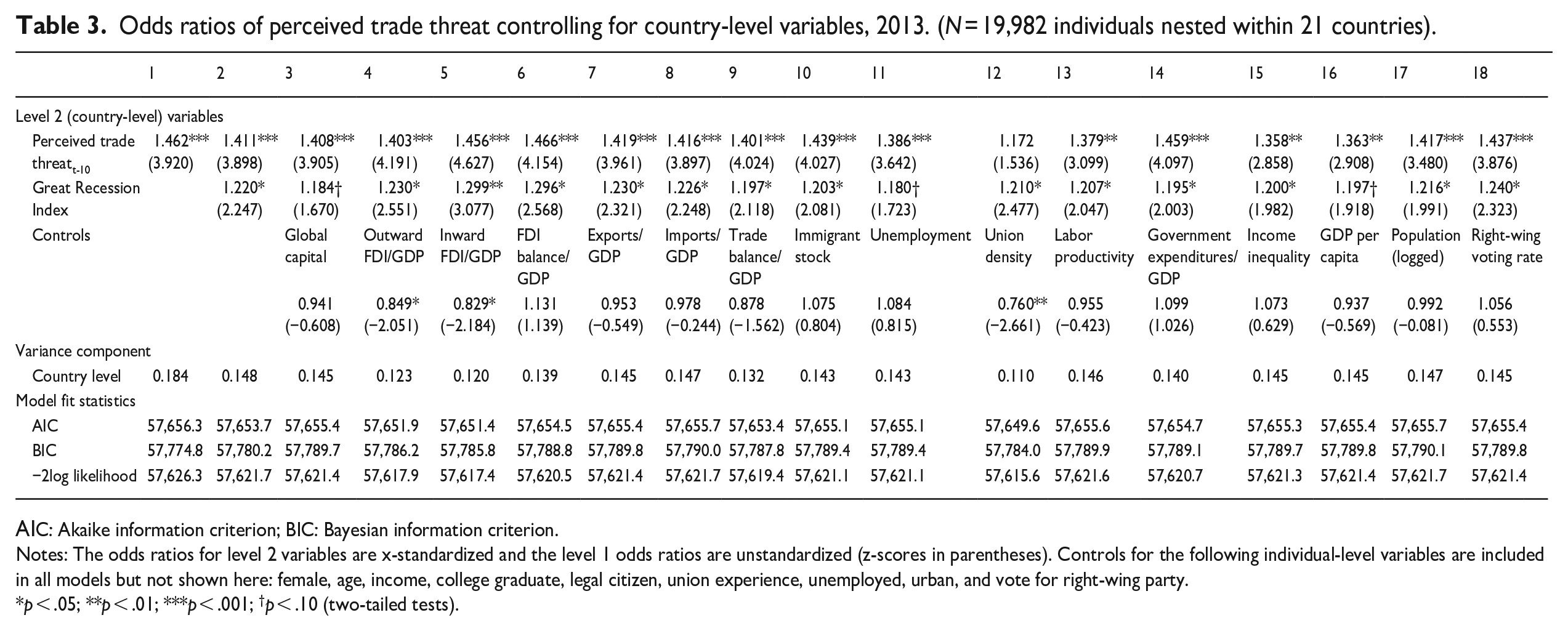
Table 3 presents odds ratios predicting PTT of the GRI and other country-level covariates for 2013. Individual-level covariates from Table 2, Model 2 are included in the models, but their effects are not shown as they deviate very little from those shown in Table 2. 8 In Model 1, we find that the 10-year quasi-lag of PTT is positively related to PTT, indicating that a country’s modal attitude toward trade in 2003 is a strong determinant of individual respondents’ PTT in 2013. In Model 2, we add the GRI and find that it has a positive impact on PTT, which supports the claim of the citizens-as-workers perspective that the GR increases anti-trade attitudes. The effect of the quasi-lag is slightly reduced but retains its significance.
Odds ratios of perceived trade threat controlling for country-level variables, 2013. (N = 19,982 individuals nested within 21 countries).
AIC: Akaike information criterion; BIC: Bayesian information criterion.
Notes: The odds ratios for level 2 variables are x-standardized and the level 1 odds ratios are unstandardized (z-scores in parentheses). Controls for the following individual-level variables are included in all models but not shown here: female, age, income, college graduate, legal citizen, union experience, unemployed, urban, and vote for right-wing party.
p < .05; **p < .01; ***p < .001; †p < .10 (two-tailed tests).
Next, using Model 2 as a baseline, we add the other 16 country-level covariates one at a time in Models 3 through 18 to see if any of them affect the relationship between the GRI and PTT. Here, we find that only three of the 16 covariates achieve statistical significance—outward FDI/GDP, inward FDI/GDP, and union density have negative effects on PTT. First, people who live in countries with high levels of FDI outflow and inflow are more likely to have favorable attitudes toward imports of foreign products. Also, the negative direction of the odds ratio for trade balance/GDP nearly achieves statistical significance (z > 1.50), suggesting that people in countries with greater exports than imports may be less threatened by imports. Liberalization of the capital market, along with international trade, is a prominent process of neoliberal policy that maximizes the interests of the private business sector (Harvey, 2005; Stiglitz, 2004). This result suggests that pervasive neoliberal policies oriented toward capital market liberalization may help foment optimistic views about international trade, but conclusive evidence to support this claim would require further research. Second, the negative effect of union density suggests that unions may reduce anti-trade attitudes because labor unions play a significant role in bending national trade policies to benefit workers (Bradford, 2006), including creating tariffs on imports and incentives to export-dominant industries. Notably, whereas we found that personal experience of labor unions increases PTT in Table 2, country-level union density decreases PTT. This suggests that while unions heighten their members’ awareness and concerns about trade as workers, unions as institutions are effective in mitigating these concerns by shaping policies that protect unionized workers from trade-related job losses and income declines. The quasi-lag retains statistical significance throughout most models in Table 3, suggesting that there is a strong carryover of national attitudes about PTT from 2003 to 2013. The one exception is Model 12, which controls for union density, but the direction of the quasi-lag effect is still positive, and the z-score exceeds 1.50.
Importantly, in Models 3 through 18, we find that the association between the GRI and PTT remains statistically significant in all 16 models at p < .10 and in 13 of 16 models—all except global capital, unemployment, and GDP per capita—at conventional levels (p < .05). These findings support the citizens-as-workers perspective that the GR raised awareness of the negative influence of trade for workers’ lives, even after controlling for numerous plausible national characteristics that might serve as alternative explanations.
In additional models not shown here, we re-ran 15 of 16 models substituting percentage change in the country-level covariates in place of their 2013 levels (percentage change in right-wing voting could not be calculated for lack of the 2003 measure) to further test the robustness of our findings. As before, we included the quasi-lag and the GRI in all 15 models. Once again, we find a consistently positive, significant effect of the GRI on PTT. 9 Overall, both sets of findings overwhelmingly support the claim of citizens-as-workers that the GR intensified citizens’ anti-trade attitudes.
Interaction effects of the GR
Just as the duration and intensity of the GR may vary across countries, the effects of the GR on PTT may not be uniform for all citizens within a country. Citizens in more or less privileged positions or in societal locations where they are either shielded from or vulnerable to the Recession’s effects may experience the GR differently. These different experiences, in turn, may differentially affect their attitudes toward foreign imports. Therefore, while the results shown thus far favor the citizen-as-worker interpretation, that interpretation may be stronger or weaker for different members of the population.
To explore this possibility, we next examine interaction effects between the GRI and each of the individual- and country-level covariates that affect PTT. As with the main effects, we do not explicitly hypothesize the effects of these interactions, noting only that most would regard them as plausible alternatives. While we examined results for all possible interactions between the GRI and both individual- and country-level variables, we present only those interactions that we found to be statistically significant at p < .05 to emphasize strong results. Table 4 presents six interaction effects: four cross-level interaction effects, one country-level interaction for 2013, and one additional interaction from the supplementary analyses using percentage change in country-level covariates from 2003 to 2013. We also portray these same interaction effects graphically in Figure 2, with Panel 1 illustrating the cross-level interactions and Panel 2 showcasing the country-level interactions. To facilitate interpretation, in the figures we display only the slopes for the two highest outcomes, Outcome 4 (“agree”) and Outcome 5 (“agree strongly”) of the dependent variable PTT, which conceptually distinguished between the two most negative attitudes toward trade as shown in Figure 1. 10 For the interpretation of country-level interactions, we compare the effects of the GR between a hypothetical country that falls one standard deviation below the mean of the country-level covariate and another hypothetical country that falls one standard deviation above the mean.
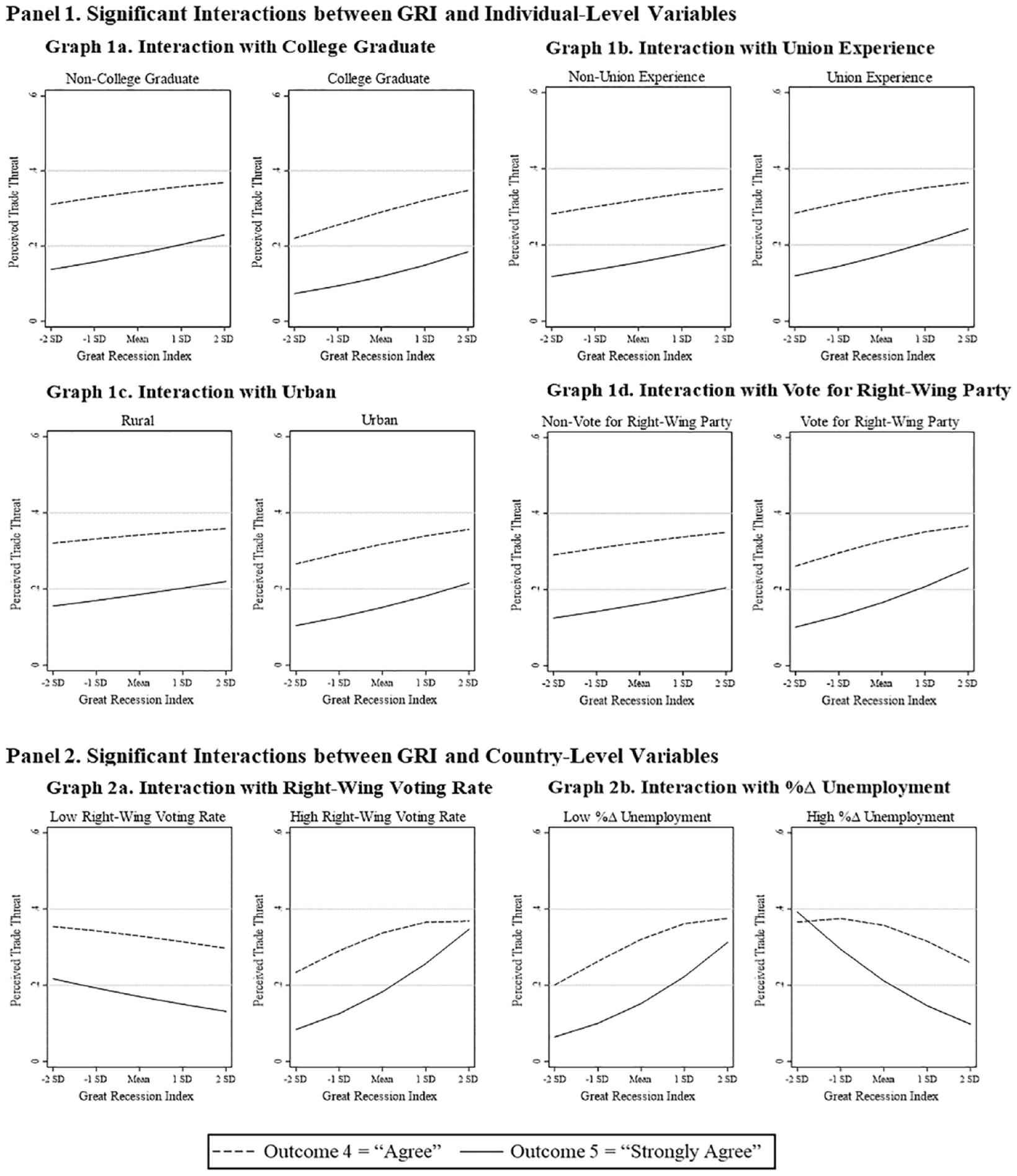
Interaction effects on perceived trade threat.
Interaction effects of perceived trade threat, 2013. (N = 19,982 individuals nested within 21 countries).
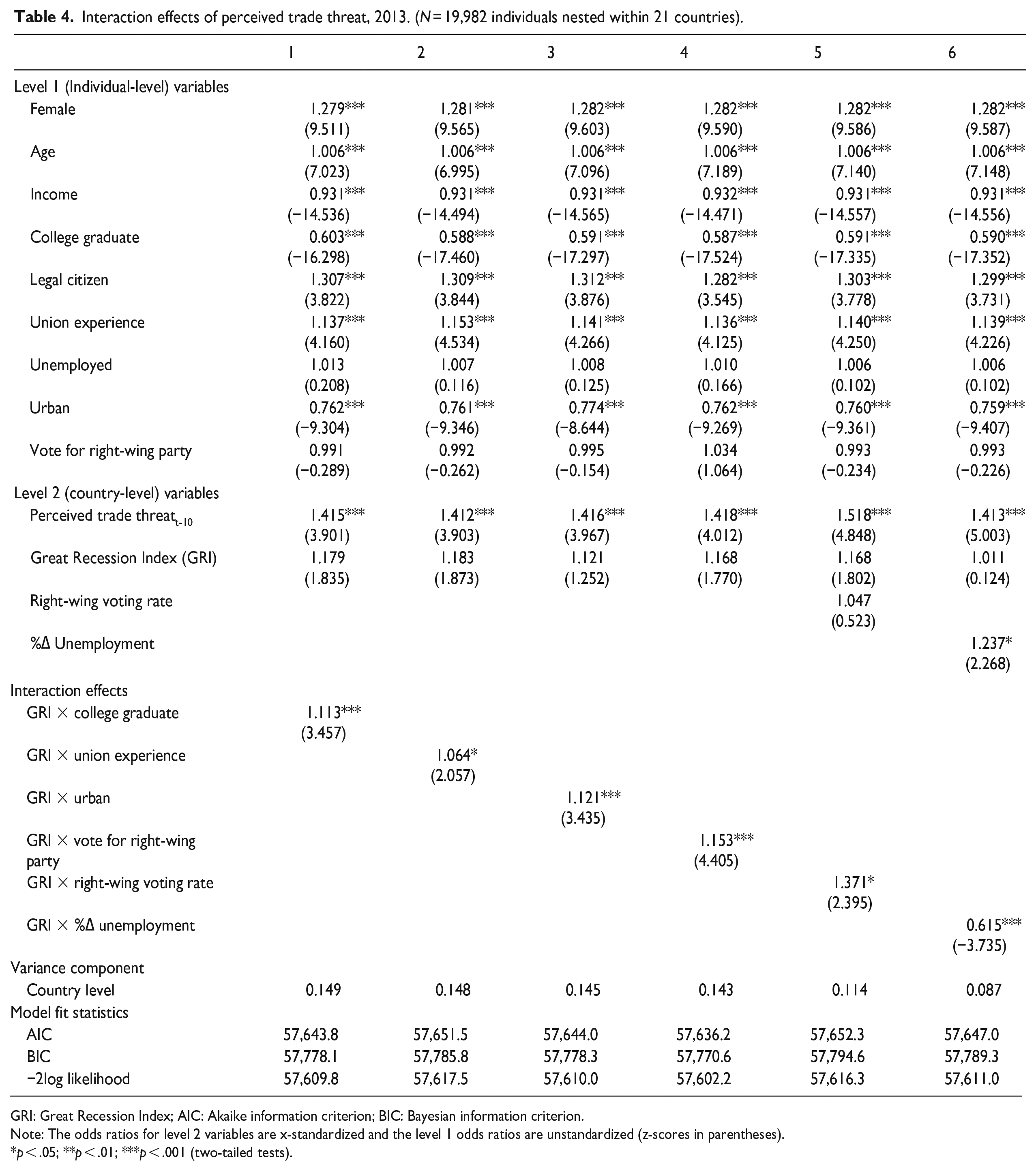
GRI: Great Recession Index; AIC: Akaike information criterion; BIC: Bayesian information criterion.
Note: The odds ratios for level 2 variables are x-standardized and the level 1 odds ratios are unstandardized (z-scores in parentheses).
p < .05; **p < .01; ***p < .001 (two-tailed tests).
In Model 1, the positive interaction of the GRI with college graduate indicates that, as the GR becomes more severe, the positive effect of the GRI on PTT increases at a faster rate for college-degree holders than non-college-degree holders. This is graphically shown in Panel 1, Graph 1a of Figure 2 where high levels of PTT of non-college graduates increase more slowly than the college graduates as the GR worsens, although generally those without college degrees have a higher level of PTT than college-degree holders. This finding shows that anti-trade sentiments of those with relatively lower education are less affected by the severity of the GR—presumably because cheap foreign products are more beneficial in easing the brunt of economic hard times for low-educated workers with low job security.
In Model 2, the interaction between GRI and union experience is positive, suggesting that, as the severity of the GR increases, those who are currently or previously union members show steeper increases in negative attitudes about imports than those without union experience. This result is illustrated in Panel 1, Graph 1b in Figure 2 where those who have union experience have slightly steeper upward-sloping levels of PTT than those without union experience as the effect of the GR intensifies. This finding shows that those who achieve a strong identity as workers through union experience have higher PTT as the impact of the GR intensifies.
Model 3 shows that the interaction effect of the GRI with urban is positive and significant, suggesting that concerns about foreign products increase more rapidly among urban residents as the GR intensifies. In Panel 1, Graph 1c of Figure 2, urban residents have lower levels of PTT at low levels of severity of the GR, but their levels increase more sharply than rural residents as the Recession grows more severe. Wage workers are most heavily concentrated in urban areas, so the GR might drive them to project their threats about job insecurity onto imported products.
Model 4 shows that the interaction of the GRI with vote for right-wing parties in the last election is positive and significant, which suggests that, as the GR worsens, right-wing party supporters’ PTT increases at a faster rate than those who do not support right-wing parties. In Panel 1, Graph 1d of Figure 2, the graphic presentation shows that the slopes of high levels of PTT for right-wing party supporters increase faster than those for non-right-wing party supporters as the intensity of the GR increases. This result indicates that, as the GR worsens, those who support right-wing political parties are more likely to feel increased threats regarding job insecurity due to increasing imports of foreign products.
Model 5 shows that the country-level interaction between the GRI and the right-wing voting rate is positive and significant, providing evidence that right-wing voting is a strong national-level context that influences PTT as the severity of the GR intensifies. Panel 2, Graph 2a of Figure 2 highlights that in countries with low right-wing voting rate, PTT decreases as the severity of the GR increases. On the contrary, in countries with a high right-wing voting rate, PTT increases as the severity of the GR increases. This result, in line with the cross-level interaction with individual voting for right-wing parties found in Model 4, shows the effects of right-wing support in fostering anti-trade sentiments of citizens-as-workers after the GR.
Finally, Model 6 shows that the interaction between the GRI and the percentage change in unemployment rates from 2003 to 2013 is negative and significant, suggesting that as the severity of the GR increases, rising unemployment rates decrease PTT. In Graph 2b, Panel 2 of Figure 2, the graph shows that countries with a small change in unemployment rates have upward-sloping effects on high levels of PTT as the GR intensifies, whereas countries with large increases in unemployment rates have downward-sloping effects. Economic decline combined with a rapid growth of unemployment indirectly signals consumers to prepare for future economic hardship and directly reduce their purchasing power due to wage cuts and job losses. This finding suggests that those in countries with growing unemployment favor imports of cheap products during the GR presumably because cheaper foreign products allow them to cut back on spending.
Discussion and conclusion
Many studies have examined attitudes toward international trade drawing on international trade theories (Hainmueller and Hiscox, 2006; Mayda and Rodrik, 2005; Scheve and Slaughter, 2001, 2006), but a systematic understanding of how the economic crises impact anti-trade sentiment remains underdeveloped. Given this fact, in this research we have not intended to present a comprehensive theoretical explanation of anti-trade attitudes; rather, our goal has been more narrowly to understand how the GR, both directly and indirectly through its interaction with demographic and structural features of society, might have influenced PTT. Due to the limitations of our dataset and research design, our results should not be regarded as definitive. Rather, our research provides a set of plausible hypotheses—stepping stones, if you will—that can be more rigorously tested by future researchers to develop more theoretically-driven accounts of the link between economic crises and attitudes about trade policy across various groups and countries.
In this article, we investigated two competing perspectives to explain how the GR affected citizens’ PTT. The citizens-as-workers perspective argues that imported goods pose a severe threat to job security for workers, so PTT increases during the GR. By contrast, the citizens-as-consumers perspective suggests that PTT decreases during the GR as imports provide better opportunities for cheaper consumer goods. To test how the dual identities of citizens as workers and consumers play a role in shaping the effects of the GR on PTT, we devised a GRI comprised of four country-level components of the economic crisis of 2007–2010: the housing crash, the financial crisis, economic decline, and employment loss. We then examined a series of multilevel ordered logit models for 19,982 individuals nested within 21 countries, using the 2003 and 2013 ISSP which is ideally sequenced to capture the impact of the GR of 2007–2010.
Our analysis supports the citizens-as-workers perspective for PTT. We found that the GRI has a positive, significant effect on PTT, suggesting that citizens prioritize their role as workers over their role as consumers when faced with the increased threat of imported foreign products. Furthermore, in the interaction of the GRI with union experience, we found that unions help consolidate the citizens’ identities as workers and sensitize them to the threat that foreign products might pose to job losses and wage cuts.
The findings of the citizens-as-workers perspective have important implications for how anti-trade sentiment relates to the current upsurge of right-wing populist politics. Since the GR has worsened PTT among the supporters of right-wing parties and those living in countries with high right-wing voting rates, the promise of protectionism as a path to improve economic insecurity from populist politicians might be seen as embracing the identity of citizens-as-workers. While our analysis did not establish a direct connection between voting for right-wing populists and PTT, the increasing popularity of populist politics may have exploited the economic distress of citizens-as-workers who had heightened anti-trade sentiments after the GR.
Despite dominant anti-trade sentiments after the GR, some evidence in the interaction analyses suggests that the citizens-as-consumers perspective is also at play. The positive interaction between the GRI and college graduates shows that low-educated, low-skilled workers are less likely to be influenced by their identities as workers during economically depressed periods because cheap foreign products offer some relief to their economic situation, supporting their roles as citizens-as-consumers. Also, the negative interaction between the GRI and percentage change in unemployment from 2003 to 2013 shows that the GR combined with increased unemployment might decrease public concerns about international trade by prioritizing citizens’ identities as consumers.
These findings favoring the citizens-as-consumers perspective suggest that consumers can resist protectionism. Despite the possible threat that imported foreign products pose to workers’ job security, there is little doubt that cheaper and high-quality imported goods promoted through powerful retail entities like Walmart and e-commerce firms like Amazon assuage those concerns and encourage efficient shopping as a path to economic security. Notwithstanding their roles as workers, when faced with uncertain economic times, citizens seek out cheaper products to stretch their budgets and maintain their current consumption levels when their economic security is unstable. This result shows that although anti-trade sentiments of citizens-as-workers were dominant after the GR, a subterranean citizens-as-consumers sentiment may have helped counteract a protectionist backlash.
Despite several strengths, our research encountered some limitations which we hope can be overcome in future research. As a strength, the research design draws on ISSP surveys which occur in 2003 and 2013, years which fortuitously occur before and after the GR. This design allows us to evaluate changes in PTT over the decade-long period which are likely attributable to the intervening GR. However, the country-level sample size (N = 21) constrains the ability to estimate a fully specified model with several covariates at a time, which constitutes a trade-off. In addition, we would have liked to have fuller representation of countries, particularly more of the affluent democracies which are the best situated to test our theories. Finally, some countries were dropped from the analysis because the PTT question was not available in the earlier survey. That said, the shortcomings point to three major recommendations for future international surveys on these issues. Future datasets investigating these topics should strive for (a) a greater sampling of countries including broader representation of the world’s affluent democracies; (b) a strong longitudinal component, to provide as much comparable data over time with as many countries as possible; and (c) uniformity of questions in different national settings and over time. This would provide greater opportunity to examine these issues in the future when economic downturns occur (as they inevitably will).
While our research has supported the idea that economic globalization can impact citizens’ roles as workers and consumers, we leave many open questions for future research. First, how permanent or transitory are the effects that we found? Does the experience of the GR have long-lasting effects or do those effects dissipate over time? Second, do all economic downturns predominantly affect citizens’ roles as workers, as we found here, or do some have larger implications for citizens’ roles as consumers? Third, are there national variations in how economic downturns affect citizens’ attitudes about trade and, if so, what factors are likely to shape those variations? Fourth, how can we tease out the complicated ways in which institutional and personal factors interact with economic downturns to shape attitudes toward trade? Our findings regarding unions are instructive here: We found that while unions sensitize their members to the threat of foreign trade, unions as institutions are successful in bending trade policy in a favorable direction for their members. Fifth, how does the complicated relationship between economic downturns and citizens’ roles as consumers and workers influence their susceptibility to the appeals of populist politicians who offer simplistic solutions based on protectionism and nativism? While our findings relating to the citizens-as-workers perspective provide a nuanced view on this question, future research should explore the direct connection between rising populist politics and citizens’ responses to the GR in greater depth by addressing more fully the issue of reverse causality between support for populist politics and anti-trade sentiments. Finally, as recent experience with the coronavirus pandemic reminds us, economic crises are endemic to capitalist economies and their multi-faceted impacts on a variety of outcomes for nations and ordinary citizens deserves our urgent attention.
Footnotes
Appendix
Variables, descriptions, and sources.
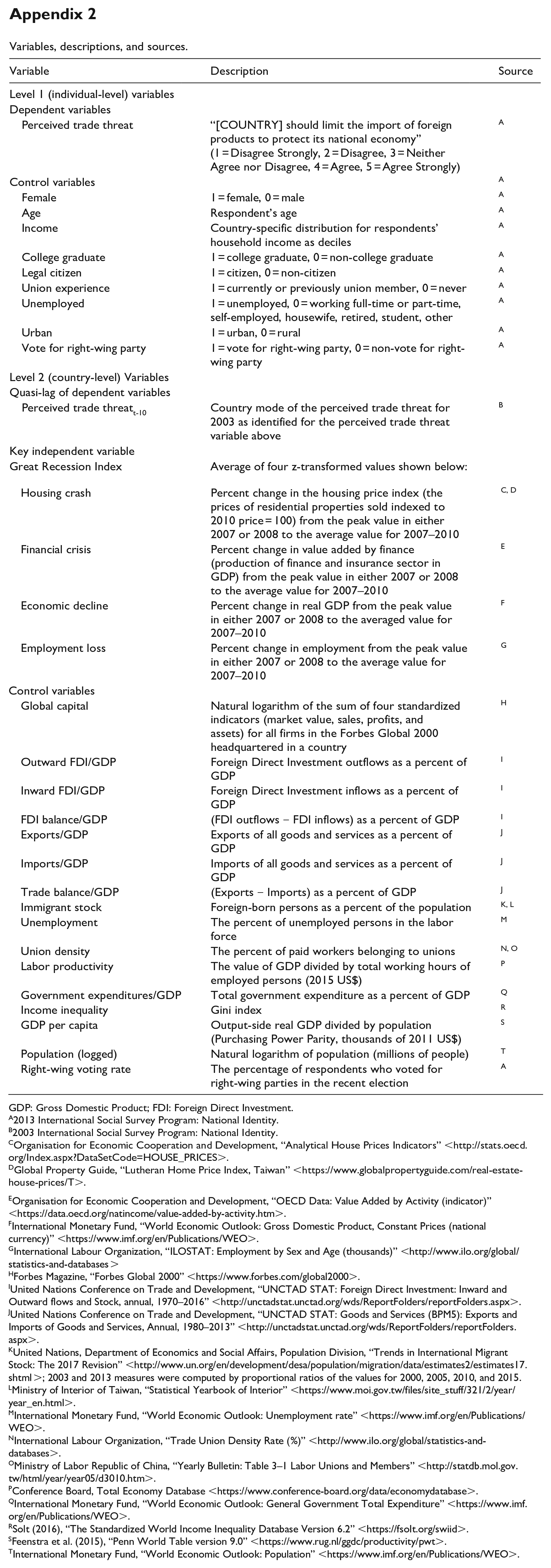
| Variable | Description | Source |
|---|---|---|
| Level 1 (individual-level) variables | ||
| Dependent variables | ||
| Perceived trade threat | “[COUNTRY] should limit the import of foreign products to protect its national economy” (1 = Disagree Strongly, 2 = Disagree, 3 = Neither Agree nor Disagree, 4 = Agree, 5 = Agree Strongly) | A |
| Control variables | A | |
| Female | 1 = female, 0 = male | A |
| Age | Respondent’s age | A |
| Income | Country-specific distribution for respondents’ household income as deciles | A |
| College graduate | 1 = college graduate, 0 = non-college graduate | A |
| Legal citizen | 1 = citizen, 0 = non-citizen | A |
| Union experience | 1 = currently or previously union member, 0 = never | A |
| Unemployed | 1 = unemployed, 0 = working full-time or part-time, self-employed, housewife, retired, student, other | A |
| Urban | 1 = urban, 0 = rural | A |
| Vote for right-wing party | 1 = vote for right-wing party, 0 = non-vote for right-wing party | A |
| Level 2 (country-level) Variables | ||
| Quasi-lag of dependent variables | ||
| Perceived trade threatt-10 | Country mode of the perceived trade threat for 2003 as identified for the perceived trade threat variable above | B |
| Key independent variable | ||
| Great Recession Index | Average of four z-transformed values shown below: | |
| Housing crash | Percent change in the housing price index (the prices of residential properties sold indexed to 2010 price = 100) from the peak value in either 2007 or 2008 to the average value for 2007–2010 | C, D |
| Financial crisis | Percent change in value added by finance (production of finance and insurance sector in GDP) from the peak value in either 2007 or 2008 to the average value for 2007–2010 | E |
| Economic decline | Percent change in real GDP from the peak value in either 2007 or 2008 to the averaged value for 2007–2010 | F |
| Employment loss | Percent change in employment from the peak value in either 2007 or 2008 to the average value for 2007–2010 | G |
| Control variables | ||
| Global capital | Natural logarithm of the sum of four standardized indicators (market value, sales, profits, and assets) for all firms in the Forbes Global 2000 headquartered in a country | H |
| Outward FDI/GDP | Foreign Direct Investment outflows as a percent of GDP | I |
| Inward FDI/GDP | Foreign Direct Investment inflows as a percent of GDP | I |
| FDI balance/GDP | (FDI outflows ‒ FDI inflows) as a percent of GDP | I |
| Exports/GDP | Exports of all goods and services as a percent of GDP | J |
| Imports/GDP | Imports of all goods and services as a percent of GDP | J |
| Trade balance/GDP | (Exports ‒ Imports) as a percent of GDP | J |
| Immigrant stock | Foreign-born persons as a percent of the population | K, L |
| Unemployment | The percent of unemployed persons in the labor force | M |
| Union density | The percent of paid workers belonging to unions | N, O |
| Labor productivity | The value of GDP divided by total working hours of employed persons (2015 US$) | P |
| Government expenditures/GDP | Total government expenditure as a percent of GDP | Q |
| Income inequality | Gini index | R |
| GDP per capita | Output-side real GDP divided by population (Purchasing Power Parity, thousands of 2011 US$) | S |
| Population (logged) | Natural logarithm of population (millions of people) | T |
| Right-wing voting rate | The percentage of respondents who voted for right-wing parties in the recent election | A |
GDP: Gross Domestic Product; FDI: Foreign Direct Investment.
2013 International Social Survey Program: National Identity.
2003 International Social Survey Program: National Identity.
Organisation for Economic Cooperation and Development, “Analytical House Prices Indicators” <http://stats.oecd.org/Index.aspx?DataSetCode=HOUSE_PRICES>.
Global Property Guide, “Lutheran Home Price Index, Taiwan” <https://www.globalpropertyguide.com/real-estate-house-prices/T>.
Organisation for Economic Cooperation and Development, “OECD Data: Value Added by Activity (indicator)” <https://data.oecd.org/natincome/value-added-by-activity.htm>.
International Monetary Fund, “World Economic Outlook: Gross Domestic Product, Constant Prices (national currency)” <https://www.imf.org/en/Publications/WEO>.
International Labour Organization, “ILOSTAT: Employment by Sex and Age (thousands)” <http://www.ilo.org/global/statistics-and-databases >
Forbes Magazine, “Forbes Global 2000” <https://www.forbes.com/global2000>.
United Nations Conference on Trade and Development, “UNCTAD STAT: Foreign Direct Investment: Inward and Outward flows and Stock, annual, 1970–2016” <http://unctadstat.unctad.org/wds/ReportFolders/reportFolders.aspx>.
United Nations Conference on Trade and Development, “UNCTAD STAT: Goods and Services (BPM5): Exports and Imports of Goods and Services, Annual, 1980–2013” <http://unctadstat.unctad.org/wds/ReportFolders/reportFolders.aspx>.
United Nations, Department of Economics and Social Affairs, Population Division, “Trends in International Migrant Stock: The 2017 Revision” <http://www.un.org/en/development/desa/population/migration/data/estimates2/estimates17.shtml >; 2003 and 2013 measures were computed by proportional ratios of the values for 2000, 2005, 2010, and 2015.
Ministry of Interior of Taiwan, “Statistical Yearbook of Interior” <https://www.moi.gov.tw/files/site_stuff/321/2/year/year_en.html>.
International Monetary Fund, “World Economic Outlook: Unemployment rate” <https://www.imf.org/en/Publications/WEO>.
International Labour Organization, “Trade Union Density Rate (%)” <http://www.ilo.org/global/statistics-and-databases>.
Ministry of Labor Republic of China, “Yearly Bulletin: Table 3–1 Labor Unions and Members” <http://statdb.mol.gov.tw/html/year/year05/d3010.htm>.
Conference Board, Total Economy Database <https://www.conference-board.org/data/economydatabase>.
International Monetary Fund, “World Economic Outlook: General Government Total Expenditure” <https://www.imf.org/en/Publications/WEO>.
Solt (2016), “The Standardized World Income Inequality Database Version 6.2” <https://fsolt.org/swiid>.
Feenstra et al. (2015), “Penn World Table version 9.0” <https://www.rug.nl/ggdc/productivity/pwt>.
International Monetary Fund, “World Economic Outlook: Population” <https://www.imf.org/en/Publications/WEO>.
Funding
The author(s) received no financial support for the research, authorship, and/or publication of this article.
