




Abstract
Unlike left outsiders in contexts of steadfast traditional opposition in Latin America, Fernando Lugo refrained from intensifying the conflict with the political establishment and mobilizing subaltern groups to push through progressive policies after winning the 2008 elections. Ultimately, conservative interests pushed through impeachment proceedings and forced him out of office prematurely, and Lugo yielded to their will instead of using the interbranch stalemate to instigate popular resistance. For their part, the popular sectors did not mobilize to pressure the Lugo government, nor did they stand firmly against the president’s impeachment. The article aims to answer why Lugo flopped as a political broker and why Paraguayans did not mobilize to Lugo’s defense by developing a two-level argument that combines the institutional supply side that determines the actors’ mobilization capacity and the demand side of movement issue-framing that conditions actors’ willingness to mobilize. First, the organizational and representative pathologies of the left parties persisted into Lugo’s reign and curtailed the capacity of the mobilization brokers to forge ties between otherwise separate organizations in society and to serve as a veto gate in power centers. Second, community leaders and social actors did not engage in active issue-framing processes to construct new meanings to orient their collective action. The article draws on interview data, public opinion polls, and archival works to substantiate the argument and contributes to social movement literature by highlighting the role of political leadership’s strategic choices and its interactions with opponents and allies (inside and outside power centers) in realizing favorable political opportunity and remolding clientelistic ties to mobilize social constituencies.
Keywords
Introduction
The economic crisis that hit the region in the 1980s impaired states’ fiscal capacity and pushed for the implementation of market liberalization measures accompanied by institutional transformations. Traditional parties had to recast their societal linkages and their competitive alignments to execute bold market-oriented measures and reposition themselves programmatically rightward on the political spectrum (Roberts, 2015). Some parties succeeded in re-establishing their linkage portfolio to social constituents and re-building support coalition along either a “neo-corporatist re-regulation project” (Snyder, 1999) that re-organized social supporters for the new policy orientation into a new institutional framework (such as the Institutional Revolutionary Party—PRI—in Mexico) or selective “clientelistic networks” that developed personal ties with neighborhood brokers and local caudillos to preempt dissociation of voters (such as the Peronist Party (PJ) in Argentina) (Levitsky, 2005). Other political parties, however, failed to adopt an adaptive strategy to remain electorally viable and avert voter dealignment, paving the way for political outsiders and/or populist leaders to assume power and reshape state structure (as it happened in Venezuela, Bolivia, 1 Ecuador, and Nicaragua).
The rise of the populist left to power in Latin America against the backdrop of fervent supporting popular movement and the entire collapse of the party system (e.g. Chávez in Venezuela and Morales in Bolivia) or fierce electoral contestation (e.g. Ortega in Nicaragua and Correa in Ecuador) offered a conducive Political Opportunity Structure (POS) for empowering popular sectors, transforming policy priorities, and reconfiguring party systems and state institutions. Running on a radical electoral platform that promises the transformation of policy orientation and traditional power structures, articulating a populist discourse that pits “the people” against the “elite,” relying on plebiscitary commendation that aims at wielding sufficient power to bypass legislative and judicial bodies, and promoting participatory democracy that opens opportunities for the hitherto excluded popular sectors have been central components of populist programs in the region to carry out their transformative projects (Roberts, 2021). That is, the ascension of a left outsider offered a political opportunity to re-organize and mobilize the popular sectors beyond the electoral arena as a strategic choice of the political leadership to either consistently intensify the conflict with the intransigent elites (such as Chávez in Venezuela) or instantly leverage its bargaining position vis-à-vis actors in the state institutions (such as Correa in Ecuador and Ortega in Nicaragua).
In Paraguay, the agricultural structure maintained the “stark contrast between vast cattle-raising estates, or latifundios, and a multitude of smallholdings, or minifundios” (Brun, 2021: 138). The peasantry represented a large number of small farmers or tenants and the traditional Colorado (The National Republican Association – ANR-PC) and Liberal party (The Authentic Radical Liberal Party – PLRA) have long maintained their far-flung clientelistic networks through the local branches—seccionales partidarias—which obstructed the emergence of considerably autonomous local organizations of small peasants outside of the state’s outreach and constrained access to state resources (Abente, 2007: 302, 303, 308; Duckworth, 2011: 119, 120; Lambert and Nickson, 1997: 3, 4). The clientelistic networks also increased entry barriers to left political outsiders to capitalize on well-organized constituencies and mobilize party linkages for opposing policy programs. Surprisingly, however, Fernando Lugo, a former bishop and an advocate of liberation theology, shot to prominence when he organized a campaign called “Citizen Resistance” (resistencia ciudadana) to promote political and economic changes in preparation for the 2008 presidential elections.
Lugo mobilized large swathes of activist networks and his electoral campaign appealed to several opposition parties that converged on a common goal to dislodge the Colorado party and terminate its stranglehold on power (Latin American Weekly Report (LAWR), 2006a, 2006b). Lugo ran on a progressive political platform that promised a far-reaching land reform and poverty reduction and drew together different left oppositions and popular sectors under the umbrella of the Patriotic Alliance for Change (La Alianza Patriótica para el Cambio (APC)). 2 He also forged a formal alliance with the traditional Liberal party to counterweight the Colorado-majority congress (Lugo, 2013: 350–354; Palau and Ortega, 2008: 25).
The electoral victory of the APC raised expectations of breaking new ground to restructure party–society linkages along cohesive community-based organizations and multiclass alliance. Contrary to the leftist outsiders, however, Lugo neither depended on any personal qualities to cultivate paternalistic relations with the “people,” nor did he refashion the existing clientelistic ties to develop anti-elitist opposing worldviews that wide disaffected social groups harbor. Traditional elites, ultimately, turned on Lugo and forced him to leave office prematurely after passing an impeachment motion in June 2012, in what became widely known as a “parliamentary coup” (or golpeachment). For their part, the popular sectors did not come to Lugo’s defense and acquiesced to his removal from power. Neither the ascension of a left outsider nor his unseating, therefore, marked a political opportunity to develop new forms of political contention in the country. This begs two interlinked questions: Why did Lugo fall short of organizing the popular sectors as a vehicle to offset strong conservative interests in the state institutions and push through his party-based initiatives? And why did not the popular sectors realize the opportunity of the interbranch impasse under Lugo’s reign, that marked a regime crisis, to mobilize in defense of Lugo and his progressive policy program?
The puzzle and the argument
The rise and fall of Lugo as a political outsider is a puzzling issue: first, he campaigned on a radical platform that mobilized wide segments of society, forged ties and brokered coordination between separate social actors, and assumed power amid a “closed” POS. 3 Lugo’s electoral triumph did not emanate from a culmination of institutional crises of highly volatile or collapsed party systems, nor the erosion of the clientelistic networks that contributed to the transformation of the competitive alignments and enabled the left and/or outsider leaders elsewhere in the region to change leadership patterns, reshape the party system, establish an antagonistic line between the “people” and the oligarchical interests, and assert “plebiscitary” forms of governance to assail the establishment 4 (Foweraker, 2018: 122). On the contrary, the clientelistic parties remained electorally viable, but Lugo succeeded in inducing the aggrieved sectors to break with the clientelistic deal and striking a strategic pact with a traditional party within the establishment. Although the alliance between the APC and the Liberal party diluted Lugo’s progressive discourse, befriending rivals and forming a strategic alliance with traditional forces do not necessarily preclude the formation of a “unified” popular subject or block off opportunity for the articulation of radical demands. Daniel Ortega in Nicaragua formed an alliance with his traditional opponents, most notably the church and some business groups that helped him consolidate his power after winning the elections of 2006. Forming alliances with state actors, therefore, could be used to secure a “legislative shield” in the short run (Thaler, 2017: 157–160) or to split off voters of traditional parties and realign them to the presidential party in the long run. Lugo, however, counted on his rhetoric of policy changes and tended to reconcile conservative and popular sectors’ interests. When the conservative actors in congress blocked the executive’s policies during his short tenure in office, “policy immobilism” did not produce a “favorable” political opportunity for street activism and mobilization of party linkages. The executive refrained from using its veto authority to hedge against the cohesive voting of the conservative parties in Congress and tended to align itself with the core policy areas of the conservative-dominated legislature, instead of mobilizing the masses in defense of the president’s policy program (Hatab, 2023a). Ultimately, Lugo’s topsy-turvy policies isolated the popular sectors and enabled traditional elites to isolate the president and expose him as an ideologically waffling and inept leader. Thus, as much as leadership choices and idiosyncrasies can create political opportunity for mobilization (as it happened in Lugo’s electoral campaign), they can also hinder the realization of an already existing one. The alliance choices of the left leader and his interaction with political opponents and social allies cannot be dealt with as an epiphenomenon of the de facto intense societal conflicts. The agency of political leadership may mitigate or intensify already brewing conflicts and thereby shape or downplay political opportunities to mobilize the masses.
Second, unlike similar situations of the dislocation in the executive-ruling party relations (when the ruling Colorado party was wracked by internal divisions), policy immobilism and the dislocation in executive-legislative relations under Lugo’s rule did not entice the popular sectors into extra-institutional mobilization (Thaler, 2017). Furthermore, mass mobilization across the region was the decisive factor to either unseat unpopular presidents or counterweight opposition to the presidency in Congress (Hochstetler, 2006; Pérez-Liñan, 2014). 5 For example, the popular sectors repeatedly rose up to defend Chávez in Venezuela and served as a bulwark against opposition effort to destabilize his administration in the April 2002 coup. In Paraguay, the widely excluded popular sectors did not mobilize to support Lugo (both in office and after his impeachment) against the traditional elite and agribusiness oligarchs (Corrales, 2002; Gillespie, 1990; Pérez-Liñan, 2007). “Framing political opportunity” (i.e. developing shared beliefs and understanding of a situation) (see Gamson and Meyer, 1996) and heightening issues of urgency, therefore, condition actors’ realization of permissible opportunity, and the lack of realization of opportunity can produce self-fulfilling prophecy.
Paraguay thus represents a “crucial” case that challenges the theoretical proposition of the effect of both party’s extensive clientelistic linkages on demobilization and the conducive POS on social mobilization. The case helps uncover the interaction between the institutional context and the strategic choices of the mobilization “brokers” 6 on one hand, and the underlying beliefs and cognitive realization of permissible opportunities, on the other. I develop a two-level argument that brings together both the supply side of protest brokers and the demand side of issue-framing to a sharp analytical focus. I argue that social actors’ response to a conducive POS (i.e. fluidity of elite alignments, availability of veto players in decision-making bodies, and policy immobilism and interbranch stalemate) to support a left outsider and his party program against lambaste opponents is not automatic. The supply side of the organizational and representational quality of the left brokers determines the mobilization capacity in society. The pre-Lugo organizational and representative pathologies of the left (inter and intra-organizational rivalry, lack of class solidarity, and paternalistic practices of the left parties) persisted into Lugo’s period. The well-positioned progressive president and left parties in office never took on a brokerage role or offered a veto gate to organize the popular sectors and link them closer to the party’s progressive policies and decision-making bodies.
The demand side of the “issue-framing” opportunity, based on actors’ perceptions, rationalization, and realization of elite behavior and choices, determines actor’s willingness to participate in protest activity. Lugo’s choices and the reproduction of left parties’ practices kept the masses from rationalizing the effectiveness of mobilization in support of a progressive political project. Lugo opted for a reconciliatory approach to implement his electoral program, the left partners devoted efforts to preparing for the reelection, and traditional actors in Congress repeatedly blocked the presidential effort to rejig the political rules of the game. Limiting social conflicts and policy changes to electoral cycles pushed wide sectors to either defer to the government to execute its policy program or disenchant entirely from politics.
The methodology of the article is based on original interviews and opinion poll data (Supplementary Appendixes A, B, and C include a list of the interviewees and interviews and survey questions). I offer an in-depth analysis of 21 semi-structured interviews 7 conducted in Paraguay between August and October 2012 with some representatives of prominent grassroots organizations, opposition elites, and academics. Conducting the interviews after 2 months of the impeachment represented an opportunity to capture actors’ immediate reflections on the political dynamics and performance of the Lugo government. I also had access to materials from different national archives and documentation centers in Asunción (the capital) and complemented the analysis with 30 semi-structured interviews with diverse labor and peasantry confederations, left parties, feminist advocacy groups, and members of Lugo’s cabinet conducted by the BASE Investigaciones Sociales 8 and published in December 2012. Finally, I used the archives of the LAWR 9 to further excavate the reflections of the conservative actors that the interview data did not cover.
Next, I put the emergence of Lugo as a consensual candidate in the broader political context that attracted the popular sectors to his electoral program and pushed the traditional Liberal party to strike a deal with him. Second, I focus on the supply side of mobilization showing how the fragmentation of community-based organizations, disarticulation of class identity, and malpractices of left leadership persisted into Lugo’s period, which undermined both the organizational and representative capacity of the left brokers to sustain ties between isolated actors, associations, and organizations in society and/or veto conservative decisions in the state institutions. Third, I examine the demand side of mobilization highlighting the absence of “opportunity framing” that hindered the development of shared understanding and willed away demands for collective action to support the president and his policy initiatives. The fourth section concludes by underscoring the contribution of the Paraguayan case to social movement literature, bringing out the mediating role of the strategic choices of political leadership to effectively broker mobilization, serve as a veto authority, and enable the realization (if not the creation) of political opportunity that stems from both the interbranch stalemate and organized clientelistic party linkages.
The rise of Lugo as a “political outsider”
From the late 1990s through the mid-2000s, diverse social actors capitalized on the internal divisions within the ruling party and organized popular mobilization to resist the privatization measures of some strategic sectors (telecommunications, water, and railroads) and articulate demands for debt reliefs, land redistribution, and agricultural subsidies.
Against the backdrop of releasing General Lino Oviedo (who was sentenced to 10 years in prison on the charge of military mutiny) in 1999, a breakaway faction of Oviedo supporters defected from the ruling Colorado party and formed the National Union of Ethical Citizens (Unión Nacional de Ciudadanos Eticos (Unace)) which added a second largest opposition to the Colorado after the Liberal party in Congress. The dislocation in the executive-ruling party relation fomented fervent peasant protests called Marzo Paraguayo (“Paraguayan (month of) March”) to push through demands for state subsidies, loans, and supporting conditions for cotton production (Corrales, 2002). The events of March 1999 gave a vehement boost to disaffected sectors to articulate socioeconomic grievances and laid the groundwork for subsequent calls for redressing the structural causes of social inequality. When the severe economic crisis and fiscal restraints pushed the executive to undertake bold privatization measures in 2002 to finance the budget deficit, the popular sector—led by labor organizations—protested again against the privatization policies and the deteriorating living conditions (Pérez-Liñan, 2007: 33–35).
After a turbulent period of organizational disarray inside the Colorado party between 1999 and 2003, the party candidate Nicanor Duarte assumed office in 2003. In his endeavor to unify the party, Duarte pushed through constitutional amendments and tried to bend the constitutional court to his will to enable his reelection. Duarte’s political move backfired; it did not only trigger counteraction inside the Colorado party against the authoritarian inclination of the party leadership, but it also unified the opposition from across the political spectrum to lead massive protests in March 2006 against the Colorado president (Pérez-Liñan, 2007: 35–39). All the opposition forces agreed to dislodge the Colorado party in the 2008 presidential elections, and the popular sectors portrayed the protests of 2006 as reminiscent of the Marzo Paraguayo of 1999.
The ideological heterogeneity in the opposition, however, made the agreement on a consensual candidate a thorny task. Amid the March 2006 protests, Fernando Lugo launched his campaign “Citizen Resistance” that called for breaking the Colorado monopoly over political power as a stepping stone to introduce equitable economic policies and a just social order (LAWR, 2006a). The identifiability of a competitive and viable alternative to the clientelistic blocs of parties mobilized a wide gamut of social constituents to rally behind Lugo and his progressive program that pledged land reform, poverty reduction, and sustainable development. Similarly, conservative parties in opposition, after cycles of deliberations and contestations in their ranks, decided to throw their lot in with Lugo and the Liberal party forged a formal power-sharing alliance with Lugo’s APC to bring him to office in 2008 (Palau and Ortega, 2008).
To attract supporters on the opposing sides of the political spectrum and reach out to diverse ideological forces, Lugo walked a fine line between the ever-increasing popular demands and deep-seated conservative interests. He promised a “new dawn” of social justice, democracy, and inclusive development to appeal to the popular sectors and community leaders (Lugo, 2013: 350), but at the same time, he distanced himself from the radical populist left in the region to assuage fears of his conservative coalitional partner. Lugo projected an image of a moderate progressive candidate and denied charges that depicted him as a radical populist leader, asserting his independent, unique, and pragmatic pathway to change: “nowadays there are no chemically pure ideologies; ideologies are eclectic, characterized by pragmatism (LAWR, 2008c) . . . I will become neither a Paraguayan Chávez nor a Paraguayan Evo [Morales], Paraguay must have its own process” (LAWR, 2007).
In his inaugural speech, however, he reasserted his commitment to the progressive goals and alluded to Salvador Allende’s last speech in 1973 that defended the “people” and the socialist project of the institutional and socio-economic transformation in Chile. Lugo praised the people’s pivotal role in bringing him to power to do away with corruption and the “secretive nature of the state.” He explicitly referred to Allende’s encouragement of his social support base (women, workers, farmers, professional associations) to go with the social struggle against imperialism and foreign capital and their domestic allies of conservative forces, and “sooner rather than later, the great avenues will open . . . where free men will walk to build a better society” (Lugo, 2013: 353). Furthermore, Lugo emphasized national sovereignty to reclaim full control over the land and natural resources, contending that indigenous people, Paraguayans, will be the foremost owners of the future of our natural resources . . . From today onward these lands will not only be culturally sacred but will be protected under law. No white man who trades in indigenous lands, or who humiliates or victimizes the people there, will enjoy the impunity of the past. (Lugo, 2013: 353)
Lugo thus struck a delicate balance between the “people” and their demands for institutional and structural transformations on one hand, and the socio-economic interests of the conservative class, on the other. He vowed to orchestrate a “social pact” to eradicate the structural causes of poverty in partnership with diverse state and market actors. He asserted a form of “collective responsibility” that not only would put an end to corrupt practices of nepotism and paternalism, but also transcend the polarized vision of society between “us” and “them” to “recover a shared vision of a shared future” (Lugo, 2013: 352). Lugo ended his inaugural speech on an optimistic and unifying note, calling upon all political forces to join the dedicated effort of his government to carry out the “structural renewal” program: “In your hands, you hold a brick with which to build our new Paraguay. Join us, regardless of your political party. Political affiliation is no longer an obstacle to working with the government” (Lugo, 2013: 354).
Lugo called for achieving unity and overcoming polarization to push through progressive reform agenda. His dual commitment to progressive and anti-polarization rhetoric, however, was at odds with both the oligarchical interests who fought nail and tooth to preserve the existing power structures and the populist logic of constituting the “people” that required “equivalential articulation” of myriad grievances (Laclau, 2005: 74) and realignment of these claims into “rival binary camps on opposing poles of a new axis political contestation” (Roberts, 2021: 682). Unlike left leaders whose strategies of mass mobilization depended on the intensity of the conflict between the left government and the opposition and/or the strength of subaltern organizations, Lugo shied away from establishing an antagonistic divide. For example, Correa in Ecuador ran on anti-establishment campaign, but he tended to demobilize the ever-growing indigenous organizations (through cooptation and fragmentation) and reduced the participation of unions in public institutions after reaching power as he did not face too fierce opposition in the state institutions to preclude the implementation of his project of the bureaucratic transformation. He, therefore, established a techno-populist government that viewed society as an empty space where the rulers can engineer entirely new practices and institutions and claimed the representation of all interests of society. On the contrary, the relative weakness of the popular sectors and the exclusion of the informal sector from the corporatist organizations during the two-party system rule in Venezuela pushed Chávez to organize the subaltern from the top down and depend on his personal qualities to set the limits for the revolutionary tone and radical changes (Becker, 2011; Clark and García, 2019; De la Torre, 2013: 28, 34, 43).
Even when compared to the pragmatic and moderate governing style of Lula da Silva in Brazil, Lugo’s leadership qualities limited his strategic choices and his alliance choices with the conservative actors enabled the political establishment to reign him in as ideologically compromising. In addition, unlike Lula’s Workers’ Party (PT) that operated as a mass-based party for decades, Lugo’s APC lacked well-established formal and informal linkages with social constituents. Lula in Brazil broke with the long-standing informal rule of fisiologismo that entailed patronage spending items released by the executive (e.g. ministerial posts or bureaucratic appointments) to facilitate the electoral success of particular candidates in exchange for legislative support for the president’s initiatives. He instead sought alternative means of vast public contracting kickback schemes, illegal campaign financing, and offshore accounts to gain financial autonomy and to concentrate decision-making in the executive. Although Lula’s strategic adaptation in power alienated his party members and grassroots communities and turned the PT away from its commitment to boosting internal participation and reduced its role to electoral mobilization, his astute management and charismatic personality enabled his administration to mitigate intense internal squabbles or large-scale popular disenchantment with the PT (Kingstone and Ponce, 2010). Conversely, Lugo’s pacts with the conservative right to mitigate the governability crisis attenuated his ability to act independently in several policy areas (such as leading the negotiation with Brazil over Itaipú binational hydroelectric dam, transferring agricultural subsidies allocated for rural development policies, and issuing tax income law that aimed at increasing the financial autonomy of the administration) (LAWR, 2011). His coalitional partner blocked initiatives of land and constitutional reform introduced by Lugo and his progressive allies in the ruling coalition (who formed the Broad Front (Frente Guasú) in 2010 to prepare for the presidential election in 2013, and to build a solid popular support base away from the traditional forces that buttressed the APC coalition).
Indeed, the ruling coalition was in shambles in 2012 with the mounting hostility between Lugo and the Liberal partner. The Liberals colluded with the Colorados in Congress to push through the impeachment proceedings on 15 June 2012 to unseat Lugo on the pretext of failing to maintain social harmony, generating a “constant confrontation and struggle of social classes, and instigating poor farmers to occupy land” (Wilm, 2012). Ultimately, the tug-of-war between Lugo and his vice president on one hand, and Lugo’s ambivalent ad hoc alliances with the conservative parties in Congress on the other, stripped him of both the congressional and popular support needed to stabilize his rule. Therefore, the ascension of an outsider president with a progressive policy agenda that should have exhibited a permissible opportunity for a radical articulation of demand-making, presence of veto actors in decision-making bodies, and effective and direct mobilization of party linkages (Navia and Walker, 2009) turned into an ephemeral rupture in the body politic. The ease with which Lugo was removed from power without engendering interbranch gridlock or fueling mass mobilization to defend the president-elect begs further investigation of the conditions under which social forces may have the capacity and the will to realize and capitalize on “open” political opportunity.
In the following sections, I examine the supply and demand side factors of mass mobilization. I show how the conducive political opportunity for protest mobilization at the meso-institutional level under Lugo’s reign (defined by the fluidity of elite alignments in Congress, presence of left brokers and/or veto players in power, and interbranch impasse) is contingent on the interplay between the representative and organizational capacity of the political brokers that determine the supply side of protest mobilization, and the issue-framing and realization of opportunity that determine the demand side of social activism.
The supply side of mass protests: the organizational and representational capacity of the left brokers
The pre-Lugo legacy of organizational fragmentation and poor representation of the left parties undermined the ability of the community leaders to forge a broad cross-class alliance and sustain ties between otherwise isolated forces and organizations in society. Civil society organizations have been deeply divided along overlapping gender, geographic, and rudimentary ideological lines. These divisive lines obstructed the articulation of class identity, the exchange of material resources, and the formation of a readily mobilizable subject. Poor state amenities further hindered the creation of dense local networks with effective communication systems to connect rural communities with urban centers necessary for forming cross-class alliances, bridging differences, and sharing information on possible courses of action.
Furthermore, the colossal patronage networks of the Colorado and Liberal party shaped prevailing norms that emphasized excessive reliance on political leaders (caudillismo) and the state to run public affairs and provide social services. Community leaders and the left opposition fell short of either re-socializing local communities into differentiated ideological attributes or remolding the clientelistic bonds to mobilize social constituents in extra-electoral arenas. Before Lugo assumed office, popular sectors had articulated socio-economic demands from an “outsider” position and deferred to their leaders to lead the negotiation with the national government. Community leaders, however, lacked any bargaining leverage vis-à-vis the traditional parties that coopted union leaders to demobilize their rank-and-file.
The ascension of a leftist leader with a progressive policy program to power marked a significant rupture with the Colorados’ monopoly over the chief executive position in Paraguay. However, Lugo forbore assailing the oligarchical interests and tended to negotiate with the conservative forces and demobilize the popular sectors. Lugo’s strategic choices of forging ad hoc alliances with the conservative actors were perceived by community leaders and progressive parties in his coalition (albeit in hindsight) as a strategic blunder and ideological baffling. For their part, community leaders who occupied political positions in the Lugo government did not serve as visible interlocutors or veto players to provide communication links to the popular sectors and connect them with decision-making agencies. After all, the Lugo government reproduced the same exclusionary and paternalistic practices of the conservative ruling class, which dissociated social forces from politics and denied them access to reliable information necessary for political action.
Based on the interview data, leaders and members of social organizations, trade unions, and left parties identified three key problems that have eroded the mobilization capacity of the left brokers and were reproduced under Lugo’s reign: inter and intra-organizational rivalry and ideological fragmentation, disarticulation of class identity, and malpractices and representation crisis of the left leaders.
Inter- and intra-organizational rivalry and ideological fragmentation
Grassroots organizations have been riven by ideological divisions and lacked a strategic vision to connect and mobilize local communities for progressive demands. Community leaders with different ideological orientations reproduced feckless debates about means of achieving political goals without envisioning a clear policy program and agreeing on policy priorities. Anarchists endorsed non-institutional practices and a non-negotiable stance toward state actors; other left-leaning forces believed in creating sites of negotiation within the existing power centers and participating in electoral contestation to get access to the decision-making bodies (Soto, 1993: 163,164; Stevenson, 2007: 205–212). Agustín Barua, a university professor who works in a local mental-health organization, expressed how the ideological disorientation of community leaders and lack of common policy goals kept them from capitalizing on Lugo’s electoral victory and working with an allied government to materialize a policy program. He maintained that the ill-prepared social organizations suddenly had a government that was building the state as an ally, and suddenly some comrades did not want to reform the state, they did not want to relate to the state. They did not even want to destroy it, they wanted to do something else . . . is yet to be [developed]. (Author interview, 20 September 2012, Asunción)
Francisco Estigarribia, a member of the Popular University Movement (Movimiento Universitario Popular de Trabajo Social (MUP)) further highlighted how the Lugo period revealed the long-running organizational crisis of the left. He claimed that leaders of social organizations did not develop an understanding of the necessity of “unity . . . to build an alternative political project and . . . a common agenda” and mobilize social bases around policy goals. Left leaders have reproduced the debate about institutional and extra-institutional means of doing politics and considered electoral participation and collective mobilization as diametrically opposing goals (instead of using their electoral success to deepen the political and social struggle) (Estigarribia, 2012: 157). Najeeb Amado of the Paraguay Communist Party (PCP) also deplored the divisive role of the leftist leaders who fell short of “building their authority on . . . moral grounds to become the leading force in Gramscian [terms].” Union and party leaders never worked on creating “critical consciousness” about the asymmetrical distribution of power resources and unjust social relations in the country. They rather engaged in theoretical disputes over “the meaning of resistance and whether it should be through electoral campaigns or popular mobilization” (Author interview, 19 September 2012, Asunción). The ideological disagreements over means and policy priorities, therefore, have kept left leaders from investing in capacity-building and training programs to politicize local communities through active engagement in both electoral campaigns and public deliberations.
For his part, Lugo did not devote energy to reorganizing linkages to mass constituencies in different forms (either class-based horizontal or patronage vertical ties) to keep up the mobilization momentum and establish a wide social support base in extra-electoral arenas. The electoral mobilization of the popular sectors centered mainly around Lugo’s personality as a new leader (caudillo) to achieve political goals. Since the construction of populist movements is “umbilically tied to dominant personalities, the preferences and interests of these personalities weigh heavily on organizational strategies in civil and political society” (Roberts, 2021: 128). Lugo opted for a reconciliatory approach rather than deepening the conflict with the oligarchical elites and mobilizing the popular sectors beyond the electoral sphere (Lugo, 2013: 352). Dionisio Borda (2012) of the Minister of Agriculture critiqued Lugo’s choice of negotiation that was not a feasible way to push through social reforms and even impaired the government’s efforts to formulate and implement the agrarian reform program (p. 206). Hugo Richer of the Secretary of Social Action (la Secretaría de Acción Social (SAS)) pinpointed how “impossible the cohesion was” inside the Lugo coalition to enable negotiation over irreconcilable issues. The conservative partner has a different “ideological vision towards social policies and agrarian reform” which watered down the ideological orientation of the APC and exposed its indecisive posture (Richer, 2012: 264). Ultimately, Lugo’s strategic alliance with the Liberal party to preempt the governability crisis proved to be a liability. The Liberals voted cohesively with the Colorados in Congress to curb Lugo’s autonomous action. The Liberal party even pushed through rambling calls for Lugo’s resignation and instigated street protests against the president’s decisions (LatinNews Daily, 2011). Gladys Cardozo of the Secretary of National Emergency (Secretaría de Emergencia Nacional (SEN)) asserted that the liberal partner was the weakest link in the chain that created divisions in the government and distanced social organizations. He reflected on the government choices that erroneously abandoned the popular sectors that should have been a fulcrum to bring about social transformation: “I always say that this government was a hinge, now . . . the citizens are the ones who had [sic] to support [the government] . . . In this sense, . . . the demobilization of the people [was] a big mistake” (Cardozo, 2012: 214, 215). Camilo Soares, the leader of the Party of the Movement to Socialism (Partido del Movimiento al Socialismo (P-Mas)), further lamented Lugo’s congressional coalition with the Colorados and the Partido Patria Querida (PPQ) that diluted the progressive bent of the APC and created intra-partisan conflicts in the left. He described Lugo’s political choices as “a circus; not about alliances but an under-the-table deal that went [sic] against everything we stand for” (LAWR, 2008b). Amado of the PCP also underscored the negative implications of these pact-making choices for the isolation of the radical left and depoliticization of grassroots communities which contributed eventually to the national defeat of the left: the 2008 elections brought the popular sector to the fore of political debates . . . but the government sat behind closed doors to negotiate with the conservative right. . . This happened because we did [sic] not reach a consensus [over] the path we should take to dismantle the oligarchical state. . . [The lack of vision] led to the heterogeneity of the alliance, . . . taking into account that the definition of change was not only different, but contradictory and in tension with the political forces of the Patriotic Alliance for Change. (Amado, 2012: 165, 166)
The disputes within the government over the coordinating strategies with allies in society and opponents in the state institutions undermined Lugo’s popular credibility. Liz Torres of the Secretary of Childhood and Adolescence (Secretaría de la Niñez y la Adolescencia (SNNA)) described the internal divisions in the left as a “political suicide” that exposed “the fragility of the alliance and the lack of leadership” to the public (Torres, 2012: 273). Ramón Medina of the Popular Socialist Convergence Party (El Partido Convergencia Popular Socialista (PCPS)) further spotlighted Lugo’s lack of clear ideological orientation that disconnected him from the social basis and kept him from drawing the popular sectors closer together and to his party-based initiative: It must be recognized that Lugo, in one way or another, detached himself from the social movements, . . . Lugo tried to solve many things with agreements, . . . Sometimes [he] stayed in the center, other time in the right and much more times in the left.
That is why on many occasions his decisions “did not make any sense,” especially those that dealt with the peasant movement (Medina, 2012: 172).
Although ideological eclecticism is not an uncommon feature (if not a definitional property) of populism, Lugo’s choice of dissociating the popular sectors, befriending opponents, and mitigating conflicts in extra-electoral spheres of contestation—even after the mounting hostility in Congress toward his policy proposals—limited his strategic choices and eliminated the possibility of re-founding his mandate on “plebiscitary” acclamation to circumvent the established institutions (Foweraker, 2018: 122). His deals with the conservative forces further induced conservative politicians to block the presidential bills to curb the fiscal capacity of his administration (LAWR, 2009c). Traditional parties staved off Lugo’s proposal of constitutional revisions to enable his reelection and to hold a referendum to evaluate the performance of Congress and the Supreme Court with a plan to convene a constituent assembly. After a year in office, representatives of the majority parties in Congress signed a “democratic accord” to annihilate the president’s plan of laying a foundation for “participatory democracy.” Traditional players highlighted Lugo’s lack of a powerful popular base to foster a credible threat and introduce institutional reforms. Oviedo of the Unace party implicitly referred to Lugo’s lack of cohesive popular constituency and openly challenged the president to convene a constituent assembly “if he has the political power that . . . he has never shown.” Moreover, Lugo vice-president led a faction inside the Liberal party dissatisfied with the cabinet appointments and signed the accord that derailed the executive attempt to increase the popular inputs in politics (LAWR, 2009a).
In fact, the APC was an empty vessel devoid of any organizational identity or political doctrine. Lugo’s failure to effectively link popular sectors to his party-based initiatives did not give him the strategic balance that he needed to switch economic policies. Amado of the PCP drew an analogy between Lugo and Chávez to show how disempowering the popular sector was a strategic error that abetted the conservative forces to dislodge him (Author interview, 20 September 2012, Asunición). Chávez realized the threat of his opponents after the April 2002 coup, jettisoned the anti-organizational tactics and excessive “electoralism” of the Revolutionary Fifth Movement (MVR), and solidly organized his supporters into the Bolivarian circles, communal councils, and urban land committees (Ellner, 2008: 175–179; Hawkins, 2010: 36; Hetland, 2017: 24, 25). Contrarily, Lugo “misread the political reality” and never took serious actions, apart from spats in Congress or cabinet reshuffles, to offset or overturn the opposition majority in Congress (Author interview, 20 September 2012, Asunición). Quintín Riquelme, a professor at the Center for Documentation and Studies (Centro de Documentación y Estudios (CDE)), stressed that the presence of traditional forces in the APC thwarted Lugo’s attempts to introduce even moderate reforms, deepened disagreements between the left partners over common policy goals, and gave conservative interests greater latitude than the social sectors in the decision-making process (Author interview, 25 September 2012, Asunición).
Ultimately, the collision between Lugo and the Liberal partner came to a head with Lugo’s conciliation with the Colorados, which provoked the Liberals to rein in his political power and reinstate the dominance of the traditional actors. When the conservative forces passed the impeachment motion in Congress, Lugo conceded to the will of the legislators and chose not to incite social protests. Bernardo Rojas of the Unitary Center of Authentic Workers (Central Unitaria de Trabajadores Auténtica (CUT-A)) and Miguel Zayas of the Centro Nacional de Trabajadores (CNT) decried Lugo’s cession to the impeachment decision that could have activated popular protests in defense of his mandate (Rojas, 2012: 72; Zayas, 2012a: 68). Elizabeth Duarte of the Peasant Organization of the North (Organización Campesina del Norte (OCN)) contended that the marginalization of the loosely organized, if not fragmented, popular sectors made the counter-coup mobilization unfeasible: Lugo did not build a front to support him, he did not unify the popular sectors . . . There was no moment of reaction because [Lugo] did not make a speech that motivated the people. As a politician, he had to bring people together knowing that he did not have support from the parliament, he had to bet on the people but he isolated himself, and therefore, the people did not accompany him. (Duarte, 2012: 54)
Cardozo of the SEN ironically reflected on Lugo’s negotiation tactic that did not prevent plotters from scheming, nor did it help him to reverse the coup by mobilizing party linkage and stimulating mass protests: any coup, of any type, can be stopped by [organizing] popular mobilization, . . . it could have been stopped if we had more work at the grassroots level.. we entertained the thought that things were going well, we didn’t know how to see what the right was preparing on time, negotiating with politicians was in vain because they already had taken the decision. (Cardozo, 2012: 217)
Up until the point of his impeachment, Lugo thought that the conservative parties were just bluffing, and he took people’s support for granted. In an interview held with him after the impeachment, Lugo believed that the impeachment process was swift, and the people would have mobilized in a collective defense of the government, had they had much time to organize protests. He responded to a question interrogated the lack of anti-coup mobilization emphasizing that In the parliament, they talked 23 times about the coup and people said, “well, this is one more time” and as the 23 times passed, citizens possibly believed this time also was going to pass . . . it was an express coup, there was no time [for people] to organize and demonstrate. . . [it took] less than 24 hours. (Lugo, 2012: 201)
It seems that Lugo thought of mass mobilization as an effortless task that did not require focused time and energy from the political leadership to cultivate, organize, and sustain ties between fragmented networks in a consistent and constant manner. The strategic choices of the president and his interaction with political opponents and social allies, therefore, produced uneven records of extra-systemic mobilization.
Disarticulation of class identity
The sprawling patronage networks of the traditional parties averted the formation of party-mediated collective identities based on differentiated ideological properties or social stratification (Roberts, 2002). The Colorado and Liberal party inoculated the polity structure against radical changes that swept across the region in the wake of the Great Depression in 1930. The agricultural structure did not also give way to the rapidly expanding industrialization period that marked a watershed in shaping the party system across the region by incorporating the popular sectors into politics from the 1930s through the 1950s (Lambert and Nickson, 1997: 3, 4). The predominant agricultural economy did not spawn a strong working class with a coherent class identity. 10 Trade unions had been suppressed under Alfredo Stroessner’s reign and lacked any ties with opposition parties to spearhead a class struggle and push through social reforms (Arditi and Rodríguez, 1987; Carrizosa, 1986: 159; Rodríguez, 1991: 5–7, 17). Julio López of the Confederation of the Working Class (Confederación de la Clase Trabajadora (CCT)) emphasized that although the CCT assumed a class position, it lacks a “definite ideological and political position” to herald organized and prolonged class struggle. He also pointed out the hostility between the confederation and all political parties that tended to coopt the top echelon of labor confederations and incorporate them into the existing power structures (López, 2012: 61, 62).
The Landless Movement has been the vibrant social sector that forcefully fought for rights to communal lands 11 since the formation of the Agrarian Leagues with the support of the Catholic Church in the 1960s and 1970s. 12 The peasantry, however, lacked firm ideological commitment with organizational or partisan bonds that combine a blueprint for alternative social order with material and subsistence demands. Unlike peasants’ communities in Mexico, Bolivia, and Ecuador that weaved together the material demands of land reform and indigenous cultural autonomy, Paraguayan peasants developed an anemic indigenous identified movement. The steady commercialization of agroforestry of the Guaraní land did not give way to organized forces to politicize Guaraní identity and intensify pressures for the appropriation of ancestral land. 13 Alicia Amarilla of the rural organization called the National Coordination of Organizations of Rural and Indigenous Women Workers (Coordinadora Nacional de Organizaciones de Mujeres Trabajadoras Rurales y Indígenas (CONAMURI)) brought out the impact of the dislocation of peasantry identity on disheartening calls for agrarian reforms and blocking the formation of a class perception of ongoing societal conflicts: “nowadays the youth no longer want to be peasants, they want to [migrate] to the city and do not want to go to the [farms], do not want to know anything about the seeds, the land, [and] ancestral culture.” Breaking with peasants’ agricultural heritage, ancestral culture, and attachment to land made the peasant community amenable to state categorical identification and hindered the articulation of class identity to unify the struggle for justice and political inclusion (Author interview, 20 September 2012, Asunción). For their part, the leftist parties weakly represented the peasantry sector to aggregate their claims into viable policy programs. Leftists’ ideological orientation toward class solidarity has been incongruent with the daily experiences of peasants whose socio-economic demands have relied on the traditional clientelistic ties and thus detached from class categorization (Amado, Author interview, 20 September 2012, Asunción).
The continual identification with the traditional parties, therefore, loomed large and derailed the articulation of different political and class identities. Milagros Ramirez, a member of the Truth Commission for Justices and Reparation in Paraguay (Dirección General de Verdad, Justicia y Reparación del Paraguay (DGVJR-DP)), commented on the predominant position of the traditional elites and persistent clientelistic relations in the countryside that practically precluded the organization of the peasantry as a social class: Democracy should have helped re-organize the popular sector [that was] crushed under Alfredo Stroessner, but the phenomenal partisanship has always been a formidable obstacle. [With the traditional parties], it has always worked like this: if you want your rights, affiliate with my party and vote for my candidate, and then we give you your rights! (Author interview, 17 September 2012, Asunción)
Nonetheless, similar extensive clientelistic linkages and state cooptation strategies have had mobilizing just as much as demobilizing effect elsewhere in the region. In Oaxaca and Chiapas in Mexico, for example, coffee producers reworked the extensive clientelistic linkages-established to strengthen peasant electoral support for the ruling party (PRI)-into participatory policy networks in the 1990s that not only offered technical assistance and processing and marketing activities, but also incentivized them to form opposition alliances and mobilize grassroots forces to countervail the power of local patrons and force the ruling party to respond to their demands. Negotiation with the authority, therefore, was not inherently detrimental to the movement autonomy or identity. Small producers in Mexico used all the symbolic and material resources at their disposal to mobilize the local community as a marginalized peasantry. In addition, small coffee growers built cross-class alliances with workers in urban centers and reached out to left opposition parties to gravitate the struggle toward common policy goals and leverage their negotiable position with the federal government, forcing it to provide concessionary policies (Snyder, 1999: 173–204).
Thus, the formation of indigenous-identified peasant movements in Latin America went in tandem with forging cross-class alliance as a palpable strategy to articulate a class identity and unify social struggle into a common set of goals. The working class in Paraguay, however, has been weak and union leaders have been coopted by the state apparatus. Tomás Zayas of the Peasant Organizations Association of Farmers of Alto Paraná (Organizaciones Campesinas Asociación de Agricultores del Alto Paraná (ASAGRAPA)) stated that “the working class is much more fragmented than [peasants] are, it is much [sic] weaker. I understand that many of the leaders were also occupying spaces in public institutions, then they were not fulfilling a mobilizing role as union leaders” (Zayas, 2012b: 28). Ernesto Benítez of the Coordination of Agricultural Producers of San Pedro Norte (Coordinadora de Productores Agrícolas de San Pedro Norte (CPA-SPN)) added that workers’ confederations have been too ideologically disoriented to lead a prolonged class struggle against the oligarchs. And the peasant community has led the struggle only in isolated rural areas and with little support from “a small urban nucleus of professionals [and] parties.” With the Colorados and their cronies spreading their “tentacles within state institutions,” it became increasingly difficult to coordinate between different marginalized classes and public-sector employees to cultivate progressive partisan ties with them (Benítez, 2012: 35, 36).
Poor state services further hampered the creation of dense local networks with effective communication links in rural areas that isolated the countryside from the urban centers and even kept different rural sites unconnected. Indeed, the presence of “trans-community networks” is a necessary wherewithal to connect different local sites and foster cooperation and communication between unconnected local communities. The local networks in Ecuador, for example, offered avenues for developing a common understanding that helped construct a collective “indigenous” identity. The Andean and Amazonian groups used their local networks to straddle their mutual suspicions and unify their social struggle against the state. They founded the Confederation of Indigenous Nationalities of Ecuador—CONAIE—to represent them as “Indians,” which enhanced the organizational capacity of the indigenous peasantry and created well-connected enclaves of resistance and synergies between the Andeans’ socio-economic and the Amazonians’ cultural demands (Yasher, 2005: Ch. 5).
14
Amado of the PCP underscored the thorny task of creating “class consciousness” and establishing partisan linkages to the peasantry community to empower the “people” and anchor their struggle for social and economic demands. He claimed that peasants’ organizations hardly represent a geographically concentrated community which restrained the ability of left “political cadres” to imbue the local contexts with revolutionary teachings and construct different norms, practices, and perceptions about their social role that would contribute to the development of self-realization of rights and shared understanding of the structural roots of social inequalities (Author interview, 20 September 2012, Asunción). Sofía Espíndola Oviedo of CONAMURI also highlighted the problem of lacking an effective communication system that halted the articulation of fragmented identities into an intelligible class category and visible sites of resistance. She stated that the indigenous movement does not have . . ., much visibility [on the national level]. . . They are not political actors who question power . . . I believe that not even 10% of the peasantry is organized into [a coherent class category]. [And] those who are organized operate like . . . fronts.
To be sure, some contingent cross-class alliances among labor organizations, peasants, and public-sector employees emerged in Paraguay, but they lacked any solid institutional, logistical, or partisan basis (Powers, 1992; Yuste, 2005: 79). Juan Torales, a member of the National Center of Labor (CNT) argued that these coordinated efforts tended to be ad hoc and never developed class solidarity or solid partisan linkages (Author interview, 21 September 2012, Asunción). The disarticulation of class-based interests not only jeopardized the mobilization capacity of the popular sectors, but also enabled the state to reproduce the widespread pattern of power relations (Cantero, 2005: 166, 167).
The Lugo government also bore the brunt of the leniency toward the conservative parties that halted any articulation of class identity among the marginalized sectors. Lugo never changed his strategic calculations to use “the people” to face off his opponents even when it was obvious that traditional forces tried to destabilize his rule. On the contrary, he even cracked down on radical forces and tended to demobilize them. A few months into the presidency, the Paraguayan People’s Army—Ejército del Pueblo Paraguayo (EPP)—escalated its insurgency in the Eastern part of the country to force Lugo to expedite the land reform program. Elvio Benítez, the firebrand leader of the Coordination of Agricultural Producers of San Pedro Norte—Coordinadora de Productores Agrícolas de San Pedro Norte—threatened to even take “extreme measures” of land invasions and violence against Brazilian landowners unless Lugo proceeded rapidly with his land reform plans (with the state purchasing large tracts of lands from large Brazilian farmers and redistributing them to landless peasants and smallholders) (LAWR, 2008a).
Against the backdrop of rising insurgency against wealthy ranchers, Lugo faced frequent calls of impeachment in Congress, and he chose to demobilize land squatters to stop land invasions in exchange for delivering his electoral pledges of land reform. Richer of the SAS asserted how “the reactionary Right” conspired against Lugo from the outset for fear of transplanting “the Bolivarian model of Venezuela and Bolivia” into the country (Richer, 2012: 264). Lugo proceeded cautiously with the land reform and portrayed it in terms of “rural development,” rather than land redistribution, to mitigate the class struggle with agribusiness elites and their supporters in the state institutions (LAWR, 2008a).
Thus, agrarian elites with their political connections inside the legislature and the judiciary formed an insurmountable barrier to move ahead with comprehensive land reform policies, and Lugo went with the tide and downplayed the class struggle to achieve social equality in a piecemeal fashion. In his state-of-the-nation speech in Congress in 2010, Lugo admitted his inability to proceed with land reforms at a break-neck speed. He referred to the difficulties of eradicating the inherited structural problems, describing some of them as “obsolete and anachronistic” to justify his slow advancement toward the declared progressive goals (LAWR, 2010b). Miguel Ángel and López Perito of the General Secretary of the President of the Republic (Secretaría General de la Presidencia de la República) reflected retrospectively on the political mismanagement and ideological bafflement of the Lugo government that asserted class harmony and obstructed the realization of the policy changes. They maintained that we were unable to consolidate . . . a class project . . . we cannot compare [the left in Paraguay] with others in the region such as the PT [of] Brazil or the Broad Front [FA] of Uruguay. [Both] are projects that have been going on for several years [and] are consolidated. (Perito, 2012: 228, 231)
Indeed, both the PT in Brazil and the FA in Uruguay were born out of mass-based movements and factional organizations that were committed to advancing internal participation early on before the PT evolved into a professional electoral party. The FA continued to preserve its organic ties with activists and grassroots organizations, which formed integral part of the organizational structure of the party, secured sustainable channels for activists to influence decision making in the party, and immunized the party against the influence of elites and their cooptation tactics (Bentancur et al., 2020: Ch. 4 and 5; Bentancur et al., 2021). Ángel and Perito asserted how Paraguay lacked the well-established mass-based left party, including Lugo’s APC, and highlighted how the conservative elites erected the institutional barriers and used the negotiation space in the left government to mitigate class conflict. They just feared Lugo’s potential capability to organize the masses to tip the prevailing balance of power and be the first inkling of change to develop a left project and restructure the social struggle along class categories (Ángel and Perito, 2012: 232).
Lugo, after all, failed to capitalize on the zealous electoral mobilization to reorganize party linkages around differentiated class attributes to counterweight the oligarchical interests. Ricardo Canese of the Guasú Front dubbed the government strategy of class reconciliation and interests harmonization as “a fatal error” that jeopardized its bargaining position and paved the way for “the reactionary or conservative forces to carry out the coup” without facing social resistance (Author interview, 21 September 2012, Asunción). The government had to go through a stumbling road to implement the land reform program—the challenge that Lugo never met head-on by providing communication and information channels to help community networks to organize, connect, bridge differences; identify with a class as a social category; and act collectively to establish a new social order (see, for example, Diani, 2003; Emirbayer and Goodwin, 1994).
Malpractices of leaders of community organizations and left parties
Leaders of left parties and grassroots organizations reproduced the paternalistic modalities of traditional parties to exclusively mobilize local communities for electoral purposes. For their part, the grassroots communities deferred to local leaders to do politics on their behalf (Giménez, 2005: 37; Pareja, 2005: 44, 45). Marielle Palau of the BASE emphasized how the “chauvinist” norms have defined the left’s relations with society (Author interview, 24 September 2012, Asunción), and its reproduction of the traditional role of “el caudillismo” has precluded the emergence of “social entrepreneurs” with popular credentials and feasible project of socio-cultural transformation (see also Duré, 2005: 47–51; Soto, 1993: 178, 179; Rodriguez, 1994: 39, 40). Amado of the PCP offered a detailed self-critique to the Paraguayan left that tended to depict local communities as “apathetic” and “helpless,” which hobbled effort toward empowering the popular sectors and building solid social bases to defend a national project: “as a people, we cannot overcome the idiosyncrasy of the caudillo, we continue to wait for a leader to tell us where to go . . . the Communist Party has a fairly fluid relationship with civil society organizations . . . The great challenge that the Communist Party has . . . is to . . . establish a dialogue with the people . . . without prejudices” to provide a clear policy program and guide their action (Author interview, 20 September 2012, Asunción). Miguel Lovera of the National Service of the Quality and Plant Health of Seeds (Servicio Nacional de Calidad y Sanidad Vegetal y de Semillas (SENAVE)) placed the blame on the leadership of the left parties for not exploiting the prevailing norms of caudillismo to their advantage. Union and party leaders tended to demobilize the radical peasantry sector and led the negotiation with the national authority over the minimum bar of some material demands. Lovera (2012) maintained that there are apprentices of the classic tribal caudillo style of doing politics in Paraguay. [Doing politics] continues to be an extremely personalistic [task which is limited to] a very petty group of people who are not trained to negotiate in at least the broadest sense of that word. (p. 243)
Leaders of the peasant movement in Paraguay have reduced social struggle to modest negotiable goals with the Ministry of Agriculture to garner limited material benefits (Arditi and Rodríguez, 1987: 14; Gillespie, 1990: 54, 55; Powers, 1992; Rivarola, 1986: 13–15; Yuste, 2005: 79). Only when peasant squatters abandon the tactic of direct negotiation with government agencies, some post hoc peasant organizations emerge to vindicate land invasion until the state either responds to the escalating pressures and offers overtures or reaches a truce with top leadership in the local organizations (Ness, 2009: 2604–2607; Quintín, 2012, personal communication; Riquelme, 2003: 26–28; Viladesau, 2005: 29–31). Keeping mobilization strategy on the back burner and negotiation on the front burner undercut the leverage position of the community leaders to pressure the national government to introduce far-reaching changes.
Ricardo Canese of the General Coordination of the Commission of Binational Hydroelectric Entities (Coordinador General de la Comisión de Entes Binacionales Hidroeléctricos (CEBH)) reflected on Lugo’s personalistic leadership style that was deployed for a wrong purpose, only to break with his electoral pledges and diminish his credibility, instead of reworking the caudillo personalist modalities to cultivate personal qualities and appeal to the widely excluded sectors. Canese emphasized that Lugo could have reworked the predominant caudillo norms to draw the popular sectors together and link them to the APC policy program as it incidentally occurred with mobilizing the people for particular policies, such as levying taxes on soybeans, imposing restrictions on genetically modified food, and vetoing the decisions of financing the Electoral Tribunal and subsidizing the Rio Tinto Alcan plant (Canese, 2012: 209).
Oviedo of CONAMURI further enumerated what she dubbed the “authoritarian practices” of the leftist leaders who inherited the top-down and exclusionary approaches to decision-making. She deplored the “non-vanguardist role” of the Lugo government “to build solid social bases” or to envision new social order as “it occurred in Bolivia and Ecuador” (Author interview, 21 September 2012, Asunción). Although the strong grassroots organizations that formed the foundation of Morales’ mass party shared strong communitarian traditions of collective decision-making and curtailed Morales’ attempts to be the voice of the unitary people and even forced him to reverse some policies, Morales re-elaborated the class category of the indigenous people and used cultural and symbolic resources to empower the indigenous people in extra-electoral arena (Anria et al., 2022; Roberts, 1998). Conversely, the left parties and union leaders inside the Lugo government were preoccupied only with winning the next elections with no aim to focus effort and time to organize mass support base or to assume a vanguardist role and orchestrate top-down mobilization.
The left government tended to use the Guasú Front as an electoral machine rather than an intermediary body to rebind the grassroots organizations. Benítez of the CPA-SPN alluded to the bickering and politicking inside the left government and how the left in power acted selfishly which added fissures inside the popular movement and unwittingly motivated the right to contrive ways to overthrow the government: “we could not [sic] take advantage of the historic moment . . . the comrades began to prioritize electoral plans for 2013 . . . they sent [sic] messages to our people: those who are not with us will be excluded. The irresponsibility of the progressive, popular, and leftist leadership, [and] their selfish attitudes” further isolated the people and widened the gap between the left and the base community (Benítez, 2012: 37). Nicolasa Trinidad of the National Center of Peasant and Popular Indigenous Organizations (Central Nacional de Organizaciones Campesinas y Indígenas Populares (CNOCIP)) also asserted the political opportunism of the left and lamented their short-sighted struggle over votes without developing a clear bottom-up political strategy that engages the people with the decision-making process: we must work for a political project that defends the interests of all social and popular sectors, we must work [for and] with the people, so that everyone is informed and is not used in the elections through the purchase of votes, through deceit, . . . we must work [to ensure that] the people act consciously and autonomously. (Benítez, 2012: 31)
The exclusion of women and the persistence of the chauvinist and paternalistic tendencies of the left leaders marked another blow in the already-fraught relationship between the left and wide segments of feminist associations. Verónica Villalba of a feminist organization called Women for Citizen Participation (Mujeres por la participación ciudadana (FRIDA)) underscored the lack of self-criticism in the left that has perpetuated the same patriarchal ideas that guided its exclusionary and discriminatory practices against women in the public sphere. She remarked that “the left –and also the feminist movements—are still thinking in a binary mode,” which deepened the divisions in society, exacerbated the representation crisis, and hampered coordination with the Lugo government (Author interview, 24 September 2012, Asunción). Gabriella Schvartzman of a feminist political movement called Kuna Pyrenda also highlighted the monopoly of men over the leadership positions inside the left parties and grassroots organizations. She asserted “the strong machismo” and noted that “there are many male leaders who feel that their leadership is threatened by . . . female leaders,” a pattern that became obvious under Lugo’s reign which further discredited the left and closed off potential deliberative spaces with feminist organizations necessary for unifying the struggle against the conservative elites. She reiterated that “with the same prebendary practices, . . . we found it very difficult . . . to carry out our [project] within that [same] space” (Author interview, 24 September 2012, Asunción). Therefore, leftist feminist organizations (they themselves are wracked by internal divides) operated in isolated domains and turned away from supporting Lugo’s political project on the national level. After all, union and left leaders lacked the political skills to fuel concerted action and use social mobilization as a bargaining chip in the negotiation with the state officials. The national defeat of the left accompanied by the ousting of Lugo was just symptomatic of the representation crisis of the left in Paraguay in the pre-Lugo period.
In the interview held with him after the impeachment, Lugo repeatedly referred to the legislature as the headlock of the conservative parties and brought out the achievements of his government defined in terms of leading regional negotiations and ratification of international agreements that ensured the national sovereignty of the country (i.e. the negotiations with the Rio Tinto over the construction of an aluminum plant in Paraguay, and with Brazil over the energy sale conditions of the Itaipu dam on the Paraná River on the Brazil–Paraguay borders to secure energy sovereignty) (Lugo, 2012: 196, 197). Lugo thus had different policy priorities that drifted away from his early promises of social reform that mobilized masses in his support. With the organizational disarray of his government and the isolation of the popular sector, Lugo just became a sitting target toward the end of his mandate. When the deadly clashes between landless farmers and the police escalated on 12 June 2012, Lugo tried to placate the Colorado Party to stabilize his rule. But his last-ditch gambit of firing the minister of interior and the top brass of the army and replacing them with Colorado-affiliated figures backfired and pushed the Liberals in his coalition to defect and support the Colorados in their endeavor to pass the impeachment motion. On 21 June, the Chamber of Deputies voted 76 to 1 to impeach Lugo and the vote ended his mandate amid conspicuous social acquiescence.
The demand side of mobilization: issue-framing and actors’ rationalization
The surprising mobilization of wide social actors in Lugo’s electoral campaign proved that the long-running clientelistic linkages did not turn into a “self-enforcing group equilibrium of compliance” (Auyero, 2000). The politicization of the aggrieved sectors, however, was fleeting and did not give way to mobilization of party linkages in support of a progressive policy program. In addition, the presidential impeachment that marked interbranch gridlock was not realized as a mutable situation that required collective defense tactics. Although it is true that Lugo refused to add fuel to the flames and intensify conflict with the state actors, the popular sectors as well did not come to his defense. The inertia of social sectors cannot be, thus, deduced from either the immediate leadership choice of not brokering coordination between hitherto isolated networks or the long-running clientelistic bonds with traditional parties. Social actors are not mere passive recipients of the decisions of left politicians or the structural properties of the vertical interest aggregation of the clientelistic parties that did not, in fact, keep them from mobilizing for a left outsider in the 2008 elections. Social forces, therefore, engage in social processes to produce or transform meanings, understandings, and beliefs about allies, opponents, and bystanders that guide their move between action and inaction. “Framing” theorists lurk beneath the (de-)mobilization event and interrogate the underlying perceptions and rationale of social forces that explicitly link broader institutional dynamics with the processes of meaning production (Benford and Snow, 2000; Snow and Benford, 1988; Snow et al., 1986).
In fact, permissible political opportunities are subject to “framing” dynamics as multilayered process of meaning construction happens in a variety of arenas that reach beyond electoral arena to include government, public, and media arenas. That is, how social actors perceived Lugo’s negotiable strategy and his interaction with the establishment determined the demand side of mobilization during his short tenure in office. Although the progressive electoral program of the APC offered effective diagnosis of the problems of rampant corruption, egregious inequality, and institutional atrophy to draw social actors into electoral participation, the electoral triumph of the left outsider did not create debates about clear solutions of the societal conflicts. Committed activists and grassroots communities did not envision a revolutionary project, nor did they aim at radicalizing the public sphere to recruit supporters and sustain protest campaigns. Developing a collective action frame requires cognitive mobilization to fashion a shared understanding of political situations, blame-attribution, and tactics for action (Hatab, 2023b: 805). Collective action frames, therefore, condition movement strategic action and may turn adverse political context into favorable one and vice versa.
Based on the interview data and the public opinion survey of Latinobarómetro, the demand side of issue mobilization was curtailed due to the rationalization of social actors that pertains to their perception of the representation quality of the Lugo government and its performance, as well as the possible consequences of mobilization for achieving the desirable outcomes. Social actors articulated their demands under Lugo’s reign from an “insider” position. Some endorsed the government’s negotiation path with the traditional politicians and deferred to the Lugo’s leadership to carry out the social program. They feared jeopardizing his rule and making him a softer target for traditional elites by pressuring his administration to go off the reservation to respond to people’s demands (especially amid frequent impeachment calls raised in Congress). Others got disenchanted with the Lugo government, calling into question the representative quality of his administration, critiquing his cross-ideological alliances and the political opportunism of the left, and believing in the futility of mobilization to pressure an allied government with diametrically opposing goals. Finally others thought that mobilizing could be used against Lugo, feeding the media’s scaremongering machine amid the lack of popular sources of information, and hence protests could be perverse and counter-productive to initial instigators’ intent.
Actors’ deference to Lugo to redress social grievances and the “jeopardizing” effect of mobilization
The existence of the left party in office created resignation tendencies to strong leadership to formulate and implement public policies that resolve the social and economic problems of the country (Bruhn, 2008: Ch. 1; Ortiz, 2005). The new rhetoric of social policies and agrarian reform instilled beliefs about possible reframing of the inequality issue as well as changes in organizational practices and distribution of resources of the established political institutions. The electoral victory of Lugo thus activated the prevailing norms of caudillismo that demobilized large swathes of social sectors and subsequently mitigated against popular pressures on the right forces in Congress. Trinidad of the CNOCIP emphasized the propensity of peasants to demobilize considering the allied government as a force to reckon with: There was a [. .] talk about the peasant organizations reaching an agreement with Lugo not to mobilize, . . . [but] I don’t think it was [sic] exactly an agreement, but [they] expected a lot [from him], he knows the needs of the people. . . As CNOCIP, we didn’t [sic] even have an agreement with him during his government. (Trinidad, 2012: 30)
Marcial Gómez of the Peasant National Federation (Federación Nacional Campesina (FNC)) asserted the mobilizing capacity of the FNC to press its claims for food sovereignty and social services in the countryside, but the peasantry sector preferred to reach a “truce” with the Lugo government to enable it to “achieve something,” and deal with the entrenched conservative interests (Gómez, 2012: 43).
According to Latinobarómetro survey in 2012 (Latinobarómetro, 2012), Figure 1 shows that nearly 78% of respondents “agreed” or “strongly agreed” with the compulsion of a strong leader’s role in solving the country’s problems.
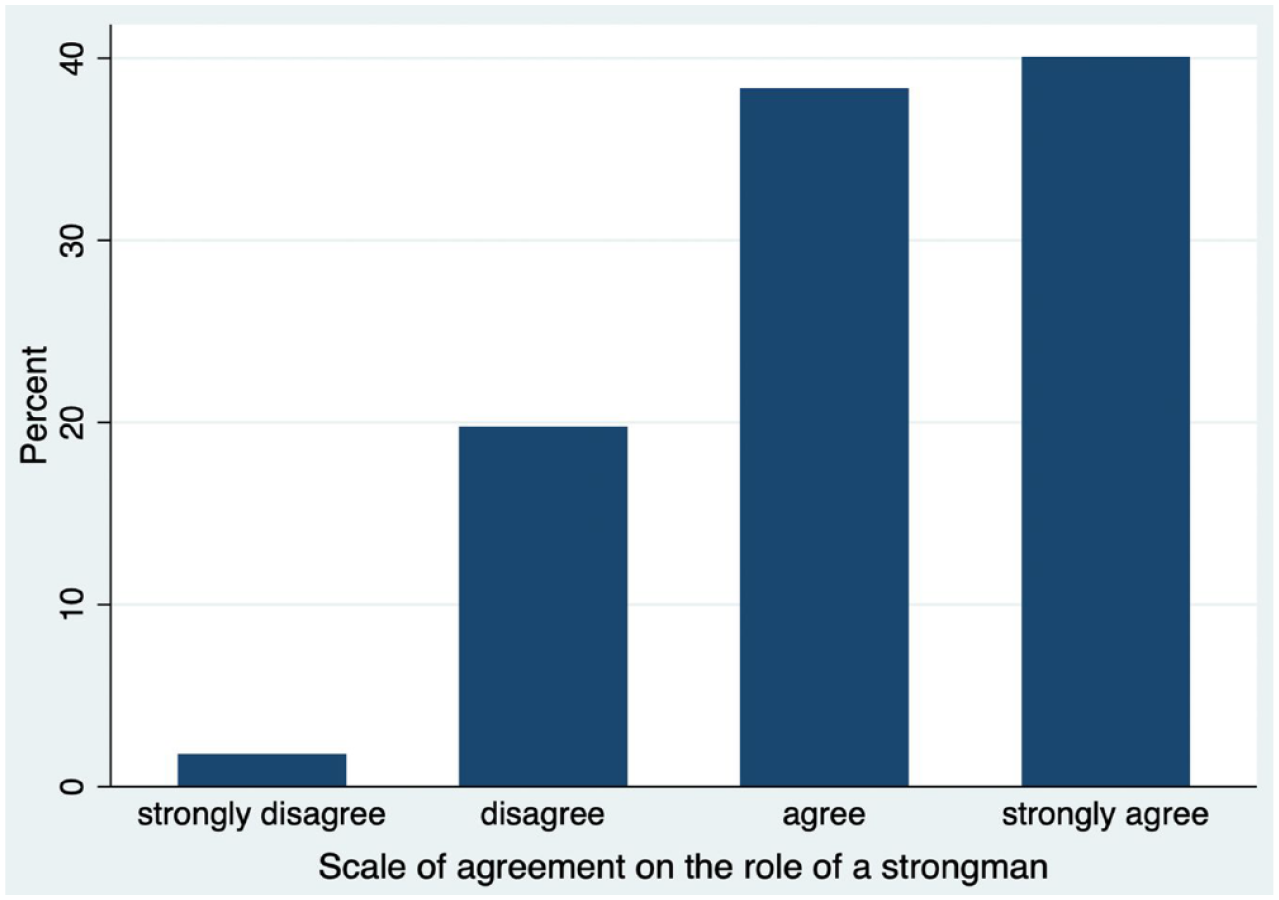
Believes in a strong leader to solve all country’s problems.
Esperanza Martínez (2012: 247) of the Ministry of Public Health and Social Welfare (Ministerio de Salud Pública y Bienestar Social (MSPyBS)) underlined the close affinity between the government social program and the demands of social forces that kept them from undertaking extra-institutional action for fear of harming or discrediting the left allies in office: In some way, the focus of the social programs helped to demobilize social sectors that were previously protagonists of . . . historical struggle [against] the oligarchy and social inequality . . . I think that somehow these sectors saw a government that was close, that was related [to them], that had good ideas and intentions in terms of supporting the historical struggles of the popular sectors. The support [choice] was also a way to achieve government stability, because we must not forget that . . . on 23 occasions, congress raised the issue of impeachment . . . All of this [happened] within the framework of a media war, stigmatizing the entire process [of peasant struggle] and disqualifying [sic] the [left government].
Oviedo of the CONAMURI raised the same point, but she attributed actors’ beliefs about the destructive impact of mobilization against Lugo to the lack of entrenched democratic practices that made segments of society prone to indisputably support their political allies in office: “people, I think, misunderstood their role in a democratic process and, . . . they thought that without mobilization they were supporting and stabilizing democracy” (Author interview, 21 September 2012, Asunción). Ana Valdez of the MUP added that the popular sectors allied with the party in power and did not want to dig in their heels and stifle the government: “the popular sectors [say] ‘if you do something against Lugo . . ., [the government] is going to fall apart.’ So, ‘you do not go out to demonstrate’” (Author interview, 21 September 2012, Asunción).
Unlike social forces in Chile and Uruguay who developed sense of efficacy stemmed from their programmatic ties with the left parties over years and sometimes mobilized against allied left governments to push them to withdraw, moderate, or introduce policy initiatives (Bentancur et al., 2021; Hatab, 2023b), social actors in Paraguay perceive electoral participation and protest mobilization as separate, rather than complementary, arenas. Given the lack of organized constituents, Paraguayan parties cannot reduce the political struggle to programmatic competition in electoral cycles. Schvartzman of the Kuña Pyrenda highlighted how the divorce between electoral and social struggles and the excessive deference to the left government weakened social organizations in their endeavor to push through social transformation: We need strong social organizations, whatever the government takes office, be it from the right or from the left, . . .we believe that . . . the electoral political struggle and the social political struggle are valid. They don’t have to be divorced . . . Some on the street and others in the spaces of power, they have to have the same objectives . . . [Otherwise] we are not going to have the necessary power for the transformation. (Author interview, 24 September 2012, Asunción)
Ricardo Roa of the Student Revolutionary Movement (Movimiento Revolucionario Estudiantil (MRE)) alluded to the misconception about mobilization that permeated social organizations: social organizations mobilized very little during that period . . . Because . . . it was not understood that power [lied] in parliament . . . we stopped [sic] mobilizing and waited [sic] for everything to come from above . . . people waited for Lugo . . . to change all things from the place where he was, and they didn’t understand that the parliament was the place that should have been. . . [sic] attacked, let’s say. (Author interview, 19 September 2012, Asunción)
The participation in Lugo’s electoral campaign in 2008 politicized wide segments of the disadvantaged sector. But the campaign did not result in the organization of the multiple interests and fluid political identities into a unified popular subject, nor did it sustain an interactively intersubjective space for the reproduction of new self-identification with particular class or indigenous category. Some social sectors conformed to the government’s de-radicalization discourse and the institutionalized means of policy changes, leaving the left allies to face off the right majority in Congress to push through the reform program. Benítez (2012: 33) of the CPA-SPN illuminated how shaping new reformist mindsets and oppositional identity, rather than relying on a left ally in office, was indispensable (albeit daunting) task to ensure active role in the extra-institutional arena: It is not that with this government we would achieve great changes, but rather . . . with it, we would move towards a stage of greater change . . . the democratic advance in our country was not enough. Historically, there has been a lot of fragmentation in the popular movement, in the forces of the left, in the progressive democratic sector . . . In these four years, . . . there was no enough time to have a greater accumulation, which allows [for] broad unity of all sectors of society, who fight for democracy in our country.
Barua of the local mental health organization illuminated how Paraguayans have long been ingrained in an exploitative economic structure that limited their claim-making to personal survival and inhibited developing “imaginative capacity” to act collectively and consistently on establishing a new social order. He depicted the Ecuadorean indigenous movement as a prototypical case in its determination to take the struggle to a contentious terrain. He asserted that dealing with Paraguayans’ cognitive behavior would put the country along the same path. Barua underscored the main goal of his organization is to deal with people’s mental health. The main target is to establish clinics in the form of local organizations, or local groups that deal with people’s needs, and serve as [means] to stimulate rage. For us, rage is the popular educator . . . I think a key thing is to make people believe in themselves, in their entitlement to rights.
For him, “changing the way people think” is a crucial stage to step out of erratic and ineffective top-down attempts of organizing the local communities and to build interactive networks that guide their action (Author interview, 20 September 2012, Asunción).
Indeed, the process of popular subject formation is slow, rather than rhythmic, and it requires longer cycles to construct new self-image and jettison anesthetic and conformist norms. The vestiges of the past and state institutions add complexity to the present cognitive map which besets efforts to eradicate the residue of the past political behaviors and give way to new cognitive schemata. The turning point of the rise of leftist outsider to power did not produce cognitive alteration or new interpretation of the structural causes of inequality. The development of new partisan identification has not also been a central element of the political lexicon of the active Guaraní communities. The committed peasant movement routinized issue-based mobilization that remained spontaneous and localized in remote areas. After the ascension of Lugo, social forces preferred to articulate their demands through the institutionalized means and deferred to Lugo’s leadership to carry out the APC’s electoral program.
Disillusionment with the Lugo government, the representation crisis, and the futility of mobilization
Some social forces took stock of the alienating policies of the left government. They perceived the leftist allies producing more of the same practices which sent confusing signals to social constituents about whose interests the left partners were serving in office. In less than a year, a national poll published by the national daily ABC Color reported that 54% believed that the Lugo government “is doing little” to meet his electoral promises and 22% considered Lugo “is doing nothing” (LAWR, 2009b).
The criminalization of the social struggle was very indicative of the troubled relationship between Lugo and the progressive social sectors. After 2 years in office, the government reproduced old repressive tactics to double down on peasants’ insurgency and approved an anti-terror law in June 2010 (a law that was previously rejected in 2001). Lugo sought congressional approval to declare “a state of exception” for a month in five departments of Concepción, San Pedro, Amambay, President Hayes, and Alto Paraguay in a bid to suppress the EPP. Congress rejected his proposal claiming that the president tried to impose unpopular measures on Congress instead of using his decree power to declare the state of exception. The opposition majority in Congress voted for an even harsher version of the “state of exception” and passed anti-terrorism law on 6 May 2010 that suspended a range of constitutional rights, outlawed public protests, and authorized the security forces to carry out detentions without warrants (Borón, 2012; LAWR, 2010a). López (2012: 61, 63) of the CCT condemned Lugo’s repressive policies that went in tandem with his approach of class conciliation to harmonize utterly opposing interests that estranged various popular sector organizations: The criminalization of the struggle . . . occurred in a cruder way in the countryside . . . We say that it was not a normal bourgeois government, but that it is presented as a government of class conciliation . . . to be . . . with the rich and with the poor, to reconcile the interests of the latifundistas with those of the landless. There was confusion not only for [sic] the working class of the countryside and the city, but for the entire citizenry. [It] produced a new style of governance, because for the first time since a long time, an important sector of the social vanguards [became] part of the government. We criticized the government . . . for having demobilized the popular movement, [and promoting] a policy of class conciliation . . . Agreements were not only raised with the Liberal party, but also with the ultra-right, for example, with Oviedism and it even fell into a plane of naivety. We all know what interests these groups respond to, and how they play against the interests of the people.
In line with López’s emphases, Figure 2 of the Latinobarómetro (2008–2012) surveys shows that nearly 80% of respondents in 2010 and 2011 believed that the country under Lugo’s reign continued to serve the interests of the few powerful interests.
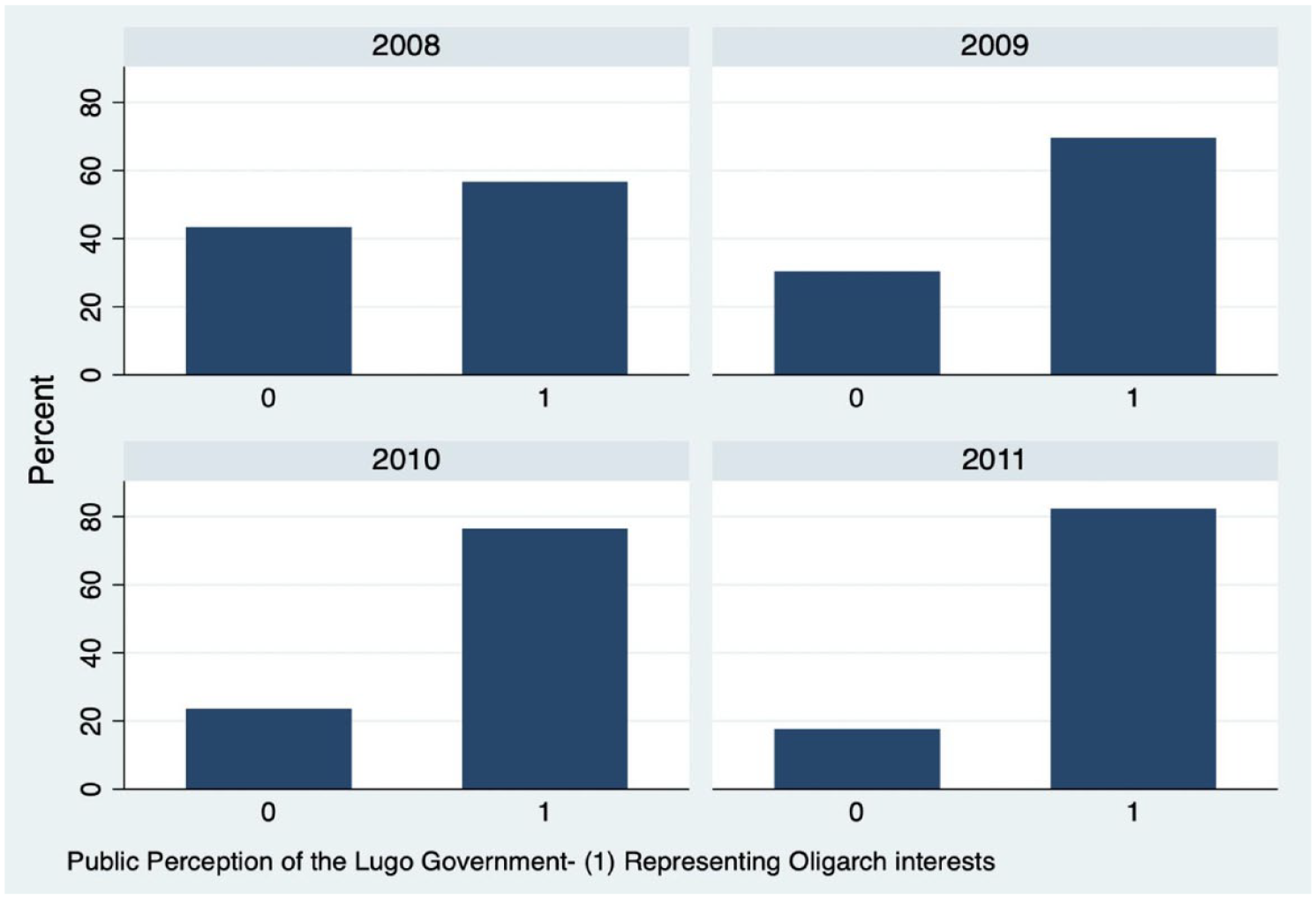
Public perception of Oligarchical Rule 2008–2011.
Valdez of the MUP further explained how Lugo represented an extension of the traditional politics of disarticulation of popular interests with the constant depoliticization of social cleavages, contrary to “Morales” who heightened ethnic differences and deepened class struggle against the segregation and subjugation of the Indians in Bolivia. She contended that “[Lugo] had to organize [society] for a cause as it happened in Bolivia for the water [in Cochabamba]. Then the deepening of the popular struggle would [sic] arise” (Author interview, 21 September 2012, Asunción). Angélica Roa and Cristina Román of the Coordinación de Mujeres del Paraguay (CMP) also deplored the inconsistent policies of the Lugo government that not only curtailed policy changes, but they also isolated the popular sectors and even impaired issue-based mobilization. They pointed out a plan going forward to transform people’s awareness that had long made them vulnerable to clientelistic exchanges and reduce them to mere electoral subjects. They asserted that the left government did little to transform the prevailing cultural codes and that the only way out is to train our people, raise awareness. . . At this moment we have to win the conscience of our people, because economically the others beat us by far. The only thing we must guarantee for the process we started . . . is to continue with the formation of our people. (Roa and Román, 2012: 102)
Moreover, the cooptation of union leaders and their commitment to harmonizing mutually exclusive interests exacerbated the representation crisis of the Lugo government and further pulled the embryonic popular support base apart. With union leaders assuming governmental positions, they never served as viable interlocutors in the government and deserted their constituencies. López of the CCT pointed out the effect of the cooptative tactics on widening the schism between union leaders and their rank-and-file who felt that they had been sold out: what happened with the Confederation . . . is that we were left isolated . . . because there was also a process of co-optation of the leadership of the labor unions by the Lugo government . . . the traditional workers unions, such as the CNT, the CUT, CUT-A, were part of the government . . . they were linked to the structures of the previous governments and this, in a certain way, tied the hands and feet of the comrades to have an independent policy. (López, 2012: 61, 62)
Many forces in the popular organizations felt betrayed, and Lugo did little to travel across the country to dispel the sense of betrayal. Roa and Román of the CMP explicitly blamed the left government for abandoning the peasantry organization in the countryside: “the peasant organizations no longer perceived the support of the Guasú Front; We planned [sic] to speak with Lugo through the Guasú Front to update him on the situation in the field . . . At that time the crisis was already overflowing. We said in the communiqué that the Guasú Front acted worse than the right, because at least the right received us every time we mobilized” (Roa and Román, 2012: 103). Esther Leiva of the Organization of the Struggle for Land (Organización de Lucha Por la Tierra (OLT)) highlighted Lugo’s tendencies from the start to get around the radical demands by demobilizing the popular sectors, “while it was assumed that they were the motor and promoter of the process of change” (Leiva, 2012: 57).
According to Latinobarómetro survey data (2008, 2009, 2010, and 2011), the percentage of respondents who “strongly support” Lugo decreased steadily over the short period of his rule. As Figure 3 shows, the mean value of the 10-point scale that measured his support rate decreased from 8 in 2008, to 6 in 2009 and 2010, and 5 in 2011. And Figure 4 further illustrates that nearly 65% of respondents in the 2012 survey had “little” or “no trust” in his presidency.
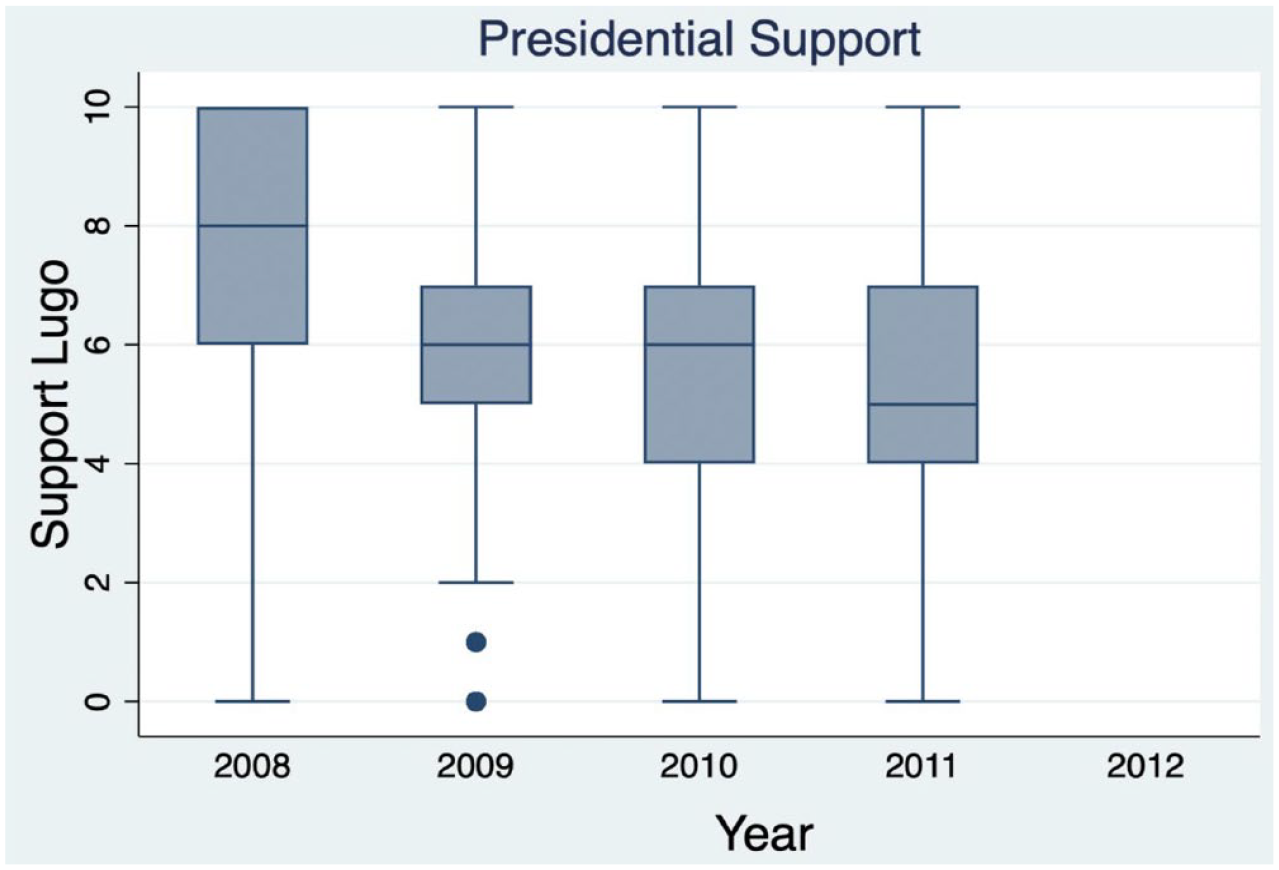
Support for Lugo (2008–2011).
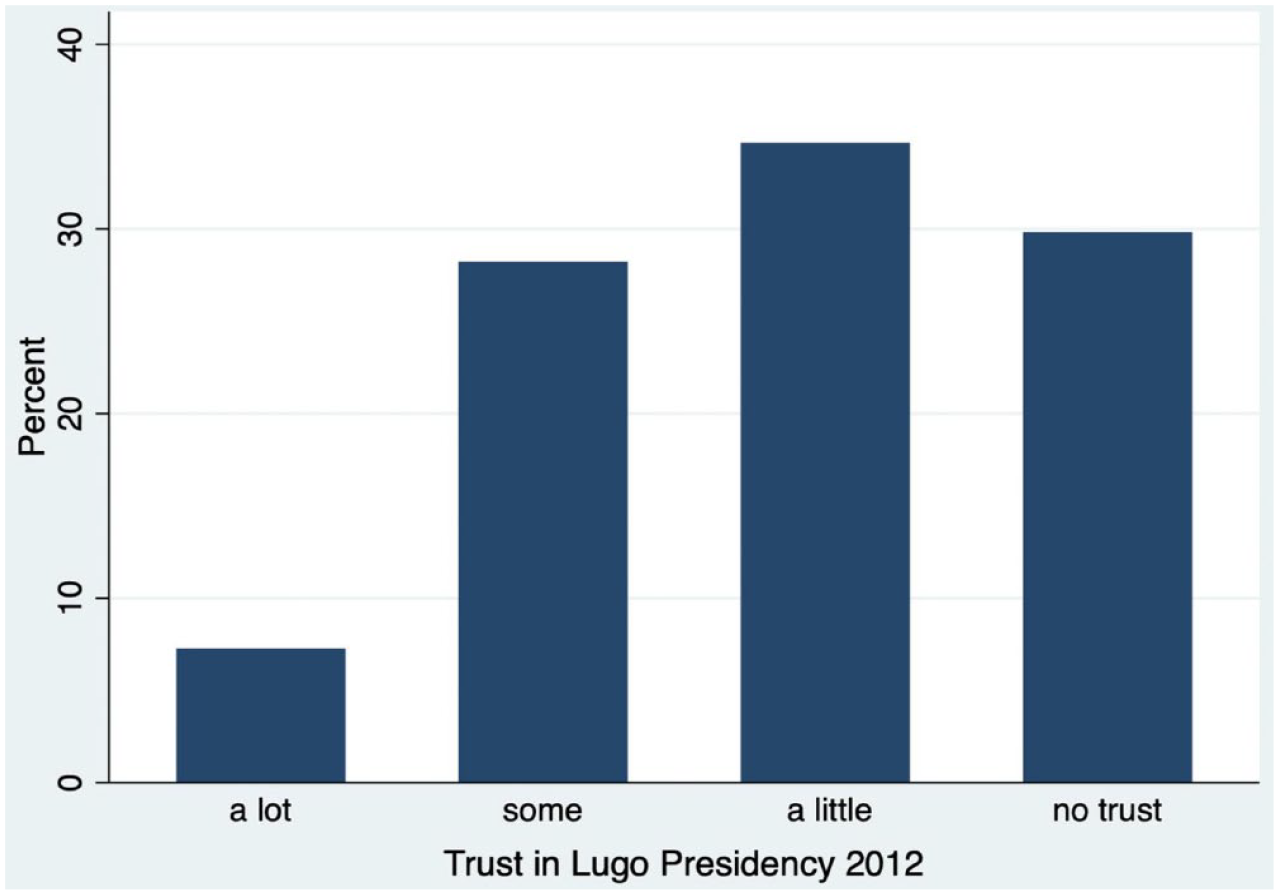
Public trust in the president in 2012.
The declining approval rate and trust level in 2012 indicated the ever-increasing chasm between the left government and the citizens. Roa of the MRE placed partial blame on Lugo for alienating the social sectors which kept him from using the masses as nuclease of his struggle against entrenched bureaucrats, and traditional politicians and their socio-economic allies of agribusiness firms (Author interview, 19 September 2012, Asunción). Richer of the SAS attested to the fact of the blurring boundaries between the government and the right opposition that hindered the articulation of anti-establishment demands and made the emergence of a coherent popular movement to circumvent the existing legislative and judicial bodies difficult: we were [sic] facing really powerful [right] . . . But regardless of that, I believe that the government could have done more, . . . there were hesitations, confusions, and disorientations that prevented further progress. A problem of the Fernando Lugo government was evidently the cohesion of the government team. An impossible cohesion . . . that . . . impeded the construction of a unified orientation of the government policy. (Richer, 2012: 263, 264)
Torres of the SNNA also underscored that the ideological disorientation of the president estranged wide sectors in society and had a devastating effect on the transformation process. Torres dubbed the Lugo government as “quite schizophrenic” because the government outsourced the blame on the conservative partner, but it was the left government itself that consciously distanced peasant and turned “a historic step of the creation of an inter-ministerial participation table” into useless means of popular participation in the decision-making process (Torres, 2012: 272, 273).
Social forces, therefore, lacked veto allies in power. The presence of an ally in office could have offered a window of opportunity for advocacy networks in society to “frame” a compelling case of socio-economic inequality and press the government to respond to the cumulative grievances of social sectors. The alliance between the left and right, however, engendered a representation crisis that debilitated the already-unconsolidated ties between the left coalition in power and the social constituents that voted it into office.
Fearmongering, the propaganda machine of the media, and the preserve effect of mobilization
Media was also a site of struggle that transformed the nature of the political opportunity of the interbranch gridlock. Aida Robles of the Citizen Participation Party (Partido Participación Ciudadana (PPC)) and Medina of the PCPS contended that the conservative interests repeatedly relied on their media outlets to wage a war against the left and spread fears in society to preempt the outbreak of mass protests to defend Lugo (Medina, 2012: 176; Robles, 2012: 183). Cardozo of the SEN depicted a gloomy picture after the removal of Lugo and highlighted the central role of the media in vilifying dissents and infusing timidity in society: “I feel a setback so great in everything, and a fear . . . once again installed . . . it was probably the effect that they wanted to inflame . . . there is a lot of insecurity among the people” (Cardozo, 2012: 218). Leiva of the OLT also asserted that the surrender of Lugo put committed organizers and grassroots networks in trouble as they believed that given his inside knowledge, he “had accepted the coup to stop what could have been a new massacre” (Leiva, 2012: 57).
Mass media access, in forms of news “beat,” story lines, and commentary reports, plays a central role in creating controversy and heightening the saliency or downplaying the urgency of issues (Gamson and Meyer, 1996: 285). Benítez (2012: 33) of the CPA-SPN highlighted the role of the right-wing media in demonizing opposition, cowing people into acquiescence, and thereby defining the parameters of action for active social forces: The right-wing, allied with the interests of the multinationals that express themselves permanently through the media, systematically sabotaged all democratic progress. It terrorized our people, it misinformed [them], and at a certain moment, it possibly exhausted our people, [and] confused them . . . There are many factors that combined and came together, so that we found [sic] ourselves in a moment of weakness, and our enemies took advantage of this to hit us.
Social organizations and grassroots communities lacked effective informational devices to provide them with a reliable flow of information to counterweight the official narrative, break fear barriers, and stimulate extra-institutional mobilization. Roa and Román of the CMP called attention to the information deficit that not only impeded the formation of class identity, but it also deprived remote sites of getting analysis of the political situation under Lugo’s reign. Roa and Román underlined the pivotal role of the media in shaping the political consciousness, and that “people who have space in the media and who are informed have power” (Roa and Román, 2012: 104). In a similar vein, Martínez of the MSPyBS pointed out the importance of mass media access and information circulation in shaping beliefs and expanding or limiting public issues: “When the trial began in congress, the citizens and the social sectors watched [it] with a certain perplexity; perhaps they expected that at some point a slogan of resistance, . . . would be given, which was not given and left people at home, except for those who were in the square at that time. All this was accompanied by . . . a very strong media campaign [reporting] that there were snipers stationed around the square” to arouse fears of mobilization (Martínez, 2012: 250, 251).
The lack of information and thorough analysis of the situation precluded cognitive mobilization to develop common understanding of the intensity of the conflict, stimulate full realization of the existing opportunity, and shape contentious issues that resonate in society and guide political action. Fatima Rodríguez of the Paraguayan Association for Immigrants (Asociación Paraguaya de Enfermería (Ape Paraguay)) underlined the crucial role of media coverage and media attention in conferring standing on social players and denigrating others: “The last big public demonstration was before the coup, and it was against . . . a budget increase for the Supreme Tribunal of Electoral Justice . . . people took to the streets en masse, but it was [salient] because of [sic] the media . . . But when it’s a peasant march, [reporters] do not [sic] even show up . . . So there is a communication problem. [Social] organizations in Paraguay have to spend more on communication and . . . they have to bet more . . . on media” to gain political and social position and imbue local context with alternative narratives about the urgency of social issues and possibilities of socio-political transformation (Author interview, 19 September 2012, Asunción). She pointed out the role of the “popular radios”—Radios Comuntarias—in delivering the analysis to the local community to make informed decisions about political mobilization. Indeed, the “popular radios” helped the weak and fragmented indigenous associations in Ecuador to intensify the struggle with the state, reappropriate their indigenous identity, and subvert subordinate norms. Providing local context with information and political analysis created spaces for the formation of indigenous parties that helped them to become active players in the political sphere at the national level (Lee Van Cott, 2005). With the absence of similar media outlets in Paraguay, the pro-state media generally interpellated 15 peasants and limited their practices to the re-inscription of power relations related to a specific set of political techniques, discourses of official agrarian policies, and authoritative actions through which abeyant subjects come to be formed.
In sum, the easiness with which old state actors removed Lugo from office and the surprising quiescence of popular sectors toward their once preferred leader redirected attention to the lingering effect of the prevailing understandings in the society that conditioned the perception of social actors and altered the material basis of the conducive political opportunity (Grössling, 2005: 106, 117). Social actors engaged in what Hirschman (1991) calls a “rhetoric of reaction” (Hirschman, 1970: 70). They framed issues of opportunity that entailed inaction and reduced demands for protest activity based on three pillars: “jeopardy, futility, and perverse effects” (Gamson and Meyer, 1996: 285, 286). Some actors cozied up to the left administration and communicated the jeopardy theme that considered mobilization as a risky track that could erode “achievements already won” and make Lugo a softer target. Other actors dissociated themselves from the Lugo government and underscored the futility of mobilization for far-reaching reforms with a conservative-dominated government and low chances of changing the alliance possibility to tilt the balance of forces in favor of the left. A third group of advocacy networks and committed organizations’ leaders highlighted the perverse effects of mass demonstrations that would have made the situation worse (with the right-wing media circulated information on the heavy-handed strategy of the state officials and with the absence of independent media sources to inform the public about the political situation).
Conclusion
The article focused the analysis on one of Latin America’s often overlooked left-wing outsiders: Paraguay’s Lugo (2008–2012). It showed how left parties and social organizations reworked existing vertical clientelistic ties to draw the masses into electoral mobilization and cast a ballot for Lugo in 2008, but these ties proved to be ephemeral. The electoral triumph of a left outsider neither uniformly mobilized social bases against the political establishment nor did it create public debates around promised policy changes to mobilize party linkages around them. Lugo neither constructed formidable party organization to encapsulate the popular sectors and defy intense conservative opposition, nor did he cultivate non-institutionalized and unmediated ties with mass constituencies to increase his bargaining leverage in the face of the conservative actors who relentlessly blocked his policy initiatives. Even when the established elites banded together and impeached him on vague charges of mis-performance (mal desempeño), he chose not to throw a lit match into kindling and succumbed to the powerful oligarchs.
Left players in societal and political domains tended to respond to short-term electoral calculations in a socio-structural context that did not allow them to strike roots in society due to organizational and representational deficits. The demobilization of the popular sectors under Lugo’s reign reinforced the prevailing docile norms and alienated committed organizers in active sectors and therefore hindered the realization of “open” political opportunity emanated from the inter-branch impasse that predisposes the system to extra-systemic mobilization. Not only the rise of Lugo to power marked a “missed” opportunity for brokering mobilization, but also his downfall challenged conventional wisdom about the role of social movements in dissuading legislators from unseating the president. Social forces did not develop independent understanding or construct new beliefs about the political situation and policy issues to come to his defense.
Lugo’s debacle is illustrative to interrogate the “missed opportunity” of mobilizing masses to materialize a progressive policy program and defend the president’s mandate. In a socio-structural context that relies heavily on the caudillo to introduce policy changes, the strategic choices of political leadership and its proclivity to exercise the veto authority to mobilize mass support are crucial to realize and “frame” the permissible opportunity. Some political opportunities, therefore, interweave both institutional and agency choice elements. As Sewell (1992: 19) puts it, they are “sets of mutually sustaining schemes and resources that empower and construct social actions, and that tend to be reproduced by that social action.”
Paraguay under Lugo’s rule has thus made a significant contribution to social movements literature in relation to POSs and party-society linkages: First, social movement formation is not an automatic response to “open” POS. Some political opportunities interweave both institutional supplies and strategic choices or veto acts of political brokers. The left coalition in power misused resources at its disposal to enhance ties with disorganized actors and to facilitate exchanges of material resources and provide communication links to social organizations. The well-positioned left brokers reproduced the same ways of dissociating the fragmented (or loosely organized) social constituencies from politics. The left government reduced masses to mere voters, rather than serving as a veto gate in the state institutions and using the people as a hedge against state officials. The strategic choices of the president, therefore, hindered the realization of the fluidity of elite alignments, the presence of well-positioned brokers in power to serve as a veto gate, and the possible refashioning of the prevailing caudillo norms as a favorable political opportunity to mobilize party linkages, create new self-identification, develop collective action frame, and push through progressive policy changes. Realization of opportunity, in terms of developing shared understanding of a situation and framing issues of urgency, may create political opportunities, but the lack of realization of opportunity can hold committed activists back and produce self-restraining tendencies.
Second, the rise of Lugo against the backdrop of a desultory track record of popular mobilization and amid a “closed” POS dominated by clientelistic parties calls into question the causal relationship between clientelism and demobilization (albeit not conclusive in the existing literature, cf: Machado et al., 2011; Moseley, 2018). The Paraguayan case helped to parse out the direct mechanism of clientelistic linkages and their consequences for mobilization as a contingent outcome of the availability of competitive alternative and leadership choice of mobilizing clients for electoral and non-electoral politics. That is, elite choices and leadership idiosyncrasies enable the exploitation of vertical clientelistic bonds to mobilize mass constituents to attract more followers and penetrate pre-existing power centers, rather than reproducing compliance with the clientelistic deal (cf: Auyero, 2000).
Supplemental Material
sj-docx-1-cos-10.1177_00207152231196320 – Supplemental material for The rise and fall of political outsiders: Political opportunity structure and (de-)mobilization in Paraguay (2008–2012)
Supplemental material, sj-docx-1-cos-10.1177_00207152231196320 for The rise and fall of political outsiders: Political opportunity structure and (de-)mobilization in Paraguay (2008–2012) by Shimaa Hatab in International Journal of Comparative Sociology
Footnotes
Funding
The author(s) disclosed receipt of the following financial support for the research, authorship, and/or publication of this article: The author(s) received financial support from Essex University to conduct a fieldwork.

Supplemental material
Supplemental material for this article is available online.
Notes
References
Supplementary Material
Please find the following supplemental material available below.
For Open Access articles published under a Creative Commons License, all supplemental material carries the same license as the article it is associated with.
For non-Open Access articles published, all supplemental material carries a non-exclusive license, and permission requests for re-use of supplemental material or any part of supplemental material shall be sent directly to the copyright owner as specified in the copyright notice associated with the article.
