




Abstract
Building on qualitative interviews with Syrians who participated in the anti-regime movement of 2011 and now live in Berlin and Oslo, the article unpacks the ways that these contexts affected participants’ decision to continue or disrupt their activism in exile. By analyzing their activist trajectories from revolution to exile and drawing on the concept of emotional resonance, I reveal how Berlin and Oslo provided participants with different environments when dealing with their past experiences of participation. I show that while the mobilizing structures of Berlin provided spaces for activism that resonated with the emotional needs of activists, enabling them to continue activism on behalf of Syria, the mobilizing structures of Oslo failed to produce spaces that could respond to activists’ needs, playing a part in their disengagement there. The article extends the concept of emotional resonance and adds to the study of Syrian diasporas and emotions in the Syrian uprising.
Introduction
Emotions were a recognizable part of the Arab uprisings as mass demonstrations reflected anger, joy, and pride (Ayata and Harders, 2018; Coşkun, 2019; Pearlman, 2013). In Syria, emotions did not just play a marginal role but are argued to have been one of the main drivers of the uprising (Pearlman, 2013, 2016). Yet, we know little about the emotional implications of individuals’ participation in the uprising after large swathes of activists have been displaced out of the country. Scholars of social movement studies have shown how emotions can enable, consolidate, and disrupt action over time (Gould, 2009; Wood, 2001; Yang, 2000), but few have examined how this occurs across space and different contexts (see Bosco, 2007 for an exception)—how emotions may influence action depending on the political environment in which individuals live. Answering Pearlman’s (2013) call to follow what happened to the emotions that ensued from the Arab uprisings, this article looks into the emotional experiences of activism among Syrian activists in exile and adds to this emerging scholarship by investigating how emotions of activism travel in time and space. I use emotional experiences to refer to experiences of activism that are emotionalizing and laden with long-term emotions.
The article grounds the study of emotions in comparative perspective by examining how emotions influence the evolution of activist trajectories 1 across different contexts of exile. It draws on 34 in-depth interviews with Syrians who participated in the uprising of 2011 and are currently living in two different European cities, Berlin and Oslo. While Berlin is a city with a large Syrian community with access to an established organizational framework and a diverse activist milieu, Oslo is an example of a small-sized community that lacks supporting community infrastructure. Studies of Syrian diaspora activism have demonstrated how active mobilization in favor of Syria arose in host contexts with large Syrian communities and relatively favorable opportunity structures (Khoury, 2017; Moss, 2020; Ragab, 2020). There is less research on how such mobilization occurred or not in other contexts that do not have the same conditions (Selim, 2021). Comparing activist trajectories in two exile contexts of different characteristics, the article brings attention to the role that experiences of past activism may play in why some Syrian diasporas were able to mobilize while others could not.
To this end, I ask in what ways do the different sociopolitical milieus of Berlin and Oslo shape activist trajectories and how past experiences of activism are made relevant within these contexts? To answer this question and unpack the impact of emotions on activist trajectories, I draw on the concept of emotional resonance. Emotional resonance is defined as the “emotional harmony and/or disjuncture between collective action frames and the emotional lives of potential recruits” (Schrock et al., 2004: 61). I use this concept to link between individuals’ experiences of past activism and the mobilization conditions of the contexts in which they live and focus on how individuals navigate the emotional weight of their participation memories in the presence of strong or weak networks and protests as spaces for activism in exile. By spaces, I refer to the specific features of networks and protests, looking at the impact of larger structural features such as community size and organizational framework. By memories of participation, I refer to recollections of experiences lived in the past in connection to activism. In particular, I investigate how different mobilization environments can be understood to contribute to different levels of emotional resonance when responding differently to individuals’ experiences of participation. Linking memory and space through emotional resonance, I examine how individuals’ emotional needs arising from past experiences of activism are supported or denied within the larger contexts of networks and protests in exile.
In the pages that follow, I discuss the social movement research on emotions and present an integrated theoretical framework of memory, space, and emotional resonance to understand how experiences of past action interact with spaces for activism in exile, creating conditions for emotional resonance. This is followed by a background on the contexts of Berlin and Oslo, a section on methods, and my findings in which I will present two activist biographies from each city. Finally, I conclude with new insights on emotions in the Syrian uprising, expanding our understanding of its role beyond the initial moments of mobilization. The article also extends the current conceptualization of emotional resonance by expanding its application to comparisons and suggesting contextual dimensions—spaces for activism in the form of access to networks and protests—as crucial to understanding how emotional resonance works. The article will close off with suggestions on why Syrian mobilization emerged or failed to occur in some contexts and not others.
Emotions and (dis)engagement in social movements
There are numerous theorizations for emotions that are rooted in sociology as well as biology (see Turner, 2009, for an overview). Following work on the sociology of emotions (Turner and Stets, 2006; Bericat, 2016), I see emotions as “the bodily manifestation of the importance that an event in the natural or social world has for a subject” (Bericat, 2016: 493).
In social movement studies, emotions have traditionally been dismissed as far too constant or irrational to explain action until the cultural turn reintroduced emotions as essential to explaining the rise, continuance, and decline of movements (Flam and King, 2005; Goodwin et al., 2001). Emerging out of cognitive processes based on moral principles, judgments, and normative imperatives, moral emotions such as indignation and outrage over injustice have been particularly emphasized as key to understanding how people are motivated into action and how action is sustained over time (Goodwin et al., 2004; Jasper, 2011). In her study of the armed insurgency in El Salvador, Wood (2001, 2003) observes how resistance was continued out of moral outrage against the government and as a tribute to the forsaken in fighting for the cause. Pearlman’s (2016) study of the Syrian uprising makes explicit how people were drawn into action by a sense of obligation at the sight of others enduring heavy repression. In revolutions, moral outrage is generally recognized as an important driver of collective action (Pearlman, 2013; Reed, 2004).
In addition to moral emotions, previous research also points to the role of joy, pleasure, and hope in the sustainment of action (Jasper, 1998; Pearlman, 2013; Reed, 2004). These emotions come to be particularly felt in the course of action as people experience the “pleasurable effects” of having a say through the act of protesting (Jasper, 1998). Such emotions can also arise in situations characterized by extreme violence. Wood (2001, 2003) highlights the role played by pride and increased self-esteem next to moral outrage, while Pearlman (2016) indicates the satisfaction and sense of agency prompted by participation in the uprising. Feelings of solidarity, camaraderie, and unity in sharing and fighting for a cause can cultivate loyalty and belonging among movement participants, which can in turn contribute to continued action (Bosco, 2007; De Volo, 2006; Gould, 2009; Jasper, 2011; Nepstad, 2004; Ransen-Cooper et al., 2018). Activism can be therapeutic for activists grieving loss (De Volo, 2006), a source of well-being under conditions of high risk (Nah, 2021), and an opportunity for self-fulfillment and “emotional achievement” in face of repression (Yang, 2000).
In contrast, there is less research on emotions in disengagement. Jasper (1998) hints at frustration as a potential cause of disbandment. Losing belonging, feeling irrelevant or disposable can also make disengagement seem logical (Kleres, 2005). Among refugees, ambivalence can inhibit and limit possibilities for action toward the homeland (Belloni, 2019). Furthermore, within post-revolutionary contexts, Accornero (2019b) and Matthies-Boon (2017) both argue how such contexts characterized by dashed hopes, undesirable political outcomes, and increased state violence elicit acute feelings of disillusionment, disappointment, and defeat that lead movement actors to retreat from politics. Thus, the stronger the feeling of disillusionment, the more activists are likely to be drawn to the choice of disengagement.
Memory, space, and emotional resonance
This section considers the combined role of memory, space, and emotional resonance in the formation of activist trajectories. Few scholars have examined how memory can influence action (but see Accornero, 2019a; Harris, 2006; Tang, 2021; Zamponi and Daphi, 2014). Accornero’s (2019a) work makes a connection between emotions, memory, and activist trajectories, showing how antifascist activists perceived their struggle through the prism of the revolution, which affected their activist trajectories in behalf of continued and strengthened engagement. Similarly, Zamponi and Daphi (2014) conceptualize memories as an interpretive framework of reality. In their study of the anti-austerity movement in Italy, Zamponi and Daphi (2014) note that activists mobilize their memories of participation in the global justice movement in continuing and discontinuing certain practices. Thus, their memories function as a lens through which they evaluate what works and what needs to be changed with their current mobilization.
Inspired by these works, I treat memories as a channel of participation experiences in the uprising. More importantly, I look at how individuals’ experiences of past activism create present emotional needs and how these can have an impact on the perception, interpretation, and assessment of action in later stages (Jasper, 1998; Johnston, 2014; Pearlman, 2013). For example, Adams (2003) shows how experiencing being part of a movement may leave a sense of bitterness in its participants later when that movement ends, as in their participation individuals came to experience moments of joy and being part of a community and purpose. As a result, these emotional experiences in movements can lead to the generation of negative emotions of isolation and loneliness for which individuals may seek resolution by joining a new movement. Memories of past action are thus important as far as they are incubators or potential activators of emotional needs that can be important to the decision of (dis)engagement.
In the context of exile, whether these emotional needs can be fulfilled or not depends a great deal on the specific mobilization features of the cities in which participants live. Therefore, it is important to pay attention to activists’ interactions within their physical environments. Linking emotions to space, several scholars have studied and conceptualized this dynamic relationship in different ways (Bosco, 2007; Brown and Pickerill, 2009; Guenther, 2009; Ransen-Cooper et al., 2018; Tang, 2021; Whittier, 2001). Whereas some focus on larger contextual aspects of relationships with the state, government institutions, and laws and how these create opportunities and constraints for emotional mobilization (Guenther, 2009; Whittier, 2001), others go down to the micro-level, examining activists’ relationships with their physical surroundings and how feelings evoked and suppressed in such environments can foster activism (Bosco, 2007; Brown and Pickerill, 2009; Ransen-Cooper et al., 2018; Tang, 2021). In much of the latter scholarship, space is generally understood to incorporate networks of activists, supporters, and sympathizers (Bosco, 2007), sites of meeting and commemoration (Ayata and Harders, 2018; Tang, 2021), and practices of mourning and celebration (Gould, 2009).
These spaces do not often, however, offer equal levels of empowerment. Schrock et al. (2004) found that support groups could not fully meet the emotional needs of transgendered people, leaving them more susceptible to recruitment by social movement organizations as the latter framed activism to be the solution to their emotional problems. These scholars propose that what explains transgendered people’s successful recruitment is emotional resonance—“the link between targeted recruits’ emotional lives and the emotional messages encoded in SMO framing” (Schrock et al., 2004: 62). This definition is built on the concept of frame resonance, which focuses on how social movement framing, their discourse, values, and rhetoric, connect with targeted recruits and members to ensure their recruitment or persistence (Snow and Benford, 2000). Emotional resonance explores the emotional aspect of framing, analyzing how organizations respond to the emotional needs of members and recruits, potentially offering an emotional resolution to negative feelings of shame, alienation, or powerlessness and/or an enhancement of positive feelings such as solidarity and belonging (Schrock et al., 2004).
In this study, I borrow substantially from emotional resonance in its original conceptualization, but my framework goes a step further as to developing a comparative lens to investigate how different spaces of activism across different contexts of exile may influence (dis)engagement. I examine how participation memories create emotional needs that may be met or left unmet by protests and networks of activists in exile, creating different levels of emotional resonance depending on their strength or weakness, while contributing to (dis)engagement.
Context
There are significant differences between Berlin and Oslo in terms of the population size, migration history, and more importantly mobilization levels and organizational landscape. Below, I briefly address some of these differences.
Germany is Europe’s largest recipient of Syrians, with a total population of 867,585 (Statistisches Bundesamt, 2022). Although Germany adopts a highly decentralized policy of refugee dispersal (Katz et al., 2016), Berlin is home to the largest Syrian community in Germany, with an estimated number of around 47,075 (Amt für Statistik Berlin-Brandenburg, 2021). These numbers are largely attributable to Germany’s initial open door policy, which promised protection for asylum seekers irrespective of the Dublin regulation.
Even from before the uprising, Germany was Europe’s first destination for Syrian migrants who came for work, studying, or in escape of political persecution. They established their own organizations that prioritized issues of integration and culture and avoided political mobilization. With the eruption of the peaceful movement in 2011, mobilization in Germany was first focused on supporting the uprising, but soon shifted to meeting the increasing humanitarian needs generated by displacement and conflict developments (Ragab, 2017).
The arrival of more activists who experienced the uprising from Syria revitalized the landscape in Germany, re-shifting focus to political issues (Ragab, 2020) including advocacy campaigns and transitional justice (Stokke and Wiebelhaus-Brahm, 2019). For example, capitalizing on the principle of universal jurisdiction, multiple diaspora groups have successfully managed to bring Syrian officers implicated in war crimes before German courts. In addition to humanitarian relief, much of the ongoing mobilization in Germany also became centered on helping and empowering people and organizations inside Syria by funding them and increasing their capacities in the areas of education and media (Ragab, 2020). For example, many of the people I interviewed are active in this arena, with projects extending help to people inside Syria, which also enables them a virtual connection with their cause. Therefore, much of their social media engagement is devoted to coordinating these projects.
Protest activities are also organized regularly and by multiple groups to express solidarity and increase attention to different kinds of political happenings in Syria. For instance, next to the anniversary of the uprising that is commemorated and celebrated by hundreds of participants each year, rallies are often called upon whenever the regime escalates its campaign against a particular area in Syria. These protest repertories and linkages with Syria were enabled upon the networks that were enlarged and formed with the arrival of activists with experiences, resources, and skills from Syria. This wider mobilization might have been also aided by the political ground in Germany that is more established for homeland claims-making (see Koopmans and Statham, 2003).
In contrast, the size of the Syrian community in Norway is small when compared to Germany. According to official statistics, around 39,897 Syrians live in Norway (Statistisk Sentralbyrå, 2022a), of which 3958 live in Oslo (Statistisk Sentralbyrå, 2022b). Like Germany, Norway also follows a policy of refugee distribution, which favors the dispersal of refugees all over the country so as to avoid a possible concentration in Oslo.
The community that existed before 2011 did not exceed 1500 people (Tønnessen et al., 2020), which limited possibilities for community mobilization. Nonetheless, when the uprising began, many people started organizing to express their support for the movement in Syria, both in the physical space in Oslo and online. In particular, online mobilization characterized most of the existing efforts at that time. Much of this mobilization quickly waned, however, before picking up again in 2015 as many people coming from Syria sought asylum in Norway, creating a momentum for mobilization. Although such efforts led to the creation of some activities on behalf of the uprising, it did not endure due to internal disagreements, thus limiting advocacy and the formation of robust linkages with Syria.
Protests and solidarity activities are also not organized on a regular basis, but are rather sporadic and attract fewer participants, reflecting the lack of necessary networks for achieving homeland mobilization. Currently, the activities organized by Syrians in Oslo focus on student life, culture and art, integration, and civic engagement. Much of this mobilization is influenced by Scandinavian traditions and their emphasis on volunteerism and increased participation as a measurement of integration (see Djuve, 2011). Moreover, former activists’ online engagement is limited to making comments on timely political happenings instead of grassroots mobilization (see Pantti and Boklage, 2014 for an example). There are thus two distinct landscape for mobilization and activism across the two cities of Berlin and Oslo.
The study
This study is part of a larger research project called “Imagining and Experiencing the Refugee Crisis”. It draws on a selection of 34 interviews conducted for a part of this project, looking at how Syrians’ trajectories of activism have evolved in exile. In particular, the study aims to examine how exile contexts affect activist trajectories by contextualizing individuals’ experiences of past activism and their biographies within the wider contexts of exile and their conditions for mobilization. Therefore, this research employs a “most different case” approach, which means selecting cases based on how different they are in order to examine the particular ways in which different external variables lead to different outcomes (Flyvbjerg, 2006). Thus, the cities of Berlin and Oslo, with their different activist milieus, landscape for mobilization, and Syrian community size, provide contrasting cases as differences in structural features can be used to understand and specify how (dis)engagement occurs in exile.
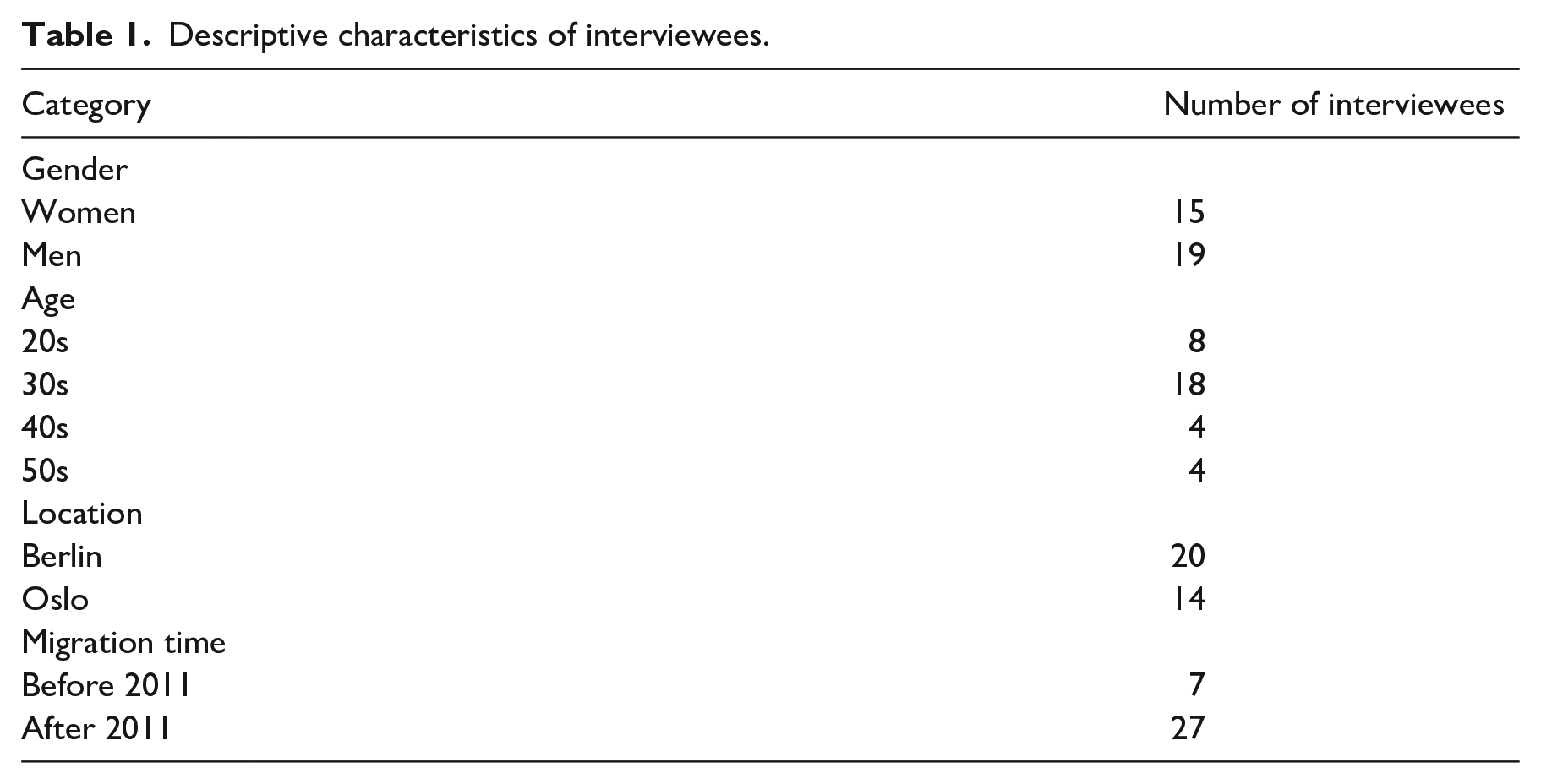
Informants were selected for interviews based on having a history of participation in the uprising, which I used as a starting point for comparison. By history of participation, I refer to the practices and actions which my research participants named in describing their involvement in the uprising. These include but are not limited to protest organizing, humanitarian activities, reporting news, documenting abuses and so on. 2 I located these individuals through events I attended during fieldwork, through snowball sampling, as well as Facebook browsing. The dataset is diverse both in terms of people’s past involvements and current occupations. For those who are still involved in activism related to Syria, some do so through engaging in visible sectors including humanitarianism, development, political advocacy, media, while some others enact their activism in informal ways through protest organizing and fundraising. Those who have disengaged are involved in broader fields of action (see Selim, 2021). In terms of histories of activism, half of the people I interviewed in Oslo are diaspora dissidents who were living in Norway before 2011 and were engaged in anti-regime mobilization from abroad. In Berlin, I mainly interviewed people who were active in Syria before coming to Germany as it became a popular destination for many activists after 2011. The sample thus captures different participation trajectories, from people protesting in repressive settings, to others engaging online or through loose collectivities in their countries of reception. Table 1 below provides a description of the interviewees’ characteristics in terms of gender, age, location, and migration time.
Descriptive characteristics of interviewees.
Interviews followed a biographical line of questioning (Brannen and Nilsen, 2011) and a timeline focus. I began by asking for a little introduction about their background and why and how informants participated in the uprising. The stories were centered around key events including revolution, leaving Syria, and exile. The intention was to map motivations for participating in the revolution, how such participation progressed and developed throughout the course of the movement, and finally why and in what ways they remain or refrain from being active in exile. In this sense, interviewees were encouraged to share their experiences without too much guidance and take an active part in the narrativization of their biographies. In migration and social movement studies, in-depth interviews are encouraged as a tool of interviewing as it allows individuals to foreground their agency vis-à-vis forceful political events (Corrigall-Brown and Ho, 2013; Eastmond, 2007). In addition, this method allowed thick descriptions of participation memories to emerge. All interviews were conducted in Arabic, which aided in creating a situation where participants felt comfortable to speak, articulate, and elaborate on their experiences. Excerpts used in the article were translated verbatim by the author.
Research with refugees and exiled activists often poses ethical dilemmas (Shahidian, 2001), the most concerning of which is the risk of re-traumatization. These groups go through massive traumas that include experiences of persecution, imprisonment, forced displacement, personal losses, and more. As these groups are asked to share their experiences regarding activism, immigration or else, it is important to ensure that the interviewing methods are designed in a way to reduce the potential of re-traumatization. During interviews, I avoided direct questions that point to any traumatic experiences, but usually started and followed with generic questions that involved cues to how they were generally involved in activism or any activities throughout their activist trajectories. Whenever activists alluded to a traumatic event in their lives and reacted in tears or distress upon remembering those events, I would stop the interview to check for their well-being, after which I would shift the conversation to a different topic. However, some interviewees chose to speak in length about their traumatic experiences, as they are constitutive of their identities and affirming of their decision to stay engaged or leave activism. These instances are often attributed to the readiness of interviewees to come forward about these experiences, as they spent years prior to the interview processing and healing from them (Shahidian, 2001).
Emotions were not part of the original research design of this project. I did not approach the field with the intention of observing and documenting the role of emotions in activism. Yet, emotions emerged in different remarkable ways during interviews that it was hard to ignore its presence and potential influence over trajectories. Some interviewees spoke with trembling voices while others cried openly while recounting certain life-defining moments in their lives. Some stated directly how they felt and named certain emotions, while others had emotions underlying their tone and speech throughout the interview. These expressions manifested differently across interviews, with some interviewees more emotionalized than others. In particular, those with experiences in Syria seemed more emotionalized than those with experiences from outside, and those who continued activism as even more so than those who have disengaged from activism. These variations warranted a deeper analysis.
I used Atlas.ti to code the data systematically according to the principles of grounded theory (Charmaz, 2006). In this process, I kept in mind how emotions are culturally constructed, and thus can influence how participants tell their stories about activism (Gabriel and Ulus, 2015; Kleres, 2011). This approach helped me go beyond the surface meanings of the data. For example, when informants described in incredible detail the activities they organized in the early days of and during the uprising, I coded this as an underlying expression of pleasure. With this approach, I proceeded to map emotions onto the trajectory described in each interview from revolution to exile. As I was coding different emotional expressions ranging from pride, excitement, and fear during the revolution to relief and disappointment in exile, it became clear that emotions capture a central and prevalent theme across the entire material and trajectory. Most importantly, I found an important tendency in the data: participants’ experiences of activism in the uprising are framed through emotions, indicating its long-term effect and potential role in influencing action over time.
Furthermore, moving to the exile part of the trajectory, I started to notice how certain emotions were being expressed in connection to each of the studied contexts. I started doing a more systematic comparison between the two contexts. In this part of the analysis, I focused on a fewer number of interviews (around 20) to allow for a deeper investigation of the emotional impact of the context. As I was analyzing how participants feel about doing (or not doing activism) in the places they live, the pattern of the difference between the two contexts became very clear and a new analytical perspective was gained: emotional resonance was introduced as a conceptual link between individuals’ experiences of past activism and opportunity structures in exile.
Therefore, to best capture the complex position of emotions in the narratives of research participants, I present the data through four biographies. The selected biographies are used to show the intersection of time (previous emotional experiences of activism), and place (exile locations) and display different trajectories. Research on activist trajectories often resorts to this way of presenting empirical data as it best meets its research goals, which is exploring how people’s political inclinations, motivations for participation, and paths to (de)radicalization evolve, shift, and change over time (Blee, 2016; Bosi and Donatella, 2012). In this article, the biographies selected highlight important variations in the data. These variations include migration time, genders, and different conditions of engagement, and emotional expressions of varying levels of intensity that summarize the main narratives in the data. In order to ensure participant safety and anonymity, all original names have been replaced with pseudonyms. Also, all identifying information that might render participants known has been removed.
Activist trajectories and emotional resonance in exile
The Berlin cases: strong spaces for emotional resonance
Growing up in a refugee camp in a family that suffered from social exclusion and physical dislocation for generations, Hatim talked in length during the interview about how these circumstances shaped his political consciousness and relationship to authority. With a deep sense of grievances, Hatim became involved in cultural activism before 2011, and later more actively when the uprising began, doing a range of activities from protest organizing to service provision and media activism. As he continued to mobilize in subsequent years during which the uprising was militarized and violence escalated, Hatim expressed a range of feelings experienced during that time, from persistent outrage in sight of massacres being committed, to hopelessness and incredible sadness in response to the violations committed by rebel factions, and a growing sense of obligation toward people enduring bombing and displacement. As shown in previous research (Pearlman, 2016; Wood, 2001, 2003; Yang, 2000), Hatim also expressed a sense of exhilaration, pleasure, and empowerment in being able to defy the regime and live the extraordinary, even amid great violence: This clamor and the moment we were living in created a feeling or even released chemicals in the body akin to pleasure, which made us not think about the future. It made us experience this state without fear, without being concerned with the future. When you live in the moment of “now,” it directs you. When Homs was under siege and there were a lot of problems there, I tried as hard as I could to go there. Human beings are supposed to have this instinctive avoidance of danger, but to throw yourself at danger is difficult to understand. To throw myself into a besieged area or be on the verge of starvation, none of that makes sense but it happened. It gave us a thrill.
Hatim almost describes a state of ecstasy derived from enacting and realizing oneself (Wood, 2001; Yang, 2000) and an exhilaration in being “swept away” by the “revolutionary state” without much reflexivity or minding of the dangers involved at the time. This expressed sense of pleasure was so dominant in Hatim’s narrative of how he experienced activism.
After the situation became more complicated over time with rising rebel factionalism and foreign intervention, Hatim started to feel estranged from the surroundings and the movement and lost the sense of belonging that was fueling him to operate under such conditions. In response to the estrangement he felt, Hatim decided to leave Syria and go to Germany. His experiences of participation, however, soon confronted him with an emotional struggle: I came here hoping I could heal from what I lived through, from pain, from the wounds that have been inflicted upon us. But when I arrived, it felt the opposite. I had this nostalgia and yearning from the very beginning. I did not want this normal situation. It was normal back there, not here. This normal situation was painful to me. True, there are no sounds of shelling, no state of fear, no blood, but it continues, and I see it and I know it is still there and has not ended. Meanwhile, you are supposed to have a normal life, so there was no balance. Part of me is there, and the other part is forced to be here. There was a separation between whether I am here or there. It is either I forget about there and live here or have my mind there and be isolated from reality. I couldn’t have a balance between the two sides and that’s what leads to depression and lots of psychological problems. It was all pressure, pressure!
Hatim’s emotional experiences of activism, and the sense of belonging and purpose it bestowed, kept hunting him, creating feelings of nostalgia, guilt, and estrangement as his connection to Syria, activism, and the people with whom he shared a cause and common suffering were ruptured by going into exile. As these emotional experiences produced negative feelings, adding to his pain, Hatim had to seek a resolution through which he could put an end to this emotional dilemma: I thought I had to let go and live a normal life to recover, but I discovered that that is the worst thing I could have done because it is wrong. I belong to the people who are still there, those who have been displaced and tortured and some of whom made it here. So, the only thing that makes me at ease is to stay in this revolutionary state of mind that I was in, so in fact I can’t give up. I can’t take off this suit and change the way I am. I am still part of the revolution; I have to remain part of it because we started it and have to go with it until the end. So, I returned to protests and everything that has to do with the revolution. Doing anything that can help and everything in my capacity is what helped me achieve a bit of balance in my life. From protests to doing projects inside Syria, there is nothing I did not work with. And to that day, these are the people that I belong to and I am trying to the best of my ability to remain part of them by the thing I am doing.
Through protests and projects, Hatim shows how he was able to feel better and restore balance in his life. His case illustrates how emotional balance was achieved through the continuation of activism as it could enable him to respond to the sense of obligation and belonging he feels toward people inside Syria. Similar to the emotional framing of activist organizations and how it spoke to the emotional needs of transgendered people (Schrock et al., 2004), spaces of protest and networks in Berlin and their promised emotional benefits of comfort and balance also resonated with the emotional needs and experiences of Hatim by showing that not only could the continuation of activism end and trump his feelings of guilt and estrangement and fulfill his sense of obligation, but it could also offer him something closer to the “thrill” he felt back in Syria: All the clamor and momentum the revolution gave us, I was learning something new every day. But the day in Germany is boring, it makes you feel bored, so I go to any event I can participate in. I take part in anything, for me happiness is to do something. We did that event you attended, and at the same time I cooked the food there. I did everything, you get me. And if I had had time, I would have also taken part in the discussion. That’s the enjoyable part of life, that you be part of every beautiful story and the thing you love. In Syria, the state of mind was much more enjoyable because you were part of something. Besides taking part in changing the regime, you were experiencing a unique state of mind that was impossible to experience again, so everything was enjoyable with all that danger.
Taking an active part in the building of these spaces enables Hatim to relive the pleasurable experiences of participation, providing him with an emotional impetus to continue activism. As activism continues to lend Hatim the emotional benefits of being connected to people inside Syria and his past, it represents an important source of well-being in his life by contributing to his larger emotional journey of healing (Nah, 2021) and bestowing a sense of continuity as a way of coping with the trauma of displacement and political violence.
Unlike Hatim, Mona’s participation in the protests in her hometown came as a response to the violence that people were met with in Daraa
3
where the uprising first began. The sense of moral duty and outrage motivated Mona to protest and continue to participate along the way through taking part in different kinds of activities (Pearlman, 2016), more specifically, humanitarian activities. Mona’s narrative of participation was dominated by underlying expressions of anger, sadness, and grievances as a close family member was arrested without knowing anything about his fate. Leaving Syria early on to avoid imprisonment as a result of her activities, Mona described an incredible amount of sadness as she was forced to leave rather abruptly. When she moved to a country close to Syria, she got involved in humanitarian activism again as a way of dealing with the sense of guilt and estrangement prompted by her premature departure: I honestly felt guilty that after the revolution began and two years of making sacrifices and having people getting arrested and killed . . . It was not my choice to leave Syria, but there was no any other solution because staying meant dying. So, I wanted to keep going to do something that can keep me connected to the country and the revolution and make me feel I haven’t disappointed the people who are still inside Syria. This work that I was part of made me very happy even though there was a lot of pressure.
Mona describes how she utilized activism early on as a strategy for addressing feelings of guilt to those left behind and premature exile by keeping a connection with Syria. Expectedly, as Mona left for Germany because of personal issues, these feelings of estrangement were renewed as her connection to the family and Syria was interrupted once again: When we first arrived, you know this feeling of alienation, of being removed completely . . . I felt like a tree in the desert, with roots in that desert, I couldn’t move, I couldn’t live, I couldn’t do anything. It was a very difficult feeling. Like seriously I used to cry [those days] and what made it even more difficult is that I had a child who was really attached to my family and the surroundings, so [they] could not cope as well. So they used to cry and I’d cry with them too [laughing]. It was really difficult in the beginning. I used to feel like a feather taken in different by directions by the breeze. There was no stability at all. But what made us pull it together were the protests. There was almost no protest we did not go to. We go and shout and feel that we are in a safe place; same feeling we had in the first protests we went into in the beginning of the revolution in Syria. This feeling made me feel a little bit safe that there are still people going out to call for those who are still back in Syria. So from there I continued in this field and got to know activists and people active here in Berlin and take part in activities taking place here.
Mona points to feelings of alienation and instability that emanated from being uprooted from the revolutionary sphere where she exercised activism and felt more connected to Syria. Her statement puts into sharp perspective how she was able to overcome negative feelings by resorting to protest activities and activist networks in Berlin and how these enabled her to deal with feelings of estrangement and seek emotional comfort through keeping a solidaristic connection with people inside Syria. Even though Mona is critical of how fragmented these spaces are in Berlin: “it is sad this fragmentation and factionalism because we are supposed to have one cause which is supporting the Syrian revolution,” she recognizes the emotional value of participating in protests and being part of a group: we are all alike, people who have been harmed by the regime, so we are just trying to work hand in hand for our cause. Thus, the strength of spaces in Berlin does not derive from how united they are but from how, in having a large community of activists with shared emotional experiences, individuals are able to find the groups that can provide them with the emotional support they need to continue activism.
In addition to fulfilling needs of mitigating guilt, the continuation of activism also allows Mona to express feelings of outrage that are embedded in personal grievances, loss, and present circumstances: All we can do is raise our voice, tell our stories of personal suffering and what we had witnessed. I know that it is never enough, but if you can leave an impact, even if simple, and make a change, even if among your neighbors . . . I did not come to Germany as a refugee just to receive money from the Job Center and spend this money on my personal pleasures. I came here to create a better life for myself and my family because my country is being ruled by a dictator who killed, displaced, bombed, and destroyed the country and made it unlivable.
Having the ability to do something, however small, enables Mona to counter feelings of powerlessness and have a sense of control by acting in line with her feelings of moral outrage. By doing so, continued activism becomes as intertwined with well-being as in the case of Hatim for its therapeutic properties of not only facilitating healing (Nah, 2021) and easing pain in the grieving of loss (De Volo, 2006), but also for allowing the redemption of a sense of self-worth against a reductive discourse about refugees.
Coming to Berlin with emotional experiences of activism embedded in feelings of moral outrage and pleasure, activists felt guilty and estranged in having their connection cut off with people inside Syria and their past. In spaces of protests and networks, activists found the answer to their emotional difficulties, as feelings of safety, stability, and balance generated in these spaces mitigated feelings of guilt and estrangement by increasing possibilities of continuity and connectedness with Syria. In doing so, these spaces fulfilled activists’ emotional needs, leading participants to continue activism on behalf of Syria and associate its continuation with their own well-being as the emotional intensity of the past and the need to connect with people in Syria is addressed through such a link. Thus, emotional resonance was successfully established thanks to the strength of these spaces, as they ultimately helped activists negotiate a resolution to their emotional needs, trumping negative feelings while enhancing reinforcing ones. Figure 1 provides a summary of this process.
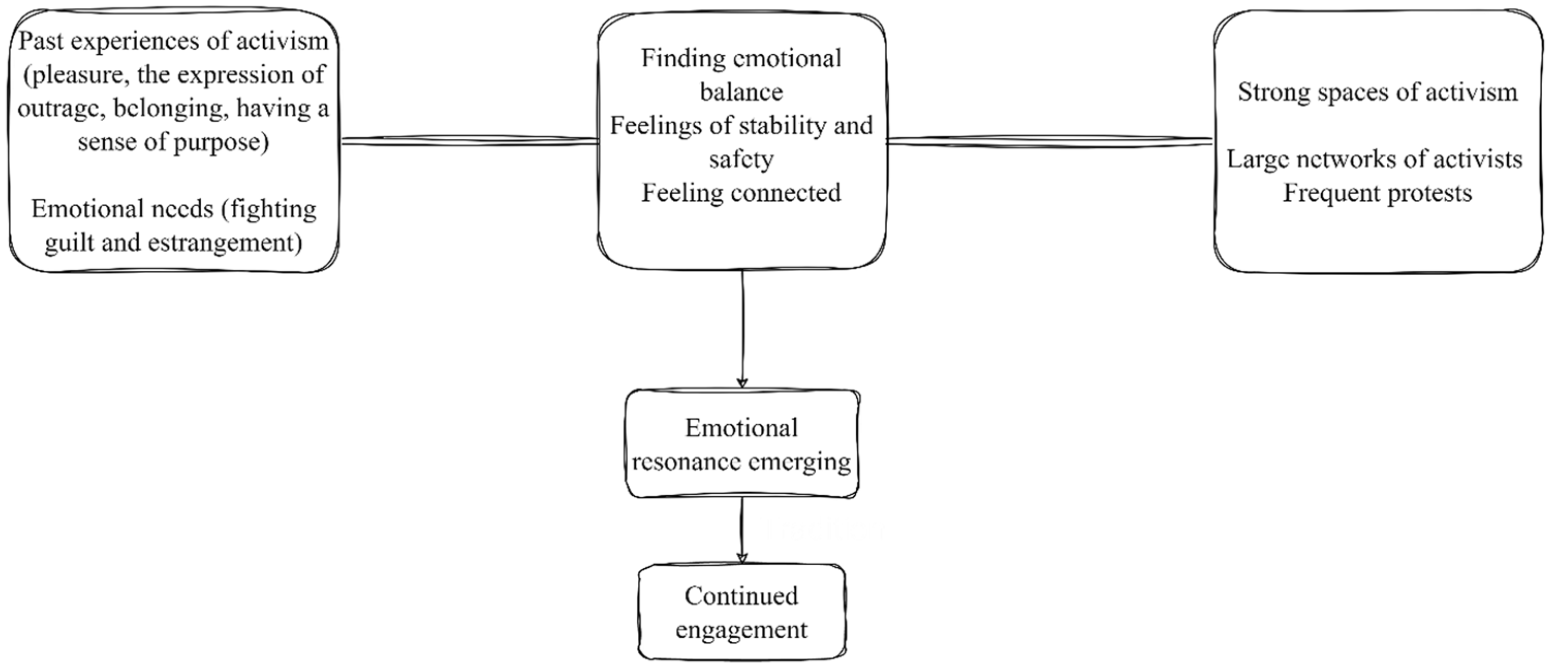
Summary illustration of emotional resonance and continued engagement.
The Oslo cases: weak spaces for emotional resonance
Coming from a family of means, Ali explains how he was initially influenced by the discourse of the regime accusing protesters of being terrorists or foreign agents seeking to destabilize the country. As he was exposed to the narrative of people coming from revolting cities to his hometown, hearing about stories of the violence committed against them, Ali changed his perspective and became fully active in support of the uprising. Ali was, too, motivated by a sense of obligation and duty to participate in the uprising in response to the violence he found unacceptable (Pearlman, 2016). He began smuggling medical supplies to revolting areas. Because of his activities, he was arrested and stayed in prison for a while. He was particularly traumatized by the time he spent in prison and spoke in incredible length of the torture, starvation, and inhuman conditions he was subjected to. When he came out of prison, he was filled with outrage over what he witnessed and experienced in that brief encounter with imprisonment: When I looked at myself in the mirror I thought I was seeing someone else. I was an entirely different person. I came out of prison another person than the one I knew. I could not recognize myself. In that moment, I became more vindictive against the regime. I spent few days with my family and then went to the liberated areas.
Ali’s feelings of anger over the horrific experiences he endured in prison were so overpowering that he had to avenge himself by upscaling his engagement. Instead of redirecting him away from action, the experience of prison pushed Ali to continue his fight against the regime. Leaving to rebel-controlled areas, Ali was more hopeful in the beginning that a change can be made, but his initial sense of optimism was soon defeated by the state of affairs and how rebels turned out to be mercenaries, preoccupied by making money, splitting spoils, and establishing dominance. As a result, he became so disillusioned by the whole situation: There was nothing left to make sacrifices for. The people I was willing to make sacrifices for were gone, so I decided to leave.
Ali too like Hatim did not see a point in continuing action from rebel-controlled areas seeing as how their movement was hijacked by opportunists. In consequence, exiting Syria became the decision best aligned with his assessment of the situation.
After coming to Norway, Ali was overcome by a deep sense of disillusionment and hopelessness over his experiences of what he witnessed in rebel-controlled areas. In order to put an end to these feelings, seeing an opportunity to make a change from outside after it became so difficult to do that from inside Syria, Ali tried to resume activism: I started to check who [from activists] came to Norway and Germany, and started getting in contact with people here. In the beginning, we organized some activities, including protests, sending aid, whatever we could do. We started organizing protests with other groups in Europe where we would all go and protest at the same time. We would go out and take part, but few people showed up. After a while of taking part in those protests and not seeing enough engagement from people here in Norway, especially that it is a cold, to protest in a weather of -10 or 20 degrees is difficult, I became convinced that this regime [in Syria] is not such that anyone can bring down. This regime is backed by big countries. It is an occupation in the form of a dictatorship. When I reached that conclusion, I started to lose morale little by little. There is nothing to work for. We did so much in the past with no avail. I figured that’s about enough. So, I stopped all revolutionary activities here in Norway and I haven’t been doing anything since.
As Schrock et al. (2004) point out, transgendered people were able to derive some relief from their participation in local support groups, which however was not enough to fulfill their emotional needs. By expanding his networks and going into protests, he was able to briefly do so, but was unable to derive the emotional support needed to carry on. The spaces he attempted to create did not fully meet his emotional needs of wanting to end hopelessness as it did not attract the amount of attention and engagement desired, leaving him with a feeling of loneliness and without much emotional energy to continue. In exacerbating these negative feelings while ineffectively responding to existing needs inherited from before, these spaces failed to create emotional resonance, which made Ali became more and more disillusioned (Accornero, 2019a; Matthies-Boon, 2017) and relate more to experiences of hopelessness in evaluating the continuation of activism as illogical.
Unlike the others, Bushra left Syria for Norway before 2011. Describing her time in Syria, she was dismayed by nepotism, ideological indoctrination, and the inability to choose a path not preordained by the regime. To address her frustrations and channel her energy, she turned to humanitarian volunteering. Thus, when the uprising began, Bushra was motivated to become engaged from outside in its support, doing online advocacy and going in protests. However, because of how the situation was turning in Syria, rendering action rather futile in her view, Bushra started to experience hopelessness: After a while you discover as a helpless Syrian citizen, no matter how much we talked and wrote on Facebook that we are not against anyone and that we are okay with whoever wants to stay in power so long as there is reform and there is no one-party rule . . . personally, I am not against anyone, if Assad wants to stay in power, ok, but he has to make reforms. So the people who are like me and I attempted to spread this awareness. We never expected things to go that way, that there be a war, or that the revolution would escalate that much, we did not know that we would get to that point. After a while, you find out that there is no point because the game is beyond us, beyond that platonic and romantic vision we had. So you just lose interest.
Not only was Bushra losing hope, but also her attitudes toward the regime have changed over time as a result of how the uprising turned into a game beyond the control of ordinary people. When she compares herself to people who experienced the uprising from Syria, she refers to grievances and how she thinks that she suffered less compared to them: “Those people who have lost everything because of the regime, it is hard to imagine [. . .] I did not go through what they had been through, so I understand.” Drawing on her position as an outsider, living the uprising from outside, Bushra alludes to how she did not acquire the emotional intensity that others have acquired from operating in Syria. Her emotional experiences were thus marked more by hopelessness as she was exposed to conflict-related trauma from a distance without experiencing the effects of participation in Syria but rather how action from outside was becoming more and more useless.
With the arrival of Syrians in the following years to Norway, Bushra described how she was somewhat encouraged by that moment to revive her engagement, hoping that their arrival could lessen her disillusionment about the benefit of taking action. Soon however, not only was she disappointed by the impact that war left on people and how she could not identify with them, but she also could not find a place for herself within the larger activist network in Oslo: We are a very diverse society in Syria, so every time I go into a protest, it is organized by a different person. Even though all of those people were from the opposition, they disagreed with each other. I couldn’t identify with anyone even though we all had the same goal in terms of being against what was going on, but at the same time there was something belying the general goal. It felt strange to me at least. So I stopped participating in protests.
The protest activities in Oslo could not respond to Bushra’s need of fighting hopelessness, which is characteristic of her experiences of participation and how they are marked by the feeling that action is futile. Unable to relate and affiliate with people organizing and present in these spaces undermined her attempts at countering feelings of hopelessness and powerlessness by cultivating belonging and regaining energy. By failing to suppress hopelessness while instead making her feel more estranged, these spaces did not resonate with her emotional aspirations of minimizing hopelessness, making disengagement appear as the more logical choice in view of increased disillusionment.
With participation experiences rooted in a general perception that action is futile in light of circumstances in Syria, participants were overwhelmed with feelings of hopelessness and disillusionment. These presented challenging emotional needs that participants sought to resolve through joining spaces of networks and activists to procure feelings that could counter their overall feelings of hopelessness. These spaces, however, failed to promote the desired feelings of togetherness, belonging, and faith that action matters. As these spaces could not meet activists’ needs and left them with exacerbated feelings of isolation and estrangement, they increased their sense of disillusionment instead of speaking to their demands. Unable to have their emotional demands accommodated by these spaces for the continuation of activism, participants chose to disengage from action on behalf of Syria. Below, Figure 2 starkly contrasts Figure 1.
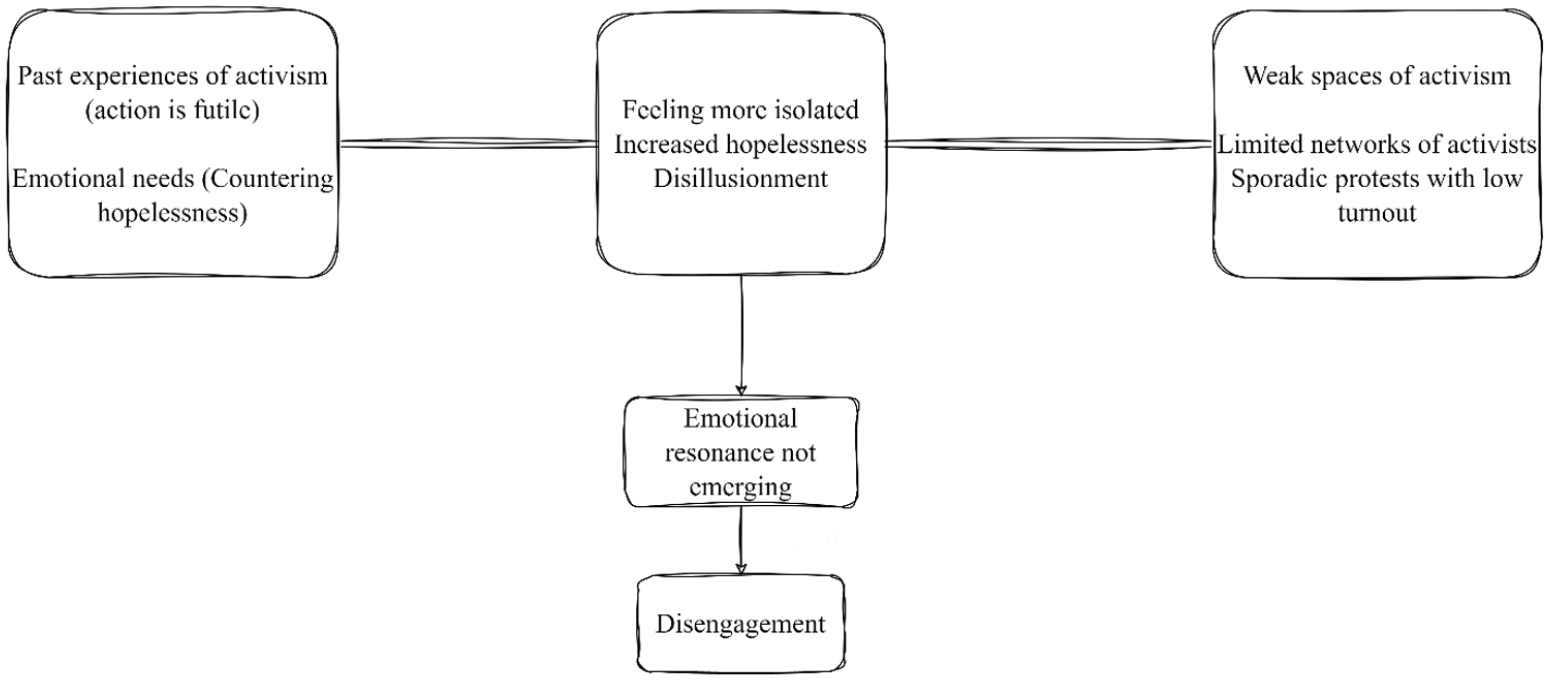
Summary illustration of emotional resonance and disengagement.
Discussion and conclusion
In this article, I have investigated the ways in which the exile contexts of Berlin and Oslo created unequal spaces of emotional resonance for the emotional experiences of activists. Unpacking participants’ narratives from their experiences of participation in the uprising, through exit, and into exile revealed that activist trajectories were shaped and defined by how exile contexts resonated with activists’ emotional needs arising from action in the past experienced as pleasurable, rightful, or futile. The context of Berlin provided strong spaces for organizing protests and developing activist networks. This, I found, dampened feelings of estrangement and guilt and replaced them with a sense of togetherness and safety that were critical to the continuation of activism. In contrast, Oslo produced protests of unsatisfactory turnout and small networks of divided loyalties that were unable to mute feelings of hopelessness or strengthen belonging to support engagement. Thus, differences in spaces of emotional resonance, in specific, the ability of networks and practices to create positive emotions and trump negative ones, played a key role into why trajectories played out so differently between activists in Berlin and those in Oslo. Based on these insights, I contribute to existing literature in three ways.
First, I add to Pearlman’s (2013, 2016) work about the role of emotions in the Syrian uprising by showing how emotions of activism traveled in time and space. By paying specific attention to actors’ experiences of participation as it translates through their memories, my analysis has shown how activists’ emotional needs that arose in exile essentially originated from how they experienced action in the past. Thus, opening up the inquiry to individuals’ experiences of activism in exile enabled an insight into how emotions of past activism affected individuals, leading to a series of key emotions as time progressed and activists moved geographically to other countries.
Second, this study adds to our understanding of how emotions shape action across place (Bosco, 2007) and extends the concept of emotional resonance (Schrock et al., 2004) through the comparative analysis of Syrians’ activist trajectories in Berlin and Oslo. I highlight what kind of contextual elements are important for emotional resonance to emerge, while emphasizing how the lack of these particular elements can hamper its emergence. For emotional resonance to arise, activists have to secure access to spaces that can be fulfilling of their emotional needs in a way that can support activism. This means that these spaces have to provide vital networks of activists and sites of claims-making, including protests that are strong enough to act as vehicles for deriving emotional energy and cultivating a sense of belonging. When these means are available, activists may be able to resolve their emotional needs and feel more emboldened to continue activism. In contrast, when the context of exile lacks spaces where networks of activists are scarce or divided and protests are sporadic or fragmented, emotional resonance is less likely to emerge, leaving activists with an increased sense of disillusionment and a leaning toward disengagement. In this way, my take on emotional resonance takes it beyond its initial conceptualization of how social movement framing speaks to the needs of potential recruits (Schrock et al., 2004), specifying contextually the particular elements that can make emotional resonance work or not work. The study therefore reveals the utility of context and physical space as an important avenue for examining emotional resonance and suggests spaces for emotional resonance as a conceptual frame that can be utilized for a better understanding of how emotional resonance works and how that can affect activist (dis)engagement across different contexts.
Finally, this study may generally contribute to diaspora mobilization studies by generating insights on how some Syrian diasporas became active in support of their homeland cause while others did not. It contends that to understand how diasporas develop strong political mobilization in their infancy, it is important not only to look at opportunity structures in host countries as conventional wisdom goes, but it may be also crucial to pay attention to actors’ experiences of activism in the past, especially in the context of revolutions or other major political upheavals.
Footnotes
Acknowledgements
I am deeply grateful to my supervisor Susanne Bygnes for her constant help and support. I thank my co-supervisor Mette Andersen, my colleagues at the department and IMER network, and IMEX advisory board for reading earlier drafts of the manuscripts and engaging with her work. Finally, I am forever indebted to participants for sharing their inspiring stories with her.
Funding
The author(s) disclosed receipt of the following financial support for the research, authorship, and/or publication of this article: This work is supported by the Research Council of Norway (grant no. 262987) as part of IMEX (Imagining and Experiencing the Refugee Crisis) project.
