




Abstract
In this country-comparative study, we ask to what extent differentiation in secondary education accounts for the association between social origins and social destinations in adult age. We go beyond the widely applied formal definitions of educational tracking and particularly pay attention to country-specific approaches to educational differentiation. Our main expectation is that once we factor in these particularities, the degree to which educational differentiation accounts for social reproduction is quite similar across countries. Our analyses are based on national individual-level life-course data from six European countries that span from secondary education to occupational maturity. Our findings show that educational differentiation mediates the association between social origins and social destinations to a substantial degree in all countries. However, we still find some differences between countries in the extent to which educational differentiation accounts for social reproduction.
Keywords
Introduction
Education is widely regarded as an important mediator of the association between social origins and social destinations. For that reason, differences in educational systems have received much attention in country-comparative social mobility research (Breen and Jonsson, 2005; Hout and DiPrete, 2006; Jackson, 2013), assuming that the formative mechanisms of social reproduction depend on the design of institutional structures. An important characteristic of educational systems is educational differentiation: the separation of students into different groups, tracks, or streams for instructional purposes (cf. Sørensen, 1970). Usually, this separation, also called stratification or simply referred to as tracking, takes effect in secondary education. Previous research suggests that educational systems with early between-school tracking in secondary education show higher levels of social inequality in school performance or educational attainment than education systems with comprehensive schooling or late between-school tracking (cf. Skopek et al., 2019; Terrin and Triventi, 2022). However, two objections raised in the literature challenge the universality of this pattern.
First, this conclusion is primarily based on studies that use a narrow and formal definition of tracking. Several authors point out that educational differentiation can take on very different forms and thus provide functional equivalents to formal between-school tracking. Different labels and concepts that describe those alternative forms of educational differentiation exist in the literature, such as within-school, informal or hidden forms of differentiation (cf. Triventi et al., 2016a) or de facto tracking (Lucas and Berends, 2002). According to Triventi et al. (2016b), educational differentiation appears in virtually all secondary education systems, and it also channels the association between social origins and destinations, irrespective of whether school systems are formally classified as tracked or comprehensive. While this observation leaves open the question whether specific systems produce more social reproduction overall, it suggests that educational differentiation—once properly measured—is an important mediator of social reproduction within all educational systems.
Second, much of the literature on the effects of early tracking considers social inequality in early outcomes, such as school performance. Hence, one might wonder whether different types of educational differentiation have different implications for social reproduction when it comes to longer-term outcomes, such as labor market placement. For example, Brunello and Checchi (2007) argue that the outcomes most relevant for intergenerational mobility are observed later in the life course. Indeed, the literature focusing on long-term outcomes finds more mixed results on the influences of educational differentiation (Ballarino et al., 2016; Brunello and Checchi, 2007; Dustmann et al., 2017; Heisig et al., 2019; Pfeffer, 2008; Reichelt et al., 2019; Van de Werfhorst, 2019; Vogtenhuber, 2018).
This article jointly examines these two aspects of educational differentiation in six European countries. We go beyond the usual narrow definitions of tracking and pay more attention to country-specific schemes of educational differentiation. This means that we do not apply any common concept of differentiation for all countries, but seek to identify for each country individually how students are formally or informally separated for instructional purposes. Thereby, we focus on those most salient dimensions of separation which generate differences with regard to further labor market opportunities. We assume that whenever these differences are relevant, it generates an incentive for more advantaged groups to exploit them for their intergenerational reproduction. We use the term “track” whenever we refer to the separate pathways within a given country’s differentiation scheme—irrespective of whether this is a formal or informal approach.
Quantitative empirical measures hardly exist for each and every hidden form of educational differentiation. To address this problem, we make use of the fact that the most salient types of country-specific educational differentiation materialize in upper secondary education in categories that are accessible through empirical indicators and readily available in already existing data sets. Furthermore, we explicitly consider the mediating role of educational differentiation in the association between social origins and long-term outcomes in the labor market when the persons under investigation have reached occupational maturity.
The main objective of this article is to examine to what extent the role of the most salient form of educational differentiation—once properly identified through country-specific indicators—in mediating the association between social origins and destinations is similar across countries, as suggested by Triventi et al. (2016b). An innovation of this article is that we provide country-comparative analyses that are based on country-specific life-course data, which span from secondary education to occupational maturity. The analyses cover six European countries that represent different educational differentiation regimes: Denmark, England, Finland, France, Germany, and Italy. With our country selection, we cover four typical approaches to educational differentiation (Triventi et al. 2016b): (1) the early-tracking model (Germany) with formal and selective between-school tracking in lower secondary education; (2) the Nordic inclusive model (Denmark, Finland) with late-tracking and a general formal two-track system for vocational or academic upper secondary education; (3) the individual choice model (England) without formal between-school tracking throughout upper secondary education; and (4) the mixed tracking model (France, Italy) with more than two options in upper secondary education.
For each country, we conduct separate analyses based on individual-level data. Drawing on country-specific data allows us to identify country-specific forms of educational differentiation. This means that our measure of educational differentiation differs between countries. For each country, we estimate to what extent its specific measure of educational differentiation accounts for the association between social origins and destinations. To be able to compare the role of educational differentiation across countries, we standardized all other relevant variables, methods, and cohorts to the greatest extent possible across the national data sets. We follow a stepwise procedure to approach our core research questions, which we explicate in the following section.
Conceptual framework
Figure 1 represents the so-called social mobility triangle, which describes the association between social origins (O) and social destinations (D). As we know from decades of social mobility research, in contemporary societies, the most important mediator of this association is educational attainment (E). Conceptually, we deviate from the classical mobility triangle by shifting the focus from educational attainment to school track attendance in secondary education (T). We want to find out to what extent educational track placement already accounts for the association between social origins and destinations. As can be taken from the graph, we assume that the association between track placement and destinations is again mediated by educational attainment. This means that the stronger the correlation between T and E is, the more are social destinations (D) already predetermined by track placement in secondary education. In some education systems, track placement and final educational attainment are closely linked. For example, this can be the case when changes between tracks are uncommon or when access to higher education is bound to the completion of specific tracks. In other countries, students can correct their envisaged educational careers between track placement and final educational attainment. In such cases, educational differentiation is non-rigid.
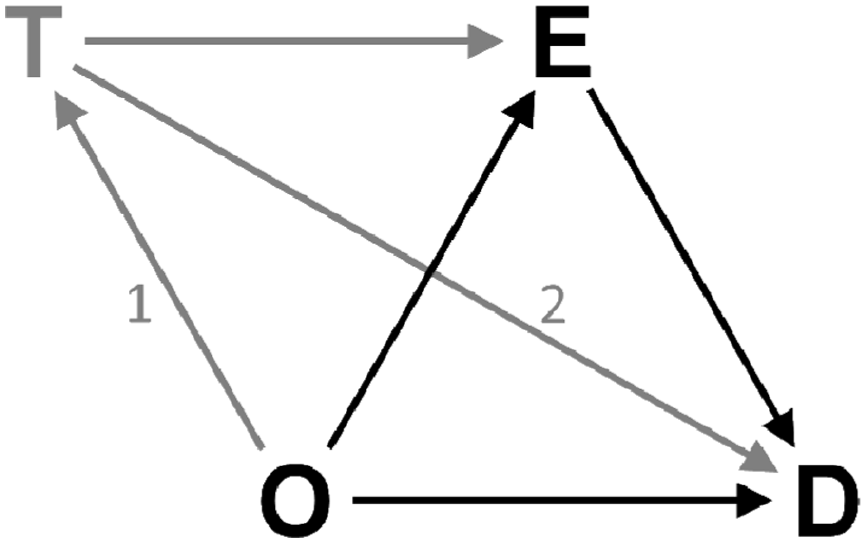
Extended social mobility triangle with school track in secondary education.
We compare the mediating role of school track attendance between our country cases in three consecutive steps. First, we ask to what extent the association between social origins and track attendance varies across countries (association 1 in Figure 1). Second, we ask to what extent the association between track attendance and labor market outcomes at occupational maturity varies between countries (association 2 in Figure 1). Third, we consider the overall association between social origins (O) and destinations (D) and ask to what extent it is mediated by placement in the country-specific system of educational differentiation (T). Our prime interest is the extent to which the degree of mediation is similar or differs across countries. This analysis refers to the relative importance of educational differentiation for the process of social reproduction within countries. Besides, we will also provide some insights on whether some forms of educational differentiation are associated with higher absolute levels of inequality than others. Within the limits of our rather small number of country cases (which nevertheless represent typical examples of different tracking regimes), this will enable us to relate our analyses to the conventional wisdom that early-tracking systems are associated with higher levels of social reproduction than comprehensive systems.
Previous research
Measuring educational differentiation
Research on the relationship between educational differentiation and social inequality is heavily influenced by country-comparative analyses on the macro level. Different indicators of tracking have been suggested. In its most simple version, countries and their education systems are classified as either early tracking or comprehensive/late tracking and correlated with country-level indicators representing their degree of social inequality (e.g. Hanushek and Wößmann, 2006). Other approaches draw on the number of distinct school tracks at a given school grade (e.g. Ammermüller, 2005) or the timing of first tracking (Waldinger, 2006) as indicators. More complex approaches consider multiple indicators of tracking, such as the age when students enter formal tracking, the percentage of schooling spent in a formally tracked system, the share of students in vocational tracks, or the degree to which selection into tracks is based on ability (e.g. Brunello and Checchi, 2007; Traini, 2022). To quantify the degree of formal tracking, Bol and Van de Werfhorst (2013) construct an index of tracking based on such multiple indicators. While these approaches are suitable for macro-level analyses with countries as units of analyses, the suggested indicators are less adequate to detect country-specific approaches to educational differentiation. We are not aware of any country-comparative study that considers countries’ idiosyncrasies in sorting their students for instructional purposes. However, this will be important if we want to find out to what extent the specific mode of differentiation in a given country contributes to social reproduction within that country. While the study by Blossfeld et al. (2016) explicitly acknowledges this issue in their country-level analyses, they do not provide any standardized comparative analysis. On a different but related issue, the conceptual framework of the study by Jackson and Jonsson (2013) provides a role model for our purposes. They compare social inequality in the first transition to the most prestigious secondary school track of a given country. Yet, both the timing of the transition and the definitions of school tracks vary across countries. In addition, all analyses are based on national datasets that cover all relevant country-level idiosyncrasies. We will follow this approach and adapt it to our purposes. To identify the most salient forms of differentiation within the different countries, we can rely on descriptions from previous work (Birkelund et al., 2019; Blossfeld et al., 2016; Capsada-Munsech and Boliver, 2019; Facchini et al., 2019; Heiskala and Erola, 2019; Henninges et al., 2019; Herbaut et al., 2019).
Associations of the O-T-D triangle
There is not much comparative research on the association between social origins (O) and track placement in secondary education (T). Following Triventi et al. (2016b), in all educational systems, students with privileged family backgrounds are more likely to access the most prestigious educational pathways in secondary education than students from disadvantaged social origins. However, their analyses do not provide a common metric that would allow for a comparative assessment linking the type of educational differentiation to the magnitude of this association. The study by Jackson and Jonsson (2013) arrives at similar conclusions. In addition, they compare the magnitude of the associations between social origins and participation in the most prestigious secondary school track based on quantitative indicators. Even though they do not categorize the countries by their type of differentiation, they find that the magnitude of the association seems to be a function of the degree to which selection into the tracks is driven by individual choices.
Much research has been concerned with the association between educational attainment (E) and social destinations (D). This association is strongest in countries with formally stratified educational systems or strong vocational sectors (DiPrete et al., 2017; Müller and Gangl, 2003; Shavit and Müller, 1998). Less research has been devoted to the extent to which track placement in secondary education (T) is predictive of social destinations (D). Some insights can be gained from country studies. For example, the paper by Dustmann et al. (2017) finds that early track placement in Germany is less predictive of labor market outcomes than commonly assumed. Their explanation is that track placement can be corrected in the further educational career. This highlights the role of the rigidity of educational differentiation (cf. Sørensen, 1970), which refers to the correlation between track placement (T) and educational attainment (E). The study by Triventi et al. (2016b) shows that educational mobility after first track placement is more common in early-tracking than in late-tracking systems. This suggests that the differences between countries in the association between track attendance and social destinations might be smaller when track attendance is measured after students have entered upper secondary education. A series of country studies, which takes into account country-specific forms of differentiation in upper secondary education, appears to support this expectation (Bar-Haim and Feniger, 2021; Barone et al., 2021; Birkelund et al., 2021; Capsada-Munsech and Boliver, 2021; Heiskala et al., 2021; Herbaut et al., 2021; Traini et al., 2021). They find that track placement is an important predictor of labor market outcomes irrespective of the countries’ systems of student sorting.
The mediating role of educational stratification
While social mobility research has identified education as the most important mediator of the association between social origins (O) and destinations (D) in modern societies, the comparative study by Ballarino and Bernardi (2016) showed that the extent to which educational attainment (E) mediates this association varies across countries. However, they did not pay particular attention to the role of different types of educational differentiation. We are not aware of any comparative study that analyzed the mediating role of track placement (T) in a similar way across countries. Hence, we consider it a contribution of our article to fill that gap and provide new insights as to whether the country-specific approaches to student sorting in secondary education differ in mediating social reproduction or are just functional equivalents for identical processes.
Expectations
Association between social origins and track attendance
The common assumption about the association between social origins and educational participation is that educational systems that pursue early between-school tracking produce higher levels of educational inequality than late-tracking or comprehensive school systems. This argument can be derived from the life-course hypothesis (Müller and Karle, 1993), which postulates that the influences of the family are stronger at early educational transitions. However, this argument neglects that informal ways of educational sorting can fulfill functional equivalents in those educational systems that do not formally track their students in early phases of secondary education. Following the theory of “effectively maintained inequality” (EMI; Lucas, 2001), we stipulate that if such alternative channels of differentiation exist, social inequalities may materialize along these lines. Furthermore, we consider that formal early tracking is not deterministic. Early-tracking systems usually allow for correction processes and track mobility in the course of the educational career (Dustmann et al., 2017; Jacob and Tieben, 2009). To the extent that functional equivalents of sorting exist in late-tracking systems and formal tracking is not rigid in early-tracking countries, we expect that the association between social origins and educational differentiation in upper secondary education is more similar across educational systems than commonly assumed. Thus, if we properly identify the relevant country-specific differentiation features in upper secondary education, we expect the associations between social origin and track attendance to be similar across countries.
Association between track attendance and social destinations
As to the association between education and social destinations, previous research shows that labor market outcomes have a tighter linkage with educational credentials in stratified educational systems (DiPrete et al., 2017; Müller and Gangl, 2003; Shavit and Müller, 1998). Scholars explain this finding in terms of stratified systems providing more vocationally specific training during formal education, while specific skill production largely occurs more in the labor market in less stratified systems. Therefore, formal credentials convey specific human capital in stratified systems, which creates a tighter linkage to labor market opportunities. However, following the idea that every educational system pursues some more or less visible forms of educational differentiation, we expect that even in educational systems that are commonly classified as less stratified, functional equivalents might exist that are predictive of later-life labor market outcomes. Even if in these systems, formal credentials do not represent specific human capital to the same extent as in stratified systems, other forms of educational differentiation can still provide signals (e.g. cognitive ability, motivation, or trainability) that are decisive for access to different occupational trajectories (see, for example, Di Stasio and van de Werfhorst, 2016 on the different mechanisms linking education to labor market allocation). Thus, we expect that differences between educational systems are less pronounced than commonly assumed in the literature. We expect that the predictive power of placement in a country’s secondary educational differentiation system for social destinations is similar across countries once the relevant dimension of educational differentiation is properly identified and measured.
The mediating role of track attendance in upper secondary education
With regard to the role of educational track attendance in mediating the association between social origins and destinations, we expect that to the extent that both the associations between origins (O) and track attendance (T) and track attendance and destinations (D) display a high level of similarity among different educational systems, the mediating role of educational differentiation should also display little country variation. We expect that countries do not differ substantially in the role that differentiation in secondary education plays in shaping long-term social reproduction once we factor in the relevant dimensions of educational differentiation.
Description of countries and data
As we analyze long-term labor market outcomes at occupational maturity, our analyses cover birth cohorts for which we can observe such outcomes. In all countries, the individuals under investigation are born between 1970 and 1980. The only exception is Italy, where—because of data availability—analyses can only be conducted based on cohorts born between 1958 and 1967. Similarly, the secondary education systems described here are those that these cohorts went through. Table 1 provides a comparative summary of educational differentiation in lower and upper secondary education in our selection of countries by depicting the various formal and informal tracks of the respective educational system. We also indicate at which age these educational episodes commonly start. Previous comparative research often just classifies countries into early- or late-tracking systems (e.g. Hanushek and Wößmann, 2006) or classifies countries based on multiple indicators such as timing of tracking, duration of tracking, selectivity of tracking, or the role of vocational training (e.g. Bol and Van de Werfhorst, 2013; Brunello and Checchi, 2007; Traini, 2022). Yet, these classifications rely on formal indicators that are applied to all countries alike. In Table 1, we contrast the common simple formal categorization of differentiation with a more detailed consideration of student sorting that also takes into account country-specific informal and more subtle ways of differentiation. We follow the definition by Triventi et al. (2016b) and consider as formal differentiation all “regulated forms of diversity that are recognized by law and are visible in school certificates and qualifications” (p. 11).While we only summarize the key features of these educational systems here, a detailed description can be found in a series of country reports (Birkelund et al., 2019; Capsada-Munsech and Boliver, 2019; Facchini et al., 2019; Heiskala and Erola, 2019; Henninges et al., 2019; Herbaut et al., 2019). 1
Dimensions of educational differentiation in lower and upper secondary education.
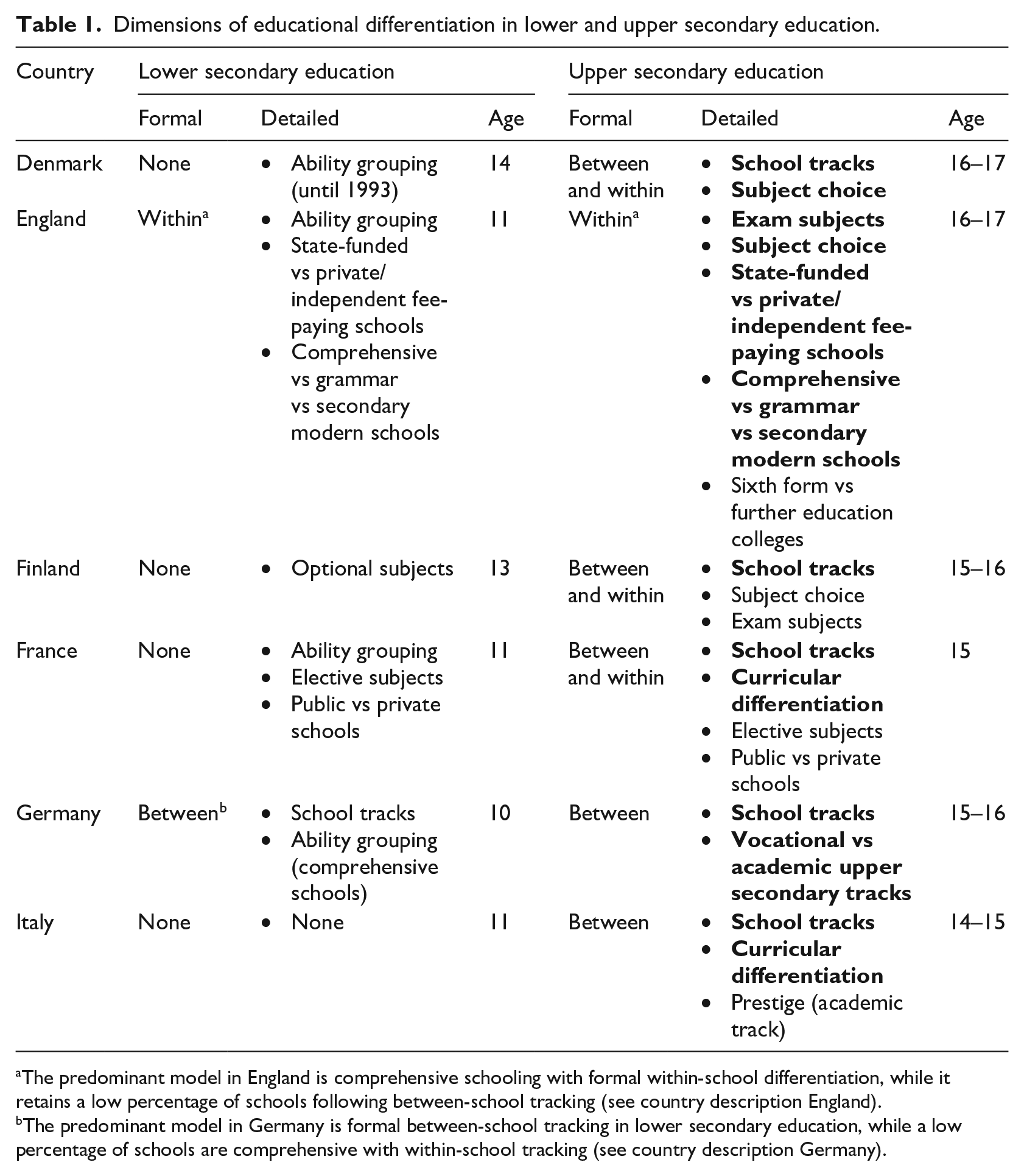
The predominant model in England is comprehensive schooling with formal within-school differentiation, while it retains a low percentage of schools following between-school tracking (see country description England).
The predominant model in Germany is formal between-school tracking in lower secondary education, while a low percentage of schools are comprehensive with within-school tracking (see country description Germany).
The table shows that many countries do not pursue formal differentiation in lower secondary education. Yet, in all countries but Italy, a more detailed consideration reveals that informal sorting practices already prevail in lower secondary education. In upper secondary education, all countries pursue formal differentiation, which, in many cases, materializes as a consequence of informal sorting in lower secondary education. We have indicated in bold letters all dimensions of differentiation in upper secondary education that we are able to observe in our empirical data. In all countries but Finland, we are able to provide more detailed measures of differentiation than the common standard measures of tracking. We provide a description of the variables and their univariate distributions in Table 2. We will use these country-specific indicators of educational differentiation in all subsequent analyses.
Description of country-specific data and measurement of educational differentiation.
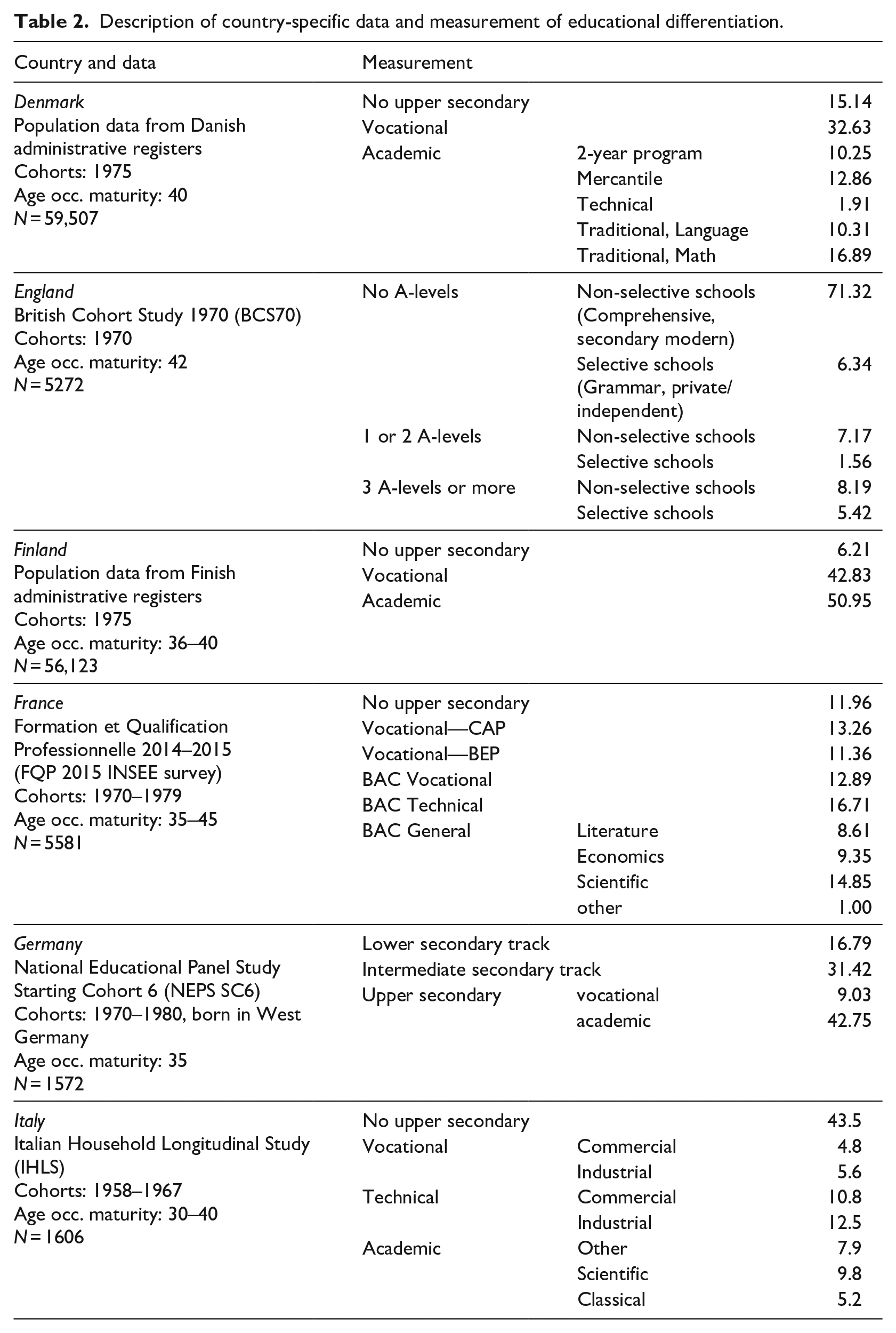
Because countries differ slightly regarding the age when people are commonly established in the labor market, we follow country-specific definitions of occupational maturity. Partly, those definitions also depend on data availability. They range between 30 and 45 years. We measure all labor market outcomes when persons are at those ages. Since we use social class as our indicator of labor market outcomes (see description below), the age variation between countries is not expected to bias our results. Social class positions usually remain rather stable once persons have reached occupational maturity (cf. Bukodi and Goldthorpe, 2011; Goldthorpe et al., 1987; Härkönen and Bihagen, 2011). Table 2 lists the country-specific age definitions together with the birth cohorts under investigation, the titles of the national data sets, and their sample sizes (further properties and the share of missing data can be found in Table S1 in the Online Supplement). The table also displays the country-specific variables denoting the categories of differentiation in upper secondary education with their univariate distributions. Relying on country-specific measures of our key mediator variable confronts us with the problem that—due to data availability—the level of precision of the measurement can vary across countries. This can influence the results when we are comparing the mediating role of educational differentiation between countries: more differentiated variables tend to account for more variation than less differentiated variables. For that reason, we kept the number of substantive categories in the differentiation variables approximately similar across countries. Exceptions are Finland and Germany. The Finnish data do not allow for a more differentiated version, which is why we expect to underestimate the role of educational differentiation compared to the other countries. For Germany, we considered a more differentiated version of the variable, but the results were similar to the four-category version shown in Table 2. This is why we draw on the more parsimonious variable in the analyses shown below. In the following, we provide short descriptions of the countries’ educational systems to provide some background for the selection of country-specific variables. 2
Denmark
The Danish educational system does not show any noteworthy differentiation in lower secondary education for the birth cohort studied here (except course-based within-school ability grouping, which was abolished in 1993). Formal differentiation starts with upper secondary education (grade 10), when pupils either leave school or attend an academic or vocational track. The academic track (Gymnasium) is characterized by further within-differentiation: the traditional academic track, the mercantile track, and the technical track, all of which are three-year programs. In addition, a two-year late-starter track also exists. Within the traditional academic track, students have some degree of freedom in configuring their courses according to their preferences (social science, science, language, and arts). Denmark has a unitary education system and there is no institutional variation on the sub-national level.
We base the empirical analyses of the Danish educational system on population data from the Danish administrative registers, more specifically the entire 1975 birth cohort. We code the differentiation in upper secondary education in accordance with the above-mentioned tracking structure, also distinguishing between math- and language-dominated configurations of the traditional academic track (cf. Table 2). We measure the track attendance of students as their track of upper secondary completion. We use measures of occupational attainment when respondents are 40 years old.
England
The lower secondary education system in England is a nominally comprehensive one following the phasing out of academic selection at age 11 during the late 1960s and early 1970s. That said, around five percent of pupils aged 11–15 in the state-maintained sector still attend academically selective grammar schools (Bolton, 2016). A further seven percent attend fee-paying private/independent schools (Green et al., 2017). Many comprehensive schools pursue within-school differentiation through ability grouping in Math and English (Francis et al., 2017), as detailed in Table 1. Pupils who stay on in upper secondary education can choose to pursue academic qualifications known as A-levels (Advanced-levels, KS5)—usually specializing in three curriculum subjects. Others pursue vocational qualifications such as National Vocational Qualifications (NVQs) or Business and Technology Education Council (BTEC)—usually in a single subject. Some pursue a combination of the two (e.g. one A-level and a BTEC qualification). Progression to the academic route in upper secondary education (i.e. A-levels) tends to be restricted to higher achievers in the General Certificate of Secondary Education (GCSE) and equivalent qualifications, whereas vocational study programs (e.g. BTEC) at upper secondary level are more accessible to low achievers at GCSE. While access to university is usually gained via the academic route, those with vocational upper secondary qualifications can also access university if they meet the threshold entry criteria. Conversely, those with upper secondary academic qualifications can access vocational college courses, even though it is an uncommon route.
The analyses in this article are based on the 1970 British Cohort Study (BCS70) data (University of London, Institute of Education, 2016), which follows over time a representative sample of people born in the United Kingdom in the same week in 1970. We restrict the analyses to those individuals who have undergone their formal education in England, due to the differences in the educational system across the four UK nations. The Scottish education system and, to a lesser extent, the Northern Irish one are substantially different in terms of relevant tracking features compared to the English one. While the Welsh education system is comparatively more similar to the English one, there are no grammar schools in Wales. Thus, we focus on the English case only to ensure we measure the most relevant upper secondary tracking measures, as displayed in Table 1. We differentiate between those who gained at least three A-level qualifications at upper secondary level, those that gained one or two, and those with none. We then combine it with the type of school attended, differentiating between those that attended a non-selective school (i.e. comprehensive or secondary modern school), or a selective school (i.e. academically selective grammar school or fee-payment selective private/independent school, cf. Table 2). Indicators of educational attainment or occupational placement are measured when respondents were 42 years old.
Finland
With comprehensive schooling until age 15–16, the Finnish educational system does not comprise any formal differentiation in lower secondary education. In upper secondary education, the Finnish school system follows between-school tracking after grade 9. While a small minority of the pupils leave school, roughly equal shares of the rest enter either vocational or general upper secondary schools (Table 2). In addition to formal within-school tracking in vocational upper secondary education, Finnish lower secondary and general upper secondary schools are also characterized by informal within-school differentiation through course-based subject specialization and electives. All upper secondary qualifications give eligibility to apply to universities and universities of applied sciences, so the rigidity of tracking in the Finnish educational system is loose. There is no institutional variation on the sub-national level in the Finnish educational system.
The empirical analyses of the Finnish educational system are based on full population data from Finnish administrative registers and relate to the birth cohort 1975. Unfortunately, the data do not contain information on within-school differentiation in upper secondary education, such as subject choices, outlined in Table 1. The analyses will distinguish whether pupils left school after lower secondary education or completed upper secondary education either at a vocational or academic school. Indicators for educational and occupational attainment are measured when respondents were 36–40 years old.
France
The French lower secondary educational system is characterized by comprehensive schooling until grade 9. Despite the absence of formal differentiation, there are several channels of informal differentiation that might already pave the way for later sorting (cf. Table 1). Formal tracking begins in upper secondary education with grade 10 when pupils attend a vocational high school or a general and technological high school. At the end of 10th grade, the latter choose between an academic or a technological track. The vocational track can be completed either with a vocational qualification or with an upper secondary degree that provides eligibility for higher education. The academic, technological, and vocational tracks can lead to upper secondary degrees (baccalauréat, BAC) granting higher education eligibility. All tracks are characterized by within-differentiation as they provide several streams of subject specialization. In addition to these formal aspects of differentiation, French upper secondary education also shows some informal ways of sorting, such as the divide between public and private schools, elite and standard institutions. However, the French education system is a highly centralized one with, for instance, the private sector being both funded and controlled by the State, so that educational institutions are very similar across regions and there is little institutional variation on the sub-national level in France.
The empirical analyses of the French educational system are based on the survey “Formation et Qualification Professionnelle 2014-2015” (FQP, 2015) and cover the birth cohorts 1970–1979. Unfortunately, the data do not contain information on informal differentiation in upper secondary education, but they cover detailed aspects of all formal tracks and streams. As depicted in Table 2, the analyses will distinguish between students who did not attain more than lower secondary education, students who completed a short vocational qualification (Certificate d’Aptitude Professionelle, CAP or Brevet d’Etudes Professionelles, BEP) and students who attained an upper secondary degree in the vocational, technical, or general track. Moreover, students who completed the general upper secondary track will be further differentiated according to their stream of specialization: literature, economics and social sciences, scientific, or other. Indicators for educational and occupational attainment are measured when respondents were 35–45 years old.
Germany
The German education system is the prime example of an education system with early between-school tracking (cf. Table 1). In the time under view in this study, formal tracking already started at the beginning of lower secondary education. At age 10 (grade 5), students attended either one of three hierarchical school tracks or a comprehensive school (only available in some federal states). While only the academic track (Gymnasium) in the tracked school system or a corresponding stream in the comprehensive school system ends with eligibility for higher education, the German education system allows for track mobility and offers opportunities for educational upgrading. Students who did not attend the academic track could continue schooling when performance was good enough or they could upgrade their credentials in add-on schools—most of which are part of the vocational school system—and obtain either full or restricted eligibility for higher education. Restricted eligibility allows access to universities of applied science, but not to universities. There are differences between federal states (two states track after grade 6, states differ in the extent to which elementary school teachers determine track placement in secondary education, and the institutional pathways for educational upgrading can be organized differently), but these differences still justify treating Germany as a unitary systems type in international comparison. Since our analyses are based on indicators referring to upper secondary education, these differences between federal states will not create any systematic bias.
The analyses of the German educational system are based on the adult cohort (Starting Cohort 6) of the National Educational Panel Study (NEPS-SC6) and cover the birth cohorts 1970–1980. 3 We construct the tracking variable based on the highest school track students have completed by the age of 22 (lower, intermediate, and upper secondary). Students in comprehensive schools have been assigned to one of these categories according to their acquired certificates. If students have obtained a restricted or full higher education eligibility through second-chance education in the vocational sector, we recode the variable accordingly (cf. Table 2). Indicators for educational and occupational attainment are measured when respondents were 35 years old.
Italy
Italian lower secondary education is comprehensive and lasts until grade 8. At this level, there is hardly any additional source of notable informal differentiation between or within schools (cf. Table 1). Formal between-school tracking in upper secondary education begins with grade 9, when students attend one of three main school branches (academic, technical, or vocational), which differ in their curricula and academic requirements. In addition to these main branches, schools also differ in their areas of specialization within tracks. Academic tracks offer multiple streams: classical, scientific, foreign languages, and psycho-pedagogical curricula. Within the technical and vocational tracks, schools have two main streams, either commercial or industrial, which comprise multiple curricula relating to specific sectors or occupations. Graduation from any track gives access to higher education. The probability of enrolling in tertiary education and obtaining a degree are highest for academic graduates and lowest for vocational graduates. The Italian education system can be treated as unitary, since educational institutions are standardized nationwide.
The analyses on the Italian educational system are based on the Italian Household Longitudinal Study (IHLS) and cover the birth cohorts 1958–1967. The tracking variable has been measured at the time of track completion. We distinguish between students that did not obtain any upper secondary school degree, and graduates of vocational, technical, and academic school tracks. In addition, for vocational and technical graduates, we differentiate between those who attended the commercial stream and those who attended the industrial stream. Finally, academic graduates are distinguished on the basis of their curriculum: classical, scientific (the most prestigious ones), and other curricula (cf. Table 2). Indicators for occupational attainment are measured when respondents were 30–40 years old.
Common independent and dependent variables
As our measures of social origins and social destinations, we follow previous analyses of the social mobility triangle and draw on a six-category version of the Erikson–Goldthorpe–Portocarero (EGP) class schema (Erikson et al., 1979). We distinguish the salariat (I + II), non-manual routine occupations (IIIab), the self-employed outside (IVab) and in agriculture (IVc), skilled (V + VI) and unskilled (VII) working classes. For social origins, we rely on parents’ EGP, using the highest EGP in case of two different categories according to the dominance principle (Erikson, 1984). For social destinations, we measure EGP at occupational maturity at the country-specific ages defined in Table 2. In the English data, we do not have any measure of EGP. Instead, to approximate parents’ EGP, we use an adaptation of the Registrar-General’s Social Class (RGSS) scheme with the following category correspondence: EGP I + II includes professional (I), managerial and technical occupations (II); EGP IIIab includes skilled non-manual occupations (III N); EGP V + VI includes skilled manual occupations (III M); EGP VII includes partly skilled (IV) and unskilled occupations (V). For the individuals’ own EGP, we use an adaptation of the National Statistics Socio-Economic Classification (NS-SEC) scheme with the following category correspondence: EGP I + II includes large employers and higher managerial occupations (1.1), higher professional occupations (1.2), and lower managerial and professional occupations (2); EGP IIIab includes intermediate occupations (3); EGP IVab includes small employers and own account workers (5); EGP V + VI includes lower supervisory and technical occupations (5) and semi-routine occupations (6); EGP VII includes routine occupations (7). Table 3 displays the distributions of parents’ and own EGP in the six countries. The distributions reflect the general patterns known from social mobility research. Italy’s distribution deviates from the other countries. On the one hand, this reflects the comparatively older cohort that the analyses are based on. On the other hand, the Italian class structure is characterized by less occupational upgrading compared to the other countries (cf. Pisati and Schizzerotto, 2004).
Distributions of key independent and dependent variables.
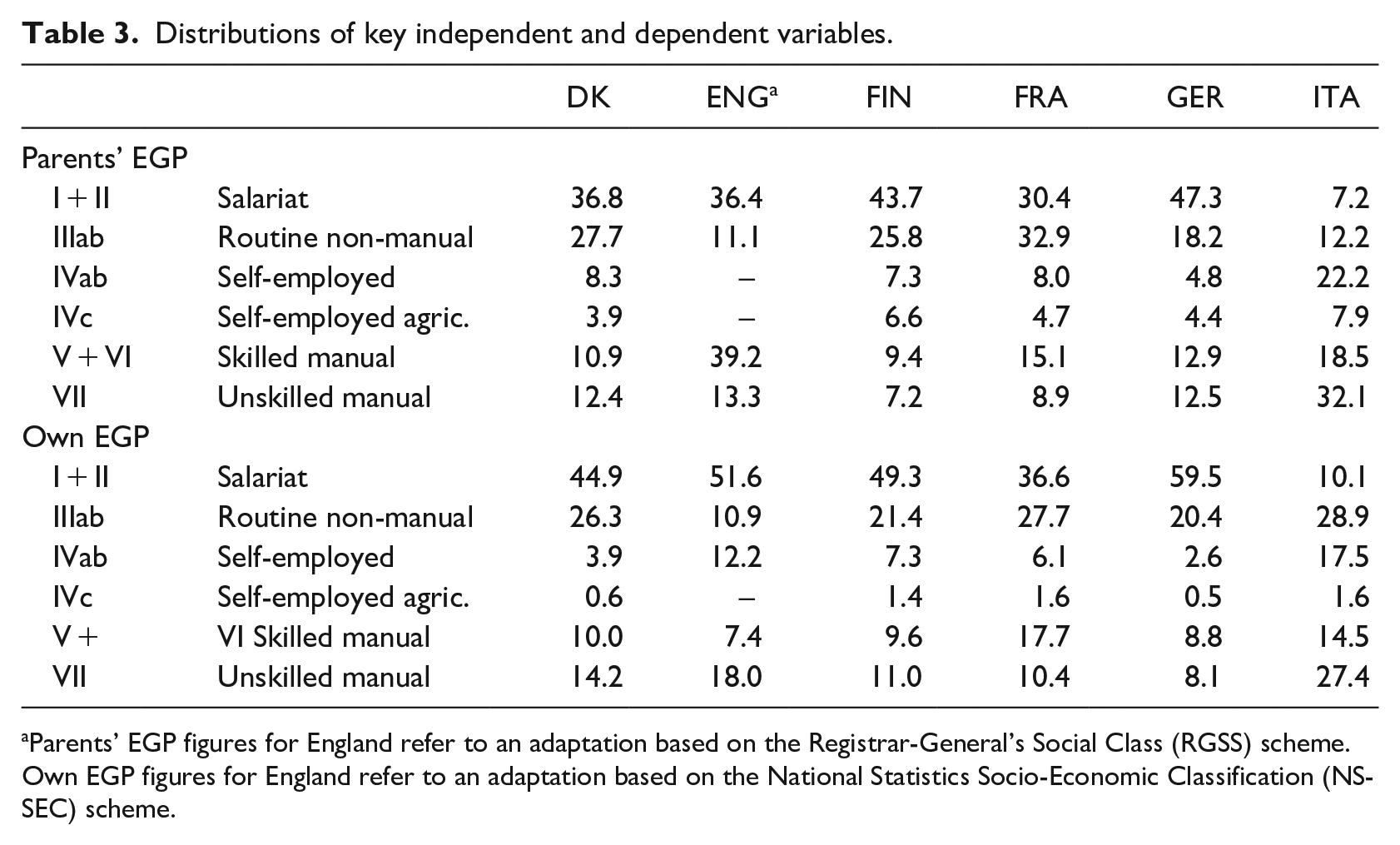
Parents’ EGP figures for England refer to an adaptation based on the Registrar-General’s Social Class (RGSS) scheme. Own EGP figures for England refer to an adaptation based on the National Statistics Socio-Economic Classification (NS-SEC) scheme.
Analytical approach
In a first step, we present descriptive analyses of the two bivariate associations between social origins and track attendance on the one hand and between track attendance and social destinations on the other. They are based on multinomial logistic regressions with no further controls, conducted separately for each country. To be able to compare the strength of the associations between countries, we rely on the (absolute) lambda index suggested by Lachat (2007). Lambda is a generalized version of the kappa index (Hout et al., 1995), which summarizes the different coefficients of a polytomous independent variable into one index. It is defined as the standard deviation of the conditional probabilities of a given category of the dependent variable across all categories of the independent variable. For example, in the association between O and T, it would be the standard deviation of the probabilities to end up in a given educational track across social classes of origin. Lambda modifies the kappa index by weighting the differences in the probabilities by the relative share of the independent variable’s categories (cf. Lachat, 2007). It ranges between 0 (no association) and 0.5 (strong association). As a sensitivity check, we also provide similar analyses based on Cramer’s V as our measure of association, derived from simple cross-tabulations.
The final step contains our core analyses. As we want to know to what extent educational differentiation accounts for the association between social origins and destinations, we turn to mediation analyses using our country-specific tracking variables as mediators (shown in Table 2). That way, we can assess to what extent a given country’s level of social reproduction is channeled through its country-specific form of educational differentiation. And we can compare whether the relative importance of educational differentiation for social reproduction is similar or differs between countries. In binary logistic models, we predict access to the salariat classes (EGP I and II) versus all other social classes of destination. To estimate the strength of mediation in each country, we draw on the Karlson–Holm–Breen (KHB) method (Karlson et al., 2012), which is particularly well-suited for assessing indirect effects in nonlinear regression models. The KHB method estimates the percentage of reduction in the coefficients of the social origin indicator by comparing two nested logistic regression models: a reduced model (without mediator variables) and a full model (including mediator variables). To make the coefficients comparable across models, the method corrects for scaling effects, which arise because coefficients and error variance are not separately identified in logistic regression models. The percentage of reduction in the social origin indicators can be interpreted as the part of the association between social origins and social destinations which is accounted for by track placement. We will show the percentage of mediation in two selected contrasts between categories of social origin: EGP I/II vs EGP VII (unskilled working class) and EGP I/II vs EGP V/VI (skilled working class).
Analyses
Association between social origins and track allocation in upper secondary education (O-T)
The left-hand side of Figure 2 reports the lambda values and their 95 percent confidence intervals (not visible due to very short confidence intervals) of the associations between parents’ EGP class and school track allocation at the end of upper secondary education. We list the exact values underlying the figure in Table S2 of the Online Supplement. The strongest and also quite similar associations with lambda values between 0.13 and 0.14 can be observed for England, Finland, and Germany, which represent very different systems of educational differentiation (cf. Table 1). Denmark and France show the weakest associations with lambda values below 0.1. The country comparison does not reveal any systematic pattern between common definitions of formal differentiation and the strength of the O-T association as measured with our country-specific indicators. As it proves difficult to derive substantive conclusions about country differences from a comparison of the absolute lambda values, we also provide a relative comparison in the notes of the table. We take the country with the strongest association (Germany) as a reference and describe the other countries’ lambda values relative to it. This exercise provides a more tangible illustration of the differences in the strength of the association between social origins and track allocation between countries. On the right-hand side of the figure, the sensitivity check based on Cramer’s V as an alternative measure of association can replicate the basic pattern found with the lambda values and shows a similar rank order of the association strengths.
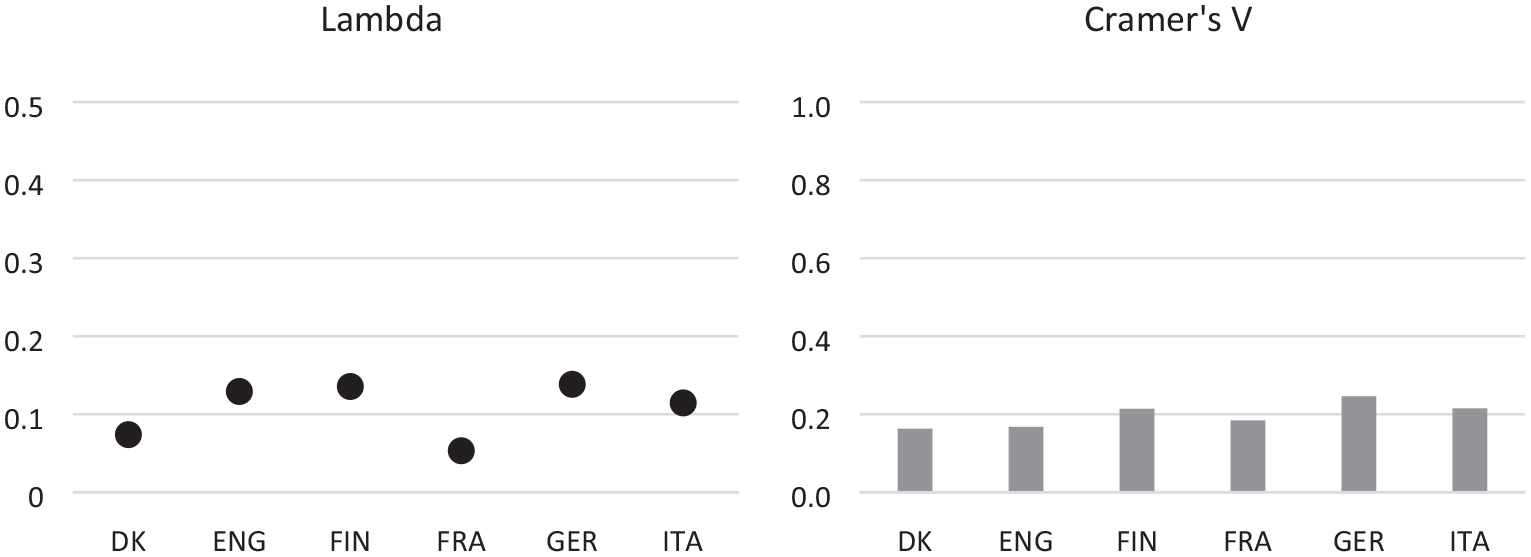
Association between social origins (EGP class) and track allocation in upper secondary education (country-specific measure).
Association between allocation in upper secondary education and long-term labor market outcomes (T-D)
The left panel of Figure 3 displays the lambda values of the associations between the country-specific measures of track allocation in upper secondary education and EGP destinations at the time of occupational maturity. The figure also comprises 95 percent confidence intervals (again not visible due to their shortness). We list the exact values underlying the figure in Table S3 of the Online Supplement. The lambda values range between 0.12 and 0.18. Again, we display a relative comparison to the reference country with the strongest association (here: France) in the note of the table. In the association between track allocation and destinations, the countries show a higher degree of similarity than in the association between social origin and track allocation. We cannot observe systematic differences along the lines of formal tracking definitions. England stands a bit out with the weakest association. However, it remains unclear to what extent this has to be attributed to the different measurement of the destination variable. It can be assumed that it biases the associations in downward direction, because social destination classes cannot be differentiated with the same level of precision as in the other countries. Again, the sensitivity check with Cramer’s V replicates the global pattern found with the lambda index.
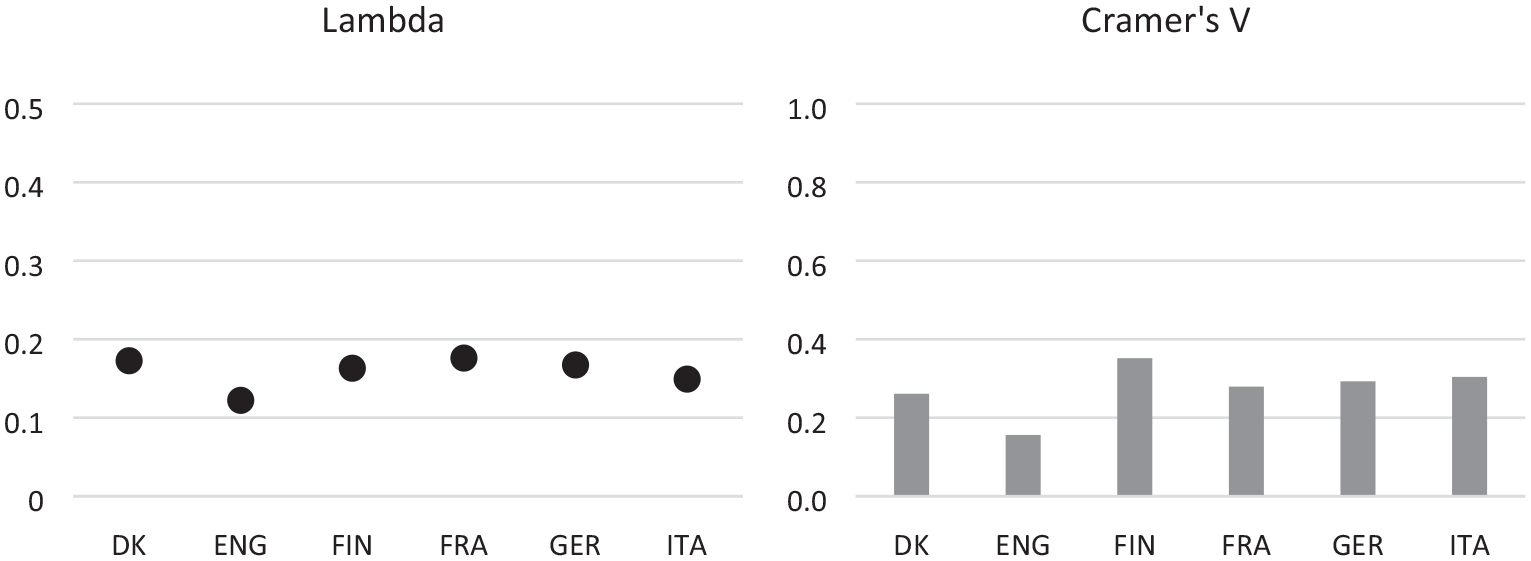
Association between allocation in upper secondary education (country-specific measure) and long-term labor market outcomes (EGP class).
Mediation of the association between social origins and long-term labor market outcomes through differentiation in secondary education (O-T-D)
In the final step of our analyses, we want to evaluate to what extent the associations between social origins and social destinations are mediated by the differentiation of upper secondary education in each country. For that purpose, we have to turn to a binary recode of the dependent variable. We predict access to the salariat classes (EGP I and II) at occupational maturity with EGP class of origin. Figure 4 displays the logit coefficients from binary logistic regressions (for the exact values, cf. Table S4 in the Online Supplement). We only show the coefficients for two selected contrasts of parents’ social class: EGP I/II vs EGP VII (unskilled working class) and EGP I/II vs EGP V/VI (skilled working class). Hence, we contrast the most advantaged class of origin with the two socially most disadvantaged classes. Substantively, this analysis has a more specific focus than the associational analyses shown in the previous section. In contrast to the overall associations we analyzed in the two previous sections, we now only consider differences in access to the most rewarding class positions between the most extreme comparisons between classes of social origin.
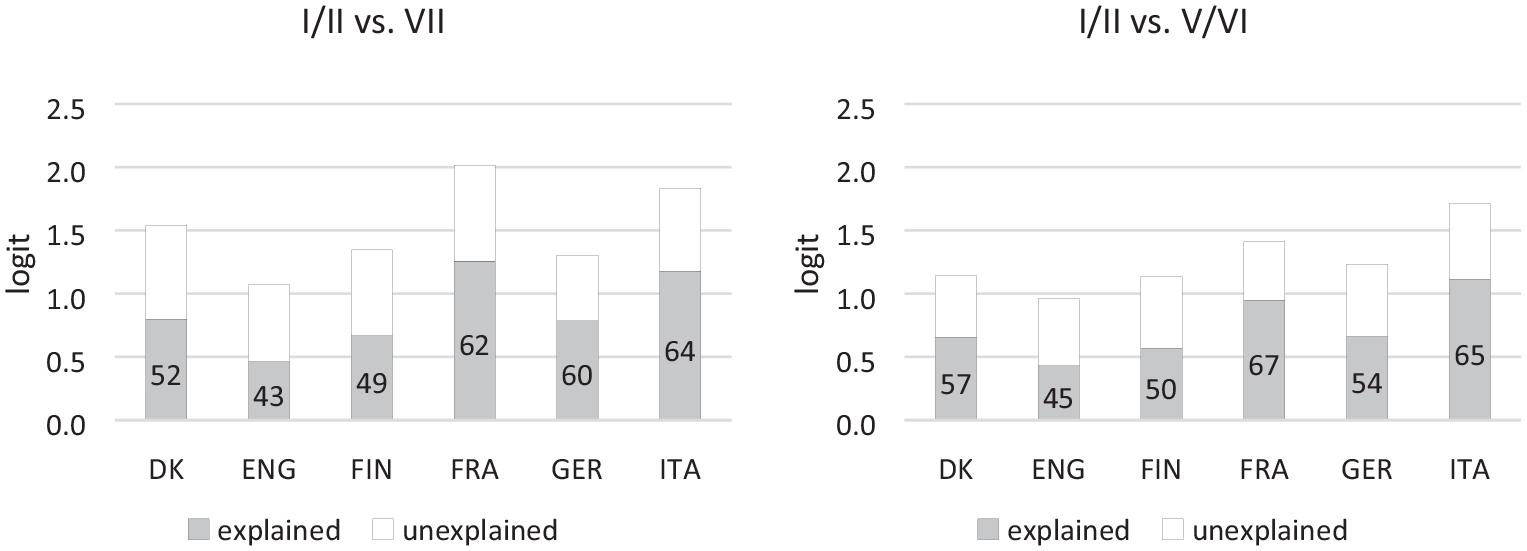
Mediation of the association between social origins and access to EGP I and II destinations through track allocation in upper secondary education.
The height of the bars in Figure 4 displays the logit coefficient of EGP I/II class of origin when EGP VII (left panel) or EGP V/VI (right panel) form the reference group. It can be interpreted as a rough indicator of the strength of the association between social origins and access to the salariat classes. Both contrasts show some variation in this association between countries. The pattern of country variation is similar for both contrasts. Generally, the strength of the associations is stronger for the contrast between EGP I/II and VII than for the contrast between EGP I/II and V/VI. This finding is to be expected as the social distance between the latter two classes can be considered smaller than the social distance between the former two classes. 4 The pattern of country variation approximately reflects the findings on social reproduction levels from previous research (e.g. Ballarino and Bernardi, 2016).
The shaded areas of the bars denote the shares of these associations that are mediated through track attendance in upper secondary education. The figures in the bars indicate the percentages of mediation that have been estimated by the KHB method. While we expected a high level of similarity of the relative importance of educational differentiation for social reproduction, the figures show quite some country variation. For the contrast between EGP I/II and VII, the mediation percentages range from 43 for England to 64 for Italy. For the contrast between EGP I/II and V/VI, the mediation percentages range from 45 for England to 67 for France. The pattern of country differences in the magnitude of mediation is identical across the two contrasts: the mediation is weakest in England and Finland and strongest in France and Italy. Denmark and Germany take on an intermediate position.
While these mediation percentages relate to the extent to which differentiation in secondary education accounts for social reproduction within each country, they do not answer whether different tracking approaches result in different levels of social reproduction. For example, the relative share of mediation can be similar in two countries. However, if one of those countries shows larger levels of social reproduction overall, it means that educational differentiation accounts for a larger absolute part. In that case, different approaches to educational differentiation could be compared across countries with a focus on whether they are responsible for larger or lower absolute levels of social reproduction. But this question is beyond the scope of this article. However, following the approach of Jackson and Jonsson (2013), some tentative insights could be gained from comparing the heights of the gray parts in the bars of Figure 4. In that sense, educational differentiation in France and Italy is associated with the highest levels of social reproduction, educational differentiation in England and Finland “produces” the least social reproduction, and Denmark and Germany range somewhere in between. This partly aligns with the conventional wisdom that countries with stricter and earlier formal tracking score higher on social reproduction. Yet, Germany not being part of the group with the education systems producing the highest levels of social reproduction is rather unexpected.
Discussion and conclusion
This article sought to assess the extent to which the associations between social origins and destinations in six European countries are accounted for by educational differentiation in secondary education. We deviate from the common framework of the O-E-D mobility triangle by considering allocation in upper secondary schooling instead of final educational attainment as mediator of the O-D association. We specifically consider that educational differentiation can have different forms in different countries. This approach allows us to assess the importance of educational sorting in the process of inequality formation within countries. In addition, with national life-course data, we are in a position to assess the role of educational differentiation for social inequality in long-term outcomes.
Our main expectation was that—by paying attention to country-specific forms of differentiation—the mediating role of students’ track placement in secondary education might reveal more similarities across the six countries than it is usually supposed. We do not find very clear support for that hypothesis. In our analyses, the share of mediation shows variation that is too substantial to still consider it lying within the range of similarity. On the contrary, country differences are not large either. We observe that differentiation in secondary education accounts for a substantial part of the O-D association in all our countries. Hence, based on our results, one could rephrase our initial expectations into a weaker statement. Instead of referring to similarity, we can state that differentiation in secondary education is an important channel of social reproduction in each country in our sample. This also holds for countries that usually have been considered as non-differentiated or late-tracking.
With respect to the differences that we observe between countries, an obvious question is why the role of educational differentiation in mediating social reproduction varies between education systems. Two basic sets of potential explanations should be highlighted against the findings of our article. First, the importance of educational differentiation in upper secondary education for social reproduction might indeed vary across countries. This means that—depending on the country—factors other than upper secondary differentiation possess either more or less weight. Second, differences in the precision of the measurement of educational differentiation might be responsible for differences in the mediation outcomes.
As to the first explanation, we should take into consideration that we were measuring educational differentiation at a specific moment of the educational career, which we held constant across all countries: upper secondary education. In a way, all countries’ upper secondary education systems are similar in that they partial out certain tracks, streams, or requirements that lead into or have a particular connection with higher education, while others are connected with subsequent non-academic or vocational trajectories. While this aspect generates a component of similarity, the countries differ in the extent to which those subsequent trajectories are already determined by the allocation in the upper secondary differentiation system. In other words, educational mobility after upper secondary education can create variation in the strength of the association between upper secondary track allocation and destinations (T-D association). In addition, even though we made the assumption that not only formal credentials but also informal and less obvious criteria of educational differentiation create linkages with labor market allocation, it is still possible that the strength of the linkage between educational differentiation and labor market allocation varies between countries. With regard to the T-D association, our analyses generally indicate a high level of similarity between countries. But the fact that England deviates from that pattern in that it shows the weakest association aligns with the conventional wisdom that the linkage between education and the labor market is particularly loose in so-called internal labor market systems (ILM, cf. Gangl, 2003). For the case of England, this could drive the comparatively low level of mediation. Our bivariate analyses also suggest that the cross-country variation in the association between social origins and track placement in upper secondary education is more pronounced than the country variation in the association between track placement and social destinations. Hence, the former aspect might be a more important driver of country differences in the mediating role of educational differentiation.
The second set of explanations, the precision of measurement of educational differentiation, relates to a technical aspect and points to a general limitation and downside of relying on different national data sets. While the clear advantage of that approach arises from the fact that we are able to measure country-specific criteria of educational differentiation, the level of detail and precision can still differ between the datasets. We should bear in mind that none of the national datasets was explicitly designed to measure the most salient visible or hidden forms of educational differentiation in secondary education. Consequently, variation in the mediating role of educational differentiation can be a mere consequence of differences in the ability to measure educational differentiation appropriately. In Table 1, we documented the extent to which we were able to measure the theoretically relevant aspects of educational differentiation. This means that we are likely to underestimate the degree of mediation in those countries where we could not measure all relevant dimensions of differentiation properly. An obvious example is Finland, where we could only rely on crude and formal aspects of differentiation. Most likely, this explains why the mediation percentage is comparatively low vis-à-vis the other countries. We should also stress that—to be able to compare results between countries—we had to make a compromise between standardized analyses and detail of measurement. Since we had to rely on a common denominator that was available for all countries, we had to discard information for some. This means that we may underestimate the role of educational differentiation in shaping social reproduction processes in all the countries under view, but more so the less we were able to measure educational differentiation properly. Another but related aspect concerns the nature of the datasets. The different national datasets represent three types of data: administrative register data (Denmark and Finland), retrospective surveys among adults (France, Germany, and Italy), and prospective longitudinal data (England). This means that the measurement of educational differentiation differs with respect to its timing and mode of measurement. In addition, the different types of data can also create general differences with regard to measurement error and non-response. In this respect, administrative data is superior to survey data. We cannot exclude that this difference has some influence on our comparative results. At the moment, our databases represent the best available sources. Further progress on the matter requires a more explicit measurement of educational differentiation.
Despite these limitations, we can conclude that, although differentiation processes in secondary education come in a different shape in different countries, they are always relevant in mediating a substantial part of the influence of social origins on long-term social destinations—at least in our country sample. With our perspective that looked beyond the common narrow and formal definitions of educational tracking, we could make a case for a more comprehensive account of educational differentiation. Educational differentiation can be more than the most visible formal aspects of student separation for instruction. Education systems that do not have a tradition in formal tracking most likely have developed functional equivalents that contribute to social reproduction in similar ways. While our analyses could only scratch the surface in this regard, we hope that future research will make further progress in measuring these different aspects of educational differentiation. Also, our analyses targeted the role of educational differentiation for social reproduction within countries. A key question in comparative educational research is, however, whether different educational systems actually do produce different levels of social reproduction—or put it differently: whether changing a country’s approach to educational differentiation can be expected to result in changes in its level of social reproduction. Even though our analyses were not specifically concerned with that very issue, we found no reason to challenge the conventional wisdom that (formally) early-tracking systems coincide with higher levels of social reproduction. However, a more careful inspection of country-specific approaches to educational differentiation might also enlighten that debate by drawing attention to the mechanisms that are responsible for that pattern.
Supplemental Material
sj-docx-1-cos-10.1177_00207152231151390 – Supplemental material for Educational tracking and social inequalities in long-term labor market outcomes: Six countries in comparison
Supplemental material, sj-docx-1-cos-10.1177_00207152231151390 for Educational tracking and social inequalities in long-term labor market outcomes: Six countries in comparison by Steffen Schindler, Eyal Bar-Haim, Carlo Barone, Jesper Fels Birkelund, Vikki Boliver, Queralt Capsada-Munsech, Jani Erola, Marta Facchini, Yariv Feniger, Laura Heiskala, Estelle Herbaut, Mathieu Ichou, Kristian Bernt Karlson, Corinna Kleinert, David Reimer, Claudia Traini, Moris Triventi and Louis-André Vallet in International Journal of Comparative Sociology
Footnotes
Funding
The author(s) disclosed receipt of the following financial support for the research, authorship, and/or publication of this article: This work was funded by NORFACE (grant no. 462-16-020).

Supplemental material
Supplemental material for this article is available online.
Notes
References
Supplementary Material
Please find the following supplemental material available below.
For Open Access articles published under a Creative Commons License, all supplemental material carries the same license as the article it is associated with.
For non-Open Access articles published, all supplemental material carries a non-exclusive license, and permission requests for re-use of supplemental material or any part of supplemental material shall be sent directly to the copyright owner as specified in the copyright notice associated with the article.
