




Abstract
Every society is marked by memory gaps. Taking Poland and (East) Germany as examples, we use a social constructivist-poststructuralist approach and conduct focus groups and qualitative interviews to investigate how the communist past is remembered in private everyday discourse and its differentiation from the hegemonic public memory discourse. Both countries exhibit striking parallels in their everyday and hegemonic memory practices, but they differ in how the memory gap is interpreted: in Poland along class lines, in Germany according to quasi-ethnic lines. Thus, the study shows that private–public memory gaps may determine the societal (re)production of group-specific identities in mnemonic conflicts.
Anyone familiar with the most important events, dates, and structures of the German Democratic Republic (GDR) “can only wonder about the nostalgic glossing over of the socialist dictatorship,” writes Klaus Schroeder (2020) in his latest work on the united Germany: “Apparently, many people [in East Germany] need a retrospective recognition of their life in and with this system as a reference factor” (p. 303). The “subjective perception of the lack of recognition” by West Germans would obscure the East German view of the “dark sides of the socialist dictatorship”—consequently, the head of the Forschungsverbund SED-Staat (Research Association on the SED State) holds East German nostalgia for their communist past partly responsible for the fact that East and West Germany have not yet grown together (Schroeder, 2020: 303). Interestingly, while Schroeder’s thesis of the late victory of the SED (the GDR’s communist party) is firmly part of the canon of academic GDR history and memory discourse (see Schroeder et al., 2012), today, no one discusses the communist worker’s party (PZPR) in Poland in similar terms. Does this mean that Poles resist even a hint of nostalgia for the communist past because, unlike East Germans, they recognize the “dictatorial core” of the defunct People’s Republic of Poland (PRL), which they confront without the legitimacy constraint that defines the East German–West German relationship?
Understanding how East Germans and Poles make sense of their communist pasts provides insights into larger debates regarding the societal impact of public memory. Given the long tradition of social memory research dating back to the work of Halbwachs (1992 [1925]), it is self-evident that “discursive constructions of collective memory shape groups’ commemorative practice and identification,” as Tenenboim-Weinblatt and Baden (2016) note; however, “it is less clear how these shared narratives emerge from the deliberate accounts provided by individual and collective public actors” (p. 4). In the field of reception research, the influence of publicly mediated communication on collective memory remains a black box (Neiger et al., 2011: 16).
In this article, we aim to explore this issue by comparing the everyday memory of the communist past in Poland and East Germany, commonly referred to as private or communicative memory (Assmann, 2008), and contrasting everyday memory in both countries with public memory. Our objective is to investigate how memory and nostalgia develop in two distinct social contexts that both exhibit a historically analogous path dependency and maintain a similar hegemonic public memory discourse, manifested in the (official) politics of memory as well as in the reporting of leading mass media outlets. With this research focus, the present study centers the local population within the analysis as the target audience of publicly mediated memory practices.
Ultimately, this study aims to determine how conflicting societal narratives influence collective memory: how does the existence of competing mnemonic narratives affect collective memory formation in Germany, where the communist era has left a historical legacy that applied uniquely to East Germans, compared with a country like Poland, where the communist past has opened a mnemonic space for the entire population (i.e. contemporary witnesses and their descendants)? Both countries serve as excellent objects of comparison: until the collapse of the Eastern bloc, both the GDR and Poland were part of the Soviet-led Warsaw Treaty Organization and the Council for Mutual Economic Assistance (Comecon), their political systems invoked a communist state doctrine, and they relied on centralism as a political structural principle. Moreover, both countries housed strong opposition movements relevant to the fall of the Iron Curtain. However, the historically analogous path of both countries was followed by a diverging historical reappraisal after the fall of the Wall. The GDR formally joined the Federal Republic of Germany (FRG) on 3 October 1990, through Article 23 of the Basic Law, integrating the defunct communist state into the already existing economic and political structures of West Germany. Following an elite-led transformation process after 1989, Poland became a democratic sovereign state with parliamentary elections in October 1991. Whereas in a united Germany, coming to terms with the communist past was characterized from the outset by a teleological understanding of victory by the West, the core of which was the superiority of the capitalist system, in Poland, this process emerged from the dynamics of the post-transition period.
Today, more than 30 years after the collapse of the Eastern bloc, both countries—despite the different post-cold war paths taken—have produced a politics of memory characterized by hegemonic anti-communist commemoration (Heß, 2014; Szcześniak and Zaremba, 2019). If Schroeder is correct and the perceived lack of recognition among West Germans is indeed the reason for the persistence of the private–public memory gap in East Germany, can we then observe a greater convergence of memories in Poland?
In the following, developments in the politics of memory and the mass-mediated memory discourse in both countries after 1990 are outlined as the foundations of the current hegemonic discourse of remembrance in Poland and Germany, embedded in reflections on the general anti-communist climate in post-Cold War Europe. The explanations tie in with our theoretical framework, which we locate at the intersection of mnemonic hegemony (Molden, 2016), discourse, and power (Foucault, 1972, 1982), on one hand, and the concept of everyday discourse (Waldschmidt et al., 2008), on the other. We then present our methodological approach. With a distance of 30 years, the analysis comes at the right time—ample contemporary witnesses are available, and at the same time, the hegemonic memory frame has solidified.
Theorizing the hegemonic memory of the communist past
Memory is a political battlefield of the present. The quest for historical legitimacy, in which questions of collective identity are continuously negotiated, is fundamentally a power struggle over the hegemony of narratives and patterns of interpretation. Gramsci (1971) has used the term hegemony to describe political power relations in which certain social forces succeed in achieving a broad consensus for their particular interests—through coercion (i.e. laws and jurisdiction) but also through consent and incentives. Hegemony is, therefore, about a common will—“it is spontaneous, but implicitly orchestrated, consent to the status quo,” which does not mean that there can be no dissenting opinions. Instead, as Gramsci continues, “many diverse currents of thoughts coexist” (Dillon, 2020: 194).
In a society, hegemonic master narratives about the past thus exist side by side with others but are differentiated by their higher level of penetrating power. “The success of any narrative,” writes Molden (2016), who elaborated on the concept of mnemonic hegemony, “greatly depends on the social audibility and power of the voices that promote it so as to penetrate and determine the hegemonic set of specific memories that form memory cultures and their historical canons” (p. 140). Consequently, if we want to understand which narratives prevail in the “political field” of memory, we must ask about the most powerful actors, including their interests, their economic and symbolic resources, and the core of their quest for legitimacy. Nevertheless, hegemony should not be interpreted simply as the dominance of particular individuals or groups; rather, it is about a “conception of the world that is implicitly manifest in art, in law, in economic activity and in all manifestations of individual and collective life” (Gramsci, 1971: 328). Thus, hegemonic meaning is engraved in discourse, which, following Foucault, manifests through statements based on specific rules of formation. The latter operate “according to a sort of uniform anonymity, on all individuals who undertake to speak in this discursive field” (Foucault, 1972: 63). In short, no one can escape the hegemonic reading. “Discourse is not simply that which translates struggles or systems of domination,” argues Foucault (1981), “but is the thing for which and by which there is struggle, discourse is the power which is to be seized” (pp. 52–53).
Foucault’s (1982) understanding of power also includes his concept of subjectivation: the powerful knowledge of discourse is reflected in the “immediate everyday life which categorizes the individual, marks him by his own individuality, attaches him to his own identity, imposes a law of truth on him which he must recognize and which others have to recognize in him” (p. 781). Accordingly, one cannot shut oneself off from a hegemonic paradigm about the communist past, even if one disagrees with it. However, as noted above, hegemonic memory narratives always coexist with other narratives in society. “The symmetry between objective and subjective reality cannot be complete,” as Berger and Luckmann (1991) have noted: “no individual internalizes the totality of what is objectivated as reality in his society” (pp. 153–154).
In their concept of everyday discourse, a team of sociologists led by Anne Waldschmidt combine the basic theoretical assumptions of Foucault into a synthesis with those of Berger and Luckmann, which we apply to our analysis of everyday memory discourse in Poland and Germany. Waldschmidt et al. (2008) define everyday knowledge as “subjective experiential knowledge” (p. 329), noting that a framing close to everyday life produces qualitatively different knowledge than expert discourse. Applied to our study, this approach reveals that what people produce in their memories of communism does not necessarily correspond to what more effective producers of hegemonic truth, such as academia, politics, or mass media, bring to the fore. Referencing Berger and Luckmann (1991), Waldschmidt et al. (2008) elaborate three characteristics of everyday knowledge: first, its recipe character, “that is, knowledge limited to pragmatic competence in routine performances” (Berger and Luckmann, 1991: 56); second, its typification tendency, or the routine formation of taxonomies “to classify the flood of everyday events”; and third, individual relevance structures, which “help to distinguish important from unimportant, to set priorities and preferences, to arrive at value judgements” (Waldschmidt et al., 2008: 325). While expert knowledge relies heavily on abstract notions, everyday discourse is rooted firmly in a web of practices, which adds its own form of validation (i.e. legitimizing power) through firsthand practical experience, making everyday discourse highly credible. Specifically, “if, for example, the offered foils of subjectification contradict the experiences of everyday life, this can provoke different reactions,” as the sociologists go on to explain, “rejection or aversion, resistance, adaptation or—as a fourth possibility—a creative potential” (Waldschmidt et al., 2008: 330).
While Waldschmidt et al. (2008) emphasize the central question of power by drawing upon Foucault, the researchers—again referencing Berger and Luckmann (1991)—also point to the importance of contexts of justification, according to which the existence of social institutions and overarching patterns of social order must appear legitimate in everyday life. Put differently, the hegemonic knowledge that objectifies itself in the real world must “prove itself in some way, be recognized as meaningful and useful or prove authority” by the public (Waldschmidt et al., 2008: 326). Here, the question of legitimacy primarily pertains to the objectification of hegemonic communist memory in the established culture of remembrance of both Germany and Poland. Following Houdek and Phillips (2017), we assume that “a wide variety of artifacts give evidence of public memory, including public speeches, memorials, museums, holidays, and films” (p. 1). Moreover, as the primary “repository of shared memory across time and space” (Zelizer and Tenenboim-Weinblatt, 2014: 12), journalism must be included in the list of the most important agents of collective memory.
Against the background of this theoretical framework, it is therefore necessary to clarify which rules the hegemonic memory discourse in Germany and Poland obeys and identify the actors that dominate this discourse. Given that various studies have dealt with these questions, in the following we will first proceed with a literature review that summarizes the central findings related to the hegemonic memory discourse in both countries.
The hegemonic anti-communist memory paradigm
Hegemony in the field of memory is a complex process. For space reasons, we focus primarily on the politics of memory and the mass-mediated discourse of memory in Poland and Germany, placing both in the larger European context. We are aware that other memory agents (such as cultural institutions) may have a more nuanced view of the past. However, we assume that hegemonic political and mass-mediated memory frameworks have a normatively binding character reflected in all of society’s cross-cutting hegemonic memory practices (see, for example, Olick, 1998; Zelizer and Tenenboim-Weinblatt, 2014).
Germany
Historical analyses and, above all, empirical studies generally conclude that an anti-communist stance characterizes the hegemonic memory of the GDR in Germany (e.g. Meyen, 2013; Sabrow, 2009). According to Heß (2014), the communist past has been used as a political resource for both “condemning the GDR and legitimizing the new political [capitalist] system” (p. 208). By the early 1990s, after a fleeting “vacuum of reappraisal” (Rudnick, 2011: 37), the German Bundestag set up two commissions of parliamentary inquiry to reassess the SED dictatorship and the establishment of German unity, aiming to publicly delegitimize the GDR as an unjust state. Throughout the two decades after unification, the “hegemony of interpretation” over the past was firmly in the hands of “[West German] conservatives and historians, victims’ representatives, former civil rights activists and opposition activists” (Rudnick, 2011: 731). They were able to impose a view of the past, which at times led to “undifferentiated interpretations of the history of the GDR based on the theory of totalitarianism” (Rudnick, 2011: 731) including the implicit equation of communism and National Socialism.
Heß (2014), who analyzes political documents including memorials and the museum and exhibition work of political actors, finds that these documents clearly refer “to the dictatorial character of the GDR,” while the press portrayed the GDR as “somewhat more complex and less homogeneous than in the context of political reappraisal” (p. 206). Meyen (2013) identifies differences among German media outlets regarding their GDR reporting but concludes that little of what GDR eyewitnesses remembered was reflected in the media. This imbalance can be explained not only by the general anti-GDR climate but also by the fact that most East German media outlets were bought by West German publishers during the Wende (transition), undermining the emergence of an East German media market (Tröger, 2019). Even today, journalists of East German origin are underrepresented in management positions among German media houses (Kollmorgen, 2021).
Poland
In post-1989 Poland, anti-communism became the default position for most politicians, intellectuals, and journalists (Ochman, 2013: 2). The ideological exchange of official memory followed the rapid delegitimization of the pre-1989 memory paradigm, which was replaced by the previously marginalized, victimhood-oriented model of the national past that had emerged during the 1980s among the anti-communist opposition. Anti-communism was based on two main narratives that emerged from this model and dominated Polish memory in the late 1990s. The first can be described as a moderate-right/liberal memory narrative, which is associated with European integration and the modernization of Poland by critically working through its historical traumas. According to this reading, the communist past has been depicted as a black hole in Polish history: a period when the country was “frozen” in its civilizational development. This position served moderate-right/liberal politicians who characterized the Polish systemic transformation as a “success story” and silenced its critics as those who were not mature enough for democracy (Ilkowski, 2021: 9–11). The second, far-right narrative is associated with profoundly conservative and “Eurosceptic” positions that refuse to acknowledge the collective entanglement and complicity of Poles in any past wrongdoing. According to this position, the PRL was an illegal state ruled by traitors to the Polish nation who collaborated with the Soviets to deliberately destroy the national character (Nijakowski, 2008: 204–210). This extremely negative image of the communist period supported, in turn, the narrative of an “unfinished transition” (Korycki, 2017: 520).
Importantly, as Korycki (2019) shows, each of these repudiations of the communist past directly or indirectly conflated communism with Jewishness. In this way, the myth of the “evil Jew” was incorporated into both anti-communist narratives, downplaying the importance of Holocaust memory in Polish national memory in favor of the ethnicization of the country as “a place without Jews” (Korycki, 2019: 366).
For the most part, the private media in Poland lean toward one or the other anti-communist narrative, and the state media tend to adopt the narrative of the ruling political party. In the case of both narratives, the transition period is presented as a “return to normality” to be contrasted with the communist past, which is understood as a “failed experiment” (Gökarıksel, 2017). This position includes a departure from the social prominence of the working classes associated with communist states (Dunn, 2004). As a result, members of the working class were discursively “othered” as backward-looking losers of the political transformation (Buchowski, 2006), while the social and cultural hegemony of elites was understood as a return to normalcy following a failed historical detour. All these processes introduced a cultural standard to redefine the communist past and legitimized the elite view on transformation in parallel with the political process of establishing a dominant politics of memory.
The communist past in Europe
The anti-communist paradigm in both countries cannot be understood outside of the European context. In general, the literature notes a trend toward the radicalization of communist remembrance, especially after the turn of the millennium (e.g. Mälksoo, 2014). While initially, the focus was primarily on a moral-normative condemnation of the legacy of communism, over time, calls for the legal criminalization of communist acts in several Eastern EU countries have intensified (e.g. Belavusau, 2018).
Manifold reasons underpin the desire to anchor the commemoration of communism in the doctrine of totalitarianism, including an East European “regional desire for victimhood status” (Ghodsee, 2014: 117) or “political grievances over insufficient recognition of the region’s particular historical legacies” (Mälksoo, 2014: 85). Ghodsee (2014) views the demonization of the communist legacy primarily in the “context of regional fears of a re-emergent left,” driven by economic interests such as “the elite desire to discredit all political ideologies that threaten the primacy of private property and free markets” (p. 117). For Ghodsee, therefore, there is a clear link between the 2008 Euro crisis and the rise of anti-communist rhetoric. For example, in 2008, 23 August was proclaimed as a Day of Remembrance for the Victims of all Totalitarian and Authoritarian Regimes in Europe. In 2011, the Platform for European Memory and Conscience was founded in Prague with the support of the European Parliament and the Council of the European Union, an association of non-governmental organizations and research institutes. Its stated aim was to raise awareness of the crimes of totalitarian regimes, including communist crimes: “With the tacit support of Brussels, there exists today in Eastern Europe an institutionally sanctioned Denkverbot [prohibition on thinking] about the everyday lived experiences of communism” (Ghodsee, 2014: 118). Anti-communist tendencies are thus not unique to Poland and Germany but fit into a more comprehensive overall picture of anti-communist rhetoric in Europe.
Research design
Against the background of this theoretical framework and previous memory research on Germany and Poland, several research questions arise: how does everyday knowledge about communism differ in the two countries, and what is its present-day relevance? Furthermore, how legitimate does the public post-Cold War memory regime appear in the everyday discourse? What happens, for instance, when firsthand experiences contradict hegemonic remembrances? The question of legitimacy is relevant because it ultimately determines whether a consensus-based collective memory can emerge within society.
Our study is based on two qualitative research approaches: focus group discussions (FGD) and in-depth interviews (IDI). From December 2018 to May 2020, we conducted 10 FGD and 20 IDI in Germany, and 6 FGD and 20 IDI in Poland. Table 1 provides the gender and age distribution of the interviewees, their educational background, and their origin. In terms of age, a distinction was made between participants born before 1975 who thus attended school (at least in part) under the communist system (firsthand experience) and respondents who were born after 1975 and were more likely to receive transmitted knowledge. IDI lasted between 60 and 90 minutes, and FGD spanned 90–120 minutes. All interviews and discussions were recorded and fully transcribed. With a few exceptions, four to seven respondents who did not know each other prior to participating in the study took part in each group discussion.
Study participants in focus group discussions and interviews.
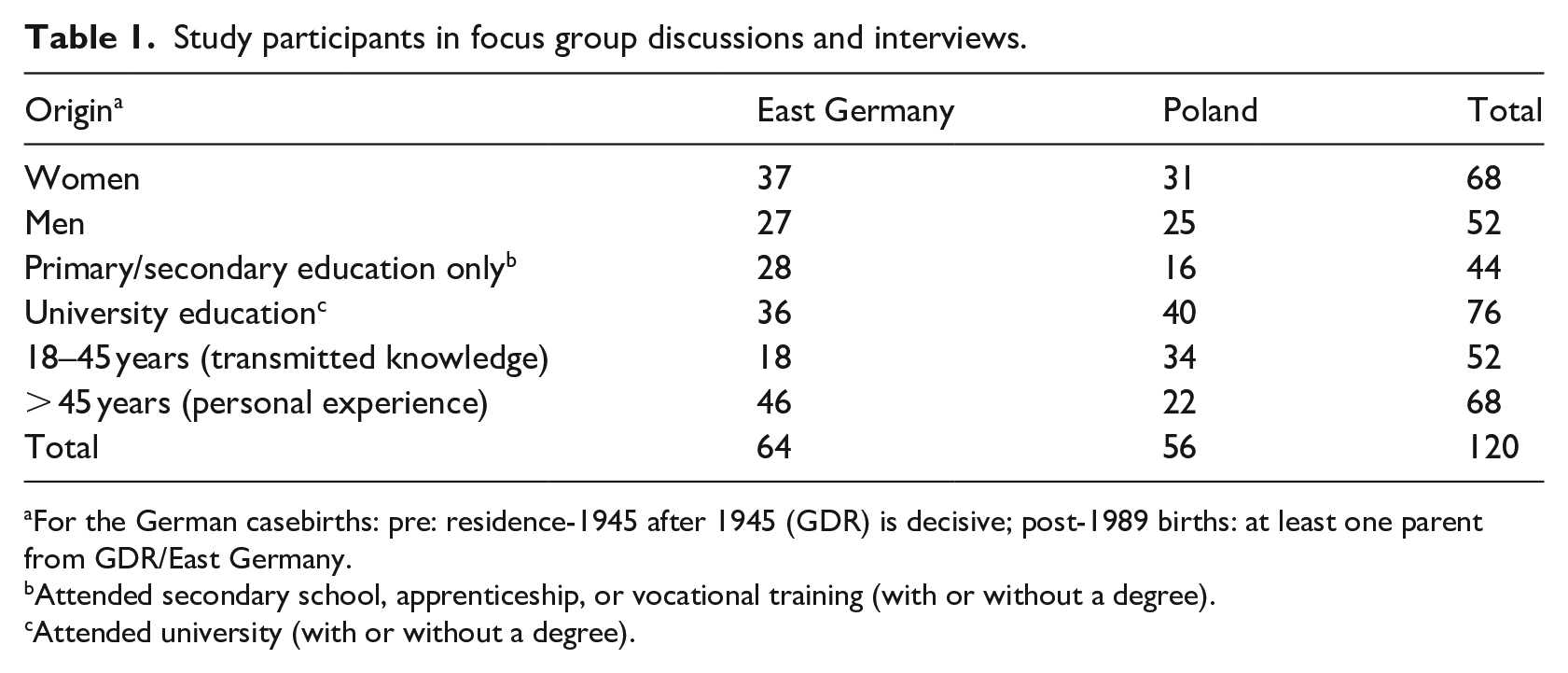
For the German casebirths: pre: residence-1945 after 1945 (GDR) is decisive; post-1989 births: at least one parent from GDR/East Germany.
Attended secondary school, apprenticeship, or vocational training (with or without a degree).
Attended university (with or without a degree).
For the most part, IDI and FGD were conducted by the authors of this article in the applicable national languages; in Germany, some of the data collection involved (under-)graduate students in communication and media studies who had previously been trained in a seminar on the research objectives, methodology, and ethical aspects of the study. Participants were informed in advance about the aims of the study. They were assured of anonymity, and all names in the results section are pseudonyms. The semi-structured guidelines were based on four thematic blocks: introduction of the participants (personal data, life history), identity (feelings of national belonging and perceptions of national identity), personal memories or experiences with communism (including firsthand or inherited memory), and public memory, in particular mass-mediated representations of the communist past (e.g. questions on perception and evaluation thereof).
We analyzed the data using a category system derived from our theoretical assumptions (Table 2). In addition to the characteristics typical of everyday discourse (knowledge forms, relevance structures, legitimation), we are also interested in the influence of the speaker’s position (i.e. whether someone personally experienced communism) on the evaluation of the communist past and the hegemonic memory discourse, as well as the question of how the hegemonic anti-communist discourse is subjectivized. In Table 2, the speaker’s position and subjectification lie across the categories defined by Waldschmidt et al. (2008) for everyday discourse (i.e. we can assume that the speaker’s position and subjectification find expression in each of the characteristics of everyday discourse).
Theory-based category system.
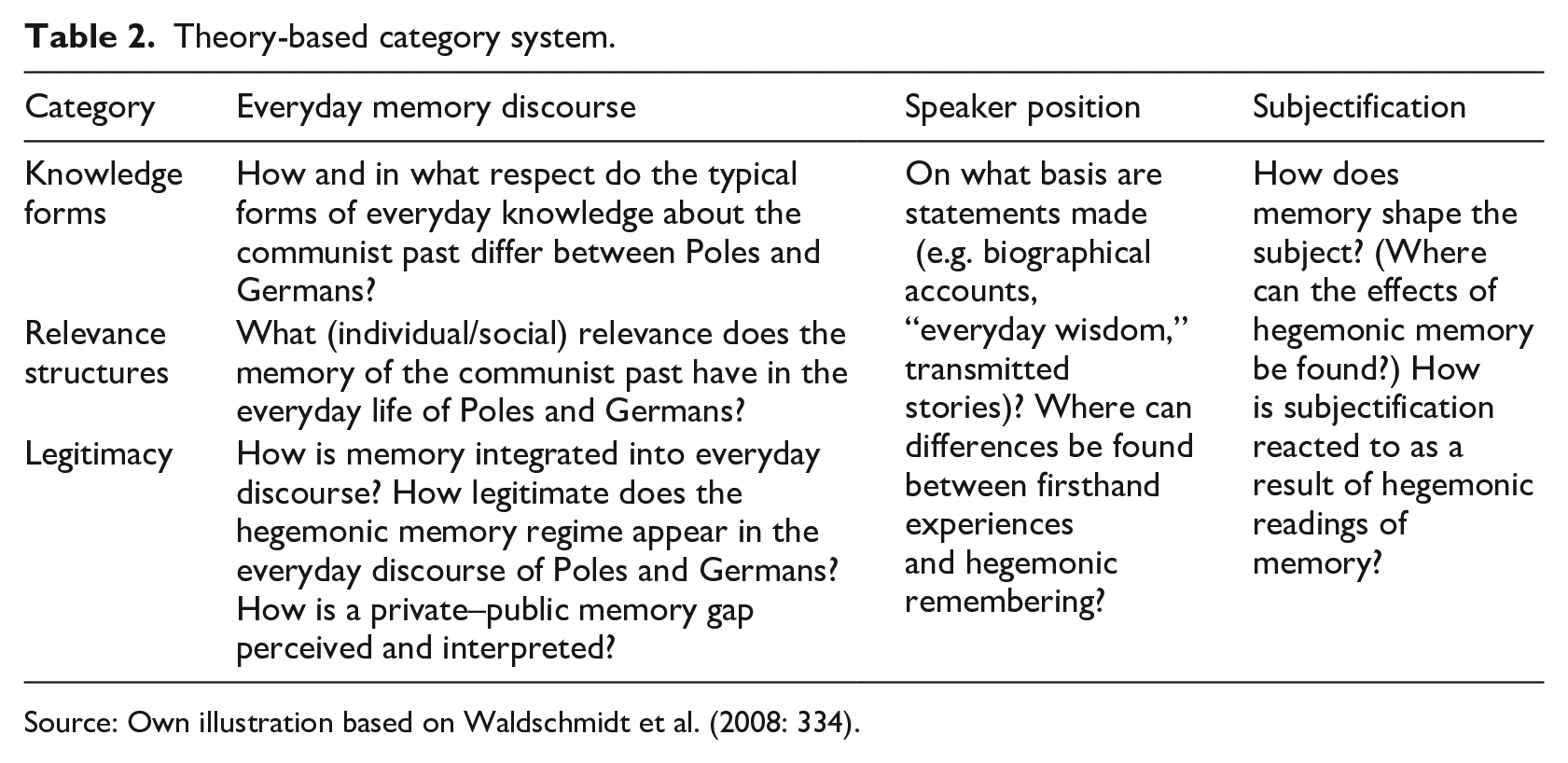
Source: Own illustration based on Waldschmidt et al. (2008: 334).
Study participants were selected either through the authors’ social networks or through a snowball sampling process with different entry points (i.e. by engaging distinct networks and conducting interviews in various parts of each country) to avoid selection bias. In selecting the interviewees, we varied the demographic characteristics to obtain as broad a picture as possible of everyday discourse. Thus, variables such as gender, age, educational status, and origin (urban/rural, GDR/East Germany) were varied several times to attain theoretical saturation (Glaser and Strauss, 2017). In recruiting, we also attached importance to the fact that the respondents had attended at least secondary school in one of the countries under study. Nationality was thus defined by socialization in the school system.
Qualitative research is not representative because the respondents were not selected according to the criteria used to create representative surveys. However, the theoretical selection of respondents allows for a certain level of generalizability. In analyzing the transcripts, a close reading technique was applied (Brummett, 2018), that is, the transcripts were each read several times. First, the statements were subjected to a rough classification system; subsequently, the classification was refined by rereading and identifying recurring patterns.
Results: the communist past in the everyday discourse of Poles and East Germans
The quotes reproduced in this section are presented according to the principle of pars pro toto; that is, we have taken care to select those passages from the transcripts that represent a specific discourse community.
Knowledge forms
Our study did not focus on factual knowledge. In the interviews, respondents were asked to freely associate their knowledge of their country’s history (“What would have to be displayed in a museum of national history?”) and to discuss family discussions about the communist past. Three key findings can be discerned. First, the “recipe knowledge” about the communist period is primarily: everyday knowledge, which is constructed from biographical accounts. “When I think about the PRL, I understand it as a story of everyday life.” This quote from Natalia, a 36-year-old orthodontic specialist who comes from southern Poland and knows the communist era only from stories, is representative of all interviewees. Thirty years after the end of the Cold War, many of the Polish and East German participants were silent about the “official” memory accounts. For a witness of communism like Marek, a 60-year-old tool grinder from a town in the middle of Poland, the everyday relevance is hardly surprising: “People like us, simple people, not involved in various movements, simply lived this life.” Katrin also relayed this feeling: “I did not run through my studies thinking at every party, oh there is going to be someone from the Stasi here,” said the 58-year-old teacher from Mecklenburg-Vorpommern about her life in the GDR. “I have been asked by pupils: Goodness, you must have been self-censoring all this time? No, I cannot say that.”
Second, there is a mnemonic convergence of narratives between the two cases: recalled memories about the communist era are strikingly similar in Poland and East Germany. Negative and positive memories exist side by side, and nostalgic views and criticism are interwoven in the image of the past—in part independent of generational affiliation, as memories of the generations that actively experienced communism are passed on to children and grandchildren. Negative memories center primarily on the economy of scarcity—the memory of empty shelves inside and long queues outside of stores. “My mother told me about the times when there was nothing in the stores,” said Aleksander, a 20-year-old sociology student from East Poland: “the lines were so long that she had to go early in the morning to get bread and stand in line for a few hours.” Even those who were economically well off, such as the family of Aleksander’s fellow student Mikołaj, knew the difficulty of indulging in a bit of luxury: “My mom told me how she had to make a run for it in order to get Johnnie Walker for her friend’s bachelorette party,” reported the 21-year-old sociology student from Warsaw.
While basic foodstuffs were generally available in the GDR, imported goods and sought-after but rare products were difficult to obtain: “Suddenly the most primitive things were no longer available,” remembered Silke, “you had to know where to find them.” The 58-year-old educator from Berlin continued that “people were walking around with baby strollers, collecting ketchup, coffee, and bananas. I thought to myself, ‘what kind of madness is that?’” The abundance of memories connected to the economy can be explained by the general characteristics of living under economies of scarcity (Mazurek, 2010): to cope with everyday needs, residents were required to invent ingenious personal coping strategies that may seem exotic from the vantage point of the current economy, which can explain the re-emergence of this motif in everyday discourse.
Additional negative memories that emerged included such features as the lack of freedom to travel, bribery and nepotism, spying, expropriation, the arbitrariness of political criminal justice, missed educational opportunities, living in cramped quarters in dilapidated buildings, and the pressure of the political system. Olga, for example, recalled this story: “When we wanted to get a flat, the director said that we had to join the communist party,” the 59-year-old cook from central Poland recounted. Richard, a 70-year-old pensioner from an East German village in Thuringia, had a similar story: “If someone wanted to pursue a higher career but was not a party member, they were barred from doing so from the start.” Cases of resistance were discussed in connection with the opposition movement of the 1980s. Some East German participants also spoke of departure requests and ransom payments to the FRG.
This finding leads to the critical observation of a recurring topos in the discussions: the discursive interweaving (described in the theory section as “typification”) of the everyday memories of the communist past with the period of the political transition of 1989 and beyond. One obviously cannot be remembered independently, which will be discussed in more detail in the subsequent section.
Third and finally, conclusions can be drawn about how subjective knowledge (whether firsthand or transmitted) about the communist past is interpreted against the background of hegemonic knowledge, which spans a normative value framework that no one can defy (Fiedler, 2021). In a related study, Gerhards et al. (2017) have observed that in their FGD, the more nostalgic recollection of everyday life was almost detached from other interpretations about communism: for example, that the broad lines of missing rule-of-law principles were juxtaposed with nostalgia at an individual level. The researchers interpret this finding to mean that focus group participants would “negotiate the different aspects on different levels” and that it was thus apparently possible for them to speak “positively about everyday life and their individual and family memories” while adopting anti-communist elements, such as oppositional goals (Gerhards et al., 2017: 47, 103).
What Gerhards et al. (2017) have tried to describe using the somewhat vague notion of different levels is, in our view, the discernible effect of subjectification through hegemonic memory, which always runs along as a kind of background foil in the recollection process. Like an “elephant in the room,” hegemonic memory manifested most clearly in moments when interviewees from both countries indulged in positive, “nostalgic” memories—such as the mutual respect and solidarity they experienced under the communist system. For example, “because of the lack of prosperity, people were looking for some kind of community,” said 61-year-old Elżbieta, a retired saleswoman from western Poland, pointing to both sides of the economy of scarcity in Poland: “They shared what they had.” Similarly, Dagmara, a pensioner from a small village in the heart of Poland, said: “It was more peaceful to live then. [. . .] It was safer on the streets than it is now,” the 62-year-old recalled. East Germans mentioned a more progressive society for women in the GDR, including kindergartens for working mothers. They spoke of inexpensive rents, secure jobs, and a better education system. “For me, it was totally positive that money did not really matter,” said Silke, the educator. “I think it is stupid that today material things are always the focus.”
All these expressions of positive remembrance of the communist past, however, are accompanied by the reminder that the GDR and the People’s Republic were, of course, dictatorships, political regimes in which injustices were committed. Katrin serves as a perfect example: “I must honestly say that I was always glad that I could be sure that my child was in good hands when I went to work,” said the schoolteacher, noting in the same breath that she “of course” had noticed “the intentional indoctrination from kindergarten on.” Hegemonic memory can inhibit mnemonic knowledge retrieval (as long as one conflicts with the hegemonic memory paradigm), which Paweł summed up perfectly: “Describing the positive aspects of the PRL is generally not considered very appropriate,” said the 29-year-old programmer from Warsaw: “If I wanted to say something positive, I would have to break through the existing barrier. [. . .] I am not saying it is terribly strong, but such a barrier exists—it is not without consequences.”
Relevance structures
For some time, it looked as if the communist past would soon disappear into mnemonic oblivion. Written almost one decade ago, Meyen (2013) notes that Germans “would prefer not to talk about the GDR anymore,” and that even in eastern Germany, the topic was “no longer as important to the younger generations as it was to parents or grandparents” (p. 227). In the case of Poland, similar observations have been made by Staniszkis (2009). Indeed, even our interlocutors from the contemporary generation of witnesses show signs of fatigue concerning memories of the communist period. “The people among us who could talk about this topic are already dead,” said Agata, a 58-year-old clerk from a village in central Poland, “we do not discuss it at all anymore.” Weronika, a 65-year-old retired teacher from the same area, seconded this argument: “In our country, the PRL is a thing already forgotten.” In East Germany, similar voices can be found. If one believes Marianne, “What has been is now in the past, I would say,” said the 75-year-old physician’s assistant from Thuringia.
This generation also denied the younger ones the ability to form any judgment about the communist past: “But does the youth understand this to the very end? We do more. We who went through communism,” was Katarzyna’s opinion, a 65-year-old pensioner who worked previously as a cashier and human resources clerk. It is precisely this experience, which distinguishes the older generation from the younger, that makes it an integral part of the self, a part of one’s biography—the habitus, to use Pierre Bourdieu’s (1977) term. Consequently, when it comes to grasping the relevance of the communist past for this generation of contemporary witnesses, it functions “subcutaneously.” Specifically, the experience is part of socialization, manifested, for example, in the annoyance with today’s youth who think they must have everything: “If you were alive at that time, you would eat it, you would not even make a face if you had stood two hours waiting for it,” grumbled Jagoda, a 58-year-old pensioner who has kept her head above water as a casual worker, coming from the same town as Katarzyna.
Still, predictions from earlier studies on collective forgetting have been proven wrong, and older generations disadvantage the young when they deny them their historical heritage. This process has been demonstrated in Germany not only by the generation of the so-called Wende children (birth cohorts from about 1975 to 1985), some of whom today vociferously advocate for the plight of East Germans (e.g. Hensel, 2009) but also an entire generation of East German post-unification children has grown up in the meantime. Their search for identity is rooted in the communist past of the German part-state (e.g. Kubiak, 2019).
For the younger interviewees, who never experienced communism firsthand, the past is primarily relevant as part of shared family history. “For me, it is super important that my family talks about it,” said Nancy, a 22-year-old East Berlin student of agricultural sciences. According to 24-year-old Leonie, who is training to be a biological-technical assistant, “hardly a family meeting goes by [. . .] where the topic is not brought up.” A native of Cologne, whose parents both come from East Germany, she found: “The time is definitely glorified.” The transcripts from the interviews with Polish participants deliver a similar message. “Nowadays, we mainly share anecdotes. That is how you drove a Syrena [an old Polish automobile model] to Bulgaria when there was no air-conditioning. Politics is not being talked about,” said Wojciech, a 20-year-old law student from Lower Silesia. Irmina, a 20-year-old cognitive science student from Silesia, expressed a similar perspective: “For me, these were stories about my childhood in the context of nostalgia; the political aspect did not matter.”
At the same time, just as in East Germany, there seems to be an intense desire among younger people to learn more about their origins and to reflect on the role of their parents and grandparents under communism in the search for their identity. Aleksander, the sociology student, spoke of his aunt who was on the Wildstein List, a “list of people who collaborated with communists.” Zofia’s grandmother, “an outstanding violinist” who toured with a band at home and abroad in the days of the People’s Republic, had amassed so much money that “she had nowhere else to spend it, except for bribes.” The 22-year-old student, who now works at a university in Poland, was visibly uncomfortable that her grandmother was able to build her home with materials “that were ‘borrowed’ from the Palace of Culture”—a magnificent building erected in the center of Warsaw in the 1950s on Stalin’s orders.
Other respondents from the younger generation complained of feeling that information was withheld from them by family members. For example, according to Natalia: “Many things that would shine a positive light on the People’s Republic of Poland only surfaced when I started asking as an adult.” The orthodontic specialist continued, “My grandmother probably would not have obtained access to higher education or even a high school diploma because she had two older brothers and the family could not afford to educate a third child, a girl.” However, the 36-year-old said, “in the PRL, she managed to get an education and go to Warsaw, which was something special.”
The younger interviewees in both samples, from East Germany and Poland, regretted that the topic of communism was not taught frequently at school, stating that they knew too little about that time. “In history class, I did almost nothing but National Socialism and the Holocaust and similar topics,” said Melanie, a 20-year-old flight attendant from Dresden. According to Bartosz, history lessons at school fail to cover important subjects like the imposition of martial law in Poland in 1981. “As if it were the least significant epoch, and in fact—from an educational perspective—it should probably be the first event to be discussed,” said the 23-year-old student from Poznań. Paweł, the programmer, compared the communist past with a “tiny, almost blank piece of paper.” “I certainly have loose associations, but I would have to footnote every one of them, stating that I am not sure,” he said, “now a particular policy is being created—for people like me who have a mental blank slate.”
Referring to the political instrumentalization of the communist past, Paweł’s quote transitions well to the following section. It also illustrates a fundamental difference from the respondents from East Germany. In Poland, the communist legacy gains relevance through increasing political exploitation, which is diametrically opposed to the desire to know what “really” happened. “We make ammunition out of it, and all the time, we fight with what ended 30 years ago,” said Jacek, a 22-year-old unemployed man from Warsaw. Right-wing parties use the word communist as a slur against each other, but it is more often directed at left-wing parties, whether communist or not. It runs through all political factions, according to Aleksander, the sociology student: “In the end, they say the PO are communists, the PiS are Bolsheviks, the SLD is [. . .] everyone knows that. The Razem party, too. Everyone is a communist!” Of course, weaponizing the past to discredit political opponents is a process that has taken place in Germany as well, and it continues into the present. Indeed, the political left was long regarded as an extended arm of the SED (e.g. Knabe, 2008). Today, these historical comparisons are certainly less pronounced than in the 1990s. With the rise of the right-wing Alternative for Germany party, historical analogies to the National Socialists tend to be drawn with the right wing (Fiedler, 2021).
Legitimacy
Berger and Luckmann (1991) have pointed out the difference between objective and subjective reality—between what people encounter as “objective truth” and what is internalized from this objectified reality through socialization, which becomes subjective reality. This distinction helps to differentiate how respondents viewed hegemonic remembering—as individuals who apprehend themselves “as a being both inside and outside society” (Berger and Luckmann, 1991: 154).
Two questions arise from this theoretical viewpoint: first, how do people perceive and evaluate what has become hegemonic (legitimation in the objective lifeworld)? Molden has described Cold War memory as “layers of historical representation,” noting that certain narratives are excluded, ignored, or intentionally forgotten, while others are passive or fail to contradict the hegemonic reading (Molden, 2011: 217). The discrepancy between everyday and hegemonic memory in both countries can essentially be condensed to the suppression, ignorance, or discrediting of positive narratives of communist ideals (i.e. equality, solidarity, idealism). Of course, this does not mean that all respondents named or felt this discrepancy—or even criticized it. However, the central point for us is that this private–public memory gap exists in strikingly similar ways in both countries despite different post–Cold War developments. Most importantly, these developments explain why the gap is interpreted and constructed differently by members of the two societies. In both cases, the view of the past is refracted by post-1989 events, which explains why different causal forces are identified for the existence of the memory gap.
In Poland, hegemonic anti-communist commemoration is interpreted as an instrument of the political elite, which uses this past for its own political ends. “The narrative connected with authoritarianism and totalitarianism dominates [. . .]. The successes of the PRL are not discussed as often as the dark side of the communist period,” analyzed Aleksander, the 20-year-old sociology student. When identifying a possible cause, he mentioned the delegitimization of left-wing politics: “Such social and living arguments may be undermined by the slogan ‘we tried once before—it did not work out!’—and similarly in the United States it is said that ‘it will be like Venezuela.’” Szymon, a 19-year cleaning worker from Warsaw, recalled a report he saw on the main news program on Polish public TV in which an attack on the church was compared with actions from the communist period. Any discussion will be cut short, said Irmina, the cognitive science student, “with the fact that someone has communist goals.” The mass media, in particular, do not fare well in interviewee narratives: “History is instrumentalized for use in today’s political struggle,” said Mikołaj, the 21-year-old sociology student. “Therefore, when you read every medium, you have to apply a filter that will tell you not to accept everything as presented.” His fellow student Wiktor, a 20-year-old from Warsaw, argued similarly: “All the media are very one-sided and strongly criticize the PRL. The advantages are forgotten, such as the fight against illiteracy and the rebuilding [of the country after WWII]. There is no objective view.”
Underlying the gap between private and hegemonic memory is the assumption of the production of classes; that is, winners and losers of the system change after 1989. “Who benefited the most from privatization? Some people have made a huge fortune from this system change,” said Olga, a cook from a village in central Poland. The 59-year-old grumbled about the sale of formerly state-owned farmland and factories: “One person took over all this land because he had the right to buy it for a penny, for a penny! It was our property, and individuals took it over.” The 1989 round table discussions? “Betrayal of the Polish nation,” said Marek, the tool grinder. Elżbieta, the retired saleswoman, recalled the rapid process of privatization: “All machines. Everything was sold.”
Not only did the generation of contemporary witnesses remember the sale of land and factories, unemployment, and the poverty trap after 1989, but young people like Natalia also invoked personal memories from their families. The orthodontic specialist recalled how her grandmother had seen Leszek Balcerowicz, commonly considered the “father” of Poland’s economic transition from state socialism to capitalism, on television at the time, and immediately observed with fear: “Dziołcho, doj se pozor [in Silesian: Girl, watch out], Balcerowicz said that there must be poor people because without them there would be no rich people.” Agnieszka worried about the fact that “all traces of the PRL” have been removed, stating, “we are tearing down the Palace of Culture and Science in Warsaw and everything that somehow has to do with the time when we were dependent on the Soviet Union, which in this sense probably continues to exist,” said the 19-year-old student from Warsaw.
The East German interviewees told a similar story. In 2006, the Palace of the Republic, which once housed the GDR’s parliament, was cleared for demolition in East Berlin. “Buildings, facilities, systems that were simply abolished because they came from the East,” said Angelika, a 58-year-old teacher from East Berlin. In the German case, too, the discussants spoke of winners and losers produced by the change of the political system. The argumentation, however, is not class-based (e.g. an instrumental remembrance of an elite), as shown in Angelika’s quote, but along the quasi-ethnic lines drawn between East and West Germans. The notion of quasi-ethnicity refers to the sociocultural marginalization of East Germans in the Federal Republic after 1990 (Howard, 1995), with the consequence of an East German identity formation that implies similar problems of social exclusion as those of migrants (Foroutan, 2018). Marianne’s quote revealed this in an impressive way: “A great deal was broken there,” said the physician’s assistant, whose brother had worked at the Weimar-Werk, one of the largest industrial plants for agricultural machinery in the GDR. “They did excellent work there. My brother was a foreman.” There had also been such a plant in West Germany, the 75-year-old continued, but Weimar-Werk “was completely flattened” within few years after unification. “And the one in the West then profited from it.” While Olga spoke of elite “individuals” who enriched themselves during the political transition, in Marianne’s case, the profiteer was identified geographically (“the one in the West”). Volker, a 61-year-old toolmaker from Thuringia, may serve as another example: “You are kind of pushed into the role as an East German, because actually after such a long time of unity, you are still not treated equally, whether it is in the wage structures or some other things.” Viewed in this light, the memory gap, unlike in Poland, can be understood as an extension of the historical inner-German conflict between the Federal Republic and the GDR. “Now it has been more than 28 years since the Wall fell, and it is still in people’s minds,” Christa, a 53-year-old teacher from East Berlin, said succinctly.
Cultural hegemony along the East-West axis goes hand in hand with a feeling many of the East German respondents had of being looked down upon. “What annoyed me after the Wende,” Marianne said, “you often heard: East Germans are so stupid.” According to Georg, a 47-year-old business economist from Saxony-Anhalt, people especially “tried not to identify themselves as East Germans in the early 90s.” “I think a majority, especially in West Germany, just make fun of former East Germans,” stated Leonie, the 24-year-old future biological-technical assistant. “You just have to say the word bananas.” Steffi, a 56-year-old technical draftswoman from East Berlin, was specifically upset about the media, “how East Germans are portrayed—horrible, Saxon, work-shy, old-fashioned, Ostalgic [nostalgia for communism; in German: Ostalgie].”
Interestingly, the hegemonic discourse in 1990s Poland had similar stereotypes built around class distinctions (Dunn, 2004), such as the stereotype of the lazy worker in popular Polish comedies—a person, typically a manual, unskilled worker—who shows up at his workplace only to then avoid work. This symbolic declassification of the working class and their memories went hand in hand with the establishment of new management regulations in the 1990s that rendered the skills and knowledge of the working class useless.
The second dimension, which addresses legitimation in the subjective lifeworld, leads to the question: how is knowledge about the communist past used in self-representation to legitimize an individual point of view? Here it is exciting to observe how the arguments of the generation of contemporary witnesses in Poland and Germany converge again, at least among those interviewees who are not fundamentally opposed to the communist past. The general tenor of the group is that the period under communism was not positive, but that what came afterward was not superior. “Today, it is not the [communist] party that is the yardstick, it is the wallet,” said Richard, the pensioner from Thuringia in East Germany: “That is a terrible thing.” “I am more to the left today than I have ever been,” stated Margarete, a 67-year-old urban planner from East German Frankfurt (Oder), “I look at our economic system today, and I ask myself, can it be? This idea of growth all the time [. . .]. The earth will soon burst.” Marek, the tool grinder, complained that today “it is all about the flow of money.” Jagoda, the retired casual laborer from a small village in Poland, recalled how people used to say in the communist era, “Now we have money, there is nothing in the stores.” Today there is no more money, but “in the stores there is everything.”
Conclusion
In this study, the question of the societal impact of public memory was posed using two countries that exhibit historical path dependency but have developed in two divergent directions after a period of transformation. Perhaps the most important finding of the study is that while personal memory of the past is more prominent in everyday memory discourse than hegemonic mnemonic interpretations, these hegemonic discourses simultaneously constrain personal memory. Contemporary public interpretations of the past are evaluated as a product of situational and contextual circumstances, that is, less as an expression of what “really” happened than as a reflection of power-political interests.
Specifically, the results of our study not only show that there is no convergence between private and public memory in the two countries, but also that the narratives about this period are very similar. Thus, Schroeder’s thesis, cited at the outset, of an East German “nostalgia specificity” concerning the communist era does not stand up to empirical scrutiny. “The nostalgia that has persisted for 30 years and paints a picture of a humane, solidarity-based society worth living in” (Schroeder, 2020: 303) characterizes parts of both East German and Polish society. The most common reaction that we could observe in both cases is a subjective distance from “official” communicative memory: the everyday discourse presents a different view of history without claims to universal validity.
Where the two countries differ, however, relates to the legitimacy of this memory gap. While in Poland, respondents accentuate the perspective of an elitist constructed political and media discourse as a carrier of hegemonic narratives, which is entirely different from their lived everyday experience, in East Germany, this argument plays out along historically situated quasi-ethnic dividing lines. In the case of both countries, we can observe historical discourse as a battleground for the conflict between hegemonic and counter-hegemonic claims: in the case of Germany, the hegemonic narrative of reunification is targeted by a counter-hegemonic discourse that focuses on the perceived exclusion of East Germans; in the case of Poland, the hegemonic narrative of the transition from totalitarianism to democracy is countered by class-based narratives about complex webs of privilege and disadvantage that emerge in both the PRL and capitalist Poland. In both cases, private memory serves as a broad repertoire for constructing counter-hegemonic claims that reveal the particularity of the hegemonic narrative.
Due to the historical path dependency of both countries, this study therefore empirically demonstrates that the perception and interpretation of the private–public memory gap, which is shaped by the present, determines the societal (re)production of group-specific identities in mnemonic conflicts. Put differently, the perception and interpretation of the memory gap must be considered separately from factual memory by those who seek to understand mnemonic divisions in society. Consequently, one should wonder less about how people remember (to paraphrase Dutch novelist Cees Nooteboom (1980): “Memory is like a dog that lies down where it pleases” [1]) and instead search for the socially imputed power structures of hegemonic memory paradigms. Thus, the study leads to the normative conclusion that instrumental rather than substantive issues are central to a society’s mnemonic challenges.
What is more, such identity constructions should not be tacitly assumed in analyses if scholars hope to avoid succumbing to the fallacy that these same constructions can also be an integral part of a hegemonic memory paradigm—and not (only) its consequence. Hegemonic memory always implies a history of oppression and ignorance. Both countries, Germany and Poland, show that the change of their political system has produced perceived losers and winners. In the German case, a change of perspective would clarify that by no means was everyone in the West a winner and everyone in the East a loser when the economy shifted. Also, there are voices on the West German side that are critical of anti-communist commemorations and East German voices that support this view without reservation. Last but not least, the comparison with Poland shows that there would probably be very similar mnemonic practices and challenges in East Germany today (i.e. a similar memory gap), especially when viewed in a pan-European context, if the GDR had emerged from the transition years as a sovereign state.
In dominant political discourse in Poland, liberal and right-wing parties use the communist past as part of their respective political mythology: narrating transition as a departure from totalitarianism toward freedom—from national “treason” toward sovereignty. The persistence of the memory gap and its articulation observed in our research can be understood as discontent with this simplified image of the communist past. Our respondents (even from younger age cohorts) recall vividly either firsthand or transmitted memories of both the hardships of living under state socialism and memories of social cohesion, solidarity, and the positive aspects of the system. Those results reveal a social need for a more nuanced debate about the communist past and the social outcomes of the transition to capitalism—noting that the further political instrumentalization of memory will only make this need more urgent. Both the Polish and German cases show that researchers should be more suspicious of the overly general notion of “nostalgia for communism” (in German, Ostalgie)—asking what precisely is evaluated positively about the past and clarify which social problems today stem from this positive evaluation of the past.
