




Abstract
The focus of this article is the link between the modern world culture and national public policy commitments. Drawing on world society theory and using data for 193 countries between 1990 and 2020—1411 documents in total—we analyze the global pattern of policy commitments to out-of-home childcare deinstitutionalization. Deinstitutionalization refers to the policy of moving children from institutional residential care (e.g. orphanages) to family-based and family-like care in the community. Using the reports by state parties of the UN Convention on the Rights of the Child, we find that 85 percent of countries make at least some commitment to deinstitutionalization. At the same time, the data reveal significant variation in the interpretation of deinstitutionalization. We also find that similar policy commitments are underpinned by diverse motives that reflect different normative frames within the dominant world culture—human rights, scientization, and cost efficiency. This diversity does not fit the standard world society concepts of convergence, resistance, or decoupling. We argue that countries can selectively adopt specific aspects of world culture, with important policy implications.
Keywords
Introduction
Many social policies are becoming global, and child policies are no exception. Nation states increasingly adopt similar policies in relation to children (Armstrong et al., 2010; Arthur et al., 2018; Brehm and Boyle, 2018; De Guzman Chorny et al., 2019; Linde, 2014; Vargas-Barón, 2014). How can these similarities be conceptualized? Drawing on world society theory and using data for 193 countries between 1990 and 2020, we analyze the global pattern of policy commitments to out-of-home childcare deinstitutionalization.
The article makes two contributions. Empirically, it captures the global geography of childcare deinstitutionalization. Conceptually, it criticizes the standard world society lens on cross-national public policy dynamics, which tends to divide the world into those countries that adopt a given policy and those that resist. We argue that this binary perspective is often not a useful simplification of the policy diffusion process. We show that within both categories—adoption and non-adoption—there is a lot more nuance and we need to be thinking of adoption to resistance as a continuum. One useful approach for world society scholars would be to look beyond wholesale compliance or resistance to modern world culture and to develop a logics-based perspective on policy adoption. It is important to understand how different logics which all fall under the broader world cultural umbrella underpin policy adoption. Depending on the choice of the predominant logics, there are likely to be different implications for policy effectiveness and outcomes.
Deinstitutionalization of out-of-home childcare (DI) usually refers to a collection of reforms and policies that target care provision for children without parental care (also referred to as out-of-home, or alternative, childcare) in order to ensure that children grow up in a family-like environment. DI is often described as “the transition from institutional to family and community-based care” (Costa and Giraldi, 2014: 9). “Institutions” refers to children’s homes, orphanages, and various other typically large 24/7 residential care facilities with rigid, non-personalized routines. DI involves transforming institutions in a way to make them more family-like; moving children out of institutions; and avoiding new placements—by supporting parents in difficult circumstances, finding adoptive or foster parents, with any form of institutional care forming a last resort. DI policy is a complex, multi-sectoral policy, the implementation of which often requires an overhaul of multiple areas of public service provision, including education, health, social care, and so on. This pro-family trend in out-of-home childcare is promoted by the United Nations, European Union, United States Agency for International Development (USAID), international civil society, and scientific community (Better Care Network, 2019; EC, 2013; Goldman et al., 2020; Jones, 2019; US Government, 2012; Van IJzendoorn et al., 2020).
The expansion of DI policy is discussed in a number of case studies (e.g. An and Kulmala, 2021; Babington, 2015; Chaitkin et al., 2017; Huseynli, 2018; Kuuse and Toros, 2019; Ulybina, 2020), but a global comparative picture of how these policies have diffused across the various national contexts that constitute the world polity is missing. This study aims to fill this gap by providing a comparative cross-national analysis of policy commitments related to out-of-home childcare deinstitutionalization. We pursue two aims: (1) to capture the global geography of DI policy commitments, and (2) to discuss the similarities and variation of countries’ DI commitments, and how these can be conceptualized, from a neo-institutional world society perspective. Importantly, this study has no normative underlining.
The rest of the article is structured as follows. Section “Uses of world society theory to understand global childcare policy trends” briefly reviews how world society studies theorize the link between world culture and global policy patterns. We clarify the key concepts of convergence, resistance, decoupling, and world cultural frame. Section “Data and method” explains the methods of data collection and analysis. Section “Results” presents the results—the global geography and statistics of national commitments to the DI. We provide examples to illustrate the complexity of the global pattern of DI (non-)commitments. Section “Discussion” discusses the empirical findings from the world society perspective. We argue that standard world society analysis focusing on convergence, resistance, and decoupling is not sufficient to capture the relationship between world culture and global policy patterns. We stress the need to understand which particular world cultural frames are behind policy commitments and propose the concept of selective adoption of world culture.
Uses of world society theory to understand global childcare policy trends
To conceptualize global trends in childcare deinstitutionalization, we draw on world society theory (Meyer et al., 1997), which is increasingly used by scholars to understand both cross-national convergence and divergence in public policies. Below, we explain why the world society perspective is useful and relevant for analyzing deinstitutionalization policies. On the one hand, this framework is attuned to how global norms become diffused across the world polity. On the other hand, critical scholars within the world society perspective also point out how processes of global policy diffusion are contested, vary in terms of their specific policy arrangements, and vary in terms of the discursive frames that facilitate national-level institutions. In other words, the world society perspective offers significant analytical breadth for investigating how widely the DI policy spread, given different sources of divergence.
We briefly review how world society scholars theorize the link between world culture and global policy patterns. To develop our hypotheses, we bring together four strands of world society research which focus on cultural convergence, resistance, and decoupling, as well as a more sophisticated analysis of the multi-frame content of world culture. As laid out in the following findings and discussion sections, we argue that existing world society scholarship needs to develop a more refined analysis of policy diffusion. For this, we suggest focusing on the complex relationship between public policy adoption and the content of world culture, in particular the possibility of selective adoption of world culture.
Public policy and cultural convergence
The analysis below is informed by world cultural perspective on global policy processes. Neo-institutionalist world society scholars note the growing global isomorphism and policy convergence across nations. (Meyer et al., 1997) They explain this phenomenon through shared global culture and connectedness to world society. According to the world society approach, identities and behavior of national actors are exogenously constructed. Internationally legitimated ideas and policy models penetrate from the global environment down into national settings and result in “modernization.” The modern world culture usually stands for a collection of cognitive paradigms and normative frameworks, such as individualization, rationalization and scientization of social life, professionalization, human rights, liberalism, and neoliberalism (e.g. Boli, 2005; Boyle et al., 2015; Bromley et al., 2020, 2021; for review of definitions of world culture, see Lechner and Boli, 2008). This culture propagates certain social norms, such as consumerism, environmentalism, educational expansion, and democracy, along with respective policy models.
World society theory is particularly relevant to theorizing the global spread of DI policy. DI is a typical product of modern world culture. It is underpinned by the sanctity of the individual, with their own individual interests and rights (General Assembly resolution 64/142; EC, 2009). This reflects the key logic of the modern world culture—the construction of the modern actor “as an authorized agent for various interests (including those of the self)” (Meyer and Jepperson, 2000: 101). Institutionalization of children in children’s homes is seen by many as an agency-depriving practice. DI discourse, on the other hand, contains a theory of action that assumes that children, families, relatives, and community are empowered to make care choices, capable of taking care and responsibility. We therefore expect to find that most countries have adopted DI policies.
Scholars recognize, however, that the global convergence is never “perfect.” High-level policy commitments filter through national circumstances and institutions. Therefore, they rarely lead to the same policy designs and changes on the ground. In the case of DI, we expect that global DI blueprint will be adjusted to local circumstances.
Public policy and cultural resistance
Global policy developments of the last decade triggered a major shift in world society scholarship from the traditional focus on policy isomorphism toward a broader perspective on world society dynamics and global contentions over world culture. Scholars emphasize the global rise of polarizing policy dynamics, the transnational backlash against modern, liberal, and human rights–based policies (Bromley et al., 2020; Graff et al., 2019; Hadler and Symons, 2018; Lerch et al., 2020; Schofer et al., 2018). The currently predominant world culture of individual empowerment and liberalism is not accepted universally (Boli, 2005; Boyle, 2005; Boyle et al., 2015), as it “consists primarily of Western concepts, institutional configurations and values” (Schafer, 1999: 73). Global international organizations are dominated by a few rich Western societies, failing to represent the broader world society (Beckfield, 2003). Resistance to this liberal, rationalized, and scientized world order is thought to be organized by transnational actors that espouse alternative discourses and practices. National policies are influenced by rival, competing international norms, and national policy adoption occurs not in a cohesive, homogeneous, but rather a heterogeneous, even divided, world cultural environment (Hadler and Symons, 2018; Van Der Bly, 2007). Studies show ongoing regress in women’s participation and rights of sexual minorities, university enrollment decline, and decreased funding to human rights non-government organizations (NGOs) in countries linked to illiberal organizations (Bromley et al., 2020; Hadler and Symons, 2018; Lerch et al., 2020; Schofer et al., 2018).
Analysis of resistance to world culture and to globally promoted policy models is relevant to the global spread of childcare policies and practices. Despite extensive scientific evidence of the harm caused by orphanages, childcare institutions continue to be built and funded around the world, both in countries that have and have not adopted a DI policy (e.g. McLaren and Qonita, 2020). There are signs that out-of-home childcare is similar to other policy areas, such as the regulation of homosexuality or abortion (Boyle et al., 2015), in that it is a site of contestation between the “liberal” and “traditional” world models. Actors with “traditional” worldviews, such as religious organizations, resist liberal DI policies. According to gray literature estimates, in some countries, 90 percent of orphanage funders are faith-based organizations (LUMOS, 2017: 8; see also McLaren and Qonita, 2020).
Not only the liberal aspect of DI policy makes it a potential knot of contentions. DI policy is fundamentally based on Western ideas about family and childhood, prioritizing the nuclear family and individualism (Brown et al., 2002; Hoffman, 2021). These ideas are often at odds with cultural and social realities elsewhere (Archambault, 2010; Harlow, 2021; Hoffman, 2021). Around the world, traditional extended family and informal kinship care remain important, partly because of the adaptable and flexible nature of these arrangements, which is key in resource-poor societies, where families are likely to face severe social and economic adversity (Brown et al., 2002). DI also incorporates Western conceptions of childhood, where children are expected to have their own private space, live in a nuclear family, and not work. These ideas are neither universally valued nor practiced (Chin, 2003; McEwen, 2017). In this sense, DI policy is “a key arena for opening up new channels for Northern intervention,” a tool to force countries into compliance with Western standards of childcare and protection (Hoffman, 2021: 2).
DI is also part of the widely opposed neoliberal agenda. DI reforms are viewed as a mechanism for reducing the role of the state in the realm of childcare service provision and child protection, whereby the responsibility for the provision of care services is shifted back to families and communities (Hoffman, 2021). Here, one can consider similar modernization and deinstitutionalization processes in adult social care. Adult DI was strongly criticized for following cost-saving imperatives, mistakenly relying on “imagined communities,” and merely moving care recipients “from a position of enforced collectivism to an enforced individualism characteristic of neoliberal constructions of economic life” (Roulstone and Morgan, 2009: 333; also Mladenov, 2015; Mladenov and Petri, 2020). The individualistic approach taken in adult deinstitutionalization reforms was criticized for ignoring the diversity of care recipients, their needs, and capabilities, as well as the value of collective arrangements (Roulstone and Morgan, 2009). Given the above, we expect that some countries will not adopt DI policies.
Public policy and decoupling
World society scholars recognize that not all policy commitments are equal. A particular category of commitments, distinguished by world society scholars, are symbolic policy commitments, also referred to as decoupling. Such commitments can be made when international organizations put pressure on governments to adopt certain policies, whereas these policies are “inconsistent with local . . . requirements, and cost structures” and decoupled from practices (Meyer et al., 1997: 154; Hafner-Burton et al., 2008). In such cases, policies are adopted only formally, as low-cost means to show commitment to world cultural norms, in order to boost the international legitimacy of the government. For example, some repressive states make empty promises and ratify human rights treaties “without the capacity or willingness to comply with the provisions” (Hafner-Burton et al., 2008: 1383).
There are reasons to believe that DI is a decoupling-prone policy. First, it is a human rights–based policy. It was shown specifically for human rights treaties that governments ratify them often as a matter of “empty promises” and window-dressing (Hafner-Burton et al., 2008). This is partly due to the global institutionalization of human rights and the international pressure on governments to demonstrate compliance. The UN Convention on the Rights of the Child (UN CRC) is “an international human rights treaty and like its normative siblings, it harbours progressive ambitions . . . the realization of which will be gradual and time consuming” (Tobin, 2019: 2). This means that state parties can declare certain policy principles and commitments, and then gradually move (or not) toward their incorporation in domestic laws and strategies.
Second, DI is repeatedly pushed onto the national agenda by the UN CRC, through its monitoring process. The CRC’s Concluding Observations reports addressed to various countries explicitly and repeatedly, often in nearly identical phrasing, urge state parties to adopt the DI policy (e.g. CRC Concluding Observations reports for Albania 2005 and 2012; Angola 2010; Austria 2012 and 2020; the Bahamas 2005; Belize 2005; China 2013). At the same time, the reporting process under the Convention is flexible, in that while “most countries that have submitted reports have taken their obligations seriously,” the national reports “vary widely in comprehensiveness, candidness, and completeness” (Limber and Flekkøy, 1995: 8). This means that states feel pressured to comply with global norms and may make high-level generic commitments to internationally approved policies but leave out the noncompliant details of their childcare systems.
Third, even more so than some other human rights areas, DI is often not a high-profile topic in domestic politics, and DI reforms concern relatively insignificant resources. This is relevant because human rights treaties themselves do not offer rewards or sanctions for governments that would be sufficient to ensure enforcement. Implementation of new policies is often dependent on the pressures by civil society and various domestic interest groups, which use ratification of treaties as a leverage to pressure governments (Hafner-Burton et al., 2008). If a policy has a low public profile and does not concern powerful interest groups, there may be few forces that would oppose the slow or poor realization of commitments. Therefore, governments proclaiming DI are unlikely to run into strong criticism of poor policy implementation. Key stakeholders and main interest groups do not tend to be very powerful. Even if there is political will to carry our DI reforms, DI is associated with significant implementation challenges. Finally, there is indeed some empirical evidence that countries make DI commitments, irrespective of their domestic circumstances and the extent of child institutionalization (Ulybina, 2022a, 2022b).
Given the above, we expect that some countries among those who commit to DI would do so only symbolically. Taking the logic of the world society theory to the extreme, we think it is possible that even some countries with no institutional childcare will make symbolic commitments to deinstitutionalization policy. It would be natural for a country with rare human rights violations to commit to respecting human rights (Hafner-Burton et al., 2008). In the same way, one can easily imagine the situation where a country with no children’s homes, that is, with no “objective” need for such a policy, symbolically commits to prioritizing family- and community-based care or to preventing child institutionalization.
Beyond the binary analysis of convergence and resistance
Let us briefly summarize the above points about cultural convergence, resistance, and decoupling. World society studies generally treat similar policy commitments as a sign of the underlying cultural convergence, based on world cultural principles. Judging by their policy commitments, countries are often divided into two groups, indicating “the embrace or resistance of world-cultural principles by policy-makers” (Bromley, 2016: 194). For example, if a country adopts environmentalist, pro-human rights policies, or policies supporting liberal NGOs, the country is treated as having embraced the modern world culture, and vice versa (Bromley et al., 2020; Ebetürk, 2021; Elliott, 2014; Frank et al., 2000). This also concerns cases of decoupling. Countries with poor policy implementation record are viewed as those who accepted the modern world culture. Policy implementation is expected to improve as soon as more resources become available, or civil society exercises more pressure on the government, or the country strengthens its international ties. The resulting binary theorization of global policy patterns as convergence/resistance is underpinned by the implicit assumption about the nature of the world culture—its internal closely knit content and ability to travel as a package of closely tied norms and ideas.
A number of world society scholars are trying to move beyond binary thinking about policy patterns and go beyond the convergence and resistance debate (e.g. Silova and Rappleye, 2015). However, empirical policy analysis remains often normative, focusing on pointing out the “outsiders” that resist world cultural norms and policy models (Silova and Brehm, 2015). Scholars often view global diversity as an outcome of imperfect implementation of the global (in reality—Western) blueprint. They focus on how global models are appropriated, re-made locally, and mixed with domestic, or region-specific, socio-cultural reality (e.g. Pope and Meyer, 2016; Schulte, 2012; Ulybina, 2022a, 2022b; Windzio and Martens, 2022). Domestic context is thus viewed as the main source of variation in how the same policy commitments are interpreted and implemented on the ground. However, as discussed below, there is increasing evidence that this world cultural blueprint has multiple components and is itself a source of global diversity.
Public policy and world cultural frames
One way to go beyond the binary world cultural analysis of policy diffusion is to look at the content of the world culture itself, which underpins policy adoption. World society studies see the currently dominant world culture as a culture of individualism and actorhood. This culture has multiple dimensions. The broad cultural principle of individualism can manifest itself through several logics or normative frames: human rights, scientization, and neoliberalism. These normative frames are not perfectly compatible with each other, as many of the underlying world cultural principles are contradictory, for example, the tension between individuality and efficiency (Bode, 2015; Lechner and Boli, 2008). Scholars admit that “each of us appreciates various dimensions of world culture,” and hence “the effects of world culture are radically ambiguous” (Lechner and Boli, 2008: 239; also Bode, 2015; Yoo, 2011). From this perspective, a major source of global variety is the existence of different aspects of world culture, which actors can utilize selectively. Although there is a common ground of individualism, as well as “a common set of standards and concepts” to refer to (Lechner and Boli, 2008: 35), there is no reason to expect that everyone will simultaneously accept all these standards and automatically act according to different individualism-driven frames.
As some world society scholars argue, actors are not passive receivers of world culture—they strategically pick specific elements from world culture, for example, in order to justify their own political aims (Alasuutari, 2016; Verger, 2016). Similar policy commitments are more likely to constitute “synchronization” of national paths rather than their convergence (Alasuutari, 2016). Although a wide range of agendas, ideas, and discourses constitute Western world culture, these ideas are enacted selectively. Policy-makers can adopt similarly looking policies, which are driven by different motivations and associated with different frames of the same broad individualistic world culture. Therefore, the same policy commitments, for example, to reduce child institutionalization, may in fact hide the internally complex content and structure of the world culture itself, with which actors engage in a selective and strategic manner.
Recent world society studies point out the simultaneous expansion of the neoliberal and human rights orders, and effectively conflate these cultural frames (Bromley and Meyer, 2021; Lerch et al., 2022). Yet other scholars make a point about the need to distinguish between specific logics or “aspects of world culture” (Bode, 2015; Yoo, 2011). Several studies explore the varying roles of different world cultural frames in global policy trends (Boyle et al., 2015; Cole and Geist, 2021).
The frames perspective is relevant to DI policy. DI is usually justified through three world cultural frames: human rights, scientization, and cost efficiency. In 1989, the UN Convention on the Rights of the Child was adopted—the main international legal framework for DI. The Convention recognized that “the child, for the full and harmonious development of his or her personality, should grow up in a family environment” (UNHR, 1989: 1). This provision was later elaborated in the UN Guidelines for the alternative care of children (General Assembly resolution 64/142).
Second, DI promotion draws heavily on the science of early child development (Berens and Nelson, 2015; Dozier et al., 2012; Nelson et al., 2007; Van IJzendoorn et al., 2020). Advocates of the scientific logic treat childcare as a legitimate object of natural-science-like studies, where experimentation and “scientific” methods of cognition are deemed appropriate and trustworthy. Children are even placed in different care settings, through randomized controlled trials (e.g. the Bucharest Early Intervention Project, see Nelson et al., 2007). Thus, DI relies on rational scientific and professional authority—more so than witness opinions of children’s relatives, immediate carers, or children themselves.
Finally, DI policy is associated with cost reduction and potential savings for governments, where childcare institutions are financed by the state (Carter, 2005; Costa and Giraldi, 2014). This framework privileges efficiency and economic growth as ends in themselves. Justified this way, DI policy can be viewed as part of a wider neoliberal trend toward minimalist state and privatization of social services, whereby the success of these services is formally measured, in terms of efficiency and effectiveness (e.g. Hyslop, 2018). Given the above, it is reasonable to assume that governments that adopt DI policies are motivated by different logics, and consequently the same DI commitments may lead to different policy designs and diverging practices.
Hypotheses
To summarize, world society studies analyze global policy patterns through the lens of world culture. Three concepts are mainly applied to policy patterns: convergence, resistance, and decoupling. At the same time, scholars seem to make different assumptions about the ways policy-makers engage with world culture, and consequently about the sources of global diversity. Studies often assume that countries adopt the same world culture, but some of them do it merely symbolically, hence the diversity of outcomes. Yet other studies take a more refined perspective and assume that countries do not adopt world culture as a single whole but rather specific frames within the same world culture. In the latter case, the resulting diversity of outcomes is not just due to resistance, hypocrisy, or limited resources on the ground, but also due to adoption of different aspects of the shared world culture. These considerations lead us to several hypotheses, which we test by analyzing national reports to the UN Convention on the Rights of the Child.
Hypothesis 1. We expect most countries to make DI commitments.
Hypothesis 2. We expect some variation in how DI is interpreted, how encompassing it is, what types of childcare institutions are included, whether the focus is on disability, poverty, and so on.
Hypothesis 3. Accounting for the phenomenon of decoupling, we expect that some commitments will be merely symbolic. In other words, countries will use the term “deinstitutionalization,” not only to (a) report already implemented policies and programs and (b) outline government’s intentions and work-in-progress, but also to (c) demonstrate the government’s symbolic commitment to global childcare norms, even when the statement is not underpinned by actual intentions, capability, or need. Given the strong international normative pressures to DI, as well as the flexibility of CRC reporting, we expect that most world countries will make explicit DI commitments in their UN CRC reports, whereas fewer countries will refer to more specific DI “ingredients” (H3a). Furthermore, we expect that some countries with no children in children’s homes will make symbolic commitments denouncing the use of institutional care (H3b).
Hypothesis 4. Since DI is a product of the controversial Western culture, we expect some countries to explicitly reject the DI policy norm and commit to alternative policies, which are deemed more appropriate for their national context. It may be unclear of course whether the lack of DI commitments presents a temporary deviation from a long-term pro-DI trend or indicates principled divides and “a move toward “multiple modernities” (Hadler and Symons, 2018: 1725).
Finally, based on studies arguing that policies are associated with specific world cultural frames, we expect countries to vary in their choices of world cultural frames and hence justify DI commitments in different ways (H5). Based on existing DI research, we assume that three frames are most relevant to DI policy—human rights, scientization, and cost efficiency. Hence, reduction of child institutionalization is likely to be discussed in the context of the children’s right to grow up in a loving family, or the scientific evidence of the harm caused by deprivation of the family environment, or the need to make childcare provision more efficient.
Data and method
In order to understand which countries have committed to deinstitutionalizing childcare, we collected a large and novel dataset. We analyzed regular reports produced by state parties of the UN Convention on the Rights of the Child—all publicly available reports (including state party reports and replies to list of issues) for all 193 UN countries as of April 2020, that is, all reports since the early 1990s until early 2020. The total was 1411 documents. All public documents related to state party reporting under the Convention are available at UN Treaty Body Database (https://www.ohchr.org).
State parties are supposed to report to the Committee on the rights of the child every 5 years, stating the measures they have taken to realize their commitments on the children’s rights, although in practice there are delays. The UN Committee then assesses countries’ progress and makes recommendations for improvement (for more about the UN CRC reporting, see Sloth-Nielsen, 2019; UN CRC, 2014). The Convention is the most ratified international convention: the only non-ratifying state remains the United States. This means that these documents present a comprehensive and systematic set of similarly structured documents, with a separate dedicated section “Family environment and alternative care.”
UN CRC reports contain a wealth of policy information, which scholars have recently started to make use of. Studies often involve the analysis of UN CRC party reports from an implementation and compliance perspective (Heymann et al., 2014; Vaghri et al., 2019). Researchers aim to understand the impact of the UN CRC on governments (Lundy, 2019) and “to contribute to the implementation of children’s rights and to have an impact on children’s role in society” (Stalford and Lundy, 2020). This study analyses UN CRC reports with the aim to understand how public policies spread around the globe—at least at the level of high-level commitments and discourse. Previous studies drawing on CRC reports were not DI-related.
UN CRC state party reports are interesting in terms of adoption by countries of concepts and vocabulary because state parties, in their replies to the Committee’s comments and recommendations, are pushed to incorporate global policy norms into their account of national policy development. Therefore, state party reports constitute a site where globally promoted policy concepts meet national policy reality, and in this way policy synchronization and discursive convergence are encouraged.
The list of countries was retrieved from the United Nations ( https://www.un.org/en/member-states/ ). The only UN member state for which there are no reports is the United States, since it is not party to the UN CRC.
“Family environment and alternative care” is a standard section in UN CRC state party reports and concluding observations of the Committee, with a subsection on “Children deprived of a family environment,” which is most relevant to our analysis. The other relevant section is “Children with disabilities,” which often discusses the issue of child institutionalization. In addition, we conducted keyword search of the remaining parts of the documents. The key words included: “institutional,” “residential,” “parental,” “community,” “deinstitutionalization,” “alternative,” “family,” and “foster.”
When the relevant parts of the text were identified, we carried out a qualitative content analysis on them (Hsieh and Shannon, 2005). We systematically read and re-read all analyzed texts, to code them. The codes were developed based on the UN Guidelines for the alternative care of children (General Assembly resolution 64/142: 4-7). The UN Guidelines recognize that “residential care facilities and family-based care complement each other in meeting the needs of children” and see the aim of DI in “progressively eliminating” specifically “large residential care facilities (institutions)” (General Assembly resolution 64/142: 5). The UN Guidelines consider small residential facilities acceptable if they are family-like and provide individualized care. This broad interpretation of DI is shared by many DI advocates (e.g. Eurochild, SOS Children’s Villages), although they recognize the risk that merely downsizing institutions does not guarantee individualized care provision (Costa and Giraldi, 2014; European Expert Group (EEG), 2014). The following codes were used: existence of institutions; explicit use of the term “deinstitutionalization”; reducing child institutionalization; downsizing institutions; preventing the need for out-of-home care; developing non-institutional out-of-home care; considering child institutionalization as a measure of last resort.
All countries were included in the analysis, including countries that do not have any residential institutions for children and countries that de-institutionalized a long time ago. It could be argued that these countries have no institutions that can be subject to deinstitutionalization and are therefore not “eligible” to enter the dataset. However, as explained in the theoretical section above, according to world society theory, countries often adopt policies not because of some objectively existing problems that can be resolved through the policy in question but rather because of the policy’s symbolic cultural value. In the end, we had a table for all countries, which looked as follows (Table 1).
Example of coded data.
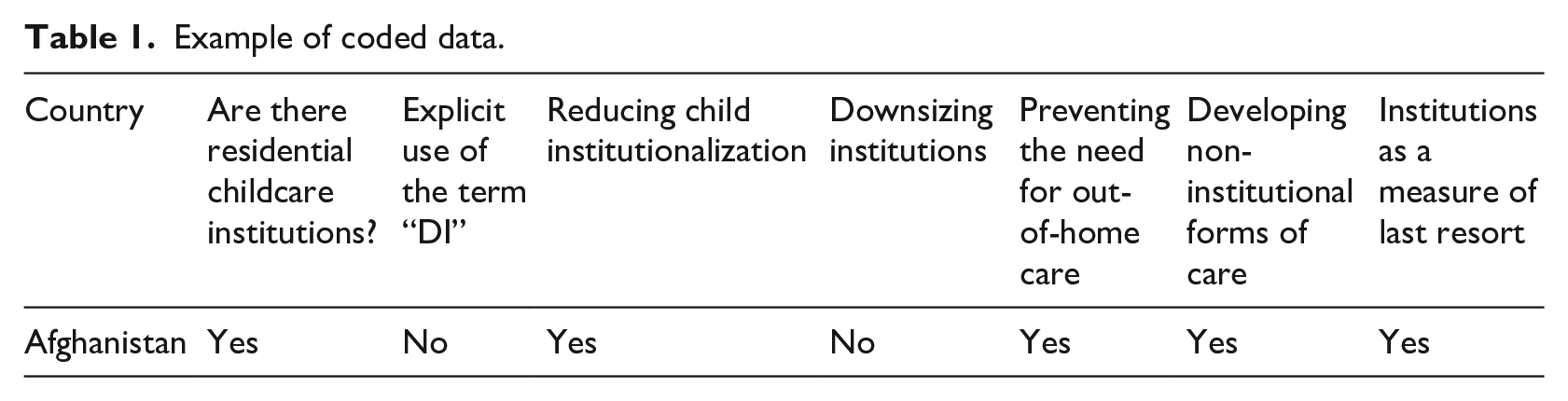
To produce a map of national DI commitments, we labeled each country as having or not having a DI policy. The country was labeled as having a DI policy (“Yes”) if at least one of the three variables had positive value: (1) explicit use of the term DI, (2) explicit statement about reducing child institutionalization, and (3) explicit statement about downsizing institutions.
To identify potential cases of symbolic DI commitments, we draw on a study showing that states were eager to sign international human rights covenants, symbolizing their commitments, but not so much the optional protocols, associated with stronger enforcement (Cole, 2005). Similarly, it may be easier for the Committee to hold governments accountable if they make concrete commitments, such as to develop non-institutional forms of care. Following this logic, we differentiate between high-level generic and low-level, more specific DI commitments. To identify cases of potential symbolic commitment, we count countries that make generic statements—explicitly mention “deinstitutionalization” or make an equivalent explicit commitment, such as a statement about reducing child institutionalization, or transition from institutional to community- and family-based care. To identify potential substantive commitments, we look for commitments to various specific elements of DI, such as preventing child abandonment and developing non-institutional forms of care. The latter statements do not carry the same symbolic value, are not as broad as “deinstitutionalization,” and are not as signifying of a modernizing policy turn, which is advocated for and expected by the UN CRC.
The results presented below should be taken with two important caveats in mind. First, the prime concern of the article is with policy commitments. We are not looking at the actual implementation of discussed global ideas in the given countries. An evaluation of ground-level DI reforms or their consequences is outside the scope of this article. For the purposes of this article, statements about measures already taken, planned, or broad intentions of the government are considered equivalent. This article focuses on discursive convergence and the adoption of DI-related concepts. At the same time, in our analysis, we aim to understand to what extent the conceptual and discursive convergence might be indicative of a deeper cultural convergence at the level of norms and ideas.
Second, the absence of evidence is not evidence of the absence of DI policy. The information in UN CRC reports is naturally limited and relatively of high level; therefore, it is possible that some relevant policy information was missed in the analysis. We are mindful of the fact that the analyzed documents are unlikely to reveal all aspects of countries’ childcare policies, but rather they may shed a light only on those aspects which a country in question decided to shed a light on.
Results
Below, we present our key findings and relate them to key concepts used in world society analysis of cross-national policy trends—convergence, decoupling, resistance, and world cultural frames. These findings support the following key arguments. The global spread of DI commitments is significant and, in line with world society theory, is associated with foreign, internationally flowing ideas and policy norms (subsection “The global geography of DI commitments”). However, we discover a lot of diversity both among what seems like policy adopters and non-adopters. We argue that this diversity cannot be fully captured by the standard concepts used by world society scholars—convergence, decoupling, and resistance.
To start with, there are a noticeable number of countries that did not commit to DI. In the subsection “DI non-committing countries—are they really policy non-adopters?,” we analyze these countries and try to understand whether we can capture the non-commitment trend with the concept “resistance.” Recent world society scholarship predicts that there will be a noticeable number of policy non-commitments, and these are conceptualized as resistance. However, we show that outright resistance is relatively rare. Instead, many of the countries that do not make broad DI statements still commit to selected aspects of DI. And even for the other countries that do not, there are statements that mesh with the logic of DI, for instance, noting that institutionalization can have negative effects or stressing that family-like care is provided.
In relation to policy adopters, world society studies usually operate with two key concepts—convergence and decoupling. With this conceptual lens, scholars focus either on the growing homogeneity (“convergence”) or on one source of potential divergence—the superficial isomorphism that is underpinned by nations’ hypocrisy and lack of actual commitment (“decoupling”). In the subsection “DI commitments and global convergence” and discussion below, we show the limited value of both concepts in the case of DI policy. We show that there is important variation in the meanings assigned to deinstitutionalization (and so by using the concept convergence we would omit important policy trends). In search of a potentially useful theoretical development, we reveal variation in the cultural frames that are marshaled to justify the importance of DI policy (subsection “DI commitments and selective adoption of world culture”).
The global geography of DI commitments
According to UN CRC reports, all countries have various forms of out-of-home childcare. It is also evident that a majority of countries, across income groups, are going through the process of reforming their legislation in the field of out-of-home childcare. Let us consider national commitments to DI policy and the extent of their spread across the globe (see Map 1).
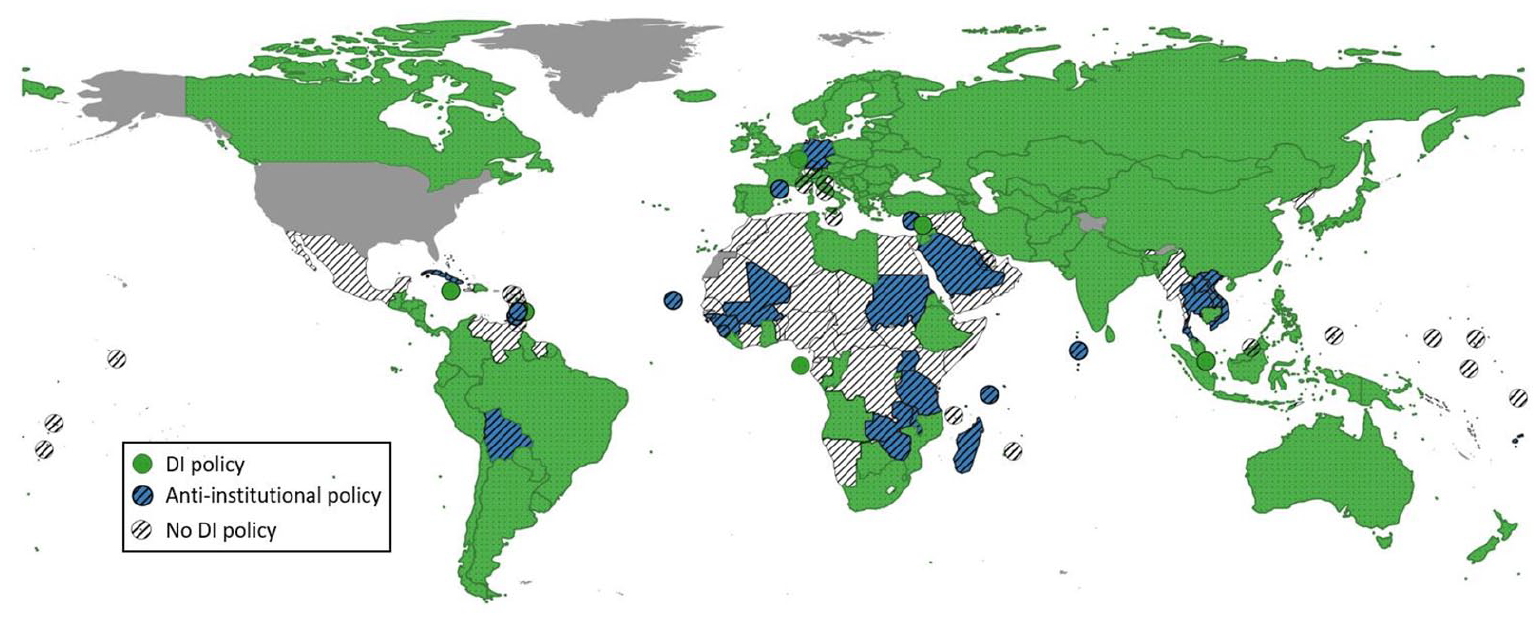
Deinstitutionalization and anti-institutionalization policies worldwide. Countries are colored according to the legend. Gray coloring indicates no information or disputed territory.
The map shows the global spread of DI policy commitments (countries shaded green), operationalized as clear statements about government commitment to replace institutions with community- and family-based forms of care, or transform institutions in a way to provide family-like care. The data show that over half of all countries (101 out of 193) made some sort of DI commitment. Of these countries, 51 explicitly used the term “deinstitutionalization” to describe the government’s policies (Chart 1).
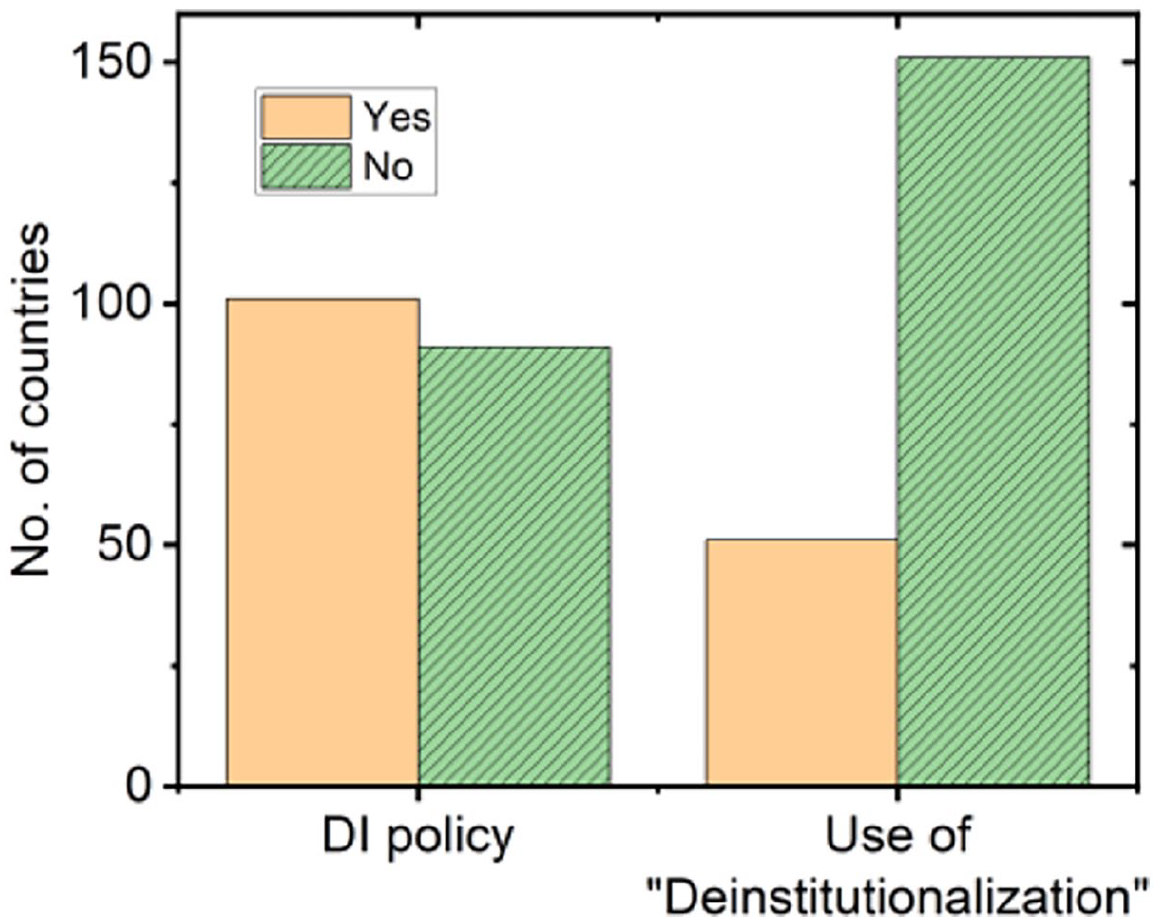
Deinstitutionalization commitments versus explicit use of the term “deinstitutionalization.”
What is driving this striking policy similarity across national borders? Our data suggest that it is driven by international ideational and normative changes, and hence world society theory is indeed relevant to understanding global DI trends. World society theory posits that policy commitments reflect ideational and normative changes—rather than the need to address some domestic issue. Many CRC reports support this argument, for example: In recent years there has been a growing awareness among the personnel of institutions working with children and adolescents, as well as among the population, of the disadvantages of institutionalization; for that reason, efforts are being directed towards strengthening the family in its own setting. (CRC report for Bolivia 2008, p. 16)
In line with world society perspective, reports are clear about the fact that DI shift is driven by influences from abroad and extensively supported by external actors: The MoSW has taken an initiative in 2010 with support from UNICEF for a gradual shift in its approach by incorporating preventive and protective measures supported by the concept of transformation of institutions into a family environment. (CRC report 2012 Bangladesh, p. 30) . . . in partnership with organisations IFCO (International Foster Care Organisation) and ICDI (International Child Development Initiatives) <. . .> two conferences on foster care were organised and a study travel in 2008 to the Netherlands for professionals from social welfare centres and children’s homes. (CRC report for Croatia 2011, p. 56)
In Armenia, new forms of care for disabled children are seen as influenced by developments abroad (CRC report for Armenia, 2002, p. 43). DI and reforms of orphanages are described as being in line with “international best practice,” as well as implemented with support of international actors such as World Vision International NGO (CRC report for Armenia, 2010, p. 48–49; CRC report for Armenia 2013, p. 6).
DI non-committing countries—are they really policy non-adopters?
A significant number of countries (91 countries) did not make explicit statements about the need to reduce child institutionalization. What are these countries and how can we conceptualize their non-commitment? Can this divergence be captured under the concept of resistance, as frequently done in world society research?
Table 2 shows that non-committing countries belong to different income groups and can be found both in the global South and in the global North. Twelve of these countries are relatively small and, reportedly, have no residential institutions for children, for example, Comoros, Dominica, and Vanuatu.
DI non-committing countries by income.
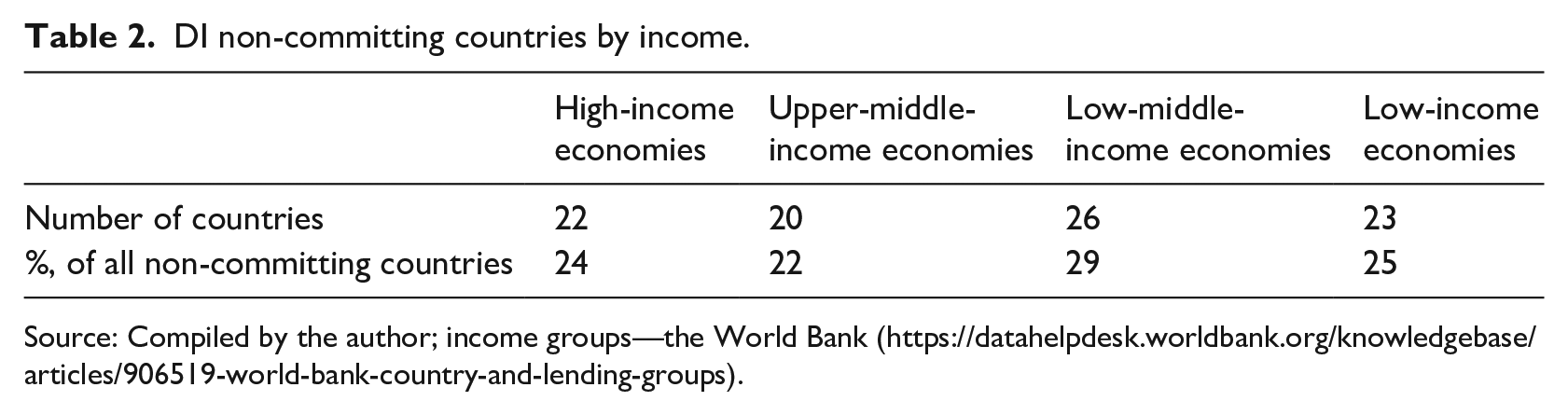
Source: Compiled by the author; income groups—the World Bank (https://datahelpdesk.worldbank.org/knowledgebase/articles/906519-world-bank-country-and-lending-groups).
Previous studies suggest that adoption and resistance to world cultural norms and associated policies may have regional patterns (e.g. Hadler and Symons, 2018). As seen on Map 1, the two seemingly discernible groups of countries with no DI commitments are small island states and African countries. The African group includes former colonies of Great Britain, France, Germany, Portugal, Belgium, Spain, and Italy, suggesting no obvious influence of the colonial legacy.
State party reports are flexible and vary greatly in how much and what kind of information they provide under the rubric “Family environment and alternative care.” If countries do not commit to DI, they tend to not mention DI policy, let alone explain the reasons of policy non-adoption. One notable exception is Switzerland—an example of an explicit policy non-adopter. In response to the CRC committee’s request “to indicate what measures have been taken to reduce and prevent the institutionalization of children,” Switzerland replied, “The Ordinance does not aim ‘to reduce and prevent the institutionalization of children’ but to take the correct action at the correct time, recognizing that placement is not necessarily the worst solution” (Replies of Switzerland to the list of issues, 2014, p. 18) Other non-committing countries do not discuss DI policy. To understand the reasons of non-commitments, one would need to undertake country-level case studies. However, it seems that at least some of “No DI” results are due to the nature of the analyzed material. If DI policy was adopted long time ago or, to the opposite, very recently, this may not show up in available UN CRC reports. Thus, for Sweden, we recorded no transformation of institutions into smaller family-like units because institutions already function in this way, and therefore no “transformation” of this sort is mentioned in the reports. Some countries have only recently started approaching the issue of child institutionalization (e.g. Nigeria, Burundi, Zambia, Kenya, Guinea-Bissau, Haiti), so reports do not reflect this.
A significant number of countries did not make explicit statements about the need to reduce child institutionalization, but nevertheless adopted the principle “institutions as a last resort” or made other policy statements about prioritizing family-type, non-institutional care settings, which could be crudely described as “anti-institutionalization.” Reports pronounce the need to prevent family separation and child abandonment, in order to avoid child institutionalization, or develop non-institutional forms of care. There is a wide range of statements, explicitly or implicitly recognizing that institutions are bad. Out of the total 91 non-committing states, 64 countries indicated commitment to at least one of the analyzed aspects of DI (preventing the need for out-of-home care; developing non-institutional out-of-home care; institutions as a measure of last resort)—countries shaded blue with hatching on Map 1. If we exclude 12 states that reported having no institutions, the number of UN CRC parties making at least some kind of DI commitments stands at 85 percent.
To give an example, some reports proclaim the “institutions only as a last resort” principle. For instance: “The Sudanese experience in caring for such children has established that the family and the community offer the best form of care and that institutional care should be used only as a last resort” (Sudan CRC report 1999)
In some reports, although no DI or “last resort” commitments are made, it is admitted that existing systems, involving child institutionalization, have a negative impact on children (Suriname CRC report 2014; Georgia CRC report 1998). Institutions are criticized as an inferior care option (Kenya CRC report 2000; Bahrain CRC report 2009; Kuwait CRC report 1996). Reports of Timor-Leste do not go as far as subscribing to reducing child institutionalization but mention the need to curb the increase in institutional placements (Timor-Leste CRC report 2007).
According to several weaker statements, avoiding institutionalization and considering family-type care options is the mandatory first step when placing the child. An even weaker statement here: “The Government does not promote the institutionalisation of persons with disabilities. The National Policy on Persons with Disabilities favours the integration and full participation of children, youth with disabilities into mainstream society” (Trinidad and Tobago CRC report 2003).
Countries highlight the family-like nature of the care they provide and thereby implicitly subscribe to anti-institutionalism. This is true even for countries that continue to place children in institutions. For example, although Liechtenstein places children into institutions in neighboring Switzerland and Austria, its national reports adopted the discourse of family-like out-of-home care: “The care provided promotes individual development of the personality and accompanies the group process. The small number of adolescents requiring care (4-6) means that the residential group is a family-type environment . . .” (Liechtenstein CRC report 1998). A similar example is Saudi Arabia, about Social Education Homes: “These establishments were created to house, care for and raise them in a manner as close as possible to the natural family home” (Saudi Arabia CRC report 2014).
Altogether, there is a clear discursive and policy trend toward minimizing the resort to institutional care. We see that many countries do not make explicit “umbrella” statements about pursuing a DI policy. At the same time, there is hardly any discursive resistance to DI and the underlying ideas about childhood and care. Countries do not sign up to DI policy in the same way, but at the same time they do not reject DI norm. In other words, we find that a lack of DI commitments does not always mean resistance. The statements found in UN CRC reports concerning institutional childcare can be described as a spectrum, ranging from intentions to expand to completely abolish institutional childcare, whereby most countries are closer to the “abolition” end of the spectrum, and take a deinstitutionalization or anti-institutionalization stance.
DI commitments and global convergence
How can we conceptualize the broad cross-national spread of DI commitments? Can we usefully apply the concept of convergence?
Although many states adopted DI vocabulary and discourse, the same words are not used to mean the same thing. The definitions of institutional care vary. Boarding schools are generally included into “institutional care” (Timor-Leste, Georgia, Italy, Tajikistan, etc.), but sometimes not (Thailand, Latvia). According to Bhutan CRC report 2007, “Bhutan does not have any orphanages or institutions for children without a family environment although a few orphans find homes in monasteries and monastic institutions.” However, Bhutan’s monasteries are major providers of institutional care (Reply to the list of issues 2008). Similarly, in Mongolia, a major type of institutional childcare—dormitories for children of herders (Mongolia CRC report 2015)—is not included in the definition of “institutions,” which are covered by DI policy (Mongolia CRC report 2008, p. 107). Such terminological differences are likely to affect the scope and scale of DI policies.
In some countries, institutional care is largely state-run (e.g. former republics of the USSR), while in others it is provided privately, with little monitoring from the state and many unregistered care providers (Kenya). Local informal institutions differ: in Kenya, people prefer foster care to adoption, while in many other countries it is the other way round. Existing kinship and community ties provide different space for accommodating children with their relatives, as opposed to placing them with professional foster families or family-type children’s homes. Hence, policy designs are bound to vary.
Claims about DI implementation measures have a wide range—from generic statements of policy priorities and objectives (Algeria, China) to named DI strategies with specified timelines for reform and allocated funding (Bulgaria CRC report 2014).
Finally, policies change. For example, Israel prioritized foster care since 1920s, but then resorted to residential care, and over time shifted to viewing community-based solutions as more desirable again (Israel CRC report 2001). Similarly, Russia adopted a DI policy, but in 2008 the DI reform was suspended (UN CRC, 2014). Papua New Guinea provides another example: “Formal foster placements are a thing of the past, as the Office of Child Welfare has no budgetary provision to cover the cost incurred by foster arrangements” (Papua New Guinea CRC report 2002). So ascertaining that the DI policy is globally shared may not be indicative of where individual countries will move next and how stable or culturally determined this global pattern is.
Altogether, vocabularies, concepts, and discourses are shared across national borders; national agendas are synchronized. Child institutionalization is increasingly framed as problematic across countries, indicating rather broad discursive convergence and policy synchronization. At the same time, this convergence is like an envelope which contains a lot of variation in cultures, institutions, and understandings. In the next subsection, we explore one source of this diversity—the internal complexity of world culture, and existence of multiple world cultural frames, or logics, underpinning the same DI commitments.
DI commitments and selective adoption of world culture
We argue that in addition to convergence, resistance, and decoupling, there is another mode of actor’s relationship with world culture, namely, selective adoption. Actors can choose to adopt only some aspects of world culture or adopt different aspects to varying degrees.
As discussed in the theory section above, DI policy sits at the intersection of multiple logics: human rights, scientization, and cost efficiency. Which of these frames find reflection in national CRC reports? Typically, CRC reports explain the nature of state policies in relation to child institutionalization and provision for children deprived of parental care, and provide factual information with regard to institutionalization statistics, available care options, as well as state measures of family support and interventions aimed at reducing or preventing institutionalization. The underlying motives for state policies and interventions are typically not explicated. Avoiding child institutionalization is often mentioned as a self-evident norm, based on objective facts and international practice, and not requiring justification. For example: “The most positive way for solving the issue concerned is to return a child left without parental care to a family environment—biological, adoptive, or foster family” (CRC report for Armenia, 2010, p. 48–49). The universal imperative is “to curb the rise in the number of children in institutions and help to eradicate this social scourge and return children to their families” (CRC report for Armenia, 2002, p. 36). DI is viewed as a move toward “modern,” and therefore legitimate, system of care: “passing from the type of closed residential services on to the type of modern services, which are decentralised and widely distributed in the community” (CRC report for Albania, 2003, p.11).
Still, some reports reflect different motivations driving DI commitments. First, DI is justified by reference to the legalistic human rights frame. DI is mentioned as a way to secure “the rights and legitimate interests of the child” (CRC report for Armenia, 2010, p. 48–49)—which is unsurprising for a national report to the UN Committee on the rights of the child.
Second, DI policy is justified through the scientization frame—as a policy which was scientifically proven to be beneficial for the psycho-social development of children: . . . numerous studies by psychologists and teachers have shown that placement of children in residential institutions does not ensure the satisfaction of their basic needs . . . (CRC report for Kazakhstan 2011, p. 44) The MoSW undertook a study in 2008-2009 to assess the situation of different categories of children placed in institutions. Based on the findings of the study, the MoSW adopted measures to improve their living conditions. (CRC report 2012 Bangladesh, p. 30)
Third, we find that DI policy is justified through the neoliberal cost-reduction and efficiency frame. This is somewhat unexpected, given that CRC reports are meant to explain what the government is doing to secure children’s rights—not how it ensures the cost efficiency of care provision. The economic aspect of out-of-home care is discussed as an important factor for reducing the number of children in institutions: Australia acknowledges ongoing issues with the high numbers of children entering out-of-home care and protection system. . . . The national recurrent expenditure on child protection and out-of-home care services was almost $4 billion in 2015–16, a real increase of $283.74 million from 2014–15. (CRC report for Australia 2018, p. 17)
Moreover, out-of-home care is treated as a legitimate tool for achieving budgetary savings and making care provision more efficient, suggesting that some countries have socialized to the neoliberal world cultural view of childcare. For example, several reports from Belize focus on the implications of child institutionalization for national finances and the benefits of diverting budgetary savings from DI into counseling and other services: Such institutionalisation is also expensive: such resources could be far better reallocated for the long—term benefit of so many such young people—including through the extension of parent effectiveness efforts. (CRC report for Belize 2003, p. 35–-36)
To discourage parents from sending their children to institutional care, and thereby reduce the cost of institutional care for the state, another report suggests shifting the expenses for the child’s upkeep in institutions to the child’s parents (CRC report for Belize 1996, p. 17–18).
Governments explicitly give priority to non-residential forms of care because these are “less costly” (CRC report for Albania, 2003, p.11).
A report from Angola lists the key areas of responsibility of the government, specifically Angola’ National Children’s Office entrusted with protection of children’s rights. As follows from this list, reduction of children in institutional care goes side by side with cost reduction: “promoting low-cost alternative forms of care for young children and adolescents at risk; developing and coordinating the National Family Tracing and Reunification Programme” (CRC report for Angola 2004, p.10).
A report from Kazakhstan (2011) shows a full-on neoliberal approach to providing care for disabled children. It discusses DI in the context of Kazakhstan’s global competitiveness and developing the market of special social services: The Special Social Services Act was adopted in 2008 with a view to implementing the strategy for making Kazakhstan one of the 50 most competitive countries in the world . . . The adoption and implementation of the Act will make it possible to: • Establish an up-to-date model for the delivery of special social services; • Establish a comprehensive system of social services for disadvantaged persons; • Expand the special social services market through the participation of NGOs whose work stimulates competition and improves service quality. (CRC report for 2011, p. 49)
As we see from the above, countries commit to DI for different cultural reasons. Arguably, world cultural comparative policy analysis cannot merely look at the policy’s globality. Conceptualizing global policy trends from a world cultural perspective requires considering the cultural contents of the policy in question, what aspects of world culture it grew out of, and how these different cultural facets play out in national contexts.
Discussion
Our results suggest that there are two big trends in the global policy landscape of childcare deinstitutionalization. First, a large and growing number of countries commit to DI policy, which is underpinned by the modern world culture. Second, there is a lot of diversity accompanying what seems like an emerging global consensus on DI.
To theorize these trends, we tried using the standard world society approach, which is largely binary and categorizes policy patterns “convergence” or “resistance,” with a caveat that some convergence is merely symbolic / hypocritical (“decoupling”). Our exercise revealed that these concepts are not fit for purpose as they do not allow us to capture important policy diversity. Below, we argue that this issue may be rectified by expanding the application of another concept, which was recently introduced in world society studies—world cultural frames. We propose that the complex, multi-logics nature of world culture is itself a source of policy divergence, because it allows governments to selectively adopt specific logics of the world culture, rather than the whole “package.” Let us now consider the implications of our results in more detail.
The vast majority of countries address the issue of child institutionalization in their reports. States react to the same events, such as the adoption of the UN CRC, the UN Guidelines for the alternative care of children, and DI commitments by other states. The UN Committee for the Rights of the Child regularly issues country-specific DI recommendations to state parties. Therefore, the reporting process itself encourages countries to express their position regarding DI. Moreover, most countries indeed make DI commitments, as we hypothesized (H1). The wide spread of DI related discourses and commitments (see Map 1) suggests extensive cultural and normative convergence.
Given the diversity of national socio-economic, political, and cultural systems, we also expected to find variation in how DI is interpreted (H2). As hypothesized, UN CRC reports show that DI ideas are interpreted and adjusted to domestic conditions and constraints. The extent of DI commitments, particular focus, and implementation progress vary. Some countries focus on reforming care provision for healthy children abandoned due to poverty or divorce, whereas elsewhere, these issues are not so significant, and governments focus on children with special needs or in a situation of abuse. Children are placed in institutions for various reasons, such as born out of wedlock, separated due to conflict, natural disaster, work-related migration of parents, orphans, and imprisoned parents. In some countries, the issue of institutionalization is most pronounced for ethnic minorities and indigenous communities (Australia and Canada). Some countries only address the institutionalization of babies and children under the age of 3, whereas others have gone further and deal with older children, which are generally more difficult to place in families.
In other words, even the explicit DI policy commitments have a wide range of meanings. This means that the revealed broad, high-level discursive convergence is often superficial and hides heterogeneity of the policy, institutional, and cultural landscape. This heterogeneity is partly due to the cross-sectoral, umbrella nature of DI policy. The DI concept allows consolidating various existing efforts under the umbrella of ensuring “the child’s right to a family” while allowing the government to respond to social, political, economic, and demographic needs particular to that national context. This feature makes DI policy different from some other social policies that are not so wide in scope, for example, a policy abolishing (or not) the death penalty for children or a policy to establish (or not) the institution of children’s ombudsman. The resulting methodological issues are common for comparative studies of other umbrella-type policies too (Armstrong et al., 2010; D’Alessio and Watkins, 2009; Lohmann and Zagel, 2016).
Since the term “convergence” does not reflect the full story of what goes on underneath DI commitments, does the concept of decoupling capture the nature and origins of divergence? Guided by world society research on decoupling, we expected (H3a) that most world countries would explicitly commit to “deinstitutionalization,” or make equivalent generic statements about reducing child institutionalization, or transition from institutional to community- and family-based care. At the same time, we expected that fewer countries would refer to more specific DI ingredients. Our data did not meet these expectations. Although more than half of world countries made clear DI policy statements (101 out of 193), an additional 64 countries made no such commitments but rather statements about some more specific element of DI policy: preventing the need for out-of-home care, or developing non-institutional forms of care, or using institutionalization only as a measure of last resort. In other words, the uneven global DI policy landscape is not necessarily associated with decoupling and driven by policy-makers’ hypocritical legitimacy-seeking behavior.
We also hypothesized (H3b) that some countries with no children in institutional care will make symbolic commitments denouncing the use of institutional care. We did not find any cases where a country with no institutions committed to DI.
Therefore, while there is clearly a wide range of ideas and understandings sitting behind DI commitments, this diversity cannot necessarily be described as decoupling. It is not purely legitimacy-seeking that drives the observed variation. Many countries do not make generic explicit DI claims, “ticking the box” to gain legitimacy. Rather, they describe their efforts to achieve DI ends, without explicitly linking these to the UN-promoted DI policy norm. This finding highlights the agency of national actors, and that ready-made global policy norms are not simply copied by national actors, even in discursive form, as “empty promises,” but selectively applied and adjusted to the national context (Alasuutari, 2016).
There may be multiple reasons for this moderate discursive isomorphism. Possibly, policy-makers try to avoid explicit references to what they may view as a controversial DI policy, potentially associated with neoliberal cost-cutting reforms or negative experiences around adult deinstitutionalization. Governments may also place different importance on UN CRC reports, as they experience different demand for external legitimacy. Possibly, the phenomenon of decoupling is not as widespread as may be expected. Finally, childcare deinstitutionalization, as an umbrella policy concept, was mainstreamed relatively recently and may spread more widely in a few years.
World society studies commonly discuss policy heterogeneity as result of resistance or a backlash to the efforts of many international actors to promote the liberal world culture (Bromley et al., 2020; Graff et al., 2019; Lerch et al., 2020; Schofer et al., 2018). This analytical lens does not appear fruitful in the case of DI policy. In our dataset, we expected to see countries explicitly reject the DI policy norm (H4). However, the examples of explicit or obvious disagreement with DI norm are extremely rare (see Switzerland above). Instead, the internal tensions of world culture are themselves sources of conflict and social variety. To take the example of Estonia: “while the principle of deinstitutionalisation has been embraced in Estonia, foster care has not been popular. This according to Sindi et al. (2018) is due to the cultural emphasis on individualism and family privacy. In consequence, foster care placements decreased between 2005 and 2015” (Harlow, 2021: 8). In other words, the rise of individualistic culture leads not only to DI commitments but also to resistance to the internationally promoted DI policy model, which includes development of formal foster care.
Based on the above, we argue that the binary analysis in terms of convergence and resistance, commonly used in world society research, is not helpful in the case of DI. A dichotomous division of countries into policy adopters and non-adopters oversimplifies the diversity among countries even at the formal policy commitment level, not to mention the ground-level implementation.
Based on our examination, we argue that world society scholars need to move beyond binary analysis of wholesale compliance or resistance to global norms. Analysis should be refined and consider how different logics which all fall under the broader world cultural umbrella are employed to motivate compliance. As we argued for the case of deinstitutionalization, the choice of particular logics may indicate different drivers of policy adoption and have serious implications for policy design and eventual outcomes.
In line with our hypothesis H5, we find manifestations of three main frames justifying DI policies in national CRC reports. Countries evoke different logics (human rights, scientization, and cost efficiency), which are all associated with the modern world culture. Arguably, countries which adopted DI policy for reasons of cost reduction are likely to focus on de-responsibilization of the state, potentially ignoring children’s needs. Other states, however, may commit to DI primarily as a way to promote evidence-based policy making or the child’s rights agenda—possibly with different outcomes. It is therefore important to appreciate the multi-level cultural heterogeneity that may hide behind the nominal pattern of modern world culture-associated policy spread.
This kind of frame analysis is relevant to different policy norms. The combination of different cultural logics is not specific to DI policy—there exist other global “umbrella norms” (Cole and Geist, 2021). However, the manifestation of world cultural frames is likely to depend on the norm. It is possible that it will not always matter which world cultural frame is behind policy adoption. For example, contraception advocacy is framed in economic, human rights, or healthcare terms. Irrespective of which frame dominates the contraception advocacy in a country, the outcome is the same—an increase in contraception rate (Cole and Geist, 2021). However, it can matter in the case of DI—whether deinstitutionalization ideas resonate more with children’s rights or economic development groups. DI policy designed around the protection of children’s rights is less likely to lead to a speedy dismantling of children’s homes before substitute services in the community are in place.
It is reasonable to assume that the role of each of these frames varies across nations (e.g. Cole and Geist, 2021). For example, the cost efficiency frame is more likely to appeal to governments where out-of-home care is provided by the state and which already embraced neoliberalism in other policy areas. The case of DI supports similar arguments made by Yoo (2011): “Future research should specify which aspects of world culture have distinct effects on various kinds of women’s rights” (p. 521). Depending on whether DI is driven by neoliberal or some other logics, this affects our expectations for policy design and outcomes, as well as our measures of decoupling.
Both DI and abortion policies can be viewed through the lens of competing normative frames. However, unlike the case of abortion policies (Boyle et al., 2015), all DI frames are associated with the same world culture. Therefore, if one frame dominates and accounts for policy adoption, it is not about weak institutionalization of a policy script, but rather of the meaning attached to this policy. Hence, the recent focus of many world society studies on cultural convergence/resistance/decoupling needs to be replaced with a more refined analysis of “the politics and semiotics of policy adoption,” that is, “the multiple and even divergent motives why countries adopt <specific policies>” (Verger, 2016: 76). This would make world society research less deterministic and allow avoiding broad-sweeping generalizations portraying the world as two “camps.” Instead, one could better appreciate the roles of national actors, as carriers of partly overlapping sets of ideas, and agents making choices in relation to the broad range of internationally legitimate norms.
Our results push us not only in the direction of world cultural frame analysis. They also point at the need to combine world cultural lens with a more functionalist, non-cultural analysis. The analyzed reports suggest that DI commitments are driven by new, internationally circulating ideas, which is in line with the world society explanation of policy adoption. At the same time, our analysis shows that national actors play an important role in filtering internationally popular ideas. They do not automatically adopt all norms promoted by major international organizations like the UN. Rather, they choose those ideas which appear useful in their domestic context and can help resolve some problem. The symbolic and legitimating value of DI commitments needs to be boosted by some other, “functional” value in order to guarantee that such commitments will be made. In our dataset, there were 12 relatively small countries that, according to their reports, have no institutional childcare, such as Marshall Islands, Micronesia, or Nauru. Contrary to our world society theory–based expectations (H3b), none of these countries committed to DI. In other words, no countries made DI commitments where they had no “objective” needs for DI policy. This suggests that DI policy commitments reflect interest-driven, functional policy needs, as much as ideational and normative changes.
Similarly, countries with low numbers of institutionalized children, such as Gambia, Liechtenstein, San Marino, and Qatar, did not make any DI commitments in their reports. From a neo-institutionalist perspective, the fact that they make no DI commitments shows that DI policy carries limited normative value and is of limited importance for country’s international legitimacy.
This agrees with another finding: a surprisingly large number of countries commit to specific aspects of childcare deinstitutionalization but do not make generic DI claims (Chart 2). This result contrasts with our world society theory–based expectations of the widely present decoupling (H3a). Our data thus suggest that DI commitments are driven by various problem-driven motives, such as the need to cut budgetary expenses, reduce the rate of child abuse, or achieve some domestic political aims. This does not mean that the underlying ideas (ideas about human rights, the authority of science, or the neoliberal ideas about the roles of state vis-à-vis private actors) are not powerful. Rather, actors draw on world cultural norms in order to justify the reforms that they wish to pursue. (Alasuutari, 2016) In doing so, they can choose the world cultural frames that are most useful for their purposes. In other words, while DI policy is associated with different cultural frames, the power of these cultural frames is limited by policy’s functionality and choices made by policy-makers.
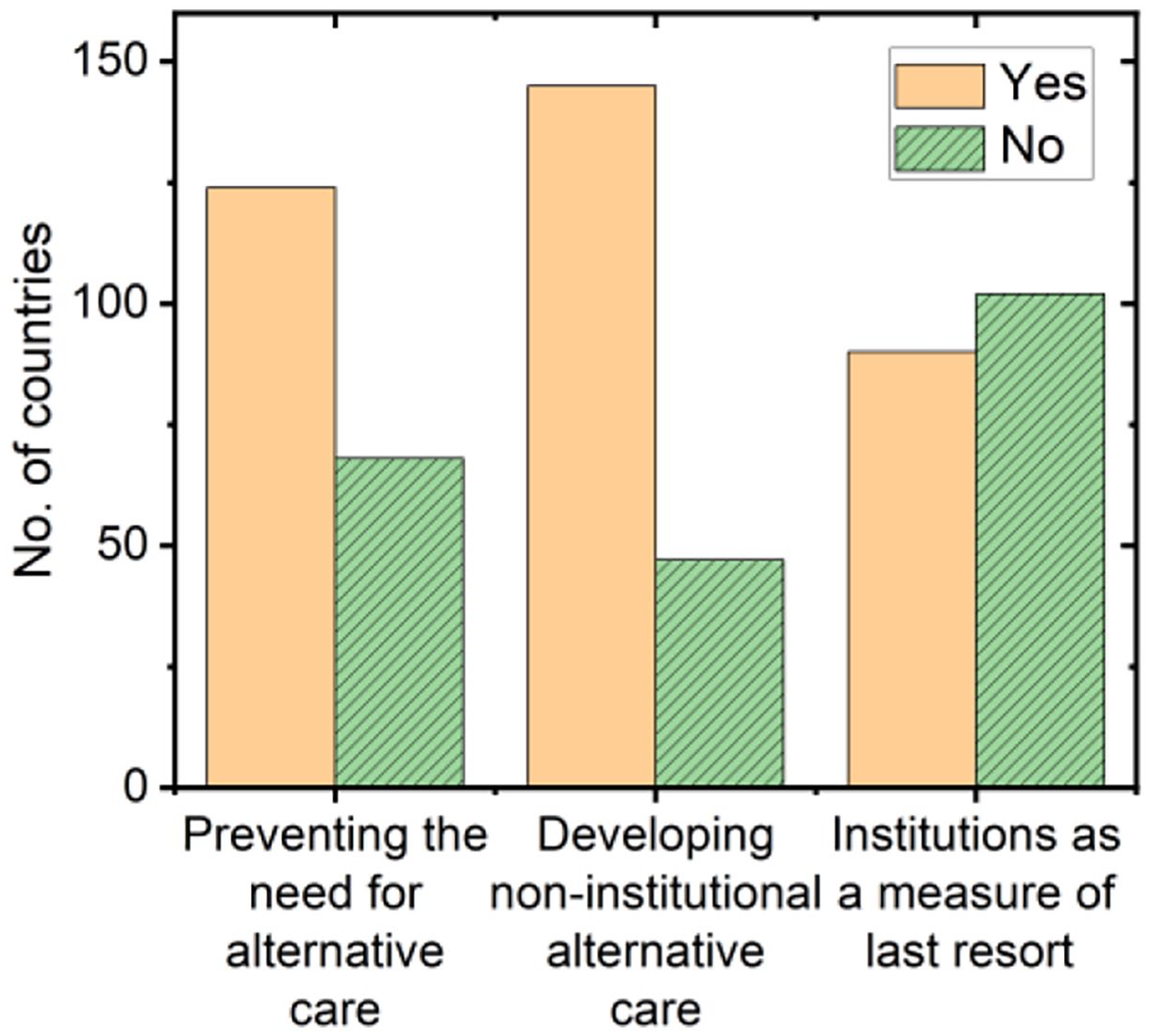
Commitments to individual elements of deinstitutionalization policy.
Our study naturally has its limitations, and DI policy trends require further detailed investigation. One issue is related to identifying decoupling. As pointed out above, national reports are not comprehensive and vary in completeness (Limber and Flekkøy, 1995). The states feel pressured to comply with global norms and therefore, in their reports, they may leave out the potential evidence of non-compliance, especially since there is no mechanism to control the quality of reporting. This limitation of our data could affect our results. It is possible that the extent of decoupling is larger than we can see from the reports.
Our study raises questions about the usefulness of conceptual tools used by world society scholars. In order to better understand how global norms diffuse, future research needs to do more empirical analysis of different umbrella policies.
Conclusion
We examined how childcare deinstitutionalization commitments spread cross-nationally. Our data attest to the major transnational discursive policy shift toward childcare deinstitutionalization. Governments around the world acknowledge the negative effects of residential care institutions and commit to minimizing or even rejecting institutional care. DI has grown into a major global social policy. We can interpret these findings as a powerful illustration of world society theory, predicting broad-based policy discourse convergence, underpinned by the spread of the modern world culture.
However, we show that the relationship between the adoption of the hegemonic world culture and specific policy commitments is rather complex. The extent of discursive convergence and decoupling is not as significant as one might expect based on world society theory. This finding supports arguments about the agency of national actors, whose policy choices vary even in conditions of normative pressures from international organizations and peer pressure. We observe a multi-level heterogeneity of DI global policy. First, there is variation in the meanings attached to childcare deinstitutionalization and related concepts, such as family and institutional care. Second, there is significant variation in explicit commitments to the arguably human rights–based DI policy norm. Following recent world society studies, one might be tempted to conceptualize this variation as divergence, resistance, or backlash to the hegemonic liberal world culture. However, based on reading national UN CRC reports, we could identify only very little actual non-adoption or rejection of DI policy norm. Variation in commitments does not appear to follow clear-cut regional patterns.
This complexity is not adequately captured by the standard world society conceptual framework. The case of DI suggests that heterogeneity is not only about overt resistance and explicit, outright “disputation” of some dominant ideological paradigm and global normative polarization, whereby some states choose to comply with rival norms (e.g. Hadler and Symons, 2018). Nor can heterogeneity be reduced to decoupling, where world-culture propagated policy models are adhered to symbolically and hypocritically. There are many world cultural motives to adopt a DI policy. Given the different justifications for DI commitments, countries selectively adopt individual aspects, or frames, of the shared Western world culture. Actors engage in the strategic selection of—from their point of view useful or appropriate—human rights, scientization, neoliberal, or some other world cultural logic. Therefore, accurate conceptualization of observed policy adoption patterns requires analysis of processes that produce these patterns. Focusing on the complex content of world culture and investigating how similar policy commitments are motivated by different frames within the same broad world culture are promising ways to overcome this limitation.
