



Abstract
This study examines trade union decline in light of concurrent changes in the demographic and sectoral composition of labor markets. Drawing on classical sociology and contemporary scholarship on work and employment, the author theorizes that the emergence of post-industrial work settings coupled with more socially diverse workforces make labor organizing more difficult than prior research recognizes. Operating through various mechanisms, these factors are thought to hinder the development of solidarity among workers and direct employment growth toward previously unorganized parts of the economy. Using panel data on 18 countries from 1960 to 2015, these ideas are tested with regression models that capture labor market changes indicative of post-industrial capitalism—measured by changes in deindustrialization, foreign-born population, and female share of employment. The results support the theoretical argument, with counterfactual estimates suggesting that labor market changes occurring between 1960 and 2015 reduced union density by 9 to 13 points for the whole sample.
Introduction
Trade unions in most advanced capitalist countries have steadily lost members for decades, as they struggle to adapt to changes in the economy and society (Gumbrell-McCormick and Hyman, 2013; Rosenfeld, 2014). Because union decline has pronounced implications for important societal outcomes—affecting phenomena such as income inequality, democratic class politics, and social mobility—sociologists are keen to understand its causes. One prominent explanation highlights the enduring importance of labor market institutions, such as centralized wage bargaining and the Ghent system (Checchi and Visser, 2005; Scruggs and Lange, 2002; Western, 1995, 1997). Here considerable evidence suggests that union membership remains buoyant when these institutions are present and robust. Other explanations focus on structural economic changes, such as the offshoring of routine production jobs (Blaschke, 2000; Vachon et al., 2016), the rollback of public-sector employment (Blaschke, 2000; Scruggs and Lange, 2002), and the financialization of the economy (Kollmeyer and Peters, 2019). Still other explanations highlight how the political climate has turned against trade unions in some countries and question whether this is pushing union density downward (cf. Farber and Western, 2002; Tope and Jacobs, 2009).
Building on these explanations, the present study considers whether trade union decline is bound up with labor market changes indicative of post-industrial capitalism. Seemingly, the pronounced shift toward service-sector employment should cause problems for organized labor (Blaschke, 2000; Kollmeyer, 2018; Lee, 2005), although some evidence suggests this is not the case (Brady, 2007). Likewise, rising numbers of female and foreign-born workers may impede unionization for various reasons (Lee, 2005), but comparative research on this topic yields no consensus (cf. Brady, 2007; Lee, 2005). Furthermore, although there are successful cases of union organizing in post-industrial work settings (e.g. Milkman, 2006), these cases may run counter to general trends, making the overall effect on union density unclear.
The present study contributes to the literature on trade union decline by asking how recent changes in the demographic and sectoral composition of labor markets affect trade union density. I focus on three structural changes occurring over the late-20th century that likely hamper the ability of trade unions to attract and keep members: (1) deindustrialization reversed a longstanding trend in which capitalist development concentrated workers into large and regimented worksites where they could be easily organized; (2) rising levels of immigration increased the ethnic diversity of labor markets, creating potential complications for attempts to organize workers along class lines; and (3) similarly, rising levels of female labor market participation introduced another social cleavage into labor markets, potentially complicating labor organizing efforts through various means. Together, these structural changes broadly reconfigured the demographic and sectoral composition of labor markets. In this new social context, which I refer to as post-industrial capitalism, the task of labor organizing becomes more difficult and hence less likely to succeed at levels necessary to sustain high union density.
Importantly, few studies systematically assess this possibility. To date, a few quantitative studies consider some combination of deindustrialization, immigration, and female labor market participation as determinants of union density, but their conclusions vary considerably (cf. Brady, 2007; Lee, 2005). Using panel data similar to mine, Lee (2005) links all three factors with falling union density but makes no assessment about their substantive effects. Conversely, using hierarchical cross-sectional data, Brady (2007) finds that deindustrialization plays no role in union decline and that immigration has positive effects under some model specifications. However, female employment levels are not considered. Combined, these inconsistent results leave uncertainties about the role demographic and sectoral changes play in trade union decline.
Furthermore, no study considers the possibility that demographic and sectoral changes in labor markets function not as standalone factors (additive causation) but rather combine and interact in ways that alter the original social forces (moderated causation). Other quantitative studies of union density consider interactions between market forces and institutions such as the Ghent system (Checchi and Visser, 2005; Ebbinghaus and Visser, 1999; Scruggs and Lange, 2002). Yet no study assesses the possibility that labor market changes themselves interact in ways that lower union density.
To fill this gap in the literature, I gather data from 18 advanced capitalist countries from 1960 to 2015 and run panel regression models of trade union decline based on both additive and moderated causation. The latter models include three-way interactions (and all possible two-way interactions) among deindustrialization, foreign-born population, and female labor market participation. The results show that the interactions are statistically and substantively significant, but that some interactions boost union density, even though the overall effect is sharply negative. By contrast, the additive model identifies foreign-born population and female labor market participation as prominent determinants of trade union decline, with deindustrialization having a more limited effect. Overall, the evidence from both models supports the argument that the reconfiguration of labor markets under post-industrial capitalism plays a prominent role in trade union decline.
Classical theories of collective action and trade unionism
As discussed below, classical accounts of class formation, collective action, and trade unionism highlight two important factors relative to my study: (1) that different production regimes within capitalism can create attendant social conditions that either facilitate or impede class formation and working-class collective action and (2) that salient non-class divisions in society can hinder class solidarity and impede workers’ ability to organize around common class interests. I discuss each point in turn.
First, in the Communist Manifesto, Marx (1988: 61–64) argued that early industrial capitalism was unwittily organizing workers into a potentially powerful social and political force. This was occurring, Marx contended, because capitalist development pulled workers into urban areas, concentrated them in factory settings, and organized them into an “industrial army.” It also homogenized their material conditions, both at work and in their communities. For Marx, the combination of similar material conditions and close physical proximity prompted industrial workers to form small “associations” against their employers (1988: 63). Over time, these associations grew and aggregated into modern trade unions. In this way, Marx viewed the logic of industrial capitalism as actually facilitating the organization of the working class (see Sabia, 1988).
By contrast, some production regimes from this era remained outside the logic of industrialism and hence their structures impeded working-class mobilization. Notably, some industries in Marx’s time followed the “domestic industry” model, in which workers undertook piecemeal work in their homes or in small workshops. For Marx (2000: 304), this production regime left workers socially isolated and hence possessing little “power of resistance.” Furthermore, although the peasantry were highly exploited and numerically large, Marx (1977a: 317) saw them as “incapable of enforcing their class interests” because they were scattered across the countryside and rarely interacted with one another. Hence, for both peasants and piecemeal domestic workers, the structure of their workplaces made labor organizing inherently difficult.
Similarly, Weber claimed that the structure of work affects workers’ response to their common problems. He claimed that “class-conscious organization succeeds most easily” when “large numbers of people are in the same class situation” and when “it is technically easy to organize them, especially if they are concentrated at their place of work” (1978: 305). This describes most industrial work settings where similarly situated workers are assembled in regimented groups. In sum, classical theory highlights how the logic of industrial capitalism facilitated labor organizing.
The second point arising from classical theory is that status-group divisions in society can impede workers’ ability to organize around their common class interests. For Weber (1978: 303–307, 926–940), exploitation under capitalism need not provoke organized resistance from the working class. His argument rests partially on the idea that classes are merely large aggregates of people, who are similarly positioned relative to the economy but may have little else in common. Hence, in discussing the possibility of strong labor movements, Weber concluded that “the emergence of associations or even mere social action from a common class situation is by no means a universal phenomenon” (1978: 929). Instead, he stressed that status groups, such as ethnicities, form a stronger basis for building social solidarity because they function as social “communities,” with shared norms and common patterns of behavior (see Hechter, 1978; Nielsen, 1985). Importantly, people within the same status-group can occupy different class positions. When this occurs, it becomes difficult to mobilize around both status group and class identities (see Hechter, 2004). This idea—that class and status groups can function as cross-cutting systems of social stratification—is a central concept in Weberian sociology. It also animates discussions among the contemporary left about the difficulties of simultaneously pursuing “redistribution” (in support of the working class) and “recognition” (in support of disadvantaged status groups) (see Fraser, 1995).
Although little known, Marx tangentially discussed this point as well. Pointing toward ethnic divisions in the working class, Marx (1977b: 591) described how immigration from Ireland divided the British working class: “Every industrial and commercial centre in England now possesses a working class divided into two hostile groups, English proletarians and Irish proletarians.” This ethnic antagonism was intensified by Britain’s domination of Ireland and Ireland’s struggle for independence, but nonetheless it hindered working-class unity. In fact, for Marx, “this [ethnic] antagonism is the secret of the impotence of the English working class” (1977b: 591).
Clearly, there is no essential reason for status-group distinctions to have such salience, but socially defined categories have been entrenched in the “geoculture” of Western capitalism since the rise of the modern nation-state (Wallerstein, 2011). In particular, the 19th century witnessed the “creation of our entire contemporary conceptual apparatus of identities” (Wallerstein, 2011: 217), giving rise to notions of nationality, ethnicity/race, and gender. These socially defined categories, in turn, have real political consequences. For example, during the 19th century, status-group distinctions repeatedly created tensions among labor, ethnic/race, and women’s movements, preventing them from effectively collaborating even though all three movements represented disadvantaged groups (see Wallerstein, 2011: 184–217).
In terms of my study, these ideas from classical sociology point toward early industrial capitalism and related societal structures as creating a social context that generally favored trade unionism. In this regard, I draw attention to three structural features of industrial society, all peaking in the mid-20th century: (1) industrialization concentrated similarly situated workers into large and regimented worksites where they could be easily organized (Marx, 1988: 61–64; Sabia, 1988; Visser, 2012); (2) low levels of immigration limited employment shares of foreign-born workers (Hatton and Williamson, 2005) and lessened tensions between class and status group as the salient basis of solidarity in the workplace (Hechter, 2004; Nielsen, 1985; Weber, 1978); and (3) similarly, postwar gender norms relegated women to unpaid domestic work, or to the margins of the paid economy, thus limiting gender as a potential social division within the industrial workforce (Milkman and Townsley, 1994). Combined, these structural conditions spatially concentrated and socially homogenized the workforce, creating a social context in which workers could be readily organized.
In this way, classical theory points toward what contemporary labor scholars call “positional” and “solidaristic” accounts of trade unionism (see Rosenfeld and Kleykamp, 2009). Positional accounts emphasize the labor market position of workers and how certain occupations and types of jobs are more or less difficult to organize. From this perspective, the erstwhile factory system of industrial capitalism provided more fertile grounds for labor organizing than today’s post-industrial worksites. Conversely, solidaristic accounts emphasize factors that promote or hinder solidarity among workers, making workers more or less inclined to mobilize around common concerns. From this perspective, the more socially homogeneous labor markets of the mid-20th century made class solidarity easier to build because cross-cutting pressures arising from competition among status groups were less prevalent (also see Nielsen, 1985).
Rise of post-industrial capitalism and trade unionism
Sectoral changes in labor markets
Although the causal links are debated, the steady decline of union density over recent decades closely coincides with sectoral changes in the composition of labor markets (see Table 1). Regarding its effect on trade unionism, deindustrialization massively reorganized the sectoral composition of employment, shifting relative employment shares away from the industrial sector (where union density is high) and toward the service sector (where union density is typically lower). Indeed, for the countries in my sample, employment in the industrial sector peaked at 40 percent of the workforce in 1969, and then slowly declined for decades, falling to just under 18 percent by 2015 (OECD, 2017a).
Descriptive statistics of study’s main variables.
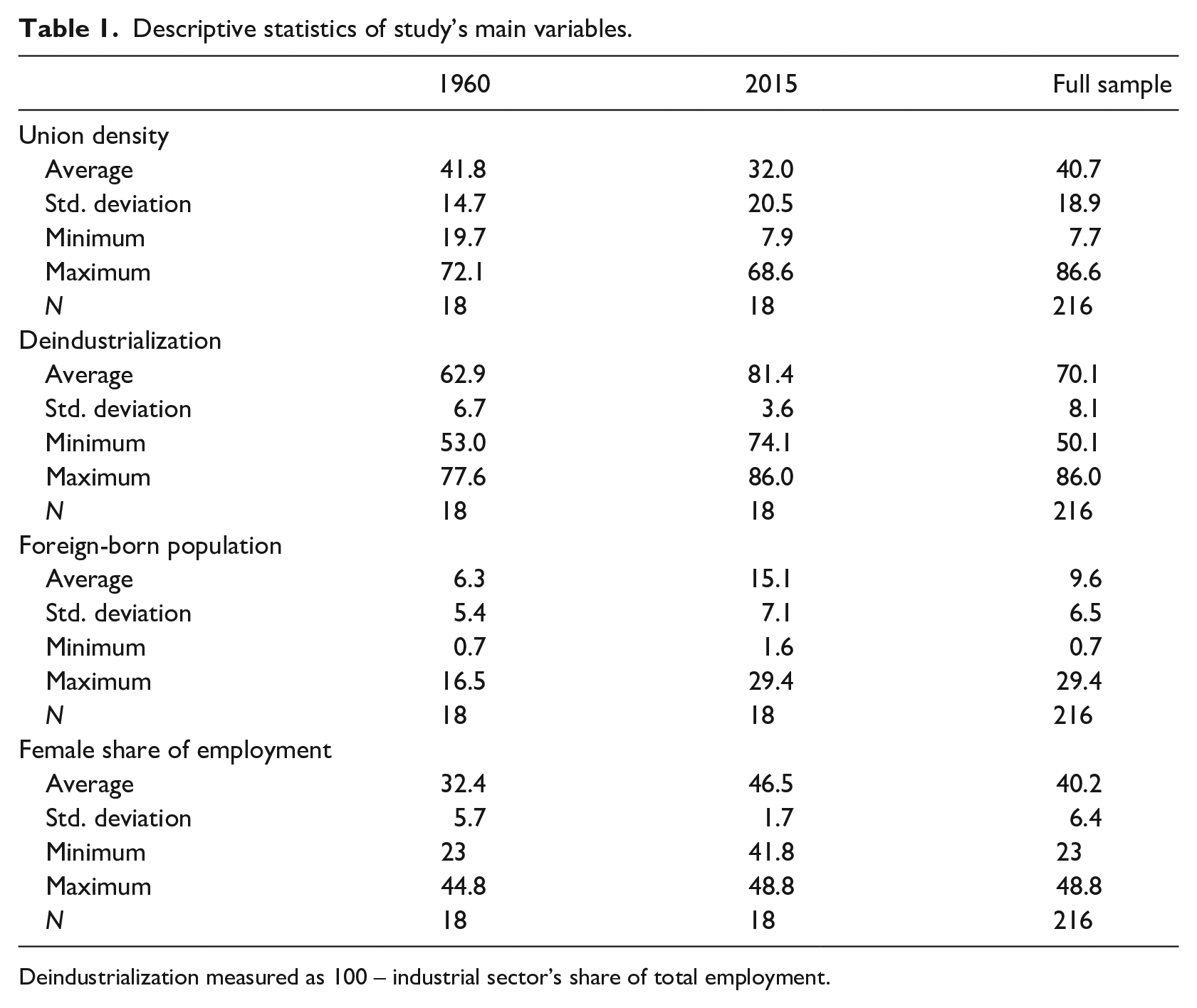
Deindustrialization measured as 100 – industrial sector’s share of total employment.
Deindustrialization and service sector expansion can contribute to trade union decline in two important ways. First, based on US data, Farber and Western (2001) show that differential employment growth between non-unionized and unionized sectors of the economy significantly contribute to trade union decline. The key issue is that, if employment expands more rapidly in non-unionized sectors of the economy (such as services), then considerable amounts of new organizing are required just to maintain current density levels. For the United States, they calculate that the rate of new organizing required to keep union density stable is far greater than the US labor movement could ever hope to achieve. As deindustrialization is occurring in all the countries examined in this study (see Kollmeyer, 2009: Fig. A1), differential employment growth between industry (typically high unionization) and services (typically low unionization) should contribute to trade union decline outside of the United States as well.
Second, deindustrialization forces trade unions to organize new workplaces, but the post-industrial economy makes this particularly challenging (Dølvik and Waddington, 2004; Lash and Urry, 1987; Lipset and Katchanovski, 2001). Unlike the industrial sector, worksites in the service sector are typically small and geographically dispersed, and workforces are often fragmented by high turnover rates and non-standard employment practices. In addition, some service-sector workers view trade unionism as a blue-collar concern and thus have little direct experience with it. Combined, these circumstances make labor organizing challenging. Indeed, empirical studies generally find a negative relationship between service sector employment and union density (see Blaschke, 2000; Lee, 2005; Polachek, 2004; cf. Brady, 2007).
Demographic changes in labor markets
The growing demographic diversity of labor markets also coincides with trade union decline (see Table 1). Notably, the employment shares of female and foreign-born workers have steadily risen for decades in nearly all advanced capitalist countries. For my sample, the female share of total employment rose from 32 to 46 percent between 1960 and 2015 (OECD, 2017a), and the foreign-born population (a proxy for foreign-born workers) rose from 6 to 15 percent of the total population over the same period (World Bank, 2017). Since most trade union members in the postwar era were native-born men, these demographic trends mean that trade unions now operate in a very different social context.
These demographic shifts may impede unionization in several ways. One problem is solidaristic in nature. Potentially, an influx of foreign-born workers can undermine the social cohesion and comradery upon which trade unionism is built. This can happen by heightening perceived competition for jobs (Bonacich, 1972) and by introducing cultural divisions among groups trying to engage in class-based collective action (Hechter, 2004: 431; Wets, 2018). Historically, some employers in the United States intentionally pitted workers of different ethnicities and races against one another, attempting to weaken organized labor (Brown, 2000; Lipset and Marks, 2001: Chapter 4). Such management tactics may remain today, but this historical example clearly demonstrates the potential for ethnic divisions in the workplace to weaken class solidarity. Importantly, if this occurs, trade union participation should decline for foreign- and native-born workers alike because diminished social cohesion makes collective action less appealing for all workers. Quite possibly, gender divisions in the workplace foster similar problems, but this is not documented.
Solidaristic accounts of trade union decline have some notable limitations. One limitation is that they assume that labor market participants from different status groups compete for the same jobs and share the same work settings. However, some labor markets are highly segmented, with men and women or native-born and migrant workers rarely competing for the same jobs (see Sakamoto and Chen, 1991). On this topic, Hudson (2007) finds that US labor markets are increasingly stratified by citizenship, with migrant workers disproportionately confined to low-wage work in secondary labor markets. Most likely, European labor markets are less segmented, but they nonetheless exhibit a strong “insider-outsider” logic (Rueda, 2007). Importantly, when labor markets are demographically segmented, solidaristic accounts of trade union decline become less applicable.
By contrast, positional accounts of unionization highlight how segmented labor markets present their own problems for trade unions. First, female and migrant workers are often overrepresented in marginalized and non-unionized areas of the economy, giving them fewer chances to join trade unions (Gorodzeisky and Richards, 2013; Rosenfeld and Kleykamp, 2009; Theodoropoulos, 2018; Wrench et al., 2016). In addition, since turnover rates are often high in marginalized jobs, trade unions can underappreciate the benefits of incorporating these workers into their ranks, leading to half-hearted organizing drives (Crouch, 1982: 70–72). Indeed, it is well documented that trade unions have struggled to organize marginalized workers, especially those from diverse backgrounds (Bronfenbrenner, 2005; Gumbrell-McCormick and Hyman, 2013: Chapter 3; Milkman and Voss, 2004). These failures are often attributed to trade unions themselves and their inadequate response to changing social circumstances.
Post-industrial capitalism and union revitalization
Conversely, some scholars view demographically diverse labor markets as an opportunity to revitalize trade unions (Milkman and Voss, 2004; Milkman, 2006; Ness, 2005). Here, the main argument is that female and foreign-born workers represent new opportunities for labor organizing, especially in the United States where decades of low union density mean that most native-born men have little experience with the labor movement. Indeed, organizing campaigns targeting migrants and women have proven successful, albeit mainly in highly segregated workplaces with few native-born men (Holgate, 2005; Milkman, 2006). Hence, in these particular cases, trade unions are overcoming positional rather than solidaristic barriers to union organizing, but they do suggest that the effects of post-industrialism are not wholly negative for trade unions. Overall, however, it is unlikely that these new organizing opportunities could fully compensate for the structural barriers highlighted in this study.
Consequently, our understanding of how post-industrialism and attendant labor market changes affect union density at the national level are incomplete. Evidence from cross-national studies yield mixed results. Studies examining the relationship between foreign-born workers and union density generate varied results, ranging from lowering union density (Lee, 2005), to increasing union density (Brady, 2007), to having little effects on union density (Vachon et al., 2016). 1 Furthermore, to my knowledge, only Lee (2005) assesses the possibility that female labor market participation influences union density, and he finds no effect. Ebbinghaus and Visser (1999) posit a negative effect, but do not test for this in their models.
Moderation hypothesis
This study considers the possibility that sectoral and demographic changes describe above interact with one another, creating more complex social forces than additive causation would otherwise suggest. The literature on trade union revitalization (e.g. Frege and Kelly, 2003; Gumbrell-McCormick and Hyman, 2013; Milkman, 2006) hints at the possibility that post-industrial capitalism opens up new possibilities for trade unionism. This seems likely, at least in some ways. For example, overtly masculine workplace cultures were endemic to industrial work settings and quite likely re-enforced gender imbalances in trade union participation. In this regard, one may surmise that a post-industrial economy provides promising opportunities for mixed-gender trade unionism, because highly gendered work cultures are less prevalent and traditionally masculine jobs in industry are waning. In this way, the rise of post-industrialism may alleviate some of the challenges trade unions face when trying to incorporate women into their ranks.
However, some moderation effects are likely negative. For instance, the post-industrial economy may heighten cultural barriers that hinder the incorporation of migrant workers into trade unions operating in the expanding service sector. Here it is likely that service sector employment, especially where social interaction with customers is necessary, may require cultural sensibilities and soft skills that disadvantage foreign-born workers in ways that the industrial economy never did.
In methodological terms, these types of causation imply the presence of an interaction effect whereby an otherwise straightforward bivariate relationship (i.e. deindustrialization’s effect on union density) is altered by the presence of a third variable (i.e. demographic diversity in labor markets). In standard regression models, the parameter estimates of variables are unaffected by other variables in the model. For instance, one may anticipate that a surge in foreign-born workers would complicate unionization efforts. Under the additive logic of standard regression models, this effect is the same across different socioeconomic contexts—for example, in both industrial and post-industrial economies and in both male-dominated and gender-balanced labor markets. Yet these assumptions may not hold in actual workplaces where union organizing occurs.
By contrast, moderated causation allows for more complex relationships between demographic and sectoral changes in labor markets and the ways they affect union density. Here the effect of one factor can be contingent upon the presence and magnitude other factors under consideration. For instance, if moderated causation prevails, we might find that deindustrialization drives down union density, but mainly when rising numbers of foreign-born workers enter the labor market. Importantly, interaction effects can either “mute” or “amplify” the original effect (see Pedulla, 2018). My hypothesis is that labor market changes are creating countervailing pressures on union density, with some muting and others amplifying, but that the overall effect is still negative, albeit smaller in magnitude than additive model would predict.
Data and methods
Sample and main variables
To test my arguments about trade union decline, I collect data on 18 advanced capitalist countries from 1960 to 2015. The 18 countries are Australia, Austria, Belgium, Canada, Denmark, Finland, France, Germany, Ireland, Italy, Japan, the Netherlands, New Zealand, Norway, Sweden, Switzerland, the United Kingdom, and the United States. For reasons discussed below, the countries are observed every 5 years, starting in 1960 and ending in 2015. This yields 216 observations per variable (t = 12 × n = 18). 2 Admittedly, this is a relatively small sample, but major studies in macro-comparative sociology are based on fewer observations (e.g. Beckfield, 2006 with n = 48). Clearly, a small sample reduces the precision of the parameter estimates, but it also inflates the standard errors, making statistically significant results harder to obtain. Table 2 lists and summarizes the study’s variables.
Variables used in the analysis: measurement, sources, and descriptive statistics.
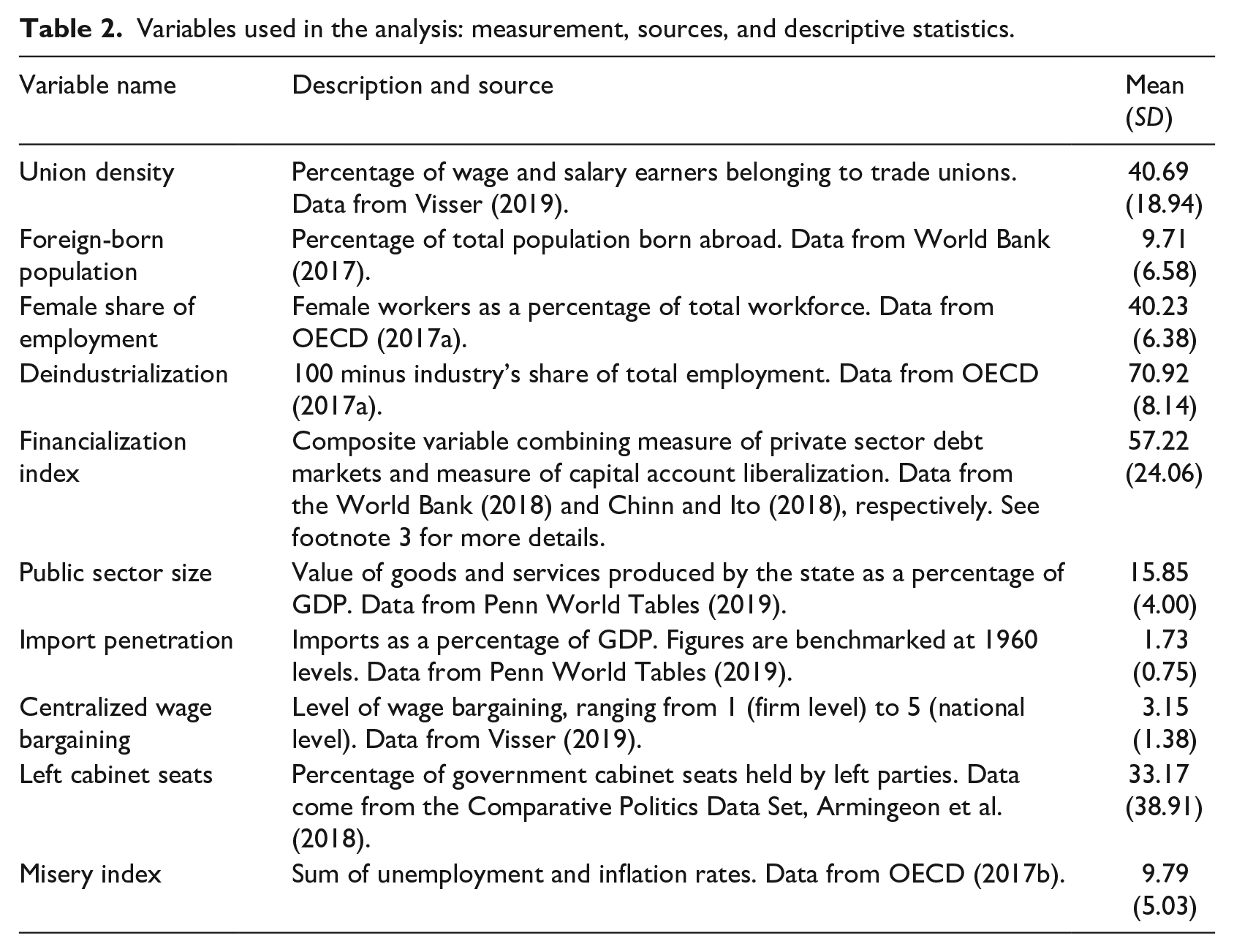
The dependent variable is the percentage of wage and salary earners belonging to trade unions. I consider limiting the analysis to private-sector trade unionism, but the necessary panel data are limited for my sample. 3 Hence, my measure of union density includes both private- and public-sector workers, but excludes union members who are self-employed, retired, unemployed, or otherwise outside the workforce. Data come from Visser (2019). In using this measure of union density, I follow numerous studies of trade unionism (e.g. Checchi and Visser, 2005; Kollmeyer and Peters, 2019; Lee, 2005; Vachon et al., 2016).
The study centers on three independent variables, each capturing some aspect of the demographic and sectoral changes indicative of the rising of post-industrial capitalism. The first variable, foreign-born population, captures the percentage of the national population born abroad and functions as a proxy for migrants in the national workforce. Data come from the World Bank (2017). Admittedly, this variable has limitations. First, I prefer a direct measure of migrants in the national workforce, but panel data are unavailable. Hence, in using this proxy, I assume that more migrants in the general population means more migrants in labor markets. Second, this measure is taken only once every 5 years, starting in 1960 and ending in 2015. To deal with this complication, I limit the temporal dimension of my sample to years covered by the World Bank data (i.e. 1960, 1965, 1970 . . . 2015). Although this results in significant data loss, I prefer this strategy to estimating annual immigration flows based on births, deaths, and total population (see Lee, 2005), since this latter process likely introduces measurement error into a key variable. Finally, my use of foreign-born as a salient status group (instead of race or ethnicity) partially reflects the lack of panel data on ethnic and racial groups within national societies, but it also reflects evidence suggesting that foreign-born workers join unions at lower rates than their native-born children (Rosenfeld and Kleykamp, 2009; see also Hudson, 2007).
Fortunately, the two other independent variables are easier to measure. The variable deindustrialization captures the structural shift away from manufacturing and heavy industry as significant sectors of employment and job growth. It equals 100 minus industry’s share of total employment, with industry including manufacturing, mining, construction, oil and gas extraction, and similar activities. Larger numbers reflect greater levels of deindustrialization. The other variable, female share of employment, captures the growing prevalence of women in the paid workforce. It equals female workers as a percentage of the total workforce. Data for both variables come from OECD (2017a).
Control variables
My baseline model includes six well-known covariates of union density. The first set of control variables account for structural features of the economy that may affect union density (Blaschke, 2000; Scruggs and Lange, 2002; Vachon et al., 2016). Public sector size is included because the public sector is often highly unionized but its size varies considerably across my sample. Given the lack of panel data on public sector employment for the first decade of my sample, I use the public sector’s contribution to national economic output as a proxy. This proxy equals the value of all goods and services produced by government, but excludes direct cash transfers for social welfare payments and debt repayments. Next, I control for import penetration—imports as a percentage of gross domestic product (GDP)—because imports may replace domestic unionized jobs. Since small countries naturally have more open economies, I benchmark this measure against imports levels prevailing in 1960. Data for both variables come from the Penn World Table (Feenstra et al., 2019). 4 In addition, financialization may lower union density (Kollmeyer and Peters, 2019). Recent research measures financialization with composite variables, but the required data only begin in the mid-1970 to 1980s. To resolve this issue, I develop a new financialization index with data going back to 1960. 5 This index combines a measure of lending to the private sector with a measure of regulatory constraints placed on cross-border capital flows. To create the index, these two measures are normalized on a 100-point scale, summed, and divided by two. Higher figures represent greater levels of financialization.
A second set of control variables accounts for institutional factors that help trade unions attract and sustain members (Checchi and Visser, 2005; Ebbinghaus and Visser, 1999 Western 1994, 1997). First, left-labor political parties often support trade unions through their strategic use of state power. To gauge the influence of such parties, left cabinet seats capture the percentage of government cabinet seats held by left parties, with the Liberals in Canada and the Democrats in the United States being coded as centrist not left. Data come from the Comparative Politics Data Set (Armingeon et al., 2018). Next, centralized wage bargaining benefits trade unions by allowing them to concentrate their organizational capacities and by reducing employers’ opposition to trade unionism. The latter occurs because all employers, whether their workplace is unionized or not, pay the centrally negotiated wage. Scores for this variable range from 1 (firm-level bargaining) to 5 (national-level bargaining). Data come from Visser (2019). Finally, in the Ghent system, trade unions administer state-subsided unemployment benefits on behalf of their members. This creates strong incentives for workers to join unions. However, as discussed below, my modeling strategy cannot incorporate time-invariant variables, so these effects are absorbed by the fixed effects (FE) regression models.
In addition, my baseline model uses the misery index to control for prevailing macroeconomic conditions. This index equals the sum of inflation and unemployment rates (OECD, 2017b). Here, I expect that rising insecurity brought about by macroeconomic problems heightens incentives for workers to join unions.
Estimation strategy
My estimation strategy accounts for several methodological complications associated with panel data. Standard regression techniques assume that observations comprising the sample are independent, but observations in panel data are structurally linked. This data structure allows me to enlarge my sample, and to model union density over time and under different market and institutional contexts. Yet, if unmeasured country-specific effects are present and correlated with independent variables (a likely possibility), then standard regression techniques will yield biased and inconsistent parameter estimates (Halaby, 2004; Wooldridge, 2012: Chapter 14).
This complication can be handled in various ways, but I use FE models for two reasons: (1) FE models use within-country variation in the panel data to purge the unmeasured country-specific effects that would otherwise yield biased and inconsistent parameter estimates. Importantly, the FE model’s emphasis on within-country change is consistent with my study’s emphasis on trade union decline over time. Hence, by using FE models, my parameter estimates are interpreted as average longitudinal effects arising from my 18-country sample and (2) random effects (RE) models are preferred when using time-invariant regressors, such as my Ghent variable. This is the case because FE models generate perfect collinearity between the FE and the time-invariant regressors. However, since I use the Ghent system merely as a control variable, this advantage of RE models becomes inconsequential, because my FE models will purge all unmeasured country-specific effects, including those associated with the Ghent system. Hence, my FE models indirectly account for the Ghent system, even though specific parameters are not estimated.
In addition, I account for two other complications associated with panel data: (1) time trends within panel data can yield spurious results if variables trend together over time but are not causally linked (Wooldridge, 2012: Chapters 10, 11, and 18). To safeguard against this possibility, I include a time-trend variable (i.e. t = 1, 2, 3. . . n) as a regressor (Wooldridge 2012: 363–368). In addition, I log this time trend, allowing it to capture the rise and fall of union density over the timeframe of my study; and (2) standard regression techniques assume that the model’s errors are independent and identically distributed (i.i.d.), but models based on panel data often violate this assumption (Beck and Katz, 1995; Wooldridge, 2012: Chapter 12). Consequently, I use country-specific robust standard errors, which control for heteroscedasticity and serial correlation.
Modeling interaction effects
Finally, given my use of interaction effect, I review some issues related to their use in regression models. First, standard regression analysis assumes a straightforward additive logic, in which the value of the dependent variable equals the arithmetic sum of the net effects arising from each independent variable. In addition, it is assumed that these net effects are not influenced by the values of other variables in the model. For example, the effect of female labor market participation on union density remains constant across various levels of deindustrialization (i.e. the same in both the industrial and post-industrial work setting). By contrast, models with interaction terms allows for moderated causation, whereby the effect of one variable depends on the values of other variables in the interaction term (Jaccard and Turrisi, 2003). Importantly, prior research assessing the effect of labor market changes on unionization, such as those addressed in this study, implicitly assumes an additive logic (see especially Brady, 2007; Lee, 2005; Vachon et al., 2016). However, some theory suggests these effects may vary across industrial and post-industrial economy. Consequently, this study not only tests for additive effects but also the possibility of complex interactions among my three primary independent variables.
Second, some researchers may worry about multicollinearity, because multiplicative interaction terms are highly correlated with their constitutive variables (i.e. X1 X2 will be highly correlated with X1 and X2). However, multicollinearity causes estimation problems mainly when the independent variables are highly correlated, not when the constitutive variables are highly correlated with their interaction terms (Jaccard and Turrisi, 2003: 27–28; Brambor et al., 2006). Hence, I check for excessive multicollinearity among my independent variables but find none (see Note 6).
Results
Preliminary models
Using the data and methods described above, the analysis begins by presenting bivariate models of union density (see Table 3). Model 1 focuses on sectoral changes in labor markets associated with deindustrialization. The resulting parameter estimate is negative as well as statistically and substantively significant. Regarding the latter, each one percentage-point shift from industrial to service-sector employment pushes union density down by more than half a point (i.e. b = −0.684). Using the summary statistics from Table 1, the substantive effect of this parameter estimate is easily calculated. For my sample, deindustrialization rose, on average, by 18.5 percentage-points between 1960 and 2015. Hence, the observed level of deindustrialization over this period implies more than a 12-point drop in union density (e.g. −0.684 × 18.5 = −12.7).
Preliminary models of union density.
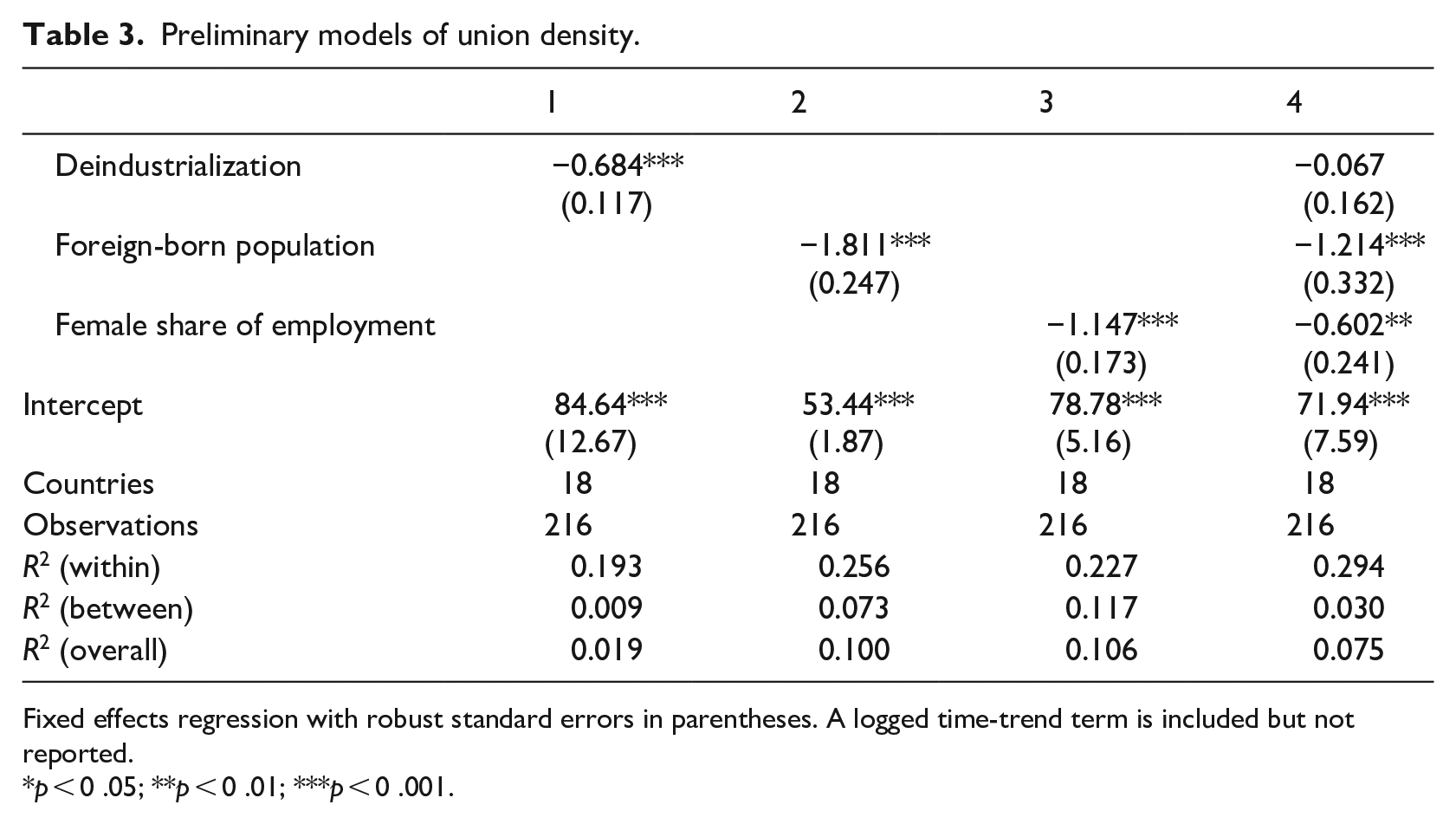
Fixed effects regression with robust standard errors in parentheses. A logged time-trend term is included but not reported.
*p < 0 .05; **p < 0 .01; ***p < 0 .001.
The other two models examine bivariate relationships between the demographic composition of labor markets and union density. As expected, both parameter estimates are statistically significant and negative. In particular, Model 2 estimates the effect of the foreign-born population and finds that a one percentage-point increase pushes union density down by 1.81 points (i.e. b = −1.811). Since the foreign-born population rose, on average, by 8.8 percentage points between 1960 and 2015 (see Table 1), this amounts to nearly a 16-point drop in union density (e.g. −1.81 × 8.8 = −15.9). Similarly, Model 3 estimates that a 1 percentage-point rise in the female share of employment pushes union density downward by 1.15 points (i.e. b = −1.147). Given the 14.1 points increase in the female share of employment between 1960 and 2015 (see Table 1), this also implies about a 16-point drop in union density (e.g. −1.15 × 14.1 = −16.2). In sum, the bivariate models find statistically significant and substantively large relationships between demographic and sectoral changes in labor markets and union density. However, given that these are bivariate models, there may be considerable overlap among these effects, which if accounted for, will reduce the size and significance of the parameter estimates.
With this in mind, Model 4 estimates the three labor market variables simultaneously. This specification estimates the unique contribution to trade union decline attributed to each independent variable, under conditions when the other independent variables in the model are held constant. Thus, if the variables have overlapping effects on union density, the resulting parameter estimates will be reduced accordingly. Indeed, this appears to be the case. In particular, foreign-born population and female employment retain their strong, negative effects on union density, although as expected the size of the effects are now smaller. Surprisingly, however, deindustrialization now exhibits low statistical and substantive significance. Overall, this model explains nearly a third of the observed within-country decline in union density within my sample.
Again, the combined substantive effects can be calculated using the summary statistics in Table 1. Assuming deindustrialization has no effect (given its statistical insignificance), the parameter estimates for foreign-born population and female employment imply a combined 19-point drop in union density over the period of the study (i.e. (0.0 × 18.5) + (−1.214 × 8.8) + (−0.602 × 14.1) = −19.2). This combined effect remains substantively large, but as expected, it is now smaller than the summation of the individual bivariate models would suggest.
Baseline model, main effects, and interaction effects
The analysis now introduces a baseline model that captures six known covariates of union density (see Table 4). The results indicates that a broad range of market and institutional forces are important determinants of union density (see Model 5). Importantly, all parameter estimates exhibit the expected signs and nearly all achieve statistical significance. Overall, this model confirms that public sector size, poor macroeconomic conditions, and centralized wage bargaining are positively associated with union density, and that financialization and foreign imports are negatively associated with union density. Conversely, left political power has a negligible effect on union density, net of the other variables in the model.
Models of trade union density.
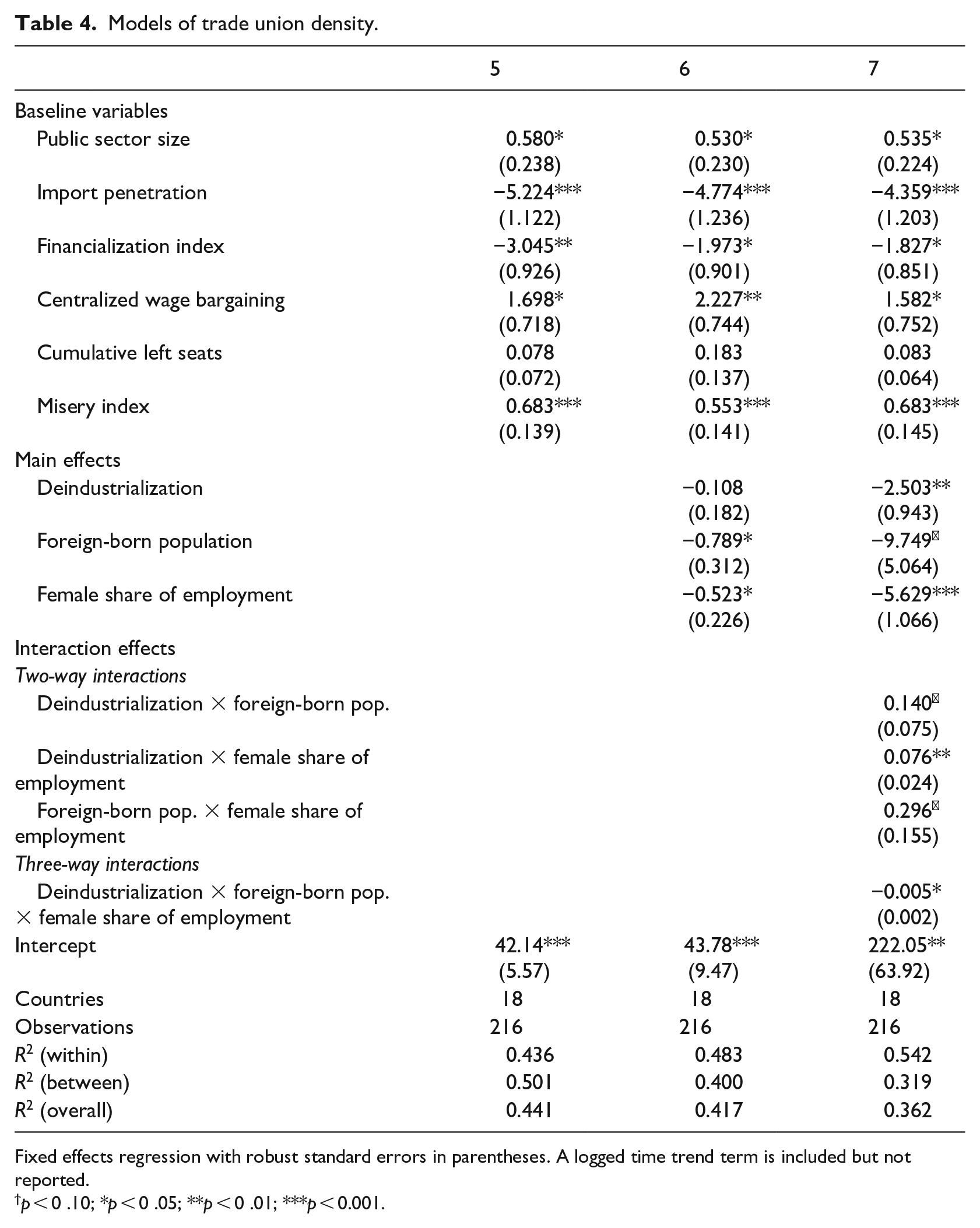
Fixed effects regression with robust standard errors in parentheses. A logged time trend term is included but not reported.
p < 0 .10; *p < 0 .05; **p < 0 .01; ***p < 0.001.
Next, Model 6 adds the labor market variables to the baseline model. Like the previous models, it assumes an additive causal logic, in which each labor market variable exerts its own effect on union density, which goes above and beyond the other factors in the model. Despite the introduction of the control variables, which account for potential confounding effects, the parameter estimates of the labor market variables change only modestly from the earlier model (cf. Models 4 and 6). In particular, the effect of female employment declines slightly, the effect of foreign-born population falls by nearly half but remains large, and both variables retain their statistical significance albeit at a lower confidence level. Furthermore, deindustrialization continues to show little effect on union density. In substantive terms, the combined parameter estimates for the labor market variables imply a 14-point drop in union density over the period of the study (i.e. (0.0 × 18.5) + (−0.789 × 8.8) + (−0.523 × 14.1) = −14.3). This is still a substantively large effect.
To this point, the regression results suggest that demographic changes in labor markets examined are substantively significant determinants of trade union decline, but that the sectoral changes associated with deindustrialization have little effect. The analysis now considers a more complex possibility, one in which the labor market variables interact with one another, shaping union density through moderated causation. To investigate this possibility, Model 7 builds on the prior model by adding a three-way interaction term and all possible two-way interaction terms. Recall that lower-order terms from the interaction effects are no longer interpreted as unconditional effects, but instead as conditional effects arising when the other lower-order term is zero (Jaccard and Turrisi, 2003). Hence, the size and statistical significance of the lower order terms can be misleading.
As expected, this model finds evidence of interaction effects among the three labor market variables. Foremost, the three-way interaction term and most of the two-way interaction terms are statistically significant, all of which suggest the presence of moderated causation. In addition, unlike the additive model, deindustrialization now becomes statistically significant—not only under the three-way interaction but also under some of the two-way interactions and the lower-order term as well. Interestingly, some of these two-way interactions with deindustrialization are positively signed, indicating that post-industrial economies create some opportunities for union organizing even though the overall trend is downward. In particular, the two-way interaction between female employment and deindustrialization is positively signed, suggesting that, holding levels of immigration constant, increases in female employment in the context of rising service sector employment leads to higher union density. This finding is consistent with prior case studies, arguing that successful labor organizing within post-industrial settings is possible in some circumstances (e.g. Milkman, 2006).
In addition, the moderated model differs from the additive model in two important ways. On one hand, the moderated model explains more of the observed variation in union density, as evidenced by its r2 being 6 percentage points larger than the additive model’s. On the other hand, the moderated model implies a smaller substantive effect on union density, although this is not readily apparent due to the numerous interaction terms. Hence, using the technique described below, I calculate the substantive effecting, finding that changes in the labor market variables between 1960 and 2015 yield a 9-point drop in union density. This is clearly smaller than the 14-point drop predicted by the additive model, again suggesting that some of the moderated effects are boosting rather than diminishing union density.
Counterfactual estimates
The analysis ends by considering several counterfactual scenarios, with the aim of clarifying the substantive effects of the demographic and sector labor market changes examined in this study. Using Stata’s margins command, the counterfactual estimates use the regression coefficients from Models 6 and 7, along with the sample’s data, to predict annual union density under two scenarios. The first scenario keeps deindustrialization, foreign-born population, and female share of employment at their 1960 levels across the whole sample period (representing industrial capitalism), while the second scenario keeps these variables at their 2015 levels (representing post-industrial capitalism). For both scenarios, the model’s control variables take their actual values. Note that the two scenarios are examined twice, first using the parameter estimates from the additive model (Model 6) and then from the moderated model (Model 7). By comparing these scenarios, we can gauge the substantive effect on union density arising from changes in the composition in labor markets between 1960 and 2015 and decern differences between the additive and moderated models of trade union decline.
Figure 1 displays trend lines for both scenarios along with trends in actual union density as a benchmark. Starting with the additive model, the two scenarios yield clear differences in predicted union density. Under the first scenario, the labor market variables remain at levels from 1960. This results in predicted union density starting the sample period at 42.3, rising to a high of 54.9 in 1975, and then declining to 46.4 by 2015. Conversely, under the second scenario, the labor market variables remain at levels from 2015. Here predicted union density starts much lower, at 29.5, rises to a high of only 42.1 in 1975, and then declines to 33.5 by 2015. Overall, there is a 12.8-point difference between the two trend lines. Note that actual union density equals predicted union density for the years 1960 and 2015, because the values from 1960 and 2015 are part of the counterfactual scenarios and the actual observations for those years, respectively.
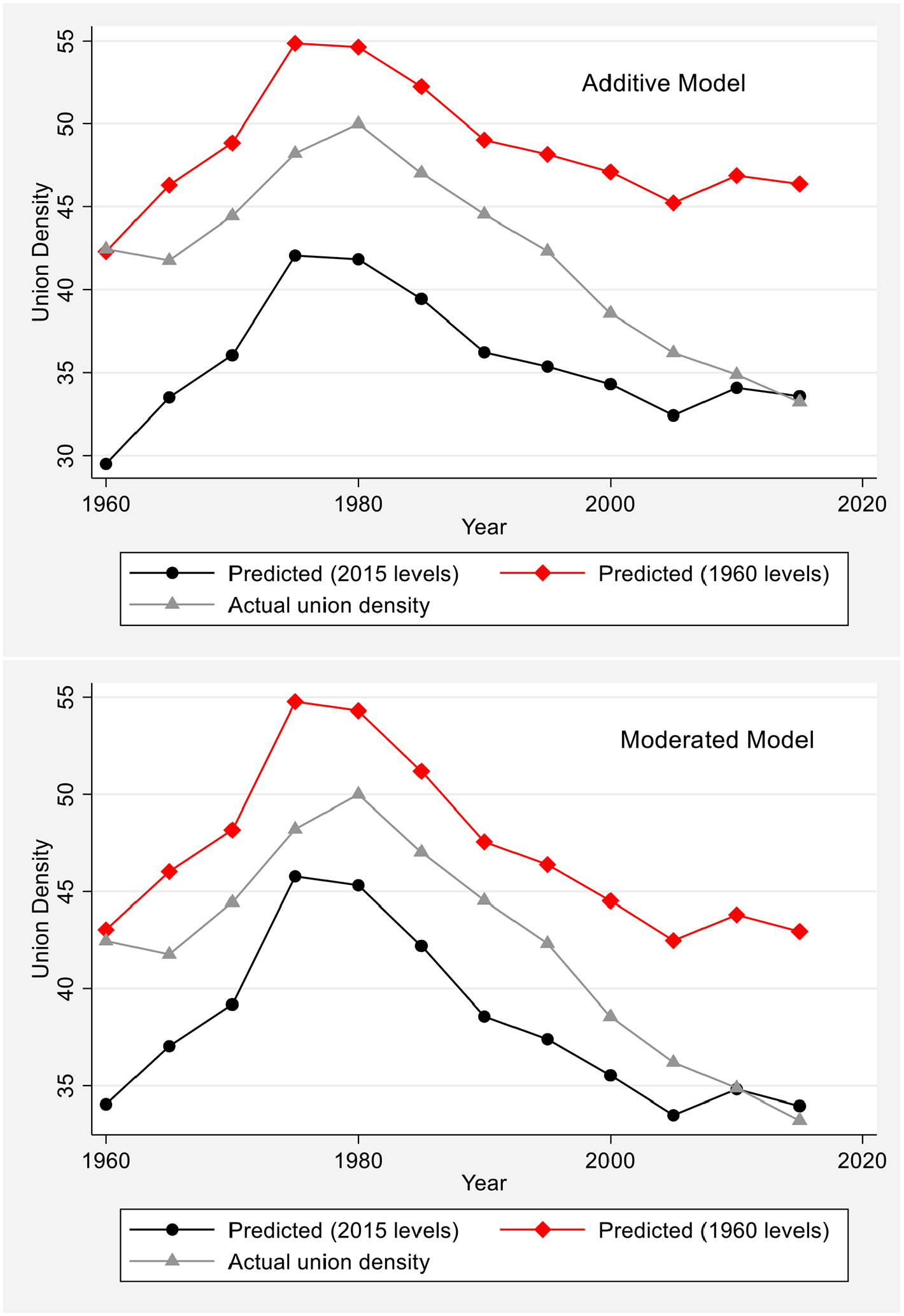
Actual and counterfactual union density under additive and moderated models.
Finally, turning to the moderated model, the two scenarios yield meaningful but somewhat smaller differences in predicted union density. Now, under the first scenario, predicted union density begins at 43.0, rises to a high of 54.8 in 1975, and then declines back to 43.0 by 2015. Conversely, under the second scenario, predicted union density starts much lower, at 34.0, rises to a high of 45.8 in 1975, and then declines to 34.0 by 2015. The difference between the two scenarios is 9.0 points. Clearly, both the additive and moderated models suggest that the labor market variables examined in the study are substantively meaningful determinants of trade union decline, but the moderated model captures the presence of countervailing forces, which lower the overall substantive effect by about 4 points (i.e. from 12.8- to 9.0-point decline in union density).
Conclusion and discussion
This study revisits the question of why union density has fallen in most affluent democracy over recent decades. My account of this phenomenon emphasizes broad demographic and sectoral shifts in the composition of labor markets and how these changes combine in ways that ultimately hinder trade unionism. During the postwar era, structural conditions were conducive to trade unionism because the industrial economy gathered workers into large and regimented worksites where they were easily organized, and because traditional gender norms and restrictive immigration laws meant that native-born men predominated in most workplaces. Operating in this social context, trade unions expanded their membership rolls over the mid-20th century, becoming a key institution in the political economy of advanced capitalism. However, over recent decades, the emergence of post-industrial economies, coupled with growing demographic diversity in workplaces, reconfigured these social conditions. Now, trade unions often operate in social contexts where workforces are spatially dispersed and socially heterogeneous and where expanding sectors of the economy have little track-record of unionization. From a positional and solidaristic view of unionization, these conditions should hinder unionizing efforts and consequently high union density will be difficult to sustain.
Importantly, I empirically examine these demographic and sectoral trends, testing the degree to which they influence trade union participation and whether the resulting effects manifest through additive or moderated forms of causation. Regarding the latter, this study presents evidence that the increased prevalence of service-sector employment and the growing employment shares of female and foreign-born workers have countervailing effects on union density. Some of these emergent social forces appear to benefit labor organizing (as suggested by the literature on labor movement revitalization), but broader trends have pushed union density downwards. This complexity is evidenced by the moderated model, which finds that some interactions positively affect union density, resulting in less downward pressure on trade unionism than the additive model predicts.
My findings have several theoretical implications. First, they suggest that unionization has become more difficult for both positional and solidaristic reasons (Rosenfeld and Kleykamp, 2009). Regarding the latter, growing demographic diversity may dampen class solidarity by expanding status-group divisions among workers, which makes class-based collective action more difficult. Regarding the former, post-industrialism disaggregates workers into smaller and more flexible work settings where organizing efforts become more difficult, and it channels employment growth into areas of the economy lacking experience with trade unionism (see also Farber and Western, 2001). However, I emphasize that neither positional nor solidaristic factors have primacy, but both play roles in trade union decline.
Second, in an odd way, my findings are consistent with theoretical expectations derived from classical sociological thinking on workers and their response to capitalism. In particular, a close reading of Marx suggests that the incipient labor movement of the 19th century was spurred not just by workers’ sense of exploitation, but also by the specific socioeconomic conditions associated with industrialism. Regarding the latter, Marx saw industrial capitalism as expanding the size of the working class and crucially aggregating them into large worksites where they could be easily organized. Hence, the dominant organizational forms of industrial capitalism—for example, factories, shipyards, mills, and mines—were crucial to Marx’s account of class formation and working-class movements. Quite possibly, in a post-industrial economy such as ours, Marx would be less sanguine about the potential for working-class movements.
Third, my analysis contributes to broader debates about collective action. Here classic debates hinge on whether rational and self-interested individuals would join trade unions, with some arguing that such forms of collective action are irrational due to the free ride problem (Olson, 1965) but others arguing that they are a rational response to exploitation (Crouch, 1982). By contrast, my argument focuses not on individuals and their rationality, but on prevailing structural conditions in the political economy and whether they facilitate or constrain class formation and collective action. In particular, I suggest that collective action becomes harder to achieve when the workforce becomes socially differentiated and disaggregated into smaller and more varied worksites, and when job growth occurs in previously non-unionized sectors of the economy. In this way, the social structure of the workplace acts as an “opportunity structure,” either opening up or closing down the possibilities for collective action (Tilly, 1978). Surely, there are ways to overcome the present obstacles to labor organizing, and this may be a fruitful direction for future research, but my account of trade union decline offers fresh insights into the interplay between social structure and collective action.
In addition, my findings help reconcile prior research on trade union decline and its link to deindustrialization, female labor market participation, and migrant labor. My results are largely consistent with Lee (2005). We both find evidence that rising shares of female and foreign-born workers push union density downwards. Lee also finds strong effects from deindustrialization, while my findings are more circumspect in this regard, finding that under certain model specifications deindustrialization has limited effects on union density. Potentially, our different results may reflect his considerably larger sample size, which makes it more likely to find statistically significant effects.
By contrast, my results provide very limited support for qualitative work examining trade union revitalization under post-industrial capitalism (Frege and Kelly, 2003; Gumbrell-McCormick and Hyman, 2013; Milkman, 2006). On one hand, my results suggest that deindustrialization does play a role in trade union decline, but not entirely a negative one. Under some circumstances, post-industrial workplaces offer new opportunities, in particular for organizing women. In this way, there is some hope of revitalization. However, on the other hand, my results are broadly negative for the fortunes of trade unions. Quite clearly, the overall trends associated with labor market changes are pushing union density downward, and downward by substantial amounts. Specifically, I estimate that union density is about 10-points lower due to the factors considered in this study. Since average union density for my sample for just under 31 points for 2015, a 10-point difference is large indeed.
Furthermore, my analysis may underestimate the importance of politics and political forces in explaining trade union decline. Although my models include direct measures of several political and policy-related factors, these factors may inadequately capture the changing balance of class power that influence union density. Clearly, the typical policy stance of left parties has changed considerably with the rise of neoliberalism. My measure of left-party strength misses this political shift. Perhaps future research could account for this by creating a new measure of left-party strength, one that weights left cabinet seats by the ideological preferences expressed in party manifestos. This latter type of data is available (e.g. the Manifesto Project), making such a composite measure possible to construct.
Politics and social movements matter in another way as well. There is no immutable reason why rising shares of migrant and women in the workforce should push union density lower. Here, the effects depend on the reactions and strategic choices of national governments, political parties, civic groups, and trade unions themselves. For this reason, the revitalization literature focuses squarely on these more qualitative factors (Frege and Kelly, 2003), especially trying to identify organizing strategies that can overcome contemporary barriers to labor organizing. My study admittedly misses these factors as well. Instead, it focuses on structural changes and how they hinder or support high union density. However, despite the importance of strategic choices and the possibility of more effective class politics, an inordinate amount of strategic guile is necessary to overcome the structural shifts in the economy that have disadvantaged trade unions. Consequently, some scholars see political and strategic failures as secondary causes of trade union decline (see Farber and Western, 2001, 2002). My research supports this conclusion.
