



Abstract
In this article, we compare how racial inequalities are shaped by school-to-work transitions among bachelor’s degree (BA) holders in Brazil and the United States. Our findings reveal how distinct paths linking higher education and the job market can drive similar patterns of Black–White earnings gaps. While the distribution across fields of study matters more for racial earnings inequality in Brazil, differential returns to the same field and occupations are a stronger determinant in the United States. We also find that linked closure, that is, the exclusion of Black BA holders from occupations with high levels of linkage to the labor market, is the predominant mechanism in the United States, while a mix between linked closure and what we term unlinked closure, that is, the exclusion of Black BA holders from occupations that have weak linkages to fields of study, is more important in Brazil. By identifying variations in mechanisms leading to racial inequality, this article contributes to debates in comparative race relations and stratification.
Keywords
Introduction
Spurred by forces including democratization, a concern for human rights, and increased trust in science, higher education enrollment has increased significantly in the past half-century around the world (Schofer and Meyer, 2005). As part of this expansion, there is substantial evidence that a bachelor’s degree (BA) is an important gateway to the professional and managerial class, but it is increasingly not a sufficient one: many recent graduates struggle to find secure positions and good wages, while the role of the BA as a “great equalizer” is challenged by growing inequalities among BA holders (Fiel, 2020; Monaghan and Jang, 2017; Oh and Kim, 2020; Witteveen and Attewell, 2017). It is less clear, however, how distinct mechanisms operating at the national level contribute to these inequality-producing trends or whether differences in these mechanisms may lead to divergent patterns of inequality in one country compared with another.
In this article, we compare how different school-to-work transitions shape racial earnings inequalities among BA holders in the United States and Brazil across different fields of study. A comparative analysis of racial inequalities among BA holders is particularly important given the expansion of affirmative action policies around the world to include a wider array of underrepresented groups that take into consideration race, ethnicity, religion, and other forms of categorical differences in higher education (Warikoo and Allen, 2020). Brazil and the United States are among the countries that have implemented these and related policies to expand higher education access to their historically underrepresented Black populations. 1 Two countries built on Black slavery, Brazil and the United States, are often portrayed as the most racially unequal countries in the world (Andrews, 1992; Hamilton et al., 2001; Vargas, 2018). While a growing literature compares these countries to explore their different national understandings about race (e.g. Lamont et al., 2016; Marx, 1998), a smaller literature analyzing racial social stratification shows that racial inequality is high and persistent in both countries (Gradín, 2014; Lam and Levison, 1992; Telles, 2004). Scholars dedicated to studying race from a comparative perspective, however, have paid little attention to how the distinct national arrangements of school-to-work pathways in these countries play a role in reproducing racial inequalities. Bringing the insights of comparative research on school-to-work transitions to the study of racial inequalities, we provide an in-depth analysis of the pathways linking higher education to the labor market and how these pathways shape racial inequality among BA holders in Brazil and the United States.
In order to account for both the macro structures of these two countries and the more granular mechanisms that shape them, we mobilize the methodological tool of school-to-work “linkages,” which we explain in detail below. Strong linkages, or relatively strong connections between particular fields of study and small sets of occupations, have been shown to increase earnings (Bol et al., 2019; DiPrete et al., 2017), but we know much less about how these patterns vary across racial groups and countries. We examine this issue using nationally representative data drawn from the Brazilian Census and the American Community Survey and the Survey of Income and Program Participation (SIPP) in the United States.
We arrive at four important conclusions from our analysis. First, although Black and White BA holders are unevenly distributed across fields of study in both countries, field of study segregation is more consequential for the racial earnings gap in Brazil than in the United States. Second, graduating from strongly linked fields of study, that is, fields of study that funnel people into a small set of occupations, is beneficial for Black and White graduates in both countries. Third, the likelihood that Black and White graduates end up in occupations highly related to their field of study, which we call “linked occupations,” contributes to earnings inequality in both countries. However, this common pattern emerges through different arrangements. In the United States, we find that linked occupational closure, that is, the exclusion of Black graduates from linked occupations, drives earnings inequalities across fields of study. In contrast, in Brazil, we discover a more complicated story: racial inequality arises to a significant extent because those employed in a smaller set of unlinked occupations, more frequently closed to Black than to White graduates, receive higher returns. Finally, racially unequal returns to graduates in the same field of study and in the same linked occupation contribute more strongly to Black–White inequality among BA holders in the United States than in Brazil. Overall, our findings provide a detailed account of how school-to-work transition patterns in Brazil and the United States contribute to racial inequalities among BA holders. They also highlight how different mechanisms underlie seemingly similar country-level racial inequalities, suggesting the need for distinct policy solutions.
The remainder of the article is organized as follows: in the following sections, we provide the rationale for our comparison of racial inequalities among BA holders in Brazil and the United States, and describe key concepts that may explain persisting racial earnings inequalities among BA holders. Next, we present our data and methods. We then report our results, organizing our findings into four steps: (1) the impact of field of study segregation on racial earnings inequalities; (2) the description of field of study linkages by race; (3) the relationship between school-to-work transitions and mechanisms including occupational segregation, linked and unlinked closure, and unequal returns to the same fields of study and occupations; and (4) the description of intersections between these mechanisms, and the ways in which these intersections shape racial earnings inequalities in business, teaching, and medicine. In the concluding remarks, we briefly discuss the implications of our findings for current higher education policy debates in both countries.
Race, field of study, and school-to-work linkages in Brazil and the United States
The transnational resonance of the Black Lives Matter movement brought to the spotlight the global origins and widespread consequences of racism across different national contexts (Vargas, 2018). Nevertheless, if we take seriously the fact that race is a social construction, understanding how it is enacted locally is equally important. The growing research agenda on comparative race and racism tackles these questions by systematically comparing different meanings, experiences, and consequences of racialization (Moraes Silva, 2020; Suzuki, 2017).
Because of sharp differences in the ways race is experienced in Brazil and the United States, comparisons of race relations between these two countries are overrepresented in this literature. Most of these studies rely on macro-historical or ethnographic and interview-based studies to analyze the different understandings and ideologies of race and racism and generally confirm that race is constructed and reproduced in different ways in the two countries. Furthermore, they emphasize the differences in salience and meanings of racial boundaries as well as their consequences to antiracism strategies (e.g. Lamont et al., 2016; Marx, 1998). Nonetheless, systematic comparisons of the ways that racial inequalities take shape in Brazil and the United States are scarcer and generally converge in identifying similar and statistically significant inequalities across national contexts (Andrews, 1992; Gradín, 2014; Telles, 2004).
In this article, we build on these previous studies and their solid findings that race (or racialization as Black) acts as an independent source of disadvantage in Brazil and the United States. Yet, we are more interested in understanding whether and how different mechanisms create and reproduce similar racial inequalities in these two national contexts, particularly focusing on mechanisms driving the school-to-work transition processes. This topic has received much scarcer attention in the comparative race literature, despite its important contribution to revealing the relationship between institutional mechanisms and racial inequality.
Empirically, we focus on how the higher education systems and linkage structures between school and work in Brazil and the United States (re)produce racial inequalities. Racial inequality in BA completion is an important aspect of social stratification in both countries. In 2010, around 8 percent of Brazilian Black students received a BA compared with 21 percent of White students, producing an odds ratio of 0.32. In the United States, these figures are 23 percent and 38 percent, respectively, creating an odds ratio of 0.45 (authors’ calculations). 2 Furthermore, in both countries, studies have found that Black–White differences in university access and BA completion exist even after considering socioeconomic background (e.g. for Brazil: Marteleto et al., 2016; Ribeiro, 2011; Valente, 2017; for the United States: Bennett and Xie, 2003; Ciocca Eller and DiPrete, 2018; Merolla, 2018).
While there is an extensive literature, partly cited above, on the selection mechanisms that exclude Black students from educational opportunities en route to receiving a BA in Brazil and the United States (i.e. high school non-completion, college non-enrollment, and college non-completion), scholars in both countries focus less attention on the processes that explain racial inequalities in earnings among those who do receive a BA degree. This omission might be because, regardless of racial identification, holding a BA still generally produces higher earnings returns in Brazil (Ribeiro, 2011), while in the United States, many studies suggest the growing importance of BAs in defining multiple life outcomes (for a review, see Hout, 2012). According to our calculations, holding a BA rather than a high school degree is associated with earnings nearly 2.5 times higher in Brazil and 2 times higher in the United States in 2010, net of racial identification. Nevertheless, Black–White inequalities remain high even among those with a terminal BA: Black BA holders earn 17 percent less in the United States and 25 percent less in Brazil than White BA holders (authors’ calculations). 3
Key mechanisms explaining racial inequality in earnings among BA holders
In order to understand the mechanisms producing racial gaps among BA holders in Brazil and the United States, we focus on three consecutive stages that scholars have identified as key junctures that reproduce inequality in the school-to-work transition among BA holders (Elbers, 2021). First, we investigate how BA graduates are distributed (or segregated) across different fields of study. Second, we analyze how, after graduating in these different fields of study, BA holders are linked to occupations in the job market. Finally, we examine how different types of occupations, (i.e. linked and unlinked occupations) lead to different returns among BA graduates. We find that each step of the process builds on the previous one, leading to cumulative racial advantages and disadvantages. Yet our analytical approach specifically also allows us to pinpoint the strength and consequences of each step in shaping racial inequalities in each country.
Racial field of study segregation
Field of study is often presented as a key variable to explain differences in earnings among college graduates (Bol and Van de Werfhorst, 2011; Davies and Guppy, 1997; Gerber and Cheung, 2008). An extensive literature confirms that BA degrees have different levels of prestige and labor market value in Brazil and the United States based on field of study (Altonji et al., 2012; Kim et al., 2015; Reis and Machado, 2015; Ribeiro and Schlegel, 2015).
These initial field of study differences drive wage inequality, particularly between Black and White college graduates in the United States (Staniec, 2004; Thomas and Zhang, 2005; Weinberger and Joy, 2007). For example, Black students are overrepresented in social science fields (Charles and Bradley, 2009; Dickson, 2010) and have lower graduation rates in STEM fields (Gelbgiser and Alon, 2016). While there is less research pertaining to Brazil in this area, Reis (2017) demonstrates that Black students tend to populate less prestigious fields such as teaching and that field-distribution differences explain nearly one-third of the racial earnings gap. Contributing to these efforts, our comparison allows us to further explore the patterns of these uneven distributions—what we call racial field of study segregation—and to quantify their impact on the broader racial gaps we find among BA holders in the two countries.
Linkage strength
The extent to which field of study affects either average earnings or racial inequality in earnings also may depend on the structural relationship between particular fields and the labor market. As Monaghan and Jang (2017: 2) describe, “[M]ajors vary in the degree to which they offer a well-established path to a set of occupations, and in the remuneration of occupations to which they render access.” Although, in comparison with most European countries, American and Brazilian educational institutions are weakly linked to the labor market (De Souza Leão et al., 2021), there is still substantial variation in how fields of study channel graduates into occupations in both countries. For example, medicine funnels graduates into a small set of occupations, while business funnels graduates into a much larger set. Therefore, beyond prestige, fields vary in their ability to guarantee access to certain labor market positions. We explore differences in the strength of ties between fields and occupations, which we term local linkage, as well as variation in how these differences affect earnings across countries and racial groups.
Occupational segregation, occupational linked and unlinked closure, and racially unequal returns
Even after considering the distribution of Black and White graduates across fields of study in Brazil and the United States, the related earnings inequality connected to this distribution, and the structural relationship between particular fields and occupations, it is also possible that overall Black–White earnings inequality mainly results from forces originating from the labor market. It could be the case that, regardless of graduates’ field of study, certain occupations are more likely to include individuals from one racial group over another. In fact, occupational racial segregation is a key variable in explaining the persistence of racial earnings inequalities despite Afro-Americans’ and Black Brazilians’ educational gains (e.g. Arcand and D’Hombres, 2004; Baunach, 2002; Lowe and Wallace, 2017; Salardi, 2016).
Occupational racial segregation may be particularly harmful if it excludes Black graduates from occupations that strongly match to particular fields of study for White graduates. Previous research points out that some educational qualifications lead their credential holders to a small set of occupations while others do not and confirms that access to occupations matched to field of study has a positive impact on earnings (Bol et al., 2019). We call occupations that are tightly matched with each field of study a linked occupation. We use the term, linked occupational closure, to describe the process of Black exclusion from occupations that are tightly linked with each field of study. We use this term because, in a process similar to what Weberian scholarship has termed “closure,” it suggests that certain occupations may be more restricted to Black graduates because “social groups formed around positions in the technical division of labor create social and legal barriers that restrict access to resources and opportunities to a limited circle of eligibles” (Weeden, 2002: 57, citing Parkin, 1979). Although our data do not allow us to observe the closure processes that restrict access to these most-linked occupations (such as occupational-specific credentialism or the role of unions), we are able to measure how likely Black and White BA holders in the two countries are to access linked occupations.
It is also possible, however, that certain fields of study lead to higher earnings when graduates funnel into occupations outside of those most linked to that field. This pattern would characterize engineering graduates, for example, who instead of going to an engineering firm might wind up working (for higher returns) in finance or in the digital economy—a process that has been much less studied in the literature. We use the term unlinked occupational closure to refer to the situation where Black BA holders are funneled into occupations strongly linked to a field of study, but the highest returns are in unlinked occupations from which they are more frequently excluded.
We also take into consideration that Black students graduating from the same fields of study and entering similarly linked or unlinked occupations as White graduates may still receive lower labor market rewards. We refer to this source of inequality as racially unequal returns. While our data do not allow us to explain the exact causes of unequal returns, existing research has suggested several possible drivers, such as placement in markets with low-income clients and worse working conditions related to racialized markets (Skrentny, 2015) or discrimination in individual negotiation of salaries (Hernandez et al., 2019).
In short, we detail mechanisms at three consecutive junctures of the school-to-work transition that we argue may explain earnings inequality between Black and White BA graduates in Brazil and the United States: those driven by fields of study distribution, those derived from the structure of school-to-work transitions, and those driven by occupations. In the following sections, we compare the role of these mechanisms in shaping racial inequalities in each country.
Data and methods
To compare patterns of racial inequality between Black and White BA holders in Brazil and the United States, we use the 2010 Brazilian Census for Brazil and the 2009 American Community Survey (ACS) together with the 2004 and 2008 waves of the Survey of Income and Program Participation (SIPP) for the United States. For both Brazil and the United States, we follow the existing literature by limiting the analysis to those aged between 25 and 65 years who are currently employed, with no missing information on occupation, education, and fields of study variables (plus age, race, sex, wages, hours worked, and region) (Bol et al., 2019; DiPrete et al., 2017). In Brazil, we rely on the 10 percent Census sample that responded to a long version of the census questionnaire, which included questions about their BA or postgraduate field of study. This leaves us with a sample size of 677,697 individuals with a BA or above in Brazil. In the United States, we base our analyses on the ACS but supplement it with the SIPP because the ACS does not contain information on field of study for postgraduate degrees while the SIPP includes this information (see DiPrete et al., 2017 for a similar strategy). Because the SIPP sample size is much smaller than for the ACS, we develop weighting measures for the SIPP calibrated with the weights present in the ACS, enabling the two sets to represent the overall US population when used together. This approach results in a total sample of 333,559 individuals with a BA or above in the United States. 4 The distribution of our sample by racial identification and fields of study is presented in Table 1.
Sample Description: Field of study distribution by country and racial identification.
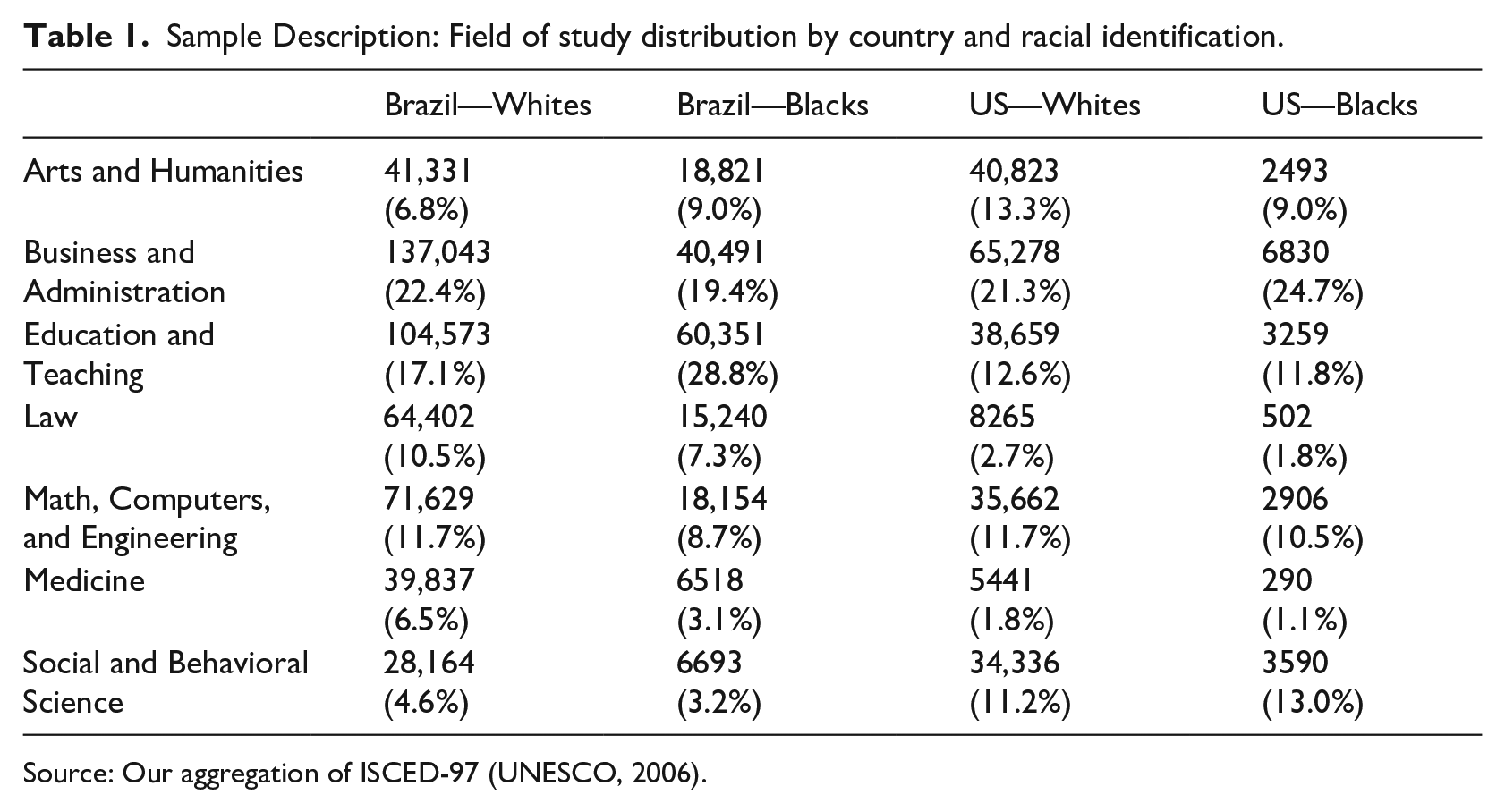
Source: Our aggregation of ISCED-97 (UNESCO, 2006).
We rely on Brazilian and American Census categories to measure racial inequalities. We refer to Whites as those who identify as “White” (branco) according to this Census category, available both in Brazil and in the United States, which specifically refers to those who identify as non-Hispanic, non-Latinx Whites. In the case of the “Black” category, in the United States we refer to those who identify as “Black or African American” according to the census categories present on the 2009 ACS, also omitting those who identify as Hispanic or Latinx. 5 In the ACS, Black individuals represent 13.5 percent of the US population. In Brazil, we use the category “Black” to refer to those who identify as pretos (Black) and pardos (Brown) according to the Brazilian Census categories. Those groups represent 51 percent of the Brazilian population in the 2010 Census (and 26% in our sample, which consists of only higher education graduates). Relying on census racial categories and comparing the experiences of Brazilian pretos and pardos with African Americans are procedures that are widespread in the comparative literature (e.g. Lamont et al., 2016; Telles, 2004), but also contested ones. We are keenly aware of the limitations of this approach to capture certain dimensions of the Brazilian racial order, due to (1) the alleged artificiality of census categories in Brazil (Harris, 1964), (2) the potential differences between pretos and pardos (Moraes Silva and De Souza Leão, 2012), and (3) high rates of individual ethnoracial reclassification (De Carvalho et al., 2004). Next, we discuss our considerations on these issues to justify our methodological choice for the questions discussed in this article.
Early scholarship emphasized the multiple categories mobilized by Brazilians to define their racial identity (Harris, 1964). More recent scholarship, however, demonstrates that most Brazilians rely spontaneously on the census color categories of branco (White), pardo (Brown), or preto (Black) (Telles, 2004). Studies largely agree that there is some mismatch between self and interviewers’ classification, but the definition of Whiteness is very much consensual, and that the disagreement is more about the boundaries between pretos and pardos.
Although Brazilian literature increasingly points to the different perceptions and experiences of racialization of those who identify as pretos and pardos (Daflon et al., 2017; Moraes Silva and De Souza Leão, 2012), most of the racial stratification literature in Brazil still insists on the relevance of aggregating these categories in studies about inequality research for three main reasons. First, since the 1980s, studies demonstrate that the socioeconomic indicators of those who identify as pardos and pretos in Brazil are largely similar, especially when compared with Whites (Hasenbalg and do Valle Silva, 1988). This is also the case for BA completion: according to our analysis of the 2010 census, 7 percent of those who identify as pardos and 8 percent as pretos have a BA degree versus 21 percent of those who identify as Whites. Second, studies find that regardless of the type of classification used (auto, hetero, open, closed) the inequality between Whites and non-Whites remains statistically significant (Bailey et al., 2013; Loveman et al., 2012). Finally, and more pragmatically, in statistical research, scholars justify this decision because the percentage of those who identify as pretos is very small, especially in higher socioeconomic groups, making it statistically necessary to merge this group with pardos for certain analyses. In the case of granular analyses, such as those conducted in this article, this necessity emerges prominently. To ensure that we can compare our results with those produced by papers that disaggregate pretos and pardos, we performed sensitivity checks using this disaggregation to the best of our ability, given the sample size restrictions. We found no significant difference between these two groups, and so we choose to present the combined results in the body of the article. 6
In regard to the issue of reclassification, previous studies in Brazil have demonstrated substantial movement in individuals’ self-identification across time (De Carvalho et al., 2004), as well as variation in the amount and quality of racial inequality depending on how Census questions are asked and used (Bailey et al., 2013). Specifically, scholars find that upward social mobility drives changes in racial identification (Schwartzman, 2007), a process historically identified as Whitening. However, more recent literature has questioned this finding and even has identified a trend toward “blackening” (Telles and Paschel, 2014). Although we acknowledge that such reclassification may happen, we argue that our results still are relevant and important. We do so because although racial fluidity exists in Brazil, its impact on racial inequality should not be overstated. More importantly, in-depth interviews and smaller surveys with more diverse measures of racial categorization would not allow us to study inequality dynamics at the group or national level, since this approach requires large samples only made possible by Census data.
Educational and occupational categories also are analytical constructs and their meaning varies across contexts. Our analysis is based on harmonized comparative descriptive data for Brazil and the United States. Educational categories for levels of education and fields of study are harmonized using the International Standard Classification of Education 1997 (ISCED) developed by UNESCO (2006). For educational levels, we omit level 5B, or 2-year degree holders in the United States, because there is no comparable category in Brazil. That said, our results do not change substantively if we incorporate 5B into the category for high-school diploma recipients. We also combine levels 5A (BA holders) with levels 6A/B (those with more than a BA) since the population of individuals with post-baccalaureate credentials in Brazil is very small (3.55%). In the United States, the proportion is larger (about 14%), likely because certain professional occupations (such as medicine, law, and in many places, elementary and high school teacher) require post-baccalaureate education in the United States but not in Brazil. As a result, we code graduates into field of study categories based on the highest degree they have achieved. 7
For the field of study codes, we use the two-digit version of the ISCED classification, disaggregated in three-digit fields to distinguish between general health, nursing, and medicine, given important differences in occupational trajectories in the health field. We subsequently create a more condensed field scheme based on the two-digit codes to handle the issue of sparse cells in a small number of fields of study and to increase interpretability. In this scheme, we collapse boundaries between fields with substantial commonalities (i.e. physical and biological sciences or math, computing, and engineering) while leaving other fields with no obvious pairing (i.e. law or medicine) as their own categories. The condensed fields are detailed in Table 1. In our analysis we focus on the seven most frequent fields in terms of the overall distribution which include about 75 percent of BA graduates.
Occupational classifications are harmonized using both the three-digit and one-digit International Standard of Occupations (ISCO-88). The Brazilian Census of 2010 follows an organization of occupational classification that is fairly similar to the ISCO-88 standard, with minor differences, which we manually adjusted. For the United States, we similarly use a crosswalk to translate 2000 Census occupation codes to 1988 ISCO codes (Elliott and Gerova, 2005).
Field of study segregation
We draw on a wide variety of methods in this article. To assess the contribution of field of study segregation to the overall Black–White earnings gap, we first calculate comparative odds ratios between Black and White graduates in Brazil and the United States. These odds ratios express the extent to which Black versus White graduates are (1) represented in any given field of study and (2) achieve earnings parity within each field of study. We use odds ratios because they allow us to account for differences in the size of both the Black population and the BA-holding population in Brazil versus the United States.
To connect field of study segregation with earnings differences, we calculate a basic regression model as follows

In this equation, logged monthly earnings for individual i serves as the dependent variable (
As one additional step in this section, we turn to decomposition analysis to examine the relative impacts of field of study segregation and racially unequal earnings on overall earnings inequality between Black and White graduates in Brazil and the United States. Decomposition methods are helpful because they use the properties of standard regression models to deconstruct an overall effect—here, earnings differences between Black and White graduates—into its component parts, in turn allowing analysts to understand the primary driver(s) of the effect of interest. We specifically draw on the Juhn–Murphy–Pierce method of decomposition (Juhn et al., 1993), a variant on the traditional Oaxaca–Blinder method, because it accounts for the marginal distribution of graduates into fields of study in Brazil and the United States. This property enables us to make direct, structural comparisons between the two countries.
Local linkage strength
In order to examine the impact of the structure of ties between fields of study and occupations on overall Black–White earnings gap, we use a new approach. Specifically, we follow DiPrete et al. (2017), who use segregation measures to indicate the extent to which workers with the same educational qualification (expressed both in educational level and field of study) are clustered in a set of occupations. Their approach is based on the Mutual Information Index (M), which is a measure of segregation that can be used to characterize the total linkage strength between educational outcomes and occupations for a country’s entire workforce (Mora and Ruiz Castillo, 2011). We then decompose total M into what DiPrete et al. (2017) call local linkage scores for each field of study described in Table 1, which indicate the reduction in educational entropy that comes with observing a graduate’s occupation, for each level-field combination. 9 In short, this measure represents the tightness or closeness of linkage between education and occupation, that is, the extent to which workers with a shared educational background are clustered in particular occupational destinations. The local linkage score for education categories takes the following form

where pj|g is the conditional probability of working in occupation j given that one is in educational outcome g, and pj is the unconditional probability of working in occupation j. To provide a concrete example, the equation dictates that if graduates from a given field of study cluster in only a small number of occupations, the local linkage score for that field of study will be high. DiPrete et al. (2017) find that medicine represents one such field, while humanities represent a field at the other end of the spectrum, with limited clustering in particular occupations and a very low local linkage score.
We evaluate differences in local linkage by race and by country as a way to describe the structural patterns of allocation between educational credentials and the occupational structure. We also use local linkage scores as independent variables in regression models. These have the objective to assess (1) the impact of local linkage on earnings; (2) racial differences in the impact of local linkage on earnings within each country; and (3) between-country discrepancies in racial differences in the impact of local linkage on earnings. We describe these regression models in greater detail below.
Linked occupations, racial occupational segregation, racial linked versus unlinked closure, and racially unequal returns
To assess racial occupational segregation, we define a new variable, which we term the “linked occupations” measure, to assess how individuals from each field of study funnel into a small number of “most associated” labor market positions, which we explain in more detail below. To be clear, the term “linked occupations” signifies something different than “local linkage.” Whereas local linkage strength refers to the structure of linkage between fields of study and occupations at the national level, linked occupations instead describe how individuals progress from their field of study into particular occupations that are particularly well connected to their chosen fields—regardless of the overall strength of structural linkage between fields and occupations. So, while “medicine” is a field with high linkage strength (graduates cluster into a small number of occupations) and “business” is a field with lower linkage strength (graduates cluster into a wider array of occupations), medicine graduates who become doctors and business graduates who become “business, finance, and administration associates” both would be considered entering linked occupations.
We create the term for linked occupations by following Bol et al. (2019) to identify those occupations most strongly “associated” with each field of study. To do so, we first identify the 10 largest occupational destinations for each field of study, which intuitively might be viewed as the “most linked.” However, from a mathematical perspective, some occupations may fall within this group of 10 simply because they contain a relatively large share of the total workforce, rather than a large share of workers specific to a particular field of study. We therefore take the additional step of comparing the number of graduates entering a particular occupation from each field with the number that would be expected if field of study was unrelated to occupational destination. The ratio of these two quantities is a standardized measure of how strongly associated any particular occupations is with each field of study.
We identify the three occupations where the number of graduates who hold that occupation represents the largest proportional increase over what would be expected if fields were not related to occupations. 10 We construct linked occupations within each racial group, so it is possible that the three most-linked occupations for White graduates are different from those for Black graduates in both countries, an issue to which we return below. We then assess differences in representation between Black and White graduates in the top three most-linked occupations using comparative odds ratios, as well as overlap in the most-linked occupations according to the Black versus White distributions as an additional indicator of segregation and, in turn, of inequality.
In order to examine occupational closure, we assess odds ratios for the representation of Black versus White graduates in the top three most-linked occupations according to the White distribution. We do so as a means of understanding whether Black graduates are able to enter the same, highly linked occupations as White graduates—one of the key principles of occupational closure. We also connect these odds ratios to Black–White earnings differences in each occupation in order to see how linked occupational closure might affect the overall gap in earnings between Black and White graduates. Here, we use the basic regression model detailed in Equation 1, modifying it slightly by adding a binary indicator as to whether graduates from a specific field of study enter a linked or unlinked occupation. This analysis also provides foundational insight into the issue of racially unequal returns.
Comparing the patterns and consequences of school-to-work transitions for racial earnings inequality in Brazil and the United States
Field of study segregation
When comparing fields of study for BA holders in Brazil and the United States, our results indicate notable differences, both on average and in terms of the relative representation of Black and White graduates across fields of study. We report the proportions of the overall concentration of graduates in each field of study, as well as odds ratios describing the concentration of Black and White graduates in each field, in Table 2, columns 2–5.
Distribution and correlations of race identification and wages across focal fields of study.
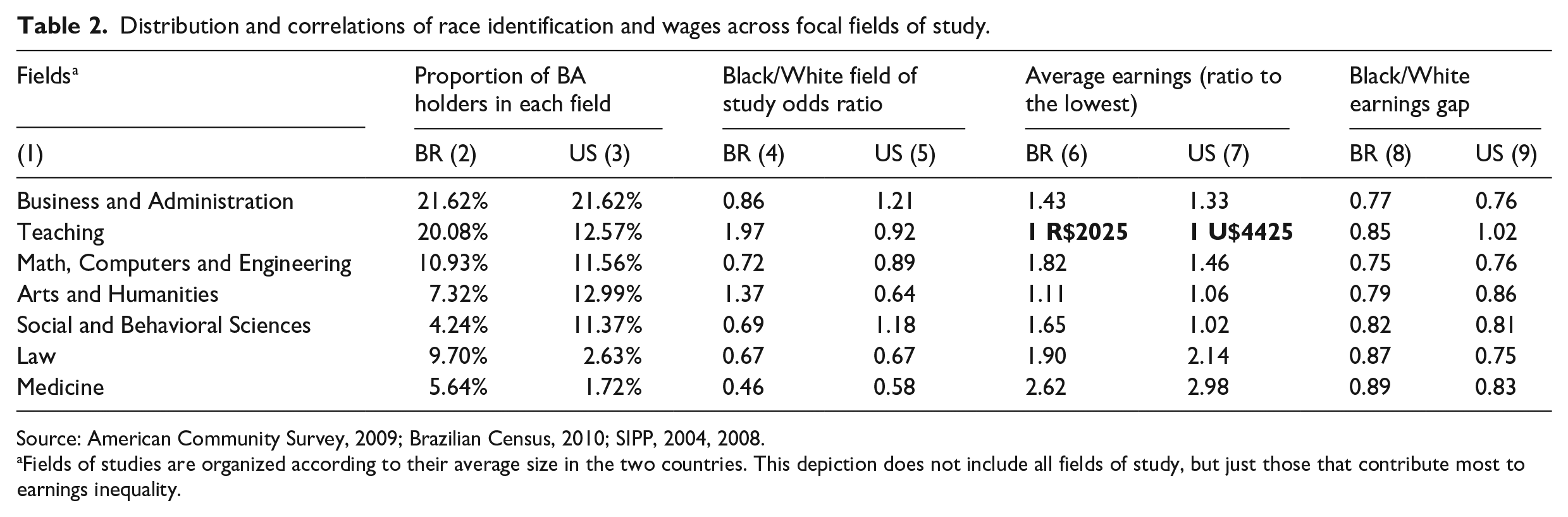
Source: American Community Survey, 2009; Brazilian Census, 2010; SIPP, 2004, 2008.
Fields of studies are organized according to their average size in the two countries. This depiction does not include all fields of study, but just those that contribute most to earnings inequality.
On average, Brazil contains a much higher frequency of teaching, law, and medicine degrees and the United States possesses more arts & humanities and social & behavioral science graduates. In the abstract, these different concentrations signify very little. But paired with an analysis of Black–White differences in field of study composition, as well as with average and racial earnings differences between fields of earnings differences, they become an important part of the overall explanation of Black–White earnings inequality in the two countries.
We start by examining the racial distribution across fields of study. As evidenced in Table 2, columns 4 and 5, Black and White graduates are unevenly distributed across fields of study in both countries. Especially worth noting are the fields in which Black graduates are overrepresented, including business & administration and social & behavioral sciences in the United States and teaching and arts & humanities in Brazil. This overrepresentation is not in itself a problem and could prove equalizing, enabling greater presence of Black graduates in these fields. Nevertheless, when paired with lower overall returns to these fields in the labor market, this overrepresentation may prove detrimental for Black graduates.
We next connect these patterns of field of study segregation with racial earnings gaps, first presenting these gaps descriptively in Table 2, columns 6–9. Columns 6 and 7 indicate the average earnings ratio between fields of study in Brazil and the United States, without taking race into consideration. These results confirm existing findings that different fields of study lead to very different labor market returns, with teaching posting the lowest returns and medicine the highest—nearly three times higher than teaching in the case of the United States. We also see in columns 8 and 9, drawn from the regression equation expressed in Equation 1, that country-level differences exist in Black/White earnings discrepancies for each field of study, with certain fields like teaching and arts & humanities posting much more racially unequal pay in Brazil than in the United States, while the racial earnings gap in medicine and especially law is more salient in the United States.
As we noted earlier, these gaps could prove especially consequential for the overall Black–White earnings inequality if they emerge in fields in which Black graduates are overrepresented, thereby exacerbating earnings differences. We address this issue by decomposing the racial gap in earnings in Brazil and the United States into the component driven by field- of-study segregation and the component driven by wage discrimination using Juhn et al.’s (1993) decomposition strategy (Table 3). This analysis shows that the overall earnings gap between Black and White BA recipients in Brazil is 0.338 log points and in the United States it is 0.164 log points. In Brazil, the distribution of graduates into fields of study accounts for 36 percent of the gap and acts to widen it. Yet in the United States, the field of study distribution reduces the total earnings gap by about 17 percent rather than widening it. In contrast, 64 percent of the gap in Brazil is caused by unequal earnings given the field of study, whereas 117 percent of the gap in the United States is caused by within-field earnings inequality. In other words, field of study segregation contributes much less to Black–White earnings differences in the United States than in Brazil.
Contribution of field of study distribution and earnings values to the overall earnings gap in Brazil and the United States.
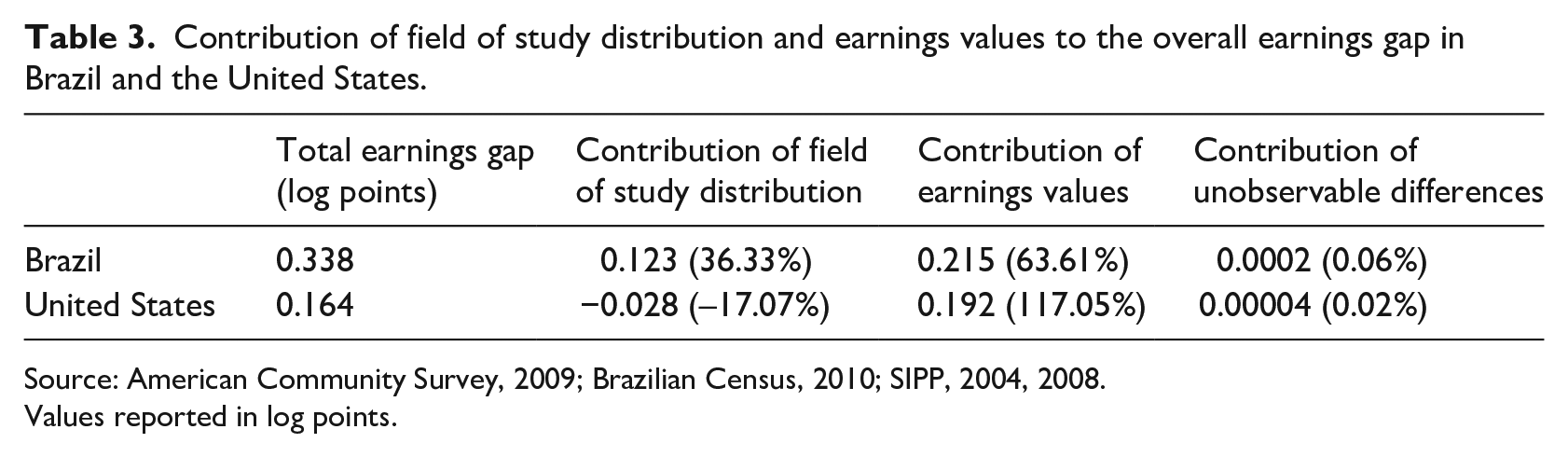
Source: American Community Survey, 2009; Brazilian Census, 2010; SIPP, 2004, 2008.
Values reported in log points.
We explain this difference by referring back to which fields of study appear most racially imbalanced in Brazil and the United States (see Table 2). In Brazil, the field most saturated by Black graduates, teaching, is also a field that comprises over 20 percent of the overall population of graduates. The disproportionate representation of Black graduates, together with the large proportion of overall graduates represented in this field, appears to contribute substantially to Brazil’s overall Black–White earnings gap. We explore this finding in detail when we discuss how teaching plays a key role in shaping the Brazilian racial earning gap in the section “Teaching: different dynamics of field of study segregation and linkage.”
In the United States, meanwhile, there is no field that combines as high a representation of graduates overall with an overrepresentation of Black graduates as in Brazil. Although we note the substantial underrepresentation of Black graduates in fields of study linked with the highest pay overall, such as math, computing & engineering, law, and medicine, the fields where Black graduates are overrepresented, including business & administration and social & behavioral science, are not those with the lowest earnings in the US distribution. In contrast, except for teaching, there are earning gaps between Black and White graduates with the exact, same field of study credential across all fields in the United States. Together, these patterns reveal the importance of unequal returns to overall Black–White earnings inequality in the United States, an issue we take up at greater length when examining occupational mechanisms.
Local linkage strength
We next examine how pathways from school-to-work impact racial earnings inequality in Brazil and the United States using “linkage strength.” We operationalize linkage strength by computing local linkage scores for each field of study. Recall from the “Data and methods” section that local linkage captures the extent to which fields of study are structurally tied to a narrow versus broad range of labor market positions. A high linkage score indicates that most graduates from a field of study funnel into a small number of occupations, whereas a low linkage score indicates that most graduates from a field of study funnel into a much more dispersed array of occupations. In Table 4, we present the within-race local linkage measures for different fields in Brazil and the United States, separately by racial identification.
Measures of school-to-work linkage and race identification across fields of study.
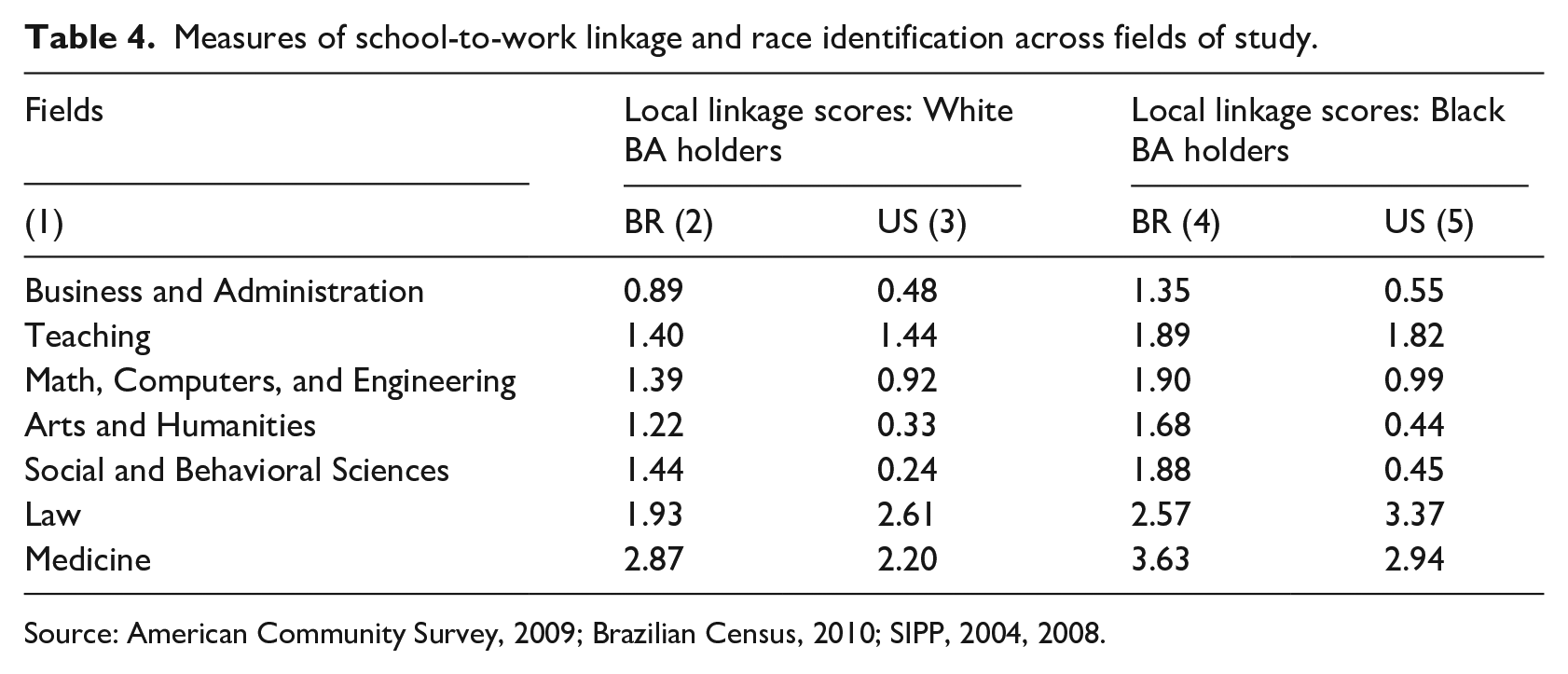
Source: American Community Survey, 2009; Brazilian Census, 2010; SIPP, 2004, 2008.
As expected, local linkage strength varies considerably across fields of study, race and between countries. That said, field of study and race appear to intersect in very similar—and quite puzzling—ways in both Brazil and the United States. Specifically, in both countries, linkages from field of study to occupation are weaker among White graduates (Table 4, columns 2 and 3) than among Black graduates (Table 4, columns 4 and 5). In other words, in both countries and across most fields of study, Black graduates funnel to a smaller set of occupations than do White graduates with degrees from the same field of study. This result is puzzling because of existing research arguing that tight progressions from school-to-work are associated with higher earnings (Bol et al., 2019). Yet Black graduates earn less, on average, than do White graduates (Table 2, columns 8 and 9). We explain this paradox by considering the relationship between local linkage and linked occupations next. This analysis also provides insight into the impacts of our three occupational mechanisms: segregation, linked occupational closure, and unlinked occupational closure.
Linked occupations, occupational segregation, linked and unlinked occupational closure and racially unequal returns
As we describe in the “Data and methods” section, we define linked occupations as the three occupations most associated with any given field of study. From our results in the last section, we see that Black graduates from the same field of study as White graduates typically funnel into a more condensed group of occupations. Yet we also know that Black graduates tend to earn less than White graduates, despite the strong, positive relationship that current scholarship suggests between high local linkage scores and earnings.
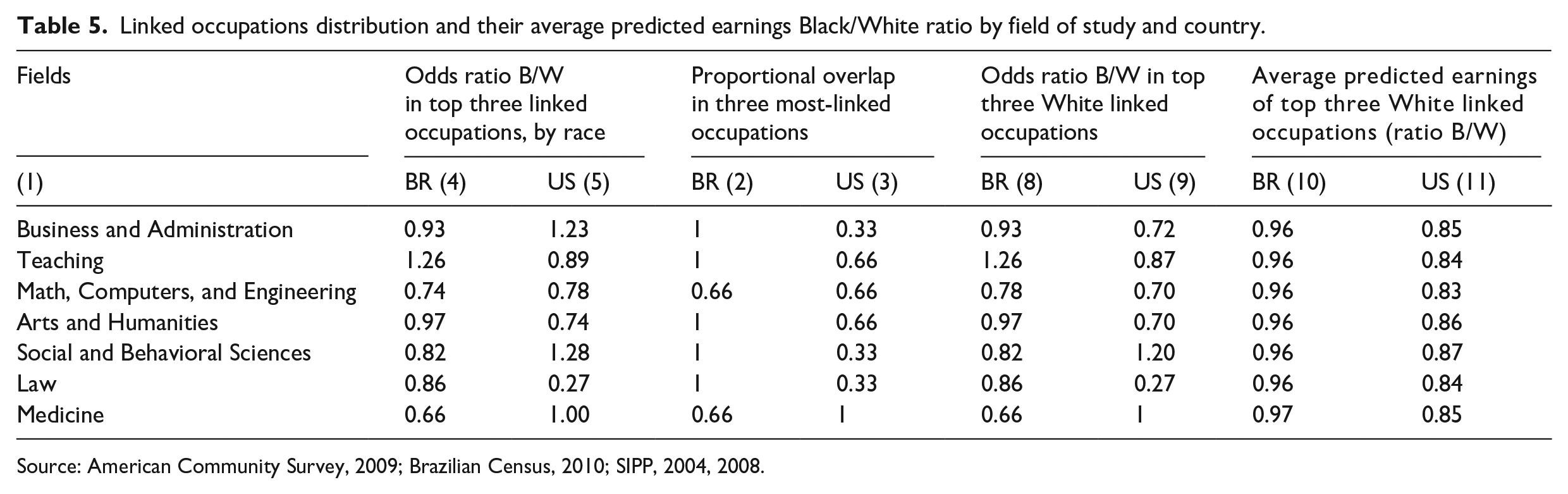
We suspect that one explanation for this paradox is that Black graduates and White graduates may have different sets of linked occupations, with the returns to White linked occupations higher than those for Black linked occupations (racial occupational segregation). Black students also may be more frequently excluded from White linked occupations (linked racial occupational closure), or they may receive different returns from the same linked occupations (racial unequal returns). In Table 5, we explore these possibilities by presenting results examining odds ratios for the presence of Black and White graduates in within-race linked occupations, overlap between Black and White linked occupations, the presence of Black graduates in White linked occupations, and earnings differences within White linked occupations.
Linked occupations distribution and their average predicted earnings Black/White ratio by field of study and country.
Source: American Community Survey, 2009; Brazilian Census, 2010; SIPP, 2004, 2008.
Examining Table 5, columns 2 and 3, we find that White graduates progress more frequently to the three occupations most linked to their fields of study than do Black graduates in both countries, save for teaching in Brazil and social & behavioral sciences and business in the United States. This finding confirms our point that local linkage strength is related to, though distinct from, linked occupations. While higher local linkage scores characterize the school-to-work transition for Black graduates, meaning that more Black graduates from each field progress to a smaller array of occupations, this pattern is not equivalent to entering the most-linked occupations for the reasons we describe above. In fact, even those Black graduates coming from fields of study with high local linkage scores, such as math, science, & engineering or law, do not progress as frequently to the most-linked occupations as do White graduates.
We examine racial occupational segregation by measuring the extent of overlap in the three most-linked occupations for the Black and White distributions of graduates in both countries. This information is captured in Table 5, columns 4 and 5, with a simple calculation of the proportion of the top three occupations that overlap between Black and White graduates in Brazil and the United States, with one occupation equating to 0.33, two occupations equating to 0.66, and all three occupations equating to 1. We show that overlap exists in the three most-linked occupations for White and Black graduates in both Brazil and the United States, although the overlap is more pronounced in Brazil (Table 5, columns 4 and 5). For example, in Brazil, all three of the most-linked occupations for Black and White graduates are the same for large fields including business, teaching, arts and humanities, social and behavioral sciences and law, while in the United States, the only field with complete equivalence is medicine. This analysis indicates that racial occupational segregation among top occupational destinations is stronger in the United States than in Brazil, providing some evidence that this mechanism contributes to Black–White earnings inequality in the United States, in particular. Yet we suspect that other mechanisms are at play, including occupational closure.
We examine the argument for linked occupational closure first by using odds ratios to analyze whether Black graduates enter the three most-linked White occupations at a rate similar to White graduates. As Table 5, columns 6 and 7, demonstrate, the odds of Black graduates entering the top three White occupations are more like those of White graduates in Brazil than they are in the United States (with the exception of social & behavioral sciences). In Brazil, the lowest recorded odds are for medicine (0.66), and yet the odds for this field still are upward of 0.65. In addition, Black graduates are more concentrated in the top three White occupations for teaching than are White graduates in Brazil.
The patterns for Black graduates’ entry into the most-linked occupations according to the White distribution looks different in the United States. Specifically, Black graduates’ odds of entering one of the White top three occupations are below 50 percent for high-paying fields such as law and medicine, even as they are above 1 for a low-paying field, teaching. Representing a similar trend as we find above, this pattern indicates that linked occupational closure is, on average, stronger in the United States than in Brazil.
We also find that the racial gap in returns to the top three White occupations in the United States is larger than in Brazil (Table 5, column 8 and 9). Specifically, Black graduates in the United States who enter these most-linked occupations still earn about 15 percent less than their White counterparts, whereas the gap in Brazil is just 5 percent. This finding indicates that unequal returns to linked occupations may be a more important driver of the racial earnings gap in the United States than in Brazil. Taken together, these findings solidify the importance of the occupational side of the equation for explaining Black–White earnings inequality in the United States, whereas the field of study side of the equation serves as a more powerful driver in Brazil.
In order to further analyze the perplexing relationship between strong local linkages but lower earnings returns among African Americans and Black Brazilians, we examine the possibility of what we have called unlinked occupational closure, or the process by which entering a linked occupation may be detrimental to earnings. Here, we rely on regression analysis, the details of which are provided in Tables 6 (Brazil) and 7 (United States) in Appendix 1. The figure shows that in the two countries and for both racial groups, the effect of graduating from a field of study with strong local linkage is positive, even if graduates do not progress to a linked occupation. This finding means that there are positive earnings returns to those fields of study capable of leading graduates into a narrower rather than broader range of occupations in both Brazil and the United States. Furthermore, as we discuss below, there are no racial differences in this positive effect in either country.
That said, whether or not graduates receive any additional increase in earnings by progressing to a linked occupation depends on the interaction of local linkage strength, race, and national context. First, in both countries, we find that among graduates who are not in linked occupations, holding degrees in fields with strong linkage is equally beneficial for Black and White BA holders. However, different patterns emerge when examining graduates in Brazil and the United States who do hold linked occupations. For these graduates, the effect of holding a linked occupation varies substantially based on their placement in the local linkage strength distribution and their national context.
We interpret this finding as reflecting unlinked occupational closure in Brazil, where those with degrees in weakly linked fields of study who do not enter a linked occupation benefit more in the labor market than those who do. This pattern impacts the graduates of three fields, including business. This field is a particularly important contributor to the Black–White earnings patterns we observe in Brazil given the large proportion of graduates that enter it. In short, the joint effects of high concentration, low field of study linkage, unequal returns, and non-linked occupational closure in business play an important role in shaping the overall Black–White inequality we observe in Brazil, as we will discuss in detail in the section “Business: linked versus unlinked occupational closure and unequal returns.”
In the United States (see Figure 1(b)), similarly, the effect of being in a linked occupation varies with the linkage strength of fields of study. However, unlike in Brazil, there is no negative impact of being in a linked occupation. Instead, the impact is positive and increasing across the entire linkage distribution for both racial groups. We also find a different pattern of racial inequality in the United States in that the increased earnings associated with high linkage strength and entering a linked occupation are larger for White graduates than for Black graduates. For White graduates in White linked occupations, every unit increase in linkage strength corresponds with an additional 13.9 percent boost in earnings, above and beyond the premiums for being in a linked occupation and a field with average linkage strength or above. This increase for White graduates is statistically greater than the 5.6 percent increase for Black graduates, net of the premiums received from landing in a linked occupation or graduating from a field with average linkage or above (F = 0.00). In other words, unequal returns appear to be present among Black graduates who enter linked occupations, compounding the earnings discrepancies resulting from occupational segregation and linked occupational closure.
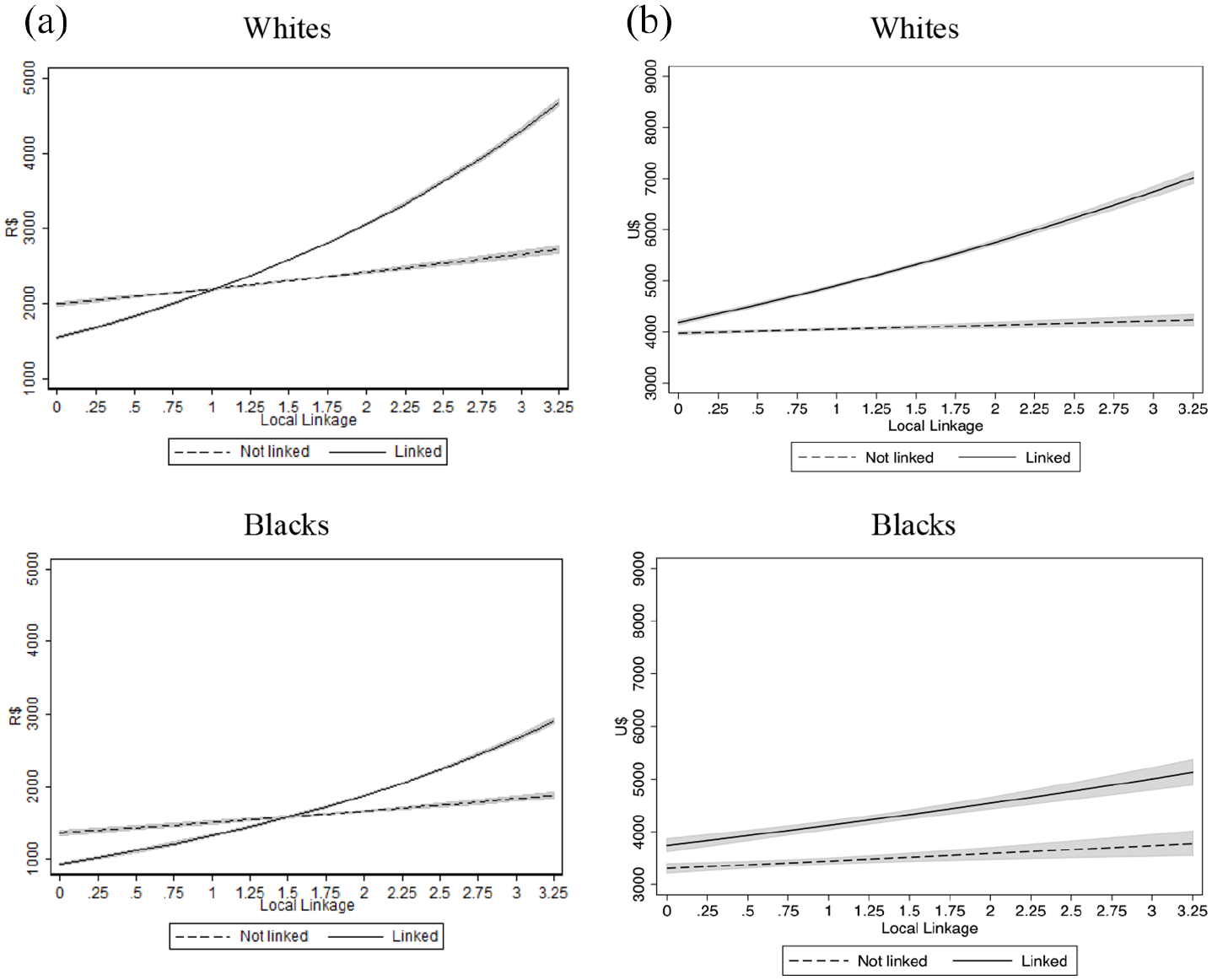
Predicted eariners of linkage strength for graduates in linked and non-linked occupations, regression illustrations: (a) Brazil and (b) the United States.
School-to-work linkages in action
In this section, we step back to provide more concrete examples of the ways in which national configurations shape racial inequalities. We do so by comparing the interaction of field- of-study segregation, linkage strength, occupational segregation, linked and unlinked occupational closure and unequal returns in three fields of study in the two countries: medicine, which is highly linked and very selective with high returns; teaching, which has average local linkage strength, low returns, and nationally distinct patterns of racial segregation; and business, which is characterized by weak local linkage, relatively high returns, and nationally specific patterns of racial segregation. With this closer look at particular fields, we describe how certain racialized school-to-work patterns are common in the two countries, but others are specific to the national configurations of Brazil and the United States, respectively.
Medicine: field of study segregation drives earnings inequalities
We start with the example of medicine, a traditionally elite field, due to its selectivity and higher costs. Although this field is small, it has among the highest returns, making it important for understanding racial inequality in both countries. Referencing Table 2, we find that in the two countries, medicine is the field in which Black graduates are the most underrepresented (the Black–White odds ratio is 0.46 in Brazil and 0.58 in the United States) showing the important role of field of study segregation. Yet, among those Black graduates who do earn degrees in medicine, their odds of entering a linked occupation are comparable to those of White graduates in the United States but not in Brazil (1 vs 0.66). That said, the earnings gap among Black and White graduates who enter the most-linked occupations, by race, is higher in the United States (earnings ratio = 0.82) than in Brazil (earnings ratio = 0.97), indicating that direct job market discrimination may play a more important role in the latter. This pattern offsets, to an extent, the lower odds of entering a linked occupation among Black graduates in Brazil.
Taking these distributional and earnings findings together, the main mechanism through which medicine contributes to racial inequalities in both countries is the higher barrier to entry for Black students or racial field of study segregation. Other mechanisms, such as linked occupational closure in Brazil and unequal returns to linked occupations in the United States, appear relevant but secondary. This finding stresses the continuing importance of affirmative action to guarantee the diversification of elite fields of study (for the case of medicine, see Lakhan, 2003), a point to which we will return in our concluding section.
Teaching: different dynamics of field of study segregation and linkage
In contrast, teaching, the field with the lowest average returns in the two countries, is an example where the differences between Brazil and the United States are very relevant to understanding the distinct mechanisms leading to racial earning inequality among BA holders. The dynamics pertinent to teaching are particularly consequential for overall earnings inequalities in Brazil, since this field contains 20 percent of all BA graduates in the country and has a higher concentration of low-income and first-generation BA students (Carvalhaes and Ribeiro, 2019). While in Brazil, Black graduates are overrepresented in teaching (the Black–White odds ratio is 1.94), in the United States, Black graduates are slightly underrepresented in this field (the Black–White odds ratio is 0.92). Yet, turning to the occupational distribution among those with a teaching degree, Black Brazilians have similar, linked occupational destinations as White Brazilians (overlap = 1) and on average are paid only about 4 percent less among those who link. In contrast, linked occupational destinations are slightly less compatible by race in the United States (overlap = 0.66). Furthermore, when American Black graduates enter a linked occupation, they still earn 15 percent less than White graduates in similar, linked occupations.
Hence, field of study segregation is the most important driver of the earnings gap in Brazil, whereas a combination of linked occupational closure and unequal returns is more prevalent in the United States. Our findings confirm the importance of the concentration of Black BA holders in teaching degrees (suggested by Reis, 2017) in shaping overall earning gap racial inequalities in Brazil. Our results also point to the fact that Brazilian higher education expansion policies focusing on teaching degrees might be unintentionally reproducing broader patterns of racial inequalities, another point we return to in the conclusion.
Business: linked versus unlinked occupational closure and unequal returns
Finally, business—the largest field in the two countries—provides an interesting comparative example of the different impact of occupational closure on racial earnings inequality given specific national contexts. In terms of the field of study distribution, Black and White BA holders earn business degrees at similar rates in the two countries. However, school-to-work dynamics differently structure the outcomes of Black and White business graduates in the United States and Brazil.
In the United States, as shown in Table 5, Black business graduates are more likely to enter linked occupations based on the Black distribution than are White business graduates based on the White distribution (column 3). However, when evaluating the presence of Black graduates in White linked occupations (column 7), their odds fall to 0.72, indicating occupational segregation that is harmful to Black graduates. In addition, Black business graduates who enter the White most-linked occupations make about 15 percent less than White graduates (column 9). These results suggest that linked occupational closure and unequal returns to linked occupations together produce lower earnings among Black business graduates in the United States compared with Whites.
In Brazil, by contrast, we observe non-linked occupational closure operating more prominently. In Table 5, Brazilian Black graduates in business are almost equally as likely as White graduates to enter a linked occupation (defined either by the Black or White distribution) and earn about the same when doing so (columns 2, 4, 6 and 8). However, given the overall relationship between field of study linkage and the labor market (Figure 1(a)), both Black and White business graduates are penalized when they enter linked occupations if they have earned their degrees in fields of study with weak local linkage, like business, compared with graduates whose fields of study have strong local linkage.
Putting these pieces of information together, a clearer story unfolds: Black graduates in business in Brazil initially are disadvantaged by field of study segregation that excludes them from a relatively high-paying field, then are channeled from business fields of study into a narrower range of linked occupations than White graduates, then are economically penalized for this trajectory, both on average and within the overall distribution of local linkage scores by field of study. In addition, they are excluded from the more highly paid non-linked occupations, probably because those rely on other types of attributes (cultural capital, social networks) in which racial discrimination is likely to play a stronger role. In short, the fact that Brazilian Black business graduates enter a linked occupation and receive comparable earnings does not equalize opportunities for this group; instead, the combination of field of study segregation and unlinked occupational closure contribute to the racial inequalities we observe in the Brazilian population as a whole.
Discussion and conclusion
Comparative studies of race and racism are on the rise. Taking seriously the idea that race is a social construction, most of these studies focus on how different understandings of ethnoracial categories shape different forms of racism and discrimination. In the case of comparisons between Brazil and the United States, these studies made clear that distinct understandings of racism and discrimination shaped very different antiracism strategies. In this article, we compare race relations in Brazil and the United States using a different lens by asking how the persistent racial inequalities in education, work, and income that structure these two countries may be (re)produced by different processes. By paying close attention to how school-to-work transitions shape racial socioeconomic inequalities, we find that very different mechanisms drive similar racial gaps in Brazil versus the United States.
Through a focus on BA holders, we unveil that highly educated Black professionals still face what can be considered racialized glass ceilings in accessing high-paying occupations in Brazil and the United States. But our analysis goes beyond confirming the presence of labor market discrimination. We identify how these similar racialized glass ceilings result from distinct underlying mechanisms that have nationally specific impacts on cumulative economic disadvantage: field of study segregation, linkages between the field of study and occupations, and unequal returns to occupations. Methodologically, we rely on aggregate measures of field of study segregation and also the more granular methods of linkage that have been seldom used to address racial inequalities.
Our step-by-step approach allows us to identify common processes, but also to distinguish specific national configurations that shape Black–White racial earnings inequalities in both countries. We have four main empirical findings. First, although Black and White BA holders are unevenly distributed across BA fields of study in both countries, field segregation is more consequential to the racial earnings gap in Brazil. Second, considering the school-to-work transition, we find that being in a strongly linked field is beneficial to Black and White BA holders in Brazil and the United States. Third, we show that occupational segregation and linked occupational closure, together with unequal racial returns to linked occupations, shape Black–White earnings gaps in both countries. However, these occupational patterns are more consequential for the overall Black–White earnings gap in the United States than in Brazil. Finally, the difference between linked and non-linked closure identified in our article, and the salience of the latter in Brazil, exemplifies how racial earnings inequalities are reproduced differently depending on graduates’ field of study and the national context.
These results confirm our initial hypothesis that different social processes shape the similar racial earnings gap that we find among BA holders in Brazil and the United States. For example, linked occupational closure, prevalent across fields of study in the United States, is a mechanism extensively identified in the American literature—the restriction of access to scarce resources, in this case, linked occupations—which together with unequal returns to the same linked occupations, explains the bulk of racial earnings inequality among BA holders in the United States. In Brazil, where the analysis of linkage strength is unprecedent, we find that these mechanisms are also prevalent in strongly linked fields of study, but unlinked occupational closure is more notable in weakly linked fields such as business, which is the largest field of study in the country. Overall, these findings confirm not only that the hiring, firing, and wage negotiation mechanisms work differently across national contexts, but also that nationally shaped closure and anti-closure mechanisms have particular impacts on how racial earnings inequality is created and reproduced.
Several new questions emerge from our analysis, which is only a first step toward comparing how these educational and labor market patterns shape racial earnings inequalities in Brazil and the United States. First, because race is a multi-dimensional and dynamic category, we must consider that the school-to-work transition may change the racial identification itself. Such process has been more clearly mapped in Brazil, for example, by studies that show that affirmative action students change their racial identification when enrolling in public universities (Francis-Tan and Tannuri-Pianto, 2015) but has not received comparable attention in the United States. This is because, in the latter, racial categories are still perceived as rigid and stable despite the growing number of people who fall in-between the White and Black poles. To do so, panel data that follows students through time would be required, mapping how students’ enrollment in different fields of studies and mobility into different types of occupations shape their racial understandings.
Second, our findings suggest that nationally specific linked and unlinked occupational closure mechanisms impact how racial earnings inequality is created and reproduced. But this article has not examined organizational-level hiring and wage practices or the role of personal networks that could further explain the results we found, and future research should focus on these issues. In turn, we hope that the distinct mechanisms we have identified have implications for the comparative study of labor market discrimination and for policies that aim to reduce these practices and could benefit from more research.
Finally, our findings emphasize that the structural differences between the levels of higher education enrollment and job market structures are not the cause of the differences we found in Brazil and the United States. We purposefully adopt an analytical strategy that aims to take these differences into account and would vehemently argue against invalidating our findings with claims that the expansion of higher education in Brazil, or the development of its economy, will automatically make it more similar to the United States. Instead, we believe that the intersection between the current higher education and labor market structures in Brazil and the United States, together with the policy choices made in the years to come, will be the most important variables for explaining convergence or divergence.
More importantly, we believe our findings should be read through a lens of national policy choices and their intended and unintended effects on racial earnings inequalities. For example, in the United States, the disproportionate effect of the backlash against affirmative action on college and graduate school access is likely to exacerbate racial earnings inequalities since a lessened commitment to affirmative action likely will exclude African Americans from the highest paying and most strongly linked fields, like medicine and law, and in turn also may increase field of study segregation (Garces, 2012). In contrast, the concentration of Black Brazilians in teaching and business is partly explained by growing privatization (Sampaio, 2011) and low diversification of the higher education sector in the country (Balbachevsky et al., 2019) which has encouraged the expansion of low-cost diplomas (like teaching and business) as opposed to high costs one (like engineering and medicine). The persistent racialized pay gaps in the two countries warn us not only that the growing presence of Black students in higher education can happen alongside the reproduction of racial earnings inequalities among BA holders, but also that distinct policy choices reproduce these inequalities in different ways—calling for different solutions to address them.
Footnotes
Appendix 1
Funding
The author(s) disclosed receipt of the following financial support for the research, authorship, and/or publication of this article: The research in this paper has been supported by a grant from Rio de Janeiro State Research Foundation (FAPERJ) Grant 26/010.001756/2014, the Presidential Global Innovation Fund from Columbia University, and in part by National Science Foundation Grant SES-1423828.
