




Abstract
The global COVID-19 pandemic has exposed and accentuated the irreconcilable differences among Indo-Pacific states concerning ideology, governance, and understandings of the legitimate uses of power. The Communist Party of China is employing great power statecraft that is best described by the Chinese concept of 霸权主义 Bàquán zhŭyì (hegemonism or aggression aimed at weaker states). This ideologically driven behavior threatens the stability of the global system and may hinder the political and economic gains achieved over decades through the collective cooperation and constraint of aggressive great power statecraft. This article describes a transformation in the People's Republic of China's (PRC) approach towards Australia. It suggests that unless there's an internal upheaval in the PRC's statecraft, the global system might need to temporarily rely on mercantilist blocs to maintain human security, primarily within the democratic states of the Indo-Pacific. This survival strategy would involve resisting hegemonism.
Introduction
Chinese Marxism-Leninism has entered an imperialist
1
phase characterized by attempts to redefine the political freedoms and economic opportunities of the peoples of the Indo-Pacific. From a political economy
2
perspective, this article substantiates the thesis that without an endogenous shock that alters the extant beliefs held by the Communist Party of China (CPC), the Indo-Pacific will only become viable by transforming into a bloc via mercantilist policies that are intended to hinder the hegemonism of the People's Republic of China (PRC). The Indo-Pacific's viability is assessed against its collective ability to develop with this approach, advancing the following debate: What is the Indo-Pacific geographically, politically, and economically, and for what purpose? To be an effective concept, the Indo-Pacific ought to be capable of advancing the well-being of nations, states, firms, and peoples. Applicably, Anthony Payne defines viable development as: [T]he collective building by the constituent social and political actors of a country (or at least in the first instance a country) of a viable, functioning political economy, grounded in at least a measure of congruence between its core domestic characteristics and attributes and its location within a globalizing world order and capable on that basis of advancing the well-being of those living within its confines.
3
The differences among states are acknowledged broadly by a hierarchy identifying great, middle, and small powers, which enables the creation of appropriate policies that are achievable and have the available capacity for conducting international relations. The discipline of political economy grounds these concepts and relations between states by placing them principally within four intersecting, but not exclusive, policy areas: global and domestic politics, and global and domestic economics. These differentiated concepts assist in establishing an understanding of Chinese hegemonism, and thus enable the prediction, and thereby the creation, of viable policy to more assuredly produce desired development outcomes. 4
This article first considers the threshold between collective policy and congruence by considering the relations between Australia, a middle power, and the great power of China. 5 The PRC's imperialism is characterized as hegemonism advanced by a vanguard party. I then review Australia's reaction to the CPC's hegemonism and discuss mercantilist policy options and mateship as a requirement for independence. Australia's political culture of mateship provides a viable means through which Indo-Pacific mercantilist policies may enable collective security, with India, Indonesia, and the South Pacific Islands states as critical additional mates. Finally, the article identifies offensive mercantilist policies that enable viable global development outcomes regarding the reliability of supply, Indigenous sovereignty, and the environment.
The limits of policy adaptation for congruence
Optimistically, prior to the onset of the COVID-19 global pandemic, I rationally advocated that middle powers 6 should adapt and learn to work with the PRC for their own benefit. 7 However, in the intervening period the CPC, under President Xi Jinping since 2013, has radically changed the PRC; consequently, the world's policies must also adapt. The PRC presently is unable to cooperate equally with all states (especially democracies) within the established rules-based order. 8 Australia, the primary state studied in this article, is unable to change to accommodate the PRC in the Indo-Pacific in the way in which the PRC has demanded through numerous outbursts of anger and frustration (for example, Australia has been called “gum stuck to the bottom of China's shoe” and a “giant kangaroo dog”). 9
As a consequence, the Indo-Pacific meta-region is solidifying and, due to the PRC's actions, may evolve into a mercantilist bloc. 10 Middle powers such as Australia and the Philippines are at present unable to work independently to defend themselves against Chinese Marxist-Leninist imperialism (hegemonism), and will seek support through collective security measures led by great powers or will pursue additional defensive hard power capacities. For example, Australia has announced, via the 2020 Defence Strategic Update and 2020 Force Structure Plan, A$800 million to purchase an AGM-158C LRASM [long-range anti-ship missile] for the F/A-18F Super Hornets; A$1 billion to create a sovereign missile program; and, most recently, the formation of the Australia-United Kingdom-United States [AUKUS] security partnership and the acquisition of nuclear-powered submarines. 11
The CPC's intent to end Westphalian sovereignty
At the Australian Defence Force Academy on 1 June 2020, Australian prime minister Scott Morrison, speaking at the launch of the 2020 Defence Strategic Update, declared: [W]e need to…prepare for a post-COVID world that is poorer, that is more dangerous and that is more disorderly…. Sovereignty means self-respect, freedom to be who we are, ourselves, independent, free-thinking. We will never surrender this: never ever…Australia will invest in longer-range strike weapons, cyber capabilities, and area denial.
12
The dossier in Figure 1 declares the PRC's imperialist and hegemonic expectations, with Australia becoming its vassal state. Australia, as the PRC demands, should cede control over foreign policy, foreign investment, national security, health policy, relations between Canberra and Australian states, and freedom of speech, and should ban think tanks and allow cyber-attacks and spies. China obviously would disagree with the above characterization of its policies and their intent; their understanding is built upon different conceptions of world order. 15 Thus, the PRC is a systemic rival to sovereign and democratic Australia. However, Australia is not alone, as other Indo-Pacific states know. 16 For example, during 2020–2021, the PRC physically attacked India and repeatedly coerced Japan, and its maritime militia invaded the Philippines in its sovereign exclusive economic zone at Whitsun Reef. 17
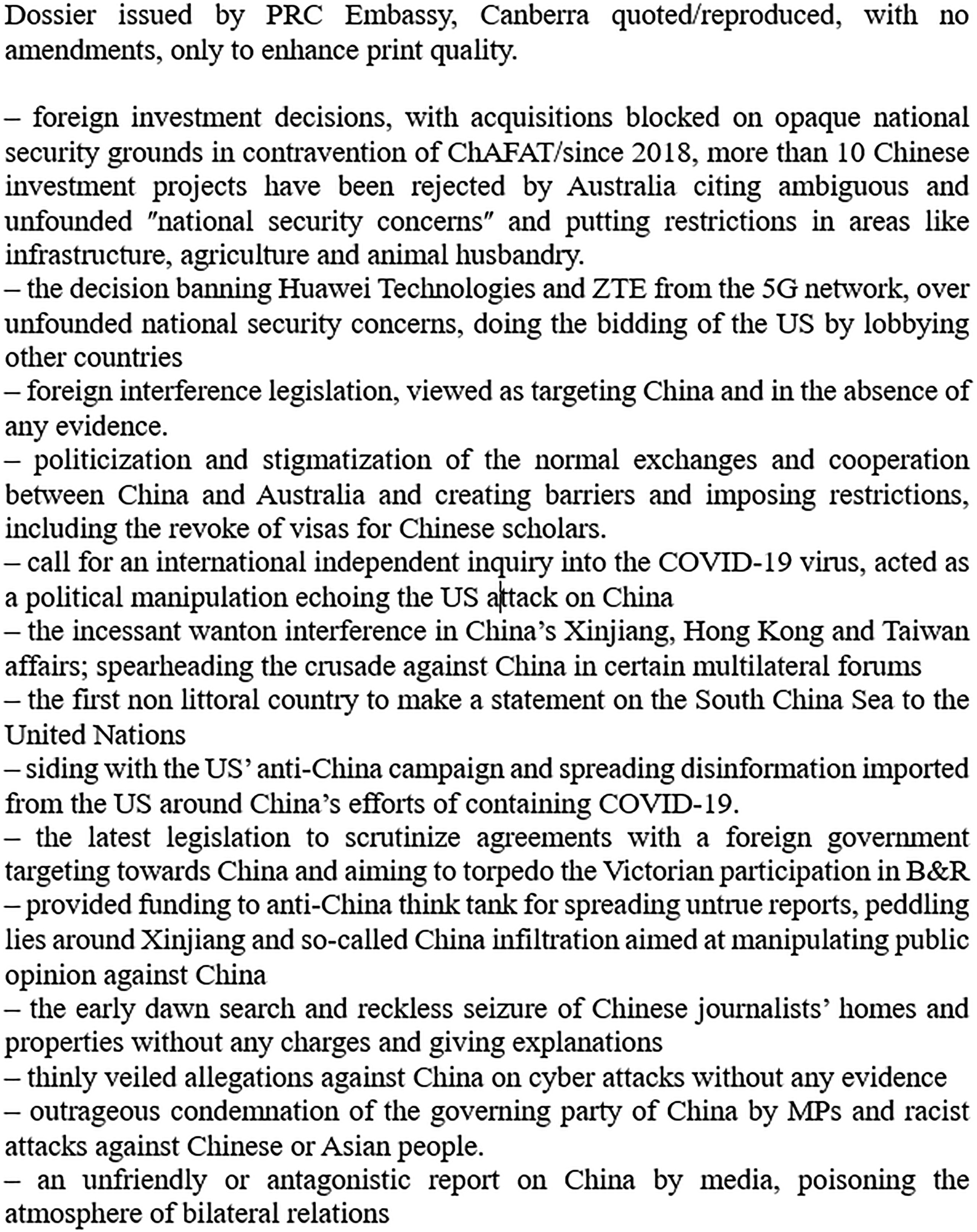
Dossier issued by PRC Embassy, Canberra, to Australian journalists in November 2020 (p. 5).
Whether the PRC is entering a period of traditional Chinese isolationism, as discussed below, through deliberate policies such as “dual circulation” deployed within the Chinese surveillance state, is irrelevant to the Indo-Pacific concept. However, it is important to note that the PRC's pseudo-reality nationalism enables it to use trade as a weapon. Interdicting trade is, historically, a strategy used by China to achieve its political aims (the contemporary term for interdiction is economic coercion). 18 Since May 2020, China has interdicted trade with Australia in the areas of barley, beef, lamb, wine, cotton, lobster, timber, and coal, which has resulted in a 40 percent drop in trade. 19 This is despite both states being members of the World Trade Organization (WTO) and having a bilateral trade agreement, the China-Australia Free Trade Agreement or CHAFTA, which came into effect on 20 December 2015. 20
Kowtowing to the empire
Prior to European encroachment, China's imperial system employed a combination of tribute trade and suzerainty to administer compliance. For recalcitrant vassals, interdiction was a fearful hegemonic policy that could weaken their economy and thus lead to a fatal loss in relative power to their neighbors.
21
Varied in its success and character, the interdiction policy ranged from a complete ban of trade to the allowance of segregated trading communities (which ultimately resulted in the policy's subsequent failure).
22
In the contemporary political economy, Chinese scholars’ understanding of hegemony generally places the PRC as the victim of European and, more recently, US imperialism. As Wang Yong and Louis Pauly state: In Mandarin, hegemony (霸权, or Bàquán) refers first to policy and behavior [sic]: the condition of imposing one's own will on others or obliging others to follow, usually by force. Its initial connotations, then, are strongly derogatory. During the Cold War, a more popular political word was hegemonism ([霸权主义] Bàquán zhŭyì). The ideological inflection here usually connoted aggression aimed at weaker, typically developing, countries.
23
Accepting the CPC's intent
The critical element missing from the past decade of China research and policy is the Indo-Pacific's inability to take the PRC at its word and act accordingly. Emblematic of this failure is the misleading “Wolf Warrior” description of the PRC's recent hegemonistic diplomacy. PRC diplomacy clearly expresses the ideological beliefs of the CPC and its government officials, including their attitudes towards governance and understanding of the legitimate use of power. For a government official to depart from these tenets would be extremely dangerous. 25 Taken from the popular Wu Jing action movie of the same name, 26 the Wolf Warrior descriptor acts as an excuse for combative rhetoric, but implies that there is acting involved on China's part. Notably, however, China's statements are authentic and directed at the Indo-Pacific. A foreboding exemplar is China's refusal to accept the emphatic rejection by the Permanent Court of Arbitration in 2016 of its nine-dash line claim to the South China Sea. 27
The Indo-Pacific as a bloc is not presently viable and is unable to protect itself politically or economically from hegemonism. It cannot yet assure members of their security and gain consent to move from mercantilist self-interest and hard power to collective security by creating the required foundational integrated liberal market. The main barrier to the viable development of the Indo-Pacific is that it presently includes the PRC. Without a return to a more collegial, rules-based system of interaction, China's vanguard party will eventually corrode the “free and open” component of the Indo-Pacific. Importantly, the PRC does not accept the concept and has publicly declared that it wants it to dissipate. 28 Thus, in its current form, a development-centred definition of the Indo-Pacific does not include the PRC. 29
Are these differences in development irreconcilable? The CPC, based as it is on Marxist-Leninist theory, perceives any outside claims to power as threats, leading to an aggressive, expansionist stance fueled by Chinese exceptionalism, a politicized education system, and a state-controlled social system. 30 As professional revolutionaries, the vanguard elite must hold all power to achieve socialism. 31 Prior to President Xi, there was interest among the CPC to moderate and integrate (for example, by establishing a two-term limit). 32 In Beijing in 2019, Chinese and foreign participants from China Foreign Affairs University, China Institutes of Contemporary International Relations, and the China Institute of International Studies discussed the ongoing US-China trade war and the potential Thucydides trap, Scientific War, and Cold War 2.0, and acknowledged that failing to alter this trajectory would be a great embarrassment for this generation. However, a great power sets its own path; thus, any failure is primarily the CPC/PRC's, with global implications. 33
Graham Allison's Destined for War utilizes historical patterns of structural power to warn China and the US of the Thucydides trap, a recurring dilemma that may drag the rising China and the dominant US into a catastrophic war. For middle powers, the trap is equally consequential and more problematic, as they have even less power over the result. 34
Australian mercantilist policy
Australia established diplomatic relations with the PRC in 1972, and the present policy is summarized by the Department of Foreign Affairs and Trade as follows: “[T]he Australian Government remains committed to a mutually beneficial and respectful relationship with China in which we can pursue our shared interests, while remaining consistent with our own national sovereign interests.” 35
Over the past five decades, China's importance to Australia has risen dramatically, with two-way trade forming 31 percent of Australia's total world trade.
36
In 2014, President Xi addressed the Parliament of Australia, referencing the Comprehensive Strategic Partnership and the Free Trade Agreement, but also, importantly, his own experiences of Australian goodwill, understanding, friendship, and commitment, and China's need for peace. He stated: A harmonious and a stable domestic environment and a peaceful international environment are what China needs most…. China has always viewed Australia as an important partner. During my visit, the two sides have decided to elevate our bilateral relations into a comprehensive strategic partnership and announced the substantial completion of FTA [free trade agreement] negotiations…. As the Chinese saying goes, true friendship exists only when there is an abiding commitment to pursue common goals.
37
However, if the PRC continues to attack Australia with trade interdiction and its dossier of fourteen disputes then Australian trade policy should be prepared to change in response to PRC hegemonism. This would supplement and follow changes already made, as noted above and in several other policy areas, such as the Foreign Relations Act 2020. 39 As Robert Keohane has noted: “The threat to cut off a particular state's access to one's own market, while allowing other countries continued access, is a “potent and historically relevant weapon of economic ‘power.’” 40 However, such a threat is only powerful because of the external party's desire to interact. Thus, through formal channels and in cooperation with states, multinational corporations, and intergovernmental organizations, Australia may consider decoupling trade and should be ready to stop all A$150 billion of its exports to China to help ensure a viable Indo-Pacific (see Figure 2). 41 All trade theoretically could be between states that adhere not only to the existing rules-based order under the WTO, but also to the principles and desire to further liberalize trade to increase global efficiencies. In addition, Australia may consider lobbying for the PRC to be expelled from the WTO.
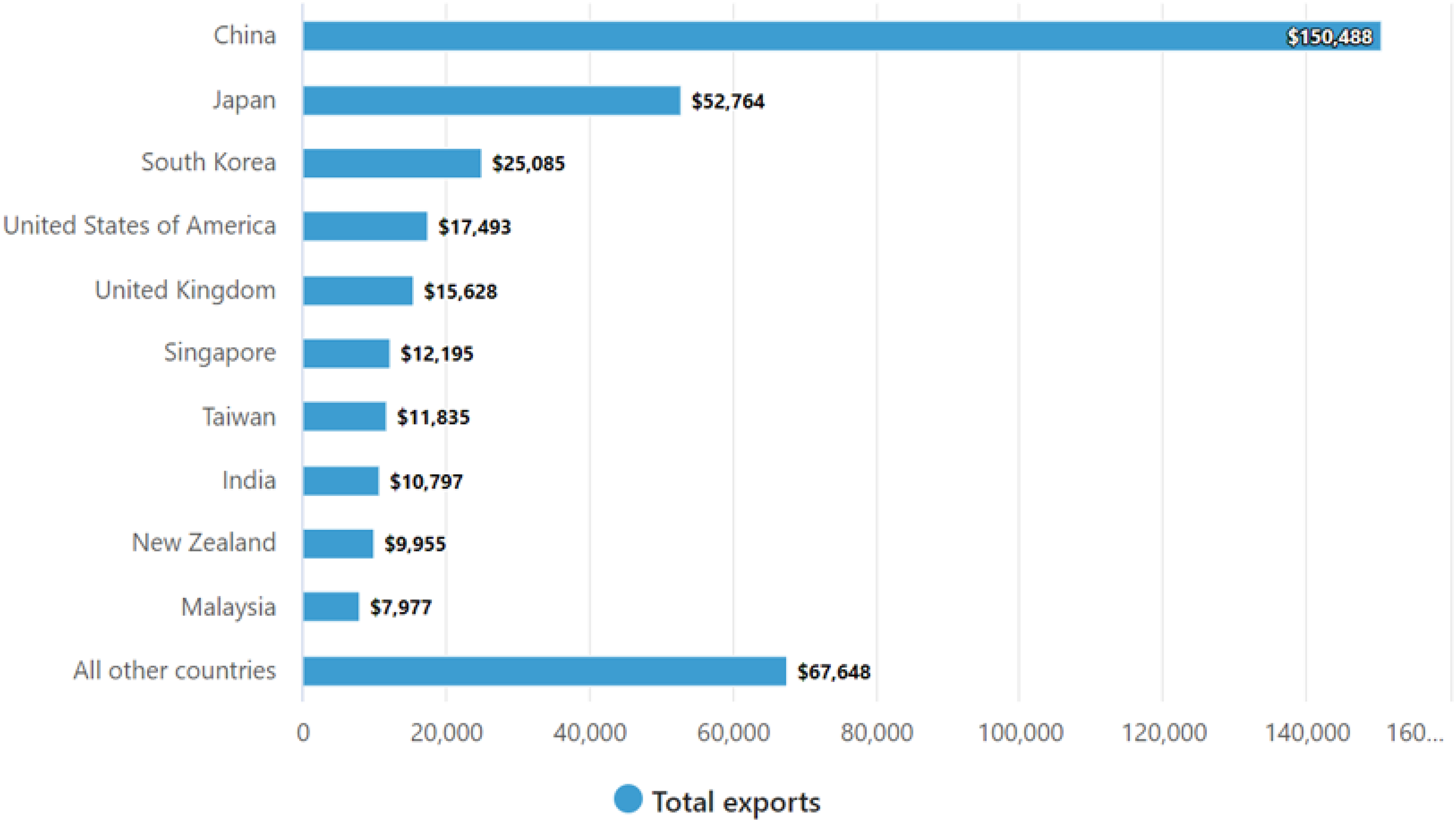
Total exports ($m) of goods, by destination country, 2019–2020(a) (p. 8).
Alternatively, Australia's trade policy may consider the PRC's interdiction approach and use domestic policy mechanisms on specific commodities. Australia has the largest known reserves of iron ore, at 52 billion tonnes, with the PRC purchasing approximately 80 percent. Its reserves are followed by Russia's 25 billion tonnes; Brazil's 23 billion tonnes, and China's 21 billion tonnes. 42 The major exporting companies are Rio Tinto, BHP Group, Fortescue Metals, ITOCHU Minerals and Energy of Australia, and Hancock Prospecting. A super tax on these companies would drive up prices and provide higher government revenue to assist those industries affected by PRC interdiction.
However, such an approach would be counterproductive because it would decrease efficiency by distorting market signals. It could also spark an investment strike or capital flight and would be a waste of government resources. By the year 2100, the UN projects that the global population will be approximately 11 billion (see Figure 3). 43 Globally, humanity must cooperate and develop enough supply capacity to accommodate the expected global demand. This may be considered the main task of the political economy—to avoid being cajoled towards socialist utopia by the PRC's vanguard elite.
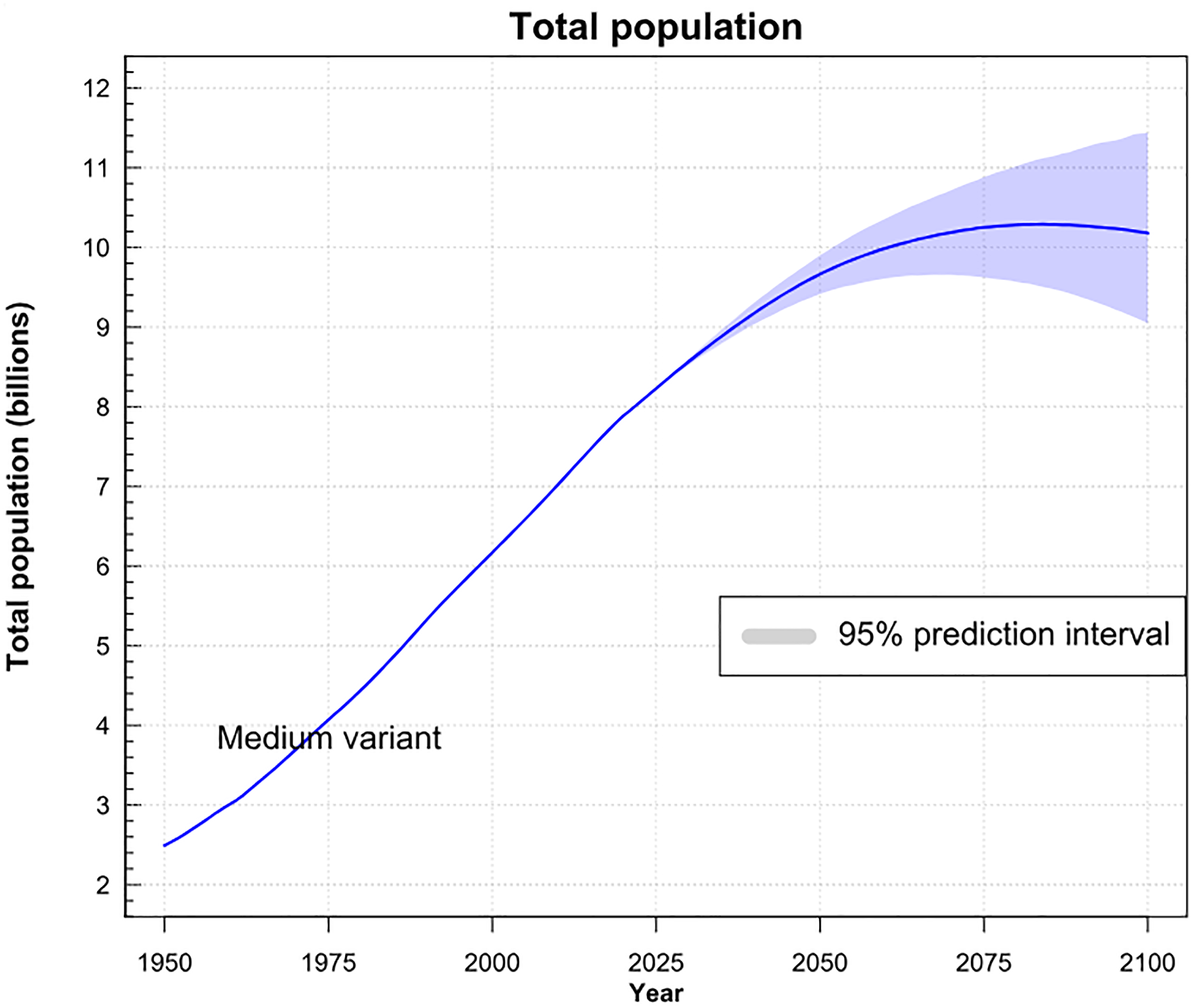
United Nations projected global population by 2100 (p. 9).
In the short term, ending trade with the PRC would be exceptionally painful for every Australian. However, Australians are determined to maintain their freedom and lifestyle. Due to China's recent insults and accusations, and the dossier of fourteen disputes and trade interdictions, as well as the impact of the pandemic, Australians are in front of government policy and would welcome a change in strategy. A 2020 Lowy Institute poll that asked: “Would you support or oppose the following Australian government policies towards China?” found that 94 percent of respondents supported the statement: “Working to find other markets for Australia to reduce our economic dependence on China.” 44
Historically, individual Australians have led the way. In 1938, the Waterside Workers’ Federation of Australia refused to load pig iron onto the steamship SS Dalfram. The then attorney general, Robert Menzies, was nicknamed “Pig Iron Bob” because the workers were in dispute with their own government. Led by their Communist leader, Ted Roach, the workers did not want Australian iron being shot at Chinese civilians by Japanese troops who had invaded Manchuria in 1937. In addition to workers’ unions, democracies have independent non-governmental organizations, intergovernmental organizations, and multinational corporations, all of which may contribute to policy that obtains broadly desired outcomes. Thus, any demand for a mercantilist trading bloc would not be a government policy dictate; rather, it would stem from individual people and firms seeking to protect their connected identities through democratic means. 45 It could even be part of a global multi-actor campaign, such as the Better Cotton Initiative, to uphold ethical and moral standards, such as against slavery and genocide. 46
Over the long term, the expanding global population will increase demand and prices for Australia's exports and facilitate development, employment, and growth. Australia's success during the pandemic is testament to its peoples’ ability to work together and accomplish difficult tasks. Australia does not practice people's war, with its associated class narrative and human sacrifice; it has an egalitarian culture of mateship, and this could form the basis of a regional response to PRC hegemonism.
Australian independence as a catalyst for collective security through mercantilist policy
Australia became an independent, federated state in 1901, but its political culture of mateship came from the eighteenth-century British ideal of pastoral independence. 47 The US, as a kindred migrant settler society, also carries these ideals, albeit expressed differently, as the “American Dream.” 48 From the early 1900s on, scholars such as William Hancock and Ian McAllister have attempted to define mateship in a more scholarly way than the accurate contemporary Australian colloquialism, “the pub test,” to embody themes such as utilitarianism, egalitarianism, conformism, collectivism, and materialism. 49
Independence through mateship in Australia is an enduring aspiration for economic self-sufficiency, within a working-class vision and without a requirement for deference or fear of oppression for expressing a political opinion. Congruently, the family farm, quarter-acre block, or small business provides economic control for legitimacy, identity, and resilience to corresponding threats such as drought and flooding, class derision, and capitalist subservience.
Successive government policies responding to mateship under the scrutiny of a free press within the rule of law, and through the democratic politics of representative political parties, have formed the Australian state as a bulwark against oppression. Thus, for all settler Australian citizens, from the first migrants fleeing the English landed gentry of the 1700s to those escaping poverty in post-World War II Europe, and to the families who escaped the catastrophic wars in Vietnam and Afghanistan, global threats form part of an existential threat to their independence that may be overcome collectively through the egalitarian principles of mateship to ensure everyone gets a “fair go.” 50
The political role of the Australian state has thus been understood as being in the pursuit of independence, which includes economic independence. Ann Capling argues that “a prime role assigned to the [Australian] state was to ensure the integrity of the social fabric in the face of anarchy of commerce.” 51 Hence, the CPC's dossier of fourteen disputes, and especially its trade interdiction—its hegemonism—towards Australians is recognized as akin to a drought or bushfire (i.e., a natural disaster), political discrimination without merit (i.e., political oppression by an aristocracy or regime), and unjustified economic loss (i.e., through being defrauded by a company, low wages, or simply bad luck). It is culturally unacceptable and must be resolved through mateship.
Indo-Pacific mercantilist policy
Australian state officials such as the Australian ambassador to the PRC, Graham Fletcher, warned the Australia China Business Council in 2021 that the PRC is an unreliable and vindictive trade partner that cannot be trusted. 52 South Australian ex-trade minister Tom Kenyon, in an article entitled “We must cut China ties I helped build…,” stated that “Australia needs to begin disengaging economically from China or, at the very least, limiting our exposure to the Chinese economy.” 53 Austrade's website prominently states: “The Australian Government is aware of reports that trade disruptions have affected some goods entering China from Australia.” 54 The government is already advising Australian businesses to diversify their existing markets and also to adopt more mercantilist policies to actively create new markets in the Indo-Pacific. Key to courting Indo-Pacific states is to be open about the PRC's unreliability and vindictiveness as a trade partner and to encourage trade between honest governments (in other words, to help out our mates).
Thus, the broad question to be answered is: Who are Australia's close partners and what can be achieved for a viable Indo-Pacific? If the US, Five Eyes partners, Japan, and the Association of Southeast Asian Nations (ASEAN) are existing partners, then India, Indonesia, and the South Pacific Islands states are the most important to develop. The Quad is a positive link to India, but bilateral trade relations are a significant opportunity to develop both states and the region. Notably, the Australia-India Economic Cooperation and Trade Agreement, started 29 December 2022, will be fully implemented by 2026, with businesses expected to benefit. 55 Australia already has advanced relations with Indonesia and the South Pacific Islands states through the Indonesia-Australia Comprehensive Economic Partnership Agreement of 5 July 2020 and the Pacific Agreement on Closer Economic Relations Plus of 13 December 2020, both of which could be better utilized and expanded. 56 Thus, to achieve mateship for the Indo-Pacific, Australia may consider looking to India and working alongside Indonesia and with its South Pacific family.
The biggest component missing from the Indo-Pacific states’ policy coordination, beyond excluding the PRC for viable development, is a mercantilist policy to create a regional market to enable regional trade. The Quad's COVID-19 response—sharing tools and expertise to manufacture and distribute one billion Indian-manufactured vaccines, using capital from the US and Japan and with “last mile” logistics by Australia—is a good example of what is possible 57 and was of great interest to the media. Delegates of the first summit created the Quad Vaccine Partnership/Quad Vaccine Experts Group, and agreed to create two groups of greater long-term importance: the Quad Climate Working Group and the Quad Critical and Emerging Technology Working Group. 58 The second summit, held on 24 September 2021, expanded and consolidated these initiatives. 59
Businesses inherently exhaust modes of production and seek a return on investments, and for the past several decades—especially following the Asian Financial Crisis—they have focused on the PRC and have developed capital allocation plans to increase their investments. However, states create markets, and Indo-Pacific states can change the rules to change what investment follows. The liberalization of trade, as encouraged through effective policies by the WTO, World Bank, and International Monetary Fund, may continue with honest, reliable members. 60
However, Indo-Pacific viability also depends on states aligning policies in a mercantilist manner to create a stable market (for example, by lowering tariffs, standardizing procedures and product standards, building infrastructure, and providing aid for trade, tax incentives, free trade zones, education, and promotional support). The goal may be to build a viable Indo-Pacific market by addressing two questions: How are goods and services going to cross state borders? How are goods and services going to be paid for? Essential is a reliable, resilient flow of high-quality goods and services that underpins the quest for personal success. To consolidate a community that accepts pluralism, debate, and the rule of law, the Indo-Pacific states may consider working together and competing within a transparent market of their own making, to deter PRC hegemonism.
Collaborations could be deliberately expanded, and into areas such as the environment and supply chain resilience, as identified by the Quad working groups. Sun Cable is a good Indo-Pacific collaboration between Singapore and Australia that will generate renewable power in Australia and deliver it via cable to Singapore and eventually ASEAN. 61 Malaysia, Australia, and US cooperation through Lynas Corporation is an Indo-Pacific enterprise to supply rare earths to the Indo-Pacific. 62 Also critical to the Indo-Pacific markets are the technologies developed through the Fourth Industrial Revolution (for example, 3-D printing, 5G internet of things, artificial intelligence, autonomous vehicles, biotechnology, blockchain, energy storage, materials science, nanotechnology, quantum computing, robotics).
The largest and most developed states, including the Quad states, could provide the Indo-Pacific with public goods, both political and economic. This could include a center for the study of the Indo-Pacific, which could study democracy, lead regional education campaigns, and encourage links between regional political parties, in this way engendering a whole-of-society approach. Such a center could support government market creation with independent research, scholarships, and people-movement opportunities. Land, labor, capital, and enterprise may all be put towards infrastructure and education to foster a substitution model for Chinese imports with an intra-regional export focus.
India's inability to resolve post-independence regional issues, such as relations with Pakistan, principally concerning partition and Kashmir, seemingly prevent it from playing a great power role of leading the political agenda and being a consumption economy. The US hub-and-spoke security approach of the Quad + does not deliver a viable economy without India. India's proposed India-Middle East-Europe Corridor indicates an expanding awareness of the role that the Indian state may play in market development and the complementary provision of public goods. Similarly, Indonesia has the potential to play a larger role and needs support with education and infrastructure, plus market access and development. The South Pacific Islands states, including Australia, could benefit from a focus on Indigenous sovereignty, research on how to progress the sovereign Blue Pacific, 63 infrastructure, and buttressing environmental outcomes, such as through the creation of an organization of coal-exporting countries or OCEC (see below).
The Indo-Pacific may also employ offensive mercantilist policy, comparable to what is already demonstrated by the PRC's Belt and Road initiative. The creation of an OCEC would enable market intervention by the Indo-Pacific coal exporters Australia, Indonesia, the US, and Canada (and potentially South Africa and Columbia). 64 The OCEC could increase the price of coal, reduce consumption, pool funds, and develop new energy technology (such as fusion), 65 thus benefiting the environment and at the same time increasing the cost of coal to encourage climate policy accountability by the PRC. The PRC is the world's largest producer, importer, and consumer of coal, burning more than 50 percent of the coal used globally (see Figures 4 and 5). 66 The PRC creates the most CO2 emissions and, despite declaring a zero emissions target, plans to build hundreds of new coal-fired power stations under its fourteenth five-year plan for 2021–2025. 67
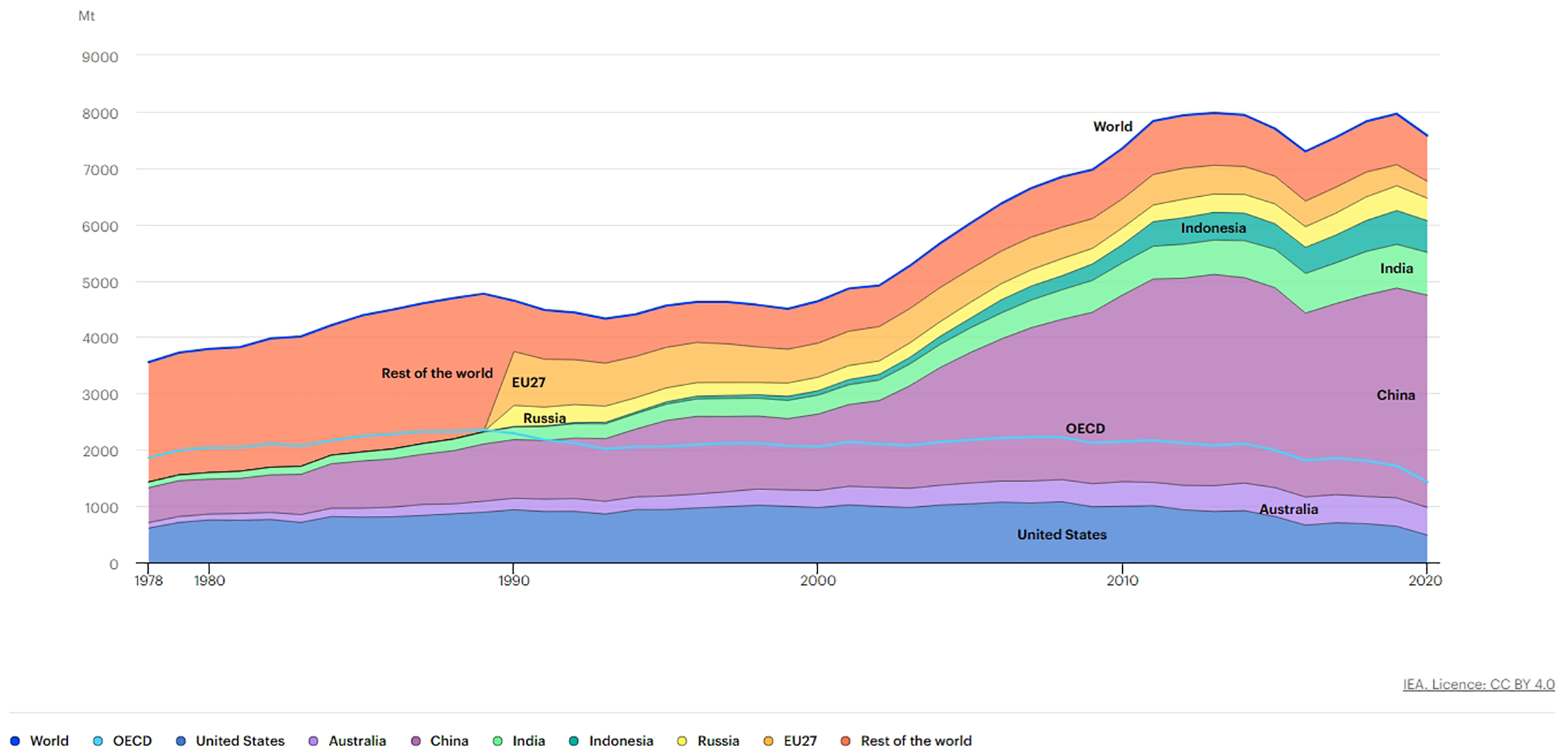
World total coal production, 1971–2020 provisional (p. 12).
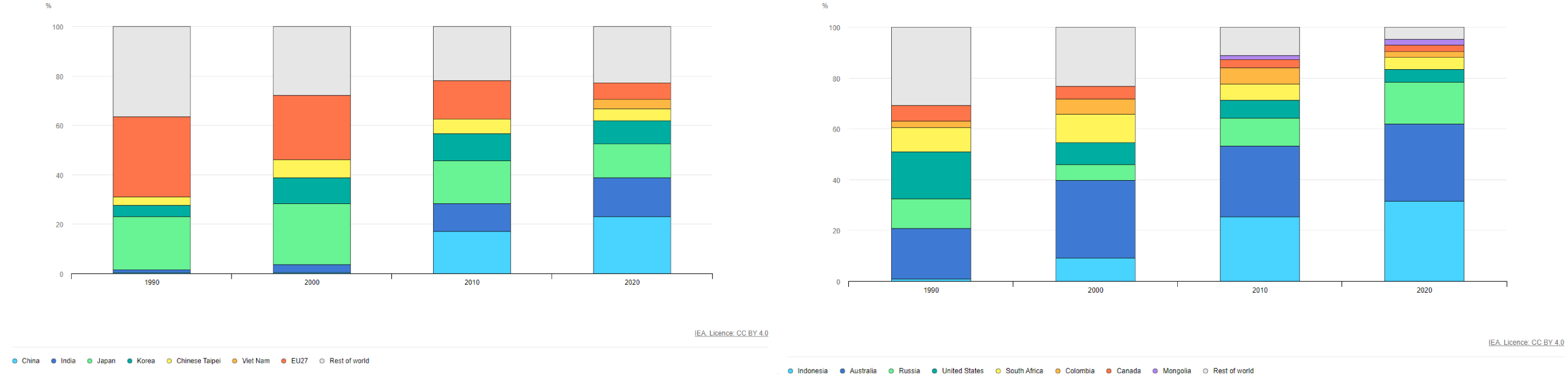
Share of coal imports and exports, 1990–2020 provisional (p. 12).
Conclusion
This article's aim has been fourfold: 1) to analyze the changed statecraft of the PRC in relation to Australia and the Indo-Pacific region, and how it threatens the stability and development of the global system; 2) to argue that the PRC's hegemonism, driven by its Marxist–Leninist ideology, is incompatible with the political freedoms and economic opportunities of the Indo-Pacific peoples; 3) to propose that the Indo-Pacific states may need to form a mercantilist bloc to counter the PRC's hegemonism and to sustain their human security and collective well-being; and 4) to contribute to the debate on the definition, purpose, and viability of the Indo-Pacific as a geopolitical and geo-economic concept. The limitations of the article, which are also possible opportunities for further research, include the geographical scope; the impact of other ideological perspectives on PRC statecraft beyond Marxism-Leninism; the quality of data available and predictive limitations that may be improved; and middle power and Indo-Pacific definitions, functions, and uses.
This political economy study of contemporary events finds that the use of mercantilist policies within the expanding liberal global market is a policy option to ensure the continuance of political freedom and economic development in the Indo-Pacific. Australia and other democracies have experienced a change in the behavior of the PRC that constitutes systemic rivalry, which threatens their continuance as sovereign states. The CPC is the political party presently leading the Chinese people. Its Chinese Marxist-Leninist ideology, combined with carefully selected history, has created the capacity for hegemonism and conflict, and threatens the contemporary rules-based order. The Indo-Pacific community, by accepting the PRC at face value, ignoring “what-aboutism,” and focusing on outcomes, could create a viable Indo-Pacific to counter PRC hegemonism. Australia and other middle powers may rely on collective security led by the US, India, and Japan, or may expand their hard power capabilities. Indo-Pacific states that wish to be free of Chinese Marxism-Leninism can collaborate on mercantilist policies to shape their strategic environment, enabling viable development and awaiting the demise of the CPC's current policy of hegemonism.
Footnotes
Declaration of conflicting interests
The author declared no potential conflicts of interest with respect to the research, authorship, and/or publication of this article.
Funding
The author received no financial support for the research, authorship, and/or publication of this article.

Notes
Author Biography
Dr. Jonathan Ping is an associate professor at Bond University. He is a graduate of the University of Melbourne and received his Ph.D. from the University of Adelaide. He is a political economist who specialises in the study of statecraft. In this area he has developed the first unifying theory of the middle power concept—hybridization theory—as presented in his book Middle Power Statecraft. His current research focus is on great power statecraft theory, middle power statecraft theory, and a theory of the nature of hegemony in and from Asia. He is Founder and a Director of the East Asia Security Centre.