




Abstract
Advocates of progressive political economy agree that the neo-liberal economic order has worsened environmental degradation, worker precarity, and oligarchy, but what are the alternatives? This article relates left-progressive discourses about concrete approaches and policy ideas to implications for the global economic order. While progressives explicitly seek a more social democratic global order, the various policy initiatives in the progressive imaginary implicitly involve approaches to order-building that are in scarcely acknowledged competition with one another. While neo-Keynesianism, justice for the Global South, a Global Green New Deal, and degrowth are all anti–neo-liberal approaches that pursue the same broad aims—reducing inequality within the Global North, raising standards of living and buffering structural violence in the Global South, and responding to the climate crisis—these goals potentially exhibit the tensions of a trilemma.
Keywords
The political economy plays an outsized role in left-progressive thinking. Not only is economic inequality a concern of everyone on the left, but the anti-militarist character of progressive foreign policy finds the sources and remedies for global insecurity primarily in the domain of political economy. 1 But what alternatives are there to the neo-liberal economic order that has prevailed since the 1970s, and where do they converge with and diverge from one another?
Since the 2008 global financial crisis, there has been an intellectual ferment fusing long-running left-progressive resistance critiques against neo-liberalism, with positive demands that range from modest reform policies to radical transformations of the international system toward a “post-capitalist” imaginary. This article explains how the dozens of policy ideas found in those discourses explicitly seek a more progressive (social-democratic) global order, but implicitly involve approaches to order-building that are in scarcely acknowledged competition with one another.
Accordingly, I make two arguments. First, left-progressive policy proposals can be organized based on how they align with competing “models” for global order: neo-Keynesianism; justice for the Global South; a Global Green New Deal (GGND); and degrowth. Each has distinct priorities driving its approach, prescribes distinct ways of overcoming neo-liberalism, and is logically compatible with a finite range of policies. Second, while all four approaches pursue the same broad goals—reducing inequality within the Global North, raising standards of living and buffering structural violence in the Global South, and responding to the climate crisis—these goals potentially exhibit the tensions of a trilemma. While there are some policies that would advance all three, most government action would not advance them equally, implicitly privileging one above the others. Optimizing policy for responding to the climate crisis and reducing inequality within the North limits how you reduce economic precarity in the South. Optimizing policy for responding to the climate crisis and improving life chances in the South constrains the ability to reduce inequality within the North. And optimizing policy for reducing inequality within the North and precarity in the South requires compromising how you respond to the climate crisis. Knowing where and why the policy imaginary that reaches to the left of neo-liberalism implicates competing models helps ensure awareness of what progressive goals are being subordinated in order to realize others. The novelty of this research is thus in both linking specific policy ideas to larger models of economic order and identifying risks of each model. Put differently, I am relating policies to ordering constructs for the global political economy. These would be legible to leftists and progressives, both because they reflect social democratic ends and because the ideas themselves exist as a somewhat unorganized patchwork of floating proposals and debates on the left.
The remainder of the article proceeds in three parts. The first part briefly establishes a multidimensional critique of neo-liberalism from the left, and the shared goals of a progressive economic order that respond to those criticisms. The second part, comprising the majority of the article, constructs multiple models of progressive political economy by surveying left-progressive literature on anti-neo-liberal political economy—these models represent different arguments or proposals for how to realize progressive anti-neo-liberal goals. It foregrounds the ways in which the four approaches are not fully fungible, but also identifies the kinds of specific policy ideas that could be areas of convergence. The third part foregrounds the trilemmatic tensions across these four approaches to progressive economic ordering in the form of intra-progressive critiques of each. It is possible to navigate these tensions, but only by first identifying how each approach sets different priorities and what policies risk pitting them against each other.
A progressive order against neo-liberalism
Advocates of the neo-liberal economic order that has prevailed since the 1970s brand it as “grounded in the belief that market forces had to be liberated from government regulatory controls.” 2 As an ideology, though, neo-liberalism represents the primacy of capital over labour, and subordinates public policy accordingly. 3 Neo-liberalism's proponents pitched deregulation, austerity, and unencumbered foreign investment as a set of prescriptions that might increase inequality but that would generate absolute gains—all could be better off as a result of capital mobility, barrier-free trade, and global production networks. Centre-left political parties touted the belief that such a globalization-facilitating approach to political economy would actually reduce inequality. 4 Globally, this led institutionalized leftism to support “watered-down versions of neo-liberalism that barely differentiated it from the centre-right.” 5
But left-progressives judge that the centre-left's bet on neo-liberalism has failed. Neo-liberal policies have facilitated oligarchic concentrations of wealth at the same time as they have obliterated the power of organized labour and forced workers into a global Hunger Games-like race to the bottom in terms of wage competition. 6 This has negatively affected the Global North and South, but in different ways—in the Global North, it has suppressed wages and taken jobs away (especially in manufacturing) and relocated them to the Global South, where they exist as lower paying, more environmentally damaging, and tax-avoiding gigs that rely on repressive working conditions. It has also given rise to a global “precariat”—billions of workers who are not only underemployed but whose jobs are chronically casual and insecure—and that precariat has a different character in the North versus the South. 7 Even aside from its specifically economic consequences, the economic insecurity wrought by the neo-liberal economic order has given rise to a new global far right and accelerated environmental degradation. 8
In short, progressives find the neo-liberal bargain unacceptable. But neo-liberalism's shortfalls have created a breach in the discourse about economic policy that left-progressive ideas have entered. And the belief that politics must intervene directly to redistribute capital, protect the environment, and improve economic security for workers has become core to modern left-labour politics, and arguably the defining cleavage between it and the economic neo-liberalism that has been the reigning orthodoxy of party-based left-liberals for a generation.
Competing approaches to a progressive economic order
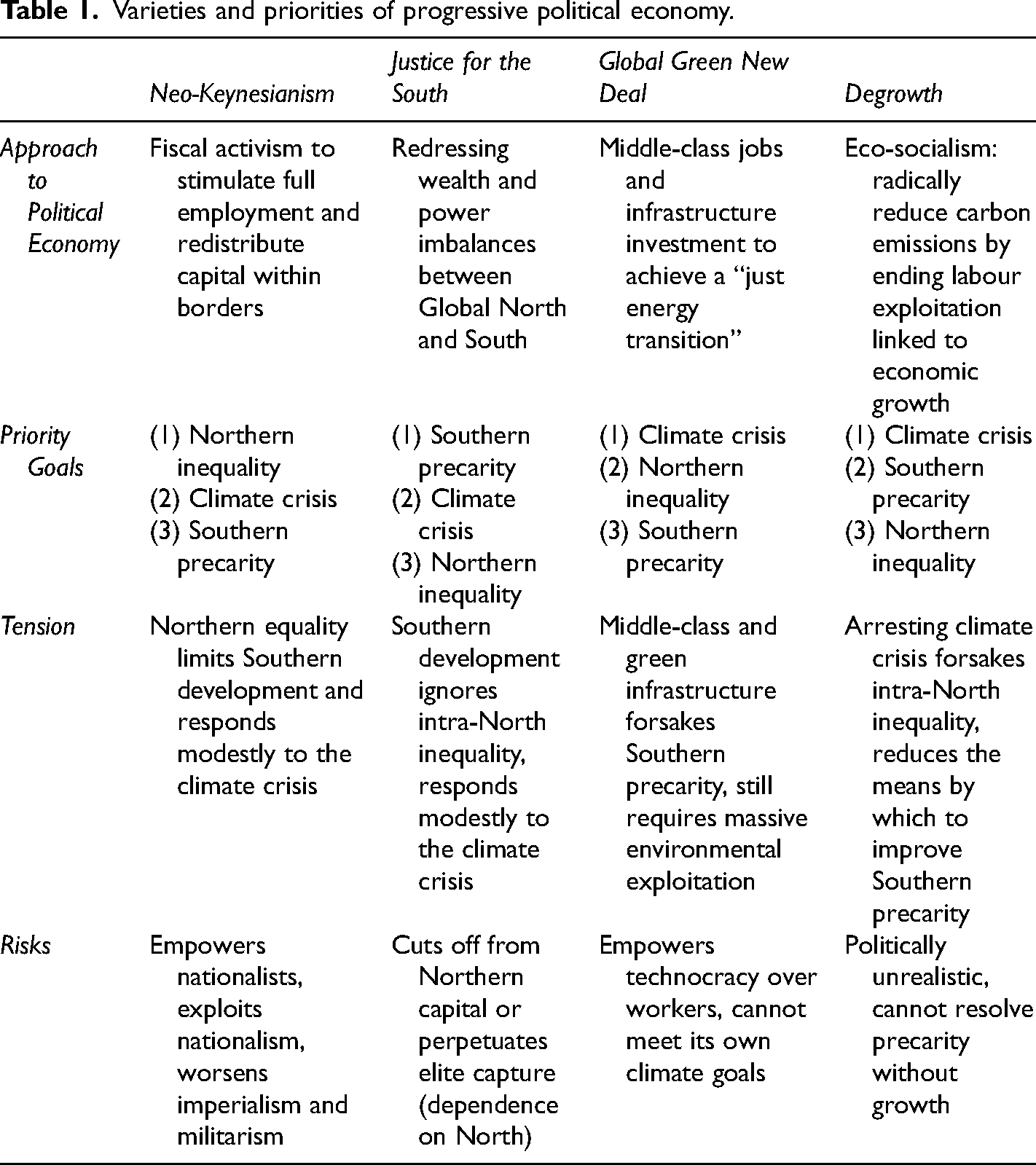
Table 1 contrasts the alternative approaches to post-neo-liberal economic order-building and how they implicitly rank progressive goals differently. Neo-Keynesianism asserts the power of the state on behalf of skilled jobs and infrastructure. Justice for the Global South insists that addressing inequality starts with correcting historical power imbalances between the Global North and South, which translates into resources that help the developing world achieve both ecologically- and economically sustainable governance. The GGND tells us that massive financial investments in renewable energy production and measures to mitigate the effects of climate change on the world's poor offer an economically just pathway for getting the world to net-zero carbon emissions. And the degrowth movement offers prescriptions that would do the most to arrest the climate crisis, albeit by halting some forms of economic productivity and focusing instead on economic redistribution. I am constructing these models out of prevailing left-progressive economic and environmental discourses—with the exception of the GGND, champions or agents of these various models advocate on their behalf implicitly or un-comprehensively, via discrete policy proposals or grand but imprecise visions (i.e., without transparency about either the hierarchy of goals or the risks and tradeoffs of their proposals).
Varieties and priorities of progressive political economy.
Neo-Keynesianism
Keynesian economics became the basis for fiscal and monetary policies of labour-aligned political parties during the 1930s. 9 It attempts to deal with unemployment and extreme wealth inequality through increased aggregate demand, which it achieves by combining government stimulus-spending, tailored taxation policies, and interest-rate setting. During periods of economic depression, government intervention may be the only source of demand growth.
Although Keynesianism fell out of favour in the 1970s as neo-liberalism became economic dogma globally—even in centre-left parties—it has since seen a revival since the 2008 global financial crisis, which taught us that “if you have an activist central bank, you can do whatever … you like in terms of fiscal policy … you can run up debt like you did in World War II.” 10 This is the essence of what might be called neo-Keynesianism, which is no longer just about aggregate demand but rather a fiscally activist approach to political economy that channels government resources toward equality within national borders, domestic worker power, national public infrastructure investment, and full employment. 11 These are all classically progressive priorities whose realization requires breaking away from neo-liberal austerity and privatization in favour of more ambitious government spending, taxation, and regulation.
Internationally, a neo-Keynesian orientation privileges policies that centre economic actors in the Global North. For instance, a global minimum wage and minimum tax would make labour in advanced industrial economies more competitive internationally while raising global living standards. So would “employee funds,” which are sovereign wealth funds owned by corporate wage earners (usually via unions) and capitalized by a portion of corporate profits. 12 This social-democratic structure could generate the capital needed for international projects and a green-energy transition at home and abroad. In a similar vein, a Tobin tax is a form of national capital control that would impose a nominal, proportional tax on global currency transactions to suppress the kinds of currency speculation that triggered the Asian Financial Crisis in 1997 and 1998. 13 Global North labour, the most direct beneficiaries in neo-Keynesian schemes, have also been champions of increasing market-access quotas for international economies that show progress on labour power or allowing unions to form, which reduces the labour-based competition between domestic and foreign workers. In 1997, the US granted Cambodia increased import quotas for textiles on the condition that Cambodia permit its garment workers to unionize. 14 In this way, the developing nation would get a larger volume of exports and the nation's workers would get basic bargaining rights. This shows that the needs of Northern labour unions are not necessarily at odds with those of labour unions in the Global South, as is the movement to seek “floor wages” in certain sectors of the global economy like textile production. 15
Neo-Keynesianism grants far greater economic sovereignty to national governments than neo-liberalism, which makes possible policies like the “right to ban” foreign imports even under conditions of zero tariff barriers for reasons of national well-being (for instance, Europe's restrictions on genetically-modified food). Yet this approach to the political economy also limits economic sovereignty. Progressives have argued that Investor-State Dispute Settlement Courts (ISDS)—a global legal mechanism that allows companies to sue national governments outside national courts—should either be shut down or expanded to allow individuals and civil society groups to bring cases against corporations or governments. 16 The neo-Keynesian model has also stressed corporate supply-chain accountability, making multinational corporations liable for labour, human rights, and environmental standards implicated by their contractors or partners anywhere in their supply chain.
Contra the neo-liberal ethos, supply-chain accountability would require much greater regulation of large corporations than has previously been the case, but it would also make companies much warier of offshoring and outsourcing based purely on the cheapest labour inputs. As an adjunct to this revolutionary form of corporate responsibility, progressives have proposed social-dumping tariffs as a pro-labour, pro-justice way of making it easier for corporations to operate clean supply chains. 17 Just as Northern economies can impose anti-dumping tariffs on imported goods whose price and supply undercut domestic markets, so could they impose tariffs on imports whose price and supply undercut domestic markets when relying on the exploitation of wage-starved and precaritized workers.
As an essentially nation-first perspective on economics, neo-Keynesianism provides a distinct answer to the climate crisis. The most direct, mainstream response is national-level legislation for a “Green New Deal”—large public investments in renewable energy, sustainable national infrastructure, and a green-jobs program. Another response involves drawing on national economic power to impose “green” sanctions in the form of tariff penalties or restrictions for products manufactured at the expense of environmental damage or with excessive carbon emissions. The EU's carbon border adjustment tax is a passive method of green sanctions that, if adopted by other advanced industrialized economies, would synergize Global North policies on climate. A more activist method would involve targeting sanctions against corporations or international actors who are causing environmental damage. 18 Neo-Keynesianism could also address climate change through monetary policy. The practice of “quantitative easing,” a national tool, gives central banks the ability to infuse capital into the economy through commercial banks. Left-progressive economists have argued that this practice could be extended to public banks, capitalizing them for the purpose of making investments in sustainable energy transitions. 19
Justice for the Global South
Raising standards of living in and reducing structural violence against the Global South requires de-colonizing the international political economy. As many colonial territories converted to nation-states after World War II, the extractive economic order that had been part and parcel of the European and American empires did not transform to the same degree as the political order did. Conceptualizing the very existence of a Global North and South was a prerequisite to making sense of patterns of economic dependency through which the enrichment of the North, or “core,” in perverse ways required the deprivation and impoverishment of the South, or “periphery.” 20 The new forms of economic exploitation sustained through international financial institutions and global power imbalances favouring the North over the South came to be understood as neo-colonialism or neo-imperialism. 21
Taking the progressive imperative for economic equality seriously means taking seriously the dramatic development inequalities dividing the OECD nations and what used to be referred to as the Third World. Many progressive policy initiatives aim to center the Global South, rebalancing its wealth and power with that of the Global North and unwinding the processes of resource extraction and structural violence perpetuated there. But there is more than one imagined path to justice.
New International Economic Order
The New International Economic Order (NIEO) emerged as a set of Third World demands during the Cold War and passed as a UN General Assembly resolution in 1974. So many different proposals were part of the NIEO concept that the acronym became something of a floating signifier, but the common denominator in those demands was a material redress of colonial pillaging of the Global South. This included price stability for commodities that Global South economies relied on for export, ending Western subsidies in those commodities so as not to undermine Southern development, increased market access for Southern exports, development aid that did not include “structural adjustment” conditions and that instead respected the economic sovereignty of the South, debt restructuring or forgiveness, and support for building infant industries in the South through non-reciprocal protectionism. 22 And although the NIEO was overtaken by neo-liberalism before it ever gained traction, it has recently been revived in the form of the Havana Declaration of January 2023, a bloc of seventy-seven countries championing a new NIEO, drawing not just on inspiration but also directly on those older prescribed policies. 23
South-South interdependence
The NIEO remains the keystone for Global South-first strategies of reforming the economic order, though the vision has evolved. In one version that draws on Third Worldism, Black Internationalism, and anti-imperialism, the Global South needs to build interdependence within itself, forging strong South-South bonds that decrease reliance on the North. 24 The South must “shift from the external [North] to the internal [South] market so as to ensure that the poor majority of our population participates in the growth process both as consumers and as producers.” 25
The policy agenda for South-South interdependence overlaps with the NIEO, but the principal effect it seeks to achieve involves breaking patterns of export dependency and eliminating the compromises of fiscal sovereignty that come with dealing with IFIs and Western nations on an individual basis. That means the NIEO approach of seeking greater market access in (and offshoring capital accumulation in) the US and Europe is contrary to South-South aims. Instead of Southern economies exporting capital to finance American military adventures, “[expanding] domestic markets, reorienting trade, and shifting away from the US dollar as a reserve currency [toward dollar multilateralism] would remove this source of support for imperialism.” 26
Progressive globalization
An alternative path to better conditions in the South is “progressive globalization,” which argues for “the management of globalization by multilateral institutions under principles of social justice.” 27 It seeks to embed capitalism within an international social democratic order, demanding many of the reforms sought as part of the NIEO—for Global South trade barriers to fall only after a period of sufficient sectoral development, to end OECD agricultural subsidies, to fix pricing systems in commodities that the South exports, and for intellectual property exemptions that would allow the South to address its public health needs. 28
In addition to these, progressive globalization's two major planks involve strategically directing capital from the Global North to investment in the South, and ending the neo-liberal practice of liberalizing public services, national infrastructure, and utilities. By avoiding deregulation and austerity and capitalizing projects in developing economies, progressive globalization will power global growth via increased consumer and production demand in the South (where a neo-liberal order has stifled demand beneath its potential by starving it of equity investment). 29 Some of the neo-Keynesian schemes like the Tobin tax and “employee funds” would generate the capital necessary for the Global North to play this altered role toward the South. But intellectual property covenants, which are a priority for economies in the Global North and the US in particular, are an impediment to Southern development.
Reparations and restorative justice
A reparations-based approach to the Global South is a hybrid of progressive globalization, the NIEO, and South-South interdependence. Its policy prescriptions are not that different from progressive globalization, but its reasoning has to do with a forward-looking restorative justice. Those with the most resources—that is, the “people and institutions that have benefited the most from these historical processes” of imperialism, slavery, and later neo-colonialism—should bear the disproportionate cost of building a just international economic order. 30
Put to that purpose, economic statecraft should be expanding climate financing and technology transfers to aid developing economies with their transitions to environmentally sustainable modes of development. It should be granting zero-tariff market access to exports from the Global South. And it should favourably reallocate to the Global South the IMF's “Special Drawing Rights” quotas—dollarized coupons allocated on a country basis that national financial institutions can exchange for real money to pay for public goods, emergencies, or currency reserves. Just as voting rights in international financial institutions are allocated overwhelmingly in favour of the US and Europe, so too are Special Drawing Rights (SDRs), which the IMF grants disproportionately to the world's richest countries, even though they rarely make use of them. 31
This is a waste of resources that could benefit developing economies, and it results directly from an unfair imbalance of power in the international economic order. Immediately correcting this problem entails either eliminating the IMF's quota system for SDRs in favour of some South-favouring rule-set for allocation, or else redirecting the SDRs that the US and OECD nations receive toward climate investment funds and multilateral development banks. Longer term, the IMF should not be allocating voting share within the institution on the basis of a country's share of the global economy because that literally means that the richer you are, the more power you are given. Undoing legacies of colonialism like this are not just penance; they are how to realize better conditions in the world.
One of the most powerful proposals to transform both North-South relations and the living conditions of the Global South also happens to be among the most antagonistic to neo-liberal capitalism—debt justice. Progressives concerned with the developing world have urged OECD economies to concentrate their influence, bureaucratic attention, and resources toward alleviating debt burdens in the Global South. 32 Sovereign debt involves the public debts accrued by a foreign government, which can come from either private borrowing in financial markets or from IFIs and public finance (lending by other governments). “Odious” debt is sovereign debt accrued by oppressive regimes whose people carry the debt burden even after the regime has changed. For embattled economies in the South, debt is a mechanism of direct harm to social welfare and national development.
In cases where the debt is owed to Global North governments or an IFI, canceling the debt outright should be a priority, especially if the debt can be legally classified as odious debt. 33 In cases where the debt is a private creditor or consortium of creditors, governments in the Global North should be using their influence to negotiate debt restructuring and partial forgiveness, either by slashing interest rates on loans, extending repayment terms, or securing outright moratoriums on repayment. 34 Northern governments also could, depending on the circumstances, either offer “grant-in-aid” funds as a vehicle to take over paying sovereign debts for another country or, barring any of the above, could secure or offer “concessional terms” on exports from the indebted country as an offset for debt repayment. Whatever the method of debt relief, the basis for policy change requires recognizing that debt is in many cases an unresolved legacy of historical injustice, an albatross around the neck of developing economies, and a source of long-term geopolitical risk. All of that makes prioritizing debt relief as a problem worthy of strategy and statecraft.
Global Green New Deal
In neo-Keynesian and Global South approaches to progressive political economy, the threat of climate change is instrumental rather than essential—an area of policy activism and a means of realizing other goals, but not the focal point. For the GGND and its derivative proposals, though, saving humanity from environmental destruction is the goal of orchestrating political-economic action; generating middle-class jobs and infrastructure happens to be instrumental to the vision for how to save the planet.
Sometimes also referred to as plans for a “just energy transition,” the GGND concentrates policy change and resources on reducing anthropocentric harm to the environment and environmental harm to humanity, seeking “a fair transition to a carbon-free economy.” To reach this goal, advocates have called for four broad priorities: the world's governments must achieve large reductions in greenhouse gas emissions by 2030 (somewhere between 45 percent in reductions and net zero, depending on the proposal); renewable energy resources must be dramatically expanded; workers in the fossil fuel industry must not experience economic insecurity; and the economic order must be both environmentally sustainable and raise “mass living standards.” 35 Although addressing climate change is its ultimate raison d’être, the GGND's proponents also see it as a way of “driving the transformation of capitalism away from its current interregnum between neo-liberalism and neo-fascism.” 36
The Global South features prominently in the GGND for two reasons. One is because “it is poor countries and poor people who stand to bear the greatest cost of global warming”; countries in the South lack technological adaptations for daily life (sea walls and air conditioners), and live in places where climate change is already having the greatest impact. 37 The other is because there is no solution to climate change without arresting carbon emissions from those parts of the world. OECD countries are responsible for most historical carbon emissions, but the developing world collectively accounts for 63 percent of emissions today, and close to 90 percent of emissions growth projected out to 2040. 38 At best, a green energy transition limited to the Global North marginally slows but does not stop the effects of climate change.
Accordingly, the GGND calls for massive outlays of climate financing on the order of $2 trillion per year, which Northern economies should fund proportional to their share of global GDP. 39 Some of this could come from a carbon border adjustment tax and a domestic carbon cap that imposes taxes on carbon-producing firms beyond a specified ceiling. Some could come from monetary policy, directing quantitative easing toward capitalizing climate sustainability programs at public investment banks. Some funding could also come from industrial policy. For instance, Northern governments can use (and encourage foreign governments to also introduce) “feed-in tariffs” to direct public utilities to buy renewable energy from private renewable energy producers, reducing the risk and increasingly the profitability of investing in renewable energy production. 40 But most of the funding for the GGND would necessarily come from the US and European Union issuing climate-related bonds that would direct money raised to a fund managed by multilateral institutions (for instance, the United Nations manages a “Green Climate Fund”). 41
The purpose of all this financing is to help the South transition to green economies that substitute renewables. Supporting measures that further the GGND's larger aims include green sanctions, intellectual property waivers that would support organic agricultural production and lower-carbon manufacturing practices, renegotiating debt burdens in exchange for carbon emission reductions, and reallocating voting share in the World Bank and IMF. But the kernel of the GGND project is unlocking world-historic levels of funding to move the global economy to renewable energy while improving global standards of living.
Degrowth
The conceit of the degrowth movement is that humanity can live happily and healthily with a “radically smaller resource throughput” than it uses currently. 42 The movement sees capitalist production and consumption as both unnecessary and the ultimate source of global carbon emissions that are wreaking havoc on the environment. 43 Consequently, in its approach to the international economic order, the degrowth movement urges its adherents to break away from “development” and growth as measures of global and national success in favour of an ecologically sustainable economic life. 44
There is more than one way to “do” degrowth, but three goals are common to most proposals: reducing human impact on the environment; increasing economic redistribution/equality; and forging a cooperative way of life that relates human beings to each other and to the environment. 45 These goals converge with the GGND in many specific policy areas. Utilizing green sanctions, technology transfers to the South, climate finance, intellectual property waivers, the renegotiation of debt burdens, and democratizing voting share in the IMF and World Bank—all these measures would advance a GGND and degrowth agenda because they address global inequality and reduce humanity's carbon footprint. Some degrowth proponents have even argued for a “Green New Deal without Growth” that would incorporate degrowth policies into the GGND agenda. 46
But there are two major points where degrowth and the GGND diverge and affects how their policy proposals are described. One is that degrowth advocates see the GGND and other mainstream pro-environmental policies as inadequate for the urgent task of preventing increases in global temperatures beyond 1.5 °C. Keeping the temperature from changing that much requires, in the most modest version, halving global emissions by 2030. As ambitious as the GGND is, it will not reach that target, which the Intergovernmental Panel on Climate Change (IPCC) believes is the critical tipping point for the planet. 47 Moreover, degrowth critics of the GGND believe that renewable energy cannot be generated at a scale sufficient to sustain economic growth, and further, that simply substituting renewable energy for fossil fuels reduces carbon emissions, but at the expense of even greater heavy metal and mineral extractions that will themselves lead to ecological breakdown. 48
Degrowth, by contrast, presumes that “the slower the rate of economic growth, the easier it is to achieve emissions reductions.” 49 The world can reach IPCC-designated climate targets if OECD countries bring an end to processes of overaccumulation and prioritize policies of redistribution (rather than growth) within the North while facilitating forms of “green” development in the South.
The other main difference between degrowth and the GGND is that advocates of the former understand the growth obsession of modern governments as constitutive of the historical processes of colonial exploitation and extraction; theirs is a green anti-colonial critique of capitalism. 50 That makes shifting to a more cooperative, inclusive political economy—which presupposes greater justice for the Global South—the way of ending governments’ Gross Domestic Product-focused mindset and thereby reducing productivity in sectors that harm the environment. If the world allows economic growth to continue being treated as a political necessity, governments will not be able to halt productivity in ecologically damaging sectors of the economy.
The progressive trilemma
These different proposals for a more progressive economic order broadly respond to the entwined problems of economic inequality in the North, higher standards of living in the South, and the climate crisis. They all share an aim of discarding neo-liberalism and its corresponding policy prescriptions. And as discussed in the preceding section, they even share a number of the same policies. But the nature of the stories on which these approaches rest, and the policies that would enact them, are not fully fungible. Indeed, the criticisms that each model faces from within left-progressive discourses amounts to advocating one approach over another, sometimes explicitly so.
Neo-Keynesianism
For all its antagonism of neo-liberalism, some critics on the left see neo-Keynesianism as harkening back to an idealized mirage of the 1950s and 1960s economy, which was highly patriarchal and segregated. 51 There was never a Keynesian economy that was fully democratic and egalitarian; resurrecting it now would require exclusions. Others cast it as really “imperialist Keynesianism,” noting how much of the political framing around neo-Keynesian policies has to do with competing with China, not the creation of a just society or world. 52 Neo-Keynesianism heightens the imperialist competition between “the West” and China, which inhibits the ability of either to address the needs of the Global South or collectively address the climate crisis—collective great-power action is not possible in Cold War-like conditions. 53
What is more, a nationalist approach to anything eventually runs up against logical tension with others’ nationalisms; it is hard to be at once inclusive and boundary-drawing. For instance, one of the policy proposals for more progressive trade that directly targets benefits to the middle class in the Global North has been to use free-trade negotiations to prevent other economies from offering tax incentives and subsidies to relocate Northern corporations overseas. To the same extent that this “saves” Northern jobs, it also forecloses on corresponding job growth and economic impact in the country where they might have been relocated. For China and many nations in the Global South, legal and financial incentives are policy tools to entice investment from the Global North on their (the South's) terms.
Such an example is congruent with a larger tendency of neo-Keynesian ideas to implicitly privilege the Global North above the Global South. A global regime of carbon border adjustment taxes would disproportionately benefit the economies of OECD countries. Supply-chain accountability benefits everyone, but is going to be far easier to implement for resource-endowed American and European corporations than for Southern ones. Quantitative easing and central-bank coordination of monetary policies are mostly a US and European affair. And the “right to ban” imports for wooly, idiosyncratic reasons obviously works against export-dependent economies, which includes much of the Global South.
Justice for the Global South
Depending on the particular configuration, delivering justice for the Global South might not be good for economic equality or the environment. The idea of the NIEO would have been a progressive transformation compared to the neo-liberal order that came to dominate instead, but it was also statist and would have accommodated authoritarian capitalism. For instance, if the idea of justice for the South were to look something like the Asian “miracles” of the 1970s to the 1990s, then growth would take priority over sustainable development, poverty reduction would come at the expense of economic equality, labour power would be suppressed, and global markets would help legitimize autocrats. As much as the NIEO was to be “socialism among states,” it also would have permitted plutocratic concentrations of wealth within them. 54
Other orientations toward justice for the South raise different dilemmas and potential tradeoffs. Supply chains and financial networks that stay within the Global South would be extremely resource-constrained given that the richest nations are in the North, so securing independence from them would mean accepting less growth. The Global South itself exhibits differential patterns of growth and productivity, suggesting a risk that South-South policies could yield benefits for some at the expense of others—the North-South divide replayed within the South itself. 55 And if the model for centring the South takes the form of progressive globalization, there is a real risk that diverting Northern capital to the South creates the very dependencies and resource exploitation that characterized historical relations with the Third World in the post-colonial era. Outside investment in emerging market economies roughly doubled in the decade after the 2008 global financial crisis, yet inequality over that same period worsened while price stability and default risks on sovereign debt increased anyway. 56 Financial globalization, which was supposed to “support investment in poor countries, has undermined development projects and created a relationship in which poor countries supply financial resources to rich ones.” 57 The risk (and worrying historical precedent) is that specifying Northern capital for the South is ripe for misappropriation if not done in specific ways that safeguard developing economies, like ending the creeping corporate capture of multilateralism through euphemistic processes of “multi-stakeholder governance.” 58
Global Green New Deal
While proposals for a GGND include measures to benefit the Global South, including reductions in income inequality and middle-class jobs, these are not its central preoccupation; the environment is. If progressive politicians enacted a GGND or any similar plan, its primary metric of success would be reductions in carbon emissions, and secondarily, the creation of green jobs; it would do almost nothing to address wealth inequality, and any net increase in green jobs might be hailed as a success even though GGND plans do not project full employment. There is also a problem of proportionality between ends (halting climate change's effects) and means (climate finance and renewable energy). The EU is already engaged in climate financing but at a modest scale. The US—whose resources could be decisive—has made outlays to finance transitions away from fossil fuels in places like India and South Africa, but not only did they not deliver the amount promised ($100 billion per year since 2008); that amount itself is a pittance compared to the $2 trillion per year needed to facilitate green transitions on a timeline that matters. 59
Leftists have raised other concerns as well. First, carbon taxation is a way to avoid simply taxing the rich, who should be fronting the cost of a green energy transition. 60 Second, no GGND plans have addressed the prominence in the South of informal employment, which is both a major source of economic productivity in non-OECD nations and the immediate reason for worker precaritization there. Most of the “green jobs” projected in the South would be in the informal economy, which are low-wage occupations stripped of rights and welfare benefits. 61
Third, even though the GGND is a viable pathway to transcend neo-liberalism, it may also become the saviour of capitalism and relies on corporate-friendly governance structures. 62 Many leftists see the capitalist mode of organizing economic productivity as the cause of the climate crisis, believing consequently that there is no solution to the climate crisis within capitalism. Finally, as the Global Alliance for a Green New Deal illustrates, the GGND is a lodgment for achieving many other priorities—from vaccine equality to IMF reform to universal healthcare. Even some of the GGND's greatest proponents worry that seeking to hang so much political change on one banner initiative is a poison pill that “makes it all too easy for its detractors to oppose the Green New Deal without addressing the fundamental climate issue.” 63
Degrowth
According to its left-progressive critics, the only way for degrowth to tackle the climate crisis as advertised and improve life chances in the Global South is to reduce conventional material standards of living in the Global North. Robert Pollin, a leading advocate of the GGND, believes degrowth makes an analytical error in pegging its critique to growth per se. 64 He explains that neo-liberalism—not growth—defines real-world political economy. The neo-liberal economic order consists of financial intermediation, capturing rents, and encasing existing concentrations of wealth, even at the expense of growth; it is a post-productivity capitalism. Economic growth rates, especially in the Global North, have fallen since the 1970s, and yet inequality and climate change worsened all the same. For Pollin, pairing redistribution policies with massive growth in particular sectors (renewable technology, specialized finance, and sustainable agriculture) is the only way out of the climate crisis. 65 Other critics of degrowth have advanced similar arguments—for example, that growth is a prerequisite to addressing poverty and precarity, that growth makes redistribution easier, and that the focus of policy should be on “how the most emission-intensive goods and services could be taxed in order to reduce their consumption.” 66
Additionally, however difficult are the politics of other approaches to progressive political economy, they are still harder for degrowth, which embraces the most radical aspects of the GGND and Justice-for-the-South models. Most of the criticisms that apply to the GGND—no plan for full employment, a blind spot on the informal economy in the Global South, an overstretched mandate that makes it less politically viable—also apply to degrowth proposals. The only GGND critique that does not necessarily apply is that degrowth is a vehicle to rehabilitate capitalism. Degrowth is the most aligned with eco-socialism and the preferred alternative for anti-capitalist environmental policy.
Conclusion
Each of the above approaches to progressive economic order-building presents a slightly different story about how to reduce inequality, for whom, and whether it ought to take precedence over the climate crisis in instances where progress toward these goals does not advance equally or simultaneously. Progressives may agree that neo-liberal policies worsen environmental degradation, worker precarity, and oligarchy, but their idea ecosystem consists of multiple alternatives emphasizing different virtues and strategic judgments.
That progressive arguments set different priorities and approaches is not to say that the goals they seek are not interdependent. Inequality in the Global North has historically been linked not just to inequality but also to outright oppression in and domination of the Global South. 67 And there is new evidence that sustaining conditions of inequality—not just economic growth—dramatically increases carbon emissions. 68 But recognition of trilemmatic tensions suggests selecting new progressive policies cautiously. All of the ideas discussed above move toward a post-neo-liberal world, but all such alternative futures are not equally desirable; prioritizing some goals may come at the expense of others and such strategic choices deserve maximum analytical transparency.
Footnotes
Declaration of conflicting interests
The author(s) declared no potential conflicts of interest with respect to the research, authorship, and/or publication of this article.
Funding
The author(s) received no financial support for the research, authorship, and/or publication of this article.

Notes
Author Biography
Van Jackson, PhD, is a senior lecturer in International Relations at Victoria University of Wellington, a distinguished fellow at the Asia Pacific Foundation of Canada, a senior research scholar with Security in Context, and Defence & Strategy Fellow at the Centre for Strategic Studies in Wellington, New Zealand. He was an informal adviser on foreign policy for four Democratic presidential campaigns during the 2020 primary (sequentially). He is the author of two books with Cambridge University Press on US–North Korea relations, as well as Pacific Power Paradox: American Statecraft and the Fate of the Asian Peace (Yale University Press 2023).