



Abstract
In this article, I examine one book, seven edited volumes, and twenty-four Canadian Foreign Policy course outlines to assess the inclusion of women scholars, feminist research, Indigenous scholars, and Indigenous-themed research. As we will see, the degree to which “silences have been broken” is strikingly uneven. Indigenous scholars are rare in the field and the inclusion of work by Indigenous scholars is also rare. The extent of inclusion of women scholars in edited volumes is varied, as is the representation of women scholars in readings found in course outlines. Some texts and course outlines show that the silences have been broken. However, through whose work they include, some textbooks and course outlines suggest that the work of women scholars remains marginal to the field, that Indigenous content is of little relevance, and in some cases, the work of Indigenous and female scholars is neither heard nor seen.
In one of my classes, I ask students to review Canadian Foreign Policy course outlines. I have them look for what voices are not there. I ask them to seek out the silences. I’ll never forget one student who exclaimed: “Isn’t it 2021? This course outline feels like it was written in 1950!” What they meant is that the course outline did not represent the diversity of the world as they experienced it. Almost thirty years after Deborah Stienstra wrote her article, “Can the silence be broken? Gender and Canadian Foreign Policy,” 1 and despite the growth of feminist publishing on the topic and the emergence of more women scholars in the fields of Canadian foreign, defense, and development policy, 2 there remain sites of profound silences in some of the textbooks and course outlines that purport to survey Canadian Foreign Policy. Despite the emergence of the Women in International Security (WIIS) organization as an important site for mentoring junior scholars and fostering work by women and feminists, we still find course outlines that include no women scholars. 3
While perhaps it is true that some “feminist scholars in CFP [Canadian Foreign Policy] have achieved prominence in the field, despite their underrepresentation” 4 —an observation which Stéfanie von Hlatky states she received from anonymous reviewers—to argue that some have achieved prominence despite underrepresentation obfuscates all the systemic barriers, the not-so-subtle reminders of the marginality of feminists, and the offensive behavior that has to be somehow navigated within the field (as von Hlatky herself has experienced 5 ). Von Hlatky is not alone in her experience. Claire Turenne Sjolander, Stienstra, and I wrote in the preface of our 2003 volume about how our work, funded in part by the Department of Foreign Affairs and International Trade (DFAIT), was greeted by hostility by policymakers. 6 And I’ve written about being told to “keep feminist research … as a sideline because it won’t get me anywhere.” 7 And so, the prominence of unnamed feminist scholars doesn’t undo the ongoing underrepresentation and doesn’t undo the fact that female and feminist scholars, along with Indigenous scholars and scholars of color, remain vastly underrepresented in the field. That Canadian Foreign Policy is dominated by white male settler scholars often reveals itself in course outlines and textbooks. 8
Inspired by the work of Stienstra, Jane Parpart, and others, below, I explore this question of silences in Canadian Foreign Policy course outlines and textbooks. I begin by reflecting on some of the feminist and post-colonial literature of silences. I then move to an assessment of one book, seven edited volumes, and twenty-four course outlines with a primary focus on the inclusion of women scholars, feminist research, Indigenous scholars, and Indigenous-themed research. As we will see, the degree to which silences have been broken is strikingly uneven. Indigenous scholars are rare in the field, and the inclusion of work by Indigenous scholars is also rare. The inclusion of women scholars in edited volumes is varied, as is the inclusion of women scholars in course outlines. There are texts and course outlines whose readings suggest that the silences have been challenged and that editors and instructors are attentive to the need to break the silence in an ongoing fashion in all that we do. However, there are also textbooks and course outlines whose contents suggest that the work of women scholars remains marginal to the field and that Indigenous scholarship is of little relevance. And there are some cases where the work of Indigenous and female scholars is neither heard nor seen. The article concludes with some reflections on my findings and their implications for the discipline of Canadian Foreign Policy.
Reflections on silences
When Stienstra asked, “Can the silence be broken?,” she was the first feminist scholar to ask that of Canadian Foreign Policy. Challenging the silences within the field and through the constitution of the field has been an ongoing project for feminist and critical scholars. 9 For the purposes here, I want to highlight some of the insights of feminist scholars and post-colonial scholars to add nuance to the ideas of silences.
First, it is insufficient to treat silences as binary, as in silence and voice, or absence and presence. 10 In the analysis below, there is an emphasis on presence and absence, but to notice those is only a starting point, not an end point, because “silence is never nothing.” 11 Silences can be disabling, such as those in course outline and textbooks, which represent silence by erasure, 12 but silences can also be enabling when they are adopted by those who choose to be silent. Parpart and Swati Parashar add that adopting silence can be “a coping mechanism, a choice, an action that can help deal with toxic and often dangerous situations” or silence “can create a space for reflection” or a “platform for strategizing and organizing resistance to oppression.” 13 Silences have many layers 14 and are influenced by context, and thus “the meaning and function of silence can change.” 15 As Kimberly Hutching argues, “the politics of silence is not singular, it works in different ways for different purposes, and it is never controlled by only the powerful.” 16 To explore the context and purpose of silence fully is beyond the scope of this article, but I am mindful that context matters and that will be addressed, in part, in the concluding reflections.
Second, one of the dangers of treating silence as a binary is that someone could argue, “well, there are women publishing in this volume or there are some prominent feminists who do a lot of work,” so how can we argue there is silence? It is insufficient to identify the “historic firsts” of publication and say, “our work here is done.” We do need to interrogate silences, but we also need to ask if we have reached the stage of Canadian Foreign Policy scholarship by women, feminists, and Indigenous scholars being “one of the many”? 17 What does “one of the many” look like? One of the many will vary across contexts and materials, but in this article I’ll be looking for percentages of inclusion in outlines and textbooks.
Third, to make claims about silences being broken, we need to determine, in some fashion, if the contributions have been heard. “It is a quite different process to be silent than it is to be unheard. One may speak and simply not be listened to, understood, or taken seriously.” 18 There is so much in this idea of “being heard” that merits further examination, but I’m going to equate being heard with sustained change over time.
Finally, beyond course outlines and textbooks, I can create silences in the way I write. I am mindful of my invocation of the “we,” which could be read as some sort of homogenous Canadian Foreign Policy community with the same incentives and obstacles faced by all scholars. We are not a homogenous network with equal access to resources, working and living in a gender-neutral, race-neutral world, or a world where there are no barriers for queer or transgender or differently-abled scholars. It would be ludicrous to suggest otherwise. I’ve no doubt that some of the course outlines included in the analysis were created by scholars in precarious positions, and whose course creation may have been impacted by a lack of time and resources. I know that for some scholars, investing their time in an edited volume may not be a good career choice. There are any number of systemic forces at play.
I understand that my positionality impacts my teaching and research. My rank and Whiteness provide me with many kinds of privilege, many of which I’m unaware. I have a responsibility to engage in ongoing reflective practice about how I engage in my scholarship and teaching. But I am not alone in the need to do this work in an ongoing fashion. When I write of “we,” I write for and to those with security of position, funding, access to resources, those who invite scholars to be part of edited volumes, and those with the luxury of taking some time to design a course outline. There are many in my “we.” We have an obligation to continue to break silences, to disrupt the field and foster spaces where many voices can be heard.
Methodology
In terms of the textbooks, all except The Politics of Canadian Foreign Policy 19 by Kim Nossal, Stéphane Roussel, and Stéphane Paquin are edited volumes. I include Nossal, Roussel, and Paquin because of its standing in the field 20 and because it was used in six of the course outlines examined below. Five of the edited volumes were used in course outlines examined below. Those volumes are: J. Marshall Beier and Lana Wylie's Canadian Foreign Policy in Critical Perspective, 21 two editions of Duane Bratt and Christopher Kukucha's Readings in Canadian Foreign Policy: Classic Debates and New Ideas, 22 Heather Smith and Claire Turenne Sjolander's Canada in the World: Internationalism in Canadian Foreign Policy, 23 and Canada Among Nations 2017: Justin Trudeau and Canadian Foreign Policy, 24 edited by Norman Hillmer and Philippe Lagassé. The final two edited volumes included here are David Carment and Richard Nimijean's 25 2021 volume on Political Turmoil in a Tumultuous World: Canada Among Nations 2020 and The Palgrave Handbook of Canada in International Affairs, published in 2021 and edited by Robert Murray and Paul Gecelovsky. 26 These last two texts are included to provide more recent examples of edited volumes that provide a breadth of topics and could be adopted as textbooks.
When assessing the textbooks I examined the number of chapters, the number of chapters authored or co-authored by women, and chapter titles that included the words “feminist,” “gender,” “women,” “Indigenous,” or “Aboriginal.” 27 This collection of books facilitates comparisons over time and builds on previous work on silences in the field. 28
The twenty-four course outlines assessed below were all publicly accessible. They were found through Google searches for Canadian Foreign Policy course outlines and through department-specific searches, given that some departments post their course outlines. The course outlines included represent eighteen different institutions over the last ten years, providing comparisons over time. Twenty of the twenty-four course outlines examined used textbooks or parts of textbooks reviewed here. When assessing the course outlines, I examined the textbooks or readings adopted. I recorded the number of female authors and co-authors where possible. I noted readings that were written by self-identified Indigenous authors and readings that had “Indigenous” in the title. Some scholars have more than one course outline represented in the sample. In some cases, the course outlines changed from one version to the next. In other cases, the course outlines did not change substantially from one year to the next, but the outlines still represent discrete examples of their teaching, because there would be different students in the classes from one year to the next.
All the textbooks and course outlines assessed for this article were written in English. This is unquestionably a limitation of the article because it excludes the work of important Francophone scholars. I also did not try to assess the inclusion of scholars of color because I think that authors can be easily misrepresented; however, where scholars have self-identified as Indigenous, I did include that in my assessment of the course outlines and textbooks, as will be seen below. Similarly, I’m careful about identifying a scholar as feminist. In some instances, scholars label their work as feminist or self-identify as feminist and as such, I’ll use that identity marker. And while I may interpret some work to be feminist and other work not to be feminist, I know there is bias in that interpretation, given my preferences for transformative and critical feminist approaches. It is also important to note that in the analysis below, there are questions raised about women rather than feminist scholars. The two are not the same. Just because a scholar is a woman doesn’t mean she is a feminist. Below I ask questions related to women scholars and contributions identified as feminist by the authors. Finally, in the assessment that follows, authors are categorized by sex. These categorizations were based on self-identification of the authors in biographies found in books, university websites, and other locations. I fully acknowledge these limitations. However, it is essential that we try to catalogue both sites of silences and sites of openings in an ongoing fashion because it contributes to our understanding of the evolution and devolution of the field and provides opportunities for collective self-reflection on who and what we want to be as a field going forward.
Review of textbooks
First, I’ll start with Nossal, Roussel, and Paquin's 2015 edition of The Politics of Canadian Foreign Policy. This is a 376-page textbook with three male authors, two of whom are Francophones. Given this is not an edited volume we cannot assess diversity in authorship, but given that the inclusion of Francophone authors to the volume had a powerful impact on the telling of the Francophone story, perhaps future editions of this volume could expand this authorship further. And while there is no doubt that this book is rich with history and detail, the narrowness of its representation of the subject matter of Canadian Foreign Policy has broader implications, as we’ll see when I turn to the course outlines.
Turning to edited volumes, I begin with Beier and Wylie's Canadian Foreign Policy in Critical Perspective (2010). This volume has fourteen chapters and an introduction, nine chapters authored or co-authored by women. Nine female scholars and six male scholars contributed to this volume. There is no title that says “feminist” or “women” or “gender.” We could assume that several of these scholars consider themselves feminist, given five scholars identity the work they do as relating to feminism or gender in the list of contributors’ section 29 —Beier, Smith, Rebecca Tiessen, Turenne Sjolander, and Kathryn Trevenen—but none of their chapters indicate a feminist approach. One chapter, by Beier, “At home on Native land: Canada and the United Nations Declaration on the Rights of Indigenous Peoples,” 30 has explicit Indigenous content.
Bratt and Kukucha's 2011 edition of Readings in Canadian Foreign Policy: Classic Debates and New Ideas 31 has twenty-eight chapters with five chapters authored or co-authored by women. There are six female scholars as chapter authors or co-authors and twenty-eight distinct male authors or co-authors. One chapter by Turenne Sjolander and Trevenen 32 is informed by feminist theory, although they do not use “gender” or “feminism” in the title of the chapter. There is one chapter with “Indigenous” in its title, written by non-Indigenous scholars Whitney Lackenbauer and Andrew Cooper. 33 The list of contributors provides no insights into the theoretical self-identification of the authors.
Smith and Turenne Sjolander's 34 Canada in the World: Internationalism in Canadian Foreign Policy has fifteen chapters including the introduction. Eight chapters are authored or co-authored by women, with a total of six women contributors and nine men contributors. No chapter title includes the word “feminist.” One chapter title includes “women” and is a chapter by Tiessen and Krystel Carrier on maternal health. 35 Two chapters raise questions related to race (Turenne Sjolander's 36 and Smith's 37 ), one of which includes discussion of Indigenous peoples but no reference to this in the title. The contributor's biographies give no indication of theoretical self-identification.
In the 2015 edition of Readings in Canadian Foreign Policy: Classic Debates and New Ideas, edited by Bratt and Kukucha, 38 there are twenty-eight chapters, six of which are authored or co-authored by women, although two are authored or co-authored by the same scholar, and so five female scholars are represented in the volume in contrast to twenty-eight male authors. There is no chapter that includes the word “women” and there is no chapter title with the word “feminist.” This said, there are chapters by feminist scholars and pieces with feminist perspectives, including chapters by Turenne Sjolander and Smith, and by Nicole Wegner. 39 Smith's piece, “Choosing not to see: Canada, climate change, and the Arctic,” 40 included in this volume, includes reference to Indigenous ways of knowing, but there is no chapter with the words “Indigenous” or “Aboriginal” in the title and there are no chapters, as far as I know, by Indigenous authors. The single piece on Indigenous Peoples by Cooper and Lackenbauer in the 2011 volume was not included in the 2015 edition.
Canada Among Nations 2017: Justin Trudeau and Canadian Foreign Policy, edited by Hillmer and Lagassé, has fifteen chapters, with ten authored or co-authored by women. In total, there are nine male scholars in the volume and eleven female scholars. “Feminist” and “Indigenous” show up twice in chapter titles, for chapters written by Tiessen and Emma Swan and Sheryl Lightfoot respectively. 41 This volume includes Indigenous and feminist perspectives and women writing on issues such as defence policy, 42 arms exports and human rights, 43 Canada and the United Nations, 44 and international military operations, 45 showing the depth and breadth of scholarship by women in the field.
Carment and Nimijean's 46 2021 volume, Political Turmoil in a Tumultuous World: Canada Among Nations 2020, has fifteen chapters, eleven of them authored or co-authored by men and four of them authored or co-authored by women. There are four distinct female contributors and thirteen male contributors. One chapter, written by Tiessen, 47 includes “feminist” in the title and focuses on Canada's feminist foreign policy. There is also a chapter on the “Impact of Ukraine's informal economy on women.” 48 No chapter titles include the word “Indigenous,” but a search of the digital volume shows that several chapters include reference to Indigenous Peoples, including the chapter by Kari Roberts 49 on “Geopolitics and diplomacy in Canadian Arctic relations.”
Finally, turning to The Palgrave Handbook of Canada in International Affairs, published in 2021 and edited by Murray and Gecelovsky, 50 this volume has thirty-two chapters including the introduction. Ten chapters are authored or co-authored by women and twenty-two authored or co-authored by men. There are twelve female scholars in the volume in total and twenty-five male scholars, with two scholars whom I was unable to identify through the contributors’ biographies or Google searches. The volume includes a chapter on feminist foreign policy by Tiessen and Smith, 51 but there are no chapter titles that indicate Indigenous content.
So what?
What does this review of one co-authored and seven edited volumes related to Canadian Foreign Policy tell us about silences in the field? Have the silences been broken? And for whom have the silences been broken? Have the silences been broken for gender and feminism, female authors, and/or Indigenous authors? Have we arrived at the stage of “one of the many”? It is to these questions that we now turn.
First, excluding Nossal, Roussel, and Paquin, there are seven edited volumes included above. Two of the seven volumes include female editors or co-editors. Twenty-eight percent does not seem sufficient to me. Indeed, there are edited volumes not included in this analysis, which might shift this number, but this snapshot does raise questions about the inclusion of female volume editors. While the silences have been broken in terms of female editors in absolute terms, I hesitate to argue that we are now at the stage of “one of the many.”
In terms of distinct numbers of editors, there are a total of twelve editors, three of whom are women. Of the three women represented as editors, two of them—Smith and Turenne Sjolander—are co-editors on the same volume. The Smith and Turenne Sjolander collection is the only volume of the seven that has only female editors, whereas five of the volumes have only male editors. It is also worth noting that Smith and Turenne Sjolander's book was published in 2013. If one looks at the edited texts over time (see Figure 1), we can see that there is no sustained increase in the number of female editors. In the volumes published between 2015 and 2021 included here, all have male-only editorial teams.
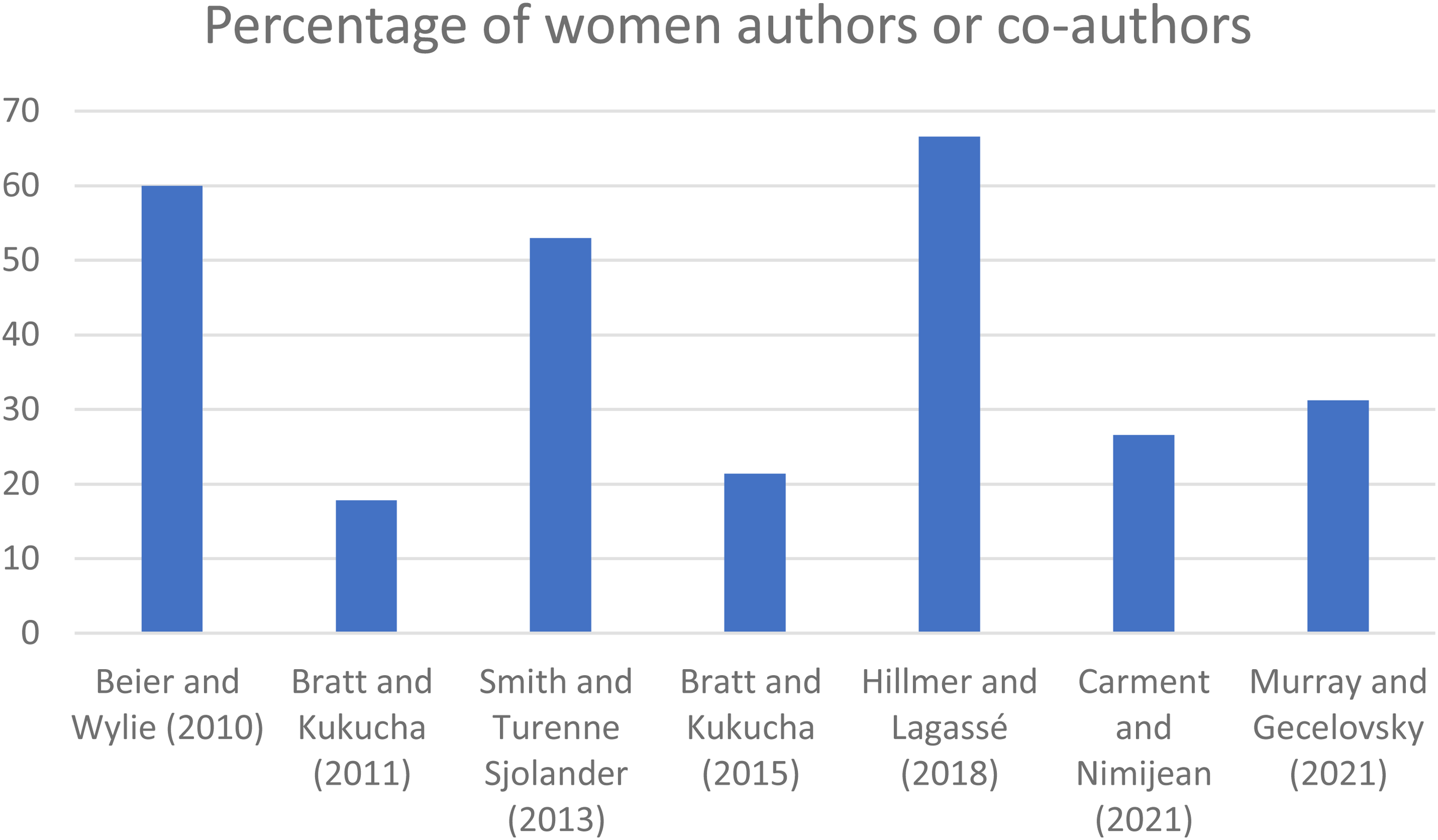
Percentage of female authors/co-authors by text.
Similarly, if we look at the percentage of female chapter authors, we find percentages ranging from 66 percent female authors or co-authors in Hillmer and Lagassé to 17.8 percent in Bratt and Kukucha in 2011. We also need to consider how the numbers look over time. In this regard, the volume published in 2021 by Murray and Gecelovsky has 31 percent female scholars respectively as chapter authors, in contrast to the higher percentages of female authors in Beier and Wylie at 60 percent and Smith and Turenne Sjolander at 53 percent. Given this information, I cannot identify a clear trend of growing inclusivity in edited volumes. Given the amazing work done currently by female scholars across all sectors of Canadian Foreign Policy, surely editors can do better in the inclusion of female scholars? Do we still need to ask, “where are the women”?
What is further worth noting is that the two volumes with female co-editors, Beier and Wylie, and Smith and Turenne Sjolander, have a higher percentage of inclusion of female authors than either of the Bratt and Kukucha volumes or the Murray and Gecelovsky volume. Beier, Wylie, Smith, and Turenne Sjolander all have histories of work as critical and/or feminist scholars. Does it matter if women or self-identified feminists are book editors? That seems to be the case. Of course, the level of inclusion of women scholars by Hillmer and Lagassé is a welcome exception and shows that male-only editor teams can create volumes where many women, from across the field, are included. It appears, however, that where the volumes are more inclusive, there is a female editor or co-editor. This is suggestive and should guide our future practices.
As noted above, asking where the women editors and women-authored chapters are is not the same as asking, “where is gender?” We cannot equate women with feminists, and we cannot assume feminists will write analyses of gender. Two chapters out of 148 have titles that refer to women. Only three out of 148 chapters included in this analysis have the title “feminist” in them. All three pieces are authored or co-authored by Tiessen and focus on feminist foreign policy. While there are other chapters that are informed by feminist theorizing in some of the volumes included above, Tiessen's work stands out for the clarity with which she identifies her work as feminist. I do wonder, though, what happens if feminist foreign policy goes out of fashion or is rejected by a future government with a different partisan orientation? What then? Are the silences only broken in these cases because feminist foreign policy is part of the government's foreign policy agenda? My concern is that editors may be influenced more by the agenda of the government than by the ongoing need for feminist work that speaks to the theory and practice of Canadian Foreign Policy. Feminist scholars will persist and continue to make crucial contributions to the field whether or not Canada has a feminist foreign policy, but I wonder if publishing opportunities vary according to the government agenda.
We also need to ask: where are the Indigenous scholars? Out of the 148 chapters included in the edited volumes surveyed, I was able to identify one piece written by an Indigenous scholar. One piece. This is the chapter written by Lightfoot in the Hillmer and Lagassé volume. Aside from Hillmer and Lagassé, in the six remaining edited volumes there are pieces written by settler scholars that have a focus on or inclusion of Indigenous Peoples in five of the volumes, although only two chapters have titles that signal content related to Indigenous Peoples. This gives us a total of three chapters out of 148 that has the word “Indigenous” in the title—that's 2 percent. This is shameful and, unfortunately, not surprising.
The lack of inclusion of Indigenous scholars is not just a question of the demographics of the field but also the framing of the field. As noted by Gchi'mnissing Anishinaabe scholar Hayden King, in the study of Canadian Foreign Policy “there is near universal acceptance of two core assumptions: the legitimacy of the Canadian state itself as the primary actor in foreign policy and the concept of the national interest, which the field of foreign policy strives to serve.” 52 King goes on to state: “for critical Indigenous scholars, these assumptions are myths that form not a legitimate state in the community of nations, but rather a violent settler colony.” 53 As a settler scholar, I must be willing to interrogate the colonial and violent underpinnings and premises of this field and my own work. And if you are a settler, I ask you, how, then, do we disrupt the core assumptions of the field? Based on the books above, inclusion of Indigenous content and one Indigenous scholar is insufficient. If I/we take King's assessment seriously, my/our ability to truly break the silence without challenging core assumptions of what we do will ensure a regressive and colonial Canadian Foreign Policy scholarship for the foreseeable future.
Review of course outlines
For this article, I assessed twenty-four course outlines to determine the inclusion of women scholars and Indigenous scholars, among other categories. The course outlines date from 2012 to 2022 and represent Canadian Foreign Policy courses taught at eighteen different institutions across Canada. Of the twenty-four course outlines, fourteen were created by men and eleven were created by women, representing nine different female scholars and thirteen different male scholars.
Like the edited volumes, it is apparent in Figure 2 that there is no consistent or sustained growth over time in the inclusion of female authors in the course outlines. The two course outlines that include the highest percentage of female scholars were produced in 2015 and 2020, but the three course outlines that include no female scholars were produced between 2017 and 2019. The three course outlines without any female scholars included all adopted Nossal, Roussel, and Paquin as their primary text and typically had no additional supplementary readings listed on the course outline. One of the course outlines with no women scholars did have additional readings, but still none representing the work of women scholars. In contrast, the four course outlines that had over 40 percent of women authors in assigned readings adopted the Smith and Turenne Sjolander, or Beier and Wylie, or Hillmer and Lagassé supplemented by Nossal, Roussel, and Paquin, or they didn’t adopt any textbook at all. Of the faculty who adopted either edition of Bratt and Kukucha, the range of inclusion of female authors was 10.5 percent to 36 percent. Those in the higher ranges, exceeding the percentages in the edited volumes themselves, were course outlines that supplemented Bratt and Kukucha with additional readings. There is a noteworthy, if not predictable, trend here whereby the adoption of a text that includes a higher number of female scholars also ensures greater representation of female scholars within the course outlines. When a text with fewer female authors is adopted, additional readings must be used to ensure better representation of the diversity of the field.
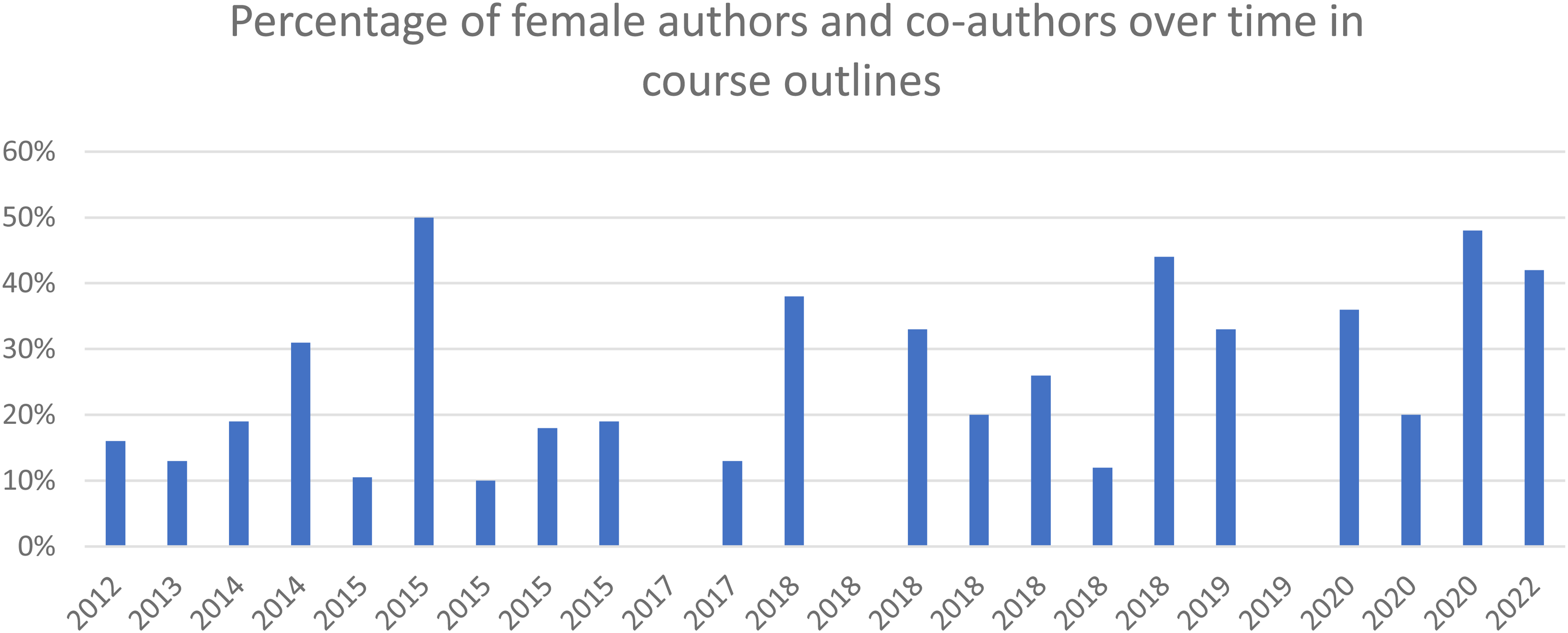
Percentage of female authors and co-authors over time in course outlines.
The total number of readings included in all the course outlines was 757. Of those readings, 183 54 were written by female scholars, representing 24 percent of the readings overall, despite three courses including no women whatsoever. Of the nine course outlines that included 30 percent or more of female-authored readings, seven of the course outlines were designed by women. Of the fourteen course outlines with less than 20 percent of women authored readings, ten were created by men and four were created by women. This finding supports research on gender bias in International Relations syllabi where Jeff Colgan found “that female instructors tend to assign more readings by female authors than male instructors.” 55 However, we must also be mindful that more inclusive course outlines are not solely the purview of women scholars, given that 28.5 percent of the course outlines with less than 20 percent of female scholars were crafted by women and two of the more inclusive course outlines were crafted by men. In addition, we cannot assume that a greater number of women scholars included in a course outline means there is more feminist research included. 56
Twelve of the course outlines included some Indigenous content, but only three of the courses included content written by Indigenous scholars. Out of a total of 757 scholars represented, those three readings equal 0.4 percent of all the readings. The most used piece by non-Indigenous scholars was the piece by Lackenbauer and Cooper in the Bratt and Kukucha 2011 edition, and the most common piece by an Indigenous scholar was the article by King. The inclusion of Indigenous scholars in the field lags well behind the inclusion of women scholars in the field. As a field, we can and should do better.
When we review Canadian Foreign Policy course outlines, it becomes clear that in at least three classrooms, women scholars don’t exist. In only eight of the classrooms will students have a sense that Indigenous Peoples matter to our understanding of Canada in the world. And while women scholars and Indigenous scholars may be mentioned in lectures or discussions, the course outlines and the adoption of the textbook signal particular choices on how to represent the field to our students. As Maïka Sondarjee argues in her exceptional article on gender and IR course outlines, “what is written down and which readings are assigned matters a great deal” because it “reveals a lot about what (and who) is considered fundamental to the field.” 57 Silences continue to exist. In many course outlines women scholars are marginalized and Indigenous scholars are non-existent. Thankfully, there are some scholars who are attentive to what their course outlines say about the field, thus helping to break the silences.
Concluding reflections
By way of conclusion, I want to share four observations arising out of the assessment above. The first observation relates to agency. Choices must be made to ensure edited volumes are more inclusive. Editors may run into issues securing the authors of their choice or they may have someone drop out and thus lose a chapter, but realistically, there are significant questions to be raised when women scholars are marginalized from texts. And frankly, claiming that “all the women said no” or “all the feminists said no” or “I don’t know any Indigenous scholars” isn’t the fault of the woman or the feminist or the Indigenous scholar who has been asked. It raises questions about who is in our networks, who we include and exclude—know or don’t know. It raises questions about structural issues within the field and within the academy. Editors have the agency and, indeed, the responsibility to ensure our work is more diverse. There are, of course, a variety of networks that are working to build more inclusive scholarly spaces, but that pipeline has not yet revealed itself in our edited volumes. We also have the agency and responsibility to ensure that our course outlines represent the questions that should be part of the field and the dynamic of Canadian foreign relations. Rather than bemoan “single issue and one-off tourism-style scholarship,” 58 we should welcome insights from scholars who bring new ideas and perceptions of the field, who may help a stagnating discipline become more robust and imaginative.
If you’re not sure where to look for feminist or Indigenous work, or work authored by female scholars, ask a colleague to share their course outlines. I know that I have learned a lot by looking at the course outlines of other scholars teaching Canadian Foreign Policy. As noted by Joanne Yao and Andrew Delatolla, in terms of International Relations outlines, “we encourage academics to consider reaching out to colleagues who may have alternative perspectives and readings that could be included. …This would also mean that the syllabus is no longer an individuals’ reflection or intellectual possession but a collective project to increase our engagement with the diversity of scholarship that form our discipline and the multiplicity of voices that shape our world.” 59
The second observation is that titles matter. Searching for feminists and feminist approaches is encumbered by the way we title our scholarly articles. It is entirely possible that I’ve missed and mislabeled pieces that could otherwise be categorized at feminist contributions and we’ve missed or mislabeled authors who may consider themselves feminist. This raises the question, then, of how we name our work. How do we and others label our contributions? Do we, in our efforts to coin catchy titles, perhaps bury the lead? Or are there broader structural issues at play where we are asked to tone down the feminism or change the title for purposes of publishing? Or maybe we minimize the feminist contributions and avoid calling our work feminist because it might be easier to publish? Do we self-silence in the way we identify ourselves and our work? We know that, at least in the past, feminist contributions have been greeted with public ridicule, subject to less-than-subtle suggestions to step away from feminist theorizing, 60 and that women without tenure have felt uncomfortable to speak in some spaces. I do think that some of the silences in our writing and the way we present our work is a choice in the face of sometimes less-than-subtle push-back in toxic spaces. As such, authors may well adopt silence as a coping mechanism. 61
I think some of the silences reflect the constitution of the field itself. I suspect there are feminist, LBGTQIA, and Indigenous scholars, as well as other scholars of color, who do not see a home for themselves in Canadian Foreign Policy. Consequently, their absence is a strategic refusal to engage and an act of resistance 62 —a decision to take one's ideas and written voice to spaces that are more hospitable and welcoming. While there are certainly cases, as noted in the past, of scholars being told that it is better for their careers to publish more internationally, I think we must not underestimate that the silences in our field may also be a result of purposeful decisions to not engage with the field.
Third, if we are crafting course outlines and textbooks that have students wondering if “it's the 1950s,” it raises questions about how our scholarship and teaching reflects the world in which we live. In practice, as Jill Campbell-Miller and Greg Donaghy argue, “much has changed” 63 since the publication of Stienstra's article. “By 2019 some of the top positions at Global Affairs Canada (GAC), including foreign minister, deputy minister, and assistant deputy minister of strategic policy were filled by women (though significantly all white women).” 64 Indeed, as I write, the deputy prime minister, minister of foreign affairs, and minister of defense are all women—a situation that is unprecedented. Campbell-Miller and Donaghy also point to the Feminist International Assistance Policy as an indicator of the Canadian government's heightened commitment to gender and women, although, of course, the degree to which the policy reflects a meaningful commitment has been questioned. 65 Moreover, if we are to take seriously the Calls to Action of the Truth and Reconciliation Commission of Canada, we must include Indigenous perspectives and scholars in our teaching and our textbooks. If we are unwilling to do so, we are complicit in the maintenance of dominant discourses that deny the impact of Canada's colonialism on Indigenous peoples both in the past and the present. Our students should be able to engage with a Canadian Foreign Policy that is current and dynamic. And our students need to see themselves in our courses if they are to believe what we teach is relevant to them. Who and what do they see when they review our course outlines?
Finally, our teaching and writing are acts of community creation. I am grateful to see some members of the community actively engaging in breaking silences in an ongoing fashion. There is still work to be done—that, too, is clear. And this article is just a beginning—a snapshot. Additional texts and course outlines could be added. Different categories of analysis could be added. The stories behind the creation of the course outlines or experiences of being silences or breaking silences could be added. Much more work needs to be done to explore this theme. Recognizing this, I nonetheless, challenge us all to reflect on what our course outlines, textbooks, and edited volumes say about our field. It is 2022, after all.
Footnotes
Declaration of conflicting interests
The author(s) declared no potential conflicts of interest with respect to the research, authorship, and/or publication of this article.
Funding
The author(s) received no financial support for the research, authorship, and/or publication of this article.

Notes
Author biography
Heather A. Smith is a Professor of Global and International Studies at the University of Northern British Columbia.