



Abstract
It is widely recognized that exports contribute to economic growth. Many governments have seen economic diplomacy representation (foreign offices, embassies and consulates) as an important tool to diminish export barriers and foster economic growth. Thus, this study aims at understanding to what extent does the presence of Portuguese economic diplomatic representation in foreign states impact Portuguese exports. Based on merchandise exports to 144 countries for the period between 2008 and 2018, and using a quasi-gravity model of trade, results indicate that ceteris paribus, Portugal exports more to countries which host a Portuguese office and an increase in the number of offices in a foreign country positively affects exports to that country.
Exports have been encouraged and perceived by many governments as having a vital role in the improvement of a country’s economic performance, 1 which can be explained by an increase in the factor productivity, superior technical efficiency or better usage of the productive capacity and economies of scale. 2 And in reality, empirical studies have shown that “trade has a quantitatively large and robust positive effect on [national] income,” 3 especially when compared to those countries which foster the protection of the home market. 4
While in the past, transportation and communication costs were seen as the major barriers to international trade, over the last few decades these barriers have lost importance, and today, cultural and institutional factors are accounted as such. 5 This is where economic diplomacy figures as an important tool, having the power to minimize the impact of these new barriers to trade. Seen as the compilation of the relationships developed by a country with its international network, economic diplomacy comprises the relations and influence established by a country’s government which has an effect on trade and investment. 6 Furthermore, and in spite of not being directly involved in trade, governments tend to function as vehicles for information and communication. 7 This is because, when considered its trusted intermediary purpose, governments have, among others, the function of providing market information to the potential exporters and identifying possible sales opportunities abroad. 8 Since failure to enter foreign markets is on many occasions connected with information asymmetry, foreign missions can have the power to mitigate such issues, 9 with such being possible due to the “unique, reliable and impartial access to information, such as through the global embassy network and other government channels and contacts.” 10
Additionally, promotion activities have the role of minimizing the uncertainty surrounding a firm’s entry into a new market—whether by assisting in the assessment of possible profitable exporting markets, aiding in the foreign contractual procedures surrounding the process, or even in the analysis of the consumers’ response and/or information on the exporting product. 11
Foreign offices, embassies, and consulates figure as examples of instruments of economic diplomacy, and in recent years literature has shown an increasing focus on the assessment of the impact of these instruments on trade. As the first author to produce a macro-economic study of this matter, Andrew Rose 12 concluded that diplomatic representation does have a positive influence on trade. 13 Rose went even further and realized that the “creation of an embassy has a substantially larger impact on exports than additional consulates.” 14 Moreover, Daniel Lederman, Marcelo Olarreaga, and Lucy Payton 15 found a positive correlation between the increase of an export promotion agency’s budget and national exports—helping to overcome the issues of information asymmetry and possible trade barriers. Also, Yusuf Bagir 16 concluded that the presence of an embassy has a positive impact on exports, with the overall impact coming mainly from the volume effect (i.e., the intensive margin of trade).
Even though recent studies have shown that the extent of the impact of economic diplomacy on trade tends to be distinct when taking into consideration the level of differentiation of the goods or the intensive and extensive margin of trade 17 or even the level of development of the countries engaged in the trade activities, 18 overall, the literature has expressed a positive relationship between economic diplomacy and trade. The value of this, however, has been the source of debate—especially due to limited data availability; exclusive focus on one country, from which general conclusions should not be drawn; a limited set of partner countries; or an exclusive focus on developed countries. 19 Thus, the impact of economic diplomacy on trade figures as an interesting topic that should be further explored. Consequently, the purpose of this study is to analyze to what extent the presence of Portuguese diplomatic representation in foreign states impacts Portuguese exports to those countries. Hence, having as a basis the gravity model of trade and export data of Portugal and 144 partner countries in a 11-year-period (between 2008 and 2018), an econometric study is conducted on the influence of economic diplomacy on trade.
Indeed, when we focus on Portugal, we can see that the country witnessed a growth in the value of its goods’ exports, from 38.95 billion euros in 2008 to 57.807 billion euros in 2018. 20 Furthermore, over the past five years, the annual budget of the Ministry of Foreign Affairs in Portugal represented about 0.6% of the total state budget, and when compared to 2019, the Ministry expected to use 61.3 million euros more during the year 2020 (the budget for 2020 was almost 15% larger than that of 2019);—all of which goes to show the growing importance of the foreign presence of Portugal, its services, and assistance. The embassies and other consular offices emerge as the main absorber of this figure, with Portugal having 133 foreign posts, of which 76 are embassies, 48 are consulates, and 9 are permanent missions, whose role today is largely connected with economic diplomacy, with a focus on the promotion of trade and foreign investment. 21 Additionally, Portugal also has several foreign offices, which are a part of the Ministry of Foreign Affairs. AICEP (Agência para o Investimento e Comércio Externo de Portugal), the national agency for trade and investment, focuses on identifying opportunities for foreign investment in Portugal, as well as assisting national firms in their internalization process. 22 Currently, AICEP’s global network is composed of 55 offices, with the field of action of some of these offices comprising more than one territory. In 2018, 69 countries were formally represented by AICEP, compared to only 47 in 2008.
Moreover, all top 10 destination countries of Portuguese merchandise exports (according to UN Comtrade data from 2018) were reported as being hosts to Portuguese embassies and AICEP offices. 23 Since, to our knowledge, no other analysis of this kind has been conducted with a focus solely on Portugal, the study of the influence of Portuguese economic diplomacy on trade would seem to be an interesting and relevant topic to develop and examine further, particularly due to the period of growth in Portuguese merchandise exports (those exports grew at an annual average rate of approximately 4% between 2008 and 2018), as well as the expansion of the network of AICEP offices abroad.
This study is organized as follows. Section 2 is a review of the literature, focused on the gravity model of trade and on the effects of economic diplomacy on trade. Section 3 addresses the methodology. Section 4 introduces the results of this research along with a discussion of those results. Finally, Section 5 presents the conclusion.
Literature review
The gravity model of trade
Most studies that try to understand the impact of economic diplomacy on trade have as a starting point the gravity model of trade. Utilizing, as a source of inspiration, Newton’s law of gravitation, Jan Tinbergen brought together the influence of the distance between two countries and their dimension in order to explain the volume of bilateral trade flows. The gravity model of trade states that trade flows between two countries are proportional to their gross domestic product (GDP) and inversely proportional to the geographic distance between those countries.
24
Thus, of “two nations with similar resources, industrial and institutional structures, the one closer to nation
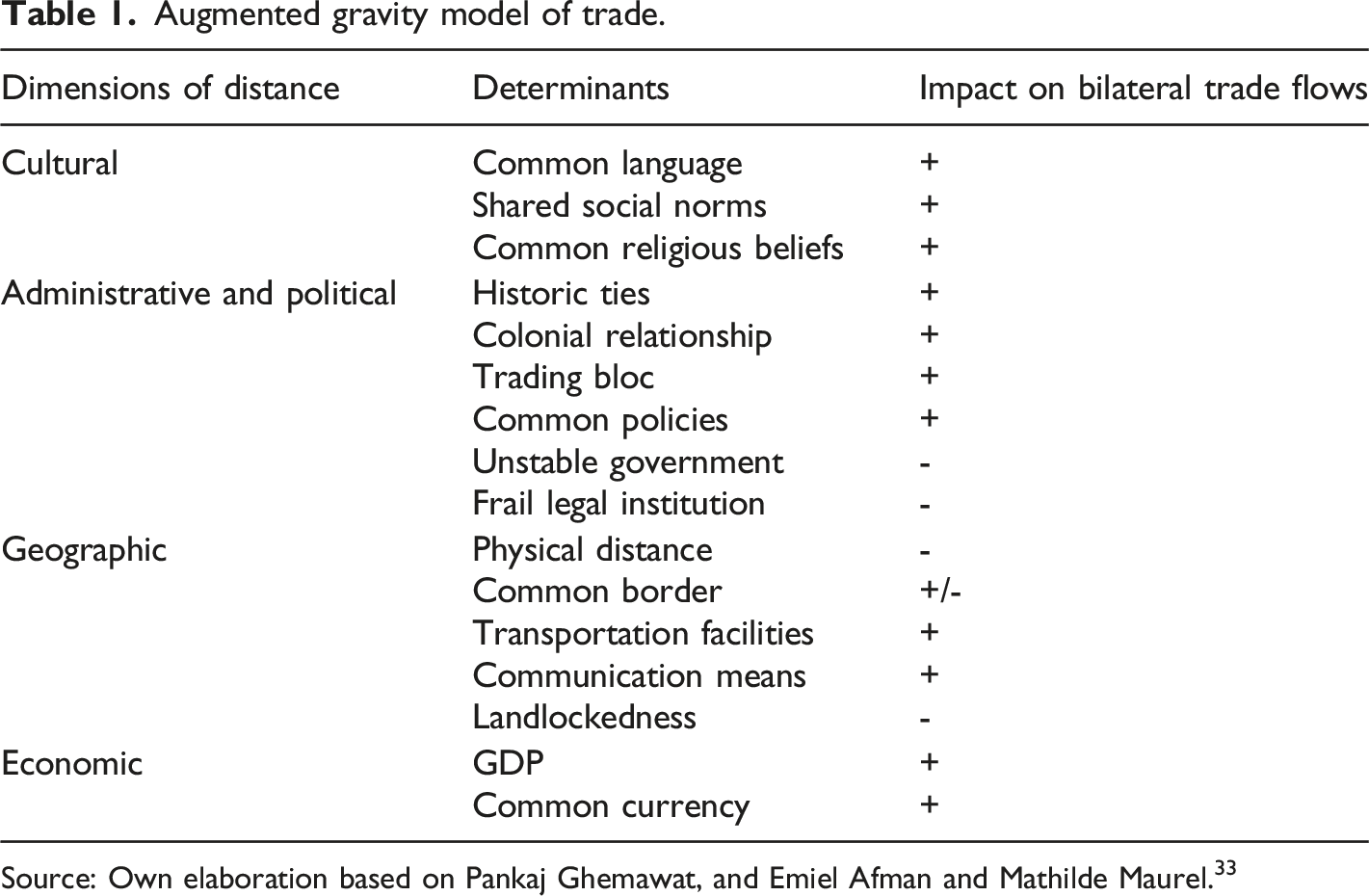
Augmented gravity model of trade.
Source: Own elaboration based on Pankaj Ghemawat, and Emiel Afman and Mathilde Maurel. 33
Expressions of cultural distance, such as distinct religious beliefs, language, race, practices, and social norms, will in the end have an influence upon bilateral trade. Indeed, due to high communication costs, similarities among languages can encourage trade, with lesser need for an interpreter or a commercial intermediary. 34 As stated by Jan Fidrmuc and Jarko Fidrmuc, “speaking the same language facilitates communication and makes transaction easier and more transparent,” 35 especially considering that language should be taken into account throughout all the stages of the internationalization process of a company—from the search for partners, to the negotiation phase, or even in the contracts established between the partners. 36 Jacques Melitz and Farid Toubal provide an interesting insight into the impact that the different spheres of language can have upon the establishment of trade relationships, shedding light on the relevance of considering both spoken and native common languages and their impact on trade, as opposed to simply the official language. 37
The administrative/political dimension includes past historical bonds, common regional trading blocs, political governmental decisions, and hostility, factors which can also affect trade patterns. 38 Indeed, past colonial ties can foster the existence of a lingua franca, or even the pre-establishment of business contacts between producers, distributors, and suppliers. 39 Moreover, belonging to the same trade bloc can foster opportunities for trade creation or trade diversion, by shifting from a third (outside the trade bloc) partner to an intra-bloc commercial relationship—due to the impediments associated with the barriers to trade. 40 Additionally, a common trade bloc can also lower the chances of political and international conflicts, 41 and can tend to induce higher levels of integration and similarities, at the institutional and policy levels, between the bloc countries. 42
When considering geographic distance, we can go beyond the actual kilometres distance between two given nations, which measures the impact of transportation costs, 43 to include other characteristics which should be taken into consideration, such as sharing a common border, topography, the lack of sea or river access, differences in climate, landlockedness, or weak transportation and communication links. 44 Indeed, the existence of a common border will mean geographic proximity between the adjacent countries, which can have a positive impact on bilateral trade. 45 Thus, one might think that trade patterns at the regional level would be little impacted by land borders, which is to say that trade levels with a neighbour country would be similar to internal trade—that is, between the different regions of that country. However, evidence shows that borders tend to reduce bilateral trade levels—with this impact being greater for smaller countries. 46 This conclusion was reached by John McCallum when analyzing the impact of the United States/Canada border on the regional trade rates. 47 When studying these two countries, due to their apparent cultural and language affinity, one would think that the geographic boundaries between the two would have little impact. However, the author concluded that, in this case, “national borders matter,” as trade activity was higher among Canadian provinces than with US states—when considering similar distances, economic dimensions, and the presence of both countries in the trading bloc of the North American Free Trade Agreement (NAFTA). 48 In the end, we should bear in mind that the broad idea of borders, beyond the geographic delimitation between two countries, also refers to differences in culture, customs, institutions, regulations, and policies. 49
Finally, concerning economic distance, the differences of income of the inhabitants, the costs and quality of natural, financial, human, or infrastructural resources, and a common currency should also be accounted for as having an impact on trade patterns. 50 Indeed, if two countries share a currency, the transaction costs can be hindered, with a reduction of the volatility of the exchange rate playing an important role. 51
To sum up, the augmented gravity model includes several variables that are likely to encourage or prevent trade between two countries. And this is where economic diplomacy emerges as a relevant tool, and a further intervening variable for the gravity model, which can be used to minimize the effect of intangible obstacles to trade 52 —such as different institutional and cultural characteristics between potential commercial partners or international (dis)trust, among others. 53
Economic diplomacy and international trade
Economic diplomacy can have a role in fostering trade opportunities and minimizing the effects of the different distance dimensions. Since the end of World War II, governments have become more involved and have paid increased attention to the economic side of the relationships established with foreign states and the “management of external economic activities.” 54 Economic diplomacy is thus seen as “the use of political means as leverage in international negotiations, with the aim of enhancing national economic prosperity, and the use of economic leverage to increase the political stability of the nation.” 55 As stated by Prahastuti Maharani, several government policies are used to promote exports, but the most important factor is to build a good country image. This is where economic diplomacy comes in. 56
Although in recent years non-state actors, such as non-governmental organizations or international media agencies, have also become involved in economic diplomacy, 57 the state carries on as the dominant party in this area as it “represent[s] and mediate[s] the interests of business as well as civil society interests to political and public entities abroad.” 58 Thus, governments use their international network of influence and relationships as a catalyst for trade and direct investment opportunities, through the form of permanent international representation, such as embassies, consulates or export promotion offices/agencies, and diplomatic bilateral activities. 59
With a more formal tone, embassies carry the responsibility of state-to-state relations, having the entrustment of the total territory 60 —an embassy’s functions comprise representation, fostering the country’s interests, fomenting influence and local friendly relations, negotiation and lobbying, political reporting, gathering of information, and commercial diplomacy. 61 A consulate, on the other hand, can be located in numerous locations within a country’s territory, and its function today is largely connected with providing support to nationals when needed and fostering its interests or the issuing of visas, 62 although information-gathering, trade opportunities seeking, and fostering political, commercial, economic, and cultural relationships with the receiving state are also considered as the services provided by a consulate. 63
With the goal of helping “exporters understand and find markets for their products,” 64 export promotion agencies (EPAs), often called “foreign offices,” conduct services of four distinct types: country image-building (promotional events), export support services (technical assistance, information on trade, customs logistics, packaging), marketing (trade shows, importer and exporter missions), and market research (general, sector, and firm information, importer and exporter databases). EPAs can be seen as outposts, as they develop contacts and provide a flow of information. 65 In the end, the role of EPAs is largely connected with assisting internationalization activities and enhancing the performance of the business sector, which happens to have an impact on the competitiveness and image of the home country abroad. 66 Finland was the first, in 1919, to set up an EPA in an overseas country. Some countries, such as Spain, also create regional offices abroad, which provide support and information to firms, at the regional level, that wish to export to overseas markets. 67
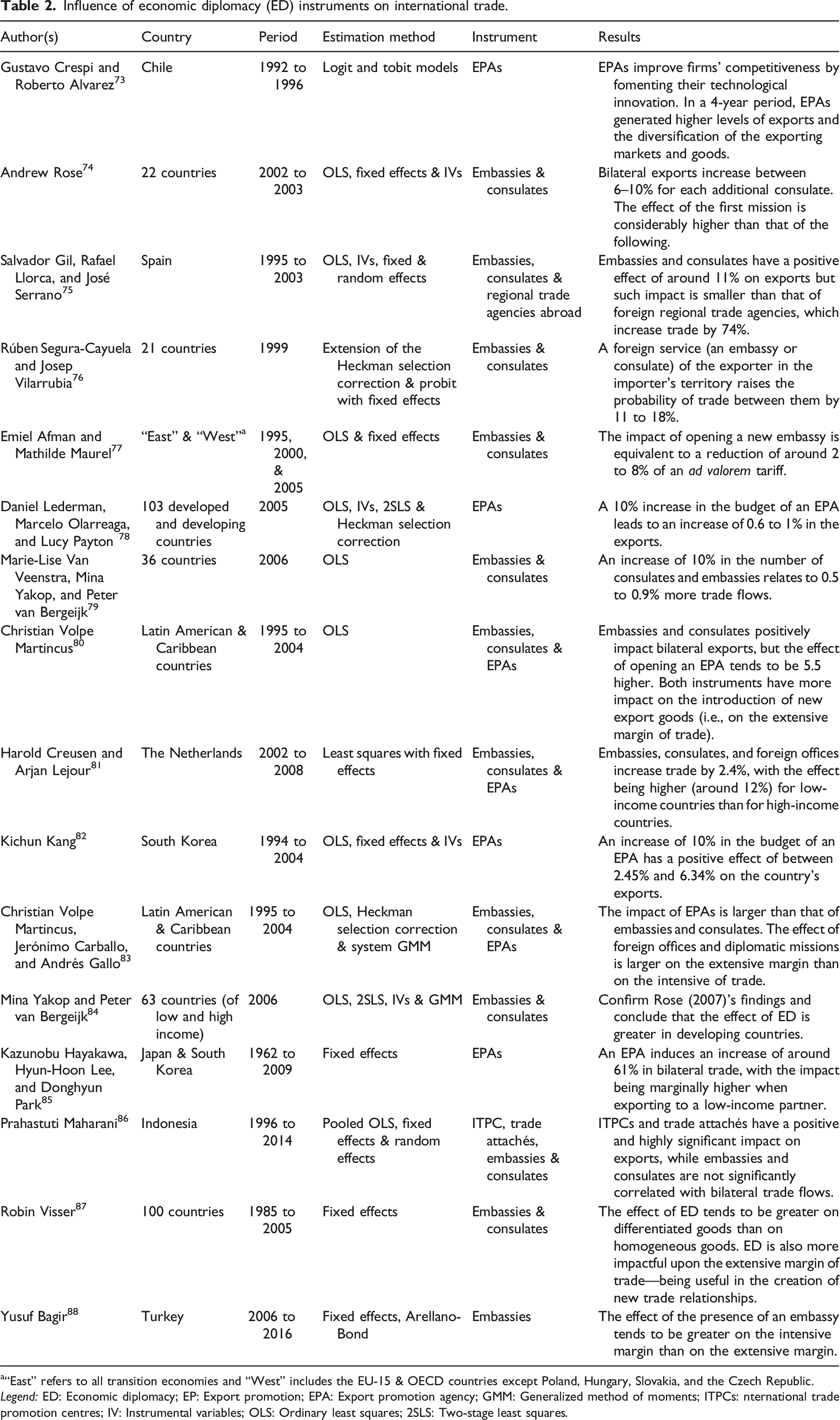
Influence of economic diplomacy (ED) instruments on international trade.
a“East” refers to all transition economies and “West” includes the EU-15 & OECD countries except Poland, Hungary, Slovakia, and the Czech Republic.
Legend: ED: Economic diplomacy; EP: Export promotion; EPA: Export promotion agency; GMM: Generalized method of moments; ITPCs: nternational trade promotion centres; IV: Instrumental variables; OLS: Ordinary least squares; 2SLS: Two-stage least squares.
Almost all the studies analyzed can be considered macro-studies in the sense that they use country-level trade data of a country or a set of countries. The exceptions are the study of Gustavo Crespi and Roberto Alvarez, whose sample is a collection of Chilean exporting companies, and that of Harod Creusen and Arjan Lejour, which is based on firm-level data as it analyzes new trade relations of a sample of companies in the Netherlands—both thus being micro-studies. 83 84 85 86 87 88 89
From the information presented in Table 2, we can see that the instruments of economic diplomacy analyzed seem to have a positive impact on a country’s exports; however, the actual value of this impact is quite heterogeneous. Furthermore, the impact tends to vary according to the level of development of the countries 90 and the intensive or extensive margin of trade, 91 or even the level of differentiation of the traded goods. 92
For instance, regarding embassies and consulates, Andrew Rose found that exports increase for each additional consulate around 6 to 10%. However, this result tends to be smaller compared to the impact of a common language, land border, or regional trade agreement. Additionally, the positive effect of the first foreign post, usually an embassy, is relatively higher, accounting for an increase of around 120% on exports, than that of the following ones, about 5 to 11%—with this impact declining as more consulates are created. 93
As a way of reducing information, transport, legal, and regulatory costs, the countries could foster diplomatic representation offices between them—with the opening of a new embassy being equivalent to a reduction of around 2 to 8% of an ad valorem tariff. 94 Furthermore, Rúben Segura-Cayuela, and Josep Vilarrubia found that the existence of an embassy or consulate enhances the chances of trade between 11 to 18% but seems to have little impact on the volume of trade with already existing partners. 95 These results are in line with those of Robin Visser, who also concluded that economic diplomacy tends to be more effective in the creation of new trade relationships, due to its ability to reduce the fixed costs of trade. 96 However, Bagir concluded that the presence of an embassy increases export value by 30%, which comes mainly from the volume effect (i.e., intensive margin of trade), as the author also found that the number of exporting firms increases by about 8% (extensive margin of trade). 97
Additionally, economic diplomacy, in the form of embassies and consulates, tends to be seen as more effective for trade flows which either originate or end in developing countries rather than in developed ones. 98 With the same being witnessed when comparing its effect upon low- and high-income countries, the impact of economic diplomacy on export growth on low-income countries tends to be more substantial (around 12%) than that on high-income countries (quite null). 99 Marie-Lise van Veenstra, Mina Yakop, and Peter van Bergeijk go even further and conclude that the most significant positive effect is that of the establishment of an embassy of a high-income country in a low-income one—indicating that the level of development of the nations engaged in the bilateral trade activities should be taken into account in the assessment of the real effectiveness of economic diplomacy. 100
Salvador Gil, Rafael Llorca, and José Serrano understand that the goals of embassies and consulates are somewhat connected with bilateral affairs of a political, military, and cultural nature. 101 Because of this, Spain developed a set of alternative institutional bodies, the regional agencies abroad, which aim to promote the internationalization venture of Spanish firms, with a specific focus on the promotion of trade and investment opportunities. Indeed, the above authors concluded that these regional agencies led to a positive impact of around 74% on regional exports—with this effect being larger than that of Spanish embassies and consulates of around 11%, although smaller than that of a common language (458%) or that belonging to the same trade bloc, the European Free Trade Association (EFTA) and the European Union (EU) in this case (153%).
The effect of an EPA on trade tends to differ when we analyze both the extensive and intensive margins of trade. When discussing the extensive margin, one tends to consider the establishment of new trade relationships 102 and/or the increase in product categories traded among countries/firms which already trade, 103 while the intensive margin focuses on the possible variation of trade volumes of already existing trade relationships. 104 And indeed, the “number of products exported is 27.8% greater when establishing a foreign office of an export promotion organization in the importer country”—that is when considering the extensive margin of trade, while it is only 16.1% when focusing on the intensive margin. 105 For embassies and consulates, those results are 6% and 2.8%, respectively, 106 which suggests that the impact of the export promotion offices seems to be greater than that of diplomatic missions, as embassies and consulates. 107 These results are in line with those of Christian Volpe Martincus, who believes that this can be explained by the fact that information problems figure as more likely when trying to diversify the trade portfolio and introduce new goods, and EPAs tend to be more specialized entities whose personnel is more focused on enhancing trade-related matters, with its marketing expertise, for instance, being helpful in this goal. 108 This can also explain why this author found that the positive effect of EPAs seems to be higher when accounting for differentiated goods being traded, while the impact of embassies and consulates is higher with respect to the trade variation of homogeneous goods.
Methodology
Econometric model and its variables
The present study aims to further explore the influence of economic diplomacy—in this case the EPAs, embassies, and consulates that Portugal has established throughout the world—on the country’s exports. 109
As one of the most empirically successful models in economics, as mentioned above, the gravity model of trade correlates the volume of trade between two countries to the physical distance between them, GDP, and further variables which may impact bilateral trade flows.
110
In this way, the econometric model as estimated is provided by the following equation:
The dependent variable, Exp
ijt
, corresponds to the real Portuguese merchandise exports in year t to the partner country j, in millions of US dollars (constant prices 2010).
112
The data was extracted from the International Monetary Fund (IMF) website, similar to Andrew Rose or Mina Yakop and Peter van Bergeijk.
113
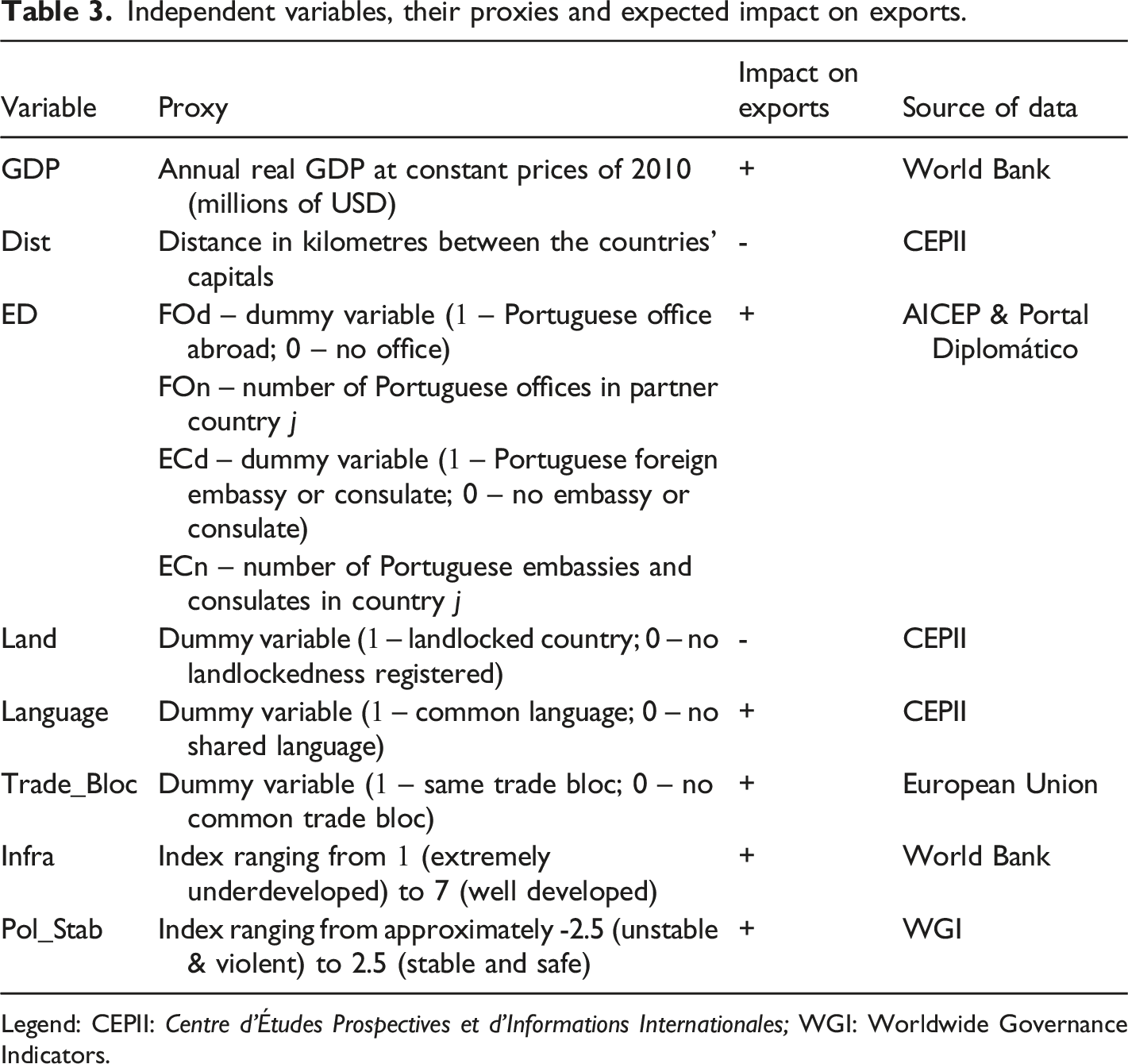
Concerning the explanatory variables, this study includes the following: • GDP: the annual real gross domestic product of importing country j, in millions of US dollars (constant prices 2010).
114
• Dist: the geographic distance in kilometres between the capitals of countries i and j. • ED: denotes economic diplomacy and is measured through four proxies. First, a dummy variable (FOd) which is given the value of 1 if country i has a foreign office in country j and 0 otherwise. Secondly, the number of foreign offices country i (Portugal) has in the territory of country j in year t (FOn). This data was extracted from the AICEP website and the values represent the number of offices the agency owned in each of the countries between 2008 and 2018. Third, a dummy variable (ECd) which is given the value 1 if country i has an embassy or consulate in country j and 0 otherwise. Finally, the number of embassies and consulates Portugal has within its trade partners (ECn).
115
This data was obtained through the Portal Diplomático website, which is a part of the Ministry of Foreign Affairs of Portugal. However, for this variable we were only able to obtain the data for the year 2018. • Land: a dummy variable which is accorded the value 1 if country j is landlocked, which is to say if its territory does not have a connection to any ocean, and 0 otherwise, similar to what is usual in the literature. • Language: a dummy variable which assumes the value 1 if countries i and j share a common language and 0 otherwise.
116
• Trade_Bloc: a binary variable in which 1 indicates that countries i and j are a part of the same trade bloc and 0 otherwise. Like Afman and Maurel,
117
the trade bloc considered was the European Union. • Infra: indicates the quality of port infrastructures of country j and refers to an indicator ranging between 1, which stands for extremely underdeveloped port infrastructures, and 7, well-developed and efficient by international standards. According to the 2019 UNCTAD Review of Maritime Transport, “more than four fifths of world merchandise trade by volume is carried by sea.”
118
Additionally, optimized and developed infrastructures have the power to enhance both competitiveness on a regional level and economic developments.
119
Thus, in a world of global supply chains, the quality of logistics [infrastructures] figures as a relevant tool for trade efficiency,
120
and consequently, is included in this study. • Pol_Stab: refers to a political stability indicator of country j, measured through the detailed documentation of The Worldwide Governance Indicators: Methodology and Analytical Issues, and stands for political stability and absence of violence and terrorism, which represent the “perceptions of the likelihood of political instability and/or politically-motivated violence, including terrorism.”
121
This indicator ranges from approximately -2.5, where the country is seen as being politically unstable and likely to host violent attacks in its territory, to 2.5, where the country is seen as stable and thus safer and less expected to suffer violent offensives. Politics have the power to mould the patterns of international trade, with similar policy interests and democratic environments fostering international trade activity.
122
Conflicts and violence, on the other hand, hinder the chances of trade by implying additional transaction costs. This stems not only from the insecurity that violence generates and its impact on the population’s consumption patterns, but also from the increasing costs of doing business in such an environment, the country’s decreasing attractiveness to international producers, the impact of the violent acts upon the countries’ infrastructures, or consequent security regulations, such as the shutting down of borders.
123
Thus, the indicator for political stability and likelihood of violence figures as relevant for the purposes of our study as it can be impactful on trade patterns.
Independent variables, their proxies and expected impact on exports.
Legend: CEPII: Centre d’Études Prospectives et d’Informations Internationales; WGI: Worldwide Governance Indicators.
Characterization of the sample and descriptive statistics
This study focuses on Portuguese merchandise exports to 144 countries during a time period of 11 years, from 2008 to 2018. 124 Although bilateral trade data collected initially included 212 countries, 68 of these were removed due to missing data for some relevant variables, such as the exports values, quality of port infrastructures, or political stability. 125
During the period under analysis, Portuguese merchandise exports to the 144 destination countries increased from 51.375 billion dollars in 2008 to 67.89 billion dollars in 2018 (see Figure 1). The Portuguese merchandise exports value to foreign states varied slightly over the years, reaching its lowest point in 2009 (around 41.167 billion dollars)—which may be explained by the financial crisis of 2007–2008. After this slight decrease, the following years saw a recovery, and after a couple of years of stable values, since 2016 we have seen a steady increase. In fact, the exports value peaked and hit the maximum value in 2018, surpassing the 67.89 billion dollar mark (see Figure 1). Evolution of Portuguese exports (2008–2018, millions of US dollars, constant prices 2010).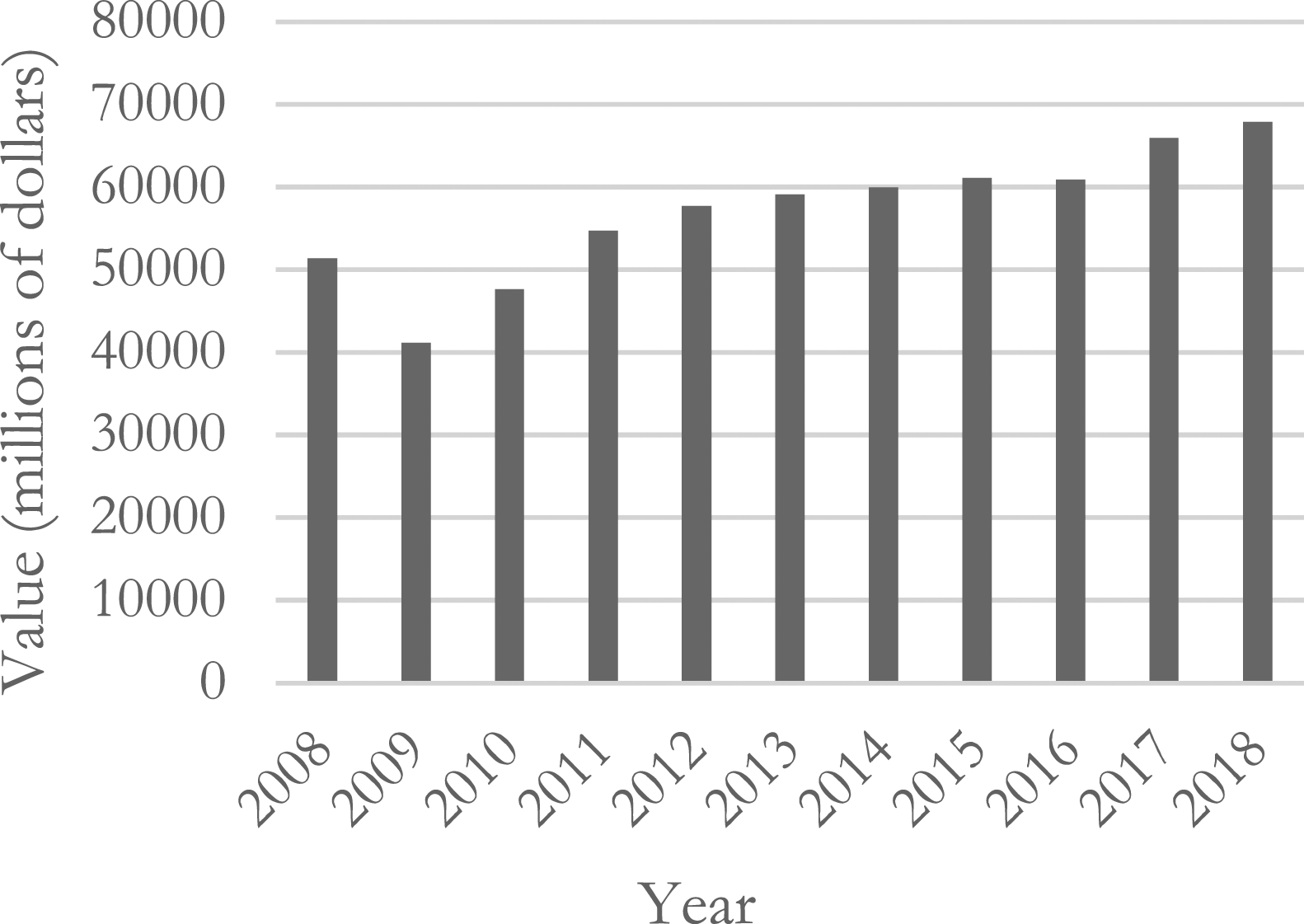
Regarding the number of foreign offices Portugal has in the destination countries (a proxy for the economic diplomacy variable, our main explanatory variable), between 2008 and 2018 that number increased from 47 to 69 (see Figure 2). It should be noted that there are some foreign offices whose sphere of activity is not restricted to the country in which they are located—that is, their scope of action can also entail the affairs of neighbouring countries, functioning as a representation of the region and not solely of the country in which they are based. For instance, currently, the scope of action of the AICEP office in Chile is not limited to the affairs of this country, but also includes those of Peru—the AICEP delegate oversees both territories, in spite of being based in only one of them. Likewise, the delegation in Bangkok is currently responsible not only for Thailand, but also for Myanmar, Laos, Vietnam, and Cambodia. Consequently, we adopted a comprehensive definition of foreign office, and all territories which had and currently have a formal representation of AICEP are counted, for the purposes of this study, as having a Portuguese foreign office in its territory, whether the actual office is located within their borders or not.
126
This is because the foreign office is not only a source of information and support for Portuguese exporting firms in its market but also for the neighbouring ones, which are dependent on that delegation. For instance, in the years following the opening of the AICEP office in Bangkok in early 2017, we can see an increase in Portuguese exports not only to Thailand, but also to Vietnam and Cambodia. Evolution of Portuguese foreign offices (2008–2018).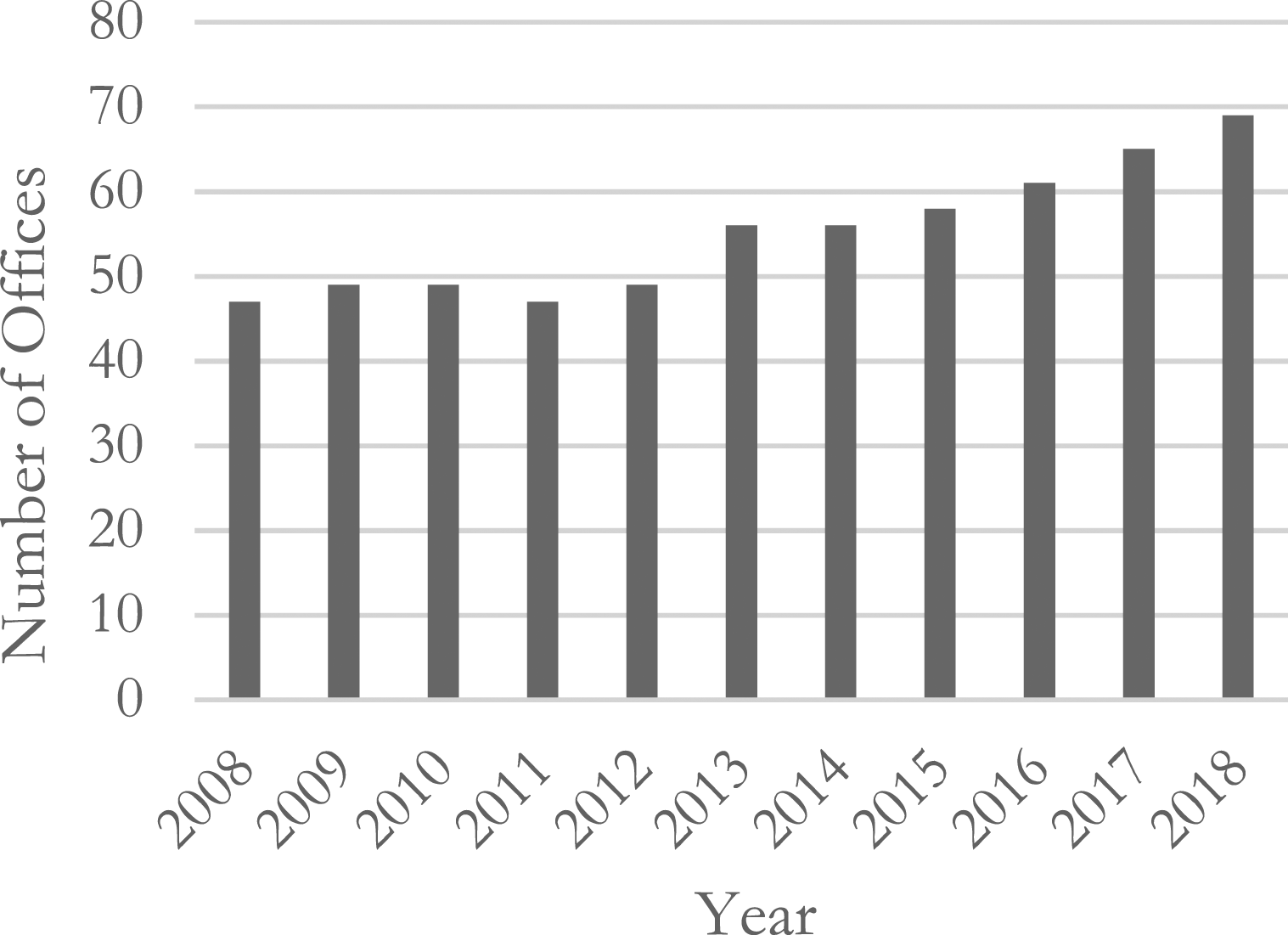
Examining Figure 2, it is noted that, although relatively small, since the number of countries within our sample which have no offices is quite high (in 2018, around 55% of the countries of the study did not have any Portuguese office in its territory), the number of offices Portugal hosts overseas has in fact increased throughout the years. In fact, its peak was reached in 2018, when a total number of 69 foreign offices in host states was reached (see Figure 2).
Descriptive statistics of the model’s variables.
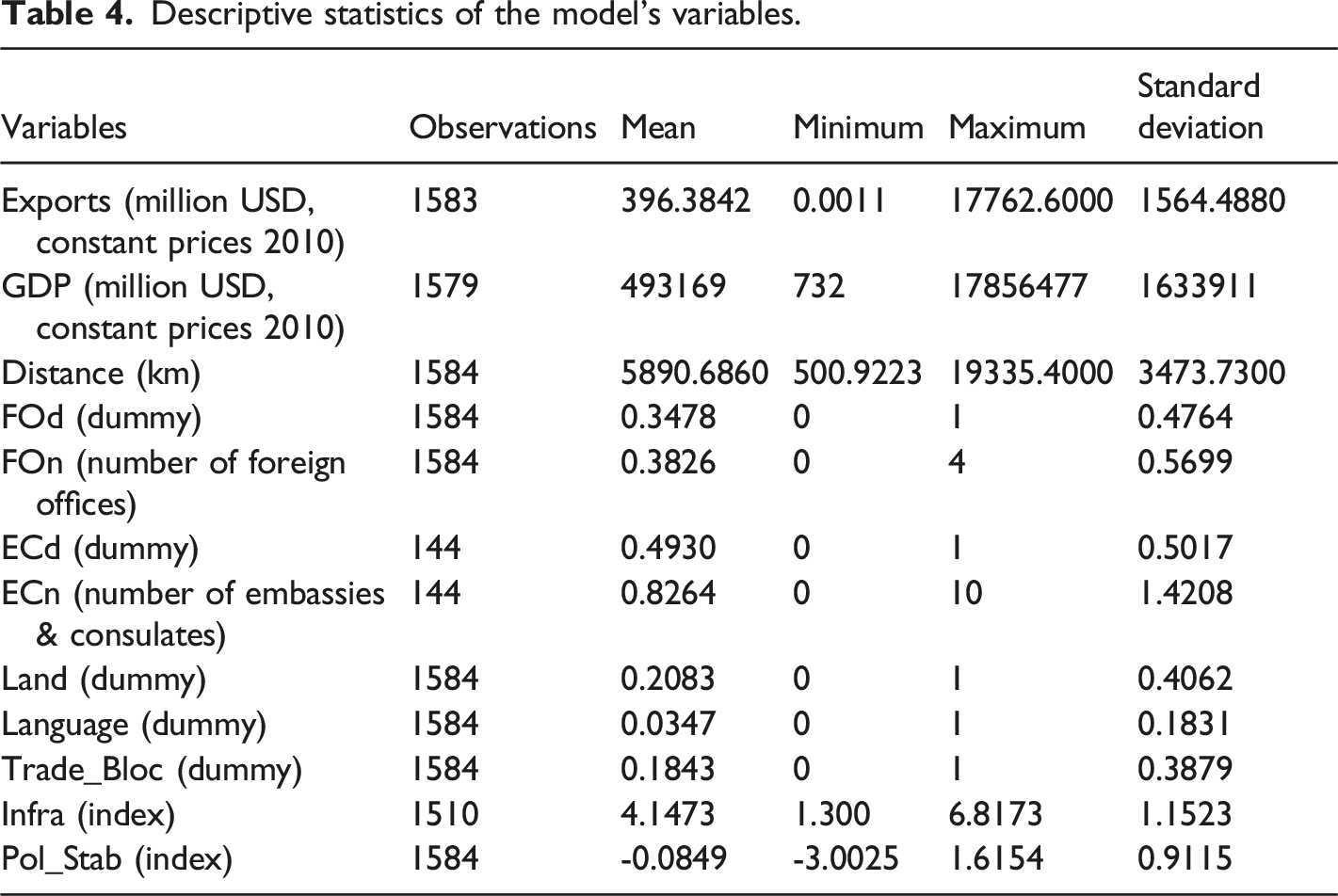
Starting with Exports, the dependent variable, its mean for the period under analysis was 396 million US dollars, with the maximum value of about 17.763 billion dollars referring to the Portuguese exports to Spain for the year 2018. Spain was, throughout the years under analysis, the main destination of Portuguese merchandise exports, representing the destination of 22 to 28% of total merchandise exports between 2008 and 2018. The minimum, on the other hand, was of 0.001 million dollars, referring to value of the Portuguese exports to Rwanda for the year of 2008. Therefore, although a small percentage (about 10%) of observations present very small values, contrary to what often happens with the gravity models of trade, the present study does not have to deal with the problem of zero trade flows since they are absent in the sample.
The GDP variable presents an average of 493.17 billion dollars, with the maximum being 17,856.5 billion dollars, which refers to the GDP of the US for the year of 2018, and the minimum being about 0.73 billion dollars, referring to Timor-Leste’s GDP in 2008. This variable appears as quite scattered, which can be witnessed by the value of the standard deviation, since the sample of countries included in the study features economically big countries, such as the US and China, but also much smaller ones, such as Seychelles and Gambia.
Concerning the variable Distance, its mean is about 5,891 kilometres, with the maximum of 19,335 kilometres being the distance that separates Portugal and New Zealand and the minimum being that between Portugal and its neighbouring country, Spain, whose capital is located a mere 501 kilometres from Lisbon.
When we focus on Economic Diplomacy, the mean of the variable FOd (dummy variable taking the value 1 if Portugal has a foreign office in the destination country and 0 otherwise) indicates that during the period under analysis only 34.78% of the countries in the sample had a Portuguese office in their territory. Furthermore, examining the number of Portuguese foreign offices (FOn), we can see that the means’ value of this variable is of 0.38, which is to say that this is the average number of offices Portugal hosted in foreign states between 2008 and 2018. The maximum of 4 offices matches the number of offices Portugal held in Spain over several years. And the minimum is 0, since around 65% of the countries included in the collected data did not have any Portuguese office in their territories throughout all the years under analysis. Concerning the dummy variable ECd (which is given the value of 1 if Portugal has an embassy or a consulate in the destination country and 0 otherwise), its mean reveals that 49% of the countries included in this study hosted a Portuguese embassy or consulate in their territory in 2018. Finally, regarding the number of embassies and consulates (ECn), we see that the countries in the sample host, on average, about 0.83 embassies or consulates of Portugal in their territories. The maximum of 10 concerns the number of embassies and consulates Portugal hosted in Brazil, and the minimum, which is 0, accounts for the non-existence of an embassy or consulate in 73 of the countries included in the sample for the year 2018.
Regarding the dummy variable Land, its mean indicates that only about 21% of the countries in the sample are landlocked and thus have no geographic connection to an ocean. Moreover, of the countries included in this research, only a mere 3% share a language with Portugal, thus having Portuguese as the official language as well. And lastly, around 18% of the 144 countries belong to the same trade bloc as Portugal, which is to say that 18% of the countries included in the study are a part of the European Union.
For the quality of infrastructures variable (Infra), the mean of its values is 4.15. Furthermore, the maximum figure is 6.8—referring to the values of the Netherlands for a total of 5 years—which is to say that during these years, this country was the one whose port infrastructures were, according to international standards, the most developed. On the other hand, the lowest value recorded was 1.3—which indicates that, for the years of 2013 and 2014, the quality of Kyrgyz Republic’s port infrastructures was the weakest among the countries analyzed.
Finally, when it comes to the political stability variable, its mean is -0.085, which can be considered rather small. Moreover, its maximum value of 1.61 was achieved by Singapore in 2017—from the countries considered, this country was the one whose compliance rate of the mentioned values was the highest and thus it can be considered a state with a strong political framework. On the other hand, with the minimum value and a rating of -3, Yemen was, in 2018, the least compliant country, having thus a fragile and vulnerable political structure.
Correlation between model’s variables
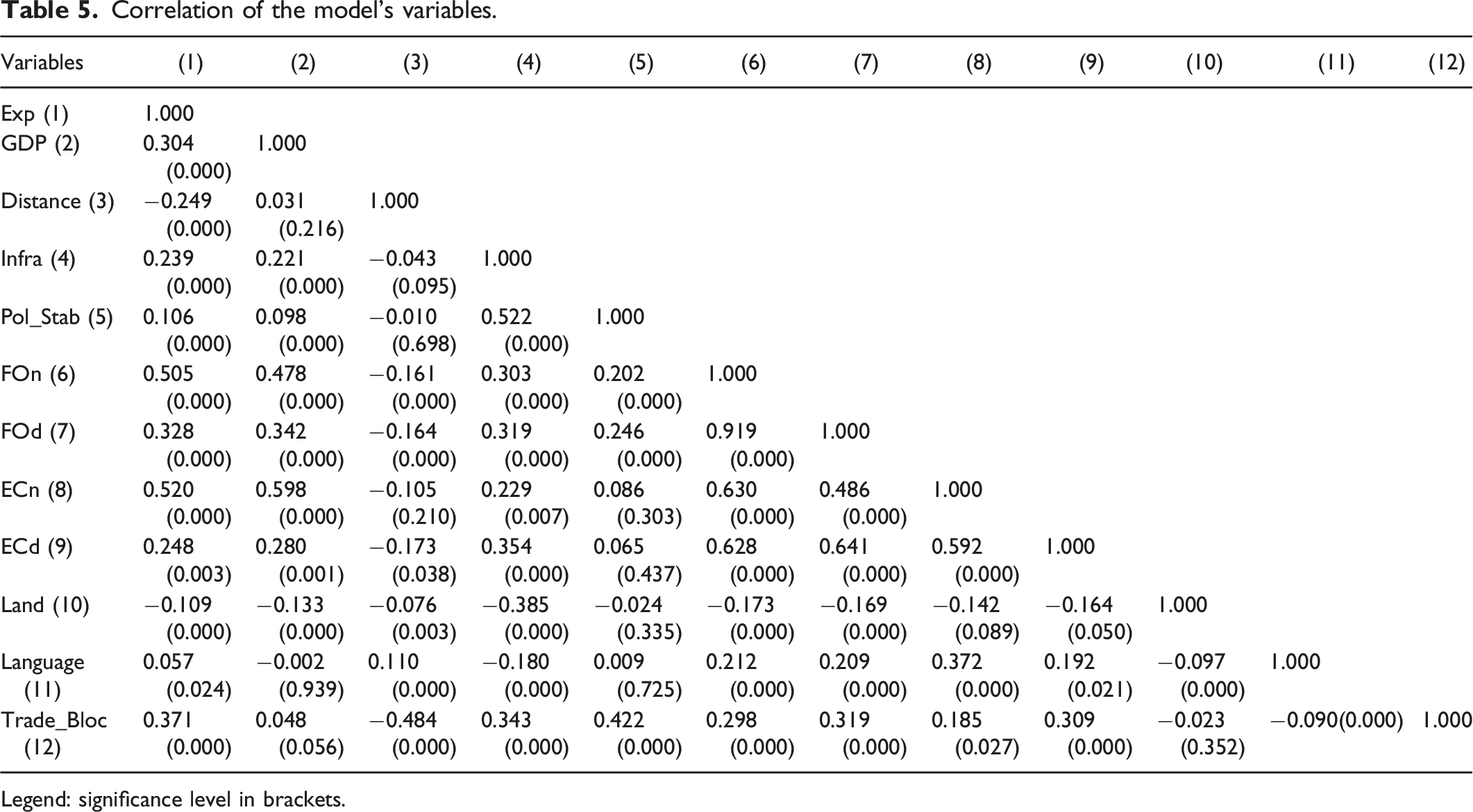
Correlation of the model’s variables.
Legend: significance level in brackets.
As Table 5 illustrates, all variables are correlated with exports: all correlation coefficients are statistically significant and exhibit the expected sign. Indeed, distance and landlockedness are negatively correlated with exports, while the remaining variables (GDP, the quality of infrastructures, political stability, economic diplomacy, a common language, and belonging to the same trade bloc) are positively correlated.
Concerning the correlation between the explanatory variables, although most of the coefficients are statistically significant, these are relatively small and thus will not cause problems in the estimation of the model. The highest correlation coefficient of 0.919 is that between the dummy variable (FOd) and number of Portuguese foreign offices (FOn), two alternative proxies for economic diplomacy, and therefore will not be simultaneously included in the model.
Results and discussion
Estimation results
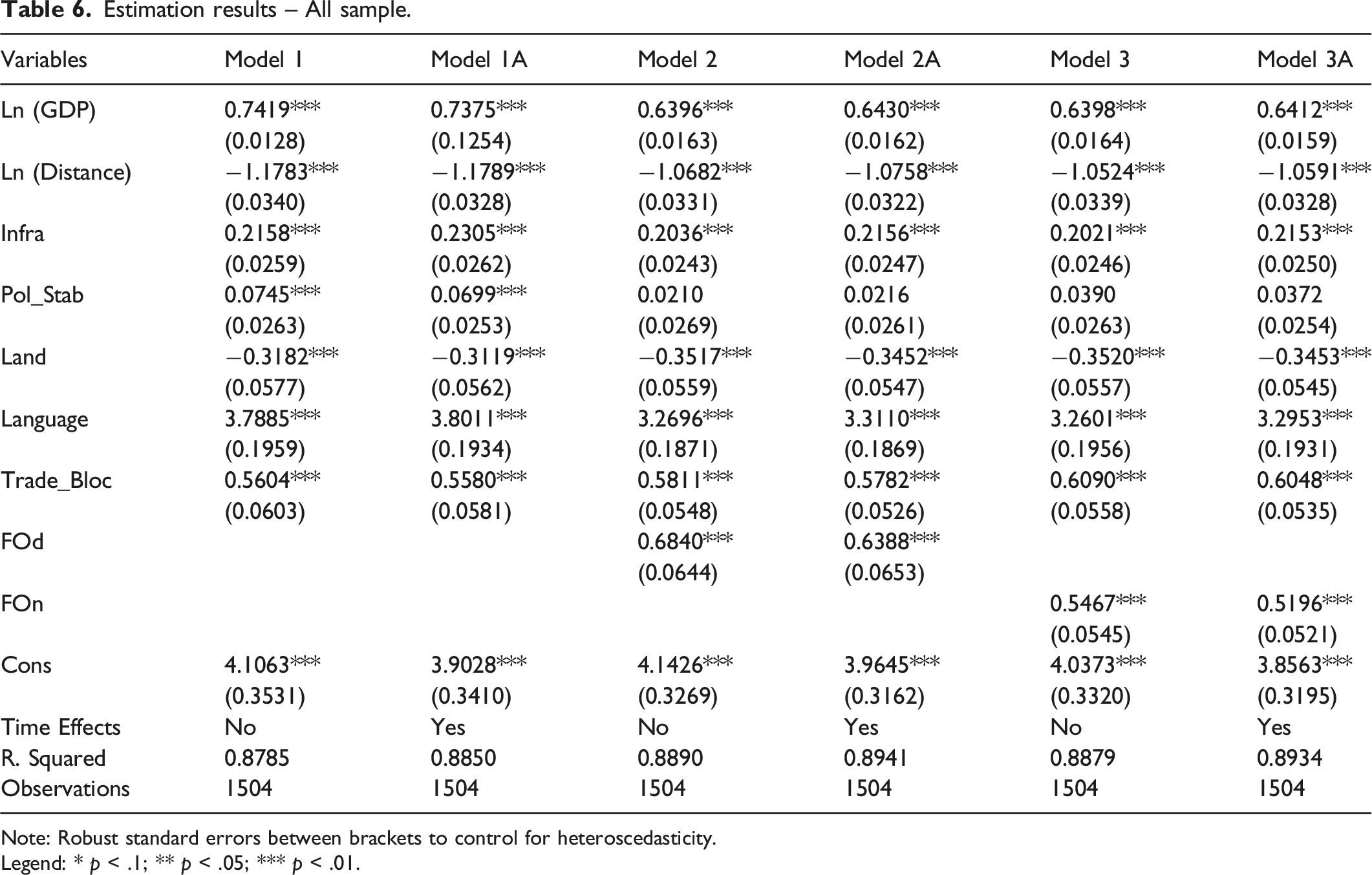
Estimation results – All sample.
Note: Robust standard errors between brackets to control for heteroscedasticity.
Legend: * p < .1; ** p < .05; *** p < .01.
The results of model 1A indicate that the gravity equation fits the data well as it explains 88.5% of the variation in Portuguese exports. Additionally, all coefficients are statistically significant at 1% level and present the expected sign. Exports increase with the size of the destination country and decrease with the distance between Portugal and the importing country: ceteris paribus, an increase in the destination country’s GDP by 1% will induce an increase in the Portuguese exports by 0.74%, and an increase in distance by 1% will induce a decrease in exports by 1.18%. Furthermore, the results also indicate that, all else equal, exports dropped by 27% [(exp(-0.3119)-1)*100] in the case of landlocked destination countries. On the contrary, Portugal exports 4,375% [(exp(3.8011)-1)*100] more with countries that share the Portuguese language. Similarly, having a common trade bloc (in this case, being part of the EU) increased exports by 75% [(exp(0.5580)-1*100]. Finally, there is a positive relationship between Portuguese exports and the quality of infrastructures and the political stability of the destination countries. To sum up, the results of model 1A are in line with what is predicted by the literature, confirming the robustness of the underlying model.
Focusing on the results of model 2A, in which the variable of Economic Diplomacy was added as a dummy variable, we see once again that the gravity equation fits the data well, explaining 89.4% of the variation in Portuguese exports. It is important to note that the coefficients of most of the variables included in model 1A remain statistically significant and with similar values (and in line with what was expected). The exception occurs with the Political Stability variable, which, in model 2A, is not statistically significant. Moreover, with regard to the economic diplomacy variable, it is statistically significant and the coefficient shows the expected sign: we can expect that ceteris paribus Portugal exports 89% [(exp(0.6388)-1)*100] more to partners that host a Portuguese office when compared to those in which Portugal does not have such offices.
Finally, the estimation results of the model 3A are, for almost all of the variables, highly similar to the results of model 2A. The exception occurs with the variable Economic Diplomacy that in model 3A is measured through the number of Portuguese offices in its partner countries (FOn). The estimated results for this variable once again reveal a positive relationship between Economic Diplomacy and exports; ceteris paribus, the opening of a Portuguese office in an importing country will induce a rise of around 68% of Portuguese exports to that country.
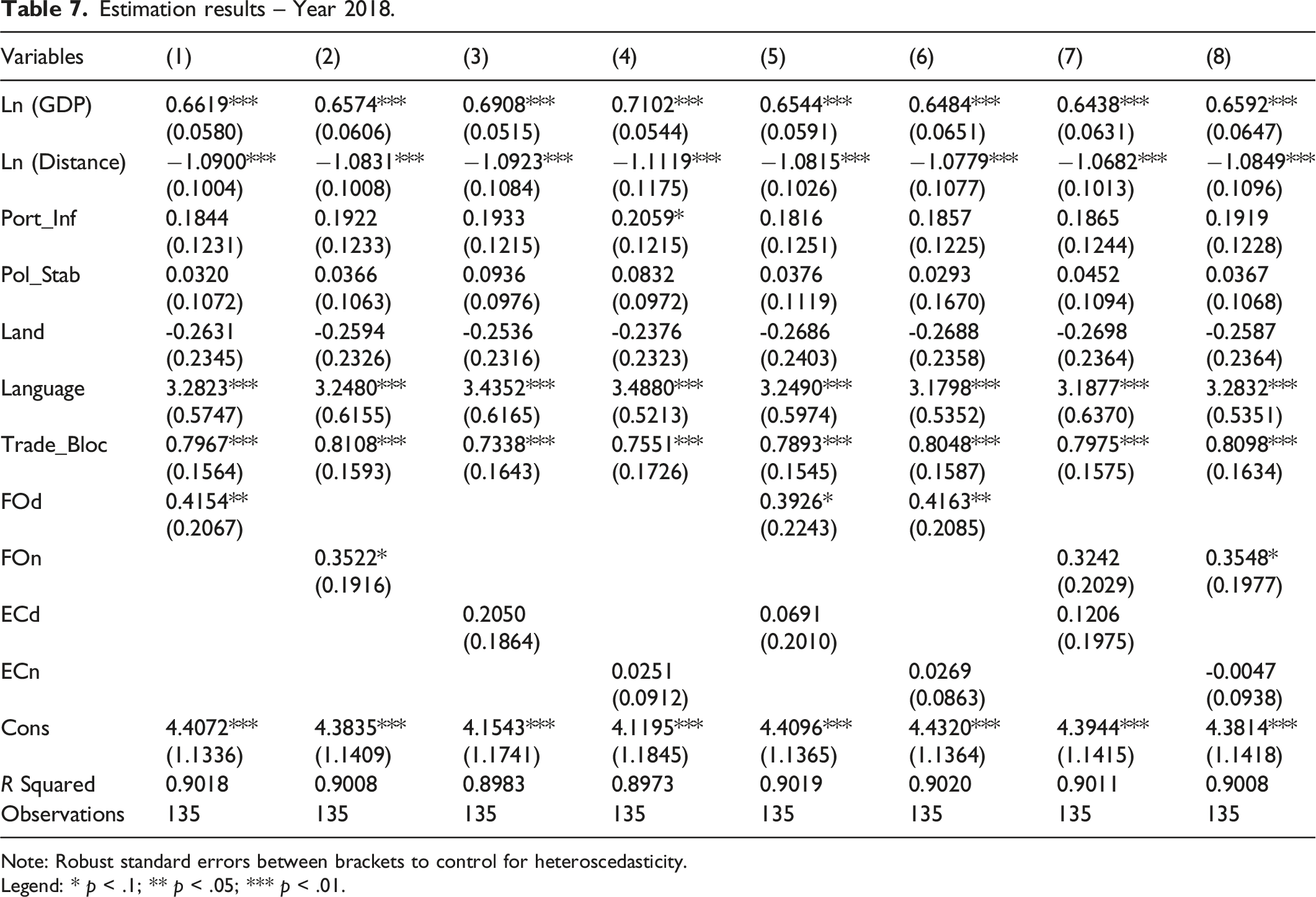
Estimation results – Year 2018.
Note: Robust standard errors between brackets to control for heteroscedasticity.
Legend: * p < .1; ** p < .05; *** p < .01.
Table 7 presents the results of eight estimations considering different proxies for the variable Economic Diplomacy. In model (1) economic diplomacy is measured as FOd (a dummy variable for the existence of Portuguese offices in overseas countries), in model (2) through the number of offices Portugal held in foreign countries (FOn), in model (3) again a dummy variable for the existence of embassy or consulate of Portugal (ECd), and in model (4) economic diplomacy is measured as the number of embassies and consulates (ECn). Furthermore, when it concerns model (5), both dummy variables (FOd and ECd) are added; in model (6) the focus is on FOd and ECn, in model (7) FOn and ECd are brought to light, and lastly, in model (8), the spotlight is on FOn and ECn.
The results presented on Table 7 indicate that the gravity equation fits the data well, explaining about 90% of the variation in Portuguese exports. In addition, in all models estimated, the variables of the base gravity model are significant, and the respective coefficients show the expected sign, as do most of the remaining variables (Language and Trade_Bloc). Indeed, ceteris paribus, a growth of 1% in the destination country’s GDP will lead to an increase of around 0.64 to 0.71% of Portuguese exports to that country, and a growth of 1% in the distance between the countries will negatively impact export flows by around 1.1%. Additionally, the estimations also indicate that, ceteris paribus, Portugal exports more to countries within the same trade block (in this case, the EU), and to those which share a common language.
From these assessments, we can conclude that, in 2018, the presence of Portuguese foreign offices positively impacted exports by 51% [(exp(0.4154)-1)*100], and the opening of one office brought an increase of around 42% to the Portuguese exports to the country in which the office is based -according to the results of models (1) and (2), respectively. Lastly, in regard to the effect of embassies and consulates, we see that the variable is not statistically significant in any model, and thus conclusions on its effect cannot be drawn. However, we seem to be able to denote that, as instruments of economic diplomacy, the effect of the foreign offices appears to be more impactful than that of embassies and consulates.
Discussion
As shown in the previous section, economic diplomacy, measured through the number of Portuguese foreign offices, has a positive impact on Portuguese merchandise exports. In fact, not only does Portugal export more to partners that host a Portuguese office in their territory, but the opening of a new office will also induce the rise of exports to that country.
Thus, our findings are in line with those of past empirical studies on the impact of economic diplomacy on trade, such as those of Kazunobu Hayakawa, Hyun-Hoon Lee, and Donghyun Park. 128 These authors found, in their assessment taking into account country-pair effects, that the existence of an EPA in a certain country results in an increase of around 61% of bilateral trade with the EPA’s host country, with this impact being 68% in our study (according to the findings of model 3A), when focusing on Portuguese merchandise exports.
However, if we take a closer look at the results of model 3A, we find, similarly to Rose and Gil et al., 129 that the impact of economic diplomacy tends to be smaller than that of a common language or membership in the same trade bloc (in this case, the EU). Indeed, ceteris paribus, Portugal trades 2,598% more with countries that also have Portuguese as official language and 83% with those that are part of the EU, while a foreign office will translate to an increase of around 68% in Portuguese exports.
Moreover, similarly to some authors, 130 our results seem to denote that export promotion offices tend to be more relevant for promoting bilateral trade than embassies or consulates, since foreign offices have a positive impact on exports while embassies and consulates are not statistically significant. Thus, EPAs may be perceived as being more effective in their pursuit of lowering barriers to trade and information asymmetry than embassies or consulates, which may be due to the fact that their set of activities and fields of work are more specialized and targeted than those of the embassies, as explained above.
Conclusion
Economic diplomacy, in the form of embassies, consulates, and export promotion agencies, has gained prominence as a catalyst for exports. 131 In fact, as government tools for influence and assistance abroad, these instruments can have the power to minimize the market’s frictions, 132 reduce informal trade barriers, 133 and function as vehicles of information for domestic firms. 134 In a world in which geographic distance has lost importance as the main obstacle to trade, and is now accompanied by cultural, administrative, and economic factors, 135 and where information asymmetry, uncertainty, and externalities mostly stand between a firm and its decision to internationalize, economic diplomacy can have the power to alleviate these issues. This can be pursued by identifying possible sales or investment opportunities, providing information on the markets and its consumers, or aiding with the bureaucratic processes. 136 In the end, having met their purpose, these instruments will impact the trade patterns of their home country.
Thus, with a rising number of studies trying to grasp the real impact of economic diplomacy instruments on trade in recent years, this paper has attempted to answer the question of whether the export promotion agencies, embassies, and consulates Portugal has in foreign countries indeed impact the Portuguese exports to those countries. Through an augmented quasi-gravity model of trade, and having as baseline of our data the Portuguese merchandise exports to 144 countries during a time period of 11 years, from 2008 to 2018, we were able to draw an econometric equation to conduct our assessment. In this equation, aside from the two basic independent variables, economic size (GDP) and physical distance, we have also added a variable related to economic diplomacy (our main exploratory variable) and further control variables, which also have the power to impact trade—these being landlockedness, common language, belonging to the same trade bloc, the quality of infrastructures, and political stability.
Through our assessment we concluded that distance and landlockedness are negatively related with exports, while a shared language and belonging to the same trade bloc, along with a stable political framework and good quality of infrastructures can be seen as having a positive impact on bilateral exports, thus confirming the results of Emiel Afman and Mathilde Maurel. 137
Additionally, in regard to economic diplomacy, we found a positive relationship between the existence of foreign offices and Portuguese exports. Results indicate that not only does Portugal export 89% more to partners that host a Portuguese office compared to those in which Portugal does not have offices, but also that the opening of a new Portuguese office in an importing country will induce a rise of around 68% of Portuguese merchandise exports to that country. These results are consistent with the past literature which focused on the matter of economic diplomacy, particularly those of foreign offices and its impact on trade. 138 Nevertheless, both the effects of a common language and trade bloc seem to be more impactful with respect to Portuguese exports than that of economic diplomacy, as shown by Rose and Gil et al. 139
Overall, the main contribution of this study to the literature seems to be the confirmation of a positive impact of the opening of an export promotion agency office on Portuguese merchandise exports. This is because the results for the assessment of the effect of embassies and consulates have proven not to be statistically significant.
Although the effect of the different dimensions of economic diplomacy seems to vary according to the actual instrument adopted, the truth is that the main limitation of this study stems from the fact that, for the assessment of the effect of embassies and consulates, we were only able to collect data for the year 2018. Thus, even though we seem to verify that Portuguese export promotion agencies gave a positive boost to the exports to the countries in which they are located, we were not able to confirm the conclusion of Gil et al. or Volpe Martincus that embassies and consulates seem to have little importance, because our results were not statistically significant. This topic figures, therefore, to be an interesting matter for further examination. 140
Moreover, when it comes to future research on the theme of economic diplomacy and trade, especially when focusing on the Portuguese case, one can see that there is still more to grasp about the impact of the instruments of economic diplomacy on trade when taking into account the level of development of the countries with which Portugal is engaged in terms of trade activity. And, additionally, as previously mentioned, the potential distinct role of these instruments when analyzing their effect on both the intensive and extensive margins of trade or the degree of differentiation of the traded goods can also be taken as a topic for future research.
Footnotes
Declaration of conflicting interests
The author(s) declared no potential conflicts of interest with respect to the research, authorship, and/or publication of this article.
Funding
The author(s) received no financial support for the research, authorship, and/or publication of this article.
