



Abstract
During the 2021 mass protests in Colombia, and while international calls for the Colombian government to respect human rights were intensifying, Canada’s position remained somewhat ambiguous. Part of Canada’s ambiguity can be explained by a simplistic characterization of Colombia as a “weak state.” This article assesses Canada’s bilateral relationship by historizing the development of Colombia’s governance in the key overlapping sectors of security, human rights, and natural resources. From extensive fieldwork, we distinguish two competing rationalities based on the articulation of the notions of “conflict” and “dissent” with the notion of the “rule of law.” We believe that Canada’s bilateral relation with Colombia in the last decades has overlooked the contradictions that exist between democratizing rationalities and antipolitical rationalities. As a result, Canada’s foreign policy has been based on an overly simplistic conception of the relationship between development, security, and the rule of law.
Keywords
On 28 April 2021, a national strike began in Colombia. In the context of an ongoing economic crisis, broad social dissatisfaction, and the COVID-19 pandemic, Colombian citizens were initially protesting President Iván Duque’s tax reform plan. Serious human rights abuses were committed by Colombian security forces against protesters, with reports of forced disappearances, gender-based violence, and ethnic-racial violence in several Colombian cities. 1 As international calls for the Colombian government to respect human rights were growing more persistent, Canada’s position remained somewhat ambiguous. In his only statement on the situation on May 9, the Canadian minister of foreign affairs, the Honourable Marc Garneau, expressed concern for “the disproportionate use of force by security forces,” but tempered his remarks by condemning “acts of vandalism and attacks directed against public officials.” 2 This tepid stance attracted criticism and raised questions regarding Canada’s foreign policy objectives in Colombia. 3
At least part of the ambiguity in Canada’s response can be explained by its overly simplistic characterization of Colombia as a State to be “strengthened.” Indeed, while the academic fascination with defining “weak” or “failed” States has waned, these concepts are still used with regards to Colombia, 4 and remain widely operational in international policy discourse. 5 Notwithstanding the varied and sometimes contradictory definitions, policies are routinely justified by “fragile state” narratives aimed at “strengthening” different aspects of a nation’s governance and institutions.
Canada’s bilateral relationship with Colombia 6 is no exception. Indeed, from 2018 to 2020, Canadian official reports on human rights and free trade with Colombia refer to “weak rule of law” as a significant challenge for the peace process and improving human rights protection. 7 Regardless of this longstanding approach, however, assigning “weakness” to Colombia’s political structures and institutions is too often a blunt process that overlooks how different historical processes “weaken” some institutions while “strengthening” others. Thus, policies aimed at “strenghtening the Colombian State” without specifying institutions or modalities can be called into question.
This article will assess the Canada-Colombia bilateral relationship using a conceptual framework that historizes the development of Colombia’s governance in the key overlapping sectors of security, human rights, and natural resources. To do so, we problematize the coexistence and/or struggles between different rationalities, or “regimes of reason,” in Colombia. These different regimes of reason—which are not necessarily consistent with the different options and ideologies represented in Colombia’s party system—are expressed in various institutions through overlapping and competing discourses, doctrines, mobilizations, cosmovisions, policies, jurisprudences, techniques, and norms.
We begin by presenting our theoretical framework, which draws on the Foucauldian notion of governmentality and the heterodox political economy notion of structural power. We then describe how, building on the ambiguity of the notion of “rule of law,” a continuum of peace, human rights, and development has been constructed within the Canada-Colombia bilateral relationship. We illustrate our argument with an examination of Canadian government support for the work of Lawyers Without Borders Canada (LWBC) in Colombia.
Based on a review of primary and secondary literature and insights obtained through 15 years of ongoing practice and fieldwork, we contrast this hegemonic construction with the specific rationalities underlying two interrelated fields structurally linked to Colombia’s human rights landscape: (a) counterinsurgency practices and transitional justice; and (b) territorial organization and natural resource management. The competing rationalities of these two fields can be respectively described as “democratic” and “antipolitical.” Indeed, these rationalities assume very different articulations between the notion of “conflict” or “dissent,” and the notion of the “rule of law.”
In sum, our argument is the following: Canada’s overall foreign policy toward Colombia has been based on an overly simplistic conception of the relationship between development, security, and the rule of law. Overlooking the contradictions that exist between democratizing rationalities and antipolitical rationalities in Colombia, interventions have often been misguided, favouring regressive dynamics. Following the peace agreement with the Revolutionary Armed Forces of Colombia—People’s Army (FARC-EP) on 24 November 2016, the ambiguity in Canada's approach should be abandoned if Canada is to support a genuine democratic transition in post-agreement Colombia. 8
Theoretical framework
As a type of assistance grounded in the post–Cold War environment, “security humanitarianism has become increasingly central to Canada’s relationship with the world.” 9 In the wake of 9/11, a global security agenda aimed at fixing “failed” states emerged among Western countries and international organizations; 10 the concept of “weak” or “fragile” states structured the political lexicon on peace, development, and security of Canada’s development assistance programs. 11 These terms, however, amalgamate diverse states into an oversimplified, homogenous group toward which aid donors “react in a formulaic manner to enhance state capacity—even though these countries drastically differ in terms of security, capacity and legitimacy.” 12
For instance, the 2005 Fragile States Index (FSI) Annual Report 13 published by the American magazine Foreign Affairs stated that “instability takes the form of episodic fighting, drug mafias, or warlords dominating large swaths of territory (as in Afghanistan, Colombia, and Somalia);” 14 a definition that, prima facie, equates Colombia’s situation to those of nations with vastly different contexts. Despite numerous criticisms related to defining, identifying, and measuring “weak,” “failed,” and “fragile” states, 15 these have been recurring adjectives in Canadian international cooperation with Colombia, both before and after the 2016 peace agreements were signed.
Central to the concept’s limitations is the implicit assumption of the “essence” of a state from which one could deductively derive an assessment of a given state’s strength and, a fortiori, propose solutions to its weaknesses.
16
However, as Michel Foucault reminds us: The State has no fundamental essence. [It] is nothing other than the effect […] of perpetual processes of “statizations,” of incessant transactions which modify, displace, upset, insidiously modify […] the sources of funding, the modes of investment, the decision-making centres, the forms and types of control, the relationships between local powers, central authority, etc. […] The State is nothing other than the mobile effect of a system of multiple governmentalities (our translation).
17
In this sense, “governmentality” refers to the different rationalities, or regimes of reason—ways of thinking and ways of feeling—through which different conducts are promoted or regulated and different individuals empowered, disciplined, constrained, or coerced. 18 These regimes of reason are an integral part of what heterodox political economy calls “structural power.” 19
Canada’s approach to its bilateral relations with Colombia in the area of security and governance exemplifies this point. David Chandler defines “security governance interventions” as “the projections of external power in or over another state in order to direct or influence the security behaviour of actors within that state.” 20 In that regard, it “is not only power that is projected but a certain framework of ideas and values and political purpose.” 21 As we argue below, the projection of coherence between the securitization of Canadian economic interests, justice, and human rights is central to Canada’s policies promoting the rule of law in Colombia. The “whole-of-government approach,” first articulated in the context of the war in Afghanistan, thus constructs a conceptual coherence between diplomacy, defense, development, and commerce. 22
We agree with scholars who have identified that ambiguous definitions of the rule of law are a condition of possibility for projecting policy coherence. 23 In fact, coherence with other foreign policy objectives has been an issue since the beginning of Canadian foreign aid during the Cold War. 24 In keeping with the debate between realism and idealism in the field of International Relations, the debate on Canadian aid has been largely dominated by a conceptual dichotomy between ethical and self-interested motives. 25 As David Black argues, however, “a more nuanced understanding of the relationship between ethics and interests” is needed to “better captur[e] the dilemmas and ambiguities of ethical purpose.” 26 Indeed, Canada’s aid to Latin America has been historically shaped by “the tension between relatively strong Canadian commercial interests in the region and pressures from highly mobilized civil society.” 27
Canadian intervention and the hegemonic construction of a peace, human rights, and development continuum
According to the Canadian government, the goal in applying a “whole-of-government approach” to its bilateral relations with Colombia is simultaneously to “[expand] trade and investment” while maintaining a “frank dialogue on human rights” and supporting “Colombia’s justice, security and peace-building efforts.” 28 As highlighted in a comparative study of Canada’s interventions in post-conflict Guatemala and Colombia, “strengthening the rule of law” is frequently mobilized as a way to reconcile policy objectives that are often incompatible when applied on the ground: promoting human rights, promoting regional security, and promoting investments. 29 The notion also has the advantage of appealing to the various audiences and actors interested in Canada’s foreign policy, including civil society organizations and the business community. 30
The Colombian extractive sector illustrates both the imperative to reconcile these policy objectives and the difficulties involved. Canadian foreign direct investment (FDI) in the mining sector has represented a significant proportion of Colombia’s gross domestic product (GDP) for the past decade. 31 According to Natural Resources Canada, Canadian mining assets in Colombia totalled $837 million among twenty-eight companies in 2020. 32 The impact of Canadian mining activities in Colombia has generated discussion on how to hold corporations and States accountable for human rights and environmental abuses. According to a report by the Justice and Corporate Accountability Project (JCAP), the deaths of six individuals can be linked to the operations of Canadian mining companies in Colombia between 2000 and 2015. 33
Meanwhile, Canada has consistently used ODA to promote the extractive sector. Between 2012 and 2017, Colombia was Canada’s fourth largest recipient of aid linked to mineral resources and the mining sector, following Indonesia, Tanzania, and Peru. 34
The rest of this section analyzes the work of Lawyers Without Borders Canada to illustrate both the Colombian context and the hegemonic construction of a continuum between Canadian economic interest, justice and human rights.
Contradictions between human rights and trade objectives
Canada’s whole-of-government approach in Colombia (2003–2005).
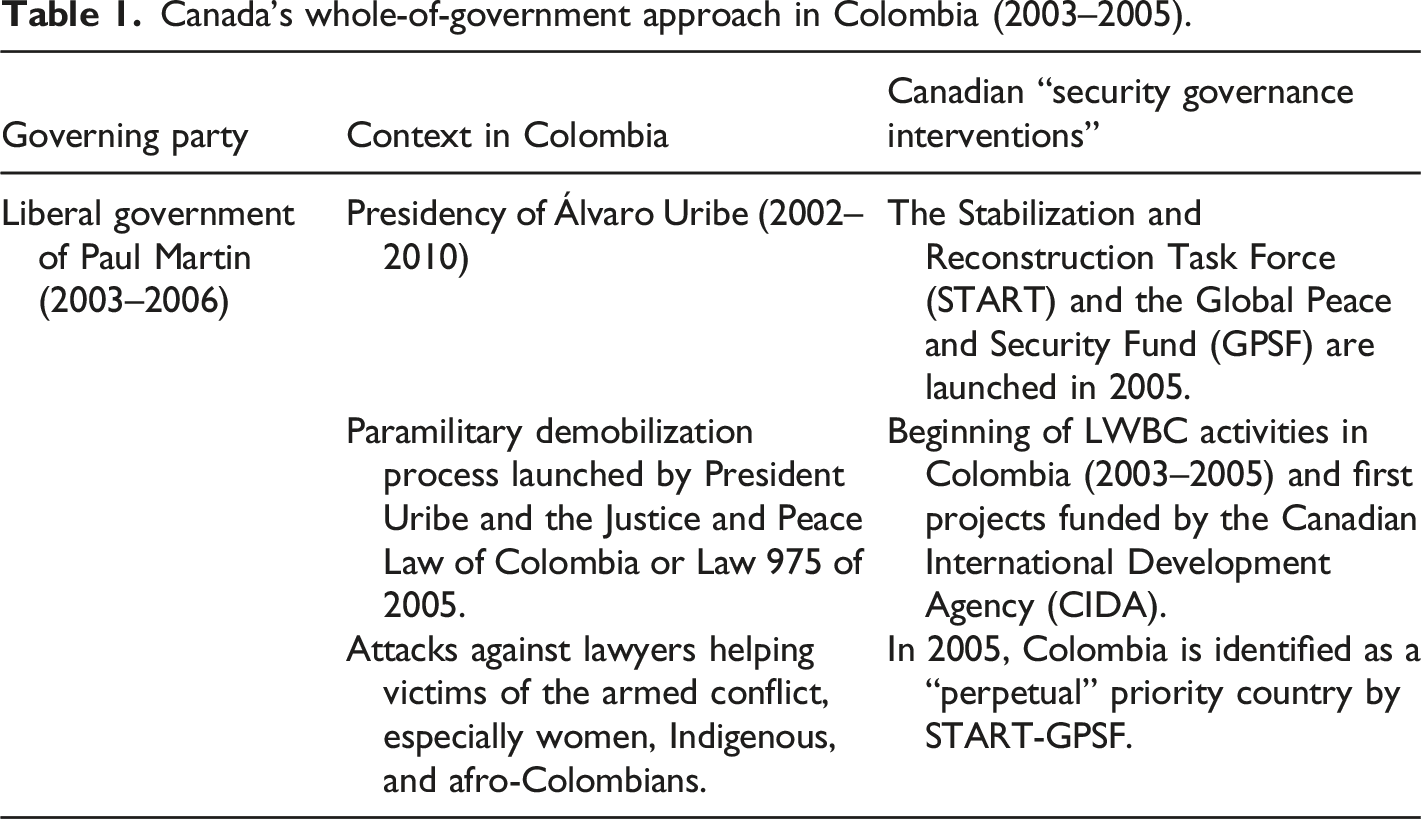
In 2003, LWBC launched their first international cooperation missions in “weak and fragile” states such as Afghanistan, Colombia, Nigeria, and Sierra Leone.
37
Appearing before the Standing Committee on International Trade on 26 May 2008, LWBC’s director general, Pascal Paradis, described Lawyers Without Borders as: […] an organization that contributes to the defense and promotion of human rights, the fight against impunity, holding fair and impartial trials and respect for the rule of law in various countries in crisis, developing countries or so-called fragile countries (our translation).
38
LWBC received its first grant from the Canadian International Development Agency (CIDA) in 2004–2005 for a training and protection program for Colombian defence lawyers. This collaboration with the Canadian government coincided with the creation of the Stabilization and Reconstruction Task Force (START) and the Global Peace and Security Fund (GPSF) in 2005. The Government of Canada created them “with a mandate to advance Canada’s foreign policy priorities of addressing international security challenges and promoting the Canadian values of freedom, democracy, human rights, and rule of law in fragile and conflict-affected states.” 39
Business and human rights issues during the Harper era (2006–2015).
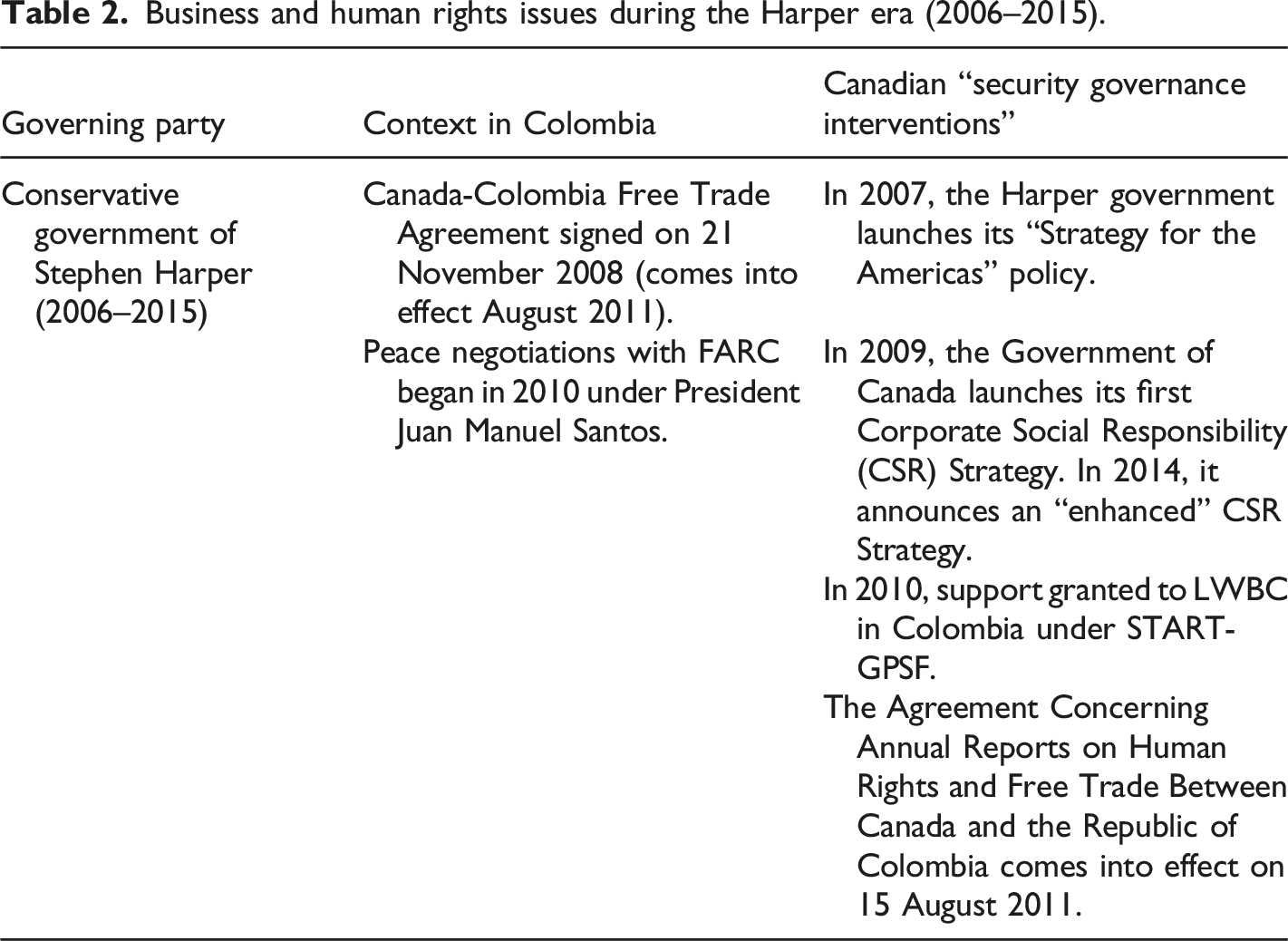
In 2008, LWBC received a major programmatic funding from the Department of Foreign Affairs and International trade (DFAIT) for a new project on Access to Justice for Indigenous Communities and Victims of Conflict. While this project ostensibly reconciled human rights promotion and legal stability for business through the promotion of the rule of law, LWBC’s position on business and human rights issues in Colombia reflected the difficult conciliation between the two objectives. During this period, Canadian security governance interventions in Colombia were intrinsically linked with the negotiations of the Canada-Colombia Free Trade Agreement (CCOFTA).
42
Appearing at the Standing Committee on International Trade in May 2008, LWBC’s director Pascal Paradis, emphasized that the NGO’s focus: […] is on the rule of law, justice and human rights, and it is our role to denounce human rights violations committed by a State. And if Canada embarks on free trade negotiations with that State, we believe it is our duty to urge caution.
43
From 2010 to 2011, LWBC navigated the ambiguity within Canadian “security governance interventions” with some success. For example, they participated in an ONIC-organized Colombia-wide discussion on the right to prior consultation. Further, they monitored human rights violations when a Canadian mining company’s open-pit mining project in Marmato caused an increase in social conflict and displacements. 44
Competing priorities, however, kept hindering Canada’s foreign policy, as illustrated by the elaboration of Annual Reports on Human Rights and Free Trade between Canada and the Republic of Colombia, an agreement in parallel with CCOFTA. These ex-post human rights impact assessments (HRIA) were criticized for their limited scope and methodology, which excluded the evaluation of the impacts of Canadian extractive investments on human rights.
45
Although they first participated in these HRIAs, some non-governmental organizations (NGOs), such as Amnesty International, thus eventually decided to withdraw from the process “unless there [was] a substantial change in scope and methodology for the report.” They further stated that: […] the Government of Canada chooses to interpret its human rights reporting responsibilities in a limited and restrictive manner that ignores and overlooks pressing human rights concerns directly related to critical trade, investment and business policy and activities that are encouraged, promoted and furthered by the CCOFTA.
46
In 2013, when CIDA and DFAIT were merged into one department, LWBC’s funding was reduced by 75 percent, which affected its ability to defend human rights. 47
Tiptoeing around the elephant in the room
Transitional justice and Trudeau’s feminist agenda.
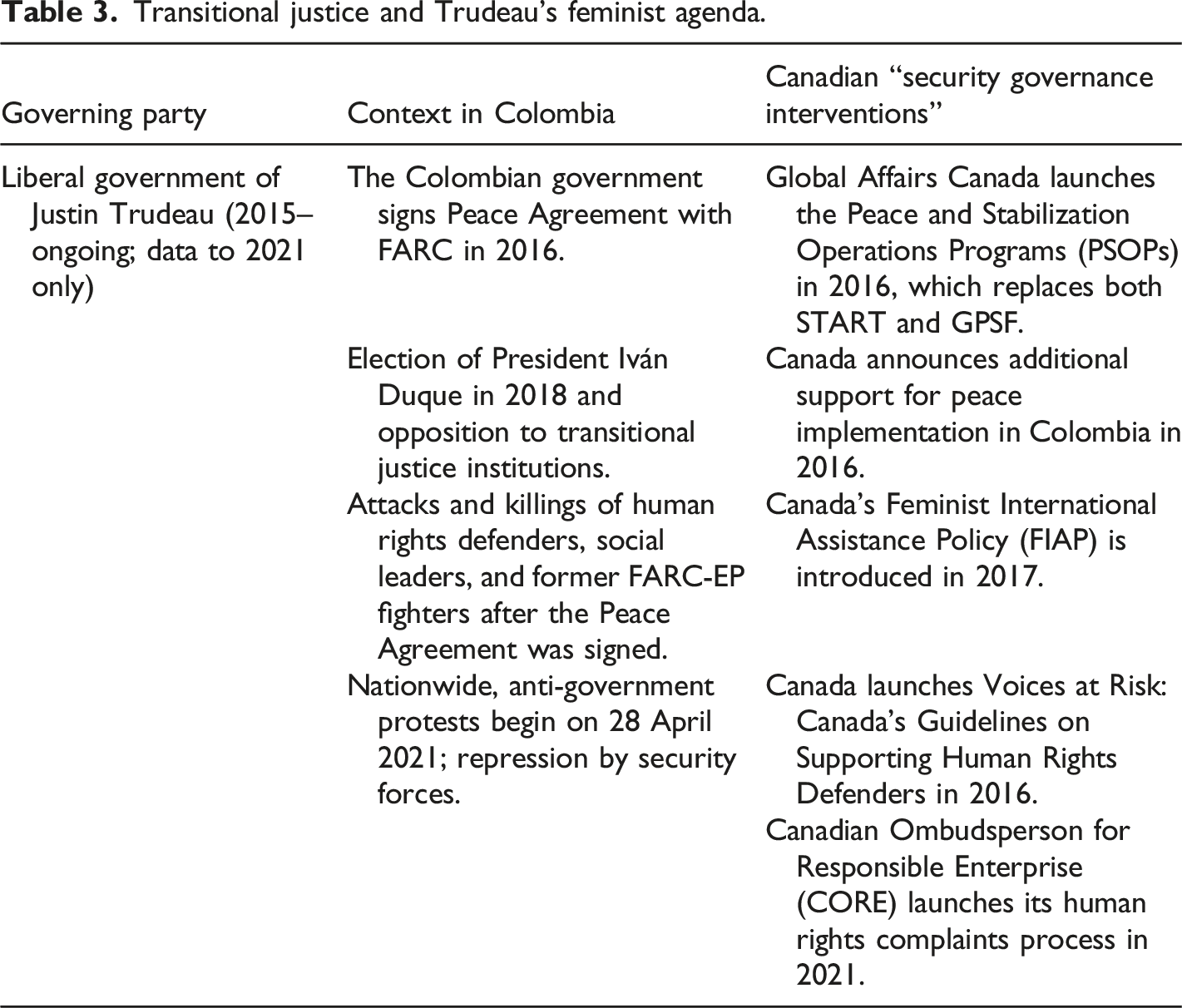
Due to the importance of Canada’s feminist foreign policy for the Trudeau government, LWBC’s new projects in Colombia were framed according to those goals and objectives. Since 2017, PSOPs have supported LWBC’s Transitional Justice for Women program (JUSTRAM) in Colombia, which aims to “actively foste[r] the participation of women and members of the Afro-Colombian and Indigenous communities in the national dialogue” and to promote “the emergence of a justice model that can inspire other States facing similar challenges.” 50
The projects to enhance the rule of law have had a positive impact for human rights advocacy in Colombia; however, tension between the competing regional priorities of the Canadian government remains. While the Canadian embassy in Colombia “continued delivering upon its 2016 commitment of over $78 million in funding for peacebuilding efforts in Colombia,” 51 none of the new projects involving LWBC directly address human rights violations linked to Canadian extractive companies, rather aligning with Canada’s commitment to corporate social responsibility (CSR). 52
Organizations like LWBC creatively circumvent contradictions in Canada’s foreign policy objectives by using the apparent political neutrality of “the rule of law” to support important work. The requirements of transnational advocacy work, however, also produce “‘silences,’ exclusions, [and] paradoxical effects.” 53 These “silences” are not trivial. As described in the next section, they may enable or facilitate attacks and stigmatization against human rights defenders accused of what Colombian army officials call “political warfare.” 54
“Libertad y Orden”: The politics of democracy and antipolitics in Colombia
Since 1834, Colombia’s motto has been “Libertad y Orden,” i.e., “Liberty and Order.” Order and liberty, however, have often been at odds throughout its history.
This tension is reflected in two competing notions of the “rule of law.” For example, democratic and emancipatory regimes of reason in Colombia—whether liberally or radically inclined—associate the legitimacy of norms and laws with how they correspond to certain teleological aspirations. The rule of law, under this logic, is a means to an end. For example, the current Colombian Constitution enunciates what “the People of Colombia” consider to be the objectives of the Colombian Republic: the unity of the Nation[,] the life of its members, peaceful coexistence, work, justice, equality, knowledge, freedom and peace[,] a legal, democratic and participatory framework that guarantees a just political, economic and social order, and [the promotion of] the integration of the Latin American community.
55
The Constitution also ratifies—as does contemporary constitutionalism in general—“human dignity” and “human rights” as teleological aspirations. 56 Under this logic, dissent and political conflict—as opposed to unanimity—are not only legitimate, but inherent to the expression of liberty.
Competing with this teleological logic is another regime of reason articulated around the imperative of “norm efficiency,” “stability,” or “order.” Under this logic, law is an end in itself: its legitimacy is a function of its ability to produce order, to rule, and to organize. This governmentality is, of course, reminiscent of Hobbesian philosophies; however, as Foucault’s genealogy of the notion of the “rule of law” highlights, the imperative of normative efficiency also underlies neoliberal condemnation of laws that interfere with a naturalized, self-enforcing “law” of the market. 57 Under this form of governmentality, political dissent tends to be delegitimized as a factor of disorder or sub-optimal resource allocation. Consequently, conflict is reduced to its antagonistic dimension as inherently dangerous, rather than viewed through its agonistic, productive dimension. 58 This opposing signification, which we call “antipolitical,” has considerable traction in a country ridden by poverty and by the longest armed conflict in the hemisphere. 59
In the following sub-sections, we illustrate how these two governmentalities collide in two contemporary Colombian political sites: the intersection of counterinsurgency practices and transitional justice, and the instersection of territorial organization and natural resource management.
Counterinsurgency practices, transitional justice, and the “rule of law”
“Hearts and Minds” counterinsurgency theories, originally developed by the French in Algeria, and updated by American theorists, have echoed throughout military doctrines adopted by Latin American armies from 1960 onward, notably in Colombia. 60 These doctrines tend to adopt a singular understanding of the conflict, with a focus on the way that people think and feel. They also tend to view political dissent, albeit expressed through legal and democratic channels, as a challenge to the collective interest of the Nation, the integrity of which is embodied by the military.
These doctrines thus tend to substitute the classical (and legal) distinction between combatant and non-combatant, enemy and allied forces, with the criterion of ideological functionality: anyone who does not explicitly demonstrate full support for the counterinsurgency effort is to be considered functionally linked to the insurgency. 61
The resulting rationality is antipolitical in the strictest sense: it pursues a cognitive and emotional control over society to prevent its members from organizing into a deliberative political community. In Colombia, for example, the construction of the internal enemy as a “terrorist[,] a moralizing process which imposes a norm on the whole of society,” is pervasive in official and paramilitary discourses.
62
According to Colombian human rights defenders, the objective of this ideological construction is: to infuse terror, punish and prevent political opposition or social claims, to deconstruct or break the communal bonds that serve as the basis for various forms of collective action [and] to exercise control over the population.
63
While ostensibly pursuing the rule of law, Hearts and Minds doctrines necessarily uphold normative efficiency over teleological legitimacy. While General Ospina Valle describes the military’s aim as “democracy through security, but with a legitimate security concept limited by people’s rights,” 64 he also affirms that law—and first and foremost human rights law—is “politicized” and “weaponized” to subvert the established order. 65 For Brigadier General (ret’d) Fernando Puentes Torres, “political warfare”consists of attacking “the legitimacy of the State using the legitimate instruments of the State.” 66 Indeed, according to the first French theoreticians of “political” or “irregular” warfare, if a country’s legal framework cannot be made explicitly counterinsurgent—by the traditional coup d’état, for example—then a degree of illegality in the fight against insurgency is necessary and inevitable. 67 In Colombia, the “false positives scandal” provides a clear example of such malfeasance. 68
The Colombian military intends to consolidate Hearts and Minds logics in the post-agreement era. Puentes Torres, who is also former executive director of military criminal justice, identifies “legal and judicial warfare” as “the most destructive” of “all the dimensions of political warfare” faced by the Colombian armed forces in the post-agreement era: 69 “the worst of the war begins when […] those who defended their people and their homeland are tried without mercy.” 70 Promoting this legal and judicial warfare are “illegal armed groups and related organizations (national or international NGOs as well as political parties linked to the extreme left) [who] rely on distorted, psychological and propagandistic actions.” 71 These statements uphold the criteria of ideological functionality, blurring the distinction between an insurgent and someone whose actions might be useful to the insurgency while erasing any difference between legal and illegal military targets—a distinction, on the other hand, that is absolutely fundamental to democratic, constitutional, and teleological understanding of the rule of law. In Colombia, the antipolitical regime of reason clearly endangers human rights defenders, who have been victims of more than 450 killings since 2016, including ten assassinations of victims’ rights activists. 72
It is at this point where coherence between human rights and legal certainty for investment reaches its limit. As previously mentioned, LWBC initially partnered with organizations directly involved in struggles concerning Indigenous people’s rights and extractivism, such as ONIC. One such organization, CAJAR, collaborated with other NGOs from the Working Group on Mining and Human Rights in Latin America to produce a report titled “The Impact of Canadian Mining in Latin America and Canada’s Responsibility,” 73 which was submitted to the Inter-American Commission on Human Rights in 2013. The strictly legal activities of these organizations are vital to the full realization of constitutional and human rights. Nonetheless, the Colombian government has often stigmatized them as being functional to the guerillas, and as such, they have been victims of several attacks. 74
This regime of reason also diverges from the transitional justice mechanisms put in place under the 2016 peace agreement. Indeed, opponents of the peace agreement perceive the Special Jurisdiction for Peace (JEP – Jurisdicción Especial para la Paz) as being too lenient on crimes committed by ex-FARC-EP fighters and too severe on military personnel accused of human rights violations. Former president Iván Duque’s (2018–2022) “emphasis on the rule of law has also gone hand in hand with denying the relevance and autonomy of the [JEP].” 75 While Duque failed to undermine the JEP, 76 the underlying antipolitical rationality remains a powerful driver of mobilization for certain elements of the state security apparatus and segments of Colombian society; the Colombian tradition of regionally based private armies and militarized economic elites has consequently been revived. 77 In this context, Canada’s foreign policy cannot afford to be ambiguous about which rationality underlies the “rule of law” being put forward by different actors in post-agreement Colombia.
Territorial organization, “legal stability,” and CSR
A parallel struggle is occurring at the intersection of resource extraction and territorial organization. At the heart of the struggle is the ongoing contradiction between the centralizing and technocratic tendencies of the Colombian elite and the constitutional principle of decentralized, “democratic, participatory [and] rational” territorial planning articulated around autonomous municipal governments. 78 Between 1991 and the 2011 adoption of the first Land-Use Act (Ley Orgánica de Ordenamiento Territorial, Ley 1454 de 2011), the principle of democratic and decentralized land planning was left uncodified, which enabled a powerful central bureaucracy to impose its territorial planning on local administrations. 79 Notwithstanding those impositions, social groups in various parts of Colombia have claimed this constitutional principle to empower popular democratic mobilization with the notable purpose of pre-empting or mitigating paramilitary control over local governments and territories. 80 The struggle between these two logics—democratic and decentralized vs. technocratic and centralized—remains unresolved and regularly ends up in Colombia’s high courts.
Canada’s relationship with Colombia is inextricably linked to this struggle. Indeed, mineral extraction triggered a number of these court cases over the last 20 years, 81 and Canada has supported Colombia in developing that sector for at least 25 years. According to James Rochlin, Canada had worked with the Colombian government “to create a mining program that was friendly to transnational investment” 82 from 1997 until 2001. As a result, the 2001 Mining Code stipulates that “no regional, sectional or local authority may establish portions of their territories where mining activity would be temporarily or permanently prohibited.” 83 The central government thus imposed the principle of “free mining” 84 seeking to generate “legal stability” for mining title holders.
This extractivist rationality, which perceives the rule of law as securing normative stability for extractive investment, is clearly at odds with the realization of the constitutional principle of democratic and decentralized land planning. 85 Indeed, the Mining Code has been successfully challenged in court for revoking municipal competence over territorial planning and for contradicting the decision-making rights of the local population with regard to land planning, notably through binding referenda on mining projects. 86
These decisions, however, have not deterred the central government from upholding the principle of free mining. 87 Echoing Canada’s position that human rights and a favourable investment environment in the extractive sector go hand in hand, the Colombian government has instead promoted corporation-community dialogue and corporate social responsibility agreements as a solution to conflicts between local communities and extractive operators. Colombia’s Business and Human Rights policy—“institutionalizing CSR under a rights-based approach” 88 —provides effective rhetorical support to Canada’s position by constructing a coherence between the management of “social and political risks” by private operators and the protection of human rights. 89
Unfortunately, free mining is not so easily reconciled with human rights and the aspirations enshrined in Colombia’s constitution in practice. In fact, CSR displaces the overarching constitutional principle of decentralized and democratic land planning, and replaces it with negotiated forms of justice. 90 In the process, local aspirations and grievances are reconstructed in a manner consistent with the extractive operator’s interests, which, in turn, are implicitly assumed to represent the interests of society as a whole. 91 At its worst, the governmentality that emerges through this approach is one of a public-private Reason of State that is antagonistic to rights-based collective action. Under this governmentality, claims that are incompatible with the operators’ interests are stigmatized as contrary to the general interest of society, and complainants are often subjected to political violence. 92
This dynamic is not exclusive to Colombia. In the Americas, extractive activities are often associated with unilateral affirmations of state sovereignty—over Indigenous title, for example. When challenged—whether through Indigenous claims to self-determination, 93 alternative modes of territorial occupation, or development models incompatible with extractivism 94 —States tend to respond with charges of terrorism and other related accusations. 95 Criminalization of dissent against the “commodities consensus” 96 is thus a common issue related to extractive projects worldwide 97 and especially in Latin America. 98
CSR rationalities thus expand the counterinsurgent categories of the “internal enemy” that were outlined in the previous section. Indeed, territorial ordering structures an integral part of the post-agreement counterinsurgency doctrine championed by the Colombian military, which focuses on “civil society, territory and sovereignty.” 99
The issue is particularly acute in Colombia. In fact, ongoing faith in Colombia’s peace process arguably hinges on successfully challenging the perpetuation of antipolitical counterinsurgency doctrines that provide “legal certainty” for Colombia’s land-owning economic elite and the extractive industry. The effects of these doctrines thus far are alarming. Since 2016, Colombians have witnessed the resurgence of “neo-paramilitary conservative forces that have taken over former FARC territories; a rise in killings of social leaders and ex-combatants […] and the often forceful pursuit of neoliberal reforms dispossessing marginalized populations of lands and livelihoods.” 100 Clearly, an ambiguous stance in this context would only undermine Canada’s contribution to peace, human rights, and democracy in Colombia.
Conclusion: Clarifying Canada’s position in Colombia
As the legacy of antipolitical counterinsurgency practices were internationally denounced and condemned during the April–March 2021 mobilizations in Colombia, there was something troubling about Canada’s official response to the crisis, in which police brutality and vandalism by protesters were put on an equal footing. In keeping with the two-faced nature of Canadian human rights policy in Latin America, the Canadian government positioned itself very carefully on both sides of the issue.
Less than 3 months later, on the 10th anniversary of the Canada-Colombia Free Trade Agreement on 14 July 2021, Canada’s minister of foreign affairs restated Canada’s commitment to “our ongoing partnerships in the areas of peace and security, human rights, democracy, trade and development.” 101 As we have argued, the “weakness of the State” framework enables a convenient blurring of Canada’s contradicting interests in Colombia. Canada’s interventions to “strengthen the rule of law” have left the premise that there is a coherence between peace, human rights, and development unchallenged. However, failing to recognize the contradictions that may arise between these areas, depoliticizing the notion of “rule of law,” and minimizing crucial political tensions remains a hazardous strategy in post-agreement Colombia.
Despite considerable achievements made through strategic human rights litigation projects funded by the Canadian government in the last decade, including the invaluable work of LWBC, Canada’s security governance interventions in Colombia maintain blind spots on human rights issues related to transitional justice and extractivism.
Therefore, it seems important to pursue the analysis of the politicization and depoliticization of human rights issues through Canada’s interventions in post-conflict countries. How much more effective could these interventions be if the “weak State” framework was replaced with decisive support in favour of democratic conceptions of the rule of law and vigorous condemnation of anti-political rationalities.
Footnotes
Declaration of conflicting interests
The author(s) declared no potential conflicts of interest with respect to the research, authorship, and/or publication of this article.
Funding
The author(s) disclosed receipt of the following financial support for the research, authorship, and/or publication of this article: This work was supported by the Government of Canada, Social Sciences and Humanities Research Council of Canada, 430-2019-00792.
