




Abstract
This paper examines the dark side of Afghanistan’s peace negotiations that started under Donald Trump’s South Asia policy in Doha, Qatar, in September 2018 and ended, without a meaningful success, in December 2020. The paper examines both the United States–Taliban and the intra-Afghan negotiations and discusses the impact of the false negotiation behaviour by the Taliban and the Afghan government on the peace talks. It also explains how, in the absence of conditions for a political settlement, parties to the conflict acted as false negotiators, which resulted in the failure of efforts to launch a genuine peace process and in the Taliban’s military domination of Afghanistan.
The Taliban conquered Afghanistan in August 2021. The insurgent group returned to power for two main reasons: first, the failure of efforts to settle the conflict politically, and second, the military defeat of the Afghan government and its international allies by the insurgency. This paper examines how the failed efforts for a political settlement led to the insurgency’s military domination.
After the resurgence of the Taliban in 2003, the insurgent group followed a clear strategic agenda for returning to power forcefully. Achieving the goal seemed difficult in the early years because the Afghan government and its armed forces were part of the United States (US)’s war on terrorism and received remarkable financial and military support from NATO. However, the war became increasingly costly to the Afghan government and its international allies. Therefore, they increasingly tried to rely on alternative measures of conflict resolution, including negotiation and mediation.
The Taliban initially welcomed all efforts for a negotiated settlement, which helped the group to launch a political and diplomatic front parallel to its military campaign on the ground. As a result, different branches and segments of the Taliban participated in any possible international platform tactically and dishonestly to pave the way for reaching the group’s strategic goal, which was a total domination of power. In this context, the negotiation tactic increased the international and political legitimacy of the Taliban, when the group was simultaneously occupying territory by expanding its insurgent operations in the countryside and its terrorist attacks in major cities. The fall of Afghanistan to the Taliban was an outcome of the insurgent group’s tactical and strategic manoeuvres and the Afghan government and its international allies’ misunderstanding of the insurgent group’s core plan and objective.
The Taliban’s political and diplomatic dominance started with the commencement of the US-Taliban negotiation under the Trump administration in Doha, Qatar, in September 2018, and ended with the failed intra-Afghan peace talks in December 2020. The Taliban used the two negotiations as short-term tactics to achieve a long-term strategic goal which included a total domination and defeat of the enemy.
The US-Taliban negotiation reached a bilateral agreement with the Trump administration in February 2020. The agreement defined a timeline for the withdrawal of US troops from Afghanistan, counterterrorism guarantees by the Taliban, a path to a ceasefire between the Taliban and the Afghan government, and an intra-Afghan negotiation to bring peace to the war-torn country. 1 Except for its promise to stop attacking US forces in Afghanistan, the Taliban did not respect any other clauses of the agreement. The group continued its military operations against the Afghan government, did not cut its relations with al-Qaeda and other terrorist organizations, refused a ceasefire, and did not launch a meaningful intra-Afghan negotiation as part of its deal with the Americans. The US government reports in 2020 showed that the Taliban never stopped its relationship and interaction with al-Qaeda. 2 The Taliban’s violation of the agreement is a key indicator of its engagement as a “false negotiator” in Afghanistan’s peace process. 3
The Taliban initially agreed to negotiate with the US under significant international pressure, particularly from Pakistan. Therefore, the Taliban agreed to negotiate with the Trump administration firstly to avoid further external pressure and prevent a new American agreement with the Afghan government, and secondly to enhance political and diplomatic legitimacy while expanding its military operations against the armed forces of Afghanistan throughout the country.
Moreover, while the Afghan government and its allies were fighting and talking with the Taliban, the Taliban did not show any sign of compromising its ideological norms and boundaries to reach a comprehensive political settlement. At the same time, the Afghan government failed to understand the Taliban’s ideological rigidity, its complex transnational ties, and its political objectives. Therefore, in the absence of a comprehensive long-term vision for governance and controlling the insurgency, the government invested entirely in short-term tactical goals to prolong its rule. International players in Afghanistan also failed to create and implement an effective and coherent strategy for a peace process that would force both the Taliban and the government to consider a political settlement as the only solution. 4 Furthermore, the Trump administration’s hectic policy for ending the “forever war” misled all domestic and international players. In this environment, all players of Afghanistan’s peace process failed to detect the Taliban’s false negotiation and short-term tactic. 5
With the commencement of the US-Taliban negotiation in Doha in 2018, all players, including the Afghan government and its domestic and foreign allies, considered the Trump agenda for the peace of Afghanistan as a shortcut, if not the best solution. The negotiations provided a favourable environment for the Taliban, which was initially targeted as a terrorist group and was never able to directly negotiate with the US. The negotiation was a milestone in Taliban’s victory. Therefore, the group joined the negotiation to increase its political and international legitimacy, while continuing to play its spoiler role and rely on its rigid ideology, zero-sum strategy, and military-based objectives. However, the US and its allies failed to manage the spoiler when it was possible in the early stages of the negotiations. 6
By contrast, during the Doha negotiations, the Taliban increased its political legitimacy, expanded its diplomatic relations, and improved its status from an insurgency to a political reality of the country and a potential counterterrorism ally to the US. Meanwhile, the US-Taliban negotiation damaged the Afghan government’s self-confidence and the armed forces’ morale on the battleground, which eventually led to the hectic withdrawal of US forces from Afghanistan and the fall of Kabul to the Taliban in August 2021.
Drawing on “false negotiation” theory of conflict resolution, 7 this paper addresses three questions concerning conflict resolution and its outcome in Afghanistan: Why did parties to the conflict not negotiate sincerely? How did the Taliban and, to some extent, the Afghan government’s false negotiation strategies affect political settlement? How did the absence of conditions for a political settlement lead to the failure of negotiations and to the Taliban’s military domination?
The remainder of this paper proceeds as follows. First it describes the false negotiation context; second, it provides an analysis of the US-Taliban and the intra-Afghan negotiations; third, it articulates the absence of necessary conditions for a political settlement in Afghanistan; and in conclusion, it explains how the failed negotiation behaviour by the parties to the conflict and the absence of conditions for a negotiated settlement led to the failure of efforts to reach a political settlement and to the insurgency’s military domination of Afghanistan.
False negotiation
A negotiated settlement is possible when parties to a conflict are sincerely ready to solve their dispute at the negotiation table and believe that a peace agreement is better than any alternative. 8 In this context, negotiation is defined as a sincere talk that will define meaningful steps for long-term reconciliation. 9 False negotiation is the opposite of the sincere talk. A false negotiator uses peace talks as a tactic to deceive other players for a short period of time and create favourable conditions for achieving its long-term strategic goal. 10
Therefore, while a sincere negotiation is the art of reaching a peace agreement by the players that are genuinely ready to end a conflict, false negotiation is the art of not reaching an agreement. 11 False negotiations typically occur when parties to a conflict do not believe that the negotiation will produce a result better than their best alternative and, hence, they use negotiation as a political tactic without any intention of reaching an agreement. 12 Three circumstances explain the occurrence of false negotiation.
First, a false negotiation occurs when one of the parties to the conflict is pressured by an external regulator to negotiate with its competitor. The external regulator is typically an influential foreign player like the Trump administration during the US-Taliban negotiations in Doha. In this circumstance, the pressured party calculates that leaving the negotiation is too expensive. Therefore, it participates in peace meetings for a number of purposes, which include deceiving the external regulator; avoiding harsher pressures, such as sanctions and military deployment by the external players in favour of its competitor; avoiding endangering its long-term vision; and buying time for achieving its strategic goal, whether through negotiations or military initiatives in a better circumstance. 13 The better circumstance, in this context, is the change or replacement of the external regulator. As soon as the false negotiator realizes that the new regulator has a different vision of conflict resolution, it will leave the ongoing peace talks with the purpose of rescheduling alternative meetings in a more favourable circumstance. 14
Second, parties to a conflict engage in false negotiation as a tactic for achieving secret or secondary goals. For example, a party can engage in false negotiation to increase political legitimacy, gain diplomatic leverage parallel to its military initiatives, and establish an international reputation by creating multilateral relations with internal and external players. 15 The false negotiator uses this tactic for a dual purpose: to minimize the internal and external threat to its political reputation and maximize military operations while maximizing its domestic and foreign support.
Third, a false negotiation occurs when one of the parties to a conflict concludes that refusing the negotiation could lead to an agreement between its competitor and the external regulator. 16 Therefore, the false negotiator starts peace meetings under an “imposed circumstance,” and will withdraw from the process as soon as the circumstance changes. 17
A false negotiator uses two general tactics to avoid reaching an agreement. First, it uses the delay tactic which will cause the negotiation process to fail by prolonging the peace talks. 18 In this situation, the false negotiator tries to block its competitor from benefitting from the talks by developing a strong response to the competitor’s proposal and avoiding allowing the key issues to become part of the negotiation. 19 This tactic prolongs the negotiation and keeps it from reaching a sincere result. Second, the false negotiator relies on the extreme tactic, which involves justifying its extreme and hardening position during the peace talks. The extreme tactic leads to prolonging the negotiation and eventually causing it to fail before reaching a meaningful result. 20
Overall, a false negotiator uses the carrot and stick policy during the negotiations to prolong the status quo, buy time for expanding its military and political activities, and wait for a more favourable zero-sum condition while keeping its cooperative signal on. 21 This tactic forces the false negotiator’s competitor to follow the false negotiator’s strategy of using the competitive and cooperative games simultaneously. 22 In this circumstance, a negotiated settlement and the reaching of a peace agreement becomes very complex and impossible to a great extent. Therefore, a new framework, an alternative condition, and an extended pressure for a negotiated settlement are required to change the direction of a false negotiator’s agenda for reaching a sincere agreement. The following sections explain how the US-Taliban and the intra-Afghan negotiations suffered from the false negotiation framework, the false negotiator’s agenda, and the lack of conditions for a sincere political settlement.
The US-Taliban negotiation (September 2018–February 2020)
Conflict resolution requires four stages: opening negotiation, advancing negotiation, reaching an agreement, and implementing the agreement. 23 The US-Taliban negotiation in Doha ended at the third stage. 24 After signing the bilateral agreement with the Trump administration, the Taliban did not show a sincere intention to implement the agreement that required the insurgent group to cut ties with terrorist organizations, agree on a ceasefire with the Afghan government, and launch a sincere intra-Afghan negotiation for reaching a political settlement. 25
The bilateral negotiation started under the umbrella of Trump’s South Asia Strategy (2017), which forced the Taliban to negotiate a political settlement for ending the war in Afghanistan—the longest war in US history. 26 Trump’s strategy also motivated President Ashraf Ghani of Afghanistan to launch a simultaneous program of negotiation with the Taliban. The “unconditioned” peace offer to the Taliban in February 2018 was Ghani’s first move to contribute to Trump’s agenda. 27 The offer was further articulated by Ghani in his “roadmap” for peace talks at a UN conference in Geneva in November 2018. 28 The Taliban refused to respond to Ghani’s offer, but obeyed Trump’s agenda for a direct negotiation with the US delegate in Doha in September 2018.
As soon as the bilateral negotiation started, the Taliban launched a broad online and offline campaign in support of the negotiation. The purpose of this campaign was to propagate among the Afghan people and the international community that the insurgent group has changed and, therefore, it is ready to replace its military agenda with a political settlement through different stages of negotiation and peace talks. Sirajuddin Haqqani, who became the minister of interior of Afghanistan following the fall of Kabul to the Taliban, wrote to The New York Times about the details of the Taliban’s desire for achieving a political settlement through negotiations. 29 But, in fact, the Taliban used the opportunity to minimize pressures from the Trump administration and other foreign and domestic players that had largely invested in materializing a negotiated settlement in Afghanistan. Therefore, the Taliban compromised with international and domestic efforts for a negotiated settlement to avoid pressures by domestic and foreign players and utilize a political and legitimacy opportunity that could have been lost by leaving the negotiation. 30
Although the Taliban slowly developed a good relationship with the US negotiators in Doha, the US-Taliban negotiation occurred and ended under all three circumstances of false negotiation. 31 First, the negotiation started with the Trump administration putting enormous pressure on the Taliban and Pakistan to facilitate the withdrawal of American troops from Afghanistan by signing a peace agreement between America and the Taliban. 32 Second, signing the agreement before the US presidential election of 2020 would allow “Trump to point to a campaign promise kept: getting the United States out of its longest war.” 33 Third, the agreement would lower America’s post-9/11 cost of war in Afghanistan by obtaining a domestic counterterrorism guarantee by the Taliban. 34 In this imposed circumstance, the Taliban accepted the peace talks as an immediate political opportunity and tactic for increasing international and diplomatic leverage which would facilitate the achievement of the group’s long-term strategic goal of total domination. 35
During the bilateral negotiation, the Taliban used both the delay and the extreme tactics to facilitate the achievement of its strategic goal. The delay tactic was used to buy time for a more favourable circumstance. The extreme tactic was used to force the Americans to include the Taliban’s key priorities and terms like the Islamic Emirate in the bilateral agreement. The two tactics improved the Taliban’s political and international position, expanded its international relations, and helped the group to challenge the Afghan government’s extreme tactics which included a ceasefire and banning the Taliban sanctuaries in Pakistan before the commencement of an intra-Afghan negotiation. The Taliban also used the misrepresentation tactic to justify the withdrawal of American troops as the priority for peace, on the one hand, and to classify the ceasefire and the intra-Afghan talks as secondary issues of the peace process, on the other. 36
The US-Taliban negotiation resulted in the signing of a bilateral agreement. The agreement included three key issues: a guarantee from the Taliban to not cooperate with terrorist organizations like al-Qaeda, a timeline for the withdrawal of US troops from Afghanistan, and an agreement on launching an intra-Afghan dialogue between the Taliban and the government of Afghanistan to end the war. 37 The US-Taliban agreement was supported by all domestic, regional, and international players. Every player that supported the bilateral agreement publicly rejected the restoration of the Taliban’s Islamic Emirate as a result of the negotiation. 38
In this environment, which was in favour of the republic of Afghanistan, the Afghan government and its domestic and foreign donors were drowned in daily politics, ceremonial meetings, cocktail-like parties, surreal travels, and meaningless interactions with local and international players, while the Taliban was heavily investing in its strategic zero-sum game. This means that the Taliban knew what it was fighting for, while the government and its supporters were following chaotic politics. With the transition of power in the United States, the Taliban became more dominant both on the battleground and on the international platforms. Joe Biden’s hectic agenda for the withdrawal of troops from Afghanistan increased the Taliban’s momentum and its manoeuvres for achieving a zero-sum goal. The fall of Kabul to the Taliban was the result.
The intra-Afghan negotiation (September–December 2020)
The intra-Afghan negotiation in Doha only occurred as the opening stage of peace talks but failed to reach an advanced phase of conflict resolution because both the Taliban and the Afghan government were not ready to sincerely negotiate. 39
The negotiation started under US pressure and in the international environment that was created by the US-Taliban agreement. The Afghan government was directly forced by the US administration to extend the Doha process for reaching a political settlement with the Taliban. Meanwhile, the Taliban joined the first stage of the negotiation just to get rid of America’s pressure. 40 At the opening stage of the negotiation, both parties to the conflict did not show any interest in a positive-sum result. Rather, they tried to use the negotiation table as an opportunity to buy time for reaching a zero-sum result in the future. 41
Following the US-Taliban agreement, the Trump administration put remarkable pressure on both the Taliban and the government of Afghanistan to directly negotiate in Doha. 42 Most of the pressure was imposed on the Afghan government to meet the Taliban’s preconditions, including the release of more than 5000 Taliban prisoners. The Afghan government accepted the preconditions, and the intra-Afghan negotiation started in Doha in September 2020 as a result.
At the opening stage of the negotiation, both the Afghan government and the Taliban acted as false negotiators for certain reasons. The two parties started the negotiation with the assumption that it would not produce results better than their best alternatives.
The Taliban’s best alternative was the political and military domination of the country, while the Afghan government’s best alternative was using the opportunity to persuade foreign players, particularly the United States, to force the Taliban to integrate into Afghanistan’s post-2001 political system. Therefore, the two parties started the intra-Afghan negotiation without believing in it as a stage of conflict resolution. The negotiation included two phases. Phase one included a series of bilateral talks on the “roles of procedure,” while phase two was planned to organize negotiations on the agenda and lay out practical steps of a political settlement.
Phase one started in September and ended in December 2020 without any significant achievement. At this stage, both parties to the conflict played the role of false negotiators solely to reduce the pressure from the US as the external regulator. The talks were entirely constrained in preliminary discussions on the “roles of procedure” for later stages of negotiation. Therefore, none of the parties were interested in bringing significant issues to the negotiation table. In this circumstance, the parties tried to delay the process by focusing on issues unrelated to the conflict and conflict resolution. As a result, after 3 months of talks and discussions, the two Afghan parties agreed on a three-page document setting the very general rules of procedure for the next phases of negotiation, which never took place. 43 At the end of this phase of the intra-Afghan negotiation, the two parties scheduled the second phase of talks to begin on 5 January 2021, but it never took place for certain reasons.
The intra-Afghan negotiation was a Trump artifact and therefore disappeared after he lost the US election to Joe Biden. Following the transition of power in the United States, both the government of Afghanistan and the Taliban believed in changes in America’s policy toward the peace of Afghanistan. Therefore, they both cooled down the Doha process. The Taliban immediately withdrew from the negotiation as their chief negotiators including Mullah Abdul Ghani Baradar and Mullah Hakim did not return to Doha from Pakistan to start the planned second phase of peace talks. Although Baradar wrote that he was still committed to his promises, the Taliban practically sabotaged the second phase of the intra-Afghan negotiation and focused more on observing Joe Biden’s policy for Afghanistan and the region. 44
Thus, phase two of the intra-Afghan negotiation, which was expected to settle the Afghanistan’s war politically, never materialized. Although Biden’s administration drafted an eight-page peace plan for Afghanistan in March 2021, practical measures to implement the plan were never introduced. 45 In the absence of a clear roadmap for a political settlement, the Taliban increased its military operations on the battleground and started capturing villages, districts, and provincial capitals. Therefore, the fall of Kabul to the Taliban was an outcome of the unrealistic and poor US vision and agenda for a negotiated settlement in Afghanistan and the Afghan government’s incapability of managing troops against the Taliban in the spring and summer of 2021.
The lack of conditions for a political settlement
With the commencement of the Doha talks, the Trump administration broadly invested in facilitating and accelerating the withdrawal of troops from Afghanistan. Therefore, it ignored the insurgent group’s behaviour as a false negotiator. The Afghan government also failed to transparently report the details of the Doha process to the public because it had to follow the US’s agenda as well as buy time for survival and alternative measures.
In addition to the US government’s hectic agenda for ending the “forever war,” the Taliban’s lack of trust in a negotiated settlement, and the Afghan government’s inability to appear as an effective actor during the Doha negotiations, the lack of conditions for a political settlement also affected Afghanistan’s peace process.
Negotiation theories suggest that in the absence of conditions for a political settlement, parties to the conflict only use negotiation as a short-term tactic to facilitate the achievement of their long-term strategic goal. 46 Therefore, some negotiations only open the door for a peace talk but fail to advance it (e.g., the intra-Afghan negotiations), while other negotiations manage to advance peace talks and reach an agreement but fail to implement it (e.g., the US-Taliban negotiation). 47 The US-Taliban and the intra-Afghan negotiations show that at least one of the parties to the negotiation acted as a false negotiator.
False negotiators mostly exist in the absence of conditions needed for comprehensive political settlement. The following sections discuss the absence of three key conditions necessary for a political settlement in Afghanistan that forced the parties to the conflict to act as false negotiators during both the US-Taliban and the intra-Afghan negotiations in Doha. Those conditions are: 1) the lack of an agreement on a post conflict political regime; 2) the lack of flexibility in the internal and external by the Taliban which produced structural rigidity; and, the lack of any international consensus on a political settlement.
The lack of agreement on a political regime
Political regime, as a set of rules that determines the leadership and policies of a country for governance, 48 remained a major source of dispute and disagreement between the government of Afghanistan and the Taliban before and during the Doha negotiations. But the Afghan and foreign mediators failed to settle the contradicting views.
Following the collapse of the Taliban’s Emirate in 2001, Afghan politicians and their international donors decided to build a state in line with democratic values, at least in theory. This effort, however, was challenged by the resurgence of the Taliban that initially aimed to avenge and restore its Islamic Emirate. The Taliban’s vision of the Islamic Emirate was rejected by foreign players including the United States, the European Union (EU), and even the group’s main supporter, Pakistan. 49 Nevertheless, the Taliban consistently referred to itself as the Islamic Emirate to challenge the government of Afghanistan’s legitimacy by labelling it as a western-crafted political system, and to create an idea of state-building and political process in line with its vision of rule and governance. 50
The details and full characteristics of the Taliban’s preferred state system were not disclosed during both phases of negotiations in Doha. Even after the Taliban conquered the country militarily in August 2021, the group did not publicly articulate the details of its vision for governance and a political regime. A few studies that investigated the Taliban’s political views also did not provide a clear image of the insurgent group’s framework of governance. 51 In contrast to the Taliban’s vague image of governance, the Afghan government and the pro-government elite suggested an electoral democracy as the post-conflict political system before and during the Doha talks. This scenario required the Taliban to integrate into Afghanistan’s political system, which was based on elections, civil liberties, and political diversity. 52 The Taliban publicly refused this vision.
Therefore, the Doha negotiations, particularly the intra-Afghan talks, were severely influenced by disagreements on a post-conflict political regime. The Afghan government and its allies advocated an electoral democracy and advertised it as a relevant system to Afghanistan’s diverse society and its sociopolitical mosaic. However, the Taliban characterized the government’s post-2001 model as a corrupt and inefficient system and propagated its Islamic Emirate as the only alternative and solution.
The post-2001 political system was short of key elements of democracy, but it was not an authoritarian or theocratic regime. Scholars categorized this system as a transitional or hybrid regime (Figure 1).
53
Rulers in this regime failed to establish a reliable electoral system, respect the rule of law, satisfy democratic principles, and fulfil democracy’s institutional prerequisites.
54
Therefore, from 2001 to 2021, Afghanistan was never categorized as a full democracy or a free state, though it was not named a dictatorship or autocratic regime either.
55
However, the Taliban only focused on the shortcomings of the transitional government and propagated its theocratic model of governance as the only solution. Taliban’s Emirate in the typology of regimes (Source: Luhrmann et al. 2018; Ibrahimi 2019).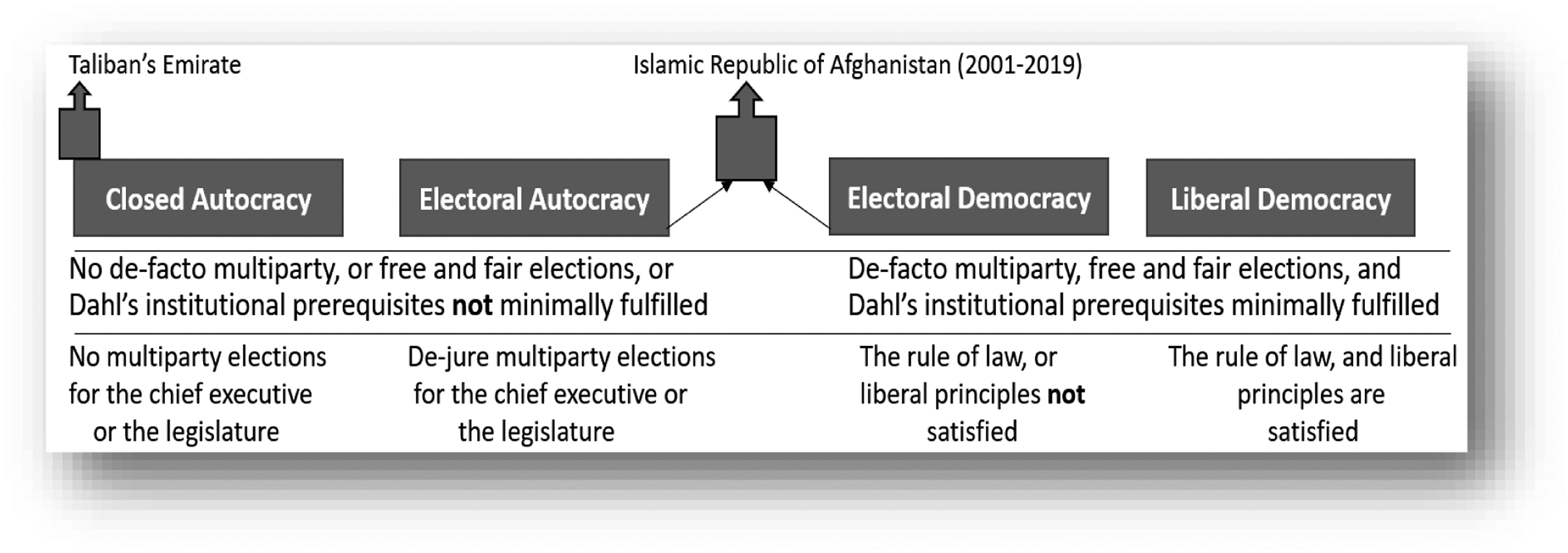
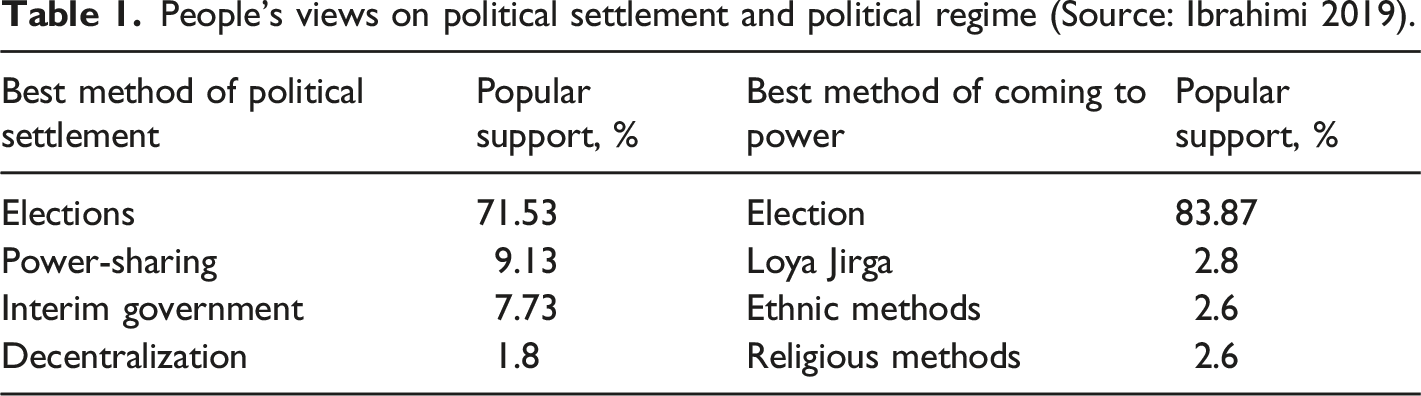
People’s views on political settlement and political regime (Source: Ibrahimi 2019).
The Lack of Flexibility in the Taliban’s Internal and External Structures
Negotiations in Doha also suffered from the rigidity of the Taliban’s internal and external structures. The Taliban fighters were estimated at 60,000 in 2019 and were organized in networks and operational units under the Leadership Council, or the Shora-e-Rahbary (SeR), based in Quetta, Pakistan. 57 The Taliban’s internal and external structures were shaped by the SeR and its units and subsets operated using both centralized and networked methods. Therefore, the Taliban’s internal and external structures and the way they functioned were crucial in its negotiation vision and agenda.
Internally, the insurgency was organized in both hierarchical and networked structures. Its hierarchy, which was mostly formed around the SeR, made decisions on critical issues such as peace and post-conflict political order. Figure 2 provides a clear image of the Taliban’s hierarchy and internal structure before its military domination in August 2021.
58
The group’s ideological rigidity and centralized structure prevented any form of flexibility in decision-making during the negotiations.
59
The Taliban’s political council in Doha had to follow the rigid view of the SeR which was based on maximum gains, making any political compromise impossible. The SeR’s rigidity also represented the desire of fighters on the battleground that functioned as networks and semi-independent units of insurgents, bombers, and informants. Taliban internal structure (Source: U.N. Analytical Support and Sanctions Monitoring Team).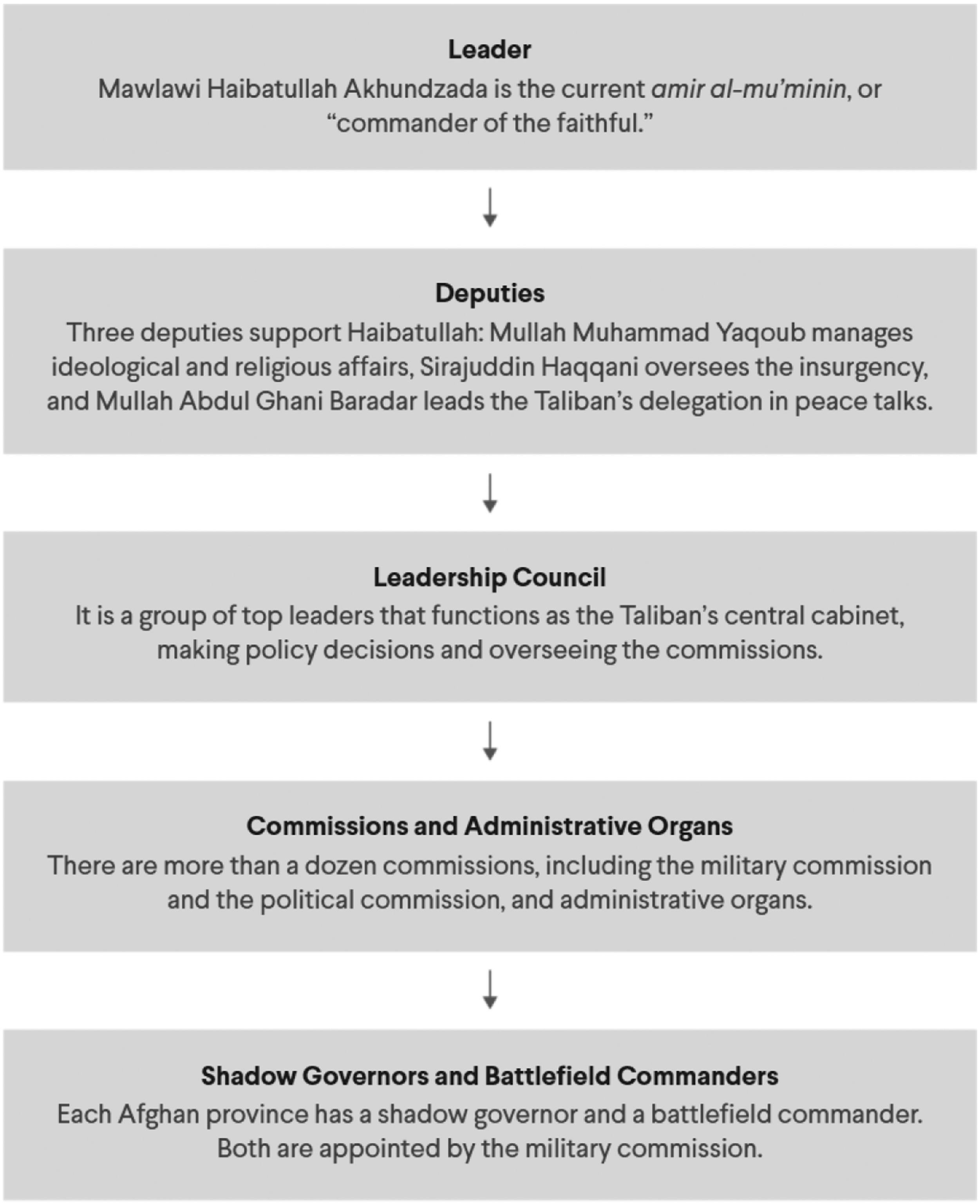
After the death of the Taliban’s founder, Mullah Omer, in 2015, the group branched into at least seven so-called councils and military headquarters that operated semi-autonomously in different parts of the country. 60 This organizational segmentation created the impression that the Taliban was no longer a uniform and centralized group. However, popular instances like the Eid-al-Fitr three-day ceasefire in June 2018, a ceasefire in May 2020 and May 2021, and the Taliban’s obedience to the SeR’s rigid position during the Doha negotiations indicated that the group was highly centralized while operating in a networked manner. Even parts of the Rasool Shura and a new Taliban splinter group that self-declared the Islamic Province Party did not have a significant impact on the SeR’s leadership on the battleground and the peace talk table. 61
Furthermore, the Taliban’s external structure was crucial during the negotiations. Four key elements shaped the Taliban’s external structure, including local and tribal support, cross-border sanctuaries, state-sponsored support from the region, and poverty in Afghanistan. First of all, the Taliban enjoyed cross-border ethnic and tribal ties on both sides of the Durand line between Afghanistan and Pakistan, which facilitated its cross-border movement and creation of sanctuaries in Pakistan. 62 The group’s external structure was also shaped by official foreign support from the Pakistani government and its intelligence service and religious establishment. 63 Poverty and underdevelopment also shaped the Taliban’s external structure. The Taliban operated in one of the most impoverished rural areas in the world, which helped the insurgency recruit from the very poor and conservative communities. 64
The Taliban’s external structure was entirely overlooked in both the US-Taliban and the intra-Afghan negotiations. For example, during the negotiations, there was no emphasis on the Taliban’s sanctuaries in Pakistan, the group’s external support bases, the domestic and regional root causes and networks of the insurgency, and the Taliban’s increasing recruitment from impoverished communities. 65 The lack of attention paid to these issues was not because Americans or Afghans misunderstood the structure of the insurgency. Rather, it was an outcome of the Taliban’s rigidity and lack of interest in negotiating on its existential issues. As a result, both the US-Taliban and the intra-Afghan negotiations took place on shallow issues concerning a meaningful peace process in Afghanistan. The US-Taliban negotiation was mainly based on the future of terrorism and the withdrawal of US troops. In the absence of US interest in focusing on the Taliban’s structure as a key puzzle of war and peace in Afghanistan, the intra-Afghan talks started and ended with vague, ambiguous, shallow, and irrelevant rhetoric.
The lack of international consensus
In addition to the lack of agreement on a post-conflict political system and the Taliban’s rigid structure, negotiations also suffered from the lack of an international consensus on a political settlement in Afghanistan. Major players, including the US, the EU, China, Russia, Pakistan, Iran, and others, followed various contradicting policies during the negotiations. The international chaos on the peace of Afghanistan forced the Taliban and the Afghan government to deal separately with every external power based on their preferences. This situation motivated both parties to the conflict to invest in extracting the opportunities provided by international players and buy time for reaching a favourable condition. 66 As a result, both tried to meet the international demand for a negotiated settlement but behaved as false negotiators.
During the Doha negotiations, the government of Afghanistan tried to sell to the international community its political settlement vision that emphasized the integration of the Taliban into the post-2001 political system. This vision contradicted the Taliban’s agenda of restoring its Islamic Emirate. This means that the Afghan government and the Taliban approached the negotiations with a win-win strategy from the beginning. The division of Afghan politics on negotiation and political settlement led to the fragmentation of international politics on the issue.
As a result, the United States and its European allies supported the government’s vision of integrating the insurgency into the post-2001 political system, while Russia, Pakistan, Iran, and eventually China supported the Taliban’s goal of establishing an interim government in Kabul. 67 The lack of the foreign players’ consensus on a political settlement not only forced the Afghan parties to play the role of false negotiators but also affected the result of the negotiations.
Although the foreign players signed a temporary agreement on Afghanistan’s peace in the spring of 2021, they never showed a practical and honest intention to find a comprehensive solution. The agreement was released as the Joint Statement of Extended “Troika” on 18 March 2021, in which the US, Russia, China, and Pakistan stated that they would support a political settlement. 68 The Afghan government endorsed the statement. However, the Taliban did not support the agreement because the Troika members did not endorse the return of an Islamic Emirate. 69 While the extended Troika failed to produce a clear result, some members of the platform became more destructive than helpful to a uniform peace process by launching parallel meetings with the Taliban and other players. As a result, the lack of an international consensus on a political settlement in Afghanistan destroyed the peace process and sabotaged efforts for a negotiated settlement at different stages and levels.
Conclusion
In this paper, I have argued that “false negotiation” undermined both the US-Taliban and the intra-Afghan talks in Doha. The US-Taliban negotiation started under immense US pressure. The Taliban joined the negotiation as a false negotiator to reduce the pressure and increase its diplomatic leverage on international platforms. As a result, the Taliban managed to transform its image from that of a terrorist organization to that of a counterterrorism partner of the United States and an alternative political reality for Afghanistan.
Likewise, in the intra-Afghan negotiation, which initially planed to integrate the Taliban into the post-2001 political system, the insurgent group acted as a false negotiator to prevent a new agreement between the United States and the Afghan government and increase its own international legitimacy. Therefore, it reluctantly attended the negotiations and delayed the process to buy time for a better circumstance. The Taliban withdrew from the negotiations as soon as Trump lost the presidential election.
The Doha negotiations, like many other initiatives for peace in Afghanistan, failed in the absence of three key conditions for a political settlement: the lack of an agreement on a post-conflict political regime, the Taliban’s structural rigidity, and the lack of an international consensus on conflict resolution. From the resurgence of the Taliban in 2003 to the fall of Kabul to the Taliban in August 2021, efforts for a negotiated settlement included four phases: (1), Hamid Karzai’s efforts to reach out to the Taliban leadership during his first term in office from 2004 to 2009; (2), Karzai’s fight-and-talk policy during his second term in office from 2009 to 2014 when he used the High Peace Council to bring the Taliban to the negotiation table parallel to his US-funded counterinsurgency campaign; (3), Ghani’s prioritization of intra-Afghan talks, which started with the “Kabul Process II Conference” in February 2018—the Taliban never responded to Ghani’s offer; and (4), the US-Taliban negotiation in Doha, which started in September 2018 and overshadowed all domestic efforts for a negotiated settlement.
In the fourth phase, the US administration launched a direct negotiation with the Taliban in Doha. The Taliban joined the process under significant international pressure, particularly from Pakistan, which in turn was pressured by the Trump administration to bring the insurgent group to the negotiation table. The US-Taliban negotiation in Doha reached a bilateral agreement on 29 February 2020. The agreement defined a timeline for US troop withdrawal from Afghanistan, counterterrorism guarantees by the Taliban, a path to a ceasefire between the Taliban and the Afghan government, and an intra-Afghan negotiation to bring peace to the war-torn country.
After the bilateral agreement was signed by the head of the Taliban political office, Mullah Baradar, and the US representative for the peace of Afghanistan, Zalmay Khalilzad, the Taliban did not conduct a single attack against US forces in Afghanistan. However, the group did not respect other clauses of the agreement, particularly its promise to disconnect from terrorist organizations and a ceasefire with the Afghan government. Moreover, the intra-Afghan negotiation as a subset of the bilateral agreement entirely failed because of the US’s overemphasis on the withdrawal of troops and its lack of attention to conflict management and peace-building in a post-withdrawal context. The Taliban’s military domination was an outcome of both the failure of the Afghan government to provide alternative measures for a better result and of the US administration to provide a comprehensive structure for a political settlement between the Taliban and the government of Afghanistan.
The Taliban benefitted greatly from the utilization of the false negotiation strategy in Doha: it managed to avoid further external pressures, increase its political leverage, improve its image from that of an insurgent group to that of an alternative political reality for the country, and prevent any possible agreement between the external regulator (the US) and the government of Afghanistan. The use of the “false negotiation” strategy, in this context, helped the Taliban to boost its political manoeuvring at international platforms while expanding its military campaign on the battleground. The Afghan government and its international allies failed to understand the insurgency’s complex approach to war and peace, and therefore were surprised by the Taliban’s rapid military expansion and the fall of Kabul in August 2021. 70
The military victory of extremist insurgent groups has always been catastrophic to international peace and security. 71 The Taliban victory has provided the conditions for the revitalization and expansion of regional and international terrorist organizations and a new phase of civil war in Afghanistan.
Footnotes
Declaration of conflicting interests
The author(s) declared no potential conflicts of interest with respect to the research, authorship, and/or publication of this article.
Funding
The author(s) received no financial support for the research, authorship, and/or publication of this article.

Notes
Author biography
S Yaqub Ibrahimi is an adjunct professor in the department of Political Science at Carleton University in Ottawa.