




Abstract
Following Brexit (the withdrawal of the UK from the EU and the European Atomic Energy Community at the end of 31 January 2020), the British government stated that it hoped to reach a new trade agreement with Canada to be modelled after the Canada–EU Comprehensive Economic and Trade Agreement, the first free-trade deal for which Canadian provinces were directly involved at every stage of negotiations. In the UK, while there are mechanisms for the involvement of devolved regions in European policy, there is no clear constitutional doctrine as to the roles they should play in elaborating trade policy more generally. Moreover, the asymmetric nature of the UK’s devolution system complicates the involvement of its devolved governments in trade negotiations. By providing a specific focus on the cases of Quebec and Scotland, this article provides a comparison of substate governments’ roles in trade negotiation and trade promotion. It concludes that, while there seems to be only limited scope for substate governments’ formal input into future trade negotiations, their trade and investment promotion organizations allow them to pursue different objectives over trade outcomes within a unified national framework.
Having formally left the EU, the UK reached a “transitory” trade agreement with Canada in late 2020, modelled after the Canada–EU Comprehensive Economic and Trade Agreement (CETA) and to be followed in 2021 by negotiations for a new bilateral free-trade deal between the two countries. In the more than forty years since the UK last negotiated a trade deal—as opposed to the negotiations having been led by the EU on its behalf—its constitutional arrangements have evolved substantially, with devolved legislatures being established in Scotland, Wales, and Northern Ireland in 1999. The UK’s future trade agreements have implications for these legislatures, not least because they will impact a whole range of devolved policy responsibilities. As a result, all three have made the case that they should have a formal role in the development and negotiation of future UK trade agreements. This argument has been made particularly forcefully by the Scottish government (SG), which argues that it should have a formal role in all stages of negotiations, from the formulation of negotiating mandates to treaty ratification.
Canada and the UK share many of the same constitutional principles. Even though the federal setting of Canada contrasts with the UK as a unitary state characterized by a very asymmetric devolution system, in both countries’ trade negotiations and ratification are reserved to the central government. And in both countries the second chamber of the central government also does not play the role of a representative of the substate governments. Moreover, neither Quebec nor Scotland has the ability to veto a trade negotiation conducted by Canada or Britain, respectively. In Canada, the Canadian provinces can only refuse to implement the agreement in their areas of jurisdiction. In the UK, the devolved institutions have no formal role in co-determining trade policy, and there is no requirement for them to even be consulted.
Nevertheless, the two countries are contrasting cases for the fundamental issue of the role of substate governments’ participation in trade negotiations. In Canada, a practice established since the 1980s gives an important role to the Canadian provinces. In the CETA negotiations, Canadian provinces even had access to certain negotiating tables. That being said, while Canada’s CETA experience has frequently been hailed as a paragon of subnational involvement, it is not necessarily typical of the roles of Canadian provinces. One area of greater similarity between the UK and Canada is the role that the devolved and provincial governments, respectively, play in stimulating exports and encouraging inward investment via subnational trade and investment promotion organizations (TIPOs). These agencies’ knowledge about exporter and investor needs could indeed become valuable in maximizing the beneficial outcomes of future trade negotiations.
The aim of this paper is thus to explore these differences and similarities, to find out what has worked, what has not, and what lessons from the Canadian experience could be applied more broadly to the UK. We provide a comparative analysis both of the motivations of Quebec and Scotland to become engaged in international trade agreements and of the factors that determine the extent to which the subnational governments can influence the outcomes of such agreements. We draw from published materials, government documents, parliamentary statements, and formal and informal interviews with civil servants from Scotland and Quebec. In the case of Canada, semi-structured interviews were conducted throughout the CETA, the Comprehensive and Progressive Agreement for Trans-Pacific Partnership (CPTPP), and the Canada–United States–Mexico Agreement (CUSMA) negotiations with officials, advisors, and experts from Ottawa, Quebec, and the EU who were directly involved in negotiations.
With such a specific focus on the cases of Quebec and Scotland, and by adding the angle of trade and investment promotion to the more traditional analysis of multi-level governance and trade policy, this article provides a comprehensive comparison of the two systems across policy sectors. Our argument is that, although they have historically been overlooked in the conduct of international trade negotiations in multi-level settings, subnational trade and investment promotion networks are particularly well-developed in both Quebec and Scotland and would therefore be well placed to inform subnational but also national governments and trade negotiators of the market gaps and opportunities that future trade agreements should address. We therefore conclude that, while there seems to be only limited scope for formal subnational input into future trade negotiations led by Canada or the UK as a whole, TIPOs do provide effective avenues through which different objectives over trade outcomes can be achieved at the subnational level.
Literature Review
International trade negotiations address increasingly sensitive issues for substate governments, such as government procurement, regulatory cooperation, services, public health, diversity of cultural expressions, business subsidies, investor–state dispute settlement, removal of non-tariff barriers, agriculture, labour mobility, and the environment. 1 In this context, substate governments are aware that their constitutional jurisdiction and ability to formulate and implement policy depends on these trade agreements. Increasingly, therefore, some substate governments want to be included in the multi-level dynamics of trade negotiations. 2 The lessons from the CETA negotiations also confirm that substate governments are important actors in legitimizing trade deals because, when they oppose such agreements, as in the Walloon case, they jeopardize the negotiations and risk provoking chain reactions. 3
In the international political economy literature on trade negotiation, a frequent opposition to the inclusion of substate governments comes from Fritz Scharpf’s concept of the “joint decision trap.” 4 Following this perspective in terms of trade negotiations means that substate governments should find it easier to agree on the lowest common denominator or to advance their defensive interests, thereby encouraging protectionism. Freudlsperger argues, however, that the participation of Canadian provinces in the negotiation of CETA invalidated this perspective. 5 During these negotiations, for instance, Canadian provinces proposed the most important concessions in their history in the area of public procurement.
Another important theory states that there is an asymmetry, in the EU context, between the means of influence of regional authorities in federated states and the results of trade negotiations. 6 The substate governments that have the most power to influence trade negotiations are those of Belgium. Since they participate in the Belgian delegation to the European Council, they can influence the European Commission. They can also threaten to use their veto and block Belgium’s approval process, as the Walloon Region did with CETA, supported by the Brussels-Capital Region and the French Community of Belgium. To resolve the problem of the Walloon blockade, many concessions were made by the EU and Canada, such as the inclusion of a joint interpretative legal instrument to clarify the interpretation of certain provisions, particularly in the areas of labour law, the environment, and the investor–state dispute settlement mechanism. 7
Some regional authorities in Europe can also influence trade negotiations through a collective institution such as the Bundesrat in Germany, in which members are appointed by Länder governments and can block the ratification of trade agreements. Most regional authorities in Europe, however, are rather “transceivers”: their role is generally limited to receiving and transmitting politically relevant information to national negotiators. 8 Regional authorities, such as Scotland, that do not have the constitutional powers to veto or mobilize collectively through an institution such as a senate can only act as transceivers. Scotland’s means of influence are indeed not very effective since its government has no veto, little access to trade policy-makers through intergovernmental mechanisms, and cannot block international agreements through the House of Lords.
Neither do Canadian provinces have the ability to veto a Canadian-led trade negotiation. In Canada, the federal government has plenary power in matters relating to international trade. Canadian provinces can only refuse to implement the agreement in their areas of jurisdiction. Moreover, the Canadian Senate does not represent the provinces. Still, the experience of CETA indicates that, while Canadian provinces did not have a veto over the negotiations, they nonetheless had unprecedented influence, as they were able to impact the positions of Canada from within. This influence was even greater than that of Wallonia. 9 Quebec, for example, submitted more than 150 policy position papers and participated in more than 275 meetings with federal, provincial, and territorial negotiators. Overall, Quebec’s influence was felt on many issues, such as regulatory cooperation, certification, labour mobility, and diversity of cultural expressions. 10 Moreover, the provinces largely accepted the outcome of the negotiations because they were part of it.
According to Tatham, substate governments have various channels of influence in trade negotiations. 11 These channels can be intra-state and extra-state. However, to a very large extent, the constitutional powers of substate governments influence their strategies. In Europe, regions such as Wallonia or Bavaria can use extra-state channels to engage with European institutions, notably through the Committee of the Regions. In the EU context, extra-state channels tend to be mobilized more frequently than intra-state ones. The opposite holds true in the North American context, since the federated states of the three North American federations—Canada, Mexico, and the US—have no supranational institutions to lobby.
What is missing from Tatham’s analysis, however, is that Canadian provinces can also seek to influence European institutions. Canadian provinces, such as Quebec, can make representations to European institutions and trade policy actors. For example, Quebec’s delegate general in Brussels met the European commissioner for trade to explore the idea of relaunching trade negotiations with Canada. Quebec’s Premier, Jean Charest, also convinced France’s Nicolas Sarkozy, who held the rotating presidency of the EU Council in 2008, to support the idea of relaunching free-trade negotiations. According to Paul Magnette, 12 President François Hollande approved of CETA because it was born out of a France–Quebec initiative. During the negotiations, the Quebec government’s chief negotiator also had numerous bilateral face-to-face meetings with the EU’s chief negotiator. 13
The influence of Canadian provinces in trade negotiations is therefore wielded mainly through intergovernmental mechanisms or intra-state and extra-state channels. Canada lacks, however, a comprehensive framework agreement for federal–provincial consultations related to international negotiations, and there is very little consistency in approaches. For each negotiation, provinces must “negotiate their role in the negotiations,” and their level of participation in CETA was exceptional. 14
Despite major differences between the Canadian and British systems, Canadian provinces and the UK’s devolved regions have been able to erect wide-ranging and similarly structured “commercial paradiplomacy” apparatuses, centred around trade-focused networks of international offices and TIPOs. 15 These have proved very useful in the day-to-day practice of international trade and investment, especially in helping businesses navigate the rules of commercial agreements and the intricacies of foreign markets. Yet, they have so far remained peripheral to the elaboration of trade policies or the conduct of trade negotiations themselves. In the wake of Brexit (the withdrawal of the UK from the EU and the European Atomic Energy Community at the end of 31 January 2020), however, closer coordination between subnational governments and TIPOs in Quebec and Scotland illustrated how commercial policy-makers and negotiators in Canada and the UK could benefit from TIPOs’ first-hand knowledge about markets.
In developed countries, most TIPOs operate either as “in-house” ministerial units or as “arms-length” public agencies. Most subnational TIPOs operate independently from (although often in concertation with) national diplomatic services and coordinate much more closely with their own government sponsor and/or other regional organizations. 16 TIPOs perform a range of functions, and many are becoming full-fledged economic development agencies. The central economic rationale behind their establishment has been that of “information asymmetries,” as exporters and foreign investors generally have limited knowledge about their target markets, and the costs of acquiring such knowledge often appear prohibitive in comparison to the projected benefits. 17
In the case of export promotion organizations, services offered thus range from managerial advice to market intelligence, including marketing in commercial missions and trade fairs (on behalf of individual businesses and/or industrial sectors); networking (helping exporters find clients, suppliers and distributors); and the management of financial or fiscal aid. 18 Investment promotion organizations, in turn, engage in “branding” the home market as an investment destination, identifying potential investors, “targeting” investors likely to complement or complete domestic clusters’ supply-and-value-chains, “matching” foreign investors with potential local partners, managing financial/fiscal incentives, and providing “aftercare” services (i.e., the accompaniment of investors and “embedding” of foreign subsidiaries in the home market). 19
The importance of such “commercial paradiplomacy” for the maximization of international trade flows has been underlined by a relatively abundant literature. 20 Most of it has focused on either export promotion or investment promotion organizations, although the two are increasingly being merged. This literature demonstrates that TIPOs strongly contribute not only to growing and diversifying trade and investment flows but also to upholding them during economic downturns. 21 In some cases, the opening of a trade and investment promotion office abroad “is almost equivalent to signing a free-trade agreement with the same country.” 22 Many analyses of regional TIPOs also demonstrate their key importance, 23 and highlight the necessity of a good match between TIPOs’ services and the business populations they serve, which is more likely to be attained at the subnational level.
TIPOs, moreover, generally serve another crucial function: policy advocacy. Coordinating with their government sponsors, they provide information and advice on businesses or investor needs, and on policy best practice. 24 Indeed, provincial and regional TIPOs are best placed not only to inform exporters and investors of potential market opportunities but also to inform governments of the market gaps and prospects that trade policies should prioritize. Both Quebec and Scottish TIPOs, for instance, are closely involved, through either regular high-level meetings with government officials or contributions to government consultations on specific policy initiatives, in both the elaboration and implementation of their regions’ governmental strategies for international trade and investment. 25 Therefore, notwithstanding their respective countries’ systems of intergovernmental relations concerning international trade, these organizations can provide an effective avenue through which different objectives over trade outcomes can be achieved at the subnational level.
Federalism, provincial prerogatives, and the Quebec exception in Canadian trade negotiations
In Canada, The Constitution Act, 1867 barely addresses the issue of international relations. Unlike some other federations, there is no constitutional assignment of exclusive jurisdiction over foreign affairs. The provisions on the division of legislative powers—sections 91 and 92—do not explicitly specify a federal or provincial authority over foreign policy. 26 This is explained by the fact that Canada did not become a sovereign country in 1867 but remained a member of the British Empire. Only the latter enjoyed the rights of a sovereign entity, and there was no need to define the prerogatives of the provinces or federal government in this area. The framers of the Constitution did not foresee that Canada would eventually enjoy the same autonomy in foreign policy as it did in domestic affairs.
As a result of the Statute of Westminster of 1931, Canada was granted full international personality, including the right to enter its own treaties. The federal government, then, quickly became more proactive in treaty-making and attempted to impose treaty implementation on the provinces. Several disputes were thus brought before the courts. The Judicial Committee of the Privy Council in London rendered the most important judgment on the rights of provinces in international treaty matters in 1937. In its judgment, the committee noted that, while section 132 of the Constitution Act, 1867 gave Parliament and the federal government the power to implement imperial treaties, it did not confer general jurisdiction on the Canadian state to implement treaties. The decision placed great emphasis on the reasoning that, if the federal government’s treaty powers were exclusive, the federal government could then implement treaties in areas of provincial jurisdiction—in complete contradiction to the division of powers provided for in sections 91 and 92 of the Constitution. The Judicial Committee thus ruled that the power of implementation follows this division of powers. 27
Today, it is generally accepted that only the Canadian government has the power to enter into international treaties (even though some provinces, such as Quebec, also enter into international “agreements”). However, Canadian provinces have been increasingly involved in trade negotiations since the 1980s 28 for two fundamental reasons.
First, while the federal government is constitutionally responsible for international trade and can negotiate in areas of exclusive provincial jurisdiction, it cannot compel the provinces to implement ratified trade agreements. The federal executive branch is responsible for the negotiation of treaties, signature, and ratification. The legislative branch, federal or provincial, is responsible for the implementation. Legislative intervention at the appropriate level is therefore necessary to incorporate treaties into domestic law. 29 If the federal or provincial law is already compatible with the treaty, no new legislation is required, but where domestic law is incompatible, implementing legislation is required and may take different forms, ranging from an annex to a separate statute that, more or less, reproduces the provisions of the treaty.
Second, the “new generation” of trade agreements, such as CETA, increasingly concern areas of provincial jurisdiction. 30 When a trade treaty affects a province’s jurisdiction, provincial procedures vary. In most cases, an executive decree in which a province declares itself bound by the treaty or an amendment to the regulations is enough. Ontario, for example, does not have a formal approval procedure for free-trade agreements negotiated by Canada. Rather, an assessment is made to determine whether legislative, regulatory, or administrative changes are required. The province then implements them. In the case of a treaty that affects Quebec’s constitutional jurisdiction, the situation is different. Since 2002, the National Assembly must approve the treaty before the government gives its assent. Any “significant” international commitment, which requires the adoption of new legislation, the drafting of regulations, the imposition of a tax or the acceptance of a financial obligation, or that concerns human rights or international trade, must be approved by the National Assembly. Yet, the fact that the National Assembly must approve treaties gives it little influence over negotiations. Indeed, the debate and vote in the National Assembly take place after the treaty is signed. Members of the National Assembly can neither adopt nor reject the agreement. They may, however, refuse to implement the treaty within Quebec’s jurisdictions.
Thus, in practice, while Canada’s trade negotiations are operated by the federal government even when the subject matter of the negotiation is within the exclusive jurisdiction of the provinces, provincial governments have been increasingly involved. Intergovernmental negotiations take place between senior officials and sometimes between ministers. Final decisions also involve first ministers, but there is no overall framework agreement for federal–provincial consultations related to international negotiations. This situation has created problems in the past, and Canada’s inability to ensure that the treaties it negotiates are implemented by the provinces in their areas of jurisdiction undermines its credibility in negotiations. 31 Various strategies have been used in the past to avoid such problems. The first is to negotiate an agreement only in areas of federal jurisdiction. During the negotiation of the Canada–Colombia Free Trade Agreement, for example, the federal government excluded all provincial measures that predated the potential agreement in the areas of services and investment. 32
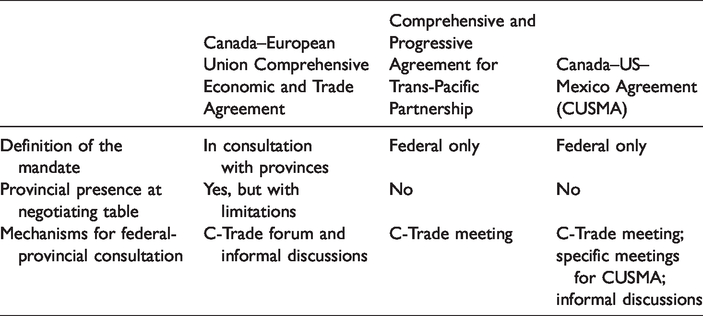
Another strategy is to involve the provinces in the negotiations. To do this, the federal government and the provinces can set up intergovernmental mechanisms. Since the 1970s and 1980s, a number of such mechanisms have been established, first in the context of the General Agreement on Tariffs and Trade negotiations and, beginning with the Canada -US Free Trade Agreement, for preferential agreements. Today, the most widely used are the “C-Trade meetings,” regularly convened by the federal government. 33 These meetings involve federal, provincial, and territorial officials and are designed to discuss Canada’s trade issues. In the case of CETA negotiations, the provinces have been called upon to play a much greater role than in any previous international negotiation. Provinces that participated in the drafting of Canada’s negotiating mandate, were able to give their opinions on the issues and subjects of negotiation, obtained greater access to the texts during the negotiations, and were consulted or even participated in all rounds of negotiations in Ottawa and Brussels. During the negotiations, Quebec produced more than 150 policy position papers. 34 In addition, “more than 275 meetings between federal negotiators and their provincial and territorial counterparts, many meetings involving provinces and territories with common interests, and bilateral meetings in camera between a province or territory and federal negotiators” were held (Table 1). 35
Around the same time, Canada also entered into the Trans-Pacific Partnership, which later became the CPTPP. Canada's involvement in these negotiations came late. This context influenced not only the scoping exercise, but also the drafting of the negotiating mandate. Indeed, Canada joined the negotiations from a more defensive perspective to ensure that an agreement would not be reached in its absence. This contrasts with the offensive role that Canada assumed in CETA. Consequently, the issue of provincial participation in the negotiations was not a condition of the negotiating countries. Neither was the CETA model of active provincial participation taken up in these negotiations. 36 Provinces were not consulted on policy issues, nor did they have access to the negotiating tables, and intergovernmental mechanisms were limited to meetings and updates on trade in goods and services during and after the negotiating rounds. In addition, during negotiating rounds, negotiating texts were often presented to the provinces at the last minute; comments were solicited, but there was often insufficient time for analysis. The same approach was used for post-round briefings on the spot and at C-Trade meetings.
Neither were the provinces invited to the negotiating tables during the renegotiation of the North American Free Trade Agreement (NAFTA). They received regular updates and shared their views with the federal government but did not have access to the negotiations. However, they were consulted closely in areas of significant economic interest or shared/specific jurisdiction. Frequent consultations between the federal and provincial teams also took place in special meetings focused on the renegotiation, rather than in the usual C-Trade meetings. 37 Provinces were also invited to participate in strategy meetings prior to negotiating rounds, as well as in monthly debriefing sessions. Representatives from all Canadian provinces were present at each round of NAFTA renegotiations, as these were important opportunities to meet with federal negotiators, stakeholders from various sectors, and representatives from other provinces to work with them on specific issues. Throughout the renegotiations, all provinces also had a representative in Washington, DC, and had the opportunity to participate in discussions on all issues within their areas of jurisdiction. Negotiation texts were circulated and all parties respected confidentiality protocols. 38
Due to the large volume of information required for NAFTA, the C-Trade meetings were replaced by separate meetings specifically dedicated to these renegotiations. The provinces were not only consulted but also given the opportunity to provide input. Thus, unlike the CPTPP negotiations, where the provinces were not consulted in depth because of the rapid pace of the process, federal–provincial engagement in the NAFTA renegotiations was broader and more inclusive. 39 However, the federal level remained responsible for final decisions, and all final decisions on sensitive issues were decided without provincial input. The difference between federal–provincial relations during the CETA process on the one hand, and CUSMA and the CPTPP negotiations on the other, can be explained, first, by the fact that the EU insisted on the involvement of the provinces in the first case, but, second, by the actual content of the negotiations. 40 The potential extent of provincial involvement in trade negotiations between Canada and the UK therefore remains unclear and will depend on the issues discussed. It will also most likely depend on the level of participation granted to substate governments in the UK.
Brexit, devolution, and the SG’s prerogatives in UK trade negotiations
Since the UK voted to leave the EU in June 2016, “Brexit” has been the source of tensions between the UK and its devolved governments. 41 One key source of such tension has been international trade. Like in Canada, external relations, including the negotiation and ratification of trade agreements, is reserved to the UK government. 42 As pointed out above, the devolved institutions have no formal role in co-determining trade policy, and there is no requirement for them to even be consulted. But while the negotiation of trade agreements is formally “reserved,” the breadth of the devolved parliaments’ competencies are such that trade agreements have implications in areas of devolved policy competence. 43 These include direct implications in cases of agricultural subsidies, state aid rules, and regional development funding, but also, indirect ones in areas such as economic development, higher education, or research and development. Like many aspects of Brexit, the machinery of this is still being developed. But we do have an early signal of the approach that the UK government intends to take with the devolved administrations on trade.
This is perhaps best illustrated in the draft 2020 United Kingdom Internal Market Bill, 44 which aims to do two things. First, it seeks to reaffirm the position of the UK government in having constitutional responsibility for all international treaties. Second, it aims to set out how international treaties—including future trade deals—should be implemented within the UK devolved policy-making framework. Under EU membership, policies of all governments are made within the context of EU law. Doing so ensures that there are no barriers to trade and mobility across the EU. When the EU signs a trade deal, the details are required to be adhered to in each and every part of the EU, including within the UK. The UK government’s proposals were designed to ensure that this holds true after 1 January 2021. The Market Access Commitment in the bill means that goods, service providers, and professional practitioners that meet regulatory standards in one part of the UK are entitled to enter the market anywhere in the UK, without having to meet local regulations.
These rules on mutual recognition and non-discrimination will ensure that, in effect, any trade deals the UK government strikes and implements for England must be adhered to in Scotland, Wales, and Northern Ireland (even if such a policy does not meet local regulations). 45 The internal market bill is thus hugely controversial, and it remains uncertain whether it will be passed into law in its current form. The bill had a resounding defeat in the House of Lords in October 2020. Both the Scottish and Welsh Parliaments have refused to give legislative consent to the bill. The underlying issues and principles that lie at the heart of the bill—that is, the autonomy of the devolved Scottish and Welsh Parliaments to seek to influence or block any UK-wide trade agreements where such decisions would influence the practical impact of laws or regulations made by the devolved parliaments—are likely to remain thorny issues. In effect, by centralizing a large part of de facto power over key aspects of future economic, environmental, and social policy through this internal market approach, the SG and the other devolved nations would have no ability to prevent international rules and standards in devolved areas of competence to which the UK government agreed.
On the one hand, the UK government’s approach here— including the drafting of the internal market bill—simply conforms to the interpretation that the UK is a unitary state. But, as is well-known, British constitutional law is made up of both hard rules and constitutional conventions, and the latter cannot be easily ignored. One of the most important is the Sewel Convention, which states that the UK Parliament will not “normally” legislate in areas that have implications for devolved competencies without the consent of devolved legislatures. However, the Sewel Convention is not legally binding. It was put into law in the Scotland Act 2016 and the Wales Act 2017. But although these recognize the convention, they do not legally constrain the power of the UK Parliament. In 2017, the UK Supreme Court ruled that since Sewel remains a political convention, “policing the scope and manner of its operation does not lie within the constitutional remit of the judiciary.” 46 In other words, the devolved governments cannot turn to the courts to enforce the legislative consent convention.
On the other hand, a tension exists between any view of the UK parliament as sovereign and the alternative view of the UK as a plurinational union of nations, with a clear respect for devolved versus reserved policy outcomes. 47 In effect, the draft 2020 United Kingdom Internal Market Bill would give UK ministers powers to regulate a potentially wide range of otherwise devolved matters in the name of the internal market, a concept that the UK government itself will define, elaborate, and implement via statutory instruments rather than primary legislation. This has created all manner of tensions, which have been at their greatest in the case of Scotland. The SG has argued that it should have a formal role in all stages of the development of trade agreements, including the formulation of negotiating mandates and treaty ratification. 48 There are two broad sets of reasons put forward by the SG to justify this argument. First, trade agreements could have potentially different implications across economic sectors. 49 Second, UK trade agreements could constrain policy-making in areas that are ostensibly devolved, including the environment, agriculture, food standards, housing, and public procurement.
On the one hand, Scotland is likely to have different priorities for trade than those of the UK as a whole. Scotland’s goods exports are dominated by two sectors: “refined petroleum” products associated with oil and gas production in the North Sea (around 80 percent of which is from Scottish territorial waters 50 ); and “food and drink” (in particular, whisky). These sectors are relatively less important for the UK. Similarly, Scotland has a large agricultural sector, and the SG has expressed concerns about trade agreements with countries that have large and highly productive farm sectors. Certain aspects of the fishing industry are also relatively more important to the Scottish economy—with landings by Scottish vessels accounting for around 65 percent of the tonnage of all landings by UK vessels in 2018. 51 Although the UK government has promised to protect Scotland’s interests, it is hard to see how it is feasible to protect the interests of all regions simultaneously when each have different priorities.
The SG has also expressed concern about the potential for the UK to pivot away from the EU’s regulatory framework on issues relating to social, environmental, and ethical concerns. Prime Minister Boris Johnson has indicated that he would be content for UK standards to diverge as part of future trade agreements. 52 In contrast, the SG prefers to maintain alignment with the EU. 53 This is particularly the case in relation to areas of devolved competence such as the environment, food standards, and animal welfare, but extends to regulatory alignment with the EU more broadly. 54 This objective is justified explicitly by reference to a desire to retain what are characterized as more “robust” forms of protection offered by the EU relative to (for example) the US. But implicitly, this objective is also shaped by the Scottish National Party government’s aspiration for Scotland to be readmitted to the EU as an independent member country at some future date. 55
In short, trade agreements have the potential to shape opportunities and economic structures in powerful ways, with respect to both devolved and reserved areas of policy competence. 56 Of course, one important point here is the question over how much influence the SG had over EU trade policy in the first place. Where influence was perhaps greater was outside of Parliament through initiatives such as the European Committee of Regions, with consultation from the UK government on EU policy structured through the Joint Ministerial Committee (Europe). There is an argument that the SG is elevating the risks around trade to secure electoral gain. The ambitions of the SG to have “full, early and formal involvement in policy formulation and opportunities to influence the development and agreement of international negotiations” would certainly require a radical transformation of the mechanics of intergovernmental relations in the UK. Hence, it is not surprising that the SG has frequently pointed to the involvement of Canadian provinces in relation to CETA as an example of the positive role that subnational actors can play.
The UK government responded to the SG’s proposals with a Command Paper outlining the “processes” for making trade deals. 57 It affirmed the UK government’s intention to work “collaboratively” with the devolved administrations, but it is envisaged that this collaboration will be carried out “within the context of the current constitutional make-up of the UK.” In the wake of this Command Paper, the UK government established a new Intergovernmental Forum for Trade. This met twice in 2020, although terms of reference have yet to be agreed upon. As set out in a letter from the then minister of state for trade policy to the Scottish Parliament’s Finance and Constitution Committee, 58 the UK government hopes that these institutional structures will provide some form of platform for the SG to influence UK-wide trade policies.
The SG has expressed concern that these structures serve as an opportunity for the UUK government to share only limited information without offering opportunity for influence, as was the experience of the Joint Ministerial Committee on European Negotiations. 59 The SG was indeed given no material influence over the substance or outcomes of UK–EU negotiations for the terms of Brexit. More recently, the SG was given no meaningful opportunity to comment on the UK’s negotiating mandate for EU talks, published in early 2020, nor was it given an opportunity to comment on the UK’s negotiating mandates for talks with the US, Japan, and Canada in 2020. Furthermore, both the EU (Withdrawal) Act 2018—which transfers EU legislation to the UK statute—and the EU (Withdrawal Agreement) Act 2020—which passes into law the exit deal negotiated with the EU, were passed by the UK Parliament despite the decision of the Scottish Parliament to withhold its consent for this legislation.
The publication of the proposals for the internal market, again without consultation, has only heightened these tensions. The UK government appears to be adopting an increasingly top-down and centralizing approach. If it seemed unlikely before the UK elections of December 2019 that the SG and other devolved institutions would be granted a meaningful role in the UK’s future trade negotiations, it seems even less likely now. This has created further tensions, not helped by an apparent breakdown in working relationships between the two governments. 60 It seems likely, therefore, that the SG’s ambitions—and those of the other devolved governments in Wales and Northern Ireland—to exert greater formal influence over future UK trade deals will be thwarted. In such a case, what scope is there for these substate governments to exert authority over future trade outcomes? This is where we finally turn.
Subnational trade and investment promotion organizations
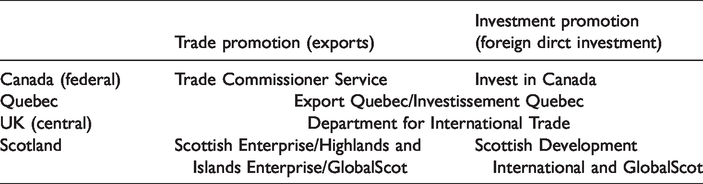
At the upstream of issues related to subnational prerogatives in trade policy lies the overlooked variable of trade and investment promotion. Given that in both countries, trade and investment promotion is a shared jurisdiction between central and subnational levels of government, all major Canadian provinces and British devolved regions have been expanding their own commercial paradiplomacy networks, which also promote their interests in industrial areas otherwise reserved to central governments, such as aerospace in Quebec, or energy in Scotland. Both the UK and Canada are indeed home to numerous subnational trade and investment promotion organizations (TIPOs), which generally take one of three forms: foreign investment promotion agencies; export promotion organizations; or a combination of both (Table 2). 61
Summary of provincial roles in Canadian trade negotiations.
In Canada, Quebec’s commercial paradiplomacy network is the most developed, with a wide-ranging grid of international offices housing commercial attachés, from the Ministère de l’Économie et de l’Innovation and its export promotion unit Export Quebec (EQ) to business development representatives from the public agency Investissement Quebec (IQ), specialized in the attraction of foreign investment. Scotland’s network is also particularly well developed, with international offices housing investment prospectors from Scottish Development International, a joint-venture between the SG and economic development agencies Scottish Enterprise, and Highlands and Islands Enterprise. The promotion of foreign investment and exports is also performed by GlobalScot, a networking service mobilizing the Scottish business diaspora to assist Scotland’s exporters and inward investors. 62
The Scottish network coordinates closely with the SG and with other business organizations, such as chambers of commerce, exporters associations, sectoral industrial associations, and British trade and diplomacy services. Its activities have lately been intensified, with a renewed focus on first-time exporters and investors, strategic industrial sectors, and new target markets—in line with the SG’s latest trade and investment strategies. 63 New centres have been opened in Dublin, Berlin, and Beijing in recent years, and Canada is also one of those new target markets, following the 2010 Plan for Engagement with Canada and the 2017 Canada Engagement Strategy. The establishment of new staff at the Toronto and Calgary offices, the strengthening of the GlobalScot network in Canada, and the creation of the Alberta–Scottish Business Association and British Columbia–Scottish Business Association have tightened Scotland’s trade and investment relationships with Canada. 64
The same can be said of Quebec’s networks, which coordinate with Canadian services and with other Quebec organizations, such as the Organismes régionaux de promotion des exportations, Montréal International, and Québec International. As part of a new international strategy devised by the Quebec government, IQ and EQ will soon be merged and operate as an integrated, trade and investment promotion agency. 65 Such a streamlining of export promotion and investment prospection is consistent with emerging policy practices across developed economies, as governments aim to offer rationalized support to foreign businesses focused on re-exportation, and to domestic firms looking to export, invest, or expand abroad. For all these reasons, Quebec and Scottish TIPOs’ knowledge about exporter and investor needs could become of great value for negotiators in future trade talks. Yet, in previous trade negotiations, including those in which, such as in the case of CETA, substate governments were deeply involved from the onset, the input of subnational TIPOs has been minimal.
In 2017, a large-scale survey of TIPOs from Organisation for Economic Co-operation and Development countries established that, although policy advocacy and coordination with government officials, diplomatic teams, and private-sector trade or business associations are very common practices (Figure 1), few TIPOs actually engage in trade facilitation (25 percent) or in the negotiation of international trade agreements themselves (10 percent). 66 Therefore, even though coordination between national governments or TIPOs and subnational TIPOs are also common practice, allowing for the integration of regional/local trade and investment needs into national strategies or for the conduct of “joint” promotion activities, 67 subnational TIPOs have not yet been directly involved in trade negotiation processes. Three main factors can explain this gap between TIPOs’ input potential and their exclusion from these processes: the highly political nature of such negotiations; the exclusive jurisdiction of central governments over international trade; and the difficulty of translating TIPOs’ “microeconomic” knowledge about businesses’ needs into practical, “macro-level” treaty provisions. 68
Major trade and investment promotion organizations in Canada/Quebec and the UK/Scotland.
Given the increasingly complex nature of “new generation” trade agreements, however, this may be starting to change. One interesting example of that was the close engagement of Quebec and SGs with their respective TIPOs and trade offices in the UK and Canada following the 2016 Brexit vote. Given the uncertainties raised by this vote with regards to investor and business reciprocal access to British and Canadian markets, regular conference calls and meetings between TIPOs, their overseas offices, and government officials have been held since late 2016 for the purpose of information sharing on market conditions and on potential shifts in tariffs or regulations. Similarly, regular consultations with trade promotion offices and TIPOs were organized by Quebec and SG officials to gather information on business and investor worries and needs—information which could be used in bilateral trade talks between Canada and the post-Brexit UK. 69
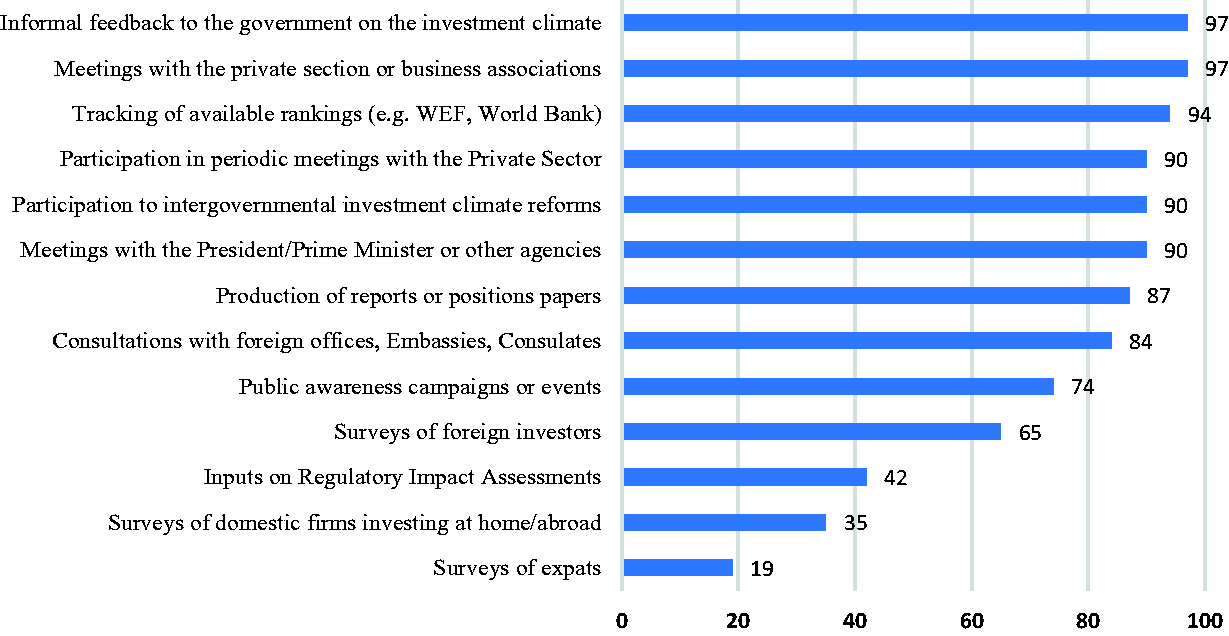
Percentage share of Organisation for Economic Co-operation and Development (OECD) TIPOs performing policy advocacy activities. Taken from OECD, “Mapping of investment promotion agencies in OECD countries,” 41 (see Note 19).
The current contribution of Quebec and Scottish TIPOs mainly consists, for now, in maximizing and diversifying trade and investment flows while keeping their subnational (and to a lesser extent, national) government sponsors up-to-date on market conditions and on business or investor needs. It is a contribution, in other words, focused on outcomes. Yet, this knowledge also represents untapped potential for well-informed, multi-level trade policy-making and negotiations. One way to utilize this potential might be to develop, as Sweden or France have done, 70 formal networks, frameworks, and processes of information-sharing between Canadian and British TIPOs. While circumventing the formal division of powers between levels of government, this would allow for the inclusion of subnational organizations in nationwide international trade and investment apparatuses, and it would facilitate a chain of market information towards policy inputs that are shared with, or at least commonly presented and thereby more useful to, central government negotiators.
Conclusion
Our review of the experience of both Canada and the UK provides a number of useful conclusions for policy-makers and scholars seeking to gain insights about the potential roles of substate regions in trade negotiations. While the experience of Canadian provinces, and especially of Quebec, in the negotiation of trade deals is interesting for the UK context, the extent to which the Canadian model can be applied to the UK is debatable. In the wake of Brexit, the UK government recognized the need for a more inclusive approach to developing future trade policy, but the extent to which it is genuinely committed to enabling devolved parliaments and legislatures to influence, as opposed to simply be informed about, the development of trade agreements remains uncertain. Thus, as the UK multiplies post-Brexit trade negotiations, there is still an urgent need for improvement if further constitutional and political crises are to be avoided.
This is where the Canadian experience becomes instructive, although far from perfect, and particularly true as Canada and the UK enter into formal, bilateral trade negotiations in the wake of Brexit. Provinces and devolved regions could agree on a set of common demands regarding both their involvement in negotiations themselves and issues of provincial or devolved responsibility. Short of such a concerted approach, however, substate governments will continue to look for other ways to influence trade outcomes. Provincial and regional TIPOs might therefore be consulted more systematically and, short of being included in the elaboration of trade policies and negotiation mandates themselves, will likely intensify their activities in order to ensure that provincial and regional industries, exporters, and investors can avoid being harmed by nationally devised policies and treaties, while enjoying continued support to target and access their own preferred markets.
Footnotes
Declaration of Conflicting Interests
The authors declared no potential conflicts of interest with respect to the research, authorship, and/or publication of this article.
Funding
The authors disclosed receipt of the following financial support for the research, authorship, and/or publication of this article: This work was supported by the Government of Canada, Social Sciences and Humanities Research Council of Canada and Economic and Social Research Council of the United Kingdom, Knowledge Synthesis Grant program.
1
Stéphane Paquin, “Trade paradiplomacy and the politics of international economic law: The inclusion of Quebec and the exclusion of Wallonia in CETA negotiations,” New Political Economy, forthcoming; and Jörg Broschek and Patricia Goff, eds., The Multilevel Politics of Trade (Toronto: University of Toronto Press, 2020),  .
.
2
Yelter Bollen, Ferdi De Ville, and Niels Gheyle, “From Nada to Namur: Sub-federal Parliaments’ involvement in European Union trade politics, and the case of Belgium,” in Jörg Broschek and Patricia Goff, eds., The Multilevel Politics of Trade (Toronto: University of Toronto Press, 2020), 256–280; Stéphane Paquin, “Federalism and trade negotiations in Canada: CUSFTA, CETA and TPP compared,” in Jörg Broschek and Patricia Goff, eds., The Multilevel Politics of Trade, 35–56; and Michaël Tatham, “Shaping but also blocking: The rise of regional influence in the EU, from soft policy lobbying to hard vetoing,” Journal of Common Market Studies 56, no. 3 (2018): 672–686.
3
Paul Magnette, CETA—Quand l’Europe déraille (Waterloo: Éditions Luc Pire, 2017).
4
Fritz W. Sharpf, “The joint-decision trap: Lessons from the German federalism and European integration,” Public Administration 66, no. 3 (1988): 239–278.
5
Christian Freudlsperger, Trade Policy in Multilevel Government, Organizing Openness (Oxford: Oxford University Press, 2020).
6
Margaut Kersschot, Bart Kerremans, and Dirk De Bièvre, “Principals and transceivers: Regional authorities in EU trade negotiations,” Political Research Exchange 2, no. 1 (2020), 4–5.
7
Magnette, CETA.
8
Kersschot, Kerremans, and De Bièvre, “Principals and transceivers.”
9
Paquin, “Trade paradiplomacy.”
10
Paquin, “Federalism and trade”; Stéphane Paquin, “Fédéralisme et négociations commerciales au Canada: l’ALE, l’AECG et le PTP comparés,” in Stéphane Paquin and Mathieu Arès, eds, “Géopolitique et nouveaux enjeux des négociations commerciales transpacifiques,” Études internationales XLVIII, no. 3–4 (2017): 347–369; and Stéphane Paquin, “Federalism and the governance of international trade negotiations in Canada: Comparing CUSFTA with CETA,” International Journal 68, no. 4 (2013): 545–552.
11
Tatham, “Shaping.”
12
Magnette, CETA.
13
Paquin, “Federalism and trade.”
14
Broschek and Goff, The Multilevel Politics; Paquin, “Federalism and trade”; and J. Anthony VanDuzer, “Could an intergovernmental agreement make Canadian treaty commitments in areas within provincial jurisdiction more credible?” International Journal 68, no. 4 (2013): 536–544.
15
Hubert Rioux, “From sub-state nationalism to subnational competition states: The development and institutionalization of commercial paradiplomacy in Scotland and Quebec,” Regional and Federal Studies 25, no. 2 (2015): 109–128.
16
Salvador Gil-Pareja, Rafael Llorca-Vivero, José Antonio Martinez-Serrano, and Francisco Requena-Silvente, “Regional export promotion offices and trade margins,” Review of World Economics 151, no. 1 (2015): 145–167.
17
Marcio Cruz, Daniel Lederman, and Laura Zoratto, “Anatomy and Impact of Export Promotion Agencies,” Policy Research Working Paper, no. 8470, World Bank Group, 2018; and Johannes Van Biesebroeck, Emily Yu, and Shenjie Chen, “The impact of trade promotion services on Canadian exporter performance,” Canadian Journal of Economics 48, no. 4 (2016): 1481–1512.
18
Ibid.
19
20
Francisco Aldecoa and Michael Keating, Paradiplomacy in Action: The Foreign Relations of Subnational Governments (New York: Routledge, 2014); Christopher Kukucha, The Provinces and Canadian Foreign Trade Policy (Vancouver: University of British Columbia Press, 2008); and Rioux, “From sub-state nationalism.”
21
Van Biesebroeck, Yu, and Chen, “The impact.”
22
Cruz, Lederman, and Zoratto, “Anatomy and impact,” 11.
23
Rioux, “From sub-state nationalism”; Hubert Rioux, “Noces de porcelaine: Investissement Quebec et le modèle québécois de développement (1998–2018).” in Stéphane Paquin and Robert Bernier, eds., L’État québécois: Où en sommes-nous? (Quebec: Presses de l’Université du Quebec, 2019), 203–239.
24
Octavian-Liviu Olaru, “Trade promotion organizations (TPOs) role in laying the groundwork for an export promotion program,” Institute for World Economy Global Economic Observer 2, no. 1 (2014): 163–169.
25
Scottish Government, Economic Development Directorate, Scotland’s Trade and Investment Strategy, Edinburgh, 2016; Scottish Government, Economic Development Directorate, A Trading Nation—A Plan for Growing Scottish Exports, Edinburgh, 2019; and Gouvernement du Quebec, Ministère des relations internationales et de la Francophonie, Le Quebec: Fier et en affaires partout dans le monde. Vision internationale du Quebec, Communiqué, Quebec, 2019.
26
Paquin, “Federalism and trade.”
27
Howard A. Leeson and Wilfried Vanderelst, External Affairs and Canadian Federalism: The History of a Dilemma, (Toronto: Holt, Rinehart and Winston, 1973), 65–77.
28
Hugo Cyr and Armand de Mestral, “International treaty-making and the treaty implementation,” in Peter Oliver, Patrick Macklem, and Nathalie Des Rosiers, eds., The Oxford Handbook of the Canadian Constitution (New York: Oxford University Press, 2017), 595–621; Kukucha, The Provinces.
29
Paquin, “Federalism and trade.”
30
Paquin, “federalism and trade”; Paquin, “Federalism and the governance”; and Christopher Kukucha, “Provincial/Territorial governments and the negotiations of international trade agreements,” IRPP Insight, no. 10 (2016): 1–16.
31
Broschek and Goff, The Multilevel Politics; Paquin, “Federalism and trade”; and VanDuzer, “Could an intergeovernmental.”
32
VanDuzer, “Could an intergeovernmental.”
33
Kukucha, “Provincial/Territorial”; and Paquin, “Federalism and trade.”
34
Anonymous interview, June 2014.
35
Pierre-Marc Johnson, Patrick Muzzi, and Véronique Bastien, “Le Quebec et l’AECG,” in Christian Deblock, Joel Lebulanger and Stéphane Paquin, eds., Un nouveau pont sur l’Atlantique: l’Accord économique et commercial global entre l’Union européenne et le Canada (Quebec: Presses de l’Université du Quebec, 2015), 30.
36
Anonymous interviews in Quebec, October 2017, April 2018, and October 2018; and in Toronto in March and October 2018.
37
Ibid.
38
Ibid.
39
Ibid.
40
Paquin, “Fédéralisme et négociations.”
41
42
Schedule 5 of the Scotland Act 1998 states that: “International relations, including relations with territories outside the UK, the [European Union] (and their institutions) and other international organisations, regulation of international trade, and international development assistance and co-operation are reserved matters.”
43
44
45
46
47
Michael Keating, “Brexit and the nations,” The Political Quarterly 90, no. 2 (2019): 167–176.
48
Scottish Government, International Trade and Investment Directorate, Scotland’s Role in the Development of Future UK Trade Arrangements: A Discussion Paper, Edinburgh, 2018.
49
Fraser of Allander Institute, “Brexit and the sectors of the Scottish economy,” 2019, https://www.strath.ac.uk/ (accessed 9 October 2020); and Fraser of Allander Institute, “The direct long-term trade impacts of EU exit scenarios on Northern Ireland,” 2019, (accessed 9 October 2020).
50
51
52
In a statement to Parliament on 3 February 2020, Prime Minister Boris Johnson said of the UK’s future trade arrangements with the EU that “any agreement must respect the sovereignty of both parties and the autonomy of our legal orders. It cannot therefore include any regulatory alignment, any jurisdiction for the CJEU [Court of Justice of the European Union] over the UK’s laws, or any supranational control in any area, including the UK’s borders and immigration policy,”
53
Scottish Government, International Trade and Investment Directorate, Scotland’s Role.
54
55
Although it is also true that, given that the majority of Scotland’s trade is with the rest of the UK, Scottish independence and regulatory alignment with the EU might come at the cost of significant trade frictions with the UK, if the remaining UK is no longer part of the EU’s regulatory framework.
56
Scottish Government, International Trade and Investment Directorate, Scotland’s Role, 5.
57
United Kingdom Government, Department for International Trade, Processes for Making Free Trade Agreements Once the United Kingdom Has Left the European Union, London, 28 February, 2019.
58
59
Ibid.
60
61
Cruz, Lederman, and Zoratto, “Anatomy and impact.”
62
63
Scottish Government, International Trade and Investment Directorate, Scotland’s Trade; and Scottish Government, International Trade and Investment Directorate, A Trading Nation.
64
Ibid.; Scottish Government, Economic Development Directorate, Scottish Government’s Plan for Engagement in Canada—Progress Report, Edinburgh, 2012; and Scottish Government, Economic Development Directorate, Scotland’s International Framework: Canada Engagement Strategy, Edinburgh, 2017.
65
Gouvernement du Québec, Ministère des relations internationales et de la Francophonie, Le Quebec: Fier en affaires; and Rioux, “Noces de porcelaine.”
66
OECD, “Mapping of investment.”
67
Ibid.
68
Anonymous interviews with representatives of Scottish Enterprise, Scottish Development International, and the Scottish Government, Glasgow, December 2018.
69
Anonymous interviews with representatives of Investissement Quebec and the Quebec Government, Montreal, October, 2018; and Anonymous interviews with representatives of Scottish Enterprise, Scottish Development International, and the Scottish Government, Glasgow, December 2018.
70
OECD, “Mapping of investment,” 100.